
25th Nov 2026 07:00
 25 November 2026
Bradda Head Lithium Ltd
(“Bradda”, "BHL" or the "Company")
Bradda Head Intersects 38.13 meters of 1.34% Li₂O, Including 23.39 meters of 1.62% Li₂O, in Drillhole WSTL0022 at Whistlejacket, Arizona
Bradda Head Lithium Ltd (AIM: BHL), the North America-focused lithium development company, is pleased to announce assay results from drillhole WSTL0022 at the Whistlejacket Lithium Project ("Whistlejacket" or "WJ"), held under the Company's Option to Joint Venture agreement with Kennecott Exploration Company ("KEX"). WSTL0022, the third hole of the Company's 2026 drilling campaign, intersected the main mineralized pegmatite up-dip of drillhole WSTL0020.
Highlights:
Assay results for WSTL0022 returned a core length-weighted average grade of 1.34% Li₂O over 38.13m (64.01m to 102.14m downhole), including a higher-grade 23.39m interval grading 1.62% Li₂O from 64.01m.The single highest-grade sample returned 9,282 ppm Li (2.00% Li₂O) over 1.76m from 75.14m depth, and seven of the fourteen samples within the 23.39m higher-grade interval exceed 1.70% Li₂O, highlighting the consistency of the lithium in pegmatite.Two additional mineralized intervals were cut higher in the hole: 5.66m at 1.10% Li₂O from 43.82m (including 4.05m at 1.30% Li₂O from 44.34m) and 3.63m at 1.01% Li₂O from 55.57m.WSTL0022 intersected the pegmatite body “up-dip” from BHL core hole WSTL0020 (Figure 2).These results include elevated LCT pathfinder elements (Ta, Nb, Be, Cs) and low Fe (average 0.44%).The drilling programme has proceeded more slowly than initially anticipated, with operational challenges with the rig contributing to slower progress.All reported intervals are downhole lengths. True widths have not yet been determined.
Ian Stalker, Executive Chair, commented:
“WSTL0022 returned 38.13 meters at 1.34% Li₂O, including 23.39 meters at 1.62% Li₂O, and intersected the mineralized pegmatite up-dip of WSTL0020. These results, which include the longest and highest-grade lithium-mineralized interval in the program to date, add to our understanding of the geometry and grade distribution of the mineralized body at Whistlejacket. We expect to report assays from the remaining drill holes as results arrive.”
Core samples
The Company has received assay results from core hole WSTL0022, drilled in the 2026 campaign by Bradda Head (Figure 1) to a total depth of 137.76m. The hole was drilled at a 172-degree azimuth, -45 degrees and intersected the same mineralized pegmatite body seen in WSTL0020 (Figure 2). The hole also cut two narrower mineralized intervals higher in the hole (Table 1). These results follow the WSTL0020 assays announced on October 13, 2026. Results from WSTL0021 remain pending and are not reported in this release.
This hole represents the longest and highest grade lithium-mineralized interval (64.01m – 102.14m) in the program to date, visual assessment and logging have identified numerous intervals with fresh spodumene crystals (Figure 3). The hole returned a down hole core length-weighted average grade of 6,216 ppm Li (1.34% Li₂O) over 38.13m (Table 1). The upper part of the interval returned higher grades, with 23.39m grading 7,528 ppm Li (1.62% Li₂O) from 64.01m to 87.40m, in which seven of fourteen samples exceed 1.70% Li₂O. The single highest-grade sample is 75.14m–76.90m (1.76m), returning 9,282 ppm Li (2.00% Li₂O). The pathfinder suite of elements is consistent with an LCT (lithium-cesium-tantalum) pegmatite, with length-weighted averages of 29.6 ppm Ta (36.1 ppm Ta₂O₅), 69.2 ppm Nb (98.9 ppm Nb₂O₅), 162.2 ppm Be (450.3 ppm BeO), 20.6 ppm Bi (24.5 ppm Bi₂O₅) and 112.2 ppm Cs. Importantly, iron content (Fe) is very low with an average of 0.44% Fe).
Two separate pegmatites were encountered further up hole with the following mineralized intervals: 5.66 meters (43.82–49.48) returned a length-weighted average of 1.10% Li₂O (5,111 ppm Li), including 4.05m at 1.30% Li₂O from 44.34m with a peak of 1.71% Li₂O; 3.63 meters (55.57–59.20) returning 4,680 ppm Li 1.01% Li₂O (4,680 ppm), with a peak of 1.65% Li₂O from 56.51 to 57.51m.
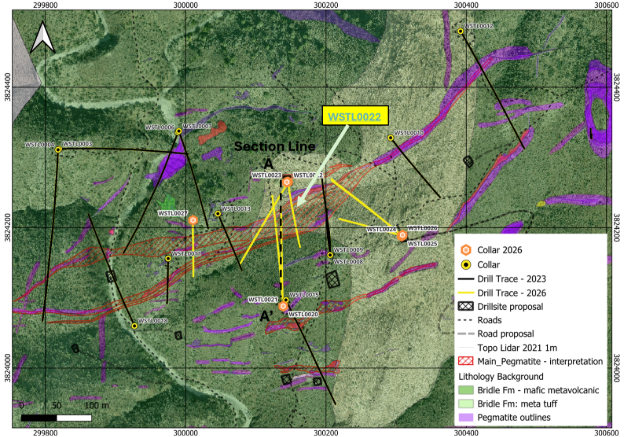
Figure 1.- Location map showing hole WSTL0022 and all other collars/traces of holes drilled in this 2026 drilling campaign plus previous campaigns by KEX, the interpreted main pegmatite body, and the location of cross section A – A’.
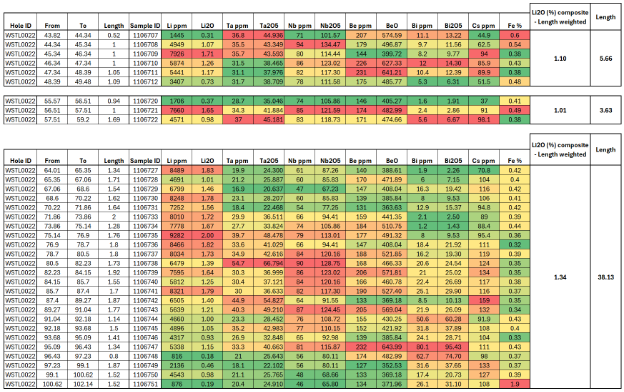
Table 1.- Assay results and length-weighted Li₂O % composites for mineralized intervals in drill hole WSTL0022. Li₂O values have been rounded to two decimal places.
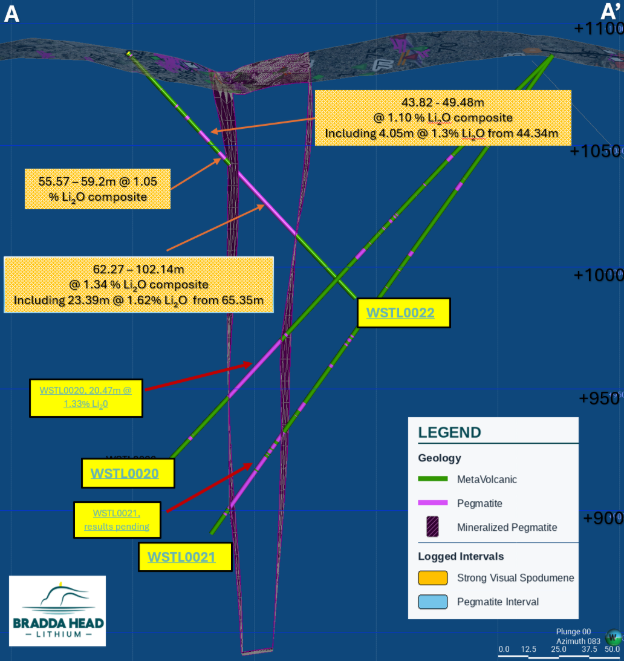
Figure 2.- Cross section A – A’, looking east, with drill holes WSTL0020, WSTL0021 & WSTL0022, with composite assay grades shown for WSTL0022.
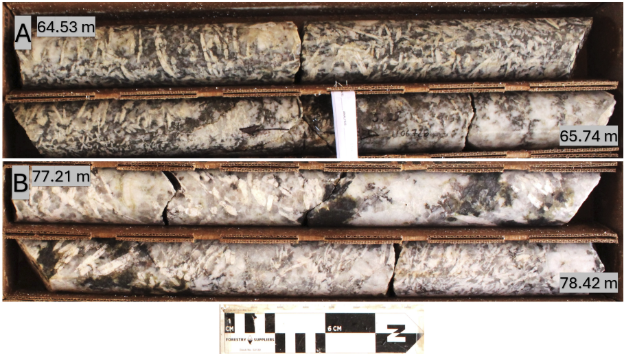
Figure 3.- Mineralized core examples from drill hole WSTL0022, showing spodumene crystals. Intervals within the longest mineralized interval.
QAQC
Core samples were collected under the supervision of Hugo Zuniga, Senior Project Manager. Sampling information was recorded in the MXDeposit database; core was sawed, and samples were bagged, secured, and delivered to the SGS preparation facility in Tempe, Arizona. Following sample preparation, pulps were shipped to SGS Laboratories in Burnaby, British Columbia, Canada, for analysis using sodium peroxide fusion with an ICP-AES and ICP-MS finish (method GE_ICM90A50). Certified reference materials and blanks were inserted into the sample stream as part of the Company's QAQC procedures and reviewed by Hugo Zuniga. All standards returned values within the first standard deviation of their certified values, and blanks returned results below detection limits, confirming the reliability of the reported assay results. The Company's Qualified Person ("QP"), Mr. Joey Wilkins, consents to the inclusion of the technical information in this release and the context in which it appears.
Qualified Person (Bradda Head)
Joey Wilkins, B.Sc., P.Geo., is an external consultant and the Qualified Person who reviewed and approved the technical disclosures in this news release. Mr Wilkins is a graduate of the University of Arizona with a B.Sc. in Geology with more than 40 years of experience in mineral exploration and is a qualified person under the AIM Rules and a Qualified Person as defined under NI-43-101. Mr Wilkins consents to the inclusion of the technical information in this release and context in which it appears.
THIS ANNOUNCEMENT CONTAINS INSIDE INFORMATION FOR THE PURPOSES OF THE MARKET ABUSE REGULATION (EU No. 596/2014) AS IT FORMS PART OF UK DOMESTIC LAW BY VIRTUE OF THE EUROPEAN UNION (WITHDRAWAL) ACT 2018. UPON THE PUBLICATION OF THIS ANNOUNCEMENT VIA A REGULATORY INFORMATION SERVICE, THIS INSIDE INFORMATION IS NOW CONSIDERED TO BE IN THE PUBLIC DOMAIN AND SUCH PERSONS SHALL THEREFORE CEASE TO BE IN POSSESSION OF INSIDE INFORMATION.
For further information please visit the Company's website: www.braddaheadltd.com.
ENDS
Contact:
Bradda Head Lithium Limited |
Beaumont Cornish
| Shard Capital |
Tavistock
|
Company | Nomad | Broker | Investor Relations |
Ian Stalker, Executive Chair Denham Eke, Finance Director | James Biddle / Roland Cornish | Damon Heath / Isabella Pierre | Nick Elwes / Poppy Culver
|
+44 1624 639 396 | +44 20 7628 3396 | +44 207 186 9927 | + 44 20 7920 3150 |
About Bradda Head Lithium Ltd.
Bradda Head Lithium Ltd is a North America-focused lithium development group. The Company's principal interests include the Basin Project, comprising Basin East and Basin West, and the San Domingo Project in Arizona.
The Basin East Project has a Measured Mineral Resource of 20 Mt at an average grade of 929 ppm Li, containing 99 kt LCE; an Indicated Mineral Resource of 122 Mt at an average grade of 860 ppm Li; and an Inferred Mineral Resource of 499 Mt at an average grade of 810 ppm Li. Together, these categories contain 2.81 Mt LCE. A plan of operations for the Basin West area was approved by the Bureau of Land Management in 2025, and the Company is progressing the associated Environmental Assessment.
The San Domingo Project comprises 248 claims covering approximately 1,850 acres, located primarily on Bureau of Land Management land, together with two Arizona State Land Department claims. To date, 108 drill holes totalling 13,089 m have been completed across three drilling campaigns. More than 1,000 pegmatites have been mapped across the project area; 18 have been identified as priority targets and six have been drill-tested. Two Notices of Intent are active, and updated drilling plans may be implemented once the required permits have been secured. The next exploration phase is intended to further delineate prospective areas and assess their potential to support a Mineral Resource Estimate prepared in accordance with NI 43-101.
The Whistlejacket Project comprises nine Arizona State Land Department Mineral Exploration Permits covering 2,010.7 hectares. The project is subject to a definitive option-to-joint-venture agreement with Kennecott Exploration Company and targets spodumene-bearing pegmatites.
Kennecott's previous exploration included 19 diamond drill holes totalling 4,188 m, all of which intersected lithium mineralisation. Reported results include 51.0 m at 1.11% Li₂O in hole WSTL0009 and 19.47 m at 1.66% Li₂O in hole WSTL0008. Surface mapping, sampling, airborne geophysics and high-resolution aerial imagery have also contributed to the geological dataset for the project.
The Group intends to continue advancing its three principal projects in Arizona while seeking to realise value from its other prospective pegmatite and brine assets in Arizona, Nevada and Pennsylvania.
Nominated Adviser Statement
Beaumont Cornish Limited ("Beaumont Cornish"), is the Company's Nominated Adviser and is authorised and regulated in the United Kingdom by the Financial Conduct Authority. Beaumont Cornish's responsibilities as the Company's Nominated Adviser, including a responsibility to advise and guide the Company on its responsibilities under the AIM Rules for Companies and AIM Rules for Nominated Advisers, are owed solely to the London Stock Exchange. Beaumont Cornish is not acting for and will not be responsible to any other person for providing the protections afforded to customers of Beaumont Cornish nor for advising them in relation to the transaction and arrangements described in the announcement or any matter referred to in it.
Distribution
This announcement has been notified via a Regulatory Information Service and it is not authorised for distribution into North America or any other jurisdiction where to do so would constitute a violation of the relevant laws or regulations of that jurisdiction.
Glossary of Terms
Term | Definition |
AIM | The London Stock Exchange's market for smaller, growing companies. Bradda Head Lithium Ltd trades on AIM under the ticker BHL. |
Amphibole | A group of rock-forming silicate minerals; holmquistite is a lithium-bearing member of this group formed at pegmatite–host rock contacts. |
Beryllium oxide (BeO) | The oxide form used to report beryllium grade, calculated from beryllium (Be) assay results. |
Bismuth oxide (Bi₂O₅) | The oxide form used to report bismuth grade, calculated from bismuth (Bi) assay results. |
Bureau of Land Management (BLM) | The U.S. federal agency that administers public lands, including land on which portions of the Company's Arizona projects are located. |
Certified reference material (CRM) / standard | A sample with a known, certified concentration of the element(s) being analyzed, inserted into the sample stream to verify laboratory accuracy as part of QA/QC. |
Collar | The surface location where a drill hole begins. |
Contact (hangingwall / footwall) | The boundary between the mineralized pegmatite and the surrounding host rock; the hangingwall contact lies above the pegmatite and the footwall contact lies below it, using standard downhole/geological orientation. |
Cross section | A vertical slice through the ground used to show the geometry of drill holes and mineralized zones relative to one another. |
Diamond drilling / diamond drill hole | A drilling method that uses a diamond-tipped bit to cut a cylindrical rock “core” sample, allowing direct visual and laboratory analysis of the rock and mineralization intersected. |
Down-hole | Measured along the length of a drill hole, as opposed to true (perpendicular) thickness; down-hole interval lengths can overstate the real thickness of a mineralized zone depending on the angle of intersection. |
End of hole (EOH) | The total depth reached by a drill hole. |
Environmental Assessment | A review process, typically required by U.S. federal land-management agencies such as the BLM, that evaluates the potential environmental effects of proposed exploration or development activities. |
Grade | The concentration of a valuable mineral or element within rock, typically expressed as a percentage or in parts per million (ppm). |
Holmquistite | A lithium-bearing amphibole mineral that forms through metasomatic reaction between lithium-rich fluids released from a crystallizing pegmatite and iron- and magnesium-rich (mafic) host rock. It typically occurs as a narrow reaction zone at the pegmatite contact and is used in exploration as an indicator, or vectoring tool, for nearby lithium-cesium-tantalum (LCT) pegmatite mineralization. |
ICP-AES / ICP-MS | Inductively Coupled Plasma – Atomic Emission Spectrometry / Mass Spectrometry: laboratory analytical methods used to measure the concentration of elements in a prepared sample, commonly used together to cover a wide range of elements and detection limits. |
Indicated Mineral Resource | A mineral resource category defined under NI 43-101 with a level of geological confidence sufficient to support mine planning, but lower than a Measured Mineral Resource. |
Inferred Mineral Resource | The mineral resource category with the lowest level of geological confidence under NI 43-101, based on limited data; it carries greater uncertainty than Indicated or Measured categories. |
Intercept / intersection | The length of mineralized rock encountered by a drill hole, usually reported as a down-hole interval (e.g. “38.13m from 64.01m to 102.14m”). |
Kennecott Exploration Company (KEX) | The counterparty to Bradda Head's Option to Joint Venture agreement over the Whistlejacket Project; KEX previously drilled and explored the project prior to the current agreement. |
LCE (Lithium Carbonate Equivalent) | A standard industry measure used to express the quantity of lithium contained in a resource or product as if it were entirely converted to lithium carbonate, allowing comparison across different lithium-bearing minerals and compounds. |
LCT pathfinder suite (lithium-cesium-tantalum) | A characteristic group of trace elements, tantalum (Ta), niobium (Nb), beryllium (Be), cesium (Cs) and rubidium (Rb), that is typically enriched in lithium-cesium-tantalum (LCT) pegmatites and is used to help identify and vector toward this style of mineralization. |
Length-weighted average grade | A grade calculated by weighting each sample's grade by the length of rock it represents, so that longer intervals contribute proportionally more to the overall average than shorter ones. |
Li₂O (lithium oxide) | A unit commonly used to report lithium grade in spodumene mineralization and concentrates (e.g. “1.34% Li₂O”), converted from elemental lithium (Li) assay results. |
Mafic | Describing rock relatively rich in iron and magnesium (and correspondingly darker in colour); at Whistlejacket, mafic host rock reacts with lithium-rich pegmatite fluids at the contact to form holmquistite. |
Market Abuse Regulation (MAR) | UK/EU regulation governing the disclosure of inside information by publicly listed companies, incorporated into UK law following Brexit. |
Measured Mineral Resource | The mineral resource category with the highest level of geological confidence under NI 43-101, based on closely spaced sampling and drilling. |
Metasomatic reaction / metasomatism | A geological process in which the chemical composition of a rock is altered by the introduction or removal of elements via fluid interaction, without complete melting; at a pegmatite contact, this process can produce holmquistite from Li-rich fluids reacting with Fe/Mg-rich host rock. |
Mineral Exploration Permit | A permit issued by the Arizona State Land Department authorizing exploration activities on the state land it covers; the Whistlejacket Project comprises nine such permits. |
MXDeposit | A database platform used by the Company to record drill-hole and sampling information as part of its data management and QA/QC procedures. |
NI 43-101 | “National Instrument 43-101 – Standards of Disclosure for Mineral Projects,” the Canadian securities regulatory standard governing how companies disclose scientific and technical information about mineral projects. |
Niobium oxide (Nb₂O₅) | The oxide form used to report niobium grade, calculated from niobium (Nb) assay results; niobium is part of the LCT pathfinder suite. |
Nominated Adviser (Nomad) | A firm authorised and regulated by the UK Financial Conduct Authority that advises and guides an AIM-listed company on its regulatory responsibilities; Beaumont Cornish Limited is the Company's Nominated Adviser. |
Notice of Intent (NOI) | A regulatory filing submitted to the Bureau of Land Management describing proposed exploration activities that disturb public land, required before certain work can proceed. |
Option to Joint Venture agreement | An agreement giving a party the right, subject to meeting defined conditions, to earn an interest in a project by funding exploration or other work, potentially leading to a joint venture; the Whistlejacket Project is held under such an agreement with Kennecott Exploration Company. |
Pegmatite | A very coarse-grained igneous rock, often associated with granite intrusions, that can host economically significant concentrations of spodumene and other lithium-bearing minerals. |
ppm (parts per million) | A unit of concentration; 10,000 ppm is equivalent to 1%. Commonly used to express lithium and pathfinder-element grades in assay and mineral resource results. |
Qualified Person (QP) | An individual meeting defined professional and experience criteria under NI 43-101 (or an equivalent standard under the AIM Rules) who reviews and takes responsibility for technical disclosures in a company's public statements. |
QA/QC (Quality Assurance / Quality Control) | The procedures, including insertion of certified reference materials and blanks into the sample stream, used to verify the reliability and accuracy of assay results. |
Sodium peroxide fusion | A sample preparation method in which a pulverized sample is fused with sodium peroxide at high temperature to fully dissolve resistant minerals such as spodumene, prior to analysis by ICP-AES/ICP-MS. |
Spodumene | A lithium aluminum silicate mineral (LiAlSi₂O₆) and the primary ore mineral targeted at Whistlejacket; it is a key source of lithium for battery production. |
Tantalum oxide (Ta₂O₅) | The oxide form used to report tantalum grade, calculated from tantalum (Ta) assay results; tantalum is part of the LCT pathfinder suite. |
True width / true thickness | The actual thickness of a mineralized zone measured perpendicular to its orientation, as distinct from the (typically longer) down-hole interval length, which depends on the angle at which the drill hole crosses the zone. |
Related Shares:
Bradda Head Lithium