
22nd May 2026 07:00
22 May 2026
East Star Resources Plc
("East Star" or the "Company")
Snowy Project: Exploration Update
Rock chips indicate fertile epithermal gold target at Snowy
East Star Resources Plc (LSE:EST), the Kazakhstan-focused gold and copper exploration and development company, is pleased to provide an update on recent exploration activities and future work plans in relation to its Snowy gold project.
Highlights:
Snowy Epithermal Gold Target
· Additional rock chip analyses and mapping highlight prospective vein system
· Vein samples show gold up to 1.44g/t in veins at surface
· Veins traced out along strike for up to 200m
· Current interpretation fits with a low-sulfidation epithermal mineralisation model
· IP Survey has commenced - results expected in Q2 2026
Alex Walker, East Star CEO, commented:
"The latest mapping and rock chip geochemistry is delivering encouraging results at our Snowy gold project. Recent field work by the East Star geological team has included several mapping and sampling transects over the Snowy alteration system with an expansive hydrothermal breccia identified at surface with encouraging gold results.
Our low-sulfidation epithermal geological model is based on the geology observed at surface and we are excited to progress the project which has the potential to host a large gold system."
To watch a video of Christopher van Wijk, Technical Director, discussing this announcement, visit: https://eaststarplc.com/link/yzY93P
Copper Porphyry/Epithermal Gold
The Company conducted a short mapping and surface sampling campaign over the Snowy target to follow up on anomalous soil results announced previously. This work identified a series of auriferous veins at surface with peak results of 1.44g/t Au, 0.66g/t Au (Figure 1) and numerous samples reporting over 0.2g/t Au. All samples also carry anomalous silver (up to 2.86g/t). Based on our field work and surface expression of the anomalism, our interpretation of the anomaly has changed to focus on a low sulfidation style of mineralisation which better fits the style of veining and alteration observed at surface.
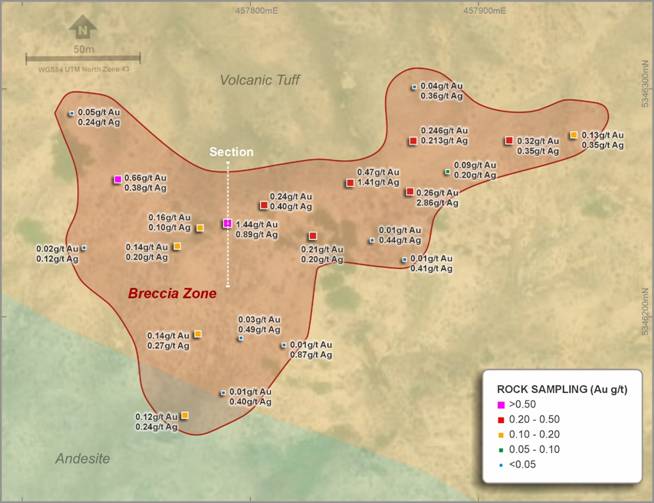
Figure 1 - Snowy schematic map with rock chip results
The Snowy veins are typically composed of quartz with minor occurrences of pyrite and the gold is associated with the veins at surface and proportional to the pyrite content of the rocks. The veins have been traced along strike for up to 200m and run approximately east-west, dipping steeply to the north (around 70⁰) and cross-cutting the stratigraphy.
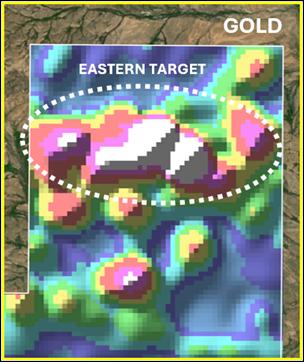
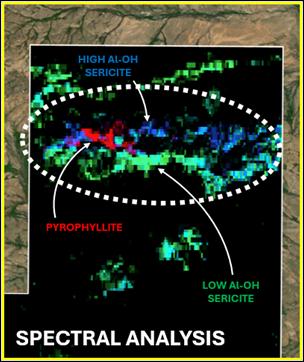
The Snowy alteration as observed in the hyperspectral data is characterised by a pyrophyllite anomaly at the western end (which was the initial focus of the exploration work), followed by a high Al-OH sericite anomaly running along the northern strike of the ridge and a low Al-OH sericite anomaly running along the southern strike of the ridge, which hosts the Eastern Target (See Figures 1 & 2). The current interpretation is that the variation between the high and low Al-OH sericite marks a stratigraphic contact between the volcaniclastic units.
The stratigraphy consists of a series of bedded volcaniclastic units which dip moderately (30-40⁰) to the north. All of the rocks are pervasively silica and sericite altered at surface. The auriferous veins cut the stratigraphy at a steep angle, presenting an attractive conceptual target at depth where there is potential to find the 'boiling zone' where the ascending fluids meet a more permeable, usually volcaniclastic host rock: an attractive host rock for gold (See Figure 4).


Note on Low-sulfidation Epithermal Mineralisation
East Star is now evaluating the potential for gold at Snowy using a low-sulfidation epithermal deposit model. Low-sulfidation epithermal gold deposits form in the near surface environment where hot ascending hydrothermal fluids mix with meteoric water which cools the hydrothermal fluids and induces mineral precipitation. The fluids forming the deposit are typically neutral to mildly acidic and the alteration is typically less intense than high sulfidation systems, consisting mostly of adularia and sericite alteration. The spectral data demonstrates that the Snowy alteration system is mostly composed of sericite and is indeed less intense than the nearby lithocap to the south-west of the Snowy target.
Snowy has a number of the key features expected when targeting this deposit style:
1. Veining at surface - Quartz veins with gold and low base metal content at surface - see pictures in Figure 3 above.
2. Alteration - Sericite alteration confirmed through Terraspec and hyperspectral data
3. Permissive host rocks - Tuffaceous and volcaniclastic rocks
4. Scale - Demonstrated alteration over a very large area - multiple kilometres of altered strata along strike
The biggest examples of low-sulfidation deposits in production are Round Mountain in Nevada (20Moz contained) and Silicon/Merlin in Nevada (16Moz).
Next Steps
Given that the gold at Snowy is directly proportional to the pyrite content in the rocks and that no other sulphide species have been observed, it is expected that this target will respond to basic geophysics in the form of an Induced Polarisation survey. It is expected that the quartz will produce a discrete resistivity signature whilst the chargeability should correspond to the pyrite content of the rocks and highlight more prospective areas within the vein system. If a chargeable anomaly can be identified, this would present a compelling target for follow-up. The Company has planned two lines of IP over the breccia zone with results expected in the second quarter of 2026.
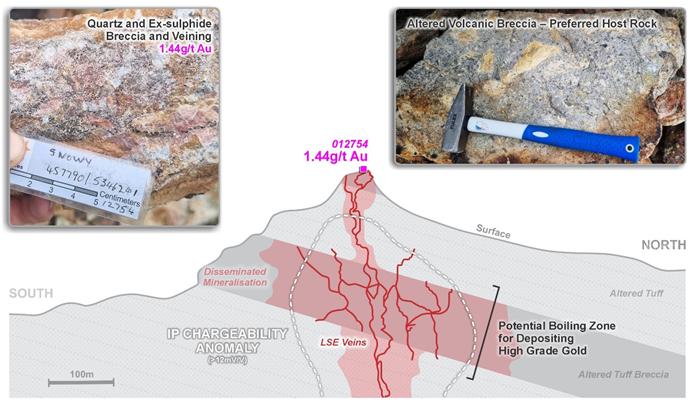
Figure 4- Schematic cross-section of the exploration model at Snowy.
East Star Resources Plc
Alex Walker, Chief Executive Officer
Tel: +44 (0)20 7390 0234 (via Vigo Consulting)
SI Capital (Corporate Broker)
Nick Emerson
Tel: +44 (0)1483 413 500
Vigo Consulting (Investor Relations)
Ben Simons / Seb Weller
Tel: +44 (0)20 7390 0234
Glossary
Ag | Silver |
Al | Aluminium |
Au | Gold |
G/t | Grams per tonne |
Moz | Million ounce(s) |
OH | Hydroxyl |
About East Star Resources Plc
East Star Resources is focused on the discovery and development of copper and gold in Kazakhstan. The Company is pursuing multiple exploration strategies including:
· | A joint venture with Hong Kong Xinhai Mining Services Limited to take the Verkhuba Deposit (20.3Mt @ 1.16% copper, 1.54% zinc and 0.27% lead) into production (at no further cost to East Star) with East Star retaining 30% ownership in production |
· | A second VMS Exploration Target with up to 23Mt @ 2.4% copper equivalent in the same region, with numerous other targets being advanced to drill-ready status |
· | A $25 million+ strategic gold exploration joint venture with Endeavour Mining |
· | Tier 1 potential copper porphyry targets and epithermal gold targets in a proven copper porphyry and epithermal belt |
Visit our website:
www.eaststarplc.com
Follow us on social media:
LinkedIn: https://www.linkedin.com/company/east-star-resources/
X: https://x.com/EastStar_PLC
Engage with us by asking questions, watching video summaries and seeing what other shareholders have to say. Navigate to our interactive Investor Hub here: https://eaststarplc.com/link/yzY93P
Subscribe to our news alert service: https://eaststarplc.com/regulatory-news
The person who arranged for the release of this announcement was Alex Walker, CEO of the Company.
Competent Person Statement
The technical information related to East Star Resources assets contained in this report that relates to Exploration Results is based on information compiled by Mr Christopher van Wijk, who is a Member of the Australasian Institute of Mining and Metallurgy and who is a Geologist employed by East Star Resources as an Executive Director. Mr van Wijk has sufficient experience which is relevant to the style of mineralisation and type of deposit under consideration, and to the activity which he is undertaking, to qualify as a Competent Person as defined in the 2012 Edition of the 'Australasian Code for Reporting of Exploration Results, Mineral Resources and Ore Reserves'. Mr van Wijk consents to the inclusion in the release of the matters based on the information he has compiled in the form and context in which it appears.
This announcement contains inside information for the purposes of Article 7 of Regulation 2014/596/EU which is part of domestic UK law pursuant to the Market Abuse (Amendment) (EU Exit) Regulations (SI 2019/310) ("UK MAR"). Upon the publication of this announcement, this inside information (as defined in UK MAR) is now considered to be in the public domain.
Table 1 Assay Results
Note, only samples >0.1g/t Au are reported.
Sample ID | Grid ID | Northing | Easting | Au (g/t) | Ag (g/t) | Lab Method |
R104004 | WGS84_43N | 5346192 | 457777 | 0.14 | 0.27 | ME-MS61L |
R104006 | WGS84_43N | 5346157 | 457771 | 0.12 | 0.24 | ME-MS61L |
R104009 | WGS84_43N | 5346277 | 457914 | 0.33 | 0.35 | ME-MS61L |
R104010 | WGS84_43N | 5346280 | 457942 | 0.13 | 0.35 | ME-MS61L |
R104012 | WGS84_43N | 5346277 | 457871 | 0.25 | 0.21 | ME-MS61L |
R104013 | WGS84_43N | 5346261 | 457742 | 0.66 | 0.38 | ME-MS61L |
R104018 | WGS84_43N | 5346259 | 457844 | 0.47 | 1.41 | ME-MS61L |
R104019 | WGS84_43N | 5346236 | 457827 | 0.21 | 0.20 | ME-MS61L |
R12752 | WGS84_43N | 5346231 | 457768 | 0.14 | 0.20 | ME-MS41L |
R12753 | WGS84_43N | 5346239 | 457778 | 0.16 | 0.10 | ME-MS41L |
R12754 | WGS84_43N | 5346241 | 457790 | 1.44 | 0.89 | ME-MS41L |
R12755 | WGS84_43N | 5346249 | 457806 | 0.24 | 0.40 | ME-MS41L |
R12756 | WGS84_43N | 5346255 | 457870 | 0.26 | 2.86 | ME-MS41L |
R12757 | WGS84_43N | 5342897 | 459918 | 0.11 | 0.08 | ME-MS41L |
Table 2 - JORC Code, 2012 Edition
Section 1 Sampling Techniques and Data
Criteria | JORC Code explanation | Commentary |
Sampling techniques | · Nature and quality of sampling (e.g. cut channels, random chips, or specific specialised industry standard measurement tools appropriate to the minerals under investigation, such as down hole gamma sondes, or handheld XRF instruments, etc). These examples should not be taken as limiting the broad meaning of sampling. · Include reference to measures taken to ensure sample representivity and the appropriate calibration of any measurement tools or systems used. · Aspects of the determination of mineralisation that are Material to the Public Report. · In cases where 'industry standard' work has been done this would be relatively simple (e.g. 'reverse circulation drilling was used to obtain 1 m samples from which 3 kg was pulverised to produce a 30 g charge for fire assay'). In other cases, more explanation may be required, such as where there is coarse gold that has inherent sampling problems. Unusual commodities or mineralisation types (e.g. submarine nodules) may warrant disclosure of detailed information. | · Grab samples were taken at sites noted to contain quartz veins or veinlets · Samples were taken from in-situ outcrop · The sulphide content of samples was noted in the geological descriptions · Easch sample was described, the location and coordinates noted and entered into EST's database
|
Drilling techniques | · Drill type (e.g. core, reverse circulation, open-hole hammer, rotary air blast, auger, Bangka, sonic, etc) and details (e.g. core diameter, triple or standard tube, depth of diamond tails, face-sampling bit or other type, whether core is oriented and if so, by what method, etc). | · Not applicable |
Drill sample recovery | · Method of recording and assessing core and chip sample recoveries and results assessed. · Measures taken to maximise sample recovery and ensure representative nature of the samples. · Whether a relationship exists between sample recovery and grade and whether sample bias may have occurred due to preferential loss/gain of fine/coarse material. | · Not applicable |
Logging | · Whether core and chip samples have been geologically and geotechnically logged to a level of detail to support appropriate Mineral Resource estimation, mining studies and metallurgical studies. · Whether logging is qualitative or quantitative in nature. Core (or costean, channel, etc) photography. · The total length and percentage of the relevant intersections logged. | · Samples were described by EST geologists into excel datasheets and imported into EST's database · EST's database is maintained by independent contractors Rock Solid in Perth, Australia · Logging is completed visually with the guidance of the Exploration Manager and other Competent Persons · All samples were described and photographed. Photographs are kept on EST's secured file storage system |
Sub-sampling techniques and sample preparation | · If core, whether cut or sawn and whether quarter, half or all core taken. · If non-core, whether riffled, tube sampled, rotary split, etc and whether sampled wet or dry. · For all sample types, the nature, quality, and appropriateness of the sample preparation technique. · Quality control procedures adopted for all sub-sampling stages to maximise representivity of samples. · Measures taken to ensure that the sampling is representative of the in-situ material collected, including for instance results for field duplicate/second-half sampling. · Whether sample sizes are appropriate to the grain size of the material being sampled. | · Whole samples were submitted. · Samples were collected in sample bags and sent to ALS Ust Kamenogorsk for sample preparation · ALS sample preparation technique involves drying (at >100°C for rocks), fine crushing to 70% passing <2mm, riffle splitting a 250g subsample, and pulverizing to better than 85% passing 75 microns; it is a high-quality, standard method appropriate for geochemistry analysis of drill core, rock, and chip samples to produce homogeneous subsamples · Quality control procedures in at ALS include internal verifications at each size reduction stage to confirm particle size specifications, cleaning equipment with clean rock, silica, and compressed air between samples to prevent carryover, and availability of QC data via Webtrieve™ to maximize sample representivity during sub-sampling · No QA/QC materials were submitted by EST. · Sample sizes were deemed appropriated for the material being sampled · Sample pulps will be returned to EST for long term storage. |
Quality of assay data and laboratory tests | · The nature, quality and appropriateness of the assaying and laboratory procedures used and whether the technique is considered partial or total. · For geophysical tools, spectrometers, handheld XRF instruments, etc, the parameters used in determining the analysis including instrument make and model, reading times, calibrations factors applied and their derivation, etc. · Nature of quality control procedures adopted (e.g. standards, blanks, duplicates, external laboratory checks) and whether acceptable levels of accuracy (i.e. lack of bias) and precision have been established. | · Some samples were analysed using the ME-MS61L method. This involves a four-acid digestion (HNO₃-HClO₄-HF-HCl) of a 0.25 g sample aliquot, providing near-total dissolution of most geological materials, followed by ICP-MS multi-element analysis. The method reports up to 50 elements with super-trace detection limits (including Ag, As, Cu, Pb, Zn and other pathfinder elements, gold analyses obtained using AU-ICP21). The accuracy and precision for a wide range of ore and lithogeochemical concentrations is appropriate for the geological exploration of epithermal deposits. · Some samples were analysed using the ME-MS41L method. This utilises a standard aqua regia digestion of a 0.5 g sample aliquot for partial extraction, followed by ICP-MS multi-element analysis. The method provides super-trace detection limits for a broad suite of elements (this method includes Au and other pathfinder elements). It is well-suited for exploration geochemistry, particularly in soils, sediments, and partial extractions relevant to sulphide-associated mineralisation. · Some samples were analysed for gold using the Au-ICP21 method. This involves fire assay fusion of a 30 g sample aliquot with lead collection, cupellation to produce a silver bead, followed by digestion and ICP-AES analysis. The method provides a detection limit of approximately 0.001 ppm Au (1 ppb) with an upper range to 10 ppm. · All samples were analysed using the TRSPEC-20 method. Crushed rejects were analysed using the TerraSpec® 4 HR spectrometer, which collects visible-near infrared to short-wave infrared (VNIR-SWIR) reflectance spectra. Raw spectral data files are produced in ASD format or ASCII format. These spectra enable identification of minerals, particularly those with diagnostic absorption features in the VNIR-SWIR range (e.g., clays, micas, carbonates, sulfates, and many alteration minerals). Data was interpreted by ALS using the spectral geologist (TSG) software. The spectral results were used to support geological characterisation and alteration mapping. · The difference in aqua regia and four acid digest methods did not introduce any relevant bias in the results and both are deemed suitable for surface geological mapping, but EST prefers the use of four acid digests for total rock compositions. · EST didn't include QA/QC samples for this exploration work.
|
Verification of sampling and assaying | · The verification of significant intersections by either independent or alternative company personnel. · The use of twinned holes. · Documentation of primary data, data entry procedures, data verification, data storage (physical and electronic) protocols. · Discuss any adjustment to assay data. | · Not applicable to soil results. |
Location of data points | · Accuracy and quality of surveys used to locate drill holes (collar and down-hole surveys), trenches, mine workings and other locations used in Mineral Resource estimation. · Specification of the grid system used. · Quality and adequacy of topographic control. | · Sample locations were surveyed using handheld GPS. · Grid system WGS84, UTM43N. · Topographic control using SRTM is sufficient for early stage exploration |
Data spacing and distribution | · Data spacing for reporting of Exploration Results. · Whether the data spacing and distribution is sufficient to establish the degree of geological and grade continuity appropriate for the Mineral Resource and Ore Reserve estimation procedure(s) and classifications applied. · Whether sample compositing has been applied. | · Initial sampling took only samples of interest · Additional work sampled on a 25m grid over the exposed veining. Only samples with veining or sulphides were taken within 3 m of the grid points |
Orientation of data in relation to geological structure | · Whether the orientation of sampling achieves unbiased sampling of possible structures and the extent to which this is known, considering the deposit type. · If the relationship between the drilling orientation and the orientation of key mineralized structures is considered to have introduced a sampling bias, this should be assessed and reported if material. | · Not applicable at this stage of exploration |
Sample security | · The measures taken to ensure sample security. | · Sample security is maintained by East Star geologists until delivered to the ALS laboratory |
Audits or reviews | · The results of any audits or reviews of sampling techniques and data. | · No audits were undertaken for this work. |
Section 2 Reporting of Exploration Results
Criteria | JORC Code explanation | Commentary |
Mineral tenement and land tenure status | · Type, reference name/number, location and ownership including agreements or material issues with third parties such as joint ventures, partnerships, overriding royalties, native title interests, historical sites, wilderness or national park and environmental settings. · The security of the tenure held at the time of reporting along with any known impediments to obtaining a licence to operate in the area. | · The Snowy Target is located in the eastern part of exploration license 2506-EL (the "License"). The license was issued to Copperland Limited on 16 February 2024, then reissued on 10 November 2025 for initial period of 6 years with a possibility of further five years extension subject to reduction of the license area by 40%. · East Star owns 100% owns of the license (2506-EL) · East Star resources have servitude for exploration from the local Akim (administrative head), and local landholders, over some areas within the Licence and the license can be explored under these agreements. · There are no known legal or security impediments to obtaining a mining license. |
Exploration done by other parties | · Acknowledgment and appraisal of exploration by other parties. | · At this stage of exploration no historical exploration programmes are known for the Snowy Target aside from 1:50,000 scale geology mapping over the area.
|
Geology | · Deposit type, geological setting, and style of mineralisation. | · The deposit type being explored is low sulphidation epithermal Au-Ag. · The area is underlain by volcaniclastics and andesites, typical of epithermal deposit settings |
Drill hole Information | · A summary of all information material to the understanding of the exploration results including a tabulation of the following information for all Material drill holes: o easting and northing of the drill hole collar o elevation or RL (Reduced Level - elevation above sea level in metres) of the drill hole collar o dip and azimuth of the hole o down hole length and interception depth o hole length. · If the exclusion of this information is justified on the basis that the information is not Material and this exclusion does not detract from the understanding of the report, the Competent Person should clearly explain why this is the case. | · Not applicable |
Data aggregation methods | · In reporting Exploration Results, weighting averaging techniques, maximum and/or minimum grade truncations (e.g. cutting of high grades) and cut-off grades are usually Material and should be stated. · Where aggregate intercepts incorporate short lengths of high-grade results and longer lengths of low-grade results, the procedure used for such aggregation should be stated and some typical examples of such aggregations should be shown in detail. · The assumptions used for any reporting of metal equivalent values should be clearly stated. | · Not applicable |
Relationship between mineralisation widths and intercept lengths | · These relationships are particularly important in the reporting of Exploration Results. · If the geometry of the mineralisation with respect to the drill hole angle is known, its nature should be reported. · If it is not known and only the down hole lengths are reported, there should be a clear statement to this effect (e.g. 'down hole length, true width not known'). | · Not applicable |
Diagrams | · Appropriate maps and sections (with scales) and tabulations of intercepts should be included for any significant discovery being reported These should include but not be limited to a plan view of drill hole collar locations and appropriate sectional views. | · Relevant diagrams have been included in the body text. |
Balanced reporting | · Where comprehensive reporting of all Exploration Results is not practical, representative reporting of both low and high grades and/or widths should be practiced to avoid misleading reporting of Exploration Results. | · Samples with grades below the 0.1g/t have not been reported with these results. |
Other substantive exploration data | · Other exploration data, if meaningful and material, should be reported including (but not limited to): geological observations; geophysical survey results; geochemical survey results; bulk samples - size and method of treatment; metallurgical test results; bulk density, groundwater, geotechnical and rock characteristics; potential deleterious or contaminating substances. | · Not applicable. |
Further work | · The nature and scale of planned further work (e.g. tests for lateral extensions or depth extensions or large-scale step-out drilling). · Diagrams clearly highlighting the areas of possible extensions, including the main geological interpretations and future drilling areas, provided this information is not commercially sensitive. | · East star is planning to undertake IP surveys over the mineralised target · Target area is defined in figure 1 of the body text, highlighting the location of the target shown in section in figure 4.
|
Related Shares:
East Star Reso