
29th Apr 2026 07:00
29 April 2026
Warpaint London PLC
("Warpaint", the "Company" or the "Group")
Results for the year ended 31 December 2025
Warpaint London plc (AIM: W7L; OTCQX: WPNTF), the specialist supplier of high quality colour cosmetics and personal care brands at an affordable price, and owner of the W7, Technic, Skin & Tan, Super Facialist, Dirty Works, Fish Soho and Barry M brands is pleased to announce its audited results for the year ended 31 December 2025.
| Audited 12 months to 31 December 2025 | Audited 12 months to 31 December 2024
| Change |
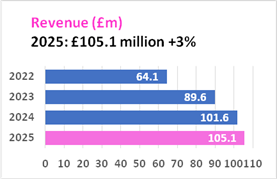
Revenue | £105.1m
| £101.6m
| +3% |
Gross profit margin | 42.6%
| 41.2%
| +140bps |
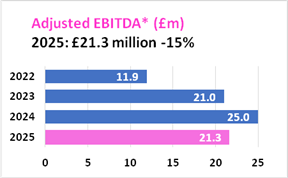
Adjusted EBITDA
| £21.3m | £25.0m | -15% |
Profit before tax
| £18.1m | £23.8m | -24% |
Profit attributable to equity holders | £14.4m | £18.2m | -21% |
Adjusted Earnings per share
| 16.7p | 22.3p | -25% |
Cash and cash equivalents1 | £16.0m | £7.9m | +102% |
1 2024 Cash and cash equivalents excludes £14.0 million, which was held in an escrow account at 31 December 2024. The funds were released in February 2025 and utilised in the acquisition of Brand Architekts Group PLC.
Adjusted numbers are close to the underlying cash flow performance of the business which is regularly monitored and measured by management. The adjustments made to the statutory numbers are shown in the table below.
Numbers are displayed rounded to one decimal place. Percentages are calculated based on the original (unrounded) figures.
Financial Highlights
· | Results reflect the challenging trading environment across many of the Group's markets
|
· | Group sales for 2025 grew by 3% to £105.1 million (2024: £101.6 million), including the £11.8 million contribution from Brand Architekts Group PLC ("Brand Architekts") from 12 February 2025 |
| · EU revenue was 3% lower at £52.9 million (2024: £54.7 million) · UK revenue increased by 11% to £38.9 million (2024: £35.0 million) |
| · US revenue fell 21% to £6.9 million (2024: £8.7 million), a decrease of 18% in US dollar terms · ROW revenue increased by 101% to £6.5 million (2024: £3.2 million) |
· | Continued improvement in gross profit margin, increasing by 140bps to 42.6% (2024: 41.2%) due to factors including successful launches of new product lines, a modest price increase undertaken in the first half of the year, sourcing improvements and volume savings |
· | Strong cash position of £16.0 million as at 31 December 2025 (31 December 2024: £7.9 million1), with no debt |
· | Recommended increased final dividend of 9.0 pence per share (2024: 7.5 pence per share), bringing the total dividend for the year to 13.0 pence per share (2024: 11.0 pence per share) |
Operational Highlights
· Completed the acquisition of Brand Architekts in February 2025 and successfully integrated the business into the Group, delivering a positive Adjusted EBITDA contribution compared to the losses reported prior to acquisition. Further improvements to the Brand Architekts portfolio being implemented in 2026 that are expected to increase margin, particularly in H2 2026 and into 2027
|
· Continuing brand focus, particularly in H2 2025, both internationally and the UK, including: |
o In Europe: launch of W7 into 200 Tigota stores in Italy, with a capsule collection going into a further 400 stores; expanded W7 assortment into all 546 Etos stores in the Netherlands, with permanent fixtures and an expanded range and W7 going into an additional 150 Normal stores following the chain's expansion o In the UK: expanded into 140 additional Superdrug stores; gifting rolled out into 350 Boots stores for Christmas 2025, alongside an expansion of accessories into 250 additional stores and further expansion with 150 additional Tesco stores taking an Impulse offering o In the US: expanded the W7 range stocked and rolled out to a further 399 CVS stores o In the ROW: expanded sales in Chemist Warehouse in Australia and New Zealand and launched into the Warehouse Group, New Zealand o In a number of retailers volumes increased year-on-year, but generated reduced revenues as consumers increasingly favoured lower price points within the product range |
· Direct online sales were £11.6 million, up 38% year on year, accounting for 11.0% of Group sales (2024: £8.4 million/8.3%) |
Post-Period End Highlights and Outlook
· The difficult trading conditions experienced in 2025 continued in Q1 2026 with unaudited Group sales for the four months to 30 April 2026 expected to be approximately £26.1 million (four months to 30 April 2025: £32.6 million). However, sales in April 2026 are expected to be in excess of those achieved in April 2025, with signs of recovery being experienced |
· Sales in 2026 are expected to be more second half weighted than prior years due to the timing of certain larger orders and planned customer rollouts from May 2026 |
· Maintained a strong balance sheet, with no debt. Cash balances as at 31 March 2026 were £17.3 million (31 March 2025: £15.8 million) |
· Acquisition of the Barry M brand, including its IP, stock and order book, but excluding the manufacturing capabilities and any liabilities, for a cash consideration of £1.4 million, out of administration. Barry M is a well-established value cosmetics brand, trading in a similar market segment to Warpaint's cosmetics brands · Significantly improved Christmas order received from Walmart, now that tariff levels in the US have settled compared to 2025 |
· Expansion of the Group's footprint in Europe in 2026 is expected to include a contribution from Dirk Rossmann in Germany, part of the AS Watson group, which is launching, as a pilot, a capsule range of W7 products into all of its 2,200 stores from May 2026
|
· The Group continues to expand outside of the UK, Europe and the US, with new markets opened in South America and an Indian subsidiary entity starting trading in Q2 2026
|
· Despite continuing global macroeconomic headwinds the Group has significant planned expansion opportunities, particularly for later in 2026, and expects continued margin improvement |
Commenting, Clive Garston, Chairman, said:
"Whilst the 2025 results were disappointing, it was a year of resilience and strategic progress for Warpaint. Despite a challenging macroeconomic backdrop and specific one-off headwinds, the Group delivered record revenues, strengthened margins and maintained a robust, debt-free balance sheet. We also demonstrated the ability to execute value-accretive acquisitions, successfully integrating Brand Architekts and, post year end, adding the Barry M brand to further enhance the Group's brand portfolio and retail reach.
"Looking ahead, whilst trading conditions remain subdued, I am confident that our clear strategy, strong cash generation and entrepreneurial culture position Warpaint well for a return to earnings growth. With an expanded brand portfolio, further customer rollouts expected and increasing global distribution, the board expects performance to improve through 2026, particularly in the second half."
This announcement contains inside information for the purposes of Article 7 of Regulation (EU) No 596/2014 which is part of UK law by virtue of the European Union (Withdrawal) Act 2018
Enquiries:
Warpaint London Sam Bazini - Chief Executive Officer Eoin Macleod - Managing Director Neil Rodol - Chief Financial Officer
| c/o IFC
|
|
Shore Capital (Nominated Adviser & Joint Broker) Patrick Castle, Daniel Bush, Lucy Bowden - Corporate Advisory Fiona Conroy - Corporate Broking
| 020 7408 4090 | |
Berenberg (Joint Broker) Clayton Bush, Alix Mecklenburg-Solodkoff, Alex Wright | 020 3207 7800 | |
IFC Advisory (Financial PR & IR) Tim Metcalfe, Graham Herring, Florence Staton |
020 3934 6632
| |
Warpaint London plc
Warpaint is a specialist supplier of high quality colour cosmetics and personal care brands at an affordable price, sold under the W7, Technic, Skin & Tan, Super Facialist, Dirty Works and Fish Soho brands. Our brands are sold primarily to major retailers, retail chains and supermarkets, with a growing direct online business. Additionally, in February 2026, Warpaint acquired the Barry M colour cosmetic brand.
HEADLINE RESULTS FOR THE YEAR ENDED 31 DECEMBER 2025
Statutory Results £m | Year ended 31 Dec 2025 | Year ended 31 Dec 2024 |
Revenue | 105.1 | 101.6 |
Profit from operations | 18.5 | 24.0 |
Profit margin from operations | 17.6% | 23.6% |
Profit before tax ("PBT") | 18.1 | 23.8 |
Earnings per share ("EPS") | 17.8p | 23.5p |
Cash and cash equivalents | 16.0 | 7.91 |
1 2024 Cash and cash equivalents excludes £14.0 million, which was held in an escrow account at 31 December 2024. The funds were released in February 2025 and utilised in the acquisition of Brand Architekts Group PLC.
Adjusted2 Statutory Results £m | Year ended 31 Dec 2025 | Year ended 31 Dec 2024 |
Revenue | 105.1 | 101.6 |
Adjusted profit from operations | 16.3 | 24.8 |
Adjusted profit margin from operations | 15.5% | 24.4% |
Adjusted PBT | 15.9 | 24.6 |
Adjusted EPS | 16.7p | 22.3p |
Cash and cash equivalents | 16.0 | 7.91 |
2 Adjusted numbers are closer to the underlying cash flow performance of the business which is regularly monitored and measured by management, the adjustments made to the statutory numbers are as follows:
£m | Year ended 31 Dec 2025 | Year ended 31 Dec 2024 |
Statutory profit from operations | 18.49 | 24.00 |
Depreciation | 1.27 | 0.93 |
Amortisation of right of use assets | 1.52 | 1.27 |
Amortisation of intangible assets | 0.29 | 0.03 |
Foreign exchange loss/(gain) | 2.23 | (2.00) |
EBITDA | 23.80 | 24.23 |
Gain on bargain purchase4 | (4.52) | - |
Exceptional items3 | 1.39 | 0.42 |
Share-based payments | 0.62 | 0.35 |
Adjusted EBITDA | 21.29 | 24.99 |
|
|
|
Statutory profit from operations | 18.49 | 24.00 |
Exceptional items3 | 1.39 | 0.42 |
Amortisation of intangible assets | 0.29 | 0.03 |
Gain on bargain purchase4 | (4.52) | - |
Share-based payments | 0.62 | 0.35 |
Adjusted profit from operations2 | 16.27 | 24.80 |
|
|
|
Adjusted profit margin from operations2 | 16.27 / 105.08 = 15.48% | 24.80 / 101.61 = 24.4% |
|
|
|
Statutory PBT | 18.10 | 23.76 |
Exceptional items3 | 1.39 | 0.42 |
Amortisation | 0.29 | 0.03 |
Share-based payments | 0.62 | 0.35 |
Gain on bargain purchase4 | (4.52) | - |
Adjusted PBT2 | 15.88 | 24.56 |
|
|
|
Statutory profit attributable to equity holders | 14.35 | 18.23 |
Exceptional items3 | 1.39 | 0.42 |
Amortisation of intangible assets | 0.29 | 0.03m |
Share-based payments | 0.62 | 0.35m |
Gain on bargain purchase4 | (4.52) | - |
Foreign exchange loss / (gain) | 2.23 | (2.00) |
Tax attributable to adjusting items | (0.88) | 0.29 |
Adjusted profit attributable to equity holders | 13.48 | 17.32 |
Weighted number of ordinary shares | 80,774,765 | 77,691,505 |
Adjusted EPS2 | 16.68p | 22.28p |
3 Exceptional items include directly attributable acquisition costs, restructuring costs and other one-off costs as a result of the acquisition of Brand Architekts
4The gain on bargain purchase relates to the acquisition of Brand Architekts in the year. See note 12 for further explanation
CHAIRMAN'S STATEMENT
2025 was a challenging year for Warpaint, against a backdrop of difficult macroeconomic conditions and subdued consumer confidence, both in the UK and our other markets. During the year the Group continued its strategy of building its brands, concentrating on increasing its presence in larger retailers globally and growing direct online sales, at attractive margins. I believe this strategy, along with the focus on growing margins, generating cash and remaining debt free continues to ensure that Warpaint remains very well positioned for the future and will be an essential part of our future success.
On 12 February 2025, we completed the acquisition of Brand Architekts. Following the acquisition, decisive action was taken to apply the Group's know-how, right-size the cost base, streamline operations and integrate the business into the Group's wider infrastructure as a result of which the business has now been successfully incorporated into the Group. Brand Architekts delivered a positive Adjusted EBITDA contribution in line with our expectations compared with the losses reported prior to acquisition. This represents an important milestone and demonstrates the Group's ability to acquire, integrate and improve underperforming businesses.
Post year end, on 9 February 2026, the Group acquired the Barry M brand, including its IP, stock and order book, but excluding the manufacturing capabilities and any liabilities, for a cash consideration of £1.4 million out of administration. Barry M is a well-established value cosmetics brand, trading in a similar market segment to Warpaint's cosmetics brands and providing the Group with a very cost-effective opportunity to increase its UK retailer presence and grow its brand portfolio.
Results
Despite the challenges, 2025 was again a year of achievement, with the Group delivering record sales of £105.1 million (2024: £101.6 million), at an increased gross margin. On a like-for-like basis, excluding the sales generated by Brand Architekts in the period, revenue was £93.3 million. However, the results for the year were negatively impacted by certain specific, one-off events, as reported in our year end trading update. These included: tariff volatility in the US, which disrupted the placing of Christmas gift orders and impacted regular business causing the loss of approximately £2.4 million of sales, and a large customer of the Technic brand, Bodycare, going into administration, causing the loss of £3.3 million of sales. These issues were major contributors to the lower profit before tax of £18.1 million (2024: £23.8 million), with basic earnings per share of 17.8 pence (2024: 23.5 pence).
The balance sheet remains strong, with cash at 31 December 2025 of £16.0 million (31 December 2024: £7.9 million excluding £14.0 million held in escrow to fund the acquisition of Brand Architekts), and the Group remains debt free.
Dividend
In accordance with the Group's progressive dividend policy and reflecting the available cash and ongoing profitability of the Group, the board is pleased to recommend an increased final dividend 9.0 pence per share which, if approved by shareholders at the annual general meeting ("AGM"), will be paid on 3 July 2026 to shareholders on the register at 12 June 2026. The shares will go ex-dividend on 11 June 2026.
During the year, an interim dividend of 4.0 pence per share was paid on 21 November 2025, bringing the total dividend for the year to 13.0 pence per share, an 18% increase over the 11.0 pence per share dividend for 2024.
Board
I am pleased to announce that Indira Thambiah, who has been an independent Non-Executive Director since 1 January 2024, has been appointed Senior Independent Non-Executive Director of the Company from 27 April 2026.
Annual General Meeting
The Company's AGM will be held at the Company's offices at Units B&C, Orbital Forty Six, The Ridgeway Trading Estate, Iver, Bucks, SL0 9HW on 16 June 2026 at 10.00 a.m. and the board looks forward to welcoming those shareholders who are able to attend in person.
Summary and Outlook
The difficult trading environment experienced in 2025 has continued into the current year, but I believe that Warpaint is making the right decisions to sustain long term growth. It is a founder-led, entrepreneurial company, with a culture that enables it to move quickly in adapting to changing circumstances and to withstand the challenging environment. The board is confident that this will support a return to earnings growth when market conditions permit. One of the strengths of Warpaint is its people and I would like to thank my colleagues on the board and all of the Warpaint team for their dedication and exceptional efforts during the year.
Warpaint continues to have a consistent and focused strategy of ensuring its branded products are sold through an ever-expanding network of large retailers globally, by gaining more space within these retailers, entering into relationships with new ones and increasing the Group's online sales presence. The addition of the Brand Architekts' brands during the year and the Barry M brand more recently, present further significant opportunities for growth in 2026 and the future.
Whilst the board is mindful of the continuing global macroeconomic uncertainty and continued subdued consumer confidence in many parts of the world, we expect the Group performance to improve in 2026, particularly in the second half.
Clive Garston
Chairman
28 April 2026
CHIEF EXECUTIVE'S STATEMENT
The 2025 results were heavily impacted by the very challenging macroeconomic environment seen during the year and specific one-off factors, however, we were pleased with the progress made in many areas of the Group and the Company again achieved another record level of sales, at an improved gross profit margin.
Group sales increased by 3.4% to £105.1 million (2024: £101.6 million), importantly at an increased gross margin of 42.6% (2024: 41.2%), including the contribution from Brand Architekts. As outlined in the Company's February 2026 trading update, revenue in 2025 was negatively impacted by the closure of Bodycare, a significant customer for Technic (-£3.3 million), the challenging consumer and customer environment (approximately -£4.0 million), and business lost as a result of US tariff uncertainty earlier in the year leading to stalled momentum in the US (-£2.4 million).
Despite the headwinds experienced, the Group generated Adjusted EBITDA of £21.3 million and maintained its strong financial position with no debt and continued strong cash generation. The resilience of the business model, combined with disciplined cost control and careful management of working capital, enabled the Group to continue paying significant dividends while investing in future growth opportunities.
In 2025, the addition of the Brand Architekts' brands to our portfolio, and more recently the Barry M brand, has provided additional opportunities to grow sales and profits over and above those we expect from our core cosmetic brands. Our global market share remains modest and there continues to be substantial opportunities for growth, both with the Group's existing retail partners and from other major retailers globally that we are in discussions with.
W7
The Group's lead brand is W7, with sales in 2025 of £63.9 million, accounting for 61% of total Group revenue (2024: £65.4 million/64%).
W7 revenue in the UK was down 5% year-on-year to £17.6 million (2024: £18.6 million), and represented 28% of W7 sales in the year (2024: 28%), reflecting subdued consumer confidence in the UK, mitigated to a large extent in the second half of the year by expansion of the range and outlets served by existing retail partners. W7 sales in the UK continue to see significant growth potential, particularly with existing retailers, where plans are in place to expand the number of stores served and to increase the footprint in existing stores during 2026. In the second half of 2025, W7 was rolled out into an additional 140 Superdrug stores and launched accessories into 250 Boots stores, along with a Christmas gift offering going into 350 Boots stores for the first time. W7 also expanded its impulse offering into a further 150 Tesco stores.
In 2025, W7 sales in Europe were £35.9 million (2024: £36.8 million), a fall of 2% and represented 56% of W7 sales (2024: 56%). In the first half of the year, certain larger retailers reduced their historic levels of stock held, however, these returned to more normal order levels in the second half of the year. Furthermore, additional sales were secured with existing customers as they expanded the size of their estates, and new opportunities were secured with new customers, including in countries where the Group has previously had only a limited presence. Europe continues to present significant growth opportunities for the Group, with both existing customers and new ones, both of which are actively being pursued.
In the US, W7 sales decreased by 25% to £5.8 million in 2025 (2024: £7.8 million), accounting for 9% of overall W7 sales (2024: 12%), with growth into an additional 399 CVS stores not fully mitigating lost sales due to the tariff situation, particularly in April/May 2025, when retailers were looking to place orders for Christmas. As tariffs have stabilised, albeit at higher than historic levels, we continue to see significant opportunities in the US.
Across the rest of the world, W7 sales grew by 102% to £4.6 million in 2025 (2024: £2.3 million), but remain a modest proportion of overall W7 sales at 7% (2024: 4%).
Technic
In 2025, overall Group sales of Technic branded product, which includes the Technic, Body Collection, Man'stuff and Chit Chat brands, fell by 15% to £25.3 million (2024: £29.7 million), due particularly to the closure of Bodycare, a significant Technic customer.
White label products are made for several major high street retailers and are assessed on a case-by-case basis, based on the return they can deliver. In 2025, Technic's white label sales were £1.6 million (2024: £4.3 million), and accounted for 1.5% of Group revenue (2024: 4%) as fewer appropriate opportunities were presented.
Europe continued to represent the largest proportion of Technic sales in the period, at £15.9 million or 59% (2024: £17.8 million/53%), with the UK being its next largest market at £9.3 million, representing 35% of Technic's total revenue (2024: £14.3 million/42%), the UK decreasing largely as a result of the Bodycare closure and reduced white label business.
ROW sales were £1.4 million in 2025 and accounted for 5% of Technic sales (2024: £0.9 million/3%), and while small in the context of the Group as a whole, present an opportunity for future growth.
Technic continues to grow its direct online sales, particularly through brand stores on Amazon.co.uk, Amazon.com and on continental European Amazon sites. These direct online sales also remain a modest proportion of Technic's overall sales and present a further opportunity for growth.
Brand Architekts
On 12 February 2025, the Group completed the acquisition of Brand Architekts, a health, beauty and personal care brand specialist selling predominantly in the UK. The brands have a focus on every day, high-performing products that engender high levels of consumer loyalty. The Brand Architekts' portfolio of brands encompasses female beauty, skincare, self-tan and male grooming. Brands (including Skin & Tan, Super Facialist, Dirty Works and Fish Soho) are available on the high street in leading pharmacy and drugstore chains, in national grocery stores, on the platforms of global retailers, and through own brand ecommerce websites.
From 12 February 2025, revenue from the Brand Architekts portfolio was £11.8 million, representing 11% of total Group revenue. The majority of Brand Architekts' sales are in the UK (85%), with the remainder in the EU (7%), which grew strongly in the second half of 2025, and Australia.
Following the acquisition, the Group made significant efforts to integrate the business and reposition the individual brands. A number of decisive operational actions were taken, including the rationalisation of the cost base, the closure of the legacy head office and the integration of functions into the Group's existing infrastructure. These measures created a more efficient operating platform and aligned the business with the Group's broader strategy.
As a result of these actions, Brand Architekts delivered a positive Adjusted EBITDA contribution of £0.8 million since 12 February 2025, representing a significant improvement on the Adjusted EBITDA loss reported prior to acquisition (year to 30 June 2024: approximate £1.1 million loss). Returning the business to profitability within the first full year of ownership was an important objective for the Group and reflects the benefits of the integration process, and the operational discipline and know how applied. Alongside the operational restructuring, work was undertaken during the year to strengthen the brand portfolio, develop new product ranges and prepare the business for future growth. Much of this work was not reflected in the 2025 financial performance and is expected to be seen particularly in the second half of 2026 and into 2027. In addition, Brand Architekts moved to Group inhouse warehousing in early 2026, having been required to give 12 months' notice to their previous third party logistics partners.
e-Commerce
The Group continued to drive direct online ("D2C") sales in 2025, an initiative that started in 2020. Revenue increased by 38% to £11.6 million (2024: £8.4 million), and as a proportion of Group revenue, D2C sales increased to 11.0% in 2025 (2024: 8.3%). While growing these online sales, the focus remains on achieving a similar net margin to that achieved via the Group's sales through traditional physical outlets.
Significant opportunities to grow sales exist through the W7, Technic and Brand Architekts brands' own e-commerce sites, and on Amazon in the UK, Europe and the US.
Close-out
While close-out sales were slightly higher than last year, they are not a core focus of the Group. However, the Group will continue to take advantage of profitable close-out opportunities if they become available, as they continue to provide a significant and profitable source of intelligence in the colour cosmetics market. In 2025, close-out sales were £2.5 million (2024: £2.3 million) and represented 2% of the overall revenue of the Group (2024: 2%).
Barry M
Post year end, on 9 February 2026, the Group acquired the Barry M brand, including its IP, stock and order book, but excluding the manufacturing capabilities and any liabilities, for a cash consideration of £1.4 million out of administration.
Barry M is a well-established value cosmetics brand, with strong recognition in the UK beauty market and a long-standing presence with major retailers. It trades in a similar market segment to Warpaint's cosmetics brands and has significant retail distribution channels with one metre plus stands in more than 1,300 stores, including Superdrug (650), Boots (420), Sainsbury's (120), Tesco (50) and Priceline Australia (90), as well as trading direct to consumers online.
The acquisition was financed from Warpaint's existing cash resources and represented an attractive opportunity to expand the Group's brand portfolio and further strengthen its position within the UK cosmetics sector. Barry M benefits from significant existing retail distribution and a loyal consumer following, while also offering opportunities for profitable growth through product development, enhanced sourcing efficiencies and expansion into additional retail outlets and international markets. Barry M is expected to contribute meaningful revenue to the Group in 2026 and with the Group's sourcing, logistics and distribution capabilities, offers the potential for improved margins and further value creation over time.
Customers and Geographies
The largest markets for sales of the Group's brands are retail partners in continental Europe and the UK, with a nascent presence in the US, coupled with a rapidly growing online presence. In 2025, the Group's top ten customers represented 68% of revenues (2024: 72%).
UK
In 2025, revenue from the UK was £38.9 million (2024: £35.0 million), an 11% increase, and accounted for 37% of Group revenue (2024: 34%). UK revenue growth was a result of the Brand Architekts acquisition, with both W7 and Technic contracting, for the reasons noted above.
The top ten UK customers accounted for 72% of UK sales (2024: 82%), with strong growth from major retailers being offset by overall subdued consumer spending and a significant customer, Bodycare, ceasing trading. Significant space growth was achieved in Boots, Superdrug and Tesco, and this should continue in 2026, accelerated by the acquisition of the Barry M brand. The Group now supplies the six largest cosmetic retailers in the UK and has significant potential to grow sales with them.
Europe
Since 2022, continental Europe has been the largest sales region for the Group. In 2025, Group revenue from Europe was £52.9 million, a decrease of 3% year on year (2024: £54.7 million), and Europe accounted for 50% of overall Group sales (2024: 54%). The largest markets for the Group's brands in continental Europe are Spain, Scandinavia, Turkey, the Netherlands, and Italy, but with an increasing presence in many other countries in the region. Europe continues to present growth opportunities, both with existing and new customers, and particularly in countries where the Group currently has a more limited presence.
Expansion of the Group's footprint in Europe in 2026 is expected to include a contribution from Dirk Rossmann in Germany, part of the AS Watson group, which is launching, as a pilot, a capsule range of W7 products into all of its 2,200 stores from May 2026. If this proves successful, it may open up other markets within AS Watsons' EU footprint, which is substantial.
US
In 2025, revenue from the US, in sterling terms, was £6.9 million (2024: £8.7 million), a decrease of 21% and a decrease of 18% in US dollar terms, and in line with 2023 revenue. This equated to 7% of Group sales (2024: 9%).
Over recent years, significant US sales were generated in the second half of the year from gifting orders, including a large Christmas order received from Walmart for the W7 and Chit Chat brands in 2024. In spring 2025, significant additional import tariffs were imposed by the US administration, particularly on goods manufactured in China. Whilst the Group looked to mitigate the effects as far as possible and to navigate the evolving tariff landscape, the imposition of higher tariffs coincided with the period customers looked to place orders for the key holiday selling season at the end of the year and these orders were either not placed or were placed for smaller quantities of lower cost items.
Despite this backdrop, there were still a number of smaller wins including CVS expanding the W7 range stocked and conducting a roll-out to a further 399 stores in the second half of 2025, taking the number of CVS stores stocking the Group's products to 918. In 2026 the Group has received a significantly improved Christmas order from Walmart and there is increased confidence for the Group's US prospects now that tariff levels have settled compared to 2025.
Rest of the World
Sales from the rest of the world more than doubled in 2025 to £6.5 million (2024: £3.2 million), with strong growth in Australia and New Zealand through both the W7 and Technic brands. Whilst the rest of the world has not been a primary focus for the Group, the Group has 2026 expansion plans that will see the launch of W7 into the Indian and certain South American markets.
New Product Development
New product development ("NPD") continues to be core to the Group's proposition, to provide new products that are exciting, on trend, fast to market and that meet consumers' evolving tastes.
During 2025, the NPD team continued to develop a strong pipeline of customer-focused new products. The NPD team works with around 25 manufacturing partners, in China and globally, that can provide high quality products quickly, at competitive prices, while meeting the Group's legal and ethical compliance requirements, together with ensuring continuity of delivery. The Group continues to investigate new manufacturing partners, particularly outside of China, to ensure a diversity of supply and to mitigate, as far as possible, the effects of tariffs increasingly being implemented, particularly in the US on Chinese manufactured products.
The Group's cosmetic products are 'cruelty free' and are not tested on animals irrespective of where the products are being supplied. The Group supports cruelty free alternatives to animal testing to become compulsory and animal testing overall to cease globally. Warpaint proudly displays the PETA company logo on its products and its commitment to the PETA 'Beauty without Bunnies program' covers all brands within the Group, including the newly acquired Brand Architekt brands, apart from Skin & Tan, which are in the process of having approval renewed under the Cruelty Free International Leaping Bunny programme.
Environmental and Social Impact
Warpaint is committed to operating responsibly and ensuring that the Group's activities have a positive impact on its employees, communities and the environment. The Group's culture promotes inclusivity, opportunity and respect, with diversity, equality of pay and opportunity embedded across the Group. The health, safety and wellbeing of colleagues remains a priority and management aims to provide an environment in which individuals can develop and progress within the business.
The Group benefits from a loyal and diverse workforce with relatively low staff turnover, reflecting a strong culture and the opportunities for progression available across the business. Colleagues are encouraged to seek internal advancement wherever possible, with many progressing from operational roles into administrative and managerial positions. The Group's reward structure includes share option participation for eligible employees, enabling staff to share in its long-term success. Open communication is encouraged through regular departmental meetings and an open-door management culture, ensuring employees can contribute ideas and feedback. Diversity remains an important consideration across the organisation, including at board and senior management level, where a strong representation of female colleagues is maintained.
Warpaint also seeks to support the communities in which it operates. Recruiting locally, wherever possible, and working with local suppliers and trades, helping to support local employment and economic activity. The Group continues to maintain strong links with academic institutions, particularly Sunderland University, where members of the regulatory, new product development and marketing teams provide lectures to students studying cosmetic science. This engagement helps bridge the gap between academic study and industry practice, and the Group also offers a gap-year placement to provide students with practical industry experience.
The Group supports a range of charitable and educational initiatives. We maintain a long-term partnership with iHeart, which supports young people's mental health through educational programmes.
Environmental responsibility is an increasingly important focus for the Group. Warpaint is committed to reducing the environmental impact of its products and operations and aims to be recognised as a leader in sustainable product design and packaging within its sector. The Group is proud to be associated with Plant Mark, which provides a recognised framework for measuring and reporting carbon emissions. Through this programme the Group measures its carbon footprint and implements initiatives designed to reduce emissions, stay ahead of evolving environmental regulation and ensure transparent communication of sustainability performance.
The Group's product teams continue to focus on reducing packaging waste and improving recyclability across our ranges. The Group uses recyclable plastics in the outer packaging of its gifting products and continues to remove unrecyclable plastics from year-round ranges wherever possible. Paper and cardboard packaging are used wherever practicable to enable effective recycling by both retailers and consumers.
Across the Group's branded portfolio, all products are manufactured to be vegan friendly and free from parabens. No heavy metals or ingredients of concern are added, and all raw materials comply with the strict regulatory requirements applicable in the UK, EU, US, Canada and other international markets in which the Group operates. Through these initiatives, Warpaint aims to ensure its products meet high environmental and ethical standards while continuing to deliver accessible and inclusive beauty products for consumers worldwide.
Marketing and PR
The Group has a highly focused, product-led marketing and PR strategy built around the strength of its brands, targeting value-conscious consumers seeking on-trend, high-quality cosmetics at accessible price points. The Group's approach prioritises digital and social media engagement, appropriate influencer partnerships and rapid reaction to emerging beauty trends, allowing new products to be promoted efficiently across multiple territories. Marketing activity is closely aligned with retail partners and distributors to maximise in-store visibility and online conversion, while PR and brand communications emphasise the Group's vegan-friendly formulations, responsible ingredient standards and evolving sustainability credentials. This disciplined, cost-effective approach enables Warpaint to build strong brand recognition and customer loyalty, while maintaining a relatively lean marketing spend compared with larger global cosmetics companies.
Strategy
On an annual basis, the board reviews and adapts its three-year strategic plan for the business based on consumer insight, market data, experience and the Group's aims. This is targeted by year, measured, monitored and reviewed as part of the board's on-going business throughout the year. The strategic plan was most recently updated in February 2026, forming the basis of the Group's focused activity through to 2028. The plan is developed to drive shareholder value and has defined targets for sales by the six key pillars below, EBITDA, earnings per share and cash generation, with a particular emphasis on driving incremental EBITDA growth.
The strategic plan comprises six key pillars:
· Develop and build the Group's brands and ensure new product development reflects trends and consumer needs
Continually review, evaluate and develop the Group's brand portfolio, including: maintaining a clear brand hierarchy and brand positioning; full, regular new product development reviews to determine market price and profit; create franchises within brands; and continued monitoring of brand and product proliferation, allowing focus on core products.
· Develop and nurture current business
There is still significant growth potential to be realised and further distribution gains across the Group's brands to be made with current customers. The Group is committed to ensuring this potential is maximised, focusing on maintaining continued sales momentum, growing a multi brand presence across the customer base, all the while improving productivity by optimising retail space allocated to each brand and increasing cross-selling across the range and Group brands.
· Grow market share in the UK: 75/25 Plan
The Group now has a presence in the key UK high street and grocery chains. Significant growth opportunities exist by continuing to focus on increasing the presence of the Group's brands across the channels in which our consumers shop, thereby increasing accessibility and driving profitable market share growth. This includes increasing the number of stores selling Warpaint brands, increasing the number of Group brands sold in these customers, as well as increasing the shelf space within stores. This will be achieved by targeting legacy brands, aiming to improve productivity by maximising return on investment from acquired retail space. The Group will also look to achieve category expansion, using data insights to introduce new product categories, and increase brand penetration in its existing customer base.
· Grow market share in the US and the rest of the world
The US continues to provide major long-term growth opportunities for the Group and there are other markets globally that have great potential. Following the US tariff challenges in 2025, the market is expected to return to greater normality in 2026. The US growth strategy is data and case study led to drive sustainable, profitable growth. As in other markets, the Group will utilise the appropriate brands for the appropriate channels, utilising gifting, accessories and potential exclusives to gain access.
Meanwhile, elsewhere in the world the Group will develop and grow existing relationships and look to expand into new markets with the necessary scale for sustainable, profitable growth, utilising, where possible existing relationships with Customers who participate in multiple geographical markets.
· Develop the online/e-commerce strategy for brand development and profitable sales
Warpaint aims to grow and maximise profitable sales across the Group's Direct to Consumer ("D2C") channels. As well as continuing to sell on its own websites, Tik Tok shop and developing its own consumer community, plans continue to be executed to develop sales across Amazon platforms, globally. Further on-line sales platforms and geographies continue to be evaluated and, where profitable opportunities are identified, launched over the course of the three-year plan.
The Group continues to develop and build its brands by utilising brand ambassadors, influencers and make-up artists to engage actively with its target audience, as well as trialling exclusive and targeted lines, and streamlining operations commensurate with the scale of the ecommerce business. The Group also seeks to focus its sales efforts on full price e-tailers.
· Develop and implement appropriate strategies that ensure Warpaint reduces its impact on the environment
Warpaint recognises consumers', customers' and its own requirement to reduce its environmental impact. The business has already implemented a number of initiatives to reduce its environmental footprint via reduced shipping and road mileage; removing plastics where possible from packaging and improving recyclability; removing parabens from ingredients and ensuring all products are manufactured cruelty free and marketed with the PETA logo on packaging and displays. Further initiatives have been identified, targeted and will be implemented across the course of the three-year plan. Further information is contained within the ESG section of the annual report.
Summary and Outlook
During the year, we made significant operational progress across the business. A key achievement was the successful integration and turnaround of Brand Architekts. As a result of the actions taken, Brand Architekts generated an adjusted EBITDA profit in its first full year within the Group, delivering a positive contribution compared with the losses reported prior to acquisition. This represents an important milestone and demonstrates the Group's ability to acquire, integrate and improve underperforming businesses. Further improvements are being made to the Brand Architekts portfolio in 2026 that are expected to benefit margin, particularly in H2 2026 and into 2027.
Across our brands, we continued to strengthen our retail relationships and expand distribution. In the UK, we deepened our partnerships with leading retailers including Tesco, Superdrug and Boots. During the year we rolled out a significant Christmas gifting range with Boots and extended our presence into additional product categories. Our relationships with the UK's major beauty retailers now provide the Group with a strong platform for future growth.
Internationally, trading conditions remained challenging. In the US, tariff uncertainty during the year created a degree of disruption to ordering patterns from certain retailers, particularly restricting Christmas orders, although we retained key relationships including Walmart, CVS and Five Below. In Europe, weaker consumer demand and changes in purchasing strategies from certain customers impacted sales. Nevertheless, the Group continued to expand its geographic reach, securing new retail partners and growing its presence in a number of international markets, including Australia and New Zealand.
While revenues were affected by subdued consumer confidence, underlying demand for the Group's brands remained encouraging. In several instances volumes increased year-on-year, with consumers increasingly favouring lower price points within the product range as they adjusted spending patterns in response to broader economic pressures.
Following the year end, the Group completed the acquisition of the well-established cosmetics brand Barry M. This acquisition represents an attractive opportunity to expand the Group's brand portfolio. Barry M is a recognised brand with strong distribution in the UK beauty market and offers significant opportunities for growth through both expanded retail distribution and product development. The brand will also benefit from the Group's sourcing capabilities, operational infrastructure and international distribution network.
The Group entered 2026 with a solid balance sheet, strong retail partnerships and a portfolio of established brands. Whilst the difficult trading environment experienced in 2025 continued in Q1 2026 and the global economic environment remains uncertain, some signs of recovery have been seen more recently. A number of initiatives undertaken during 2025, including new product launches, retail rollouts and international opportunities, are expected to contribute to growth in 2026, particularly in the second half of the year and into 2027, and the board remains confident in the long-term prospects of the business.
Overall, the Group remains a profitable, cash-generative and well-capitalised business with significant operational resilience. While market conditions remain challenging, the progress made during the year leaves us well positioned to capitalise on opportunities as trading conditions improve.
Sam Bazini
Chief Executive Officer
28 April 2026
CHIEF FINANCIAL OFFICER'S REVIEW
2025 was a challenging year for the Group resulting in lower revenue and profit than expected at the start of the year. In the UK, uncertainty around economic issues and cost of living increases had a knock-on effect on consumer confidence and willingness to spend, resulting in a major customer of the Group entering administration. In addition, the US market saw significant uncertainty due to volatile import tariffs. Trading in our Rest of the World segment was more positive, seeing revenue more than double as a result of good sales progress in Australia and New Zealand. We took the decision to modestly increase prices in the first half of the year, which, amongst other actions taken, underpinned the fifth year running that gross margin has improved.
Post year end, on 9 February 2026, the Group acquired the Barry M brand, including its IP, stock and order book, but excluding the manufacturing capabilities and any liabilities, out of administration, for a cash consideration of £1.4 million, from existing cash resources. Further commentary and rationale for the acquisition is contained in the CEO's statement.
The Group continues its strategy of building its brands, and remains focused on margin, generating cash and remaining debt free.
The Group monitors its performance using a number of key performance indicators, which are agreed and monitored by the board.
*Adjusted numbers are closer to the underlying cash flow performance of the business, which is regularly monitored and measured by management, the adjustments made to EBITDA are shown below:
£m | Year ended 31 Dec 2025 | Year ended 31 Dec 2024 |
Statutory profit from operations | 18.49 | 24.00 |
Depreciation | 1.27 | 0.93 |
Depreciation of right of use assets | 1.52 | 1.27 |
Amortisation of intangible assets | 0.29 | 0.03 |
Foreign exchange loss/(gain) | 2.23 | (2.00) |
EBITDA | 23.80 | 24.23 |
Gain on bargain purchase | (4.52) | - |
Exceptional items | 1.39 | 0.42 |
Share based payments | 0.62 | 0.35 |
Adjusted EBITDA | 21.29 | 24.99 |
Headline results, shown above, represent the performance comparisons between the consolidated statements of income for the years ended 31 December 2024 and 31 December 2025.
Revenue
Group revenue for 2025 increased by 3.4% to £105.1 million (2024: £101.6 million). On a like-for-like basis, excluding sales generated by Brand Architekts in the period, revenue was £93.3 million.
In 2025, certain events negatively impacted group sales that were one off and exceptional in the ordinary course of business, and impacted H2 2025 specifically. In the US, tariff volatility disrupted the placing of gift orders and some regular day to day business causing the loss of approximately £2.4 million of sales, and Bodycare, a large customer for the Technic brand, went into administration causing the loss of £3.3 million of sales.
Company branded sales were £101.0 million (2024: £95.1 million). The W7 brand generated sales in the year of £63.9 million (2024: £65.4 million), the Technic portfolio of brands, excluding sales of retailer own brand white label cosmetics, contributed sales of £25.3 million (2024: £29.7 million), while sales from the Brand Architekts portfolio from 12 February 2025 to the end of 2025 were £11.8 million.
In 2025, sales of white label cosmetics were £1.6 million (2024: £4.3 million). The white label business is traditionally cost competitive and is only undertaken based on commercial viability, in particular margin.
Close-out sales were marginally higher than last year at £2.5 million (2024: £2.3 million), the Group strategy remains to reduce its focus on close-out opportunities, whilst still taking advantage of those that are of a good net margin.
The major regions for Group sales are Europe, the UK, and the US. In Europe, sales were £52.9 million (2024: £54.7 million) a decrease of 3.3%. In the UK, sales of £38.9 million (2024: £35.0 million) increased by 11.0%, as a result of the inclusion of Brand Architekt sales.
In the US, Group sales decreased by 20.8% to £6.9 million (2024: £8.7 million), which, in US dollar terms, was a decrease of 18.2%, to US$9.1 million (2024: US$11.1 million). This was because of significantly higher tariffs imposed in Q2 2025, when retailers were looking to place orders for the December holiday season, resulting in lost business and consequently an Adjusted EBITDA loss for the year of US$0.6 million (2024: profit US$1.3 million). Tariffs have reduced significantly since 2025 and now remain relatively settled, so that management expect the US business to return to profitability in 2026 and have calculated that the tariffs will have no material impact on the business as a whole, or the carrying value of the goodwill in its US entity.
Sales to the rest of the world were £6.5 million (2024: £3.2 million), up 100.8%.
E-commerce sales were up by 38% to £11.6 million, representing 11.0% of Group revenue (2024: £8.4 million/8.3%). Brand Architekts in the period generated £2.7 million of e-commerce sales.
Product Gross Margin
Gross margin was 42.6% for the year compared to 41.2% in 2024.
This is the fifth year in a row that gross margin has improved incrementally. A modest inflationary price increase undertaken in the first half of the year, new product development, increased scale of orders to suppliers, and sourcing product from new factories helped to achieve the gross margin improvement in 2025. Also contributing to the improvement in gross margin are more normalised annual freight rates compared to prior years and an improved exchange rate for GBP against the US$.
In 2025, the proportion of Group revenue from Group branded portfolio, which overall achieves a higher margin than close-out sales and retailer own brand white label sales, was 96% (2024: 94%) as a result of significantly lower white label product and increased branded product following the acquisition of Brand Architekts. Group brand sales include all-year-round colour cosmetics, health, beauty and skincare and gifting, which is sold at a more competitive margin than all-year-round products. Gifting sales in 2025 grew slightly but remained at the same percentage of overall Group brand sales and therefore made little impact to the overall margin achieved by the Group in the year.
We remain focused on improving gross margin where possible in all our businesses and are working with our Asian business units to execute this. Margins are also benefiting from the increased scale of our orders placed with existing suppliers as the business grows but at the same time, we continue to move some production to new factories of equal quality to retain or improve margin and have a partial natural hedge from our US dollar revenue.
At 31 December 2024, forward foreign exchange contracts were in place for the purchase of US$57 million at an average exchange rate of US$1.2912/£, this helped to protect our margin in 2025. During 2025, we purchased more forward foreign exchange contracts to further help protect our gross margin in 2025 and into 2026. At 31 December 2025, forward foreign exchange contracts were in place for the purchase of US$81 million at an average exchange rate of US$1.3416/£.
The currency options we have for the current year, along with new product development and sourcing strategies, will all contribute to protecting our gross margin in 2026.
Operating Expenses
Total operating expenses before exceptional** items (exceptional items include directly attributable acquisition costs, restructuring costs and other one-off costs as a result of the acquisition of Brand Architekts), amortisation costs, depreciation, foreign exchange movements and share-based payments, were £22.5 million in the year, or 21.45% of revenue (2024: £16.9 million/16.6%). On a like-for-like basis, excluding Brand Architekts in the period, operating expenses were £18.6 million, and as a percentage of sales, excluding those sales of Brand Architekts in the period, they were 20.0%.
The absolute increase of £1.7 million year-on-year was made up of increases in wages and salaries, business rates, the spend on PR and marketing as e-commerce sales continue to grow, legal and professional fees, and the cost of a larger US sales team that was put in place in late 2024, all of which are necessary to support the growth of the business.
There was also an impairment of financial assets in the year, being a bad debt provision following the administration of Bodycare in 2025 and the administration of The Original Factory Shop in early 2026. The bad debt charge for the year was £1.0 million (2024: £nil).
Warpaint remains a business with relatively fixed operating expenses evenly spread across the whole year. We continue to monitor and examine major costs to ensure they are controlled and strive to reduce them. In addition, the increased scale of the business continues to give the Group increased buying power on certain scalable costs.
** Exceptional items are those which, in the directors' judgement, should be disclosed separately by virtue of their size, nature, or incidence to enable a full understanding of the group's financial performance
Adjusted EBITDA
The board considers Adjusted EBITDA (adjusted for share-based payments, the gain on bargain purchase, and exceptional items) a key indicator of the performance of the Group and one that is more closely aligned to the underlying performance of the business. Adjusted EBITDA for the year was £21.3 million (2024: £25.0 million).
£m | Year ended 31 Dec 2025 | Year ended 31 Dec 2024 |
Statutory profit from operations | 18.49 | 24.00 |
Depreciation | 1.27 | 0.93 |
Depreciation of right of use assets | 1.52 | 1.27 |
Amortisation of intangible assets | 0.29 | 0.03 |
Foreign exchange loss/(gain)*** | 2.23 | (2.00) |
EBITDA | 23.80 | 24.23 |
Gain on bargain purchase | (4.52) | - |
Exceptional items | 1.39 | 0.42 |
Share-based payments | 0.62 | 0.35 |
Adjusted EBITDA | 21.29 | 24.99 |
***Foreign exchange loss in the year totalled £2.23 million, of which £0.13 million was unrealised losses of forward foreign exchange contracts in place at 31 December 2025.
Profit Before Tax
Group profit before tax for the year was £18.1 million (2024: £23.8 million). A reconciliation between profits in 2025 and 2024 is shown below:
£m | Effect on Profit |
Sales volume growth | 1.6 |
Margin growth | 1.6 |
Increase in operating expenses (detailed above) | (5.6) |
Impairment of financial assets (bad debt charge) | (1.0) |
Foreign exchange loss in 2025 £2.2m (2024: gain £2.0 million)*** | (4.2) |
Exceptional items | (1.0) |
Gain on bargain purchase - Brand Architekts | 4.5 |
Amortisation of intangible assets | (0.5) |
Share-based payments | (0.3) |
Depreciation of right-of-use assets, and property, plant and equipment | (0.6) |
Other items | (0.2) |
Change in profit before tax between 2025 and 2024 | (5.7) |
***Foreign exchange loss in the year totalled £2.23 million, of which £0.13 million was unrealised losses of forward foreign exchange contracts in place at 31 December 2025.
Tax
The tax rate for the Group for 2025 was 20.72% compared to the average UK corporation tax standard rate of 25.0% for 2025. Since the acquisition of LMS, the Group is exposed to tax in the USA at an effective rate of approximately 25% and in other jurisdictions the Group operates cost centres, but these are not materially exposed to changes in tax rates.
Earnings Per Share
The statutory basic and diluted earnings per share were 17.77p and 17.73p, respectively, in 2025 (2024: 23.47p and 23.34p).
The adjusted basic and diluted earnings per share before exceptional items, amortisation costs, share-based payments, gain on bargain purchase, foreign exchange loss, and the tax attributable to adjusting items in the year were 16.68p and 16.65p respectively in 2025 (2024: 22.28p and 22.16p).
£m | Year ended 31 Dec 2025 | Year ended 31 Dec 2024 |
Statutory profit attributable to equity holders | 14.35 | 18.23 |
Exceptional items | 1.39 | 0.42 |
Amortisation of intangible assets | 0.29 | 0.03 |
Share-based payments | 0.62 | 0.35 |
Gain on bargain purchase | (4.52) | - |
Foreign exchange loss/(gain)*** | 2.23 | (2.00) |
Tax attributable to adjusting items | (0.88) | 0.29 |
Adjusted profit attributable to equity holders | 13.48 | 17.32 |
Weighted number of ordinary shares for the purpose of basic EPS | 80,774,765 | 77,691,505 |
Adjusted basic EPS | 16.68p | 22.28p |
Weighted number of ordinary shares for the purpose of diluted EPS | 80,951,523 | 78,124,762 |
Adjusted diluted EPS | 16.65p | 22.16p |
***Foreign exchange loss in the year totalled £2.23 million, of which £0.13 million was unrealised losses of forward foreign exchange contracts in place at 31 December 2025.
Dividends
The board is recommending a final dividend for 2025 of 9.0 pence per share, making a total dividend for the year of 13.0 pence per share of which 4.0 pence per share was paid on 21 November 2025 (2024: Total dividend of 11.0 pence per share, of which the interim dividend was 3.5 pence per share and the final dividend was 7.5 pence per share). The dividend for the year is covered 1.28 times by adjusted earnings per share.
Cash Flow and Cash Position
The Group's year end cash balance decreased by £5.9 million to £16.0 million (2024: £21.9 million, which included restricted cash of £14.0 million held in an escrow account, released in February 2025 and utilised in the acquisition of Brand Architekts). Net cash, excluding the restricted cash at 31 December 2024, increased £8.1 million in the year, having acquired £6.0 million of cash as a result of the Brand Architekts acquisition.
Net cash flow generated from operating activities was £14.3 million (2024: £9.2 million). The cash generated was principally used to fund working capital, make dividend payments in the year, and for the acquisition of Brand Architekts.
We expect the capital expenditure requirements of the Group to remain low. However, as part of our strategy to grow market share in the UK, Europe and US, there will be occasions where investment in store furniture for customers is required to secure business.
In 2025, £2.2 million (2024: £2.2 million) was spent on store furniture, new computer software and equipment, warehouse improvements and other general office fixtures and fittings and plant upgrades. Warehouse improvements included the preparation of a 94,000 sq. ft. warehouse to store and distribute the Technic and Brand Architekts brands when existing third party logistic arrangements come to an end.
As the Group continues to grow, it is both necessary and prudent to have bank facilities available to help fund day-to-day working capital requirements. Accordingly, the Group maintains an £8.0 million invoice and stock finance facility (2024: £9.5 million), and a 'general purpose' £1.0 million facility (2024: £5.0 million); both facilities were reduced at the Company's request during 2025. At the year end, both facilities were unused and the balance outstanding was £nil (31 December 2024: £nil). These facilities, together with the Group's positive cash generation and cash balances, ensure that future growth can be comfortably funded.
Share Options
No options over ordinary shares were exercised or granted by the Company in 2025. The share-based payment charge of the EMI and CSOP share options for the year was £0.62 million (2024: £0.35 million) and has been taken to the share option reserve.
Exceptional Items
Exceptional** costs in 2025, which were directly attributable acquisition costs, restructuring costs and other one-off costs as a result of the acquisition of Brand Architekts, totalled £1.39 million and included £0.64 million of direct acquisition-related costs, £0.57 million of staff redundancy costs, and £0.18 million of restructuring and other costs (2024: £0.42 million of acquisition-related costs).
** Exceptional items are those which, in the directors' judgement, should be disclosed separately by virtue of their size, nature, or incidence to enable a full understanding of the group's financial performance.
Balance Sheet
Inventory was £0.2 million higher at the year end at £31.4 million (2024: £31.2 million). Included in the inventory total at 31 December 2025 is £3.2 million of Brand Architekts product. The level of inventory supports growth of the business and to ensure delivery disruption is avoided for our customers. One of the Group's unique selling propositions is that it can deliver a full range of colour cosmetics to our customers, in good time all year round. Having appropriate inventory levels is vital to providing that service. The provision for old and slow inventory was £0.60 million, 1.9% at the year-end (2024: £0.42 million, 1.3%), the increase being partly as a result of the acquisition of Brand Architekts. Across the Group we endeavoured to sell through older stock lines, allowing for our provision for old and slow inventory to remain modest in percentage terms. To better manage the Group businesses as growth continues, the stock provision policy has been amended to now apply a flat 1.3% charge across the Group's total stock value, plus a provision for specific stock items that are slow moving or being sold at less than cost, instead of tracking the specific age of individual items (under the previous policy the provision for old and slow inventory at 31 December 2025 would have been £0.69 million). However, we remain confident that many such items will ultimately be sold, in the normal course of business, through our close-out operations without a loss to the Group. The 1.3% value was derived after examining the running average of the Group stock provision for the previous four years, being 2021 to 2024.
Trade receivables are monitored by management to ensure collection is made to terms, to reduce the risk of bad debt and to control debtor days. At the year end, trade receivables, excluding other receivables, were £17.1 million (2024: £13.6 million). The Brand Architekts business trade receivables at 31 December 2025 were £3.4 million. The provision for bad and doubtful debts carried forward at the year-end was £0.15 million, 0.9% of gross trade receivables (2024: £0.09 million, 0.6%). Despite an unusually high bad debt charge in 2025, management have assessed the year end trade receivables balance, net of provision and consider it to be fully recoverable.
At year end, the Group had no borrowings outstanding (2024: £nil), apart from those associated with right-of-use assets as directed by IFRS 16 (see below). The Group was therefore debt free at the year end.
Working capital decreased by £2.3 million in the year to £61.1 million (2024: £63.4 million).
The main components were an increase in inventory of £0.2 million, an increase in trade and other receivables of £3.6 million, a decrease in cash at the year-end of £5.9 million, and an increase in trade and other payables of £0.4 million. Other items contributed an increase of £0.2 million.
Free cash flow (cash from operating activities less capital expenditure) remained strong at £12.2 million (2024: £6.9 million).
The Group's balance sheet remains in a very healthy position. Net assets totalled £80.4 million at 31 December 2025, an increase of £7.1 million from 2024. Most of the balance sheet is made up of liquid assets of inventory, trade receivables and cash. Included on the balance sheet is £7.3 million of goodwill (2024: £7.3 million) and £4.3 million of intangible fixed assets (2024: £0.1 million), the increase in the year is as a result of the value of the Brand Architekts' brands and customer lists acquired. At the year-end, cash totalled £16.0 million (31 December 2024: £21.9 million, including restricted cash of £14.0 million held in an escrow account and utilised for the acquisition of Brand Architekts in February 2025).
Goodwill represents the excess of consideration over the fair value of the Group's share of the net identifiable assets of acquired businesses / cash generating units at the date of acquisition. The carrying value at 31 December 2025 of £7.3 million included Treasured Scents Limited at £0.5 million, Retra Holdings Limited at £6.2 million and Marvin Leeds Marketing Services, Inc. at £0.6 million. Management has performed the required annual impairment review at 31 December 2025 and concluded that no impairment is indicated for Treasured Scents Limited, Retra Holdings Limited or Marvin Leeds Marketing Services, Inc. as the recoverable amount exceeds the carrying value.
The balance sheet also includes £9.5 million (2024: £4.1 million) of right-of-use assets, which is the inclusion of Group leasehold properties, recognised as right-of-use assets as directed by IFRS 16. An equivalent lease liability is included of £9.8 million (2024: £4.2 million) at the balance sheet date. The increase relates to the new 94,000 sq. ft. warehouse discussed above.
Foreign Exchange
The Group currently imports most of its finished goods from China, paid for in US dollars, which are purchased throughout the year at spot as needed, or by taking forward foreign exchange contracts when rates are deemed favourable, and with consideration for the budget rate set by the board for the year. Similarly, forward foreign exchange contracts are taken to sell forward our expected Euro income in the year to ensure our sales margin is protected.
We started 2025 with forward foreign exchange contracts in place for the purchase of US$57 million at an average exchange rate of US$1.2912/£, and the sale of €2.3 million at €1.1627/£. During 2025 when currency rates were favourable, we purchased additional US dollar forward foreign exchange contracts and spot rate amounts to cover our total US dollar requirement for the year.
In addition, during 2025 we purchased forward foreign exchange contracts to help protect the Group's gross margin in 2026. At 31 December 2025, forward foreign exchange contracts were in place for the purchase of US$80.6 million at an average exchange rate of US$1.3417/£, and the sale of €0.75 million at €1.1414/£.
There was a foreign exchange loss in the period of £2.23 million (2024: gain of £2.00 million), of which £0.13 million was unrealised losses of forward foreign exchange contracts in place at 31 December 2025 (2024: unrealised gains of £1.34 million).
The Group additionally has a natural hedge from sales to the US, which are entirely in US dollars, in 2025 these sales were US$9.1 million (2024: US$11.1 million).
Together with sourcing product from new factories where it makes commercial sense to do so, new product development, and by buying US dollars when rates are favourable, we are able to mitigate to a large extent the effect of a strong US dollar against sterling.
Acquisition of Brand Architekts
On 12 February 2025, the Company completed the acquisition of 100% of the ordinary shares of Brand Architekts for £13.34 million in cash and the issue of 103,422 Warpaint shares at £5.24 per share, making a total purchase consideration of £13.88 million (the "Acquisition"). Including legal and professional fees, the total purchase price of the Acquisition was £14.94 million, of which £0.42 million was incurred in 2024.
The Acquisition has been accounted for using the acquisition method of accounting in accordance with IFRS 3. Management has completed the process of allocating the purchase price. The Acquisition is considered a "bargain purchase" because the final assessed fair value of the assets acquired of £18.40 million was greater than the purchase price of £13.88 million, resulting in negative goodwill of £4.52 million. Further details are shown in note 12.
The Acquisition included a defined benefit occupational pension scheme, which has been closed to new members since 2015. The scheme will have its next triannual valuation in April 2026. The triennial valuation is a mandatory, legal, actuarial assessment of a defined benefit pension scheme's financial position conducted every three years. It calculates the difference between assets and liabilities to determine if the scheme is properly funded and determines the employer contribution rates needed. Current independent valuations undertaken for the Company indicate the scheme is in surplus, such that its assets exceed pension liabilities. The scheme surplus at 31 December 2025 has been valued at £3.3 million (30 June 2024: £0.8 million, 12 February 2025: £1.5 million) and has been included as an asset in the balance sheet. Under the rules of the scheme, the Company has an unconditional right to a refund of surplus under the principles of IFRIC 14 where the Company elects to "run-off" the Scheme until there are no liabilities left to be paid and only assets remain before choosing to terminate allowing the Trustees and Employer to wind-up the Scheme. The Company has therefore recognised a surplus in full as at 31 December 2025. No additional minimum funding liability has been recognised in relation to the Company's ongoing deficit reduction contributions to the Scheme as the surplus is unrestricted. Further details are shown in note 13.
Sale of Brands in the Year
On 27 June 2025, The Brand Architekts Limited (a wholly owned subsidiary of Warpaint London PLC) sold all the inventory and intellectual property relating to three of its brands, Mr Expert Solutions, The Solution, and Kind Natured. These had an intangible value of £0.153 million. Total consideration was £0.823 million. At the same time certain Christmas brands acquired within Brand Architekts were discontinued, these had an intangible value of £0.121 million, this amount being written off in full. The brands Mr Expert Solutions, The Solution, Kind Natured and the Christmas brands were not considered critical to the ongoing strategy of the Group business. Overall, this disposal of brands and inventory resulted in a small gain of £1,000.
Business Disposal
On 12 September 2025, InnovaDerma Limited (a wholly owned subsidiary of Warpaint) sold 100% of the share capital in its Australia subsidiary InnovaDerma AUS & NZ Pty Ltd, which sold men's beauty and healthcare products in Australia and New Zealand, under the brand name Charles & Lee. On acquisition of the Brand Architekts business no value was attributed to the brand Charles & Lee as the company in Australia had been loss making for several years. After the acquisition of Brand Architekts an offer was received for the InnovaDerma AUS & NZ Pty Ltd business including the brand name Charles & Lee, which was accepted by Warpaint. The result was a loss of £44,000 compared to the net assets of the business at the date of completion, which was charged to exceptional items in the year.
Post Balance Sheet Events
On 9 February 2026, the Group acquired the Barry M brand, including its IP, stock and order book, but excluding the manufacturing capabilities and any liabilities, out of administration, for a cash consideration of £1.4 million, from existing cash resources.
Section 172(1) Statement
The directors are well aware of their duty under section 172 of the Companies Act 2006. Further information on how the directors have had regard to the Section 172(1) Matters can be found in the Section 172 Report (Engagement with Stakeholders).
Strategic Report - Risk Management
Warpaint is exposed to a variety of risks that can have financial, operational and regulatory impacts on the Group's business performance. The board recognises that creating shareholder returns is the reward for taking and accepting risk. The effective management of risk is therefore critical to supporting the delivery of the Group's strategic objectives.
Risk
| Risk Level | Movement |
Currency / Foreign Exchange ("FX")
Due to the Group's goods being manufactured outside of its key trading areas and its extensive export business from the UK, it both generates revenues and incurs manufacturing costs in foreign currencies. As a result, the Group is exposed to the risk that adverse exchange rate movements cause the value (relative to its reporting currency) of its revenues to decrease, or costs to increase, resulting in reduced profitability.
Management continues to review the Group's hedging policy to ensure it remains appropriate while it increases its international business. There is a Group FX committee made up of senior management who communicate regularly. Whenever possible foreign currency is purchased (using forward foreign exchange contracts) at, or as close as possible to, the budget rate to cover the annual needs of the business.
| Medium | Unchanged |
Reliance on Key Suppliers
In 2025, one key supplier from China was responsible for approximately 13.5% (2024: 17.3%) of the Group's branded colour cosmetics. This is the first time since IPO to AIM that the key supplier percentage has fallen below 14.0% as we continue to source from new suppliers. If there were some catastrophic event that reduced or stopped deliveries from this key supplier, management would be able to place orders with other existing suppliers. However, this would take several months to implement and such an event would therefore have a material adverse effect on the Group's financial position, results of operations and future prospects.
Management retains close relations with suppliers with relatively short lead times, and the Group typically holds four to six months of inventory at any one time, nevertheless the sourcing of new suppliers in a wider geographic location is ongoing.
| Medium | Unchanged |
Product Liability
All products are manufactured in facilities approved by relevant authorities. The ingredients in each product are compliant with and meet the relevant standards required by the markets to which the products will be sold into. There is however always the risk that an end user could have an allergic or other reaction to an individual product leading to the possibility of compensation claims and potentially damaging the good reputation of the Group's brands.
Management has every colour cosmetic ingredient independently checked by a qualified chemist for compliance with UK, EU, US regulations and when necessary, any other relevant legislation, and maintain adequate product and public liability insurance to ensure that any claims have little impact on the Group's profitability.
| Medium | Unchanged |
Significant Customers
The Group has one customer in Denmark with over 1,000 stores across Denmark, Norway, Sweden, the Netherlands, France, Finland, Portugal, Spain, Italy and Ireland. In 2025 this customer represented 29.4% (2024: 27.2%) of Group revenue. We currently have an excellent working relationship with this customer who has a significant awareness of Warpaint's brands.
Management believes that, should the customer decide not to sell our brands, a large amount (if not all) of the existing business will be taken up by other retailers in the countries in which the customer operates, given that the brands are now established in the respective markets.
| Medium | Unchanged |
Cyber Attacks
There is an increasing risk that cybercrime will cause business interruption, loss of key systems, loss of online sales, theft of data or damage to reputation.
The Group regularly reviews, tests and invests in the development and maintenance of its IT infrastructure, systems and security. There is in place disaster recovery and business continuity plans that are tested annually. The Group has a password policy in place and utilises Multifactor Authentication (MFA) before access is granted to its systems and data.
| Medium | Unchanged |
Tariffs
The global trade environment has been shaped by significant tariff escalations and other macroeconomic and geopolitical events throughout 2025, with some volatility continuing in 2026. Tariffs have increased the costs of goods imported into the US that are made in China, impacting gross margins and sales growth in the US. Management have calculated that tariffs will have no material impact on the business as a whole, or the carrying value of the goodwill in its US entity. To mitigate for tariff increases, management can increase prices, in particular online which is a major element of US sales. New product developed with tariffs incorporated into the costing can maintain margin. There is potential to manufacture approximately 12 products that form the bulk of the range sold in the US, in the UK and other geographic locations less affected by tariffs.
| High | Unchanged |
This information forms part of the strategic report and has been approved for issue by the board on 28 April 2026.
Neil RodolChief Financial Officer
28 April 2026
CONSOLIDATED STATEMENT OF COMPREHENSIVE INCOME
FOR THE YEAR ENDED 31 DECEMBER 2025
Year ended 31 December | |||
2025 | 2024 | ||
Note | £'000 | £'000 | |
|
| ||
Revenue | 2 | 105,082 | 101,607 |
| |||
Cost of sales | 2 | (60,343) | (59,739) |
|
|
| |
Gross profit |
| 44,739 | 41,868 |
|
| ||
Administrative expenses | 3,4 | (29,783) | (17,921) |
Impairment (loss)/gain on financial assets |
| (995) | 39 |
Gain on bargain purchase | 12 | 4,524 | - |
|
|
| |
Profit from operations |
| 18,485 | 23,986 |
| |||
Finance expense | 5 | (625) | (341) |
Finance income | 5 | 242 | 116 |
|
|
| |
Profit before tax |
| 18,102 | 23,761 |
|
| ||
Tax expense | 6 | (3,750) | (5,528) |
|
|
| |
Profit for the year attributable to equity holders of the parent company | 14,352 | 18,233 | |
| |||
Item that will not be reclassified to profit or loss: | |||
Re-measurement of defined benefit liability | 13 | 1,085 | - |
Item that will or may be reclassified to profit or loss: | |||
Exchange gain on translation of foreign subsidiary | (41) | 11 | |
|
| ||
Total comprehensive income attributable to equity holders of the parent company, net of tax | 15,396 | 18,244 | |
|
| ||
Basic earnings per share (pence) | 27 | 17.77 | 23.47 |
Diluted earnings per share (pence) | 27 | 17.73 | 23.34 |
|
| ||
The notes form part of these financial statements.
CONSOLIDATED STATEMENT OF FINANCIAL POSITION
AS AT 31 DECEMBER 2025
| As at 31 December | ||
| 2025 | 2024 | |
Note | £'000 | £'000 | |
Non-current assets | |||
Goodwill | 8 | 7,274 | 7,274 |
Intangibles | 9 | 4,318 | 90 |
Property, plant, and equipment | 10 | 3,373 | 2,527 |
Right-of-use assets | 11 | 9,513 | 4,073 |
Deferred tax assets | 19 | 1,221 | 568 |
Retirement benefit surplus | 13g | 3,339 | - |
|
|
| |
Total non-current assets | 29,038 | 14,532 | |
| |||
Current assets | |||
Inventories | 14 | 31,351 | 31,192 |
Trade and other receivables | 15 | 19,957 | 16,336 |
Corporation tax recoverable |
| 1,850 | 273 |
Cash and cash equivalents | 16 | 15,985 | 21,887 |
Derivative financial instruments | 25 | - | 1,340 |
|
|
| |
Total current assets |
| 69,143 | 71,028 |
|
|
| |
Total assets |
| 98,181 | 85,560 |
|
|
|
|
Current liabilities |
| ||
Trade and other payables | 17 | (7,883) | (7,630) |
Lease liabilities | 18 | (1,275) | (1,326) |
Derivative financial instruments | 25 | (129) | - |
|
|
| |
Total current liabilities |
| (9,287) | (8,956) |
|
|
|
|
Non-current liabilities |
| ||
Lease liabilities | 18 | (8,541) | (2,919) |
Deferred tax liabilities | 19 | - | (391) |
|
|
| |
| |||
Total non-current liabilities |
| (8,541) | (3,310) |
|
|
| |
Total liabilities | (17,828) | (12,266) | |
|
|
| |
NET ASSETS | 80,353 | 73,294 | |
|
|
| |
| |||
The notes form part of these financial statements.
CONSOLIDATED STATEMENT OF FINANCIAL POSITION
AS AT 31 DECEMBER 2025
| 2025 | 2024 | |
| £'000 | £'000 | |
Equities |
|
| |
Share capital | 21 | 20,197 | 20,171 |
Share premium |
| 34,114 | 34,114 |
Merger reserve |
| (15,584) | (16,100) |
Foreign exchange reserve |
| (8) | 33 |
Share based payment reserves | 23 | 1,041 | 652 |
Retained earnings |
| 40,593 | 34,424 |
|
| ||
TOTAL EQUITY | 80,353 | 73,294 | |
|
|
|
The financial statements of Warpaint London plc were approved and authorised for issue by the Board of Directors and were signed on its behalf by:
Neil Rodol
Chief Financial Officer
Date: 28 April 2026
The notes form part of these financial statements.
CONSOLIDATED STATEMENT OF CHANGES IN EQUITY
FOR THE YEAR ENDED 31 DECEMBER 2025
| Share Capital | Share Premium | Merger Reserve | Foreign exchange reserve | Share based payment reserve | Retained Earnings | Total Equity |
£'000 | £'000 | £'000 | £'000 | £'000 | £'000 | £'000 | |
As at 31 December 2023 | 19,314 | 19,726 | (16,100) | 22 | 594 | 23,249 | 46,805 |
Comprehensive Income for the year | |||||||
Profit for the year | - | - | - | - | - | 18,233 | 18,233 |
Other comprehensive income: | |||||||
Exchange gain arising on translation of foreign subsidiaries | - | - | - | 11 | - | - | 11 |
|
|
|
|
|
|
| |
Total comprehensive income for the year | - | - | - | 11 | - | 18,233 | 18,244 |
Contributions by and distributions to owners | |||||||
Equity shares issued (note 21) | 857 | 14,835 | - | - | - | - | 15,692 |
Share issue costs (note 21) | (447) | (447) | |||||
Transfer to retained earnings for exercised share options | - | - | - | - | (321) | 321 | - |
Deferred tax movement | - | - | - | - | 30 | - | 30 |
Share based payment charge | - | - | - | - | 349 | - | 349 |
Dividends paid | - | - | - | - | - | (7,379) | (7,379) |
|
|
|
|
|
|
|
|
Total contributions by and distributions to owners | 857 | 14,388 | - | - | 58 | (7,058) | 8,245 |
As at 31 December 2024 | 20,171 | 34,114 | (16,100) | 33 | 652 | 34,424 | 73,294 |
|
|
|
|
|
|
| |
Comprehensive Income for the year | |||||||
Profit for the year | - | - | - | - | - | 14,352 | 14,352 |
Other comprehensive income: | |||||||
Exchange gain arising on translation of foreign subsidiaries | - | - | - | (41) | - | - | (41) |
Remeasurement of defined benefit liability (note 13) | - | - | - | - | - | 1,085 | 1,085 |
|
|
|
|
|
|
| |
Total comprehensive income for the year | - | - | - | (41) | - | 15,437 | 15,396 |
Contributions by and distributions to owners |
|
|
|
|
|
|
|
Equity shares issued (note 21) | 26 | - | 516 | - | - | - | 542 |
Transfer to retained earnings for expired share options | - | - | - | - | (23) | 23 | - |
Deferred tax movement | - | - | - | - | (208) | - | (208) |
Share based payment charge | - | - | - | - | 620 | - | 620 |
Dividends paid | - | - | - | - | - | (9,291) | (9,291) |
|
|
|
|
|
|
| |
Total contributions by and distributions to owners | 26 | - | 516 | - | 389 | (9,268) | (8,337) |
As at 31 December 2025 | 20,197 | 34,114 | (15,584) | (8) | 1,041 | 40,593 | 80,353 |
|
|
|
|
|
|
|
|
The notes form part of these financial statements.
CONSOLIDATED STATEMENT OF CASH FLOWS
FOR THE YEAR ENDED 31 DECEMBER 2025
| Year ended 31 December | ||
| 2025 | 2024 | |
Note | £'000 | £'000 | |
Operating activities | |||
Profit before tax | 18,102 | 23,761 | |
Non-cash items: |
| ||
Finance expense | 5 | 625 | 341 |
Finance income | 5 | (242) | (116) |
Impairment loss/(gain) on financial assets |
| 995 | (39) |
Gain on bargain purchase | 12 | (4,524) | - |
Depreciation of property, plant and equipment | 10 | 1,274 | 934 |
Depreciation on right of use assets | 11 | 1,524 | 1,273 |
Loss on disposal of property, plant and equipment | 3 | 105 | 9 |
Loss on disposal of subsidiary | 12 | 44 | - |
Amortisation of intangible assets | 9 | 294 | 26 |
Impairment of intangible assets | 9 | 122 | - |
Profit on sale of intangibles | 9 | (123) | - |
Share based payments | 23 | 620 | 349 |
Contributions to defined benefit pension scheme | 13 | (292) | - |
Movement in derivative financial instruments |
| 1,469 | (1,858) |
Increase in deferred tax liabilities | 19 | - | 24 |
Foreign exchange impact |
| 26 | 45 |
Other adjustments: |
| ||
Acquisition related costs | 3 | - | 418 |
Working capital adjustments: |
| ||
Decrease/(increase)in inventories | 14 | 2,647 | (2,807) |
Decrease/(increase) in trade and other receivables | 15 | 165 | (3,190) |
Decrease in trade and other payables | 17 | (3,053) | (1,943) |
|
|
| |
Cash generated from operations |
| 19,778 | 17,227 |
Tax paid |
| (5,431) | (8,070) |
|
|
| |
Net cash flows from operating activities |
| 14,347 | 9,157 |
|
|
|
|
Investing activities |
| ||
Acquisition related costs | 3 | - | (418) |
Acquisition of subsidiary, net of cash acquired (note 2 below) | 12 | (7,362) | - |
Purchase of intangible assets | 9 | (2) | (23) |
Purchase of property, plant and equipment | 10 | (2,184) | (2,237) |
Proceeds from sales of property, plant and equipment |
| 2 | 12 |
Proceeds from the sale of intangible assets |
| 275 | - |
Proceeds from disposal of subsidiary net of cash disposed | 12 | 118 | - |
Interest received | 5 | 242 | 116 |
|
|
| |
Net cash used in investing activities |
| (8,911) | (2,550) |
|
|
|
|
Financing activities |
| ||
Loans received from Directors |
| - | 14,000 |
Loans repaid to Directors |
| - | (14,000) |
Lease payments | 18 | (1,393) | (1,270) |
Proceeds from issued share capital |
| - | 15,245 |
Lease liability interest | 18 | (473) | (206) |
Interest paid | 5 | (152) | (135) |
Dividends | 20 | (9,291) | (7,379) |
|
|
| |
Net cash (used in)/from financing activities |
| (11,309) | 6,255 |
|
| ||
The notes form part of these financial statements.
CONSOLIDATED STATEMENT OF CASH FLOWS
FOR THE YEAR ENDED 31 DECEMBER 2025
|
| Year ended 31 December | |
|
| 2025 | 2024 |
| Note | £'000 | £'000 |
Net (decrease)/increase in cash and cash equivalents |
| (5,873) | 12,862 |
Cash and cash equivalents at beginning of period |
| 21,887 | 9,053 |
Exchange loss on cash and cash equivalents |
| (29) | (28) |
|
|
| |
Cash and cash equivalents at end of period | 16 | 15,985 | 21,887 |
|
|
| |
Cash and cash equivalents consist of: |
| ||
Cash and cash equivalents¹ | 16 | 15,985 | 21,887 |
|
|
| |
| 15,985 | 21,887 | |
|
|
| |
Note 1: Cash and cash equivalents in 2024 include restricted cash of £14,021,000 (see Note 16) which was held in an escrow account at 31 December 2024. The funds were released in February 2025 and utilised in the acquisition of Brand Architekts Group PLC. Further details of this acquisition are provided in Note 12.
Note 2: On 12 February 2025, the Company issued 103,422 ordinary shares of £0.25 each at £5.24 per share as partial consideration for the acquisition of Brand Architekts Plc.
The notes form part of these financial statements.
NOTES TO THE CONSOLIDATED FINANCIAL STATEMENTS
AS AT ENDED 31 DECEMBER 2025
1. Material accounting policies
Basis of preparation
The financial statements of Warpaint London PLC (the "Company" or "Warpaint") and its subsidiaries (together the "Group") for the year ended 31 December 2025 were authorised for issue by the board of directors on 28 April 2025.
Warpaint London PLC is a public limited Company incorporated and registered in England and Wales. Its registered office is Units B&C, Orbital Forty-Six, The Ridgeway Trading Estate, Iver, Buckinghamshire, SL0 9HW.
The Group's financial statements have been prepared in accordance with UK adopted international accounting standards and in conformity with the requirements of the Companies Act.
The financial statements are presented in pounds sterling and are rounded to the nearest thousand (£'000) except where otherwise indicated foreign operations are included in accordance with policies set out in the Foreign Currencies accounting policy.
The annual financial statements have been prepared on the historical cost basis, except for certain financial assets and liabilities which are carried at fair value.
The preparation of financial statements in accordance with UK adopted international accounting standards requires the use of estimates and assumptions that affect the reported amounts of assets and liabilities and disclosure of contingent assets and liabilities at the date of the financial statements and the reported amounts of revenues and expenses during the reported period. Although these estimates are based on management's best knowledge of current events and actions, actual results ultimately may differ from those estimates. The principal accounting policies adopted are set out below.
Basis of consolidation
Where the Company has control over an investee, it is classified as a subsidiary. The Company controls an investee if all three of the following elements are present: power over the investee, exposure to variable returns from the investee, and the ability of the investor to use its power to affect those variable returns. Control is reassessed whenever facts and circumstances indicate that there may be a change in any of these elements of control.
The consolidated financial statements present the results of the Company and its subsidiaries as if they formed a single entity. Intercompany transactions and balances between group companies are therefore eliminated in full. All subsidiaries have a reporting date of December.
The consolidated financial statements incorporate the results of business combinations using the acquisition method. In the statement of financial position, the acquiree's identifiable assets, liabilities and contingent liabilities are initially recognised at their fair values at the acquisition date. The results of acquired operations are included in the consolidated statement of comprehensive income from the date on which control is obtained. They are deconsolidated from the date on which control ceases.
On consolidation, the results of overseas operations are translated into pounds sterling at rates approximating to those ruling when the transactions took place. All assets and liabilities of overseas operations, including goodwill arising on the acquisition of those operations, are translated at the rate ruling at the reporting date. Exchange differences arising on translating the opening net assets at opening rate and the results of overseas operations at actual rate are recognised in other comprehensive income and accumulated in the foreign exchange reserve.
Exchange differences recognised in the profit or loss of the Group entities' separate financial statements on the translation of long-term monetary items forming part of the Group's net investment in the overseas operation are reclassified to other comprehensive income and accumulated in the foreign exchange reserve on consolidation.
On disposal of a foreign operation, the cumulative exchange differences recognised in the foreign exchange reserve relating to that operation up to the date of disposal are transferred to the consolidated statement of comprehensive income as part of the profit or loss on disposal.
Going concern
The Directors have concluded that it is reasonable to adopt a going concern basis in preparing the financial statements. This is based on a reasonable expectation that the Group has adequate resources to continue in operational existence for at least twelve months from the date of signing of these accounts. The Group made a statutory profit after tax of £14.3 million in the year to 31 December 2025 (2024: £18.2 million) and had net current assets of £59.9 million at 31 December 2025(2024: £62.1 million).
The Group occasionally makes use in its Retra Holdings Limited ("Retra") subsidiary of a £6.0 million bank facility that can be used for confidential invoice discounting, and a £2.0 million bank facility that can be used for stock finance, which is used if needed during the peak gift buying season. These facilities are ongoing without a fixed term. In addition, the Group has a £1.0 million) general purpose bank facility in its Warpaint Cosmetics (2014) Limited ("Warpaint Cosmetics") subsidiary. This facility was renewed for another year on 10 March 2026 and was put in place to support the continued growth of the business. As at the year end £nil of the bank facilities were utilised and the Directors expect that in 2026 the facilities will rarely be used, if at all and only to modest levels well within the facility limits, to support the day to day working capital of the business. At the 31 March 2026 the Company had cash of £17.3 million (8 April 2025: £17.3 million), no debt and had used £nil of its bank facilities (8 April 2025: No debt and £nil bank facilities were used).
The Directors have prepared forecasts covering the period to December 2027, built from the detailed Board-approved budget for 2026. The forecasts include a number of assumptions in relation to varying levels of sales revenue. Whilst the Group's trading and cash flow forecasts have been prepared using current trading assumptions, the operating environment presents a number of challenges which could negatively impact the actual performance achieved. These challenges include, but are not limited to, achieving forecast levels of sales and order intake, the impact on customer confidence as a result of general economic conditions, achieving forecast margin improvements, supply side price inflation, increases in freight costs, and the director's ability to implement cost saving initiatives in areas of discretionary spend where required.
The Group's cash flow forecasts and projections, taking account of reasonable and possible changes in trading performance, offset by mitigating actions within the control of management including reductions in areas of discretionary spend, show that the Group will be able to operate comfortably through to the end of December 2027, and in Retra and Warpaint Cosmetics within the level of their own bank facility.
In preparing this analysis, a number of scenarios were modelled. The scenarios modelled were all based on varying levels of sales revenue, including one that assumes no growth for 2026 and 2027 as a reasonable downside scenario, and more extreme falls in revenue of up to 30% in both years as a worst-case scenario. In each scenario, mitigating actions within the control of management have been modelled. In addition, management have considered the changing US tariffs made in recent months and during 2025, even though sales into the US are a small part of the business (Sales 2025: £6.9 million, 2024: £8.7 million). Management calculated that the changes in tariff made an immaterial impact on the business and the carrying value of the goodwill in its US entity. Under each of the scenarios modelled, the Group has sufficient cash to meet its liabilities as they fall due and consequently, the directors believe that the Group has sufficient financial strength to withstand the possible disruption to its activities.
While the ongoing Middle East crisis has been monitored by management, it currently does not pose a threat to the Group's status as a going concern. The business maintains immaterial sales exposure within the affected region, ensuring that core revenue streams remain insulated from direct geopolitical volatility. The primary impacts are operational rather than structural, specifically involving fluctuations in shipping rates and extended transit times due to rerouted logistics. These inflationary pressures and delays are being managed through proactive supply chain adjustments and are not expected to impair the Company's ability to meet its financial obligations for the foreseeable future.
Based on the above indications the directors believe that it remains appropriate to prepare the financial statements on a going concern basis.
Revenue Recognition
Performance obligations and timing of revenue recognition
The Group's revenue is derived from selling goods with revenue recognised at a point in time when control of the goods has transferred to the customer. This is generally when the goods are delivered to the customer. However, for export sales, control might also be transferred when delivered either to the port of departure or port of arrival, depending on the specific terms of the contract with a customer. There is limited judgement needed in identifying the point control passes: once physical delivery of the products to the agreed location has occurred, the group no longer has physical possession, usually will have a present right to payment (as a single payment on delivery) and retains no control of the goods in question.
UK sales are recognised and invoiced to the customer once the goods have been delivered to the customer. Overseas sales are recognised and invoiced to the customer once the goods have been delivered to the customer or collected by the customer from the Group's warehouse according to the terms of sale. Online sales are recognised and invoiced to the customer once the goods have been delivered to the customer.
Under IFRS 15, volume rebates and early settlement discounts represent variable consideration and is estimated and recognised as a reduction to revenue as performance obligations are satisfied. Management recognises revenue based on the amount of estimated rebate and discounts to the extent that revenue is highly probable of not reversing. Management monitors this estimate at each reporting date and adjusts it as necessary.
Determining the transaction price
Most of the group's revenue is derived from fixed price contracts and therefore the amount of revenue to be earned from each contract is determined by reference to those fixed prices. Exceptions are as follows:
· Some contracts provide customers with a limited right of return. These relate predominantly, but not exclusively, to online sales direct to consumers and sales made to certain large retailers. Historical experience enables the group to estimate reliably the value of goods that will be returned and restrict the amount of revenue that is recognised such that it is highly probable that there will not be a reversal of previously recognised revenue when goods are returned.
· Variable consideration relating to volume rebates has been considered in estimating revenue in order that it is highly probable that there will not be a future reversal in the amount of revenue recognised when the amount of volume rebates has been determined.
Allocating amounts to performance obligations
For most contracts, there is a fixed unit price for each product sold, with reductions given for bulk orders placed at a specific time. Therefore, there is no judgement involved in allocating the contract price to each unit ordered in such contracts (it is the total contract price divided by the number of units ordered). Where a customer orders more than one product line, the Group is able to determine the split of the total contract price between each product line by reference to each product's standalone selling prices (all product lines are capable of being, and are, sold separately).
Practical Exemptions
The group has taken advantage of the practical exemptions:
· not to account for significant financing components where the time difference between receiving consideration and transferring control of goods (or services) to its customer is one year or less; and
· expense the incremental costs of obtaining a contract when the amortisation period of the asset otherwise recognised would have been one year or less.
Alternative Performance Measures
Alternative performance measures (APM's) are used by the Board to assess the Group's performance and are applied consistently from one period to the next. They therefore provide additional useful information for shareholders on the underlying performance and position of the Group. Additionally, adjusted profit from operations is used to determine adjusted EPS which is used in some instances for the Company's share option schemes. These measures are not defined by IFRS and are not intended to be a substitute for IFRS measures.
Adjusted numbers are closer to the underlying cash flow performance from recurring operations of the business, which is regularly monitored and measured by management.
Underlying results are used in the day-to-day management of the Group. They represent statutory measures adjusted for items which could distort the understanding of performance and comparability year on year. Non-underlying items include the amortisation of intangible assets, acquisition related costs in respect of the acquisition of Brand Architekts Group Plc (see note 12) and share-based payments.
Non-underlying items are considered by management to be non - cash items which are included as part of the consolidation process such as amortisation of intangible assets, other non - cash items and one-off expenditure, such as exceptional items and foreign exchange gains and losses, which management consider will distort the performance measures being monitored.
The table below discloses the performance measures monitored by the Company.
Year ended 31 Dec 2025 | Year ended 31 Dec 2024 | |
Statutory profit from operations | £18.49m | £24.00m |
Depreciation | £1.27m | £0.93m |
Depreciation of right of use assets | £1.52m | £1.27m |
Amortisation of intangible assets | £0.29m | £0.03m |
Foreign exchange gain/loss | £2.23m | £ (2.0) m |
EBITDA | £23.80m | £24.23m |
Gain on bargain purchase** | £(4.52)m | - |
Exceptional Items* | £1.39m | £0.42m |
Share based payments | 0.62m | £0.35m |
Adjusted EBITDA | £21.29m | £25.00m |
| ||
Statutory profit from operations | £18.49m | £24.00m |
Exceptional Items* | £1.39m | £0.42m |
Amortisation of intangible assets | £0.29m | £0.03m |
Gain on bargain purchase** | £(4.52)m | - |
Share based payments | £0.62m | £0.35m |
Adjusted profit from operations | £16.27m | £24.80m |
| ||
Adjusted profit margin from operations | £16.27m / £105.08m = 15.48% | £24.80m / £101.61m = 24.4% |
| ||
Statutory PBT | £18.10m | £23.76m |
Exceptional Items* | £1.39m | £0.42m |
Amortisation of intangible assets | £0.29m | £0.03m |
Share based payments | £0.62m | £0.35m |
Gain on bargain purchase** | £(4.52)m | - |
Adjusted PBT | £15.88m | £24.56m |
| ||
Statutory profit attributable to equity holders | £14.35m | £18.23m |
Exceptional Items* | £1.39m | £0.42m |
Amortisation of intangible assets | £0.29m | £0.03m |
Share based payments | £0.62m | £0.35m |
Gain on bargain purchase** | £(4.52)m | - |
Foreign exchange gain/loss | £2.23m | £ (2.0) m |
Tax attributable to adjusting items | £(0.88)m | £0.29m |
Adjusted profit attributable to equity holders | £13.48m | £17.32m |
Weighted number of ordinary shares | 80,774,765 | 77,691,505 |
Adjusted EPS | 16.68p | 22.29p |
| ||
Exceptional Items* |
| |
Exceptional items are those which, in the directors' judgement, should be disclosed separately by virtue of their size, nature, or incidence to enable a full understanding of the group's financial performance. They include directly attributable acquisition costs, restructuring costs and other one-off costs as a result of the acquisition of Brand Architekts Group PLC.
Gain on bargain purchase** The gain on bargain purchase relates to the acquisition of Brand Architekts in the year. See note 12 for further explanation. | ||
Intangible assets
Intangible assets acquired in a business combination
Intangible assets acquired in a business combination and recognised separately from goodwill are initially recognised at their fair value at the acquisition date (which is regarded as their cost). Subsequent to initial recognition, intangible assets acquired in a business combination are reported at cost less accumulated amortisation and accumulated impairment losses, on the same basis as intangible assets that are acquired separately. Amortisation is provided on customer lists and brands so as to write off the carrying value over the expected useful economic life of five and fifteen years. Other details of the acquisition are detailed in note 9.
Goodwill
Goodwill represents the excess of the cost of a business combination over the Group's interest in the fair value of identifiable assets, liabilities and contingent liabilities acquired.
Cost comprises the fair value of assets given, liabilities assumed, and equity instruments issued, plus the amount of any non-controlling interests in the acquiree. Contingent consideration is included in cost at its acquisition date fair value and, in the case of contingent consideration classified as a financial liability, remeasured subsequently through profit or loss.
Goodwill is considered to have an indefinite useful economic life and is capitalised as an intangible asset with any impairment in carrying value being charged to the consolidated statement of comprehensive income. Where the fair value of identifiable assets, liabilities and contingent liabilities exceed the fair value of consideration paid, the excess is credited in full to the consolidated statement of comprehensive income on the acquisition date and is shown as "gain on bargain purchase"
Impairment of non-financial assets (excluding inventories and deferred tax assets)
Impairment tests on goodwill and other intangible assets with indefinite useful economic lives are undertaken annually at the financial year end.
Other non-financial assets are subject to impairment tests whenever events or changes in circumstances indicate that their carrying amount may not be recoverable.
Where the carrying value of an asset exceeds its recoverable amount (i.e. the higher of value in use and fair value less costs to sell), the asset is written down accordingly. Where it is not possible to estimate the recoverable amount of an individual asset, the impairment test is carried out on the smallest group of assets to which it belongs for which there are separately identifiable cash flows; its cash generating units ('CGUs').
Goodwill is allocated on initial recognition to each of the Group's CGUs that are expected to benefit from a business combination that gives rise to the goodwill. Impairment charges are included in profit or loss, except to the extent they reverse gains previously recognised in other comprehensive income. An impairment loss recognised for goodwill is not reversed.
Property, plant and equipment
Items of property, plant and equipment are initially recognised at cost. As well as the purchase price, cost includes directly attributable costs.
Depreciation is provided on all items of property, plant and equipment so as to write off their carrying value over the expected useful economic lives. It is provided at the following rates:
Plant and machinery - 25% reducing balance or 20% straight line
Fixtures and fittings - 25% reducing balance or 20% straight line or 33.3% straight
Line.
Computer equipment - 25% reducing balance or 33.33% straight line
Motor vehicles - 20% straight line
Financial assets
The Group classifies its financial assets into one of the categories discussed below, depending on the purpose for which the asset was acquired. Other than financial assets in a qualifying hedging relationship, the Group's accounting policy for each category is as follows:
Fair value through profit or loss
This category comprises in-the-money derivatives and out-of-money derivatives where the time value offsets the negative intrinsic value (see "Financial liabilities" section for out-of-money derivatives classified as liabilities). They are carried in the statement of financial position at fair value with changes in fair value recognised in the consolidated statement of comprehensive income. Other than derivative financial instruments which are not designated as hedging instruments, the Group does not have any assets held for trading nor does it voluntarily classify any financial assets as being at fair value through profit or loss.
Amortised cost
These assets arise principally from the provision of goods and services to customers (e.g. trade receivables) but also incorporate other types of financial assets where the objective is to hold these assets in order to collect contractual cash flows and the contractual cash flows are solely payments of principal and interest. They are initially recognised at fair value plus transaction costs that are directly attributable to their acquisition or issue and are subsequently carried at amortised cost using the effective interest rate method, less provision for impairment.
Impairment requirements use an 'expected credit loss' ('ECL') model to recognise an allowance. Impairment is measured using a 12- month ECL method unless the credit risk on a financial instrument has increased significantly since initial recognition in which case the lifetime ECL method is adopted. For receivables, a simplified approach to measuring expected credit losses using a lifetime expected loss allowance is available and has been adopted by the Group. During this process the probability of the non-payment of the trade receivables is assessed. This probability is then multiplied by the amount of the expected loss arising from default to determine the lifetime expected credit loss for the trade receivables. For trade receivables, which are reported net, such provisions are recorded in a separate provision account with the loss being recognised within administrative expenses in the consolidated statement of comprehensive income. On confirmation that the trade receivable will not be collectable, the gross carrying value of the asset is written off against the associated provision.
The Group's financial assets measured at amortised cost comprise trade and other receivables, and cash and cash equivalents in the consolidated statement of financial position.
Cash and cash equivalents include cash in hand, deposits held at call with banks and restricted cash held under escrow (see note 16). For the purpose of the statement of cash flows - bank overdrafts. Bank overdrafts are shown within loans and borrowings in current liabilities on the consolidated statement of financial position.
Financial liabilities
The Group classifies its financial liabilities into one of two categories, depending on the purpose for which the liability was acquired. The Group's accounting policy for each category is as follows:
Fair value through profit or loss
This category comprises out-of-the-money derivatives where the time value does not offset the negative intrinsic value (see "Financial assets" for in-the-money derivatives and out-of-money derivatives where the time value offsets the negative intrinsic value). They are carried in the consolidated statement of financial position at fair value with changes in fair value recognised in the consolidated statement of comprehensive income. The Group does not hold or issue derivative instruments for speculative purposes, but for hedging purposes. Other than these derivative financial instruments, the Group does not have any liabilities held for trading nor has it designated any financial liabilities as being at fair value through profit or loss.
Other financial liabilities
Other financial liabilities include the following items:
· Trade payables, other borrowings and other short-term monetary liabilities, which are initially recognised at fair value and subsequently carried at amortised cost using the effective interest method.
Derivative financial instruments
The Group enters into a variety of derivative financial instruments to manage its exposure to foreign exchange rate risk, through the use of foreign exchange rate forward contracts.
Derivatives are initially recognised at fair value at the date the derivative contracts are entered into and are subsequently re-measured to their fair value at the end of each reporting period. The resulting gain or loss is recognised in profit or loss immediately unless the derivative is designated and effective as a hedging instrument, in which event the timing of the recognition in profit or loss depends on the nature of the hedge relationship.
Foreign currencies
Transactions entered into by Group entities in a currency other than the currency of the primary economic environment in which they operate (their "functional currency") are recorded at the rates ruling when the transactions occur. Foreign currency monetary assets and liabilities are translated at the rates ruling at the reporting date. Exchange differences arising on the retranslation of unsettled monetary assets and liabilities are recognised immediately in profit or loss.
For the purpose of presenting consolidated financial statements, the assets and liabilities of the group's foreign operations are translated at exchange rates prevailing on the reporting date. Income and expense items are translated at the average exchange rates for the period, unless exchange rates fluctuate significantly during that period, in which case the exchange rates at the date of transactions are used. Exchange differences arising, if any, are recognised in other comprehensive income and accumulated in a foreign exchange translation reserve.
Leases
The Group assesses whether contract is, or contains, a lease at the inception of the contract.At the commencement date of a lease, a right of use asset and corresponding lease liability are recognised.
Lease liabilities are measured at the present value of the contractual payments due to the lessor over the lease term, with the discount rate determined by reference to the rate inherent in the lease unless (as is typically the case) this is not readily determinable, in which case the group's incremental borrowing rate on commencement of the lease is used. Variable lease payments are only included in the measurement of the lease liability if they depend on an index or rate. In such cases, the initial measurement of the lease liability assumes the variable element will remain unchanged throughout the lease term. Other variable lease payments are expensed in the period to which they relate.
On initial recognition, the carrying value of the lease liability also includes:
· amounts expected to be payable under any residual value guarantee;
· the exercise price of any purchase option granted in favour of the group if it is reasonably certain to assess that option; and
· any penalties payable for terminating the lease, if the term of the lease has been estimated on the basis of termination option being exercised.
Right of use assets are initially measured at the amount of the lease liability, reduced for any lease
incentives received, and increased for:
· lease payments made at or before commencement of the lease;
· initial direct costs incurred; and
· the amount of any provision recognised where the group is contractually required to dismantle, remove or restore the leased asset.
Subsequent to initial measurement lease liabilities increase as a result of interest charged at a constant rate on the balance outstanding and are reduced for lease payments made. Right-of-use assets are amortised on a straight-line basis over the remaining term of the lease or over the remaining economic life of the asset if, rarely, this is judged to be shorter than the lease term.
When the group revises its estimate of the term of any lease (because, for example, it re-assesses the probability of a lessee extension or termination option being exercised), it adjusts the carrying amount of the lease liability to reflect the payments to make over the revised term, which are discounted at a revised discount rate. The carrying value of lease liabilities is similarly revised when the variable element of future lease payments dependent on a rate or index is revised. In both cases an equivalent adjustment is made to the carrying value of the right-of-use asset, with the revised carrying amount being amortised over the remaining (revised) lease term.
When the group renegotiates the contractual terms of a lease with the lessor, the accounting depends
on the nature of the modification:
· if the renegotiation results in one or more additional assets being leased for an amount commensurate with the standalone price for the additional rights-of-use obtained, the modification is accounted for as a separate lease in accordance with the above policy;
· in all other cases where the renegotiated increases the scope of the lease (whether that is an extension to the lease term, or one or more additional assets being leased), the lease liability is remeasured using the discount rate applicable on the modification date, with the right-of-use asset being adjusted by the same amount ; and
· if the renegotiation results in a decrease in the scope of the lease, both the carrying amount of the lease liability and right-of-use asset are reduced by the same proportion to reflect the partial of full termination of the lease with any difference recognised in profit or loss. The lease liability is then further adjusted to ensure its carrying amount reflects the amount of the renegotiated payments over the renegotiated term, with the modified lease payments discounted at the rate applicable on the modification date. The right-of-use asset is adjusted by the same amount.
For contracts that both convey a right to the group to use an identified asset and require services to be provided to the group by the lessor, the group has elected to account for the entire contract as a lease, i.e. it does allocate any amount of the contractual payments to, and account separately for, any services provided by the supplier as part of the contract.
Nature of leasing activities (in the capacity as lessee)
The group leases a number of properties in the jurisdictions from which it operates with a fixed periodic rent over the lease term. The group has a total of 7 property leases.
The Group depreciates the right-of-use assets on a straight-line basis from the lease commencement date to the earlier of the end of the useful life of the right-of-use asset or the end of the lease term.
The Group also assesses the right-of-use asset for impairment when such indicators exist.
The right-of-use assets are included in a separate line within non-current assets on the Consolidated Balance Sheet.
Taxation
Income tax expense represents the sum of the tax currently payable and deferred tax.
Current tax
The tax currently payable is based on taxable profit for the year. Taxable profit differs from 'profit before tax' as reported in the consolidated statement of comprehensive income and other comprehensive income because of items of income or expense that are taxable or deductible in other years and items that are never taxable or deductible.
The Group's current tax is calculated using tax rates that have been enacted or substantively enacted by the end of the reporting period.
Deferred taxation
A deferred tax liability shall be recognised for all taxable temporary differences, except to the extent that the deferred tax liability arises from:
· the initial recognition of goodwill;
· the initial recognition of an asset or liability in a transaction which is not a business combination and at the time of the transaction affects neither accounting or taxable profit at the time of the transaction, does not give rise to equal taxable and deductible temporary differences; and
· investments in subsidiaries and jointly controlled entities where the Group is able to control the timing of the reversal of the difference and it is probable that the difference will not reverse in the foreseeable future.
Recognition of deferred tax assets is restricted to those instances where it is probable that taxable profit will be available against which the difference can be utilised.
The amount of the asset or liability is determined using tax rates that have been enacted or substantively enacted by the end of the reporting period and are expected to apply when the deferred tax liabilities or assets are settled or recovered. Deferred tax balances are not discounted.
Deferred tax assets and liabilities are offset when the Group has a legally enforceable right to offset current tax assets and liabilities and the deferred tax assets and liabilities relate to taxes levied by the same tax authority on either:
· the same taxable group company; or
· different Company entities which intend either to settle current tax assets and liabilities on a net basis, or to realise the assets and settle the liabilities simultaneously, in each future period in which significant amounts of deferred tax assets and liabilities are expected to be settled or recovered.
Inventories
Inventories are initially recognised at cost, and subsequently at the lower of the cost and net realisable value. Cost comprises all costs of purchase, costs of conversion and other costs incurred in bringing the inventories to their present location and condition. Costs are calculated using the FIFO (first in, first out) method. Provision is made for obsolete, slow-moving or defective items where appropriate.
Operating segments
Operating segments are reported in a manner consistent with the internal reporting provided to the chief operating decision-maker. The chief operating decision maker has been identified as the management team including the Chief Executive Officers, Managing Director and the Chief Financial Officer.
The Board considers that the Group's activity constitutes two operating segments presented in Note 2, as defined under IFRS 8. Management reviews the performance of the Group by reference to total results against budget.
The total profit measures are operating profit and profit for the year, both disclosed on the face of the combined income statement. No differences exist between the basis of preparation of the performance measures used by management and the figures in the Group financial information.
Earnings per share
Basic earnings per share is calculated by dividing the earnings attributable to ordinary shareholders of the parent by the weighted average number of ordinary shares outstanding during the year, excluding treasury shares and shares in employee benefit trusts, determined in accordance with the provisions of IAS 33 earnings per Share. Diluted earnings per share is calculated by dividing earnings attributable to ordinary shareholders of the parent by the weighted average number of ordinary shares outstanding during the year adjusted for the potentially dilutive ordinary shares.
Share Capital
The Group's ordinary shares are classified as equity instruments. Costs specifically relating to the issue of shares are offset against any share premium arising on the issue of those shares. Any share issue costs in excess of share premium are expensed to the consolidated statement of comprehensive income.
Pension obligations
The Group operates both defined benefit and defined contribution pension plans.
i) Defined benefit plans
Defined benefit scheme surpluses and deficits are measured at:
· The fair value of plan assets at the reporting date;
· less Plan liabilities calculated using the projected unit credit method discounted to its present value using yields available on high quality corporate bonds that have maturity dates approximating to the terms of the liabilities and are denominated in the same currency as the post employment benefit obligations; less
· The effect of minimum funding requirements agreed with scheme trustees.
Remeasurements of the net defined obligation are recognised directly within equity. The remeasurements include:
· Actuarial gains and losses
· Return on plan assets (interest exclusive)
· Any asset ceiling effects (interest exclusive).
Service costs are recognised in profit or loss, and include current and past service costs as well as gains and losses on curtailments.
Net interest expense (income) is recognised in profit or loss, and is calculated by applying the
discount rate used to measure the defined benefit obligation (asset) at the beginning of the annual period to the balance of the net defined benefit obligation (asset), considering the effects of contributions and benefit payments during the period.
Gains or losses arising from changes to scheme benefits or scheme curtailment are recognised
immediately in profit or loss.
Settlements of defined benefit schemes are recognised in the period in which the settlement occurs.
ii) Defined contribution plans
Costs of defined contribution pension plans are charged to the profit or loss in the year they fall due.
Exceptional items
Exceptional items are significant, non-recurring items of income or expense presented separately to aid understanding of underlying performance. In the current period, they relate primarily to acquisition costs, including professional and transaction fees, which are not expected to recur in the normal course of business.
Share-based payments
Where equity settled share options are awarded to employees, the fair value of the options at the date of grant is charged to the consolidated statement of comprehensive income over the vesting period. Non-market vesting conditions are considered by adjusting the number of equity instruments expected to vest at each reporting date so that, ultimately, the cumulative amount recognised over the vesting period is based on the number of options that eventually vest. Non-vesting conditions and market vesting conditions are factored into the fair value of the options granted. As long as all other vesting conditions are satisfied, a charge is made irrespective of whether the market vesting conditions are satisfied. The cumulative expense is not adjusted for failure to achieve a market vesting condition or where a non-vesting condition is not satisfied.
Where the terms and conditions of options are modified before they vest, the increase in the fair value of the options, measured immediately before and after the modification, is also charged to the consolidated statement of comprehensive income over the remaining vesting period.
Where equity instruments are granted to persons other than employees, the consolidated statement of comprehensive income is charged with the fair value of goods and services received.
Dividends
Dividends are recognised when they become legally payable. In the case of interim dividends to equity shareholders, this is when paid to the shareholders. In the case of final dividends, this is when approved by the shareholders at the annual general meeting.
Changes in accounting policies
a) New standards, interpretations and amendments adopted from 1 January 2025
The following amendments are effective for the period beginning 1 January 2025:
· Lack of exchangeability (Amendment to IAS 21 The Effects of Changes in Foreign
Exchange Rates)
On 15 August 2023, the IASB issued Lack of Exchangeability which amended IAS 21 The Effects of Changes in Foreign Exchange Rates (the Amendments). The Amendments introduce requirements to assess when a currency is exchangeable into another currency and when it is not. The Amendments require an entity to estimate the spot exchange rate when it concludes that a currency is not exchangeable into another currency.
These amendments had no effect on the consolidated financial statements of the Group.
The following illustrative examples have been issued during 2025 with no effective date:
· Illustrative examples on reporting uncertainties in financial statements
On 28 November 2025, the IASB issued Disclosures about Uncertainties in the Financial Statements - Illustrative examples, which amended multiple IFRS Accounting Standards to include illustrative examples demonstrating how companies can apply IFRS Accounting Standards when reporting the effects of uncertainties in their financial statements. The illustrative examples are accompanying materials to IFRS Accounting Standards and do not have an effective date. The IASB had issued a near-final staff draft of the illustrative examples in July 2025. The Group has considered these illustrative examples in its preparation of the consolidated financial statements and no additional disclosures or changes in presentation were considered necessary.
b) New standards, interpretations and amendments not yet effective
There are a number of standards, amendments to standards, and interpretations which have been issued by the IASB that are effective in future accounting periods that the Group has decided not to adopt early.
The following amendments are effective for the annual reporting period beginning 1 January 2026:
· Amendments to the Classification and Measurement of Financial Instruments (Amendment s to IFRS 9 Financial Instruments and IFRS 7 Financial Instruments: Disclosures)
· Contracts Referencing Nature -dependent Electricity (Amendments to IFRS 9 and IFRS 7)
The following standards and amendments are effective for the annual reporting period beginning 1 January 2027:
· IFRS 18 Presentation and Disclosure in Financial Statements
· IFRS 19 Subsidiaries without Public Accountability: Disclosures.
The Group is currently assessing the effect of these new accounting standards and amendments.
IFRS 18 Presentation and Disclosure in Financial Statements, which was issued by the IASB in April 2024 supersedes IAS 1 and will result in major consequential amendments to IFRS Accounting Standards including IAS 8 Basis of Preparation of Financial Statements (renamed from Accounting Policies, Changes in Accounting Estimates and Errors). Even though IFRS 18 will not have any effect on the recognition and measurement of items in the consolidated financial statements, it is expected to have a significant effect on the presentation and disclosure of certain items. These changes include categorisation and sub-totals in the statement of profit or loss, aggregation/disaggregation and labelling of information, and disclosure of management-defined
performance measures.
The Group does not expect to be eligible to apply IFRS 19.
Critical accounting judgements and key sources of estimation uncertainty
The Group makes certain estimates and assumptions regarding the future. Estimates and judgements are continually evaluated based on historical experience and other factors, including the expectations of future events that are believed to be reasonable under the circumstances. In the future, actual experience may differ from these estimates and assumptions. The estimates and assumptions that have a significant risk of causing a material adjustment to the carrying amounts of assets and liabilities within the next financial year are discussed below.
Key sources of estimation uncertainty
a) Inventories
Inventories are initially recognised at cost, and subsequently at the lower of the cost and net realisable value. There is judgement involved in assessing the level of inventory provision required in respect of slow-moving inventory. Inventory is carried at a value of £31.3 million (2024: £31.2 million) at the year end.
To better manage the group business as we continue to grow, we have amended our stock provision policy. Instead of tracking the specific age of individual items, we now apply a flat 1.3% across our total stock value, plus we make provision for specific stock items that are slow moving or being sold at less than cost. The 1.3% value was derived after examining the running average of the group stock provisions for the previous four years, being 2021 to 2024.
The Group made a 1.3% general provision of its total stock holding at the year end. In addition, a further "net realisable value" provision is made to write stock down for any slow-moving items, or items that are being sold at less than cost. At the year end the general provision of 1.3% totalled £423,000, and the net realisable value provision totalled £178,000, making a total provision for the year of £601,000. If the same provision basis had been applied in 2024 the year end the general provision of 1.3% would have totalled £411,000, and the net realisable value provision would have totalled £84,000, making a total provision for the year of £495,000.
The previous provision basis was a 50% specific provisions for perishable items of stock that were greater than two years old. In 2024 we reported a provision of £423,000, and for 2025 the provision would have been £686,000 if the previous method was used.
b) Defined benefit pension
The present value of post-employment benefit obligations is determined on an actuarial basis using various assumptions, including the discount rate, inflation rate and mortality assumptions.
Changes in these assumptions can have a material impact on the defined benefit obligation and net pension position. Actuarial gains and losses arising from changes in assumptions and experience are recognised in other comprehensive income in the period in which they occur.
The Group uses independent actuaries to determine the assumptions, which are reviewed at each reporting date to reflect current market conditions.
Key assumptions and sensitivities for post-employment benefit obligations are disclosed in Note 12.
c) Business combinations
The accounting for business combinations requires significant estimation in determining the fair value of identifiable assets and liabilities at the acquisition date.
Valuation techniques, including discounted cash flow models, are used to measure identifiable intangible assets such as brands and customer relationships, requiring assumptions such as future cash flows, growth rates and discount rates.
Judgement is also required in recognising deferred tax assets on tax losses carried forward in the acquired entity. This assessment is based on the probability of future taxable profits and the period over which the losses can be utilised. Where recovery is not considered probable, a portion of the deferred tax asset is not recognised.
These estimates and judgements affect the fair value of net assets recognised and, consequently, the amount of gain on bargain purchase arising on acquisition.
Critical accounting judgements
In the process of applying the Group's accounting policies, management has made the following judgements which have the most significant effect on the amounts recognised in the financial statements.
Recognition of defined benefit pension surplus
In applying IAS 19 Employee Benefits, management has exercised judgement in determining whether, and to what extent, a surplus in the Group's defined benefit pension scheme is recoverable and can therefore be recognised as an asset.
In accordance with IFRIC 14 The Limit on a Defined Benefit Asset Minimum Funding Requirements and their Interaction, the amount recognised as an asset is limited to the economic benefits available to the Group in the form of refunds from the plan or reductions in future contributions.
The assessment of recoverability requires judgement and consideration of the scheme rules, funding arrangements and applicable legislation. In particular, management considers whether the Group has an unconditional right to a refund or whether the surplus can be recovered through reduced future contributions.
Recognition of deferred tax assets on tax losses
Management has exercised judgement in determining the extent to which deferred tax assets are recognised in respect of tax losses, particularly those arising in an acquired subsidiary, in accordance with IAS 12 Income Taxes.
This includes judgement as to whether it is probable that sufficient future taxable profits will be available against which the losses can be utilised, taking into account the specific circumstances of the acquired entity, including its historical performance, business plans and the period over which the losses can be used.
Deferred tax assets have been recognised only on those losses for which recovery is considered probable. Losses for which utilisation is not considered probable have not been recognised.
2. Segmental information
For management purposes, the Group is organised into two operating segments; Branded and Close-out. The segment 'Branded' relates to the sale of own branded products whereas 'Close-out' relates to the purchase of third-party stock which is then repackaged for sale. These segments are the basis on which the Group reports internally to the Board. The executive directors Sam Bazini, Eoin Macleod and Neil Rodol together with members from the Group's senior management teams are the chief operating decision makers of the whole business.
Year ended 31 December | 2025 | 2025 | 2025 | 2024 | 2024 | 2024 |
Branded | Close-out | Total | Branded | Close-out | Total | |
£'000 | £'000 | £'000 | £'000 | £'000 | £'000 | |
| ||||||
Revenue | 102,582 | 2,500 | 105,082 | 99,357 | 2,250 | 101,607 |
Cost of sales | (58,911) | (1,432) | (60,343) | (58,416) | (1,323) | (59,739) |
|
|
|
|
|
| |
Gross profit | 43,671 | 1,068 | 44,739 | 40,941 | 927 | 41,868 |
Administrative expenses | (25,707) | (594) | (26,301) | (15,253) | (396) | (15,649) |
Depreciation | (1,274) | - | (1,274) | (934) | - | (934) |
Depreciation of right of use assets | (1,524) | - | (1,524) | (1,273) | - | (1,273) |
Amortisation | (294) | - | (294) | (26) | - | (26) |
Gain on bargain purchase | 4,524 | - | 4,524 | |||
Exceptional items | (1,385) | - | (1,385) | - | - | - |
|
|
|
|
|
| |
Profit from operations | 18,011 | 474 | 18,485 | 23,455 | 531 | 23,986 |
|
|
|
|
|
| |
Reconciliation of segment result to profit before tax: | ||||||
Segment result | 18,011 | 474 | 18,445 | 23,455 | 531 | 23,986 |
Finance Income | 242 | - | 242 | 116 | - | 116 |
Finance expense | (625) | - | (625) | (341) | - | (341) |
|
|
|
|
|
| |
Profit before tax | 17,268 | 474 | 18,102 | 23,230 | 531 | 23,761 |
|
|
|
|
|
| |
Analysis of total revenue by geographical market: | ||||||
UK | 36,883 | 1,975 | 38,858 | 32,870 | 2,128 | 34,998 |
Europe - Other | 8,686 | 69 | 8,755 | 10,283 | 10 | 10,293 |
Europe - Spain | 12,409 | 29 | 12,438 | 14,623 | 84 | 14,707 |
Europe - Denmark | 31,605 | 106 | 31,711 | 29,716 | 17 | 29,733 |
Rest of World - USA | 6,540 | 321 | 6,861 | 8,649 | 11 | 8,660 |
Rest of World - Australia and New Zealand | 5,145 | - | 5,145 | 2,168 | - | 2,168 |
Rest of World - Other | 1,314 | - | 1,314 | 1,048 | - | 1,048 |
|
|
|
|
|
|
|
Total | 102,582 | 2,500 | 105,082 | 99,357 | 2,250 | 101,607 |
|
|
|
|
|
|
|
2. Segmental information (continued)
During the year ended 31 December 2025, revenues of approximately £30.9 million (2024: £27.7 million) were derived from a single external customer based in Denmark, with operations across Europe (29.3%; 2024: 27.3%).
The Directors are not able to attribute the Group's assets and liabilities by reportable business segment.
Analysis of non-current assets by geographical market: | ||||||
Year ended 31 December | 2025 | 2025 | 2025 | 2024 | 2024 | 2024 |
| UK | USA | Total | UK | USA | Total |
£'000 | £'000 | £'000 | £'000 | £'000 | £'000 | |
Goodwill | 6,720 | 554 | 7,274 | 6,720 | 554 | 7,274 |
Customer lists | 255 | - | 255 | - | - | - |
Brand | 4,000 | - | 4,000 | - | 3 | 3 |
Patents | 40 | - | 40 | 60 | - | 60 |
Website | 23 | - | 23 | 27 | - | 27 |
Property, plant and equipment | 2,915 | 458 | 3,373 | 1,986 | 541 | 2,527 |
Right of use assets | 9,448 | 65 | 9,513 | 4,023 | 50 | 4,073 |
|
|
|
|
|
|
|
| 23,401 | 1,077 | 24,478 | 12,816 | 1,148 | 13,964 |
|
|
|
|
|
|
|
The Group has disaggregated revenue into the following category:
Year ended 31 December | ||
2025 | 2024 | |
Sales Type | £'000 | £'000 |
Sales to retailers and distributors | 93,479 | 93,199 |
E-commerce sales | 11,603 | 8,408 |
|
| |
105,082 | 101,607 | |
|
| |
3. Operating profit
Operating profit for the period is stated after (crediting)/charging:
Year ended 31 December | ||
2025 | 2024 | |
£'000 | £'000 | |
Foreign exchange loss/(gain) | 2,227 | (2,004) |
Depreciation | 1,274 | 934 |
Loss on disposal of property, plant and equipment | 105 | 9 |
Profit on disposal on intangible assets | (123) | - |
Impairment of intangible assets | 122 | - |
Depreciation of right-of-use assets | 1,524 | 1,273 |
Amortisation of intangible assets | 294 | 26 |
Impairment (loss)/gain on financial assets | 995 | (39) |
Exceptional items | 1,385 | 418 |
Staff costs (note 4) | 11,054 | 9,337 |
Write off of inventories | 178 | 45 |
Inventories recognised as an expense (note 14) | 49,462 | 50,244 |
|
| |
Exceptional items are those which, in the directors' judgement, should be disclosed separately by virtue of their size, nature, or incidence to enable a full understanding of the group's financial performance. They include directly attributable acquisition costs, restructuring costs and other one-off costs as a result of the acquisition of Brand Architekts Group PLC. Further details of the acquisition are provided in note 12.
Auditor's Remuneration
Analysis of auditor's remuneration is as follows:
Year ended 31 December | ||
2025 | 2024 | |
£'000 | £'000 | |
|
| |
Fees payable to the Company's auditor for the audit of the Group's annual accounts | 413 | 147 |
Fees payable to the Company's auditor and its associates for the audit of subsidiary companies | 233
| 186 |
|
| |
Total audit fees | 646 | 333 |
|
| |
Tax advice | - | 5 |
|
| |
Total non-audit fees | - | 5 |
|
|
|
4. Staff costs
| Year ended 31 December | |
2025 | 2024 | |
£'000 | £'000 | |
|
| |
Wages and salaries | 9,540 | 8,199 |
Social security costs | 1,279 | 1,004 |
Share based payment (note 23) | 620 | 349 |
Pension costs (note 13) | 235 | 134 |
|
| |
11,674 | 9,686 | |
|
| |
The average monthly number of employees during the period was as follows:
| Year ended 31 December |
| |||||||
2025 | 2024 |
| |||||||
No. | No. |
| |||||||
Directors | 9 | 9 |
| ||||||
Administrative | 35 | 23 |
| ||||||
Finance | 20 | 14 |
| ||||||
Warehouse | 73 | 71 |
| ||||||
Sales | 23 | 17 |
| ||||||
New Product Development and PR | 27 | 21 |
| ||||||
|
|
| |||||||
187 | 155 |
| |||||||
|
|
| |||||||
| |||||||||
2025 | 2024 | ||||||||
Directors' remuneration, included in staff costs | £'000 | £'000 |
| ||||||
Salaries and bonus | 1,277 | 1,616 | |||||||
Share based payments (note 23) | 108 | 74 | |||||||
Benefits | 27 | 28 | |||||||
Pension contributions | 4 | 4 | |||||||
|
|
| |||||||
| 1,416 | 1,722 | |||||||
|
| ||||||||
Remuneration of the highest paid director:
2025 | 2024 | ||
Directors' remuneration, included in staff costs | £'000 | £'000 |
|
Salaries and bonus | 309 | 450 | |
Pensions | 1 | - | |
Benefits | - | 15 | |
|
| ||
310 | 465 |
| |
|
|
4. Staff costs (continued)
The highest paid director did not exercise any share options in the year and had no shares receivable under long-term incentive schemes.
The highest paid director in 2025 is (2024: is not) a member of the Company's money purchase pension scheme.
Number of executive directors to whom retirement benefits are accruing under the money purchase pension scheme was 2 (2024: 2
Number of non- executive directors to whom retirement benefits are accruing under the money purchase pension scheme was 2 (2024: Nil).
During the year no options over ordinary shares were of 25p each were exercised or sold by the Directors.
In 2024 Directors exercised 250,000 options over ordinary shares of 25p at an exercise price of 122p and sold for 485p.
The Directors of the Group are the only key management personnel.
5. Finance income and finance expenses
| Year ended 31 December | |
2025 | 2024 | |
£'000 | £'000 | |
Finance income |
|
|
Interest received | 242 | 116 |
|
| |
242 | 116 | |
|
| |
Finance expenses | ||
Lease liability interest (note 18) | (473) | (206) |
Other interest relating to trade finance facilities | (152) | (135) |
|
| |
(625) | (341) | |
|
|
|
|
| |
6. Income tax
| Year ended 31 December | |
2025 | 2024 | |
£'000 | £'000 | |
Current tax expense | ||
Current tax on profits for the period | 3,852 | 5,335 |
Overprovided tax in respect of prior periods | - | (72) |
|
| |
3,852 | 5,263 | |
Deferred tax expense | ||
Origination and reversal of temporary differences | (102) | 265 |
|
|
|
Total tax expense | 3,750 | 5,528 |
|
|
|
The reasons for the difference between the actual tax charge for the year and the standard rate of corporation tax in the United Kingdom applied to profit for the year before tax as follows:
| Year ended 31 December | |
2025 | 2024 | |
£'000 | £'000 | |
Profit for the period before taxation | 18,102
| 23,761 |
Expected tax charge based on UK effective corporation tax rate of % (2024: 25% UK standard rate) | 4,525 | 5,940 |
Expenses not deductible/(income not allowable) | (884) | (175) |
Other adjustments | 239 | - |
Different tax rates applied in overseas jurisdiction | (16) | (68) |
Losses utilised | (114) | - |
Reduction of deferred tax on losses utilised | - | (97) |
Overprovided tax in prior years | - | (72) |
|
| |
Total tax expense | 3,750 | 5,528 |
|
| |
The standard rate of UK corporation tax is 25% (2024: 25%). The Group's effective tax rate for the year is 20.72% (2024: 23.27%).
7. Subsidiaries
At the period end, the Group has the following subsidiaries:
Subsidiary name | Nature of business | Place of incorporation | Percentage owned | ||
Warpaint Cosmetics Group Limited | Holding company | England and Wales | 100% | ||
Warpaint Cosmetics (2014) Limited* | Wholesaler | England and Wales | 100% | ||
W7 Cosmetics India Private Limited** | Wholesaler | India | 100% | ||
Treasured Scents (2014) Limited | Holding company | England and Wales | 100% | ||
Treasured Scents Limited* | Non - operating entity | England and Wales | 100% | ||
Warpaint Cosmetics Inc. | Holding company | U.S.A. | 100% | ||
Retra Holdings Limited | Holding company | England and Wales | 100% | ||
Badgequo Limited* | Wholesaler | England and Wales | 100% | ||
Badgequo Hong Kong Limited* | Supply chain management | Hong Kong | 100% | ||
Jinhua Badgequo Cosmetics Trading Co., Ltd* | Wholesaler | People's Republic of China | 100% | ||
Marvin Leeds Marketing Services, Inc.* | Wholesaler | U.S.A. | 100% | ||
Warpaint Cosmetics (ROI) Limited | Wholesaler | Republic of Ireland | 100% | ||
Beaute Sales EU Limited | Wholesaler | England & Wales | 100% | ||
Brand Architekts Group Limited | Holding company | England and Wales | 100% | ||
The Brand Architekts Limited * | Wholesaler | England and Wales | 100% | ||
MR. Haircare Limited * | Non - operating entity | England and Wales | 100% | ||
InnovaDerma Limited * | Holding company | England and Wales | 100% | ||
InnovaDerma UK Limited * | Non - operating entity | England and Wales | 100% | ||
SkinnyTan UK Limited * | Non - operating entity | England and Wales | 100% | ||
InnovaDerma AUS & NZ Pty Ltd *(owned from 12 Februray 2025 to 12 September 2025) | Wholesaler | Australia | 100% | ||
Skinny Tan Pty * | Wholesaler | Australia | 100% | ||
Innova Science, Inc * | Wholesaler | U.S.A. | 100% | ||
* Indicates indirect interest
** incorporated 31 October 2025
All entities detailed above have been in existence for the whole of the reporting period, except for W7 Cosmetics India Private Limited, which was incorporated on 31 October 2025.
The registered office for all UK incorporated subsidiaries is Units B&C, Orbital Forty-Six, The Ridgeway Trading Estate, Iver, Bucks. SL0 9HW, with the exception of Beaute Sales EU Limited (Units 3 & 4 Zodiac Business Park, High Road, Cowley, UB8 2GU as per CH, as below.
The registered office for Warpaint Cosmetics Inc. is 445 Northern Boulevard - Great Neck, New York 11021.The registered office for Badgequo Hong Kong Limited is 12F, 3 Lockhart Road, Wanchai, Hong Kong.The registered office for W7 Cosmetics India Private Limited is M100 Basement, Saket, Saket (South Delhi), New Delhi, South Delhi, 110017, Delhi, India.
The registered office for Jinhua Badgequo Cosmetics Trading Co. Ltd is Room 1401, Gongyuan Building No. 307 South Shuanglong Street, Wucheng District, Jinhua, Zhejiang, China 321000.
The registered office for Marvin Leeds Marketing Services, Inc. is 225 West 34th Street, 9th Floor, New York, NY 10122.
7. Subsidiaries (continued)
The registered office for Warpaint Cosmetics (ROI) Limited is 6th Floor, South Bank House, Barrow Street, Dublin 4, D04 TR29.
The registered office for Beaute Sales EU Limited is Units 3 & 4 Zodiac Business Park, High Road, Cowley, Uxbridge, UB8 2GU.
The registered office of Innova Science Inc is 251 Little Falls Drive, Wilmington, Delaware, USA.
The registered office of Skinny Tan Pty Limited is Level 42, 2-26 Park Street Sydney NSW 2000 Australia.
The registered office of InnovaDerma Aus & NZ Pty Limited was Suite 743, 1 Queens Road, Melbourne, VIC 3004, Australia.
8. Goodwill
Cost | £'000 |
At 1 January 2024, 31 December 2024 and 31 December 2025 | 8,086 |
| |
Impairment | |
At 1 January 2024, 31 December 2024 and 31 December 2025 | 812 |
|
|
Net book value |
|
At 31 December 2025 | 7,274 |
| |
At 31 December 2024 | 7,274 |
|
|
Goodwill represents the excess of consideration over the fair value of the Group's share of the net identifiable assets of the acquired business/CGU at the date of acquisition. The carrying value as at 31 December 2025 includes Treasured Scents (2014) Limited ("TS2014") (the Close-out business) of £513,000, Retra Holdings Limited £6,207,000 and Marvin Leeds Marketing Services, Inc. £554,000.
Impairment is calculated by comparing the carrying amounts to the recoverable amount being the higher of value in use derived from discounted cash flow projections or the fair value less costs to sell. A CGU is deemed to be an individual division, and these have been grouped together into similar classes for the purpose of formulating operating segments as reported in Note 2. The discount rate for the CGU has been calculated using various assumptions to arrive at the Weighted Average Cost of Capital ("WACC"). The WACC has been calculated by weighting the required returns of interest bearing debt and common equity in line with an estimated split of the capital structure of market participants. Value in use calculations are based on a discounted cash flow model ("DCF") for the subsidiary, which discounts expected cash flows over a five-year period using a pre-tax discount rate of 13.5%. Cash flows beyond the five-year period are extrapolated using a long-term average growth rate of 2.0%.
The fair value less costs to sell was based on a multiple of earnings less estimated costs to sell. For the year ended 31 December 2024, a multiple of 6.9 was applied. As the recoverable amount based on the fair value less costs of disposal was, in each case, in excess of the carrying value, the value in use was not calculated for that year. For the year ended 31 December 2025, a multiple of 6.3 was applied. In addition, however, the value in use was also calculated as referred to above.
Management have performed the annual impairment review as required by IAS 36 and have concluded that no impairment is indicated for TS2014, Retra Holdings Limited ("Retra") or Marvin Leeds Marketing Services, Inc. ("LMS") as the recoverable amounts exceed the respective carrying values.
8. Goodwill (continued)
Key assumptions and sensitivity to changes in assumptions
The key assumptions are based upon management's historical experience. The calculation of VIU is most sensitive to the following assumptions:
· Discount rate - the pre-tax discount rate was estimated at 13.5% that reflects current market assessments of the time value of money and the risks specific to the asset.
· Growth Rate - used to extrapolate beyond the budget period and for terminal values based on a long-term average growth rate of 2.0%.
· Operating cash flows - forecasts were prepared for each CGU incorporating compound annual growth in revenues of 15% for LMS, 10% for Retra and 5% for Treasured Scents over the next five years, with assumptions made for the gross margin percentage and growth in administrative expenses. The forecast EBITDA figures link into operating cash flow projections for each CGU.
Sensitivity to changes in assumptions
The impairment review of the Group is sensitive to changes in the key assumptions, most notably the pre-tax discount rate, the terminal growth rate, the projected operating cash flows. Reasonable changes to these assumptions are considered to be:
· 5.0% increase in the pre-tax discount rate;
· reduction in the terminal growth rate to 1%; and
· 10.0% reduction in projected operating cash flows.
Reasonable changes to the assumptions used, considered in isolation, would not result in an impairment of goodwill.
9. Intangible assets
Brands | Customer lists | Patents | Website | Licences | Total | |
| £'000 | £'000 | £'000 | £'000 | £'000 | £'000 |
Cost | ||||||
At 1 January 2024 | 3,802 | 8,241 | 244 | 49 | 6 | 12,342 |
Additions | - | - | - | 23 | - | 23 |
|
|
|
|
|
| |
At 31 December 2024 | 3,802 | 8,241 | 244 | 72 | 6 | 12,365 |
|
|
|
|
|
| |
Additions | - | - | - | 2 | - | 2 |
Acquired through business combinations (note 12) | 4,508 | 286 | - | - | - | 4,794 |
Disposals | (152) | - | - | - | - | (152) |
|
|
|
|
|
|
|
At 31 December 2025 | 8,158 | 8,527 | 244 | 74 | 6 | 17,009 |
Accumulated amortisation and impairment | ||||||
At 1 January 2024 | 3,799 | 8,241 | 161 | 42 | 6 | 12,249 |
Charge for the year | - | - | 24 | 2 | - | 26 |
|
|
|
|
|
| |
At 31 December 2024 | 3,799 | 8,241 | 185 | 44 | 6 | 12,275 |
Charge for the year | 237 | 31 | 19 | 7 | - | 294 |
Impairment | 122 | - | - | - | - | 122 |
|
|
|
|
|
| |
At 31 December 2025 | 4,158 | 8,272 | 204 | 51 | 6 | 12,691 |
|
|
|
|
|
| |
Net book value | ||||||
At 31 December 2025 | 4,000 | 255 | 40 | 23 | - | 4,318 |
|
|
|
|
|
| |
At 31 December 2024 | 3 | - | 59 | 28 | - | 90 |
|
|
|
|
|
| |
For details of securities and charges against intangible assets , please refer to note 30.
Sale of Brands in the Year
On 27 June 2025, The Brand Architekts Limited (a wholly owned subsidiary of Warpaint London PLC) disposed of all the inventory and intellectual property associated with three brands (Mr Expert Solutions, The Solution, and Kind Natured). The assets disposed had a total carrying value of £0.7 million, comprising £0.548 million of inventory, £0.152 million of brand assets. Total consideration received was £0.823 million, comprising £0.548 for inventory and £0.275 million for brand assets, resulting in a gain on disposal of £0.123 million, recognised in the consolidated statement of comprehensive income (note 3). In addition, various Christmas Season brands, acquired as part of the acquisition of The Brand Architekts Limited, were discontinued during the year. These brands had a carrying value of £0.122 million, which were written off in full. The disposal and discontinuation of these brands were undertaken as they were not considered critical to the Group's ongoing strategic objectives.
10. Property, plant and equipment
Plant and machinery | Fixtures and fittings | Computer equipment | Motor vehicles | Total | |
£'000 | £'000 | £'000 | £'000 | £'000 | |
Costs | |||||
At 1 January 2024 | 1,437 | 1,761 | 618 | 78 | 3,894 |
| |||||
Additions | 56 | 2,089 | 42 | 50 | 2,237 |
Disposals | - | (155) | (2) | (34) | (191) |
Foreign exchange gain | - | 1 | - | - | 1 |
|
|
|
|
| |
At 31 December 2024 | 1,493 | 3,696 | 658 | 94 | 5,941 |
Additions | 1,115 | 952 | 117 | - | 2,184 |
Acquired through business combinations(note 12) | 81 | - | - | - | 81 |
Disposals | (1) | (348) | - | - | (349) |
Foreign exchange gain/(loss) | 3 | (57) | (2) | - | (56) |
|
|
|
|
| |
At 31 December 2025 | 2,691 | 4,243 | 773 | 94 | 7,801 |
|
|
|
|
|
|
Accumulated depreciation |
|
|
| ||
At 1 January 2024 | 1,049 | 1,165 | 381 | 54 | 2,649 |
| |||||
Charge for year | 99 | 741 | 83 | 11 | 934 |
Disposals | - | (135) | (1) | (34) | (170) |
Foreign exchange gain | - | 1 | - | - | 1 |
|
|
|
|
| |
At 31 December 2024 | 1,148 | 1,772 | 463 | 31 | 3,414 |
Charge for year | 232 | 941 | 85 | 16 | 1,274 |
Disposals | - | (242) | - | - | (242) |
Foreign exchange loss | - | (15) | (3) | - | (18) |
|
|
|
|
| |
At 31 December 2025 | 1,380 | 2,456 | 545 | 47 | 4,428 |
|
|
|
|
|
|
Net book value | |||||
At 31 December 2025 | 1,311 | 1,787 | 228 | 47 | 3,373 |
|
|
|
|
|
|
At 31 December 2024 | 345 | 1,924 | 195 | 63 | 2,527 |
|
|
|
|
| |
|
11. Right-of-use assets
| Leasehold property | Computer equipment | Total | |
| £'000 | £'000 | £'000 | |
Costs | ||||
At 1 January 2024 | 8,998 | 77 | 9,075 | |
| ||||
Additions | 66 | - | 66 | |
Disposals | (139) | - | (139) | |
|
|
| ||
At 31 December 2024 |
| 8,925 | 77 | 9,002 |
| ||||
Additions | 6,888 | - | 6,888 | |
Modification | 76 | 76 | ||
|
|
| ||
At 31 December 2025 |
| 15,889 | 77 | 15,966 |
|
|
|
| |
| ||||
Accumulated amortisation | ||||
At 1 January 2024 | 3,718 | 77 | 3,795 | |
| ||||
Charge for the year | 1,273 | - | 1,273 | |
Disposals | (139) | - | (139) | |
|
|
|
| |
At 31 December 2024 |
| 4,852 | 77 | 4,929 |
|
|
|
|
|
Charge for the year | 1,524 | - | 1,524 | |
|
|
|
| |
At 31 December 2025 |
| 6,376 | 77 | 6,453 |
|
|
| ||
Net Book Value |
|
|
|
|
|
|
|
| |
At 31 December 2025 |
| 9,513 | - | 9,513 |
|
|
| ||
At 31 December 2024 |
| 4,073 | - | 4,073 |
|
|
|
The weighted average incremental borrowing rate applied to measure lease liabilities and Right of use assets on initial recognistion is 6.85% (2024: 4.16%) for leasehold property.
12. Business combination/disposal during the period
12 (a) Business combination during the period
On 12 February 2025 the Group acquired 100% of the voting equity instruments of Brand Architekts Group Plc ("Brand Architekts"), Brand Architekts is a beauty brand specialist which offers a portfolio of problem-solving challenger beauty brands, sold throughout the UK and internationally. Brand Architekts' focus is on brands and products that engender high levels of consumer loyalty and reflect the focus on high-performance problem-solving solution-led brands for everyday beauty. Brand Architekts' brand portfolio encompasses female skincare, self-tan and male grooming. Brands (including Super Facialist, Skinny Tan and Dirty Works) are available on the high street in leading pharmacy and drugstore chains; in national grocery stores; on the platforms of global e-tailers; and through ecommerce websites.
Brand Architekts operaties in a similar sector to the Group and its acquisition will further bolster Warpaints' growth opportunities and relatively low risk. In addition, Brand Architeks has a number of high-quality health beauty and personal care brands with a well established customer base which complements Warpaint's existing customer relationships and its brand portfolio. The acquisition will strengthen the enlarged Warpaint's customer proposition and facilitate cross -selling opportunities by leveraging a wider brand offering and broader customer relationships.
In addition, while Brand Architekts has grown its gross margins over recent financial periods, it carries a high overhead cost base relative to the level of gross profit generated by the business, in part as a result of being a small Company carrying the corporate and governance costs associated with a public quotation. The Warpaint Board believes that the level of overheads relative to the scale of the Brand Architekts Group is inefficient and has impacted profitability. Warpaint believes that the Acquisition will provide the opportunity to generate cost synergies and reduce overheads to a more efficient level which should increase Brand Architekts' profitability in the future.
12. Business Combination during the period (continued)
12 (a) Business combination during the period
|
|
| Fair value |
|
|
| £'000 |
Non-current assets |
|
|
|
Intangible assets |
|
|
|
Goodwill |
|
|
|
Brands |
|
| 4,508 |
Customer relationships |
|
| 286 |
Property plant and equipment |
|
| 81 |
Retirement benefit surplus |
|
| 1,539 |
Deferred tax asset |
|
| 3,183 |
Current assets |
|
|
|
Inventories |
|
| 3,111 |
Trade and other receivables |
|
| 4,819 |
Cash |
|
| 5,976 |
Current liabilities |
|
|
|
Trade and other payables |
|
| (3,514) |
Tax payable |
|
| (2) |
Non- Current liabilities |
|
|
|
Deferred tax |
|
| (1,583) |
Total net assets |
|
| 18,404 |
|
|
|
|
Fair value of consideration paid |
|
|
|
Cash |
|
| 13,338 |
Shares |
|
| 542 |
Total consideration |
|
| 13,880 |
|
|
|
|
Negative goodwill |
|
| 4,524 |
103,422 shares of £0.25 each per share were issued at £5.24, Warpaint's share price on 4 December 2024.
The fair value of identifiable assets and liabilities acquired which was a net value of £18.4 million exceed the total consideration payable of £13.8 million. Accordingly, the excess gives rise to negative goodwill, known as a "gain on bargain purchase" totalling £4.5 million.
Business Combination during the period(continued)12 (a) Business combination during the period
As part of the acquisition of Brand Architekts, the Group recognised a gain on bargain purchase of £4.524 million, representing the excess of the fair value of the identifiable assets acquired and liabilities assumed over the consideration transferred.
The gain on bargain purchase arose principally because, at the acquisition date, Brand Architekts was loss‑making and experiencing ongoing cash outflows, which adversely affected its valuation and resulted in the business being acquired at a price below the fair value of its identifiable net assets.
In accordance with IFRS 3, management reassessed the identification and measurement of all identifiable assets acquired, and liabilities assumed and concluded that all relevant items had been appropriately recognised and measured at fair value at the acquisition date.
Separately, following the acquisition, the Group expects to realise operational efficiencies and cost savings through the integration of the acquired business, particularly through the reduction of overhead costs.
Exceptional items, include £426,000, directly attributable acquisition costs as a result of the acquisition of Brand Architekts Group PLC.
Since the acquisition date, Brand Architekts has contributed £12.2 million to group revenues and incurred a loss of £0.1 million against group profit before tax (this being after exceptional costs of acquiring the business in the year). If the acquisition had occurred on 1 January 2025, the Group's revenue would have been £106.7 million and the Group's profit before tax for the period would have been £16.4 million.
12 (b) Business disposal during the period
On 12 September 2025, InnovaDerma Limited, a wholly owned subsidiary of the Group, sold its 100% shareholding in InnovaDerma AUS & NZ Pty Ltd. The subsidiary operated in Australia and New Zealand selling men's beauty and healthcare products under the Charles & Lee brand and was acquired as part of the earlier acquisition of The Brand Architekts business. At the acquisition date, no value was attributed to the Charles & Lee brand, as InnovaDerma AUS & NZ Pty Ltd had been loss‑making for a number of years. Following the acquisition, the Group received and accepted an offer to dispose of the business, including the Charles & Lee brand. The disposal resulted in a loss of £44,000 compared to the net assets of the business at the completion date, which has been recognised as an exceptional item in the consolidated financial statements (Note 3). The net assets disposed of comprised of:
|
|
|
|
|
|
| £'000 |
Current assets |
|
|
|
Inventories |
|
| 305 |
Trade and other receivables |
|
| 38 |
Cash |
|
| 11 |
Current liabilities |
|
|
|
Trade and other payables |
|
| (181) |
Total net assets |
|
| 173 |
|
|
|
|
Total consideration |
|
|
|
Cash |
|
| 129 |
Total consideration |
|
| 129 |
|
|
|
|
Loss on disposal |
|
| (44) |
13. Employee benefits
Defined Contribution Pension Plan
The Group operates a defined contribution pension scheme. Contributions payable to the Company's pension scheme are charged to the statement of comprehensive income in the period to which they relate. The amount charged to profit in each period was £235,267 (2024: £134,432).
Defined Benefit Pension Plan
The Group acquired the defined benefit pension plan on acquisition of Brand Architekts on 12 February 2025
The Group operates a funded defined benefit plan, the Aerosols International Pension Plan (the Plan) in the UK which provides both pensions in retirement and death benefits to members. Key characteristics of the plan are detailed below.
Payments made by the Company to the Plan and in respect of Plan liabilities were:
12 February to 31 December 2025 £000's | |
Deficit recovery payments | 292 |
Plan administrative expenses | 82 |
Pension Protection Fund premium | - |
Total | 374 |
The amounts expensed in the Group Statement of Comprehensive Income were:
2025£000's | |
In Operating profit: |
|
Plan administrative expenses | 67 |
Pension Protection Fund premium | 12 |
79 | |
In Finance income: |
|
Interest receivable | (79) |
Total | - |
Based on the triennial valuation in 2023, a deficit reduction payment of £318,000 per annum until 30 June 2033 was agreed. The scheme will have its next triannual valuation in April 2026. The triennial valuation is a mandatory, legal, actuarial assessment of a defined benefit pension scheme's financial position conducted every three years. It calculates the difference between assets and liabilities to determine if the scheme is properly funded and determines the employer contribution rates needed. Current independent valuations undertaken for the Company indicate the scheme is in surplus, such that its assets exceed pension liabilities. The scheme surplus at 31 December 2025 has been valued at £3.3 million (30 June 2024: £0.8 million, 12 February 2025: £1.5 million) and has been included as an asset in the balance sheet.
Anticipated payments by the Company in respect of plan administrative expenses and the pension protection fund premium in the year ending 31 December 2026 are expected to be of a similar order of magnitude to payments in the current period.
IAS 19 requires that the assets and liabilities to members of the Plan are consolidated in these Group accounts using the valuation method prescribed in the accounting standard. The effects of the application of IAS19 on the statement of financial position at December 2025 are:
2025£'000s | |
Remeasurement of defined benefit liabilities | 1,429 |
Deferred tax on remeasurement of defined pension obligations (Note 19) | (344) |
Recognised in Other Comprehensive Income | 1,085 |
Accounting standards require the discount rate used for valuations under IAS 19 'Employee Benefits' to be based on yields on high quality (usually AA-rated) corporate bonds of appropriate currency, taking into account the term of the relevant pension plan's liabilities. Corporate bond indices are used as a proxy to determine the discount rate. At the reporting date, the yields on bonds of all types were higher than they were at 12 February 2025. This has resulted in higher discount rates being adopted for accounting purposes compared to last year. This has decreased the fair value of the plan liabilities as measured under IAS 19, which, combined with an improvement in the fair value of the scheme's assets, has translated into a decreased liability under the IAS 19 methodology. For accounting purposes at 31 December 2025, the Group recognised under IAS 19 a net asset of £3,339.
Under the rules of the scheme, the Company has an unconditional right to a refund of surplus under the principles of IFRIC 14 where the Company elects to "run-off" the Scheme until there are no liabilities left to be paid and only assets remain before choosing to terminate allowing the Trustees and Employer to wind-up the Scheme.
The Company has therefore recognised a surplus in full as at 31 December 2025. No additional minimum funding liability has been recognised in relation to the Company's ongoing deficit reduction contributions to the Scheme as the surplus is unrestricted.
13. Employee benefits (continued)
(a) The actuarial assumptions used at the Statement of Financial Position date were as follows:
|
|
|
| 2025 | ||
Discount rate |
|
|
|
| 5.65% | |
Inflation assumption (RPI) |
|
|
|
| 2.65% | |
Inflation assumption (CPI) |
|
|
|
| 2.35% | |
Deferred revaluation for benefits before retirement |
|
|
|
|
| |
GMP |
|
|
|
| Fixed | |
Non-GMP |
|
|
|
| 2.4% | |
Rate of increase in pensions in payment: |
|
|
|
|
| |
CPI, max 3% |
|
|
|
| 1.95% | |
RPI, max 5% |
|
|
|
| 2.60% | |
RPI, max 2.5% |
|
|
|
| 1.85% | |
Mortality assumptions: |
|
|
|
|
| |
Life expectancy of male aged 45 now |
|
|
|
| 21.9 | |
Life expectancy of female aged 45 now |
|
|
|
| 20.7 | |
Life expectancy of male aged 65 in 20 years |
|
|
|
| 24.3 | |
Life expectancy of female aged 65 in 20 years |
|
|
|
| 22.9 | |
Cash commutation: | 95% of members take maximum tax-free cash using Scheme factors (no change to assumption) |
| ||||
Mortality (current and future pensioners) |
| S4PXA tables with a 1-year age rating, future improvements in line with CMI_2024 and a long term improvement rate of 1.25% p.a. |
| |||
The weighted-average duration of the defined benefit obligation at 31 December 2025 was 13 years.
The assumptions used in determining the overall expected return on the plan's assets have been set with reference to yields available on corporate bonds.
b) The assets in the plan at the Statement of Financial Position date were as follows:
Unquoted Investments | 2025Market value£'000 |
Equity* | 10,390 |
Property* | 1,824 |
Index Linked Gilts | 1,575 |
Corporate Bonds | 2,329 |
Diversified Growth Funds | 3,153 |
LDI Funds | 4,173 |
Insureds | 117 |
Cash/Other | 104 |
Fair value of plan assets | 23,665 |
*Equity and property are invested through pooled investment vehicle, which provides indirect exposure to these asset classes without direct ownership
13. Employee benefits (continued)
(c) Amounts recognised in the Statement of Financial Position:
2025£'000 | |
Present value of funded obligations | (20,326) |
Fair value of plan assets | 23,665 |
Net asset recognised in the Statement of Financial Position | 3,339 |
A surplus, based on an actuarial valuation on 31 December 2025, has been recognised within the financial statements. The Company has access to economic benefit in the future where the scheme is in surplus from reduced contributions and, as a result, no onerous liability in respect of future contributions is recognised.
(d) Reconciliation of opening and closing balances of the present value of the defined benefit obligation:
2025£'000 | |
Benefit obligation at 12 February 2025 | (21,299) |
Movement in the year: |
|
Notional finance cost | (982) |
Actuarial gains - financial | 1,422 |
Actuarial losses - demographic | (90) |
Actuarial losses - experience | (252) |
Net benefits paid out | 875 |
Benefit obligation at end of year | (20,326) |
(e) Reconciliation of opening and closing balance of the fair value of plan assets:
2025£'000 |
| |
Fair value of plan assets at 12 February 2025 | 22,838 |
|
Movement in the year: |
|
|
Notional interest on plan assets | 1,061 |
|
Return on assets, excluding interest income | 349 |
|
Contributions - employer | 292 |
|
Benefits paid out | (875) |
|
Fair value of plan assets at end of year | 23,665 |
|
13. Employee benefits (continued)
(f) Re-measurement of the net defined benefit liability to be shown in other comprehensive income
2025£'000 | |
Net re-measurement - financial | 1,422 |
Net re-measurement - demographic | (90) |
Net re-measurement - experience | (252) |
Return on assets, excluding interest income | 349 |
Impact of asset ceiling | - |
1,429 | |
Deferred taxation | (344) |
Total re-measurement of the net defined benefit liability to be shown in OCI | 1,085 |
(g) History of plan - the history of the plan for the current year and prior years is as follows:
Statement of Financial Position | 2025£'000 | 12 February 2025£'000 |
|
Present value of defined benefit obligation | (20,326) | (21,299) |
|
Fair value of plan assets | 23,665 | 22,838 |
|
At end of year | 3,339 | 1,539 |
The weighted-average duration of the defined benefit obligation at 31 December 2025 was 13 years.
Characteristics of the Plan and the risks associated with the Plan
a) Information about the characteristics the Plan
i. The Plan provides pensions in retirement and death benefits to members. Pension benefits are linked to a member's final salary at retirement and their length of service. As of 31 December 2015, the Plan closed to future accrual.
ii. The Plan is a registered plan under UK legislation and was contracted out of the State Second Pension.
iii. The Plan is subject to the plan funding requirements outlined in UK legislation. The last scheme funding valuation of the Plan was as at 5 April 2023 and revealed a deficit of £4,612,000.
iv. The Plan membership as at 5 April 2023 comprised 217 deferred pensioner members and 161 pensioner members.
v. The Plan was established from 1 January 1987 under trust and is governed by the Plan's trust deed and rules dated 19 January 2001. The Trustees are responsible for the operation and the governance of the Plan, including making decisions regarding the Plan's funding and investment strategy in conjunction with the Company.
b) Information about the risks of the Plan to the Company
The Plan exposes the Company to actuarial risks such as market (investment) risk, interest rate risk, inflation risk, currency risk and longevity risk. (see below). The small number of Plan members means that the Plan and ultimately the Company are exposed to the experience (such as life expectancy and take-up of member options) of individual members. The Plan does not expose the Company to any unusual Plan-specific or Company-specific risks.
Market (investment) risk
The present value of the scheme's liabilities is calculated using a discount rate. The rate is set by referencing market yields available on high quality corporate bonds (generally considered to be rated AA or equivalent) of appropriate currency and term to the liabilities. There is a risk for potential financial losses due to broad market fluctuations that affect all investments simultaneously.
The Trustee holds a proportion of the Scheme's assets in pooled funds invested in gilts, corporate bonds and liability driven investment funds to provide some degree of matching with the Scheme's liabilities. Liability driven Investment funds and an index-linked gilts fund are used to provide a degree of price inflation and interest rate matching with the liabilities.
Interest rate and currency risk
Interest and exchange rate fluctuations can affect the value of assets, liabilities, and net interest income. The scheme has indirect exposure to currency risk as the scheme assets and liabilities are predominantly sterling and therefore the overall risk is considered to be low.
Inflation risk
The rate of inflation can affect the level of revaluation to pensions in deferment and increases to pensions in payment.
Variation in inflation rates can lead investors to be concerned about the potential for future inflation to be higher than anticipated.
The Scheme's investment strategy is to invest broadly 75% in return seeking assets and 25% in matching assets, which include leveraged liability driven investment funds in order to hedge some of the Scheme's interest rate and inflation exposure.
This strategy reflects the Scheme's liability profile and the Trustees' and Company's attitude to risk.
Longevity risk
The risk that a scheme member will outlive their expected life span, leading to potential shortfalls in retirement savings or higher than anticipated payout obligations. The present value of the scheme's liabilities is calculated on the best estimate of the mortality of the scheme's participants.
The latest published tables from UK self-administered pension schemes ("SAPS") tables are used with consideration of an adjustment for the specific demographics of the Scheme members.
13. Employee benefits (continued)
c) Virgin Media vs NTL Pension Trustees II Limited
In June 2023, the High Court judged that amendments made to the Virgin Media scheme were invalid because the necessary S37 certification associated to these historic amendments was not prepared or documented appropriately. The case was subsequently reviewed by the Court of Appeal in July 2024 which upheld the High Court's decision. The High Court's decision has wide ranging implications, affecting other schemes that were contracted-out on a salary-related basis and made amendments between April 1997 and April 2016. Historic scheme amendments without the appropriate certification might now be considered invalid, leading to additional, unforeseen liabilities.
In September 2025, the Government introduced an amendment to the forthcoming Pension Schemes Bill that intends to allow affected schemes to obtain retrospective written actuarial confirmation that historic benefit changes met the relevant statutory requirements. The Company, together with the scheme trustees, continues to assess whether the proposed legislation will be applicable to the Group's scheme and, if so, the circumstances in which retrospective actuarial confirmation of historic benefit changes may be required. While this assessment is ongoing, on the basis of the information available at the reporting date, management is not aware of any indications of non‑compliance with the relevant statutory requirements. There remains uncertainty as to the extent to which the proposed legislation may affect the measurement of the Group's defined benefit obligations. Accordingly, no adjustment has been made to the carrying amount of the defined benefit pension liabilities recognised in the financial statements. The position will continue to be monitored and reassessed as further clarity becomes available.
Amount, timing and uncertainty of future cash flows
a) Sensitivity analysis
Please note that the results in the disclosures are inherently volatile, particularly the figures shown on the statement of financial position. The results disclosures are dependent on the assumptions chosen by the Directors.
The table below shows the approximate impact of varying the key assumptions adopted as at 31 December 2025.
2025£'000 | ||
Impact on scheme liabilities | ||
Discount rate (increase of 0.25% p.a.) | Decrease by | 690 |
Rate of RPI inflation (increase of 0.25% p.a.) | Increase by | 430 |
Mortality (1.5% long term rate, rather than 1.25%) | Increase by | 110 |
b) Description of asset-liability matching strategies
The Trustees hold a proportion of the Plan's assets in pooled funds invested in gilts, corporate bonds and liability driven investment funds to provide some degree of matching with the Plan's liabilities. Liability driven investment funds and an index-linked gilts fund are used to provide a degree of price inflation and interest rate matching with the liabilities.
c) The Plan's investment strategy
The Plan's investment strategy is to invest broadly 75% in return seeking assets and 25% in matching assets, which include leveraged liability driven investment funds in order to hedge some of the Plan's interest rate and inflation exposure. This strategy reflects the Plan's liability profile and the Trustees' and Company's attitude to risk.
The Plan holds a number of annuity policies which match a portion of pensions in payment.
14. Inventories
| As at 31 December | |
2025 | 2024 | |
£'000 | £'000 | |
Finished goods | 31,952 | 31,615 |
Provision for impairment | (601) | (423) |
|
| |
31,351 | 31,192 | |
|
| |
The cost of inventories recognised as an expense and included in 'cost of sales' amounted to £49.5 million in the year ended 31 December 2025 (2024: £50.2 million).
The cost of inventories recognised as an expense includes a provision for impairment in the year of £178,000 (2024: £45,000).
15. Trade and other receivables
| As at 31 December | |
2025 | 2024 | |
£'000 | £'000 | |
Trade receivables - gross | 17,136 | 13,562 |
Provision for impairment of trade receivables | (151) | (85) |
|
| |
Trade receivables - net | 16,985 | 13,477 |
Other receivables | 966 | 465 |
Prepayments | 2,006 | 2,394 |
|
| |
Total | 19,957 | 16,336 |
|
| |
The directors consider that the carrying values of trade and other receivables, excluding prepayments, measured at book value and amortised cost approximates to their fair value.
The individually impaired receivables relate to the supply of goods to customers. A provision is recognised for amounts not expected to be recovered. Movements in the accumulated impairment losses on trade receivables were as follows.
15. Trade and other receivables (continued)
| As at 31 December | |
2025 | 2024 | |
£'000 | £'000 | |
Accumulated impairment losses at 1 January | 85 | 129 |
Acquired balances - Brand Architekts | 101 | - |
Additional impairment losses recognised/(released) during the year, net | 995 | (39) |
Amounts written off during the year as uncollectible | (1,030) | (5) |
|
| |
Accumulated impairment losses at 31 December | 151 | 85 |
|
| |
The impairment losses recognised during the year are net of a credit of £0.009 million (2024: £Nil) relating to the recovery of amounts previously written off as uncollectable.
16. Cash and cash equivalents
Cash and cash equivalents include the following for the purposes of the cash flow statement:
| As at 31 December | |
2025 | 2024 | |
£'000 | £'000 | |
Cash at bank and in hand | 15,985 | 7,866 |
Cash equivalents (restricted) | - | 14,021 |
|
| |
15,985 | 21,887 | |
|
| |
In 2024, Cash equivalents (restricted) refers to cash held in escrow and could only be used for the acquisition that took place in February 2025 (see note 12).
17. Trade and other payables
| As at 31 December | |
2025 | 2024 | |
£'000 | £'000 | |
Current | ||
Trade payables | 3,307 | 3,119 |
Social security and other taxes | 1,162 | 1,101 |
Other payables | 398 | 85 |
Accruals | 3,016 | 3,325 |
|
| |
Total | 7,883 | 7,630 |
|
|
|
The directors consider that the carrying values of trade and other payables excluding social security and other taxes measured at book value and amortised cost approximates to their fair value.
Accruals comprise goods in transit accruals of £841,999 (2024: £1,353,276) while the remaining are accruals for usual business expense.
18. Lease liabilities
| As at 31 December | |
2025 | 2024 | |
£'000 | £'000 | |
Lease liabilities |
|
|
Repayable within 1 year | 1,275 | 1,326 |
Repayable within 2 - 5 years | 2,977 | 2,263 |
Repayable in more than 5 years | 5,564 | 656 |
|
| |
9,816 | 4,245 | |
|
| |
The Group did not enter into any short-term leases or leases of low-value assets during the period. Accordingly, no amounts have been recognised in profit or loss in respect of such leases under the recognition exemptions permitted by IFRS 16 Leases.
Undiscounted lease payments
| As at 31 December | |
2025 | 2024 | |
£'000 | £'000 | |
Lease liabilities | ||
Repayable within 1 year | 1,914 | 1,476 |
Repayable within 2 - 5 years | 5,096 | 2,605 |
Repayable in more than 5 years | 7,780 | 689 |
|
| |
Total | 14,790 | 4,770 |
|
|
|
18. Lease liabilities (continued)
Lease liabilities
|
|
| As at 31 December | |
|
| Leasehold property | Total | |
|
| £'000 | £'000 | |
|
|
|
| |
As at 1 January 2024 | 5,449 | 5,449 | ||
Lease additions | 66 | 66 | ||
Interest expense | 206 | 206 | ||
Lease payments | (1,476) | (1,476) | ||
|
| |||
As at 31 December 2024 |
|
| 4,245 | 4,245 |
Lease additions | 6,964 | 6,964 | ||
Interest expense | 473 | 473 | ||
Lease payments | (1,866) | (1,866) | ||
|
| |||
As at 31 December 2025 |
|
| 9,816 | 9,816 |
|
|
| ||
Nature of lease liabilities
The Group leases a number of properties in the United Kingdom and United States of America.
The interest rates expected are as follows:
As at 31 December | ||
| 2025 | 2024 |
| % | % |
Interest rates | 5.74 | 6.74¹ |
|
| |
Note 1: Base rate + 1.99% | ||
19. Deferred tax
Deferred tax assets are recognised to the extent that it is probable that taxable profits will be available against which deductible temporary differences can be utilised. The carrying amount of deferred tax assets is reviewed at each balance sheet date and reduced to the extent that it is no longer probable that sufficient taxable profits will be available to allow all or part of the assets to be recovered.
Deferred tax is calculated in full on temporary differences under the liability method using tax rate of 25%.
The movement on the deferred tax account is as shown below:
|
| 2025 | 2024 | |
|
| £'000 | £'000 | |
|
|
|
| |
At 1 January | 177 | 412 | ||
Recognised in the profit and loss | ||||
Tax expense | 102 | (265) | ||
| ||||
Recognised in other comprehensive income | ||||
Actuarial gain on defined benefit scheme | (450) | - | ||
Recognised in equity | ||||
Share based payment | (208) | 30 | ||
- |
|
| ||
As at 31 December |
|
| (379) | 177 |
Arising on business combination | 1,600 | - | ||
|
| |||
As at 31 December |
|
| 1,221 | 177 |
|
|
|
Details of the deferred tax asset/(liability), amounts recognised in profit and loss and amounts recognised in other comprehensive income are as follows:
Asset | Liability | Net | (Charged)/credited to the profit and loss | (Charged)/ (credited) /to Other comprehensive income | (Charged)/ credit to equity | |
2025 | 2025 | 2025 | 2025 | 2025 | 2025 | |
£'000 | £'000 | £'000 | £'000 | £'000 | £'000 | |
Accelerated capital allowances | 14 | (640) | (626) | (236) | - | - |
Available losses | 3,678 | - | 3,678 | 273 | - | - |
Share based payment | 37 | - | 37 | (100) | - | (208) |
Pensions | - | (835) | (835) | 24 | (450) | - |
Intangible assets | - | (1,109) | (1,109) | 65 | - | - |
Right of use assets | - | (2,378) | (2,378) | (2,378) | - | - |
Lease liability | 2,454 | - | 2,454 | 2,454 | - | - |
Total asset (liability) | 6,183 | (4,962) | 1,221 | 102 | (450) | (208) |
Set off of tax liability | (4,962) | 4,962 | - | - | - | - |
1,221 | - | 1,221 | 102 | (450) | (208) |
Asset | Liability | Net | (Charged)/credited to the profit and loss | (Charged)/ (credited) /to Other comprehensive income | (Charged)/ creditited to equity | |
2024 | 2024 | 2024 | 2024 | 2024 | 2024 | |
£'000 | £'000 | £'000 | £'000 | £'000 | £'000 | |
Accelerated capital allowances | - | (391) | (391) | (211) | - | - |
Available losses | 222 | - | 222 | (56) | - | - |
Share based payment | 346 | - | 346 | 2 | - | 30 |
Total asset (liability) | 568 | (391) | 177 | (265) | - | 30 |
Set off of tax liability | - | - | - | - | - | - |
568 | (391) | 177 | (265) | - | 30 |
19. Deferred tax (continued)
The deferred tax asset has arisen from loss carry forward for LMS amounting to £1,842,067 (2024: £1,198,923) and recognised at a rate of 21% amounting to £509,826 (2024: £222,000) and losses carried forward from Brand Architekts Group Limited, which could be utilised amounting to £5,200,000, recognised at rate of 25% amounting to £1,300,000.
Deferred tax amounting to £36,075 (2024:£244,368*) has been recognised in the share based payment reserve, in the Statement of Changes in Equity.
Deferred tax recognised amounting to £450,000 has been charged to other comprehensive income in respect for remeasurement of defined pension obligations.
*In the prior period £346,316 was disclosed, this being the deferred tax asset in respect of share based payments recognised in the statement of financial position
20. Dividends
Year to December 2025 | Paid | Amount per share | Total £'000 |
|
|
| |
Final dividend - 2024 | 04 July 25 | 7.5p | 3,232 |
Interim dividend - 2025 | 21 Nov 25 | 4p | 6,059 |
| |||
9,291 | |||
| |||
Year to December 2024 | Paid | Amount per share | Total £'000 |
|
|
| |
Final dividend - 2023 | 05 July 24 | 6p | 4,658 |
Interim dividend - 2024 | 22 Nov 24 | 3.5p | 2,721 |
| |||
7,379 | |||
|
The Group has proposed a final dividend for the year ended 31 December 2025 of 9.0p per share.
21. Called up share capital
No. of shares |
| |
'000 | £'000 | |
Allotted and issued | ||
Ordinary shares of £0.25 each: | ||
At 1 January 2024 | 77,257 | 19,314 |
Issued on 9 May 2024 | 86 | 21 |
Issued on 30 May 2024 | 290 | 73 |
Issued on 19 September 2024 | 110 | 28 |
Issued on 9 December 2024 | 2,941 | 735 |
|
| |
At 31 December 2024 | 80,684 | 20,171 |
Issued on 12 February 2025 | 103 | 26 |
|
| |
At 31 December 2025 | 80,787 | 20,197 |
|
|
On 9 May 2024, the Company issued 85,895 equity shares with par value of £0.25 per share for £2.375 per share. The entire amount was paid in cash. No shares were allotted other than for cash. £182,527 was recognised in share premium.
On 30 May 2024, the Company issued 290,000 equity shares with par value of £0.25 per share for £1.22 per share. The entire amount was paid in cash. No shares were allotted other than for cash. £281,300 was recognised in share premium.
On 19 September 2024, the Company issued 110,000 equity shares with par value of £0.25 per share for £1.22 per share. The entire amount was paid in cash. No shares were allotted other than for cash. £106,700 was recognised in share premium.
On 9 December 2024, the Company issued 2,941,176 equity shares with par value of £0.25 per share for £5.10 per share. The entire amount was paid in cash. No shares were allotted other than for cash. £14,264,704 was recognised in share premium.
On 12 February 2025, the Company issued 103,422 ordinary shares of £0.25 each at £5.24 per share as partial consideration for the acquisition of Brand Architekts Plc.
Expenses incurred on the issue of shares amounting to £Nil (2024: £447,000) were deducted from Share Premium.
All ordinary shares carry equal rights.
22. Reserves
Share premium
The share premium reserve contains the premium arising on the issue of equity shares, net of issue expenses incurred by the Company.
Retained earnings
Retained earnings represent cumulative profits or losses, net of dividends and other adjustments.
Merger reserve
The merger reserve arose due to the group reconstruction in 2016. The effect of the application of merger accounting principles on the merger reserve is that the share capital and other distributable reserves that existed in Warpaint Cosmetics Group Limited (the Company) as at the point Warpaint London PLC legally acquired Warpaint Cosmetics Group Limited is accounted for as if it had been in existence as at 31 December 2015 and as at 1 January 2015. The corresponding entry being the merger reserve so the overall net assets as at the comparative dates are not affected.
During the year, the balance on the merger reserve increased as a result of the Company issuing equity shares as consideration for the acquisition of Brand Architekt's (see note 12). In accordance with section 612 of the Companies Act 2006, the excess of the fair value of the shares issued over their nominal value has been credited to the merger reserve rather than the share premium account.
Share option reserves
'Share option reserves' have arisen from the share-based payment charge. The shares over which the options were issued are that of the parent company.
Foreign exchange reserves
'Foreign exchange reserves' have arisen on translation of foreign subsidiaries.
23. Share based payments
The Company have granted options under two schemes:
Company Share Option Plan (CSOP)
These options are granted to key persons discharging managerial responsibilities (PDMR's). The options are exercisable between three and ten years from the date of grant, with the usual first exercise date being the 3rd anniversary of the date of the grant. There are no performance conditions attaching to these options.
Company Share Option scheme (unapproved)
Under the Company share option scheme which follows the Enterprise Management Incentive (EMI) scheme rules. The options are exercisable between three and ten years from the date of grant, with the usual first exercise date being the 3rd anniversary of the date of the grant. In general, there are no performance conditions attaching to these options except or those issued on 5 December 2024. These Options are exercisable subject to certain non-market based performance conditions being met, including that the compound annual growth rate in the Company's Adjusted Basic earnings per share must exceed 10 per cent. over the three financial years commencing 1 January 2025, subject to the discretion of the Board.
Long term Investment Plan (LTIP)
Share options with an exercise price of 254.50p, equal to the closing mid-market value immediately prior to the date of grant, and subject to the achievement of demanding Earnings Per Share ("EPS") and Total Shareholder Return ("TSR") performance conditions measured over a period of up to 5 years were granted to certain directors.
All options are equity settled.
23. Share based payments (continued)
CSOP
Movements in the number of options and their weighted average exercise price are as follows:
| Weighted average exercise price (pence) | Number of options | Weighted average exercise price (pence) | Number of options |
2025 | 2025 | 2024 | 2024 | |
Outstanding at the beginning of the year | 382.51 | 990,200 | 313.54 | 675,781 |
Granted during the year | - | - | 490.00 | 360,509 |
Adjustment | 382.51 | 2,000 | - | - |
Reclassified to EMI options | 325.0 | (38,156) | - | - |
Exercised | - | - | 216.7 | (46,090) |
Expired and lapsed during the year | 417.9 | (51,500) | - | - |
|
|
|
| |
Outstanding at the end of the year | 382.92 | 902,544 | 382.51 | 990,200 |
|
|
|
|
The weighted average remaining contractual life of the options is 8.78 years (2024: 9.79 years).
EMI
| Weighted average exercise price (pence) | Number of options | Weighted average exercise price (pence) | Number of options |
2025 | 2025 | 2024 | 2024 | |
Outstanding at the beginning of the year | 367.44 | 839,073 | 177.08 | 839,456 |
Granted during the year | - | - | 272.07 | 460,922 |
Adjustment | 247.72 | 70 | - | - |
Reclassified from CSOP options | 325.0 | 38,156 | ||
Exercised | - | - | 143.51 | (461,305) |
|
|
|
| |
Outstanding at the end of the year | 3655.00 | 877,299 | 367.44 | 839,073 |
|
|
|
|
The weighted average remaining contractual life of the options is 7.96 years (2043: 8.96 years).
23. Share based payments (continued)
The following options over ordinary shares have been granted by the Company and remain unexercised at the year end:
Share option scheme | Exercise price | Expiry period | Number of options | |
| Pence | (years) |
| |
29 June 2017 | EMI | 237.50 | 10 | 10,842 |
20 May 2020 | CSOP | 49.50 | 10 | 10,000 |
01 March 2022 | EMI | 127.50 | 10 | 200,000 |
24 November 2023 | CSOP | 325.00 | 10 | 559,035 |
24 November 2023 | EMI | 325.00 | 10 | 205,465 |
30 October 2024 | CSOP | 490.00 | 10 | 333,509 |
30 October 2024 | EMI | 490,00 | 10 | 255,992 |
05 December 2024 | EMI | 490.00 | 10 | 205,000 |
At the date of grant, the options were valued using the Black-Scholes option pricing model. The fair value of options granted and the assumptions used in the calculations were as follows:
| 05 Dec 24 | 30 Oct 24 | 24 Nov 23 | 01 Mar 22 | 20 May 20 | 29 June 17 | |
Expected volatility | 42% | 41% | 40% | 54% | 76% | 64% | |
Expected life (years) | 3 | 3 | 3 | 3 | 3 | 3 | |
Risk-free interest rate | 4.03% | 4.06% | 4.35% | 0.99% | 0.01% | 0.38% | |
Expected dividend yield | 1.75% | 1.75% | 1.79% | 4.94% | 2.08% | 2% | |
Fair value per option (£) | 1.617 | 1.371 | 0.918 | 0.354 | 0.213 | 0.963 |
On 30 October 2024, the Company granted in aggregate 362,509 ordinary shares of 25 pence each at an exercise price of 490 pence each under a Company Share Option Plan (CSOP) scheme. The options are exercisable between three and ten years from the date of grant, with the usual first exercise date being the 3rd anniversary of the date of the grant.
On 30 October 2024, the Company granted in aggregate 255,992 ordinary shares of 25 pence each at an exercise price of 490 pence each under an unapproved Enterprise Management Incentive (EMI) scheme. The options are exercisable between three and ten years from the date of grant, with the usual first exercise date being the 3rd anniversary of the date of the grant.
On 05 December 2024, the Company granted in aggregate 205,000 ordinary shares of 25 pence each at an exercise price of 490 pence each under an unapproved Enterprise Management Incentive (EMI) scheme. The
options are exercisable between three and ten years from the date of grant, with the usual first exercise date being the 3rd anniversary of the date of the grant. The Options are exercisable subject to certain non-market based performance conditions being met, including that the compound annual growth rate in the Company's Adjusted Basic earnings per share must exceed 10 per cent. over the three financial years commencing 1 January 2025, subject to the discretion of the Board.
The charge in the statement of comprehensive income for the share-based payments during the year was £619,356 (2024: £348,913).
24. Related party transactions
Transactions between the Company and its subsidiaries, which are related parties, have been eliminated on consolidation.
Key management personnel are considered to be the directors. Compensation of the directors is disclosed in note 4 with the exception of dividends which are disclosed in note 20.
The lease between Warpaint Cosmetics (2014) Limited and Direct Supplies (2014) Group Limited is a 10 year lease which commenced on the 3 August 2016, with annual rental payments of £138,800. During 2025, Warpaint Cosmetics (2014) Limited paid rent in the sum of £138,800 (2024: £138,800) to Direct Supplies (2014) Group Limited, of which S Bazini is a director. At the year end the amount due to Direct Supplies (2014) Group Limited was £34,700 (2024: £34,700).
The lease between Warpaint Cosmetics (2014) Limited and Trading Scents Group Limited is a 10 year lease which commenced on the 3 August 2016, with annual rental payments of £138,800. During 2025, Warpaint Cosmetics (2014) Limited paid rent in the sum of £138,800 (2024: £138,800) to Trading Scents Group Limited, of which E Macleod is a director. At the year end the amount due to Trading Scents Group Limited was £34,700 (2024: £34,700).
During the year ended 31 December 2023, Warpaint Cosmetics (2014) Limited entered into two lease agreements, for two additional units with Warpaint Cosmetics Limited. The agreements relate to two leases to the 2 August 2026, with annual rental payments of £138,000 and £110,250 respectively. Warpaint Cosmetics (2014) Limited paid rent in the sum of £248,250 (2024: £248,250) to Warpaint Cosmetics limited, of which S Bazini and E Macleod are directors. At the year end the amount due to Warpaint Cosmetics Limited was £62,063 (2024: £62,063).
Warpaint Cosmetics (2014) Limited also entered into a 10 year lease agreement with Warpaint Cosmetics Limited on the 3 August 2016, with annual rental payments of £138,800. During 2025, Warpaint Cosmetics (2014) Limited paid rent in the sum of £138,800 (2024: £138,800) to Warpaint Cosmetics Limited, of which E Macleod and S Bazini are directors. At the year end the amount due to Warpaint Cosmetics Limited was £34,700 (2024: £34,700).
During 2025, Retra Holdings Limited paid rent in the sum of £410,107 (2024: £410,107) to Warpaint Cosmetics Limited, of which E Macleod and S Bazini are directors. The leases between Retra Holdings Limited and Warpaint Cosmetics Limited are two 10 year leases which commenced on 11th March 2018 with annual rental payments of £225,000, and £185,107 respectively. At the year end the amount due to Warpaint Cosmetics Limited was £34,176 (2024: £34,176).
Paul Hagon, an executive director of Warpaint London plc ("Warpaint"), is a member of Ward & Hagon. Ward & Hagon were paid £255,000 fees (2024: £225,000).
24. Related party transactions (continued)
Financing of the Acquisition of Brand Architekts PLC - Directors' Loans
The Company completed its purchase of the entire ordinary share capital of Brand Architekts PLC in February 2025 (see note 12). Before raising the funds through a placing which completed on 9 December 2024, the Company received loans from two of its Directors in order to demonstrate adequate cash resources prior to the placing of new shares in the Company.
The Directors' Loans in the year consisted of:
· a loan from Sam Bazini of £8,500,000 to Warpaint London PLC; and
· a loan from Eoin Macleod of £5,500,000 to Warpaint London PLC.
The Directors' Loans were each on the same terms and interest was payable by the Company on the full amount of each Directors Loan at the Bank of England's base rate plus 0.5 percent, until the date on which the relevant loan was repaid in full, there was no fixed term, and no security was provided by the Company.
The Director's Loans were made on the 29th November 2024, and repaid in full on the 10th December 2024. There were no amounts outstanding at the end of the year
25. Financial instruments
Capital risk management
The Board has overall responsibility for the determination of the Group's risk management objectives and policies. The overall objective of the Board is to set policies that seek to reduce risk as far as possible without unduly affecting the Group's competitiveness and flexibility. The Group reports in Sterling. All funding requirements and financial risks are managed based on policies and procedures adopted by the Board of Directors.
The Group manages its capital to ensure its ability to continue as a going concern and to maintain an optimal capital structure to reduce cost of capital. The capital structure of the Group comprises equity attributable to equity holders of the Company consisting of invested capital as disclosed in the Statement of Changes in Equity and cash and cash equivalents.
The Group's invested capital is made up of share capital, share premium and retained earnings totalling £93,326,000 as at 31 December 2025 (2024: £88,709,000) as shown in the statement of changes in equity.
The Group maintains or adjusts its capital structure through the payment of dividends to shareholders and issue of new shares.
25. Financial instruments (continued)
| Year ended 31 December | |
2025 | 2024 | |
£'000 | £'000 | |
Financial assets | ||
Financial assets at amortised cost: | ||
Trade and other receivables | 17,951 | 13,942 |
Cash and cash equivalents | 15,985 | 21,887 |
Financial assets measured at fair value through the profit and loss: | ||
Derivative financial instruments | - | 1,340 |
|
| |
33,936 | 37,169 | |
Financial liabilities |
|
|
Financial liabilities at amortised cost: | ||
Trade and other payables | (6,721) | (6,529) |
Lease liabilities | (9,816) | (4,245) |
Financial liabilities measured at fair value through the profit and loss: | ||
Derivative financial instruments | (129) | - |
|
| |
(16,666) | (10,774) | |
|
| |
Financial assets measured at fair value through the profit and loss comprise derivative financial instruments.
Financial assets measured at amortised cost comprise trade receivables and other receivables, excluding prepayments and cash and cash equivalents.
Financial liabilities measured at amortised cost comprise trade payables and other payables, and lease liabilities but exclude social security costs and other taxes.
Cash and cash equivalents
This comprises cash and short-term deposits held by the Group). The carrying amount of these assets approximates their fair value.
General risk management principles
The Group's activities expose it to a variety of risks including market risk (interest rate risk), credit risk and liquidity risk. The Group manages these risks through an effective risk management programme and through this programme, the Board seeks to minimise potential adverse effects on the Group's financial performance. The Directors have an overall responsibility for the establishment of the Group's risk management framework. A formal risk assessment and management framework for assessing, monitoring and managing the strategic, operational and financial risks of the Group is in place to ensure appropriate risk management of its operations.
25. Financial instruments (continued)
The following represent the key financial risks that the Group faces:
Market risk
The Group's activities expose it to the financial risk of interest rates.
The Group, along with other businesses, will face the risk of inflationary pressures through commodities cost increases.
Interest rate risk
The Group has minimal interest rate exposure as it has no external borrowing.
Credit risk
Credit risk is the risk of financial loss to the Group if a customer or a counterparty to a financial instrument fails to meet its contractual obligations.
The Group's principal financial assets are trade and other receivables and bank balances and cash. The credit risk on liquid funds is limited because the counterparties are banks with high credit-ratings assigned by international credit-rating agencies.
The Group's credit risk is primarily attributable to trade receivables. The Group has a policy of assessing credit worthiness of potential and existing customers before entering into transactions. There is ongoing credit evaluation on the financial condition of accounts receivable using independent ratings where available or by assessment of the customer's credit quality based on its financial position, past experience and other factors. The Group manages the collection of its receivables through its ongoing contact with customers so as to ensure that any potential issues that could result in non-payment of the amounts due are addressed as soon as identified. The Group makes a provision in the financial statements for expected credit losses based on an evaluation of historical data and applies percentages based on the ageing of trade receivables.
The maximum exposure to credit risk in respect of the above is the carrying value of financial assets recorded in the financial statements. As at 31 December 2025, the Group has trade receivables of £17,136,000 (2024: £13,562,000).
25. Financial instruments (continued)
The following table provides an analysis of trade receivables that were due, but not impaired, at each financial year end. The Group believes that the balances are ultimately recoverable based on a review of past impairment history and the current financial status of customers.
| As at 31 December | |
2025 | 2024 | |
£'000 | £'000 | |
|
| |
Current | 12,900 | 7,000 |
1 - 30 days | 2,715 | 4,560 |
31 - 60 days | 869 | 1,573 |
61 - 90 days | 418 | 185 |
91 + days | 234 | 244 |
|
| |
17,136 | 13,562 | |
Provision for impairment of trade receivables | (151) | (85) |
|
| |
Total trade receivables - net | 16,985 | 13,477 |
|
| |
The Directors are unaware of any factors affecting the recoverability of outstanding balances at 31 December 2025 and, consequently, no further provisions have been made for bad and doubtful debts.
The allowance for bad debts has been calculated using a 12-month lifetime expected credit loss model, as set out below, in accordance with IFRS 9.
| As at 31 December | As at 31 December | ||||
2025 | 2024 | |||||
£'000 | % | £'000 | £'000 | % | £'000 | |
Current | 12,900 | 0.135% | 17 | 7,000 | 0.135% | 9 |
1 - 30 days | 2,715 | 0.405% | 11 | 4,560 | 0.405% | 18 |
31 - 60 days | 869 | 1.215% | 11 | 1,573 | 1.215% | 19 |
61 - 90 days | 418 | 3.645% | 15 | 185 | 3.645% | 7 |
91 + days | 234 | 41.880% | 98 | 244 | 13.115% | 32 |
|
| |||||
152 |
|
| 85 | |||
|
| |||||
25. Financial instruments (continued)
Credit quality of financial assets
| As at 31 December | |
2025 | 2024 | |
Trade receivables, gross (note 15): | £'000 | £'000 |
|
| |
Receivable from large companies (see below for definition) | 11,325 | 6,284 |
Receivable from small or medium-sized companies | 1,575 | 716 |
|
| |
Total neither past due nor impaired | 12,900 | 7,000 |
|
| |
For the purpose of the Group's monitoring of credit quality, large companies or groups are those that, based on information available to management at the point of initially contracting with the entity, have annual turnover in excess of £100,000 (2024: £100,000).
| As at 31 December | |
| 2025 | 2024 |
Past due but not impaired: | £'000 | £'000 |
Less than 30 days overdue | 2,686 | 4,533* |
30 - 90 days overdue | 1,261 | 1,732 |
91+ days | 138 | 212 |
|
| |
Total past due but not impaired | 4,085 | 6,477 |
|
| |
Lifetime expected loss provision: | ||
Less than 30 days overdue | 29 | 27 |
30 - 90 days overdue | 26 | 26 |
91+ days | 97 | 32 |
|
| |
Total lifetime expected loss provision (gross) | 152 | 85 |
|
| |
Less: Impairment provision | (152) | (85) |
|
| |
Total trade receivables, net of provision for impairment | 16,985 | 13,477 |
|
|
Cash and cash equivalents, neither past due nor impaired.
\* The 2024 figure has been amended from £4,542.
25. Financial instruments (continued)
Liquidity risk
Liquidity risk arises from the Group's management of working capital. It is the risk that the Group will encounter difficulty in meeting its financial obligations as they fall due. The Group's policy is to ensure that it will always have sufficient cash to allow it to meet its liabilities when they become due. To achieve this aim, it closely monitors its access to bank and other credit facilities in comparison to its outstanding commitments on a regular basis to ensure that it has sufficient funds to meet the obligations as they fall due. Bank and loan facilities are available within the Group but they were not utilised during the financial year or after the year end.
The Board receives monthly cash balance updates and weekly sales and margin reports marked against budget. At the start of each year the Board approve and adopt a budget and cash flow for the next 24 months, the CFO monitors these and reports any material divergences to the Board, so that management can ensure that sufficient funding is in place as it is required. The budget and cash flow are updated at the end of each year, for the following 24 months.
The tables below summarise the maturity profile of the combined group's non-derivative financial liabilities at each financial year end based on contractual undiscounted payments, including estimated interest payments where applicable:
Year ended 31 December 2025
Less than 6 months | Between 6 months and 1 year | Between 1 and 5 years | Over 5 years | Total | |
£'000 | £'000 | £'000 | £'000 | £'000 | |
Trade payables | 3,382 | - | - | - | 3,382 |
Other payables | 398 | - | - | - | 398 |
Accruals | 3,474 | - | - | - | 3,474 |
Lease liabilities | 957 | 957 | 5,096 | 7,780 | 14,790 |
|
|
|
|
| |
8,211 | 957 | 5,096 | 7,780 | 22,044 | |
|
|
|
|
|
Year ended 31 December 2024
Less than 6 months | Between 6 months and 1 year | Between 1 and 5 years | Over 5 years | Total | |
£'000 | £'000 | £'000 | £'000 | £'000 | |
Trade payables | 3,119 | - | - | - | 3,119 |
Other payables | 85 | - | - | - | 85 |
Accruals | 3,325 | - | - | - | 3,325 |
Lease liabilities | 738 | 738 | 2,605 | 689 | 4,770 |
|
|
|
|
| |
7,267 | 738 | 2,605 | 689 | 11,299 | |
|
|
|
|
|
25. Financial instruments (continued)
The borrowings of the subsidiary companies, Retra Holdings Limited and Badgequo Limited, are secured by a debenture including a fixed charge over the present leasehold property, a first fixed charge over book and other debts and a first floating charge over all assets of those companies.
Foreign exchange risk
The Group operates in a number of markets across the world and is exposed to foreign exchange risk arising from various currency exposure in respect of cash and cash equivalents, trade receivables and trade payables, in particular with respect to the US dollar and Euro.
Foreign exchange risk arises when individual Group entities enter into transactions denominated in a currency other than their functional currency. The Group's policy is, where possible, to allow group entities to settle liabilities denominated in their functional currency with the cash generated from their own operations in that currency. Where group entities have liabilities denominated in a currency other than their functional currency (and have insufficient reserves of that currency to settle them), cash already denominated in that currency will, where possible, be transferred from elsewhere within the Group.
As of 31 December the Group's net exposure to foreign exchange risk was as follows:
Currency | Liabilities | Assets | ||
2025 | 2024 | 2025 | 2024 | |
USD | $809,085 | $7,487,643 | $5,366,833 | $7,284,506 |
EUR | €62,126 | €13,289 | €1,690,215 | €2,252,459 |
HKD | HKD 22,952 | HKD 22,952 | HKD 295,831 | - |
RMB | ¥4,248 | ¥52,942 | ¥166,472 | ¥418,453 |
Included within the assets and liabilities of the Group are balances in currencies other than GBP £. If these currencies were to strengthen by 5% against GBP£, this would give rise to a gain of £255,146 (2024: £86,312)
Foreign exchange risk
2025 | 2024 | |
£'000 | £'000 | |
Derivatives carried at fair value: | ||
Forward foreign currency contracts | (129) | 1,340 |
|
|
25. Financial instruments (continued)
Derivatives: Foreign currency forward contracts
The Group enters into forward foreign exchange contracts to manage the risk associated with anticipated sale and purchase transactions which are denominated in foreign currencies. Derivatives are recognised initially at their fair value at the date the derivative contract is entered into and are subsequently remeasured to their fair value at each reporting date. The resulting gain or loss is recognised immediately in the profit or loss unless the derivative is designed and effective as a hedging instrument, in which event the timing and recognition in the profit or loss depends on the nature of the hedging relationship. Derivative financial instruments are measured at fair value as level 2 instruments. Level 2 assets and liabilities are valued using externally sourced information provided by the counterparties, Santander and NatWest.
As at 31 December 2025, the group has in total 74 (2024: 66) forward foreign exchange contracts outstanding, made up of regular forward foreign exchange contracts.
Regular forward foreign exchange contracts:
At 31 December 2025, there were74(2024: 66) regular forward foreign exchange contracts, to buy US dollars and sell Euros, for an agreed amount of foreign currency on a specific future date. The purchase or sale is made at a predetermined exchange rate. The outcome is certain and will deliver a known fixed amount. The following table details the regular forward foreign exchange contracts outstanding as at the balance sheet date.
a) Contracted exchange rate | 2025 | 2024 | 2025 | 2024 |
|
£/ $ | £/€ |
| |||
3 months or less | 1.3372 | 1.2851 | n/a | n/a |
|
3 to 6 months | 1.3402 | 1.2855 | n/a | 1.1635 |
|
6 to 12 months | 1.3425 | 1.2752 | 1.1414 | 1.1613 |
|
12 months or more | 1.3667 | n/a | n/a | n/a |
|
b) Contract value | 2025 | 2024 | 2025 | 2024 |
|
| £/$ | £/€ |
| ||
£'000 | £'000 | £'000 | £'000 |
| |
3 months or less | 11,573 | 27,403 | - | - |
|
3 to 6 months | 18,709 | 13,882 | - | 1,289 |
|
6 to 12 months | 27,561 | 3,530 | 657 | 728 |
|
12 months or more | 2,195 | - | - | - |
|
|
|
|
|
| |
60,038 | 44,815 | 657 | 2,017 |
| |
|
|
|
|
| |
c) Foreign currency | 2025 | 2024 | 2025 | 2024 |
$'000 | $'000 | €'000 | €'000 | |
3 months or less | 15,476 | 35,242 | - | - |
3 to 6 months | 25,074 | 17,830 | - | 1,500 |
6 to 12 months | 37,000 | 4,500 | 750 | 845 |
12 months or more | 3,000 | - | - | - |
|
|
|
| |
80,550 | 57,572 | 750 | 2,345 | |
|
|
|
|
25. Financial instruments (continued)
Fair value of financial assets and liabilities
Financial instruments are measured in accordance with the accounting policy set out in Note 1. All financial instruments carrying value approximates its fair value with the exception of foreign currency forward contracts s which are considered Level 2. The Directors consider that there is no significant difference between the book value and fair value of the Group's financial assets and liabilities and is considered to be immaterial.
26. Controlling party
In the opinion of the directors there is no ultimate controlling party.
27. Earnings per share
Basic earnings per share are calculated by dividing profit or loss attributable to ordinary equity holders by the weighted average number of ordinary shares in issue during the period.
2025 | 2024 | |
|
| |
Basic earnings per share (pence) | 17.77 | 23.47 |
|
| |
Diluted earnings per share (pence) | 17.73 | 23.34 |
|
| |
The calculation of basic and diluted earnings per share is based on the following data: | ||
| 2025 | 2024 |
Earnings | £'000 | £'000 |
Earnings for the purpose of basic and diluted earnings per share, being the net profit | 14,352 | 18,233 |
|
|
Number of shares | 2025 | 2024 |
Weighted number of ordinary shares for the purpose of basic earnings per share | 80,774,765 | 77,691,505 |
Potentially dilutive shares awarded | 176,758 | 433,257 |
|
| |
Weighted number of ordinary shares for the purpose of diluted earnings per share | 80,951,523 | 78,124,762 |
|
|
In the current year, 985,342 (2024: 1,779,843) share options in issue have been included in the computation of diluted earnings per share, as per IAS 33, as they are all likely to be exercised given that the average market price is higher than the exercise price.
28. Notes supporting statement of cash flows
Changes in liabilities arising from financing activities are shown in the table below.
Non-current loans and borrowings | Current loans and borrowings |
Total | |
£'000 | £'000 | £'000 | |
| |||
At 1 January 2024 | 4,190 | 1,259 | 5,449 |
|
|
|
|
Non-cash flows | 66 | - | 66 |
Cash flows | - | (1,270) | (1,270) |
Reclassification from Non-current loans and borrowings to current loans and borrowings | (1,337)
| 1,337 | - |
Loans received | - | 14,000 | 14,000 |
Loans repaid | -
| (14,000) | (14,000) |
At 31 December 2024 | 2,919 | 1,326 | 4,245 |
|
|
|
|
Non-cash flows | 6,964 | 6,964 | |
Cash flows | (1,393) | (1,393) | |
Reclassification from Non-current loans and borrowings to current loans and borrowings | (1,342) | 1,342 | - |
|
|
| |
At 31 December 2025 | 8,541 | 1,275 | 9,816 |
|
|
|
|
The above relates to payments in respect of the groups right of use assets. The group does not have any loans and borrowings.
29. Post balance sheet events
On 9th February 2026 the Group acquired the Barry M brand, including its intellectual property, stock and order book, but excluding the manufacturing capabilities and any liabilities, out of administration, for a cash consideration of £1.4 million.
30. Commitments and contingencies
The Company has provided guarantees in respect of certain subsidiary undertakings to enable them to claim exemption from statutory audit under section 479A of the Companies Act 2006.
The following companies are exempt from the requirements relating to the audit of individual accounts for the year ended 31 December 2025 or for the 18 month period to 31 December 2025, by virtue of a guarantee provided by Warpaint London Plc under section 479A of the Companies Act 2026:
Subsidiary name | Company Number |
Warpaint Cosmetics Group Limited | 08994198 |
Treasured Scents (2014) Limited | 08967110 |
Treasured Scents Limited | 03287650 |
Retra Holdings Limited | 05783393 |
Beaute Sales EU Limited | 14622684 |
Brand Architekts Group Limited* | 01975376 |
The Brand Architekts Limited * | 06315241 |
MR. Haircare Limited * | 09495035 |
InnovaDerma Limited * | 09226823 |
InnovaDerma UK Limited * | 09028508 |
SkinnyTan UK Limited * | 09363606 |
*Accounts for the 18 months ended 31 December 2025
Assets pledged as security
Certain subsidiaries within the Group have granted fixed and floating charges over their assets in favour of third parties.
Fixed and floating charges are held over all the property and undertakings of the certain subsidiaries, most of which are those subsidiaries acquired in Brand Architeks, and are currently in the process of being removed.
There is also a legal assignment of contract monies held in respect on one of the subsidiaries, The Brand Architekts Limited. This being a legacy factor arrangement that has expired and has not been used for several years. The Brand Architekts Limited are in the process of having this assignment removed.
Related Shares:
Warpaint London