
30th Apr 2026 10:11

NOT FOR RELEASE, PUBLICATION OR DISTRIBUTION, IN WHOLE OR IN PART, DIRECTLY OR INDIRECTLY IN OR INTO AUSTRALIA, CANADA, JAPAN, THE REPUBLIC OF SOUTH AFRICA, THE UNITED STATES, ANY TERRITORY OR POSSESSION THEREOF OR ANY OTHER JURISDICTION WHERE TO DO SO WOULD CONSTITUTE A VIOLATION OF THE RELEVANT LAWS OF SUCH JURISDICTION.
30 April 2026
Hamak Strategy Limited
("Hamak" or the "Company")
Results for the period ended 31 December 2025
Availability of Annual Report
Hamak Strategy Limited (LSE: HAMA / OTCQB: HASTF) a company combining traditional gold exploration in West Africa with a Digital Asset Treasury Management strategy, is pleased to announce its audited results for the period ended 31 December 2025.
Copies of the Company's full Annual Report and Financial Statements for the period ended 31 December 2025 will be made available on the Company's website at https://hamakstrategy.com/.
Highlights
· Transition from Hamak Gold Limited to Hamak Strategy Limited, including new Board, management team and strategic repositioning
o Established dual strategy of pursuing quality gold projects and adding an innovative Bitcoin and physical gold treasury policy, acquiring 20 Bitcoin
o Appointment of a high-profile Advisory Board, including Dr Arthur Laffer and Brittany Kaiser
· Successfully raised £5 million from new equity and convertible loan notes.
· Secured exclusive option to acquire the highly prospective Akoko gold licences in Ghana's Ashanti gold belt
· Continued exploration at the Nimba licence in Liberia, including over 1,500m of diamond drilling, detailed mapping and soil sampling
Post Period
· Formal termination of Nimba JV with FAU with Aus$750,000 realised from sale of FAU shares, with Hamak now owning 100% of the Nimba licence.
· Increased Bitcoin treasury holding from 20 to 26 Bitcoin
· Initiation of physical gold treasury holdings, with 1.65kg acquired
· Acquisition of a 3.05% stake in Vaultz Capital Plc, an Acquis listed company with Bitcoin.
· Completion of due diligence at the Akoko project and commencement of resource drilling
· Appointed Mike Murphy as Executive Director of Strategy with further appointments to the Advisory Board to strengthen expertise in gold, crypto and treasury management
Karl Smithson, CEO and Executive Director commented: "2025 has been a transformational year for Hamak. We have repositioned the Company with a new leadership team, a strengthened balance sheet and a strategy that combines high-quality gold exploration with our treasury approach.
"Securing the Akoko project in Ghana represents a compelling opportunity, with attractive acquisition metrics and the potential to grow the existing resource. Alongside this, our continued progress at Nimba demonstrates the quality of our portfolio.
"Our treasury strategy, including Bitcoin and physical gold, has already began to strengthen our balance sheet and we believe this dual exposure to gold and digital assets provides a unique platform for value creation.
"We have started 2026 with good momentum, having increased our Bitcoin holding, initiated physical gold exposure and advanced work at Akoko. With a clear strategy and strong team in place, we are well positioned to deliver growth and value for our shareholders."
For the purposes of UK MAR, the person responsible for arranging release of this announcement on behalf of Hamak is Karl Smithson, CEO and Executive Director.
For further information on Hamak you are invited to view the company's website at https://hamakstrategy.com/ or please contact:
Hamak Strategy Limited Karl Smithson, CEO and Executive Director Mike Murphy, CSO and Executive Director |
|
AlbR Capital Limited (Corporate Broker) | +44 (0) 20 7469 0930 |
Yellow Jersey PR Annabelle Wills | +44 (0) 20 3004 9512
|
About Hamak Strategy Limited
Hamak Strategy Limited (LSE: HAMA / OTCQB: HASTF) is a UK listed company focussed on gold exploration in Africa and with a strategy of pursuing an appropriate and compliant BTC / crypto treasury management policy.
Important Notice
The Company maintains some of its treasury reserves and surplus cash in Bitcoin, a form of cryptocurrency. The Company is not authorised or regulated by The Financial Conduct Authority (FCA) and Bitcoin investments are generally not subject to regulation by the FCA or otherwise in the United Kingdom. Neither the Company nor investors in the Company's shares are protected by the UK's Financial Ombudsman Service or the Financial Services Compensation Scheme.
However, the FCA considers Bitcoin investments to be high-risk. The value of Bitcoin can go up as well as down, leading to fluctuations in the value of the Company's Bitcoin holdings, and the Company may not be able to realise its Bitcoin holdings for the same amount it paid to acquire them, or even for the value the Company currently attributes to its Bitcoin positions.
The Company's Board of Directors have identified the following risks in relation to the holding of Bitcoin, which are not exhaustive:
• The value of Bitcoin can be highly volatile, with its value falling as quickly as it rises. Investors in Bitcoin must be prepared to lose all money invested.
• The Bitcoin market is largely unregulated. There is a risk of losing money due to factors such as cyber-attacks, financial crime, and counterparty failure.
• The Company may not be able to sell its Bitcoin at will. The ability to sell Bitcoin depends on various factors, including the supply and demand in the market at the relevant time. Operational failings such as technology outages, cyber-attacks, and comingling of funds could cause unwanted delays.
• Cryptoassets carry a perception of fraud, money laundering, and financial crime.
An investment in the Company is not an investment in Bitcoin itself, but prospective investors in the Company are encouraged to conduct their own research before investing and should be aware that they will have indirect exposure to the high-risk nature of cryptoassets, including their volatility, and could therefore sustain large or total losses of their investment.
Chairman's Statement
Dear Shareholder,
2025 has been a transformational year for Hamak Strategy Limited (the "Company" or "Group" as applicable). We started the year as Hamak Gold, focused on just the Nimba gold project in Liberia, and finished the year as Hamak Strategy, with a new Board, a new management team and a strengthened balance sheet to support the expansion of our gold exploration portfolio and our innovative treasury policy which includes investments in Bitcoin and, in early 2026,physical gold. We are delighted that our Advisory Board now includes Dr. Arthur Laffer, Brittany Kaizer, Tim Franks and Steven Poulton giving us access to expertise in finance, economics, blockchain, crypto and natural resources. I know that they will provide invaluable advice to the Board as we seek to execute our innovative growth strategy.
During the year the Company raised £5 million via a combination of equity placings and convertible loan notes. This allowed us to initiate our crypto strategy, as set out on page 20, and we held 20 Bitcoin by year end and are currently holding 26 Bitcoin having increased the holding following price weakness. We are also holding 1.65kg of physical gold in treasury, as well as a 3% stake in listed Bitcoin company Vaultz Capital both acquired post year end.
The Group has continued to assess gold exploration opportunities in West Africa, and this culminated in securing an option to purchase the high-quality Akoko gold project located in the renowned Ashanti gold belt in Ghana. Based on historical drilling and assay results, our consultants estimate that Akoko hosts a 252,000-ounce resource (non-JORC) from just two small areas and at depths of less than 50m from surface, which we believe may be amenable to low-cost open pit mining. Our consultant and geologists believe this resource can be increased significantly through further drilling.
If the Company exercises the Akoko option, we estimate that the acquisition cost will equate to just US$10.78 per ounce of gold in cash, or $13 per ounce of gold inclusive of the Hamak shares issued, which, at the current gold price of over $4,800 per ounce would make the transaction extremely attractive and value accretive for Hamak shareholders.
During 2026 our teams will be restating the Akoko resource to compliant standards through further drilling and assay work. An independent group will be selected to conduct a Preliminary Economic Assessment of the Akoko resource which will support Hamak in its decision to exercise its option and to then progress the project towards development and production.
At Nimba, although First Au Limited (FAU) decided to withdraw from the joint venture and focus on Australia, the Company benefitted from the committed minimum spend of A$600,000 (US$420,000) on exploration work by FAU. In addition, we received cash of A$250,000 (US$175,000) and shares (now sold) of A$750,000 (US$525,000) respectively from FAU on exit. We are now engaged in negotiations with a potential new joint venture partner for the Nimba project.
In the current year, we will continue to pursue our strategy of being a West African gold explorer and developer with an innovative Bitcoin and physical gold treasury policy. We will seek to create yield on our balance sheet holdings of gold and Bitcoin which we believe will provide a clear differentiation from our peer group. We will not only create tangible value from the planned exercise of the Akoko acquisition but also will continue to assess and secure additional gold projects that we believe present the same compelling value opportunities.
This is my first Annual Report as Chair, and I would like to thank our shareholders for their continued support. We have, I believe, a unique opportunity at Hamak Strategy to deliver growth via our chosen asset classes of gold and crypto and the Board and management team looks forward to an exciting year ahead.
Nicola Horlick
Non-Executive Chair
29 April 2026
OPERATIONS REPORT
Introduction
During 2025 the Company continued to focus its exploration efforts on the Nimba licence in northern Liberia. Hamak entered into a joint venture with ASX Listed First Au Limited (ASX:FAU) over the Nimba project which entitled FAU to earn a progressive interest in the Hamak subsidiary company that holds the Nimba licence, 79 Resources Inc., in return for funding ongoing exploration work at Nimba as well as making certain cash and share payments in FAU to the Company. The joint venture, which was dissolved in January 2026, completed detailed structural mapping, soil sampling and over 1,500m of diamond drilling on the Nimba projects, the results of which are reported in this report.
Hamak's stated strategy of pursuing additional high-quality gold projects in West Africa came to fruition in November 2025 when the Company announced that it had secured an exclusive option to acquire a gold licence in Ghana, located in the major gold producing Ashanti gold belt in the south of the country. Hamak entered into a detailed due diligence period towards the end of the year, which was successfully completed in Q1-26. Based on previous drilling and assay results Hamak's consulting geologist has calculated a non-JORC compliant estimate of 252,000 ounces of contained gold in the upper portions of two small areas of the licence. The terms of the option are detailed later in this report but the overall cost is a very attractive range of US$7.8 to 13 per ounce of gold equivalent.
A significant change to the operating strategy of the Company came in July 2025 when a new team and board joined Hamak and raised £2.5 million in new equity funds. The new Board then embarked on a dual strategy of continuing with gold exploration in West Africa and an innovative new Treasury Policy that included purchasing Bitcoin and physical gold, thus differentiating Hamak from its peer group on the LSE.
Licence Holdings
During 2025, Hamak (via its 100% owned subsidiary company 79 Resources Inc.) held one exploration licence in northern Liberia, Nimba, which covers an area of 831 square kilometres. The licence was granted on the 23 January 2025 for an initial period of three years.
In Ghana, Hamak secured an exclusive option to acquire the Akoko licence, which comprises two non-contiguous areas covering an area of 83 square kilometres and which is valid until July 2027.
Operating Review
Nimba Licence (MEL 701 2725)
The Nimba Licence, covering 831 square kilometres, is located approximately 30km southwest of Endeavour Mining's 5-million-ounce ("Moz") Ity Gold Mine in neighbouring Cote D'Ivoire (Figure 1).
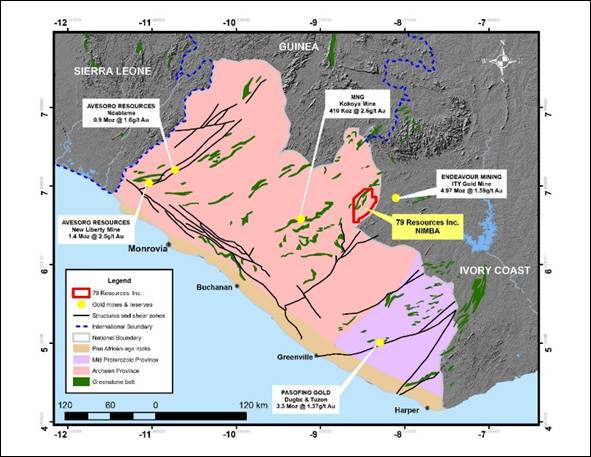
Figure 1: Location map of the Nimba Gold Project licence in Liberia and neighbouring mines
Previous work by Hamak has included geochemical soil sampling, ground geophysics, trenching, rock chip sampling and diamond drilling. This work led to the early discovery of an outcropping (at surface) gold mineralised greenstone unit at a site called Ziatoyah. Initial drilling below the Ziatoyah outcrop returned a significant gold intersection of 20m at 7g/t Au near surface, which included 5m at 22g/t Au (Figure 2).
Ziatoyah Outcrop and Drilling
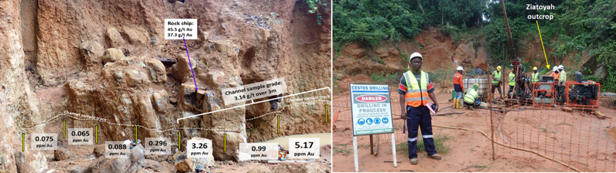
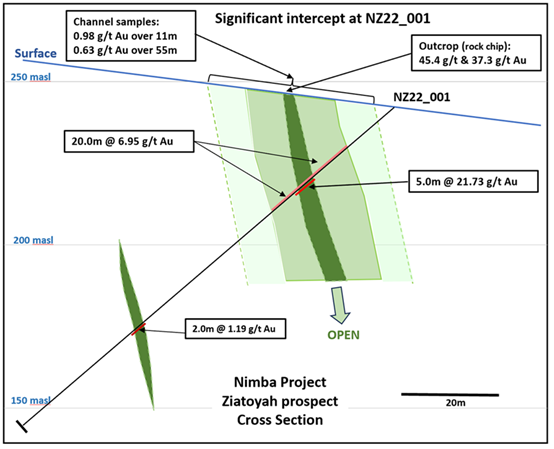
Figure 2: Section through two drill holes at Ziatoyah showing Au intercepts
The discovery site is located on the edge of an extensive gold-in-soil anomaly that covers an area of 5.7km by 1km which suggests that the gold mineralization extends for some distance beyond the discovery area (Figure 3).
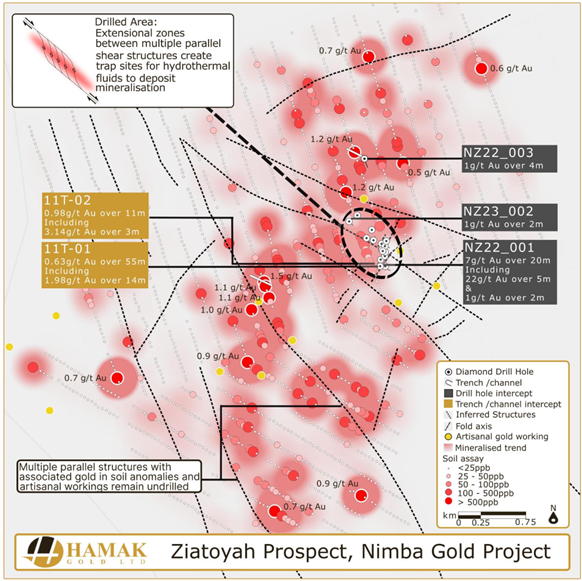
Figure 3: Nimba Gold Project gold-in-soil anomaly and the Ziatoyah discovery outcrop
Following a review of all exploration data, it is now believed that regional-scale folds and probable associated parasitic folds should be considered the primary exploration targets across the Nimba Licence. Although there has not been any updated defined deformational history for the prospect, there are clear signs that the area has undergone more than one deformational event judging by the structural trends discernible at map scale (Figure 4).
As a result, the Company undertook additional detailed field mapping during the report period to become more conversant with the stratigraphic, lithological, alteration patterns and structural controls to the mineralisation at the Ziatoyah prospect.
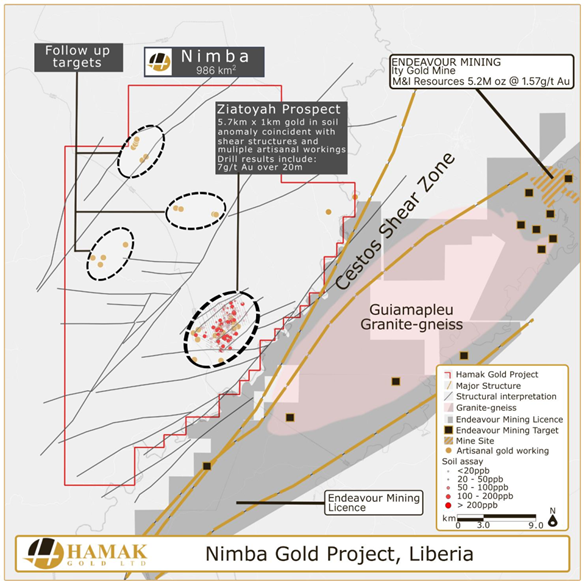
Figure 4: Structural geology of Nimba Gold Project with secondary splays off the main Cestos Shear Zone
Joint Venture with First Au Limited
In early 2025 Hamak and FAU signed a binding term sheet to enter into a joint venture agreement over the Nimba licence. After completing its due diligence, FAU and Hamak signed the agreement and announced on the 21st May 2025, as follows:
Hamak Gold and First Au Limited have entered into a binding terms sheet dated 15 May 2025. The terms give the right for FAU to progressively earn up to a 70% interest in 79 Resources Inc, the 100% owned subsidiary of Hamak Gold which directly holds the Nimba licence, through funding exploration work at Nimba as well as issuing up to £627,473 (A$1.3 million) of FAU shares (or combination of cash/shares) to Hamak Gold Limited over the next nine months. FAU will then have the option to further increase its interest to full ownership in the project should results justify, in return for continued project expenditure and the issue of a further £289,603 (A$600,000) shares in FAU, being a possible total consideration of £917,077 (A$1.9 million). All shares issued by FAU will be subject to a six-month voluntary escrow period from time of issue. Furthermore, subject to resource milestones being achieved, FAU will issue up to £965,344 (A$2 million) shares in FAU to Hamak Gold, in two equal tranches of A$1 million each. The first tranche will be issued when a compliant indicated mineral resource estimate of at least 750,000 ounces Au at a grade of >1.1 g/t Au, is declared. The second tranche will be issued when the compliant indicated mineral resource estimate is declared at 1.5 million ounces Au at a grade of >1.1g/t Au, within five years of the date of issue. Figures stated are converted at a current exchange rate of £1 to A$2.07.
On the 27th June 2025 completion of the due diligence was announced.
FAU Joint Venture Work in 2025
FAU shipped two new drill rigs to Liberia in the first half of 2025 and immediately deployed one rig to Nimba. Pending the arrival of the drill rig, FAU and Hamak geologists continued detailed geological mapping of various outcrops and structures to guide the planned drill programme, which was originally stated as 3,000m for the season.
FAU eventually drilled 11 holes for 1,570m. The first hole targeted a deeper extension of the Hamak discovery hole and made significant intercepts (announced 8th October 2025) as follows and as shown on Figure 5;
Hole FADD25-001 intersected a wide mineralised zone of 29m at 0.97g/t Au from 49m to 78m
o Including 23m at 1.15g/t Au from 49m to 72m depth, with individual high-grade intersections of 4.1g/t Au, 3.1g/t Au, 2.7g/t Au, 2.3g/t Au and 2.0g/t Au
· A deeper intersection also yielded 8m at 2.55g/t Au from 130m to 138m
o Including 2m at 8.37g/t Au with individual intersections of 7.7g/t Au and 9.1g/t Au
· These intersections confirm the continuity of mineralisation at depth from the first Hamak drilling that intersected 20m at 7g/t Au closer to surface
· The gold mineralisation remains open at depth
Drill Results at Ziatoyah Gold Discovery
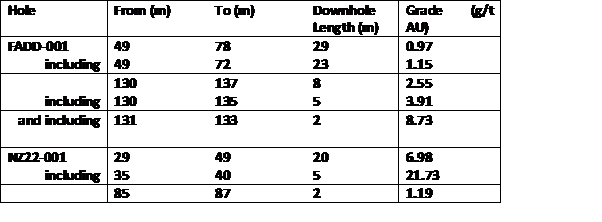
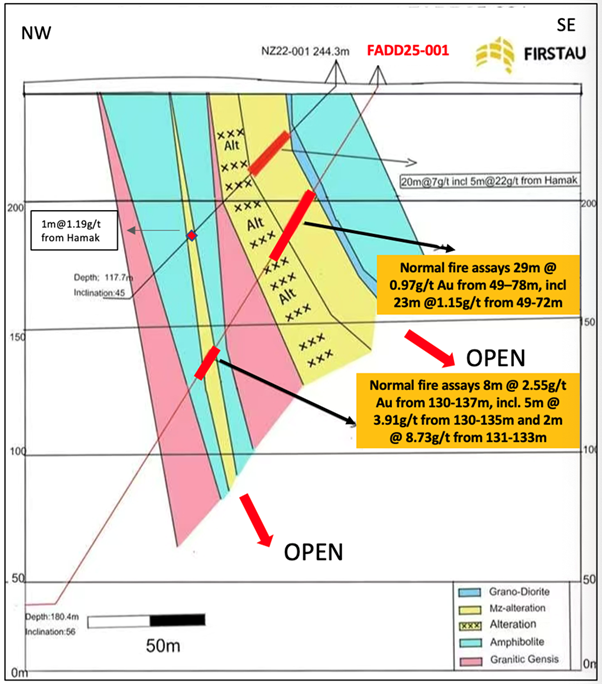
Figure 5: FAU and Hamak Drill Section
Visible gold was seen in the drill core from this intersection, shown here;
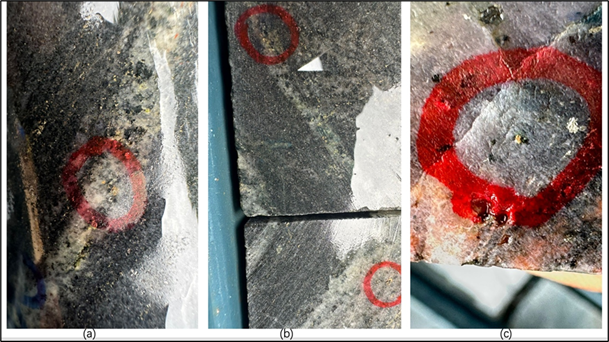
Further holes drilled by FAU towards the northeast of this discovery site were not as successful, returning mostly low tenure gold results which shows that although some holes were mineralized they were not as compelling as at Ziatoyah.
It is clear that the gold mineralization discovered at Nimba is hosted in structurally complex units. Therefore, the drilling was paused and it was decided to complete infill geochemical soil sampling across the key areas of the original anomalies. The infill sampling was conducted on a 50m x 50m grid essentially infilling the 250m line spacing of the past surveys. Although this work continued slightly beyond year end, the total samples collected was 2,010 (Figure 6). These samples remain to be consigned to the laboratory for assay.
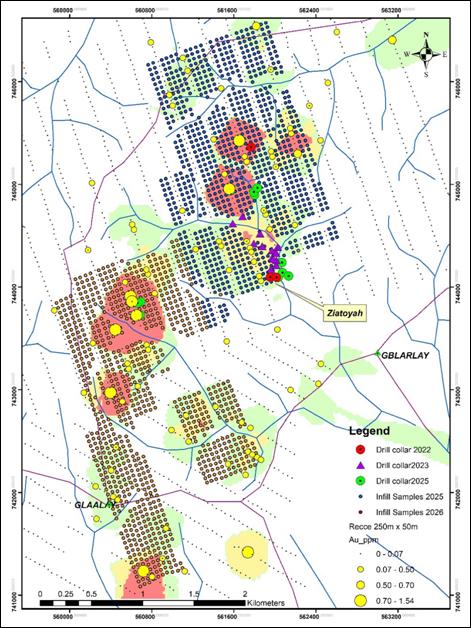
Figure 6: Nimba Infill Geochem Sampling
Termination of FAU Joint Venture
Post period, on the 30th January 2026, Hamak and FAU announced a termination of the JV on Nimba as FAU sought to refocus its exploration strategy on Western Australia.
During the JV, FAU committed to spend a minimum of A$600,000 (US$420,000) on the project. In addition, Hamak has received 100m shares in FAU as well as A$250,000 (US$160,000) in cash, in return for issuing FAU a 35% interest in the Nimba project. Both Hamak and FAU have agreed that the 35% interest in Nimba will be returned to Hamak in return for a future Net Smelter Royalty of 2%, which Hamak can repurchase at the production stage for US$1 million for each percentage. Hamak agreed to sell its 100m shares in FAU off market for A$750,000 (US$525,000), being a 17% discount to the 15 day VWAP of the FAU share price. Hamak has received the full A$750,000 of cash receipts.
Nimba Project: Next Steps
Hamak is currently negotiating a joint venture agreement with a new potential partner which, if successful, will see a new group fund the ongoing exploration costs at Nimba. This would include further drilling and sampling with the objective of advancing towards the declaration of a maiden resource statement.
Akoko Project: Ghana
On the 3 December 2025 Hamak announced that it had secured an exclusive option to acquire the Akoko Gold Project in Ghana from a private UK company called CAA Mining. Hamak was given an exclusive four-month period to undertake a thorough due diligence which was completed post year end, as announced on the 3 March 2026.
Akoko Option Agreement
Hamak holds an exclusive option agreement with CAA Mining to acquire the Akoko Gold project. The key terms of the option agreement are as follows:
Subject to satisfactory confirmatory work during which Hamak has committed to spend £500,000 on exploration activities, Hamak will have the right to exercise its option any time prior to 14 December 2026 to purchase the Akoko licence via the CAA option with Topago through the payment of £50,000 cash to CAA and the issue of £1 million of new Hamak shares to CAA or its nominees. These shares will be issued at a 10% premium to a 30-day VWAP prior to the notice of the exercise and will be subject to a six-month escrow period. In addition, Hamak will pay at exercise US$1.9 million in cash to Topago Mining, the local holder of the Akoko licence.
On completion of the acquisition and on entering into commercial production, CAA will be awarded a Net Smelter Royalty of 0.5% on gold production up to 250,000 ounces and thereafter a 1% on gold production from 250,000 ounces to 1 million ounces, capped. Hamak has the right of first refusal to purchase the CAA royalty.
The proposed acquisition price of cash and shares equates to US$8 to 10 per ounce of gold.
Akoko Location
The Akoko Project is located 25km south of Tarkwa in the Ashanti greenstone belt of Ghana centred approximately 45km west northwest of Takoradi, Ghana's second port and primary locus for the import and fabrication of mining equipment and approximately a three-hour drive from the capital Accra (Figure 7). The project lies close to the primary mining centres at Tarkwa and Obuasi where major equipment suppliers and internationally accredited laboratory services are readily available.
The Ashanti belt of Ghana is the most significant area of gold mineralization in the Paleoproterozoic terrane of West Africa. The area, located in southwest Ghana, is covered by lithologies of the volcanic-sedimentary Birimian Supergroup and the overlying clastic sedimentary Tarkwaian Group. Both packages are highly deformed with widespread isoclinal folding and regional bedding-parallel cleavage attributed to regional northwest-southeast compression during the peak of the Eburnian Orogeny c. 2100 Ma. Regional northeast striking shear zones parallel to the belt margins are also assumed to have developed during peak Eburnian and appear to be fundamentally important in the development of the famous Birimian gold deposits for which Ghana is well known including Ashanti, Prestea-Bogosu, Konongo, and Bibiani. The proposed Akoko acquisition is in the south-western margin of the famous Ashanti Gold Belt.
The Nzema gold mine, owned by Adamus Resources Ltd, is located approximately 17km west of Akoko and is exploiting both oxide and sulphide ores from open pit mining and has potential for expansion through adjacent license areas held by the Company and by infrastructure upgrades.
The Iduapriem Mine, 22km along strike to the NNE of Akoko operated by Anglo-Gold Ashanti is a multiple open-pit operation which produced 237,000ozs in 2024 and has 1.79Mozs in reserves.
The Tarkwa mine, owned by Goldfields, is located approximately 30km NNE of Akoko, is one of the largest gold mines in Ghana, the mine has estimated reserves of 15.1Mozs of gold. In 2024 Tarkwa mine produced 551,000ozs of gold and held Proved and Probable attributable Mineral Reserves amounting to 4.35Mozs. Goldfields also operate the Damang Mine, some 60km NNE of Akoko.
The Prestea Gold Mine is located around 35km NNE of Akoko, Blue Gold Corp recently announced that it had secured US$140m in committed funding to finance the restart of the Bogoso and Prestea gold mines where reserves total 5.1Mozs.
The Wassa Mine located 75km NE of Akoko, 90% owned by Golden Star Resources, a multi-deposit operation commenced production from surface operations in 2005 and in 2018 transitioned into an underground-focused operation with reserves of 10.8Mt @ 3.1 g/t Au and annual gold production of around 150,000ozs per annum. Wassa's Southern Extension project provided additional life of mine and as of December 2024, the Wassa Underground Mining Project was under construction.
The geology seen on the Akoko Permit and the known mineralization seen in previous drilling confirms the potential of the licence to hoist economic gold mineralization in similar geologic settings to that elsewhere in the district.
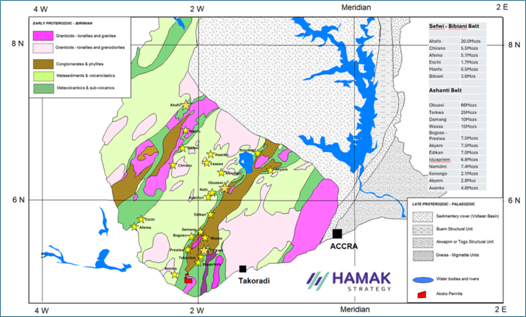
Figure 7: Location of Akoko Project in Ghana
Akoko Licence
The Akoko Prospecting Licence is held by Ghanaian registered private company Topago Mining Limited and covers a total area of 89.79km², through two separate non-contiguous areas being Akoko North 11.33km2 and Akoko South 78.46km2. The licence was recently renewed on the 7 June 2024 for a period of three further years, expiring on the 6 June 2027.
The licence area covers part of the southwestern portion of the Ashanti Belt and occurs within a wide band of Birimian metavolcanics and metasediments just south of the Tarkwaian sediments to the north and the large Prince's Town type granitoid intrusive complex to the south. The concession area extends onto the Prince's Town granitoids and extends westward to cover its western contact with the metavolcanics. This area has not been mapped in recent times and the geology and structure of the area remains poorly understood.
Historical Exploration at Akoko
Various phases of work have been undertaken on the Akoko licence areas since 2007. Overall, some 2,670 soil geochemical samples were collected, and assay results are available. Most of these samples have been focussed on the southwestern corners of the Akoko North and South licences (Figure 8).
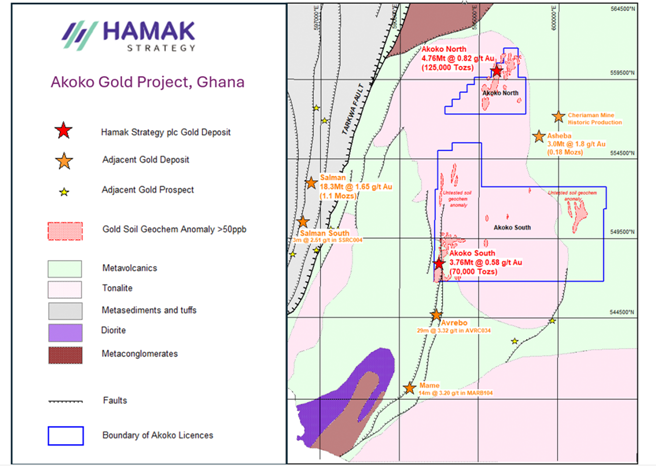
Figure 8: Geochemical Sampling and Anomalies at Akoko
The eastern portion of the Akoko Project has been subject to very limited exploration. Soil traverses were completed on mainly 1,600m spacings to extend soil coverage to the eastern limits of the licence area. This work successfully defined several new extensive gold anomalies and trends that now require infill sampling and mapping. At Akoko North nine well defined anomalies that aggregate of over 10 strike kilometres are also defined offering immediate targets for drill testing.
The CAA data room on Akoko also contains information for 16,628m of 202 reverse circulation drilling and 4 diamond drill holes. The reverse circulation drilling at Akoto North and South indicates that significant gold mineralization occurs within near surface horizontal zones up to 150m wide. These zones are laterally continuous and can be traced along strike for at least one kilometre. The mineralized zones are typically hosted within weathered basalts and quartz veining is common.
The results from the diamond cored holes are consistent with the interpretation that the oxide gold mineralization at Akoko North and South is part of a flat lying supergene enriched zone.
Significant intersections from this work included 12m@ 2.68 g/t gold from 24m in hole 11ANDD02 and 11.8m @ 3.24 g/t gold from 0.7m in hole 11ANDD03.
The mineralized zones are strongly weathered offering excellent physical mining characteristics by simple ripping and at low cost.
Historical Akoko Gold Resource Estimates
The Akoko gold deposits are hosted within metasediments and metavolcanics. The mineralised lodes are flat lying with a slight plunge to the north. Mineralization ranges from 20-50m wide and 5-20m thick, is often associated with quartz veining. Most of the Resources defined occur within surficial materials produced by extensive weathering and complete oxidation to 20-40m below surface and which show no obvious lithological controls. Mineralization is interpreted to be primary in nature with little movement from source (Figure 9).
The former producing Akoko Gold mine is located between the Akoko North and South licence blocks and was historically mined in the late 1890's and early 1900's, with gold grades of 25g/t Au reported. In the 1930's mining from deep shafts exploited quartz veins with grades of 20-30g/t Au reported, before the mine closed.
More recent work from 2007, including by Topago, has defined two separate (non-JORC compliant) resources at Akoko North and Akoko South totalling 276,500 ounces at a grade of 1.6g/t gold (0.2g/t cut-off), (See Below Table). However there remains significant exploration potential to the north, south and east of these resources, as evidenced by extensive, untested gold in soil geochemical anomalies (Figure 8).
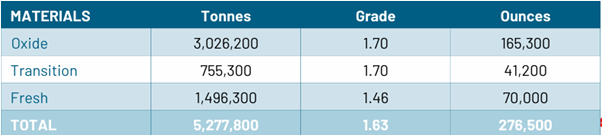
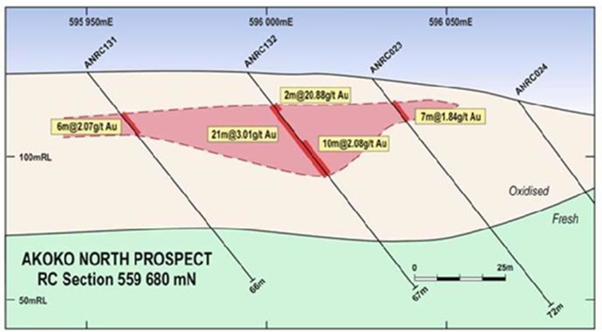
Figure 9: Simplified geological section through the Akoko North resource area showing the outline of the mineralization within the oxide zone
Remodelling of Akoko Gold Resource Estimates
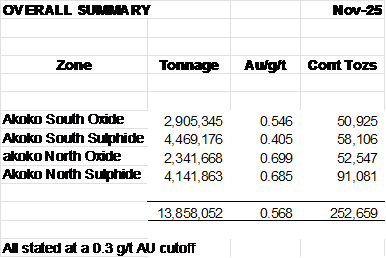
Hamak's independent consulting geologist Dr. Colin Andrew has taken a more conservative approach to the resource modelling, essentially to provide a worst-case scenario so the Company can assess the downside risk to the project. Using an economic cut-off grade of 0.3g/t Au, the resource has been defined as having a much larger tonnage potential but at a lower grade, however delivering essentially a similar gold resource of 252,569 oz Au for both the oxide and sulphide material.
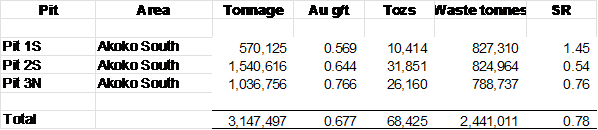
Taking a further conservative view, Hamak's consultant also looked at the mining potential of just the oxide material that can be exploited in an open pit mine scenario, with overall pit walls at a 25% angle and gold recovery assumed at 75%. Three readily exploitable pits have been identified and modelled, two on the Akoko South resource (Pits 1S and 2S) and one on the Akoko North resource (Pit 3N). Combined these pits could deliver over 68,000 oz of extractable gold ore at a strip ratio of 0.78.
Based on the detail of the drilling and modelling, Dr. Colin Andrew stated that these resources could be classified in the Indicated Resource category with high level of confidence. A minimum four-year life of mine at 750,000 tons per annum could be envisaged, which could be extended further by mining laterally and deeper into more gold mineralized oxide material and at greater depths into the gold bearing sulphide material, as open pit operations with staged pit pull-backs.
Akoko: Next Steps
Clearly the Akoko project has significant potential to be advanced into a development and production project. However, Hamak will conduct some confirmatory and infill drilling of the existing Akoko resources to better estimate the resources to a JORC classification. A 4,125m reverse circulation drilling campaign is going to be implemented in Q2-26, along with fire assay of the drill samples and some metallurgical studies on the material produced. In addition, Hamak will retain an independent consulting group to undertake a Preliminary Economic Assessment of the Akoko gold mine potential, to include an estimate of capex, opex and revenues for an open pit heap leach gold mining operation.
It is envisaged that all this work will be completed before the end of 2026 and allow for Hamak to make an informed decision on whether to exercise its exclusive option to acquire the Akoko gold project on the binding terms outlined above.
Business plan and strategic objectives
The Group's strategic objectives are to be a successful mineral exploration company that through deploying systematic exploration techniques or acquisition can lead to the discovery of a significant gold resources in the short to medium term (two to five years) on its mineral exploration properties in Liberia and Ghana, and other potential jurisdictions in West Africa. The Group will seek to achieve these aims through exploring its own licence areas and by identifying and securing quality gold assets. The Directors believe that pursuing a gold strategy in a market of record gold prices is appropriate and will seek to advance its projects to the resource and potentially development stages in a pursuit of creating value and returns for shareholders.
In addition, the Company has established a Treasury policy that complements gold exposure by providing access to digital monetary instruments with asymmetric upside. The Company's Treasury strategy aims to achieve:
· Steady accumulation of Bitcoin and physical gold as core treasury reserve assets;
· Creation of yield-generating strategies within risk-controlled frameworks;
· Maintained compliance with the UK Financial Conduct Authority and international AML/KYC standards;
· Diversified custody and jurisdictional exposure to mitigate regulatory risk.
The Group's growth strategy and medium-term roadmap includes:
· Securing a new Joint Venture Partner for the Nimba project to advance the gold discovery to the resource stage;
· Advancing the Akoko Project to a compliant gold resource status with the delivery of a Preliminary Economic Assessment to support the decision to exercise the option to acquire the project;
· Continuing to evaluate new opportunities to expand our West African gold exploration portfolio;
· Scaling the Bitcoin Treasury within defined allocation limits;
· Pursuing yield and hedging strategies to stabilise returns;
· Identifying and evaluating strategic M&A opportunities to diversify asset exposure.
There are a number of risks associated with junior resource companies at the early exploration stage in the natural resources sector, especially in West Africa. The Board regularly reviews the risks to which the Group is exposed and endeavours to mitigate them as far as possible.
The following summary, which is not exhaustive, outlines some of the risks and uncertainties the Group may be exposed to:
Treasury Policy
The Company maintains some of its treasury reserves and surplus cash in Bitcoin, a form of cryptocurrency, and physical gold. The Company is not authorised or regulated by The Financial Conduct Authority (FCA) and Bitcoin investments are generally not subject to regulation by the FCA or otherwise in the United Kingdom. Neither the Company nor investors in the Company's shares are protected by the UK's Financial Ombudsman Service or the Financial Services Compensation Scheme.
The FCA considers Bitcoin investments to be high-risk. The value of Bitcoin can go up as well as down, leading to fluctuations in the value of the Company's Bitcoin holdings, and the Company may not be able to realise its Bitcoin holdings for the same amount it paid to acquire them, or even for the value the Company currently attributes to its Bitcoin positions.
The Company's Board of Directors have identified the following risks in relation to the holding of Bitcoin, which are not exhaustive:
• The value of Bitcoin can be highly volatile, with its value falling as quickly as it rises. Investors in Bitcoin must be prepared to lose all money invested.
• The Bitcoin market is largely unregulated. There is a risk of losing money due to factors such as cyber-attacks, financial crime, and counterparty failure.
• The Company may not be able to sell its Bitcoin at will. The ability to sell Bitcoin depends on various factors, including the supply and demand in the market at the relevant time. Operational failings such as technology outages, cyber-attacks, and comingling of funds could cause unwanted delays.
• Crypto assets carry a perception of fraud, money laundering, and financial crime.
The Company's Treasury Policy seeks to mitigate risks by, for example, dealing only with accredited parties and monitoring of the Company's holdings, and has added crypto expertise to its Advisory Board to provide additional skills and experience which can be called upon as required.
Political conditions, government regulations, macroeconomic volatility and regulatory risks
The Company's performance and growth may be constrained by delays or shutdowns due to political, commercial or legal instability in Liberia and Ghana. The ability of the Company to generate long-term value for shareholders could be impacted by these risks.
Changes may occur in local political, fiscal and legal systems, which might adversely affect the ownership or operation of the Group's interests including, inter alia, changes in exchange rates, currency, exchange control regulations changes in government and in legislative, fiscal and regulatory regimes. The Group's strategy has been formulated in light of the regulatory environment as at the latest practicable date prior to the publication of this Document and what are deemed to be probable future changes (though due regard should be given to the uncertainty in making predictions involving political governance risks).
Regional instability due to corruption, bribery and generally underdeveloped corporate governance policies have the potential to impact the Group's performance in Liberia and Ghana and, as a result, the Company's share value. These risks could have a materially adverse effect on future profitability, the ability to finance or, in extreme cases, the viability of the Group. Management has strong connections in Liberia including at governmental level to enable it to take timely action should this be necessary to mitigate such risks.
Within Liberia, a number of economic and political factors have contributed to a lack of infrastructure investment. As such, the country lacks well-developed infrastructure connections, which could impact the profitability of the Group. The Group will assess the requirement for infrastructure required to economically mine its assets when these projects are further advanced.
Economic challenges in Liberia and Ghana, including high rates of unemployment, may lead to a reduction in local, skilled workforce such that geologists, mining engineers and other technically qualified and skilled individuals have gone abroad for work. In the past international investors were reluctant to deploy capital to Liberia, leading to significant underinvestment within its exploration and mining sector. Although improving, these factors may create operational challenges for the Group. The Group has contacts in the country to assist in securing suitably qualified personnel when required for operations.
The licences held are subject to various laws and regulations relating to the protection of the environment and the Group is also required to comply with applicable health and safety and other regulatory standards. Environmental legislation can comprise numerous regulations which might conflict with one another, and which cannot be consistently interpreted. Such regulations typically cover a wide variety of matters including, without limitation, prevention of waste pollution and protection of the environment, labour regulations and worker safety. The Group may also be subject under such regulations to clean-up costs and liability for toxic or hazardous substances which may exist on or under any of its properties or which may be produced as a result of its operations. The Group intends to operate in accordance with high standards of environmental practice and comply in all material respects and currently is not subject to any fines or liability or clean-up cost in relation to environmental rehabilitation.
Any failure to comply with relevant environmental, health and safety and other regulatory standards may subject the Group to liability, fines and/or penalties and have an adverse effect on the business and operations, financial results or financial position of the Group. Furthermore, the future introduction or enactment of new laws, guidelines and regulations could serve to limit or curtail the growth and development of the Group's business or have an otherwise negative impact on its operations. Any changes to and increases in current regulation or legal requirements, with the enforcement thereof, may have a material adverse effect upon the Group in terms of additional compliance costs.
Renewal of licences as allowed in the Mines Acts of Liberia and Ghana is dependent on the Company maintaining them in good standing on an annual basis. The Nimba and Akoko licences are valid and in good standing at the time of this report.
Management has strong connections in Liberia including at governmental level to enable it to take timely action should this be necessary to mitigate such risks.
Climate Related Financial Disclosures
The Company provides disclosures under the framework recommended by the Task Force on Climate Related Disclosures (TCFD). These are designed to help investors and wider stakeholders understand how companies are managing climate related financial risks.
Gold mining plays a vital part in the economic and social development of many emerging or developing economies and the West African countries of Ghana and Liberia are no exception in this regard as it is likely to be vulnerable to the disruptive and potentially destructive impacts from climate change and extreme weather events. Liberia has currently two operating gold mines and a number of small explorers actively engaged in mineral exploration. There is therefore a likelihood, even expectation, of new discoveries and hence additional mines coming into production in Liberia in the near future. Ghana is the largest gold producing country in Africa and has a well-established gold mining sector with numerous multi-million-ounce mines in production in the area where Akoko is located. The Group, which currently is in the exploration phase, is not aware of current climate-related impediments but monitors risks and physical impacts in order to implement better plans to prepare for and adapt to risks arising.
Climate change risks and impacts on gold exploration in Liberia
There is a wide range of factors that influence the adaptation and resilience to climate change in gold mining. However, at the prospecting or exploration level, the main risks to our operations are physical factors manifested in acute impacts (severe and short-term) and chronic impacts (long-term, gradual change). Acute physical risk can be in the form of extreme weather and weather-related events such as excessive rainfall (during the wet season) or wildfires (during the dry season) while chronic impacts refer to enduring changes and shifts in, for example, air and land temperatures. Since our gold exploration activities are focused on the interiors of Ghana and Liberia, coastal and sea level impacts are negligible. However extreme weather conditions may pose challenges to access to site and lead to delays in exploration activities.
Management conducts its operations in the light of seasonal weather conditions to mitigate risk.
Gold exploration activities
The nature of our work involves the collection and analysis of samples of various materials, ranging from rocks and earth (soils) to stream sediments in our search for anomalous quantities of gold or gold-related minerals in the natural geological environment. These samples are small amounting to a few kilograms of material and are collected by teams of geologists (comprising 2 to 3 individuals). Remote sensing exploration techniques, including geophysics, are practiced occasionally while drilling of small diameter holes (to ~ 100 - 150m) into the bedrock is also carried out - once anomalies have been identified from the sampling programmes. Trenches and pits may be periodically excavated and material sampled. These mobile exploration activities are conducted from temporary, often tented, camps and bases with special attention to the maintaining of cordial and sound relations with our host communities in the various villages impacted by our presence.
For the purposes of financial reporting requirements and disclosure, at our current level of operations, climate-related risks are negligible. Should exploration activities lead to a discovery and hence more permanent, year-round, activities, the Company will reassess its position with regard to climate-related management.
Limited operating history
The Company was formed and listed on the LSE in March 2022. The Board and Management of the Group have considerable exploration, development and mining experience in the West Africa region, in particular in Liberia, Sierra Leone and Guinea. Furthermore, the Board has evolved to include experienced market facing members with decades of financial and City experience. The establishment of an Advisory Board has also brought into the company vast experience in the Crypto, blockchain and resource sectors.
Exploration and development risks
Following the Group's early exploration success in the Nimba licence, there still remains a high degree of risk as mineral exploration and development can be highly speculative and to date no mineral resource has been defined. The economics of developing mineral properties are also affected by many factors including the cost of operations, variations of the grade of ore mined, fluctuations in the price of the minerals being mined, fluctuations in exchange rates, costs of development, infrastructure and processing equipment and such other factors as government regulations, including regulations and tariffs relating to royalties, allowable production, importing and exporting of minerals and environmental protection.
In addition, the grade of mineralisation ultimately mined may differ from that indicated by drilling results and such differences could be material. As a result of these uncertainties, there can be no guarantee that mineral exploration and development of any of the Group's investments will result in profitable commercial operations.
Financing risk
Whilst the Directors are confident that the Group will be able to raise additional funds as and when required and is expected to raise sufficient funds to continue to meet its liabilities as they fall due for at least 12 months from the date of approval of the consolidated financial statements there can be no assurance that such funds as may be required will be raised. However, since the listing the Company has successfully concluded a number of placings with the support of Directors, Management and shareholders and therefore the Directors are confident of successful future fund raises. The Company, where necessary, will seek to attract funding partners into its project developments and the Board has significant experience in negotiations and securing joint venture partnerships.
Industry-specific risks
The natural resources sector is inherently tied to the performance of the global economy and fluctuations in the price of global commodities. As a result, segments of the natural resources sectors (or even the sector as a whole) could be affected by changes in general economic activity levels and other changes which are beyond the Group's control. The revenues and earnings from developing its assets will rely on commodity prices, and the Group will be unable to control the prices for commodities which may adversely affect the Group's business, results of operations, financial condition or prospects.
Key performance indicators
Appropriate key performance indicators will be identified in due course as the business strategy is implemented.
Gender analysis
A split of directors by gender who served during the year is shown below:
Male | Female |
7 | 1 |
Directors and employees
The Group currently has three male directors and one female director and is committed to promoting gender equality based on relevant skills and experience as it progresses through its life cycle. At the current stage of exploration, the Group has previously sourced individuals with experience not only in the sector but also in the wider West African and African settings, although at the date of the report none are directors of the listed parent companies. However, at the subsidiary company level the Company has retained local directors who have experience in the country of operations and have strong connections with Governments and Ministries. The Board was for part of the year diversified from an ethnicity perspective during the financial year, having two Directors of African heritage which is appropriate given the Company is a Liberian and Ghanaian focused entity. The information provided is based on the updated personnel records maintained by the Group.
Environment, Social and Corporate Governance (ESG)
As a new Group focused on exploration and development, we aim to conduct our business with honesty, integrity and openness, respecting human rights and the interests of our shareholders, employees and local community stakeholders. We aim to provide timely, regular and reliable information on the business to all our shareholders and conduct our operations to the highest standards.
Environment
The Group submitted environmental licence reports and applications to allow for exploration to continue in the Nimba licence during the year. Environmental permits are issued by the Environmental Protection Agency (EPA) of Liberia according to the prevailing laws of the country. Since the exploration is at an early stage there is no significant rehabilitation work required. All sampling holes are back filled at the end of the sampling process. Trenches are ring fenced during excavation and back filled after completion. Drill pads are cleaned and levelled after each hole. In the tropical environment of Liberia vegetation rehabilitation is natural and rapid.
In Ghana the Company will apply for an environmental permit in 2026 to enable it to conduct its planned drilling and exploration activities.
Social
The Group, along with, during the period of the joint venture, its joint venture partner, has conducted extensive exploration work at the Nimba licence during 2025. The Group adheres to the social requirements within the country of working with local communities at all times, engaging with them so they are aware of our activities and where possible recruiting labour from nearby communities. According to the Minerals law, there is a requirement for the Group to contribute to community development the equivalent of 2% of the year's exploration expenditure on any mineral exploration licence, in arrears which was made during the year.
Corporate Governance
Being a public Group listed on the LSE Main Market, the Group adheres to all required governance rules as stated in the Corporate Governance Statement and has in place the necessary structure of Board committees to oversee the business of the Group to ensure adherence to best practice procedures.
Health and Safety
Although Hamak Strategy has a relatively small staff contingent in Liberia and Ghana, the Company strives to create a safe and healthy working environment for the well-being of its staff and contractors and create a trusting and respectful environment, where all members of staff are encouraged to feel responsible for the reputation and performance of the Group. As the Company grows, it aims to establish a diverse and dynamic workforce with team players who have the experience and knowledge of the business operations and markets in which we operate. Through maintaining good communication, members of staff are encouraged to realize the objectives of the Group and their own potential.
N Horlick
Non-Executive Chair
29 April 2026
Consolidated Statement of Comprehensive Income For the year ended 31 December 2025 |
| ||
Continuing operations | Notes | Year ended 31 December 2025 $'000 | Year ended 31 December 2024 $'000 |
General and administrative expenses | 7 | (1,208) | (684) |
Revaluation loss on bitcoin intangible asset | 10 | (616) | - |
Gain on revaluation of financial assets at FVTPL | 9 | 238 | - |
Loss on sale of a FVTPL financial asset | 18 | - | (219) |
Gain on the extinguishment of financial liabilities | 19 | 109 | - |
Impairment of exploration cost | 15 | - | (170) |
Loss from operations |
| (1,477) | (1,073) |
Finance income | 11 | - | 24 |
Finance expense | 11 | (228) | (41) |
Net foreign exchange gains/(losses) | (129) | 6 | |
(Loss) before taxation |
| (1,834) | (1,084) |
Income tax | 12 | - | - |
Total (loss) for the year |
| (1,834) | (1,084) |
|
|
| |
| |||
Total comprehensive loss for the year attributable to shareholders from continuing operations |
| (1,834) | (1,084) |
| |||
Earnings per share: |
|
| |
Basic and diluted earnings per share (USD) | 13 | (0.01) | (0.02) |
Consolidated Statement of Financial Position | ||||
As at 31 December 2025 | ||||
|
|
Note |
2025 |
2024 |
|
| $'000 | $'000 | |
|
|
|
| |
Non-current assets |
| |||
Property, plant and equipment |
| 14 | 26 | 12 |
Intangible assets - exploration and evaluation |
| 15 | 2,258 | 1,921 |
Intangible assets - cryptocurrency | 15 | 1,750 | - | |
Total non-current assets |
|
| 4,034 | 1,933 |
| ||||
Current assets |
|
| ||
Trade and other receivables | 16 | 51 | 35 | |
Financial assets carried at FVTPL | 9 | 467 | - | |
Cash and cash equivalents | 3,110 | 27 | ||
Total current assets |
|
| 3,628 | 62 |
|
|
|
| |
Total assets |
|
| 7,662 | 1,995 |
|
| |||
Equity and Liabilities
|
|
| ||
Equity attributable to owners of the parent |
|
| ||
Share capital and share premium | 19 | 7,807 | 4,261 | |
Share-based payment reserve | 20 | 165 | 25 | |
Retained earnings | (4,597) | (3,356) | ||
Total equity |
|
| 3,375 | 930 |
|
| |||
Non-current liabilities |
|
| ||
Loans and borrowings | 18 | - | 315 | |
Financial liabilities carried at FVTPL | 20 | 252 | - | |
Derivative financial liability | 18 | - | 78 | |
Total current liabilities |
|
| 252 | 393 |
|
| |||
Current liabilities |
|
| ||
Trade and other payables | 17 | 357 | 669 | |
Loans and borrowings | 18 | 3,446 | 3 | |
Derivative financial liability | 18 | 232 | - | |
Total current liabilities |
|
| 4,035 | 672 |
Total liabilities |
|
| 4,287 | 1,065 |
| ||||
Total equity and liabilities |
|
| 7,662 | 1,995 |
These financial statements were approved and authorised for issue by the Board of Directors on and were signed on its behalf by:
Nicholas Karl Smithson
Executive Director
Consolidated Statement of Changes in Equity
For the year ended 31 December 2025
Share capital and share premium | Share based payment reserve | Retained earnings | Equity attributable to owners of the parent |
Non-controlling interests |
Total equity | |
$'000 | $'000 | $'000 | $'000 | $'000 | $'000 | |
Balance at 1 January 2024 | 3,805 | 16 | (2,272) | 1,549 | - | 1,549 |
Loss for the period | - | - | (1,084) | (1,084) | - | (1,084) |
Total comprehensive income for the period | - | - | (1,084) | (1,084) | - | (1,084) |
| ||||||
Transactions with owners in their capacity as owners: |
| |||||
Issue of share capital | 475 | - | - | 475 | - | 475 |
Share issue costs | (19) | - | - | (19) | - | (19) |
Share based payment - vesting | - | 9 | - | 9 | - | 9 |
Total transactions with owners | 456 | 9 | - | 465 | - | 465 |
Balance at 31 December 2024 | 4,261 | 25 | (3,356) | 930 | - | 930 |
Loss for the period | - | - | (1,834) | (1,834) | - | (1,834) |
Total comprehensive income for the period | - | - | (1,834) | (1,834) | - | (1,834) |
Transactions with owners in their capacity as owners: | ||||||
Issue of share capital | 3,748 | - | - | 3,748 | - | 3,748 |
Share issue costs | (202) | - | - | (202) | - | (202) |
Partial disposal of interest in subsidiary | - | - | (400) | (400) | 785 | 385 |
Reacquisition of interest of non-controlling interest | - | - | 986 | 986 | (785) | 201 |
New warrants granted | - | 138 | - | 138 | - | 138 |
Share based payment - vesting | - | 9 | - | 9 | - | 9 |
Share based payment - lapsed | - | (7) | 7 | - | - | - |
Total transactions with owners | 3,546 | 140 | 593 | 4,279 | - | 4,279 |
Balance at 31 December 2025 | 7,807 | 165 | (4,597) | 3,375 | - | 3,375 |
Consolidated Statement of Cash Flows For the year ended 31 December 2025 |
|
|
|
Notes | Year ended 31 December 2025 $'000 | Year ended 31 December 2024 $'000 | |
Cash flows from operating activities | |||
Loss before taxation | (1,834) | (1,084) | |
Adjustments for: |
| ||
Depreciation | 14 | 10 | 11 |
Impairment of Intangible Assets | 15 | - | 170 |
Share-based payment charge | 20 | 399 | 9 |
Finance expenses | 11 | 228 | 41 |
Finance income | 11 | - | (24) |
Gain on the extinguishment of financial liabilities | (109) | - | |
Loss on sale of financial asset carried at FVTPL | 18 | - | 219 |
(Gain) on revaluation of FVTPL financial assets | 9 | (238) | - |
Loss on revaluation of bitcoin intangible asset | 10 | 616 | - |
Directors' fees paid in shares | 5 | 67 | 71 |
Consultancy fees paid in shares | 98 | ||
Unrealised foreign exchange charge | 78 | (2) | |
Net cashflow before changes in working capital |
| (686) | (589) |
| |||
(Decrease)/Increase in payables | (161) | 240 | |
(Increase) in receivables | (16) | (10) | |
Net cash used in operating activities |
| (863) | (359) |
|
|
| |
Cash flows from investing activities |
|
| |
Exploration expenditure | 15 | (337) | (23) |
Acquisition of bitcoin intangible asset | 15 | (2,366) | - |
Proceeds from sale and buy-back of interest in subsidiary | 8 | 428 | - |
Purchase of PPE | 14 | (24) | - |
Net cash used in investing activities |
| (2,299) | (23) |
|
|
| |
Cash flows from financing activities |
|
| |
Issue of share capital (net of costs) | 19 | 3,166 | 248 |
Drawdown of borrowings | 18 | 3,100 | - |
Proceeds from sale of financial assets received in lieu of loan | 18 | - | 159 |
Net cash generated from financing activities |
| 6,266 | 407 |
|
|
| |
Net change in cash and cash equivalents during the year |
| 3,105 | 25 |
Cash at the beginning of year |
| 27 | 2 |
Exchange (losses)/gains on cash and cash equivalents | (22) | - | |
Cash and cash equivalents at the end of the year |
| 3,110 | 27 |
Related Shares:
Hamak Strategy