
5th May 2026 07:00

THIS ANNOUNCEMENT CONTAINS INSIDE INFORMATION FOR THE PURPOSES OF ARTICLE 7 OF REGULATION 2014/596/EU WHICH IS PART OF DOMESTIC UK LAW PURSUANT TO THE MARKET ABUSE (AMENDMENT) (EU EXIT) REGULATIONS (SI 2019/310) ("UK MAR"). UPON THE PUBLICATION OF THIS ANNOUNCEMENT, THIS INSIDE INFORMATION (AS DEFINED IN UK MAR) IS NOW CONSIDERED TO BE IN THE PUBLIC DOMAIN.
NOT FOR RELEASE, PUBLICATION OR DISTRIBUTION, IN WHOLE OR IN PART, DIRECTLY OR INDIRECTLY IN OR INTO THE UNITED STATES, AUSTRALIA, CANADA, JAPAN, THE REPUBLIC OF SOUTH AFRICA OR ANY OTHER JURISDICTION WHERE TO DO SO WOULD CONSTITUTE A VIOLATION OF THE RELEVANT LAWS OF SUCH JURISDICTION.
5 May 2026
Cobra Resources plc
("Cobra" or the "Company")
Resource Drilling Completed at Rare Earths Project
Initial assays support high value resource at Boland
Cobra (LSE: COBR), a South Australian mineral exploration and development company, is pleased to announce that resource definition drilling has been completed across its Wudinna rare earth prospects, Boland and Head.
A total of 74 drillholes (~3,200m) have been drilled at Boland and Head, designed to support an initial Mineral Resource Estimate ("MRE") for the project's unique, controlled aquifer-hosted ionic rare earth element ("REE") mineralisation which is amenable to low-cost in situ recovery ("ISR").
All samples have been submitted for analysis. Initial results from Boland provide encouraging observations for REE ionic mineralisation within the permeable Pidinga and Garford formations, where metallurgy and hydrology and natural acid generating potential support cost-efficient extraction to produce a market leading heavy REE carbonate.
Further results are anticipated through the coming months.
Highlights:
· A total of 32 drillholes were completed at the Boland prospect, where preliminary results from 14 drillholes include:
o CBSC0016 intersected 5.2m at 1,674 ppm TREO (38.3 ppm Dy2O3 + Tb4O7 ("Dy+Tb") and 363 ppm Nd2O3 + Pr6O11 ("Nd+Pr")) from 26.4m.
o CBSC0017 intersected 1.7m at 1,755 ppm TREO (34.7ppm Dy+Tb and 374 ppm Nd+Pr) from 26.4m.
o CBSC0018 intersected 7.2m at 1,751 ppm TREO (39.8ppm Dy+Tb and 363 ppm Nd+Pr) from 14m.
o CBSC0021 intersected 1.5m at 891 ppm TREO (13.9 ppm Dy+Tb and 209 ppm Nd+Pr) from 31.3m.
o CBSC0035 intersected 1.1m at 1,004 ppm TREO (34.7 ppm Dy+Tb and 228 ppm Nd+Pr) from 32.6m and 2.2m at 590 ppm TREO (18.2 ppm Dy+Tb and 145 ppm Nd+Pr) from 42m.
o CBSC0028 intersected 1.5m at 891 ppm TREO (13.9 ppm Dy+Tb and 209 ppm Nd+Pr) from 31.3m.
· In addition to REE analysis, samples are being analysed for Total Organic Carbon ("TOC") and total sulphide content. Acid is a primary cost of REE extraction. By determining the quantity of acid that can be generated from mineralisation, the Company will be able to model and demonstrate materially lower acid requirements. Management believes the project is on track for bottom quartile production costs.
· Particle sizing distribution is being performed to calculate permeability.
· Additional metallurgical analyses will be performed on samples from the Head prospect to support economic assessment.
· A total of 42 drillholes were completed across the Head prospect, where a strongly reduced ISR recoverable channel has been defined.
· Further results expected across the next 6-8 weeks.
· Independent technical consultants are being engaged to support both the MRE and Scoping (Order of Magnitude) Studies.
Rupert Verco, Managing Director of Cobra, commented:
"We are very pleased to have completed this drilling programme, which is the catalyst for the Company to demonstrate the project economics and commence the journey to commercialisation. The team has done an excellent job of completing a significant programme and capturing quality data that will underpin work streams designed to provide confidence in the design and assessment process.
The conflict in the Middle East, particularly in the Strait of Hormuz, has created a bottleneck in the global supply of sulphuric acid, a key consumable for the extraction of many critical minerals. The ability to organically generate our own sulphuric acid from our geological formations is a project elevator and should not be underestimated. Our approach to incorporate this within our resource modelling will add significant value to near term economic assessments.
Whilst grade is important, economics will be determined by a combination of permeability, metallurgy, acid generation, and grade. The quality of the samples obtained from sonic core drilling enables us to assess all these inputs. Covering all technical aspects at this stage in project development will bring forward the development timeline."
To watch a video of Rupert Verco, Managing Director discussing the completed programmes visit: https://investors.cobraplc.com/link/Pw7WKP.
Boland Results
The targeted formations to support ISR recoverable REEs are the Pidinga and Garford formations where permeable sand horizons contain ionic REE mineralisation. The basal sequence of the Pidinga formation is expected to yield the highest productivity. The Garford formation contains distinct interbeds that are yet to be test in laboratory and field hydrology tests, but is considered to deliver the parameters to achieve viable confined aquifer ISR.
Table 1: Significant Intersections from results received to date
CBSC0016 | 15.77 | 21 | 5.2 | Garford | 1,674 | 81 | 283 | 49 | 6.1 | 32 |
CBSC0017 | 16.3 | 21 | 4.7 | Garford | 566 | 27 | 89 | 16 | 1.9 | 10 |
CBSC0017 | 26.35 | 28 | 1.7 | Pidinga | 1,755 | 78 | 285 | 37 | 5.4 | 29 |
CBSC0018 | 14 | 21.2 | 7.2 | Garford | 1,751 | 84 | 290 | 52 | 6.4 | 33 |
CBSC0018 | 14.7 | 17.7 | 3.0 | Garfords | 2,558 | 123 | 428 | 76 | 9.2 | 47 |
CBSC0019 | 17 | 21.2 | 4.2 | Garford | 1,172 | 56 | 202 | 34 | 4.2 | 23 |
CBSC0019 | 29 | 31 | 2.0 | Saprolite | 1,170 | 53 | 116 | 11 | 0.7 | 3 |
CBSC0020 | 41.25 | 41.7 | 0.5 | Pidinga | 300 | 13 | 54 | 16 | 2.2 | 13 |
CBSC0021 | 17 | 19 | 2.0 | Garford | 686 | 34 | 115 | 19 | 2.3 | 12 |
CBSC0021 | 29 | 32.75 | 3.8 | Pidinga | 462 | 29 | 80 | 13 | 1.5 | 9 |
CBSC0021 | 31.25 | 32.75 | 1.5 | Pidinga/Saprolite | 895 | 60 | 149 | 20 | 2.1 | 12 |
CBSC0023 | 17.6 | 19.29 | 1.7 | Garford | 472 | 23 | 74 | 15 | 1.7 | 9 |
CBSC0023 | 22.1 | 23 | 0.9 | Pidinga | 534 | 31 | 99 | 19 | 1.7 | 9 |
CBSC0023 | 32 | 32.6 | 0.6 | Pidinga | 614 | 38 | 82 | 12 | 1.3 | 8 |
CBSC0024 | 15.52 | 20 | 4.5 | Garford | 594 | 29 | 96 | 18 | 2.1 | 11 |
CBSC0024 | 31 | 31.82 | 0.8 | Pidinga | 584 | 31 | 94 | 20 | 2.3 | 13 |
CBSC0026 | 15.66 | 20.55 | 4.9 | Garford | 611 | 30 | 96 | 17 | 2.0 | 11 |
CBSC0026 | 29.62 | 31.65 | 2.0 | Pidinga | 439 | 24 | 73 | 13 | 1.6 | 9 |
CBSC0028 | 28.05 | 29.5 | 1.5 | Garford | 371 | 19 | 69 | 14 | 2.1 | 12 |
CBSC0028 | 41.21 | 42.6 | 1.4 | Pidinga | 487 | 25 | 83 | 16 | 1.9 | 11 |
CBSC0028 | 56.35 | 58.2 | 1.9 | Pidinga | 949 | 67 | 219 | 28 | 1.9 | 9 |
CBSC0031 | 13 | 17 | 4.0 | Garford | 496 | 24 | 84 | 16 | 1.8 | 9 |
CBSC0031 | 23.5 | 24.05 | 0.6 | Pidinga | 394 | 19 | 74 | 16 | 2.2 | 12 |
CBSC0031 | 32 | 33.2 | 1.2 | Pidinga | 211 | 10 | 37 | 8 | 1.1 | 6 |
CBSC0031 | 45.8 | 50 | 4.2 | Saprolite | 1,631 | 67 | 210 | 24 | 1.1 | 5 |
CBSC0033 | 24.3 | 26 | 1.7 | Pidinga | 317 | 16 | 64 | 16 | 2.0 | 11 |
CBSC0035 | 32.6 | 33.65 | 1.1 | Pidinga | 1,004 | 50 | 178 | 40 | 5.3 | 29 |
CBSC0035 | 41.95 | 44.15 | 2.2 | Pidinga | 590 | 33 | 112 | 25 | 2.8 | 15 |
CBSC0035 | 46.85 | 50 | 3.2 | Saprolite | 2,672 | 184 | 583 | 72 | 3.5 | 15 |
CBSC0041 | 30.8 | 32 | 1.2 | Garford | 551 | 26 | 91 | 17 | 2.0 | 10 |
Figure 1: Photograph of core from CBSC0017 (26-28m) that intersected 1.65m at 1,755ppm from 26.4m within the Pidinga formation. Yellow highlight represents mineralised intersection within the Pidinga formation
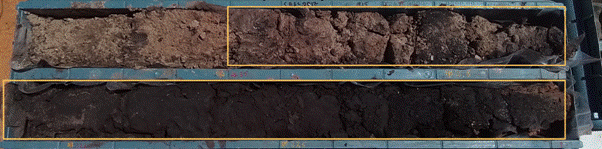
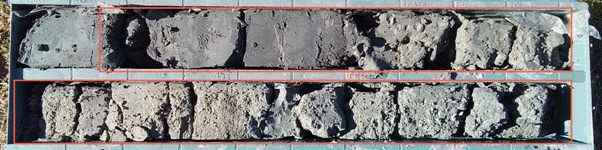
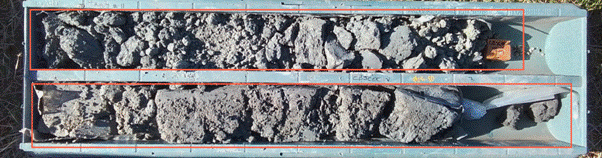
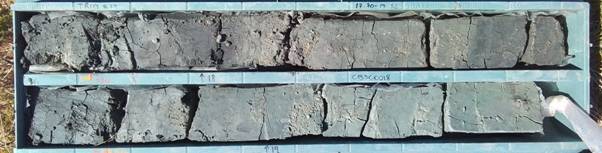
Figure 2: Photograph of core from CBSC0018 that intersected 7.2m at 1,751ppm from 14m within the Garford formation. Orange highlight represents a 3.0m permeable horizon from 14.7m grading 2,550ppm TREO
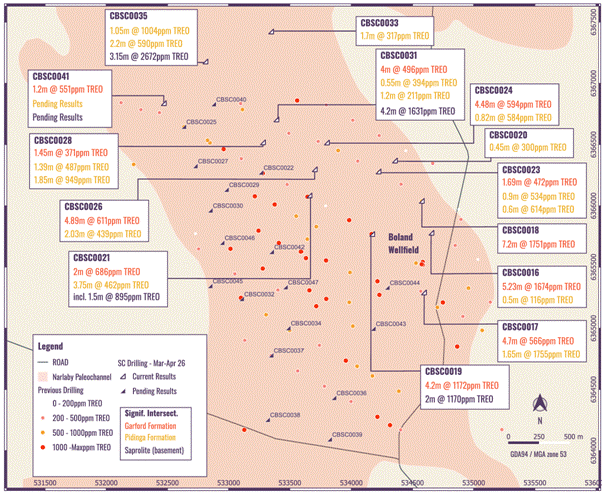
High-grade mineralisation has been previously recognised on the margins of the incised palaeochannel within a depositional environment that has resulted from system flooding. Whilst this is an important target, broader low-grade zones have previously been encountered within the incised channel where very high (>80%) recoveries have been achieved with very low levels of sulphuric acid. The drilling programme has tested the complete system as economics are expected to be determined by:
· Heavy REE enrichment - An indication of ionic metallurgy and an enabler of a higher value product.
· Permeable geology - Enables wellfield spacings to be maximised and reduces ISR timeframes.
· Metallurgy - Higher ionic portions require less acid, resulting in lower operational costs and a subsequent reduction in impurities.
· Acid generation - A product of the organic pyrite within the Pidinga and Garford formations that is readily broken down within the ISR process, generating natural sulphuric acid, reducing the amount of sulphuric acid to be sourced externally.
All of these properties will be modelled within the MRE and used to inform economic assessment.
Figure 3: Initial results from the Boland prospect
Observations from the Head Prospect
A north-south trending zone has been defined within drilling that is anticipated to deliver favourable results where the Pidinga formation is heavily reduced and contains lignite interbeds as shown in Figure 4 below:
Figure 4: Reduced Pidinga formation intersected in CBSC0081 from the Head prospect. Where observed geology appears highly favourable for ISR with 5.6m of the Pidinga formation being intersected from 25.9m (Assays Pending)
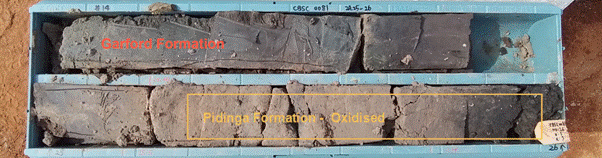
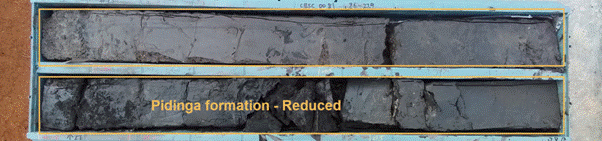
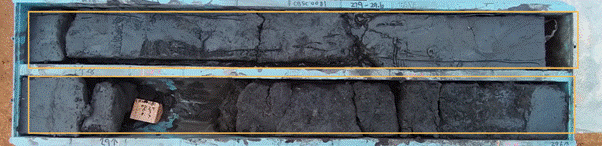
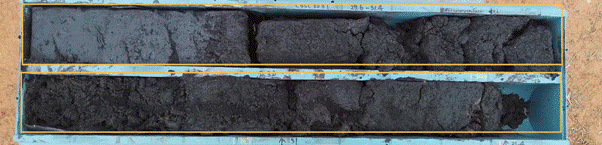
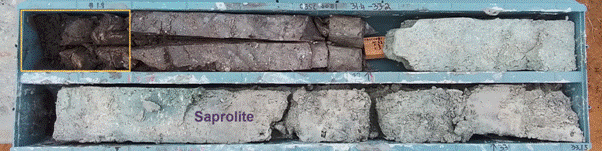
Figure 5. Completed drilling at the Head prospect (assays pending)
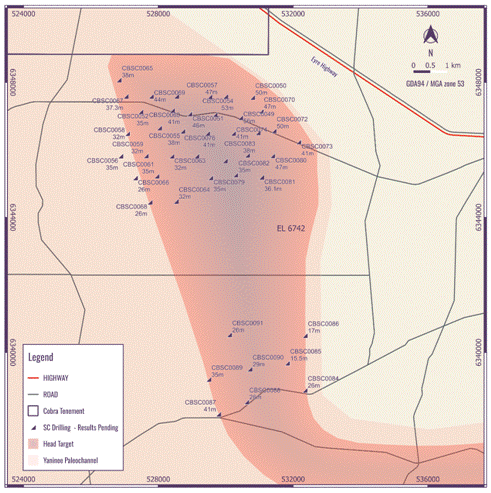
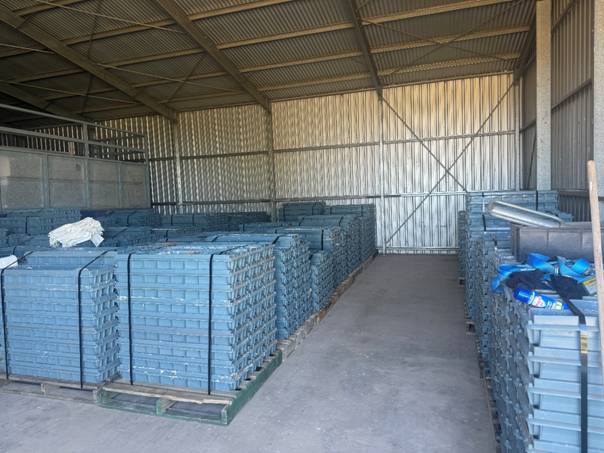
Figure 6: Sampled and stored core at the Company's leased Wudinna storage facility.
Enquiries:
Cobra Resources plc Rupert Verco (Australia) Dan Maling (UK) | via Vigo Consulting +44 (0)20 7390 0234
|
Hannam & Partners (Joint Broker) Leif Powis Andrew Chubb |
+44 (0) 20 7907 8500
|
SI Capital Limited (Joint Broker) Nick Emerson Sam Lomanto |
+44 (0)1483 413 500
|
Vigo Consulting (Financial Public Relations) Ben Simons Seb Weller |
+44 (0)20 7390 0234 |
The person who arranged for the release of this announcement was Rupert Verco, Managing Director of the Company.
Information in this announcement relates to exploration results that have been reported in the following announcements:
· Metallurgical update: "Boland Delivers Industry-Leading Heavy Rare Earth Product" dated 2 March 2026
· Metallurgical update: "Test work upgrades Boland liquor through 100% cerium removal resulting in a large increase in product value", dated 9th December 2025
· Exploration update: "Successful first pass suppression of cerium to maximise valuable dysprosium and terbium", dated 20 November 2025
· Exploration update: "Exceptional Results - Infield Permeability Study", dated 17 November 2025
· Exploration update: "Metallurgical Optimisation Upside", dated 20 October 2025
· Exploration update: "Exceptional Metallurgical Results from ISR Column", dated 14 October 2025
· Exploration update: "Met Study Supports Even Lower-Cost Recoveries", dated 11 September 2025
· Exploration update: "Low-Cost Recoveries from Optimised Testing", dated 11 August 2025
· Exploration update: "Rare Earth ISR System beyond Boland", dated 4 August 2025
· Exploration update: "Favourable Boland Metallurgical Results", dated 21 July 2025
· Exploration update: "Boland Project Update", dated 26 June 2025
· Wudinna Project Update: "Boland Aircore Drill Results", dated 25 February 2025
· Wudinna Project Update: "Further Positive Metallurgy Results from Boland Project", dated 16 December 2024
· Wudinna Project Update: "2nd Bench Scale ISR Study & £1.7M Placing", dated 26 November 2024
· Wudinna Project Update: "ISR Bench Scale Study Completion", dated 4 November 2024
· Wudinna Project Update: "ISR bench scale study delivers exceptional results", dated 1 October 2024
Competent Persons Statement
Information in this announcement has been compiled based on reports from Mitre Geophysics consultants and assessed by Mr Rupert Verco, a Fellow of the Australasian Institute of Mining and Metallurgy. Mr Verco is an employee of Cobra and has more than 17 years' industry experience which is relevant to the style of mineralisation, deposit type, and activity which he is undertaking to qualify as a Competent Person as defined in the 2012 Edition of the Australasian Code for Reporting Exploration Results, Mineral Resources and Ore Reserves of JORC. This includes 13 years of Mining, Resource Estimation and Exploration.
About Cobra
Cobra Resources is a South Australian critical minerals developer, advancing assets at all stages of the pre-production pathway.
In 2023, Cobra identified the Boland ionic rare earth discovery at its Wudinna Project in the Gawler Craton - Australia's only rare earth project suitable for in situ recovery (ISR) mining. ISR is a low-cost, low-disturbance extraction method that eliminates the need for excavation, positioning Boland to achieve bottom-quartile recovery costs.
In 2025, Cobra further expanded its portfolio by optioning the Manna Hill Copper Project in the Nackara Arc, South Australia. The project contains multiple underexplored prospects with strong potential to deliver large-scale copper discoveries.
In 2025, Cobra sold its Wudinna Gold Assets to Barton Gold (ASX: BDG) for up to A$15 million in cash and shares.
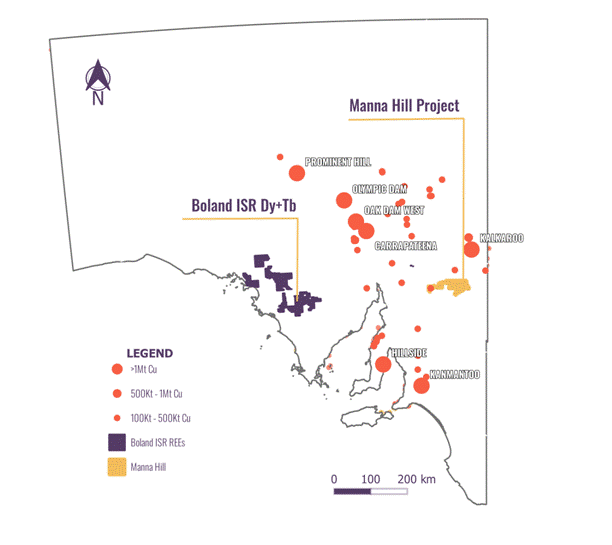
Regional map showing Cobra's tenements in South Australia
Follow us on social media:
LinkedIn: https://www.linkedin.com/company/cobraresourcesplc
X: https://twitter.com/Cobra_Resources
Engage with us by asking questions, watching video summaries and seeing what other shareholders have to say. Navigate to our Interactive Investor hub here: https://investors.cobraplc.com/
Subscribe to our news alert service: https://investors.cobraplc.com/auth/signup
Appendix 1: JORC Code, 2012 Edition - Table 1
Criteria | JORC Code explanation | Commentary |
Sampling techniques | · Nature and quality of sampling (eg cut channels, random chips, or specific specialised industry standard measurement tools appropriate to the minerals under investigation, such as down hole gamma sondes, or handheld XRF instruments, etc). These examples should not be taken as limiting the broad meaning of sampling. · Include reference to measures taken to ensure sample representivity and the appropriate calibration of any measurement tools or systems used. · Aspects of the determination of mineralisation that are Material to the Public Report. · In cases where 'industry standard' work has been done this would be relatively simple (eg 'reverse circulation drilling was used to obtain 1 m samples from which 3 kg was pulverised to produce a 30 g charge for fire assay'). In other cases more explanation may be required, such as where there is coarse gold that has inherent sampling problems. Unusual commodities or mineralisation types (eg submarine nodules) may warrant disclosure of detailed information. | Pre 2023 · Historic Rotary Mud drilling targeting paleochannel hosted uranium was completed. Some residue samples were retained in the Tonsley Core Library, downhole geophysical logging was the primary data collected for these holes.
· Select historic sample residues over Boland were analysed as reported in RNS 1834M (26 April 2024)
2023 Aircore · A combination of 2m and 3m samples were collected in green bags via a rig mounted cyclone. A PVC spear was used to collect a 2-4kg sub sample from each green bag. Sampling commenced from the collar point with samples submitted for analysis from the top of saprolite. · Samples were submitted to Bureau Veritas Laboratories, Adelaide and pulverized to produce a 4-acid digest sample.
2024-2025 SONIC · Drill results are outlined in RNS 0297I (25 March 2024) · Core was scanned by a SciAps X555 pXRF to determine sample intervals. Intervals through mineralized zones were taken at 10cm. Through waste, sample intervals were lengthened to 50cm. Core was halved by knife cutting. XRF scan locations were taken on an inner surface of the core to ensure readings were taken on fresh sample faces. · Samples were submitted to Bureau Veritas Laboratories, Adelaide and pulverized to produce a 4 acid digest sample.
Aircore · 1m sample intervals of 2-4 kg were taken via PVC spear from green bags at the rig. All samples collected were submitted to the lab for analysis. From 0-6 m in each hole samples were composited to 3m. · Samples were submitted to Bureau Veritas Laboratories, Adelaide and pulverized to produce a 4 acid digest sample. |
Drilling techniques | · Drill type (eg core, reverse circulation, open-hole hammer, rotary air blast, auger, Bangka, sonic, etc) and details (eg core diameter, triple or standard tube, depth of diamond tails, face-sampling bit or other type, whether core is oriented and if so, by what method, etc). | Pre 2023 · Drill methods include Rotary Mud and AC 2023 · Drilling completed by McLeod Drilling Pty Ltd using 75.7mm NQ air core drilling techniques from an ALMET aircore rig mounted on a Toyota Landcruiser 6x6 and a 200psi, 400cfm Sullair compressor.
2024-2026 · Sonic Core drilling completed Star Drilling using 4" core with a SDR12 drill rig. Holes were reamed to 6" or 8" to enable casing and screens to be installed · Aircore Drilling completed by McLeod Drilling Pty Ltd using 75.7mm NQ air core drilling techniques from an ALMET aircore rig mounted on a Toyota Landcruiser 6x6 and a 200psi, 400cfm Sullair compressor.
|
Drill sample recovery | · Method of recording and assessing core and chip sample recoveries and results assessed. · Measures taken to maximise sample recovery and ensure representative nature of the samples. · Whether a relationship exists between sample recovery and grade and whether sample bias may have occurred due to preferential loss/gain of fine/coarse material. | · Aircore Sample recovery is for the style of drilling. All samples were recorded for sample type, quality and contamination potential and entered within a sample log. · In general, sample recoveries range between 5-10kg for each 1 m interval being recovered from AC drilling. · Mineralisation occurs within a confined aquifer where ground water does influence sample recovery · Mineralisation within the targeted Pidinga Formation is bound to fine, organic rich material, the potential loss of mineralized material from coarser host sands is possible · Any grade bias is expected to be grade loss · The potential loss of fine material is being evaluated by sizing fraction analysis and follow-up sonic core drilling where aircore holes will be twinned.
Sonic Core · Sample recovery is considered excellent.
|
Logging | · Whether core and chip samples have been geologically and geotechnically logged to a level of detail to support appropriate Mineral Resource estimation, mining studies and metallurgical studies. · Whether logging is qualitative or quantitative in nature. Core (or costean, channel, etc) photography. · The total length and percentage of the relevant intersections logged. |
· All drill samples were logged by a qualified geologist at the time of drilling. Lithology, colour, weathering and moisture were documented. All core drilled has been lithologically logged. · All drill metres have been geologically logged on sample intervals (1-3 m).
|
Sub-sampling techniques and sample preparation | · If core, whether cut or sawn and whether quarter, half or all core taken. · If non-core, whether riffled, tube sampled, rotary split, etc and whether sampled wet or dry. · For all sample types, the nature, quality and appropriateness of the sample preparation technique. · Quality control procedures adopted for all sub-sampling stages to maximise representivity of samples. · Measures taken to ensure that the sampling is representative of the in situ material collected, including for instance results for field duplicate/second-half sampling. · Whether sample sizes are appropriate to the grain size of the material being sampled. | Pre 2023 · Historic Residue samples were generally 2m composites and were stored at the South Australian Drill Core Reference Library at Tonsley, a subsample of approximately 20g was removed for lab submission. · Select samples of geological interest were selected for lab submission · No QAQC samples were included in the submission of these samples. Sample results were intended to indicate mineralisation potential but would not be suitable for resource estimation
Post 2023 · A PVC spear was used to collect 2-4kg of sub-sample from each AC sample length controlled the sample volume submitted to the lab. · Additional sub-sampling was performed through the preparation and processing of samples according to the Bureau Veritas internal protocols. · Field duplicate AC samples were collected from the green bags using a PVC spear scoop at a 1 in 25 sample frequency. · Sample sizes are considered appropriate for the material being sampled. · Assessment of duplicate results indicated this sub - sample method provided appropriate repeatability for rare earths.
Sonic Drilling
· Field duplicate samples were taken nominally every 1 in 25 samples where the sampled interval was quartered. · Blanks and Standards were submitted every 25 samples · Half core samples were taken where lab geochemistry sample were taken. · In holes where column leach test samples have been submitted, full core samples have been submitted over the test areas.
|
Quality of assay data and laboratory tests | · The nature, quality and appropriateness of the assaying and laboratory procedures used and whether the technique is considered partial or total. · For geophysical tools, spectrometers, handheld XRF instruments, etc, the parameters used in determining the analysis including instrument make and model, reading times, calibrations factors applied and their derivation, etc. · Nature of quality control procedures adopted (eg standards, blanks, duplicates, external laboratory checks) and whether acceptable levels of accuracy (ie lack of bias) and precision have been established. |
· Samples were submitted to Bureau Veritas, Adelaide for preparation and analysis. Multi-element geochemistry were digested by four acid ICP-MS/ ICP-OES and analysed for Ag, Ce, Cu, Dy, Er, Eu, Gd, Ho, La, Lu, Mg, Na, Nd, P, Pr, Sc, Sm, Tb, Th, Tm, U, Y and Yb.
· Field rare earth standards were submitted at a frequency of 1 in 25 samples.
· Field duplicate samples were submitted at a frequency of 1 in 25 samples.
· Reported assays pass the companies implemented QAQC database reports
· Internal lab blanks, standards and repeats for rare earths indicated acceptable assay accuracy.
Sample Characterisation Test Work performed by the Australian Nuclear Science and Technology Organisation (ANSTO)
· Full core samples were submitted to Australian Nuclear Science and Technology Organisation (ANSTO), Sydney for preparation and analysis. The core was split in half along the vertical axis, and one half further split into 10 even fractions along the length of the half-core. Additional sub-sampling, homogenisation and drying steps were performed to generate ~260 g (dry equivalent) samples for head assay according to the laboratory internal protocols. · Multi element geochemistry of solid samples were analysed at ANSTO (Sydney) by XRF for the major gangue elements Al, Ca, Fe, K, Mg, Mn, Na, Ni, P, Si, S, and Zn. · Multi element geochemistry of solid samples were additionally analysed at ALS Geochemistry Laboratory (Brisbane) on behalf of ANSTO by lithium tetraborate digest ICP-MS and analysed for Ce, Dy, Er, Eu, Gd, Ho, La, Lu, Nd, Pr, Sm, Tb, Th, Tm, U, Y and Yb. · Reported assays are to acceptable levels of accuracy and precision. · Internal laboratory blanks, standards and repeats for rare earths indicated acceptable assay accuracy. · Samples retained for metallurgical analysis were immediately vacuum packed, nitrogen purged and refrigerated. · These samples were refrigerated throughout transport.
Metallurgical Leach Test Work performed by the Australian Nuclear Science and Technology Organisation (ANSTO)
· ANSTO laboratories prepared ~80g samples for diagnostic leaches, a 443g sample for a slurry leach and a 660g sample for a column leach and a 55kg sample for a bulk column leach. Sub-samples were prepared from full cores according to the laboratory internal protocols. Diagnostic and slurry leaching were carried out in baffled leach vessels equipped with an overhead stirrer and applying a 0.5 M (NH4)2SO4 lixiviant solution, adjusted to the select pH using H2SO4. · 0.5-0.3 M H2SO4 was utilised to maintain the test pH for the duration of the test, if necessary. The acid addition was measured. · Thief liquor samples were taken periodically. · At the completion of each test, the final pH was measured, the slurry was vacuum filtered to separate the primary filtrate. · The thief samples and primary filtrate were analysed as follows: o ICP-MS for Ce, Dy, Er, Eu, Gd, Ho, La, Lu, Mn, Nd, Pb, Pr, Sc, Sm, Tb, Th, Tm, U, Y, Yb. o ICP-OES for Al, Ca, Fe, K, Mg, Mn, Na, Si. · The water wash was stored but not analysed. · Column leaching was carried out by horizontal and vertical leach columns. The columns have been pressurised with nitrogen to between 4-6 bar and submerged in a temperature controlled bath. · A 0.3 M (NH4)2SO4 lixiviant solution, adjusted to the select pH using H2SO4 was fed to the column at a controlled flowrate. · PLS collected from the end of the column was weighed, the SH and pH measured and the free acid concentration determined by titration. Liquor samples were taken from the collected PLS and analysed as follows: o ICP-MS for Ce, Dy, Er, Eu, Gd, Ho, La, Lu, Mn, Nd, Pb, Pr, Sc, Sm, Tb, Th, Tm, U, Y, Yb. o ICP-OES for Al, Ca, Fe, K, Mg, Mn, Na, Si. · The column leach test has been completed. Assays of the column have adjusted head grades of the initial bench scale study. Recoveries have been adjusted accordingly.
|
Verification of sampling and assaying | · The verification of significant intersections by either independent or alternative company personnel. · The use of twinned holes. · Documentation of primary data, data entry procedures, data verification, data storage (physical and electronic) protocols. · Discuss any adjustment to assay data. | · Sampling data was recorded in field books, checked upon digitising and transferred to database. · Geological logging was undertaken digitally via the MX Deposit logging interface and synchronised to the database at least daily during the drill programme. · Compositing of assays was undertaken and reviewed by Cobra Resources staff. · Original copies of laboratory assay data are retained digitally on the Cobra Resources server for future reference. · Samples have been spatially verified through the use of Datamine and Leapfrog geological software for pre 2021 and post 2021 samples and assays. · Twinned drillholes from pre 2021 and post 2021 drill programs showed acceptable spatial and grade repeatability. · Physical copies of field sampling books are retained by Cobra Resources for future reference. · Significant intersections have been prepared by Mr Michael McMaster and reviewed by Mr Rupert Verco |
Location of data points | · Accuracy and quality of surveys used to locate drill holes (collar and down-hole surveys), trenches, mine workings and other locations used in Mineral Resource estimation. · Specification of the grid system used. · Quality and adequacy of topographic control. |
2021-2023 · Collar locations were initially surveyed using a mobile phone utilising the Avenza Map app. Collar points recorded with a GPS horizontal accuracy within 5 m. · RC Collar locations were picked up using a Leica CS20 base and Rover with an instrument precision of 0.05 cm accuracy. · Locations are recorded in geodetic datum GDA 94 zone 53. · No downhole surveying was undertaken on AC holes. All holes were set up vertically and are assumed vertical. · RC holes have been down hole surveyed using a Reflex TN-14 true north seeking downhole survey tool or Reflex multishot · Downhole surveys were assessed for quality prior to export of data. Poor quality surveys were downgraded in the database to be excluded from export. · All surveys are corrected to MGA 94 Zone 53 within the MX Deposit database. · Cased collars of sonic drilling shall be surveyed before a mineral resource estimate 2024 Aircore
· Collar locations were initially surveyed using A mobile phone GPS utilising the Avenza Map app. Collar points recorded with a horizontal accuracy within 5m. · Locations are recorded in geodetic datum GDA 94 zone 53. · No downhole surveying was undertaken on AC or Sonic holes. All holes were set up vertically and are assumed vertical. · Higher accuracy GPS will be undertaken on soinc core drilling to support future resource estimates 2026 Sonic Core · All holes were surveyed by Lyca GS20 equipment with Base corrections for 0.1cm percision |
Data spacing and distribution | · Data spacing for reporting of Exploration Results. · Whether the data spacing and distribution is sufficient to establish the degree of geological and grade continuity appropriate for the Mineral Resource and Ore Reserve estimation procedure(s) and classifications applied. · Whether sample compositing has been applied. | · Drillhole spacing was designed on transects 200 to 500m apart.
· Additional scouting holes were drilled opportunistically on existing tracks at spacings 25-150 m from previous drillholes.
· Sonic core holes were drilled at ~20m spacings in a wellfield configuration based on assumed permeability potential of the intersected geology
· Drillhole spacing is not expected to introduce any sample bias.
· Assessment of the drillhole spacing for resource estimation will be made once a sufficient data set can provide statistical analysis · . |
Orientation of data in relation to geological structure | · Whether the orientation of sampling achieves unbiased sampling of possible structures and the extent to which this is known, considering the deposit type. · If the relationship between the drilling orientation and the orientation of key mineralised structures is considered to have introduced a sampling bias, this should be assessed and reported if material. | · Aircore and Sonic drill holes are vertical. |
Sample security | · The measures taken to ensure sample security. | · Transport of samples to Adelaide was undertaken by a competent independent contractor. Samples were packaged in zip tied polyweave bags in bundles of 5 samples at the drill rig and transported in larger bulka bags by batch while being transported. · Refrigerated transport of samples to Sydney was undertaken by a competent independent contractor. Samples were double bagged, vacuum sealed, nitrogen purged and placed within PVC piping. · There is no suspicion of tampering of samples. |
Audits or reviews | · The results of any audits or reviews of sampling techniques and data. | · No laboratory audit or review has been undertaken. · Genalysis Intertek and BV Laboratories Adelaide are NATA (National Association of Testing Authorities) accredited laboratory, recognition of their analytical competence. |
Appendix 2: Section 2 reporting of exploration results
Criteria | JORC Code explanation | Commentary | |||||||||||||||||||||||||||||||||||||||||||||||||||
Mineral tenement and land tenure status | · Type, reference name/number, location and ownership including agreements or material issues with third parties such as joint ventures, partnerships, overriding royalties, native title interests, historical sites, wilderness or national park and environmental settings. · The security of the tenure held at the time of reporting along with any known impediments to obtaining a licence to operate in the area. | · Boland is located on EL7074, currently owned 100% by LAM Wudinna, a wholly owned subsidiary of Cobra Resource Plc
· In 2024, Cobra through its subsidiary Lady Alice Mines purchased the remaining ownership of the Wudinna Project tenements.
· The Head Prospect is located on EL6784, a tenement held by EL6784
· Alcrest Royalties Australia Pty Ltd retains a 1.5% NSR royalty over future mineral production from licenses EL7074, EL7075, EL7076, EL7077 and EL7078.
· A Native Title Agreement is in place with the Barngarla people.
· Aboriginal heritage surveys have been completed over EL7074, with no sites located in the immediate vicinity of aircore drilling | |||||||||||||||||||||||||||||||||||||||||||||||||||
Exploration done by other parties | · Acknowledgment and appraisal of exploration by other parties. | · On-ground exploration completed prior to Andromeda Metals' work was limited to 400 m spaced soil geochemistry completed by Newcrest Mining Limited over the Barns prospect.
· Other than the flying of regional airborne geophysics and coarse spaced ground gravity, there has been no recorded exploration in the vicinity of the Baggy Green deposit prior to Andromeda Metals' work.
· Paleochannel uranium exploration was undertaken by various parties in the 1980s and the 2010s around the Boland Prospect. Drilling was primarily rotary mud with downhole geophysical logging the primary interpretation method. | |||||||||||||||||||||||||||||||||||||||||||||||||||
Geology | · Deposit type, geological setting and style of mineralisation. | · Target mineralisation is ionic rare earth mineralisation that occurs primarily within the Pidinga Formation within the Narlaby Palaeochannel, immediately above REE enriched Hiltaba Suite Granites
· Ionic REE mineralisation also occurs in and adjacent to the Garford formation clays and silty sands.
· Significant chemical (pH & eH) differences exist between underlying saprolite and overlying Palaeochannel sediments. REEs are absorbed to reduced organics found within the Pidinga Formation
· Benchtop metallurgy studies indicate ISR amenability of rare earths within the Pidinga Formation basal sands summarized in RNS 1285Q (16 December 2024)
· Ionic REE mineralisation is confirmed through metallurgical desorption testing where high recoveries are achieved at benign acidities (pH5-3) at ambient temperature. · CSIRO has independently demonstrated high recoveries with sequential leach testing, delivering recoveries of 20-25% at pH7
· QEMSCAN and petrology analysis support REE ionic mineralisation, with little to no secondary phases identified.
· Ionic REE mineralisation occurs in reduced clay intervals that contact both saprolite and permeable sand units. Mineralisation contains variable sand quantities that yield permeability and promote in-situ recovery potential · Evidence that REEs are ionically absorbed to sulphides
· Mineralisation is located within a confined aquifer | |||||||||||||||||||||||||||||||||||||||||||||||||||
Drillhole Information | · A summary of all information material to the understanding of the exploration results including a tabulation of the following information for all Material drill holes: o easting and northing of the drill hole collar o elevation or RL (Reduced Level - elevation above sea level in metres) of the drill hole collar o dip and azimuth of the hole o down hole length and interception depth o hole length. · If the exclusion of this information is justified on the basis that the information is not Material and this exclusion does not detract from the understanding of the report, the Competent Person should clearly explain why this is the case. | · Drilling has been designed to support resource definition. | |||||||||||||||||||||||||||||||||||||||||||||||||||
Data aggregation methods | · In reporting Exploration Results, weighting averaging techniques, maximum and/or minimum grade truncations (eg cutting of high grades) and cut-off grades are usually Material and should be stated. · Where aggregate intercepts incorporate short lengths of high grade results and longer lengths of low grade results, the procedure used for such aggregation should be stated and some typical examples of such aggregations should be shown in detail. · The assumptions used for any reporting of metal equivalent values should be clearly stated. | · Reported summary intersects are weighted averages based on length. · No maximum/ minimum grade cuts have been applied. · No metal equivalent values have been calculated. · ISR recoverable zones have been composited to analyse for TOC, total sulphide and sizing distribution · Rare earth element analyses were originally reported in elemental form and have been converted to relevant oxide concentrations in line with industry standards. Conversion factors tabulated below:
· The reporting of REE oxides is done so in accordance with industry reporting with the following calculations applied: · TREO = La2O3 + CeO2 + Pr6O11 + Nd2O3 + Sm2O3 + Eu2O3 + Gd2O3 + Tb4O7 + Dy2O3 + Ho2O3 + Er2O3 + Tm2O3 + Yb2O3 + Lu2O3 + Y2O3 · LREO = La2O3 + CeO2 + Pr6O11 + Nd2O3 · HREO = Sm2O3 + Eu2O3 + Gd2O3 + Tb4O7 + Dy2O3 + Ho2O3 + Er2O3 + Tm2O3 + Yb2O3 + Lu2O3 + Y2O3 · MREO = Nd2O3 + Pr6O11 + Tb4O7 + Dy2O3 · NdPr = Nd2O3 + Pr6O11 · TREO-Ce = TREO - CeO2 · % Nd = Nd2O3/ TREO · % Pr = Pr6O11/TREO · % Dy = Dy2O3/TREO · % HREO = HREO/TREO · % LREO = LREO/TREO
· XRF results are used as an indication of potential grade only. Due to detection limits only a combined content of Ce, La, Nd, Pr & Y has been used. XRF grades have not been converted to oxide. | |||||||||||||||||||||||||||||||||||||||||||||||||||
Relationship between mineralisation widths and intercept lengths | · These relationships are particularly important in the reporting of Exploration Results. · If the geometry of the mineralisation with respect to the drill hole angle is known, its nature should be reported. · If it is not known and only the down hole lengths are reported, there should be a clear statement to this effect (eg 'down hole length, true width not known'). | · Preliminary results support unbiased testing of mineralised structures. · Most intercepts are vertical and reflect true width intercepts. · Follow-up sonic drilling is planned to delineate portions of the reported intersections that are recoverable and unrecoverable via ISR | |||||||||||||||||||||||||||||||||||||||||||||||||||
Diagrams | · Appropriate maps and sections (with scales) and tabulations of intercepts should be included for any significant discovery being reported These should include, but not be limited to a plan view of drill hole collar locations and appropriate sectional views. | · Relevant diagrams have been included in the announcement. · Exploration results are not being reported for existing mineral resources. · Drilling is aimed at defining new mineral resources. | |||||||||||||||||||||||||||||||||||||||||||||||||||
Balanced reporting | · Where comprehensive reporting of all Exploration Results is not practicable, representative reporting of both low and high grades and/or widths should be practiced to avoid misleading reporting of Exploration Results. | · REE mineralization occurs in several phases, ionic phase mineralisation occurs within the Pidinga and Garford formations which are amenable to ISR recovery, REO values within both of these formations have been reported. Mineralisation occurring within the saprolite is considered secondary phase mineralisation. | |||||||||||||||||||||||||||||||||||||||||||||||||||
Other substantive exploration data | · Other exploration data, if meaningful and material, should be reported including (but not limited to): geological observations; geophysical survey results; geochemical survey results; bulk samples - size and method of treatment; metallurgical test results; bulk density, groundwater, geotechnical and rock characteristics; potential deleterious or contaminating substances. | · Refer to previous announcements listed in RNS for reporting of REE results and metallurgical testing | |||||||||||||||||||||||||||||||||||||||||||||||||||
Further work | · The nature and scale of planned further work (eg tests for lateral extensions or depth extensions or large-scale step-out drilling). · Diagrams clearly highlighting the areas of possible extensions, including the main geological interpretations and future drilling areas, provided this information is not commercially sensitive. | · ISR study 1 was performed to achieve a 0.5M pH 3 whilst ISR study 2 was performed at a 0.3M pH 3 · Multiple Mixed Rare Earth Carbonates have been produced · Hydrology, permeability and mineralogy studies are being performed on core samples. · Hydrology and tracer recovery studies have been completed that support the permeabilities achieved in bench scale ISR testing.
|
Appendix 3: Drillhole coordinates
CBSC0016 | 534,655 | 6,365,778 | 101.8 | Y |
CBSC0017 | 534,593 | 6,365,295 | 100.9 | Y |
CBSC0018 | 534,576 | 6,366,039 | 101.3 | Y |
CBSC0019 | 534,170 | 6,365,772 | 102.4 | Y |
CBSC0020 | 534,354 | 6,366,369 | 107.5 | Y |
CBSC0021 | 533,659 | 6,366,086 | 100.0 | Y |
CBSC0022 | 533,274 | 6,366,299 | 101.7 | |
CBSC0023 | 534,223 | 6,366,279 | 103.1 | Y |
CBSC0024 | 533,801 | 6,366,515 | 101.6 | Y |
CBSC0025 | 532,632 | 6,366,646 | 112.9 | |
CBSC0026 | 533,700 | 6,366,300 | 101.5 | Y |
CBSC0027 | 532,728 | 6,366,328 | 110.7 | |
CBSC0028 | 533,279 | 6,366,520 | 104.4 | Y |
CBSC0029 | 532,983 | 6,366,135 | 104.9 | |
CBSC0030 | 532,851 | 6,365,965 | 106.3 | Y |
CBSC0031 | 533,388 | 6,366,705 | 100.2 | |
CBSC0032 | 533,106 | 6,365,240 | 111.2 | |
CBSC0033 | 533,370 | 6,367,426 | 99.0 | Y |
CBSC0034 | 533,487 | 6,365,001 | 111.4 | |
CBSC0035 | 532,811 | 6,367,178 | 106.0 | Y |
CBSC0036 | 533,858 | 6,364,429 | 109.7 | |
CBSC0037 | 533,346 | 6,364,778 | 110.1 | |
CBSC0038 | 533,317 | 6,364,253 | 113.2 | |
CBSC0039 | 533,821 | 6,364,092 | 115.3 | |
CBSC0040 | 532,957 | 6,366,837 | 106.9 | |
CBSC0041 | 532,424 | 6,366,812 | 114.8 | Y |
CBSC0042 | 533,351 | 6,365,625 | 110.2 | |
CBSC0043 | 534,181 | 6,365,000 | 106.2 | |
CBSC0044 | 534,305 | 6,365,368 | 107.1 | |
CBSC0045 | 532,849 | 6,365,344 | 114.5 | |
CBSC0046 | 532,945 | 6,365,698 | 111.6 | |
CBSC0047 | 533,465 | 6,365,338 | 109.0 | |
CBSC0048 | 527,476 | 6,347,125 | 70.7 | |
CBSC0049 | 530,441 | 6,346,953 | 84.9 | |
CBSC0050 | 530,798 | 6,347,555 | 89.1 | |
CBSC0051 | 528,933 | 6,347,065 | 81.3 | |
CBSC0052 | 527,479 | 6,347,130 | 70.8 | |
CBSC0053 | 528,035 | 6,346,651 | 69.0 | |
CBSC0054 | 529,998 | 6,347,585 | 89.6 | |
CBSC0055 | 528,726 | 6,346,553 | 72.6 | |
CBSC0056 | 526,886 | 6,345,819 | 60.8 | |
CBSC0057 | 529,528 | 6,347,573 | 82.7 | |
CBSC0058 | 527,092 | 6,346,478 | 63.4 | |
CBSC0059 | 527,637 | 6,345,827 | 60.8 | |
CBSC0060 | 528,414 | 6,347,167 | 75.2 | |
CBSC0061 | 527,959 | 6,345,223 | 61.7 | |
CBSC0062 | 528,538 | 6,347,588 | 84.2 | |
CBSC0063 | 528,398 | 6,345,814 | 61.6 | |
CBSC0064 | 528,528 | 6,344,475 | 65.4 | |
CBSC0065 | 526,835 | 6,348,072 | 72.4 | |
CBSC0066 | 527,321 | 6,345,169 | 61.1 | |
CBSC0067 | 527,038 | 6,347,587 | 73.2 | |
CBSC0068 | 527,753 | 6,344,449 | 60.7 | |
CBSC0069 | 527,789 | 6,347,586 | 77.9 | |
CBSC0070 | 531,053 | 6,347,143 | 85.6 | |
CBSC0071 | 529,681 | 6,347,041 | 82.0 | |
CBSC0072 | 531,432 | 6,346,561 | 88.4 | |
CBSC0073 | 532,169 | 6,346,237 | 86.8 | |
CBSC0074 | 530,228 | 6,346,494 | 77.9 | |
CBSC0075 | 530,940 | 6,346,476 | 80.7 | |
CBSC0076 | 529,463 | 6,346,489 | 75.6 | |
CBSC0077 | 529,153 | 6,345,823 | 70.1 | |
CBSC0078 | 529,976 | 6,345,667 | 66.3 | |
CBSC0079 | 529,554 | 6,345,174 | 62.3 | |
CBSC0080 | 531,392 | 6,345,825 | 82.2 | |
CBSC0081 | 531,065 | 6,345,187 | 72.5 | |
CBSC0082 | 530,295 | 6,345,261 | 68.0 | |
CBSC0083 | 530,643 | 6,345,838 | 71.0 | |
CBSC0084 | 532,350 | 6,338,882 | 67.3 | |
CBSC0085 | 531,832 | 6,339,684 | 60.8 | |
CBSC0086 | 532,357 | 6,340,503 | 72.8 | |
CBSC0087 | 529,780 | 6,338,172 | 73.5 | |
CBSC0088 | 530,621 | 6,338,533 | 60.8 | |
CBSC0089 | 529,496 | 6,339,203 | 68.8 | |
CBSC0090 | 530,697 | 6,339,550 | 65.4 | |
CBSC0091 | 530,109 | 6,340,529 | 62.4 |
Related Shares:
Cobra Resources