
30th Jun 2026 16:59
The information contained within this announcement is deemed by the Company to constitute inside information as stipulated under the UK Market Abuse Regulation (EU) No. 596/2014, as it forms part of UK domestic law by virtue of the European Union (Withdrawal) Act 2018 ("UK MAR"). Upon the publication of this announcement via a Regulatory Information Service, this inside information is now considered to be in the public domain.
LONDON BTC COMPANY LIMITED
Publication of Annual Report
London, New York, 30 June 2026 - London BTC Company Limited ("Company") (BTC: LSE, VINZF: OTCQB), the London Stock Exchange main market-listed company, announces the publication of its audited Annual Report and Financial Statements for the financial year ended 28 February 2026.
The full Annual Report and Financial Statements will shortly also be available on the Company's website: https://ldnbtc.com/
For further information please contact:
London BTC Company Limited | Hewie Rattray, CEO David Lenigas, [email protected] Rob Scott, Finance Director, [email protected] Jeremy Edelman, [email protected] |
First Sentinel (Corporate Adviser) | Brian Stockbridge / Gabrielle Cordeiro / Ahmed Iqbal T: +44 (0) 20 3855 5551 |
Clear Capital Markets (Broker) | Bob Roberts T: +44 (0) 20 3869 6080 |
Marex Financial (Joint Broker and Advisor) | Angelo Sofocleous / Matt Bailey (Broking) Email: [email protected] T: +44 (0) 207 655 6000 |
About London BTC Company Limited
The Company's primary listing is on the London Stock Exchange (United Kingdom) under the ticker "BTC.L" and it trades in the USA on the OTCQB under the ticker "VINZF". The Company is building up a strategic Bitcoin holding through acquiring Bitcoin as a treasury and currency management tool and through adding Bitcoin generated from its mining operations in North America. The Company currently operates Bitcoin miners hosted across multiple third-party facilities in Indiana, Iowa, Nebraska and Texas (USA) and Labrador (Canada). As part of its hedging strategy, the Company has begun building a portfolio of US gold assets in the Tier 1 gold jurisdiction of Nevada, to complement its core Bitcoin treasury and mining operations, thereby providing shareholders with exposure to two scarce and globally recognised stores of value.
Chairman's Report
The financial year ended 28 February 2026 has been a defining year in our short history as a publicly listed Company. We have completed our branding transformation, scaled up our mining operations, materially grown our Bitcoin treasury, and laid the foundations for a future dual North American listing. Shortly after the year end we introduced a hedging dimension to our balance sheet through selective exposure to physical gold assets. The Bitcoin price this year has been volatile, and our gold hedge strategy is seen as highly complementary to our growth strategy
In July 2025, the Company formally adopted its new name, London BTC Company Limited, completing the rebranding flagged to shareholders in our previous Chairman's Report. Our LSE ticker "BTC.L" -is one of the most powerful in UK listed markets and which continues to attract attention from retail and institutional investors alike. Our website (ldnbtc.com), corporate branding, and shareholder communications have all been aligned around this single, unambiguous proposition: London BTC is the UK's listed vehicle for direct, productive exposure to Bitcoin.
Our mandate remains unchanged and continues to drive every capital allocation decisions: to mine as much Bitcoin in North America as profitably as possible, and to acquire and hold Bitcoin in treasury as a strategic, long-duration reserve asset. Bitcoin remains our preferred currency, and the Group is structurally over-weight Bitcoin relative to fiat currencies.
The macro backdrop for Bitcoin during the year under review has been very different from the relatively benign environment that accompanied our London Stock Exchange Main Market listing in January 2025. Bitcoin reached new highs in the latter part of 2025, trading around the US$100,000 level for much of the period, before reducing sharply in early 2026 amid renewed risk sentiment, persistent inflation, geopolitical tensions in the Middle East (including stalled US-Iran negotiations and disruption around the Strait of Hormuz), and a rotation of capital between digital and traditional safe haven assets. By May 2026 Bitcoin was consolidating in the high US$70,000s, well below its cycle peak but materially above the levels at which much of our treasury was acquired, however we see a lot of mid-term to long term upside in the Bitcoin price and remain very bullish for the future of Bitcoin as a global store of wealth and breaking all historic banking conventions.
Importantly, the structural picture remains highly supportive. Publicly traded companies now hold over 1.18 million Bitcoin between them, with corporate buying running at multiples of new mining issuance. Gold, in parallel, has had an exceptional year, with prices trading at approximately US$4,000 per ounce on safe-haven demand. This bifurcation between digital and analogue scarce assets is precisely the environment in which we believe a disciplined hybrid hard asset strategy can outperform.
Against this backdrop, the Group has stayed the course: continuing to mine, looking to acquire Bitcoin opportunistically, maintaining a debt-free balance sheet, and introducing carefully sized hedging optionality through gold.
The year saw the Company materially strengthen its capital base while remaining free of any structural debt.
• Equity raises: During the period the Company raised gross proceeds of approximately £6.08 million in equity (before brokerage and expenses) through a combination of placings and a WRAP retail offer. This included the July 2025 fundraising at 18.5 pence per share and follow-on issuances designed to fund mining expansion, treasury accumulation, and our US capital markets work.
• Equity Raises and Debt facility: During the period the company secured a $4m debt facility and was advanced $2m of the facility. The advance was repaid by loans from two of the directors. The loans were settled by an issue of shares. The Company has no debt and the facility is now closed.
• Bitcoin deployment: Of the new equity capital raised, approximately £6.56 million was deployed directly into Bitcoin, held with our tier-one institutional custody partner, Fidelity Digital Assets. Combined with Bitcoin generated from our mining operations and earlier treasury purchases, the Group has built a meaningful listed Bitcoin treasury in the UK small-cap universe.
• Debt-free balance sheet: The Company entered the year with a residual loan facility, which has been managed down such that the Group is now debt free. Total assets exceeded £8 million as at the interim balance sheet date of 31 August 2025 but have dropped for the full year due to the drop in the Bitcoin price.
Bitcoin mining remains the productive heart of our business and the differentiating feature that distinguishes London BTC from a pure treasury holding company. We are one of the very few listed UK vehicles offering direct shareholder leverage to the long-term economic modelling of Bitcoin mining.
At the start of the financial fiscal year, we operated an average of approximately 640 miners across third-party hosting facilities in Indiana, Iowa, Nebraska, Texas and Labrador (Canada). By October 2025 the installed fleet had grown to approximately 1,100 machines following the addition of 385 new ASIC units. We have publicly outlined our intention to grow the North American fleet to approximately 1,500 ASICs through 2026, an increase of around 30% from current levels, which is subject to the company having the relevant funds.
Key operational themes during the year included:
• Fleet upgrading: Continued migration toward higher-efficiency, new-generation ASIC units, supported by Luxor Technology firmware optimisation, which improves hashrate per joule and reduces our effective cost of production.
• Diversification of hosting: Maintaining miners across multiple unrelated third-party hosting facilities across the United States and Canada to mitigate concentration risk in any single site, operator or power market.
• Low-cost, increasingly renewable power: Where possible, prioritising hosting partners with access to low-cost and renewable energy, reflecting both economic and ESG imperatives.
• Capital discipline: All fleet expansion is being undertaken on a fully funded basis from existing reserves, with no requirement for incremental debt or dilution to deliver the 1,500-miner target.
North America remains, in our view, the most favourable jurisdiction globally for Bitcoin mining, combining regulatory clarity, abundant energy capacity, mature hosting infrastructure, and deep capital markets. We continue to engage with hosting partners across our existing footprint regarding incremental capacity, with a clear bias toward sites that can scale with us over multiple deployment cycles.
Our Bitcoin treasury is the second pillar of the dual mandate, and one we have continued to grow with discipline throughout the year. We do not regard Bitcoin as a speculative trading instrument; we regard it as a long-duration, globally portable, hard-capped store of value with monetary properties unmatched in the traditional financial system.
Treasury developments during the year included:
• Direct acquisitions: Approximately £6.474 million of Bitcoin acquired during the period, deploying the bulk of new equity proceeds into BTC across a range of price points. Importantly, much of our treasury accumulation took place at price levels well below recent cycle highs (but above recent lows), providing meaningful embedded gains even after the early-2026 correction.
• Self-mined Bitcoin: Self-mined Bitcoin are required for operational costs, and excess will continue to flow into treasury, compounding the treasury balance through productive operations rather than dilution.
• Institutional custody: All treasury Bitcoin remains with Fidelity Digital Assets, providing institutional-grade custody, transparency and audit-readiness.
The board has also been actively assessing opportunities to deploy a portion of the treasury into secure, regulated revenue-generating activities and ancillary services that complement, rather than dilute, our core mining and treasury strategy. Any such initiatives will be undertaken only where the risk-adjusted return is clearly accretive to Bitcoin per share.
In the second half of the financial year the board took a considered decision to introduce a complementary hedging strategy through selective exposure to gold assets, while preserving Bitcoin as the dominant strategic asset of the Group. The rationale is straightforward: Bitcoin offers asymmetric upside and digital scarcity; gold offers a historically proven hedge across monetary cycles. Holding both, in our judgement, creates a more resilient platform from which to grow Bitcoin holdings faster, particularly in periods of elevated Bitcoin volatility.
In early 2026 we executed the following important steps in implementing this new gold hedge strategy:
• Tethered Gold subsidiary: In March 2026 the Company incorporated a wholly owned subsidiary - Tethered Gold LLC in Nevada - to provide a corporate structure for evaluating gold exploration, mineral claim staking and early-stage project development in two of the world's most active and supportive gold mining jurisdictions.
• US targeting programme: From late April 2026 the Company, through Tethered Gold LLC and specialist geological consultants Schiehallion Consulting, commenced field operations across Nevada and Arizona, with reconnaissance sampling and assay validation of an initial pipeline of prospective targets in established mining precincts.
Crucially, the gold strategy is deliberately capital-light and phased. It is not a pivot away from Bitcoin; it is a hedge designed to support and accelerate Bitcoin accumulation. Profits from any future gold activities are intended to be reinvested into expanding our mining fleet and treasury holdings. The board will continue to monitor sizing carefully to ensure that the Group remains, first and foremost, a Bitcoin company. Crucially, we intend to use our gold gains to boost our Bitcoin treasury and increase our Bitcoin mining fleet in North America.
The Group is governed by a focused board combining capital markets experience, mining and resources expertise, and financial discipline. During the year the board has continued to operate with appropriate independence, with active engagement on strategy, capital allocation, risk management and corporate governance. We continue to work closely with our advisers, including Clear Capital Markets, First Sentinel, Hill Dickinson, Ascentium (previously Harneys), Computershare, Marex and PKF Littlejohn.
On behalf of the board, I would like to thank our shareholders for their continued support through what has been a more volatile period in markets. The opportunity in front of us to build a meaningful, productive, listed Bitcoin business from a UK platform remains, in our view, generational.
Looking forward to the financial year ending February 2027, the board is focused on a clear and executable set of priorities:
• Delivering on the previously announced expansion of the North American mining fleet to approximately 1,500 ASICs;
• Continuing the disciplined accumulation of Bitcoin into treasury, with a strong preference for deployment during periods of price weakness;
• Advancing the dual listing process in the United States toward a formal board decision, with the objective of accessing deeper capital and institutional liquidity for the BTC.L equity story;
• Progressing the Tethered Gold programme through field-stage exploration and, where merited, into early-stage acquisitions, maintaining the hedging proportion of the balance sheet within appropriate limits;
• Evaluating, on a strictly risk-adjusted basis, complementary revenue verticals that productively utilise our Bitcoin holdings without compromising treasury integrity; and
• In closing, I would like to record my thanks to my fellow directors, our hosting partners, our advisers, and above all our shareholders, for their support during a transformational year. London BTC is now well positioned, in our judgement, to be one of the UK's most distinctive listed vehicles for direct Bitcoin exposure with a productive mining engine, a growing treasury, a debt free balance sheet, an emerging gold hedge, and a clear path to a North American capital markets platform. Our conviction in Bitcoin as the hardest monetary asset ever invented is undiminished, and our ambition to be a cornerstone part in the global Bitcoin economy is unchanged.
The macro environment is likely to remain volatile. Bitcoin's transition from a retail-driven asset class to an institutionally-distributed one is real but uneven, and we expect further sharp moves in both directions over the coming year. Our response to that volatility will continue to be governed by long-term conviction rather than short-term sentiment: keep mining, keep accumulating, keep capital structure clean, and keep our hedges deliberate and proportionate.
In closing, I would like to record my thanks to my fellow directors, our hosting partners, our advisers, and above all our shareholders, for their support during a transformational year. London BTC is now well positioned, in our judgement, to be one of the UK's most distinctive listed vehicles for direct Bitcoin exposure - with a productive mining engine, a growing treasury, a debt-free balance sheet, an emerging gold hedge, and a clear path to a North American capital markets platform. Our conviction in Bitcoin as the hardest monetary asset ever invented is undiminished, and our ambition to be a cornerstone institution in the global Bitcoin economy is unchanged.
David Lenigas Chairman
30 June 2026
Principles used to determine the nature and amount of remuneration
The objective of the consolidated entity's executive reward framework is to ensure reward for performance is competitive and appropriate for the results delivered. The framework aligns executive reward with the achievement of strategic objectives and the creation of value for shareholders, and it is considered to conform to the market best-practice for the delivery of reward.
The Board of Directors ('the Board') ensures that executive reward satisfies the following key criteria for good reward governance practices:
· competitiveness and reasonableness
· acceptability to shareholders
· performance linkage/alignment of executive compensation
· transparency
The Remuneration Committee is responsible for determining and reviewing remuneration arrangements for its directors and executives. The performance of the consolidated entity depends on the quality of its directors and executives. The remuneration philosophy is to attract, motivate and retain high performance and high-quality personnel.
In consultation with external remuneration consultants, the framework is structured to be market-competitive and complementary to the Group's reward strategy.
Alignment with Shareholder and Executive Interests
The Board seeks to enhance shareholders' interests by:
· Incorporating economic profit as a core component of plan design.
· Focusing on sustained growth in shareholder wealth (dividends and share price growth) and delivering constant or increasing return on assets.
· Focusing the executive team on key non-financial drivers of value.
· Attracting and retaining high-calibre executives.
The Board seeks to enhance executives' interests by:
· Rewarding capability and experience.
· Reflecting competitive reward for contribution to growth in shareholder wealth.
· Providing a clear, transparent structure for earning rewards.
In accordance with best practice corporate governance, the structure of non-executive director and executive director remuneration remains strictly separate.
Non-executive directors' remuneration
Fees and payments to non-executive directors reflect the demands and responsibilities of their role. Fees are reviewed annually by the Remuneration Committee, which may receive advice from independent remuneration consultants to ensure market alignment.
The Chairman's fees are determined independently based on comparative roles in the external market, and the Chairman is not present at any discussions relating to the determination of his own remuneration. Non-executive directors do not receive share options or other incentives.
Executive remuneration
The consolidated entity aims to reward executives based on their position and responsibility, utilising a mix of fixed and variable components:
The executive remuneration and reward framework has four components: base pay and non-monetary benefits, short-term performance incentives, share-based payments and other remuneration such as superannuation and long service leave.
The combination of these comprises the executive's total remuneration.
Fixed remuneration is reviewed annually by the Committee based on individual, business unit, and overall consolidated entity performance. Executives may receive fixed remuneration as cash or fringe benefits (e.g., motor vehicle benefits) where it creates no additional cost to the Group.
The short-term incentives ('STI') program is designed to align the targets of the business units with the performance hurdles of executives. STI payments are granted to executives based on specific annual targets and key performance indicators ('KPI's') being achieved. KPI's include profit contribution, customer satisfaction, leadership contribution and product management.
Performance Linkage: A portion of cash bonuses and incentive payments are directly linked to defined earnings per share (EPS) targets. The remaining portion is awarded at the discretion of the Committee.
Consolidated entity performance and link to remuneration
Remuneration for certain individuals is directly linked to the performance of the consolidated entity. A portion of cash bonus and incentive payments are dependent on defined earnings per share targets being met. The remaining portion of the cash bonus and incentive payments are at the discretion of the Remuneration Committee.
Long-term incentive plan and Employee Benefit Trust (EBT)
The Group operates a Long-Term Incentive Plan (LTIP) established in 2024 to incentivise and motivate directors, employees, and consultants by awarding Ordinary Shares. Ordinary Shares allocated under this plan will not exceed 20% of the Group's issued share capital from time to time without prior shareholder approval.
To facilitate the LTIP, the Group established the Vinanz Employee Benefit Trust (the "EBT") in 2024. The EBT is a discretionary trust that holds issued and allotted Ordinary Shares for the purpose of recruitment, retention, and incentivisation. Total shares held in the EBT shall not exceed 20% of the Group's issued share capital. Ordinary shares under this mechanism were previously issued to the EBT post-2025 year-end (refer to Note 12 for ongoing tracking).
Payment for loss of office
Directors have no entitlement to termination payments in the event of removal for misconduct.
Directors' service contracts
The table below outlines the service contracts and appointment terms of the Directors holding office during the 2026 financial year.
Name | Contract Commenced | Contract Length / Termination Period | Annualised Contract Amount (£) |
David Lenigas |
15 January 2025 |
1-month written notice |
168,000 |
Jeremy Edelman |
15 January 2025 |
1-month written notice |
168,000 |
Robert Scott | 13 May 2025 | 1-month written notice | 84,000 |
Mahesh Pulandaran | 13 April 2023 | Immediate effect | 20,000 |
Note: The terms of all Directors' appointments remain subject to re-election by the Group's shareholders on a rotational basis at the Annual General Meeting (AGM).
Directors' remuneration tables - audited
The table below sets out the remuneration received by the Directors for the year ended 28 February 2026, with comparative figures for the preceding 18-month period ended 28 February 2025.
Executive directors
Director |
Period |
Salary / Fees (£)1 | Share-Based Payments (£) |
Total Remuneration (£) |
David Lenigas | Year ended 28 Feb 2026 | 162,000 | - | 162,000 |
18 Months ended 28 Feb 2025 |
132,000 |
4,726,967 |
4,858,967 | |
Jeremy Edelman |
Year ended 28 Feb 2026 |
162,000 |
- |
162,000 |
18 Months ended 28 Feb 2025 |
132,000 |
4,726,967 |
4,858,967 | |
Robert Scott | Year ended 28 Feb 2026 | 67,500 | - | 67,500 |
TOTAL EXECUTIVE |
Year ended 28 Feb 2026 |
391,500 |
- |
391,500 |
18 Months ended 28 Feb 2025 |
264,000 |
9,453,934 |
9,717,934 |
1 Directors' salaries and fees are settled in both Bitcoin and cash
Non-executive director
Director |
Period |
Salary / Fees (£) | Share-Based Payments (£) |
Total Remuneration (£) |
Mahesh Pulandaran¹ |
Year ended 28 Feb 2026 |
20,000 |
- |
20,000 |
18 Months ended 28 Feb 2025 | 28,663 | - | 28,663 |
1 Mahesh Pulandaran's director's fee services are paid directly to Corpa Asia Advisory Pte Ltd.
Performance and spend metrics
The table below illustrates the relative changes in corporate spend metrics and total director compensation:
Financial Period | Distributions to Shareholders (£) | Total Directors' Pay (£) | Operational Cash Outflow (£) | Revenue (£) |
Year ended 28 Feb 2026 | Nil | £411,500 | £1,972,702 | £1,169,168 |
18 Months ended 28 Feb 2025 | Nil | £292,663 | £1,409,140 | £963,816 |
Year ended 31 Aug 2023 | Nil | £40,667 | £914,474 | £41,422 |
Income, revenue tracking, and cash flow monitoring remain essential variables utilised by the Remuneration Committee and Board of Directors when evaluating and setting cash-based remuneration parameters.
Historical share price performance comparison
The Directors have reviewed the standard UK corporate governance requirement for a performance graph comparing the Group's relative total shareholder return (TSR) against the Bitcoin price. Because the Group initiated trading on the London Stock Exchange on 13 January 2025, a multi-year trend graph remains truncated but will continue to develop meaningful data points as the 2026 trading year completes.
Index (Mar 2025 = 100) | 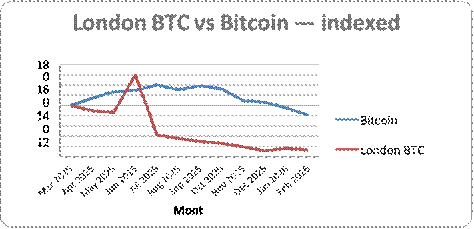 |
The Board actively reviews shareholder feedback, alongside corporate governance guidance received from institutional shareholder bodies. This insight directly feeds into the Group's annual evaluation and updates regarding its long-term remuneration policy.
This report was approved by the Board of Directors and is signed on its behalf in accordance with a resolution of the directors.
On behalf of the director
Chairman - remuneration committee 30 June 2026
Strategic and Corporate Governance Report
The Directors present their Strategic Report for London BTC Company Limited (the "Company") and its subsidiary (together, the "Group") for the year ended 28 February 2026.
This is the first Annual Report covering a full 12-month financial year following the change of accounting reference date announced in February 2025. The prior reporting period was the 18 months ended 28 February 2025, during which the Company transferred from the Aquis Stock Exchange Growth Market to the Main Market of the London Stock Exchange. The Board has continued the disclosures introduced in the prior period and has further developed its TCFD and ESG reporting, consistent with the Group's status as a Main Market issuer.
1. Purpose, strategy, and business model1.1 Purpose
The Group's purpose is to generate attractive risk-adjusted returns for shareholders, predominantly through capital appreciation, by operating and expanding a portfolio of Bitcoin mining operations across North America and by accumulating Bitcoin as a treasury asset. In the second half of the financial year, the board introduced selective gold exposure as a strategic complement to the Group's Bitcoin treasury. Bitcoin remains the primary asset: it offers asymmetric return potential and hard-capped digital scarcity. Gold adds a proven, counter-cyclical hedge. Holding both, in the board's view, produces a more durable balance sheet - and one better positioned to accumulate Bitcoin at pace during periods of elevated market volatility.
1.2 Business modelThe Group operates a decentralised, delegated hosting Bitcoin mining model. Its principal characteristics are:
· The Group owns its application-specific integrated circuit ("ASIC") mining machines but does not have equity in the data-centre facilities in which they operate.
· Mining machines are installed at third-party hosting facilities in the United States and Canada under hosting arrangements which include power, cooling, connectivity and on-site operational maintenance and support.
· Mining hashrate is directed to the Luxor Technology mining pool, under which the Group's machines combine processing power with other participants, improving the predictability of block-reward distributions and providing access to monitoring and firmware services.
· Bitcoin earned through mining is held in custody, principally in a wallet, and is treated as a long-term treasury asset. Holdings may be liquidated from time to time to fund working capital or expansion.
This model is intended to keep fixed corporate and operational overheads low, accelerate deployment of new capacity, and avoid the capital intensity and concentration risk associated with owning and operating large fixed asset proprietary buildings and associated facilities.
1.3 Choice of operating jurisdictionsThe Group operates across Canada and the United States for:
• High-quality internet infrastructure, reducing the need to locate data centres close to end-users.
• Cooler climates which reduce cooling load on mining equipment.
• Access to skilled labour outside major metropolitan centres at competitive cost.
• Access to low-cost, predominantly renewable, electricity. Over 90% of the power consumed by the Group's Canadian operations is sourced from Hydro-Québec's predominantly hydroelectric grid.
During the year the Group's operating footprint comprised hosted operations in Quebec, Iowa, Nebraska, Texas and Indiana. The Board considers geographic diversification to be a strategic mitigant against risks such as jurisdictional energy policies, regulatory changes and physical climate.
1.4 Strategy
The Group's growth strategy comprises the following pillars:
1. Organic expansion of the mining fleet through the acquisition of additional, more energy-efficient ASIC miners.
2. Geographic diversification across multiple US and Canadian jurisdictions to spread regulatory, energy-supply and physical climate risk.
3. Continuous fleet refresh, including the introduction of latest-generation Bitmain Antminer S21 series, Whatsminer M50S++ and US-manufactured Auradine miners, to improve hashrate per joule and to lower the Group's marginal cost of production.
4. Strategic partnerships within the digital asset ecosystem, including with Luxor Technology, to enhance operating margins through firmware optimisation and pool participation.
5. Disciplined treasury management, holding mined Bitcoin in regulated institutional custody and liquidating selectively to fund growth or manage working capital.
6. Selective consideration of corporate transactions, joint ventures and stock exchange listings, to broaden the Group's investor base and access to capital.
1.5 Resources and peopleThe Group does not currently employ staff other than its Directors and Officers. Delivery of the business plan is therefore dependent on the Board and on the network of hosting providers, custodians, technology partners and professional consultants and advisers with whom the Group contracts. The Directors, advisers, consultants, and stakeholders collectively bring extensive experience across capital markets, finance, listed-company management and the digital asset sector.
1.6 Review of the business and operational highlightsLondon BTC Company Limited was incorporated in the British Virgin Islands on 27 August 2021. The Company's ordinary shares were admitted to trading on the Access Segment of the Aquis Stock Exchange Growth Market on 21 April 2023 and to the Official List (Equity Shares (Transition Category)) of the Financial Conduct Authority ("FCA") and to trading on the Main Market of the London Stock Exchange on 13 January 2025.
1.7 Position at the start of the yearThe Group started the financial year ended 28 February 2026 with hosted mining operations across four US states and one Canadian province, a treasury Bitcoin balance held with Binance and Base, period-end cash of £0.9 million, and a US$4 million bridging facility (drawable in two tranches of US$2 million each). PKF Littlejohn LLP had been appointed as the Group's external auditor in March 2025.
2. Financial review and key performance indicators
2.1 Basis of comparison
These financial statements cover the 12 months ended 28 February 2026. The comparative period is the 18 months ended 28 February 2025, following the change of accounting reference date during that period. Year-on-year comparisons should be read in light of this difference in length and of the fact that the prior period included a substantial non-cash share-based payment charge of £14.0 million arising from the simplification of the capital structure ahead of admission to the Main Market in January 2025.
2.2 Key financial metrics
Metric | 12 months to 28 Feb 2026 | 18 months to 28 Feb 2025 | Commentary |
Revenue | £1.1 million | £1.0 million | First full annual reporting period of mining revenue. |
Pre-tax loss | £(4.9) million | £(16.0) million | Prior period included £14.0m of non-cash share-based payment expense. |
Pre-tax loss excluding share-based payments | £(4.9) million | £(2.0) million | Underlying comparable measure. |
Operating loss | £4.9 million | £(15.7) million | Prior period driven by share-based payment charges. |
Net cash outflow from operating activities | £(1.97) million | £(1.5) million | Reflects scale of FY26 hosted operations. |
Gross proceeds from share placings | £6.08 million | c. £2.5 million | FY26 capital markets activity. |
Capital expenditure on mining machines | £0.114 million | c. £0.5 million | Fleet expansion and refresh. |
Year-end cash | £0.04 million | £0.9 million | Movement from prior period-end. |
Net book value of mining machines | £0 | £614,000 | After annual impairment review under IAS 36. |
Bitcoin held in treasury at year-end | 80.16 | 5.92 | Custodied with Fidelity Digital Assets, Binance and Base (2025 - Binance and Base only). |
2.3 Non-financial and operational KPIs
The Board monitors a range of operational and treasury KPIs alongside conventional financial measures, including installed and operating hashrate (PH/s), realised hashprice, energy efficiency (joules per terahash), Bitcoin mined during the period, Bitcoin held in treasury, and fleet composition by ASIC generation. As foreshadowed in the prior period's report, the Group has worked during the year to capture these metrics on a more systematic basis and intends to disclose a quantified suite of operational KPIs as set out below.
Operational KPI | FY26 | Prior period | Commentary |
Average Worker Count | 881,8 | 327.5 | Average number of ASIC machines |
Average Operating hashrate (PH/s) | 91.28 | 34.00 | Average over the year |
Bitcoin earned | 15.52139294 | 18.08299429 | Gross of pool fees and hosting deductions |
Realised hashprice (US$/PH/day, average) | US$47.39 | US$66.35 | Reflects post-halving network conditions |
2.4 Liquidity, funding and going concern
The Group is loss-making on a reported basis and continues to be reliant on access to equity and other capital to fund growth and to bridge timing differences between Bitcoin generation, custody and selective liquidation. The Group raised approximately £6.08 million (gross) via equity capital raises and settled the debt facility in the period. The Group is debt-free. The Board has prepared cash flow forecasts covering at least 12 months from the date of approval of these financial statements and considers it appropriate to adopt the going concern basis of preparation. The Audit Committee has reviewed and concurred with that assessment.
3. Principal risks and uncertaintiesThe Group operates in a sector that is technologically dynamic, commercially competitive and subject to evolving regulation. The Board, supported by the Audit Committee, undertakes regular reviews of the principal risks facing the Group and the mitigations in place. The principal risks set out below are not exhaustive, but represent those which the Directors consider most material to the achievement of the Group's strategic objectives at the reporting date.
3.1 Strategic risks - overall impact: High
Risk | Description and potential impact | Mitigation |
Revenue concentration in Bitcoin | Revenue is largely a function of the realised Bitcoin price and the Group's share of network hashrate. A sustained decline in Bitcoin price, or in mining economics more broadly, would materially affect revenue and profitability. The April 2024 halving and subsequent network dynamics continue to shape mining economics during the year under review. | Active monitoring of Bitcoin price and network difficulty. Strategy permits selective diversification into related digital asset opportunities. Bitcoin treasury is held with regulated custodians, providing balance-sheet optionality. In addition a selective gold exposure as a deliberate risk-management measure, designed to offset periods of Bitcoin volatility without diluting the Group's core commitment to Bitcoin as its primary strategic asset. By holding gold alongside Bitcoin, the board aims to cushion short-term downside risk, preserving the Group's capacity to continue accumulating Bitcoin through market cycles. |
Competition from other digital assets and alternative protocols | ||
The emergence of competing cryptocurrencies, particularly those with institutional backing, could displace demand for Bitcoin or compress mining economics. | The Board monitors industry developments and maintains a supportive shareholder base which provides flexibility to raise further capital and adjust strategy if required. | |
Reliance on third-party hosting providers | The Group's mining machines are operated at facilities owned and managed by third parties. Service interruptions, contractual disputes or counterparty failure could disrupt operations and reduce hashrate. | Geographic diversification across Quebec, Iowa, Nebraska, Texas and Indiana, multiple hosting counterparties, and active engagement with each provider to monitor performance and service quality. |
Custody and private key risk | Loss, compromise or unauthorised transfer of the keys controlling the Group's Bitcoin treasury would result in permanent loss of assets and severe reputational damage. | Treasury Bitcoin is held with Fidelity Digital Assets, an institutionally regulated digital asset custodian, with appropriate operational controls. |
3.2 Market risks - overall impact: Medium
Risk | Description and potential impact | Mitigation |
Bitcoin price volatility | Bitcoin price is materially volatile and influenced by macroeconomic, geopolitical and regulatory factors outside the Group's control. Volatility affects both revenue and the carrying value of treasury Bitcoin. | Monitoring of pricing and network metrics; selective liquidation of Bitcoin holdings to manage working capital exposure; capital structure managed to absorb cyclical earnings. The selective gold exposure reduces the risk of Bitcoin as the primary strategic asset. By holding gold and Bitcoin, the board aims to cushion short-term downside pricing risk. |
Network difficulty and hashprice compression | An increase in aggregate network hashrate, in particular following the April 2024 halving, reduces the share of block rewards earned per unit of installed hashrate. This dynamic has been pronounced during the year under review. | Ongoing fleet refresh with latest-generation ASICs (S21, S21 Pro, M50S++, Auradine) and adoption of optimised firmware via Luxor to improve joules-per-terahash efficiency. |
Technological obsolescence of mining hardware | ASIC miner technology advances rapidly. Older units lose economic viability disproportionately as more efficient machines are deployed at scale, particularly in a compressed hashprice environment. | Regular fleet reviews; phased replacement of older units; budgeting for periodic capital expenditure on newer-generation ASICs. |
3.3 Financial risks - overall impact: High
Risk | Description and potential impact | Mitigation |
Funding and liquidity risk | The Group's operations have been funded through a combination of share placings and debt raised. The US$4 million bridging facility put in place during 2025 was settled in full and the Group is debt free. Where appropriate, selective liquidation of treasury Bitcoin assists liquidity. Sustained growth will require further capital and there is no certainty that future capital can be raised on acceptable terms. | Regular Board review of cash flow, working capital and pipeline of funding options; long-standing relationships with shareholders and brokers; flexibility to liquidate treasury Bitcoin if necessary; ongoing evaluation of a potential NASDAQ dual listing. |
Energy cost and availability | Mining economics are highly sensitive to electricity prices and reliability of supply. Increases in tariffs or constraints on supply to digital asset miners could erode margins. | Selection of jurisdictions with low-cost, predominantly renewable, energy; geographic diversification of hosting; ongoing monitoring of regulatory developments affecting energy supply to digital asset operators. |
Impairment of mining assets | ASIC mining machines are subject to estimation uncertainty in respect of useful economic life and recoverable amount, particularly given Bitcoin price volatility and rapid technological progress. | Annual impairment assessment under IAS 36; phased fleet replacement; conservative useful-life assumptions; oversight by the Audit Committee. |
3.4 Regulatory, legal and compliance risks - overall impact: Medium
Risk | Description and potential impact | Mitigation |
Evolving global regulation of digital assets | Digital asset mining and treasury activities are increasingly subject to legislative and regulatory attention across multiple jurisdictions. Adverse changes could increase compliance cost or restrict activities. | Operations are spread across multiple US states and Canadian provinces, and the hosted model avoids direct ownership of facilities, providing optionality if any single jurisdiction becomes adverse. |
Listing rules and market conduct | As a Main Market issuer the Company is subject to the FCA's UK Listing Rules, the UK Market Abuse Regulation, the Disclosure Guidance and Transparency Rules and related regimes. Breach could damage reputation and result in regulatory action. | Adoption of share dealing code, social media policy and market abuse procedures; Board and adviser oversight; ongoing training on disclosure obligations. |
Anti-bribery, corruption and financial crime | ||
Operations across multiple jurisdictions involve counterparty and transaction risks relating to financial crime. | Anti-bribery and corruption policy, anti- money laundering policy and whistleblowing policy in place; oversight by the Audit Committee with annual review. | |
3.5 Environmental, social and governance risks - overall impact: Medium
Risk | Description and potential impact | Mitigation |
Climate-related risks | Bitcoin mining is energy-intensive and exposed to physical climate risks (e.g. extreme weather affecting power supply) and transition risks (e.g. carbon pricing, regulatory limits on energy use for mining). | Sourcing of predominantly renewable power in Canada; continued development of TCFD-aligned disclosures and emissions data; geographic diversification. |
Stakeholder and reputational expectations | Investor, regulator and community expectations regarding ESG practices and disclosure continue to evolve. Failure to meet these expectations could affect access to capital and reputation. | Adoption of the QCA Corporate Governance Code 2023; phased build-out of ESG policies, data collection and reporting capability; Board-level oversight of climate-related matters. |
Board composition and diversity | The Board does not currently meet the diversity targets under the UK Listing Rules (UKLR 6.6.6R) and FCA Policy Statement PS 22/3. | The Board has acknowledged this position publicly and will keep diversity in mind when next making appointments, balanced against the need for sector expertise within a small board. |
4. Environmental, social and governance ("ESG") statement
4.1 EnvironmentalThe Group's direct environmental footprint is limited by virtue of its hosted operating model and absence of owned facilities. However, the Board recognises that the energy intensity of Bitcoin mining is a material ESG consideration. Over 90% of the Group's Canadian operations are powered by Hydro-Québec's predominantly hydroelectric grid, and the Board considers the carbon profile of incremental hosting jurisdictions when expanding the fleet.
4.2 SocialWith no employees beyond the Board and the Chief Executive Officer, the Group's direct social impact is currently limited. The Group expects its hosting partners and suppliers to uphold high standards of ethical labour, inclusion and social responsibility. As operations evolve, the Board will develop formal policies and frameworks proportionate to the Group's scale and reach.
4.3 GovernanceGovernance is addressed in the Corporate Governance Report which follows, including the Board's continued adoption of the QCA Corporate Governance Code 2023, its committee structure, and the controls and policies through which oversight is exercised.
5. Climate-related financial disclosures (TCFD)
London BTC Company Limited recognises that climate change represents a significant systemic risk. Compliance with the TCFD framework is required for all premium and standard listed companies on the London Stock Exchange on a comply-or-explain basis. The Board is committed to improving the quality and completeness of its climate-related disclosures year on year.
5.1 TCFD Purpose
Unlike the Streamlined Energy and Carbon Reporting (SECR) regime, which focuses on quantified GHG emissions, TCFD is primarily designed to enable investors to understand how climate change affects a company's strategy and long-term financial viability. For London BTC Company Limited, the most material climate-related financial risk is the energy intensity of Bitcoin mining and how the cost and carbon content of that electricity may evolve as the global economy decarbonises.
5.2 Climate Change Risks and Opportunities
The table below sets out the Group's disclosures against the four TCFD pillars. Where a recommended disclosure has not yet been fully met, an explanation is provided together with the Board's implementation plan.
Pillar / Sub-heading | Disclosure | Status |
GOVERNANCE | ||
Board oversight | The Board retains ultimate oversight of climate-related risks. Climate change is a standing Board agenda item where relevant, with primary executive responsibility held by the CEO. The Group does not operate a dedicated climate risk committee; the Board intends to establish one as the Group's governance infrastructure matures. | Partial |
Management's role | The CEO identifies, assesses and manages climate-related risks on a day-to-day basis and reports to the Board on material developments. Board approval of energy strategy, hosting arrangements and ASIC procurement decisions ensures climate considerations flow through capital allocation. | Ongoing |
STRATEGY | ||
Risks and opportunities identified | Transition risks: • Carbon pricing: Increased electricity costs at US grid-connected sites from carbon pricing could raise cost per Bitcoin mined. • Reputational: Stakeholder scrutiny of Bitcoin's energy intensity creates reputational risk, mitigated by fleet efficiency improvements and transparent disclosure. • Policy/regulatory: US legislation targeting cryptocurrency mining on energy grounds could restrict operations or raise compliance costs. Multi-state diversification mitigates concentration risk. • Hardware obsolescence: Failure to refresh the fleet with more efficient ASICs over time increases relative energy cost per terahash.
Physical risks: • Acute: Extreme weather events (storms, heat, grid instability) at sites could cause outages or curtailment. • Chronic: Rising ambient temperatures in southern US states may increase cooling costs and power usage effectiveness (PUE) at hosted facilities over the long term.
Opportunities: • Renewable energy sourcing: Preference for hydro-electric and low-carbon hosting reduces carbon intensity and exposure to fossil fuel pricing. • Fleet efficiency gains: Procurement of S21-series Bitmain and Whatsminer M50S++ units improves energy efficiency per terahash, reducing cost and carbon intensity per Bitcoin mined. | Identified |
Impact on strategy and financial planning | Electricity cost and availability is the primary climate-related financial exposure. The Group's decentralised, multi-site, third-party hosting model provides inherent resilience against single-site disruption. Climate considerations are integrated into hosting site selection, hardware procurement and capital budgeting. | Developing |
Scenario analysis / resilience | A formal climate scenario analysis (including against 1.5°C / well-below 2°C pathways) has not yet been conducted. The Board intends to initiate structured scenario analysis during the year ending 28 February 2027, informed by TCFD and ISSB IFRS S2 guidance, with results disclosed in the following annual report. | Not yet completed |
Risk identification and assessment | Climate risks are identified through: monitoring of US and UK regulatory and policy developments; review of energy tariff movements and grid composition at sites; assessment of weather event history and grid reliability; and review of sector publications and peer disclosures.
Climate change is a Principal Risk in the Group's risk register, embedded within related categories including energy pricing, operational continuity, regulatory compliance and reputational risk. | Established |
Risk management and integration | Climate considerations are factored into hosting site selection (energy source, grid reliability, regulatory environment), ASIC fleet refresh decisions (efficiency ratings), and capital allocation. The Group's third-party hosting model limits direct physical risk exposure. The Audit Committee reviews climate risk as part of its assessment of principal risks and internal controls. | Developing |
GHG emissions - Scope 1 | The Group owns no combustion equipment, vehicles or on-site generation assets. Scope 1 emissions are negligible and have not been quantified. | Negligible |
GHG emissions - Scope 2 | Scope 2 emissions arise from electricity consumed by the Group's ASIC fleet at third-party hosted facilities. Electricity is bundled within hosting fees rather than separately metered, and comprehensive kWh data has not been obtained for the year ended 28 February 2026.
Partial renewable energy information is available: the Group's former Canadian operations were powered predominantly by Quebec Hydro (approximately 90%+ renewable). US sites in Indiana, Nebraska and Texas are grid-connected; Nebraska benefits from significant wind generation, while Indiana and Texas have more mixed generation profiles. No renewable energy certificates (RECs) or power purchase agreements (PPAs) are in place. | Partial - Developing |
GHG emissions - Scope 3 | Not yet quantified. Material categories expected include upstream manufacture and transportation of ASIC hardware. Scope 3 quantification will be considered as part of the GHG data programme planned for FY2027. | Not yet quantified |
Other metrics | Management monitors fleet energy efficiency (J/TH) and hash rate per watt as proxies for environmental efficiency. Procurement of S21-series and M50S++ ASICs during the period has improved weighted-average fleet efficiency relative to prior periods.
Formal KPIs including energy intensity per Bitcoin mined (kWh/BTC) and estimated CO2e per Bitcoin mined will be developed once comprehensive consumption data is available. | Developing |
Targets | No formal, quantified emissions reduction targets have been established. Medium-term priorities relevant to the Group's climate ambition include: • Ongoing ASIC fleet refresh to improve energy efficiency; • Preference for hosting sites with renewable or low-carbon electricity supply; • Quantification of Scope 1, 2 and 3 GHG emissions by the year ending 28 February 2027; and • Setting measurable targets once a reliable emissions baseline has been established. | Not yet established |
The Board is committed to progressive improvement of these disclosures. In the year ending 28 February 2027 the Board will ensure that: (i) quantified GHG data (Scope 1, 2 and where practicable Scope 3) is collected and disclosed; (ii) a formal climate scenario analysis is initiated; and (iii) measurable emissions targets are established.
6. Streamlined Energy and Carbon Reporting (SECR)
6.1 Regulatory Framework
London BTC Company Limited (the "Company") is required to report its energy consumption and greenhouse gas ("GHG") emissions in accordance with The Companies (Directors' Report) and Limited Liability Partnerships (Energy and Carbon Report) Regulations 2018 (the "SECR Regulations"), which implement the UK Government's Streamlined Energy and Carbon Reporting framework.
As a company quoted on the Main Market of the London Stock Exchange, the Company is classified as a large undertaking for the purposes of the SECR Regulations and is accordingly required to disclose its energy use, associated carbon emissions, and at least one intensity metric within its Directors' Report.
6.2 Methodology and Reporting BoundaryThe Company has measured and reported all material sources of energy consumption and GHG emissions under the operational control approach. The reporting boundary encompasses all Bitcoin mining activities operated by the Company during the year ended 28 February 2026, comprising its fleet of approximately 1,100 Application-Specific Integrated Circuit ("ASIC") mining machines deployed across co-located data-centre facilities in United States and Canada.
All mining hardware is hosted at third-party co-location facilities. The Company does not own or occupy any buildings and has no Scope 1 emissions arising from stationary or mobile combustion of fuels. Energy consumption is therefore attributable entirely to the electricity consumed by the ASIC fleet and associated ancillary equipment at the co-location sites.
Mining operations are managed via the Luxor Technology mining pool, with hashrate contributed through the Company's sub-accounts. Electricity consumption data has been obtained from facility-level power draw records provided by the co-location operators and reconciled against Luxor pool hashrate telemetry.
6.3 Scope of GHG Emissions
Scope | Description | Included in Report |
Scope 1 | Direct emissions from combustion of fuels owned or controlled by the Company | Nil - no fuel combustion |
Scope 2 | Indirect emissions from purchased electricity consumed at co-location facilities | Yes - primary disclosure |
Scope 3 | Other indirect emissions (supply chain, business travel, etc.) | Not required under SECR; considered immaterial |
GHG emissions have been calculated using the EPA's eGRID GHG Conversion Factors for Company Reporting. The location-based method has been applied for Scope 2, using the US EPA eGRID sub-regional emission factors for the relevant grid regions.
6.4 Energy Consumption and GHG Emissions
The following table sets out the Company's energy consumption and associated Scope 2 GHG emissions for the year ended 28 February 2026.
Unit | Year ended 28 Feb 2026 | |
Energy Consumption | ||
Indiana facilities - electricity consumed | MWh | 9,597.7 |
Nebraska facilities - electricity consumed | MWh | 2,369.8 |
Texas facilities - electricity consumed | MWh | 61.7 |
Labrador facilities - electricity consumed | MWh | 10,523.8 |
Phoenix facilities - electricity consumed | MWh | 1,656.2 |
Total electricity consumed (Scope 2) | MWh | 24,209.2 |
Scope 1 Emissions (direct) | ||
Fuel combustion (stationary and mobile) | tCO₂e | Nil |
Scope 2 Emissions (purchased electricity - location-based) | ||
Indiana facilities | tCO₂e | 3,987.8 |
Nebraska facilities | tCO₂e | 791.7 |
Texas facilities | tCO₂e | 25.9 |
Labrador facilities | tCO₂e | 31.6 |
Phoenix facilities | tCO₂e | 673.3 |
Total Scope 2 emissions | tCO₂e | 5,510.3 |
TOTAL Scope 1 + Scope 2 emissions | tCO₂e | 5,510.3 |
6.5 Intensity Metric
In accordance with the SECR Regulations, the Company has selected an intensity metric appropriate to its principal activity of Bitcoin mining. The Directors consider that emissions per Bitcoin mined (tCO₂e/BTC) provides the most meaningful measure of the Company's carbon efficiency, as it directly relates total Scope 2 emissions to the quantum of productive output.
Intensity Metric | Unit | Year ended 28 Feb 2026 |
Total Scope 1 + Scope 2 emissions | tCO₂e | 5,510.3 |
Bitcoin mined during the year | BTC | 15.52139294 |
Carbon intensity - emissions per BTC mined | tCO₂e / BTC | 355.0 |
Energy intensity - electricity consumed per BTC mined | MWh / BTC | 1,550.7 |
6.6 Energy Efficiency Actions
The Directors are committed to improving the energy efficiency of the Company's mining operations. The following measures were undertaken or maintained during the year ended 28 February 2026:
# | Action | Status |
1 | Deployment of energy-efficient next-generation ASIC hardware to replace legacy machines, improving terahash per watt (TH/W) efficiency ratios across the fleet |
Ongoing - fleet upgrade programme |
2 | Monitoring of pool-level hashrate and efficiency data via Luxor Technology dashboard to identify underperforming or offline machines and minimise wasted energy draw |
In operation throughout the year |
3 | Evaluation of co-location facility power usage effectiveness (PUE) when selecting or renewing hosting arrangements, with preference for operators demonstrating lower PUE ratios |
Applied to new facility negotiations |
4 | Consideration of renewable energy availability and grid carbon intensity in the selection of mining site jurisdictions and power procurement arrangements |
Under review for future site selection |
5 | Remote monitoring and automated curtailment protocols to reduce energy consumption during periods of elevated electricity prices or grid stress |
Implemented via Luxor pool |
6.7 Prior Year Comparative
The comparative information presented for the year ended 28 February 2025 has been prepared on a consistent basis. Where the Company was formerly known as Vinanz Limited prior to its change of name on 3 July 2025, the comparative figures reflect the same operational entity and mining fleet. No restatement of prior year figures is required as a result of the change of name.
6.8 Exclusions and Limitations
The following items have been excluded from this disclosure on the grounds of immateriality or operational control:
Exclusion | Rationale |
Scope 3 supply chain and indirect emissions | Not required under SECR Regulations for quoted companies; considered immaterial given nature of operations |
Transmission and distribution losses associated with electricity supply | Excluded from location-based Scope 2 calculation; considered immaterial |
Energy consumed by co-location facility shared infrastructure (cooling, lighting, security) beyond the Company's metered allocation | Not within the Company's operational control; reflected in facility PUE but not directly attributable |
Business travel and employee commuting | The Company has no employees based at mining sites; Directors are UK-based; considered immaterial |
The Directors are committed to maintaining high standards of corporate governance, proportionate to the size, stage of development and complexity of the Group. The Board has adopted the Quoted Companies Alliance Corporate Governance Code 2023 (the "QCA Code"), which the Board considers to be the most appropriate recognised governance code for a company of the Group's size with a listing on the Main Market of the London Stock Exchange. A copy of the QCA Code is available at https://theqca.com/corporate-governance/.
The Board reviews compliance with the QCA Code annually. The remainder of this report sets out, principle-by-principle, the Board's application of the QCA Code during the year, including departures and the reasons for them.
7.1 Application of the QCA Code's ten principlesPrinciple 1 - Establish a purpose, strategy and business model which promotes long-term value for shareholdersThe Group's purpose, strategy and business model are set out in Section 1 of the Strategic Report. In summary, the Group seeks to generate long-term value for shareholders by operating a capital-light, geographically diversified Bitcoin mining business and by accumulating Bitcoin as a treasury asset. The strategy is delivered primarily through organic fleet expansion, partnerships with established sector counterparties such as Luxor Technology, and disciplined capital allocation. The strategy is articulated in Board-approved budgets and is communicated to shareholders through RNS announcements, the Annual Report and the Company's website.
Principle 2 - Promote a corporate culture that is based on ethical values and behavioursThe Board sets the tone for the Group's culture through its own conduct and through formal policies covering ethical conduct, anti-bribery and corruption, data protection, equality, diversity and inclusion, and whistleblowing. These policies are communicated to all individuals working for the Group and are enforced consistently. The Audit Committee has oversight of the policy suite and reviews its operation as part of its annual cycle. The Board considers that ethical conduct is integral to the Group's standing with shareholders, counterparties and regulators.
Principle 3 - Seek to understand and meet shareholder needs and expectationsThe Board communicates with shareholders through Regulatory News Service announcements, the Annual Report and interim results, the Annual General Meeting, the Company's website and ad-hoc presentations. Material existing and prospective shareholders are engaged directly by the Executive Chairman and Finance Director. The Annual General Meeting is the principal forum for retail shareholder engagement and the Board uses it to provide an update on strategy and to receive shareholder views. Voting outcomes are announced through the Regulatory News Service immediately after the meeting, including the total votes cast for and against each resolution.
Principle 4 - Take into account wider stakeholder interests, including social and environmental responsibilities, and their implications for long-term success
The Board acknowledges that long-term success depends on constructive relationships with hosting partners, technology providers, custodians, regulators, investors and the communities in which the Group's hosted operations are located. The Group's developing ESG and TCFD frameworks, set out in Sections 6 and 7 of the Strategic Report, address the environmental dimension of those relationships.
Principle 5 - Embed effective risk management, internal controls and assurance activities, considering both opportunities and threats, throughout the organisationThe Board has overall responsibility for the Group's system of internal control and for reviewing its effectiveness. The Group's principal risks are described in Section 4 of the Strategic Report and are formally reviewed by the Board and the Audit Committee.
Financial controls. The Board approves the Group's annual budget and reviews monthly management accounts and forecasts, including profit and loss, balance sheet and cash flow, against budget and prior period. The Audit Committee reviews the half-year and full-year financial statements before recommendation to the Board.
Non-financial controls. These include day-to-day management of the business by the Executive Directors, a defined schedule of matters reserved to the Board, an organisational structure with clear levels of authority, and a risk register which is periodically reassessed.
Internal audit. Given the current size of the Group and the limited number of personnel, the Board does not consider an internal audit function to be proportionate. The Audit Committee keeps this position under annual review.
Principle 6 - Establish and maintain the Board as a well-functioning, balanced team led by the chairAs at the year-end the Board comprised four Directors: the Executive Chairman, the Finance Director, the Executive Directors and an independent Non-Executive Director. Robert Scott was appointed on 13 May 2025. The Board considers that this composition reflects an appropriate balance of skills, experience and independence for a company at the Group's current scale, but acknowledges that the proportion of independent Non-Executive Directors falls below the QCA Code's expectation that at least half of the Board (excluding the Chair) should comprise independent Non-Executive Directors. The Board intends to enhance Non-Executive representation as the Group grows.
Biographical information for each Director who served during the year is set out in the table below. Conflicts of interest are managed through standing disclosure of external commitments and through the Board's standing procedures, with conflicted Directors recusing themselves from relevant discussions.
Director | Role | Biographical summary |
David Lenigas | Executive Chairman | Mr Lenigas holds a Bachelor of Applied Science (Mining Engineering) from Curtin University's Kalgoorlie School of Mines and a Western Australian First Class Mine Manager Certificate of Competency. He has extensive global corporate experience as Executive Chairman, Chairman and Non-Executive Director of multiple public companies listed in London, Canada, Johannesburg and Australia, including former Executive Chairman of Lonrho Plc. |
Jeremy Edelman | Executive Director | Mr Edelman holds bachelor's degrees in Commerce and Law and a Master's degree in Applied Finance. He is admitted as a Solicitor of the Supreme Courts of Western Australia and New South Wales. He has held senior roles in debt and acquisition finance at BankersTrust and UBS Warburg, and currently chairs AIM-listed Reabold Resources PLC. |
Robert Scott | Finance Director (appointed 13 May 2025) | Mr Scott qualified as a Chartered Accountant (CA(SA)) with Deloitte & Touche (South Africa), having obtained his Certificate of Theory of Accounting (CTA) from the University of Cape Town. He is currently a Non-Executive Director of LSE-listed Everest Global PLC, and brings senior financial, capital markets and corporate finance experience to the Board. |
Mahesh Pulandaran | Independent Non-Executive Director | Mr Pulandaran has over 20 years of experience in financial services, having begun his career in audit and assurance in the UK before moving to Asia with Deloitte, advising blue-chip clients including Microsoft and Caterpillar. He subsequently held senior offshore banking roles with HSBC and Coutts and Co International, and now leads the Trust Division of CorPa Asia Advisory Pte Ltd in Singapore. He is also a director of Main Market-listed Fragrant Prosperity Holdings Limited and AQSE-listed VVV Resources Limited. |
Board and committee meeting attendance
Attendance at formal meetings of the Board and its Committees during the year was as follows.
Director | Board1 | Audit Committee |
David Lenigas (Executive Chairman) | 16/16 | 1/1 |
Jeremy Edelman (Executive Director) | 13/16 | 1/1 |
Robert Scott (Finance Director, from 13 May 2025) | 7/7 | 1/1 |
Mahesh Pulandaran (Independent NED) | 14/14 | 1/1 |
1 The remuneration committee met as part of the Board meeting.
Principle 7 - Maintain governance structures and processes that are fit for purpose and support good decision-making by the Board
The Board operates under a formal schedule of Matters Reserved to the Board which covers overall Group strategy and management, financial reporting and controls, Group structure and capital, corporate governance, and nomination matters. The Board carries out the role of a nomination committee, including leading the process for appointment of new directors, reviewing Board composition and recommending committee membership.
The Board has two standing Committees:
Audit CommitteeThe Audit Committee comprises the independent Non-Executive Director, Mahesh Pulandaran (Chair), and the Executive Director, Jeremy Edelman. The Board acknowledges that the QCA Code expects audit committees to comprise independent Non-Executive Directors and that, with only one such Director on the Board, the Audit Committee does not fully meet that expectation. The Board considers this departure proportionate at the Group's current scale and will reconstitute the Committee as additional independent Non-Executive Directors are appointed.
The Committee's responsibilities, set out in its terms of reference, include oversight of the integrity of the financial statements, accounting policies, financial reporting, the engagement and performance of the external auditor, the framework of internal financial controls, and the operation of the Group's risk management framework. The Committee meets at least once each year, with the external auditor attending.
Remuneration CommitteeThe Remuneration Committee comprises David Lenigas (Chair) and Jeremy Edelman. The same observation regarding independence applies as for the Audit Committee, and the Board will reconstitute the Committee as further independent Non-Executive Directors are appointed.
The Committee is responsible, subject to any shareholder approval required, for setting the terms of employment, remuneration and benefits of Executive Directors and senior management, for recommending the level and structure of senior management remuneration, and for the design and operation of share-based incentive arrangements. The Committee meets at least twice each year.
Principle 8 - Evaluate Board performance based on clear and relevant objectives, seeking continuous improvementThe Board conducts an annual evaluation of its own performance and that of its Committees. The FY26 evaluation was conducted internally and considered the effectiveness of Board meetings, the quality and timeliness of management information, the operation of the Committees, the integration of the new Executive Director appointed during the year, and the balance of skills, experience and independence on the Board. The Board concluded that it and its Committees continue to operate effectively. The expansion of independent Non-Executive representation and the formalisation of succession arrangements remain identified development priorities. The Board keeps the methodology for performance evaluation under review and will consider engaging an external facilitator as the Group grows.
Principle 9 - Establish a remuneration policy which is supportive of long-term value creation and the Company's purpose, strategy and cultureThe Remuneration Committee designs remuneration to align Executive Directors and senior management with shareholders and with the Group's strategic objectives. Remuneration during the year comprised base salary or director fees. Remuneration policies are put to a shareholder vote where required by applicable rules; otherwise, the Board will continue to disclose remuneration arrangements transparently in the Annual Report and to engage with shareholders on remuneration matters.
Principle 10 - Communicate how the Company is governed and is performing by maintaining a dialogue with shareholders and other key stakeholdersThe Company communicates with shareholders and other stakeholders through the Annual Report and Accounts, half-yearly and full-year results announcements, ad-hoc RNS announcements, the Company's website, the Annual General Meeting, and direct engagement with material shareholders. The Company's governance-related policies and historical Annual Reports are available on the Company's website. The Board considers that this combination of channels provides appropriate transparency for a company of the Group's size and stage of development.
8. Report of the Audit CommitteeThis report has been prepared in accordance with the QCA Corporate Governance Code 2023. A summary of the Committee's membership, role and operation is set out in the Corporate Governance Report. The Committee met once formally, during the year.
8.1 Significant issues consideredIn discharging its responsibilities the Committee considered the following significant issues in respect of the financial statements:
Significant issue | Summary | Committee's response and conclusion |
Going concern | Cash flow forecasting in a sector characterised by Bitcoin price volatility, evolving regulation and rapid technology change is inherently uncertain. The Committee considered whether the Group has sufficient resources to meet its obligations for at least 12 months from the date of approval of the financial statements. | The committee has reviewed the forecast and is satisfied that there is sufficient liquidity, after considering sensitivity in the Bitcoin price, for the foreseeable 18-month period. |
Valuation and impairment of mining machines | Mining machines are a material asset class. Their recoverable amount is subject to estimation uncertainty given Bitcoin price volatility, network difficulty, energy costs and rapid technological obsolescence. Indicators of impairment under IAS 36 are reviewed at each reporting date. | The Company prepared a model on the cash-generating unit for the ASIC machines and concluded that with the current Bitcoin price and the current revenue per patahash, that it would be prudent to fully impair the asset mining machines. |
Revenue recognition | Bitcoin mining revenue is earned through participation in the Luxor mining pool, where block rewards and transaction fees cannot be separately identified and are accounted for as a single performance obligation under IFRS 15. The fair value of Bitcoin received is volatile and reliance on blockchain data for completeness introduces a risk of misstatement. | The Committee reviewed and challenged management's revenue recognition policy, including treatment of mining pool rewards and the methodology used to value Bitcoin received. It considered the auditor's procedures, including the use of blockchain data and pricing validation. The Committee concluded that the policy, its application and the related disclosures are appropriate. |
Carrying value of treasury Bitcoin | ||
Treasury Bitcoin is held with Fidelity Digital Assets and is accounted for in accordance with the Group's stated policy. The carrying value is sensitive to Bitcoin price movements and to the accounting classification adopted. | The Company marks-to-market the value of its Bitcoin at the close of every reporting period. | |
Share-based payments | Share-based payment charges involve material judgement in respect of grant-date fair value, vesting conditions and the timing of recognition under IFRS 2. | There were no share-based payments for the committee to review for the period under review. |
8.2 External auditor
PKF Littlejohn LLP ("PKF") was appointed as the Group's auditor on 3 March 2025, succeeding Pointon Young Chartered Accountants. The Committee has reviewed PKF's effectiveness during the year and is satisfied that the audit has been conducted to an appropriate standard. The Committee will recommend the re-appointment of PKF as auditor at the forthcoming Annual General Meeting; PKF has expressed its willingness to continue in office.
8.3 External auditor objectivity and independenceThe Committee monitors the objectivity and independence of the external auditor and has satisfied itself that PKF and the Group have in place appropriate policies and procedures to safeguard those qualities, including in relation to the provision of any non-audit services.
8.4 Internal control and internal auditThe Directors are responsible for the Group's system of internal control and for reviewing its effectiveness. The system is designed to safeguard the Group's assets and to provide reasonable, though not absolute, assurance against material misstatement or loss. The Group does not currently maintain an internal audit function. The Committee considers this proportionate to the Group's size and complexity and reviews the position at least annually.
8.5 WhistleblowingThe Group has a formal whistleblowing policy which encourages an open dialogue and provides channels through which Directors, contractors and other parties working for the Group can raise concerns about possible improprieties in financial reporting or other matters. The Committee receives reports on any matters raised under the policy as part of its regular cycle of meetings.
9. Other governance disclosures9.1 Board diversity
As at 28 February 2026, the reporting date, the Company had four Board members of which all were men and one had an ethnic origin other than white. As such the Company has not met the targets specified under the Listing Rules of having women make up 40 per cent of the Board or having a woman in at least one of the following senior positions on its Board: (A) the Chair; (B) the Chief Executive; (C) the senior Independent Director; and (D) the Chief Financial Officer. However, the Company does have one Board member from an Asian background meaning that it does meet the target of having at least one Board member from a minority ethnic background.
The Company has not met the diversity expectation of an Equity Shares (Transition) listed company on the London Stock Exchange. This is because the Board does not comprise of any women. The Board currently views its size as adequate for the needs of the Company. As the Company's needs grow the Board will also grow, which will provide the ability to create a diverse team of

Directors.
Gender identity or sexCompany as at 28 February 2026
Number of Board members |
Percentage of the Board |
Number of senior positions | Number of executive management | Percentage of executive management | |
Men | 4 | 100 | - | 3 | 100 |
Women | - | - | - | - | - |
Total | 4 | 100 | - | 3 | 100 |
Ethnic background
Company as at 28 February 2026
Number of Board members |
Percentage of the Board |
Number of senior positions | Number of executive management | Percentage of executive management | |
White | 3 | 75 | - | 3 | 100 |
Asian | 1 | 25 | - | - | - |
Total | 4 | 100 | - | 3 | 100 |
9.2 Market abuse, share dealing and social media
The Company has adopted procedures designed to manage and control inside information and to prevent its unlawful disclosure. The Directors are aware of their obligations under the UK Market Abuse Regulation and the Disclosure Guidance and Transparency Rules. The Company has adopted a share dealing code, consistent with the requirements of the Market Abuse Regulation, and a social media policy. Compliance with these policies is monitored by the Board with the support of the Company's advisers.
9.3 Anti-bribery, anti-money laundering and whistleblowing
The Group maintains the following policies, oversight of which is undertaken by the Audit Committee:
• Anti-Bribery and Corruption Policy.
• Anti-Money Laundering Policy.
• Whistleblowing Policy.
These policies are reviewed periodically and are communicated to Directors, contractors and other personnel working for the Group.
10. ApprovalThis Strategic Report and Corporate Governance Report has been approved by the Board and is signed on its behalf by:
 |
David Lenigas Executive Chairman 30 June 2026
London, United Kingdom
The directors present their report and the audited Consolidated Annual Financial Statements for the year ended 28 February 2026.
These consolidated annual financial statements have been prepared in accordance with UK adopted IAS.
The comparative figures presented in these financial statements relate to the 18-month period ended 28 February 2025. Shareholders should note that the prior period represented an extended 18-month timeframe covering a transition from a startup phase to a maturing business architecture, whereas the current period represents a standard 12-month operational cycle. Consequently, the financial results between the two periods are not directly comparable.
Corporate history and share capital trading
London BTC Company Limited (operating during the prior period under the name Vinanz Limited) was originally incorporated in the British Virgin Islands on 27 August 2021 (Registered Number: 2073995).
The historical timeline of the Group's public listings is summarised below:
· 21 April 2023: Ordinary Shares were admitted to trading on the Access Segment of the Aquis Stock Exchange Growth Market pursuant to its admission document dated 13 April 2023.
· 13 January 2025: Ordinary Shares were successfully transferred and admitted to the Official List (Transition Category) of the Financial Conduct Authority (FCA) and to trading on the Main Market for listed securities of the London Stock Exchange (LSE), where they continue to trade.
1. Principal activities and business overview
Principal activities
The Group continues to operate actively within the cryptocurrency and digital asset sector. Its core commercial activities center on the deployment of industrial Bitcoin mining operations and strategic capital investment within the broader blockchain infrastructure space. In addition, the Company is making strategic investments in gold projects as a hedging strategy.
Business review, future developments and KPI's
A detailed, comprehensive analysis of the Group's operational performance during the year, its commercial KPIs, and anticipated future developments are outlined extensively in the accompanying Strategic and Corporate Governance Report.
2. Financial results and distributions Results and dividendsThe financial performance of the Group for the year ended 28 February 2026 is set out in the Consolidated Statement of
Comprehensive Income.
The Directors do not recommend the payment of a dividend for the financial year (2025: £Nil). Given the growth-oriented nature of the cryptocurrency mining sector, the Board intends to continue prioritising long-term capital growth for its Shareholders. The Group may recommend cash distributions or dividends at a future date when it becomes commercially prudent to do so, subject to the generation of sustainable distributable reserves and the working capital requirements necessary to fund future infrastructure expansions.
3. Board of directors and share interests
Board of directors and executive officer
The directors and executive officer who held office during the financial year under review, and up to the date of approval of this report, are as follows:
Directors | ||
David Lenigas | Chairman | |
Jeremy Edelman Mahesh Pulandaran | Executive director Independent non-executive director | |
Robert Scott | Finance director | Appointed 13 May 2025 |
Executive officer Hugh Rattray |
Chief executive officer |
Appointed 21 May 2025 |
Directors' interests and remuneration
Details of the directors' beneficial shareholdings, options, and full remuneration breakdowns are disclosed within the Directors' Remuneration Report.
4. Corporate governance and risk management Going concernThe Directors have prepared the financial statements on a going concern basis, which assumes the Group will continue in
operational existence for the foreseeable future. In making this assessment, the Board has rigorously evaluated the Group's current financial performance, liquidity metrics, asset backing (including Bitcoin treasury holdings), debt obligations, and rolling cash flow projections. Based on these factors, the Directors maintain a reasonable expectation that the Group possesses adequate resources to meet its liabilities as they fall due.
Financial risk management
The Group's exposure to financial risks, including market risk, liquidity risk, credit risk, and digital currency price volatility, along with the policies implemented to mitigate these exposures, is detailed comprehensively in Note 30 of the financial statements.
Corporate governance and sustainability reporting
· Corporate Governance Statement: The Group's corporate governance framework and compliance statements are detailed in the Strategic Report.
· Streamlined Energy and Carbon Reporting (SECR): Disclosures relating to the Group's energy consumption, carbon emissions, and environmental efficiency measures associated with its mining operations are set out in the Strategic and Governance Report.
· Charitable and Political Donations: The Group made no charitable or political donations during the financial year (2025: £Nil).
5. Share capital and substantial shareholdings Substantial shareholdingsAs of 19 June 2026, the Group has been notified of the following compliance interests representing 3% or more of the issued Ordinary Share Capital (comprising a total of 358,846,093 shares in issue, as carried forward from the 2025 capital restructures):
Name | DI's | % | Cum | |
James Brearley Crest Nominees Limited | 72,296,775 | 20.15% | 20.15% | |
Pershing Nominees Limited | 57,416,356 | 16.00% | 36.15% | |
Wealth Nominees Limited | 50,740,204 | 14.14% | 50.29% | |
Lynchwood Nominees Limited | 30,065,067 | 8.38% | 58.67% | |
Peel Hunt Partnership Limited | 25,287,242 | 7.05% | 65.72% | |
Hargreaves Lansdown (Nominees) Limited | 10,926,947 | 3.05% | 68.77% | |
Total number of shares representing 3% or more | 246,732,591 | |||
Total number of shares in issue | 358,846,093 | |||
Included in the above, the directors and EBT hold shares as follows: | ||||
Number of shares | % | |||
David Lenigas | 57,046,356 | 16.15% | ||
Jeremy Edelman | 55,666,356 | 15.76% | ||
Vinanz Employee Benefit Trust | 50,740,204 | 14.36% | ||
Robert Scott | 153,000 | 0.04% | ||
Total shares held and controlled by directors | 163,605,916 | 46.30% | ||
6. Audit compliance and post-balance sheet events Post-balance sheet events
Other than the earlier disclosures above in respect of the companies Gold strategy, there are no subsequent material matters or circumstances that have arisen between 28 February 2026 and the date of approval of this report that significantly affect, or may significantly affect, the Group's ongoing operations, financial results, or state of affairs.
Disclosure of information to the auditors
Each of the persons who is a director at the date of approval of these Consolidated Annual Financial Statements as set out above confirms, so far as we are aware, that:
• there is no relevant audit information of which the Group's auditors are unaware; and
• we have taken all the steps that we ought to have taken as directors in order to make ourselves aware of any relevant audit information and to establish that the Group's auditors are aware of that information.
7. Independent Auditor
PKF Littlejohn LLP was the independent auditor for the year under review.
PKF Littlejohn LLP have expressed their willingness to continue in office as independent auditors. A resolution to re-appoint them will be proposed at the annual general meeting.
8. Annual General Meeting
The Group will hold its Annual General Meeting (AGM) at its lawyers' offices. The formal notice, along with the date and specific venue arrangements, will be communicated separately to shareholders.
This report was approved by the directors on 30 June 2026 and signed on its behalf in accordance with an official resolution of the directors.
 |
On behalf of the directors
David Lenigas
Chairman
Directors' Responsibilities and Approval
The Directors are responsible for preparing the Strategic Report, Report of the Directors, Remuneration Report and the financial statements in accordance with applicable law and regulations.
BVI Group law requires the directors to keep reliable accounting records which correctly explain the transactions of the Group, enable the financial position of the Group to be determined with reasonable accuracy at any time and allow financial statements to be prepared. The shareholders have resolved, in accordance with the BVI Business Companies Act, 2004 (as amended) and the Articles of Association, that the Directors prepare financial statements for each financial period which give a true and fair view of the state of affairs of the Group and of its profit or loss for that period.
On this basis, the Directors have elected to prepare the Financial Statements in accordance with UK adopted IAS. The Directors must not approve the Financial Statements unless they are satisfied that they give a true and fair view of the state of affairs of the Group, and of the profit or loss of the Group for that period.
In preparing these Financial Statements, the Directors are required to:
• select suitable accounting policies and then apply them consistently;
• make judgments and accounting estimates that are reasonable and prudent;
• state whether UK adopted IAS have been followed, subject to any material departures disclosed and explained in the financial statements; and
• prepare the financial statements on the going concern basis unless it is inappropriate to presume that the Group will continue in business.
The Directors are responsible for keeping adequate accounting records that are sufficient to show and explain the Group's transactions and disclose with reasonable accuracy at any time the financial position of the Group and enable them to ensure that the financial statements and the Directors' Remuneration Report comply with applicable laws and regulations. They are also responsible for safeguarding the assets of the Group and the Group and hence for taking reasonable steps for the prevention and detection of fraud and other irregularities.
The Directors are responsible for the maintenance and integrity of the corporate and financial information included on the Group's website. Legislation in the United Kingdom and the BVI governing the preparation and dissemination of accounts may differ from legislation in other jurisdictions.
Each of the Directors, whose names and functions are listed in the Directors' report confirm that, to the best of their knowledge and belief:
• The Financial Statements have been prepared in accordance with UK adopted IAS and give a true and fair view of the assets, liabilities, financial position and loss of the Group; and
• The Annual Report and Financial Statements, including the Strategy Report, includes a fair review of the development and performance of the business and the position of the Group, together with a description of the principal risks and uncertainties that they face.
This report was approved and authorised for issue by the Board and signed on its behalf by:
David Lenigas Chairman
30 June 2026
INDEPENDENT AUDITOR'S REPORT TO THE MEMBERS OF LONDON BTC COMPANY LIMITED
OpinionWe have audited the Group financial statements of London BTC Company Limited (the 'Group') for the year ended 28 February 2026 which comprise the Statement of profit and loss and other comprehensive income, the Statement of financial position, the Statement of changes in equity, the Statement of cash flows and notes to the financial statements, including significant accounting policies. The financial reporting framework that has been applied in their preparation is applicable law and UK-adopted international accounting standards.
In our opinion, the financial statements:
· give a true and fair view of the state of the Group's affairs as at 28 February 2026 and of its loss for the year then ended; and
· have been properly prepared in accordance with UK-adopted international accounting standards;
Basis for opinionWe conducted our audit in accordance with International Standards on Auditing (UK) (ISAs (UK)) and applicable law. Our responsibilities under those standards are further described in the Auditor's responsibilities for the audit of the financial statements section of our report. We are independent of the company in accordance with the ethical requirements that are relevant to our audit of the financial statements in the UK, including the FRC's Ethical Standard as applied to listed entities, and we have fulfilled our other ethical responsibilities in accordance with these requirements. We believe that the audit evidence we have obtained is sufficient and appropriate to provide a basis for our opinion.
Conclusions relating to going concernIn auditing the financial statements, we have concluded that the directors' use of the going concern basis of accounting in the preparation of the financial statements is appropriate. Our evaluation of the directors' assessment of the Group's ability to continue to adopt the going concern basis of accounting included:
· obtaining and reviewing cash flow forecasts and budgets for a period of at least 12 months from the date of signing the financial statements and the corresponding assumptions used;
· reviewing the post year end bank and digital asset balances for evidence of liquid funds available;
· Obtaining evidence of post year end fundraises and financing;
· Documenting and discussing with management future plans for the Group; and
· Challenging management's key inputs and assumptions, including but not limited to the hashprice, Bitcoin price, power costs and consumption and performing sensitivity analysis thereon.
Based on the work we have performed, we have not identified any material uncertainties relating to events or conditions that, individually or collectively, may cast significant doubt on the Group's ability to continue as a going concern for a period of at least twelve months from when the financial statements are authorised for issue.
Our responsibilities and the responsibilities of the directors with respect to going concern are described in the relevant sections of this report.
Our application of materialityWe apply the concept of materiality in planning and performing the audit, in evaluating the effect of identified misstatements on the audit and in forming our audit opinion.
Materiality for the Group financial statements as a whole was set at £59,000 (2025: £37,000), determined with reference to 1.5% of the Group's total expenses. We consider expenses to be the most appropriate benchmark given the nature of the Group's operations as a cryptocurrency mining business, where profitability may fluctuate significantly due to market volatility, but expenses provide a more stable and relevant measure of operational scale, especially whilst the business is in its infancy stages.
Performance materiality was set at £41,200 (£22,200), representing 70% (2025: 60%) of the headline materiality. This reduction reflects our assessment of the risk of misstatement and the effectiveness of the Group's control environment.
We agreed to report to the Audit Committee all corrected and uncorrected misstatements identified during our audit above
£2,900 (2025: £1,850), which represents 5% of the headline materiality, as well as any misstatements below that threshold that, in our view, warranted reporting on qualitative grounds.
The Group comprises the parent company and one subsidiary. We applied the same materiality approach at the component level, ensuring consistency across the Group audit. The audit work on the subsidiary was performed to a materiality level appropriate to its size and risk profile, but aligned with the Group's overall materiality framework.
Our approach to the audit
In designing our audit, we determined materiality and assessed the risk of material misstatement in the financial statements, whether due to fraud or error. We tailored the scope of our audit to ensure that we performed sufficient work to be able to give an opinion on the consolidated financial statements as a whole, taking into account the structure of the Group, the accounting processes and controls, and the industry in which it operates.
The Group comprises the parent company and one subsidiary. We identified the Group to be a single reporting component for audit purposes, and we performed a full scope audit on both the parent and the subsidiary. The audit of the subsidiary was conducted to a materiality level consistent with the Group's overall approach.
Our audit approach was risk-based and responsive to the unique characteristics of the Group's operations in cryptocurrency mining. This included:
· Understanding the Group's operations and control environment, particularly in relation to the recognition and valuation of digital assets and mining revenues.
· Evaluating the appropriateness of accounting policies applied to cryptocurrency transactions, including the classification, measurement, and disclosure of digital assets.
· Assessing the design and implementation of key controls over financial reporting, including those related to the safeguarding of digital assets and the recording of mining activity.
· Performing substantive audit procedures over areas of higher assessed risk, including revenue recognition, impairment of mining equipment, and the valuation of cryptocurrency holdings.
We also considered the Group's listing on the Main Market of the London Stock Exchange and the associated regulatory and disclosure requirements in our audit planning and execution.
Key audit matters
Key audit matters are those matters that, in our professional judgment, were of most significance in our audit of the financial statements of the current year and include the most significant assessed risks of material misstatement (whether or not due to fraud) we identified, including those which had the greatest effect on: the overall audit strategy, the allocation of resources in the audit; and directing the efforts of the engagement team. These matters were addressed in the context of our audit of the financial statements as a whole, and in forming our opinion thereon, and we do not provide a separate opinion on these matters.
Key Audit Matter | How our scope addressed this matter |
Revenue recognition (Note 14) | |
Under ISA (UK) 240, there is a rebuttable presumption that revenue recognition is a significant fraud risk. Total revenue recorded for the year is £1,169,168 (2025: £957,473). There is an inherent risk around the accuracy and completeness of revenue. Revenues are received from participation in the mining pools, which incorporate both block rewards and transaction fees, and gives risk to the completeness assertion. The fair value of crypto assets received are in addition subject to high levels of volatility, therefore generating a significant risk of misstatements in respect of the accuracy of revenue recognised. Income from crypto mining is split between Block rewards and transaction fees, which would normally be split between IFRS 15 revenue from contracts | Our work in this area included: • Obtaining and documenting our understanding of the information system and related controls relevant to each material income stream. • Evaluating the appropriateness of the information system and the effectiveness of the design and implementation of the related controls. • Substantive transactional testing of income recognised in the financial statements. • Documenting the contractual arrangements with the mining pools. • Testing cut-off at the year-end with reference to mining rewards and wallet receipts. |
with customers and other income. | • Ensure disclosure in the financial statements is in accordance with IFRS 15. |
However, as revenue is received as part of a mining pool this cannot be split and therefore the two elements are regarded as one performance obligation. Regarding the existence assertion, reliance is placed on transactions reported within the applicable blockchain ledger. Revenue recognition is considered a Key Audit Matter (KAM) because the measurement and timing of mining revenue can be complex, particularly given the fluctuation in cryptocurrency values/prices. Furthermore, there is an additional risk of manipulation or fraudulent activity due to the decentralised nature of blockchain and cryptocurrencies. | • Verifying the completeness of the Group's transactional revenue listing by tracing a sample from the Group's wallets to the transactional listing. • Verifying a sample of cryptocurrency sales to the blockchain and supporting bank statements in support of the accuracy of fair value calculations both throughout the year and as at year-end. • Evaluating whether there is a clear business rationale to support any significant transactions outside the normal course of the business of the entity, or transactions which otherwise appear to be unusual. |
Other information
The other information comprises the information included in the annual report, other than the financial statements and our auditor's report thereon. The directors are responsible for the other information contained within the annual report13. Our opinion on the financial statements does not cover the other information and, except to the extent otherwise explicitly stated in our report, we do not express any form of assurance conclusion thereon. Our responsibility is to read the other information and, in doing so, consider whether the other information is materially inconsistent with the financial statements or our knowledge obtained in the course of the audit, or otherwise appears to be materially misstated. If we identify such material inconsistencies or apparent material misstatements, we are required to determine whether this gives rise to a material misstatement in the financial statements themselves. If, based on the work we have performed, we conclude that there is a material misstatement of this other information, we are required to report that fact.
We have nothing to report in this regard.
Responsibilities of directorsAs explained more fully in the directors' responsibilities statement, the directors are responsible for the preparation of the financial statements and for being satisfied that they give a true and fair view, and for such internal control as the directors determine is necessary to enable the preparation of financial statements that are free from material misstatement, whether due to fraud or error.
In preparing the financial statements, the directors are responsible for assessing the Group's ability to continue as a going concern, disclosing, as applicable, matters related to going concern and using the going concern basis of accounting unless the directors either intend to liquidate the company or to cease operations, or have no realistic alternative but to do so.
Auditor's responsibilities for the audit of the financial statementsOur objectives are to obtain reasonable assurance about whether the financial statements as a whole are free from material misstatement, whether due to fraud or error, and to issue an auditor's report that includes our opinion. Reasonable assurance is a high level of assurance but is not a guarantee that an audit conducted in accordance with ISAs (UK) will always detect a material misstatement when it exists. Misstatements can arise from fraud or error and are considered material if, individually or in the aggregate, they could reasonably be expected to influence the economic decisions of users taken on the basis of these financial statements.
Irregularities, including fraud, are instances of non-compliance with laws and regulations. We design procedures in line with our responsibilities, outlined above, to detect material misstatements in respect of irregularities, including fraud. The extent to which our procedures are capable of detecting irregularities, including fraud is detailed below:
• We obtained an understanding of the company and the sector in which it operates to identify laws and regulations that could reasonably be expected to have a direct effect on the financial statements. We obtained our understanding in this regard through discussions with management, industry research, application of cumulative audit knowledge and experience of the sector.
• We determined the principal laws and regulations relevant to the company in this regard to be those arising from BVI Business Act, Disclosure and Transparency Rules, the Financial Conduct Authority Rules, General Data Protection Regulations, Money Laundering, Terrorist Financing and Transfer of Funds (Information on the Payer) Regulations 2017, BVI and local tax regulation.
• We designed our audit procedures to ensure the audit team considered whether there were any indications of non-compliance by the company with those laws and regulations. These procedures included, but were not limited to:
o Making enquires of management
o Reviewing board minutes
o Reviewing legal and professional fees and understanding the nature of the costs and the existence of any non-compliance with laws and regulations
o Reviewing RNS publications; and
o Reviewing accounting ledgers for any unusual journal entries which may indicate non-compliance
• We also identified the risks of material misstatement of the financial statements due to fraud. We considered, in addition to the non-rebuttable presumption of a risk of fraud arising from management override of controls, that the potential for management bias was identified in respect of the carrying value of mining machines, which has been addressed in the key audit matter section above.
• As in all of our audits, we addressed the risk of fraud arising from management override of controls by performing audit procedures which included, but were not limited to: the testing of journals; reviewing accounting estimates for evidence of bias; and evaluating the business rationale of any significant transactions that are unusual or outside the normal course of business.
• We obtained sufficient appropriate audit evidence regarding the financial information of the entities or business activities within the Group to express an opinion on the Group financial statements. We are responsible for the direction, supervision and performance of the Group audit. We remain solely responsible for our audit opinion.
Because of the inherent limitations of an audit, there is a risk that we will not detect all irregularities, including those leading to a material misstatement in the financial statements or non-compliance with regulation. This risk increases the more that compliance with a law or regulation is removed from the events and transactions reflected in the financial statements, as we will be less likely to become aware of instances of non-compliance. The risk is also greater regarding irregularities occurring due to fraud rather than error, as fraud involves intentional concealment, forgery, collusion, omission or misrepresentation.
A further description of our responsibilities for the audit of the financial statements is located on the Financial Reporting Council's website at: www.frc.org.uk/auditorsresponsibilities. This description forms part of our auditor's report.
Use of our reportThis report is made solely to the company's members, as a body, our audit work has been undertaken so that we might state to the company's members those matters we are required to state to them in an auditor's report and for no other purpose. To the fullest extent permitted by law, we do not accept or assume responsibility to anyone, other than the company and the company's members as a body, for our audit work, for this report, or for the opinions we have formed.
|
|
Nicholas Joel (Engagement Partner) For and on behalf of PKF Littlejohn LLP 30 June 2026 | 30 Churchill Place Canary Wharf London E14 5RE Registered Auditor
|
Statement of Profit or Loss and Other Comprehensive Income | ||||
Year ended 28 | 18 month period ended 28 February | |||
Notes | February 2026 £ | 2025 £ | ||
Revenue |
15 |
1,169,168 |
957,473 | |
Cost of sales | 16 | (1,489,534) | (785,764) | |
Gross (loss) / profit | (320,366) | 171,709 | ||
Administrative expenses | 17 | (923,385) | (979,580) | |
Other expenses | 18 | (1,476,991) | (14,915,530) | |
Downward revaluation of Bitcoin | 19 | (2,162,198) | - | |
Foreign currency gain | 19 | 49,856 | - | |
Loss from operating activities | (4,833,084) | (15,723,401) | ||
Impairment of Tokenomic investment | 20 | (1,977) | (35,084) | |
Profit on disposal of investment in quoted companies | 21 | 261,622 | - | |
(Loss) Profit on disposal of Bitcoin | 22 | (136,710) | 160,900 | |
Finance costs | 23 | (1,753,842) | - | |
Loss before tax | (6,463,991) | (15,597,585) | ||
Income tax (expense) / credit | 24 | (3,125) | 3,125 | |
Loss for the year | (6,467,116) | (15,594,460) | ||
Basic earnings per share | ||||
Basic loss per share (pence) | 27 | (1.80) | (25.05) | |
Total basic loss per share | (1.80) | (25.05) | ||
Diluted earnings per share | ||||
Diluted loss per share (pence) | 27 | (1.80) | (25.05) | |
Total diluted loss per share | (1.80) | (25.05) | ||
Other comprehensive income net of tax | ||||
Components of other comprehensive income that will not be reclassified to profit or loss | ||||
(Losses) / gains on revaluation reserve | (176,784) | 176,784 | ||
- Arising on the revaluation of intangible assets at fair value through other comprehensive income, net of tax | ||||
Total other comprehensive income (loss) net of tax 25 | (176,784) | 176,784 | ||
Total comprehensive income (loss) | (6,643,900) | (15,417,676) | ||
Statement of Financial Position | ||||
Notes | 2026 £ | 2025 £ | ||
Assets | ||||
Non-current assets | ||||
Property, plant and equipment | 5 | - | 624,349 | |
Intangible assets | 6 | 3,985,920 | 398,954 | |
Deferred tax assets | 8 | - | 3,125 | |
Prepayments | 9 | 204,313 | 96,022 | |
Total non-current assets | 4,190,233 | 1,122,450 | ||
Current assets | ||||
Prepayments | 9 | 39,154 | 68,031 | |
Cash and cash equivalents | 10 | 35,843 | 855,484 | |
Total current assets | 74,997 | 923,515 | ||
Total assets | 4,265,230 | 2,045,965 | ||
Equity and liabilities | ||||
Equity | ||||
Called up share capital | 11 | 28,412,976 | 19,701,636 | |
Accumulated loss | (24,539,863) | (18,072,747) | ||
Revaluation reserve | 12 | - | 176,784 | |
Total equity | 3,873,113 | 1,805,673 | ||
Liabilities | ||||
Current liabilities | ||||
Trade and other payables | 13 | 392,117 | 240,292 | |
Total equity and liabilities | 4,265,230 | 2,045,965 | ||
Statement of Changes in Equity | Called up share capital | Share based payment | Revaluation reserve | Accumulated loss | Total | |
£ | reserve | £ | £ | £ | ||
Balance at 1 September 2023 as previously reported |
1,178,880 |
1,939,170 |
- |
(2,546,061) |
571,989 | |
Loss for the period | - | - | - | (15,594,460) | (15,594,460) | |
Other comprehensive income | - | - | 176,784 | - | 176,784 | |
Total comprehensive income for the year | - | - | 176,784 | (15,594,460) | (15,417,676) | |
Issue of equity net of issue costs | 2,643,504 | - | - | - | 2,643,504 | |
Share-based payments | 15,879,252 | (1,939,170) | - | 67,774 | 14,007,856 | |
Balance at 28 February 2025 | 19,701,636 | - | 176,784 | (18,072,747) | 1,805,673 | |
Balance at 1 March 2025 |
19,701,636 |
- |
176,784 |
(18,072,747) |
1,805,673 | |
Changes in equity | ||||||
Loss for the year | - | - | - | (6,467,116) | (6,467,116) | |
Other comprehensive income | - | - | (176,784) | - | (176,784) | |
Total comprehensive income for the year | - | - | (176,784) | (6,467,116) | (6,643,900) | |
Issue of equity net of issue costs | 5,574,882 | - | - | - | 5,574,882 | |
Issue of equity to settle directors' loans | 1,614,714 | - | - | - | 1,614,714 | |
Fair value of shares issued to settle borrowings | 1,521,744 | - | - | - | 1,521,744 | |
Balance at 28 February 2026 | 28,412,976 | - | - | (24,539,863) | 3,873,113 | |
Notes | 11 |
Statement of Cash Flows | Notes | 12 month period ended 28 February 2026 £
|
| 18 month period ended 28 February 2025 £
|
Cash flows used in operations Cash paid to suppliers and employees | (1,972,702) | (1,517,450) | ||
Net cash flows used in operations | (1,972,702) | (1,517,450) | ||
Cash flows used in investing activities Purchase of property, plant and equipment |
5 |
(114,135) |
(384,103) | |
Proceeds from sales of intangible assets | 348,645 | 81,026 | ||
Purchase of intangible assets | 6 | (6,471,210) | - | |
Proceeds from sales of investments in quoted companies | 21 | 306,765 | - | |
Cash flows used in investing activities | (5,929,935) | (303,077) | ||
Cash flows from financing activities Proceeds from issuing shares |
5,574,882 |
2,520,121 | ||
Proceeds from borrowings | 1,508,114 | 50 | ||
Cash flows from financing activities | 7,082,996 | 2,520,171 | ||
Net (decrease) / increase in cash and cash equivalents | (819,641) | 699,644 | ||
Cash and cash equivalents at beginning of the year | 855,484 | 155,840 | ||
Cash and cash equivalents at end of the year | 10 | 35,843 | 855,484 | |
Material non-cash items | ||||
Financial period March 2025 to February 2026 |
• Bitcoin used to settle supplier invoices: £1,278,671 (net of internal transfers) of trade payables were settled via transfer of Bitcoin. This non-cash operating cost is excluded from cash outflows.
• Depreciation and impairment: non-cash charges of £156,819 and £581,665 respectively were recorded against property, plant and equipment.
• Intangibles impairment: non-cash charges of £2,162,198 were recorded against intangibles after adjusting for fair value gain reversals.
• Realised loss on Bitcoin: a non-cash realised loss of £178,211 on disposal of digital assets was recognised in profit or loss.
• Deferred tax debit: a non-cash tax debit of £3,125 was recognised reversing the credit arising in the prior year.
Financial period September 2023 to February 2025
• Bitcoin mined: £957,473 (net of internal transfers) in Bitcoin was received as block rewards during the year. As no fiat cash was received at the time of mining, this amount has been excluded from operating cash inflows.
• Bitcoin used to settle supplier invoices: £1,012,373 (net of internal transfers) of trade payables were settled via transfer of Bitcoin. This non-cash operating cost is excluded from cash outflows.
• Depreciation and impairment: non-cash charges of £129,690 and £35,084 respectively were recorded against property, plant and equipment.
• Share based payments: non-cash expense of £14,007,856 was recognised for equity instruments granted to directors and advisors.
• Realised gain on Bitcoin: a non-cash realised gain of £160,900 on disposal of digital assets was recognised in profit or loss.
• Deferred tax credit: a non-cash tax credit of £3,125 was recognised.
1. General information
London BTC Company Limited ('the Group') is a London Stock Exchange-listed Bitcoin treasury company that builds a strategic bitcoin holding through direct acquisitions and its own mining operations in North America. It positions itself as offering investors regulated, listed-equity exposure to both Bitcoin price upside and Bitcoin mining economics. In addition, it is using the defensive economics of gold to create additional value to its shareholders.
The group which is listed on the London Stock Exchange is incorporated and domiciled in the British Virgin Islands. The Group changed its name from Vinanz Limited to London BTC Company Limited on 3 July 2025.
2. Basis of preparation and material accounting policy information
These general-purpose consolidated financial statements of London BTC Company Limited have been prepared in accordance with UK adopted IAS. The consolidated financial statements have been prepared under the historical cost convention, except for, where applicable, the revaluation of financial assets and financial liabilities at fair value through profit or loss, and intangible assets at fair value through other comprehensive Income for gains.
The preparation of financial statements in conformity with UK adopted IASrequires the use of certain critical accounting estimates. It also requires management to exercise its judgement in the process of applying the Group's accounting policies. The areas involving a higher degree of judgement or complexity, or areas where assumptions and estimates are significant to the consolidated financial statements are disclosed in note 3.
The group operates an Employee Benefit Trust ("EBT") for the purpose of holding and delivering shares to employees and directors in connection with share-based payment arrangements. The EBT is controlled by the group and is therefore consolidated in accordance with the requirements of IFRS 10 (Consolidated Financial Statements).
The shares held by EBT are treated as treasury shares and are not valued until they are received by the employees and/or directors. Shares are not acquired through cash contributions but are awarded based on performance conditions being met under the terms of the relevant share-based payment scheme.
Once the shares are received by employees or directors, the fair value of the shares is recognised as an expense in profit or loss, with a corresponding increase in equity through ordinary share capital and, where applicable, share premium.
The principal accounting policies applied in the preparation of these consolidated annual financial statements are set out below. These policies have been consistently applied to all the years presented, unless otherwise stated.
2.1 Consolidation
The consolidated financial statements incorporate the assets and liabilities of all subsidiaries of London BTC Company Limited ("Group" or "parent entity") as at 28 February 2026 and the results of all subsidiaries for the period then ended. London BTC Company Limited and its subsidiaries together are referred to in these financial statements as the "Consolidated Entity" or the "Group".
Subsidiaries
Subsidiaries are all entities (including structured entities) over which the Group has control. The Group controls an entity when the Group is exposed to, or has rights to, variable returns from its involvement with the entity and has the ability to affect those returns through its power over the entity. Subsidiaries are fully consolidated from the date on which control is transferred to the Group. They are deconsolidated from the date that control ceases.
Inter-entity transactions, balances and unrealised gains on transactions between group entities are eliminated. Unrealised losses are also eliminated unless the transaction provides evidence of the impairment of the asset transferred. When necessary, amounts reported by subsidiaries have been adjusted to conform with the Group's accounting policies.
2.2 Functional currency and segmental reporting Functional and presentation currenciesThe financial statements are presented in Pounds Sterling (£), which is the Group's functional and presentational currency. The functional currency is the currency of the primary economic environment in which the Group operates. In determining the functional currency, the Group considers the currency that mainly influences sales prices for goods and services, and the currency that influences labour, material and other costs of providing goods and services.
As Bitcoin is a non-monetary asset, it is not retranslated under IAS 21. Changes in value reflect both market price movements and foreign exchange effects.
The financial statements are presented in Pounds Sterling (£), rounded to the nearest whole Pound unless otherwise indicated. Transactions in foreign currencies are translated into the functional currency using the exchange rate prevailing at the dates of the transaction. Monetary assets and liabilities denominated in foreign currencies are retranslated at the rate of exchange ruling at the reporting date. Exchange gains or losses are recognised in profit or loss.
2.2.1 Segmental reporting
Operating segments are reported in a manner consistent with the internal reporting provided to the Chief Operating Decision Maker (CODM) who is responsible for allocating resources and assessing performance of the operating segments. The CODM has been identified as the Board of Directors.
The Group operates a single reportable segment: Bitcoin mining and related cryptocurrency operations, with all material operations based in North America. As such the financial information presented reflects the performance of the consolidated business.
Operating segments
The consolidated entity operates in a single business segment, being the mining and sale of Bitcoin, and within a single geographic market. The CODM reviews financial information and allocate resources on this basis.
Revenue is derived from the conversion of mined Bitcoin via cryptocurrency platforms such as Coinbase, Luxor and Binance. These platforms serve as intermediaries for the sale of Bitcoin into fiat currency but are not considered customers in the traditional sense.
The accounting policies used in the internal reporting provided to the CODM are consistent with those applied in the consolidated financial statements.
As a result, the Consolidated Entity has determined that it has one reportable operating segment, and no further segment disclosures are required under IFRS 8 (Operating Segments).
2.3 Property, plant and equipment
Definition
Property, plant and equipment consist solely of Bitcoin mining machines. Bitcoin mining machines are classified as Property, Plant and Equipment (PPE) under IAS16 (Property, Plant and Equipment). These are tangible assets:
• held for use in the group's cryptocurrency mining operations ; and
• are expected to be used during more than one period.
Recognition
Property, plant and equipment is recognised as an asset when:
• it is probable that future economic benefits associated with the asset will flow to the entity; and
• the cost of the asset can be measured reliably.
Initial measurement
Bitcoin mining machines are initially recognised at cost, which includes:
• its purchase price, including import duties and non-refundable purchase taxes, after deducting trade discounts and rebates.
• any costs directly attributable to bringing the asset to the location and condition necessary for it to be capable of operating in the manner intended by management.
• the initial estimate of the costs of dismantling and removing the item and restoring the site on which it is located.
Subsequent measurement - Cost model
After initial recognition, property, plant and equipment is measured at cost less any accumulated depreciation and any accumulated impairment losses.
Depreciation
Bitcoin mining machines are depreciated on a straight-line basis over their estimated useful life of five (5) years. Depreciation is calculated daily, beginning from the invoice (purchase) date, to accurately match expense with asset usage.
Impairment
Assets are reviewed at each reporting date for indicators of impairment in accordance with IAS36 (Impairment of Assets). If such indicators exist, the asset's recoverable amount is estimated, and an impairment loss is recognised where the carrying amount exceeds the recoverable amount.
Derecognition
The carrying amount of an item of property, plant and equipment is derecognised when the asset is disposed of or when no future economic benefits are expected from its use or disposal. The gain or loss arising from the derecognition of an item of property, plant and equipment is included in profit or loss when the item is derecognised.
2.4 Intangible assets DefinitionThe Group has assessed whether it operates as a broker-trader of cryptocurrencies under IAS 2 and concluded that its primary intention is to hold Bitcoin as a treasury asset rather than for short-term resale. Accordingly, Bitcoin is classified as an intangible asset in accordance with IAS 38 (Intangible Assets).
Recognition
Bitcoin is recognised when:
• it is probable that the expected future economic benefits that are attributable to the asset will flow to the entity; and
• the cost of the asset can be measured reliably.
Initial measurement
Bitcoin obtained through mining activities is initially recognised at its fair value on the date the asset is received and becomes accessible to the group. Fair value is determined using the spot exchange rate in GBP at the specific date and time of receipt based on quoted prices in active markets from a principal exchange (e.g. Coinbase). This approach ensures compliance with IFRS 13 (Fair Value Measurement) and reflects the fair value of the asset transferred in exchange for the Group's mining efforts.
The amount recognised as the initial carrying value of the Bitcoin mined also corresponds to the revenue recognised in the statement of profit or loss on that date.
The Group does not capitalise mining-related operating costs into the value of the intangible asset. Instead, these are expensed as incurred, with the full fair value of the mined Bitcoin recognised as both revenue and as the initial cost of the intangible asset.
Purchased Bitcoin held as treasury is initially measured at cost.
Subsequent measurement - Revaluation model
After initial recognition, Bitcoin is measured using the revaluation model as permitted under IAS 38 (Intangible Assets). The asset is recognised at its fair value at the reporting date. Revaluation of assets held under IAS 38 (Intangible Assets) are revalued through other comprehensive income.
Impairments
At each reporting date, treasury Bitcoin is remeasured to fair value by reference to quoted prices in an active market. Increases in carrying amount are recognised in other comprehensive income and accumulated in the revaluation surplus, except to the extent that they reverse a previous downward revaluation recognised in profit or loss. Decreases in carrying amount are recognised in other comprehensive income to the extent of any existing revaluation surplus relating to the asset, with any excess recognised in profit or loss.
2.5 Share-based payments
The group issues equity-settled share-based payments to certain directors, employees and advisors. These are measured at fair value at the date of grant. The fair value determined at the grant date is expensed on a straight-line basis over the vesting period, based on the group's estimate of the number of equity instruments that will eventually vest. Fair value is determined by using an appropriate valuation model (e.g. Black-Scholes or Monte Carlo simulation) depending on the conditions of the grant.
Where share-based payments are settled by the issuance of equity instruments with no vesting conditions or service period, the fair value is expensed immediately.
The corresponding amount is recognised in the share-based payment reserve. Upon exercise or conversion of the instruments, amounts previously recognised in the share-based payment reserve are transferred to share capital and share premium as appropriate.
2.6 Financial instruments
The Group accounts for its financial instruments in accordance with IFRS 9 Financial Instruments.
A financial instrument is any contract that gives rise to a financial asset of one entity and a financial liability or equity instrument of another entity.
Financial assets are classified at initial recognition as measured at amortised cost, fair value through other comprehensive income (FVOCI), or fair value through profit or loss (FVTPL), based on the Group's business model and the contractual cash flow characteristics of the asset.
The Group applies the expected credit loss (ECL) model to assess impairment on financial assets measured at amortised cost. At each reporting date, the Group recognises a loss allowance for expected credit losses, taking into account historical default experience, current conditions, and forward-looking information.
Financial assets and financial liabilities are recognised when the Group becomes a party to the contractual provisions of the instrument.
Financial assets are initially recognised at fair value and are subsequently measured at amortised cost where they are held within a business model whose objective is to collect contractual cash flows and those cash flows represent solely payments of principal and interest. Financial liabilities are classified as subsequently measured at amortised cost. Interest expense is recognised using the effective interest method.
At the reporting date, the Group's financial assets comprise cash and cash equivalents and refundable hosting deposits, which are measured at amortised cost.
Financial liabilities comprise trade and other payables. Financial liabilities are initially recognised at fair value and are subsequently measured at amortised cost using the effective interest method.
Financial liabilities are derecognised when the obligation specified in the contract is discharged, cancelled, expires or is settled through the issue of equity instruments.
The Group derecognises a financial asset or financial liability when the contractual rights to the cash flows expire or the obligation is discharged, cancelled or expires.
Digital assets are not financial instruments and are accounted for separately in accordance with the Group's accounting policy for intangible assets as they do not give rise to a contractual right to receive cash or another financial asset.
Financial assets and financial liabilities are offset and presented net in the statement of financial position when there is a legally enforceable right to offset and an intention to settle on a net basis or to realise the asset and settle the liability simultaneously.
2.7 Fair value measurement
Assets and liabilities measured at fair value are classified into one of three levels of the fair value hierarchy based on the significance of the inputs used in determining fair value:
• Level 1: quoted prices (unadjusted) in active markets for identical assets or liabilities;
• Level 2: inputs other than quoted prices included within Level 1 that are observable for the asset or liability, either directly or indirectly; and
• Level 3: unobservable inputs for the asset or liability.
At the reporting date, the Group's recurring fair value measurements relate to treasury Bitcoin, which is classified as a Level 1 fair value measurement as it is valued using quoted prices in active cryptocurrency markets. The Group had no Level 2 or Level 3 fair value measurements during the reporting period. Accordingly, sensitivity disclosures are not applicable.
2.8 Income tax
The income tax expense or benefit for the period is the tax payable on that period's taxable income based on the applicable income tax rate for each jurisdiction, adjusted by the changes in deferred tax assets and liabilities attributable to temporary differences, unused tax losses and the adjustment recognised for prior periods, where applicable.
Deferred tax assets and liabilities are recognised for temporary differences at the tax rates expected to be applied when the assets are recovered or liabilities are settled, based on those tax rates that are enacted or substantially enacted, except for:
• when the deferred income tax asset or liability arises from the initial recognition of goodwill or an asset or liability in a transaction that is not a business combination and that, at the time of the transaction, affected neither the accounting nor taxable profits, or
• when the taxable temporary difference is associated with interests in subsidiaries, associates or joint ventures, and the timing of the reversal can be controlled and it is probably that the temporary difference will not reverse in the foreseeable future.
Deferred tax assets are recognised for deductible temporary differences and unused tax losses only if it is probable that future taxable amounts will be available to utilise those temporary differences and losses.
The carrying amount of recognised and unrecognised deferred tax assets are reviewed at each reporting date. Deferred tax assets recognised are reduced to the extent that it is no longer probable that future taxable profits will be available for the carrying amount to be recovered. Previously unrecognised deferred tax assets recognised to the extent that it is probable that there are future taxable profits available to recover the asset.
Deferred tax assets and liabilities are offset only where there is a legally enforceable right to offset current tax assets against current tax liabilities and deferred tax assets against deferred tax liabilities; and they relate to the same taxable authority on either the same taxable entity or different taxable entities which intend to settle simultaneously.
2.9 Prepayments
Prepayments represent amounts paid in advance for goods or services to be received in future periods. Prepayments are recognised as assets when payment is made and are subsequently recognised in profit or loss on a systematic basis over the period to which the underlying goods or services relate.
At each reporting date, prepayments are assessed for recoverability. Where it is no longer probable that the future economic benefits associated with a prepayment will be realised, the carrying amount is recognised in profit or loss.
2.10 Issued capital
Ordinary shares are classified as equity.
Incremental costs directly attributable to the issue of new shares or options are shown in equity as a deduction, net of tax, from the proceeds.
2.11 Revaluation reserve
The revaluation reserve arises from the remeasurement of intangible assets to fair value in accordance with IAS 38 (Intangible Assets).
Revaluation increases are recognised in other comprehensive income and accumulated in equity under the revaluation reserve, unless they reverse a revaluation decrease of the same asset previously recognised in profit or loss.
Revaluation decreases are first offset against any related credit balance in the revaluation reserve and then recognised in profit or loss.
Upon disposal or derecognition of a revalued asset, the associated balance in the revaluation reserve is transferred directly to retained earnings. This transfer is not made through profit or loss.
2.12 Revenue
Revenue is derived solely from the mining of Bitcoin by the Group's owned mining machines.
Recognition
Revenue is recognised at the point in time when the Group obtains control of the Bitcoin reward, which occurs when the mining process has been successfully completed and the Bitcoin is received in the Group's designated digital wallet. At this point, the Group has the ability to access, retain, and direct the use of the Bitcoin, thereby satisfying the criteria for control under IFRS 15 (Revenue from Contracts with Customers) and the IFRS Conceptual Framework for non-contractual income.
Measurement
Revenue is measured at the fair value of the Bitcoin received, determined by reference to the spot exchange rate in GBP on the date and time the Bitcoin enters the group's wallet. The spot price is obtained from a principal market such as Coinbase or Binance and represents a Level 1 input in accordance with IFRS 13 (Fair Value Measurement).
Wallet pooling methodology
The Group utilises a wallet pooling methodology for operational efficiency and custodial oversight. Bitcoin mined across multiple locations is consolidated into a pooled wallet environment. While the digital assets are physically pooled, the Group maintains detailed off-chain records to track the origin and timing of each Bitcoin reward. These records ensure traceability, accurate revenue recognition and reconciliation between individual mining activity and pooled wallet balances. This system enables the Group to reliably determine the fair value of each unit of Bitcoin at the time it is mined and received.
Interest
Interest revenue is recognised as interest accrues using the effective interest method. This is a method of calculating the amortised cost of a financial asset and allocating the interest income over the relevant period using the effective interest rate, which is the rate that exactly discounts estimated future cash receipts through the expected life of the financial asset to the net carrying amount of the financial asset.
Other revenue
Other income comprises realised gains on the disposal of digital assets, excluding Bitcoin mining rewards. Such gains are recognised at the point in time when control of the digital asset transfers to the buyer and the significant risks and rewards of ownership have passed. Income is measured at the fair value of the consideration received or receivable and is recognised only when it is probable that the economic benefits will flow to the Group and the amount can be reliably measured. This policy is applied in accordance with IFRS 15 (Revenue from Contracts with Customers) and relevant guidance under the IFRS Conceptual Framework.
2.13 Current and non-current classification
Assets and liabilities are presented in the statement of financial position based on current and non-current classification.
An asset is classified as current when: it is either expected to be realised or intended to be sold or consumed in the Consolidated Entity's normal operating cycle; it is held primarily for the purpose of trading; it is expected to be realised within 12 months after the reporting period; or the asset is cash or cash equivalent unless restricted from being exchanged or used to settle a liability for at least 12 months after the reporting period. All other assets are classified as non-current.
A liability is classified as current when: it is either expected to be settled in the Consolidated Entity's normal operating cycle; it is held primarily for the purpose of trading; it is due to be settled within 12 months after the reporting period; or there is no unconditional right to defer the settlement of the liability for at least 12 months after the reporting period. All other liabilities are classified as non-current.
Deferred tax assets and liabilities are always classified as non-current.
2.14 Cash and cash equivalents
Cash and cash equivalents include cash on hand, deposits held at call with financial institutions, other short-term, highly liquid investments with original maturities of three months or less that are readily convertible to known amounts of cash and which are subject to an insignificant risk of changes in value.
2.15 Earnings per share
Basic earnings per share
Basic earnings per share is calculated by dividing the profit or loss attributable to the shareholders of London BTC Company Limited, excluding any costs of servicing equity other than ordinary shares, by the weighted average number of ordinary shares outstanding during the financial year, adjusted for bonus elements in ordinary shares issued during the financial year.
Diluted earnings per share
Diluted earnings per share adjusts the figure used in the determination of basic earnings per share to take into account the after income tax effect of interest and other financing costs associated with dilutive potential ordinary shares and the weighted average number of shares assumed to have been issued for no consideration in relation to dilutive potential ordinary shares.
2.16 Impairment of non-financial assets
Non-financial assets are reviewed for impairment whenever events or changes in circumstances indicate that the carrying amount may not be recoverable. An impairment loss is recognised for the amount by which the asset's carrying amount exceeds its recoverable amount.
Recoverable amount is higher of an asset's fair value less costs of disposal and value-in-use. The value-in-use is the present value of the estimated future cash flows relating to the asset using a pre-tax discount rate specific to the asset or cash-generating unit to which the asset belongs. Assets that do not have independent cash flows are grouped together to form a cash-generating unit.
3. Significant judgements and key sources of estimation uncertainty
The preparation of the consolidated financial statements in accordance with International Financial Reporting Standards ("IFRS") requires management to exercise judgement in applying the Group's accounting policies and to make estimates and assumptions that affect the reported amounts of assets, liabilities, income and expenses. Actual results may differ from these estimates. Revisions to accounting estimates are recognised prospectively in the period in which the estimates are revised and in any future periods affected.
3.1 Critical accounting estimates and assumptions
The significant judgements and key sources of estimation uncertainty that management considers to have the most significant effect on the amounts recognised in the financial statements are set out below.
3.1.1 Classification and measurement of cryptocurrency holdings
Management has exercised judgement in determining the appropriate accounting treatment for cryptocurrencies, primarily Bitcoin. Bitcoin is accounted for as an intangible asset in accordance with IAS 38 using the revaluation model, as management has concluded that Bitcoin does not meet the definition of a financial asset and that an active market exists from which reliable fair values can be obtained.
Fair value is determined using quoted prices from the group's principal exchange (i.e. Coinbase), and movements are recognised through other comprehensive income. Due to the high volatility of cryptocurrency markets, significant judgement is required in selecting the valuation source and determining whether indicators of impairment exist. A material change in market price close to or after the period end may significantly impact reported carrying values. Fair value measurement is classified as a Level 1 measurement within the fair value hierarchy established by IRFS 13, Fair Value Measurement.
Therefore, forward looking information used for impairment assessments as required by IAS 36 Impairment of Assets only incorporates adjustments to future cash flows to the extent that the information was available at the Group's reporting date.
Refer to notes 6, 6.2 and 20.
3.1.2 Going concern
Management's assessment of going concern reflects a period of at least twelve months from the approval of these financial statements and is based on the group's current financial position, forecast cash flows, and funding arrangements. This includes assumptions regarding Bitcoin prices, mining economics, network difficulty, operating costs and the Group's liquidity requirements.
As the Group's operations and liquidity are closely linked to Bitcoin mining activities and the realisation of treasury Bitcoin holdings, changes in these assumptions may affect the outcome of the going concern assessment.
3.1.3 Impairment of mining equipment
The Group's mining equipment is subject to impairment testing when indicators of impairment exist. Management determines the recoverable amount of cash-generating units (CGUs) using a value-in-use model based on future cash flows. The Group has identified individual mining facilities, or pools of mining machines generating independent cash inflows, as its cash-generating units.
The determination of recoverable amount requires the use of significant estimates and assumptions. Future Bitcoin prices are inherently volatile and are estimated by reference to observable market data without assuming speculative appreciation. Network difficulty reflects the expected growth in global hashrate over time, which progressively compresses mining revenue per unit of hashrate contributed. Mining efficiency captures the hashrate output and energy consumption profile of the Group's machines relative to the broader network, which deteriorates as newer-generation hardware enters service. Operating uptime reflects assumptions about machine availability and pool connectivity across hosted facilities. Hosting costs represent contracted and expected electricity and facility charges at each site, which are the primary determinant of cash operating margins. The discount rate is a pre-tax rate reflecting the time value of money and the risks specific to the mining operations.
Changes in any of these assumptions may result in material adjustments to the carrying amount of the Group's mining equipment in future reporting periods.
Refer to note 18
3.1.4 Recognition of deferred taxes
Deferred tax assets are recognised to the extent that it is probable that taxable profits will be available to utilise deductible temporary differences and carried forward losses. The recognition involves significant judgement, particularly in relation to the assessment of future taxable income and the timing of reversal of temporary differences in a sector subject to earnings volatility and regulatory uncertainty.
4. Changes in accounting policies and disclosures
4.1 Standards and Interpretations effective and adopted in the current year
There were no changes in accounting policies and disclosures adopted in the current year.
4.2 New standards and interpretations not yet mandatory or early adopted
Accounting standards that have recently been issued or amended but are not yet mandatory, have not been early adopted by the Consolidated Entity for the annual reporting period ended 28 February 2026. The Consolidated Entity has not yet assessed the impact of these new or amended Accounting Standards and Interpretations other than as disclosed below.
IFRS 18 Presentation and Disclosures in Financial Statements
IFRS 18 includes requirements for all entities applying IFRS for the presentation and disclosure of information in financial statements.
Management has considered the requirements of IFRS 18. The standard is expected to affect the presentation and disclosure of items within the statement of profit or loss, including the presentation of defined subtotals. Based on management's preliminary assessment, the standard is not expected to have a material impact on the Group's financial position, financial performance or cash flows.
The mandatory implementation required by the standard is for years beginning on or after 1 January 2027. This change in accounting policy will be implemented for the first time for the financial year ending 29 February 2028.
IFRS 19 Subsidiaries without Public Accountability: Disclosures
IFRS 19 specifies the disclosure requirements an eligible subsidiary is permitted to apply instead of the disclosure requirements in other IFRS Accounting Standards.
The mandatory implementation required by the standard is for years beginning on or after 1 January 2027. This change in accounting policy will be implemented for the first time for the financial year ending 29 February 2028.
5. Property, plant and equipment
Bitcoin mining machines are recognised as tangible assets under IAS 16 (Property, plant and Equipment). These assets are used in the Group's core cryptocurrency mining operations and are expected to provide economic benefits over their useful lives.
5.1 Balances at year end and movements for the year | |||
Bitcoin Mining machines |
Total | ||
2026 £ | 2025 £ | ||
Reconciliation for the year ended 28 February 2026 | |||
Balance at 1 March 2025 | |||
At cost | 784,674 | 784,674 | |
Accumulated depreciation | (160,325) | (160,325) | |
Carrying amount | 624,349 | 624,349 | |
Movements for the year ended 28 February 2026 | |||
Additions from acquisitions | 114,135 | 114,135 | |
Depreciation | (156,819) | (156,819) | |
Impairment loss recognised in profit or loss | (581,665) | (581,665) | |
Property, plant and equipment at the end of the year | - | - | |
Closing balance at 28 February 2026 | |||
At cost | 898,809 | 898,809 | |
Accumulated depreciation and impairment | (898,809) | (898,809) | |
Carrying amount | - | - | |
Reconciliation for the period ended 28 February 2025 | |||
Balance at 1 September 2023 | |||
At cost | 265,871 | 265,871 | |
Accumulated depreciation | (30,635) | (30,635) | |
Carrying amount | 235,236 | 235,236 | |
Movements for the period ended 28 February 2025 | |||
Additions from acquisitions | 519,442 | 519,442 | |
Depreciation | (129,690) | (129,690) | |
Assets written off | (639) | (639) | |
Property, plant and equipment at the end of the year | 624,349 | 624,349 | |
Closing balance at 28 February 2025 | |||
At cost | 784,674 | 784,674 | |
Accumulated depreciation | (160,325) | (160,325) | |
Carrying amount | 624,349 | 624,349 | |
5.2 Depreciation and impairment losses
Depreciation and impairment losses have been included under the following expenditures:
| 2026 £ | 2025 £ |
| Cost of sales |
|
|
Bitcoin Mining machines | 156,819 | 129,690 |
5.3 Impairment review
During the year, management identified indicators of impairment relating to the Group's bitcoin mining operations and performed an impairment assessment in accordance with IAS 36, Impairment of Assets. The Group's mining operations were assessed as a single cash-generating unit ("CGU"), being the lowest level at which independent cash inflows are generated.
The recoverable amount of the CGU was determined using a value-in-use model based on estimated future cash flows derived from management-approved forecasts. The impairment assessment incorporated a number of significant assumptions, including forecast Bitcoin prices, expected network difficulty, mining efficiency, operating uptime, hosting and electricity costs, capital expenditure requirements and the discount rate applied to future cash flows.
Management identified clear internal and external indicators of impairment as follows:
• External - hashprice: mining economics have deteriorated materially. The prevailing hashprice per the Luxor Hashrate Lookback series is approximately 0.00047 BTC per PH/s per day, which at a Bitcoin price of approximately US$66,771 (£49,945 at a USD/GBP rate of 0.748) is insufficient to cover the cash hosting and electricity costs of the fleet,
• External - network difficulty and fleet efficiency: continuing growth in network hashrate, combined with the age and efficiency profile of the Company's machines relative to latest-generation hardware, has compressed unit margins, with no reasonable expectation of recovery within the remaining useful life of the machines, and
• Internal - operating performance: the mining division is operating at a sustained cash gross loss, with revenue per machine below direct cash operating cost at four of the five hosted sites and for the fleet in aggregate.
As a result of the assessment, the recoverable amount of the CGU was determined to be lower than its carrying amount and an impairment loss of £581,665 (2025: £0) was recognised in profit or loss. The impairment loss was allocated to property, plant and equipment within the CGU.
The impairment arose primarily as a result of reductions in forecast mining profitability, driven by changes in expected Bitcoin prices, network difficulty and other market conditions affecting future cash flows.
6. Intangible assets
6.1 Reconciliation of changes in intangible assets
Bitcoin mined £ | Binance digital asset £ | Fidelity digital asset £ | Tokenomic digital asset £ | Total £ | ||||||
Reconciliation for the year ended 28 February 2026 | ||||||||||
Balance at 1 March 2025 | ||||||||||
At cost | 92,076 | 304,901 | - | 37,061 | 434,038 | |||||
Accumulated impairment | - | - | - | (35,084) | (35,084) | |||||
Carrying amount | 92,076 | 304,901 | - | 1,977 | 398,954 | |||||
Movements for the year ended 28 February 2026 | ||||||||||
Opening balance fair value adjustment | 34,021 | 65,224 | - | - | 99,245 | |||||
Mined Bitcoin | 1,168,829 | - | - | - | 1,168,829 | |||||
Bitcoin acquisitions | - | - | 6,474,350 | - | 6,474,350 | |||||
Downward revaluation of Bitcoin | - | (143,504) | (2,195,477) | - | (2,338,981) | |||||
Disposals/transfers/write-downs | (1,278,671) | (5,833) | (529,996) | (1,977) | (1,816,477) | |||||
Intangible assets at the end of the year | 16,255 | 220,788 | 3,748,877 | - | 3,985,920 | |||||
Closing balance at 28 February 2026 | ||||||||||
At cost or revaluation | 16,255 | 220,788 | 3,748,877 | 37,061 | 4,022,981 | |||||
Accumulated impairment | - | - | - | (37,061) | (37,061) | |||||
Carrying amount | 16,255 | 220,788 | 3,748,877 | - | 3,985,920 | |||||
Movements for the period ended 28 February 2025 | ||||||||||
Opening balance and acquisitions | 92,076 | 292,294 | - | 37,061 | 421,431 | |||||
Impairment loss recognised in profit or loss | - | (123,173) | - | - | (123,173) | |||||
Revaluation increase (decrease) | - | (24,220) | - | (35,084) | (59,304) | |||||
Disposals | - | 160,000 | - | - | 160,000 | |||||
Intangible assets at the end of the year | 92,076 | 304,901 | - | 1,977 | 398,954 |
Bitcoin
At the reporting date, management assessed the carrying amount of the Group's Bitcoin holdings for impairment in accordance with IAS 36 Impairment of Assets. Based on this assessment, the carrying amount of the Bitcoin holdings exceeded their recoverable amount and an impairment loss was recognised in profit or loss.
The recoverable amount of the Bitcoin holdings was determined using fair value less costs of disposal. Fair value was determined with reference to quoted market prices for Bitcoin in active markets at the reporting date. Costs of disposal were considered immaterial. Accordingly, the fair value measurement is classified as a Level 1 measurement within the fair value hierarchy established by IFRS 13 Fair Value Measurement.
An impairment loss of £(2,338,981) (2025 gain: £176,784) was recognised during the year to reduce the carrying amount of the Bitcoin holdings to its recoverable amount. The impairment loss was reduced by the reversal of previous gains from the revaluation reserve of £176,784 to £2,162,198.
The determination of recoverable amount is based on observable market inputs, principally quoted Bitcoin prices and applicable foreign exchange rates at the reporting date.
Due to the volatility in digital assets markets, the fair value of Bitcoin holdings is subject to material fluctuations. A 10% movement in market prices would result in the following changes in total fair value:
+10% change | -10% change | |
Asset type | £ | £ |
Bitcoin | 404,442 | (404,442) |
7. Financial assets Fair value hierarchy
At the reporting date, the fair value measurements of the Group's digital assets fall within the following levels of the IFRS 13 fair value hierarchy.
Level 1 £ | Level 2 £ | Level 3 £ | Total £ | ||||
Year ended 28 February 2026 Bitcoin |
3,985,920 |
- |
- |
3,985,920 | |||
Period ended 28 February 2025 Bitcoin |
396,977 |
- |
- |
396,977 | |||
Tokenomic | - | 1,977 | - | 1,977 | |||
396,977 | 1,977 | - | 398,954 |
Financial assets continued...
Transfers between levels of input
There were no transfers between levels during the reported financial periods
8. Deferred tax
8.1 The analysis of deferred tax assets and deferred tax liabilities is as follows:

8.2 Reconciliation of deferred tax movements
| Deferred tax £ | Total £ | ||
Opening balance at 1 March 2025 | 3,125 | 3,125 | ||
(Charged) / credited to profit or loss | (3,125) | (3,125) | ||
Closing balance at 28 February 2026 | - | - | ||
Opening balance at 1 September 2024 (Charged) / credited to profit or loss | - 3,125 | - 3,125 | ||
Closing balance at 28 February 2025 | 3,125 | 3,125 | ||
8.3 Deferred tax assets where utilisation is dependent on future taxable profits |
Cumulative tax losses of £50,191 (2025 - £49,846) with a potential cumulative deferred tax asset of £12,548 (2025 - £12,462) have not been recognised due to uncertainty over future taxable profits.
9. Prepayments | 2026 | 2025 | ||
Prepayments comprise the following balances | ||||
Prepayments - hosting and mining-related operating costs | 204,313 | 139,587 | ||
Security deposits comprise non-refundable advance payments under long-term service agreements for future operating costs associated with the Group's Bitcoin mining operations. These advance payments are classified as non-current assets as the related services are expected to be consumed beyond twelve months from the reporting date. | ||||
These advance payments primarily relate to long-term hosting, energy, and infrastructure support agreements with third-party service providers. The costs will be systematically expensed to the income statement over the term of the respective agreements, in line with the receipt of services. | ||||
The Group assesses these balances for recoverability at each reporting date with consideration given to supplier performance, contractual enforceability, and service continuity. No impairment losses have been recognised as of the reporting date | ||||
Prepayment - administrative costs | 39,154 | 24,466 | ||
Administrative and operation prepayments primarily consist of upfront costs for insurance, software subscriptions, professional fees and other contracted services | ||||
At the reporting date, the Group had not identified any indicators of impairment or non-recoverability for these prepayments. | ||||
243,467 | 164,053 | |||
Non-current assets |
204,313 |
96,022 | ||
Current assets | 39,154 | 68,031 | ||
243,467 | 164,053 | |||
10. Cash and cash equivalents
Cash and cash equivalents included in current assets:
| 2026 £ | 2025 £ |
Cash |
|
|
Balances with banks | 35,843 | 855,484 |
Cash and cash equivalents comprise cash at bank held in operational accounts. These funds are available for immediate use in the Group's operations and are not subject to any restrictions or significant risk of changes in value.
The total cash and cash equivalents balance reconciles to the cash flows from operating, investing, and financial activities.
11. Called up share capital
Ordinary shares entitle the holder to participate in dividends and the proceeds on the winding up of the Group in proportion to the number of and amounts on the shares held. The fully paid ordinary shares have no par value and the Group does not have a limited amount of authorised capital.
On a show of hands, every member present at a meeting in person or by proxy shall have one vote and upon a poll each share shall have one vote.
Issued | 2026 | 2025 | ||
358 846 093 (2025 - 253 701 022) fully paid up ordinary shares | 28,412,976 | 19,701,636 | ||
During the year the Group settled its outstanding borrowing through the issue of ordinary shares. Accordingly, the borrowing was derecognised during the reporting period. Interest expense and foreign exchange differences incurred prior to settlement have been recognised in profit or loss. The difference between the carrying amount of the financial liability immediately before derecognition and the fair value of the equity instruments issued has been recognised as a loss on extinguishment of borrowings. | ||||
Share reconciliation | ||||
Shares - beginning of the year / period | 253,701,022 | 116,491,839 | ||
Issued | 105,145,071 | 137,209,183 | ||
Shares - closing | 358,846,093 | 253,701,022 | ||
Movement in ordinary share capital Date Shares |
Issue price (£) |
£ | ||
Issued ordinary shares to EBT 28 May 2025 50,740,204 | - | - | ||
WRAP capital raise 20 June 2025 22,028,474 | 0.01375 | 3,028,915 | ||
Direct subscription 24 June 2025 4,000,000 | 0.01375 | 550,000 | ||
WRAP capital raise 09 July 2025 3,783,733 | 0.01850 | 699,991 | ||
Direct subscription 17 July 2025 1,621,621 | 0.01850 | 300,000 | ||
Accelerated book build 16 July 2025 11,538,462 | 0.01300 | 1,500,000 | ||
J Edelman - loan shares 05 February 2026 5,716,289 | 0.14124 | 807,357 | ||
| 0.14124 | 807,357 | ||
105,145,072 | 7,693,620 | |||
12. Reserves | ||||


Reserves represent the cumulative and other equity components of the Group that arise from various transactions and accounting treatments under IFRS.
12.1 Classification of reserves
| 2026 | 2025 |
Revaluation reserve | - | 176,784 |
12.2 Detailed analysis of other comprehensive income movements
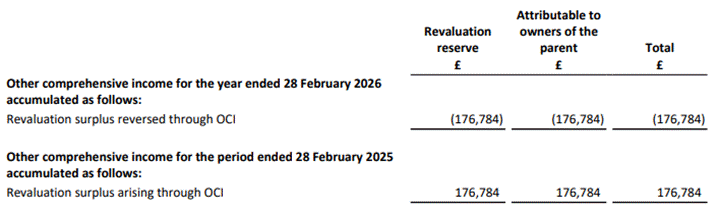
12.3 Nature and purpose of reserves
The revaluation reserve includes unrealised gains or losses arising from the revaluation of intangible assets (cryptocurrencies) where the revaluation model has been applied in accordance with IAS 38. Gains are recognised in Other Comprehensive Income (OCI) and accumulated in this reserve, expect to the extent that they reverse previously recognised losses through profit or loss.
13. Trade and other payables | 2026 £ | 2025 £ | ||
13.1 Trade and other payables comprise: | ||||
Trade and other payables | 89,368 | 153,037 | ||
Accrued liabilities | 298,939 | 80,600 | ||
Other payables | 3,810 | 6,655 | ||
Total trade and other payables | 392,117 | 240,292 | ||
13.2 Additional disclosures | ||||
Trade payables represent amounts due to suppliers for goods and services purchased by the Group. These are typically settled within 30 to 60 days, depending on the payment terms agreed upon with suppliers.
Accrued liabilities represent costs incurred but not yet invoiced or paid as at the reporting date. These typically include professional fees, operational expenses, and other services received but unpaid.
14. Financial liabilities | ||||
Carrying amount of financial liabilities by category | ||||
At amortised cost |
Total | |||
£ | £ | |||
Year ended 28 February 2026 | ||||
Trade and other payables excluding non-financial liabilities (Note 13) | 392,117 | 392,117 | ||
Items of income, expense, gains or losses | ||||
Net gains or net losses through profit or loss | 1,647,005 | 1,647,005 | ||
During the year the Group settled its outstanding borrowing through the issue of ordinary shares. Accordingly, the borrowing was derecognised during the reporting period. Interest expense and foreign exchange differences incurred prior to settlement have been recognised in profit or loss. The difference between the carrying amount of the financial liability immediately before derecognition and the fair value of the equity instruments issued has been recognised as a loss on extinguishment of borrowings. | ||||
Year ended 28 February 2025 | ||||
Trade and other payables excluding non-financial liabilities (Note 13) | 240,290 | 240,290 | ||
15. Revenue | ||||
15.1 Revenue comprises: | ||||
Block rewards and transaction fees | 1,169,168 | 957,473 | ||
Revenue is recognised at a point in time when control of the mined Bitcoin is transferred to the Group, which is the point in time at which the Bitcoin is received into the Group's designated digital wallet. This represents the moment the Group has the ability to direct the use of, and obtain substantially all the remaining benefits from, the asset | ||||
Revenue from Bitcoin mining is measured as the fair value of the Bitcoin received, translated into Pounds Sterling at the spot exchange rate on the date of receipt. This approach reflects the Group's policy of recognising income based on the actual value of digital assets at the time they are earned. | ||||
15.2 Sources of revenue | ||||
Contracts with customers | 1,169,168 | 957,473 | ||
16. Cost of sales | 2026 £ | 2025 £ | ||
Cost of sales comprise: | ||||
Power and hosting costs | 1,332,715 | 656,074 | ||
Depreciation of Bitcoin mining machines | 156,819 | 129,690 | ||
Total cost of sales | 1,489,534 | 785,764 | ||
17. Administrative expenses | ||||
Administrative expenses comprise: | ||||
Accounting fees | 63,583 | 35,529 | ||
Advertising and marketing | 79,569 | 231,530 | ||
Auditors remuneration - Fees | 82,500 | 83,131 | ||
Bank fees | 12,858 | 28,985 | ||
Consulting and professional | 561,238 | 539,579 | ||
General expenses | 108,807 | 53,570 | ||
Secretarial fees | 2,129 | - | ||
Membership and subscriptions | 12,654 | 7,256 | ||
Telecommunication | 47 | - | ||
Total administrative expenses | 923,385 | 979,580 | ||
18. Other expenses | ||||
Other expenses comprise: | ||||
Compliance | 13,393 | 17,254 | ||
Cryptocurrency costs | 17,788 | 3,290 | ||
Directors' remuneration | 411,501 | 292,663 | ||
Impairment costs - Bitcoin mining machines | 581,665 | - | ||
Insurance | 20,065 | 25,766 | ||
Investor relations | 95,908 | 11,961 | ||
Listing fees | 163,677 | 206,693 | ||
Penalties | 576 | - | ||
Printing and stationery | 64 | - | ||
Repairs and maintenance | 155 | 16,867 | ||
Research and development costs | (3,980) | 136,149 | ||
Share based payments | - | 14,007,856 | ||
Share registry costs | 38,423 | 40,349 | ||
Taxes on purchases - unclaimable | 70,649 | 110,986 | ||
Travel - Overseas | 67,107 | 45,696 | ||
Total other expenses | 1,476,991 | 14,915,530 | ||
19. Other gains and (losses) | 2026 £ | 2025 £ | ||
Other gains and (losses) comprise: | ||||
Gain or (loss) on foreign exchange differences on liabilities |
49,856 |
- | ||
Downward fair value adjustment on Bitcoin held | (2,162,198) | - | ||
Total other gains and (losses) | (2,112,342) | - | ||
20. Impairment of investment | ||||
Impairment of investment in Tokenomic Coin | (1,977) | (35,084) | ||
21. Profit on disposal of investment | ||||
Gain on the disposal of quoted companies | 261,622 | - | ||
The investment in Vaultz Capital was acquired during the year for £41,143 and disposed of before the year end for £306,765. At the beginning of the year, the Group had no investments in quoted companies. At the end of the year, the Group had no investments in quoted companies.
22. (Loss) Profit on disposal of Bitcoin | |||||
Arising on the disposal of Bitcoin | (136,710) | 160,900 | |||
23. Finance costs | |||||
Finance costs included in profit or loss: | |||||
Trade and other payables | 236 | - | |||
Group loan liabilities | 1,647,005 | - | |||
Shareholder loan liabilities | 106,601 | - | |||
Total finance costs | 1,753,842 | - | |||
Pursuant to the cancellation of outstanding debt obligations to directors (namely D Lenigas and J Edelman), the Company issued them a capital amount of £1,508,113, in total, by issuing 10,677,818 ordinary shares plus an additional 754,760 ordinary shares in respect of an interest component of 12% per annum payable to these directors. Consequently each director received, in settlement of the loan, 5,716,289 shares. This was in full and final settlement of the $2 million loans advanced by them. | |||||
The interest expense arising on conversion of the investor loan facility to share capital comprises interest of £9,788 on settlement while a loss on extinguishment of the debt of £1,521,743 was incurred. This loss was the difference between the carrying amount of the liability and the consideration paid and was a premium attaching to the shares issued to settle the debt. | |||||
24. Income tax expense / (credit)
24.1 Income tax recognised in profit or loss:
The Group is incorporated and registered in the British Virgin Islands (BVI). Under current BVI legislation, the Group is not subject to income tax in the BVI provided it does not carry on business with BVI residents. As such, no income tax expense arises for the parent group.
 |
The Group includes Vinanz (UK) Limited, a wholly owned operating subsidiary registered and tax resident in the United Kingdom. Vinanz (UK) Limited is subject to UK corporation tax on its taxable profits in accordance with UK tax laws. On 17 February 2026, the group incorporated a US company, which had not traded by year end.
Deferred tax | 2026 £ | 2025 £ | ||
Originating and reversing temporary differences - Vinanz (UK) Limited | 3,125 | (3,125) | ||
Total income tax expense / (credit) | 3,125 | (3,125) | ||
24.2 Additional disclosures | ||||
The deferred tax benefit of £3,125 in 2025 arose in relation to audit fees accrued in Vinanz (UK) Limited, but not yet deductible under UK tax law. The accrual was reversed in the current year.
The deferred tax asset relating to the trading loss of £296 (2025 - £49,846), in Vinanz (UK) Limited, has not been recognised due to uncertainty over the availability of future taxable profits. The group operates from the British Virgin Islands where the statutory rate is 0%.
25. Other comprehensive income | |||
Disclosure of gross, tax and net other comprehensive income | |||
Gross other comprehensive income £ | Net other comprehensive income £ | ||
Year ended 28 February 2026 | |||
Revaluation reserve | 176,784 | 176,784 | |
Total other comprehensive income | 176,784 | 176,784 | |
Period ended 28 February 2025 | |||
Revaluation reserve | (176,784) | (176,784) | |
Total other comprehensive income | (176,784) | (176,784) | |
26. Share-based payments | |||
27. Earnings per share | 2026 £ |
| 2025 £ |
27.1 Basic earnings per share | |||
The earnings and weighted average number of ordinary shares used in the calculation of basic earnings per share are as follows: | |||
Loss for the year (period) attributable to owners of the Group for continuing operations | (6,467,116) | (15,594,460) | |
Earnings used in the calculation of basic earnings per share for continuing operations | (6,467,116) | (15,594,460) | |
Weighted average number of ordinary shares used in the calculation of basic earnings per share |
358,846,093 |
62,243,329 | |
27.2 Diluted earnings per share | |||
The earnings used in the calculation of diluted earnings per share are as follows: | |||
Earnings used in the calculation of basic earnings per share for continuing operations | (6,467,116) | (15,594,460) | |
Weighted average number of ordinary shares used in the calculation of diluted earnings per share | 358,846,093 | 62,243,329 | |
Total anti dilutive potential ordinary shares | - | - | |
28. Financial risk management |
The Consolidated Entity's activities expose it to a variety of financial risks. The Consolidated Entity's overall risk management program focuses on the unpredictability of financial markets and seeks to minimise potential adverse effects on the financial performance of the Consolidated Entity.
Risk management is carried out the finance director (Finance) under policies approved by the Board of Directors (the Board). These policies include identification and analysis of the risk exposure of the consolidated entity and appropriate procedures, controls and risk limits. Finance identifies and evaluates financial risks within the consolidated entity's operating units. Finance reports to the Board on a monthly basis.
Financial risk management continued...
28.1 Foreign exchange risk
The Consolidated Entity undertakes certain transactions denominated in foreign currency and is exposed to foreign currency risk through foreign exchange rate fluctuations.
Foreign exchange risk arises from future commercial transactions and recognised financial assets and financial liabilities denominated in a currency that is not the entity's functional currency. The risk is measured using sensitivity analysis and cash flow forecasting.
Exposure
The Group's exposure to foreign currency risk at the end of the reporting period, expressed in Pounds Sterling, was as follows:
28 February 2026 | US Dollars £ | Australian Dollars £ | Canadian Dollars £ | Pounds Sterling £ | |||
Trade and other receivables | 126,629 | - | 77,684 | - | |||
Trade payables | 6,785 | 30,497 | - | 53,900 | |||
US Dollars |
Australian Dollars |
Canadian Dollars |
Pounds Sterling | ||||
28 February 2025 | £ | £ | £ | £ | |||
Trade receivables | 96,022 | - | - | - | |||
Trade payables | 68,717 | 15,703 | 47,358 | 23,078 | |||
28.1.1 Bitcoin price risk |
The Group is exposed to movements in the market price of Bitcoin. Revenue from mining activities is received in Bitcoin and the Group also holds Bitcoin as a treasury asset. Consequently, fluctuations in the market price of Bitcoin may materially affect the Group's revenue, profitability, cash flows and the carrying value of its Bitcoin holdings.
Management monitors Bitcoin price movements on an ongoing basis and manages treasury holdings having regard to anticipated operating cash requirements and market conditions.
28.2 Fair value of financial instruments
Unless otherwise stated, the carrying amounts of financial instruments reflect their fair value. The Group continuously monitors market developments and reassesses classification within the fair value hierarchy as conditions evolve.
28.2.1 Concentration risk
The Group's operations are substantially dependent upon the Bitcoin ecosystem. Adverse movements in the Bitcoin price, mining economics or network conditions may materially affect the Group's financial performance and financial position.
28.3 Liquidity risk
The consolidated entity manages liquidity risk by maintaining adequate cash reserves by continuously monitoring actual and forecast cash flows and matching the maturity profiles of financial assets and liabilities.
29. Capital management
The Group's objective when managing capital is to safeguard its ability to continue as a going concern while maintaining sufficient financial resources to fund its Bitcoin mining operations, capital expenditure requirements and working capital needs, thereby creating long-term value for shareholders
The Group's capital comprises issued share capital, accumulated losses and treasury Bitcoin holdings, which are actively managed as part of the Group's treasury strategy. Management monitors available cash resources and treasury Bitcoin holdings on an ongoing basis and may realise Bitcoin holdings to fund operating expenditure, capital investment and other cash requirements as they arise.
The Group manages its capital structure in response to changes in economic conditions, the Bitcoin market and the funding requirements of its operations. Where appropriate, the Group may retain mined Bitcoin, realise treasury Bitcoin or raise additional equity capital to support its activities.
The Group has no interest-bearing borrowings and was not subject to any externally imposed capital requirements during the current or prior reporting period.
30. Related parties | |||||||
30.1 Group entities | |||||||
Parent Entity | London Bitcoin Company Limited | ||||||
Subsidiary | Vinanz (UK) Limited | ||||||
30.2 Directors emoluments | |||||||
Directors emoluments paid / receivable for services as director from |
Share based |
Total | |||||
Year ended February 2026 Name | company £ | payments £ | remuneration £ | ||||
David Lenigas | 162,000 | - | 162,000 | ||||
Jeremy Edelman | 162,000 | - | 162,000 | ||||
Mahesh Pulandaran | 20,000 | - | 20,000 | ||||
Robert Scott | 67,500 | - | 67,500 | ||||
Total directors emoluments | 411,500 | - | 411,500 | ||||
Directors emoluments paid / receivable for services as director from |
Share based |
Total | |||||
18 month period ended February 2025 Name | company £ | payments £ | remuneration £ | ||||
David Lenigas | 132,000 | 4,726,967 | 4,858,967 | ||||
Jeremy Edelman | 132,000 | 4,726,967 | 4,858,967 | ||||
Mahesh Pulandaran | 28,663 | - | 28,663 | ||||
Robert Scott | - | - | - | ||||
Total directors emoluments | 292,663 | 9,453,934 | 9,746,597 | ||||
30.3 Related party transactions and balances | |||||||
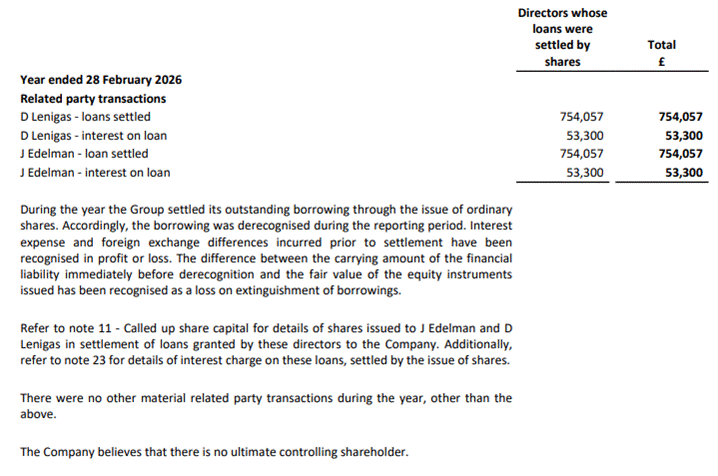
Related Shares:
London Btc