
5th May 2026 07:00
5 May 2026
ALTONA RARE EARTHS PLC
("Altona" or "the Company")
Monte Muambe MRE results
Altona (LSE: REE), (OTCQB: ANRCF), a resource exploration and development company focused on critical raw materials in Africa, is pleased to announce JORC-compliant Mineral Resource Estimates ("MRE") for fluorspar and gallium for the Monte Muambe project.
Highlights - Fluorspar
· JORC MRE: 3.48 million tons at 20.6% CaF2 for 716,000 tons of CaF2 contained.
· Initial base case mine life: 9.5 years at 50,000tpa acid-spar.
· Additional exploration target (Kudu - up to 3,200,000 tons of CaF2 contained) and additional exploration potential at Jambire and Jambire Mn targets (not drilled yet).
· Results justify initiating other fluorspar scoping study workflows.
Highlights - Gallium
· JORC MRE: 11.73 million tons at 54.7 g/t Ga2O3 for 641 tons of Ga2O3 contained.
· MRE tonnage significantly exceeds expectations, underpins potential for a large-scale gallium deposit.
· One of very few published gallium MRE worldwide and the first on a carbonatite deposit.
· Less than 20% of gallium soil anomaly drilled to date - strong tonnage upside potential (over 40 million tons).
· Commercial viability subject to on-going gallium extraction testing in Canada and Poland.
· No direct global peer comparison exists - Altona is at the forefront of carbonatite-hosted gallium exploration.
Cedric Simonet, CEO, commented: "The publication of the Monte Muambe fluorspar and gallium MREs represent an important and transformative milestone for the Company. The results fundamentally revalue the project.
"The fluorspar MRE supports the business case for the development of the fluorspar mine, with clear upside potential demonstrated by the Kudu exploration target. The next milestone for the fluorspar project is the metallurgy, the initial results of which are expected by the end of the second quarter of this year.
"The gallium MRE highlights a larger-than-expected mineralised system, and positions Altona at the forefront of gallium explorers globally. On-going gallium metallurgical studies will determine potential pathways for gallium concentration and/or recovery. Should this workstream prove successful, gallium extraction at Monte Muambe could evolve into a stand-alone development opportunity.
"More broadly, these results continue to validate Monte Muambe as a multi-catalyst project, with several parallel value creation workstreams, each capable of delivering tangible milestones and sustained news flow. Together, these initiatives provide multiple avenues for value creation as the Company continues to refine the project's technical and economic parameters."
Fluorspar MRE results support fluorspar mine development progress
Both MREs were prepared by Rock and Stock Investments (Pty) Ltd, a geological consultancy company based in Cape Town, South Africa, in accordance with the JORC code. The competent person is Joshua Hattingh (BSc (Hons.), FGSSA, Pr.Sci.Nat.). Fluorspar and gallium MREs were prepared for the Fluorite Zone (including its Southern Extension), and for Python. The JORC Table 1 form is attached as an appendix to this RNS. A fluorspar exploration target estimate was prepared for the Kudu target.
Zone | Category | Tonnage (Mt) | Grade (CaF2 %) | Contained CaF2 (t) |
Fluorite Zone | Measured | 1.52 | 20.7% | 314,000 |
Fluorite Zone | Inferred | 1.48 | 20.2% | 299,000 |
Fluorite Zone | Total | 3.00 | 20.5% | 613,000 |
Python | Inferred | 0.49 | 21.2% | 103,000 |
Python | Total | 0.49 | 21.2% | 103,000 |
All | Measured | 1.52 | 20.7% | 314,000 |
All | Inferred | 1.97 | 20.5% | 402,000 |
All | Total | 3.48 | 20.6% | 716,000 |
Table 1 - Fluorspar MRE (cut-off grade 12.5% CaF2 - see Notes1)
Assuming a metallurgical recovery of 65% and a concentrate grade of 97.5% CaF2, the contained CaF2 tonnage is sufficient to produce 50,000 tons per year of acid-grade concentrate for a period of 9.5 years.
These results therefore justify proceeding with the other workstreams of the fluorspar scoping study (metallurgy, mine plan, engineering studies and financial modelling).
Significant potential remains to increase the fluorspar resource at Monte Muambe. Reconnaissance drilling fences at Kudu were sufficient to define an exploration target estimate (see Table 2), with up to 3.2 million tons of CaF2 contained. In addition, the Jambire and Jambire Mn targets, which display marked fluorine-in-soil anomalies and fluorspar outcrops, have not been drilled yet and are expected to provide additional tonnage.
Target | Category | Tonnage (Mt) | Grade (CaF2 %) | Contained CaF2 (Mt) |
Kudu | Exploration Target | 9.9-14.6 | 8%-22% | 0.8-3.2 |
Table 2 - Kudu fluorspar exploration target
Further drilling is expected to lead to a material increase in the MRE, potentially sustaining an up to 100,000 tons per year operation. Such drilling will not take place immediately, but rather as part of the project's definitive feasibility study, once project viability has been confirmed by the on-going scoping study.
Gallium MRE - defining a new critical mineral asset class
Zone | Category | Tonnage (Mt) | Grade (g/t Ga2O3) | Contained Ga2O3 (t) |
Fluorite Zone | Inferred | 9.29 | 53.3 | 496 |
Python | Inferred | 2.44 | 59.7 | 146 |
All | Inferred | 11.73 | 54.7 | 641 |
Table 3 - Gallium MRE (cut-off grade 40.3 g/t Ga2O3 - see Notes2)
The gallium MRE confirms that gallium mineralisation extends beyond the fluorspar ore envelope and into adjacent fenite zones, defining a broad mineralised zone around the perimeter of the carbonatite intrusion. As a result, the tonnage of the gallium resource is much higher than that of the fluorspar resource.
It is noteworthy that the gallium MRE so far covers less than 20% of the total strike length of gallium-in-soil anomalies, indicating strong upside potential. The Board believes that the potential to increase the gallium MRE to a level of over 40 million tons is significant.
It is also important to note that the Monte Muambe gallium MRE is one of very few code-compliant gallium estimates ever published worldwide, and, the Board believes, the first for a carbonatite-hosted occurrence. Gallium is usually reported as a potential by-product of bauxite, zinc ore, lithium, and in Western Australia as a co-product of rare earths in saprolite deposits. All these deposits have very different mineralogical and metallurgical characteristics and cannot be directly compared to Monte Muambe. The publication of the gallium MRE positions Altona to the forefront of gallium exploration and development in a rare-earths and fluorspar carbonatite context.
The progress achieved by the Company underpins the importance of carrying out specific gallium metallurgical testing to test the possibility of (1) producing a concentrate enriched in gallium and (2) extracting gallium from this concentrate. This metallurgical testing is currently on-going in Canada and Poland respectively, using cutting edge technology, and will inform the next steps of the gallium exploration program.
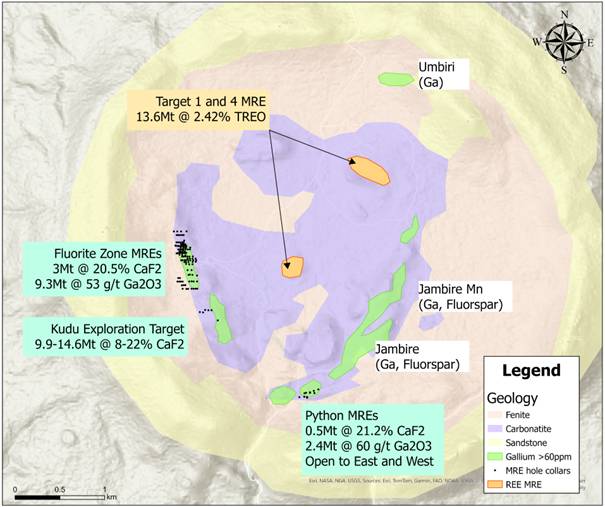
Figure 1 - Map of Monte Muambe showing the location of REE, Fluorspar and Gallium MREs, exploration targets, and untested anomalies and occurrences. Note the extent of untested gallium soil anomalies (in green).
Next steps
As announced previously, fluorspar metallurgical testing is currently progressing in South Africa. This workstream is an essential component of the fluorspar scoping study, as it will determine process parameters, process flowsheet (hence plant capex), and plant operating costs. Additional scoping study workstreams including engineering and mine planning and design are now being initiated. The fluorspar metallurgy and scoping study are expected to be completed in the third quarter of 2026.
In parallel, on-going gallium metallurgy test work will confirm whether a potentially viable pathway to gallium recovery exists. Heavy rare earths workstreams announced on 14 April 2026 (mineralogy, drilling sample assays, metallurgy) are progressing. The Board expects that an updated MRE for heavy rare earths associated to fluorspar mineralisation will be published later this year.
Gallium and heavy rare earths' behaviour is already being monitored as part of the fluorspar metallurgical studies. Results from the above workstreams will be integrated, if necessary, in the fluorspar scoping study.
The Company will continue updating investors on the progress of these activities.
Notes
(1) Ga₂O₃ in Total Inferred domain: Main Zone Inferred only (22.0 ppm Ga × 1.3442 = 29.6 ppm Ga₂O₃.The CaF₂ resource and the Ga₂O₃ resource (Section 4.3) are NOT additive and occupy different spatial domains. The Ga₂O₃ values in table 1 are in-situ grades within the CaF₂ domain only. 7.8% cavity depletion applied (×0.922). Main Zone CaF2 does not support the delineation of Indicated Resources - only Inferred and Measured CaF2 in the Main Zone. Sr at 12.5% COG: Measured 1 515 ppm; Inferred 728 ppm (Main Zone). Fe₂O₃: Measured 10.29%, Inferred 4.85%. P₂O₅: Measured 1.21%, Inferred 0.80%. MgO: Measured 0.08%, Inferred 0.05%. CaO: Measured 29.10%, Inferred 16.08%.
(2) Ga₂O₃ = Ga × 1.3442. Total Inferred grade (54.7 ppm Ga₂O₃ / 40.67 ppm Ga) is the tonnage-weighted mean of Main Zone and Python. CaF₂% and Sr ppm are reference domain grades; NOT additive to the CaF₂ MRE. 7.8% global cavity depletion applied (×0.922). ID² divergence ≤3.7% (Main Zone) and ≤3.4% (Python). The Ga₂O₃ resource and the CaF₂ resource (Section 4.2) are NOT additive. Ga₂O₃ domain substantially exceeds the CaF₂ domain. No Ga recovery methodology demonstrated at Monte Muambe.
The information contained within this announcement is deemed by the Company to constitute inside information as stipulated under the Market Abuse Regulation (EU) No. 596/2014 as it forms part of United Kingdom domestic law by virtue of the European Union (Withdrawal) Act 2018, as amended by virtue of the Market Abuse (Amendment) (EU Exit) Regulations 2019.
-ends-
To subscribe for RNS alerts, please visit: https://investors.altonare.com/
Altona Rare Earths Plc
Cédric Simonet, CEO +44 (0) 7778 866 108 ([email protected])Louise Adrian, CFO +44 (0) 7721 492 922 ([email protected])
Strand Hanson (Financial Adviser) +44 (0) 20 7409 3494
Christopher Raggett
Imogen Ellis
Zeus Capital (Corporate Broker) +44 (0) 20 3829 5000
Simon Johnson
James Hornigold
About Altona Rare Earths Plc
Altona Rare Earths Plc (ticker: REE) is a London Main Market-listed exploration and development company focused on unlocking the value of critical raw materials across Africa. The Company is pursuing a diversified strategy, targeting assets with potential for near-term monetisation alongside long-term growth.
The multi-commodity Monte Muambe Project in northwest Mozambique is a highly prospective tenement hosting rare earths, fluorspar, and gallium mineralisation. Since acquiring the project in June 2021, Altona has drilled over 7,800 metres, delivering a maiden JORC Mineral Resource Estimate of 13.6Mt at 2.42% TREO, secured a 25-year mining licence (granted December 2024), and published a Competent Person Report and scoping study for the rare earths component of the project (October 2023). The Company has received a US$ 1.875 million grant from USTDA to advance the rare earths project through the prefeasibility stage.
In parallel, Altona is progressing plans to fast-track the development of high-grade fluorspar veins identified along the western and southern margins of Monte Muambe, with a targeted production of 50,000 tonnes per annum of acid-grade fluorspar, with an initial base-case mine life of 9.5 years supported by the current MRE and significant potential to extend beyond 12 years subject to resource growth from the Kudu Southern Extension and other targets. Acid-grade fluorspar is a key input in a wide range of applications, including hydrofluoric acid, lithium battery electrolyte production, and nuclear fuel refining, placing Altona in a strong position to supply this critical material.
The discovery of gallium mineralisation, with grades up to 550 g/t identified to date, adds further value to Monte Muambe. The Company believes that gallium may be concentrated in fluorspar production tailings and is conducting metallurgical testwork to investigate the possibility of its recovery as a by-product of fluorspar.
Altona's diversified portfolio also includes the Sesana Copper-Silver Project in Botswana, strategically located just 25 km from MMG's Khoemacau Zone 5 copper-silver mine. Situated on a recognised regional contact zone for copper deposits, Sesana represents a compelling exploration opportunity aligned with Altona's growth strategy.
With a unique combination of critical raw materials projects, Altona is well positioned to contribute to the global supply of highly sought commodities essential for clean energy, high technology, defence and industrial applications.
The Company and the Board remain actively focused on identifying and evaluating additional projects that align with our investment profile and strategic objectives, leveraging our extensive network and combined industry experience to uncover compelling opportunities that can drive long-term growth.
Competent Person Statement
The Mineral Resource Estimates contained in this RNS have been compiled by Joshua Hattingh (BSc (Hons.), FGSSA, Pr.Sci.Nat. 400039/02), a director of Rock and Stock Investments (Pty) Ltd. Mr Hattingh is a Fellow of the Geological Society of South Africa and a registered Professional Natural Scientist. He has sufficient experience relevant to the style of mineralisation and type of deposit under consideration and to the activity he is undertaking to qualify as a Competent Person in terms of the 2012 Edition of the Australasian Code for Reporting of Exploration Results, Mineral Resources and Ore Reserves (JORC Code). Mr Hattingh consents to the inclusion in this RNS of the Mineral Resource Estimate information in the form and context in which it appears.
Annex B - Table 1 of JORC 2012 Code
Section 1: Sampling Techniques and Data
(Criteria in this section apply to all succeeding sections.)
Criteria | JORC Code explanation | Commentary (Updated for Monte Muambe) |
Sampling techniques | ï Nature and quality of sampling (eg cut channels, random chips, or specific specialised industry standard measurement tools appropriate to the minerals under investigation, such as down hole gamma sondes, or handheld XRF instruments, etc). These examples should not be taken as limiting the broad meaning of sampling. ï Include reference to measures taken to ensure sample representivity and the appropriate calibration of any measurement tools or systems used. ï Aspects of the determination of mineralisation that are Material to the Public Report. ï In cases where 'industry standard' work has been done this would be relatively simple (eg 'reverse circulation drilling was used to obtain 1 m samples from which 3 kg was pulverised to produce a 30 g charge for fire | As at 01 May 2026 (database closure and effective date), the project database contains 145 boreholes (71 Globe RC, 59 Altona 2025 RC, 15 Altona 2025 DD). The database includes: Borehole Collars (145), Downhole Surveys (all Altona holes), Geological Logs (145), pXRF logs (all Altona 2025 holes), and Laboratory Assay Logs (all Altona 2025 + 63 Globe holes). Globe RC chips are not preserved and the Globe assay dataset is treated as historical data. Sampling methods: RC cyclone and riffle splitting at 1 m intervals (2-5 kg sub-sample). DD half-core sampled at 0.5-2.0 m geologically controlled intervals using a diamond saw; half-core retained. Globe RC chips are not preserved; data accepted as historical. pXRF: All RC chips and DD core faces scanned at 1 m intervals (30-second reading). Used solely for lithological classification via empirical Si% and Mg% thresholds, not for grade estimation. Calibrated at start of each use. |
Criteria | JORC Code explanation | Commentary (Updated for Monte Muambe) |
assay'). In other cases more explanation may be required, such as where there is coarse gold that has inherent sampling problems. Unusual commodities or mineralisation types (eg submarine nodules) may warrant disclosure of detailed information. | Representivity: Sample intervals respect lithological boundaries. A three-level lithology hierarchy is used: pXRF chemistry (preferred), CP geological override (where justified), and original field log (fallback). Globe dataset harmonised using laboratory Si% and Mg% values. | |
Drilling techniques | Drill type (eg core, reverse circulation, open-hole hammer, rotary air blast, auger, Bangka, sonic, etc) and details (eg core diameter, triple or standard tube, depth of diamond tails, face-sampling bit or other type, whether core is oriented and if so, by what method, etc). | Altona 2025 Programme: 59 RC holes (140 mm bit, 2,735.6 m) and 15 HQ (63.5mm diameter) DD holes (690.6 m). Predominant dip -55° (61 holes); 10 holes vertical (-90°); remainder vary -60° to -70°. Azimuths vary by zone (000°, 090°, 162°, 270°, 342°) to intersect the fenite-carbonatite contact. No core orientation. Globe 2012 Programme: 71 RC holes (5,288 m). Predominantly vertical (61 of 71 holes at -90°); 10 holes at -55° with azimuths of 090°, 180°, 270°, 360°. |
Drill sample recovery | Method of recording and assessing core and chip sample recoveries and results assessed.Measures taken to maximise sample recovery and ensure representative nature of the samples.Whether a relationship exists between sample recovery and | Core recovery: Measured against drill run length for every DD run. Generally good, but treatment of core loss is suboptimal. The current system allocates remaining core run length to percentage recovery and logs cavities based on driller-reported |
Criteria | JORC Code explanation | Commentary (Updated for Monte Muambe) |
grade and whether sample bias may have occurred due to preferential loss/gain of fine/coarse material. | losses rather than observed core, which can blur boundaries and introduce bias. Recommendation made to implement metre marking and revise core loss treatment. RC recovery: Cyclone and rig ensure consistent sample return. No systematic relationship between recovery and grade is apparent. Cavity depletion: A global 7.8% depletion factor (×0.922) is applied to all reported tonnes based on historical no-recovery intervals, ensuring reported resources are not overstated. | |
Logging | Whether core and chip samples have been geologically and geotechnically logged to a level of detail to support appropriate Mineral Resource estimation, mining studies and metallurgical studies.Whether logging is qualitative or quantitative in nature. Core (or costean, channel, etc) photography.The total length and percentage of the relevant intersections logged. | All Altona 2025 core and chips logged in detail to industry-standard SOPs: lithology, mineralisation, colour, weathering, structure, RQD. Core photographed wet and dry. Logging is qualitative for geology, quantitative for RQD. pXRF provides quantitative geochemical classification at 1 m intervals. Globe 2012 logging records are available in digital format and have been harmonised to the Altona coding scheme. pXRF chemical classification: Applied to 1,288 intervals (16.9% of database). Discordance between |
Criteria | JORC Code explanation | Commentary (Updated for Monte Muambe) |
visual log and chemistry occurred in 51.7% of these intervals, reflecting the difficulty of visual classification of fine-grained carbonate and fenitised material. The chemistry-derived classification is preferred for domaining. | ||
Sub-sampling techniques and sample preparation | If core, whether cut or sawn and whether quarter, half or all core taken.If non-core, whether riffled, tube sampled, rotary split, etc and whether sampled wet or dry.For all sample types, the nature, quality and appropriateness of the sample preparation technique.Quality control procedures adopted for all sub-sampling stages to maximise representivity of samples.Measures taken to ensure that the sampling is representative of the in situ material collected, including for instance results for field duplicate/second-half sampling.Whether sample sizes are appropriate to the grain size of the material being sampled. | RC: Cyclone and riffle splitting at 1 m intervals; 2-5 kg sub-sample taken. DD core: Cut longitudinally with diamond saw; half-core sampled, half-core retained. Sample preparation (Intertek Johannesburg): Samples dried at 110°C, jaw-crushed to <2 mm, riffle split, pulverised to <75 μm (>90% passing). QAQC programme: Three project-specific ore-based CRMs (ALTONA1, 2, 3), one process blank (BLANK_QTZ), and commercial CRM AMIS0250. Duplicate programme: field 50:50 splits (RC) at ~5% frequency; laboratory pulp repeats (DD) at ~5% frequency. Full QAQC documentation available. Sample size: 2-5 kg RC sample and half-core DD samples are appropriate for the fine-grained, disseminated mineralisation style. |
Quality of assay data | The nature, quality and appropriateness of the | Primary laboratory: Intertek Johannesburg. |
Criteria | JORC Code explanation | Commentary (Updated for Monte Muambe) |
and laboratory tests | assaying and laboratory procedures used and whether the technique is considered partial or total.For geophysical tools, spectrometers, handheld XRF instruments, etc, the parameters used in determining the analysis including instrument make and model, reading times, calibrations factors applied and their derivation, etc.Nature of quality control procedures adopted (eg standards, blanks, duplicates, external laboratory checks) and whether acceptable levels of accuracy (ie lack of bias) and precision have been established. | Fluorine: ISE method (detection limit 50 ppm F; BDL substituted at 100 ppm F). Gallium & REE suite: ICP-MS. CaF₂ = F% × 2.0547 using JCU-AAC conversion factors. LOI excluded due to fluorine volatilisation risk. Globe RC data: Laboratory and analytical methods not recorded. Data accepted as historical, supported by two-campaign interleaved drilling with Altona 2025 data. pXRF (lithology only): Handheld units, 30-second reading. Si% and Mg% thresholds used to discriminate carbonatite (Si<3.27%) from fenite (Si>9.35%). QAQC Performance: In-house standards (ALTONA1-3) certified via round-robin (Intertek, UIS, ALS, Minersa, Nagrom). ALS and Nagrom excluded due to systematic bias vs SARM-32. Monitoring identified anomalies which were investigated and resolved. QAQC considered adequate for Inferred and Measured classification. |
Verification of sampling and assaying | The verification of significant intersections by either independent or alternative company personnel.The use of twinned holes.Documentation of primary | Verification: Significant intersections verified in-house by Altona geological personnel and by the CP during site visits (November 2025). |
Criteria | JORC Code explanation | Commentary (Updated for Monte Muambe) |
data, data entry procedures, data verification, data storage (physical and electronic) protocols.Discuss any adjustment to assay data. | Database: PostgreSQL 18 database. All raw data preserved in source tables; transformations at view level only. JORC audit table (t_0010_field_provenance) documents all CP-derived fields. Data entry: Locked templates with validation rules. Validated logs imported into database. pXRF raw files and scanned paper records retained. Adjustments: No adjustments made to assay data. Derived fields (e.g., CaF₂ from F%) are calculated and clearly identified. | |
Location of data points | Accuracy and quality of surveys used to locate drill holes (collar and down-hole surveys), trenches, mine workings and other locations used in Mineral Resource estimation.Specification of the grid system used.Quality and adequacy of topographic control. | Coordinate system: Metric system; WGS84 datum, UTM Zone 36S grid. Collar surveys: 140 collars surveyed by RTK-GNSS. Mean bias +1.1 m vs DTM; 81% within ±1 m. GPS-only collars (5 holes) updated to DTM-sampled elevations. MURC044 flagged as outlier (RTK 16 m above DTM; queried with client). Downhole surveys: Multi-shot for Altona 2025 holes. Historical Globe 2012 holes use planned azimuth and dip. Topographic control: DTM based on drone photogrammetry merged with upsampled SRTM, |
Criteria | JORC Code explanation | Commentary (Updated for Monte Muambe) |
validated against RTK collar surveys. Adequate for current resource reporting. | ||
Data spacing and distribution | Data spacing for reporting of Exploration Results.Whether the data spacing and distribution is sufficient to establish the degree of geological and grade continuity appropriate for the Mineral Resource and Ore Reserve estimation procedure(s) and classifications applied.Whether sample compositing has been applied. | Drill spacing: Main Zone Measured: holes ≤20 m spacing with NS ≥8. Main Zone Inferred and Python: holes ≤40 m spacing with NS ≥4. Spacing is sufficient to establish continuity at the assigned classification levels. Compositing: 1 m downhole, length-weighted, within estimation domain. Intervals <0.3 m shared equally with adjacent composites. |
Orientation of data in relation to geological structure | Whether the orientation of sampling achieves unbiased sampling of possible structures and the extent to which this is known, considering the deposit type.If the relationship between the drilling orientation and the orientation of key mineralised structures is considered to have introduced a sampling bias, this should be assessed and reported if material. | Mineralisation is hosted close to the fenite-carbonatite contact, which dips towards the crater edge and is sub-horizontal to shallow-dipping in the Main Zone. Drilling orientations (predominantly -55° to -90° from multiple azimuths) are designed to intersect the contact orthogonally or at a high angle. No significant sampling bias is considered to have been introduced. Drilled lengths are reported; true widths are estimated at 60-80% of drilled length. |
Sample security | The measures taken to ensure sample security. | Chain of custody: Managed by Altona and MMML personnel. Samples transported from site to |
Criteria | JORC Code explanation | Commentary (Updated for Monte Muambe) |
Intertek Johannesburg under signed Chain of Custody documents. Laboratory issues reconciliation reports upon receipt. Core storage: Core retained in secure core yard at site. Globe RC chips not preserved. No sample security issues were identified by the Competent Person during the November 2025 site inspection. | ||
Audits or reviews | The results of any audits or reviews of sampling techniques and data. | Internal audit: CP site visit (November 2025) identified a principal concern with diamond core logging methodology (treatment of core loss, absence of metre marks). Recommendation made to implement metre marking and revise core loss treatment. Previous reviews: Snowden Optiro (2024) REE CPR reviewed Globe 2012 fluorspar data and confirmed data quality as adequate. Hattingh (2023) REE Exploration Target also reviewed the dataset. No external audit of the 2026 CaF₂/Ga₂O₃ MRE has been conducted. CP internal review of block model, grade-tonnage curves, and validation checks is documented. |
Section 2: Reporting of Exploration Results
(Criteria listed in the preceding section also apply to this section.)
Criteria | JORC Code explanation | Commentary (Updated for Monte Muambe) |
Mineral tenement and land tenure status | Type, reference name/number, location and ownership including agreements or material issues with third parties such as joint ventures, partnerships, overriding royalties, native title interests, historical sites, wilderness or national park and environmental settings.The security of the tenure held at the time of reporting along with any known impediments to obtaining a licence to operate in the area. | The Monte Muambe project is held under Mining Concession 11854 in Mozambique, valid to 20 December 2049. The concession was derived from Prospecting Licence LPP7573L. MMML (Monte Muambe Mining Limitada) is the operating SPV; Altona Rare Earths Plc holds 51% following completion of Phase 2 of the Farm Out Agreement. Original shareholders retain a 20% free-carried and 10% participating interest. No known issues with security of tenure. A production tax (royalty) of 3% applies to mineral sales. A Level A Environmental Impact Assessment (EIA) will be required prior to mining. The area is not within a proclaimed nature reserve or national park. No permanent settlements exist within the concession area. |
Exploration done by other parties | Acknowledgment and appraisal of exploration by other parties. | Globe Metals & Mining (2009-2013): Conducted first systematic exploration: 71 RC holes (5,288 m), soil geochemistry, geophysics, geological mapping. Produced maiden Inferred fluorspar MRE (1.630 Mt at 19% CaF₂ at 10% COG), which is superseded by |
Criteria | JORC Code explanation | Commentary (Updated for Monte Muambe) |
this CPR. Data incorporated into the database after harmonisation and review. The QAQC for this historical data is not fully documented, but its use is supported by interleaved two-campaign drilling with Altona 2025 data. Regional mapping: A. François (1970s). | ||
Geology | Deposit type, geological setting and style of mineralisation. | Deposit type: Contact-metasomatic fluorite (CaF₂) and gallium (Ga) mineralisation hosted near the fenite-carbonatite contact of the Monte Muambe carbonatite intrusion, part of the Cretaceous Chilwa Alkaline Province (CAP). Mineralisation style: Disseminated to semi-massive fluorite sub-aligned along the dipping contact plane. Gallium is spatially associated with the contact zone but extends across both fenite and carbonatite lithologies (fenite mean Ga ~1.78× carbonatite). Target zones: Main Zone (N-S extent ~750 m), Python Target (E-W ~213 m, N-S ~93 m), Kudu Southern Extension (southern Main Zone corridor). |
Drill hole Information | A summary of all information material to the understanding of the exploration results including a | A full tabulation of the contributing 145 borehole collars (Altona 2025 and Globe 2012) is provided in |
Criteria | JORC Code explanation | Commentary (Updated for Monte Muambe) |
tabulation of the following information for all Material drill holes:easting and northing of the drill hole collarelevation or RL (Reduced Level - elevation above sea level in metres) of the drill hole collardip and azimuth of the holedown hole length and interception depthhole length.If the exclusion of this information is justified on the basis that the information is not Material and this exclusion does not detract from the understanding of the report, the Competent Person should clearly explain why this is the case. | Error: Reference source not foundError: Reference source not found. Key statistics: Altona 2025: 74 holes (59 RC, 15 DD) totalling ~3,426 m. Globe 2012: 71 RC holes (5,288 m). 63 holes with assay data; 8 holes without assays excluded from estimation. No material drill hole information has been excluded. | |
Data aggregation methods | In reporting Exploration Results, weighting averaging techniques, maximum and/or minimum grade truncations (eg cutting of high grades) and cut-off grades are usually Material and should be stated.Where aggregate intercepts incorporate short lengths of high grade results and longer lengths of low grade results, the procedure used for such aggregation should be stated and some typical examples of such aggregations should be shown in detail.The assumptions used for any reporting of metal equivalent values should be clearly stated. | Reporting cut-off: CaF₂ primary reporting COG is 12.5%. Ga₂O₃ primary reporting COG is 30 ppm Ga (40.3 ppm Ga₂O₃). Weighting: Length-weighted averaging used for all intercept reporting. Metal equivalents: No metal equivalents are reported. Ga₂O₃ = Ga ppm × 1.3442 (conversion factor disclosed). Top-capping: A 50% CaF₂ cap applied to composites prior to estimation (Main Zone and Python). A 150 ppm Ga cap applied for Ga estimation. |
Criteria | JORC Code explanation | Commentary (Updated for Monte Muambe) |
Relationship between mineralisation widths and intercept lengths | These relationships are particularly important in the reporting of Exploration Results.If the geometry of the mineralisation with respect to the drill hole angle is known, its nature should be reported.If it is not known and only the down hole lengths are reported, there should be a clear statement to this effect (eg 'down hole length, true width not known'). | Mineralisation is hosted near the fenite-carbonatite contact. In the Python zone the contact dips ~57° towards 152°. In the Main Zone the geometry is sub-horizontal to shallow-dipping. Drilled lengths are reported throughout. All intercepts are reported as down-hole lengths with the explicit statement that true widths are less than drilled lengths. |
Diagrams | Appropriate maps and sections (with scales) and tabulations of intercepts should be included for any significant discovery being reported These should include, but not be limited to a plan view of drill hole collar locations and appropriate sectional views. | Figures referenced in this report include geology and boreholes positions and positions of Mineral Resources, block models and validation plots such as grade-tonnage curves and swath plots. All diagrams are referenced in the Index of Tables in this CPR. Borehole collar locations are tabulated in Error: Reference source not foundError: Reference source not found. |
Balanced reporting | Where comprehensive reporting of all Exploration Results is not practicable, representative reporting of both low and high grades and/or widths should be practised to avoid misleading reporting of Exploration Results. | All results within the modelled areas for which data are available were utilised irrespective of grade. Sub-economic or barren holes are reported and described (e.g., MM126 at Kudu: mean 0.67% CaF₂, described as carbonatite interior facies). MURC057 |
Criteria | JORC Code explanation | Commentary (Updated for Monte Muambe) |
and MURC061 are documented as data gaps (no assay records). Estimation is unbiased; data were not selectively used. | ||
Other substantive exploration data | Other exploration data, if meaningful and material, should be reported including (but not limited to): geological observations; geophysical survey results; geochemical survey results; bulk samples - size and method of treatment; metallurgical test results; bulk density, groundwater, geotechnical and rock characteristics; potential deleterious or contaminating substances. | Soil geochemistry: 281 samples; F assayed by ISE at SGS Johannesburg. Values 136-89,715 ppm F. IDW grid (350 m search radius) used to define Exploration Target spatial context. Geophysics: Helicopter-borne survey (1998, Aerodat); used for target generation, not current MRE. Bulk density: 396 calliper (weight-volume) method measurements from 14 DD holes; assigned by rock type × weathering code lookup. Deleterious elements: Sr assayed for all Altona 2025 holes (Measured 1,515 ppm; Inferred 728 ppm at 12.5% COG). Sr is noted as a critical element for acid-grade concentrate specification, comparable to Okorusu Mine levels. Metallurgical testwork: None completed on Altona 2025 samples. Globe 2012 bench-scale flotation tests demonstrated acid-grade CaF₂ concentrate (~97% CaF₂). |
Criteria | JORC Code explanation | Commentary (Updated for Monte Muambe) |
Further work | The nature and scale of planned further work (eg tests for lateral extensions or depth extensions or large-scale step-out drilling).Diagrams clearly highlighting the areas of possible extensions, including the main geological interpretations and future drilling areas, provided this information is not commercially sensitive. | Immediate (Priority 1): Expanded soil fluorine geochemistry survey covering full circumferential fenite-carbonatite contact (~12 km strike) with over-sampling strategy (200 m x 100 m initial, infill to 50 m x 25 m). Staged drilling (Priority 2): - Stage 1 - Kudu Southern Extension: 15-20 RC + 3-5 DD holes (50 m x 50 m pattern) to upgrade Exploration Target to Inferred Resource. - Stage 2 - Python West & East Extensions: 10-15 RC holes per extension. - Stage 3 - Jambire & Jambire North: 5-10 reconnaissance RC holes, conditional on soil results. Technical recommendations: Implement metre marking on DD core; revise core loss logging; umpire laboratory programme; possible high-resolution LiDAR survey; metallurgical testwork (flotation, Sr rejection, Ga recovery scoping). |
Section 3: Estimation and Reporting of Mineral Resources
(Criteria listed in section 1, and where relevant in section 2, also apply to this section.)
Criteria | JORC Code explanation | Commentary (Updated for Monte Muambe) |
Database integrity | Measures taken to ensure that data has not been corrupted by, for example, transcription or keying errors, between its initial collection and its use for Mineral Resource estimation purposes.Data validation procedures used. | Database: PostgreSQL 18 (monte_muambe). All raw data preserved in source tables (t_0100_collars, t_0300_geology, t_0700_surveys, t_0800_sampling, t_1100_lab_assays, etc). All transformations applied at view level only; raw values never overwritten. JORC audit table (t_0010_field_provenance) documents all CP-derived fields with source, derivation note, date, and author. Validation checks: Collar RTK elevations validated against DTM (mean bias +1.1 m; 81% within ±1 m). GPS-only collars updated to DTM-sampled elevations. Downhole surveys checked for dip/azimuth continuity. Assay QAQC charts reviewed per batch; anomalous standards and blank outlier referred to laboratory. Duplicate label-swap anomalies documented in source data errors register. The project database was validated prior to estimation using standard collar, survey, geology, sampling and assay checks. These included verification of collar coordinate |
Criteria | JORC Code explanation | Commentary (Updated for Monte Muambe) |
completeness, downhole survey consistency, interval continuity, overlapping or negative sample intervals, missing assay records, duplicate sample identifiers, and consistency between geological and assay interval tables. Errors identified during validation were corrected in the source database or excluded from estimation where correction was not possible. | ||
Site visits | Comment on any site visits undertaken by the Competent Person and the outcome of those visits.If no site visits have been undertaken indicate why this is the case. | A site visit was conducted by the CP ( J.P. Hattingh) in November 2025. Activities included: core yard inspection (MM111-MM117, MM180-MM184, MM124, MM126); logging verification for selected intervals; recovery log checks; field QAQC review; RC sample station inspection; observation of active RC drilling. Outcome: Logging standards and procedures confirmed as adequate with some room for improvement. A principal concern was identified regarding the diamond core logging methodology: absence of metre marks and treatment of core loss based on driller-reported losses rather than physical core observation. Recommendation made to implement metre marking and revise core loss |
Criteria | JORC Code explanation | Commentary (Updated for Monte Muambe) |
treatment. No material concerns with sample collection or preparation were identified. | ||
Geological interpretation | Confidence in (or conversely, the uncertainty of ) the geological interpretation of the mineral deposit.Nature of the data used and of any assumptions made.The effect, if any, of alternative interpretations on Mineral Resource estimation.The use of geology in guiding and controlling Mineral Resource estimation.The factors affecting continuity both of grade and geology. | Confidence: High confidence in the geological model. The fenite-carbonatite contact geometry is confirmed by DD inclined drilling data and consistent across Main Zone, Python, and Kudu zones. Uncertainties: (a) depth extent of contact-hosted mineralisation below 60 m TD at Python (Inferred classification); (b) spatial distribution of cavity zones (addressed by global 7.8% depletion factor); (c) variation in fluorite enrichment laterally (captured by variogram nugget effects). Alternative interpretation: A horizontal, lenticular geometry (Globe 2012 approach) would produce a shallower-dipping volume with lower effective thickness. The current shallow dip to steeper dipping interpretation related to contact morphology is preferred and supported by structural data. Geology control: pXRF chemical classification (Si%, Mg%) used to refine lithology. Three-level hierarchy: pXRF (preferred), CP override, field log (fallback). |
Criteria | JORC Code explanation | Commentary (Updated for Monte Muambe) |
Dimensions | The extent and variability of the Mineral Resource expressed as length (along strike or otherwise), plan width, and depth below surface to the upper and lower limits of the Mineral Resource. | Main Zone: N-S extent ~700 m (N8,194,000-8,194,700); E-W 100-160 m; depth 0-60 m below surface. Measured zone: N8,194,600-8,194,910 (310 m N-S). Python: E-W ~213 m; N-S ~93 m; depth 0-60 m (40 m buffer domain). All resources are open to depth below TD; no basal constraint on mineralisation has been established. |
Estimation and modelling techniques | The nature and appropriateness of the estimation technique(s) applied and key assumptions, including treatment of extreme grade values, domaining, interpolation parameters and maximum distance of extrapolation from data points. If a computer assisted estimation method was chosen include a description of computer software and parameters used.The availability of check estimates, previous estimates and/or mine production records and whether the Mineral Resource estimate takes appropriate account of such data.The assumptions made regarding recovery of by-products.Estimation of deleterious elements or other non-grade variables of economic significance (eg sulphur for acid mine drainage | Software: Leapfrog. Estimator: Ordinary Kriging (OK); ID² as check estimator. Domains: Main Zone CaF₂: 5% CaF₂ RBF shell. Python CaF₂: bounding boundary (topography + 40 m DH buffer). Ga₂O₃: bounding boundary (DTM + 40 m buffer). Compositing: 1 m downhole, length-weighted; <0.3 m shared equally. Top-capping: 50% CaF₂ (Main Zone & Python); 150 ppm Ga (both zones). Block size: 10×10×5 m parent; sub-blocked to 5×5×1 m. Validation: OK vs ID² divergence <5% at all cut-offs. Global mean comparison <0.2% relative for CaF₂; |
Criteria | JORC Code explanation | Commentary (Updated for Monte Muambe) |
characterisation).In the case of block model interpolation, the block size in relation to the average sample spacing and the search employed.Any assumptions behind modelling of selective mining units.Any assumptions about correlation between variables.Description of how the geological interpretation was used to control the resource estimates.Discussion of basis for using or not using grade cutting or capping.The process of validation, the checking process used, the comparison of model data to drill hole data, and use of reconciliation data if available. | <5% for Ga (within acceptable range for Inferred). Swath plots (X, Y, Z) and visual inspection confirm no systematic bias. Previous estimates: Globe 2012 MRE (1.630 Mt at 19% CaF₂, Inferred, 10% COG) is superseded. By-products: No recovery assumed for Ga₂O₃; reported in-situ only. Sr is reported as a deleterious element. | |
Moisture | Whether the tonnages are estimated on a dry basis or with natural moisture, and the method of determination of the moisture content. | All tonnages are reported on a dry basis. SG measurements were conducted on air-dried samples; no moisture correction has been applied. Given the oxidised nature of near-surface regolith and competent carbonatite/fenite, moisture effects on density are considered minor. |
Cut-off parameters | The basis of the adopted cut-off grade(s) or quality parameters applied. | CaF₂ primary COG: 12.5% (client-agreed). Rationale: consistent with higher-grade Altona 2025 data, anchored by MM183 (Python) mean 25.25% CaF₂, provides conservative basis for a 50,000 tpa acid- |
Criteria | JORC Code explanation | Commentary (Updated for Monte Muambe) |
grade fluorspar operation. Sensitivity tables at 0-20% COG provided. Ga₂O₃ primary COG: 30 ppm Ga (40.3 ppm Ga₂O₃), client-agreed. Both COGs are stated as in-situ COGs without processing recovery assumptions. Economic COG will be refined during scoping/feasibility study. | ||
Mining factors or assumptions | Assumptions made regarding possible mining methods, minimum mining dimensions and internal (or, if applicable, external) mining dilution. It is always necessary as part of the process of determining reasonable prospects for eventual economic extraction to consider potential mining methods, but the assumptions made regarding mining methods and parameters when estimating Mineral Resources may not always be rigorous. Where this is the case, this should be reported with an explanation of the basis of the mining assumptions made. | RPEEE assessment: Based on geological analogue (Okorusu Mine, Namibia), shallow open-pit-compatible geometry, manageable strontium levels, and strong fluorspar market fundamentals. A Class 4 Scoping Study (AACE RP 47R-11) assesses open-pit mining with overall pit slopes 45-50° (weathered) to 55-60° (fresh rock), minimum mining width 10 m, and 5% mining dilution at pit boundary assumed for scoping purposes. These parameters are indicative only and subject to revision. Key risk: Monte Muambe grade (20% CaF₂) is lower than Okorusu (35-40%), a material risk factor requiring lower costs, higher throughput, or by-product revenue. The CP considers that CaF₂ Mineral Resources have RPEEE. Ga₂O₃ has conditional prospects pending |
Criteria | JORC Code explanation | Commentary (Updated for Monte Muambe) |
metallurgical testwork. | ||
Metallurgical factors or assumptions | The basis for assumptions or predictions regarding metallurgical amenability. It is always necessary as part of the process of determining reasonable prospects for eventual economic extraction to consider potential metallurgical methods, but the assumptions regarding metallurgical treatment processes and parameters made when reporting Mineral Resources may not always be rigorous. Where this is the case, this should be reported with an explanation of the basis of the metallurgical assumptions made. | No metallurgical testwork has been completed on Altona 2025 samples. Assumptions are based on: (a) Globe 2012 programme: Bench-scale flotation tests demonstrating acid-grade CaF₂ concentrate production (~97% CaF₂). (b) Okorusu analogue: Carbonatite-hosted fluorspar operation with multi-stage flotation to manage Sr (1,900-2,500 ppm in feed). Monte Muambe Sr levels (Measured 1,515 ppm; Inferred 728 ppm) are comparable or lower. (c) Scoping Study assumption: Assumed flotation CaF₂ recovery of ~75-80% and concentrate grade 97% CaF₂, pending testwork. Critical path: Sr rejection to below acid-grade specification (<425 ppm) has not been demonstrated. Ga recovery has no demonstrated pathway. |
Environmental factors or assumptions | Assumptions made regarding possible waste and process residue disposal options. It is always necessary as part of the process of determining reasonable prospects for eventual economic | The Scoping Study assumes dry-stack tailings disposal on-site within the licence area. A preliminary environmental baseline exists from the Altona 2022-2023 programme. An independent |
Criteria | JORC Code explanation | Commentary (Updated for Monte Muambe) |
extraction to consider the potential environmental impacts of the mining and processing operation. While at this stage the determination of potential environmental impacts, particularly for a greenfields project, may not always be well advanced, the status of early consideration of these potential environmental impacts should be reported. Where these aspects have not been considered this should be reported with an explanation of the environmental assumptions made. | Environmental Audit was validated by AQUA (Tete Province) on 24 October 2022. A Level A Environmental Impact Assessment (EIA) is required prior to mining, including Terms of Reference submitted to MITA and subsequent Environmental Licence issuance. The concession area is not within a nature reserve or national park. No permanent settlements exist within the crater. | |
Bulk density | Whether assumed or determined. If assumed, the basis for the assumptions. If determined, the method used, whether wet or dry, the frequency of the measurements, the nature, size and representativeness of the samples.The bulk density for bulk material must have been measured by methods that adequately account for void spaces (vugs, porosity, etc), moisture and differences between rock and alteration zones within the deposit.Discuss assumptions for bulk density estimates used in the evaluation process of the different materials. | Determined: 396 calliper (weight-volume) method measurements on DD core from 14 Altona 2025 holes (MM112-MM126, excluding MM125). Measurements made on intact, cylindrical core sections (15-25 cm length). Measurements grouped by rock type and weathering code. Representative SG values: Fresh carbonatite 2.80- 2.90 t/m³; weathered carbonatite 2.50-2.60 t/m³; fenite 2.65-2.75 t/m³; regolith 2.11 t/m³ (midpoint calculation using RSI CPR soil density of 1.65 t/m³ as lower bound). Assignment: Lookup table (rock type × weathering |
Criteria | JORC Code explanation | Commentary (Updated for Monte Muambe) |
code) for intervals without direct measurement. 6.5% of intervals carry measured values; 79.5% use lookup with exact weathering code. Cavity depletion: Global 7.8% scalar (×0.922) applied to all reported tonnes, accounting for void spaces and no-recovery intervals. Python holes (MM111-117): No SG measurements; assigned from lookup table using lith and weath codes. | ||
Classification | The basis for the classification of the Mineral Resources into varying confidence categories.Whether appropriate account has been taken of all relevant factors (ie relative confidence in tonnage/grade estimations, reliability of input data, confidence in continuity of geology and metal values, quality, quantity and distribution of the data).Whether the result appropriately reflects the Competent Person's view of the deposit. | Classification follows JORC 2012. Main Zone CaF₂ - Measured: Northing 8,194,600-8,194,910 m; DH distance ≤20 m; NS ≥8; two-campaign interleaved drilling (Globe 2012 + Altona 2025) with independent sampling and QAQC. Main Zone CaF₂ - Inferred: DH distance ≤40 m; NS ≥4. Python CaF₂ - Inferred: DH distance ≤40 m; NS ≥4. No Indicated classification at Python or Kudu. Ga₂O₃ - Inferred (Main & Python): DH distance ≤40 m; NS ≥4. No higher confidence categories assigned due to higher Ga nugget effect and less systematic fenite coverage. CP judgement: The classification reflects the CP's |
Criteria | JORC Code explanation | Commentary (Updated for Monte Muambe) |
view, including the conservative Inferred classification at Python/Kudu and the Measured classification at the Main Zone infilled core. | ||
Audits or reviews | The results of any audits or reviews of Mineral Resource estimates. | No formal external audit of the 2026 MRE has been conducted at the time of CPR preparation. Previous reviews: Snowden Optiro (2024) REE CPR reviewed the Globe 2012 fluorspar data and confirmed data quality as adequate for use in geological context, providing indirect validation. Internal review: Block model statistics, grade-tonnage curves, OK/ID² divergence, and swath plots have been reviewed by the CP. No Indicated-or-above classification has been applied at Python without external review. |
Discussion of relative accuracy/ confidence | Where appropriate a statement of the relative accuracy and confidence level in the Mineral Resource estimate using an approach or procedure deemed appropriate by the Competent Person. For example, the application of statistical or geostatistical procedures to quantify the relative accuracy of the resource within stated confidence limits, or, if such an approach is not deemed | Main Zone Measured: High confidence in grade continuity (two-campaign drilling, NS ≥8, SoR mean 0.869). Tonnes dependent on RBF shell geometry (moderate sensitivity). Measured classification is appropriate. Main Zone & Python Inferred (CaF₂): Grade continuity at expected Inferred level (SoR mean 0.465-0.606; NS median 6). Tonnage uncertainty |
Criteria | JORC Code explanation | Commentary (Updated for Monte Muambe) |
appropriate, a qualitative discussion of the factors that could affect the relative accuracy and confidence of the estimate.The statement should specify whether it relates to global or local estimates, and, if local, state the relevant tonnages, which should be relevant to technical and economic evaluation. Documentation should include assumptions made and the procedures used.These statements of relative accuracy and confidence of the estimate should be compared with production data, where available. | moderate (variogram range vs drill spacing ratio is primary driver). Ga₂O₃ Inferred: SoR mean 0.542-0.571; NS median 9-12. Confidence is adequate for Inferred classification. Higher Ga nugget effect requires tighter drilling for higher categories. Kudu ET: Tonnage range (9.9-14.6 Mt) reflects genuine geometric uncertainty; grade range (8-22% CaF₂) reflects geological variability across 6 holes. Primary project risk (resource confidence): Reliance on ISE fluorine assay without blind round-robin validation of Intertek/UIS against a second certified source for AMIS0250. No production data available for comparison (undeveloped deposit). Confidence assessment relates to local block estimates relevant to future mining and economic evaluation. |
Related Shares:
Altona Rare Earths