
23rd Apr 2026 07:00
23 April 2026
Q1 2026 Activities Report For the Quarter ending 31 March 2026 ('Q1', 'March Quarter' or 'the Quarter')
Quarterly Highlights
• Total Recordable Injury Frequency Rate (TRIFR) of 0.43 with only one recordable injury during Q1
• Group gold production of 59,603 ounces (oz) (Q4 2025: 65,918oz) in line with expectations at both Mako (Senegal) and Syama (Mali)
• All-In Sustaining Costs (AISC) of $2,210/oz (Q4 2025: $1,877/oz) in line with guidance as cost reductions partially offset higher royalty payments due to record average realised gold prices
• Capital expenditure of $33.4 million (Q4 2025: $28.7 million) consisting of $14.3 million non-sustaining, $6.9 million of sustaining, $5.1 million exploration capital spend, $7.1 million at Doropo and Mako Life Extension Project (MLEP). Remains on track with guidance ($310 - 360 million)
• Operating cash flow generation of $119.8 million (Q4 2025: $85.7 million) (operating cash flow before capital expenditure, exploration and working capital)
• EBITDA of $202.9 million (Q4 2025: $104.9 million); $337.6 million revenue (Q4 2025: $201.5 million)
• Net cash of $315.4 million (Q4 2025: $209.0 million), including cash, cash equivalents and bullion of $327.6 million. Drawn overdraft balances and equipment financing were $12.2 million
• Proceeds of $31.9 million received from the sale of Resolute's stake in Loncor Gold
• Key milestones reached at the Doropo Project (Côte d'Ivoire) including receipt of the mining permit and formal approval of Final Investment Decision (FID)
• Strategic Memorandum of Understanding (MoU) signed with Nimba Mining Company regarding the potential co-development of gold projects in Guinea
• Ore Reserves and Mineral Resource Statement for 31 December 2025 published:
• Total Mineral Resources increased by 60% to 17.6 Moz Au with the acquisition of the Doropo and ABC projects and exploration success at Bantaco and La Debo
• Total Ore Reserves increased by 55% to 6.8 Moz Au with the addition of Ore Reserves at Doropo and Tomboronkoto offsetting mining depletion in Mako and Syama
• Promising drill results at ABC Project (Côte d'Ivoire) including 73m at 0.8 g/t Au from 2m along strike of the existing MRE at Kona South
• Scoping Study for the ABC Project remains on track for completion in Q2 2026
• On track to meet production guidance of 250 - 275 koz. Group AISC of $2,000 - 2,200/oz is maintained, however is subject to change at current elevated gold prices and higher fuel costs
Note: Unless otherwise stated, all dollar figures are United States dollars ($). AISC guidance is based on $4,000/oz gold price.

Resolute Mining Limited (Resolute, the Company or the Group) (ASX/LSE: RSG), the West Africa-focused gold miner, is pleased to present its Quarterly Activities Report for the period ended 31 March 2026.
Chris Eger, Chief Executive Officer, commented,
"It has been a positive start to 2026 at both our operations and at our development and exploration projects.
Our operations continued to perform in line with expectations and generated $119.8 million of operating cash flows helping boost our net cash position to $315.4 million. We remain on track with production guidance which is weighted to H2 as the Syama Sulphide Conversion Project is commissioned and ramps up.
In Cote d'Ivoire we have had a very successful Quarter at ABC and Doropo. At ABC we have been focusing on strike extensions of the Kona South and Central deposits that have an existing MRE of 2.2 Moz. With the success we have been seeing at ABC, including an intercept from surface of 73 m grading 0.8 g/t, we will continue drilling in order to further expand resources. During Q1 we started a scoping study for ABC, based on the existing MRE, which we expect to release in Q2. At Doropo we achieved two major milestones: receipt of our mining permit and formal approval of FID. In April ground clearance activities started and we remain on track for first gold in H2 2028.
In Senegal, stockpile processing at Mako continued to perform extremely well. Additionally, strong progress was made on technical and permitting workstreams for the MLEP. Internal technical studies currently indicate annual gold production levels of 75 - 85 koz over seven years from the Tomboronkoto and Bantaco deposits at a capital cost of between $125 - 150 million. We are continuing with optimizations and are confident of further improvements to the project.
During the Quarter we also signed a strategic MoU with Nimba Mining Company to evaluate projects in Guinea. This aligns with Resolute's strategy of building a pipeline of high-quality growth opportunities in established West African gold jurisdictions and complements our other activities in Guinea.
While the ongoing situation in the Middle East has not resulted in any direct disruptions to our supply chain, we are closely monitoring developments. There is a potential for increased AISC due to rising fuel prices, which could impact our operational costs in the coming quarters. At this stage, we are proactively managing these risks and, where possible, minimizing any impacts.
Overall, I am pleased with the Group's activities and financials in Q1. We remain confident in delivering against our guidance, supported by a robust balance sheet and experienced teams, that are well placed to continue performing across the business as we move into Q2."
Webcast and Conference Call
Resolute will host a conference call for investors, analysts, and media on 23 April 2026, to discuss the Company's Quarterly Activities Report for the period ending 31 March 2026. This call will conclude with a question-and-answer session.
Conference Call: 6:00pm (AEST, Sydney) / 9:00am (BST, London)
Webcast registration link: https://sparklive.lseg.com/ResoluteMiningLtdAustralia/events/c3dd5dd8-30b9-42d2-ae18-47b19e044b88/resolute-mining-ltd-q1-2026-conference-call
Written questions can be submitted using the 'Ask a Question' button on the webcast page. Those wishing to ask questions as part of the Q&A should use the conference call facility (please join five minutes before the start time).
Conference call registration link: https://registrations.events/direct/LON34665289
A presentation, to accompany the call, will be available for download on the Company's website: https://www.rml.com.au/investors/presentations/.
Group Operations Overview
Group Summary | Units | March 2026 Quarter | December 2025 Quarter | % Change | March 2025 Quarter |
Mining |
|
|
|
|
|
Ore Mined | t | 794,436 | 858,470 | (7)% | 1,345,796 |
Mined Grade | g/t | 2.21 | 2.14 | 3% | 1.97 |
Processing |
|
|
|
|
|
Ore Processed | t | 1,633,013 | 1,581,115 | 3% | 1,550,187 |
Processed Grade | g/t | 1.40 | 1.51 | (7)% | 1.79 |
Recovery | % | 81 | 84 | (4)% | 84 |
Gold Poured | oz | 59,603 | 65,918 | (10)% | 75,497 |
Sales |
|
|
|
|
|
Gold Sold | oz | 69,352 | 49,941 | 39% | 64,322 |
Average Realised Price | $/oz | 4,858 | 4,023 | 21% | 2,840 |
Financials |
|
|
|
|
|
Total Capital Expenditure | $m | 33.4 | 28.7 | 16% | 29.4 |
Net Cash | $m | 315 | 209 | 51% | 100 |
AISC | $/oz | 2,210 | 1,877 | 18% | 1,708 |
Table 1: Resolute Group Operational Performance Summary
During the Quarter, Resolute processed over 1.63 Mt across Syama (Mali) and Mako (Senegal) at an average milled head grade of 1.40 g/t. In Q1 the Group produced 59,603 oz of gold at an AISC of $2,210/oz.
Environmental and Social Update
Resolute's year-to-date (and quarterly) TRIFR as of 31 March 2026 improved to 0.43 (full-year 2025: 1.87) with one recordable injury during the Quarter. This is a significant decrease on previous quarters with improvements to preventive safety measures and leading indicators during H2 2025.
In Q1, Resolute recorded no significant environmental incidents, regulatory non-compliances, and no reportable community grievances.
During the Quarter, Resolute published its 2025 Sustainability Report, Climate Report and Greenhouse Gas Emissions Calculation Method Statement. These climate-related disclosures were prepared in accordance with the Australian Sustainability Reporting Standards (ASRS).
Resolute is undergoing external assurance against the Responsible Gold Mining Principles and Conflict Free Gold Standard with assurance reports expected in Q2. In addition, Resolute will be audited against the Responsible Gold Guidance in Q2. ISO14001 Environmental Management and 45001 OHS Management audits at Syama are now expected in Q4.
In Senegal, the focus has been on the Mako Life Extension Project, comprising technical studies in support of the Tomborokoto and Bantaco satellite deposits, and expansion of the existing Mako Mine process plant. For the Tomboronkoto Satellite Deposit, the Environmental & Social Impact Assessment (ESIA) report was validated by the environmental regulator in advance of ministerial approval. Consultation is ongoing with potentially affected persons for the resettlement of Tomboronkoto village, who have selected their preferred site for detailed resettlement planning. In parallel, formal ESIA studies are ongoing for (i) the expansion of the Mako Mine process plant, including a new Tailings Storage Facility, and (ii) the Bantaco Satellite Deposit. Draft ESIA reports for these two project components are scheduled for submission to the environmental regulator in Q2.
At the Doropo Project, Côte d'Ivoire, the first phase of land acquisition is nearing completion in preparation for the commencement of early works construction activities in Q2 2026. Strategies have also been developed in consultation with project affected communities to enhance local economic participation through project-related employment and procurement opportunities.
At Syama, Mali, a detailed feasibility study and accompanying ESIA were initiated for the development of a third Tailings Storage Facility. This follows satisfactory results from the completion of multi-criteria alternatives analysis for tailings management and conceptual design studies on the preferred design option.
Mali
Syama gold production for the Quarter was 43,802oz at an AISC of $2,227/oz. The operational performance is set out in the table below.
Summary | Units | March 2026 Quarter | December 2025 Quarter | % Change | March 2025 Quarter | |
Mining | Sulphide |
|
|
|
|
|
Ore Mined | t | 711,718 | 711,984 | - % | 512,485 | |
Mined Grade | g/t | 2.23 | 2.20 | 1 % | 2.45 | |
Oxide |
|
|
|
|
| |
Ore Mined | t | 82,718 | 146,486 | (86) % | 221,846 | |
Mined Grade | g/t | 2.06 | 1.83 | 20 % | 1.41 | |
Processing | Sulphide |
|
|
|
|
|
Ore Processed | t | 627,706 | 582,931 | 8 % | 587,009 | |
Processed Grade | g/t | 2.36 | 2.34 | 1 % | 2.35 | |
Recovery | % | 76 | 78 | (2) % | 77 | |
Gold Poured | oz | 36,682 | 35,998 | 2 % | 36,143 | |
Gold Sold | oz | 47,070 | 18,861 | 150 % | 30,733 | |
Oxide |
|
|
|
|
| |
Ore Processed | t | 431,768 | 394,486 | 9 % | 429,183 | |
Processed Grade | g/t | 0.64 | 1.02 | (37) % | 1.03 | |
Recovery | % | 76 | 81 | (6) % | 84 | |
Gold Poured | oz | 7,120 | 11,165 | (36) % | 12,091 | |
Gold Sold | oz | 7,120 | 11,165 | (36) % | 12,091 | |
Cost | Syama combined |
|
|
|
|
|
Capital Expenditure | $m | 20.6 | 18.1 | 14 % | 23.8 | |
AISC | $/oz | 2,227 | 1,779 | 25 % | 1,835 | |
Table 2: Syama Production and Cost Summary
At Syama, production delivered a strong start to the year, with 43,802 oz of gold poured in Q1 across both sulphide and oxide operations, in line with the Company's plan. Operational performance remained robust, with both processing plants achieving consistently high utilisation and availability, supporting total ore throughput of approximately 1.06 Mt for period.
As expected, oxide mining was lower than the prior Quarter with material primarily sourced from the A21 (Syama North) open pit. Oxide mining is expected to continue in Q2 to build stockpiles for processing later in the year. In Q1, the primary source of oxide feed was previously stockpiled material, delivering a consistent and reliable average head grade of 0.64 g/t, demonstrating the strength and flexibility of the operation's stockpile management system.
During Q2, Stage 1 of the Syama Sulphide Conversion Project (SSCP) commissioning will move to processing a blended sulphide feed sourced from A21 fresh rock, underground sulphide ore, and sulphide stockpiles.
At the sulphide operation, underground ore tonnes were above target with additional low grade draw points accelerated, resulting in slightly lower mined grade of 2.23 g/t from the sub-level cave. These low grade ore tonnes have been stockpiled for SSCP commissioning in Q2.
The sulphide head grade averaged 2.36 g/t as higher grade run of mine ore was processed through Process Plant 1 (PP1 - historically the sulphide plant). Feed grades are expected to increase slightly to between 2.4 - 2.5 g/t from the underground production in Q2.
In Q2 sulphide processing activities will undergo a transition with a focus on commissioning of the flotation plant on Process Plant 2 (PP2 - historically the oxide plant which has been converted to dual purpose through the SSCP). As expected, sulphide production in Q2 is expected to be lower than Q1 due to a planned plant shutdown to tie in the SSCP and upgrade the roaster. As per Figure 1, Syama remains on track for full-year production guidance of 195 - 210 koz with production weighted to the second half of the year.
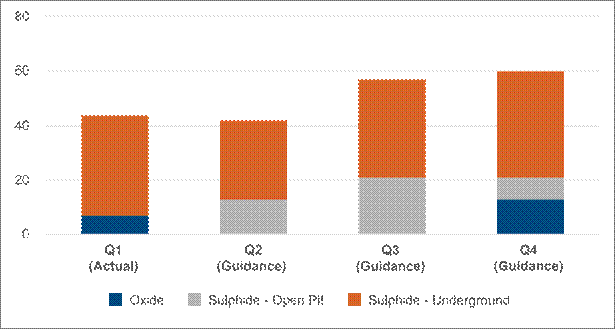
Figure 1: 2026 Syama actual gold production (koz) and guidance
During Q1 capital expenditure was $20.6 million split $6.3 million and $14.3 million between sustaining and non-sustaining capital respectively. Expenditure for the Quarter includes Underground production mobile machinery, and Tailings Storage Facility lift, with $8.0 million spent on the SSCP and Roaster upgrade as well as $5.7 million of sustaining waste capital. Syama remains on track for its capital expenditure guidance of $110 - 125 million.
Disruption in the Middle East has affected global logistics, supply chains and cost of materials. In response, Resolute has increased procurement activity and on‑site inventory levels for selected critical consumables as a risk mitigation measure, with the objective of supporting continuity of operations. At this stage, the business has not been materially impacted by consumable shortages, and supply disruptions have been successfully managed. However, the company is experiencing elevated costs for some inputs, including fuel and key reagents, which may impact overall operating costs if these price trends persist. Management continues to closely monitor market conditions and maintain contingency plans to minimize potential adverse effects on production and costs.
At Syama, storage capacity has been increased for both light fuel oil (LFO), used for mobile equipment, and heavy fuel oil (HFO), used for power generation. LFO storage on site is currently approximately 77% of total capacity equating to over 50 days of operational coverage at current consumption rates. HFO storage capacity approximately 90%, providing over 40 days of power generation coverage. For both LFO and HFO, deliveries have continued largely as scheduled, however unit costs have increased. Fuel prices in Mali are regulated by the government and in April LFO prices increased by approximately 50%. If the current prices for fuel are maintained for the remainder of the year, we expect an increase to AISC of approximately $75/oz for the full-year.
Key processing reagents, including cyanide, PAX and Sasol products, currently exceed three months of on‑site inventory. Other consumables remain in transit, with some experiencing minor delays, although no material operational impacts have been reported to date.
Explosive inventories at Syama continue to fluctuate in line with supply conditions. Current on‑site inventories provide more than one month of operational coverage. The Company has continued progress toward securing a modular emulsion manufacturing facility at Syama. Engagement with Malian authorities regarding permitting is ongoing, and subject to regulatory approvals, construction and commissioning are expected to occur in H2.
In Q1 the AISC was slightly above guidance $2,227/oz due to higher royalty payments. Royalty payments were driven by an average realised gold price during the quarter. The impact of high gold prices on AISC was approximately $135/oz above the level expected for guidance. Syama remains on track for full-year AISC guidance of $1,950 - 2,150/oz (at a gold price assumption of $4,000/oz) subject to ongoing fuel cost pressures.
Syama Sulphide Conversion Project (SSCP)
The project remains on track and on budget with no lost time injuries (LTIs) after approximately 1.06 million person-hours worked until the end of March 2026.
During the March 2026 quarter, construction of the flotation circuit was successfully completed, marking a major milestone for the SSCP and significantly advancing the project towards completion. Commissioning has now commenced, with activities progressing through Q2, positioning the operation for a strong ramp-up phase.
Capital expenditure on the SSCP in Q1 was $8.0 million and in line with the full-year guidance for capital spend of $40 million.
With flotation plant construction substantially complete, focus in Q1 shifted to advancing other critical components, particularly the secondary crusher and ball mill circuits. Strong progress was achieved across these areas during Q1, positioning SSCP well for Stage 2 commissioning in Q3.
Looking ahead to Q2, commissioning activities for the flotation plant are on schedule. In April, sulphide ore feed is planned to commence with handover to operations anticipated toward the end of the month. Construction activities in the secondary crusher and ball mill areas are expected to continue throughout Q2.
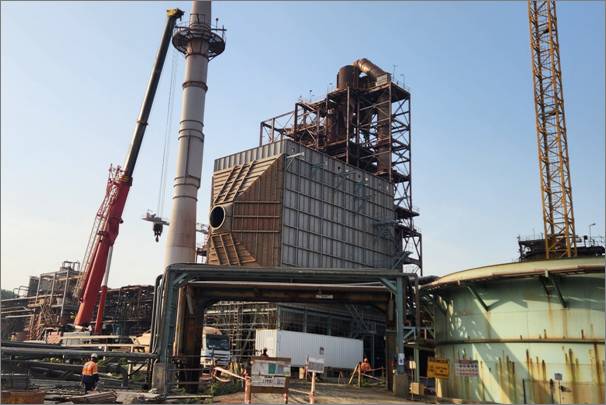
Figure 2: Construction of the Electrostatic Precipitator (ESP), a key component of Roaster Upgrade
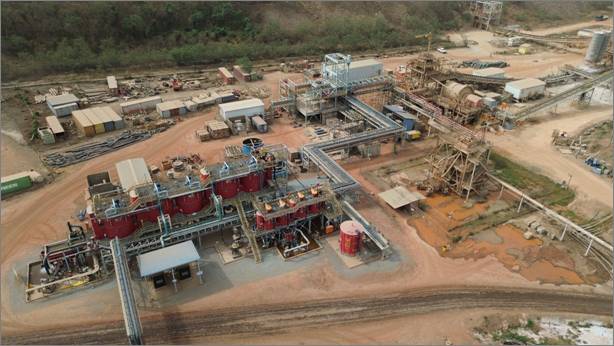
Figure 3: Flotation Circuit
The project remains on track and on budget. As per Figure 4, full commissioning is expected in Q3 2026 followed by a ramp-up throughout Q4 2026.
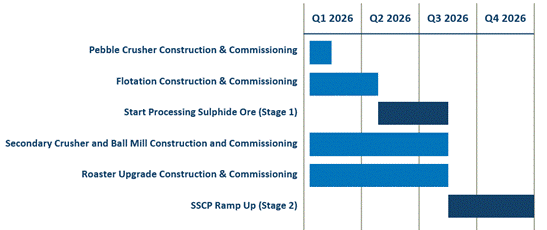
Figure 4: SSCP Timeline
Senegal
Mako Operations
Mako gold production for the Quarter was 15,801oz at an AISC of $1,669/oz. The operational performance for Mako is set out in the table below.
Summary | Units | March 2026 Quarter | December 2025 Quarter | % Change | March 2025 Quarter |
Mining |
|
|
|
|
|
Ore Mined | t | - | - | - | 611,465 |
Mined Grade | g/t | - | - | - | 1.76 |
Processing |
|
|
|
|
|
Ore Processed | t | 573,539 | 603,698 | -5% | 533,995 |
Processed Grade | g/t | 0.93 | 1.04 | -11% | 1.78 |
Recovery | % | 90 | 91 | -1% | 92 |
Gold Poured | oz | 15,801 | 18,755 | -16% | 27,263 |
Gold Sold | oz | 15,162 | 19,915 | -24% | 21,498 |
Financials | 0 |
|
|
|
|
Capital Expenditure | $m | 0.6 | 0.3 | 95% | 1.0 |
AISC | $/oz | 1,669 | 1,666 | 0% | 1,274 |
Table 3: Mako Production and Cost Summary
At Mako, the operation delivered a solid Q1 performance in line with expectations. During the quarter, the plant processed over 574 kt of stockpiled material at an average gold head grade of 0.93 g/t, producing 15,801 oz of gold. As per Figure 5, Mako remains on track for full-year production guidance of 55 - 65 koz with steady Quarterly production levels expected.
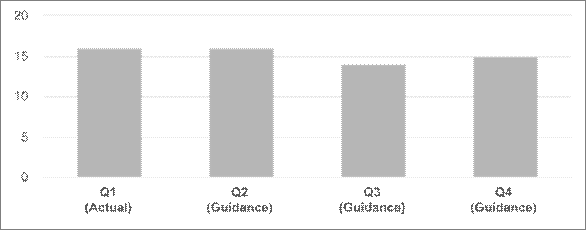
Figure 5: 2026 Mako actual gold production (koz) and guidance
During the Quarter the AISC was $1,669/oz in line with expectations reflecting continued cost discipline and operational control. Mako remains on track with full-year AISC guidance of $1,600 - 1,800/oz, supporting resilient margins and consistent cash flow generation.
Capital expenditure in Q1 was $0.6 million (Q4 2025: $0.3 million) and consisted of replacement parts for the processing plant.
No material supply disruptions have been experienced in Senegal during Q1. At Mako, which relies on LFO for both mobile equipment and power generation, fuel storage capacity is maintained at greater than 94%, representing approximately 27 days of operational coverage. Inventories of other consumables and key reagents generally exceed one month, with the majority exceeding two months. If the current prices for fuel, approximately 30% higher than originally anticipated, are maintained for the remainder of the year we expect there to be an increase to AISC of approximately $50/oz for the full-year.
Mako Life Extension Project (MLEP)
MLEP represents a compelling growth opportunity, centered on the potential development of the Tomboronkoto and Bantaco satellite deposits. Advancing these deposits is expected to extend the mine life of the Mako Gold Mine and further enhance the long-term value of the operation.
The current combined Mineral Resource Estimates of Tomboronkoto and Bantaco contain over 800 koz of gold, with possibilities of expansion based on ongoing exploration. There is significant potential at Tomboronkoto with the orebody remaining open along strike to the west and at depth.
Following internal technical studies, an initial Ore Reserve of 348 koz oz at 1.2g/t Au is at a gold price assumption of $2,500/oz was declared at Tomboronkoto.
In Q1 $2.9 million was spent on the MLEP, consisting of technical and metallurgical studies and Relocation Action Plan (RAP) development. The MLEP remains on track and on budget as per Figure 6.
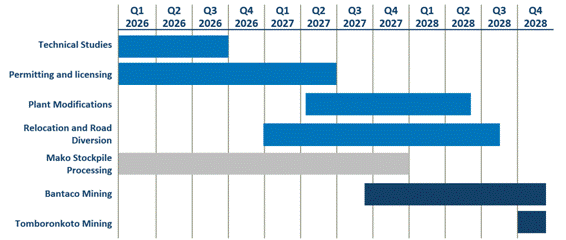
Figure 6: Approximate Timeline for the MLEP
Detailed Operating Plan
Technical studies have been carried out that consolidate historical exploration results, updated Mineral Resource Estimates as at December 2025, mine design, scheduling and metallurgical test work to a level of confidence considered appropriate for internal planning purposes.
Mining and processing studies support a conventional open pit operation with ore being processed through the existing Mako plant, subject to targeted plant upgrades. Internal scheduling work indicates Bantaco is expected to provide initial satellite mill feed ahead of Tomboronkoto (Figure 7), reflecting permitting and resettlement sequencing, with Tomboronkoto providing the majority of higher‑grade feed once mining commences.
Bantaco oxide ore properties are consistent with Mako oxides so processing plant upgrades are only required prior to processing Tomboronkoto oxides which have a higher clay content.
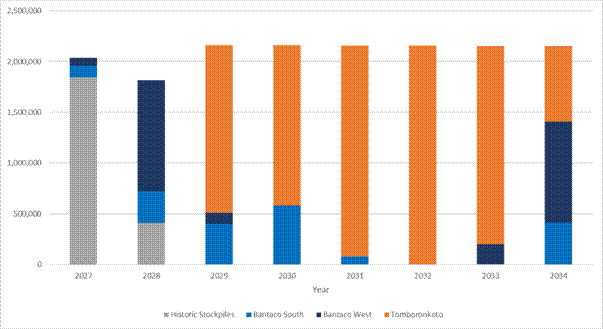
Figure 7: Annual mill feed (in tonnes) schedule by source
Based on current schedules, indicatively, the combined MLEP is assessed as capable of supporting annual gold production of approximately 75 - 85 koz over seven years with indicative gold production from satellite sources commencing following depletion of existing stockpiles and continuing over the subsequent mine life, subject to refinement through ongoing optimisation and permitting outcomes.
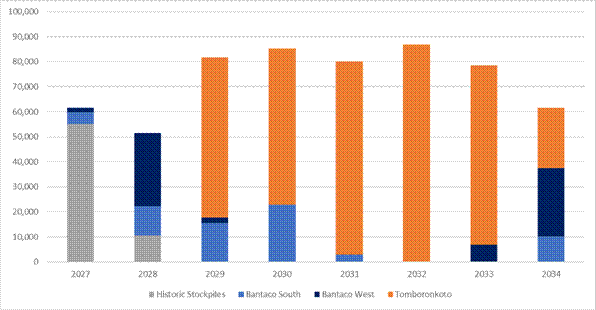
Figure 8: Annual recovered gold ounces (oz) by source
Capital and operating cost estimates were prepared on a combined MLEP basis during the quarter using detailed cost frameworks at Tomboronkoto, supplemented by high‑level estimates for Bantaco pending further study. On this basis, total pre‑production costs for the combined MLEP is estimated at approximately $125 - 150 million, reflecting process plant modifications, tailings infrastructure, resettlement and enabling works, road construction and mining establishment costs. The majority of this is expected in the second half of 2027. Operating cost estimates are expected to be similar to those at the Mako Mine with the addition of haulage and will continue to be refined as an integrated life‑of‑mine plan is progressed. All capital, cost and production parameters remain subject to further optimisation, permitting approvals and execution planning.
Tomboronkoto
During Q1 2026, key development milestones were successfully achieved at Tomboronkoto, with the final Environmental & Social Impact Assessment validated by the authorities and the feasibility study completed. These achievements significantly de-risk the project and position it strongly to support the forthcoming mining permit application that is being submitted in Q2 2026.
Planning and stakeholder engagement activities to inform the development of the RAP are well underway and remain ongoing while all required surveys are being finalised. Receipt of the mining permit will provide the necessary authority to implement the RAP, including the initiation of village relocation once agreement has been reached with the affected parties. This approach underscores our commitment to regulatory compliance, transparent community consultation, and responsible project execution.
During Q1 2026, the village relocation site was pre-selected and validated with all stakeholders, including village and state representatives. In Q2 2026, this site selection process will be finalised following the completion of all required field investigations, including geophysical surveys to identify groundwater availability, geotechnical characteristics, and sterilisation requirements. Individual household asset surveys, the relocation entitlement matrix, and public infrastructure designs will also be validated during Q2 2026.
Formal ESIA studies for the expansion of the existing Mako Mine Process Plant, including a new TSF and Ore Transport Road between Tomboronkoto and the Mako plant, progressed as planned during Q1 2026. The TSF technical study and detailed engineering commenced during the Quarter and is expected to be completed by Q3 2026. Detailed engineering for the Mako processing facility is expected to commence in Q2 2026.
Bantaco
During Q1, strong progress was made across key workstreams, including ongoing metallurgical test work and technical studies, which remain on track for completion in Q2 2026. Environmental permitting activities also advanced well, with the ESIA progressing towards submission.
Community engagement activities with the affected communities are also ongoing as part of the development of a Livelihood Restoration Plan.
Next Steps
Key next steps for the MLEP include:
• Submission of the Tomboronkoto mining permit application in Q2 and, assuming no major revisions are required, approval is anticipated in 2027
• Submission of the ESIA for the Mako plant upgrades, Gambia river bridge and ore transport route in April 2026 with approval anticipated during Q4 2026
• Finalisation of Bantaco technical studies are expected towards the end of Q2 2026
• Submission of Bantaco ESIA in Q2 2026 and validation anticipated in Q3 2026
• Preparation of all documentation for submission of the Bantaco Mining Permit application in Q3 2026
Côte d'Ivoire
Doropo Project
Doropo continues to track strongly towards first gold which is expected in H2 2028. Key milestones were delivered during Q1, as construction activities are set to accelerate in Q2 2026, positioning the project for a well-executed build and long-term value creation.
Permitting and Investment Milestones
During Q1, material progress was achieved at the Doropo Project. All key approvals were secured during the quarter, including issuance of the mining permit in February 2026, signing of the Mining Decree in March 2026 and announcement of FID on 12 March 2026.
The mining permit is valid for 14 years with the ability to extend. The permit covers a substantial area of 400km², encompassing the main Doropo deposits and several drill-tested mineralised trends.
Contracts and Procurement
During Q1 bids for the EPCM contract were evaluated and post-quarter end Lycopodium Limited were awarded the EPCM contract.
Key long-lead procurement packages were tendered during FEED, including mills, crushers, oxygen plant, CIL tanks, thickeners and associated processing equipment, with adjudication substantially complete and major equipment awards anticipated in Q2 2026.
Early construction-related packages covering camp facilities and the Doropo village were tendered and progressed to evaluation.
Site Preparation
Site preparation and engineering activities advanced, including completion of geotechnical investigations and early engineering design for the tailings storage facility, water infrastructure, access roads and airstrip.
Major earthworks contracts were adjudicated, with early pioneer earthworks awarded and mobilisation scheduled for April 2026. Water bore drilling contracts were also awarded during the quarter.
Project Team & Organisational Build-Out
Owner's team was strengthened with the appointment of senior personnel across construction, procurement, cost control and mining engineering functions.
Land Access & Community Engagement
Land access and compensation activities continued, with land surveys completed, compensation tariffs agreed and payment mechanisms established. Post-quarter end the compensation payments for early works areas were substantially completed.

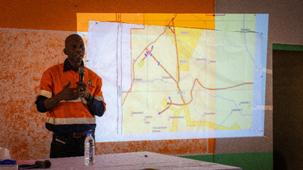
Figure 9: Land compensation activities
Planned Activities
During Q2 activities are expected to focus on placing orders for major long-lead items, commencing bulk earthworks and camp construction, expanding site infrastructure, advancing HV power supply arrangements and progressing full-scale site development. Upcoming activities include:
Owner's Team and Studies
• Continue buildup of the owner's team
• Appoint HV power engineer and start HV power supply engineering and early work
Land Access, Acquisition and Crop Compensation
• Complete compensation for all identified early works areas within the project development footprint in early April 2026
• Continue compensation activities for areas outside the early works footprint
Procurement and Fabrication Packages
• Place orders for long lead items (Mills, Jaw crusher, Apron feeders, CIL tanks and agitators, Thickener, Oxygen plant, Cyclones, Sewage treatment plant, Cranes and hoists)
• Commence tender process for remaining equipment (mechanical, electrical, piping and valves) and steelwork and fabrication packages
• Commence procurement and hire of site vehicles and mobile equipment
Site Works and Early Construction
• Commence temporary construction camp upgrade and award contracts for permanent camp construction
• Commence site earthworks, including access, plant side, construction camp and water infrastructure in April 2026
• Commence drilling and equipping of water bores
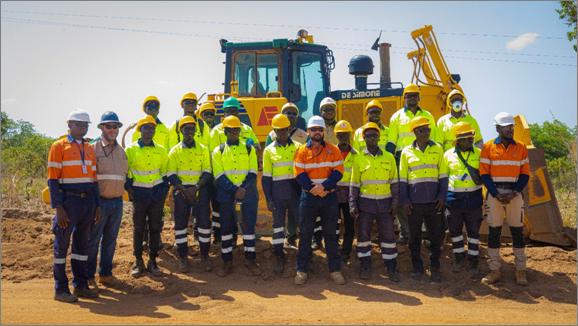 Figure 10: Groundbreaking starting on site
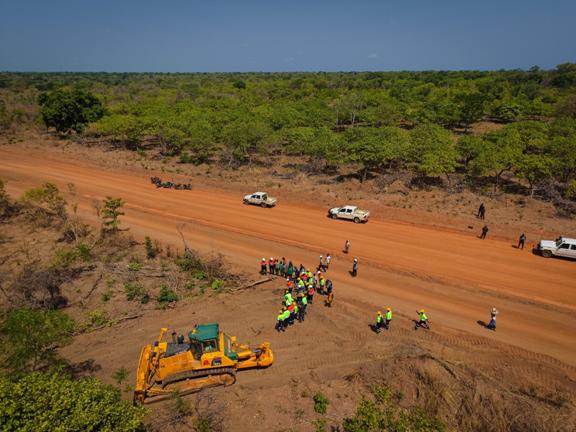 Figure 11: Ground clearance activities
The Doropo project remains on track with the timeline in Figure 12 with first gold expected in H2 2028.
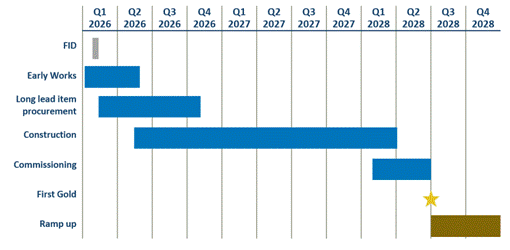
Figure 12 : Doropo Project Timeline
Côte d'Ivoire Exploration
ABC Project
The ABC Project is a greenfield exploration project located in western Cote d'Ivoire. Resolute has four exploration permits granted around the ABC Project with two further permit applications.
Over Kona Central and South deposits there is a NI 43-101-compliant Inferred MRE of 2.16 Moz grading 0.9 g/t Au contained within the Kona permit.
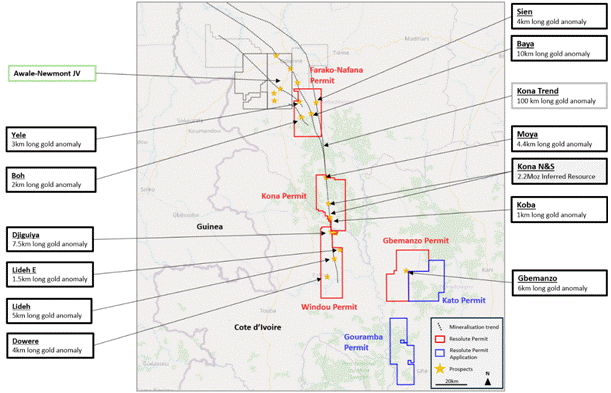
Figure 13: Permit and Prospect Locations at the ABC Project
Exploration activity during Q1 focused on drilling programs planned to expand the Mineral Resources at the Kona deposits. Furthermore, a scoping study on the ABC Project, based on the existing MRE, was advanced during the period and is expected in Q2 2026.
Drilling successfully advanced efforts to extend known mineralisation at both Kona South and Kona Central, along strike to the north and south of the deposits. A total of 64 RC holes for 11,000m were completed during the March quarter with drilling at both areas reinforcing the scale and continuity of the mineralised system.
Drilling progressed strongly during the quarter, where activity ramped up to five rigs toward period end to accelerate delineation and rapidly expand the mineralised footprint, positioning the project for continued resource growth.
Results from the first 40 holes demonstrate wide intervals of gold mineralisation across the majority of drilling completed to date, reinforcing the scale and continuity of the system. Key standout intersections include:
• KNRC0499 - 73m @ 0.8g/t Au from 2m
• KNRC0500 - 80m @ 0.4g/t Au from 88m
• KNRC0501 - 23m @ 1g/t Au from 6m
• KNRC0506R - 35m @ 0.9 and 21m @ 1.2g/t
• KNRC0508 - 10m @ 1.9g/t Au from 217m
• KNRC0512 - 31m @ 1g/t from 151m
The majority of the results returned to date are from Kona South which is higher grade than Kona Central. The drill intersections clearly confirm the along strike extensions of the gold mineralisation to the north and south of Kona South.
All reported drill intersections are located outside the current Mineral Resource block models, highlighting clear potential for a meaningful increase in the existing resource base and underpinning a compelling growth opportunity.
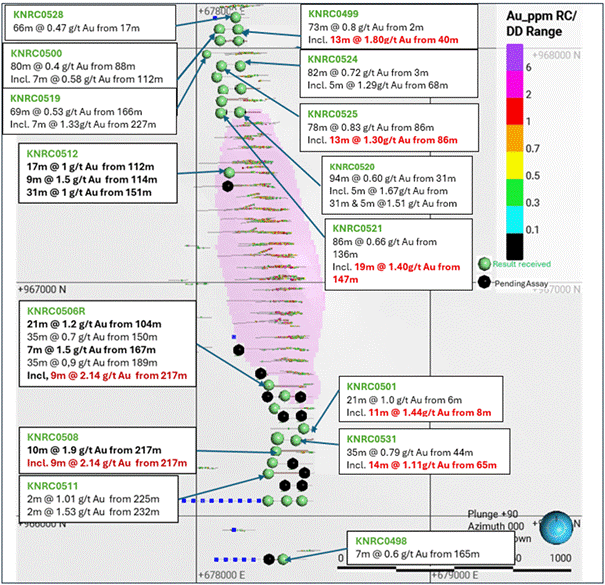
Figure 14: Kona South Plan with drillhole locations
New drilling north of Kona South has delivered wide zones of mineralisation, extending the zones by 500m to the north, highlighting potential continued resource expansion.
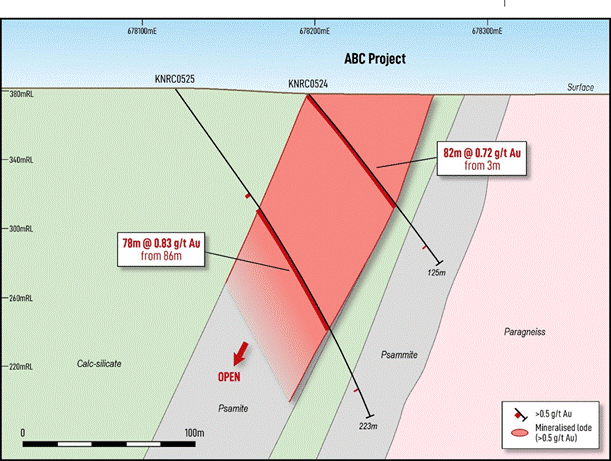
Figure 15: Kona South cross section at 967950N
The accelerated drilling program will continue throughout 2026 to build the Mineral Resource Inventory of the ABC Project. An updated Mineral Resource Estimate is planned to be announced in H2 2026.
A scoping study is underway on the existing Kona MRE, with results due for release in Q2 2026, marking an important step in advancing the project's development pathway.
La Debo Project
The La Debo Project, located in southern Côte d'Ivoire approximately 280 km west of Abidjan, hosts an Inferred Mineral Resource of 17.6Mt at 1.14 g/t Au for 643 koz of contained gold (0.5 g/t cut-off) across the G3S and G3N prospects, providing a strong foundation for future growth.
A diamond drilling program commenced in March 2026 at G3S, aimed at expanding the existing Mineral Resource. Drilling last year identified a coherent linear zone of high-grade mineralisation at the deepest levels of G3S highlighting compelling potential for the development of a future underground operation.
This drilling program aims to drill out a panel of gold mineralisation over a strike length of 600m which may form the basis of an underground operation.
Drilling is progressing well, with results expected to be released in the second half of 2026, providing near-term catalysts for resource growth and project advancement. 13,000m of drilling is planned for the remainder of 2026.
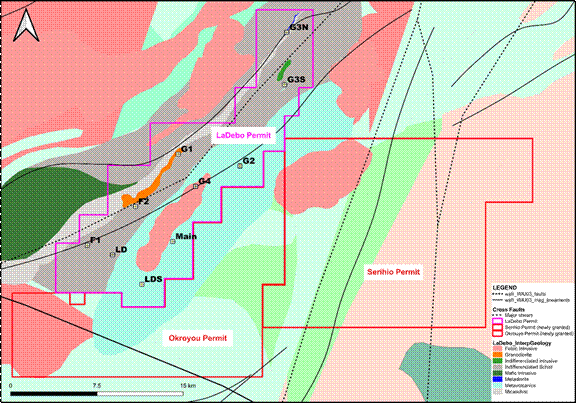
Figure 16: La Debo Project Permits and Prospect Locations
Subject to positive drilling results at depth at G3S, La Debo has the potential to advance its development stage, with further technical and strategic updates planned for the second half of 2026. This work will support a comprehensive assessment of the project's potential and help identify broader growth opportunities in the region.
Doropo Exploration
Exploration drilling within the Doropo Mining Permit is set to commence in Q2 2026 targeting both the Vako area and Kilosegui - see Figure 17.
Kilosegui represents a potential mineral resource expansion opportunity, with a 6km strike length and mineralisation remaining open at depth along its entire strike length. The initial strategy is to expand the Kilosegui Mineral Resources at depth but within the top 200m.
Historical exploration by Centamin identified a broad, high-grade gold-in-soil anomaly along the Vako Shear Zone, with initial follow-up drilling returning encouraging early-stage results. However, there was no further work carried out at the Vako Shear Zone.
Resolute plans to carry out a systematic work program at Doropo, commencing with auger drilling to identify the source of the gold anomalies, followed by a focused RC drilling campaign to test and delineate the underlying mineralisation. Detailed exploration planning is underway with up to 30,000m of drilling potentially planned.
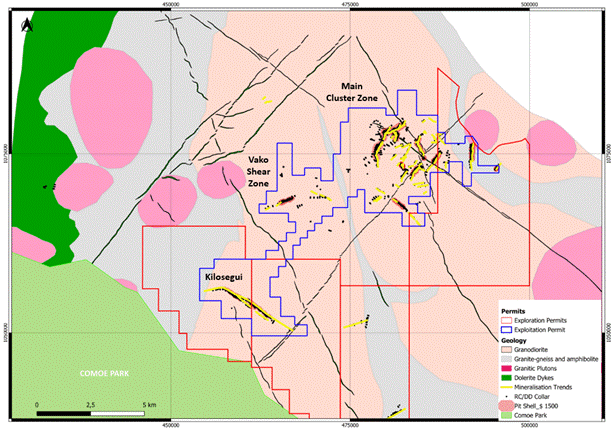
Figure 17: Map of deposits and prospects at Doropo
Guinea
Strategic Partnership with Nimba Mining Company
In March the Company signed an MoU with the state-owned company Nimba Mining Company (NMC). This strategic partnership demonstrates the Government's recognition of and the support for Resolute's growth plans in Guinea.
The partnership will focus on jointly assessing mineral resources, conducting comprehensive geological studies, and developing strategic frameworks for potential large-scale gold production operations. The MoU aligns with Resolute's strategy of building a pipeline of high-quality growth opportunities in established West African gold jurisdictions. Moreover, it complements Resolute's other exploration activities in Guinea including a reconnaissance authorisation covering 83 km2 within the Siguiri Basin.
The next steps of the MoU involve Resolute and NMC completing a preliminary assessment of areas of interest and forming a joint team to review these, within the next 90 days following signing.
Planned Activities
At Barama, initial soil geochemistry results from the reconnaissance authorisation are expected in Q2 2026. Subject to results, the Company plans to undertake tighter-spaced (infill) soil sampling to refine and prioritise identified anomalies for follow-up.
In parallel, Resolute will continue to assess additional licence opportunities and advance its business development activities throughout Q2 2026.
Mineral Resources and Ore Reserves Statement
During the Quarter Resolute released its Mineral Resources and Ore Reserves statement as of 31 December 2025.
Ore Reserves
Total Ore Reserves increased by 55% to 6.8 Moz Au with the addition of Ore Reserves at Doropo (Côte d'Ivoire) and Tomboronkoto (Senegal) offsetting mining depletion in Mali and Senegal.
| Proved | Probable | Total Reserves | ||||||
As at December 2025 | Tonnes (000s) | g/t Au | oz (000s) | Tonnes (000s) | g/t Au | oz (000s) | Tonnes (000s) | g/t Au | oz (000s) |
Mali | 808 | 1.50 | 39 | 49,315 | 2.40 | 3,847 | 50,123 | 2.40 | 3,885 |
Senegal | 3,896 | 0.90 | 118 | 9,076 | 1.20 | 348 | 12,972 | 1.10 | 467 |
Côte d'Ivoire | 1,400 | 1.60 | 73 | 57,700 | 1.30 | 2,424 | 59,100 | 1.30 | 2,497 |
Managed Ore Reserves | 6,105 | 1.20 | 230 | 116,091 | 1.80 | 6,619 | 122,196 | 1.70 | 6,849 |
Table 4: Ore Reserves (100% Basis)
Mali
At Syama, Underground Ore Reserves decreased by 235 koz Au, consistent with expectations, reflecting mining depletion and updated modifying factors based on a $2,300/oz gold price assumption. Stockpile Ore Reserves declined as material was processed, with higher sulphide depletion in 2025 due to underground mining disruptions, while oxide stockpiles reduced broadly in line with expectations; further oxide depletion is anticipated ahead of commissioning of the SSCP in H2 2026.
Ore Reserves at Tabakoroni Underground were unchanged. Ore Reserves at the Syama Satellite Deposits increased by 83 koz to 1.6 Moz Au following completion of a new pit optimisation, with Syama North underpinning the SSCP and the long‑term future of the Syama operation.
Senegal
At Mako, Ore Reserves decreased by 108 koz Au due to mining depletion, following the completion of open pit mining in June 2025 and the commencement of stockpile processing in H2 2025. Remaining Proven Ore Reserves total 108 koz Au at 0.9 g/t Au, with stockpile processing expected to continue until the end of 2027.
An initial Ore Reserve of 348 koz Au at 1.2 g/t Au has been declared for Tomboronkoto based on a $2,500/oz gold price assumption. Further optimisation studies at Tomboronkoto and Bantaco are planned as part of the Mako Life Extension Project.
Cote d'Ivoire
Following the updated DFS completed in 2025 the Doropo Ore Reserves total 2.5 Moz Au grading 1.3 g/t using a gold price assumption of $1,950/oz.
Mineral Resources
Total Mineral Resources increased by 60% to 17.6 million gold (Au) ounces (Moz) with the acquisition of the Doropo and ABC projects (Côte d'Ivoire) and exploration success at Bantaco (Senegal) and La Debo (Côte d'Ivoire).
| Measured | Indicated | Inferred | Total Resources | ||||||||
As at December 2025 | Tonnes (000s) | g/t Au | oz (000s) | Tonnes (000s) | g/t Au | oz (000s) | Tonnes (000s) | g/t Au | oz (000s) | Tonnes (000s) | g/t Au | oz (000s) |
Mali | 29,227 | 2.90 | 2,683 | 48,398 | 3.10 | 4,751 | 31,291 | 1.70 | 1,668 | 108,916 | 2.60 | 9,101 |
Senegal | 3,947 | 0.90 | 120 | 16,894 | 1.30 | 687 | 6,869 | 1.00 | 224 | 27,709 | 1.20 | 1,031 |
Côte d'Ivoire | 1,550 | 1.60 | 78 | 95,200 | 1.20 | 3,601 | 106,999 | 1.20 | 3,483 | 203,749 | 1.20 | 7,162 |
Guinea | 0 | 0.00 | 0 | 0 | 0.00 | 0 | 6,625 | 0.90 | 343 | 6,625 | 0.90 | 343 |
Managed Mineral Resources | 34,724 | 2.60 | 2,881 | 160,492 | 1.80 | 9,038 | 151,784 | 1.20 | 5,718 | 347,000 | 1.60 | 17,637 |
Table 5: Mineral Resources (100% Basis)
Mali
Mineral Resources at the Syama Underground mine decreased by approximately 680 koz Au, reflecting mining depletion, an updated resource estimate and revised RPEEE (Reasonable Prospects For Eventual Economic Extraction) inputs. The Syama North Mineral Resource decreased by approximately 50 koz to 3.3 Moz Au due to mining depletion and revised RPEEE inputs. Mineral Resources at Tabakoroni Underground were unchanged.
Senegal
Mineral Resources at Mako, including stockpiles, decreased by approximately 130 koz Au in line with mining depletion, with no further additions expected following completion of open pit mining and the commencement of stockpile processing.
Mineral Resources at Tomboronkoto increased in 2025 due to reporting at a lower cut‑off grade of 0.5 g/t Au within a $2,950/oz optimised pit shell, increasing to 444 koz Au at 1.3 g/t Au (2024: 377 koz at 1.7 g/t Au). At Bantaco the Mineral Resource was updated to 365 koz Au at 1.0 g/t Au.
Cote d'Ivoire
Mineral Resource additions reflect the acquisition of the Doropo and ABC projects and the declaration of an initial Mineral Resource at La Debo.
At Doropo, an updated Mineral Resource Estimate released in September 2025, based on a $3,000/oz gold price assumption, increased total Mineral Resources to 4.4 Moz Au, a 1 Moz Au increase from 2023, with approximately 84% classified as Measured and Indicated.
At the ABC Project, Mineral Resources total 2.2 Moz Au at the Kona Central and South deposits, with further exploration and a Scoping Study planned during 2026.
An initial Mineral Resource was declared at La Debo in November 2025 of 643 koz Au at 1.14 g/t Au, with further drilling planned during 2026.
Financial Highlights and Balance Sheet Activities
Quarterly Net Cash Movements (US$ million)
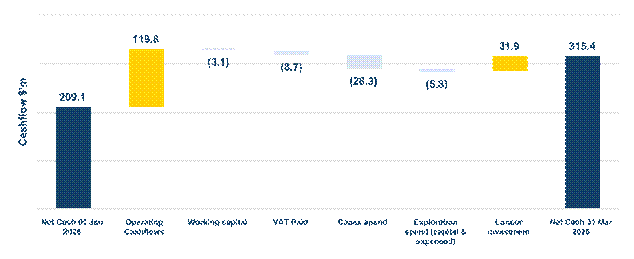
*Included in Operating Cash flows are $26.9 million of royalties
Figure 18: Q1 2026 Net Cash Movements
In Q1 gold sales of 69,352 oz were achieved at an average realised gold price of $4,858/oz (Q4: $4,023/oz), with all gold being sold at spot prices. The strong gold price environment helped the Company generate an operating cashflow of $119.8 million in Q1.
For Q1 there was a working capital outflow of $3.1 million (Q4 2025: $29.0 million inflow) The working capital outflow was due to a reduction in payables that were settled in the normal course of business.
The VAT paid in Q1 in Mali and Senegal was $8.7 million (Q4 2025: $12.3 million). During the Quarter $4.3 million of VAT mandates were approved by the Senegalese tax authorities and will be used to settle payables in Q2. Resolute continues to engage with local governments to settle these amounts. In Q2 Resolute expects considerable income tax payments in Mali and Senegal of approximately $50 million.
EBITDA for the three months ending 31 March 2026 was $202.9 million (Q4 2025: $104.9 million) reflecting $337.6 million of revenue (Q4 2025: $201.5 million) driven by the significant increase in gold prices in the quarter as well the impact of the increase of gold sales in the quarter.
Exploration Expenditure
Total Group exploration spend, including capital and operating expenditure, in Q1 was $5.3 million (Q4 2025: $5.6 million), with drilling programs continuing in Senegal ($1.1 million), Côte d'Ivoire ($3.7 million) and Mali ($0.5 million). Exploration spend remains on track with guidance ($15 - 25 million).
Net Cash Summary
Net cash (including bullion) at 31 March 2026 was $315.4 million, increasing from the $209.0 million net cash position at 31 December 2025.
Total borrowings at 31 March 2026 were $12.2 million (Q4 2025: $57.0 million) which includes in-country overdraft facilities in Senegal of $2.2 million, used to optimise working capital, as well as $10.0 million for in-country equipment financing. Cash, cash equivalents and bullion increased by $106.4 million in the Quarter to $315.4 million (Q4 2025: $209.0 million) including $31.4 million that was received from the sale of Resolute's stake in Loncor Gold. The Company has available liquidity of approximately $425.0 million (including $99.6 million bullion on hand) as at 31 March 2026.
As at 31 March 2026 the receivable for the Ravenswood promissory note was approximately $52 million. The promissory note has an annual coupon of 12% with interest being capitalised and is to be paid to Resolute upon maturity. The promissory note maturity is 31 December 2027 but may be repaid early on future Ravenswood financings, liquidity event(s), or excess cash from Ravenswood.
Financing Updates
Resolute intends to use its existing balance sheet and operating cash flows to progress Doropo into construction. The Company continues to consider a range of funding options to support the construction of the Doropo project.
Guidance
Resolute remains on track for its full-year production guidance of 250,000 - 275,000 oz.
Group AISC of $2,000 - 2,200/oz (at a gold price assumption of $4,000/oz) is maintained however is subject to change at current elevated gold prices and higher fuel costs. For every $100/oz increase in gold price we anticipate a $20/oz increase in Group AISC. If prices for fuel persist at current levels we expect an impact to the Group's full-year AISC.
| Year to Date | Guidance | ||
| Gold Production (oz) | AISC ($/oz) | Gold Production (oz) | AISC ($/oz) |
Syama | 43,802 | 2,227 | 195,000 - 210,000 | 1,950 - 2,150 |
Mako | 15,801 | 1,669 | 55,000 - 65,000 | 1,600 - 1,800 |
Total Group | 59,603 | 2,210 | 250,000 - 275,000 | 2,000 - 2,200 |
Total group AISC includes corporate costs
Table 6: Summary of year-to-date performance and full-year production and cost guidance
Total Group capital expenditure, inclusive of Doropo and exploration, is expected to be between $310 - 360 million in 2026. Administration and other corporate expenditure is expected to be approximately $25 million.
Doropo capital expenditure is expected to be weighted 75% to the second half of 2026.
(US$ million) | Year to Date Spend | Guidance |
Syama | 12.6 | 70 - 85 |
SSCP | 8.0 | 40 |
Mako | 0.6 | 5 |
MLEP | 2.9 | 10 - 15 |
Doropo | 4.2 | 170 - 190 |
Exploration | 5.1 | 15 - 25 |
Total | 33.4 | 310 - 360 |
Table 7: Summary of 2026 capital expenditure guidance
Contact
Resolute Matthias O'Toole Howes, Corporate Development and Investor Relations Manager +44 203 3017 620 | Public Relations Jos Simson, Tavistock +44 207 920 3150
Corporate Brokers Jennifer Lee, Berenberg +44 20 3753 3040
Tom Rider, BMO Capital Markets +44 20 7236 1010 |
|
About Resolute
Resolute is an African-focused gold miner with more than 30 years of experience as an explorer, developer and operator. Throughout its history the Company has produced more than 9 million ounces of gold from ten gold mines. The Company is now entering a growth phase through the development of the Doropo project in Côte d'Ivoire which will supplement the existing production from the Syama mine in Mali and Mako mine in Senegal.
Through all its activities, sustainability is the core value at Resolute. This means that protecting the environment, providing a safe and productive working environment for employees, uplifting host communities, and practicing good corporate governance are non-negotiable priorities. Resolute's commitment to sustainability and good corporate citizenship has been cemented through its adoption of and adherence to the Responsible Gold Mining Principles (RGMPs). This framework, which sets out clear expectations for consumers, investors, and the gold supply chain as to what constitutes responsible gold mining, is an initiative of the World Gold Council of which Resolute has been a full member since 2017.
Appendix 1
Q1 Production and Costs (unaudited)
March 2026 - Quarter to date | Units | Syama Sulphide | Syama Oxide | Syama | Mako | Group Total | |
UG Lateral Development | m | 608 | - | 608 | - | 608 | |
UG Vertical Development | m | - | - | - | - | - | |
Total UG Development | m | 608 | - | 608 | - | 608 | |
UG Ore Mined | t | 711,718 | - | 711,718 | - | 711,718 | |
UG Grade Mined | g/t | 2.23 | - | 2.23 | - | 2.23 | |
OP Operating Waste | BCM | 136,025 | 230,979 | 367,004 | - | 367,004 | |
OP Ore Mined | BCM | 21,982 | 9,035 | 31,017 | - | 31,017 | |
OP Grade Mined | g/t | 2.01 | 2.19 | 2.06 | - | 2.06 | |
Total Ore Mined | t | 773,288 | 21,148 | 794,436 | - | 794,436 | |
Total Tonnes Processed | t | 627,706 | 431,768 | 1,059,474 | 573,539 | 1,633,012 | |
Grade Processed | g/t | 2.36 | 0.64 | 1.66 | 0.93 | 1.40 | |
Recovery | % | 76 | 76 | 76 | 90 | 81 | |
Gold Recovered | oz | 36,314 | 6,790 | 43,104 | 15,614 | 58,718 | |
Gold in Circuit Drawdown/(Addition) | oz | 368 | 330 | 698 | 187 | 885 | |
Gold Produced (Poured) | oz | 36,682 | 7,120 | 43,802 | 15,801 | 59,603 | |
Gold Bullion in Metal Account Movement (Increase)/Decrease | oz | 10,388 | - | 10,388 | (639) | 9,749 | |
Gold Sold | oz | 47,070 | 7,120 | 54,190 | 15,162 | 69,352 | |
Achieved Gold Price | $/oz | - | - | - | - | 4,858 | |
Cost Summary |
|
|
|
|
|
| |
Mining | $/oz | 534 | 14 | 449 | 229 | 391 | |
Processing | $/oz | 554 | 1,484 | 706 | 849 | 744 | |
Site Administration | $/oz | 121 | 570 | 194 | 270 | 214 | |
Site Operating Costs | $/oz | 1,209 | 2,068 | 1,349 | 1,348 | 1,349 | |
Royalties | $/oz | 700 | 450 | 659 | 268 | 555 | |
By-Product Credits | $/oz | (10) | (9) | (9) | - | (7) | |
Total Cash Operating Costs | $/oz | 1,899 | 2,509 | 1,999 | 1,616 | 1,897 | |
Sustaining Capital | $/oz | 52 | 618 | 144 | 37 | 247 | |
Inventory Adjustments | $/oz | 7 | 476 | 84 | 16 | 66 | |
All-In Sustaining Cost (AISC) AISC is calculated on gold produced (poured) | $/oz | 1,958 | 3,603 | 2,227 | 1,669 | 2,210 |
|
ASX Listing Rule 5.23 Mineral Resources
This announcement contains estimates of Resolute's mineral resources. The information in this Quarterly report that relates to the mineral resources of Resolute has been extracted from reports entitled 'Ore Reserves and Mineral Resource Statement' announced on 5 March 2026, and are available to view on Resolute's website (www.rml.com.au) and www.asx.com (Resolute Announcement).
For the purposes of ASX Listing Rule 5.23, Resolute confirms that it is not aware of any new information or data that materially affects the information included in the Resolute Announcement and, in relation to the estimates of Resolute's ore reserves and mineral resources, that all material assumptions and technical parameters underpinning the estimates in the Resolute Announcement continue to apply and have not materially changed. Resolute confirms that the form and context in which the Competent Person's findings are presented have not been materially modified from that announcement.
ASX Listing Rule 5.8 and 5.9 Ore Reserves
This announcement contains information relating to Resolute's Ore Reserves which has been previously disclosed in the announcement titled "Ore Reserves and Mineral Resource Statement" lodged with ASX on 5 March 2026 (Resolute Announcement).
Resolute confirms that it is not aware of any new information or data that materially affects the information included in the Resolute Announcement and that all material assumptions and technical parameters underpinning the Ore Reserve estimates continue to apply and have not materially changed. The form and context in which the Competent Person's findings are presented have not been materially modified from the Resolute Announcement.
ASX Listing Rule 5.19 Production Targets
The information in this announcement that relates to production targets of Resolute has been extracted from the report entitled 'Q4 2025 Activities Report and 2026 Guidance' announced on 22 January 2026 and are available to view on the Company's website (www.rml.com.au) and www.asx.com.
For the purposes of ASX Listing Rule 5.19, Resolute confirms that all material assumptions underpinning the production target, or the forecast financial information derived from the production target continue to apply and have not materially changed.
Cautionary Statement about Forward-Looking Statements
This announcement contains certain "forward-looking statements" including statements regarding our intent, belief, or current expectations with respect to Resolute's business and operations, market conditions, results of operations and financial condition, and risk management practices. The words "likely", "expect", "aim", "should", "could", "may", "anticipate", "predict", "believe", "plan", "forecast" and other similar expressions are intended to identify forward-looking statements. Indications of, and guidance on, future earnings, anticipated production, life of mine and financial position and performance are also forward-looking statements. These forward-looking statements involve known and unknown risks, uncertainties and other factors that may cause Resolute's actual results, performance and achievements or industry results to differ materially from any future results, performance or achievements, or industry results, expressed or implied by these forward-looking statements. Relevant factors may include (but are not limited to) changes in commodity prices, foreign exchange fluctuations and general economic conditions, increased costs and demand for production inputs, the speculative nature of exploration and project development, including the risks of obtaining necessary licences and permits and diminishing quantities or grades of reserves, political and social risks, changes to the regulatory framework within which Resolute operates or may in the future operate, environmental conditions including extreme weather conditions, recruitment and retention of personnel, industrial relations issues and litigation.
Forward-looking statements are based on Resolute's good faith assumptions as to the financial, market, regulatory and other relevant environments that will exist and affect Resolute's business and operations in the future. Resolute does not give any assurance that the assumptions will prove to be correct. There may be other factors that could cause actual results or events not to be as anticipated, and many events are beyond the reasonable control of Resolute. Readers are cautioned not to place undue reliance on forward-looking statements, particularly in the significantly volatile and uncertain current economic climate. Forward-looking statements in this document speak only at the date of issue. Except as required by applicable laws or regulations, Resolute does not undertake any obligation to publicly update or revise any of the forward-looking statements or to advise of any change in assumptions on which any such statement is based. Except for statutory liability which cannot be excluded, each of Resolute, its officers, employees and advisors expressly disclaim any responsibility for the accuracy or completeness of the material contained in these forward-looking statements and excludes all liability whatsoever (including in negligence) for any loss or damage which may be suffered by any person as a consequence of any information in forward-looking statements or any error or omission.
Competent Persons Statement
The information in this report that relates to the Exploration Results, Mineral Resources and Ore Reserves is based on information compiled by Mr Bruce Mowat, a member of The Australian Institute of Geoscientists. Mr Bruce Mowat has more than 15 years' experience relevant to the styles of mineralisation and type of deposit under consideration and to the activity which he is undertaking to qualify as a Competent Person, as defined in the 2012 Edition of the "Australasian Code for Reporting of Exploration Results, Mineral Resources and Ore Reserves" (the JORC Code). Mr Bruce Mowat is a full-time employee of the Resolute Mining Limited Group and holds equity securities in the Company. He has consented to the inclusion of the matters in this report based on his information in the form and context in which it appears. This information was prepared and disclosed under the JORC Code 2012 except where otherwise noted.
Appendix 2. Recent drilling results
HoleID | East (WGS) | North (WGS) | RL | EOH(m) | AZI (WGS) | DIP | From (m) | To (m) | Width (m) | Au g/t | Gram meter |
KNRC0520 | 678187 | 967725 | 383.03 | 150 | 90 | -55 | 100 | 125 | 25 | 0.871 | 21.8 |
KNRC0526 | 678180 | 968029 | 382.36 | 110 | 90 | -55 | 28 | 56 | 28 | 0.645 | 18.1 |
KNRC0531 | 678424 | 966323 | 390.55 | 133 | 90 | -55 | 65 | 79 | 14 | 1.108 | 15.5 |
KNRC0540 | 677724 | 972191 | 393.4 | 288 | 90 | -55 | 19 | 28 | 9 | 4.994 | 44.9 |
KNRC0521 | 678107 | 967727 | 382.5 | 228 | 90 | -55 | 143 | 169 | 26 | 1.173 | 30.9 |
KNRC0547 | 677774 | 972403 | 401 | 200 | 90 | -55 | 166 | 188 | 22 | 1.131 | 24.9 |
KNRC0524 | 678195 | 967936 | 378.4 | 125 | 90 | -55 | 2 | 29 | 27 | 0.801 | 21.7 |
KNRC0524 | 678195 | 967936 | 378.4 | 125 | 90 | -55 | 33 | 73 | 40 | 0.768 | 30.7 |
KNRC0572 | 677546 | 973993 | 419.3 | 115 | 90 | -55 | 18 | 42 | 24 | 1.111 | 26.7 |
KNRC0525 | 678118 | 967933 | 381.4 | 223 | 90 | -55 | 86 | 139 | 53 | 0.962 | 51 |
KNRC0549 | 677690 | 972503 | 399.8 | 258 | 90 | -55 | 138 | 164 | 26 | 0.816 | 21.2 |
KNRC0549 | 677690 | 972503 | 399.8 | 258 | 90 | -55 | 233 | 258 | 25 | 0.89 | 22.3 |
KNRC0573 | 677494 | 973994 | 417.3 | 195 | 90 | -55 | 45 | 62 | 17 | 1.33 | 22.6 |
KNRC0573 | 677494 | 973994 | 417.3 | 195 | 90 | -55 | 102 | 108 | 6 | 2.6 | 15.6 |
Notes to Accompany Table: |
• Grid coordinates are WGS84 Zone 29 North |
• RC intervals are sampled every 1m by dry riffle splitting or scoop to provide a 2-3kg sample |
• Cut-off grade for reporting of intercepts is >0.5g/t Au with a maximum of 3m consecutive internal dilution included within the intercept; only intercepts =>3m and >15 gram x metres are reported |
• Recent drill samples are analysed for gold by MSA Labs CPA-Au1 500g sample gamma ray analysis by photon assay instrument |
JORC Code, 2012 Edition - Table 1 report
Section 1 Sampling Techniques and Data
ABC Project
Criteria | JORC Code explanation | Commentary |
Sampling techniques | • Nature and quality of sampling (eg cut channels, random chips, or specific specialised industry standard measurement tools appropriate to the minerals under investigation, such as down hole gamma sondes, or handheld XRF instruments, etc). These examples should not be taken as limiting the broad meaning of sampling. • Include reference to measures taken to ensure sample representivity and the appropriate calibration of any measurement tools or systems used. • Aspects of the determination of mineralisation that are Material to the Public Report. • In cases where 'industry standard' work has been done this would be relatively simple (eg 'reverse circulation drilling was used to obtain 1 m samples from which 3 kg was pulverised to produce a 30 g charge for fire assay'). In other cases more explanation may be required, such as where there is coarse gold that has inherent sampling problems. Unusual commodities or mineralisation types (eg submarine nodules) may warrant disclosure of detailed information. • | • The sampling was conducted using multiple techniques tailored to the project's geological and surface conditions. A systematic rock sampling program was caried out in 2017 to fully characterise the surface expression of the mineralisation. A total of 788 rock samples were collected in 2017 and 205 rock samples in 2019/2020. • Auger drilling was employed extensively over the mineralised corridor to adequately characterise the underlying rocks. Auger drilling recovered material systematically for gold analysis and geochemical interpretation. As with the rock chips, auger samples were analysed for Au by fire assay with AAS finish at Bureau Veritas in Abidjan. Multi-element analyses were completed by four-acid digest with ICP-AES and ICP-MS finish at ACME Laboratories in Vancouver. A total of 2,843 samples were collected at the end of 2020 from 22,219m drilled. • Reverse Circulation (RC) and Diamond Core (DD) drilling were the principal methods used for delineating Mineral Resources. RC drilling was conducted using 5¼ to 5¾ inch diameter face-sampling hammers to recover one-metre interval samples, typically dry unless groundwater was encountered. Diamond drilling employed HQ and NQ diameter core, with triple tube techniques for improving recovery in broken ground. RC samples were riffle split on site, and core samples were sawn to produce half-core for analysis. Sampling procedures incorporated QAQC measures, including the insertion of blanks, standards, and duplicates to ensure sample representivity. Assay protocols utilised 50 g fire assay (AAS finish) for gold, and multi-element analysis was performed where applicable. |
Drilling techniques | Drill type (eg core, reverse circulation, open-hole hammer, rotary air blast, auger, Bangka, sonic, etc) and details (eg core diameter, triple or standard tube, depth of diamond tails, face-sampling bit or other type, whether core is oriented and if so, by what method, etc). | • Drilling methods involved a combination of Reverse Circulation (RC), Diamond Core (DD), and auger drilling methods. RC drilling was primarily used for delineating near-surface mineralisation and preliminary resource definition. RC drilling employed face-sampling hammers with bit sizes ranging from 5¼ to 5¾ inches. Dry drilling was the standard procedure, with drilling halted at the water table to prevent contamination from wet samples; below groundwater, diamond drilling methods were applied. • Diamond core drilling used HQ and NQ diameter core. Triple-tube systems were implemented in highly broken ground to maximise core recovery, while standard double-tube setups were used elsewhere. Downhole surveys are taken every 30m with a single shot Reflex EZ shot system. Orientation of diamond core was conducted selectively using Reflex ACT II core orientation devices to facilitate structural logging. Auger drilling was utilised for shallow exploration across the entire area. All drill methods were executed to a high standard with contractors experienced in gold exploration in West Africa. • |
Drill sample recovery | • Method of recording and assessing core and chip sample recoveries and results assessed. • Measures taken to maximise sample recovery and ensure representative nature of the samples. • Whether a relationship exists between sample recovery and grade and whether sample bias may have occurred due to preferential loss/gain of fine/coarse material. | • Drill sample recovery was systematically monitored during both RC and diamond drilling programs. RC samples were weighed regularly, to monitor sample size consistency and ensure the representativeness of samples. Analysis of sample weights of 47,562 RC samples from Kona South and 47,464 RC samples showed a consistent recovery trend stabilizing between 30-40 kg per metre after clearing the uppermost weathered horizons. Minor variations in sample weight were observed at shallow depths and in softer materials; however, statistical checks confirmed no significant bias in gold grade associated with sample mass. • Diamond core recovery was measured, with an overall average recovery of approximately 96% across the project. Recovery rates improved with depth, with 81% core recovery in oxide, 91% recovery in transitional and 99% in fresh. Core recovery measurements were recorded in the database for each run. The use of triple-tube drilling in broken ground contributed to maintaining high recovery standards. The overall conclusion, supported by quality control reviews, was that there is no significant sampling bias attributable to differential recovery.
|
Logging | • Whether core and chip samples have been geologically and geotechnically logged to a level of detail to support appropriate Mineral Resource estimation, mining studies and metallurgical studies. • Whether logging is qualitative or quantitative in nature. Core (or costean, channel, etc) photography. • The total length and percentage of the relevant intersections logged. | • Comprehensive geological and geotechnical logging was undertaken for all drillholes including RC and DD. Drillholes were logged systematically for a range of key geological attributes: lithology, alteration, mineralisation, texture, structure, weathering, and rock quality designation (RQD). RC samples were logged visually on site, with geological observations recorded both digitally and on physical log sheets where applicable. Diamond core was logged in greater detail, particularly for structural geology, alteration styles, mineral assemblages, and vein relationships, providing critical inputs for 3D geological modelling. • Photographic records were maintained for all diamond drill core - photographed both wet and dry - before sampling. Logging captured sufficient detail to support resource estimation, mining studies, and metallurgical investigations. Logging procedures included the use of a standardised lithological and alteration coding scheme to ensure consistency across the drilling campaigns. Digital capture of logging data into a centralised database with validation rules also enhanced data reliability.
|
Sub-sampling techniques and sample preparation | • If core, whether cut or sawn and whether quarter, half or all core taken. • If non-core, whether riffled, tube sampled, rotary split, etc and whether sampled wet or dry. • For all sample types, the nature, quality and appropriateness of the sample preparation technique. • Quality control procedures adopted for all sub-sampling stages to maximise representivity of samples. • Measures taken to ensure that the sampling is representative of the in situ material collected, including for instance results for field duplicate/second-half sampling. • Whether sample sizes are appropriate to the grain size of the material being sampled. | • Systematic sub-sampling and sample preparation protocols were employed to ensure that samples remained representative of in situ mineralisation. For RC drilling, 1 m samples were split on site using a three-tier riffle splitter to achieve a target sample size of approximately 2 to 3 kg for laboratory submission. Wet samples encountered in shallow zones were left to dry naturally prior to splitting where possible. For diamond drilling, core was cut lengthwise using diamond-bladed core saws; half-core samples were collected for routine assay, while the other half was preserved for reference and potential future re-assay. • Sample preparation at the laboratory followed industry best practices. Samples were oven dried, crushed to 70 to 85% passing 2 mm, then riffle split to produce a subsample for pulverisation. The pulverised material was milled to achieve at least 85% passing 75 microns, producing a pulp of approximately 150 to 250 g for fire assay analysis. Quality assurance measures were built into preparation workflows, including the regular inclusion of duplicate splits and check samples. Laboratory facilities used (primarily Bureau Veritas Abidjan, SGS Ouagadougou) operated to ISO 17025 standards, and internal laboratory QAQC reviews were conducted regularly. More recent Au analyses were conducted by Chrysos Photon assay at MSA labs in Yamoussoukro. Laboratory and assay procedures are appropriate for Mineral Resource estimation
|
Quality of assay data and laboratory tests | • The nature, quality and appropriateness of the assaying and laboratory procedures used and whether the technique is considered partial or total. • For geophysical tools, spectrometers, handheld XRF instruments, etc, the parameters used in determining the analysis including instrument make and model, reading times, calibrations factors applied and their derivation, etc. • Nature of quality control procedures adopted (eg standards, blanks, duplicates, external laboratory checks) and whether acceptable levels of accuracy (ie lack of bias) and precision have been established. • | • Assay methodologies were based on internationally recognised standards and utilised reputable laboratories. All drill samples were primarily analysed for gold using 50 g fire assay with atomic absorption spectroscopy (AAS) or inductively coupled plasma atomic emission spectroscopy (ICP-AES) finish. In cases where assays exceeded 10 g/t Au, samples were re-analysed using a gravimetric finish to improve accuracy. For some RC and trench samples, particularly those with coarse gold. • Quality control procedures were rigorous. Certified reference materials (standards), field blanks, and field duplicates were inserted into the sample stream at regular intervals - approximately one QAQC sample every 20 to 30 samples. Laboratory duplicates, internal standards, and blanks were also monitored. QAQC data were routinely reviewed to ensure analytical accuracy and precision. Failures (e.g., a standard outside 3 standard deviations) triggered immediate re-assay of sample batches. No significant long-term bias or drift was observed across the assay dataset. Laboratories involved (Bureau Veritas, Abidjan; MSA Yamoussoukro; and SGS, Ouagadougou) are ISO/IEC 17025 accredited, ensuring laboratory practices are consistent with industry best practice.
|
Verification of sampling and assaying | • The verification of significant intersections by either independent or alternative company personnel. • The use of twinned holes. • Documentation of primary data, data entry procedures, data verification, data storage (physical and electronic) protocols. Discuss any adjustment to assay data. | • Verification of sampling and assaying was undertaken through a combination of internal reviews, duplicate analyses, and independent data validation exercises. Field duplicates were collected regularly from RC drilling to monitor sampling precision, with results demonstrating satisfactory repeatability of gold grades. CRMs and blanks were inserted at regular intervals to monitor assay accuracy and contamination. QAQC charts were reviewed continuously by project geologists and external consultants during key drilling campaigns. • The primary assay laboratories (Bureau Veritas and SGS) conducted their own internal QC programs, which were also monitored. Limited twin drilling was conducted, with twin RC holes and DD holes used to verify mineralisation continuity, grade reproducibility, and geological interpretation; results confirmed good spatial reproducibility. While external umpire (secondary lab) assay programs were not routinely undertaken, the performance of primary laboratories and internal QAQC programs were considered satisfactory for the reporting of Mineral Resources. Assay data and logging data were entered digitally into validated databases, and independent audits of the database have been performed during resource estimation reviews.
|
Location of data points | • Accuracy and quality of surveys used to locate drill holes (collar and down-hole surveys), trenches, mine workings and other locations used in Mineral Resource estimation. • Specification of the grid system used. • Quality and adequacy of topographic control. | • Drillhole collar locations were surveyed using a combination of differential GPS (DGPS) systems and total station surveying where higher precision was required. The DGPS surveys were conducted by trained field surveyors to ensure location accuracy suitable for Mineral Resource estimation, with horizontal and vertical accuracy generally within ±0.2 m. In areas of rugged topography or logistical difficulty, survey-grade handheld GPS units were temporarily used during initial exploration stages (rock sampling, auger drilling), but were later replaced with DGPS surveys for all critical drill collars. • Elevation data were tied into the Nivellement Général de Côte d'Ivoire (NGCI) vertical datum. A topographic digital terrain model (DTM) was produced using high-resolution satellite imagery and ground-truthing, which was used for resource modelling. Grid systems used were WGS84, Zone 29N for initial exploration and UTM Zone 29N (WGS84 projection) for final resource definition.
|
Data spacing and distribution | • Data spacing for reporting of Exploration Results. • Whether the data spacing and distribution is sufficient to establish the degree of geological and grade continuity appropriate for the Mineral Resource and Ore Reserve estimation procedure(s) and classifications applied. • Whether sample compositing has been applied. | • Drilling was conducted on nominal grid spacings appropriate for the level of confidence required for resource estimation. In the main mineralised zones at Kona South and Kona Central RC and diamond drilling was performed on approximately 50 m x 50 m grids with some areas of wider spacing of 50m x 100m. • Outside the main resource areas, reconnaissance and exploration drilling was more broadly spaced at 50 m x 200 m intervals, appropriate for early-stage resource targeting. Data spacing was assessed during Mineral Resource Estimation and was found sufficient to establish geological and grade continuity for inferred classification. No sample compositing was applied prior to resource estimation; raw assay intervals were used directly in estimation procedures.
|
Orientation of data in relation to geological structure | • Whether the orientation of sampling achieves unbiased sampling of possible structures and the extent to which this is known, considering the deposit type. • If the relationship between the drilling orientation and the orientation of key mineralised structures is considered to have introduced a sampling bias, this should be assessed and reported if material. | • Drilling programs were designed to target mineralised structures as close to perpendicular as possible to the interpreted dip of mineralisation at each deposit. All drillholes were oriented towards the east with an inclination of -50° to -60°, depending on the local structural orientation of gold-bearing zones. The mineralisation is generally hosted in north trending structures dipping moderately to steeply to the west, making these drill orientations appropriate to intersect mineralised zones at reasonable angles and to minimise bias in the intercept lengths. • Geological interpretations and cross sections confirm that drilling achieved reasonably representative intersections of mineralisation. No significant sampling bias related to drilling orientation was observed during resource modelling and estimation.
|
Sample security | • The measures taken to ensure sample security. | • Sample security protocols were implemented to ensure the integrity of all collected samples from the point of collection through to laboratory delivery. After collection, samples were placed into pre-numbered, durable plastic bags and securely sealed. Multiple samples were then packed into larger polyweave sacks for easier handling and protection during transport. Samples were stored in a secure, supervised facility at the exploration camp before transportation. • Transport to the assay laboratories (Bureau Veritas in Abidjan and SGS in Ouagadougou) was carried out either by company personnel or trusted, contracted couriers. Chain-of-custody forms were maintained throughout the transfer process, and receipt of samples was acknowledged in writing by laboratory staff. While rigorous internal controls were observed, there is no specific mention of external audits or independent oversight of sample security protocols. However, no incidents of sample loss, tampering, or contamination have been reported, and laboratory reconciliation of received samples consistently matched dispatch records.
|
Audits or reviews | • The results of any audits or reviews of sampling techniques and data. | • Audits and reviews of sampling techniques, assay data, and database integrity have been carried out periodically. Internal technical reviews were performed by Centamin's in-house geology and resource teams throughout the exploration and resource evaluation phases. These reviews covered sampling practices, QAQC data performance, logging standards, and database quality, ensuring consistent application of protocols and identifying areas for procedural improvement where necessary. • Independent reviews of the Resource models and supporting exploration data were conducted as part of the NI 43-101 technical report preparation. Qualified Persons (QPs) signed off on the Mineral Resource estimates after assessing the drilling, sampling, and QAQC procedures.
|
| • |
Section 2 Reporting of Exploration Results
Criteria | JORC Code explanation | Commentary |
Mineral tenement and land tenure status | • Type, reference name/number, location and ownership including agreements or material issues with third parties such as joint ventures, partnerships, overriding royalties, native title interests, historical sites, wilderness or national park and environmental settings. • The security of the tenure held at the time of reporting along with any known impediments to obtaining a licence to operate in the area. | • The Kona South and Kona Central deposits are the most advanced prospects in Resolute's ABC Kona Project, which is located in the Kabadougou Region of the Denguélé District, in the northwest of Cote D'Ivoire. The Kona permit occurs approximately 600 km west of Resolute's Doropo Project and 540 km north-west of the capital city of Abidjan. The Kona permit is 100% owned by Centamin Cote d'Ivoire SARL, which is a 100% owned Ivoirian subsidiary of Centamin and covers an area of 382.9 km2. • All permits (Kona PR658, Windou PR877 and Farako Nafana) are held in good standing with the Côte d'Ivoire Ministry of Mines and have been maintained in accordance with local legal requirements. There are no known outstanding disputes affecting the licences and no known risks or environmental liabilities that could adversely affect or result in the loss of ownership of the Resource or permits.
|
Exploration done by other parties | • Acknowledgment and appraisal of exploration by other parties. | • Newmont are believed to be the first exploration company to explore the area in 2010. They conducted regional drainage sampling, mapping and prospecting across the entire district. This work highlighted the Kona area as one of their highest ranked targets. Local exploration companies, including Golden Oriole and Sani Resources, applied for exploration permits on the back of the Newmont reconnaissance licences but never raised the finance to conduct any significant work and subsequently had their permits revoked. • Centamin acquired the exploration permits from the government in 2015 to 2016. The 2018 Kona South Mineral Resource is the first defined in the area. There is no evidence of any illegal artisanal mining in the permit area.
|
Geology | • Deposit type, geological setting and style of mineralisation. | • The ABC Kona project is situated along the main Archean-Birimian Cratonic suture zone in western Côte d'Ivoire, specifically associated with the Sassandra Fault Zone. • The principal mineralised feature identified through mapping and sampling is the Lolosso structure, a north-south striking mineralised zone interpreted as a western splay off the major transcurrent Sassandra Fault. The geological setting includes a narrow keel of later Birimian volcano-sediments entrapped within earlier Archean thrusted granite and gneissic sheets, providing a complex structural and lithological host for mineralisation. • At Kona South, gold is predominantly hosted in psammitic units (north-south striking) dipping approximately 70° west. This unit is sandwiched between a calc-silicate hanging wall to the west and a paragneiss footwall to the east. An additional mafic volcanic unit lies west of the calc-silicate layer, completing the local stratigraphy. • The style of mineralisation is structurally controlled and shows a strong spatial association with arsenopyrite. Arsenopyrite occurs as disseminations and aggregates aligned with the foliation of the psammitic host. Strong silicification is evident within mineralised zones, though quartz veining is rare and does not appear to play a significant role in gold control.
|
Drill hole Information | • A summary of all information material to the understanding of the exploration results including a tabulation of the following information for all Material drill holes: ◦ easting and northing of the drill hole collar ◦ elevation or RL (Reduced Level - elevation above sea level in metres) of the drill hole collar ◦ dip and azimuth of the hole ◦ down hole length and interception depth ◦ hole length. • If the exclusion of this information is justified on the basis that the information is not Material and this exclusion does not detract from the understanding of the report, the Competent Person should clearly explain why this is the case. | • The NI 43-101 Technical Report provides comprehensive drillhole information, covering collar locations, drill hole depths, azimuths, dips, and key intersections. Drillhole collars were initially surveyed using a handheld GPS, then independently surveyed using differential GPS (DGPS) or total station equipment. The collars are in the UTM Zone 29 North, WGS84 datum. The QP considered a drill plan and representative examples of drill sections through Kona South and Kona Central would be more informative than a tabulation of mineralised intercepts. Sections are provided in the report. • The database includes 388 drillholes for a total of 57,344 m of drilling.
|
Data aggregation methods | • In reporting Exploration Results, weighting averaging techniques, maximum and/or minimum grade truncations (eg cutting of high grades) and cut-off grades are usually Material and should be stated. • Where aggregate intercepts incorporate short lengths of high grade results and longer lengths of low grade results, the procedure used for such aggregation should be stated and some typical examples of such aggregations should be shown in detail. • The assumptions used for any reporting of metal equivalent values should be clearly stated.
| • Exploration results and Mineral Resource drill intercepts are reported based on compositing of contiguous mineralised intervals. Assay results were composited to 1m to ensure that sample length variability did not introduce bias. The average sample interval is 0.998m. • No metal equivalent values have been reported. • No top-cutting (grade capping) was applied when presenting raw exploration results; however, top-cutting was considered and applied during Mineral Resource estimation to control the influence of extreme outlier grades. Composites used downhole lengths of 1 m, reflecting the RC and DD sampling intervals.
|
Relationship between mineralisation widths and intercept lengths | • These relationships are particularly important in the reporting of Exploration Results. • If the geometry of the mineralisation with respect to the drill hole angle is known, its nature should be reported. • If it is not known and only the down hole lengths are reported, there should be a clear statement to this effect (eg 'down hole length, true width not known'). | • The Kona Project drilling program was designed to optimise intersection angles relative to the interpreted orientation of gold mineralisation. Mineralisation typically occurs within steeply dipping shear zones striking north - south, dipping steeply ~70⁰ to the west. To account for this geometry, most drillholes were inclined at approximately -55° to -60° and drilled toward the east. This does result in intersections of the mineralisation at a high angle, and in general, true thickness is 80% of the sample length. |
Diagrams | • Appropriate maps and sections (with scales) and tabulations of intercepts should be included for any significant discovery being reported These should include, but not be limited to a plan view of drill hole collar locations and appropriate sectional views. | • The NI 43-101 Technical Report provides a variety of diagrams that illustrate the distribution of mineralisation, drill coverage and geological interpretation. These include: • Plan view maps showing drill hole collar locations and surface projections of the mineralised zones. • Cross sections and long sections through the deposits depicting lithological units, interpreted mineralisation wireframes, and drill intercepts. • Regional geological maps. |
Balanced reporting | • Where comprehensive reporting of all Exploration Results is not practicable, representative reporting of both low and high grades and/or widths should be practiced to avoid misleading reporting of Exploration Results. | • Exploration results are presented in a manner that is consistent with balanced reporting principles. Both positive results (significant gold intersections) and lower-grade or barren drilling outcomes are discussed in the report narrative. • Resource estimation was based on all available drilling data, not just high-grade intervals. |
Other substantive exploration data | • Other exploration data, if meaningful and material, should be reported including (but not limited to): geological observations; geophysical survey results; geochemical survey results; bulk samples - size and method of treatment; metallurgical test results; bulk density, groundwater, geotechnical and rock characteristics; potential deleterious or contaminating substances. | • The ABC Kona project has benefited from a broad range of exploration activities in addition to drilling. Centamin's exploration campaign included reconnaissance mapping and systematic rock chip sampling, auger sampling, ground geophysical survey, an airborne Magnetic and Radiometric survey as well as reverse circulation (RC) and diamond drilling. All the exploration work was conducted by Centamin personnel, or under their direct management, when carried out by contractors. • Preliminary, metallurgical test work has been carried out by Centamin, summarised in the report. • Bulk densities have been measured from drill core. • There are no known deleterious elements. |
Further work | • The nature and scale of planned further work (eg tests for lateral extensions or depth extensions or large-scale step-out drilling). • Diagrams clearly highlighting the areas of possible extensions, including the main geological interpretations and future drilling areas, provided this information is not commercially sensitive.
| • Further work has been identified to support future exploration, evaluation, and potential development. Recommended activities include additional infill and extensional drilling aimed at converting Inferred Resources to Indicated and Measured categories, as well as to test mineralised structures beyond the current limits of resource models. Trenching to test new soil anomalies to identify additional targets. • More density testwork is required, specifically for the weathered portions of the Kona deposit to generate reliable density data. |
Section 3 Estimation and Reporting of Mineral Resources
(Criteria listed in section 1, and where relevant in section 2, also apply to this section.)
Criteria | JORC Code explanation | Commentary |
Database integrity | • Measures taken to ensure that data has not been corrupted by, for example, transcription or keying errors, between its initial collection and its use for Mineral Resource estimation purposes. • Data validation procedures used. | • The drillhole database supporting the ABC Kona Resource estimate underwent a comprehensive validation process. Detailed checks were performed on collar coordinates, downhole survey measurements, lithology logs, and assay entries to ensure consistency and accuracy. QA/QC protocols were applied throughout the data collection and entry stages. • Only RC and DD were used for the Mineral Resource estimate. • The QP reviewed the validation and found no significant issues or errors that would materially affect the confidence in the database or the subsequent resource estimate. |
Site visits | • Comment on any site visits undertaken by the Competent Person and the outcome of those visits. • If no site visits have been undertaken indicate why this is the case. | • A formal site visit was conducted by the QP who undertook the MRE, on 29-30 August 2021, as part of the data verification program. The QP observed selected drill core, discussed geological framework and mineralisation controls, toured the camp facility, visited outcrops and checked several drill collar positions. He discussed data capture, storage and management. Particular attention was given to verifying geological logging, collar locations, sampling methods, and database integrity through comparison with field observations and logs. |
Geological interpretation | • Confidence in (or conversely, the uncertainty of ) the geological interpretation of the mineral deposit. • Nature of the data used and of any assumptions made. • The effect, if any, of alternative interpretations on Mineral Resource estimation. • The use of geology in guiding and controlling Mineral Resource estimation. • The factors affecting continuity both of grade and geology. | • The geological interpretation is based on geological mapping, drilling data (both RC and diamond core), assay results, and geophysical data. • The project area is located along the main Archean-Birimian Cratonic suture zone, the Sassandra Fault zone and hosts structurally controlled gold mineralisation. The geological model interprets mineralised zones as steeply dipping shear-hosted lodes, which are consistent with regional structural trends observed in comparable deposits throughout the belt. • At Kona South the gold is hosted almost entirely in the north-south striking psammite unit, dipping approximately 70° to the west. This unit is sandwiched between a calc-silicate unit to the west (hanging wall) and a paragneiss unit to the east (footwall). A further mafic volcanic unit abuts the hanging wall calc-silicate to the west, completing the Birimian inlier stratigraphy. • The interpretation of geology and mineralisation has been used to control the definition of wireframe solids for the mineralised wireframes, with mineralisation generally limited to the psammite units. • Mineralisation wireframes were modelled in Leapfrog using the Economic compositing function with the grade threshold of 0.2 to 0.3 g/t Au. 5 mineralised lodes were modelled in Kona South. • For Kona Central, numerous lodes were initially modelled and multiple interpretations considered. Ultimately a single bulk domain was modelled which captured all possible domain interpretations. An indicator kriging approach was undertaken to define the mineralised and unmineralised lodes, with a threshold applied at 0.25 g/t gold.
|
Dimensions | • The extent and variability of the Mineral Resource expressed as length (along strike or otherwise), plan width, and depth below surface to the upper and lower limits of the Mineral Resource. | • For Kona South, 5 lodes were modelled over a strike length of 3km trending towards NNW with a steep dip of 70⁰ towards the west. The major domains have a maximum extension down dip of 400 m to 0 mRL. • For Kona Central, the mineralised domain has a strike length of 2.4 km, with a maximum extension down dip of 400 m, to 0 mRL. • The plan width of the mineralisation ranges between 5 m and 40 m, depending on the domain and the density of drilling data. |
Estimation and modelling techniques | • The nature and appropriateness of the estimation technique(s) applied and key assumptions, including treatment of extreme grade values, domaining, interpolation parameters and maximum distance of extrapolation from data points. If a computer assisted estimation method was chosen include a description of computer software and parameters used. • The availability of check estimates, previous estimates and/or mine production records and whether the Mineral Resource estimate takes appropriate account of such data. • The assumptions made regarding recovery of by-products. • Estimation of deleterious elements or other non-grade variables of economic significance (eg sulphur for acid mine drainage characterisation). • In the case of block model interpolation, the block size in relation to the average sample spacing and the search employed. • Any assumptions behind modelling of selective mining units. • Any assumptions about correlation between variables. • Description of how the geological interpretation was used to control the resource estimates. • Discussion of basis for using or not using grade cutting or capping. • The process of validation, the checking process used, the comparison of model data to drill hole data, and use of reconciliation data if available.
| • Software used for the Mineral Resource estimate included Leapfrog Geo, Surpac, Supervisor and Isatis. • The Mineral Resource estimation for Kona South used Ordinary Kriging (OK) followed by Uniform Conditioning (UC) and Localisation on SMU support (LUC). For Kona Central, Indicator kriging was performed to separate mineralisation from unmineralised material. Once domained, the estimation methods of OK into large panels (20 m x 20 m x 5 m), followed by UC and LUC into assumed SMU sized (5 m x 5 x 2.5 m) blocks. • Estimation domains were defined based on geological interpretations, including lithological and structural controls. Drillhole data was composited to 1 m intervals prior to estimation. Top-cuts were assessed and applied to 2 domains to mitigate the influence of high-grade outliers. In some areas a distance limiting constraint was applied. Variogram analysis was undertaken on normal scores transformed gold composites for each individual domain in both deposits. • The block models were constructed for each deposit with a parent block size of 5 m x 5 m x 2.5 m - the assumed SMU block size. The OK interpolation was undertaken into relatively large panel blocks - predominantly 20 m x 20 m x 5 m. • A two pass search strategy was employed, with increasing search radii and decreasing data requirements. • Grade control drill spacing and SMU block size were assumed for the process. • No production data exists to validate the estimate due to the project's exploration stage. • No by-products or deleterious elements were modelled. • Validation steps included visual comparison of block and composite grades, swath plots, and global statistical comparisons.
|
Moisture | • Whether the tonnages are estimated on a dry basis or with natural moisture, and the method of determination of the moisture content. | • Tonnages have been estimated on a dry basis. |
Cut-off parameters | • The basis of the adopted cut-off grade(s) or quality parameters applied. | • The Mineral Resource estimates for the ABC Kona Project were reported using a 0.5 g/t Au cut-off grade. This cut-off was selected based on assumptions that reflect open pit mining methods, anticipated processing costs, metallurgical recoveries, and a long-term gold price assumption. |
Mining factors or assumptions | • Assumptions made regarding possible mining methods, minimum mining dimensions and internal (or, if applicable, external) mining dilution. It is always necessary as part of the process of determining reasonable prospects for eventual economic extraction to consider potential mining methods, but the assumptions made regarding mining methods and parameters when estimating Mineral Resources may not always be rigorous. Where this is the case, this should be reported with an explanation of the basis of the mining assumptions made. | • Mining factors and assumptions are based on the expectation of open pit mining methods using conventional truck and shovel operations. • The Mineral Resource has been reported to a maximum depth of 250 m below surface.
|
Metallurgical factors or assumptions | • The basis for assumptions or predictions regarding metallurgical amenability. It is always necessary as part of the process of determining reasonable prospects for eventual economic extraction to consider potential metallurgical methods, but the assumptions regarding metallurgical treatment processes and parameters made when reporting Mineral Resources may not always be rigorous. Where this is the case, this should be reported with an explanation of the basis of the metallurgical assumptions made. | • Only limited metallurgical testwork has been conducted for the ABC Kona Project. A fresh sample composite of the Kona South was analysed by ALS Metallurgy Services in Augus 2018. The results indicate the Kona South material is hard, abrasive and non-refractory with an 88.9% overall Gravity-CIL gold recovery at P80 passing 75µm. • The mineralisation of Kona Central is analogous to Kona South and the metallurgical response is anticipated to be similar. Further test work is required. |
Environmental factors or assumptions | • Assumptions made regarding possible waste and process residue disposal options. It is always necessary as part of the process of determining reasonable prospects for eventual economic extraction to consider the potential environmental impacts of the mining and processing operation. While at this stage the determination of potential environmental impacts, particularly for a greenfields project, may not always be well advanced, the status of early consideration of these potential environmental impacts should be reported. Where these aspects have not been considered this should be reported with an explanation of the environmental assumptions made. | • No significant environmental issues are currently known. |
Bulk density | • Whether assumed or determined. If assumed, the basis for the assumptions. If determined, the method used, whether wet or dry, the frequency of the measurements, the nature, size and representativeness of the samples. • The bulk density for bulk material must have been measured by methods that adequately account for void spaces (vugs, porosity, etc), moisture and differences between rock and alteration zones within the deposit. • Discuss assumptions for bulk density estimates used in the evaluation process of the different materials.
| • Bulk density measurements were taken on drill core samples using water displacement methods to ensure accurate volume and mass measurements, accounting for any voids and porosity. Samples were taken from diamond drill core across lithologies and weathering profiles, although these were predominantly from fresh rock. Very little to no measured density values were available from transported, saprolite and partially oxidised zones. • 2,028 bulk density measurements were collected and statistically analysed. Density values were assigned to different oxidation domains based on the average density value. • The bulk density values assigned in the model are 2.01 g/cm³ for transported, 2.05 g/cm³ for oxide, 2.73 g/cm³ for saprolite, and 2.8 g/cm³ for fresh rock. |
Classification | • The basis for the classification of the Mineral Resources into varying confidence categories. • Whether appropriate account has been taken of all relevant factors (ie relative confidence in tonnage/grade estimations, reliability of input data, confidence in continuity of geology and metal values, quality, quantity and distribution of the data). • Whether the result appropriately reflects the Competent Person's view of the deposit
| • The Mineral Resource has been classified and reported in accordance with the CIM Definition Standards. Resources were classified as the Inferred category based on a combination of drilling density, geological confidence, continuity of mineralisation, and data quality. • The drill spacing across the deposit is 40 m to 50 m. The QP states that the quality and veracity of the supporting data are of industry standard and the geological controls and continuity are reasonably well understood. However, the QP does not consider the current sample spacing sufficient to support confidence in the mineralised volume or grade continuity to classify with any greater confidence than Inferred. • The classification reflects the Qualified Person's view of the deposit.
|
Audits or reviews | • The results of any audits or reviews of Mineral Resource estimates. | • No independent audit has been completed on the ABC Korona Mineral Resource Estimate. • Cube undertook regular internal peer reviews during the course of the MRE work. |
Discussion of relative accuracy/ confidence | • Where appropriate a statement of the relative accuracy and confidence level in the Mineral Resource estimate using an approach or procedure deemed appropriate by the Competent Person. For example, the application of statistical or geostatistical procedures to quantify the relative accuracy of the resource within stated confidence limits, or, if such an approach is not deemed appropriate, a qualitative discussion of the factors that could affect the relative accuracy and confidence of the estimate. • The statement should specify whether it relates to global or local estimates, and, if local, state the relevant tonnages, which should be relevant to technical and economic evaluation. Documentation should include assumptions made and the procedures used. • These statements of relative accuracy and confidence of the estimate should be compared with production data, where available. | • The relative accuracy and confidence of the ABC Kona Mineral Resource estimates are considered appropriate for the classification level assigned. • No production data is available for direct reconciliation, as the project is still in the exploration and development phase. • At the global scale, the Mineral Resource estimate is considered to have an accuracy commensurate with industry expectations for a project at the advanced exploration stage.
|
Related Shares:
Resolute Mining