
30th Jun 2026 14:08
30 June 2026
Bezant Resources Plc
("Bezant" or the "Company")
Final Results for year ended 31 December 2025
Bezant Resources plc ("Bezant" or the "Company"), the exploration and development company with projects located in Namibia, Botswana and Zambia reports its audited full year results for the year ended 31 December 2025.
The Annual Report and Financial Statements for the year ended 31 December 2025 are being sent to shareholders and will shortly be available on the Company's website https://www.bezantresources.com/
Please note that page references in the text below refer to the page numbers in the Annual Report and Financial Statements.
The audited financial information contained in this announcement does not constitute the Company's full financial statements for the year ended 31 December 2025, but is derived from those financial statements, approved by the board of directors. The auditors' report on the 2025 financial statements was unqualified and did not contain any statement under section 498(2) or (3) of the Companies Act 2006 but did as in 2024 contain a 'material uncertainty' paragraph relating to going concern. The full audited financial statements for the year ended 31 December 2025 will be delivered to the Registrar of Companies and filed at Companies House.
The information contained within this announcement is deemed by the Company to constitute inside information as stipulated under the Market Abuse Regulations (EU) No. 596/2014 as it forms part of UK Domestic Law pursuant to the Market Abuse (Amendment) (EU Exit) regulations (SI 2019/310).
Bezant Resources Plc Colin Bird Executive Chairman |
| |
Beaumont Cornish (Nominated Adviser) Roland Cornish / Asia Szusciak | +44 (0) 20 7628 3396 | |
Novum Securities Limited (Joint Broker) Jon Belliss |
+44 (0) 20 7399 9400 | |
Shard Capital Partners LLP (Joint Broker) Damon Heath |
+44 (0) 20 7186 9952 |
or visit http://www.bezantresources.com
Beaumont Cornish Limited ("Beaumont Cornish") is the Company's Nominated Adviser and is authorised and regulated by the FCA. Beaumont Cornish's responsibilities as the Company's Nominated Adviser, including a responsibility to advise and guide the Company on its responsibilities under the AIM Rules for Companies and AIM Rules for Nominated Advisers, are owed solely to the London Stock Exchange. Beaumont Cornish is not acting for and will not be responsible to any other persons for providing protections afforded to customers of Beaumont Cornish nor for advising them in relation to the proposed arrangements described in this announcement or any matter referred to in it.
Chairman's Statement
For the year ended 31 December 2025
Dear Shareholder,
The period under review has been an exciting and progressive period for the company. Generally surrounding the activities at the Hope and Gorob gold and copper project in Namibia.
We have had many material technical issues to satisfy, with the most important being testing that ore sorting works for the project and achieves the necessary ore recovery with the minimum of waste rejection. Our testing was carried out on a full-sized ore sorter and the final result demonstrated comprehensively that ore sorting will provide the necessary solution.
Having satisfied this material factor, we had the confidence to make the decision to mine and we thus moved on to further verification, expansion and test work on all other factors, completing our engineering and optimisation studies.
A further important aspect of course was the financing. We announced on 31 October 2025 that we had signed a binding term sheet for a US$7 million facility and post balance sheet on 11 June 2026, we announced the terms of the facility agreement signed with Hartree Metals for a USD7million. This facility will be paid in tranches through to the production of concentrates. The project however, commenced in earnest during the period under review, with all major contractors identified and selected including, but not limited to the earthmoving contractor, Unitrans, Steinhart the provider of the ore sorting equipment, Weir the provider of the pre-sorting crushing and screening equipment and USM for the upgrading of the NLZM Processing Plant acquired in December 2025 when we completed the acquisition of Namib Lead and Zinc Mining (Proprietary) Limited (since renamed Tsoaxaub Metals (Proprietary) for cash consideration of US$2.5 million. We will in the future also have to pay from operating income a combination of payments based on tonnage of rock treated by the NLZM Processing Plant and copper revenue royalties.
The formal ground breaking ceremony for the Hope and Gorob mine site was held last week and well attended by community members, government officials, contractor representatives and our growing number of Namibian employees. Mining development operations have already been well underway for several months at the Hope and Gorob mine site as are the upgrade and modifications work to the NLZM Processing Plant and we are well on course for first concentrate production by the end of third quarter 2026 latest.
During the period under review metal prices improved dramatically and by year end our basket of metals per tonne was valued some 60% higher than our original estimations used for the decision to mine analysis. This of course, has added to our confidence and applied our joint minds as to how we might make the operation larger in the shorter term. As soon as the operation becomes cash positive and we can release funds for drilling we will carry out further exploration on the Hope and Gorob licence and beyond where we hold exploration licences.
We are confident that we can considerably increase mineral resources and therefore the size of the operation over the coming years.
During the period under review and currently, there has been considerable increase in world geo-political tension as well as increasing commercial uncertainty relative to the USA president, Donald Trump, continually changing his stance on tariffs. In fairness, the president of the US has brought considerable attention to the fact that strategic and critical metals are generally located in the wrong countries relative to geo-political tension and has taken, and is taking, considerable financial steps to address the imbalance.
The Bezant board is convinced that the fundamentals for copper remain excellent, based as much on shortage of new supply as on the increase in demand. There is an acute shortage of major new copper projects, and we feel projects such as Hope and Gorob, which is expandable, will do much assist tomorrow's supply, although the supply will still be insufficient to meet new demand.
We are proud as an AIM company, to be one of the few companies that will take an exploration project through to production and it is our intention to continue with that model wherever the opportunity presents itself and to seek out other similar opportunities.
The Botswana manganese project has been subject to desk research and fieldwork, and it is our intention to carry out further drilling particularly at the borrow pit site to ascertain the overall production potential.
We have secured a very interesting exploration project in the Eastern Foreland of Zambia and have identified targets that are ready for drilling. We look forward to doing our first reconnaissance drilling towards the end of the dry season.
I would like to thank my fellow directors and management for their splendid efforts during the year and sincerely hope that we provide shareholders with a steady stable producing copper/gold mine before the end of the third quarter this year.
Yours sincerely,
Mr Colin Bird
Executive Chairman
30 June 2026
Board of directors
For the year ended 31 December 2025
Mr Colin Bird (Executive Chairman) (Appointed 2 March 2018)
Experience and Expertise
Executive Chairman Colin is a chartered mining engineer and a Fellow of the Institute of Materials, Minerals and Mining with more than 40 years' experience in resource operations management, corporate management, and finance. Colin has multi commodity mine management experience in Africa, Spain, Latin America and the Middle East. He has been the prime mover in a number of public company listings in the UK, Canada and South Africa. His most notable achievement was founding Kiwara Resources Plc and selling its prime asset, a copper property in Northern Zambia, to First Quantum Minerals for US$260 million in November 2009 which closed in January 2010.
Other current directorships
Includes African Pioneer Plc, Kendrick Resources Plc, Bird Leisure and Admin (Pty) Ltd, Galileo Resources Plc, Galileo Resources South Africa (Pty) Ltd, Glenover Phosphate (Pty) Ltd, Holyrood Platinum (Pty) Ltd, Lion Mining Finance Ltd , Mitte Resources Investment Ltd, New Age Metals Inc, Revelo Resources Corp, Sandown Holdings, Shamrock Holdings Inc, Umhlanga Lighthouse Café CC, Virgo Business Solutions (Pty) Ltd, Xtract Resources Plc, Camel Valley Holdings Inc, Crocus-Serv Resources (Pty) Ltd, Africibum (Pty) Ltd, Enviro Zambia Ltd, and Eureka Mine International Ltd.
Former directorships in the last 5 years
Braemore Resources Ltd, Camel Valley Holdings Inc, Crocus-Serv Resources (Pty) Ltd, Dullstroom Plats (Pty) Ltd, Enviro Mining Ltd, Enviro Processing Ltd, Enviro Props Ltd, Galagen (Pty) Ltd, Kabwe Operations Mauritius, Maude Mining & Exploration (Pty) Ltd, NewPlats (Tjate) (Pty) Ltd, Newmarket Holdings, Tjate Platinum Corporation (Pty) Ltd, Windsor Platinum Investments (Pty) Ltd, Windsor SA Pty Ltd, Tara Bar and Restaurant CC, Add X Trading 810 CC, Afminco (Pty) Ltd, Dialyn Café CC, Emanual Mining and Exploration (Pty) Ltd, Europa Metals Ltd, Isigidi Trading 413 CC, Jubilee Metals Group Plc, Jubilee Smelting & Refining (Pty) Ltd, Jubilee Tailings Treatment Company (Pty) Ltd, M.I.T. Ventures Group, Mokopane Mining & Exploration (Pty) Ltd, NDN Properties CC, Orogen Gold Plc, Pilanesberg Mining Co (Pty) Ltd, Pioneer Coal (Pty) Ltd, PowerAlt (Pty) Ltd, SacOil Holdings Ltd, Sovereign Energy Plc, Thos Begbie Holdings (Pty) Ltd, Tiger Alpha PLC, ,Mistral Resource Development Corporation ltd, Galileo Resources South Africa (Pty) Ltd and Holyrood Platinum (Pty) Ltd.
Special responsibilities
Executive Chairman of the Board & Remuneration Committee and member of the Audit Committee.
Interests in shares and options as at the date of these accounts
1,113,969,885 ordinary shares in the capital of the Company of which 30,769,231 were acquired on 31 March 2026.
60,000,000 warrants expiring on 18 December 2026 which give the right to subscribe for ordinary shares at a price of 0.06p per share.
100,000,000 warrants issued on 3 January 2025 expiring on 3 January 2028 which give the right to subscribe for ordinary shares at a price of 0.04p per share.
Interests in shares and options (continued)
The following options over ordinary shares in the Company which all expire 21 June 2028
12,500,000 at an exercise price of 1 pence.
15,000,000 at an exercise price of 0.5 pence.
24,000,000 at an exercise price of 0.425 pence per share.
24,000,000 at an exercise price of 0.564 pence per share.
40,000,000 at an exercise price of 0.08 pence per share
40,000,000 at an exercise price of 0.06 pence per share
** 257,500,000 at an exercise price of 0.165 pence per share
** Issued 3 March 2026, 50% of these options will vest upon the breaking of ground at the Hope and Gorob mine site and the balance of 50% will vest upon the first sale of concentrate mine from the Hope and Gorob project
Dr. Evan Kirby (Non-Executive Director) (Appointed 4 December 2008)
Experience and Expertise
Dr Kirby, is a metallurgist with over 40 years of international involvement. His career started in South Africa with Impala Platinum, Rand Mines and then Rustenburg Platinum Mines. In 1992, he moved to Australia to work for Minproc Engineers and then Bechtel Corporation. After leaving Bechtel in 2002, he established his own consulting company and continued with international mining project involvement. Evan's personal "hands on" experience covers the financial, technical, engineering and environmental issues associated with a wide range of mining and processing projects.
Other current directorships
Non-executive director of Europa Metals Ltd (listed on AIM and AltX of the JSE). Kendrick Resources Plc (listed on LSE), and Linq Minerals (listing on ASX), and Director of private company, Metallurgical Management Services Pty Ltd
Former directorships in the last 5 years
Technical director of Jubilee Metals Group PLC (Aim traded).
Special responsibilities
Chairman of the Audit Committee and member of the Remuneration Committee.
Interests in shares and options as at the date of these accounts
65,710,062 fully paid ordinary shares in Bezant Resources Plc.
The following options over ordinary shares in the Company which all expire 21 June 2028
2,500,000 at an exercise price of 1 pence.
5,000,000 at an exercise price of 0.5 pence.
10,000,000 at an exercise price of 0.425 pence per share.
10,000,000 at an exercise price of 0.564 pence per share.
10,000,000 at an exercise price of 0.08 pence per share
10,000,000 at an exercise price of 0.06 pence per share
**20,000,000 at an exercise price of 0.165 pence per share
** Issued 3 March 2026, 50% of these options will vest upon the breaking of ground at the Hope and Gorob mine site and the balance of 50% will vest upon the first sale of concentrate mine from the Hope and Gorob project
Mr Ronnie Siapno (Non-Executive Director) (Appointed 25 October 2007)
Experience and Expertise
Mr Siapno, graduated from the Saint Louis University in the Philippines in 1986 with a Bachelor of Science degree in Mining Engineering and is a lifetime member of the Philippine Society of Mining Engineers. Since graduation, he has held various consulting positions such as Mine Planning Engineer to Benguet Exploration Inc., Mine Production Engineer to Pacific Chrome International Inc., Exploration Engineer to both Portman Mining Philippines Inc. and Phoenix Resources Philippines Inc. and Geotechnical Engineer to Pacific Falkon Philippines Inc.
Other current directorships
President of Crescent Mining and Development Corporation, Director of Gibbous Holdings , Inc. Non-Executive President and Director of Cleangrean Solutions, Inc.
Former directorships in the last 5 years
Former director of Asean Copper Investment Ltd.
Special responsibilities
Member of the Remuneration Committee.
Interests in shares and options as at the date of these accounts
1,333,334 fully paid ordinary shares in Bezant Resources Plc.
The following options over ordinary shares in the Company which all expire 21 June 2028
5,000,000 at an exercise price of 1 pence per share.
7,500,000 at an exercise price of 0.5 pence per share.
5,000,000 at an exercise price of 0.425 pence per share.
5,000,000 at an exercise price of 0.564 pence per share.
Mr Raju Samtani (Finance Director) (appointed 26 October 2020)
Experience and Expertise
Mr. Samtani is an Associate Chartered Management Accountant and also currently Finance Director of African Pioneer Plc (listed on the LSE) . Mr. Samtani's previous experience includes being one of the founder shareholders and Finance Director of Kiwara Plc which was acquired by First Quantum Minerals Ltd in January 2010. Earlier in his career he spent three years as Group Financial Controller at marketing services agency - WTS Group Limited ("WTS"), where he was appointed by the Virgin Group to oversee their investment in WTS. During the course of his career, Raju has been involved in senior managerial positions for several AIM/Johannesburg Stock Exchange listed companies predominantly in the natural resource sector and has also had roles in FCA compliance work in the investment business sector.
Other current directorships
None
Former directorships in the last 5 years
Tiger Alpha Plc and Myning Ventures Ltd
Special responsibilities
Mr. Samtani is the Company's Finance Director and member of the Audit Committee.
Interests in shares and options as at the date of these accounts
336,933,642 fully paid ordinary shares in Bezant Resources Plc of which 30,769,231 were acquired on 31 March 2026.
48,000,000 warrants expiring on 18 December 2026 which give the right to subscribe for ordinary shares at a price of 0.06p per share.
50,00,000 warrants issued on 3 January 2025 expiring on 3 January 2028 which give the right to subscribe for ordinary shares at a price of 0.04p per share.
The following options over ordinary shares in in the Company which all expire 21 June 2028
20,000,000 at an exercise price of 0.425 pence per share.
20,000,000 at an exercise price of 0.564 pence per share.
12,500,000 at an exercise price of 0.08 pence per share
12,500,000 at an exercise price of 0.06 pence per share
**35,000,000 at an exercise price of 0.165 pence per share
** Issued 3 March 2026, 50% of these options will vest upon the breaking of ground at the Hope and Gorob mine site and the balance of 50% will vest upon the first sale of concentrate mine from the Hope and Gorob project
Mr Edward Slowey (Technical Director) (appointed 26 October 2020)
Experience and Expertise
Mr. Slowey holds a BSc degree in Geology from the National University of Ireland and is a founder member of The Institute of Geology of Ireland. Mr. Slowey has more than 40 years' experience in mineral exploration, mining and project management including working as a mine geologist at Europe's largest zinc mine in Navan, Ireland and was exploration manager for Rio Tinto in Ireland for more than a decade, which led to the discovery of the Cavanacaw gold deposit. Mr. Slowey is an experienced exploration geologist, having worked in Africa, Europe, America and the FSU and his experience includes joint venture negotiation, exploration programme planning and management through to feasibility study implementation for a variety of commodities. As a professional consultant, Mr. Slowey's work has included completion of CPR's and 43-101 technical reports for international stock exchange listings and fundraising, while also undertaking assignments for the World Bank and European Union bodies. Mr. Slowey has also served as director of several private and public companies, including the role of CEO and Technical Director at AIM-listed Orogen Gold Plc which discovered the Mutsk gold deposit in Armenia.
Other current directorships
Silver Investments Limited
Galileo Resources plc
St Vincent Minerals US Inc
Camel Valley Holdings Inc
Crocus-Serv Resources Pty Ltd
Virgo Business Solutions Pty Ltd
St Vincent Minerals Inc
Former directorships in the last 5 years
None
Special responsibilities
Mr. Slowey is the Company's Technical Director with oversight over the Company's projects.
Interests in shares and options as at the date of these accounts
89,625,000 fully paid ordinary shares in Bezant Resources Plc.
The following options over ordinary shares in the Company which all expire 21 June 2028
20,000,000 at an exercise price of 0.425 pence per share.
20,000,000 at an exercise price of 0.564 pence per share.
22,500,000 at an exercise price of 0.08 pence per share
22,500,000 at an exercise price of 0.06 pence per share
**10,000,000 at an exercise price of 0.165 pence per share
** Issued 3 March 2026, 50% of these options will vest upon the breaking of ground at the Hope and Gorob mine site and the balance of 50% will vest upon the first sale of concentrate mine from the Hope and Gorob project
Strategic report
For the year ended 31 December 2025
Principal activity
The Company is registered in England and Wales, having been first incorporated on 13 April 1994 under the Companies Act 1985 with registered number 02918391 as a public company limited by shares, in the name of Yieldbid Public Limited Company. On 19 September 1994, the Company changed its name to Voss Net Plc, with a second change of name to that of Tanzania Gold Plc on 27 September 2006. On 9 July 2007, the Company adopted its current name of Bezant Resources Plc.
The Company was listed on AIM, a market operated by the London Stock Exchange, on 14 August 1995 and its FTSE Sector classification is that of Industrial Metals and Mining and FTSE Sub-sector that of General Mining.
The Group's strategy is to build a diversified portfolio of high-potential mineral assets across southern Africa by advancing exploration and development projects with a focus on copper and gold assets, with the aim of creating long-term value through resource discovery, licensing optimisation, and project advancement to commercial production.
The principal activity of the Group is natural resource exploration and development in; Namibia where the Hope and Gorob copper gold project has mining and exploration licences; in Zambia where it has an exploration licence in the Eastern Foreland and in Botswana where its Kanye project has a manganese exploration licence.
Review of Business and future prospects
The Chairman's statement contains a review of 2025 and refers to the Company's focus on its copper and gold asset portfolio and in particular the Hope and Gorob project in Namibia. During the coming year the Company intends to focus on the development of the Hope and Gorob project into an operating mine and its other projects in Southern Africa but will also consider other opportunities consistent with its Southern Africa focus.
Principal risks and uncertainties facing the Company
The principal risks and uncertainties facing the Company are disclosed in the Directors' report on pages 22 to 28.
Performance of the Company
The Company is an exploration and development entity whose assets are not yet at the production stage. Currently, no revenue has been generated from such projects therefore standard financial KPIs as per the table below are less relevant and the key performance indicators for the Company are therefore linked to the achievement of project milestones to increase overall enterprise value; for assets held as exploration and evaluation assets these are as detailed in note 12.1 and in note 13 in relation to the mine development asset
Financial highlights:
· Consolidated profit: £2,002K after tax (2024: £1,015k - loss)
· Approximately £430k cash at bank at the period end (2024: £88k)
· The basic and diluted profit / (losses) per share are summarised in the table below
Profit (Loss) per share (pence) | |||
2025 | 2024 | ||
Basic | Note 7 | 0.0124p | (0.01)p |
Diluted | 0.0088p | (0.01)p |
· Net assets as at 31 December 2025 was £8.3m (31 December 2024 £5m)
Significant milestone achievements during the year included the award in June 2025 of Mining Licence for ML 246 in relation to the Hope and Gorob project in Namibia which is valid until 31 March 2040 and the completion in December 2025 of the acquisition of a 90% shareholding in Namib Lead and Zing Mining (Proprietary) Limited (since renamed Tsoaxaub Metals (Proprietary) Limited) which owns the NLZM Processing Plant that will be used to process pre-concentrate from the Hope and Gorob mine.
Directors' section 172 statement
The following disclosure describes how the Directors have had regard to the matters set out in section 172 and forms the Directors' statement required under section 414CZA of The Companies Act 2006. This reporting requirement is made in accordance with the new corporate governance requirements identified in The Companies (Miscellaneous Reporting) Regulations 2018, which apply to company reporting on financial years starting on or after 1 January 2019.
The matters set out in section 172(1) (a) to (f) are that a Director must act in the way they consider, in good faith, would be most likely to promote the success of the Company for the benefit of its members as a whole, and in doing so have regard (amongst other matters) to:
a. the likely consequences of any decision in the long term.
b. the interests of the Company's employees.
c. the need to foster the Company's business relationships with suppliers, customers and others;
d. the impact of the Company's operations on the community and the environment;
e. the desirability of the Company maintaining a reputation for high standards of business conduct; and
f. the need to act fairly between members of the Company.
The analysis is divided into two sections, the first to address Stakeholder engagement, which provides information on stakeholders, issues and methods of engagement. The second section addresses principal decisions made by the Board and focuses on how the regard for stakeholders influenced decision-making.
Section 1: Stakeholder mapping and engagement activities within the reporting period
The Company continuously interacts with a variety of stakeholders important to its success, such as equity investors, employees, government bodies, local community and professional service providers. The Company works within the limitations of what can be disclosed to the various stakeholders with regards to maintaining confidentiality of market and/or commercially sensitive information.
Who are the key stakeholder groups | Why is it important to engage this group of stakeholders | How did Bezant engage with the stakeholder group | What resulted from the engagement |
Equity investors
All significant shareholders that own more than 3 per cent. of the Company's shares are listed in the Directors' Report.
Currently, no revenue is generated from the Company's projects. As such, existing equity investors and potential investment partners are important stakeholders. | As an exploration and development company without a revenue generating project access to capital is of vital importance to the long-term success of our business.
We are seeking to promote an investor base that is interested in a long term holding in the Company and will support the Company in achieving its strategic objectives.
| The key mechanisms of engagement include • The AGM and Annual and Interim Reports. • Investor roadshows and presentations. • Access to the Company's brokers and advisers • Regular news and project updates.
| The Company engaged with investors on topics of strategy, governance, project updates and performance.
Please see "Relationship with shareholders" section of the Corporate governance report which starts on page 31
|
Who are the key stakeholder groups | Why is it important to engage this group of stakeholders | How did Bezant engage with the stakeholder group | What resulted from the engagement |
Employees At the period end the group had one part-time employee in the U.K. and one full-time employee in Namibia and at the year-end the Company had five directors 4 of whom are resident outside the U.K. with one resident in the U.K.
|
The number of and location of future employees will be dependent upon the development of its projects which at the date of this report are situated in Namibia, Zambia and Botswana. The Directors consider workforce issues holistically for the Group as a whole and the Company's long-term success in developing its projects will be predicated on the development of a local workforce in the countries of its projects. (see the principal risk and uncertainty starting on page 22). |
• The Company maintained an open line of communication between its, professional service providers and Board of Directors. • The Executive Chairman reported regularly to the Board, including the provision of board information. • There is a formalised director induction into the Company's corporate governance policies and procedures. |
The Board met to discuss long term remuneration strategy. Board reporting has been optimised to include sections on engagement with local communities and prospects for future employment. Directors trained in aspects of corporate policies and procedures to engender positive corporate culture aligned with the Company code of conduct. Meetings were held with directors to provide project updates and ongoing business objectives.
|
Who are the key stakeholder groups | Why is it important to engage this group of stakeholders | How did Bezant engage with the stakeholder group | What resulted from the engagement |
Governmental bodies The Group is impacted by national, regional and local governmental organisations in the UK where it is incorporated and in countries in which it has interests in projects or investments which at the date of this report includes, Namibia, Zambia and Botswana |
The Group will only be able to develop its projects once it receives relevant licences and permits from local governments to explore, mine and undertake mineral processing. |
The Group maintained its good relations with the respective government bodies and frequently communicates progress. • The Group engages with the relevant departments of the relevant government in order to progress the operational licences it will require • The Group engages local in-country experts to advise it on regulatory matters.
|
The Group has given general corporate presentations to senior government officials in Namibia.
To date, the Group has received its requisite, exploration and mining licences and environmental and land use permits to enable its exploration and mine development activities. |
Community The local community at the Company's projects which as at the date of this report were in Namibia, Zambia and Botswana. |
The community provides social licence to operate. We need to engage with the local community to build trust. Having the community's trust will mean it is more likely that any fears the community has can be assuaged and our plans and strategies are more likely to be accepted. Community engagement will inform better decision making.
The Company will in due course have a social and economic impact on the local community and surrounding area. The Company is committed to ensuring sustainable growth minimising adverse impacts. The Company will engage these stakeholders as appropriate.
|
• The Company identifies key stakeholders within the local community based on work programs within the reporting period. • Bezant's modus operandi is to have open dialogue with the local government and community leaders regarding project development. • The Company has existing CSR policies and management structure at corporate level. The Company will expand on these policies and structures at a local project level as the Company moves into further exploration activities and ultimately into construction and then production. |
The Company has systems in place to engage with the local community as part its sustainability initiatives.
Stakeholder identification enables the Company to identify representatives of stakeholder groups and community groups to engage with as it develops its projects.
|
Who are the key stakeholder groups | Why is it important to engage this group of stakeholders | How did Bezant engage with the stakeholder group | What resulted from the engagement |
Professional service providers During the exploration and development phase of projects, we will be using key professional service providers who provide drilling, geochemical, geological analysis, assaying and other services under commercial contracts.
At a local level, we also partner with a variety of smaller companies / providers, some of whom are independent, or family run businesses. |
Our professional service providers are fundamental to ensuring that the Company can complete projects on time and budget. Using quality professional service providers ensures that as a business we meet the high standards of performance that we expect of ourselves and those we work with. |
• The Company continues to work closely with professional service providers to meet deliverables. • One on one meetings and regular project and work assignment updates with professional service providers. |
The use of third-party i) exploration services for analysis and field operations and ii) engineer and mine design services for mine licence applications and mine planning as required rather than the Company maintaining its own full time in-house exploration and mine development department.The use of third-party drilling contractors rather than conducting its own exploration activities in multiple countries with an in-house team provides very significant cost savings to the Company whilst enabling the Company to diversify its project and jurisdiction risks. |
Section 2: Principal decisions by the board post year end
Principal decisions are defined as both those that have long-term strategic impact and are material to the Group, but also those that are significant to key stakeholder groups. In making the following principal decisions, the Board considered the outcome from its stakeholder engagement, the need to maintain a reputation for high standards of business conduct and the need to act fairly between the members of the Company. The Company makes regular announcements of decisions that strategically impact the Company with decisions during the year being reported in the Chairman's letter to shareholders (page 4) and Directors' report on page 16. Decisions post the year end are referred to in note 26 to the financial statements which is a summary of post balance sheet events.
On behalf of the Board
Mr Colin Bird
Executive Chairman
30 June 2026
Directors' report
For the year ended 31 December 2025
The Directors present their report together with the audited financial statements of Bezant Resources Plc (the "Company") and its subsidiary undertakings (together, the "Group" or "Bezant") for the year ended 31 December 2025.
The principal activity, review of the business and future development disclosures are contained in the Chairman's Statement on page 4 and the Strategic Report on page 11.
Results and dividends
The Group's results for the year are set out in the financial statements. The Directors do not propose recommending any distribution by way of dividend for the year ended 31 December 2025.
Directors
The following directors have held office during and subsequent to the reporting year:
Colin Bird
Ronnie Siapno
Evan Kirby
Raju Samtani
Edward Slowey
Directors' interests
The beneficial and non-beneficial interests of the current directors and related parties in the Company's shares as at 31 December 2025 and the date of this report are as follows:
31 December 2025 | Date of this report | |||||||
Ordinary shares of 0.002p each | Percentage of issued share capital | Ordinary shares of 0.002p each | Percentage of issued share capital |
| ||||
C. Bird * | 1,083,200,654 | 6.22% | 1,113,969,885 | 4.99% |
| |||
E. Kirby | 65,710,062 | 0.38% | 65,710,062 | 0.29% |
| |||
R. Siapno | 1,333,334 | 0.01% | 1,333,334 | 0.01% |
| |||
R Samtani | 306,164,411 | 1.76% | 336,933,642 | 1.51% |
| |||
E Slowey | 89,625,000 | 0.51% | 89,625,000 | 0.40% |
| |||
* Includes 35,000,000 shares held by Lion Mining Finance Ltd a company controlled by Colin Bird and 55,200,000 shares held by Sylvia Vrska a person closely associated with Colin Bird
Directors' Warrants
The following warrants have been issued to Colin Bird and Raju Samtani.
Colin Bird:
60,000,000 warrants expiring on 18 December 2026 which give the right to subscribe for ordinary shares at a price of 0.06p per share; and
100,000,000 warrants issued on 3 January 2025 expiring on 3 January 2028 which give the right to subscribe for ordinary shares at a price of 0.04p per share.
Raju Samtani:
48,000,000 warrants expiring on 18 December 2026 which give the right to subscribe for ordinary shares at a price of 0.06p per share; and
50,000,000 warrants issued on 3 January 2025 expiring on 3 January 2028 which give the right to subscribe for ordinary shares at a price of 0.04p per share.
Directors' Share Options
The Company on 23 August 2018, 10 November 2020, 15 March 2024 and 3 March 2026 has announced the issue of options over ordinary shares of 0.002p each in the capital of the Company ("Ordinary Shares") pursuant to the Executive Share Option Scheme approved at the Company's Annual General Meeting held on 22 June 2018 ("2018 AGM") (the "Options"). The Options expire on 21 June 2028 being the ten year anniversary of the 2018 AGM. Of the 1.426 million Options which have been awarded as at the date of these accounts, 698 million have awarded to the current directors of the Company as detailed in the table below.
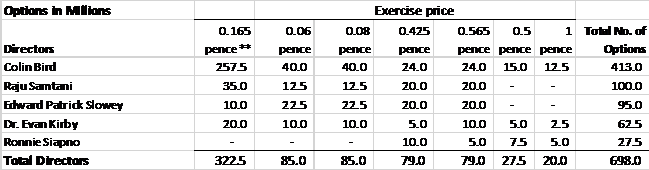
** 50% of the options will vest upon the breaking of ground at the Hope and Gorob mine site and the balance of 50% will vest upon the first sale of concentrate mine from the Hope and Gorob project
Report on directors' remuneration and service contracts
This report has been prepared in accordance with the requirements of Chapter 6 of Part 15 of the Companies Act 2006 and describes how the Board has applied the principles of good governance relating to Directors' remuneration set out in the QCA Corporate Governance Code.
Executive remuneration packages are prudently designed to attract, motivate and retain Directors of the necessary calibre and to reward them for enhancing value to shareholders. The performance measurement of the Executive Directors and key members of senior management and the determination of their annual remuneration packages is undertaken by the Remuneration Committee. The remuneration of Non-Executive Directors is determined by the Board within limits set out in the Articles of Association.
Executive Directors are entitled to accept appointments outside the Company providing the Board's permission is sought.
Aside from the Finance Director whose fees in 2025 were £40,000, the other Directors are entitled to receive between £12,000 and £18,000 per annum as Directors' Fees along with relevant Consulting Fees as applicable, with the aggregate of Salary, Directors' Fees and Consulting Fees detailed in the Directors' Remuneration Summary Table later in this report and in note 22.
Accordingly, given the development of the group's Hope and Gorob project it is likely that compensation packages for Executive Directors will need to move to a level more consistent with the market. Currently, Directors' remuneration is not subject to specific performance targets. The Company is sufficiently small that the Board does not consider that it is necessary to impose such targets as a matter of principle but believes that exceptional performance can be rewarded on an ad hoc basis.
Each Director is also paid all reasonable expenses incurred wholly, necessarily and exclusively in the proper performance of his duties.
The 2018 AGM approved a share option scheme which is to incentivise both Executive, non-Executive Directors, and consultants as well individuals holding positions of responsibility in the Company ("Share Option Scheme") on the following terms: (i) the number of options to be issued shall not exceed 10% of the issued share capital of the Company from time to time; (ii) the exercise price of the options shall be determined by the remuneration committee of the Board of directors of the Company based on the volume weighted average share price of the Company in the 30 days preceding the issue of the options; (iii) the allocation of the options shall be determined by the remuneration committee of the Board of Directors of the Company (iv) the options should vest in accordance with the terms of the Executive Share Option Scheme and (v) the options should be exercised by 21 June 2028. Details of the share options awarded to directors are in the preceding table of Directors' Options.
The 2024 Annual General Meeting approved revisions to the Company's incentive schemes The primary changes relate to the Annual Incentive Schemes so as to more closely align the annual incentive awards with the interest of shareholders which is primarily increases in the Company's share price (the "Revised Incentive Schemes"). The Revised Incentive Schemes put in place new short-term, annual and transaction incentive awards payable in cash and/or Company shares to align the interest of directors, officers, employees and consultants with those of shareholders. These awards are not intended to replace the Company's share option scheme and shall continue until the Board of the Company have put an alternative incentive scheme to the Company's shareholders which the Company's shareholders have approved. No awards have to date been made or proposed under the Revised Incentive Scheme. Eligible participants of the Revised Incentive Schemes are Directors, officers, employees and consultants of the Bezant Resources Plc group ("Eligible Participants"). Eligible Participants, who are good leavers, may continue to be eligible for awards for up to 12 months from their resignation or retirement. The remuneration committee of the Company will make awards to Eligible Participants to reward, retain and recruit Eligible Participants and reward performances against performance measures determined by the remuneration committee. A member of the remuneration committee will not participate in the determining of their own award. The remuneration committee will in determining awards take into account that it is the Company's remuneration policy to, seek where possible, to remunerate and incentivize Eligible Participants on the basis of lower base fees and on the basis that they will also be remunerated by participation in the Company's Incentive Schemes and in the case of non-executive directors be mindful of the potential effect towards objectivity and director independence that may result from significant performance linked awards. The remuneration committee will in making awards determine appropriate key performance indicators for the Eligible Participant to meet ("Award Triggers").
The Revised Incentive Schemes included short term awards to Eligible Participants with direct involvement in meeting short term operational targets for example production, project or exploration targets and annual incentive awards: The annual incentive awards will be awarded to Eligible Participants with a minimum of 80% of their awards being related to Company performance and the balance related to individual key performance indicators determined by the remuneration committee. The foregoing percentages are so as to more closely align the annual incentive awards with the interest of shareholders which is primarily increases in the Company's share price. Eligible Participants annual incentive award based on the Company performance will be based on improvements in the Company's share price in the preceding 12 month period ("Company Share Price Increase"). Following shareholder approval an annual Company Share Price Increase measure was introduced with effect from 30 June 2024. The base share price for the Company Share Price Increase was 0.04826 pence per share for the initial year being the higher of i) the VWAP for June 2024 and ii) the highest calendar monthly VWAP during the 12 months to 30 June 2024 in both cases multiplied by 120% (the "Initial Base Share Price"). In the second and subsequent years the Company Share Price Increase will be "high water marked" by the Base Share Price for the relevant year being the higher of i) the Initial Base Share Price and ii) the highest Year End Share Price (as defined below) for each previous year since the Initial Year multiplied by 120%. The year end share price for each year will be the 30 day VWAP in the last month of the 12 month period (the "Year End Share Price"). The participation rate in the Company Share Price Increase above the Base Share Price for the applicable year will be 5% (the "Participation Rate"). In the year ended 30 June 2025 there was no awards made under the Annual Incentive Awards,
Awards may, at the determination of the Board being mindful of the Company's cash position and working capital requirements, be paid in cash and / or Company shares and if in Company shares based on the 30-day VWAP following announcement of the Company's latest interim or final results prior to the award. Awards of Company shares to Directors and PDMRs in respect of their Annual Incentive Awards may, at the determination of the Board, be subject to a minimum holding period of up to 3 months and will in any 12 month period be in aggregate less than 5% of the issued share capital of the Company.
The Board considers the remuneration of Directors and senior staff and their employment terms and makes recommendations to the Board of Directors on the overall remuneration packages. No Director takes part in any decision directly affecting their own remuneration.
There has been no correspondence to date from shareholders relating to Directors' remuneration matters and therefore no such matters have been considered by the Board in formulating the Company's remuneration policy.
Pensions
The Group does not operate a pension scheme and has not paid any contributions to any pension scheme for Directors or employees.
Directors' remuneration during the year
Remuneration of the Directors for the years ended 31 December 2025 and 2024 was as follows:
2025 | |||||
Directors' Fees |
Salary and Consulting Fees | Totalcash paid year ended | Share based payment - share options | Totalcash and share based | |
£ | £ | £ | £ | £ | |
|
| ||||
C. Bird (note 1) | 12,000 | 48,000 | 60,000 | - | 60,000 |
E. Kirby | 13,665 | - | 13,665 | - | 13,665 |
R. Siapno | 12,000 | - | 12,000 | - | 12,000 |
R. Samtani (note 1) | 40,000 | - | 40,000 | - | 40,000 |
E. Slowey | 18,000 | 14,400 | 32,400 | - | 32,400 |
|
| ||||
Total | 95,665 | 62,400 | 158,065 | - | 158,065 |
Notes:
1. Mr Bird and Mr Samtani's Directors' fees include employee's NIC and UK payroll tax.
2024 | |||||
Directors' Fees |
Salary and Consulting Fees | Totalcash paid year ended | Share based payment - share options | Totalcash and share based | |
£ | £ | £ | £ | £ | |
|
| ||||
C. Bird (note 1) | 12,000 | 48,000 | 60,000 | 9,506 | 69,506 |
E. Kirby | 14,039 | - | 14,039 | 2,377 | 16,416 |
R. Siapno | 12,000 | - | 12,000 | - | 12,000 |
R. Samtani (note 1) | 40,000 | - | 40,000 | 2,971 | 42,971 |
E. Slowey | 18,000 | 15,300 | 33,300 | 5,347 | 38,647 |
|
| ||||
Total | 96,039 | 63,300 | 159,339 | 20,201 | 179,540 |
Notes:
1.Mr Bird and Mr Samtani's Directors' fees include employee's NIC and UK payroll tax.
2. Note 18 to the accounts provides information on Share-based payments.
An amount of £15,000 was paid during 2025 (2024: £15,000) to Lion Mining Finance Limited, a company controlled by C. Bird, for administration services and use of an office.
Environment, Health, Safety and Social Responsibility Policy Statement
The Company adheres to the above Policy, whereby all operations are conducted in a manner that protects the environment, the health and safety of employees, third parties and the entire local communities in general.
The Company is currently principally involved in exploration and development projects, located within, Namibia, Zambia and Botswana having sold its interest in the Eureka project in Argentina during the year and at the year-end had an equity investment in a project in the Philippines via its Blackstone Minerals shareholding.
During the period in Namibia the Company was awarded an Environmental Clearance Certificates (ECC) in relation to Mining Licence 246 in Exploration licence 5796.
During the year, current operations were closely managed in order to maintain our policy aims, with no matters of concern arising. There have been no convictions in relation to breaches of any applicable legislation recorded against the Group during the year.
Substantial & Significant Shareholdings
The Company has been notified, in accordance with DTR 5 of the FCA's Disclosure Guidance and Transparency Rules, or is aware, of the following interests in its ordinary shares as at YY June 2026 of those shareholders with a 3% and above equity holding in the Company based on the Company having 22,338,672,557 ordinary shares in issue on 25 June 2026 ("25 June 2026 Shares in Issue").
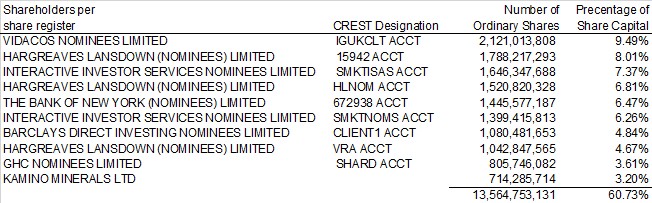
On 26 June 2025 Breamline Pty Ltd a company controlled by Christian Cordier submitted a TR-1 notification to the Company that it has an indirect interest in 791,406,503 ordinary shares in relation to the following shareholdings of companies which Christian Cordier has an interest in Tonehill Pty Ltd acting for the ("aft") The Tonehill Trust 255,538,825 shares, Coreks Super Pty Ltd aft Coreks Superannuation Fund 151,163,350 shares and Breamline Pty Ltd aft Breamline Ministries 348,704,328 shares. Mr Cordier's interest represented 3.54% at the date of issue of the TR-1 and based on the 25 June 2026 Shares in Issue
On 27 February 2025 the Company announced that Sanderson Capital Partners Ltd had confirmed that they and associates as at that date were interested in 761,469,231 shares which represents 3.41% of the 25 June 2026 Shares in Issue.
Political and charitable contributions
There were no political or charitable contributions made by the Group during the year ended 31 December 2025 (2024: nil).
Information to Shareholders - Website
The Company has its own website (www.bezantresources.com) for the purposes of improving information flow to shareholders, as well as to potential investors.
Statement of Directors' responsibilities
The Directors are responsible for preparing the financial statements in accordance with applicable laws and UK adopted International Accounting Standards. Company law requires the Directors to prepare financial statements for each financial year which give a true and fair view of the state of affairs of the Group and of the Company and of the profit or loss of the Group for that year.
In preparing those financial statements, the Directors are required to:
- select suitable accounting policies and then apply them consistently;
- make judgements and estimates that are reasonable and prudent;
- state whether applicable accounting standards have been followed, subject to any material departures disclosed and explained in the financial statements; and
- prepare the financial statements on a going concern basis, unless it is inappropriate to presume that the Group will continue in business.
The Directors confirm that the financial statements comply with the above requirements.
The Directors are responsible for keeping adequate accounting records which at any time disclose with reasonable accuracy the financial position of the Company (and the Group) and enable them to ensure that the financial statements comply with the Companies Act 2006. The Directors are also responsible for safeguarding the assets of the Company (and the Group) and for taking steps for the prevention and detection of fraud and other irregularities.
In addition, they are responsible for the maintenance and integrity of the corporate and financial information included on the Company's website.
Statement of disclosure to auditor
So far as all the Directors, at the time of approval of their report, are aware:
- there is no relevant audit information of which the Company's auditors are unaware, and
- the Directors have taken all steps that they ought to have taken as Directors in order to make themselves aware of any relevant audit information and to establish that the Company's auditors are aware of that information.
Auditors
UHY Hacker Young have expressed their willingness to continue as the auditors of the Company, and in accordance with section 489 of the Companies Act 2006, a resolution to re-appoint them will be proposed at the Company's forthcoming Annual General Meeting.
Principal risks and uncertainties
The Group has identified the following risks to the ongoing success of the business and has taken various steps to mitigate these, the details of which in relation to its Continuing Operations are as follows:
Risk that mining operations have not yet commenced
The Group's ability to meet any production, timing and cost estimates for its properties cannot be assured. The Group does not currently have any mining operations but during the period was issued a mining licence in relation to the Hope and Gorob copper gold project in Namibia (the "Hope and Gorob Project") and acquired a 90% shareholding in Namib Lead and Zinc Mining (Proprietary) Limited ("NLZM") details of which are set out at note 11.2
which owns an ore processing plant (the "NLZM Processing Plant") to be used for the processing of preconcentrate from the Hope and Gorb mine.
Development and operating risks
Actual cash operating costs, production and economic returns in financial models which the Company uses to plan its activities may differ significantly from those anticipated by studies and estimates. There are a number of uncertainties inherent in the development of any mining project which are relevant to the Hope and Gorob Project. NLZM Processing Plant upgrades and modifications and the development of the Hope and Gorob Project into full mining operations involves a number of risks and hazards associated with mining operations, including mining and industrial accidents, metallurgical and other processing problems, unusual or unexpected geological conditions, equipment failure, labour disputes, environmental hazards, changes in the regulatory environment, and weather and other acts of nature such as earthquakes and floods. These risks may result in: damage to, or destruction of, the Group's properties or production facilities; personal injury or death; environmental damage; delays in mining; increased production costs; asset write downs; monetary losses; and legal liability.
Infrastructure risks
The Hope and Gorob Project is located in a remote area with limited infrastructure. Constructing and operating a mine in such a location will pose logistical challenges, including access to skilled labour, materials and services. The NLZM Plant, is situated in a more accessible area, which mitigates these risks in relation to the NLZM Plant but they still exist. The necessary repairs, modifications and optimisation of the NLZM Processing Plant depends to a significant degree on adequate infrastructure. In the course of developing the Project the Company will need to construct and support the construction of infrastructure, at the Hope and Gorob Project site and the NLZM Processing Plant site which includes but is not limited to water supplies, power, transport and logistics services which affect capital and operating costs. Unusual or infrequent weather phenomena, sabotage, government or other interference in the maintenance or provision of such infrastructure or any failure or unavailability in such infrastructure could materially adversely affect the Company's operations, at the Hope and Gorob Project and at the NLZM Processing Plant.
In future, the Group may experience higher costs and lower revenues than estimated due to unexpected problems
Mining operations can experience unexpected problems during the life of the mine which may result from events of nature, unexpected geological features or mechanical issues that can result in substantial disruption to operations. Such disruption could increase operating costs, delay revenue growth and have implications for the working capital requirements of the business.
Reliance on third parties
The Company is reliant on third party service providers and suppliers to provide equipment, infrastructure and upgrades to the NLZM Processing Plant and the development of the mining operations at the Hope and Gorob site including offering jobs to the locals. Although the Company believes that by acquiring the NLZM Processing Plant these risks are being reduced and that skilled labour will be available in the NLZM Plant location area, there can be no assurance that such parties will be able to provide such services in the time scale and at the cost anticipated by the Company.
Reliance on key personnel and management
The Company's success raising the required capital to finance the refurbishment of the NLZM Processing Plant and the development of the Hope and Gorob Project to create a successful mining operation and thus revenue generation, is substantially dependent on the expertise and continued services of its directors, employees and consultants and the ability of the Company to recruit an in-country management team, The loss of the services of any such persons / inability to recruit personnel could have a material adverse effect on the Company's ability to develop the Hope and Gorob Project. The Company cannot guarantee the retention of its directors, employees and consultants nor that it will be able to continue to attract and retain such employees, and failure to do so could have a material adverse effect on the operations of the Company at the Project.
Requirement for regulatory approvals, permits, permits and government support
The construction and operation of mining projects, production facilities and/or infrastructure will require regulatory approvals, permits and permits to operate, and in some circumstances government financial support. Even with careful planning and verification, it is possible that not all necessary permits or permits for the construction and operation of mining projects, production facilities and/or infrastructure will be obtained. Each of the Company's Projects is also subject to the risk that a particular permit or licence is altered, withdrawn or expires and cannot be extended, which can lead to suspension, delay, or restriction in operations. In addition, relevant authorities may impose conditions on the commencement or duration of the operation of mining projects, production facilities and/or infrastructure. This may delay or restrict the operation of the plants, facilities and/or infrastructure and/or increase the costs of operation. Furthermore, governments over time may change their level of financial support for mining projects, production facilities and/or infrastructure. As a result, these may have a material adverse effect on the Company's profitability and the price of the Ordinary Shares.
Risks relating to health and safety
The physical location, construction, maintenance, and operation of the Projects may pose health and safety risks to those involved or in the vicinity of the Projects. Construction and maintenance of a Project may result in bodily injury, industrial accidents, and even death. If an accident were to occur, the relevant Project could be liable for damages or compensation to the extent such loss is not covered under existing insurance policies. Health and safety concerns and/or accidents could result in the suspension (either temporary or long-term) of operations of a Project which will reduce the revenue of the Company from that Project. Liability for damages or compensation in relation to accidents and/or suspension of operations could have a material adverse effect on the Company's profitability and/or the price of the Ordinary Shares.
Loss of critical processes
The Group's future mining, processing, development and exploration activities depend on the continuous availability of the Group's operational infrastructure, in addition to reliable utilities and water supplies and access to roads.
Any failure or unavailability of operational infrastructure, for example, through equipment failure or disruption, could adversely affect future production output and/or impact exploration and development activities. The group would seek to mitigate this risk by ensuring that access to operational infrastructure is included in any pre mining feasibility studies.
Geological and other risks
Geological risk factors and adverse market conditions could cause actual results to materially deviate from estimated future production and revenue. Failure to achieve production or cost estimates or material increases in costs could have an adverse impact on the future business, cash flows, profitability, results of operations and financial condition. While steps, such as production and mining planning are in place to limit these risks, occurrences of such incidents do exist and should be noted.
Furthermore, the business of mining is subject to a variety of risks such as actual production and costs varying from estimated future production, cash costs and capital costs; revisions to mine plans; risks and hazards associated with mining; natural phenomena; unexpected labour shortages or strikes; delays in permitting and licensing processes; and the timely completion of expansion projects, including land acquisitions required for the expansion of operations from time to time. Geological grade and product value estimations are based on independent resource calculations, studies and historical sales records.
The Group seeks to mitigate these risks in relation to exploration and mine planning activities by using the geological and mining expertise of Board members to oversee and plan exploration and mine planning activities and by engaging the services of reputable external geologists, mine engineering and other experts with appropriate skills and experience to provide exploration and mine planning services for the Group.
Licensing and title risk
Governmental approvals, licences and permits are, as a practical matter, subject to the discretion of the applicable governments or government offices. The Group must generally and specifically in relation to future projects comply with known standards, existing laws and regulations that may entail greater or lesser costs and delays depending on the nature of the activity to be permitted and the interpretation of the laws and regulations by the permitting authorities.
New laws and regulations, amendments to existing laws and regulations, or more stringent enforcement could have a material adverse impact on the Group's result of operations and financial condition. The Group's exploration and mining activities are dependent upon the grant of appropriate licences, concessions, leases, permits and regulatory consents which may be withdrawn or made subject to limitation.
There is a risk that negotiations with the relevant government in relation to the renewal or extension of a licence may not result in the renewal or grant taking effect prior to the expiry of the previous licence and there can be no assurance as to the terms of any extension, renewal or grant. This is a risk that all resource companies are subject to, particularly when their assets are in emerging markets. The Group continually seeks to do everything within its control to ensure that the terms of each licence are met and adhered to.
Economic, political, judicial, administrative, taxation or other regulatory factors
The Group's assets are located in Namibia, Zambia and Botswana and it has an equity investment in a project in the Philippines held via an Australian company and mineral exploration and mining activities may be affected to varying degrees by political stability and government regulations relating to the mining industry.
The Group is exposed to sovereignty risks relating to potential changes of local Governments and possible subsequent changes in jurisdiction concerning the maintenance or renewal of licences and the equity position permitted to be held in the Company's subsidiaries, which the group seeks to mitigate by working with local advisors and / or partners familiar with the local regulatory environment.
Government regulation and political risk related to Namibia
Although Namibia is considered to be stable democracy and the Company's operating activities are subject to laws and regulations governing expropriation of property, health and worker safety, employment standards, waste disposal, protection of the environment, mine development, land and water use, prospecting, mineral production, exports, taxes, labour standards, occupational health standards, toxic wastes, the protection of endangered and protected species and other matters, there are risks relating to changes in mining policy, taxation, ownership requirements or royalties in particular given Namibia has significant dependence on mining for export revenue and thus may adjust its fiscal regime in future.
While the Company believes that the Hope and Gorob Project and the NLZM Processing Plant currently comply with all material current laws and regulations affecting its activities, future changes in applicable laws, regulations, agreements or changes in their enforcement or regulatory interpretation could result in changes in legal requirements or in the terms of existing permits and agreements applicable to the Group, which could have a material adverse impact.
Water, electricity and seasonal weather risks in Namibia
Much of Namibia is arid or semi‑arid and hence water is scarce. Large volumes of waters will be required for the mining operations for open‑pit mining and processing. The remote location of the Hope and Gorob Project means arrangements will need to be made for the water and electricity to be supplied for the mining operation at the Project side and any problems with making such adequate arrangements might delay the commencement of operations. Additionally, the seasonality of weather means that there can be heavy rainfall or seasonal storms that can cause pit flooding, erosion or landslides at open pit mining. Furthermore, rainy season may create flash floods or other conditions which worsen road conditions, which in turn would cause delay with transportation of preconcentrate from the Hope and Goro Project to the NLZM Processing Plant for processing.
Environmental regulation risks in Namibia
Whilst the Company has been awarded the required Environmental Clearance Certificate ("ECC") for its Hope and Gorob Project and NLZM has an ECC which covers the NLZM Processing Plant these are subject to periodic renewals.
In the future environmental and safety legislation (e.g. in relation to reclamation, disposal of waste products, protection of wildlife and otherwise relating to environmental protection) may change in a manner that may require stricter or additional standards than those now in effect, a heightened degree of responsibility for companies and their directors and/or employees and more stringent enforcement of existing laws and regulations. There may also be unforeseen environmental liabilities resulting from either the NLZM Processing Plant optimisation or future mining activities at the Hope and Gorob project site, which may be costly to remedy. If the Company is unable to fully remedy an environmental problem, it may be required to stop or suspend operations at the Project or enter into interim
compliance measures pending completion of the required remedy. The potential exposure may be significant and could have a material adverse effect on the Company. The Company has not purchased insurance for environmental risks (including potential liability for pollution or other hazards as a result of the disposal of waste products occurring from exploration and production) as it is not generally available at a price which the Company regards as reasonably proportionate to the risk.
In Namibia there is not a requirement to post a mine closure rehabilitation bond but it is good practice to provide for this cost in a mine owning company's financial statements and in the NLZM audited accounts for the year ended 31 December 2025 there is an aggregate decommissioning and rehabilitation provision of NAD 5.9M (GBP 264K) for the closure of the NLZM mine. If the NLZM mine is closed and / or if the NLZM mining licence is not renewed then NLZM will be liable to pay mine closure rehabilitation costs the amount of which will depend on the condition of the mine and prevailing environmental and other regulations at the date of closure.
Currency risk
The Group reports its financial results and maintains its accounts in Pounds Sterling, the currency in which the Group primarily operates. The Group's operations in Namibia, Botswana and Argentina and an equity investment in a project in the Philippines held via an Australian company make it subject to foreign currency fluctuations and such fluctuations may materially affect the Group's financial position and results (see note 16). The Group does not have any currency hedges in place and is exposed to foreign currency movements but seeks to mitigate this risk by converting funds from Pounds Sterling to other currencies when making material commitments in other currencies.
Copper-gold price volatility
The Group's operations and any future revenue is significantly affected by changes in realisable copper-gold prices. The price of copper-gold is denominated in US$ and can fluctuate widely and is affected by numerous factors beyond the Group's control, including demand, inflation and expectations with respect to the rate of inflation, the strength of the US$ and of other currencies, interest rates, global or regional political or financial events, and production and cost levels. The Group does not have any commodity price hedges in place as it is not mining and does not produce any copper and its investment in exploration projects are exposed to fluctuations in the prices of underlying commodities.
Competition
The Group competes with numerous other companies and individuals, in the search for and acquisition of exploration and development rights on attractive mineral properties and also in relation to the future marketing and sale of precious metals. There is no assurance that the Group will continue to be able to compete successfully with its competitors in acquiring exploration and development rights on such properties and also in relation to the future marketing and sale of precious metals.
Future funding requirements
As referred to in note 1.1 of these financial statements, the Group made a profit from all operations for the year ended 31 December 2025 after tax of £2,002,000 after a fair value adjustment gain of £2,224,000 (see note 11.1) (2024 - loss of £1,015,000 after a fair value adjustment loss of £157,000 .
The Group had negative cash flows from operations and is currently not generating revenues. Cash and cash equivalents were £430,000 as at 31 December 2025. Post the year end on 31 March 2026 the Company announced a £2,070,000 fundraise and on 11 June 2026 a US$7 million (approx. £5.2 million) secured prepayment facility and offtake agreement with Hartree Metals LLC and that the repayment date for the £700,000 drawdown under the Sanderson Capital Facility Agreement had been extended to 30 September 2027. The Company has post the year end sold the Blackstone Minerals shares held at the year-end for net proceeds of £1.2 million and has been developing the Hope and Gorb mine and modifying and upgrading the NLZM Processing Plant with a target of commencing operations in Q3 2026. Therefore in the year subsequent to the date of these accounts the Company may need to raise funding to provide additional working capital to finance its ongoing activities. Management has successfully raised money in the past, but there is no guarantee that adequate funds will be available when needed in the future.
Impact of War in Ukraine
The Directors are aware of the war in Ukraine and related sanctions and there is no direct impact on the Company as it has no assets or business activities or suppliers with links in Ukraine or Russia and is not aware of any persons sanctioned in relation to the Ukraine conflict owning shares in the Company. An indirect impact of the conflict in Ukraine is the effect that the conflict and sanctions have had on energy and other prices and this and the economic effects of the war in Ukraine may have an effect on the Company's costs. The Company seeks to mitigate this risk by obtaining quotes for and agreeing on material expenditure commitments in advance of engaging services so costs are known in advance but is not in a position to reduce inflation.
Impact of Iran War
The Directors consider as a result of the war in Iran and ongoing middle east conflict and related sanctions there is no immediate impact on the Company as it has no assets or business activities or suppliers with links to Iran and is not aware of any persons sanctioned in relation to Iran owning shares in the Company. The Company is monitoring the position given the uncertainty of the impact of the war in Iran on the supply of oil, gas and other resources from the Middle East and the effect this may have on supply chains, inflation and macro-economic factors.
Going Concern
As disclosed in Note 1.1 to the accounts based on the Board's assessment that the Company will be able to raise additional funds and sell Blackstone Mineral shares held at the year end to meet its working capital and capital expenditure requirements, the Board have concluded that they have a reasonable expectation that the Group can continue in operational existence for the foreseeable future. For these reasons, the Group continues to adopt the going concern basis in preparing the annual report and financial statements.
There is a material uncertainty related to the conditions as disclosed in Note 1.1 that may cast significant doubt on the Group's ability to continue as a going concern and therefore the Group may be unable to realise its assets and discharge its liabilities in the normal course of business.
The financial report does not include any adjustments relating to the recoverability and classification of recorded asset amounts or liabilities that might be necessary should the entity not continue as a going concern.
Post Balance Sheet events
Subsequent events are disclosed in note 28 to the Accounts and summarised below:
On 11 March 2027 the Company announced the signing of an exclusive mining and logistics services agreement between the companies 70% owned Namibian subsidiary Hope and Gorob Mining Pty Limited and Unitrans Namibia Pty Limited; services to be provided include drilling, blasting and secondary breaking of ore and waste, loading and hauling, road maintenance, short-term mine planning for the Hope and Gorob mine site and material handling at the NLZM Processing Plant. These services will form a substantial part of the Hope and Gorob project operating costs.
On 24 March 2026 the Company announced the purchase by the group from MKH Tangible Investments CC of an additional 20% shareholding in Hope and Gorob Mining Pty Limited it's 70% owned Namibian registered subsidiary the holder of the Hope and Gorob Project and the settlement of any remaining obligations due to MKH Tangible Investments CC under the original 2018 agreement between MKH Tangible Investments CC and the previous owner of the Hope and Gorob Project for £1,114,000 of which £557,000 was settled in cash and £557,000 by the issue of shares in the Company.
On 31 March 2026 the Company announced a fundraising of £2,070,000 at 0.065 pence per Ordinary Share ( the "Fundraising Price") and the issue of shares to settle accrued fees of £7,166 at the Fundraising Price.
On 11 June 2026 the Company announced a US$7 million (approx. £5.2 million) secured prepayment facility and offtake agreement with Hartree Metals LLC and that the repayment date for the £700,000 drawdown under the Sanderson Capital Facility Agreement had been extended to 30 September 2027.
Post the year end through to 19 June 2025 the Company has announced the exercise of 1,201,115,385 warrants which have been exercised for in aggregate £723K - note 28 to the Accounts.
Relations with Shareholders
The Company plan to hold an Annual General Meeting in late July or August 2026 and the wording of each resolution to be tabled will be set out in a formal Notice of Annual General Meeting to be sent to shareholders.
Shareholders who are unable to attend the Annual General Meeting and who wish to appoint a proxy in their place must ensure that their proxy is appointed in accordance with the provisions set out in the Notice of Annual General Meeting.
On behalf of the Board
Mr Colin Bird
Executive Chairman
30 June 2026
Corporate GovernanceFor the year ended 31 December 2025
________________________________________________________________________
As an AIM-traded company, Bezant Resources PLC ("Bezant" or the "Company") and its subsidiaries are required to apply a recognised corporate governance code and demonstrate how the Group complies with such corporate governance code and where it departs from it.
The Directors of the Company have formally taken the decision to adopt the QCA Corporate Governance Code (2023) (the "QCA Code"). The Board recognises the principles of the QCA Code, which focus on the creation of medium to long-term value for shareholders without stifling the entrepreneurial spirit in which small to medium sized companies, such as Bezant, have been created. The Company is committed to providing annual updates on its compliance with the QCA Code further details of which are set out below.
QCA Corporate Governance Statement
The Company is committed to good corporate governance and has adopted the corporate governance guidelines of the Quoted Companies Alliance (QCA).
Principle 1: Establish a purpose, strategy and business model which promotes long-term value for shareholders
The Group's strategy is to build a diversified portfolio of high-potential mineral assets across southern Africa by advancing exploration and development projects with a focus on copper and gold assets, with the aim of creating long-term value through resource discovery, licensing optimisation, and project advancement toward commercial production.
We plan to achieve this through:
• Expertise and Experience
Leveraging the extensive mining experience and deep local knowledge of our directors and team of seasoned professionals.
• Uncovering Opportunities
Our wealth of experience enables us to identify exploration projects with significant potential. We also through the engagement of experienced mining consultants will apply appropriate mining technologies and processing techniques to our Hope and Gorob mining project which is under development, and other tools that seek to maximise returns
• A Commitment to Ethical Standards
We are dedicated to establishing ourselves as trustworthy business partners for our in country project partners, suppliers and for the communities at the Company's projects and to strictly adhere to ethical exploration and mining practices, ensuring fair treatment of workers, responsible sourcing, and minimal environmental impact. Our commitment to ethical standards is integral to every aspect of our operations.
• Strategic Decision-Making
We adopt a disciplined approach to project development, evaluating whether to proceed with further development or to divest at opportune stages to maximize shareholder value. Our decisions are guided by a commitment to enhancing returns, ensuring long term value and minimising risk.
Risk factors relating to the Group are set out in the Company's Directors' report which forms part of the Annual Report and include but are not limited to; the risk that mining operations have not yet commenced, development and operating risks, infrastructure risks, reliance on third parties, and key personnel and management, the requirement for regulatory approvals permits and government support, risks relating to health and safety, risk of loss of critical processes, geological and other risks, licencing title risks, government regulation and political risks related to Namibia, project specific infrastructure risks, environmental regulation risks, currency risk, copper gold price volatility, and prior to the commencement of operations financing risks. The Company's risk factors are reviewed and updated by the Finance Director and the wider board annually.
Principle 2: Promote a corporate culture that is based on ethical values and behaviours
The Company aims to operate ethically and be socially responsible in its actions. It has established a number of policies to support this aim, including:
• Anti-bribery
• Modern slavery and human trafficking policy
• Share dealing code
• Whistleblowing policy
• Social Media policy
The Company policies are regularly reviewed and updated (if applicable) to ensure they are still fit for purpose.
Principle 3: Seek to understand and meet shareholder needs and expectations
The Company is committed to building and maintaining strong relationships with all of its share-holders.
The Company disseminates news on significant developments and regular operational updates in stock exchange announcements via the Regulatory News Service (RNS). These are also available on the website which also contains project information and AIM Rule 26 disclosure for existing and potential shareholders
https://www.bezantresources.com/announcements.
The Company's Annual General Meeting (AGM) is the main forum for discussing matters with shareholders, addressing their queries, and understanding their needs and expectations. The Company holds its AGM (and other General Meetings) at a convenient time and location, normally in Central London, to ensure shareholders have every chance to attend. The company also attends investor and sector specific in-person events, through media outreach/interviews.
Principle 4: Take into account wider stakeholder interests, including social and environmental responsibilities, and their implications for long-term success
The Company also shares key progress updates with staff and releases public announcements via the RNS service.
The Directors believe they have acted in the way most likely to promote the success of the Company for the benefit of its members as a whole. Including:
• Considering the likely consequences of any decision in the long term;
• Acting fairly between members of the Company;
• Maintaining a reputation for high standards of business conduct;
• Considering the interest of the Company's employees;
• Fostering the Company's relationships with suppliers, and others;
• Considering the consequences of any actions taken on the Company's relationship with its partners;
• Considering the impact of the Company's operations on the community and the environment.
The Company seeks to act in a way that upholds these principles and the Strategic Report in the Company's Annual Reports provides a table summarizing how the group engages with key stakeholders.
The Company is committed to operating its mining and exploration activities in a responsible, ethical, and sustainable manner. While the Company is still in the development stage of its mining operations, ESG considerations are incorporated into all strategic and operational decisions as part of our long-term value creation plan.
The Company acknowledges the environmental sensitivity of exploration and mining. The Company strives to:
• Minimise environmental impact through responsible land use and rehabilitation planning;
• Monitor water and waste management at its project sites;
• Ensure that future energy sourcing decisions incorporate efficiency and sustainability considerations.
Principle 5: Embed effective risk management, internal controls and assurance activities, considering both opportunities and threats, throughout the organisation
The Board has identified what it believes to be a sensible and robust approach to opportunity and risk management for a Company of our size. Risks are managed throughout the Group with reviews at functional, operational and Board level.
Maintaining and evolving mechanisms for internal controls is a continuous process both within the Company and at Board level. Assurance activities, including external reviews are conducted on a regular basis. The Company receives feedback from our external auditors on the state of our risk management and internal controls.
The Board is responsible for establishing and maintaining the Group's system of internal control. Internal control systems manage rather than eliminate the risks to which the Group is exposed and such systems, by their nature, can provide reasonable but not absolute assurance against misstatement or loss. There is a continuous process for identifying, evaluating and managing the significant risks faced by the Group. The key procedures which the Directors have established with a view to providing effective internal control, are as follows:
¨ Identification and control of business risks
The Board identifies the major business risks faced by the Group and determines the appropriate course of action to manage those risks.
¨ Budgets and business plans
Each year the Board approves the business plan and annual budget. Performance is monitored and relevant action taken throughout the year through the regular reporting to the Board of changes to the business forecasts.
¨ Investment appraisal
Capital expenditure is controlled by budgetary process and authorisation levels. For expenditure beyond specified levels, detailed written proposals have to be submitted to the Board. Appropriate due diligence work is carried out if a business or asset is to be acquired.
¨ Annual review and assessment
In 2018, the Board conducted a detailed review and assessment of the effectiveness of the Group's strategy, a process that is maintained on an ongoing basis.
Principle 6: Establish and maintain the board as a well-functioning, balanced team led by the chair
The Board comprises (for the time being) five Directors of which three are executive and two are non-executives, reflecting a blend of different experience and backgrounds. The Board considers Dr. Evan Kirby and Ronnie Siapno to be independent non-executives in terms of the QCA guidelines notwithstanding the period they have been in office given they do not have significant shareholdings in the Company. The Company's Chief Executive Officer is Colin Bird who is also Chairman of the Board.
The Board is responsible for determining policy and business strategy, setting financial and other performance objectives and monitoring achievement. It meets throughout the year and all major decisions are taken by the full Board by way of meetings and circular resolutions approved by all Board members.
The Chairman is also the Chief Executive Officer and takes responsibility for the conduct of the Company and Board meetings and ensures that directors are properly briefed to enable full and constructive discussions to take place. The Group's day-to-day operations are managed by the Executive Director Colin Bird as assisted by the Group Company Secretary in respect of corporate matters generally, compliance and company administration. All Directors have access to the Company's Solicitors, along with the Group Company Secretary and any Director needing independent professional advice in the furtherance of his/her duties may obtain this advice at the expense of the Group. However, no formal procedure has been agreed with the Board regarding the circumstances in which individual directors may take independent professional advice.
The QCA Code Principle 6 states that the role of Chair and chief Executive Officer should be separate. Given the stage of the Company's early-stage exploration mining projects and the experience of the Chair Mr. Bird in managing such international exploration mining projects and his familiarity with the Company's projects the Company believes that it is appropriate for the roles of Chairman and Chief Executive Officer to be combined at this stage. The Company will keep this under review as the Company's projects develop with a view to splitting the roles when it is clear which projects will become the principal activities of the Company and can justify the need for and benefit from a separate CEO. The Company will therefore consider making further appropriate appointments to the Board as and when considered appropriate.
The Company will keep this under review as the Company's projects develop with a view to splitting the roles when it is clear which projects will become the principal activities of the Company and can justify the need for and benefit from a separate CEO. The Company will therefore consider making further appropriate appointments to the Board as and when considered appropriate.
The Board is satisfied that it has a suitable balance between independence on the one hand, and knowledge of the Company on the other, to enable it to discharge its duties and responsibilities effectively, and that all Directors have adequate time to fulfil their roles.
Details of the current Directors, biographical details are set out in the Board of Directors section of the Annual Report and on the Company's website at www.bezantresources.com. The role of the Chairman is to provide leadership of the Board and ensure its effectiveness on all aspects of its remit to maintain control of the Group. In addition, the Chairman is responsible for the implementation and practice of sound corporate governance.
Under the Company's Articles of Association, the appointment of all new Directors must be approved by shareholders in a general meeting. In addition, one third of Directors are required to retire and to submit themselves for re-election at each Annual General Meeting accordingly, contrary to the QCA Code principle 6 not all Directors will submit themselves for re-election at the Company's AGM.
The Board has established two committees comprising Non-Executive Directors and Executive Directors.
The current composition of the committees is as follows:
Audit | Remuneration |
Dr. Evan Kirby (Chairman) | Dr. Evan Kirby (Chairman) |
Raju Samtani | Ronnie Siapno |
Colin Bird |
The Audit Committee
The audit committee receives reports from management and the external auditors relating to the interim report and the annual report and financial statements, reviews reporting requirements and ensures that the maintenance of accounting systems and controls is effective.
The audit committee has unrestricted access to the Company's auditors. The audit committee also monitors the controls which are in force and any perceived gaps in the control environment.
The Board believes that the current size of the Group does not justify the establishment of an independent internal audit department.
The Audit Committee meets twice during the year to review the published financial information, the effectiveness of external audit and internal financial controls including the specific matters set out below.
Significant issues considered by the Audit Committee during the year have been the Principal Risks and Uncertainties and their effect on the financial statements. The Audit Committee tracked the Principal Risks and Uncertainties through the year and kept in contact with the Group's Management, External Service Providers and Advisers. The Audit Committee is satisfied that there has been appropriate focus and challenge on the high-risk areas.
Remuneration Committee
The Remuneration Committee determines the scale and structure of the remuneration of the executive Directors and approves the granting of options to Directors and senior employees and the performance related conditions thereof. The Remuneration Committee also recommends to the Board a framework for rewarding senior management, including Executive Directors, bearing in mind the need to attract and retain individuals of the highest calibre and with the appropriate experience to make a significant contribution to the Group and ensures that the elements of the remuneration package are competitive and help in underpinning the performance-driven culture of the Group.
The Company does not currently have a separate Nominations Committee, with the entire Board involved in the identification and approval of Board members which the Board considers to be appropriate given the Company's size and nature, but it will continue to monitor the situation as it grows. The QCA Code Principle 6 states that there should be a nomination committee to deal with the appointment of both executive and non-executive Directors except in circumstances where the Board is small. The Directors consider the size of the current Board to be small and have not therefore established a separate nomination committee. The appointment of executive and non-executive Directors is currently a matter for the Board as a whole. This position will be reviewed should the number of directors increase.
The Director's report in the Annual Report includes a report on directors' remuneration and service contracts and includes details of the share option scheme approved at the 2018 AGM ("Share Option Scheme") and the revised incentive schemes approved at the 2024 AGM ("Revised Incentive Schemes"). All the directors are eligible participants in the Share Option Scheme and the Revised Incentive Schemes
The Revised Incentive Scheme approval included a statement that the remuneration committee of the Company will make awards to Eligible Participants to reward, retain and recruit Eligible Participants and reward performances against performance measures determined by the remuneration committee. A member of the remuneration committee will not participate in the determining of their own award. The remuneration committee will in determining awards take into account that it is the Company's remuneration policy to, seek where possible, to remunerate and incentivize Eligible Participants on the basis of lower base fees and on the basis that they will also be remunerated by participation in the Company's Incentive Schemes and in the case of non-executive directors be mindful of the potential effect towards objectivity and director independence that may result from performance linked awards.
Principle 7: Maintain appropriate governance structures and ensure that individually and collectively the directors have the necessary up-to-date experience, skills and capabilities
All the current directors are considered to provide a diverse range of appropriate skills and experience. The Company provides, or will provide, adequate support and training to ensure that the Directors remain appropriately skilled and able to fulfil their duties to the required standard, and regularly assesses the board composition and will look to recruit in further skillsets as and when that may be required.
The corporate governance section of our Annual Report also details the roles and responsibilities of the Board of Directors. These are drawn from a range of backgrounds, enabling decision-making which draws upon extensive and varied experiences.
The appropriateness of the Board's structures and processes will, when appropriate, be reviewed through a formal Board evaluation and effectiveness process led by the Chairman together with other Directors, and these will evolve in parallel with the Company's objectives, strategy, business model and our governance framework.
Principle 8: Evaluate board performance based on clear and relevant objectives, seeking continuous improvement
However, given the current size and nature of the Company, the Board does not consider it appropriate, at this time, to have a formal performance evaluation procedure in place, as described and recommended in QCA Code Principle 7.
The Board will closely monitor this situation as the Company grows.
Principle 9: Establish a remuneration policy which is supportive of long-term value creation and the company's purpose, strategy and culture
Our Annual Report outlines the approach of our Remuneration Committee and policies.
Principle 10: Communicate how the company is governed and is performing by maintaining a dialogue with shareholders and other relevant stakeholders
The Company communicates with shareholders and other stakeholders through its Annual and Interim Reports, regulatory and non-regulatory announcements, its website, Annual General Meetings and face-to-face meetings. More detail has been provided in Principle 1 above.
Going concern
As referred to in note 1.1 of these financial statements, the Group made a profit from all operations for the year ended 31 December 2025 after tax of £2,002,000 after a fair value adjustment gain of £2,784,000 (see note 11.1) (2024 - loss of £1,015,000 after a fair value adjustment loss of £157,000). The Group had negative cash flows from operations and is currently not generating revenues. Cash and cash equivalents were £430,000 as at 31 December 2025. Post the year end on 31 March 2026 the Company announced a £2,070,000 fundraise and on 11 June 2026 a US$7 million (approx. £5.2 million) secured prepayment facility and offtake agreement with Hartree Metals LLC and that the repayment date for the £700,000 drawdown under the Sanderson Capital Facility Agreement had been extended to 30 September 2027. The Company has post the year end sold the Blackstone Minerals shares held at the year-end for net proceeds of £1.2 million and has been developing the Hope and Gorb mine and modifying and upgrading the NLZM Processing Plant with a target of commencing operations in Q3 2026. Therefore in the year subsequent to the date of these accounts and the Company may need to raise funding to provide additional working capital to finance its ongoing activities. Management has successfully raised money in the past, but there is no guarantee that adequate funds will be available when needed in the future.
Based on the Board's assessment that the Company will be able to raise additional funds, and also being able to sell Blackstone Mineral shares as and when required, to meet its working capital and capital expenditure requirements, the Board have concluded that they have a reasonable expectation that the Group can continue in operational existence for the foreseeable future. For these reasons, the Group continues to adopt the going concern basis in preparing the annual report and financial statements.
There is a material uncertainty related to the conditions above that may cast significant doubt on the Group's ability to continue as a going concern and therefore the Group may be unable to realise its assets and discharge its liabilities in the normal course of business.
The financial report does not include any adjustments relating to the recoverability and classification of recorded asset amounts or liabilities that might be necessary should the entity not continue as a going concern.
Dr. Evan Kirby
Non-Executive Director
30 June 2026
INDEPENDENT AUDITOR'S REPORT
TO THE MEMBERS OF BEZANT RESOURCES PLC
FOR THE YEAR ENDED 31 DECEMBER 2025
Opinion
We have audited the financial statements of Bezant Resources Plc (the 'Company') and its subsidiaries (the 'Group') for the year ended 31 December 2025 which comprise the Consolidated Statement of Profit and Loss, the Consolidated Statement of Other Comprehensive Income, the Consolidated and Company Statements of Changes in Equity, the Consolidated and Company Balance Sheets, the Consolidated and Company Statements of Cash Flows and notes to the financial statements, including significant accounting policies. The financial reporting framework that has been applied in the preparation of the group's and company's financial statements is applicable law and UK adopted International Accounting Standards.
In our opinion:
· the financial statements give a true and fair view of the state of the Group's and Company's affairs as at 31 December 2025 and of the Group's profit for the year then ended;
· the financial statements have been properly prepared in accordance with UK adopted International Accounting Standards; and
· the financial statements have been prepared in accordance with the requirements of the Companies Act 2006.
Basis for opinion
We conducted our audit in accordance with International Standards on Auditing (UK) (ISAs (UK)) and applicable law. Our responsibilities under those standards are further described in the Auditor's responsibilities for the audit of the financial statements section of our report. We are independent of the Group and Company in accordance with the ethical requirements that are relevant to our audit of the financial statements in the UK, including the FRC's Ethical Standard as applied to listed entities, and we have fulfilled our other ethical responsibilities in accordance with these requirements. We believe that the audit evidence we have obtained is sufficient and appropriate to provide a basis for our opinion.
Material uncertainty relating to going concern
We draw attention to the Going Concern section of the Accounting Policies of the Group financial statements (note 1.1) concerning the Group's and Company's ability to continue as a going concern. The Group incurred an operating loss of £774,000 during the year ended 31 December 2025 (2024: £778,000) and is still incurring operating losses. As discussed in note 1.1, post year-end on 31 March 2026 the Company announced a £2,070,000 fundraise and on 11 June 2026 a US$7 million secured prepayment facility and offtake agreement with Hartree Metals LLC. In addition, the repayment date for the £700,000 drawdown under the Sanderson Capital Facility Agreement has been extended to 30 September 2027. However, the Group's ability to continue as a going concern is dependent on the successful progression of the Hope & Gorob project, including the achievement of key development and commissioning milestones. Furthermore, the Group may require additional funding to support its ongoing activities. These conditions, along with other matters discussed in the Principal Accounting Policies indicate the existence of a material uncertainty which may cast significant doubt about the Group's and Company's ability to continue as a going concern.
Our opinion is not modified in respect of this matter.
In auditing the financial statements, we have concluded that the director's use of going concern basis of accounting in the preparation of the financial statements is appropriate. Our evaluation of the director's assessment of the entity's ability to continue to adopt the going concern basis of accounting included an assessment of the risk and audit procedures to address this risk:
The risk
The group currently does not generate any revenue and remains reliant on external funding and existing financing arrangements to support its activities, including the development of its mining projects and corporate overheads.
While funding has been secured post year-end, the Group's ability to continue as a going concern is dependent on available cash resources and the effective management of cash flows to meet obligations as they fall due over the 12 months from the date of approval of the financial statements.
Given the above factors, we consider going concern to be a significant audit risk area.
The directors' conclusion of the risks and circumstances described in the Going Concern section of the Principal Accounting Policies of the Group financial statements represent a material uncertainty over the ability of the Group and Company to continue as a going concern for a period of at least a year from the date of approval of the financial statements. However, clear and full disclosure of the facts and the directors' rationale for the use of the going concern basis of preparation, including that there is a related material uncertainty, is a key financial statement disclosure and so was the focus of our audit in this area. Auditing standards require that to be reported as a key audit matter.
How our audit addressed the key audit matter
Our audit procedures included:
· We assessed the transparency, completeness and accuracy of the matters covered in the going concern disclosure by evaluating management's cash flow projections for the next twelve months and the underlying assumptions.
· We obtained cash flow forecasts, reviewed the methodology behind these, ensured they were arithmetically correct and challenged the assumptions.
· We compared the prior year forecast against actuals to determine accuracy of forecasts prepared.
· We performed a sensitivity analysis for an increase in costs to consider the impact of inflation and other unforeseen additional costs being incurred.
· We reviewed post year-end funding arrangements, including the US$7 million secured prepayment facility and offtake agreement with Hartree Metals LLC, and assessing their impact on the Group's liquidity and ability to meet obligations over the next twelve months; and
· We discussed plans for the Group going forward with management, ensuring these had been incorporated in the budgeting and would not have an impact on the Going Concern status of the Group.
Key observations:
The Group is pre-revenue and remains reliant on external funding to support operations. While post year-end funding has been secured, the Group may require ongoing funding until the Hope and Gorob mining projects, planned for Q3 2026, becomes cashflow positive. The Group has been able to raise funds in the past, however, there is no guarantee that adequate funds will be available when needed in the future.
Our responsibilities and the responsibilities of the directors with respect to going concern are described in the relevant sections of this report.
Our approach to the audit
As part of designing our audit, we determined materiality and assessed the risks of material misstatement in the financial statements. In particular, we looked at where the directors made subjective judgements, for example in respect of impairment reviews on exploration assets that involved making assumptions and considering future events that are inherently uncertain.
We tailored the scope of our audit to ensure we performed enough work to be able to give an opinion on the financial statements as a whole, taking into account an understanding of the structure of the Company and the Group, their activities, the accounting processes and controls, and the industry in which they operate. Our planned audit testing was directed accordingly and was focused on areas where we assessed there to be the highest risk of material misstatement.
Our Group audit scope includes all Group companies. At the Company level, we also tested the consolidation procedures. During the audit, we reassessed and re-evaluated audit risks and tailored our approach accordingly.
The audit testing included substantive testing on significant transactions, balances and disclosures, the extent of which was based on various factors such as our overall assessment of the control environment, the effectiveness of controls and the management of specific risks.
We communicate with those charged with governance regarding, among other matters, the planned scope and timing of the audit and significant findings that we identified during the course of the audit.
Key Audit Matters
Key audit matters are those matters that, in our professional judgment, were of most significance in our audit of the financial statements of the current period and include the most significant assessed risks of material misstatement (whether or not due to fraud) we identified, including those which had the greatest effect on the overall audit strategy, the allocation of resources in the audit; and directing the efforts of the engagement team.
These matters were addressed in the context of our audit of the financial statements as a whole, and in forming our opinion thereon, and we do not provide a separate opinion on these matters. This is not a complete list of all risks identified during our audit. Going concern is a significant key audit matter and is described above. In arriving at our audit opinion above, the other key audit matters were as follows:
Key audit matter | How the matter was addressed during the audit
|
Impairment of exploration and evaluation assets and classification of development assets in the Group
The Group has capitalised costs in respect of the Group's licence interests in accordance with IFRS 6 'Exploration for and Evaluation of Mineral Resources' (IFRS 6).
The Directors are required to assess exploration and evaluation (E&E) assets for indicators of impairment and, where such indicators exist, to perform an impairment review. This assessment involves significant judgement and estimation, including consideration of licence status, future work programmes, funding availability and the commercial prospects of each project.
In addition, judgement is required in determining when E&E assets should be reclassified to development assets, which occurs when technical feasibility and commercial viability of extracting a mineral resource are demonstrable. The reclassification of the Namibia assets during the year represents a significant transaction and judgement area.
We therefore identified the impairment of E&E assets and classification of development assets as a key audit matter, due to the level of judgement involved and the potential impact on the financial statements. | Our audit work included, but was not restricted to:
· Obtaining each of the licences along with supporting information available for each exploration project to assess whether the licenses remain in good standing. · Discussing each of the licence areas with the directors and considered their assessment in conjunction with the available information for each exploration project and reviewed available information to assess whether the licences remain in good standing; · Reviewing the future plans of the projects in respect of funding, viability and development to assess whether there were any indicators of impairment; · Vouching a sample of additions to supporting document and assessing whether they meet the recognition criteria under IFRS 6; and · Evaluating management's determination that technical feasibility and commercial viability have been achieved in respect of the Hope & Gorob project in Namibia, including reviewing feasibility studies and financing arrangements. · Reviewed correspondence for licenses for which renewal applications had not yet been granted to determine the status of the renewal as well as whether there were any indicators that renewal will be granted · Reviewed The Mining Acts of relevant countries to confirm work could be continued whilst renewals were in progress
Key observations We obtained evidence that the licences remain valid and are in good standing.
There were no significant matters identified which indicated the licences would not be renewed.
We found that the reclassification of the Namibia assets from exploration and evaluation to development assets was appropriate, as management has demonstrated technical feasibility and commercial viability through completed feasibility studies, secured funding and offtake arrangements, and obtaining the necessary licences and approvals.
The remaining E&E assets at the year-end relate to the Kanye Manganese project in Botswana. No indicators of impairment were identified and accordingly no impairment provisions were considered necessary. |
Impairment of investments and intercompany loans in the Parent Company and investments held at FVPL in the Group and Parent Company
Under International Accounting Standard 36 'Impairment of Assets', companies are required to assess whether there is any indication that an asset may be impaired at each reporting date.
Management assessment involves significant judgements and assumptions such as the timing and extent and probability of future cash flow.
The Company has investments of £9.1m (2024: £6.4m) comprising investments and loans to subsidiaries of £7.5m (2024: £4.4m) and investments held at FVPL of £1.6m (2024: £2.0m). The Group has investments held at FVPL of £1.6m (2024: £2.1m). In conjunction with the exploration assets, the investments represent the primary balance on the Company balance sheet and there is a risk it could be impaired and that intragroup loans may not be recoverable as a result of the subsidiary companies incurring losses.
We therefore identified the impairment of loans due from subsidiary companies as a key audit matter in the Company financial statements, which was one of the most significant assessed risks of material misstatement.
| Our audit work included, but was not limited to:
· Reviewing the investments balances for indicators of impairment in accordance with IAS 36; · Assessing the appropriateness of the methodology applied by management in their assessment of the recoverable amount of intragroup loans by comparing it to the Group's accounting policy and IAS 36; · Evaluating management's assessment of recoverability by reference to the net asset position and underlying value of subsidiaries and their projects; · Reconciling intercompany loan balances and agreeing amounts between entities; · Reviewing the accounting treatment of the exchange of IDM International shares for Blackstone Minerals shares, including assessment of fair value; and · Testing proceeds and fair value calculations for partial disposals of IDM International and Blackstone Minerals shares during the year.
Key observations The investment in subsidiaries and intercompany loan balances correlates with the Hope Copper Gold Project, and Kanye Manganese Project held by subsidiaries. Our impairment review was therefore linked to our assessment of indicators of impairment on the corresponding exploration and development assets.
Our procedures did not identify any indicators of impairment in respect of investments in subsidiaries or intercompany loan balances, and we consider management's conclusion that no impairment is required to be reasonable.
We noted that the Group's equity investments changed during the year following the exchange of IDM International shares for shares in Blackstone Minerals Limited. We verified the transaction, confirmed that the resulting investments are appropriately classified and measured at fair value through profit or loss, and tested partial disposals of IDM International and Blackstone Minerals shares during the year, noting no issues with the proceeds received or the fair value calculations applied.
Overall, we found that the carrying value of investments and intercompany loans is supported, and no impairment provisions were required.
|
Impairment assessment of mining assets, plant & equipment and development assets The Group holds significant assets relating to its Namibia operations, including a processing plant of £1,573k, other plant and equipment of £498k, and mine development assets of £3,952k. These assets form part of an integrated mining and processing project and are assessed together as a single cash-generating unit (CGU) given their operational interdependency.
During the year, indicators of impairment were identified under IAS 36. These include a change in ownership and strategy following the acquisition of Namib Lead and Zinc Mining ("NLZM") for it's processing plant and the planned modifications to the processing plant to accommodate different ore types, and the inherent uncertainty associated with development-stage mining projects.
Given the materiality of the assets and the significant estimation uncertainty involved, we considered the impairment assessment of mining property, plant & equipment and development assets to be a key audit matter. | Our audit work included, but was not limited to: · Evaluating management's identification of the CGU, including assessing whether the mining and processing assets are appropriately treated as a single integrated unit; · Reviewing management's impairment model to assess compliance with IAS 36 and testing the mathematical accuracy of the discounted cash flow model; · Challenging key assumptions used in the valuation, including commodity prices, mineral resource estimates and life of mine assumptions, production plans, throughput and recovery assumptions, operating and capital budgets, and discount rate. · Assessing the sensitivity of the discounted cash flow forecast prepared by management to evaluate the impact of reasonably possible changes in key assumptions, including commodity prices, discount rates, costs and resource assumptions; · Assessing whether indicators of impairment and the conclusions reached by management are consistent with external and internal evidence, including project progress, funding arrangements and regulatory approvals; and · Evaluating the adequacy of disclosures in the financial statements relating to impairment assessments, key judgments, assumptions and sensitivities. Key observations Based on the audit procedures performed, we found that management's conclusion that no impairment is required is reasonable. The value in use of the cash-generating unit exceeded its carrying amount under both the base case and reasonably possible downside scenarios, indicating that sufficient headroom exists. In addition, we observed that the Group's mining licence remains valid through to 2040 and key regulatory approvals are in place. Furthermore, post year-end the Group has secured project funding of $7m and entered into a binding offtake agreement for 100% of production, which supports the assumptions underpinning future cash flows and the progression of the project to production.
However, we noted that the impairment assessment is subject to significant estimation uncertainty. In particular:
· The valuation is highly sensitive to commodity price assumptions, particularly copper, which represents the majority of forecast revenues; · The model includes a proportion of inferred mineral resources, which carry a lower level of geological confidence and introduce uncertainty into the life of mine and production assumptions; · The valuation is sensitive to changes in the discount rate, with reasonably possible increases resulting in a reduction in headroom; and · Future cash flows are dependent on the successful execution of project development activities, including planned modifications to the processing plant and delivery of forecast production and cost assumptions. Overall, whilst no impairment has been recognised, the valuation remains sensitive to reasonably possible changes in key assumptions, and these areas represent significant sources of estimation uncertainty. |
Acquisition of Namib Lead and Zinc (Proprietary) Limited
During the year, the Group acquired, through its wholly owned subsidiary NZLM Holdings Ltd, a 90% interest in Namib Lead and Zinc (Proprietary) Limited ("NLZM"). The acquisition was undertaken to secure the processing plant, which is intended to be modified and utilised for processing ore from the Hope & Gorob project in Namibia.
The accounting for this transaction requires significant judgement, particularly in determining whether the acquisition constitutes a business combination under IFRS 3 or an asset acquisition.
Judgement is also required in allocating the purchase consideration of £2.1m to the identifiable assets and liabilities acquired.
Given the materiality of the transaction and the significant judgement involved in both classification and measurement, we identified this as a key audit matter. | Our audit work included, but was not limited to: · Reviewing the Sale and Purchase Agreement (SPA) to understand the structure and commercial substance of the transaction and assess whether it meets the definition of a business combination under IFRS 3 or an asset acquisition; · Evaluating whether the acquired set included substantive processes, outputs, and workforce, and assessing management's application of the concentration test; · Vouching the consideration payable under the SPA and assessing the nature of any royalty arrangements, including whether these represent contingent consideration or future operating costs; · Assessing management's judgements in recognising and measuring the consideration transferred; and · Reviewing the recognition, measurement and classification of the assets and liabilities acquired to assess whether these have been appropriately accounted for in line with the identified transaction type.
Key observations We found that management's conclusion to account for the transaction as an asset acquisition is appropriate. A concentration test was performed, which demonstrated that substantially all of the fair value of the gross assets acquired is concentrated in a single identifiable asset or group of similar identifiable assets, being the processing plant and related mining assets.
We also agreed that, at the acquisition date, NLZM did not include substantive processes, workforce or outputs, supporting classification as an asset acquisition.
Accordingly, the transaction has been appropriately recognised as an asset acquisition, and the allocation of consideration to the identifiable assets and liabilities is reasonable and in line with the requirements of IFRS. |
Valuation and accounting treatment of convertible loan facility
The Company and Group has a convertible loan instrument of £615k (2024: £616k). The loan terms were modified during the year.
Convertible instruments can be complex, containing a number of features which can have a significant impact on the accounting. Therefore, management were to determine the correct treatment for the modification.
We therefore identified the valuation and accounting treatment of the convertible loan as a key audit matter in the Company and Group financial statements. | Our audit work included, but was not limited to: · Obtaining and reviewing the convertible loan agreement and loan amendment for key terms which determine the accounting treatment; · Evaluated the appropriateness of the accounting treatment under IFRS 9 Financial Instruments and IAS 32 Presentation of Financial Instruments; · Assessed the key assumptions used to determine the fair value of the liability and equity component.
Key observations Management determined that the modified facility was in accordance with IFRS 9 substantially different from the original facility and therefore the original financial liability was extinguished, and a new financial liability recognised.
The convertible loan comprises a liability and equity component. The fair value of the equity component has been calculated at 25% being the estimated rate available on an unsecured loan with no convertible option. |
Our application of materiality
The scope and focus of our audit was influenced by our assessment and application of materiality. We apply the concept of materiality both in planning and performing our audit, and in evaluating the effect of misstatements on our audit and on the financial statements.
We define financial statement materiality as the magnitude by which misstatements, including omissions, could reasonably be expected to influence the economic decisions taken on the basis of the financial statements by reasonable users.
In order to reduce to an appropriately low level the probability that any misstatements exceed materiality, we use a lower materiality level, performance materiality, to determine the extent of testing needed. Importantly, misstatements below these levels will not necessarily be evaluated as immaterial as we also take account of the nature of identified misstatements, and the particular circumstances of their occurrence, when evaluating their effect on the financial statements as a whole.
Materiality Measure | Group | Parent | |
Overall materiality We determined materiality for the financial statements as a whole to be: | £170,000 (2024: £102,000)
| £170,000 (2024: £102,000) | |
How we determine it | Based on the main key indicator, being 2% of the net assets of the Group
| Based on the main key indicator, being 2% of the net assets of the Company. | |
Rationale for benchmarks applied | We believe the net assets is the most appropriate benchmark due to the size and stage of development of the Company and Group. This is further supported by the Group not yet generating any revenue.
| ||
Performance materiality
| Group: £127,500 (2024: £76,000), Parent: £127,500 (2024: £76,000) On the basis of our risk assessment, together with our assessment of the Group's control environment, our judgment is that performance materiality for the financial statements should be 75% of materiality. | ||
Specific materiality | We also determine a lower level of specific materiality for certain areas such as directors' remuneration and related party transactions of £2,000 (2024: £2,000) as these are considered to be material by nature.
| ||
Reporting threshold
| We agreed with the Audit Committee that we would report to them all misstatements over 5% of Group materiality identified during the audit, as well as differences below that threshold that, in our view, warrant reporting on qualitative grounds. We also report to the Audit Committee on disclosure matters that we identified when assessing the overall presentation of the financial statements. | ||
Other information
The other information comprises the information included in the annual report other than the financial statements and our auditors' report thereon. The directors are responsible for the other information contained within the annual report. Our opinion on the financial statements does not cover the other information and, except to the extent otherwise explicitly stated in our report, we do not express any form of assurance conclusion thereon.
Our responsibility is to read the other information and, in doing so, consider whether the other information is materially inconsistent with the financial statements or our knowledge obtained in the course of the audit, or otherwise appears to be materially misstated. If we identify such material inconsistencies or apparent material misstatements, we are required to determine whether this gives rise to a material misstatement in the financial statements themselves.
If, based on the work we have performed, we conclude that there is a material misstatement of this other information, we are required to report that fact.
We have nothing to report in this regard.
Opinions on other matters prescribed by the Companies Act 2006
In our opinion, based on the work undertaken in the course of the audit:
· the information given in the strategic report and the directors' report for the financial year for which the financial statements are prepared is consistent with the financial statements; and
· the strategic report and the directors' report have been prepared in accordance with applicable legal requirements.
Matters on which we are required to report by exception
In the light of the knowledge and understanding of the Group and Company and its environment obtained in the course of the audit, we have not identified material misstatements in the strategic report or the directors' report.
We have nothing to report in respect of the following matters in relation to which the Companies Act 2006 requires us to report to you if, in our opinion:
· adequate accounting records have not been kept by the Company, or returns adequate for our audit have not been received from branches not visited by us; or
· the Company financial statements are not in agreement with the accounting records and returns; or
· certain disclosures of directors' remuneration specified by law are not made; or
· we have not received all the information and explanations we require for our audit.
Responsibilities of directors
As explained more fully in the statement of directors' responsibilities, set out on page 19, the directors are responsible for the preparation of the financial statements and for being satisfied that they give a true and fair view, and for such internal control as the directors determine is necessary to enable the preparation of financial statements that are free from material misstatement, whether due to fraud or error.
In preparing the financial statements, the directors are responsible for assessing the Group's and the Company's ability to continue as a going concern, disclosing, as applicable, matters related to going concern and using the going concern basis of accounting unless the directors either intend to liquidate the Group or Company or to cease operations, or have no realistic alternative but to do so.
Auditor's responsibilities for the audit of the financial statements
Our objectives are to obtain reasonable assurance about whether the financial statements as a whole are free from material misstatement, whether due to fraud or error, and to issue an auditor's report that includes our opinion.
Reasonable assurance is a high level of assurance, but is not a guarantee that an audit conducted in accordance with ISAs (UK) will always detect a material misstatement when it exists. Misstatements can arise from fraud or error and are considered material if, individually or in the aggregate, they could reasonably be expected to influence the economic decisions of users taken on the basis of these financial statements.
The extent to which our procedures are capable of detecting irregularities, including fraud is detailed below:
Based on our understanding of the Group and the industry in which it operates, we identified that the principal risks of non-compliance with laws and regulations related to exploration laws and regulations in the countries the Group operates, and company law and we considered the extent to which non-compliance might have a material effect on the financial statements. We also considered those laws and regulations that have a direct impact on the preparation of the financial statements such as the Companies Act 2006 and QCA code. We evaluated management's incentives and opportunities for fraudulent manipulation of the financial statements (including the risk of override of controls), and determined that the principal risks were related to overstatement of assets.
Audit procedures performed included: review of the financial statement disclosures to underlying supporting documentation, review of legal and professional expenditure, enquiries of management, and testing of journals and evaluating whether there was evidence of bias by the Directors that represented a risk of material misstatement due to fraud.
There are inherent limitations in the audit procedures described above and the further removed non-compliance with laws and regulations is from the events and transactions reflected in the financial statements, the less likely we would become aware of it. Also, the risk of not detecting a material misstatement due to fraud is higher than the risk of not detecting one resulting from error, as fraud may involve deliberate concealment by, for example, forgery or intentional misrepresentations, or through collusion.
A further description of our responsibilities for the audit of the financial statements is located on the Financial Reporting Council's website at www.frc.org.uk/auditorsresponsibilities. This description forms part of our auditor's report.
Use of our report
This report is made solely to the Company's members, as a body, in accordance with part 3 of Chapter 16 of the Companies Act 2006. Our audit work has been undertaken so that we might state to the Company's members those matters we are required to state to them in an auditor's report and for no other purpose. To the fullest extent permitted by law, we do not accept or assume responsibility to anyone other than the Company and the Company's members as a body, for our audit work, for this report, or for the opinions we have formed.
James Astley
(Senior Statutory Auditor)
For and on behalf of UHY Hacker Young
Chartered Accountants and Statutory Auditor
UHY Hacker Young
4 Thomas More Square
London E1W 1YW
30 June 2026
Consolidated Statement of Profit and Loss
For the year ended 31 December 2025
| Notes | Year ended 31 December 2025 £'000 |
Year ended 31 December 2024 £'000 | |||
|
|
|
|
| ||
CONTINUING OPERATIONS | ||||||
Group revenue | - | - | ||||
Cost of sales | - | - | ||||
| ||||||
Gross profit/(loss) | - | - | ||||
| ||||||
Operating expenses | 3 | (774) | (725) | |||
Share based payments | 3 | - | (53) | |||
Operating loss | 4 | (774) | (778) | |||
|
| |||||
Other gains/(losses) | 5 | 2,784 | (157) | |||
Finance Costs |
| (8) | (80) | |||
|
| |||||
Profit/(loss) before taxation | 2,002 | (1,015) | ||||
Taxation | 6 | - | - | |||
| ||||||
Profit/(loss) for the financial year |
|
| 2,002 |
| (1,015) | |
| ||||||
Attributable to: Owners of the Company | 2,002 | (1,015) | ||||
- Continuing operations | 1,442 | (928) | ||||
- Discontinued operations | 10 | 560 | (87) | |||
Non-controlling interest | - | - | ||||
| 2,002 | (1,015) | ||||
Earnings / (loss) per share (pence) |
| |||||
Basic earnings / (loss) per share from continuing operations | 7 | 0.0089 | (0.010) | |||
Diluted loss per share from continuing operations | 7 | 0.0064 | (0.010) | |||
Basic earnings / (loss) per share from discontinued operations | 7 | 0.0035 | (0.010) | |||
Diluted loss per share from discontinued operations | 7 | 0.0025 | (0.010) |
Consolidated Statement of Other Comprehensive Income
For the year ended 31 December 2025
|
| Year ended 31 December 2025 £'000 |
Year ended 31 December 2024 £'000 | |||
|
|
|
|
| ||
Other comprehensive income: |
| |||||
Profit /(Loss) for the financial year | 2,002 | (1,015) | ||||
Items that may be reclassified to profit or loss: |
| |||||
Foreign currency reserve movement | (328) | (155) | ||||
Non-controlling interest | - | - | ||||
Total comprehensive profit / (loss) for the financial year | 1,674 | (1,170) | ||||
| ||||||
Attributable to: Owners of the Company | 1,674 | (1,170) | ||||
- Continuing operations | 1,608 | (1,083) | ||||
- Discontinued operations | 66 | (87) | ||||
Non-controlling interest | - | - | ||||
| 1,674 | (1,170) | ||||
|
|
Consolidated Statement of Changes in Equity
For the year ended 31 December 2025
Share Capital £'000 | Share Premium £'000 | Other Reserves1 £'000 | Retained Losses £'000 | Total Equity £'000 | |
Year ended 31 December 2025 | |||||
Balance at 1 January 2025 | 2,224 | 41,663 | 3,659 | (42,447) | 5,099 |
Current year profit / (loss) | - | - | - | 2,002 | 2,002 |
Foreign currency reserve | - | - | (328) | - | (328) |
Total comprehensive loss for year | - | - | (328) | 2,002 | 1,674 |
Shares issued - In lieu of fees | 17 | 231 | - | - | 248 |
Share issue cost | - | (275) | - | - | (275) |
Proceeds from shares issued | 56 | 504 | - | - | 560 |
Warrants issued | - | - | 249 | - | 249 |
Warrants issued - Acquisition of NLZM | - | - | 175 | - | 175 |
Warrant exercised | 29 | 588 | (135) | 135 | 617 |
Warrant expired | - | - | (21) | 21 | - |
Equity component of new borrowings | - | - | 194 | - | 194 |
Extinguishment of equity component of borrowings | - | - | (192) | - | (192) |
|
|
|
|
| |
Balance at 31 December 2025 | 2,326 | 42,711 | 3,601 | (40,289) | 8,349 |
Share Capital £'000 | Share Premium £'000 | Other Reserves1 £'000 | Retained Losses £'000 | Total Equity £'000 | |
Year ended 31 December 2024 | |||||
Balance at 1 January 2024 | 2,205 | 41,431 | 4,127 | (41,788) | 5,975 |
Current year loss | - | - | - | (1,015) | (1,015) |
Foreign currency reserve | - | - | (155) | - | (155) |
Total comprehensive loss for year | - | - | (155) | (1,015) | (1,170) |
Shares issued - In lieu of fees | 4 | 47 | - | - | 51 |
Share issue cost | - | (50) | - | - | (50) |
Proceeds from shares issued | 15 | 235 | - | - | 250 |
Share options granted | - | - | 53 | - | 53 |
Warrant expired | - | - | (299) | 299 | - |
Options expired | - | - | (57) | 57 | - |
Equity component of new borrowings | - |
| 192 | - | 192 |
Extinguishment of equity component of borrowings | - | - | (202) | - | (202) |
|
|
|
|
| |
Balance at 31 December 2024 | 2,224 | 41,663 | 3,659 | (42,447) | 5,099 |
1 Other reserves are made up of the share-based payment, foreign exchange, merger and convertible instrument reserves.
Company Statement of Changes in Equity
For the year ended 31 December 2025
Share Capital £'000 | Share Premium £'000 | Other Reserves1 £'000 | Retained Losses £'000 | Total Equity £'000 | |
Year ended 31 December 2025 | |||||
Balance at 1 January 2025 | 2,224 | 41,663 | 3,339 | (41,804) | 5,422 |
Current year profit ( (loss) | - | - | - | 1,551 | 1,551 |
Total comprehensive loss for the year | - | - | - | 1,551 | 1,551 |
Shares issued - In lieu of fees | 17 | 231 | - | - | 248 |
Share issue cost | - | (275) | - | - | (275) |
Proceeds from shares issued | 56 | 504 | - | - | 560 |
Warrants issued | - | - | 249 | - | 249 |
Warrants issued acquisition of NLZM | - | - | 175 | - | 175 |
Warrants exercised | 29 | 588 | (135) | 135 | 617 |
Warrant expired | - | - | (21) | 21 | - |
Equity component of new borrowings | - |
| 194 | - | 194 |
Extinguishment of equity component of borrowings |
|
| (192) |
| (192) |
|
|
|
|
| |
Balance at 31 December 2025 | 2,326 | 42,711 | 3,609 | (40,097) | 8,549 |
Share Capital £'000 | Share Premium £'000 | Other Reserves1 £'000 | Retained Losses £'000 | Total Equity £'000 | |
Year ended 31 December 2024 | |||||
Balance at 1 January 2024 | 2,205 | 41,431 | 3,652 | (41,163) | 6,125 |
Current year loss | - | - | - | (997) | (997) |
Total comprehensive loss for the year | - | - | - | (997) | (997) |
Shares issued - In lieu of fees | 4 | 47 | - | - | 51 |
Share issue cost | - | (50) | - | - | (50) |
Proceeds from shares issued | 15 | 235 | - | - | 250 |
Share options granted | - | - | 53 | - | 53 |
Warrant expired | - | - | (299) | 299 | - |
Options expired | - | - | (57) | 57 | - |
Equity component of new borrowings | - |
| 192 | - | 192 |
Equity component of repaid borrowings | - | - | (202) | - | (202) |
|
|
|
|
| |
Balance at 31 December 2024 | 2,224 | 41,663 | 3,339 | (41,804) | 5,422 |
1 Other reserves are made up of the share-based payment, merger and convertible instrument reserves.
Consolidated and Company Balance Sheets
As at 31 December 2025
|
|
| Consolidated | Company | ||
|
|
|
|
| ||
|
|
| 2025 | 2024 | 2025 | 2024 |
| Notes |
| £'000 | £'000 | £'000 | £'000 |
ASSETS
|
|
|
|
| ||
Non-current assets |
|
| ||||
Processing plant | 14.1 | 1,768 | - | - | - | |
Plant and equipment | 14.2 | 578 | - | 18 | - | |
Mine Development | 13 | 3,952 | - | - | - | |
Investments | 11 | 1,606 | 1,993 | 9,161 | 6,440 | |
Exploration and evaluation assets | 12 | 1,232 | 4,192 | - | - | |
Total non-current assets |
|
| 9,136 | 6,185 | 9,179 | 6,440 |
|
|
|
|
| ||
Current assets |
|
|
|
| ||
Inventories | 11.2 |
| 55 | - | - | - |
Trade and other receivables | 15 |
| 76 | 56 | 52 | 42 |
Cash and cash equivalents |
|
| 430 | 88 | 394 | 85 |
|
|
| 561 | 144 | 446 | 127 |
Total current assets |
|
| 561 | 144 | 446 | 127 |
|
|
|
|
| ||
TOTAL ASSETS |
|
| 9,697 | 6,329 | 9,625 | 6,567 |
|
|
|
|
| ||
LIABILITIES |
|
|
|
| ||
Current liabilities |
|
|
|
| ||
Trade and other payables | 16 |
| 464 | 614 | 456 | 529 |
Borrowings | 17 |
| 620 | 616 | 620 | 616 |
Total current liabilities |
|
| 1,084 | 1,230 | 1,076 | 1,145 |
|
|
|
|
| ||
Non-current liabilities |
|
|
|
| ||
Provisions | 18 |
| 264 | - | - | - |
Total non-current liabilities |
|
| 264 | - | - | - |
|
|
|
|
| ||
TOTAL LIABILITIES |
|
| 1,348 | 1,230 | 1,076 | 1,145 |
NET ASSETS |
|
| 8,349 | 5,099 | 8,549 | 5,422 |
EQUITY |
|
|
|
| ||
Share capital | 20 |
| 2,326 | 2,224 | 2,326 | 2,224 |
Share premium | 20 |
| 42,711 | 41,663 | 42,711 | 41,663 |
Share-based payment reserve | 20 |
| 1,443 | 1,173 | 1,443 | 1,173 |
Foreign exchange reserve |
|
| 133 | 463 | 141 | 143 |
Merger reserve |
|
| 1,831 | 1,831 | 1,831 | 1,831 |
Other reserves | 17 |
| 194 | 192 | 194 | 192 |
Retained losses |
|
| (40,289) | (42,447) | (40,097) | (41,804) |
|
| 8,349 | 5,099 | 8,549 | 5,422 | |
TOTAL EQUITY |
|
| 8,349 | 5,099 | 8,549 | 5,422 |
In accordance with the provisions of Section 408 of the Companies Act 2006, the Parent Company has not presented a separate income statement. A profit for the year ended 31 December 2025 of £1,551,000 (2024 loss: £997,000) has been included in the consolidated income statement.
These financial statements were approved by the Board of Directors on 30 June 2026 and signed on its behalf by:
Mr Colin Bird Executive Chairman
Company Registration No. 02918391
Consolidated and Company Statements of Cash Flows
For the year ended 31 December 2025
|
| Consolidated | Company | ||
|
| Year ended 31 December 2025 | Year ended 31 December 2024
| Year ended 31 December 2025 | Year ended 31 December 2024
|
| Notes | £'000 | £'000 | £'000 | £'000 |
|
|
|
| ||
Net cash outflow from operating activities | 23 | (777) | (555) | (479) | (313) |
|
|
|
| ||
Cash flows from investing activities |
|
|
| ||
Exploration expenditure |
| (895) | (372) | - | - |
PPE additions |
| (22) | - | (19) | |
Loans to subsidiaries |
| - | - | (2,932) | (613) |
Payments to acquire subsidiary |
| (1,775) | - | - | - |
Proceeds from disposal of subsidiary |
| 119 | - | 46 | - |
Proceeds from sale of equity investments |
| 2,611 | 2,611 | ||
|
| 38 | (372) | (294) | (613) |
Cash flows from financing activities |
|
|
| ||
Proceeds from issuance of ordinary shares | 24 | 1,081 | 455 | 1,081 | 455 |
|
| 1,081 | 455 | 1,081 | 455 |
|
|
|
| ||
Increase / (decrease) in cash |
| 342 | (472) | 308 | (471) |
|
|
|
| ||
Cash and cash equivalents at beginning of year |
| 88 | 560 | 85 | 556 |
Foreign exchange movement |
| - | - | 1 | - |
|
|
| |||
Cash and cash equivalents at end of year |
| 430 | 88 | 394 | 85 |
Notes to the financial statements For the year ended 31 December 2025
Bezant Resources Plc (the "Company") is a company incorporated in England and Wales. The address of its registered office and principal place of business is disclosed in the corporate directory. The Company is quoted on the AIM Market ("AIM") of the London Stock Exchange and has the TIDM code of BZT. Information required by AIM Rule 26 is available in the section of the Group's website with that heading at www.bezantresources.com.
|
1. Accounting policies
1.1 | Accounting policies The principal accounting policies applied in the preparation of these financial statements are set out below. These policies have been consistently applied to all the years presented, unless otherwise stated below.
Going concern basis of accounting The Group made a profit from all operations for the year ended 31 December 2025 after tax of £2,002,000 and after a fair value adjustment gain of £2,784,000 (see note 11.1) (2024 - loss of £1,015,000 after a fair value adjustment loss of £157,000). The Group had negative cash flows from operations and is currently not generating revenues. Cash and cash equivalents were £430,000 as at 31 December 2025. Post the year end on 31 March 2026 the Company announced a £2,070,000 fundraise and on 11 June 2026 a US$7 million (approx. £5.2 million) secured prepayment facility and offtake agreement with Hartree Metals LLC and that the repayment date for the £700,000 drawdown under the Sanderson Capital Facility Agreement had been extended to 30 September 2027. The Company has post the year end sold the Blackstone Minerals shares held at the year end for net proceeds of £1.2 million and has been developing the Hope and Gorb mine and modifying and upgrading the NLZM Processing Plant with a target of commencing operations in Q3 2026. Therefore in the year subsequent to the date of these accounts the Company may need to raise funding to provide additional working capital to finance its ongoing activities. Management has successfully raised money in the past, but there is no guarantee that adequate funds will be available when needed in the future.
Based on the Board's assessment that the Company will be able to raise additional funds, to meet its working capital and capital expenditure requirements, the Board have concluded that they have a reasonable expectation that the Group can continue in operational existence for the foreseeable future. For these reasons the Group continues to adopt the going concern basis in preparing the annual report and financial statements.
There is a material uncertainty related to the conditions above that may cast significant doubt on the Group's ability to continue as a going concern and therefore the Group may be unable to realise its assets and discharge its liabilities in the normal course of business.
The financial report does not include any adjustments relating to the recoverability and classification of recorded asset amounts or liabilities that might be necessary should the entity not continue as a going concern.
Basis of preparation The financial information, which incorporates the financial information of the Company and its subsidiary undertakings (the "Group"), has been prepared using the historical cost convention and in accordance with UK adopted International Accounting Standards including IFRS 6 'Exploration for and Evaluation of Mineral Resources'.
|
| Basis of consolidation The consolidated financial statements incorporate the financial statements of the Company and its subsidiary undertakings and have been prepared using the principles of acquisition accounting, which includes the results of the subsidiaries from their dates of acquisition.
All intra-group transactions, income, expenses and balances are eliminated fully on consolidation.
A subsidiary undertaking is excluded from the consolidation where the interest in the subsidiary undertaking is held exclusively with a view to subsequent resale and the subsidiary undertaking has not previously been consolidated in the consolidated accounts prepared by the parent undertaking. |
1.1 | Accounting policies (continued)
Business combination (IFRS 3 - acquisition constituting a business) On acquisition, the assets and liabilities and contingent liabilities of a subsidiary are measured at their fair values at the date of acquisition. Any excess of the cost of acquisition over the fair values of the identifiable net assets acquired is recognised as goodwill. Any deficiency of the cost of acquisition below the fair values of the identifiable net assets acquired (i.e. discount on acquisition) is credited to profit and loss in the year of acquisition. The interest of non-controlling shareholders is stated at the minority's proportion of the fair values of the assets and liabilities recognised. Subsequently, any losses applicable to the non-controlling interest in excess of the non-controlling interest are allocated against the interests of the parent.
Asset acquisitions (IFRS 3 - acquisitions not constituting a business) When the Group acquires an interest in a company management assesses whether the transaction represents a business combination within the scope of IFRS 3 or an asset acquisition. Where the acquired set of activities and assets does not meet the definition of a business, the transaction is accounted for as an asset acquisition. In such cases: · The cost of the acquisition is measured as the fair value of consideration transferred, including directly attributable transaction costs. · The cost is allocated to the identifiable assets and liabilities acquired based on their relative fair values at the acquisition date. · No goodwill is recognised. · Deferred tax is generally not recognised on initial recognition of assets and liabilities if the recognition meets the initial recognition exemption under IAS 12. · Exploration and evaluation assets acquired are recognised in accordance with IFRS 6 Exploration for and Evaluation of Mineral Resources. · Where contingent consideration exists, it is recognised as part of the cost of the asset when payment is probable, based on past events and can be reliably measured. If the acquisition includes inputs and processes but does not include a substantive process capable of producing outputs, it is treated as an asset acquisition. |
| New IFRS standards and interpretations There are a number of standards, amendments to standards, and interpretations which have been issued by the IASB that are effective from 1 January 2025, none of which have a material impact on these financial statements.
There are a number of standards, amendments to standards, and interpretations which have been issued by the IASB that are effective in future accounting periods that the group has decided not to apply early.
• IAS 1 (Amendments) - Classification of Liabilities as Current or Non-current (effective date 1 January 2027 • IAS 7 and IFRS 7 (Amendments) - Supplier Finance Arrangements (effective date 1 January 2027) • IFRS 10 and IAS 28 (Amendments) - Sale or Contribution of Assets between an Investor and its Associate or Joint Venture (effective date deferred indefinitely) • IFRS 18 - Presentation and Disclosure in Financial Statements (effective 1 January 2027) • IFRS 19 - Subsidiaries without Public Accountability: Disclosures (effective date 1 January 2027)
Save for IFRS 18 which will affect how results are structured, classified and disclosed it is not expected that the amendments listed above, once adopted, will have a material impact on the financial statements.
The financial statements have been prepared in accordance with UK adopted International Accounting Standards ('IFRS') and those parts of the Companies Act 2006 applicable to companies reporting under IFRSs.
Company Statement of Comprehensive Income The Company has taken advantage of the exemption allowed under section 408 of the Companies Act 2006 and has not presented its own Statement of Comprehensive Income in these financial statements.
Mine and processing plant properties and plant and equipment Initial recognition of mine properties and plant and equipment. Upon completion of the mine construction phase, the assets are transferred into "Plant and equipment" or "Mine and processing plant properties". Items of plant and equipment and producing mine are stated at cost, less accumulated depreciation and accumulated impairment losses. The initial cost of an asset comprises its purchase price or construction cost, any costs directly attributable to bringing the asset into operation, the initial estimate of the decommissioning and rehabilitation obligation, and, for qualifying assets (where relevant), borrowing costs. The purchase price or construction cost is the aggregate amount paid and the fair value of any other consideration given to acquire the asset. The capitalised value of a finance lease is also included in plant and equipment.
Depreciation and amortisation, Depreciation is calculated to write off the cost of items of the assets less their estimated residual values using the straight-line method over their estimated useful lives, and is recognised in profit or loss. The average useful lives applied to the various categories of the assets are as follows:
An item of plant and equipment and any significant part initially recognised is derecognised upon disposal or when no future economic benefits are expected from its use or disposal. Any gain or loss arising on derecognition of the asset is included in statement of profit or loss and other comprehensive income when the asset is derecognised. The asset's residual values, useful lives and methods of depreciation are reviewed at each reporting period and adjusted prospectively, if appropriate. An asset's carrying amount is written down to its recoverable amount if the asset's carrying amount exceeds the higher of the asset's fair value less costs to sell or value in use
Repairs and maintenance are generally expensed when incurred. However, major repairs and renovations are capitalised and included in the carrying amount of the asset, when it is probable that future economic benefits associated with the item will flow to the entity. Major repairs and renovations are depreciated over the remaining life of the related asset. Refer to note 1.13 for the Company's policy in respect of exploration, evaluation and development expenditure.
Provisions Provisions are recognised when the Group has a present legal or constructive obligation as a result of past events, it is probable that an outflow of resources embodying economic benefits will be required to settle the obligation, and a reliable estimate of the amount can be made. Where these conditions are not met, no provision is recognised. Provisions are measured at the present value of management's best estimate of the expenditure required to settle the obligation at the reporting date. The measurement of provisions reflects, current estimates of the costs required to settle the obligation, risks and uncertainties surrounding the obligation; and where material, the time value of money using a pre-tax discount rate that reflects current market assessments.
The Group recognises a provision for the future costs of rehabilitation, restoration and decommissioning of mining sites and related facilities in the period in which the disturbance giving rise to the obligation occurs. The provision is calculated based on, estimated future costs of rehabilitation, timing of expenditure; and applicable discount and inflation rates. A corresponding asset is recognised as part of the carrying amount of the related mining asset within property, plant and equipment. This asset is depreciated over the estimated useful life of the mine or asset. Changes in the estimated liability arising from revisions to discount rates, timing or cost estimates are adjusted against the carrying amount of the related asset, or recognised in profit or loss where the asset has been fully depreciated.
|
Inventories
Inventories for a mining company comprise, ore stockpiles (including run-of-mine ore), work-in-progress, finished goods (refined metals or concentrates) and consumables and spare parts. Inventories are stated at the lower of cost and net realisable value. Net realisable value represents the estimated selling price in the ordinary course of business less estimated costs of completion and costs necessary to make the sale. The cost of inventories includes all costs incurred in bringing the inventories to their present location and condition, including, direct costs of extraction, including drilling, blasting and hauling, processing costs such as crushing, milling and refining, an allocation of direct and indirect production overheads and depreciation of mining and processing assets. Costs are determined using the weighted average cost method.
1.2 | Significant accounting judgments, estimates and assumptions |
The carrying amounts of certain assets and liabilities are often determined based on estimates and assumptions of future events. The key estimates and assumptions that have a significant risk of causing a material adjustment to the carrying amounts of certain assets and liabilities within the next annual reporting year are: |
Share-based payment transactions: | |
The Group measures the cost of equity-settled transactions with directors, consultants and employees by reference to the fair value of the equity instruments at the date at which they are granted. The fair value is determined by using a Black and Scholes model which takes into account expected share volatility, strike price, term of the option and the dividend policy. |
| Impairment of investments, options and deferred exploration expenditure: | ||
| The Group determines whether investments (including those acquired during the period), options and deferred exploration expenditure are impaired when indicators, based on facts and circumstances, suggest that the carrying amount may exceed its recoverable amount. Such indicators include the point at which a determination is made as to whether or not commercial mining reserves exist in the subsidiary or associate in which the investment is held or whether exploration expenditure capitalised is recoverable by way of future exploitation or sale, obviously pending completion of the exploration activities associated with any specific project in each segment.
|
| |
| Fair value of assets and liabilities acquired on acquisition of subsidiaries | ||
| The Group determines the fair value of assets and liabilities acquired on acquisition of subsidiaries by reference to the carrying value at the date of acquisition and by reference to exploration activities undertaken and/or information that the Directors become aware of post-acquisition (note 12).
Mine decommissioning and rehabilitation The ultimate decommissioning and rehabilitation costs are uncertain, and cost estimates can vary in response to many factors, including estimates of the extent and costs of decommissioning and rehabilitation activities, technological changes, regulatory changes, cost increases as compared to the inflation rates, and changes in discount rates. These uncertainties may result in future actual expenditure differing from the amounts currently provided. Therefore, significant estimates and assumptions are made in determining the provision for mine decommissioning and rehabilitation. As a result, there could be significant adjustments to the provisions established which would affect future financial result. The provision at reporting date represents management's best estimate of the present value of the future decommissioning and rehabilitation costs required. | ||
|
|
| |
1.2
|
Significant accounting judgments, estimates and assumptions
Investments at fair value through profit and loss ('Equity investments') Equity investments are initially measured at cost, including transaction costs. At each reporting date, the fair value is assessed and any resultant gains and losses are included directly in the Consolidated Statement of Profit and Loss under IFRS 9 (note 11).
Valuation of Equity Instruments Convertible Loan (Borrowings) Convertible instruments can be complex, containing a number of features which can have a significant impact on the accounting under IFRS 9 Financial Instruments and IAS 32 Presentation of Financial Instruments. The Company determined that the £700,000 convertible note drawn down announced on 30 June 2022 ("Original Facility") (note 15) and subsequently modified on both 14 June 2023 and 4 March 2025 ("Modified Facility") was an equity instrument as the conversion feature results in the conversion of a fixed amount of stated principal into a fixed number of shares, it satisfies the 'fixed for fixed' criterion and, therefore, it is classified as an equity instrument which requires the valuation of the liability component and the equity conversion component. The fair value of the liability component, included in current borrowings, at inception was calculated using a market interest rate for an equivalent instrument without conversion option. The discount rate applied was 25%.
i) The Company determined that the change in terms of the Modified Facility announced on 27 February 2025 being that the repayment date was extended to 31 July 2026 and the conversion price was reduced to 0.025 pence per share and the expiry date of the 437,500,000 warrants exercisable at 0.12 pence and expiring on 14 June 2025 shall be extended by one year to 14 June 2026 (the "Further Modified Facility") were in accordance with IFRS 9 substantially different; and the Further Modified Facility was an equity instrument as the conversion feature results in the conversion of a fixed amount of stated principal into a fixed number of shares, it satisfies the 'fixed for fixed' criterion and, therefore, it is classified as an equity instrument which requires the valuation of the liability component and the equity conversion component. The fair value of the liability component, included in current borrowings, at inception was calculated using a market interest rate for an equivalent instrument without conversion option. The discount rate applied was 25%.
Therefore the equity instrument comprising the Original Facility was deemed to be repaid on 26 February 2025 and a new equity Instrument comprising the Modified Facility was deemed to have been entered into on 26 February 2025.
Classification of acquisitions as asset acquisitions Management applies significant judgment in determining whether an acquisition constitutes a business combination or an asset acquisition under IFRS 3.Key considerations include; whether the acquired set includes substantive processes; the presence (or absence) of outputs; whether the acquired assets are concentrated in a single identifiable asset or group of similar assets; and the stage of development of the project (exploration vs development). In many cases within the mining sector, early-stage exploration entities or mine properties that have been in care and maintenance lack substantive processes and therefore acquisitions are often classified as asset acquisitions. Where treated as an asset acquisition management estimates the fair values of identifiable assets and liabilities to allocate purchase consideration this involves i) judgments in valuing physical assets acquired and there use in the business going forward mineral licences, exploration rights, and geological data, which often rely on limited market data based upon assumptions which may include future operational activities commodity prices, resource potential, and comparable transactions. Changes in these assumptions could result in different allocation of acquisition cost and affect future impairment assessments.
Management has determined that its acquisition of a 90% shareholding in Tsoaxaub Metals (Proprietary) Limited (previously called Namib Lead and Zinc (Proprietary) Limited) ("NLZM") was an asset acquisition under IFRS 3. This assessment was made on the basis that as at the date of acquisition NLZM had two material assets previously used in relation to lead zinc mining namely the NLZM underground mine and the NLZM Processing Plant. and had been in long term care and maintenance since 2020. Further at acquisition NLZM had no workforce or substantive processes or outputs and the transaction rationale was to acquire and modify the NLZM Processing Plant so that it could be used to process pre-concentrate from the groups Hope and Gorob copper- gold project. The acquisition of NLZM was an arm's length transaction with a third party for a consideration of £2,078,404 and this amount was allocated to the identifiable assets and liabilities of NLZM that will be used by the group post the acquisition.
Determination of consideration on acquisition of NLZM. As part of the transaction to acquire NLZM the vendor is entitled to Revenue Royalty Payments and Ore Processing payments as follows. The vendor shall be entitled to quarterly royalty payments equal to 1.5% of the Gross Revenue on Hope and Gorob project revenue (the "Revenue Royalty Payments") for each Quarter during the period beginning on the date of acquisition and ending on, and inclusive of, the twelfth anniversary of the date immediately following the sixty (60)-day period during which the NLZM Plant processes, on an annualized basis, at least 98,000 tonnes of ore ("Commencement Date") (the "Revenue Royalty Period"). The Revenue Royalty Payment is capped at a copper price of US$12,000 per tonne and is due and payable to the Vendor even in an event if the ore from Hope and Gorob project is processed at another facility and not at the NLZM Plant. Once the NLZM Processing Plant is operating the Vendor will be paid a fixed amount for each tonne of ore processed by the NLZM Processing Plant (US$6.50 per tonne for years 1 to 8 after the Commencement Date, US$2.00 per tonne for years 9 to 12 after the Commencement Date and thereafter US$1.00 per tonne) ("Ore Processing Payments"). The ore processing payments are subject to a minimum of i) US$200,000 for the six months immediately following the Commencement Date; and ii) US$25,000 per year for years 1 to 12 after the Commencement Date
The Company assessed that the Revenue Royalty payments are i) contingent on future production; ii) not unavoidable at acquisition date; and iii) linked to future economic activity and the Minimum Ore Processing Payments are dependent upon plant operations. The Company therefore determined that the Revenue Royalty payments and Ore Processing Payments are executory / usage based arrangements dependent on future economic activity not past events so are contingent liabilities and did not form part of the consideration paid in relation to the acquisition of NLZM.
Impairment assessment of mining properties and plant and machinery on acquisition Given the change of purpose of NLZM on acquisition its asset values were assessed for impairment as at the acquisition date and again as at 31 December 2025. As the future operation of the NLZM lead zinc mine is dependent on the future development of the Hope and Gorob Project it was fully impaired at the acquisition date. The carrying value of the NLZM Processing Plant and other moveable plant and machinery which will be used in the planned operations of NLZM has not been impaired as its carrying value is less than its assessed value based on a model of NLZM revenue from processing preconcentrate from the Hope and Gorob mine.
Determination of when exploration assets become development assets Determining when E&E assets should be reclassified to mine development assets requires significant judgment. Key factors considered include; completion and results of feasibility studies (pre-feasibility and definitive feasibility studies); evidence of proven and probable reserves; approval of a development plan by the Board; availability of financing to construct the mine; obtaining key regulatory approvals and permits. The timing of this decision is critical as it determines; when amortisation/depreciation begins and when the accounting treatment shifts from IFRS 6 to IAS 16/IAS 36. The assessment of technical feasibility and commercial viability involves significant estimates, including; forecasting commodity prices; estimating capital expenditures and operating costs; estimating expected production profiles and mine life; Discount rates used in economic evaluations; and regulatory and environmental considerations. These estimates directly impact whether development proceeds, the recoverability of capitalised costs and potential impairment charges. Changes in these assumptions could materially affect the carrying value of development assets and the timing of depreciation.
Management has determined that the exploration and evaluation asset in relation to the Hope and Gorob project should be reclassified as a mine development asset. The basis of this assessment was that the Hope and Gorob project has a mining licence, the acquisition of the NLZM Processing Plant for use in the Hope Copper Gold project by the acquisition of NLZM, the results of the Sound Mining Feasibility Study Report summary in relation to the Hope and Gorob project, the signing of a US$7 million financing facility term sheet announced in October 2025 and post year end the announcement on 11 June 2026 of the signing of definitive financing and offtake agreements with Hartree Metals LLC and the decision to commence the development of the Hope and Gorob mine. As at the year end the mine development assets previously recognised as an exploration and evaluation asset was £3,952,000 this asset will be amortised over the life of the mine once mining operations have commenced. No amortization change was recognised in these accounts as mining operations have not yet commenced. |
| |
1.3 | Interest income |
| Interest revenue is recognised on a time proportionate basis that takes into account the effective yield on the financial asset. |
1.4 | Share-based payments |
| The Company offered share-based payments to certain directors and advisers by way of issues of share options, none of which to date have been exercised. The fair value of these payments is calculated by the Company using the Black Scholes option pricing model. The expense is recognised on a straight-line basis over the year from the date of award to the date of vesting, based on the Company's best estimate of shares that will eventually vest (note 18). |
1.5 | Financial instruments |
|
Recognition, initial measurement and derecognition Financial assets and financial liabilities are recognised when the Group becomes a party to the contractual provisions of the financial instrument, and are measured initially at fair value adjusted by transactions costs, except for those carried at fair value through profit or loss, which are measured initially at fair value. Subsequent measurement of financial assets and financial liabilities are described below.
Financial assets are derecognised when the contractual rights to the cash flows from the financial asset expire, or when the financial asset and all substantial risks and rewards are transferred. A financial liability is derecognised when it is extinguished, discharged, cancelled or expires.
Classification and subsequent measurement of financial assets Except for those trade receivables that do not contain a significant financing component and are measured at the transaction price in accordance with IFRS 15, all financial assets are initially measured at fair value adjusted for transaction costs (where applicable). |
| For the purpose of subsequent measurement, financial assets other than those designated and effective as hedging instruments are classified into the following categories upon initial recognition: • amortised cost • fair value through profit or loss ("FVPL") • equity instruments at fair value through other comprehensive income ("FVOCI") • debt instruments at FVOCI
|
| All income and expenses relating to financial assets that are recognised in profit or loss are presented within finance costs, finance income or other financial items, except for expected credit losses of trade receivables which is presented within other expenses.
Classifications are determined by both: • The entities business model for managing the financial asset; • The contractual cash flow characteristics of the financial assets. |
| Subsequent measurement financial assets Financial assets at amortised cost Financial assets are measured at amortised cost if the assets meet the following conditions (and are not designated as FVPL): • they are held within a business model whose objective is to hold the financial assets and collect its contractual cash flows • the contractual terms of the financial assets give rise to cash flows that are solely payments of principal and interest on the principal amount outstanding
After initial recognition, these are measured at amortised cost using the effective interest method. Discounting is omitted where the effect of discounting is immaterial. The Group's cash and cash equivalents, trade and most other receivables fall into this category of financial instruments.
Financial assets at fair value through profit or loss (FVPL) Financial assets that are held within a different business model other than 'hold to collect' or 'hold to collect and sell' are categorised at fair value through profit and loss. Further, irrespective of business model financial assets whose contractual cash flows are not solely payments of principal and interest are accounted for at FVPL.
All derivative financial instruments fall into this category, except for those designated and effective as hedging instruments, for which the hedge accounting requirements apply (see below).
Investments at fair value through profit and loss ('Equity investments') Equity investments are initially measured at cost, including transaction costs. At each reporting date, the fair value is assessed and any resultant gains and losses are included directly in the Consolidated Statement of Profit and Loss under IFRS 9.
Equity instruments at fair value through other comprehensive income (Equity FVOCI) Investments in equity instruments that are not held for trading are eligible for an irrevocable election at inception to be measured at FVOCI. Under Equity FVOCI, subsequent movements in fair value are recognised in other comprehensive income and are never reclassified to profit or loss. Dividends from these investments continue to be recorded as other income within the profit or loss unless the dividend clearly represents return of capital.
Debt instruments at fair value through other comprehensive income (Debt FVOCI) Financial assets with contractual cash flows representing solely payments of principal and interest and held within a business model of collecting the contractual cash flows and selling the assets are accounted for at debt FVOCI.
|
| Any gains or losses recognised in OCI will be reclassified to profit or loss upon derecognition of the asset. |
|
IFRS 9's impairment requirements use more forward-looking information to recognize expected credit losses - the 'expected credit losses ("ECL") model'. |
| The Group considers a broader range of information when assessing credit risk and measuring expected credit losses, including past events, current conditions, reasonable and supportable forecasts that affect the expected collectability of the future cash flows of the instrument. |
| In applying this forward-looking approach, a distinction is made between: • financial instruments that have not deteriorated significantly in credit quality since initial recognition or that have low credit risk ('Stage 1'); and • financial instruments that have deteriorated significantly in credit quality since initial recognition and whose credit risk is not low ('Stage 2') |
|
'Stage 3' would cover financial assets that have objective evidence of impairment at the reporting date.
'12-month expected credit losses' are recognised for the first category while 'lifetime expected credit losses' are recognised for the second category.
Measurement of the expected credit losses is determined by a probability-weighted estimate of credit losses over the expected life of the financial instrument.
Trade and other receivables and contract assets The Group makes use of a simplified approach in accounting for trade and other receivables as well as contract assets and records the loss allowance at the amount equal to the expected lifetime credit losses. In using this practical expedient, the Group uses its historical experience, external indicators and forward-looking information to calculate the expected credit losses using a provision matrix.
Classification and measurement of financial liabilities The Group's financial liabilities include trade and other payables and borrowings classified as an Equity Instrument.
Financial liabilities are initially measured at fair value, and, where applicable, adjusted for transaction costs unless the Group designated a financial liability at fair value through profit or loss.
Subsequently, financial liabilities are measured at amortised cost using the effective interest method except for derivatives and financial liabilities designated at FVPL, which are carried subsequently at fair value with gains or losses recognised in profit or loss (other than derivative financial instruments that are designated and effective as hedging instruments).
All interest-related charges and, if applicable, changes in an instrument's fair value that are reported in profit or loss are included within finance costs or finance income.
Equity Investments are accounted for under IFRS 9 Financial Instruments and IAS 32 Presentation of Financial Instruments which requires the valuation of the liability component and the equity conversion component. The fair value of the liability component, is included in current borrowings, at inception using a market interest rate for an equivalent instrument without conversion option and the equity conversion component is expensed in the income statement within finance costs.
If the terms of an Equity Instrument are modified they are, in accordance with IFRS 9, considered substantially different if the discounted present value of the cash flows under the new terms including any fees paid net of any fees received discounted using the original effective interest rate is at least 10% different from the discounted present value of the remaining cash flows of the original financial liability. Where the terms of a modified Equity Instrument are substantially different than the original Equity Instrument is treated as repaid on the date of the modification (the "Modification Date") and a new Equity Instrument entered into on the Modification Date.
|
1.6 | Cash and cash equivalents |
| Cash comprises cash at bank and in hand. Cash equivalents are short term, highly liquid investments that are readily convertible to known amounts of cash and which are subject to an insignificant risk of changes in value. For the purposes of the Cash Flow Statement, cash and cash equivalents consist of cash and cash equivalents as defined above, net of outstanding bank overdrafts. |
1.7 | Trade and other receivables |
| Trade receivables are recognised and carried at original invoice amount less an allowance for any expected credit loss amounts. |
1.8 | Foreign currency transactions, balances and inflation |
| (i) Functional and presentational currency Items included in the Group's financial statements are measured using Pounds Sterling ("£"), which is the currency of the primary economic environment in which the Group operates ("the functional currency"). The financial statements are presented in Pounds Sterling ("£"), which is the functional currency of the Company and is the Group's presentational currency.
The individual financial statements of each Group company are presented in the functional currency of the primary economic environment in which it operates.
(ii)Financial reporting in Hyperinflationary economies In accordance with IAS 29, the financial statements of entities operating in hyperinflationary economies are restated to reflect the effects of inflation. The restatement is based on a general price index (GPI) s that reflects changes in the general purchasing power of the currency. The economy is considered hyper inflationary when cumulative inflation over three years approaches or exceeds 100%. The Company's Eureka Project in Argentina was disposed during 2025. |
| iii) Transactions and balances Foreign currency transactions are translated into the functional currency using the exchange rates prevailing at the dates of the transactions. Foreign exchange gains and losses resulting from the settlement of such transactions and from the translation at year end exchange rates of monetary assets and liabilities denominated in foreign currencies are recognised in the income statement.
Transactions in the accounts of individual Group companies are recorded at the rate of exchange ruling on the date of the transaction. Monetary assets and liabilities denominated in foreign currencies are translated at the rates ruling at the balance sheet date. All differences are taken to the income statement.
For the purpose of presenting consolidated financial statements, the assets and liabilities of the Group's foreign operations are translated at exchange rates prevailing on the balance sheet date. Income and expense items are translated at the average exchange rates for the year. Exchange differences arising recognised in other comprehensive income and transferred to the Group's translation reserve within equity as 'Other reserves'. Upon disposal of foreign operations, such translation differences are derecognised as an income or as expenses in the year in which the operation is disposed of in other comprehensive income. |
1.9 | Taxation |
| Current tax for current and prior periods is, to the extent unpaid, recognised as a liability. If the amount already paid in respect of current and prior periods exceeds the amount due for those periods, the excess is recognised as an asset. Deferred tax is provided in full in respect of taxation deferred by timing differences between the treatment of certain items for taxation and accounting purposes. A deferred tax asset is recognised for all deductible temporary differences to the extent that it is probable that taxable profit will be available against which the deductible temporary difference can be utilised. A deferred tax asset is not recognised when it arises from the initial recognition of an asset or liability in a transaction at the time of the transaction, affects neither accounting profit nor taxable profit. Deferred tax balances are not discounted. |
1.10 | Non-current assets held for sale |
| In accordance with IFRS 5 Non-current Assets Held for Sale and Discontinued Operations, a subsidiary is classified as held for sale if its carrying amount will be recovered principally through a sale transaction rather than through continuing use. This classification is made only when the sale is highly probable, the subsidiary is available for immediate sale in its present condition, and management is committed to a plan to sell the subsidiary within one year.
Upon classification as held for sale, the subsidiary's assets and liabilities are presented separately in the consolidated statement of financial position as "assets held for sale" and "liabilities associated with assets held for sale." The subsidiary is measured at the lower of its carrying amount and fair value less costs to sell. Depreciation of non-current assets ceases at the date of classification. If the subsidiary represents a major line of business or geographical area of operations, it is also classified as a discontinued operation. The results of discontinued operations are presented separately in the statement of profit or loss, net of tax.
The classification and measurement are reassessed at each reporting date until the sale is completed. |
1.11 | Impairment of assets |
| At each reporting date, the Company reviews the carrying values of its tangible and intangible assets to determine whether there is any indication that those assets have been impaired. If such an indication exists, the recoverable amount of the asset, being the higher of the asset's fair value less costs to sell and value in use, is compared to the asset's carrying value. Any excess of the asset's carrying value over its recoverable amount is expensed to the profit and loss account. |
1.12 | Trade and other payables |
| Trade payables and other payables are carried at amortised costs and represent liabilities for goods and services provided to the Group prior to the end of the financial year that are unpaid and arise when the Group becomes obliged to make future payments in respect of the purchase of these goods and services. |
1.13 | Exploration, evaluation and development expenditure |
| Exploration, evaluation and development expenditure incurred is accumulated in respect of each identifiable area of interest. These costs are only carried forward to the extent that they are expected to be recouped through the successful development of the area or where activities in the area have not yet reached a stage which permits reasonable assessment of the existence of economically recoverable reserves. Accumulated costs in relation to an abandoned area are written off in full in the year in which the decision to abandon the area is made.
When production commences, the accumulated costs for the relevant area of interest are transferred to development assets and amortised over the life of the area according to the rate of depletion of the economically recoverable reserves. A regular review is undertaken of each area of interest to determine the appropriateness of continuing to carry forward costs in relation to that area of interest.
Costs of site restoration are provided when an obligating event occurs from when exploration commences and are included in the costs of that stage. Site restoration costs include the dismantling and removal of mining plant, equipment and building structures, waste removal and rehabilitation of the site in accordance with clauses of the mining permits. Such costs have been determined using estimates of future costs, current legal requirements and technology on a discounted basis.
|
| Any changes in the estimates for the costs are accounted for on a prospective basis. In determining the costs of site restoration, there is uncertainty regarding the nature and extent of the restoration due to community expectations and future legislation. Accordingly, the costs have been determined on the basis that the restoration will be completed within one year of abandoning the site.
Reclassification from exploration and evaluation assets to mine development assets Exploration and evaluation ("E&E") assets are initially capitalised in accordance with IFRS 6. E&E assets are reclassified to mine development assets (within property, plant and equipment or mine properties) when:
· The technical feasibility of extracting the mineral resource has been demonstrated; and · The commercial viability of the resource has been established; and · A formal decision has been taken by management or the Board to develop the mine, typically supported by a feasibility study and financing plan.
Upon reclassification: · The assets are transferred at carrying amount and are not remeasured. · The reclassified assets are subsequently accounted for in accordance with IAS 16 Property, Plant and Equipment or IAS 38, as appropriate. · Depreciation commences when the asset is available for use, generally when commercial production begins.
Prior to reclassification, E&E assets are not amortised but are assessed for impairment when facts and circumstances suggest that the carrying amount may exceed recoverable amount in accordance with IFRS 6. Following reclassification, the assets are subject to IAS 36 impairment testing. |
1.14 | Investments |
| Investments in subsidiaries, joint ventures and associated companies are carried at cost less accumulated impairment losses in the Company's balance sheet. On disposal of investments in subsidiaries, joint ventures and associated companies, the difference between disposal proceeds and the carrying amounts of the investments are recognised in profit or loss. |
2. | Segment reporting For the purposes of segmental information, the operations of the Group are focused in geographical segments, namely the UK, Namibia, and Botswana, which comprise one class of business: the exploration, evaluation and development of mineral resources and Argentina which is discontinued (see Note 10). The UK is used for the administration of the Group and assessing new projects and includes equity investments in non-group companies. The Group's loss before tax from continuing operation arose from its operations in the UK, Namibia, and Botswana.
|
For the year ended 31 December 2025 |
|
|
|
|
|
| ||||||
| Continuing operations |
| Discontinued |
| Total |
| ||||||
| UK | Botswana | Namibia |
| Argentina |
|
|
| ||||
| £'000 | £'000 | £'000 |
| £'000 |
| £'000 |
| ||||
Consolidated profit before tax | 1,506 | - | (64) |
| 560 |
| 2,002 |
| ||||
Included in the consolidated loss before tax are the following income/(expense) items: |
|
|
|
|
|
|
|
| ||||
Foreign currency loss | - | - | - |
| - |
| - |
| ||||
|
|
|
|
|
|
|
| |||||
Total Assets | 2,056 | 1,232 | 6,409 |
| - |
| 9,697 |
| ||||
Total Liabilities | (1,074) | - | (275) |
| - |
| (1,349) |
| ||||
For the year ended 31 December 2024 |
|
|
|
|
|
| ||||||
| Continuing operations |
| Discontinued |
| Total |
| ||||||
| UK | Botswana | Namibia |
| Argentina |
|
|
| ||||
| £'000 | £'000 | £'000 |
| £'000 |
| £'000 |
| ||||
Consolidated loss before tax | (925) | - | (3) |
| (87) |
| (1,015) |
| ||||
Included in the consolidated loss before tax are the following income/(expense) items: |
|
|
|
|
|
|
|
| ||||
Foreign currency loss | - | - | - |
| - |
| - |
| ||||
|
|
|
|
|
|
|
| |||||
Total Assets | 2,120 | 1,151 | 3,041 |
| 17 |
| 6,329 |
| ||||
Total Liabilities | (1,144) | - | - |
| (86) |
| (1,230) |
| ||||
3. | Operating expenses |
|
| |||
|
| Year ended 31 December 2025 | Year ended 31 December 2024 | |||
|
| £'000 | £'000 | |||
|
| |||||
| Other operating expenses | 771 | 725 | |||
|
| |||||
| Share option expense | - | 53 | |||
|
| 771 | 778 | |||
4. | Operating loss |
| |
|
| Year ended 31 December 2025 | Year ended 31 December 2024 |
| The Group's operating loss is stated after charging: | £'000 | £'000 |
|
| ||
| Parent Company auditor's remuneration - audit services | 60 | 49 |
| Parent Company auditor's remuneration - other services | 3 | 3 |
| Gain on settlement of borrowings | (24) | (28) |
| Operating lease - premises | 15 | 15 |
| Foreign exchange loss | 36 | 1 |
5. | Other gains / (losses) |
|
| |
|
|
Year ended 31 December 2025 |
Year ended 31 December 2024 |
|
|
| £'000 | £'000 |
|
| Realised gain on sale of unquoted investments | 53 | - |
|
| Unrealised loss on unquoted investments | (66) | (157) |
|
| Unrealised gain on swap of Blackstone shares | 4,096 | - |
|
| Realised loss on sale of quoted investments | (1,035) | - |
|
| Unrealised loss on quoted investments | (824) |
| |
| Gain on sale of Eureka Project | 560 | - |
|
| Unrealised loss on unquoted investments | - | - |
|
|
| 2,784 | (157) |
|
| The fair value gain on the shareholding in ASX listed Blackstone Minerals was based on the market value of Blackstone Mineral shares as at the year-end compared to their carrying value. The Blackstone Minerals shares were acquired in the year as a result of the sale of IDM International Ltd to Blackstone Minerals limited (note 11.1). | |||
6. | Taxation |
| |
|
|
Year ended 31 December 2025 |
Year ended 31 December 2024 |
| UK Corporation tax | £'000 | £'000 |
| - current year | - | - |
| Total current tax charge | - | - |
|
| ||
| Factors affecting the tax charge for the year: |
| |
| Profit / (Loss) on ordinary activities before tax | 2,002 | (1,015) |
| Profit / (Loss) on ordinary activities multiplied by the |
| |
| standard rate of UK corporation tax of 25% (2024: 25%) | 500 | (254) |
| Effects of: |
| |
| Non-deductible expenses | - | - |
| Tax losses (unprovided deferred tax) | (500) | 254 |
|
Total tax charge | - | - |
At 31 December 2025, the Group had unused losses carried forward of approximated £16 million (2024 approximately £12 million) available for offset against suitable future profits. Most of the losses were sustained in the United Kingdom.
The Group's deferred tax asset as at 31 December 2025 that arose from these losses has not been recognised in respect of such losses due to the uncertainty of future profit streams. The contingent deferred tax asset, which has been measured at 25% based on the current tax rate, is estimated to be £4 million (2024: £3 million). A net deferred tax asset arising from these losses has not been established as the Directors have assessed the likelihood of future profits being available to offset such deferred tax assets is uncertain. |
7. | Profit/(Loss) per share | |||
The basic and diluted profit/(loss) per share have been calculated using the loss attributable to equity holders of the Company for the year ended 31 December 2025 of £2,002,000 (2024: £1,015,000 loss) of which £1,441,000 (2024: £928,000 loss) was from Continuing Operations and £560,000 (2024: £87,000) was from Discontinued Operations. The basic loss per share was calculated using a weighted average number of shares in issue of 16,151,926,919 (2024: 11,673,535,096).
The diluted loss per share has been calculated using a weighted average number of shares in issue and to be issued of 22,681,311,393(2024: 16,877,332,702). The diluted loss per share and the basic loss per share for 2024 are recorded as the same amount, as the diluted earnings per share should not show a more favourable position than the basic earnings per share
| ||||
8. | Directors' emoluments |
| ||
|
| Year ended 31 December 2025 | Year ended 31 December 2024 | |
|
| £'000 | £'000 | |
| The Directors' emoluments of the Group are as follows: |
| ||
| Wages, salaries, fees and share options | 158 | 180 | |
| Refer to page 20 in the Directors' Report for details of the remuneration of each director. |
| ||
9. | Employee information |
| |
|
| Year ended 31 December 2025 | Year ended 31 December 2024 |
| Average number of group employees including Company directors |
| |
| Management and technical | 6 | 5 |
|
| ||
| Year ended 31 December 2025 | Year ended 31 December 2024 | |
| £'000 | £'000 | |
| Salaries (excluding directors' remuneration) | 2 | - |
10. | Discontinued Operations |
|
The Company's Eureka Project comprises 12 licences located in north-west Jujuy near to the Argentine border with Bolivia and are formally known as Mina Eureka, Mina Eureka II, Mina Gino I, Mina Gino II, Mina Mason I, Mina Mason II, Mina Julio I, Mina Julio II, Mina Paul I, Mina Paul II, Mina Sur Eureka and Mina Cabereria Sur, held by the group's 100% owned Argentinian subsidiary Puna Metals S.A. covering, in aggregate, an area in excess of approximately 5,500 hectares and accessible via a series of gravel roads. In 2023 the Company made a provision against the carrying value of the Eureka Project and in 2024 decided to sell the Eureka Project and on 21 May 2025 the Company announced the completion of the share purchase agreement for the sale of Puna Metals S.A. which holds the 12 licences comprising the Eureka Project located in the Republic of Argentina to Ajax Resources Plc ("Ajax") (LSE: AJAX) for US$170,000. Accordingly in these accounts the Eureka Project which in addition to Puna Metals S.A. also included the group's wholly owned Argentinian subsidiary has been treated as a discontinued operation and the investment in these companies held as a non-current asset held for sale.
|
|
|
Year ended 31 December 2025 | Year ended 31 December 2024 | ||
£'000 | £'000 | ||
Consolidated profit / (loss) loss before tax | 560 | (87) | |
Total Assets | - | 17 | |
Total Liabilities | - | (86) | |
Cash flows | |||
Operating activities | - | (120) | |
Investing activities | 119 | - | |
Financing activities | - | - |
11. | Investments | ||||
|
| Consolidated | Company | ||
|
| 2025 | 2024 | 2025 | 2024 |
|
| £'000 | £'000 | £'000 | £'000 |
|
|
| |||
| Investments under fair value through profit and loss (note 11.1) |
1,606 |
1,915 |
1,606 |
1,915 |
| Debt instruments under fair value through profit and loss (note 11.1) | - | 78 | - | 78 |
| Investment in subsidiaries (note 11.3) | - | - | 2,111 | 1,915 |
| Impairment Provision | - | - | - | - |
| Loan to subsidiaries | - | - | 5,444 | 2,532 |
| Provision for subsidiary loan recoverability | - | - | - | - |
|
| 1,606 | 1,993 | 9,161 | 6,440 |
11.1 | Investments
|
| On 13 September 2021 the Company, entered into a conditional agreement with IDM Mankayan Pty Ltd ("IDM Mankayan"), a company incorporated in Australia, to take the Mankayan Project in the Philippines forward (the "IDM Mankayan Agreement"). The IDM Mankayan Agreement completed on 20 October 2021 and the Company paid A$90,000 (GBP49K) to IDM Mankayan and owned 44 IDM Mankayan shares (the "IDM Mankayan Investment") of the 160 shares issued by IDM Mankayan but had no management control over or right to appoint directors of IDM Mankayan which is why the IDM Mankayan Investment was held as an equity investment under IFRS 9. |
| On 26 October 2022 the Company entered into a conditional share purchase agreement with IDM International Ltd ("IDM International") the parent company of IDM Mankayan to sell the IDM Mankayan Investment for 19,381,054 fully paid ordinary shares of IDM International (the "IDM International SPA"). The IDM International SPA was conditional on approval of the IDM International SPA by the shareholders of IDM International and completed on 27 March 2023. |
| On 26 October 2022 the Company entered into a convertible loan note agreement with IDM International to invest A$137,500 (GBP 78K) in IDM International to acquire 137,500 notes (the "IDM International Convertible Loan Note Investment"). The Company had the right to convert the whole but not part of the face value of each Note into IDM International Shares at A$0.20 at any time (and as many times) prior to the Maturity Date which is 11 November 2026.
On 6 February 2025 the Company announced that IDM through which the Company held its interest in the Mankayan Copper Gold project in the Philippines ("Mankayan Project") had announced a proposed merger with ASX listed Blackstone Minerals Ltd ("Blackstone")("IDM Merger") and that on 5 February 2025 Bezant converted its AUD137,500 IDM Convertible Loan Note (plus accrued interest) and received 752,143 IDM shares and 343,750 options to acquire IDM shares at AUD0.40 expiring on 5 February 2029 ("IDM Loan Note Conversion"). On 27 June 2025 the Company announced
the IDM Merger has been completed. IDM Shareholders received 7.4 Blackstone shares for every 1 (one) IDM share they held with fractional entitlements rounded down and the Company has been issued 139,365,650 Blackstone shares and 2,543,750 options to acquire Blackstone shares at AUD0.06 expiring on 5 February 2029 for its IDM shares and IDM options
| |||||||||||||||||||||||||||||||||||||||||||||
Gain on IDM Merger |
|
| £'000 |
Fair values at IDM Merger |
|
Blackstone Mineral Ltd shares acquired | 5,834 |
Blackstone Mineral Ltd options acquired *** | 60 |
IDM Shares exchanged | (1,720) |
IDM Convertible | (78) |
Gain on IDM Merger |
4,096 |
*** Other investments
In accordance with the terms of the IDM Merger the Company also received 2,543,750 unlisted options in Blackstone Minerals Ltd valued at £60,000 using the Black Scholes valuation model.
Blackstone Minerals Ltd - Shares |
| |
| 31 December 2025 | 31 December 2024 |
| £'000 | £'000 |
Investments under fair value through profit and loss |
| |
Quoted investments at beginning of period | - | - |
Shares acquired on IDM Merger | 5,834 | - |
Disposals | (2,430) | |
(Decrease) / Increase in fair value during period1 | (1,858) | - |
Quoted investments at end of period | 1,546 | - |
Blackstone Minerals Ltd - Options | 60 | - |
Unquoted investments at end of period | 60 | - |
1,606 |
- |
|
1 Investments are initially valued at cost. At each reporting date these investments are measured at fair value with any gains or losses recognised through the Consolidated Statement of Profit and Loss. In 2025, the Group and Company had a realised loss of £982,000 and an unrealised gain of £3,338,000 (2024 - unrealised loss of £157,000) (Note 5).
The Group's equity investments in listed companies are grouped into level 1 of the fair value hierarchy. These equity investments are valued using quoted prices in an active market. At 31 December the Group held 56,622,293 Blackstone Minerals shares valued at £1,546,000 |
11.2 Acquisition of Tsoaxaub Metals (Proprietary) Limited
On 16 December 2026 completed the acquisition of a 90% shareholding in Tsoaxaub Metals (Proprietary) Limited (previously called Namib Lead and Zinc (Proprietary) Limited) ("NLZM") and shareholder loans owed by NLZM and the Company has assessed this was an asset acquisition under IFRS 3. This assessment was made on the basis that as at the date of acquisition NLZM had two material assets previously used in relation to lead zinc mining namely the NLZM underground mine and the NLZM Processing Plant. and had been in long term care and maintenance since 2020. Further at acquisition NLZM had no workforce or substantive processes or outputs and the transaction rationale was to acquire and modify the NLZM Processing Plant so that it could be used to process pre-concentrate from the groups Hope and Gorob copper- gold project. The acquisition of NLZM and the shareholder loans was an arm's length transaction with a third party for a consideration of £2,078,402 and this amount was allocated to the identifiable assets and liabilities of NLZM that will be used by the group post the acquisition.
The consideration of £2,078,402 was allocated to the identifiable assets acquired and liabilities of NLZM assumed based on their relative fair values at the acquisition date:
Asset category | Fair value at acquisition |
| £'000 |
Mine and Processing Plant properties | 1,687 |
Plant and equipment | 534 |
Inventories - Consumables ** | 54 |
VAT Refund ** | 18 |
Prepayments ** | 4 |
Cash ** | 128 |
Rehabilitation & Closure provision | (236) |
Decommissioning provision | (24) |
Trade Payables ** | (2) |
Other Payables ** | (82) |
Leave Provision ** | (3) |
Identifiable Assets less liabilities |
2,078 |
|
** Current assets and liabilities acquired were allocated on their actual value and the balance of the consideration was allocated to the other assets pro rata to this values
11.3 | Investments - subsidiary undertakings |
The Company's significant subsidiary undertakings held as fixed asset investments as at 31 December 2025 were as follows: | ||||
| Company Name and registered office | Country of incorporation | Principal Activity | Percentage of ordinary share capital held |
Held directly | ||||
Tanzania Gold Limited FDW House, Blackthorn Business Park Coes Road, Dundalk, Co. Louth, Ireland
| Ireland | Holding Company | 100% | |
Virgo Resources Limited Minerva Corporate Level 8, 99 St Georges Terrace, Perth, WA 6000, Australia | Australia | Holding Company | 100% | |
Hope Copper Gold Investments Ltd Tortola Pier Park, Building 1, Second Floor, Wickhams Cay 1, Road Town, Tortola, British Virgin Islands | BVI | Holding Company | 100% | |
KPZ International Limited Geneva Place, 2nd Floor, #333 Waterfront Drive, Road Town, Tortola, British Virgin Islands | BVI | Holding Company | 30% | |
Hope Namibia Copper Gold Holdings Ltd Tortola Pier Park, Building 1, Second Floor, Wickhams Cay 1, Road Town, Tortola, British Virgin Islands | BVI | Holding Company | 100% | |
Held indirectly | |||||
Anglo Tanzania Gold Limited Quadrant House, 4 Thomas More Square, London, E1W 1YW
| England | Holding Company | 100% | ||
Hepburn Resources Pty Ltd Minerva Corporate Level 8, 99 St Georges Terrace, Perth, WA 6000, Australia
| Australia | Gold and copper exploration | 100% | ||
Hope and Gorob Mining Pty Ltd Unit 3, 2nd Floor, Ausspannn Plaza, Dr Agostinho Neto Road, Ausspannplatz, Windhoek, Namibia
| Namibia | Gold and copper exploration | 70% | ||
Hope Namibia Exploration Pty Ltd Unit 3, 2nd Floor, Ausspannn Plaza, Dr Agostinho Neto Road, Ausspannplatz, Windhoek, Namibia
| Namibia | Gold and copper exploration | 80% | ||
Metrock Resources Pty Ltd Minerva Corporate Level 8, 99 St Georges Terrace, Perth, WA 6000, Australia
| Australia | Holding Company | 100% | ||
Coastal Resources Pty Ltd Minerva Corporate Level 8, 99 St Georges Terrace, Perth, WA 6000, Australia
| Australia | Gold and copper exploration | 100% | ||
Coastal Minerals Proprietary Limited Plot 102 ,Unit 13, Gaborone International Commerce Park, Gaborone, Botswana | Botswana | Gold and copper exploration | 100% | ||
Cypress Sources Proprietary Limited Plot 102 ,Unit 13, Gaborone International Commerce Park, Gaborone, Botswana
| Botswana | Gold and copper exploration | 100% | |
Namibia NZLM Holdings Ltd Tortola Pier Park, Building 1, Second Floor, Wickhams Cay 1, Road Town, Tortola, British Virgin Islands
| BVI | Holding Company | 100% | |
Kalengwa Processing Zone Limited Plot No. 2 Choma Avenue, Parklands, Kitwe, Copperbelt Province, Zambia
Tsoaxaub Metals (Proprietary) Limited (previously known as Namib Lead and Zinc Mining Pty Ltd) 12th Floor, Sanlam Cente 145-157 Independence Avenue P.O. Box 2558 Windhoek 10005, Namibia
| Zambia
Namibia | Gold and copper exploration
Mining company | 30%
90% |
12. | Exploration and evaluation assets |
Consolidated | Company | |||
|
| |||
2025 | 2024 | 2025 | 2024 | |
£'000 | £'000 | £'000 | £'000 | |
|
|
| ||
Balance at beginning of year | 4,192 | 3,899 | - | - |
Exploration expenditure | 992 | 387 | - | - |
Effect of foreign currency fluctuation | - | (94) | - | - |
Impairment (note 5) | - | - | - | - |
To Mine Development (note 13) | (3,952) |
|
| |
Carried forward at end of year | 1,232 | 4,192 | - | - |
12.1 | Exploration Assets |
|
Argentina The Eureka Project comprises 12 licences located in north-west Jujuy near to the Argentine border with Bolivia and are formally known as Mina Eureka, Mina Eureka II, Mina Gino I, Mina Gino II, Mina Mason I, Mina Mason II, Mina Julio I, Mina Julio II, Mina Paul I, Mina Paul II, Mina Sur Eureka and Mina Cabereria Sur, held by Puna Metals S.A. covering, in aggregate, an area in excess of approximately 5,500 hectares and accessible via a series of gravel roads.
As indicated in Note 5 having assessed the current macroeconomic challenges faced by the Argentina economy and the negative impact this had on investor sentiment and the intention to sell the Eureka Project the Board in 2023 decided to take the prudent approach of making a full impairment against the value of its consolidated Argentinian exploration and evaluation asset so there is no exploration asset as at 31 December 0224 in relation to the Eureka Project.
On 21 May 2025 the Company announced the completion of the share purchase agreement for the sale of Puna Metals S.A. ("Puna") which holds the 12 licences comprising the Eureka Project located in the Republic of Argentina ("Eureka Project") to Ajax Resources Plc ("Ajax") (LSE: AJAX) for US$170,000. The net gain from this sale of £560K (including a closing FX gain of £495K has been recognized as other income (note 5)..
|
| Namibia On 14 August 2020 the Company completed the acquisition of 100% of Virgo Resources Ltd and its interests in the Hope Copper-Gold Project in Namibia which at year end comprises i) 70% of Hope and Gorob Mining Pty Ltd incorporated in Namibia which owns EPL5796, and ii) 80% of Hope Namibia Mineral Exploration Pty Ltd Incorporated in Namibia which owns EPL6605 and EPL7170. The balance of the project is held by local Namibian partners.
JORC Resource: On 27 October 2023 the Company announced an updated gross ** Mineral Resource Estimate (MRE) has been completed by Addison Mining Services Ltd., an independent consultancy based in the United Kingdom and is reported in accordance with the JORC Code (2012). Resources are of Indicated and Inferred categories and include:
o Total Inferred Resources of approximately 14 million tonnes at 1.2% Cu across the Hope, Gorob, Vendome and Anomaly deposits, including approximately 3 million tonnes at 1.7% Cu and 0.4 g/t Au at Hope.
**Gross representing 100% estimated Resources - Bezant has a 70% interest in the Hope and Gorob Project |
| · A Total Mineral Resource of 15 million tonnes gross at 1.2 % Cu for 190 thousand tonnes of Cu estimated across the Hope, Gorob Vendome and Anomaly deposits and comprising: o Total Indicated Resources of 1.24 million tonnes at 1.6% Cu and 0.4 g/t Au at the Hope deposit.
| |||||||||||||||||||||||||||||||||||||||||||||||||||||||||||||||||||||||||||||||||||||||||||||||||||||||||||||||||||||||||||||||||||||||||||||||||||||||||||||||||||||||||||
| The Company announced on 25 June 2025 the issue by the Ministry of Mines and Energy of the formal mining certificate for Mining Licence ML 246 which is valid until 31 March 2040 to Hope and Gorob Mining (Pty) Ltd which is 70% owned by Bezant.
On 30 October 2025 the Company announced the publication of a Feasibility Study Report Summary in relation to the Hope and Gorob mining project (the "Report") which was prepared by independent consultants Sound Mining International Limited ("Sound Mining") The highlights of the Report were;
· Proposed use of NLZM Plant: The Run of Mine ("RoM") ore mined at the Project mine site will be pre-concentrated on-site using multi-sensor dry ore sorting technology before being trucked to the NLZM Processing Plant for concentration and production of a final product for sale. The NLZM Processing Plant is approximately 190Km from the Project mine site.
· Epoch Resources (Pty) Ltd ("Epoch"), a qualified tailings deposition engineering company based in South Africa, was engaged by the NLZM Processing Plant operator to design a Tailings Storage Facility ("TSF") with a total capacity of 1,520,000 tonnes at an average deposition rate of 217ktpa. The new TSF was constructed according to the Epoch TSF design with an estimated total of 100kt having been deposited in the TSF prior to the NLZM mine and plant going under care and maintenance. This results in a remaining designed and permitted capacity 1,420,000 tonnes with deposition rates of up to 217ktpa achievable. The Hope and Gorob project has an estimated annual deposition rate of 160ktpa (180ktpa plant feed less concentrate extracted) which is well below design deposition rates of 217ktpa and amounts to a remaining life of facility of 9 years before an expansion to the TSF is required.
· Technical Report on NLZM Processing Plant: Section 10 of the Report is an independent technical report on the NLZM Processing Plant and describes how the NLZM Processing Plant will be used to process a copper-gold preconcentrate produced at the Hope and Gorob mine site using multi-sensor dry ore sorting.
· As detailed in Section 10 MetalX provided a site review report detailing findings and recommendations following a site audit of the NLZM Processing Plant, commissioned by Bezant Resources. The audit assessed the NLZM Processing Plant's readiness to transition from lead-zinc processing to a dual copper oxide and sulphide flotation system, in preparation for preconcentrate from the Hope and Gorob mine. Key recommendations include upgrading flotation circuits, improving milling and dewatering systems, and implementing modern automated controls. Flexibility to revert to lead-zinc processing was also advised. MetalX proposed a two-phase plan for the NLZM beneficiation plant upgrade, starting with detailed engineering to refine costs and schedules, followed by execution involving procurement, construction and commissioning - all aligned with Bezant Resources' strategic goals.
· Financial Summary: The financial model summarised in Section 11 of the Report was conducted and signed off by ENC Minerals (Proprietary) Limited, with cost contributions from the relevant subcontractors involved in the Project. The model was developed using the mine plan and schedule provided by Sound, covering the Hope, Vendome and Gorob areas. The RoM mine plan and schedule was adjusted by a factor of 0.8 to allow for the inclusion of Inferred Mineral Resources in the mine plan and any unforeseen factors impacting on production outputs.
· To ensure the pit design and scheduling accurately reflected current cost assumptions, the mining input costs were sourced from a cost proposal by the preferred mining contractor, Unitrans Namibia (Pty) Ltd. This ensured alignment between operational planning and financial modelling, resulting in a more robust and realistic project evaluation. The financial model incorporates RoM material upgraded via ore sorting to produce a preconcentrate to reduce transport costs to the NLZM concentrator, located approximately 190km from the mining site at the Project. It assumes that 25% of RoM fines are sent directly to the concentrator, while the remaining material is processed through a multi-sensor ore sorter. The input parameters used in the financial model are shown in Table 1 (below) and the Financial Outcome from the financial model are shown in. Table 2 (below) and include an IRR of 62%, NPV of USD46.2M and net profit of USD104M.
· Contents and consultants and contributors to the Report: The Report includes an executive summary and introduction and sections on geology, drilling, mineral resource estimate, mining, legal and environmental, laboratory services, metallurgy and mineral processing, engineering, NLZM Processing Plant, Financials, Sound Mining capability statement, references (including glossary and abbreviations) and report compilation statement. Table 1 in the Report is a summary of the consultants and companies that contributed to the work referenced in the Report.
· Conclusion: The acquisition of the NLZM Processing Plant significantly enhances the overall profitability of the Hope and Gorob Project. By eliminating the need for a new plant construction, both capital expenditure and project lead time are substantially reduced. Additionally, the use of an existing, permitted facility minimises the time and complexity associated with regulatory approvals, offering a streamlined path to production compared to developing a greenfield processing site. The financial model presents a strong economic case for the Project, justifying the decision to advance to the execution phase.
Table One : Financial model Input Parameters
Table 2: Financial Model Financial Outcomes
| |||||||||||||||||||||||||||||||||||||||||||||||||||||||||||||||||||||||||||||||||||||||||||||||||||||||||||||||||||||||||||||||||||||||||||||||||||||||||||||||||||||||||||
| On 17 December 2025 the Company announced the acquisition of NLZM which will enable the NLZM Processing Plant to be upgraded and modified and use for the proceeding of preconcentrate from the Hope and Copper mine site
Post-acquisition there have been no indications that any impairment provisions are required in relation to the carrying value of the Hope Copper-Gold Project. The capitalised cost at 31 December 2025 was £3,952,000 which included capitalised exploration expenditure during the period of £911,000 (2024 £251,000). The capitalised exploration and evaluation asset of £3,952,000 was transferred to mine development ( note 13) at the year end. |
| Botswana
On 12 February 2021 the Company further to its announcement on 22 December 2020 announced the completion of the acquisition of 100% of Metrock Resources Ltd ("Metrock") and its manganese mineral exploration licences in Southern Botswana comprising the Kanye Manganese Project (the "Kanye Manganese Project"). The Kanye Manganese Project had historical trenching results that yielded high grade manganese oxide ("MnO") in boulders. The project area is near the ground of a TSX listed public company, Giyani Metals, which is aiming to become a low-carbon producer of high-purity manganese sulphate monohydrate (HPMSM), a precursor material used by lithium-ion battery manufacturers for the expanding electric vehicle (EV) market.. Mineralisation discovered at Kanye occurs at the same stratigraphic level as at the main Giyani Metals K-Hill deposit. |
|
By far the most prospective licence on acquisition was PL 129/2019 and the other licences were acquired as they were available at no additional cost.. The Kanye Manganese Project currently comprises PL 129/2019, as PL 424/2018 has not been renewed (the "Project Licence"), located in south-central Botswana south of the town of Jwaneng and west of the town of Kanye and 150 km by road from the capital Gaborone. The Project License covers a total area of 276 sq. km and provide the holder with the right to prospect for Metals. PL 129/2019 has been renewed to 30 September 2027and is held by Coastal Minerals Pty Ltd which is 100% owned by Coastal Resources Pty Ltd. itself a 100% owned subsidiary of Bezant Resources.
On 27 August 2024 the Company announced the positive outcome of geophysical surveying at PL 129/2019 which is the main licence at the Kanye manganese project in Botswana. The survey was planned to assist in extending the potential footprint of the deposit discovered by earlier Bezant Resources exploration. Highlights were that: · IP/resistivity geophysical surveying has traced near surface areas of high conductivity/low resistivity which could reflect manganiferous mineralisation for about 900m to the NW of the previously exposed manganese occurrence in the Moshaneng borrow pit, making 1.4km of potential target strike extent in total.
· The geophysical anomaly extends up to 300m width in places, double that in the area already drill tested, and remains open further to the NW beyond the limit of the survey |
| Previously on 9 February 2023 the Company announced the results of its maiden drilling programme at the Kanye Manganese project the highlights of which were:
· Maiden Kanye drilling programme - 11 mainly shallow, angled RC holes totaling 682m at Moshaneng prospect as well as one short diamond drill hole at Loltware prospect. · Moshaneng drilling intersected a zone of flat-lying detrital, supergene manganese-iron mineralisation which appears to infill an irregular karst surface over a minimum strike length of 400m. · Among assay intervals encountered were: a. 6m @ 28.64% MnO from 6m depth in hole MS-RC-12 i. Including 4m @ 35.38% MnO from 8m depth b. 3m @ 21.85% MnO from 4m depth in hole MS-RC-06 c. 3m @ 21.20% MnO from 2m depth in hole MS-RC-07 | |||||
| · Potential for at least another 100m of strike extension to the southeast of holes MS-RC-07 and MS-RC-012 would extend the total strike length to a minimum of 500m · Less than 25% of the more than 2km potential extent of the target defined by soil geochemistry has been drill tested · Grades compare favourably with reported grades on neighbouring more advanced manganese projects and therefore the Kanye project warrants detailed evaluation and drilling with a view to establishing the mineral resource potential · Drilling at Loltware encountered encouraging manganese enhancement in core, warranting further investigation.
On 24 July 2023 and 6 September 2023 the Company announced the results of a two phase metallurgical testing programme undertaken by Wardell Armstrong International, the highlights of which were:
· Phase 2 work followed on from previous metallurgical testing reported in July 2023, aiming to optimise manganese recovery from the 'Moshaneng' sample whilst minimising the reagent consumption rates to improve process economics. · Sulphuric acid leaching optimisation testwork found that manganese recoveries of 99.5% were achievable at moderate process conditions, specifically 60°C leaching temperature, 300kg/t of sulphur dioxide addition, and 284kg/t of sulphuric acid consumption. · Grind size had minimal influence on the final manganese recovery with 88.0% and 88.3% manganese recovery achieved for feed material particle size distributions of 80% passing 200µm and 80% passing 150µm respectively. · Leaching temperature had negligible effect on the final manganese recovery with 88.0% and 89.5% manganese recovery achieved for leach temperatures of 60°C and 90°C respectively. · Leach kinetics of manganese recovery were dependent on the sulphur dioxide addition rate. Sulphur dioxide introduced incrementally, demonstrated a staged manganese recovery. · A Benchmark Project Review was carried out on three recent manganese projects which were identified as having a similar geographical location and/or producing final products of a similar specification. a. Giyani Metals K.Hill Project Botswana; b. Manganese X Energy Corp. Battery Hill Project Canada; c. Euro Manganese Inc. Chvaletice Project Czech Republic | |||||
| · The Kanye manganese deposit demonstrates an excellent overall manganese recovery using moderate leaching conditions compared with benchmarked projects. · The Kanye deposit composite showed a negligible increase in manganese leaching performance at elevated temperatures, which is a favourable outcome from an OPEX perspective. · Having established that the Kanye mineralisation is potentially suitable for processing to high purity manganese, the Company will now press on with planning for further exploration at the project to expand the footprint of the deposit and advance towards resource definition. Further metallurgical test work will be considered at a later stage of project advancement.
Post-acquisition acquisition the company's exploration activities and exploration activities have been very much focussed on PL 129/2019 and there have been no indications that any impairment provisions are required in relation to the carrying value of the Kanye Manganese Project.
The capitalised cost at 31 December 2025 was £1,232,000 which included capitalised exploration expenditure during the period of £81,000 (2024 £42,000).
| |||||
13. | Mine Development Asset | |||||
Consolidated | Company | |||||
2025 | 2024 | 2025 | 2024 | |||
£'000 | £'000 | £'000 | £'000 | |||
|
| |||||
Brought Forward | - | - | - | - | ||
Transferred from exploration and evaluation asset note 12 |
3,952 |
- |
- |
- | ||
|
| 3,952 | - | - | - | |
Management has determined that the exploration and evaluation asset in relation to the Hope and Gorob project should be reclassified as a mine development asset. The basis of this assessment was that the Hope and Gorob project has a mining licence, the acquisition of the NLZM Processing Plant for use in the Hope Copper Gold project by the acquisition of NLZM, the results of the Sound Mining Feasibility Study Report summary in relation to the Hope and Gorob project, the signing of a US$7 million financing facility term sheet announced in October 2025 and post year end the announcement on 11 June 2026 of the signing of definitive financing and offtake agreements with Hartree Metals LLC and the decision to commence the development of the Hope and Gorob mine. As at the year end the mine development assets previously recognised as an exploration and evaluation asset was £3,952,000 this asset will be amortised over the life of the mine once mining operations have commenced. No amortization change was recognised in these accounts as mining operations have not yet commenced
At 31 December 2025, the Hope and Gorob copper-gold project remained in the development stage and had not yet commenced commercial operations. In accordance with IAS 36, management assessed whether there were any indicators of impairment. Given the project has not yet achieved operational status, a full impairment assessment was performed using a value-in-use model.
The recoverable amount of the mine development assets was determined using a discounted cash flow (DCF) model based on the life-of-mine financial model.
Key assumptions applied in the impairment test include:
· Commodity price (copper): USD 11,500 per tonne, (gold) US$3,500 per oz
· Discount rate (pre-tax): 10%
· Mine operations life: 12 years
· Run of Mine 480,000 tonners per year
· Processing capacity: 180,000 tonnes per annum of pre-concentrate
· Production profile: Based on the current mine plan and processing assumptions
· Operating and capital costs: Based on approved budgets and feasibility studies
The model incorporates management's best estimates of future economic conditions, production levels, and costs, consistent with externally available market data where applicable. The value-in-use calculation resulted in a positive net present value (NPV) of approximately USD 65 million.
As the recoverable amount exceeds the carrying value of the mine development assets, no impairment charge has been recognised as at 31 December 2025.
Sensitivity Analysis: the impairment assessment is sensitive to changes in key assumptions, particularly:
· Commodity prices (copper and gold)
· Discount rate
· Operating and capital expenditure
· Production volumes and recovery rates
Management performed sensitivity analyses and noted that:
· A decrease in copper or gold prices or increase in discount rate could reduce the headroom.
· There remains sufficient headroom under reasonably possible changes in assumptions, and no reasonably foreseeable scenario results in impairment at the reporting date.
14. Mine and Processing Plant Properties
14.1 | Fixed Mining and Processing Plant | ||||
Consolidated | Company | ||||
2025 | 2024 | 2025 | 2024 | ||
£'000 | £'000 | £'000 | £'000 | ||
|
| ||||
Balance at beginning of year | - | - | - | - | |
Acquired on acquisition of NLZM (Note 11.2) | 1,687 | - | - | - | |
FX gain | 78 | - | - | - | |
Additions post-acquisition | 3 | - | - | - | |
Additions during year | - | - | - | - | |
| At cost | 1,768 | - | - | - |
| Accumulated depreciation | - | - | - | - |
| Carrying value at 31 December 2025 | 1,768 | - | - | - |
14.2 | Plant and equipment | ||||
Consolidated | Company | ||||
2025 | 2024 | 2025 | 2024 | ||
£'000 | £'000 | £'000 | £'000 | ||
|
| ||||
Balance at beginning of year | - | - | - | - | |
Acquired on acquisition of NLZM (Note 11.2) | 534 | - | - | - | |
FX gain | 26 | - | - | - | |
Additions post-acquisition | - | - | - | - | |
Additions during year | 19 | - | 19 | - | |
| At cost | 579 | - | 19 | - |
| Accumulated depreciation | (1) | - | (1) | |
| Carrying value at 31 December 2025 | 578 | - | 18 | |
15. | Trade and other receivables | ||||
Consolidated | Company | ||||
2025 | 2024 | 2025 | 2024 | ||
£'000 | £'000 | £'000 | £'000 | ||
|
| ||||
Due within one year: |
|
| |||
VAT recoverable | 40 | 46 | 40 | 32 | |
Other debtors | 36 | 10 | 12 | 10 | |
|
| 76 | 56 | 52 | 42 |
16. | Trade and other payables | ||||
Consolidated | Company | ||||
2025 | 2024 | 2025 | 2024 | ||
£'000 | £'000 | £'000 | £'000 | ||
|
| ||||
Trade creditors | 417 | 382 | 409 | 304 | |
Directors | - | 108 | - | 108 | |
Accruals | 47 | 54 | 47 | 47 | |
Placement funds received in advance | - | 70 | - | 70 | |
|
| 464 | 614 | 456 | 529 |
17. | Borrowings | ||||
Consolidated | Company | ||||
2025 | 2024 | 2025 | 2024 | ||
£'000 | £'000 | £'000 | £'000 | ||
|
| ||||
Balance at beginning of year | 616 | 526 | 616 | 526 | |
Convertible loan repaid | (616) | (526) | (616) | (526) | |
Borrowings | 700 | 700 | 700 | 700 | |
Equity allocation | (193) | (192) | (193) | (192) | |
Finance charge accrued | 113 | 108 | 113 | 108 | |
|
| 620 | 616 | 620 | 616 |
As announced on 30 June 2022 the Company further to its announcement of 23 November 2021 confirmed that it had issued two drawdown notices of £350,000 each ("Tranche 1" and "Tranche 2") for a total amount of £700,000 (the "Drawdowns") under its £1,000,000 interest free unsecured convertible loan funding facility with Sanderson Capital Partners Ltd (the "Lender"), a long-term shareholder in the Company (the "Facility").
The amount drawdown was interest free and repayable in 12 months or can be converted at any time at the Lender's option into Bezant shares at fixed prices for Tranche 1 of £350,000, at 0.19 pence per share and for Tranche 2 of £350,000 at 0.225 pence per share. As the conversion feature results in the conversion of a fixed amount of stated principal into a fixed number of shares, it satisfies the 'fixed for fixed' criterion and, therefore, it is classified as an equity instrument. The value of the liability component of £546,000 and the equity conversion component of £154,000 were determined at the date of the Drawdowns. The fair value of the liability component, included in current borrowings, at inception was calculated using a market interest rate for an equivalent instrument without conversion option. The discount rate applied was 25%.
Under the terms of the Facility the Lender was due;
i) a drawdown fee of £14,000 being 2% of the amount drawdown which was settled by the issue of 12,522,361 new ordinary shares of £0.00002 each ("Shares") credited as fully paid at 0.1118 pence per share being the five-day VWAP on 28 June 2022 (the "Drawdown Fee Shares"); and
ii) £350,000 of three year warrants over Shares (the "Warrants"). The exercise price for the Warrants are as follows:
· £175,000 at 0.25 pence per share for the drawdown of Tranche 1; and
· £175,000 at 0.30 pence per share for the drawdown of Tranche 2.
The Facility was subsequently modified on 14 June 2023 and on 5 March 2024, and on the Company announced, on 27 February 2025 the Company announced it had by an agreement dated 26 February 2025 agreed with the Lender to extend the repayment date for the Drawdowns to 14 June 2026 (the "Further Revised Repayment Date") and that the expiry date of 437,500,000 warrants exercisable at 0.12 pence per share and expiring on 14 June 2025 had been extended to 14 June 2026 (the "Further Modified Facility") .
The Company determined that the Further Modified Facility were in accordance with IFRS 9 substantially different from the terms of the Modified Facility and that therefore the equity instrument comprising the Modified Facility was deemed to be repaid on 16 February 2025. There was a gain of £24,000 on the settlement of borrowings (note 4).
The Further Modified Facility is an equity instrument as the conversion feature results in the conversion of a fixed amount of stated principal into a fixed number of shares, so it satisfies the 'fixed for fixed' criterion and, therefore, it is classified as an equity instrument which requires the valuation of the liability component and the equity conversion component. The fair value of the liability component, included in current borrowings, at inception was calculated using a market interest rate for an equivalent instrument without conversion option. The discount rate applied was 25%.
18. | Provisions | ||||
Consolidated | Company | ||||
2025 | 2024 | 2025 | 2024 | ||
£'000 | £'000 | £'000 | £'000 | ||
|
| ||||
Brought Forward | - | - | - | - | |
Non-Current Liability provision on acquisition (note 11.2) Rehabilitation provision Decommissioning provision |
236 24 |
- - |
- - |
- - | |
Provisions recognised after acquisition |
| - | - | ||
Rehabilitation Provision | 4 | - | - | - | |
|
| 264 | - | - | - |
The company makes full provision for the future cost of decommissioning and rehabilitating mine sites and related production facilities on a discounted basis at the time of developing the mines and installing and using those facilities. The decommissioning and rehabilitation provision in Note 18 relates to NLZM and represents the present value of decommissioning and rehabilitation costs relating to mine sites, which are expected to be incurred up to 2036, which is when the producing mine properties are expected to cease operations.
These provisions have been created based on the internal estimates. Assumptions based on the current economic environment have been made, which management believes are a reasonable basis upon which to estimate the future liability. These estimates are reviewed regularly to take into account any material changes to the assumptions. However, actual decommissioning and rehabilitation costs will ultimately depend upon future market prices for the necessary works required that will reflect market conditions at the relevant time. Furthermore, the timing of decommissioning and rehabilitation is likely to depend on when the mines cease to produce at economically viable rates. This in turn, will depend upon future lead, zinc and silver prices, which are inherently uncertain.
The NLZM processing plant will be used to process pre-concentrate from the Hope and Gorob Mining Pty Ltd mine site. The NLZM underground mining area will be kept under care and maintenance for further exploration to be conducted. The discount rate used in the calculation of the provision as at 31 December 2025 was 11%.
19. | Financial instruments |
|
|
| (a) Interest rate risk |
|
|
As the Group has no borrowings which charge interest, so it is not exposed to interest rate risk on financial liabilities. The Group's interest rate risk arises from its cash held on short term deposit, which is not significant. | |||
| (b) Net fair value |
The net fair value of financial assets and financial liabilities approximates to their carrying amount as disclosed in the balance sheet and in the related notes. |
| (c) Foreign currency risk |
The Group undertakes certain transactions denominated in foreign currencies, hence exposure to exchange rate fluctuations arise. The Group has not hedged against currency depreciation but continues to keep the matter under review. |
The carrying amount of the Group's foreign currency denominated monetary assets and monetary liabilities at the reporting date is as follows: |
| |||||||||
Assets | Liabilities |
| ||||||||
2025 | 2024 | 2025 | 2024 |
| ||||||
£'000 | £'000 | £'000 | £'000 |
| ||||||
US Dollars | 356 | 3 | 28 | - |
| |||||
AU Dollars | 2 | - | 2 | 2 |
| |||||
AR Pesos | - | - | - | 77 |
| |||||
NA Dollars | 58 | - | 114 | 1 |
| |||||
416 | 3 | 144 | 80 |
| ||||||
|
Sensitivity analysis A 10 per cent strengthening of the British Pound against the foreign currencies listed above at 31 December would have increased/(decreased) profit or loss by the amounts shown below. The analysis assumes that all other variables remain the same. The analysis is performed on the same basis as at 31 December 2025. |
| ||||||||
| 2025 | 2024 | ||||||||
| £'000 | £'000 | ||||||||
|
| |||||||||
US Dollars |
| 33 | - | |||||||
AU Dollars |
| - | - | |||||||
AR Pesos |
| (6) | 7 | |||||||
|
A 10 per cent weakening of the British Pound against the foreign currencies listed above at 31 December 2025 would have had the equal but opposite effect to the amounts shown above, on the basis that all other variables remain constant. |
| (d) Financial risk management |
| The Directors recognise that this is an area in which they may need to develop specific policies should the Group become exposed to wider financial risks as the business develops. |
| (e) Liquidity risk management |
The Directors have regard to the maintenance of sufficient cash resources to fund the Group's immediate operating and exploration activities. Cash resources are managed in accordance with planned expenditure forecasts. |
| (f) Capital risk management |
The Directors recognise that the Group's capital is its equity reserves. The Group's current objective is to manage its capital in a manner that ensures that the funds raised meet its operating and exploration expenditure commitments. Currently, the Company does not seek any borrowings to operate the Company and all future supplemental funding is raised through investors as and when required in order to finance working capital requirements and potential new project opportunities, as they may develop. |
20. | Share capital |
| |||
|
|
|
| 2025 | 2024 |
| Number |
|
| £'000 | £'000 |
| Authorised |
|
|
|
|
5,000,000,000 ordinary shares of 0.002p each | 100 | 100 | |||
5,000,000,000 deferred shares of 0.198p each | 9,900 | 9,900 | |||
10,000 |
10,000 | ||||
| |||||
Allotted ordinary shares, called up and fully paid |
| ||||
As at beginning of the year | 246 | 227 | |||
Share subscription for cash | 56 | 15 | |||
Shares issued to settle Directors' and PDMR fees | 8 | - | |||
Shares issued to settle consultants' fees | 9 | 4 | |||
Shares issued on exercise of warrants | 29 | - | |||
Total ordinary shares at end of year | 348 | 246 | |||
| |||||
Allotted deferred shares, called up and fully paid |
| ||
As at beginning of the period | 1,978 | 1,978 | |
Total deferred shares at end of period (1) | 1,978 | 1,978 | |
Ordinary and deferred as at end of year | 2,326 | 2,224 |
(1) The Deferred Shares have very limited rights and are effectively valueless as they have no voting rights and have no rights as to dividends and only very limited rights on a return of capital. The Deferred Shares are not admitted to trading or listed on any stock exchange and are not freely transferable.
| Number of shares 2025 | Number of shares 2024 | |
Ordinary share capital is summarised below: | |||
As at beginning of the year | 12,304,059,682 | 11,380,918,869 | |
Share subscription for cash (1) | 2,800,000,000 | 714,285,714 | |
Shares issued to settle Directors' and PDMR fees (2) | 410,719,998 | - | |
Shares issued to settle consultants' fees (3) | 440,874,446 | 208,855,099 | |
Shares issued on exercise of warrants | 1,471,000,000 |
| |
| |||
As at end of year | 17,426,654,126 | 12,304,059,682 |
Notes re shares issued during the year
(1) (a) on 2 January 2025 the Company issued 2,800,000,000 shares to certain directors, investors and existing shareholders for £560,000.
(2) (a) On 2 January 2025 the Company issued 410,719,998 shares to settle fees due to directors and management of £123,216.
(3) (a) On 2 January 2025 the Company issued 237,999,999 shares to settle fees due to consultants of £71,400
(b) On 19 May 2025 the Company issued 167,809,490 shares to settle fees due to consultants of £44,940.
(c) On 11 July 2025 the Company issued 35,064,957 shares to settle fees due to consultants of £8,959.
Deferred share capital is summarised below: |
| ||
As at beginning of the year (1) | 998,773,038 | 998,773,038 | |
As at end of year | 998,773,038 | 998,773,038 |
|
| 2025 | 2024 |
|
| £'000 | £'000 |
The share premium was as follows: | |||
As at beginning of year | 41,663 | 41,431 | |
Share subscription for cash | 504 | 235 | |
Shares issued to settle consultants fees | 116 | 47 | |
Shares issued to settle Directors' and PDMR fees[1] | 115 | - | |
Share issue costs | (275) | (50) | |
Warrants exercised during year | 588 | - | |
As at end of year | 42,711 | 41,663 |
| Each fully paid ordinary share carries the right to one vote at a meeting of the Company. Holders of ordinary shares also have the right to receive dividends and to participate in the proceeds from sale of all surplus assets in proportion to the total shares issued in the event of the Company winding up. |
21. | Share-based payments
|
|
At the year end, the Company had the following share-based payment plans involving equity settled share options and warrants in existence:
Share Options
Number | Date granted | Exercise price | Maximum term | Vesting dates |
35,000,000 | 23/08/2018 | 0.500p | Expire on 21/06/28 | 23 August 2018 |
25,000,000 | 23/08/2018 | 1.000p | Expire on 21/06/28 | 31 January 2019 |
110,000,000 | 06/11/2020 | 0.425p | Expire on 21/06/2028 | Upon being granted |
110,000,000 | 06/11/2020 | 0.565p | Expire on 21/06/2028 | 31 March 2021 |
223,750,000 | 15/03/2024 | 0.060p | Expire on 21/06/2028 | 15 March 2024 |
223,750,000 | 15/03/2024 | 0.080p | Expire on 21/06/2028 | 15 March 2024 |
727,500,000 |
Warrants
Number | Date granted | Exercise price | Maximum term | Vesting dates |
31,600,000 | 18/12/2023 | 0.025p | Expire on 18/12/2026 | Upon being granted |
2,860,000,000 | 18/12/2023 | 0.060p | Expire on 18/12/2026 | Upon being granted |
1,894,000,000 | 03/01/2025 | 0.040p | Expire on 03/01/2028 | Upon being granted |
437,500,000 | 27/02/2025 | 0.120p | Expire on 14/06/2026 | Upon being granted |
350,000,000 | 16/12/2025 | 0.058p | Expire on 30/11/2026 | Upon being granted |
5,573,100,000 |
The number and weighted average exercise prices of the above options and warrants are as follows:
31 December 2025 | 31 December 2024 | |||
Number | Weighted average exercise price | Number | Weighted average exercise price | |
Outstanding at beginning of year | 5,214,308,333 | 0.15p | 4,810,146,795 | 0.123p |
Share options issued (1) | - | - | 447,500,000 | 0.07p |
Lapsed options | - | - | (31,800,000) | 0.40p |
Lapsed/exercised warrants | (2,606,208,333) | 0.038p | (511,538,462) | 0.25p |
Warrants issued | 3,692,500,000 | 0.043p | 500,000,000 | 0.05p |
Outstanding at end of year | 6,300,600,000 | 0.083p | 5,214,308,333 | 0.15p |
(1) Share options issued to directors and management during 2024 have been valued using the Black Scholes option pricing model using a risk-free rate of 3.718% and a volatility rate of 103.8%
(2) Warrants issued during the year have been valued using the Black Scholes option pricing model. 2,905,000,000 of the warrants were valued using a risk-free rate of 4.689% and a volatility rate of 80.15%% and 350,000,000 of the warrants were valued using a risk-free rate of 3.79% and a volatility rate of 98.33%
22. | Reconciliation of movements in shareholders' funds |
| ||||
Consolidated | Company | |||||
Year ended 31 December 2025 | Year ended 31 December 2024 | Year ended 31 December 2025 | Year ended 31 December 2024 | |||
£'000 | £'000 | £'000 | £'000 | |||
Total comprehensive profit/(loss) for the year | 1,674 | (1,170) | 1,551 | (997) | ||
|
| |||||
Shares issued | 808 | 251 | 808 | 251 | ||
Share issue costs | (275) | - | (275) | - | ||
Equity component of new borrowings | 2 | (10) | 2 | (10) | ||
Warrants issued | 424 | - | 424 | - | ||
Warrants exercised | 617 | - | 617 | - | ||
Share options issued | - | 53 | - | 53 | ||
Opening shareholders' funds | 5,099 | 5,975 | 5,422 | 6,125 | ||
Closing shareholders' funds | 8,349 | 5,099 | 8,549 | 5,422 | ||
23. | Reconciliation of operating loss to net cash outflow from operating activities
|
| ||||
Consolidated | Company |
| ||||
Year ended 31 December 2025 | Year ended 31 December 2024 | Year ended 31 December 2025 | Year ended 31 December 2024 | |||
£'000 | £'000 | £'000 | £'000 | |||
Operating (loss) from all operations | (774) | (778) | (712) | (646) | ||
|
| |||||
Share options | - | 53 | - | 53 | ||
Depreciation | 1 | - | 1 | - | ||
Shares issued to settle fees | 248 | 51 | 248 | 51 | ||
Foreign exchange gain | 61 | (61) | - | - | ||
(464) | (735) | (463) | (542) | |||
Working Capital movements |
|
| ||||
(Increase)/decrease in receivables | 13 | (17) | (10) | (11) | ||
(Decrease)/Increase in payables | (328) | 197 | (6) | 240 | ||
(Decrease)/increase in provisions | 2 | - | - | - | ||
Net cash outflow from operating activities | (777) | (555) | (479) | (313) | ||
24. | Proceeds from the issuance of ordinary shares |
| |||
Consolidated | Company | ||||
Year ended 31 December 2025 | Year ended 31 December 2024 | Year ended 31 December 2025 | Year ended 31 December 2024 | ||
£'000 | £'000 | £'000 | £'000 | ||
Share capital and premium at end of year (note 19) | 45,037 | 43,887 | 45,037 | 43,887 | |
Shares issued to settle Directors' and PDMR fees | (123) | - | (123) | - | |
Shares issued - Consultants fees | (125) | (51) | (125) | (51) | |
Share Issue costs - current year | 249 | 50 | 249 | 50 | |
Share proceeds from prior year share issue | - | 185 | - | 185 | |
Share Issue costs - prior year | - | (50) | - | (50) | |
Share proceeds received in advance | (70) | 70 | (70) | 70 | |
Share capital and premium at beginning of year | (43,887) | (43,636) | (43,887) | (43,636) | |
1,081 | 455 | 1,081 | 455 | ||
25. | Related party transactions |
(a) Parent entity | |
The parent entity within the Group is Bezant Resources Plc. | |
(b) Subsidiaries | |
Interests in subsidiaries are set out in note 11. | |
(c) Associates | |
Interests in associates are set out in note 11. | |
(d) Transactions with related parties | |
The following table provides details of remuneration and fees to related parties during the year and outstanding balances at the year-end date: |
|
| 31 December 2025 | 31 December 2024 | ||||||
|
| Paid in the year | Due at year-end date | Paid in the year | Due at year-end date | ||||
|
| £'000 (1) | £'000 | £'000 | £'000 | ||||
|
|
|
| ||||||
Colin Bird | 73 | 37 | 15 | 50 | |||||
Metallurgical Management Services Pty. Ltd (3) | 34 | 8 | 6 | 11 | |||||
R Siapno | 17 | - | 11 | 5 | |||||
R. Samtani | 42 | 25 | 13 | 27 | |||||
Silver Investments Ltd (4) | 38 | 20 | 16 | 26 | |||||
| 204 | 90 | 61 | 119 | |||||
(1)Fees paid in 2025 includes £118,648 unpaid from 2024 of which £80,566 was settled in shares.
(2) Metallurgical Management Services Pty. Ltd is a consultancy company controlled by the director Dr. Evan Kirby.
(3) Silver Investments Ltd is a consultancy company controlled by the director Edward Slowey.
An amount of £15,000 was paid during 2025 (2024: £15,000) to Lion Mining Finance Limited, a company controlled by C. Bird, for administration services and use of an office as well as a deposit of £2,500 which is included in trade and other receivables.
Related Parties: Metallurgical Management Services Pty. Ltd is a consultancy company controlled by the director Dr. Evan Kirby and Silver Investments Ltd is a consultancy company controlled by the director Edward Slowey. |
26. | Commitments and Contingent liabilities | ||
| Non-cancellable lease rentals payable as follows: | ||
|
| 2025 | 2024 |
|
| £'000 | £'000 |
| |||
Less than one year | - | - | |
Between two and five years | - | - | |
| - | - | |
|
Contingent Liabilities As part of the transaction to acquire NLZM the vendor is entitled to Revenue Royalty Payments and Ore Processing payments as follows. The vendor shall be entitled to quarterly royalty payments equal to 1.5% of the Gross Revenue on Hope and Gorob project revenue (the "Revenue Royalty Payments") for each Quarter during the period beginning on the date of acquisition and ending on, and inclusive of, the twelfth anniversary of the date immediately following the sixty (60)-day period during which the NLZM Plant processes, on an annualized basis, at least 98,000 tonnes of ore ("Commencement Date") (the "Revenue Royalty Period"). The Revenue Royalty Payment is capped at a copper price of US$12,000 per tonne and is due and payable to the Vendor even in an event if the ore from Hope and Gorob project is processed at another facility and not at the NLZM Plant. Once the NLZM Processing Plant is operating the Vendor will be paid a fixed amount for each tonne of ore processed by the NLZM Processing Plant (US$6.50 per tonne for years 1 to 8 after the Commencement Date, US$2.00 per tonne for years 9 to 12 after the Commencement Date and thereafter US$1.00 per tonne) ("Ore Processing Payments"). The ore processing payments are subject to a minimum of i) US$200,000 for the six months immediately following the Commencement Date; and ii) US$25,000 per year for years 1 to 12 after the Commencement Date
The Revenue Royalty payments are i) contingent on future production; ii) not unavoidable at acquisition date; and iii) linked to future economic activity. The Minimum Ore Processing Payments are dependent upon plant operations. The Revenue Royalty payments and Ore Processing Payments are executory / usage based arrangements dependent on future economic activity not past events so are contingent liabilities. As and when the Revenue Royalty payments become due they will be treated as an expense (cost of sales) and the Ore Processing Payments as operating costs,
| ||
27. | Control |
| Bezant Resources Plc is listed on the AIM market of the London Stock Exchange and not under the control of any one party.
|
28.
| Subsequent events
On 10 March 2026 the Company announced that Mining Licence ML185 covering the NLZM mine and processing plant had been renewed for a period of 10 years to 24 February 2036.
On 11 March 2026 announced the appointment of Unitrans Namibia Pty Ltd ("Unitrans") under an exclusive Mining and Logistics Services Agreement in relation to the Hope and Gorob project.. Services to be provided include, drilling, blasting and secondary breaking of ore and waste, loading and hauling, road maintenance, short- term mine planning for the Hope and Gorob mine site and material handling at the NLZM Processing Plant. This includes the hauling of the Hope and Gorob copper- gold preconcentrate by 50 tonne trucks to the NLZM Processing Plant for final concentration and production of a concentrate for sale.
On 24 March 2026 the Company announced the purchase by the group of an additional 20% shareholding in Hope and Gorob Mining Pty Limited (the "Hope & Gorob"), its 70% owned Namibian registered holder of the Hope and Gorob mining project. As a result of the purchase of a 20% shareholding from the Company's Namibian partner MKH Tangible Investments CC ("MKH"), the Bezant group, will hold a 90% shareholding in Hope & Gorob. MKH will retain a 10% interest in Hope & Gorob. The consideration payable for the additional 20% shareholding as well as covering any remaining obligations due to MKH, was £1,114,000 to be settled GBP557,000 by the issue of 515,263,645 fully paid ordinary shares of 0.002p each in the Company at a price of 0.10810 pence per share (the "Consideration Shares") and £577,000 in staged cash payments (£150,000 by 31 March 2026 and £407,000 by 15 May 2026) (the "Cash Consideration") (the "Acquisition")
On 31 March 2026 the Company announced a fundraising of £2,070,000 at 0.065 pence per Ordinary Share ( the "Fundraising Price") and the issue of shares to settle accrued fees of £7,166 at the Fundraising Price pence per Ordinary Share (the "Accrued Fees Price") (the "Fee Conversion").
i) Fundraising: this raised £2,070,000 from directors, existing shareholders, and new investors at the Fundraising Price by the issue of 3,076,923,077 new Ordinary Shares (the "Fundraising Shares"). The Fundraising included £20,000 subscribed for by Colin Bird, Bezant's Executive Chairman for 30,769,231 Fundraising Shares and £20,000 by Raju Samtani, Bezant's Finance Director for 30,769,231 Fundraising Shares together representing 1.93% per cent. of the total Fundraising amount. Each participated in the Fundraising was also issued one (1) warrant exercisable at 0.165 pence per ordinary share on or before 8 April 2029; and
ii) Fee Conversion: The Fee Conversion was to settle £7,166 of accrued fees as the Fundraising Price by the issue of 11,024,015 shares ("Consultant Shares").
On 11 June 2026 the Company announced the completion of definitive documentation for a US$7 million secured prepayment facility and offtake agreements with Hartree Metals LLC ("Hartree Metals") for the development of the Hope and Gorob project in Namibia. Under the Financing Agreement Hartree Metals has provided a US$7 million secured and convertible finance facility ("Facility Agreement") to support construction of the Hope and Gorob mine site and commissioning activities at the NLZM Processing Plant in Namibia and under the offtake agreement will purchase 100% of the copper concentrates produced for the life of the operation from the Hope and Gorob copper project on market terms. The Facility agreement is being made available in five tranches totalling up to US$7 million the last of which is payable on pre-production commissioning of the NLZM Processing Plant. The loan is for four years including a 12 month principle and interest repayment grace period, before a straight line repayment structure. The interest rate is the Secured Overnight Financing Rate and a margin of 4.5% and there is an establishment fee of 1% of the facility amount. Hartree has the option to elect for all a part of the facility amount to be settled by the issue of Bezant shares at a conversion price of 0.16 per share which was a premium of 28% to the Company's closing share price on 10th June 2026. Hartree Metals will also be issued a 4 year warrant with a subscription value of US$1,750,000 with a warrant exercise price of 0.11 pence per share.
On 11 June 2026 the Company also announced that by an agreement dated 10 June 2026 it had agreed with Sanderson Capital Partners Limited ("Sanderson Capital" or the "Lender") to extend the repayment date for the £700,000 drawn down under the unsecured convertible loan funding facility entered into with Sanderson Capital on 22 November 2021 (the "Facility") (the "Agreement") to 30 September 2027. The Company and the Lender have also agreed that the expiry date of the 437,500,000 warrants exercisable at 0.12 pence and expiring on 14 June 2026 has been extended to 20 June 2027
Post the year end through to 19 June 2026 the Company has announced the exercise of 1,201,115,385 warrants for payment of £722,900 and the Blackstone Minerals shares held at the year end were sold for net proceeds of £1.2 million which have been used to further advance the Hope and Gorob Project.
Other than these matters, no significant events have occurred subsequent to the reporting date that would have a material impact on the consolidated financial statement |
Related Shares:
Bezant Resources PLC