
1st May 2026 07:00
1 May 2026
Aterian plc("Aterian" or the "Company" or the "Group")
Final Results for the Year Ended 31 December 2025
Aterian Plc (LSE: ATN) is pleased to announce its audited results for the period ended 31 December 2025.
This announcement contains information which, prior to its disclosure, was inside information as stipulated under Regulation 11 of the Market Abuse (Amendment) (EU Exit) Regulations 2019/310 (as amended).
Engage directly with the Aterian PLC management team by asking questions, watching video summaries, and seeing what other shareholders have to say. Please navigate to our interactive investor hub here: https://aterianplc.com/s/fcf8eb
For further information, please visit the Company's website: www.aterianplc.com or contact:
Aterian Plc:
Charles Bray, Executive Chairman - [email protected]
Simon Rollason, CEO & Director - [email protected]
Financial Adviser and Joint Broker:
AlbR Capital Limited
David Coffman / Dan Harris
Tel: +44 (0)207 7469 0930
Joint Broker:
SP Angel Corporate Finance LLP
Ewan Leggat / Devik Mehta
Tel: +44 20 3470 0470
Financial PR:
Bald Voodoo - [email protected]
Ben KilbeyTel: +44 (0)7811 209 344
Subscribe to our news alert service: https://atn-l.investorhub.com/auth/signup
STRATEGIC REPORT
YEAR ENDED 31 DECEMBER 2025
Dear Shareholder,
2025 was a year of continued progress for Aterian as the Company advanced its exploration portfolio across Africa while strengthening its position within the critical minerals sector despite challenging capital market conditions.
During the year, we expanded and refined our project pipeline across Botswana, Rwanda and Morocco, focusing on commodities essential to the global energy transition, including copper, lithium and tantalum.
In parallel, we began establishing the foundations of a mineral trading platform in Rwanda through our subsidiary Eastinco Limited, creating an additional pathway to generate revenue and support the development of a scalable trading business.
In Botswana, we expanded our exploration portfolio through our 90%-owned subsidiary Atlantis Metals, which now holds eleven licences across the highly prospective Kalahari Copperbelt, together with three lithium brine licences in the Makgadikgadi Pans. Work during the year focused on geological interpretation and target generation, positioning the portfolio for future exploration programmes.
In Rwanda, exploration at the HCK lithium-tantalum project progressed through our joint venture with Rio Tinto, which funded a comprehensive exploration programme including diamond drilling, geochemical sampling and geophysical surveys. Rio Tinto concluded its earn-in programme in October 2025, having invested approximately US$4.7 million in exploration activities. The programme generated a substantial geological dataset and confirmed the presence of spodumene-bearing pegmatites, significantly enhancing the Company's understanding of the project.
Alongside exploration activities, we made important progress in developing our mineral trading business in Rwanda. Following the introduction of the country's mineral traceability system, Eastinco resumed trading operations and began establishing supply relationships with artisanal and small-scale mining producers, laying the groundwork for a scalable trading platform.
Morocco remains a core component of the Company's exploration strategy and represents a significant copper exploration portfolio. During the year, exploration programmes continued across the Company's key projects at Agdz, Tata, Azrar and Jebilet Est. This work confirmed copper and silver mineralisation across several prospects, with encouraging results supporting the potential for further discoveries across our licence portfolio.
In December 2025, the Company entered into a strategic AI-powered exploration joint venture with Lithosquare, designed to accelerate target generation and exploration across Aterian's project portfolio. Lithosquare is a next-generation mineral exploration company that combines artificial intelligence, advanced data science, and geological expertise. The agreement provides a capital-efficient mechanism to accelerate target generation and exploration across Aterian's portfolio.
These developments reflect Aterian's strategy of building a diversified portfolio of critical metal projects in mining-friendly African jurisdictions while developing complementary trading activities to support long-term value creation.
Demand for critical minerals such as copper, lithium and tantalum continues to strengthen as the global energy transition accelerates. Aterian remains focused on responsibly advancing its projects while contributing to secure and sustainable supply chains for these essential metals.
Rwanda Exploration and Mineral Trading
Rwanda is emerging as an attractive mining jurisdiction, offering significant mineral resources, a stable political environment and supportive investment policies. The country hosts notable deposits of tin, tantalum and tungsten (3Ts), as well as lithium, niobium and rare-earth elements, which are important components of global supply chains for technology, energy storage and electronics. Through its focus on responsible mining and transparent supply chains, Rwanda is positioning itself as an important supplier of critical minerals required for the global energy transition and technological development.
Activities during the year focused on exploration at the HCK lithium-tantalum project and the development of the Company's mineral trading platform.
At the HCK Project, exploration was undertaken in partnership with Rio Tinto under the earn-in joint venture as announced in 2023. The programme included diamond drilling and extensive geochemical and geophysical work, confirming the presence of spodumene-bearing pegmatites and demonstrated lithium prospectivity across the licence area. Following the completion of the exploration programme, Rio Tinto elected to exit the joint venture in October 2025, having invested approximately US$4.7 million in the project. Control of the project and the associated technical data have therefore reverted to Aterian.
In parallel, the Company continued to develop its mineral trading activities through Eastinco Limited. Trading operations resumed following the introduction of Rwanda's Inkomane mineral traceability system, and the business began establishing supply relationships with artisanal and small-scale mining producers.
Overall, activities in Rwanda during 2025 strengthened the Company's understanding of the HCK project while laying the foundations for the development of a scalable mineral trading business in the country.
Morocco Exploration
Morocco is emerging as an attractive mining jurisdiction, supported by a stable political environment, well-established infrastructure and a supportive regulatory framework for mineral exploration and investment. The country hosts a diverse range of mineral resources, including copper, silver, cobalt, manganese and other critical metals important to global industrial and energy transition supply chains. With a long history of mining and strong government support for resource development, Morocco is positioning itself as an important supplier of minerals essential to modern technologies and the global energy transition.
During 2025, the Company continued to advance its Moroccan exploration portfolio, which remains a core part of Aterian's critical metals strategy. The Company holds 44 exploration licences covering approximately 663 km² in the prospective Anti-Atlas region, targeting copper and silver mineralisation.
Exploration activities focused on the Company's priority projects at Agdz, Tata, Azrar and Jebilet Est. Work programmes included geological mapping, geophysical interpretation, surface sampling and reconnaissance drilling. At Agdz, drilling and trenching confirmed copper-silver mineralisation associated with structurally controlled systems, while exploration at Agdz Est identified additional mineralised fault zones, highlighting the potential for a broader district-scale system.
Across the wider Moroccan portfolio, exploration continued to define new targets and refine existing prospects through geological studies and the integration of data into the Company's AI-assisted exploration collaboration with Lithosquare. Overall, the results generated during the year strengthened the prospectivity of the Moroccan portfolio and support the Company's strategy of building a pipeline of critical metal exploration projects in mining-friendly jurisdictions.
Botswana Exploration
Botswana is emerging as an attractive destination for battery metals exploration, supported by a stable political environment, investor-friendly policies and significant mineral potential. Historically known for its diamond industry, the country is increasingly diversifying into critical minerals such as lithium, nickel, copper and manganese, which are essential for the global transition to electric vehicles and renewable energy storage.
In 2025, the Company continued to advance its Botswana portfolio following the 2024 acquisition of a 90% interest in Atlantis Metals. The portfolio comprises 14 prospecting licences covering approximately 5,211.51 km², including eleven licences in the highly prospective Kalahari Copperbelt and three lithium brine licences in the Makgadikgadi Pans.
Work during the year focused on geological evaluation and target generation across the Kalahari Copperbelt licences. The Company commissioned the reprocessing of regional airborne geophysical datasets and undertook desktop geological studies to improve the understanding of structural and stratigraphic controls on copper mineralisation. This work enabled the identification and prioritisation of several exploration targets across the licence portfolio.
At the Sua Pan lithium brine licences, a groundwater reconnaissance and sampling programme was completed to establish baseline hydrogeochemical conditions and assess lithium potential. While lithium concentrations were generally low, the programme provided valuable baseline data to inform future exploration.
Overall, activities in Botswana during the year focused on building the geological understanding of the licence portfolio and identifying priority targets for future exploration.
Financial Review
During the period under review, the Group made a loss before taxation of £2,016,000 (2024: loss £1,617,000).
The loss primarily reflects exploration expenditure across the Company's project portfolio together with corporate and administrative costs associated with advancing its operations.
Strategy
Aterian Plc is a critical metals exploration and development company focused on unlocking Africa's mineral potential. The Company's objective is to build an integrated platform spanning exploration, development and mineral trading, supporting the supply of metals essential to the global energy transition. Aterian remains committed to identifying and advancing strategic opportunities that align with this objective while contributing to the secure and responsible development of critical mineral supply chains.
Strategic Plan
Aterian's strategy focuses on building a diversified portfolio of critical mineral assets across mining-friendly African jurisdictions while developing complementary trading activities to support long-term revenue generation and shareholder value.
The key elements of the Company's strategy are:
Exploration and Asset Development
| Advancing a diversified portfolio of critical mineral projects through systematic exploration programmes designed to de-risk assets and identify opportunities for resource development. |
Strategic Partnerships and Joint Ventures
| Partnering with established industry participants to accelerate exploration, share risk and unlock value across the Company's project portfolio. |
Geographic and Commodity Diversification
| Maintaining a diversified portfolio across multiple African jurisdictions and critical metals to manage exploration risk and capture emerging opportunities in the energy transition supply chain. |
Responsible and Sustainable Practices
| Promoting responsible exploration and transparent supply chains while supporting local communities and adhering to international ESG standards. |
Targeted Mergers and Acquisitions | Pursuing selective acquisitions of prospective critical metal assets to expand the Company's exploration pipeline and enhance portfolio value. |
Integrated Business Model
| Developing an integrated business model combining exploration, project development and mineral trading to diversify revenue streams and support long-term growth. |
Through this strategy, Aterian aims to build a scalable critical minerals business that contributes to the supply of metals required for the global energy transition while maintaining responsible and sustainable operations.
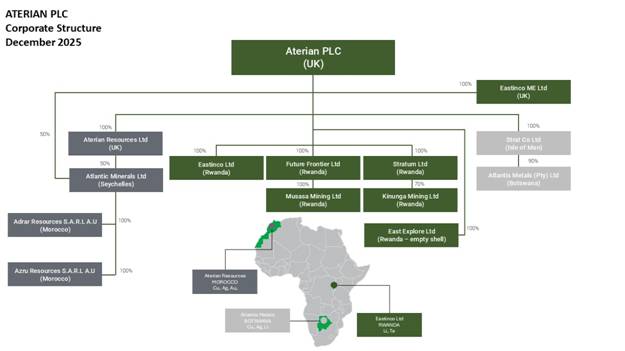
Group Overview
Operational Statement, 2025
Introduction
Aterian Plc is a critical metals exploration and development company focused on Africa, with projects in Morocco, Rwanda and Botswana. The Company targets commodities central to the energy transition, including copper, lithium, tantalum, niobium and tin, and is building a portfolio of prospective assets alongside mineral trading activities.
In Rwanda, the Company operates through several subsidiaries. Eastinco Limited holds a mineral trading licence and is actively purchasing concentrate from artisanal and small-scale miners (ASMs) for export in partnership with Wogen Resources, the Company's sales and marketing partner. Two additional subsidiaries, Kinunga Mining Limited and Musasa Mining Limited, hold exploration licences targeting tantalum-niobium (coltan) and lithium. In Morocco, Aterian operates through two subsidiaries holding exploration permits focused on developing copper and silver resources.
In April 2024, the Company acquired a 90% interest in Atlantis Minerals Pty Ltd in Botswana, initially comprising four copper-silver and lithium licences. This portfolio has since expanded to eleven licences in the Kalahari Copper Belt, and three licences adjacent to Sua Pan considered prospective for lithium-bearing brines.
Project Exploration Review - Rwanda
At year-end, the Company had two exploration projects in Rwanda.
1. The HCK Lithium-Tantalum Project, located in southern Rwanda.
2. The Musasa Lithium-Tantalum Project, located in the Western Province on the eastern shores of Lake Kivu.
HCK Lithium-Tantalum Project
The HCK Lithium-Tantalum Project covers approximately 2,750 hectares in southern Rwanda and is held by Kinunga Mining Ltd, a Rwanda-registered joint venture company owned 70% by Stratum Limited (a wholly owned subsidiary of Aterian) and 30% by HCK Mining Company Ltd.
In May 2023, Aterian entered into an Earn-In Investment and Joint Venture Agreement with Rio Tinto Mining and Exploration Ltd and Kinunga Mining Ltd. Rio Tinto exited the agreement in October 2025 after investing US$4.73 million in exploration activities, concluding that the project was unlikely to host a Tier-1 scale lithium deposit.
Exploration activities under the joint venture included diamond drilling, geochemical sampling and geophysical surveys. In early 2025, diamond drilling resumed at the HCK-1 prospect, targeting lithium-bearing pegmatites. Four diamond drill holes, totalling approximately 1,180 m, were completed across two targets (HCK-1 and HCK-2), intersecting multiple pegmatite dykes, with downhole thicknesses locally reaching up to 79 m.
Assay results confirmed the presence of spodumene-bearing pegmatites, including a notable intersection in hole MWOG0002 of 6.90 m at 2.11% Li₂O, including 3.45 m at 3.20% Li₂O within fresh pegmatite below the weathered zone. These results validated the pegmatite exploration model developed from earlier geological mapping, geochemical sampling and geophysical surveys.
The exploration programme also included the collection of 257 rock samples, 2,643 soil samples, and approximately 246 km of ground magnetic surveys, together with radiometric data and mineralogical test work. Following Rio Tinto's exit, control of the project and the full technical dataset reverted to Aterian.
Aterian intends to review the accumulated data and advance exploration at HCK with a renewed focus on lithium, tantalum and niobium mineralisation, which occur within the licence area and have historically supported artisanal mining
Musasa Lithium-Tantalum Project
The Musasa Lithium-Tantalum Project comprises an exploration licence covering approximately 350 hectares in Rwanda's Western Province and is held by Musasa Mining Limited, a wholly owned subsidiary of Aterian.
Since the licence was granted in October 2024, the Company has undertaken initial target generation work, including desktop studies and reconnaissance field surveys. A total of 66 observation points were established across the licence area, with evidence of current or historic artisanal mining identified at eight locations.
Pegmatites were recorded at 23 locations, and beryl was identified at one site. Indicators consistent with potential subsurface pegmatite mineralisation, including coarse muscovite and quartz fragments in soil, were observed at a further 20 locations.
The presence of pegmatites, indicator minerals and historic artisanal workings is considered encouraging and suggests the potential for the discovery of a new pegmatite field within the licence area.
Eastinco Limited - Mineral Trading
Eastinco Limited, a wholly owned subsidiary of Aterian, holds a mineral trading licence in Rwanda and operates the Company's mineral trading platform.
Trading operations resumed in February 2025 following the stabilisation of Rwanda's Inkomane mineral traceability and trading system. Eastinco registered as a compliant participant and conducts trading activities in accordance with Rwanda Mines, Petroleum and Gas Board ("RMB") requirements and international responsible sourcing frameworks, including the Responsible Minerals Initiative (RMI) and OECD Due Diligence Guidance.
Supply agreements have been established with vetted artisanal and small-scale mining suppliers, supported by internal quality control procedures including pXRF verification, laboratory assays and supervised blending and packaging prior to export. To support concentrate procurement, Aterian secured a US$250,000 mezzanine loan facility, alongside a trade finance agreement providing up to US$4.5 million to fund purchases of tantalum, niobium and cassiterite concentrates.
Trading activities generated a gross profit during Q4 2025, demonstrating the viability of the Company's trading model.
In 2026, Aterian further strengthened its trading operations through a profit-share joint venture with Wogen Resources, a leading international metals trader. The agreement provides access to up to US$25 million in working capital to support supplier payments, inventory financing, and full-cycle trade funding.
Additional funding of £450,000 has been raised through equity and convertible bonds to expand trading infrastructure in Rwanda, including larger premises and increased throughput capacity.
Aterian is also developing partnerships with selected artisanal mining producers, providing equipment, capital and technical support to improve production and processing. These initiatives are intended to increase short-term production by processing tailings while supporting longer-term growth.
Overall, the Rwanda trading platform has progressed from operational restart to a scalable trading business capable of generating revenue while maintaining strong ESG and traceability standards.
Project Exploration Review - Morocco
The Company holds 663 km² of exploration licences in Morocco, targeting critical minerals with a primary focus on copper and silver. The licences are held 100% by the Company's Moroccan subsidiaries, with Elemental Altus Royalty Corporation holding a 2.5% NSR royalty over each licence, except for Akka and West Tazalaght, where no royalty applies.
Most licences are located in the Anti-Atlas region, a historically significant copper-producing district hosting numerous copper occurrences associated with Neoproterozoic volcano-sedimentary sequences and sediment-hosted systems, including units of the Adoudou Formation and Cambrian carbonates.
Exploration efforts are focused on the Company's most prospective assets, including Agdz, Tata, Azrar and Jebilet Est, while maintaining flexibility to pursue additional opportunities across the Moroccan portfolio.
A summary of the key projects is provided below.
Agdz Copper-Silver Project
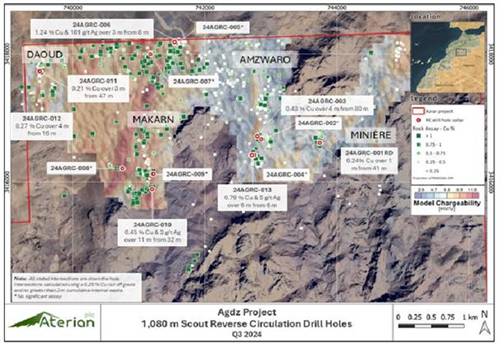
The Agdz Copper-Silver Project covers 50.4 km² in central Morocco and comprises the Agdz Est licence (15.9 km²) and the Agdz licence (34.5 km²). The project lies approximately 35 km east of Ouarzazate, within the Anti-Atlas belt, near the Bouskour copper-silver mine and the Imiter silver mine, both operated by Managem.
Mineralisation occurs within volcano-sedimentary rocks of the Ouarzazate Supergroup intruded by granodiorite and cut by fault systems associated with hydrothermal alteration and historical workings. Exploration has defined five main prospects (Makarn, Makarn North, Amzwaro, Minière and Daoud), with rock chip samples returning grades of up to 26.5% Cu, 448 g/t Ag and 3.74 g/t Au.
Work completed to date includes 576 m of trenching across 13 trenches and a reverse circulation drilling programme in 2024 comprising 13 holes for 1,080 m. Significant drill intersections include 3 m at 1.24% Cu and 101 g/t Ag at Makarn North and 6 m at 0.79% Cu and 5 g/t Ag at Amzwaro.
Recent exploration at Agdz Est identified several mineralised fault zones with four sub-parallel structures mapped over strike lengths of up to 0.9 km, returning grades of up to 2.97% Cu and 51 g/t Ag.
Data generated from recent work will be incorporated into the Company's AI-enabled exploration partnership with Lithosquare to assist with project ranking and target generation.
|
Tata Copper Project
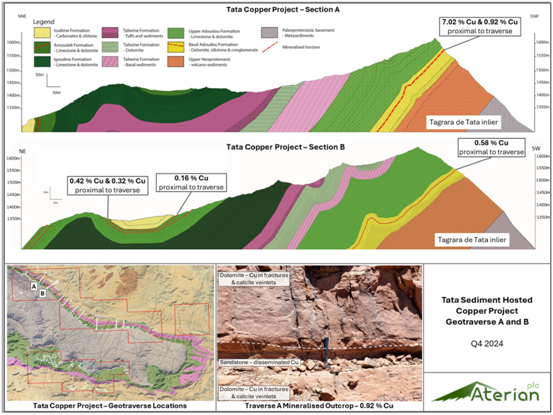
The Tata Copper Project covers 138.6 km² in the western Anti-Atlas Mountains, approximately 165 km southeast of Agadir and 50 km from the Tizert copper mine operated by Managem.
Exploration targets sediment-hosted copper mineralisation within the Adoudou Formation, with mineralisation identified along approximately 32 km of strike, of which around 13 km remains untested. Rock chip sampling has returned values of up to 7.02% Cu from bedding-parallel mineralisation within lower Adoudou siltstones.
Recent work has focused on the reinterpretation of historical airborne geophysical datasets (magnetometry, gamma-spectrometry and electromagnetic surveys) covering over 250 km². Integration of these datasets with geological and geochemical information has identified four priority copper targets with a combined strike length of approximately 14.3 km.
Further geological mapping, sampling and ground geophysical surveys are planned to refine targets for drilling.
Azrar Copper-Gold Project
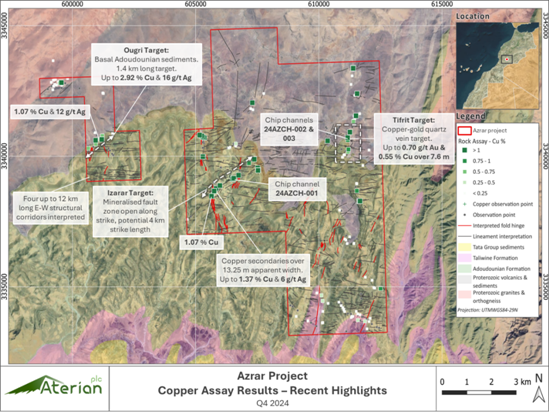
The Azrar Copper-Gold Project covers 76.9 km² in the western Anti-Atlas, approximately 155 km southeast of Agadir and 45 km from the Tizert copper mine.
Recent fieldwork included 8 line-km of geological mapping and reconnaissance channel sampling. Results include 0.80% Cu over 4.2 m at the Izarzar fault target and 0.82 g/t Au with 0.63% Cu over 9 m at the Tifrit quartz vein target, including 2.97 g/t Au and 2.00% Cu over 0.7 m.
Three principal targets have been identified:
· Tifrit - a 3.8 km quartz vein system hosting copper-gold mineralisation
· Ougri - a 1.4 km sediment-hosted copper zone returning up to 2.92% Cu and 16 g/t Ag
· Izarzar - a 4 km structurally controlled copper-silver system with sampling up to 2.45% Cu
Reinterpretation of airborne geophysical data has identified five priority exploration targets covering approximately 11.4 km². Further mapping, trenching and geophysics are planned.
Jebilet Est Copper Project
The Jebilet Est Copper Project covers 73.6 km² and is located approximately 35 km northeast of Marrakech, with good infrastructure including rail access to the port of Casablanca.
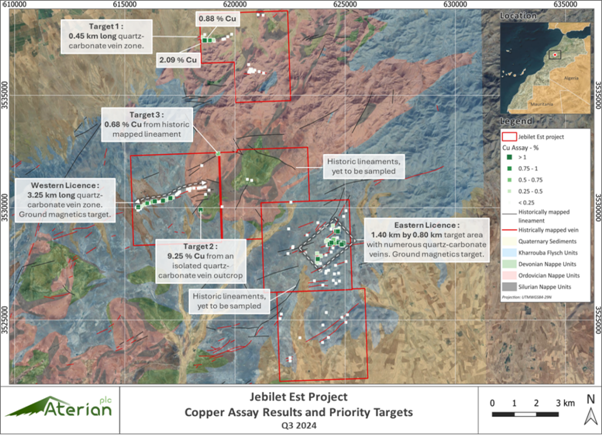
Exploration has focused on mapping quartz and quartz-carbonate veins and verifying structural lineaments. A previously mapped vein system has been extended to approximately 3.25 km, with additional sub-parallel veins identified.
Rock chip sampling returned values including 2.09% Cu, 9.25% Cu, and 0.68% Cu from several newly identified targets.
Earlier work defined two principal mineralised zones, with grades of up to 4.43% Cu in the western licence and 3.11% Cu in the eastern licence. These results indicate multiple structurally controlled copper-bearing systems across the project area.
Other Explored Moroccan Projects
Akka Copper Project
The Akka Project comprises three licences covering 47.1 km² in the western Anti-Atlas and was awarded in August 2023. The project is located approximately 15 km west of Akka and targets copper mineralisation hosted within Adoudou Formation sediments.
The project lies within an established copper district approximately 20 km east of the Akka Copper-Gold Mine and 35 km southwest of the Tazalaght Copper Mine.
Initial reconnaissance sampling returned values up to 3.93% Cu from quartz-carbonate veining within a fold hinge structure. Additional samples returned 0.30% Cu and 0.34% Cu, while disseminated copper oxide mineralisation within Adoudou dolomites returned anomalous values of 0.16% Cu.
West Tazalaght Copper Project
The West Tazalaght Project comprises two licences covering 27.4 km² in the western Anti-Atlas and was awarded in August 2023.
The project is located approximately 13 km northeast of Tafraoute and 7 km west of the Tazalaght Copper Mine. Exploration targets sediment-hosted copper mineralisation within folded sediments of the Adoudou and Taliwine Formations.
Initial reconnaissance sampling returned values of up to 0.25% Cu, and evidence of historical copper activity, including smelter slag containing malachite, was observed within the licence area.
Morocco Portfolio Review and Licence Relinquishments
This year, the Company conducted a comprehensive review of its Moroccan asset portfolio to streamline operations and focus on core projects. As a result, several non-core research permits due for renewal were relinquished. The asset review considered factors such as geological prospectivity, initial reconnaissance mapping and sampling, project size, accessibility, and infrastructure.
This strategic decision has reduced the Company's landholding from 897.7 km2 to 663.6 km2, enabling a more targeted allocation of capital and resources. The refined portfolio allows for greater focus on high-priority assets, including Agdz, Azrar, Tata, and Jebilet Est, while also creating flexibility to pursue new opportunities within Morocco.
Project Exploration Review - Botswana
In April 2024, the Company completed the acquisition of a 90% interest in Atlantis Metals (Pty) Ltd, a privately owned company registered in Botswana. Atlantis holds 14 prospecting licences comprising eleven copper-silver licences in the Kalahari Copperbelt (KCB) and three lithium brine licences in the Makgadikgadi Pans, covering a combined area of 5,211.51 km².
Kalahari Copperbelt
The Kalahari Copperbelt (KCB) is considered one of the most prospective regions globally for sediment-hosted copper deposits (USGS, 2020). The belt extends approximately 1,000 km from western Namibia into northern Botswana along the margin of the Kalahari Craton and hosts several significant copper-silver deposits.
Mineralisation in the Kalahari Copperbelt typically occurs near the contact between the D'Kar Formation and the underlying Ngwako Pan Formation, which hosts several known copper-silver deposits.
Atlantis licences are strategically located within this emerging copper district. One licence lies approximately 50 km east of MMG's Khoemacau Copper Mine Zone 5 deposit (92.9 Mt at 2.0% Cu and 21 g/t Ag), while another is located 7 km west of the Banana Zone deposit (157 Mt at 0.86% Cu and 11 g/t Ag). In March 2024, MMG Limited acquired Khoemacau's parent company, Cuprous Capital Ltd, for US$1.73 billion.
The Company engaged independent geophysical consultants to reprocess airborne geophysical datasets from the Botswana Geoscience Institute and other sources. This work improved geological interpretation and assisted in mapping the key D'Kar-Ngwako Pan contact, an important exploration horizon for copper-silver mineralisation.
Desktop studies indicate that the Atlantis licences lie within a highly prospective metallogenic province that hosts deposits such as Motheo, Khoemacau and Boseto, although the level of prospectivity varies depending on structural setting and stratigraphy.
Several licences are considered structurally favourable, particularly PL0154/2024, PL0157/2024, PL2622/2023, PL0199/2025 and PL0265/2025, where basin-margin structures, fold geometries and interpreted D'Kar stratigraphy may provide favourable conditions for copper mineralisation.
Satellite-based remote sensing using Sentinel-2 imagery identified spectral signatures associated with minerals such as bornite, chert, goethite and illite, together with anomalous CO₂ and helium emissions, which may indicate concealed copper-silver mineralisation beneath soil or deep cover.
These interpretations have been reviewed and supported by Lithosquare, the AI exploration partner collaborating with Aterian, and have enabled a portfolio-wide desktop target ranking exercise to prioritise follow-up exploration.
Sua Pan Lithium
The Company holds three prospecting licences covering 2,517 km² along the eastern and southern margins of Sua Pan within the Makgadikgadi Salt Pans.
The Makgadikgadi Pans were designated a government "Lithium Zone" in 2022 to encourage exploration following historical reports of lithium-bearing brines and the emergence of Direct Lithium Extraction (DLE) technologies that may improve the economic viability of such deposits.
Historical sampling during the 1980s reported lithium concentrations of 103, 117 and 223 mg/L, although the precise sampling locations were not recorded.
In December 2025, the Company commissioned Aqualogic (Pty) Ltd to conduct a Groundwater Reconnaissance and Sampling Programme across the licence areas to establish baseline hydrogeochemical conditions and assess lithium potential.
The programme collected 15 water samples from six boreholes and nine shallow auger holes within the salt pan sediments. Field measurements included pH, temperature, electrical conductivity and total dissolved solids, with laboratory analysis conducted by Gaborone Laboratory Services, supported by an ISO/IEC 17025 accredited laboratory in South Africa for trace element analysis.
Results show that the groundwater system is highly saline, with total dissolved solids ranging from 2,233 mg/L to 106,400 mg/L. Hydrochemical classification indicates predominantly Na-Cl type waters within the pan sediments and Na-Ca-Cl type waters in boreholes, consistent with evaporative concentration processes typical of salt pan environments.
However, lithium concentrations were extremely low or below detection limits, with similarly low levels of bromide and boron. While the reconnaissance results indicate limited lithium enrichment in the sampled groundwater, the study provides important baseline hydrogeochemical data for future exploration across the project area.
Lithosquare Partnership
In December 2025, the Company entered into a strategic AI-powered exploration joint venture with Lithosquare, a next-generation mineral exploration company that combines artificial intelligence, advanced data science, and geological expertise. The agreement provides a capital-efficient mechanism to accelerate target generation and exploration across Aterian's portfolio.
The Key Highlights of the JV:
· Up to €1.4 million fully funded AI-led programme directed across eight priority Aterian projects ("JV Projects")
· Potential for Lithosquare to earn a 2.0% net smelter return (NSR) and up to 49.9% equity, strictly tied to exploration success and value creation
· Initial €500,000 investment for AI-driven target generation, geophysics, mapping and scout drilling to identify high-value copper and critical mineral targets rapidly
· €900,000 additional projected drilling to advance successful targets
· Lithosquare has an initial 20% project interest and 0.5% ("NSR") with additional equity and NSR interests tied to value creation catalysts
This capital-efficient structure enables Aterian to accelerate value creation on its portfolio with zero dilution. The JV partners are aligned on rapid execution and value creation, with work in progress.
The Business Model
The Company's strategy is to build a scalable critical metals business through phased exploration in mining-friendly, investment-attractive jurisdictions. Aterian aims to grow its asset portfolio by identifying and acquiring high-potential greenfield opportunities through mergers and acquisitions.
Strategic partnerships form an important part of this approach, enabling the Company to accelerate exploration and advance projects toward potential development. Key milestones achieved to date include the acquisition of the Company's Moroccan exploration portfolio, the earn-in joint venture with Rio Tinto in Rwanda, and the acquisition of Atlantis Metals in Botswana.
The Company remains committed to executing this strategy while maintaining strong corporate governance based on the QCA Code.
Resources and Reserves
Given the early-stage nature of the projects held by the Company, with current exploration efforts focused on planning future drilling programmes, the Company has no stated resources or reserves.
Environment, Social and Governance Policy
Our Communities
Integrating ESG matters into our operations and investment decision-making processes is a key element of being a responsible corporate body. We firmly believe it is part of our corporate responsibility to deliver returns by being a responsible investor.
Minimising our impact on the environment is a strong company focus. This includes reducing our carbon footprint and water usage, reforestation and protecting biodiversity.
Aterian is committed to being a responsible corporate citizen and operating in a manner that is transparent and environmentally responsible, ensuring the longevity of our operations and supporting the socio-economic development of our host communities.
Responsible mining and exploration are about being transparent and open. At Aterian, we are committed to the safety of our people, the protection of the environment, and continuous improvement through technological innovation. This is made possible thanks to the dedication of our employees, as well as the support of our leadership and the communities in which we operate.
At Aterian, we recognise the importance of the UN Sustainable Development Goals (UN SDGs), and we indirectly contribute to many of them in some way.
We have prioritised the SDGs that align most directly with our business, corporate strategy, sustainability efforts, and stakeholder expectations while also representing our greatest opportunities to contribute further to the goals.
Aterian's commitment to being a responsible corporate citizen is guided by our ESG policies.
Our Commitment to the Growing Importance of ESG in the Mining Environment
ESG factors are likely to be the main source of risk in metal and mineral supply over the coming decades, more so than direct reserve depletion. Following OECD and EU guidelines on responsible sourcing of minerals is essential in preventing groups in surrounding regions from profiting from the trade of Conflict Minerals-namely tin, tantalum, tungsten, and gold. These guidelines establish a due diligence framework for companies to identify, assess, and mitigate risks in their supply chains, ensuring transparency and ethical sourcing practices. By adhering to these standards, companies and regulators help break the link between mineral extraction and the financing of violence, human rights abuses, and political instability in conflict-affected areas. This not only promotes peace and security but also supports the development of legitimate and sustainable economic opportunities in the Great Lakes region.
· Conflict Mineral Policy - Following OECD and EU guidelines, preventing armed groups in the DRC and adjacent countries from benefitting from the sourcing of Conflict Minerals.
· Local Community Support - Improving service levels to clients whilst acting fairly in dealings with suppliers and third parties.
· Environment- Minimising impact on the environment is a strong company focus.
· Training and Development - Dedicated to providing training and development opportunities to staff members.
· Clean water initiative - Helping provide clean drinking water to approx. 26,000 school children and teachers in Rwanda.
· Food and healthcare insurance support - Provided in the Musasa area of Rwanda during the Covid-19 pandemic.
· Corporate Governance - The Company conforms to the QCA Corporate Governance Code 2023 and applies this to all its subsidiaries.
As part of our efforts, we actively participate in a clean water programme that provides the local community with access to clean drinking water through the provision of water tanks and supply systems. We also support community aid programmes that assist vulnerable members. We look forward to continuing these efforts.
Employee and Greenhouse Gas (GHG) Emissions
The Company seeks to minimise carbon or greenhouse gas emissions. The Group's utility bills indicate that it consumes less than 40,000 kWh of energy per annum. It does not have responsibility for any emissions producing sources under the Companies Act 2006.
Energy and Carbon Reporting (SECR)
The Company is a "quoted company" within the meaning of the Companies Act 2006 (Strategic Report and Directors' Report) Regulations 2013, as amended by the Companies (Directors' Report) and Limited Liability Partnerships (Energy and Carbon Report) Regulations 2018 (together, "SECR"). Accordingly, the Company is required to disclose its annual energy use and associated greenhouse gas ("GHG") emissions.
The Company's current activities are restricted to exploration related activities with trenching being the most environmentally impactful. We are not mining or engaged in large scale drilling programmes.
Policies and processes are being further enhanced to ensure there is a more rigorous reporting cycle in which requirements are identified and met before giving rise to any issues. The Company functions with the clear mandate of being in full compliance with corporate standards, applicable environmental laws, regulations and permit requirements.
TCFD Governance of Climate-Related Risks and Opportunities
Transitional statement
As at 31 December 2025, the Company is not fully compliant with the requirements of the TCFD framework (on the basis that this is deemed immaterial based on the current stage of operations). The following disclosures set out where the Company is currently in this regard (i.e. whether or not it is fully compliant, partially compliant or not yet compliant), where we would like to be in the future and what steps will be taken to achieve this. The Company is still at a very early stage of developing its activities and is extremely small in terms of its operations, resources and environmental impact. Nonetheless, the Company's strategy to grow means that its impact on the environment is likely to increase, and its resources and procedures will also need to develop alongside this growth in activity.
In contrast to the Streamlined Energy and Carbon Reporting (SECR) disclosures which requires listed companies to disclose their greenhouse gases emissions, CO2 and energy usage, TCFD is primarily designed to protect shareholders from the impacts of climate change by ensuring companies adapt to the risks and opportunities that climate change presents. In the mining industry an example would be a brown thermal coal exploration company faced with reduced market demand over the next 25 years.
TCFD adherence requires disclosure of Greenhouse Gas (GHG) emissions as part of the Metrics and Targets section. This creates a degree of overlap with SECR requirements, however TCFD's main focus on emissions is to understand how GHG emissions may expose a company to future changes in law or legal challenges, regulation or market dynamics which penalise higher polluting industry sectors, sub sectors or companies.
The disclosures set out below describe whether the Company is fully compliant with the TCFD requirements and, where it is not, explain why it is not yet able to comply. It further describes what procedures are currently in place and the steps the Company expects to take to progress to full compliance.
The Company is committed to complying with local environmental regulations and international disclosure frameworks, including the Task Force on Climate-related Financial Disclosures (TCFD). With regard to the TCFD, the Company ensures that its climate-related financial disclosures are consistent with the TCFD Recommendations and Recommended Disclosures, as aligned with the listing rules UKLR 22.2.24 (1), (2), LR 22.2.25 and LR 22.2.26.
We have made the disclosures below against each TCFD Recommendation and Recommended Disclosure, noting where the Company is in full or partial compliance or where further work is planned to be undertaken to report in the 2026 Annual Report and Accounts.
When making assessments and preparing disclosures, we have considered whether particular issues and related information may influence the economic decisions of the stakeholders. Such an approach aligns with the guidance and recommendations provided by the TCFD regarding the materiality of information. Furthermore, the process of assessing risks and their potential financial impact involved the use of judgements and estimates, which we believe are consistent with the TCFD Recommendations and Recommended Disclosures.
The tables below describe the Company's position on each of the TCFD's 11 disclosure recommendations, with the following keys indicating the level of compliance:
- *Compliant
- **Partially compliant
- ***Not yet compliant
Pillar | Requirement | Company position |
Governance around climate-related risks and opportunities | a. Describe the board's oversight of climate-related risks and opportunities**
| The Board recognises that evolving legislation and regulatory frameworks aimed at addressing climate change may have future financial implications for the Group. In response, the Board proactively engages in climate governance and oversight to ensure it is able to plan for resilience and alignment with best practices. Climate change matters are regularly discussed in management and Board meetings but these are not routinely minuted on the basis that their impacts are often immaterial to the Company's current activities. However, with effect from April 2025, all board meetings are being recorded and matters covering climate change, corporate responsibility and ESG are to be formally minuted. It is intended that these procedures will cover: · Regular reviews of material issues and principal risks, including those linked to climate change. · Establishing and reviewing climate-related policies, identifying areas requiring further action, and delegation of responsibility to in-country managers for local implementation. These changes will be implemented proportionately as the Company's activities grow, with the overarching aim of ensuring that Environmental, Social and Governance (ESG) considerations, including climate-related risks and opportunities, are embedded within the Group's risk management and internal control systems. While climate-related risk is not currently deemed a principal risk due to the Group's present scale, it remains an important consideration within the broader ESG framework. Further information on ESG risks and mitigation strategies is outlined in the "Principal risks and uncertainties" section on pages 30-33. The Audit Committee is responsible for reviewing the Company's annual disclosures in relation to the Task Force on Climate-related Financial Disclosures (TCFD) and other emerging climate risks. To date, the Audit Committee's role has been limited because of the relatively immaterial scale of the Company's operations. During 2026, the Audit Committee papers and minutes will explicitly document its assessment of TCFD disclosures and plans for their future development. The Board collectively drives the Group's short, medium, and long-term strategic decisions. While annual KPIs related to emissions and climate targets are not currently set -reflecting the modest scale of Aterian's present operations - the Board recognises the opportunity to integrate such targets as the Group grows. Opportunities for Aterian plc:As global focus intensifies on climate action, Aterian is well-positioned to benefit from the transition to a low-carbon economy. Opportunities include leveraging sustainable mining practices to attract ESG-focused investors, positioning the Company as a responsible supply partner within clean technology supply chains, and exploring funding or partnership avenues tied to environmental innovation. The Board recognises that early adoption of climate disclosure frameworks and emissions reduction strategies could enhance the Company's reputation, compliance readiness, and long-term shareholder value. As the activities of the Group grow, the Board will develop its strategies in a proportionate way.
|
| b. Describe management's role in assessing and managing climate-related risks and opportunities** | The Board has overarching responsibility, and management has the oversight of day-to-day operations.
Management as a whole is responsible for day-to-day operations, including the identification and evaluation of climate-related risks and opportunities.
|
Strategy: Disclose the actual and potential impacts of climate-related risks and opportunities on the Company's businesses, strategy, and financial planning where such information is material. | a. Describe the climate-related risks and opportunities the company has identified over the short, medium, and long term**
b. Describe the impact of climate-related risks and opportunities on the organisation's businesses, strategy, and financial planning**
| The climate-related risks relevant to the business have remained largely unchanged compared to previous reporting periods, and where relevant, opportunities have also been identified, both within the context of the current activities of the business being relatively small scale.
The climate-related opportunities stem from the demand for minerals that support the energy transition (e.g., copper and lithium), which is expected to rise. Aterian is strategically expanding its trading and exploration into African regions with deposits of these metals which management believes supports green technology markets. This opportunity is driven by demand from the renewable energy sector and electric vehicle (EV) battery manufacturing. This presents an opportunity for Aterian to attract investors to its critical metal projects in Africa. Adopting energy-efficient and renewable-powered exploration technologies could also result in cost savings and enhanced environmental credentials.
To date, Board minutes and related papers have not documented its decision-making processes across short-term, medium-term and long-term horizons, but this is to be implemented during the course of 2026 to cover relevant climate-related risks and opportunities as described below.
Short-Term (0-3 Years): (Three-year period to the end of 2027): This is typically the life of the Company's exploration licences, over which the management and the Board monitor the Company's liquidity and viability.
Such period is typically the term of joint venture agreements such as the Company's agreement with Rio Tinto, and the initial tenure of a particular exploration licence or permit. The Company has a detailed financial plan that is actively managed and adapted to changes in external circumstances.
Climate-related risks deemed to affect the Company in the short-term are not as prevalent as those in the medium and longer term.
Policy and legal risks which Aterian is facing are similar to other players in the critical minerals industry:
• New and evolving reporting obligations may result in higher compliance costs but at present these are not material.
• Risks due to certain jurisdictional policy changes where exploration activities are undertaken, such as emissions target requirements or carbon pricing regulation, causing mining operations post-exploration to be commercially unviable.
We believe these risks are relatively low in the short-term but become more material over a longer horizon as the Company's operations become more significant..
Risks include regulatory changes in the UK and in the countries where the Group operates (Morocco, Rwanda, and Botswana) that may increase compliance costs and necessitate additional staffing to facilitate new regulatory requirements, such as baseline surveys and reporting obligations. Regulatory changes could cause delays in permitting exploratory activity due to concern around climate-related impacts of potential mining activity as a result of the outcomes of the exploration work, which may in turn reduce time spent undertaking field programmes, as well as physical risks like extreme weather events (e.g., flash floods, elevated summer temperatures) that could further disrupt exploration activities and/or increase the safety risk for field teams.
Although not yet readily apparent, community concerns about environmental impacts within the context of climate change could lead to reputational risks and delays to the growth in planned activities.
The financial impact of these risks and opportunities has not yet been quantitatively assessed. Given the relatively small-scale activities currently undertaken by the Company, resource allocation has been proportionate in risk assessment, and management deems the short-term impact to be minimal.
Opportunities Product and Market Expansion: The demand for minerals that support the energy transition, such as copper and lithium is expected to increase. Aterian is strategically expanding its trading and exploration into African regions with deposits of these metals, focusing on assets that support green technology markets. This opportunity is driven by demand from the renewable energy sector and electric vehicle (EV) battery manufacturing. This presents an opportunity for Aterian to attract investors to its critical metal projects in Africa.
Adopting energy-efficient and renewable-powered exploration technologies could also result in cost savings and enhanced environmental credentials. The financial impact of this opportunity has not yet been assessed in quantitative terms.
Medium-Term (3-10 Years): (Seven-year period to the end of 2034). This period is likely to feature development of successful licences into assets capable of mineral production.
Climate-related risks will be factored into scenario analysis using various mineral input prices to support the Board in decision-making for field investment proposals in line with the Group's strategy.
Technology risks are considered relevant in the medium and long-term. As global and jurisdictional legislation evolves, we may need to allocate capital to emissions reduction investments, such as carbon capture and storage, which may not provide direct revenue and, therefore, may impact the medium to long-term value of the Company.
Reputational risks include risks of stakeholder concerns and disengagement resulting from other climate-related risks, as well as increasing difficulty in accessing capital markets for future growth opportunities. We believe these risks are less of a concern in the short-term since the Company has longstanding relations with its key shareholders and noteholders. However, these may become more significant in the medium and long term.
Physical risks which may affect the Company and its operations include floods, severe heat and/or desertification.
As climate change continues, we believe that these severe weather events may occur more frequently and during unexpected periods, potentially further impacting business operations and finances. We currently operate throughout the year, but in the middle of summer, temperatures on the ground in Morocco and Botswana can exceed 40oC.
Rwanda has a more temperate climate due to its elevation. However, if temperatures were to change sharply within a short period due to climate change, this could negatively impact operations, for example, by reducing equipment productivity due to overheating or increasing fire risk.
Other risks include water scarcity, which could hinder fieldwork programs, camp construction, and the provision of water for extensive field activities in remote desert locations. Permitting may not be granted for the development of projects if water scarcity in the region is an issue (lack of reservoirs, unsuitable groundwater, etc.). Significantly increased costs of compliance and related reporting may also become more apparent, which reduces the cost and time efficiency of executing field programmes.
Opportunities in this period include the increasing demand for sustainably sourced minerals, which could help Aterian secure environmentally conscious investors. Technological innovations, such as drones, remote sensing and machine learning could improve exploration efficiency and reduce environmental impact. The Group has not yet explored such technologies but is likely to do so in the medium term. Potential direct investment in the energy sector may provide upstream opportunities for the provision of critical metals.
Longer-Term (10+ Years): (Period covering beyond 2034). This period is likely to feature both the construction of facilities and the subsequent production of mineral ore.
This is defined by the opportunities being identified that are mostly affected by climate-relate risks.
Opportunities - Investments in Aterian could present significant opportunities for the provision of notably copper and lithium aiding the transition away from fossil fuels.
Additionally, Aterian could solidify its position in critical minerals, enhancing its market reputation in a low-carbon economy.
Building long-term trust and fostering good cooperation with local and national stakeholders through local community training for sustainable exploration activities is supported by Aterian in its efforts to mitigate the effects of climate change on local populations. This responsible approach, demonstrated during the exploration stages, further enhances Aterian's reputation.
Impact on the Organisation's Businesses, Strategy, and Financial Planning:
We acknowledge that the transition to a lower carbon economy presents both risks and opportunities for Aterian. As described above, the impact on short-term strategy and financial planning remains minimal and proportionate to business operations, but we have in place the necessary flexibility to adapt as and when we see the risks evolve. In respect of medium-term and long-term financial planning, we are acutely aware of the climate-related risks and our ability to execute various projects.
With respect to physical risks, we will factor this into our strategic planning through extended and more frequent periods when exploration may not be possible and thus periods during which operations and revenues either cease or reduce.
We consider transition risks outlined in (a), above, within the context of our strategic and financial planning, noting the following potential impacts which could arise within the context of climate change:
i) reduced demand and lower pricing for minerals - resulting in lower future revenues; ii) higher operating costs in our supply chain; iii) high investment spend relating to climate risk mitigation activities through increased operational spend and increased downtime due to extreme weather events.
For physical risks, while important from a governance perspective, we deem the financial and operational impact to be lower, as we currently operate successfully in extreme weather conditions and believe we will do so going forward.
We take a conservative approach in our forward planning and therefore do not factor in opportunities that may arise in the short, medium or long-term through climate change.
As the scale of our operations increases, we will devote more resources to governance, including reporting, and these will feature in our future strategic and financial planning.
|
| c. Describe the resilience of the organisation's strategy, taking into consideration different climate-related scenarios, including a 2°C or lower scenario***
| Resilience of Strategy in Different Climate Scenarios:
The Company has not yet performed a formal scenario analysis on the potential impacts of different climate scenarios and is therefore not compliant with part (c.) of the Strategy requirements.
The limited scale of the Company's operations has meant that an allocation of resources to such scenario analysis will not be possible until we are fully funded for the medium and long-term. |
Risk Management: Disclose how the organisation identifies, assesses, and manages climate-related risks. | a. Describe the organisation's processes for identifying and assessing climate-related risks** b. Describe the organisation's processes for managing climate related risks** c. Describe how processes for identifying, assessing, and managing climate-related risks are integrated into the organisation's overall risk management** | The Board is the conduit through which climate-related risk management is enacted.
At present, as described above in its transition statement, the Company has not yet developed detailed processes for identifying and assessing climate-related risks. These will be developed as the Company's activities become more extensive.
Country managers support the Chief Executive Officer in his oversight role and will, when activities become material in scale, perform management and reporting on the risks when these are formally identified.
The processes described above under the "governance" pillar are part of our overall Group Risk Management framework and form an integral part of Aterian's risk management and internal controls system. Risk management covers both physical and transitional climate-related risks.
The Company endeavours to constantly improve its systems of risk management and internal controls. However, with the limited scale of operations and resources, the Company does not report any further material updates on these matters in this report.
|
Metrics and Targets: Disclose the metrics and targets used to assess and manage relevant climate-related risks and opportunities where such information is material. | a. Disclose the metrics used by the organisation to assess climate-related risks and opportunities in line with its strategy and risk*** management process. b. Disclose Scope 1, Scope 2 and, if appropriate, Scope 3 greenhouse gas (GHG) emissions and the related risks*** c. Describe the targets used by the organisation to manage climate-related risks and opportunities and performance against targets*** | Metrics Used to Assess Climate-Related Risks:
As of now, the Company does not track specific greenhouse gas (GHG) emissions metrics, such as Scope 1, Scope 2, and Scope 3 emissions, because the exploration activities it currently undertakes are in the early-stages and not emissions-intensive.
For further context, the Company meets the Streamlined Energy and Carbon Reporting emissions threshold exemption within the UK, meaning that it consumes less than 40MWh per reporting period.
The Company is still in the early stages of its development and does not currently record emissions from its business activities. However, as the activities grow, it will establish a baseline for GHG emissions target measurement.
Future Plans for Emissions Reporting: Aterian has not yet developed its plans to measure and manage emissions in the future. As the scale of operations grow, the Company intends to focus on the following:
· Scope 1 Emissions: Direct emissions from fuel use in exploration vehicles and equipment will be tracked by monitoring fuel consumption. · Scope 2 Emissions: Indirect emissions from electricity used at exploration sites and offices will be tracked through utility bills and fuel used for generators, which are currently leased as necessary (where their use is necessary). · Scope 3 Emissions: Although tracking Scope 3 emissions (e.g. transportation and supply chain emissions) will be phased in, the Company plans to assess indirect emissions in the future.
Targets for Managing Climate-Related Risks and Opportunities: Aterian has not yet established specific climate-related targets. In this regard, the Company is not compliant with the TCFD requirements. However, when these are established, these targets will focus on emissions reduction and broader sustainability goals aligning with industry best practices. These are likely to include:
· Emissions Reduction: the transition of all exploration vehicles to low-emission or renewable energy-powered alternatives, where feasible.
· Water Management: During exploration stages and at any future production stage, Aterian will seek to limit water consumption utilising, where possible, smaller, flexible and adaptable field teams, encouraging minimal water use wherever possible and recycling water where possible and optimising water consumption at any future production site.
· Energy Efficiency: The Company will seek to improve energy efficiency across exploration and development activities by incorporating low-energy technologies and practices.
· Sector-Specific Metrics: Aterian plans to align its reporting and targets with those of its industry peers, focusing on metrics such as carbon intensity per kilometre of exploration drilling or per tonne of the identified resource.
Implementation and Monitoring: Aterian has not yet established baseline metrics and is therefore not compliant with the TCFD requirements. Once the Company's activities are significant, we will engage third-party experts, as required, to develop a robust emissions measurement and reporting framework and report progress annually in alignment with international standards, such as the TCFD and CDP.
|
The Board is responsible for overseeing the Group's environmental, health, and safety, as well as corporate social responsibility programmes, policies, and will implement measures to monitor performance in these areas. The Board constantly strives to reduce the environmental impact of our operations.
Our People
Aterian operates within a favourable framework for labour relations based on a non-discriminatory, equal opportunities employment system that respects diversity and facilitates communication at all levels of the Group. The Group provides a healthy and safe working environment by implementing the best available international practices and procedures.
Equal Opportunity
The Company promotes a policy of creating equal and ethnically diverse employment opportunities, including those related to gender. The Company promotes and encourages employee involvement wherever practical as it recognises employees as a valuable asset and is one of the key contributors to the Group's success.
Communication
Aterian promotes and encourages the establishment of broad communication channels, continually seeking opportunities for conversation with its various stakeholders to ensure that business objectives remain in tune with social needs and expectations.
The Company will continually strive to provide relevant, transparent, and accurate information about its activities, encouraging continuous improvement in this area.
Eastinco Limited currently provides maintenance support for 65 solar water purification units, which were donated free of cost to schools in Rwanda. Each unit is 100% solar-powered and can provide safe, UV-filtered, and bacteria-free drinking water for up to 400 schoolchildren and teachers. This clean water initiative offers safe drinking water to over 26,000 children.
Risks
Risk management is one of the core responsibilities of the Board, and it is central to the decision-making process. The Board's fundamental duties as to management are:
· Assessing (quantitively and qualitatively) the principal risks to the Company. Principal risks are those risks or combination of risks that could seriously affect the performance, future prospects or reputation of the Company;
· Recognising and assessing emerging risks. Emerging risks are those which have not yet occurred but are at an early stage and anticipated to increase in significance over the medium to long-term time horizon;
· Risk management oversight and promotion of a risk mitigation culture.
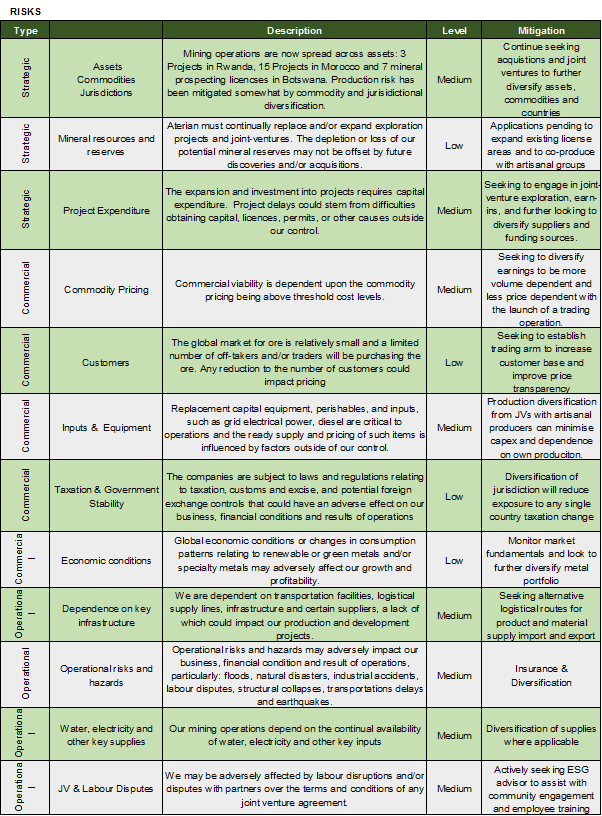
Principal Risks and Uncertainties
The Group operates in an uncertain environment, subject to several risk factors. The Directors have carried out a robust assessment of the principal risks facing the Group, including those that threaten its business model, future performance, solvency and liquidity.
They consider the following to be the principal risk factors that could materially and adversely affect the Group's future operating results or financial position.
Deterioration in the Metal Markets in Particular
There is a risk that changes in relevant law and legislation could have an adverse effect on the Group's future performance, expected return and or feasibility of any project. The Group is also exposed to general macroeconomic risk, including changes in the economic outlook in its principal markets and government changes in industrial, fiscal, monetary or regulatory policies. The Board continues monitoring developments in the market so that it can adapt its strategy. The management team has wide-ranging expertise in capital markets, mineral exploration, and trading, which, together with a flexible cost structure, enable the Group to adapt its organisation to changes in circumstances.
Funding Risk
Although the Group has sufficient working capital for at least 12 months from the date of this report, the Group may not be able to obtain additional financing as and when needed, which could result in a delay or indefinite postponement of exploration and development activities. In common with many exploration entities, and prior to trading revenue generation, the Group will need to raise further funds to progress the Group from the exploration phase into feasibility and eventually into the production of revenues.
Dependence on Key Personnel
The Company has a small management team, and the loss of a key individual could have a detrimental impact on the future of the Group's business. The Group's future success will also depend mainly on its ability to attract and retain highly skilled personnel.
There can be no assurance that the Group will be successful in attracting and retaining such personnel. The Group seek to create a workplace that attracts, retains, and engages its workforce. Efforts are also made to attract new talent and skilled people.
Environmental Risk
There may also be unforeseen environmental liabilities resulting from both the future and/or historic exploration or mining activities, which may be costly to remedy.
In addition, potential environmental liabilities as a result of unfulfilled environmental obligations by the previous owners may impact the Group. If the Group is unable to fully remedy an environmental problem, it may be required to stop or suspend operations or enter interim compliance measures pending completion of the required remedy. Environmental management systems are in place to mitigate environmental hazard risks.
Political Risk
All countries present a certain level of political risk which may ultimately disrupt business operations for some period of time. However, the Company's subsidiary management teams possess extensive experience operating in Rwanda, Morocco and Botswana.
Our local joint venture partners and subsidiary management teams maintain excellent communication with local stakeholders, ensuring that they have the necessary knowledge and expertise to assist the Company in mitigating any political risk associated with any particular project investment.
Together, we are committed to providing effective management and reducing the likelihood of political risk adversely affecting the Company's operations.
Estimates of Mineral Reserves and Resources
Mineral resources are estimates and no assurance can be given that any particular grade or tonnage will be realised or that they will be converted into ore reserves or will ever qualify as a commercially mineable (or viable) deposit that can be legally and economically exploited.
As a result of these uncertainties, there can be no assurance that any potential mineral resources defined by the Group's exploration programmes will result in profitable commercial mining operations. The Directors are confident that they have put in place a strong management team capable of dealing with the above issues as they arise.
Corporate Responsibility
We have defined the scope of our Group's responsible business practices as falling within the following key focus areas:
• Health and Safety - ensuring the safety and well-being of our staff
• Environment - managing our environmental impact areas of waste, energy and water
• Employees - supporting our people to develop and flourish within the business
• Community - positive interaction with the communities in which we operate
• Ethical Standards - operating to the highest ethical standards
We remain committed to ensuring these activities become embedded in how we operate and contribute to the success of our business. These include not only identifying and managing business risk but exploring opportunities to add value to the business.
Gender and Diversity Analysis
The following tables provide an analysis of the diversity of the individuals on the Company's board and in its executive management as of 31 December 2025:
Gender analysis | Number of board members | Percentage of the board | Number in executive management (Non-Board) | Percentage of executive management (Non-Board) |
Men | 5 | 100% | 1 | 50% |
Women | 0 | 0% | 1 | 50% |
Ethnicity analysis | Number of board members | Percentage of the board | Number in executive management (Non-Board) | Percentage of executive management (Non-Board) |
White British or other White (including minority-white groups) | 3 | 60% | 1 | 50% |
Mixed/Multiple Ethnic Groups | 0 | 0% | 0 | 0% |
Asian/Asian British | 0 | 0% | 0 | 0% |
Black/African/Caribbean/Black British | 1 | 20% | 0 | 0% |
Other ethnic group, including Arab | 1 | 20% | 1 | 50% |
The Company has not met the following targets on board diversity during the year: (i) at least 40% of the individuals on its board of directors are women; (ii) at least one of the following senior positions on its board of directors is held by a woman: (A) the chair; (B) the chief executive; (C) the senior independent director; or (D) the chief financial officer. Whilst the board aims to comply with these targets, the availability of suitable candidates with experience and expertise for these positions in the jurisdictions where the Group operates limits the opportunity to meet such targets. The Company is, however, mindful of these targets when making appointments.
The Company's approach to collecting data for the purposes of making the disclosures above is to promote diversity, inclusion and equal opportunity without referencing specific groups. Such data is collected when employees are recruited. The board considers diversity in all its forms, including gender, social and ethnic backgrounds and personal strengths. The Group's senior managers and other staff (excluding directors) are summarised as follows:
Gender analysis | Number of senior managers | Percentage of senior managers | Number of other employees | Percentage of other employees |
Men | 5 | 83.33% | 6 | 60.00% |
Women | 1 | 16.67% | 4 | 40.00% |
The Board recognises that the Group's long-term success depends on the engagement and commitment of its employees and therefore considers their interests in its decision-making processes. The Group aims to ensure that the workplace is safe and inclusive, welcoming diversity and offering everyone the opportunity to develop to their full potential. The Board has sought to enhance communication and better understand the interests of employees throughout the year. We have provided regular team updates and opportunities for Q&A. This has ensured staff receive answers to a wide variety of questions and allowed the Group to provide staff with pertinent information and key business performance updates.
The Board recognises the need to operate a gender diverse business and will ensure this is reviewed as the business develops. The Board also ensures that any employment decisions consider the necessary diversity requirements and comply with all relevant employment laws. The Board is satisfied that it possesses the experience, training, and qualifications required to operate this business at this stage of its development.
Health and Safety
The Group has maintained strict compliance with its Health and Safety Policy and is pleased to report that there were no lost-time accidents during the year.
Environment
No Group Company has had, nor has it been notified of, any instance of non-compliance with environmental legislation.
Key Performance Indicators
The Group utilises several strategic key performance indicators ("KPIs") to measure financial and non-financial performance. These KPIs are linked to our strategic objectives, helping to measure business performance and are focused on both the new trading business and exploration activities.
The most important KPI in 2025 has been the level of cash within the business, ensuring sufficient liquidity to fund operations and strategic investments. In addition to cash position, the Group monitors the following KPIs to track progress and align efforts with our growth and value-creation strategies:
1. Financial KPIs:
1. Exploration Spend vs Budget - Tracks the actual capital deployed on exploration programs compared to planned expenditures to ensure cost discipline.
2. Cash Burn Rate - Monitors monthly operational spending to evaluate sustainability and the timing of future capital requirements.
3. Return on Exploration Investment (ROEI) - Measures value generated relative to capital spent on exploration, particularly in identifying viable mineral resources.
4. Trading Revenue Growth - Evaluates performance of the Group's new trading business line and its contribution to overall revenue.
These KPIs are monitored internally but not published with specific figures in the annual report.
2. Operational KPIs:
1. Number of Active Exploration Projects - Monitors the scale and intensity of ongoing exploration work across jurisdictions.
2. Drilling Metres Completed - A key metric to assess the scope of subsurface exploration and geological data acquisition.
3. Number of New Licences or Permit Approvals - Reflects the Group's ability to secure new exploration rights and regulatory compliance.
3. Technical and Resource KPIs:
1. Discovery Rate - Measures success in identifying promising mineralisation zones per project or per metre drilled.
2. JORC/NI 43-101 Resource Estimates - Progress in upgrading exploration targets to compliant mineral resource categories.
3. Grade and Tonnage Metrics - Quality and size of identified deposits, indicating potential economic viability.
4. ESG and Non-Financial KPIs:
1. Health and Safety Incidents - Tracks the frequency and severity of workplace incidents to ensure safe operations.
2. Community Engagement Score - Qualitative and quantitative indicators of stakeholder relations and community support.
3. Environmental Compliance Rate - Measures adherence to environmental regulations, including reporting, waste management, and rehabilitation.
These KPIs provide a comprehensive framework for performance evaluation, risk management, and strategic decision-making. The dynamic nature of exploration activities requires frequent review and adaptation of these indicators to reflect evolving project milestones, market conditions, and corporate priorities.
Other Non-Financial Information
The Board acknowledges that a strong business relationship with current and future service providers and future customers is a vital part of the growth.
Aterian's core values and principles, as well as the standards of behaviour to which personnel across the Group are expected to adhere, are outlined in the Group's Code of Conduct.
These values and principles are applied to our suppliers and our stakeholders. The Group has detailed policies and procedures in place on a range of relevant areas such as business ethics, diversity and inclusion, insider dealing and share dealing and human rights and modern slavery
We value the feedback we receive from our stakeholders and take every opportunity to ensure that, where possible, their wishes are duly considered. In conducting its activities, the Board has regard for and respects human rights, as well as the Company's impact on society and local communities. In January 2023, the International Tin Supply Chain Initiative ("ITSCI"), a programme for responsible mineral supply chains, approved our application in Rwanda and granted Membership Status to the Company. The ITSCI programme supports better governance, human rights, and stability in conflict-affected areas and monitors supply chains, allowing metal users to demonstrate responsible sourcing of raw materials within the framework of the ITSCI principles, aligned with the 2016 OECD Due Diligence Guidance for Responsible Supply Chains of Minerals from Conflict-Affected and High-Risk Areas.
Policies and procedures have been established for strong corporate governance, including anti-corruption and anti-bribery matters.
Section 172 Statement
The Directors of Aterian plc are required to promote the success of the Company for the benefit of its members as a whole, having regard to the factors set out in Section 172(1) of the Companies Act 2006.
During the year ended 31 December 2025, the Board considered the interests of key stakeholders in its decision-making. The examples below illustrate how regard was given to each of the statutory factors in practice.
1. Long-term consequences of decisions
Decision: Advancement of the Lithosquare Joint Venture
During the year, the Board approved the continued development of its joint venture with Lithosquare.
In reaching this decision, the Board considered:
- The long-term strategic value of securing exposure to lithium and critical minerals;
- The potential to build a scalable asset base aligned with global energy transition demand;
- The balance between near-term funding requirements and long-term value creation.
The Board concluded that the transaction supports the Company's strategy of building a diversified portfolio of critical mineral assets and enhances long-term shareholder value.
2. Interests of employees
Decision: Resource allocation and organisational structure
In progressing its project portfolio, including the Lithosquare joint venture, the Board considered:
- The need to maintain a lean and efficient organisational structure;
- The importance of retaining key personnel with technical and regional expertise;
- The impact of strategic decisions on employee workload and responsibilities.
The Board ensured that project advancement was aligned with available internal capabilities and supported by external advisers where appropriate, thereby protecting employee wellbeing while maintaining operational effectiveness.
3. Relationships with suppliers, customers and partners
Decision: Structuring of joint venture and local partnerships
The Board placed significant emphasis on maintaining strong relationships with:
- Joint venture partners (including Lithosquare);
- Local contractors and service providers;
- In-country advisers and stakeholders.
In structuring its joint venture arrangements, the Board sought to ensure:
- Alignment of incentives between partners;
- Clear governance and decision-making frameworks;
- Long-term collaboration rather than short-term transactional arrangements.
This approach supports sustainable project development and reduces execution risk.
4. Impact on the community and the environment
Decision: Adoption of OECD-compliant trading and sourcing framework
During the year, the Board implemented and reinforced an OECD-aligned responsible sourcing and trading framework.
In doing so, the Board considered:
- The environmental and social impact of mining and mineral sourcing activities;
- The importance of operating in accordance with internationally recognised standards;
- The expectations of stakeholders, including investors and host communities.
This framework supports:
- Responsible supply chains;
- Environmental stewardship;
- Positive engagement with local communities in jurisdictions where the Company operates.
5. Maintaining a reputation for high standards of business conduct
Decision: Governance framework and compliance enhancements
The Board continued to strengthen the Company's governance and compliance processes, including:
- Maintaining adherence to recognised corporate governance standards;
- Ensuring transparency in market communications;
- Applying robust internal controls over financial reporting and decision-making.
In particular, the Board considered reputational implications in:
- Selecting partners and counterparties;
- Communicating strategic developments to the market.
The Board believes that maintaining high standards of conduct is critical to accessing capital and sustaining stakeholder trust.
6. Acting fairly between members of the Company
Decision: Equity fundraisings and warrant structures
During the year, the Company undertook equity-related transactions, including the issue and modification of warrants.
In considering these transactions, the Board:
- Sought to ensure that all shareholders were treated fairly and equitably;
- Considered the potential dilution impact on existing shareholders;
- Balanced the need for funding with the objective of preserving long-term value.
The Board also ensured that disclosures were clear and transparent, enabling shareholders to understand the rationale and impact of such transactions.
Overall approach
In all decisions taken during the year, the Board sought to balance the interests of different stakeholder groups while promoting the long-term success of the Company.
The Board recognises that not all stakeholders' interests are aligned in every decision; however, it aims to:
- Act fairly and responsibly;
- Take a long-term perspective; and
- ensure that decisions are consistent with the Company's strategy and values.
Modern Slavery and Responsible Sourcing Statement (Voluntary)
Introduction
The Company recognises that modern slavery, human trafficking, forced labour, child labour, and other forms of exploitation represent serious violations of human rights. The Company is committed to conducting its business in an ethical, transparent, and socially responsible manner and to taking reasonable steps to ensure that slavery and human trafficking are not present in its operations or supply chains.
Although Aterian is primarily an exploration and development-stage mining company, the nature of its operations, including engagement with local contractors, geological field teams, and artisanal and small-scale mining ("ASM") communities, gives rise to potential exposure to higher-risk supply chain environments in certain jurisdictions.
This statement outlines the steps taken by the Company during the financial year ended 31 December 2025 to identify, assess, and mitigate these risks.
Organisational Structure and Supply Chains
Aterian is engaged in the exploration of critical mineral resources, with operations and project interests in jurisdictions where ASM activity is present.
The Company's supply chain typically includes:
- Local drilling, earthworks, and logistics contractors
- Geological and environmental consultants
- Laboratory and assay service providers
- Equipment and consumables suppliers
- Government and community-based subcontractors
- Informal ASM participants operating in proximity to exploration licences
The Company does not operate producing mines; however, ASM activity may occur adjacent to or within areas of geological interest, particularly in early-stage exploration environments.
Risk Assessment
The Company recognises that the most significant modern slavery risks are not typically within its direct operations but may arise in:
- Informal or unregulated ASM supply chains
- Labour practices among third-party contractors in high-risk jurisdictions
- Indirect sourcing of goods and services through local intermediaries
- Transport and logistics chains in regions with limited enforcement capacity
The ASM sector in particular can be associated with elevated risks, including:
- Informal and undocumented labour arrangements
- Use of migrant or vulnerable workers
- Potential involvement of children in hazardous work environments
- Lack of formal health, safety, and labour protections
Aterian therefore considers ASM-related interfaces to represent a heightened inherent risk area requiring active monitoring and engagement, even where the Company is not directly purchasing ASM material.
Due Diligence and Risk Mitigation
During the reporting period, the Company undertook the following measures:
- Supplier and contractor controls
- Supplier onboarding checks including ethical conduct declarations
- [Inclusion of modern slavery clauses in key contractor agreements where practicable]
- Requirement for contractors to comply with applicable labour and human rights laws
Where engagement with ASM-affected communities occurs, Aterian seeks to:
- Maintain a strict policy of non-purchase of illicit or undocumented mineral production
- Engage through community liaison processes that prioritise transparency and traceability
- Encourage formalisation pathways where feasible, including health and safety awareness
- Avoid any facilitation or financing of informal mining activities that may involve exploitative labour practices
Monitoring and oversight
- Oversight of supply chain risks by senior management and the Board
- Local site supervision and periodic field-level verification of contractor activity
- Use of geological and environmental due diligence processes to identify informal mining activity in proximity to project areas
Policies and Governance
Aterian maintains policies and controls relevant to ethical sourcing and human rights, including:
- Code of Conduct applicable to employees and contractors
- Health, Safety, Environment and Community ("HSEC") standards
- Whistleblowing procedures enabling confidential reporting of concerns
- Procurement practices designed to promote responsible contractor selection
The Board retains ultimate responsibility for oversight of ESG and human rights risks, including modern slavery considerations.
Training and Awareness
Given the Company's stage of development, formalised training is currently focused on personnel most likely to encounter supply chain or ASM-related risks, including:
- Country managers and field teams
- Procurement and logistics personnel
- Exploration contractors operating on behalf of the Company
Training emphasises identification of labour exploitation indicators and escalation procedures for suspected breaches.
Effectiveness and Key Performance Indicators
The Company continues to develop appropriate indicators to assess the effectiveness of its approach, which may include:
- Percentage of suppliers subject to ethical compliance checks
- Number of contracts containing modern slavery provisions
- Incidents or suspicions reported and investigated
- Level of ASM-related engagement activity within licence areas
Future Commitments
Aterian recognises that its exposure to ASM environments requires ongoing improvement of due diligence frameworks. Over the next reporting period, the Company will consider:
- Strengthening supplier audit and verification procedures in higher-risk jurisdictions
- Expanding formalised ASM engagement protocols where relevant
- Enhancing traceability measures for materials potentially entering supply chains
- Further integrating human rights risk mapping into project development decisions
This statement is made voluntarily by Aterian plc and reflects the Company's commitment to responsible business conduct and continuous improvement in supply chain governance.
Post Balance Sheet Events
Following year-end, the Company continued to advance exploration and project evaluation activities across its portfolio.
In Morocco, further exploration work was undertaken at the Agdz Est copper-silver project, including additional geological interpretation and target evaluation. In parallel, the Company's environmental impact assessment (EIA) for the Agdz copper-silver project area was approved as part of its ongoing project development planning.
In Botswana, the Company completed the interpretation of results from the groundwater reconnaissance and sampling programme at the Sua Pan lithium brine licences, which confirmed highly saline groundwater systems. The collected data provide a baseline hydrogeochemical dataset to support future exploration decisions.
Additional desktop geological studies across the Company's Kalahari Copperbelt licence portfolio identified encouraging structural and stratigraphic features on Prospecting Licence PL0265/2025, including basin-margin structures and conductive units interpreted to be associated with favourable host horizons for copper mineralisation. These findings will be used to guide future exploration targeting.
The Company also continued to advance its mineral trading activities in Rwanda through its subsidiary Eastinco Limited. In early 2026, Eastinco entered into a 50:50 profit-share joint venture with Wogen Resources Limited, providing access to working capital financing to support mineral trading operations and the sourcing and marketing of mineral concentrates.
Outlook
We remain confident in the long-term value potential of Aterian's asset portfolio and its ability to deliver growth for the Company, its shareholders and other stakeholders. Our collaboration with Rio Tinto on lithium exploration in Rwanda, together with the continued advancement of our projects across Africa, has strengthened our understanding of the portfolio and its future potential.
As we continue to execute our strategy through exploration and corporate development initiatives, we remain committed to maintaining transparent communication with shareholders. Supported by strong long-term fundamentals for critical metals, we remain optimistic about the Company's future.
On behalf of the Board, I would like to thank our fellow directors, employees and shareholders for their continued support.
Most sincerely,
Charles G Bray
Chairman
Date: 30 April 2026
CONSOLIDATED STATEMENT OF COMPREHENSIVE INCOME
YEAR ENDED 31 DECEMBER 2025
Group | |||
| |||
Notes | Year to | Year to | |
31-Dec-25 | 31-Dec-24 | ||
|
| £'000 | £'000 |
Revenue | 4 | 110 | 42 |
| |||
Cost of sales | (104) | (42) | |
Gross profit | 6 | - | |
Administrative expenses | 7 | (1,698) | (1,728) |
Share-based payment expense | 23 | (102) | (40) |
Disposal of net smelter royalty | - | 200 | |
Other income | 5 | 1 | - |
Gains on disposal of property plant and equipment | 3 | 10 | |
Operating loss |
| (1,790) | (1,558) |
Interest received | 5 | - | |
Gain on fair valued financial instruments | 20 | 33 | - |
Interest payable and similar charges | 8 | (264) | (59) |
Loss before tax |
| (2,016) | (1,617) |
Tax expense | 9 | - | - |
Loss after tax |
| (2,016) | (1,617) |
Other comprehensive income: | |||
Items that may be reclassified to profit or loss |
| ||
Loss on translation of foreign operations | (4) | (232) | |
Total comprehensive loss | (2,020) | (1,849) | |
Loss per share |
| ||
Basic and diluted loss per share (pence) | 10 | (15.14) | (14.26) |
All activities relate to continuing operations.
The accompanying notes are an integral part of these financial statements.
CONSOLIDATED AND COMPANY STATEMENT OF FINANCIAL POSITION
AS AT 31 DECEMBER 2025
Group |
| Company | ||||
| ||||||
Notes | 31-Dec-25 | 31-Dec-24 | 31-Dec-25 | 31-Dec-24 | ||
£'000 | £'000 | £'000 | £'000 | |||
Non-current assets |
| |||||
Investments | 11 | - | - | 3,241 | 3,241 | |
Intangible exploration and evaluation assets | 13 | 3,467 | 3,405 | - | - | |
Property, plant and equipment | 14 | 65 | 139 | 8 | 7 | |
Total non-current assets |
| 3,532 | 3,544 | 3,249 | 3,248 | |
| ||||||
Current assets |
| |||||
Trade and other receivables | 16 | 212 | 76 | 141 | 62 | |
Inventories | 15 | 411 | 17 | - | - | |
Cash and cash equivalents | 17 | 126 | 64 | 98 | 57 | |
Total current assets |
| 749 | 157 | 239 | 119 | |
Total assets |
| 4,281 | 3,701 |
| 3,488 | 3,367 |
| ||||||
Equity and liabilities |
| |||||
Share capital | 22 | 11,411 | 11,006 | 11,411 | 11,006 | |
Share premium | 22 | 3,950 | 2,753 | 3,950 | 2,753 | |
Share-based compensation reserve | 23 | 2,571 | 2,482 | 2,571 | 2,482 | |
Interest in shares in EBT | 23 | (1,398) | (839) | (1,398) | (839) | |
Translation reserve | (660) | (656) | - | - | ||
Accumulated losses | (15,650) | (13,647) | (17,001) | (14,543) | ||
Convertible loan notes - equity component | 20 | - | 15 | - | 15 | |
Merger relief reserve | 1,200 | 1,200 | 1,200 | 1,200 | ||
Total equity |
| 1,424 | 2,314 | 733 | 2,074 | |
Current liabilities |
| |||||
Trade and other payables | 18 | 1,001 | 560 | 899 | 466 | |
Provision for loss | 24 | - | 161 | - | 161 | |
Deferred consideration | 19 | 262 | - | 262 | - | |
Borrowings | 20 | 529 | 666 | 529 | 666 | |
Derivative liability | 20 | 208 | - | 208 | - | |
Total current liabilities |
| 2,000 | 1,387 | 1,898 | 1,293 | |
|
|
|
|
|
|
|
Non-current liabilities |
|
|
|
|
|
|
Borrowings | 20 | 857 | - |
| 857 | - |
857 | - |
| 857 | - | ||
|
|
|
|
| ||
Total liabilities |
| 2,857 | - |
| 2,755 | - |
Total equity and liabilities |
| 4,281 | 3,701 |
| 3,488 | 3,367 |
The Company made a loss of £2,471,000 for the year ended 31 December 2025 (2024 - loss of £1,435,000).
These financial statements were approved by the Board and were authorised for issue on 30 April 2026 and signed on their behalf by:
Charles G Bray
Chairman
Company number: 07496976
The accompanying notes are an integral part of these financial statements.
CONSOLIDATED STATEMENT OF CHANGES IN EQUITY
YEAR ENDED 31 DECEMBER 2025
Share capital | Share premium | Share based compensation reserve | Interest in shares in EBT | Translation reserve | Convertible loan notes equity component | Merger relief reserve | Accumu- lated losses | Total | |
| £'000 | £'000 | £'000 | £'000 | £'000 | £'000 | £'000 | £'000 | £'000 |
| |||||||||
At 1 January 2024 | 10,892 | 2,177 | 2,442 | (839) | (424) | - | 1,200 | (12,030) | 3,418 |
Loss for the year | - | - | - | - | - | - | - | (1,617) | (1,617) |
Other comprehensive loss | - | - | - | - | (232) | - | - | - | (232) |
Transactions with owners: | |||||||||
Issue of convertible loan notes (Note 20) | - | - | - | - | - | 15 | - | - | 15 |
Share-based compensation | - | - | 40 | - | - | - | - | - | 40 |
Cost of share issues | - | (35) | - | - | - | - | - | - | (35) |
Issue of new shares (Note 22) | 114 | 611 | - | - | - | - | - | - | 725 |
At 31 December 2024 | 11,006 | 2,753 | 2,482 | (839) | (656) | 15 | 1,200 | (13,647) | 2,314 |
| |||||||||
Loss for the year | - | - | - | - | - | - | - | (2,016) | (2,016) |
Other comprehensive loss | - | - | - | - | (4) | - | - | - | (4) |
Transactions with owners: | |||||||||
Release on settlement of convertible loan notes (Note 20) | - | - | - | - | - | (15) | - | - | (15) |
Share-based compensation | - | - | 102 | - | - | - | - | 102 | |
Transfer on lapse of warrants | - | - | (13) | - | - | - | - | 13 | - |
Issue of shares to Employee Benefit Trust | 107 | 452 | - | (559) | - | - | - | - | - |
Issue of new shares (Note 22) | 298 | 745 | - | - | - | - | - | - | 1,043 |
At 31 December 2025 | 11,411 | 3,950 | 2,571 | (1,398) | (660) | - | 1,200 | (15,650) | 1,424 |
COMPANY STATEMENT OF CHANGES IN EQUITY
YEAR ENDED 31 DECEMBER 2025
Share capital | Share premium | Share-based compensation reserve | Interest in shares in EBT | Convertible loan notes equity component | Merger relief reserve | Accumulated losses | Total | |
| £'000 | £'000 | £'000 | £'000 | £'000 | £'000 | £'000 | £'000 |
| ||||||||
At 1 January 2024 | 10,892 | 2,177 | 2,442 | (839) | - | 1,200 | (13,144) | 2,728 |
Loss for the year | - | - | - | - | - | - | (1,399) | (1,399) |
Transactions with owners: | ||||||||
Issue of convertible loan notes (Note 20) | - | - | - | - | 15 | - | - | 15 |
Share based compensation | - | - | 40 | - | - | - | - | 40 |
Cost of share issues | - | (35) | - | - | - | - | - | (35) |
Issue of new shares (Note 22) | 114 | 611 | - | - | - | - | - | 725 |
At 31 December 2024 | 11,006 | 2,753 | 2,482 | (839) | 15 | 1,200 | (14,543) | 2,074 |
| ||||||||
Loss for the year | - | - | - | - | - | - | (2,471) | (2,471) |
Transactions with owners: | ||||||||
Release on settlement of convertible loan notes (Note 20) | - | - | - | - | (15) | - | - | (15) |
Share-based compensation | - | - | 102 | - | - | - | - | 102 |
Transfer on lapse of warrants | - | - | (13) | - | - | - | 13 | - |
Issue of shares to Employee Benefit Trust | 107 | 452 | - | (559) | - | - | - | - |
Issue of new shares (Note 22) | 298 | 745 | - | - | - | - | - | 1,043 |
At 31 December 2025 | 11,411 | 3,950 | 2,571 | (1,398) | - | 1,200 | (17,001) | 733 |
Reserves | Description and purpose | |||||
Share capital | Nominal value of the contributions made by shareholders in return for the issue of shares. | |||||
Share premium | Amount subscribed for share capital in excess of nominal value. | |||||
Share-based compensation reserve | Cumulative fair value of the charge/(credit) in respect of share options granted and recognised as an expense in the Income Statement. | |||||
Translation reserve | The translation reserve comprises translation differences arising from the translation of financial statements of the Group's foreign entities into Sterling (£). | |||||
Merger relief reserve | The merger relief reserve comprises differences between the fair value and at par value of shares issued for the acquisition of subsidiary | |||||
Interest in shares in Employees Benefit Trust (EBT) | The Company set up an Employees Benefit Trust on 6 March 2015 (the Equatorial EBT) for the benefit of its employees. The cost of shares held by the EBT are presented as a deduction from entity The proceeds of convertible debt allocated to the conversion option | |||||
Convertible loan note- equity component | ||||||
Accumulated losses | Accumulated losses represents cumulative profits and losses, net of dividends and other adjustments. | |||||
The accompanying notes are an integral part of these financial statements.
CONSOLIDATED AND COMPANY STATEMENT OF CASH FLOWS
YEAR ENDED 31 DECEMBER 2025
Note | Group |
| Company | |||
| 31-Dec-25 | 31-Dec-24 | 31-Dec-25 | 31-Dec-24 | ||
| £'000 | £'000 | £'000 | £'000 | ||
Cash flow from operating activities |
|
| ||||
Loss after tax |
| (2,016) | (1,617) |
| (2,471) | (1,399) |
Adjustments for: | ||||||
Depreciation |
| 22 | 24 |
| 2 | 1 |
Share-based payment expense | 23 | 102 | 40 |
| 102 | 40 |
Liabilities settled by issue of shares | 22 | 200 | 95 |
| 200 | 95 |
Interest expense | 8 | 264 | 59 |
| 264 | 59 |
Interest income | (5) | - |
| (5) | - | |
Provision for / (release of) loss | 24 | (161) | 161 |
| (161) | 161 |
Cost of share issue | - | (35) |
| - | (35) | |
Gain on disposal of Net Smelter Royalty |
| - | (200) |
| - | (200) |
Foreign exchange (gains)/losses |
| (7) |
| (3) | - | |
Gain on fair valued financial instruments |
| (33) | - |
| (33) | - |
Gains on disposal of property plant and equipment |
| (3) | (10) |
| - | - |
Operating loss before working capital changes |
| (1,649) | (1,483) |
| (2,117) | (1,278) |
Changes in working capital: | ||||||
(Increase) in inventories |
| (394) | (17) |
| - | - |
(Increase) in trade & other receivables |
| (137) | 250 |
| (80) | 156 |
Increase in trade & other payables |
| 737 | 108 |
| 679 | 142 |
Net cash outflows from operating activities |
| (1,431) | (1,142) |
| (1,506) | (980) |
Cash flow from investing activities |
|
| ||||
Purchase of plant and equipment |
| (3) | (7) |
| (3) | (1) |
Proceeds from disposal of plant and equipment |
| 8 | 231 |
| - | - |
Capitalised E&E expenditure |
| (62) | (112) |
| - | - |
Net cash from / (used in) investing activities | (57) | 112 |
| (3) | (1) | |
Cash flow from financing activities |
| |||||
Proceeds from borrowings | 20 | 662 | 181 |
| 662 | 181 |
Loan repayment | (176) | - |
| (176) | - | |
Issue of PIK bonds | 250 | - |
| 250 | - | |
Proceeds from issue of loan notes | 20 | - | 785 |
| - | 785 |
Net proceeds from director loans | - | - |
| - | - | |
Interest paid | (30) | (31) |
| (30) | (31) | |
Cash proceeds from issue of shares | 22 | 844 | 86 |
| 844 | 86 |
Net cash flow from financing activities |
| 1,550 | 1,021 |
| 1,550 | 1,021 |
Net (decrease) / increase in cash & cash equivalents |
| 62 | (9) |
| 41 | 40 |
Cash & cash equivalents at beginning of the year |
| 64 | 73 |
| 57 | 17 |
Cash and cash equivalents at end of the year |
| 126 | 64 |
| 98 | 57 |
The accompanying notes are an integral part of these financial statements.
1. General information
Aterian plc ("the Company") is an investment company, focussed on African mineral resource investment opportunities. The Company operates through its 100% owned subsidiary, Eastinco Limited ("EME Ltd"), a Rwandan tantalum, lithium, tin and tungsten exploration company and Aterian Resources Limited which holds copper-silver and base metal exploration projects in the Kingdom of Morocco. In January 2024, the Company completed the acquisition of a 90% interest in Atlantis Metals (Pty) Limited. This private Botswana registered company holds one mineral prospecting licence for copper-silver in the Kalahari Copperbelt and three for lithium brine exploration in the Makgadikgadi Pans region.
On 29 July 2024, the Listing Rules were replaced by the UK Listing Rules ("UKLR") under which the existing Standard Listing category was replaced by the Equity Shares (transition) category under Chapter 22 of the UKLR. Consequently, with effect from that date the Company was admitted to the Equity Shares (transition) category of the Official List under Chapter 22 of the UKLR and to trading on the London Stock Exchange's Main Market for listed securities.
The Company is incorporated and domiciled in England and Wales. The address of its registered office is 27-28 Eastcastle Street, London W1W 8DH.
The registered number of the Company is 07496976.
The consolidated financial information represents the consolidated results of the Company and its subsidiaries, (together referred to as "the Group").
2. Basis of preparation
2.1 GeneralThese financial statements have been prepared in accordance with International Financial Reporting Standards (IFRS and IFRIC interpretations) as adopted for use in the United Kingdom ("UK adopted IFRS") and the Companies Act 2006. The financial statements have been prepared under the historical cost convention except for the valuation of assets acquired in an asset acquisition which are measured at fair value.
The financial statements have been rounded to the nearest thousand pounds.
The Company has taken the exemption under s408 Companies Act 2006 and has therefore not published its own profit and loss account in these financial statements.
These consolidated financial statements have been prepared in accordance with the accounting policies set out below, which have been consistently applied to all the years presented.
The financial statements of the Group are presented in Pounds Sterling, which is also the functional currency of the Company. The individual financial statements of each of the Company's wholly owned subsidiaries are prepared in the currency of the primary economic environment in which it operates (its functional currency).
2.2 New standards, interpretations and amendments adopted from 1 January 2025
A number of new standards, interpretations and amendments are in issue which and which are summarised below:
New currently effective requirements
The table below lists the recent changes to Accounting Standards that are required to be applied for accounting periods beginning on or after 1 January 2025. None of these changes have had a material impact on the Group's financial statements.
Effect annual periods beginning before or after | |
Lack of Exchangeability (Amendment to IAS 21: The Effects of Changes in Foreign Exchange Rates) | 1st January 2025 |
Standards and interpretations in issue but not yet effective or not yet relevant
At the date of authorisation of these financial statements the following Standards and Interpretations which have not been applied in these financial statements were in issue but not yet effective. The most significant of these are as follows:
Effect annual periods beginning before or after | |
Amendments to the Classification and Measurement for Financial Instruments (Amendments to IFRS 9 and IFRS 7) | 1st January 2026 |
Contracts Referencing Nature-dependent Electricity (Amendments to IFRS 9 and IFRS 7) | 1st January 2026 |
IFRS 18 Presentation and Disclosure in Financial Statements | 1st January 2027 |
IFRS 19 Subsidiaries without Public Accountability: Disclosures | 1st January 2027 |
The Directors anticipate that the adoption of these Standards and Interpretations in future periods will have no material impact on the Group's financial statements.
3. Material accounting policies
3.1 Basis of consolidation
The consolidated financial statements comprise the financial statements of Aterian Plc and its subsidiaries as at 31 December 2025. Subsidiaries are entities controlled by the Group. Control exists when the Group is exposed, or has rights, to variable returns from its involvement with the investee and has the ability to affect those returns through its power over the investee. Specifically, the Group controls an investee if, and only if, the Group has all of the following:
· Power over the investee (i.e., existing rights that give it the current ability to direct the relevant activities of the investee)
· Exposure, or rights, to variable returns from its involvement with the investee
· The ability to use its power over the investee to affect its returns
· Generally, there is a presumption that a majority of voting rights results in control. When the Group has less than a majority of the voting, or similar, rights of an investee, it considers all relevant facts and circumstances in assessing whether it has power over an investee, including:
· The contractual arrangements with the other vote holders of the investee;
· Rights arising from other contractual arrangements; and
· The Group's voting rights and potential voting rights
The relevant activities are those which significantly affect the subsidiary's returns. The ability to approve the operating and capital budget of a subsidiary and the ability to appoint key management personnel are decisions that demonstrate that the Group has the existing rights to direct the relevant activities of a subsidiary.
The Group re-assesses whether or not it controls an investee if facts and circumstances indicate that there are changes to one or more of the three elements of control. Consolidation of a subsidiary begins
when the Group obtains control over the subsidiary and ceases when the Group loses control of the subsidiary. Assets, liabilities, income and expenses of a subsidiary acquired or disposed of during the year are included in the statement of profit or loss and other comprehensive income from the date the Group gains control until the date the Group ceases to control the subsidiary.
When necessary, adjustments are made to the financial statements of subsidiaries to bring their accounting policies in line with the Group's accounting policies. All intra-group assets and liabilities, equity, income, expenses and cash flows relating to transactions between members of the Group are eliminated in full, on consolidation.
A change in the ownership interest of a subsidiary, without a loss of control, is accounted for as an equity transaction.
If the Group loses control over a subsidiary, it derecognises the related assets (including goodwill), liabilities, non-controlling interest and other components of equity, while any resultant gain or loss is recognised in profit or loss. Any investment retained is recognised at fair value.
The individual financial statements of each entity in the Group are presented in the currency of the primary economic environment in which the entity operates, which is the functional currency.
Business combinations are accounted for under the acquisition method. Under the acquisition method, the results of the subsidiaries acquired or disposed of are included from the date of acquisition or up to the date of disposal. At the date of acquisition, the fair values of the subsidiaries' net assets are determined and these values are reflected in the Consolidated Financial Statements. The cost of acquisition is measured at the aggregate of the fair values, at the date of exchange, of assets given, liabilities incurred or assumed, and equity instruments issued by the Group in exchange for control of the acquiree, plus any costs directly attributable to the business combination, and directly expensed.
Any excess of the purchase consideration of the business combination over the fair value of the identifiable assets and liabilities acquired is recognised as goodwill. Goodwill, if any, is not amortised but reviewed for impairment at least annually.
Intra-group transactions, balances and unrealised gains on transactions are eliminated; unrealised losses are also eliminated unless the cost cannot be recovered. Where necessary, adjustments are made to the financial statements of subsidiaries to ensure consistency of accounting policies with those of the Group.
3.2 Business combinations
A business combination is defined as an acquisition of assets and liabilities that constitute a business and is accounted for using the acquisition method. A business is an integrated set of activities and assets that is capable of being conducted and managed for the purpose of providing goods or services to customers, generating investment income (such as dividends or interest) or generating other income from ordinary activities. A business consists of inputs, including non-current assets, and processes, including operational processes, that when applied to those inputs, have the ability to create outputs that provide a return to the Company and its shareholders.
A business also includes those assets and liabilities that do not necessarily have all the inputs and processes required to produce outputs but can be integrated with the inputs and processes of the Company to create outputs.
When acquiring a set of activities or assets in the exploration and development stage, which may not have outputs, the Company considers other factors to determine whether the set of activities or assets is a business.
The consideration transferred in a business combination is measured at fair value, which is calculated as the sum of the acquisition-date fair values of assets transferred by the Group, liabilities incurred by the Group to the former owners of the acquiree and the equity interest issued by the Group in exchange for control of the acquiree.
At the acquisition date, the identifiable assets acquired and the liabilities assumed are recognised at their fair value at the acquisition date, except that:
· deferred tax assets or liabilities and assets or liabilities related to employee benefit arrangements are recognised and measured in accordance with IAS 12 and IAS 19 respectively;
· liabilities or equity instruments related to share-based payment arrangements of the acquiree or share-based payment arrangements of the Group entered into to replace share-based payment arrangements of the acquiree are measured in accordance with IFRS 2 at the acquisition date (see below); and
· assets (or disposal groups) that are classified as held for sale in accordance with IFRS 5 are measured in accordance with that Standard.
Acquisition-related costs of a business combination, other than costs to issue equity securities, are expensed as incurred.
3.3 Asset acquisitions
Asset acquisitions
Where the Company has determined that the assets acquired do not meet the definition of a business, the transaction is accounted for as an asset acquisition. In such cases, the Company identifies and recognises the individual assets acquired and liabilities assumed. The cost to the Group is allocated to the individual identifiable assets and liabilities on the basis of their fair values at the date of purchase. Such a transaction does not give rise to goodwill. At the Group level, the transaction is an acquisition of exploration and evaluation assets. At the Company level, the acquisition is treated as an investment.
When determining the initial measurement of an asset acquisition, the Company assesses both the fair value of the consideration paid as well as the fair value of each asset acquired and liability assumed. The consideration is presumed to equal to the fair value of the net assets acquired unless there is evidence to the contrary. The fair value of the consideration determines the cost to be allocated over the group of assets acquired and liabilities assumed. The fair values of the individual assets and liabilities are used to determine the proportional amount of that cost to be allocated to the identifiable assets and liabilities that make up the transaction. No provision for deferred tax is recognised on the acquisition.
Expenses incurred directly in relation to the acquisition are capitalised as part of the cost of the assets acquired.
3.4 Going concern
The financial statements have been prepared on a going concern basis. The Group has not yet earned significant revenues and as at 31 December 2025 the Group's assets in Morocco, Rwanda and Botswana are in the early stages of exploration and feasibility assessment. Continuing operations of the Group are currently financed from funds raised from shareholders and debt providers and this will likely continue to be the case until significant revenue is generated from mining and/or trading and subsequent ore sales. The Group will likely need to raise further funds in order to progress the Group from the exploration phase into feasibility and eventually into more significant revenues.
The Company expects to raise additional equity capital to fund both day-to-day expenditure and potential growth. Such funding may be required although there can be no certainty that such funding will be forthcoming.
As at 31 December 2025, the Group had cash and cash equivalents of £126,000. As at the date of this report, cash balances were approximately £70,000.
As part of their assessment, the Directors have prepared financial cash-flow forecasts on the basis that trading revenues grow steadily. Expenditure on exploration projects is assumed to continue at current levels, largely funded by the Company's joint venture partner, Lithosquare. Separate budgets have been prepared for each of the projects in Rwanda, Morocco and Botswana, as well as the Rwanda trading operations and corporate expenditure for the 15 months to June 2027. Corporate expenditure is assumed to continue broadly at current levels.
The trading model assumes that the commodity purchases are to be conducted by Eastinco who entered into a 50:50 profit-share joint venture with Wogen Resources Limited providing access to working capital financing to support mineral trading operations and the sourcing and marketing of mineral concentrates.. The agreement provides access to up to US$25 million in working capital to support supplier payments, inventory financing, and full-cycle trade funding.
The Group's trading model assumes that, under the terms of its joint venture arrangements, a minimum equity contribution of approximately 10% of the total transaction value is required to support each trading cycle, with the balance funded through external working capital facilities. Based on current operating assumptions, including procurement, processing, export logistics, and final settlement, the working capital cycle for each transaction is estimated to range between approximately 12 to 16 weeks from initial outlay to cash realisation. Accordingly, the timing of cash inflows is dependent on the efficient execution of this cycle, and any delays in shipment, assay, or settlement may extend the conversion period and impact short-term liquidity.
Under the terms of the Group's trading arrangements, it is assumed that a portion of internally generated cash flows will be available to support short-term liquidity requirements. In particular, the Group expects that approximately 50% of the net profit generated from trading activities, in partnership with Wogen Resources Limited, will be available for distribution to the Group within each trading cycle, but subject to the price risk having been removed. Based on current operating assumptions, this profit share is expected to be realised and received approximately two months after the generation of the underlying trading activity. Accordingly, these anticipated inflows have been incorporated into the Group's cash flow forecasts as a mitigating factor in addressing short-term working capital requirements, although the timing and quantum of such receipts remain dependent on the successful execution and settlement of trading transactions.
The trading model provides surplus cash flow to support the Group's activities which are not being funded by Joint Venture arrangements, in particular corporate overhead and discretionary exploration expenditure.
While management continues to believe that it will secure sufficient funding or additional joint venture partners, it creates a material uncertainty about the Group's ability to continue operations without securing such funds.
The Projections prepared by the Group show that fresh capital is needed to maintain positive cash balances and funds have been assumed via the Trading Capital Contribution.
Should conditions exist whereby the assumptions can no longer be considered reasonable and additional equity funds cannot be secured, management would undertake a revision to the operational plan to adjust planned expenditure. In terms of mitigation actions that the Company might reasonably take to preserve cash in such a scenario, they fall broadly into the following categories:
- Reduce exploration expenditure to care & maintenance by deferring drilling and survey activities.
- Scale back trading activities
- General cost cutting to reduce overheads including deferral of directors' remuneration
Taking into account the Group's current cash reserves and the budget assumptions, as well as the anticipated capital contributions and possible mitigating actions available to the Group, the Directors are satisfied that the Company and the Group has adequate resources to continue in operational existence for the foreseeable future and for a period of not less than 12 months from the date of signing the financial statements.
However, due to the possibility that sufficient funding cannot be sourced or trading levels do not meet management's expectations, the Directors feel that there is a material uncertainty related to events or conditions that may cast significant doubt upon the Company's ability to continue to adopt the going concern basis of accounting in the future. As such, the going concern basis of accounting in preparing the financial statements of the Group remains appropriate. However, the presence of the material uncertainty will be disclosed.
Much of the Group's planned exploration expenditure is discretionary and, if necessary, could be scaled back to conserve cash should circumstances coincide with our expectations. The Directors have agreed, if circumstances require, to defer payment of their fees until such time as adequate funding is received and if necessary, scale back all discretionary expenditure including exploration expenditure.
The Directors have concluded that these circumstances give rise to a material uncertainty relating to going concern, arising from events or conditions that may cast significant doubt on the entity's ability to continue as a going concern if a further fund raise was unsuccessful. However, considering recent successful fund raises the Directors are confident that they can continue to adopt the going concern basis in preparing the financial statements.
The financial statements do not include any adjustment that may arise in the event that the Group is unable to raise finance, realise its assets and discharge its liabilities in the normal course of business.
3.5 Revenue recognition
Revenue represents the value of mineral product supplied in the provision of the Group's metal trading activities.
Revenue is recognised at an amount that reflects the consideration to which the entity expects to be entitled in exchange for transferring product to a customer net of sales taxes and discounts.
Revenue from contracts with customers is recognised using the revenue recognition principals of IFRS 15 Revenue from Contracts with Customers. Revenue is recognised when performance obligations are satisfied, which occurs on delivery of the mineral to the customer. Payment is typically due immediately after delivery, aligning with the timing of revenue recognition. Typically, a 90% payment will be made by the customer after receipt of bills of lading and associated documents. The balance is made following completion of the inspection results.
In order to meet the core principle, IFRS 15 adopts a five-step model which are assessed in turn.
1- Identify the contracts(s) with a customer.
2- Identify the performance obligations in the contract.
3- Determine the transaction price.
4- Allocate the transaction price to performance obligations.
5- Recognise revenue when (or as) performance obligations are satisfied.
The Company considers that a performance obligation is satisfied at a point in time when the ore product is shipped to a customer, whether by air or by sea. The amount of revenue recognised is the amount allocated to the satisfied performance obligation.
The underlying contract for each sale involves the delivery of Coltan, which constitutes the primary performance obligation. Payment terms are standard, with amounts due on the day of delivery, in most cases. There is no significant financing component beyond the funding cost for the capital while in transit prior to delivery.
The consideration is generally fixed, with minimal variability. Any adjustments, such as discounts or price fluctuations are assessed and estimated at the point of sale.
The Company guarantees all products are from non-conflict sources and complies with RBA (RMI) requirements and OECD Due Diligence Guidance. As seller, the Company bears the inland transportation from the place of origin to port and Rwandan export costs. If certification at Origin of mineral content is lower than contracted, the Buyer has the right to renegotiate the price of the cargo.
3.6 Segment reporting
An operating segment is a component of an entity that engages in business activities from which it may earn revenues and incur expenses (including revenue and expenses relating to transactions with other components of the same entity) whose operating results are reviewed regularly by the entity's chief operating decision maker to make decision about resources to be allocated to the segment and assess its performance and for which discrete financial information is available.
The Directors are of the opinion that the Group is engaged in three operating segments being exploration activity in Morocco, Rwanda and Botswana. The Company operates in Morocco, Rwanda and Botswana, and has its Corporate management team in the UK. Note 26 provides the Company's results by operating segment in the way information is provided to and used by the Company's CEO as the chief operating decision maker to make decisions about the allocation of resources to the segments and assess their performance. The Company considers each of its exploration projects in Morocco, Rwanda and Botswana each form a segment. Corporate legal entities are aggregated and presented together as part of the "other" segment on the basis of them sharing similar economic characteristics.
3.7 Accounting for interest in own shares held though an Employees Benefit TrustThe funds advanced to acquire the shares have been accounted for under IFRS as a deduction from equity rather than as an asset.
3.8 Financial instrumentsA financial instrument is any contract that gives rise to a financial asset of on entity and a financial liability or equity instrument of another.
(a) Financial assets
Initial recognition and measurement
Financial assets are classified, at initial recognition, and subsequently measured at amortised cost, fair value through other comprehensive income, or fair value through profit and loss.
The classification of financial assets at initial recognition that are debt instruments depends on the financial asset's contractual cash flow characteristics and the Group's business model for managing them. The Group initially measures a financial asset at its fair value plus, in the case of a financial asset not at fair value through profit or loss, transaction costs.
In order for a financial asset to be classified and measured at amortised cost or fair value through OCI, it needs to give rise to cash flows that are 'solely payments of principal and interest (SPPI)' on the principal amount outstanding. This assessment is referred to as the SPPI test and is performed at an instrument level.
The Group's business model for managing financial assets refers to how it manages its financial assets in order to generate cash flows. The business model determines whether cash flows will result from collecting contractual cash flows, selling the financial assets, or both.
Subsequent measurement
For purposes of subsequent measurement, financial assets are classified in four categories:
· Financial assets at amortised cost
· Financial assets at fair value through OCI with recycling of cumulative gains and losses (debt instruments)
· Financial assets designated at fair value through OCI with no recycling of cumulative gains and losses upon derecognition (equity instruments)
· Financial assets at fair value through profit or loss
Financial assets at amortised cost
This category is the most relevant to the Group.
The Group measures financial assets at amortised cost if both of the following conditions are met:
· The financial asset is held within a business model with the objective to hold financial assets in order to collect contractual cash flows; and
· The contractual terms of the financial asset give rise on specified dates to cash flows that are solely payments of principal and interest on the principal amount outstanding.
Financial assets at amortised cost are subsequently measured using the effective interest rate (EIR) method and are subject to impairment. Interest received is recognised as part of finance income in the statement of profit or loss and other comprehensive income. Gains and losses are recognised in profit or loss when the asset is derecognised, modified or impaired. The Group's financial assets at amortised cost include trade receivables (not subject to provisional pricing) and other receivables.
Derecognition
A financial asset (or, where applicable, a part of a financial asset or part of a group of similar financial assets) is primarily derecognised (i.e., removed from the Group's consolidated statement of financial position) when:
· The rights to receive cash flows from the asset have expired; or
· The Group has transferred its rights to receive cash flows from the asset or has assumed an obligation to pay the received cash flows in full without material delay to a third party under a 'pass-through' arrangement; and either (a) the Group has transferred substantially all the risks and rewards of the asset, or (b) the Group has neither transferred nor retained substantially all the risks and rewards of the asset, but has transferred control of the asset.
Convertible loan notes
The proceeds received on issue of the Group's convertible debt are allocated into their liability and equity components. The amount initially attributed to the debt component equals the discounted cash flows using a market rate of interest that would be payable on a similar debt instrument that does not include an option to convert. Subsequently, the debt component is accounted for as a financial liability measured at amortised cost until extinguished on conversion or maturity of the loan note. The remainder of the proceeds is allocated to the conversion option and is recognised in equity in the Convertible Loan Note reserve.
Impairment of financial assets
The Group recognises an allowance for allowance for expected credit losses ("ECLs'') for all debt instruments not held at fair value through profit or loss. ECLs are based on the difference between the contractual cash flows due in accordance with the contract and all the cash flows that the Group expects to receive, discounted at an approximation of the original EIR. The expected cash flows will include cash flows from the sale of collateral held or other credit enhancements that are integral to the contractual terms. ECLs are recognised in two stages. For credit exposures for which there has not been a significant increase in credit risk since initial recognition, ECLs are provided for credit losses that result from default events that are possible within the next 12-months (a 12-month ECL). For those credit exposures for which there has been a significant increase in credit risk since initial recognition, a loss allowance is required for credit losses expected over the remaining life of the exposure, irrespective of the timing of the default (a lifetime ECL).
For trade receivables (not subject to provisional pricing) and other receivables due in less than 12 months, the Group applies the simplified approach in calculating ECLs, as permitted by IFRS 9.
Therefore, the Group does not track changes in credit risk, but instead, recognises a loss allowance based on the financial asset's lifetime ECL at each reporting date.
The Group considers a financial asset in default when contractual payments are 90 days past due.
However, in certain cases, the Group may also consider a financial asset to be in default when internal or external information indicates that the Group is unlikely to receive the outstanding contractual amounts in full before taking into account any credit enhancements held by the Group.
A financial asset is written off when there is no reasonable expectation of recovering the contractual cash flows and usually occurs when past due for more than one year and not subject to enforcement activity. At each reporting date, the Group assesses whether financial assets carried at amortised cost are credit impaired. A financial asset is credit-impaired when one or more events that have a detrimental impact on the estimated future cash flows of the financial asset have occurred.
(b) Financial liabilities
Financial liabilities are classified, at initial recognition, as financial liabilities at fair value through profit or loss, loans and borrowings, payables, or as derivatives designated as hedging instruments in an effective hedge, as appropriate. All financial liabilities are recognised initially at fair value and, in the case of loans and borrowings and payables, net of directly attributable transaction costs. The Group's financial liabilities include trade and other payables, accruals and loan notes.
Subsequent measurement
The measurement of financial liabilities depends on their classification, as described below.
Loans and borrowings, trade and other payables, and accruals.
After initial recognition, interest-bearing loans and borrowings, trade and other payables, and accruals are subsequently measured at amortised cost using the effective interest method ("EIR'') method. Gains and losses are recognised in the statement of profit or loss and other comprehensive income when the liabilities are derecognised, as well as through the EIR amortisation process.
Amortised cost is calculated by taking into account any discount or premium on acquisition and fees or costs that are an integral part of the EIR. The EIR amortisation is included as finance costs in the statement of profit or loss and other comprehensive income. This category generally applies to trade payables, other payables and accruals.
Derecognition
A financial liability is derecognised when the associated obligation is discharged or cancelled or expires.
When an existing financial liability is replaced by another from the same lender on substantially different terms, or the terms of an existing liability are substantially modified, such an exchange or modification is treated as the derecognition of the original liability and the recognition of a new liability. The difference in the respective carrying amounts is recognised in profit or loss and other comprehensive income.
3.9 TaxationCurrent tax is calculated according to local tax rules, using tax rates and laws enacted or substantively enacted at the reporting date. Current and deferred tax is recognised in profit or loss unless it relates to an item recognised in other comprehensive income or equity in which case the related current tax or deferred tax is recognised in other comprehensive income or equity respectively.
Deferred tax is recognised on temporary differences arising between the tax bases of assets and liabilities and their carrying amounts in the financial statements, determined using tax rates and laws that are substantively enacted at the reporting date and are expected to apply as or when the temporary differences reverse. Deferred tax assets are recognised only to the extent that it is probable that future taxable profit will be available against which the temporary differences can be utilised.
3.10 Property, plant and equipmentProperty, plant, and equipment (PPE) is carried at cost less depreciation and accumulated impairment losses. Where parts of an item of PPE have different useful lives, they are accounted for as separate items of PPE. The Group assesses at each reporting date whether items of PPE are impaired.
The Company capitalises expenditures incurred in exploration and evaluation (E&E) activities as project costs, categorised as intangible assets (exploration and evaluation assets), when those costs are associated with finding specific mineral resources. Expenditure included in the initial measurement of project costs and which are classified as intangible assets relate to the acquisition of rights to explore.
Capitalisation of pre-production expenditure ceases when the mining property is capable of commercial production. Project costs are recorded and held at cost and no amortisation is recorded prior to commencement of production. An annual review is undertaken of each area of interest to determine the appropriateness of continuing to capitalise and carry forward project costs in relation to that area of interest, in accordance with the indicators of impairment as set out in IFRS 6. No impairment provision has been made in the year ended 31 December 2025 (2024: £nil), as more fully described in Note 14.
3.11 Depreciation
Property, plant and equipment is stated at cost less accumulated depreciation. Depreciation is provided on a straight-line basis over the estimated useful lives: Mining equipment 5 years; Motor vehicles 5 years; Computer equipment 3 years.
3.12 Intangible assets - GoodwillGoodwill represents the excess of the cost of a business combination over the Group's interest in the fair value of identifiable assets, liabilities and contingent liabilities acquired.
Cost comprises the fair value of assets given, liabilities assumed, and equity instruments issued, plus the amount of any non-controlling interests in the acquiree. Contingent consideration is included in cost at its acquisition date fair value and, in the case of contingent consideration classified as a financial liability, remeasured subsequently through profit or loss.
Goodwill is capitalised as an intangible asset with any impairment in carrying value being charged to profit or loss. Where the fair value of identifiable assets, liabilities and contingent liabilities exceed the fair value of consideration paid, the excess is credited in full to the consolidated statement of comprehensive income on the acquisition date. No impairment provision has been made in the year ended 31 December 2025 (2024: £nil) as goodwill was fully impaired in 2022.
3.13 Impairment of non-financial assets (excluding inventories and deferred tax assets)
Impairment tests on goodwill and other intangible assets with indefinite useful economic lives are undertaken annually at the financial year end. Other non-financial assets are subject to impairment tests whenever events or changes in circumstances indicate that their carrying amount may not be recoverable. Where the carrying value of an asset exceeds its recoverable amount (i.e. the higher of value in use and fair value less costs to sell), the asset is written down accordingly.
Where it is not possible to estimate the recoverable amount of an individual asset, the impairment test is carried out on the smallest group of assets to which it belongs for which there are separately identifiable cash flows; its cash generating units ('CGUs').
Goodwill is allocated on initial recognition to each of the Group's CGUs that are expected to benefit from a business combination that gives rise to the goodwill. Impairment charges are included in profit or loss, except to the extent they reverse gains previously recognised in other comprehensive income. An impairment loss recognised for goodwill is not reversed.
3.14 Investment in subsidiaries
The Company, through its 100% owned Rwanda registered subsidiary, Eastinco Limited which was acquired on 15 October 2019, is actively engaged in mineral exploration and development of its portfolio of critical and strategic metals in Rwanda, with the focus on extracting and recovery of lithium, tantalum and tin.
Eastinco Limited also holds a metal trading licence, issued by the authorities in Rwanda, which allows for the trading of metals from our mine supply and third-party producers and suppliers. The Company also holds a portfolio of highly prospective copper-silver and other base metal exploration projects in Morocco through its 100% owned Moroccan subsidiary, Aterian Resources Limited.
In January 2024, the Company announced the acquisition of a 90% interest in Atlantis Metals. This private Botswana registered company holds one mineral prospecting licence for copper-silver in the Kalahari Copperbelt and three for lithium brine exploration in the Makgadikgadi Pans region.
The Directors have reviewed evidence which might suggest whether the investments in the subsidiaries have become impaired.
In particular, the Directors reviewed whether there exist:
· significant financial difficulty in the subsidiaries;
· a breach of contract, such as a default or past-due event;
· it is becoming probable that the subsidiaries will enter bankruptcy or another financial reorganisation;
· the disappearance of any market for the debt of the subsidiaries because of financial difficulties; or
· the financial liabilities of the subsidiaries trade at a deep discount that reflects likely incurred credit losses.
As more fully described in Note 11, the Directors have considered the evidence in respect of the Company's investments in its subsidiaries and concluded that there were no indicators of impairment. The Company made full impairment against its investment in its Rwandan subsidiaries in the year ended 31 December 2022, amounting to £2,261,000.
3.15 Cash and cash equivalents
For the purpose of presentation in the statement of cash flows, cash and cash equivalents includes cash on hand and deposits held at call with financial institutions and deposits with maturities of three months or less from inception.
3.16 Inventories
Inventories are stated at the lower of cost and net realisable value. Cost is based on the weighted average principle and includes expenditure incurred in acquiring the inventories and other costs in bringing them to their existing location and condition.
3.17 Foreign currencies
Assets and liabilities in foreign currencies are translated into sterling at the rates of exchange ruling at the reporting date. Transactions in foreign currencies are translated into sterling at the rate of exchange ruling at the date of the transaction. Exchange differences are taken into account in arriving at the operating result.
On consolidation of a foreign operation, assets and liabilities are translated at the closing rate at the reporting date, income and expenses where the average rate is not materially different to the rates of exchange ruling at the dates of the transactions are translated at average exchange rates. All resulting exchange differences shall be recognised in other comprehensive income and are accumulated in a separate component of equity.
3.18 Interest classification
Interest paid is presented within cash flows from financing activities. Interest received is presented within cash flows from operating activities.
On disposal of the foreign operation the accumulated gains or losses previously recognised in entity are transferred to profit or loss and are recognised as a part of the overall profit or loss on disposal of the foreign operation.
3.19 Share-based payment arrangementsEquity-settled share-based payments are measured at fair value at the date of issue.
Aterian Plc has granted both share options and warrants that will be settled through the issuance of shares of the Company.
The cost of equity-settled transactions is measured by reference to the fair value at the date on which they were granted and is recognised as an expense over the vesting period, which ends on the date the recipient becomes fully entitled to the award. Fair value is determined by using the Black-Scholes option pricing model.
In valuing equity-settled transactions, no account is taken of any service and performance conditions (vesting conditions), other than performance conditions linked to the price of the shares of the Company
(market conditions). Any other conditions which are required to be met in order for the recipients to become fully entitled to an award are considered to be non-vesting conditions. Market performance conditions and non-vesting conditions are taken into account in determining the grant date's fair value.
No expense is recognised for awards that do not ultimately vest, except for awards where vesting is conditional upon a market or non-vesting condition, which are vesting irrespective of whether or not the market or non-vesting condition is satisfied, provided that all other performance or service conditions are satisfied.
At each reporting date before vesting, the cumulative expense is calculated; representing the extent to which the vesting period has expired and management's best estimate of the number of equity instruments that will ultimately vest. The movement in the cumulative expense since the previous reporting date is recognised in profit and loss, with a corresponding entry in equity.
Where the terms of the equity-settled award are modified, or a new award is designated as replacing a cancelled or settled award, the cost based on the original award terms continues to be recognised over the original vesting period. In addition, an expense is recognised over the remainder of the new vesting period for the incremental fair value of any modification, based on the difference between the fair value of the original award and the fair value of the modified award, both as measured on the date of the modification. No reduction is recognised if the difference is negative.
Where an equity-based award is cancelled (including when a non-vesting condition within the control of the entity or employee is not met), it is treated as if it had vested on the date of the cancellation, and the cost not yet recognised in profit and loss for the award is expensed immediately. Any compensation paid up to the fair value of the award at the cancellation or settlement date is deducted from equity, with any excess over fair value being treated as an expense.
3.20 Retirement and termination benefit costsPayments to defined contribution retirement benefit plans are recognised as an expense when employees have rendered service entitling them to the contributions. Payments made to state-managed retirement benefit plans are accounted for as payments to defined contribution plans where the Group's obligations under the plans are equivalent to those arising in a defined contribution retirement benefit plan.
3.21 Exploration, evaluation and development expenditures
Exploration expenditure
Exploration expenditures reflect the costs related to the initial search for mineral deposits with economic potential or obtaining more information about existing mineral deposits. Exploration expenditures typically include costs associated with the acquisition of mineral licences, prospecting, sampling, mapping, geophysical survey, laboratory work, diamond drilling and other work involved in searching for mineral deposits.
These assets relate to the exploration and evaluation expenditures incurred in respect of resource projects that are in the exploration and evaluation stage.
Exploration and evaluation expenditures include costs which are directly attributable to acquisition and evaluation activities, assessing technical feasibility and commercial viability.
These expenditures are capitalised using the full cost method until the technical feasibility and commercial viability of extracting the mineral resource of a project are demonstrable. During the exploration period, exploration and evaluation assets are not amortised.
Drilling and related costs that are for general exploration, incurred on sites without an existing mine, or on areas outside the boundary of a known mineral deposit which contains proven and probable reserves are classified as greenfield exploration expenditures and capitalised in accordance with IFRS 6.
Drilling and related costs incurred to define and delineate a mineral deposit that has not been classified as proven and probable reserves at a development stage or production stage mine are classified as brownfield activities and are capitalised as part of the carrying amount of the related property in the period incurred, when management determines that there is sufficient evidence that the expenditure will result in a future economic benefit to the Group.
Evaluation expenditure
Evaluation expenditures reflect costs incurred at projects related to establishing the technical and commercial viability of mineral deposits identified through exploration or acquired through a business combination or asset acquisition.
Evaluation expenditures include the cost of:
· establishing the volume (tonnage) and grade of deposits through drilling of core samples, trenching and sampling activities for an ore body that is classified as either a mineral resource or a proven and probable reserve;
· determining the optimal methods of extraction and metallurgical and treatment processes;
· studies related to surveying, transportation and infrastructure requirements;
· permitting activities; and
· economic evaluations to determine whether development of the mineralised material is commercially viable, including scoping, prefeasibility and final feasibility studies.
Evaluation expenditures are capitalised if management determines that there is evidence to support probability of generating positive economic returns in the future. A mineral resource is considered to have economic potential when it is expected that the technical feasibility and commercial viability of extraction of the mineral resource can be demonstrated considering long-term metal prices. Therefore, prior to capitalising such costs, management determines that the following conditions have been met:
· There is a probable future benefit that will contribute to future cash inflows;
· The Group can obtain the benefit and control access to it; and
· The transaction or event giving rise to the benefit has already occurred.
The evaluation phase is complete once technical feasibility of the extraction of the mineral deposit has been determined through the preparation of a reserve and resource statement, including a mining plan as well as receipt of required permits and approval of the Board of Directors to proceed with development of the mine. On such date, capitalised evaluation costs are assessed for impairment and reclassified to development costs.
The Group classifies its E&E assets as intangible assets.
Development expenditure
Development expenditures are those that are incurred during the phase of preparing a mineral deposit for extraction and processing. These include pre-stripping costs and underground or open-pit development costs to gain access to the ore that is suitable for sustaining commercial mining, preparing land, construction of plant, equipment and buildings and costs of commissioning the mine and processing facilities. It also includes proceeds received from pre-commercial production.
Expenditures incurred on development projects continue to be capitalised until the mine and mill move into the production stage.
The Group assesses each mine construction project to determine when a mine moves into the production stage. The criteria used to assess the start date are determined based on the nature of each mine construction project, such as the complexity of a plant or its location.
Various relevant criteria are considered to assess when the mine is substantially complete and ready for its intended use and moved into the production stage.
The criteria considered include, but are not limited to, the following:
· the level of capital expenditures compared to construction cost estimates;
· the completion of a reasonable period of testing of mine plant and equipment;
· the ability to produce minerals in saleable form (within specification); and
· the ability to sustain ongoing production of minerals.
If the factors that impact the technical feasibility and commercial viability of a project change and no longer support the probability of generating positive economic returns in the future, expenditures will no longer be capitalised and the capitalised development costs will be assessed for impairment.
3.22 Farm-outs in the exploration and evaluation stage
On 31 July 2023, the Company signed a definitive Earn-In Investment and Joint Venture Agreement ("Agreement") with Rio Tinto Mining and Exploration Ltd ("RIO") and Kinunga Mining Ltd ("Kinunga"). The Agreement was for the exploration and development of lithium and by-products at its HCK Joint Venture project ("Project") holding the HCK licence (the "Licence") in the Republic of Rwanda. For accounting purposes, the agreement has been treated as a farm-out arrangement.
RIO had the option to incur work expenditure of US$3 million over a two-year period ("Stage 1") to earn an initial 51% interest in the Licence. RIO also made cash payments to Aterian, totalling US$300,000, to reimburse previous operational expenses incurred by Aterian. An initial payment of US$200,000 was due upon completion of satisfactory due diligence by RIO, and an additional payment of US$100,000 was due at the start of Stage 2.
Upon earning a 51% interest in the Licence, RIO could earn an additional 24% interest in the Licence by funding additional work expenditures of US$4.5 million over a three-year period ("Stage 2"). After Stage 2 RIO would, provided it contributed the additional funding, hold a 75% interest in the Licence.
RIO agreed to a 2% net smelter royalty (NSR) over the project with a US$50 million cap that would have been due by the future Joint Venture between RIO and Kinunga.
In effect, the Group has entered into a farm-out agreement with RIO whereby in return for a working interest in the Project. RIO is responsible for and will contribute up to US$7.5m of operating costs and capital expenditure. RIO has been appointed as operator.
The Group did not record any expenditure made by RIO (the "farmee'') on its account. It also did not recognise any gain or loss on its exploration and evaluation farm-out arrangements but redesignated any costs previously capitalised in relation to the whole interest as relating to the partial interest retained. Any cash consideration received directly from the farmee was credited against costs previously capitalised in relation to the whole interest with any excess accounted for by the Company (as "farmor'') as a gain on disposal.
In July 2025, Rio Tinto notified the Company of its decision to exercise its Stage 1 earn-in rights under the Joint Venture Agreement resulting in their earning a 51% interest in the HCK Project Licence.
In October 2025, the Company and Rio Tinto agreed to terminate their JV after having completed geological exploration in the area surrounding the HCK Project (the "Project") and determining that the local region does not have the potential scale to support a mine meeting the lithium resource specification as required by a Tier-1 mining company. Rio Tinto had incurred exploration-related expenses of USD 4.73 million on the Project, having completed multiple programmes of surface mapping and geochemical sampling, ground-based geophysics and four diamond drill holes.
This decision follows Rio Tinto's prior notification in July 2025 to the Company of its decision to exercise its Stage 1 earn-in rights under the JV agreement.
Accordingly, the Company has now regained control of the Project, and the Company.
3.23 Provisions
Provisions are recognised when the Group has a present obligation (legal or constructive) as a result of a past event, it is probable that an outflow of resources will be required to settle the obligation, and a reliable estimate can be made of the amount.
3.24 Critical accounting estimates and judgements
The preparation of the Group's consolidated financial statements requires management to make judgements, estimates and assumptions that affect the reported amounts of revenues, expenses, assets and liabilities, the accompanying disclosures, and the disclosure of contingent liabilities at the date of the consolidated financial statements.
Estimates and assumptions are continually evaluated and are based on management's experience and other factors, including expectations of future events that are believed to be reasonable under the circumstances. Uncertainty about these assumptions and estimates could result in outcomes that require a material adjustment to the carrying amount of assets or liabilities affected in future periods.
In particular, the Group has identified a number of areas where significant judgements, estimates and
assumptions are required. Further information on each of these areas and how they impact the various
accounting policies are described and highlighted separately with the associated accounting policy note within the related qualitative and quantitative note, as described below.
Key judgements, estimates and assumptions:
a) Exploration and evaluation expenditure
The application of the Group's accounting policy for E&E expenditure requires judgement to determine whether future economic benefits are likely from either future exploitation or sale, or whether activities have not reached a stage that permits a reasonable assessment of the existence of reserves.
In addition to applying judgement to determine whether future economic benefits are likely to arise from the Group's E&E assets or whether activities have not reached a stage that permits a reasonable assessment of the existence of reserves, the Group has to apply a number of estimates and assumptions.
The determination of a resource is itself an estimation process that involves varying degrees of uncertainty depending on how the resources are classified (i.e. measured, indicated or inferred). The estimates directly impact when the Group defers E&E expenditure.
The deferral policy requires management to make certain estimates and assumptions about future events and circumstances, particularly, whether an economically viable extraction operation can be established. Any such estimates and assumptions may change as new information becomes available. If, after expenditure is capitalised, information becomes available suggesting that the recovery of expenditure is unlikely, the relevant capitalised amount is written off to the statement of profit or loss and other comprehensive income in the period when the new information becomes available.
b) Investments
The Company's investments in its subsidiaries are stated at cost less impairment provisions. Management has applied judgement in a review assessing whether or not its investments are impaired.
As noted below, in the year ended 31 December 2022, the review concluded that the recoverable amount of the Rwandan assets did not support either the Company's investment carrying value of £2,261,000 or the Group's goodwill of £2,168,000. In 2025, the review concluded that there were no indicators of impairment to the Group's investment in its Moroccan or Botswanan subsidiaries and no provision has been made.
c) Farm-out arrangements in the exploration phase
The Group undertakes certain of its business activities through farm-out arrangements. A farm-out arrangement typically involves an entity (the farmor) agreeing to provide a working interest in a mining property to a third party (the farmee), provided that the farmee makes a cash payment to the farmor and/or incurs certain expenditures on the property to earn that interest.
In developing an accounting policy for such arrangements, management has made a judgement in applying the terms of the agreement with RIO and considers that there is no joint control arising out of the arrangement, as RIO effectively manages expenditure and related committee and will ultimately gain control of the licence / Kinunga if they continue in the agreement via the two stages. As such the agreement is not regarded as a joint arrangement under IFRS 11.
The Group recognises only cash payments received and does not recognise any consideration in respect of the value of the work to be performed by the farmee and instead carries the remaining interest at the previous cost of the full interest reduced by the amount of any cash consideration received for entering the agreement. The effect is that there is no gain recognised on the disposal unless the cash consideration received exceeds the carrying value of the entire asset held.
Management has also considered the position that RIO had an option to either request Kinunga to transfer the licence to a newly formed company or for Kinunga to issue shares to RIO so that the latter obtains 51% at stage 1 or up to 75% for stage 2. If RIO had exercised its Purchase Option right in accordance with the Earn-In and Joint Venture Agreement, RIO would have been entitled to acquire all the Participating Interests held by Kinunga at the fair market value of such Participating Interests.
Management determined that the fair value of the option was immaterial on the basis that the agreement was in its early stages and the ultimate likelihood of a successful outcome to the arrangement was uncertain. Accordingly, no value has been recognised in respect of the option. As noted above, in October 2025, the Company and Rio Tinto agreed to terminate their JV after having completed geological exploration in the area surrounding the HCK Project.
d) Going concern
As part of their assessment of going concern, the Directors have prepared financial cash-flow forecasts on the basis that trading revenues grow steadily. Expenditure on exploration projects is assumed to continue at current levels, largely funded by the Company's joint venture partner, Lithosquare. Separate budgets have been prepared for each of the projects in Rwanda, Morocco and Botswana, as well as the Rwanda trading operations and corporate expenditure for the 15 months to June 2027. Corporate expenditure is assumed to continue broadly at current levels.
The significant judgements involved in this going concern assessment included consideration of a heightened inflationary environment and the availability of working capital and trading facilities. In the Directors' judgement, many of the Group's expenditures are fixed in nature and consequently inflation doesn't represent a significant source of estimation uncertainty.
e) Impairment of goodwill and exploration and evaluation assets
The Group tests annually for impairment or more frequently if there are indications that the Company's investments or the Group's goodwill and exploration and evaluation assets might be impaired.
IFRS requires management to test for impairment if events or changes in circumstances indicate that the carrying amount of a finite life asset may not be recoverable. For the year ended 31 December 2025, the Group performed a review for indicators of impairment in the values of its intangibles and evaluated key assumptions. These included considering any revisions to the mine plan, including current estimates of recoverable mineral reserves and resources, recent operating results and future expected production. This review concluded that no impairment was necessary.
In the year ended 31 December 2022, the review concluded that the recoverable amount of the Rwandan assets did not support either the Company's investment carrying value of £2,261,000 or the Group's goodwill of £2,168,000.
Management determined that all expenditure capitalised in relation to the Group's Musasa Project should be fully impaired on the basis that all production activity has been suspended. Accordingly, the Group's goodwill of £2,168,000 and the Company's investment in Eastinco ME Limited, amounting to £2,261,000 were fully impaired in 2022.
The Group's review for the year ended 31 December 2025 has concluded that there has been no change to these circumstances and that no reversal of such impairment should be made. Assumptions used in estimating recoverable amounts included future commodity prices, future operating expenses and capital expenditure estimates and fiscal regimes.
The Directors have not conducted detailed impairment testing of its exploration and evaluation assets at 31 December 2025 as no impairment triggers have been identified during the year. The data generated since acquisition and published on the Company's website demonstrates the strong potential for economic discovery.
f) Share-based payments
The Group accounts for equity-settled share-based payments at fair value at the date of issue.
The Board has exercised judgement in determining whether the warrants issued during the year should be treated as a financial instrument (IAS 32) or share based payments (IFRS 2). IFRS 2 applies to any transaction in which an entity receives goods or services as part of a share-based payment arrangement. That determination requires careful consideration of all the facts and circumstances, such as the respective rights of the warrant holders. The board has determined that all of the 2,109,000 warrants issued to investors during 2025 were for the purpose of obtaining funding via equity and debt from investors. Accordingly, these warrants issued to shareholders and investors do not fall within the scope of IFRS 2.
f) Convertible PIK Bonds
During the year ended 31 December 2025, the Company issued three tranches of 12% PIK (payment-in-kind) convertible bonds as part of its funding strategy. These PIK Bonds were subscribed for under the terms of waiver agreements whereby the lender exchanged their outstanding debt as a subscription for 12% ATN Senior Secured PIK Convertible Bonds ("PIK Bonds"). The total amounts subscribed under these arrangements were £571,000. The Company also issued a small tranche of 8% PIK convertible bonds totalling £487,000 as part of its funding strategy.
These instruments contain a conversion feature whereby the holder may convert the outstanding balance into equity at a variable conversion price. These instruments are considered to be a hybrid instrument with a host debt liability component and an embedded derivative (conversion option) (valued via Monte Carlo valuation model.
In accordance with IFRS 9, the conversion feature represents an embedded derivative, which has been separated from the host debt instrument and measured at fair value through profit or loss. The embedded derivative has been valued using a Monte Carlo simulation model. This methodology is considered appropriate due to the path-dependent nature of the conversion feature, including the VWAP-based reset mechanism. The model simulates future share price paths using a geometric Brownian motion framework.
4. Revenue
2025 | 2024 | |
£'000 | £'000 | |
Sale of ore | 110 | 42 |
110 |
All sales in the year ended 31 December 2025 and the year ended 31 December 2024 were made to the same customer. Al such sales were made in Rwanda to a Chinese-based customer.
5. Other income
2025 | 2024 | |
£'000 | £'000 | |
Others | 1 | - |
1 | - |
6. Directors' remuneration
Director salaries | Fees and salaries | Other Benefits | 2025 Totals | 2024 Totals |
| £'000 | £'000 | £'000 | £'000 |
Executive Directors |
|
|
|
|
Charles Bray | 91 | 5 | 96 | 109 |
Simon Rollason | 93 | - | 93 | 96 |
Non-Executive Directors |
|
|
|
|
Devon Marais
| 28 | - | 28 | 28 |
Alister Hume | 12 | - | 12 | 12 |
Kasra Pezeshki | 12 | - | 12 | 12 |
| 236 | 5 | 241 | 257 |
In addition to the remuneration paid to directors of the Company, Tshepo Janie, a director of Atlantis Metals (Pty) Ltd received remuneration of £22,000 for the year ended 31 December 2025 (2024: £22,000).
The highest paid director received emoluments totalling £96,000 in the year ended 31 December 2025 (2024: £109,000).
Key management personnel compensation
Key management personnel are those persons having authority and responsibility for planning, directing and controlling the activities of the Group, including the directors of the Company listed on page 44, and Tshepo Janie, a director of Atlantis Metals (Pty) Ltd.
2025 | 2024 | |
£'000 | £'000 | |
Short-term employee benefits | 263 | 279 |
Share-based payments | 33 | 19 |
| 296 | 298 |
7. Administrative expenses
2025 | 2024 | |
£'000 | £'000 | |
Directors' remuneration (Note 6) | 241 | 256 |
Staff costs | 197 | 250 |
Auditor's remuneration | 140 | 125 |
Travel expenses | 32 | 101 |
Legal expenses | 74 | 99 |
Professional fees | 869 | 310 |
Provision for loss (Note 24) | (161) | 161 |
Depreciation | 22 | 24 |
Other expenses | 284 | 402 |
| 1,698 | 1,728 |
Auditor's remuneration
2025 | 2024 | |
£'000 | £'000 | |
Auditors' remuneration: | ||
- Audit fee for the current year | 99 | 82 |
- Under provision in respect of prior year | 49 | 43 |
148 | 125 | |
Auditors' remuneration: | ||
- Amounts paid to Group auditor | 129 | 113 |
- Amounts paid to auditors overseas | 19 | 12 |
148 | 125 |
Staff costs
During the year the average number of employees (including Directors) was 19 (2024: 21).
Aggregate staff costs including directors comprise: | 2025 | 2024 |
£'000 | £'000 | |
|
| |
Salaries and wages | 383 | 428 |
Staff welfare | - | 1 |
Social security and pension contributions | 55 | 77 |
Costs capitalised | (241) | (256) |
197 | 250 |
8. Finance costs
2025 | 2024 | |
£'000 | £'000 | |
| ||
Interest on bridging loan | 29 | - |
Interest on loan notes and PIK bonds | 59 | 8 |
Interest on Timberdale loan | 42 | 20 |
Interest on trade finance facility | 19 | - |
Interest on mezzanine loan | 64 | - |
Interest on related party loan | 51 | 31 |
| 264 | 59 |
9. Taxation
| 2025 | 2024 |
£'000 | £'000 | |
Current tax: UK taxation Overseas taxation |
- - |
- - |
Total tax | - | - |
Reconciliation of income tax expense
2025 | 2024 | |
£'000 | £'000 | |
Loss before tax | (2,016) | (1,617) |
UK corporation tax rate
| 25.0% | 25.0% |
Tax at expected rate of corporation tax
| (504) | (404) |
Effects of: | ||
Effect of overseas tax rates | (16) | (16) |
Non-deductible share-based payment charges | (24) | (10) |
Unutilised tax losses carried forward | 544 | 430 |
Total tax | - | - |
Since 1 April 2023, there has no longer been a single Corporation Tax rate in the United Kingdom for non-ring fence profits. The main rate for Corporation Tax increased from 19% to 25% from this date for profits above £250,000. A small profits rate of 19% was also announced for companies with profits of £50,000 or less. Companies with profits between £50,000 and £250,000 pay tax at the main rate, reduced by a marginal relief. This provides a gradual increase in the effective Corporation Tax rate. Rwanda has a 30% tax rate and Morocco has a 31% tax rate.
The Group had losses for tax purposes of approximately £11 million as at 31 December 2025 (£9.1 million as at 31 December 2024) which, subject to agreement with taxation authorities, are available to carry forward against future profits. Such losses have no expiry date. The tax value of such losses amounted to approximately £2.5 million (£2.1 million as at 31 December 2024).
A deferred tax asset has not been recognised in respect of such losses carried forward at the year end, as there is insufficient evidence that taxable profits will be available in the foreseeable future against which the deductible temporary difference can be utilised.
10. Loss per share
The calculation of the basic and diluted loss per share is based on the following data:
| 2025 | 2024 | |
|
| ||
Earnings | £'000 | £'000 | |
Loss from continuing operations for the year attributable to the equity holders of the Company | (2,016) | (1,617) | |
Number of shares |
| ||
Weighted average number of ordinary shares for the purpose of basic and diluted earnings per share |
| ||
13,311,369 | 11,342,198 | ||
Basic and diluted earnings per share (pence) | (15.14) | (14.26) |
Dilutive earnings per share equals basic earnings per share as, due to the losses incurred, there is no dilutive effect from the existing share options and warrants or convertible loan notes.
11. Investments
| Investment in Subsidiaries | |
| 2025 | 2024 |
| £'000 | £'000 |
Investment |
|
|
Cost: |
|
|
At the beginning of the year | 5,537 | 5,502 |
Additions | - | 35 |
At 31 December | 5,537 | 5,537 |
Impairment |
|
|
At the beginning of the year | (2,296) | (2,296) |
Impairment provision | - | - |
At 31 December | (2,296) | (2,296) |
|
|
|
Carrying Amount |
|
|
At 31 December | 3,241 | 3,241 |
The Company's subsidiaries as at 31 December 2025 were as follows:
Shareholding | Nature of Business | Country of Incorporation | ||
Held directly: | ||||
Eastinco Limited | 100% | Mining & exploration | Rwanda | |
Eastinco ME Ltd | 100% | Mining & exploration | UK* | |
Aterian Resources Ltd | 100% | Mining & exploration | UK* | |
East Explore Limited | 100% | Dormat | Rwanda | |
Held indirectly: | ||||
Musasa Mining Ltd | 100% | Dormant | Rwanda | |
Kinunga Mining Ltd | 70% | Mining & exploration | Rwanda | |
Atlantic Minerals Ltd | 100% | Mining & exploration | Seychelles | |
Adrar Resources S.A.R.L.A.U. | 100% | Mining & exploration | Morocco | |
Azru Resources S.A.R.L.A.U. | 100% | Mining & exploration | Morocco | |
Strat Co Limited | 100% | Dormant | Isle of Man | |
Atlantis Minerals (Pty) Ltd | 90% | Mining & exploration | Botswana | |
Future Frontier Limited | 100% | Dormant | Rwanda | |
East Frontier Limited | 100% | Dormant | Rwanda | |
Stratum Limited | 100% | Dormant | Rwanda |
(i) The registered office of each of the UK subsidiaries is: Eastcastle House, 27/28 Eastcastle Street, London, United Kingdom, W1W 8DH.
(ii) The registered office of each of the Rwandan subsidiaries is: Remera, Gasabo, Umujyi wa Kigali, Rwanda.
(iii) The registered office of each of the Morrocann subsidiaries is: 18 Rue Jabel Tazekka, 4ème Etage, Appt 9, Agdal, Rabat, Morocco.
(iv) The registered office of Strat Co Limited is: Alma House, 7 Circular Road, Douglas, Isle of Man, IM1 1AF.
(v) The registered office of Atlantis Minerals (Pty) Ltd is Plot 56740, Block 10, Gaborone, Botswana.
(vi) The registered office of Atlantic Minerals Ltd is Suite 24, First Floor, Eden Plaza, Edensland, Victoria, PO Box 438, Mahé, Seychelles.
*: Exempt from audit under s479A of the Companies Act 2006:
Mining activity at the Group's Musasa Project was suspended in 2022. Management concluded that the mine assets capitalised in Eastinco Limited should be fully impaired. Accordingly, the carrying value of the Company's investment was considered be fully impaired on the basis that the carrying value represented the Company's investment cost in acquiring the Musasa Project. Accordingly, an impairment provision of the full carrying value of £2,261,000 was recognised in the year ended 31 December 2022. The Directors have considered evidence in respect of the Company's other investments and concluded that there were no indicators of impairment.
12. Acquisition of Atlantis Minerals (Pty) Ltd
On 8 January 2024, the Company entered into a Sale and Purchase Agreement (SPA) to acquire a controlling 90% interest in Atlantis Metals (Pty) Ltd ("Atlantis"), a private Bostwana registered entity holding mineral prospecting licences in the Republic of Botswana. Atlantis currently holds four licences covering a combined area of 3,516 km2, with one licence targeting copper in the Kalahari Copperbelt and three licences for lithium brine exploration within the Makgadikgadi region of northern Botswana. On the basis of the above, management has concluded that the acquired set of activities and assets is not a business. The consideration of US$30,000 was settled by the issue of shares in the Company.
The SPA was subject to certain conditions precedent, including the change of control approval by the relevant authorities, completion of financial and corporate due diligence and the transfer of shares in Atlantis to a nominated subsidiary of Aterian. Change of Control approval was received from the Ministry of Minerals and Energy in April 2024 allowing the Company to formally complete the acquisition of its interest in Atlantis. Atlantis was also awarded six new prospecting licences totalling 970.08 km2 in the Kalahari Copperbelt bringing its portfolio to ten strategically located copper-silver ("Cu-Ag") and lithium (''Li'') projects in Botswana, covering 4,486.11 km2.
The holder of the outstanding 10% interest in Atlantis is a private Botswana citizen who is a professional geologist is retained to provide management and exploration services. Exploration expenditure commitments, acquisition consideration, and professional service fees totalled a minimum of US$ 80,000 and was payable over the 12 months following the signing of the Sale and Purchase Agreement.
13. Intangible E&E Assets
Rwandan Assets | Moroccan Assets | Botswana Assets | Other Assets | Total | |||
Cost | £'000 | £'000 | £'000 | £'000 | £'000 |
| |
At 1 January 2025 | 2 | 3,377 | 21 | 5 | 3,405 |
| |
Additions | - | 62 | - | - | 62 |
| |
At 31 December 2025 | 2 | 3,439 | 21 | 5 | 3,467 |
| |
|
| ||||||
Impairment |
|
| |||||
At 1 January 2025 | - | - | - | - | - |
| |
Charge for the year | - | - | - | - | - |
| |
At 31 December 2025 | - | - | - | - | - |
| |
| |||||||
Net book value |
|
| |||||
At 31 December 2025 | 2 | 3,439 | 21 | 5 | 3,467 |
| |
Cost | £'000 | £'000 | £'000 | £'000 | £'000 |
At 1 January 2024 | - | 3,285 | - | - | 3,285 |
Additions | 2 | 92 | 21 | 5 | 120 |
At 31 December 2024 | 2 | 3,377 | 21 | 5 | 3,405 |
| |||||
Impairment |
| ||||
At 1 January 2024 | - | - | - | - | - |
Charge for the year | - | - | - | - | - |
At 31 December 2024 | - | - | - | - | - |
Net book value |
| ||||
At 31 December 2024 | 2 | 3,377 | 21 | 5 | 3,405 |
14. Property, plant and equipment
Group
Mine | Mining Equipment | Office Equipment | Motor vehicles | Computer Equipment | Processing Equipment | Land | Total | |
Cost | £'000 | £'000 | £'000 | £'000 | £'000 | £'000 | £'000 | £'000 |
At 1 January 2025 | 624 | 166 | 7 | 12 | 4 | 1 | 21 | 835 |
Foreign exchangeadjustment | - | (48) | - | - | - | - | (1) | (49) |
Disposals | - | (6) | - | - | - | - | - | (6) |
Additions | - | 3 | - | - | 3 | - | - | 3 |
At 31 December 2025 | 624 | 112 | 7 | 12 | 7 | 1 | 20 | 783 |
Depreciation |
| |||||||
At 1 January 2025 | 624 | 58 | 7 | 2 | 4 | 1 | - | 696 |
Charge for the year | - | 19 | - | 2 | 1 | - | - | 22 |
At 31 December 2025 | 624 | 77 | 7 | 4 | 5 | 1 | - | 718 |
Net book value |
| |||||||
At 31 December 2025 | - | 35 | - | 8 | 2 | - | 20 | 65 |
Mine |
Mining Equipment | Office Equipment | Motor vehicles | Computer Equipment | Processing Equipment | Land | Total | |
Cost | £'000 | £'000 | £'000 | £'000 | £'000 | £'000 | £'000 | £'000 |
At 1 January 2024 | 624 | 299 | 6 | 6 | 5 | 1 | 27 | 968 |
Foreign exchangeadjustment | - | (123) | - | - | (1) | - | (6) | (130) |
Disposals | (10) | (10) | ||||||
Additions | - | 1 | 6 | - | - | - | 7 | |
At 31 December 2024 | 624 | 166 | 7 | 12 | 4 | 1 | 21 | 835 |
Depreciation |
| |||||||
At 1 January 2024 | 624 | 40 | 6 | - | 2 | - | - | 672 |
Charge for the year | - | 18 | 1 | 2 | 2 | 1 | - | 24 |
At 31 December 2024 | 624 | 58 | 7 | 2 | 4 | 1 | - | 696 |
Net book value |
| |||||||
At 31 December 2024 | - | 108 | - | 10 | - | - | 21 | 139 |
The property, plant and equipment held by the Company is immaterial.
Impairment reviews
IFRS requires management to undertake an annual test for impairment of indefinite lived assets and, for finite lived assets, to test for impairment if events or changes in circumstances indicate that the carrying amount of an asset may not be recoverable.
At the end of June 2022, the Company temporarily suspended operations on the Musasa Project based on the recommendation of Quiver Ltd, an independent processing consultancy, to undertake additional metallurgical test work to improve overall metal recoveries.
On the basis that mining was suspended and low metal recovery, management has concluded that the mine assets capitalised in Eastinco Limited should be fully impaired on the basis they related specifically to capitalised exploration costs of the Musasa mine site, which is now essentially halted. Accordingly, an impairment provision of the full PPE mine site and associated equipment value of £877,000 was considered necessary in 2022.
15. Inventories
| Group |
| Company | ||
2025 | 2024
| 2025 | 2024 | ||
£'000 | £'000 | £'000 | £'000 | ||
Ore concentrate | 411 | 17 | - | - | |
411 | 17 | - | - | ||
Inventories are stated at the lower of cost and net realisable value.
In the year ended 31 December 2025 inventories recognised as an expense within cost of sales amounted to £104,000 (2024: £42,000).
16. Trade and other receivables
| Group |
| Company | ||
2025 | 2024
| 2025 | 2024 | ||
£'000 | £'000 | £'000 | £'000 | ||
Other debtors | 112 | 6 | 41 | - | |
Taxes receivable | 65 | 43 | 65 | 62 | |
Prepayments | 35 | 27 | 35 | - | |
212 | 76 | 141 | 62 | ||
*Amounts owed by group undertakings are stated net of a provision of £3,956,000 (2024: £3,163,000), summarised as follows:
| Group |
| Company | ||
2025 | 2024
| 2025 | 2024 | ||
£'000 | £'000 | £'000 | £'000 | ||
Gross value of loans to group undertakings | - | - | 3,956 | 3,163 | |
ECL provision brought forward | - | - | (3,163) | (2,812) | |
ECL expense for the year | - | - | (793) | (351) | |
Net value of loans to group undertakings | - | - | - | - | |
17. Cash and cash equivalents
| Group |
| Company | |||
| ||||||
| 2025 | 2024 | 2025 | 2024 | ||
| £'000 | £'000 | £'000 | £'000 | ||
Cash at bank and in hand |
| 126 | 64 | 98 | 57 | |
18. Trade and other payables
| Group |
| Company | ||
2025 | 2024 | 2025 | 2024 | ||
£'000 | £'000 | £'000 | £'000 | ||
Trade payables | 465 | 206 | 363 | 112 | |
Other payables | 464 | 281 | 464 | 281 | |
Accruals
| 72 | 73 | 72 | 73 | |
1,001 | 560 | 899 | 466 | ||
19. Deferred exploration expenditure
| Group |
| Company | |||
| 2025 | 2024 | 2025 | 2024 | ||
| £'000 | £'000 | £'000 | £'000 | ||
Deferred exploration expenditure |
| 262 | - | 262 | - | |
| 262 | - | 262 | - | ||
In December 2025, the Company signed a binding Heads of Terms for a strategic, AI-powered earn-in joint venture ("JV") with Lithosquare SAS ("Lithosquare"), a Paris-based next-generation exploration company combining foundational AI, advanced data science and deep geological expertise to accelerate mineral discovery.
Key Highlights of the JV:
- Up to €1.4 million fully funded AI-led programme directed across eight priority Aterian projects ("JV Projects")
- Potential for Lithosquare to earn a 2.0% net smelter return (NSR) and up to 49.9% equity and, strictly tied to exploration success and value creation
- Initial €500,000 investment for AI-driven target generation, geophysics, mapping and scout drilling to identify high-value copper and critical mineral targets rapidly
- €900,000 additional projected drilling to advance successful targets
- Lithosquare has an initial 20% project interest and 0.5% ("NSR") with additional equity and NSR interests tied to value creation catalysts
- JV covers exploration across highly promising 2,898 km2 of Copper Belts (KCB & Anti-Atlas).
Lithosquare agreed to invest up to €1.4 million (Investment Sum) in eight projects in Botswana and Morocco that Lithosquare select (JV Projects). Lithosquare agreed to initially pay Aterian €300,000 on agreeing Heads of Terms and to invest an additional €200,000 in exploration expenditure relating to the JV Projects by 30 March 2026 (together the "Initial Investment") to earn a 20% stake in each of the JV Projects' equity and a 0.50% NSR interest in each of the JV Projects.
Aterian agreed to re-invest €100,000 of the €300,000 Initial Investment into exploration expenditure in Morocco, targeting the Agdz and Azrar projects. The objective of this work is to provide additional geological information (ground magnetics) to allow Aterian, in partnership with Lithosquare, to generate initial drill targets to test the AI platform. The remainder of the Investment Sum may be invested by Lithosquare in three equal tranches over an agreed schedule from the signing of a JV agreement, with the first tranche paid no later than 3 months after the signing of the JV Agreement.
Following the Investment Sum being advanced, the parties will co-fund the relevant JV Projects in accordance with their respective equity interests. If a party fails to fund its share of the JV Project costs, its interest at the time will be diluted. Any dilution Lithosquare suffer shall be on a pro rata basis to the amount they have invested.
Upon the Initial Investment being made, Lithosquare will also be granted a 0.5% net smelter royalty (NSR) in each of the JV Projects. For each JV Project. Aterian shall have the option to buy back up to 0.5% of the NSR for US$500,000 per 0.5% in line with the existing royalties. Aterian shall also have the option to buy back an additional 0.50% of the NSR for 50% of the net present value attributable to the NSR of the said JV Project based upon a 10% discount rate from 15 years of total expected production revenue stream.
It was further agreed that upon exploration milestones being achieved, the ownership of the relevant JV Project will be transferred to a newly incorporated company/partnership (with the structure being agreed between the parties), and Lithosquare's interest shall increase from 20% up to a maximum of 49.9%.
As at 31 December 2025, the Company had received €300,000 (equivalent to approximately £262,000) of the initial investment from Lithosquare. This amount has been recognised as deferred development expenditure. Based on the fact pattern, this transaction is considered to be a conditional earn-in arrangement, not an immediate disposal of a 20% interest. No disposal has been recognised at year end as the Initial Investment was not fully due and payable until 30 March 2026.
20. Borrowings
| Group |
| Company | |||
|
| 2025 | 2024 | 2025 |
2024
| |
| £'000 | £'000 | £'000 | £'000 | ||
Current liabilities |
|
|
| |||
Loan from related party |
| - | 225 | - | 225 | |
Trade finance loan |
| - | 159 | - | 159 | |
Trade finance facility |
| 277 | - | 277 | - | |
Mezzanine finance |
| 252 | - | 252 | - | |
Convertible loan notes |
| - | 282 | - | 282 | |
| 529 | 666 | 529 | 666 | ||
Derivative liability |
| 208 | - | 208 | = | |
| 737 | 666 | 737 | 666 | ||
|
|
| ||||
Non-current liabilities |
|
|
| |||
8% convertible PIK bonds |
| 394 | - | 394 | - | |
12% PIK convertible bonds |
| 463 | - | 463 | - | |
| 857 | - | 857 | - | ||
Total borrowings |
| 1,594 | 666 | 1,594 | 666 | |
Loan from a related party
On 17 October 2022, the Company entered into a working capital facility with the trustees of the C Bray Transfer Trust pursuant to which the C Bray Transfer Trust agreed to make available to the Company a working capital facility of up to £500,000.
The facility was secured by a fixed and floating charge over all the property or undertaking of the Company. Interest of 2% per annum accrued on undrawn amounts and interest of Base Rate + 7.5% per annum on drawn amounts.
Waiver agreement
During December 2025 the Group entered into a waiver agreement with the trustees to restructure and settle outstanding borrowings totalling £373,101. Under the terms of the waiver agreement, the Trust agreed to waive a total of £373,101 in default related to the outstanding balance and exchange the outstanding debt as a subscription for £375,000 12% ATN Senior Secured PIK Convertible Bonds ("PIK Bonds") and 375,000 ATN Series 28 32.5p Resettable warrants as full payment.
C Bray, a director, is a beneficiary of the C Bray Transfer Trust. Interest of £29,793 was payable for the year ended 31 December 2025 (2024: £31,357).
A summary of the transactions in the year is as follows:
Related party loan - summary of movements | Group |
| Company | ||
| 2025 | 2024 |
| 2025 | 2024 |
|
|
|
| ||
| £'000 | £'000 |
| £'000 | £'000 |
Balance brought forward | 225 | 225 | 225 | 225 | |
Proceeds received | - | - | - | - | |
Conversion from CLN | 118 | - | 118 | ||
Interest charged | 30 | - | 30 | - | |
Repaid in cash | - | - | - | - | |
Settled by way of subscription for PIK bonds | (373) | - | (373) | - | |
Balance carried forward | - | 225 |
| - | 225 |
Trade Finance Loan issued with warrants
In August 2024, the Company entered into a trade finance funding agreement for an aggregate amount of $250,000 (equivalent to approximately £193,000), being the First Advance under the Agreement (and, subject to agreement between the parties, further amounts up to a maximum aggregate amount of $1,000,000). The initial term for the First Advance was 3 months, which was subsequently extended. The maturity date for each subsequent advance was 24 months from the applicable drawdown date. The embedded derivative element of the loan was considered to be trivial and therefore was not separately valued.
As described in Note 22, with respect to the First Advance, which was made on 25 September 2024, the Company granted warrants over the Company's ordinary shares representing 30% of the First Advance at 70 pence per ordinary share, exercisable at £1 per Warrant. The warrants have a 36-month term from the date of grant. Accordingly, the Company granted the investor 81,256 warrants to subscribe for new ordinary shares, exercisable at £1.00 per share at any time until 30 August 2027.
It was further agreed that upon each subsequent drawdown date for a further advance, the Noteholders shall be granted such number of warrants which represents 30% of the Advance divided by the applicable Reference Price (70 pence for the initial drawdown and the average of the daily VWAPs for the five trading days prior to the date of each subsequent drawdown date). The warrants have a 36-month term from the date of grant and are exercisable at a 40% premium to the relevant reference price.
The loan accrued a fixed coupon of 3.5% of the gross advance on the drawdown date, In addition, an additional 1.333% per month ("Default Rate") applied to any and all outstanding principal, interest and fees.
Conversion clause
The Noteholders were entitled to convert any amount of the loan and/or any interest and/or fees under this Agreement as has not been settled in cash into shares by serving a subscription notice on the Company on the following terms:
(a) During the term of the agreement the Noteholders could convert any part of the loan at the Fixed Premium Placing Price (for the First Advance being £1.00 per Share and, with respect to any Further Advance, being a 40% premium to the relevant Reference Price); and
(b) From the expiry of the Initial Term (being 3 months from the drawdown date) as a result of an elected missed repayment by the Company and until the balance of the loan is settled in full, the Noteholders could convert any part of the loan at the Adjusted Subscription Price (being an amount equal to 95 per cent. of the average of the five lowest daily VWAPs (as chosen by the Noteholder) in the ten trading days prior to the date of the relevant subscription).
This conversion component was considered to be a derivative because:
- Its value changes in response to the Company's share price
- It requires a net investment that is smaller than otherwise would be required
The conversion feature also meets the definition of a liability because the variable amount to be settled varies in responses to the foreign exchange rate.
The conversion feature was therefore classified as a derivative liability.
During the year ended 31 December 2025, the loan was fully repaid by way of cash repayments, the issue of shares and a restructuring of the loan in exchange for the subscription for PIK Convertible Bonds ("PIK Bonds") as full payment.
Extension of maturity
The term or maturity of the loan was extended to 28 January 2025 in exchange for the grant of 50,000 warrants with a maturity of no less than one year from their issue date and an exercise price of 70 pence per share. In May 2025, the Company agreed to grant a further 100,000 70p warrants as payment for the deferral of the Extension Period start date period to 1 August 2025. These are due to be issued in 2026.
Repayments
Cash repayments totalling £55,962 were made during the year ended 31 December 2025. Additionally, in September 2025, the Company issued 40,000 Ordinary Shares at 32.5p a share as settlement of interest and a default waiver and for extending the loan term.
Issue of PIK Convertible Bonds
In May 2025, the Company agreed to issue PIK Convertible Bonds in lieu of an interest payment due of $30,600 (equivalent to approximately £23,500). The convertible bonds have a three-year maturity and expire on 28 April 2028. The bonds carry an 8% annual coupon, payable-in kind (PIK) annually from 11 months after issuance. The conversion price is fixed at £0.50 per share and can adjust downwards only at maturity or if the Company issues equity below the conversion price. A subsequent issuance of equity below the conversion price will adjust the conversion terms downwards to that lower prevailing equity issue price, subject to a 30 pence per share minimum conversion price.
The bonds also allow for the Company to oblige conversion at the Maturity Equity Price, which is a 60-day average market representative share price at the bonds' maturity. Aterian may repay the bonds at a 105% premium in cash before the maturity window or at par thereafter, either in cash (to further reduce the dilutive impact) or shares at the Maturity Equity Price. Additionally, Aterian holds a call option to redeem the bonds at par if its shares trade above £1.00 for 10 consecutive trading days, subject to notice. In no circumstance can the bonds ever convert at an exercise price below 30 pence per share.
Waiver agreement
During December 2025 the Group entered into a waiver agreement to restructure and settle outstanding borrowings of $136,905 (equivalent to £105,000). Under the terms of the waiver agreement, the lender agreed to waive the loan balance in default and exchange the outstanding debt as a subscription for £105,000 12% ATN Senior Secured PIK Convertible Bonds ("PIK Bonds") as full payment. The PIK Convertible Bonds are debt instruments but junior in ranking to trading finance facilities, have a 12% annual coupon payable in the form of new payment-in-kind bonds (non-cash), are convertible into ordinary shares at a price of 32.5 pence per share and are redeemable on 31 December 2027.
The movements in the loan balance are summarised below:
Trade finance loan - summary of movements | Group |
| Company | ||
| 2025 | 2024 |
| 2025 | 2024 |
|
|
|
| ||
| £'000 | £'000 |
| £'000 | £'000 |
Balance brought forward | 159 | - | 159 | - | |
Proceeds received | - | 193 | - | 193 | |
Implementation fee | - | (9) | - | (9) | |
Interest charged | 42 | 20 | 42 | 20 | |
Repaid in cash | (56) | - | (56) | - | |
Repaid by issue of shares | (13) | (45) | (13) | (45) | |
Settled by way of subscription for PIK bonds | (129) | - | (129) | - | |
Foreign exchange differences | (3) | - | (3) | - | |
Balance carried forward | - | 159 |
| - | 159 |
Trade facility
In April 2025, the Company signed a trade finance agreement with a global commodity trading and financial house ("Financier"). Under the terms of the agreement, the Financier provided a US$4,500,000 operational trading facility ("Trade Facility") to fund the additional trading of tantalum, niobium, and cassiterite. The Trade Facility has an interest rate of 1-month SOFR (Secured Overnight Financing Rate) plus 3.5%. The Agreement has a five-year facility period.
The movements in the loan balance are summarised below:
Trade facility - summary of movements | Group |
| Company | ||
| 2025 | 2024 |
| 2025 | 2024 |
|
|
|
| ||
| £'000 | £'000 |
| £'000 | £'000 |
Balance brought forward | - | - | - | - | |
Proceeds received | 282 | - | 282 | - | |
Foreign exchange differences | (5) | - | (5) | - | |
Balance carried forward | 277 | - |
| 277 | - |
Mezzanine loan
In September 2025, the Company secured up to US$325,000 of mezzanine funding to support general operations and expand trading activities in the Rwanda, with a focus on the acquisition and sale of tantalum-niobium ("Coltan") concentrate. The funding was advanced alongside the Company's partnership with a leading metals and minerals trading house.
Key Terms of the loan are as follows:
- Principal Amount: US$325,000
- Interest & Fees: 20.0% interest and 2% trading fees
- Term: Initial six months, extendable thereafter by mutual agreement
- Guarantee: Aterian plc guarantees the performance of Eastinco Ltd under the facility
To complement this funding, the Company issued 1.043 million warrants to the mezzanine funding investors following the expiry of 0.50 million outstanding warrants, providing investors the opportunity to participate in the Company's growth trajectory. The newly issued warrants have a 40 pence exercise price and expire on 30 December 2027.
The movements in the loan balance are summarised below:
Mezzanine loan - summary of movements | Group |
| Company | ||
| 2025 | 2024 |
| 2025 | 2024 |
|
|
|
| ||
| £'000 | £'000 |
| £'000 | £'000 |
Balance brought forward | - | - | - | - | |
Proceeds received | 188 | - | 188 | - | |
Interest charged | 64 | - | 64 | - | |
Balance carried forward | 252 | - |
| 252 | - |
Bridge finance
During 2025, the Group entered into a series of short-term bridge funding arrangements with existing shareholders and third-party lenders to provide working capital and support ongoing exploration activities while the Company pursued longer-term financing initiatives.
The bridge loans were generally unsecured and short-term in nature, with repayment expected upon completion of further financing activities or other strategic funding initiatives. In certain cases, the lenders had the ability to convert the outstanding balances into ordinary shares in the Company at agreed prices.
The bridge loans were initially recognised as financial liabilities in accordance with IFRS 9, measured at the fair value of proceeds received and subsequently carried at amortised cost using the effective interest method.
The movements in the loan balances are summarised below:
Bridge finance - summary of movements | Group |
| Company | ||
| 2025 | 2024 |
| 2025 | 2024 |
|
|
|
| ||
| £'000 | £'000 |
| £'000 | £'000 |
Balance brought forward | - | - | - | - | |
Proceeds received | 192 | - | 192 | - | |
Interest charged | 29 | - | 29 | - | |
Repaid in cash | (150) | - | (150) | - | |
Settled by way of subscription for PIK bonds | (71) | - | (71) | - | |
Balance carried forward | - | - |
| - | - |
Convertible loan notes
Convertible loan notes issued to shareholders
On 3 May 2024, the Company issued £500,000 of Convertible Loan Notes (CLNs) to two existing shareholders, Altus Exploration Management Ltd., a subsidiary of Elemental Altus Royalties Corp., a substantial shareholder in the Company, and Mr. Simon Rollason, the Company's CEO. On 26 June 2024, the Company announced that it had received notices to convert £500,000 or the full amount of outstanding CLNs.
The Company therefore converted the £500,000 of CLNs at 70 pence per share in exchange for the issue of an aggregate of 714,286 new ordinary shares of 10p each in the Company.
Convertible loan notes due June 2025:
In July 2024, the Company completed the issue of convertible loan note instruments for an aggregate amount of £140,000.
Any Noteholder had the right (but not the obligation) to serve a conversion notice on the Company to convert all of the Notes that they hold that are outstanding and accrued interest into fully paid Ordinary Shares at a fixed Conversion Price of £0.70 per ordinary share. The Loan Notes were due for repayment on 30 June 2025.
The Loan Notes were subject to interest:
(i) at the rate of 1% per calendar month from the first calendar day falling one month after the Issue Date: and
(ii) at an increased rate of 2% per calendar month from the first calendar day falling 5 calendar months after the Issue Date.
Convertible notes are financial instruments that fall within the scope of IAS 32 Financial Instruments: Presentation and IFRS 9 Financial Instruments. On initial recognition, the contractual cash flows were discounted at the interest rate that would apply to a note without a conversion feature, which the Company estimated to be 25%. This was in order to calculate the fair value of the liability component of the compound financial instrument.
The equity component on initial recognition was £7,840.
Issue of three-month convertible bonds and warrants
In December 2024, the Company completed the issue of £150,000 of three-month convertible bonds alongside the granting of associated warrants to existing key shareholders. The convertible bonds were due for repayment on 29 March 2025 and structured to provide Aterian with short-term funding support for its strategic and operational objectives.
The convertible bonds had a 12% per annum coupon rate and were convertible into new ordinary shares of £0.10 each in the Company at a fixed price of £0.70 per share.
The equity component on initial recognition was £7,357.
The convertible bond subscribers also received 231,429 three-year warrants allowing for exercise into an equivalent number of shares at £0.70 per ordinary share, as provided for by the Convertible Bonds' terms and more fully described in Note 23.
Equity instruments granted by a borrower to a lender as part of a financing agreement may fall within the scope of IFRS 2 if they were issued in exchange for services provided by the lender, as opposed to forming part of the overall return to the lender (which would fall under IFRS 9 instead). Management has considered whether the equity instruments transferred are remuneration for a distinct service versus the fees that form part of the lender's return. In these circumstances, the issue of warrants was considered to fall outside the scope of IFRS 2 and no share-based payment has been recognised on the warrants issued.
During 2025, all of the convertible loan notes were converted, by agreement, to Convertible Payment-in-kind (PIK) Bonds such that all CLN liabilities issued in 2024 had been extinguished by the end of 2025. Accordingly, the equity component of the CLNS (£15,197) was also released in the year. The position can be summarised below:
Convertible loan notes - summary of movements | Group |
| Company | ||
| 2025 | 2024 |
| 2025 | 2024 |
|
|
|
| ||
| £'000 | £'000 |
| £'000 | £'000 |
Balance brought forward | 282 | - | 282 | - | |
Proceeds received from issue of loan notes | - | 790 | - | 790 | |
Interest accrued | 35 | 7 | 35 | 7 | |
Equity component of loan notes | 15 | (15) | 15 | (15) | |
Loans notes converted to share capital | - | (500) | - | (500) | |
Loan notes converted to PIK bonds | (332) | (332) | |||
Balance carried forward | - | 282 |
| - | 282 |
8% Convertible PIK Bonds
In May 2025, the Company secured signed subscriptions for £250,000 of capital targeted through the issue of Convertible Bonds (the "Bonds") to both new and existing investors. The Convertible Bonds have a three-year maturity and expire on 28 April 2028. The Bonds carry an 8% annual coupon, payable-in kind (PIK) annually from 11 months after issuance. The conversion price is fixed at £0.50 per share and can adjust downwards only at maturity or if the Company issues equity below the conversion price. A subsequent issuance of equity below the conversion price will adjust the conversion terms downwards to that lower prevailing equity issue price, subject to a 30 pence per share minimum conversion price.
The Bonds also allow for the Company to oblige conversion at the Maturity Equity Price, which is a 60-day average market representative share price at the Bonds' maturity. Aterian may repay the Bonds at a 105% premium in cash before the maturity window or at par thereafter, either in cash (to further reduce the dilutive impact) or shares at the Maturity Equity Price. Additionally, Aterian holds a call option to redeem the Bonds at par if its shares trade above £1.00 for 10 consecutive trading days, subject to notice. In no circumstance can the Bonds ever convert at an exercise price below 30 pence per share.
As noted above, in May 2025, the Company also agreed to issue additional PIK Bonds in lieu of an interest payment due of $30,600 (equivalent to approximately £23,500) on the trade finance loan. The Company may redeem the paid amount of the Bonds in full or in part at any time prior to the Maturity Date subject to first serving 5 Business Days' prior written notice to the Bondholders.
Further, £55,000 of the three-month Convertible Bonds and £158,500 of the Convertible loan notes due June 2025 were also converted to PIK 8% Convertible Bonds during the year ended 31 December 2025.
Accordingly, in total the Company issued PIK 8% Convertible Bonds with a principal amount of £487,000.
Derivative liability
The derivative liability element of the PIK 8% Convertible Bonds has been valued using a Monte Carlo simulation approach. The model estimates the present value of the potential gain from converting the Bonds into equity at a fixed conversion price (£0.50) over a 3-year term. The fair value of the derivative at inception was calculated to be £133,000.
At the year-end, the derivative liability was subsequently remeasured at fair value through profit and loss to £100,000.
The key assumptions used in the valuation of the derivative liability on inception were as follows:
Parameter | Value |
Loan Notional | £487,000 |
Conversion Price (Floor) | £0.50 |
Current Share Price | £0.375 |
Volatility (Annualised) | 53% |
Risk-Free Interest Rate | 4.5% |
Time to Maturity | 3 years |
The key inputs that changed from the inception valuation were time to maturity, volatility, which reduced to 44% based on preceding stock prices, spot price, which was as at year end, and exercise price, which had reduced from the contractual starting point of £0.50 to £0.325 as there were ordinary share issues at £0.325 between inception and year-end.
Because the fair value of the derivative liability has reduced, this change of £33,000 was recorded as a gain in profit and loss.
8% convertible PIK bonds Summary of movements in derivative liability | Group |
| Company | ||
| 2025 | 2024 |
| 2025 | 2024 |
|
|
|
| ||
| £'000 | £'000 |
| £'000 | £'000 |
Balance brought forward | - | - | - | - | |
Valuation on inception | 133 | - | 133 | - | |
Gain recognised on subsequent remeasurement | (33) | - | (33) | - | |
Balance carried forward | 100 | - |
| 100 | - |
12% Convertible PIK Bonds
In December 2025, the Company agreed with lenders offers to surrender debt totalling £549,289 in exchange for subscribing to £571,000 of ATN Senior Secured 12% PIK Convertible Bonds and 466,000 ATN Series 28 32.5p Resettable warrants. The warrants have a 32.5 pence exercise price and expire on 30 December 2028.
In particular:
- During December 2025 the Group entered into a waiver agreement with the trustees of the C Bray Transfer Trust as described above to restructure and settle outstanding borrowings totalling £373,101 and exchange the outstanding debt as a subscription for £375,000 12% ATN Senior Secured PIK Convertible Bonds ("PIK Bonds") and 375,000 ATN Series 28 32.5p Resettable warrants as full payment.
- In December 2025 the Company also entered into a waiver agreement to restructure and settle certain of the outstanding borrowings owing to a shareholder in the Company. Under the terms of the waiver agreement, the lender agreed to surrender the Bridge Debt and waive a total of £71,188 (or $100,000) in default related to the outstanding balance and exchange the outstanding debt as a subscription for £91,000 of 12% ATN Senior Secured PIK Convertible Bonds ("PIK Bonds") and 91,000 ATN Series 28 32.5p Resettable warrants as full payment.
- During December 2025 the Group also entered into a waiver agreement to restructure and settle outstanding borrowings under the Trade Finance Loan issued with warrants of $136,905 (equivalent to £105,000). Under the terms of the waiver agreement, the lender agreed to waive the loan balance in default and exchange the outstanding debt as a subscription for £105,000 12% ATN Senior Secured PIK Convertible Bonds ("PIK Bonds") as full payment.
The PIK Convertible Bonds are debt instruments but junior in ranking to trading finance facilities, have a 12% annual coupon payable in the form of new payment-in-kind bonds (non-cash), are convertible into ordinary shares at a price of 32.5 pence per share and are redeemable on 31 December 2027.
Derivative liability
These instruments contain a conversion feature whereby the holder may convert the outstanding balance into equity at a variable conversion price. In accordance with IFRS 9, the conversion feature represents an embedded derivative, which has been separated from the host debt instrument and measured at fair value through profit or loss.
The embedded derivative has been valued using a Monte Carlo simulation model. This methodology is appropriate due to the path-dependent nature of the conversion feature, including the VWAP-based reset mechanism. The model simulates future share price paths using a geometric Brownian motion framework.
The conversion price is defined as the lower of a cap of £0.325 and a VWAP-based measure, subject to a floor of £0.10.
The VWAP feature is modelled as the average of the lowest 20% of simulated share prices over the final 60 trading days prior to maturity.
The fair value of the derivative on inception in December 2025 was calculated to be £108,000. The key assumptions used in the valuation of the derivative liability were as follows:
Parameter | Value |
Loan Notional | £571,000 |
Conversion Price (Floor) | £0.325 |
Current Share Price | £0.27 |
Volatility (Annualised) | 43.65% |
Risk-Free Interest Rate | 3.63% |
Time to Maturity | 2 years |
12% convertible PIK bonds Summary of movements in derivative liability | Group |
| Company | ||
| 2025 | 2024 |
| 2025 | 2024 |
|
|
|
| ||
| £'000 | £'000 |
| £'000 | £'000 |
Balance brought forward | - | - | - | - | |
Valuation on inception | 108 | - | 108 | - | |
Balance carried forward | 108 | - |
| 108 | - |
As these bonds were issued in December 2025, they have not been subsequently remeasured.
Convertible PIK Bonds - summary of movements | Group |
| Company | ||
| 2025 | 2024 |
| 2025 | 2024 |
| £'000 | £'000 |
| £'000 | £'000 |
Proceeds received from issue of bonds | 821 | - | 821 | - | |
Amounts converted from convertible loan notes | 213 | - | 213 | - | |
Amounts issued in lieu of interest payment | 24 | - | 24 | - | |
Interest accrued | 40 | - | 40 | ||
Gain on fair valued financial instruments | (33) | - | (33) | - | |
Balance carried forward | 1,065 | - |
| 1,065 | - |
Derivative component of bonds | 208 | - |
| 208 | - |
Host liability | 857 | - |
| 857 | - |
Total non-current liability | 857 | - |
| 857 | - |
21. Financial instruments
Categories of financial instruments | Group |
| Company | ||
| 2025 | 2024 |
| 2025 | 2024 |
|
|
|
| ||
Financial assets measured at amortised cost | £'000 | £'000 |
| £'000 | £'000 |
Receivables | 183 | 49 | 106 | 62 | |
Cash and cash equivalents | 126 | 64 | 98 | 57 | |
309 | 113 |
| 204 | 119 | |
Financial liabilities measured at amortised cost | |||||
Trade and other payables | 1,001 | 560 |
| 899 | 466 |
Provision for litigation | - | 161 |
| - | 161 |
Borrowings | 529 | 384 |
| 529 | 384 |
Convertible instruments | 857 | 282 |
| 857 | 282 |
2,387 | 1,387 |
| 2,285 | 1,293 | |
Financial risk management objectives and policies
The Group is exposed through its operations to credit risk and liquidity risk. In common with all other businesses, the Group is exposed to risks that arise from its use of financial instruments.
This note describes the Group's objectives, policies and processes for managing those risks and the methods used to measure them. Further quantitative information in respect of these risks is presented throughout this financial information.
General objectives, policies and processes
The Directors have overall responsibility for the determination of the Group's risk management objectives and policies. Further details regarding these policies are set out below:
Capital management
The Group's objectives when managing capital are to safeguard the Group's ability to continue as a going concern in order to provide returns for shareholders and benefits for other stakeholders and to maintain an optimal capital structure to reduce the cost of capital.
The capital structure of the Group consists of issued capital, reserves and retained earnings. The Directors review the capital structure on a semi-annual basis. As a part of this review, the Directors consider the cost of capital, the risks associated with each class of capital and overall capital structure risk management through the new share issues and share buy-backs as well as the issue of new debt or the redemption of existing debt.
The Group is not subject to externally imposed capital requirements.
NOTES TO THE FINANCIAL STATEMENTS (CONTINUED)
YEAR ENDED 31 DECEMBER 2025
Market price risk
Market risk is the risk that changes in market prices, such as foreign exchange rates, interest rates and equity prices will affect the Group's income or the value of its holdings of financial instruments. The objective of market risk management is to manage and control market risk exposures within acceptable parameters, while optimising the return.
The development and success of any project of the Group will be primarily dependent on the future prices of various minerals being exploited. Mineral prices are subject to significant fluctuation and are affected by a number of factors which are beyond the control of the Company.
Future production from the projects is dependent on mineral prices that are adequate to make the projects economic. The Group reviews current and anticipated future mineral prices and adjusts the allocation of financial resources accordingly.
Credit risk
Credit risk is the risk of financial loss to the Group if a customer or counterparty to a financial instrument fails to meet its contractual obligations and arises principally from the Group's receivables and cash and cash equivalents.
The Group manages its exposure to credit risk by the application of monitoring procedures on an ongoing basis. The amount of expected credit losses is updated at each reporting date to reflect changes in credit risk since initial recognition of the respective financial instrument. For other financial assets (including cash and bank balances), the Group minimises credit risk by dealing exclusively with high credit rating counterparties.
Interest rate risk
A majority of the Group's borrowings are at non-variable rates. Accordingly, the Group is not exposed to material interest rate risk.
Liquidity risk
Liquidity risk arises from the Company's management of working capital. It is the risk that the Company will encounter difficulty in meeting its financial obligations as they fall due.
The Company's policy is to ensure that it will always have sufficient cash to allow it to meet its liabilities when they become due. The principal liabilities of the Group arise in respect of trade payables and borrowings which are all payable within 12 months. At 31 December 2025, total payables and borrowings due within one year were £1.4m, which is more than the Group's cash held at the year-end of £126,000. The Board monitors cash flow projections on a regular basis as well as information on cash balances, and manages such cash flows through short-term borrowings, including a working capital facility, and the raising of equity to support long-term expenditure.
The table below summarises the maturity profile of the Group's financial liabilities based on contractual undiscounted payments:
Maturity of financial liabilities | Group |
| Company | ||
| 2025 | 2024 |
| 2025 | 2024 |
|
|
|
| ||
Less than one year | £'000 | £'000 |
| £'000 | £'000 |
Trade and other payables | 1,001 | 560 | 899 | 466 | |
Trade finance loan | - | 159 | - | 159 | |
Trade finance facility | 277 | - | 277 | - | |
Mezzanine finance | 252 | - | 252 | - | |
Convertible loan notes | - | 282 | - | 282 | |
| 1,530 | 1,001 |
| 1,428 | 907 |
Due between two and five years |
|
|
| ||
12% PIK Bonds | 463 | - |
| 463 | - |
8% PIK Bonds | 394 | - |
| 394 | - |
| 857 | - |
| 857 | - |
Totals | 2,387 | 1,001 |
| 2,285 | 907 |
Fair value hierarchy
The derivative liability of £208k is classified as Level 3 in the fair value hierarchy. The fair value is determined using a Monte Carlo simulation model with key inputs as disclosed. A reconciliation of the reported amounts is as follows:
Derivative liability | Group |
| Company | ||
| 2025 | 2024 |
| 2025 | 2024 |
| £'000 | £'000 |
| £'000 | £'000 |
Opening balance | - | - | - | - | |
Fair value on new instruments | 241 | - | 241 | - | |
Gain recognised in profit and loss | (33) | - | (33) | - | |
Balance carried forward | 208 | - |
| 208 | - |
Foreign exchange risk
The Group operates internationally and is exposed to foreign exchange risk arising from various currency exposures, primarily with respect to the Rwandan Franc ("RWF").
Foreign exchange risk arises from future commercial transactions, recognised monetary assets and liabilities and net investments in foreign operations. Such risk is not considered to be material to the Group's financial position or results for the year.
22. Share capital
The Ordinary Shares issued by the Company have a 10p par value. The Ordinary Shares rank pari passu in all respects, including the right to attend and vote in general meetings, to receive dividends and any return of capital.
Details of changes in the year ended 31 December 2025 are summarised in the table below.
Year ended 31 December 2025 | ||||||
Number ofordinary shares of £0.01 | Number ofordinary shares of £0.10 | Number ofdeferred shares of £0.009 | Share Capital£'000 | Share Premium£'000 | ||
Brought forward at 1 January 2025 | - | 12,037,044 | 1,089,170,115 | 11,006 | 2,753 | |
Shares issued in the year (See below) | - | 4,046,956 | - | 405 | 1,197 | |
As at 31 December 2025 | - | 16,084,000 | 1,089,170,115 |
| 11,411 | 3,950 |
Year ended 31 December 2024 | ||||||
Number ofordinary shares of £0.01 | Number ofordinary shares of £0.10 | Number ofdeferred shares of £0.009 | Share Capital£'000 | Share Premium£'000 | ||
Brought forward at 1 January 2024 | 1,089,170,115 | - | - | 10,892 | 2,177 | |
Share split | (1,089,170,115) | 1,089,170,115 | 1,089,170,115 | - | - | |
Share consolidation | - | (1,078,278,405) | - | - | - | |
Shares issued in the year | - | 1,145,334 | - | 114 | 576 | |
As at 31 December 2024 | - | 12,037,044 | 1,089,170,115 |
| 11,006 | 2,753 |
During the year ended 31 December 2025, the following changes to the Company's share capital took place:
- In February 2025, the Company announced that it had completed a small private placement of 200,000 new ordinary shares of 10p each at a price of 70 pence per share, raising gross proceeds of £140,000. As part of the Placing, the investors also received 50% warrant coverage, with the issue of 100,000 warrants, with each warrant exercisable at a strike price of 70 pence per ordinary share. The warrants have a maturity date of 30 December 2027.
- Additionally, the Company issued 365,000 new shares to the Company's Employee Benefit Trust for use as incentive and compensation for its senior executives and directors. As part of the Placing, the investors also received a total of 100,000 warrants, with each warrant exercisable at a strike price of 70 pence per ordinary share and a maturity date of 30 December 2027.
- The EBT allocation was subsequently raised from 365,000 shares to 565,000 shares, reflecting the Company's commitment to aligning the interests of senior executives and directors with shareholders through long-term equity incentives.
- In October 2025, the Company secured signed subscriptions for £455,000 of equity capital through the issue of 1,400,000 new ordinary shares to both new and existing investors at a price of 32.5p per Subscription Share. Additionally, the Company issued 500,000 shares to the Company's Employee Benefit Trust to incentivise employees and 100,000 shares to a creditor to settle an outstanding debt for £32,500.
- In November 2025, the Company issued a total of 376,700 New Ordinary Shares at 32.5p to advisors and suppliers in place of cash compensation, thereby extinguishing liabilities totalling £122,427.
- In November 2025, the Company announced a temporary reduction in the exercise price of its Series 12 Warrants from 150 pence per share to 32.5 pence per share for a two-week period, allowing warrant holders to participate in recent equity placing pricing. During this period, warrant holders exercised a total of 905,256 warrants for a total consideration of £294,208.
The Deferred Shares have no right to vote or participate in the capital of the Company save in respect of insolvency and the Company has not issued any certificates or credited CREST accounts in respect of them. The Deferred Shares have not been admitted to trading on any exchange.
| 2025 | 2024 |
Summary of share issue proceeds: | £'000 | £'000 |
Issued for cash: Shares subscriptions in for cash | 550 | 86 |
Exercise of warrants | 294 | - |
Non-cash: Shares issued in lieu of cash compensation | 558 | 95 |
Payables settled by issue of shares | 200 | - |
Conversion of loan notes | - | 500 |
Short-term debt converted to equity | - | 44 |
Total proceeds from share issues | 1,602 | 725 |
23. Share-based payment arrangements
Equity settled share-option plan
The Company has established a trust for the benefit of the employees and former employees of the Company's Group and their dependants. The EBT is managed by a Trustee, who exercises independent decision making with respect to any voting of shares on behalf of Summerhill Trust.
In April 2025, the Company granted 715,000 EBT options to Directors, employees and former Directors and/or employees following the expiration of existing EBT options.
The fair values of the new options granted for services have been calculated using Black-Scholes model assuming the inputs shown below:
Share price | £0.54 |
Exercise price | £0.70 |
Time to maturity | 2.87 years |
Risk free rate | 4.51% |
Volatility | 30.0% |
Value | £0.0815 |
The total expense recognised in the Statement of Comprehensive Income during the period in respect of options over Ordinary Shares was £102,268 (2024: £40,151).
Summary of EBT Options | 2025 | 2024 |
Number of EBT Options | Number of EBT Options | |
Outstanding at beginning of year | 961,400 | 96,397,400 |
Expired during the year | - | (13,257,400) |
Adjustment on share consolidation | - | (82,308,600) |
Granted during the year | 715,000 | 130,000 |
Exercised during the year | (170,000) | - |
Outstanding at end of the year | 1,506,400 | 961,400 |
The weighted average remaining life of the options at the end of 2025 was 5.0 years (2024: 6.0 years).
Warrants | 2025 | 2024 | ||
Average exercise price per warrant | Number of warrants | Average exercise price per warrant | Number of warrants | |
Outstanding at beginning of year | 154.74p | 2,952,262 | 1.64p | 389,531,345 |
Adjustment on share consolidation | - | - | 162.36p | (385,636,031) |
Issued during the year | 42.14p | 2,109,000 | 76.72p | 362,685 |
Exercised during the year | (32.5)p | (905,256) | (50.0)p | (170,834) |
Lapsed during the year | (129.2) | (719,627) | (211.9)p | (1,134,903) |
Outstanding at end of the year | 76.1p | 3,436,379 | 154.74p | 2,952,262 |
The following changes have occurred during the year ended 31 December 2025:
- On 10 February 2025, each subscriber to the placing of shares on the same date received 50% warrant coverage totalling in aggregate 100,000 warrants as described in Note 22.
- On 18 April 2025, the Company issued 500,000 warrants pursuant to a finance facility of up to $4.5 million. The warrants are exercisable at 50 pence per ordinary share with a maturity date of 30 April 2027.
- In September 2025, the Company issued 1,043,000 warrants to the mezzanine funding investors following the expiry of 500,000 outstanding warrants, providing investors the opportunity to participate in the Company's growth trajectory. The newly issued warrants have a 40 pence exercise price and expire on 30 December 2027.
- In November 2025, the Company announced a temporary reduction in the exercise price of its Series 12 Warrants from 150 pence per share to 32.5 pence per share for a two-week period, allowing warrant holders to participate in recent equity placing pricing. During this period, warrant holders exercised a total of 905,256 warrants for a total consideration of £294,208.
- In December 2025, the Company agreed with lenders offers to surrender debt totalling £444,289 in exchange for subscribing to £466,000 of ATN Senior Secured 12% PIK Convertible Bonds and 466,000 ATN Series 28 32.5p Resettable warrants. The warrants have a 32.5 pence exercise price and expire on 30 December 2028.
- A total of 719,627 warrants in issue expired in the year without being exercised.
The total share-based payment expense recognised in respect of warrants in the Statement of Comprehensive Income during the year was £34,000 (2024: £nil). The weighted average remaining life of the warrants at the end of 2025 was 1.98 years (2024: 1.61 years).
24. Provision for loss
In 2024 Aterian suffered an adverse judgment in the Rwandan employment court regarding claims brought by Mr. Daniel Hogan, the former Managing Director of Eastinco Limited, despite the existence of a signed waiver agreement which, in Aterian's view, explicitly released all claims arising from or in connection with his engagement. This breach of the waiver terms prompted Aterian to act prudently by recognising a provisional loss of £161,000, reflecting the amount of the initial judgment. Simultaneously, Aterian has pursued redress in the UK courts to recover both the claim amount, damages, and associated legal costs, asserting its contractual rights under the waiver. In parallel, Aterian lodged an appeal in Rwanda, challenging the employment court's decision and reaffirming the validity and enforceability of the waiver agreement executed with Mr. Hogan.
In 2025, the High Court in Rwanda reversed the intermediate court decision and found Daniel Hogan had resigned and accordingly the waiver was valid. Mr Hogan has appealed to the Court of Appeal - the appeal has been admitted but no hearing has been scheduled as yet. The appeal contains seven grounds focused on the waiver and evidence weight. The primary claims are that the waiver was signed under coercion and court disregarded his evidence. As at the reporting date, no pretrial or hearing date has been set; the registrar may call a pretrial and invite mediation.
In summary, the Company has reviewed the provision at the balance sheet date and considers that there has been a change in the status of the case and the provision has therefore been released to profit and loss.
Provision for loss | Group |
| Company | ||
| 2025 | 2024 |
| 2025 | 2024 |
| £'000 | £'000 |
| £'000 | £'000 |
Opening balance | 161 | - | 161 | - | |
Release / (provision) recognised in profit and loss | (161) | 161 | (161) | 161 | |
Balance carried forward | - | 161 |
| - | 161 |
25. Notes to statement of cash flows
Changes in liabilities arising from financing activities:
Company and Consolidated cash flows | Borrowings | Total | |
Year ended 31 December 2025 | £'000 | £'000 | |
At 1 January 2025 | 666 | 666 | |
Proceeds from borrowings | 529 | 529 | |
Loan repayment | (176) | (176) | |
Interest paid | (30) | (30) | |
Issue of PIK bonds | 857 | 857 | |
Net proceeds | 1,372 | 1,372 | |
Non-cash items: | |||
PIK funds | 607 | 857 | |
Other non cash item | 73 | 73 | |
Derivative liability | 208 | 208 | |
Conversion to PIK bonds | (666) | (666) | |
Total liabilities from financing activities at 31 December 2025 | 1,594 | 1,594 | |
Current | 757 | 757 |
Year ended 31 December 2024 | £'000 | £'000 | |
At 1 January 2024 | 225 | 225 | |
Proceeds from borrowings | 181 | 181 | |
Proceeds from issue of loan notes | 785 | 785 | |
Payment of interest | (31) | (31) | |
Net proceeds | 1,160 | 1,160 |
|
Non-cash items: | |||
Converted to equity (Note 22) | (500) | (500) | |
Shares issued to Timberdale as repayment of loan | (50) | (50) | |
Loan costs | (9) | (9) | |
Equity component of loan notes | (15) | (15) | |
Accrued interest | 80 | 80 | |
Total liabilities from financing activities at 31 December 2024 | 666 | 666 | |
Current | 666 | 666 |
Non-cash transactions
During the year ended 31 December 2025, non-cash transactions included:
- Conversion of convertible loan notes to PIK bonds: £332k
- Restructure of related party loan as PIK bonds: £373k
- Liabilities settled by share issue: £188k
- Derivative liability recognised on PIK bond issuance: £208k
26. Operating segments
The Directors are of the opinion that the Group is engaged in a three operating segments being exploration activity in Morocco, Rwanda and Botswana. The Company operates in Morocco, Rwanda and Botswana and has its Corporate management team in the UK.
The table below provides the Company's results by operating segment in the way information is provided to and used by the Company's CEO as the chief operating decision maker to make decisions about the allocation of resources to the segments and assess their performance.
The Company considers its exploration projects in Morocco, Rwanda and Botswana each form a segment. Corporate legal entities are aggregated and presented together as part of the "other" segment on the basis of them sharing similar economic characteristics.
Management monitors the operating results of its business units separately for the purpose of making decisions about resource allocation and performance assessment and is considered to be the Group's Chief Operating Decision Maker (CODM). Segment performance is evaluated based on operating profit or loss and is measured consistently with operating profit or loss in the consolidated financial statements.
However, the Group's financing (including finance costs and finance income) and income taxes are managed on a group basis and are not allocated to operating segments. Transfer prices between operating segments are on an arm's length basis in a manner similar to transactions with third parties.
The accounting policies used by the Group in reporting segments internally are the same as those contained in Note 3 and the respective quantitative and qualitative notes of the financial statements.
|
| |||||||
|
|
| Moroccan segment | Rwandan segment | Botswana segment | Other | Group Year to | |
|
| 31-Dec-25 | 31-Dec-25 | 31-Dec-25 | 31-Dec-25 | 31-Dec-25 | ||
|
|
|
| £'000 | £'000 | £'000 | £'000 | £'000 |
|
| |||||||
| Revenue |
| - | 110 | - | - | 110 | |
|
| |||||||
| Cost of sales |
| - | (104) | - | - | (104) | |
| Administrative expenses |
| (66) | (257) | (9) | (1,366) | (1,698) | |
| Share-based payment expense |
| - | - | - | (102) | (102) | |
| Other income |
| - | 1 |
| - | 1 | |
| Gains on disposal of property plant and equipment |
| - | 3 | - | - | 3 | |
| Operating loss |
|
| (66) | (247) | (9) | (1,468) | (1,790) |
|
| |||||||
| Interest received |
| - | - | - | 5 | 5 | |
| Gain on fair valued financial instruments |
| - | - | - | 33 | 33 | |
| Interest payable and similar charges |
| - | - |
| (264) | (264) | |
| Loss before tax |
|
| (66) | (247) | (9) | (1,694) | (2,016) |
|
| |||||||
| Tax expense |
| - | - | - | - | - | |
|
| |||||||
| Loss after tax |
| (66) | (247) | (9) | (1,694) |
(2,016) | |
|
| |||||||
| Segment assets |
| 3,452 | 511 | 32 | 286 | 4,281 | |
|
|
|
| |||||
Segment liabilities |
| - | (104) | - | (2,753) | (2,857) | ||
|
|
| Moroccan segment | Rwandan segment | Botswana segment | Other | Group Year to | |
|
| 31-Dec-24 | 31-Dec-24 | 31-Dec-24 | 31-Dec-24 | 31-Dec-24 | ||
|
|
|
| £'000 | £'000 | £'000 | £'000 | £'000 |
|
| |||||||
| Revenue |
| - | 42 |
| - | 42 | |
|
| |||||||
| Cost of sales |
| - | (42) | - | - | (42) | |
| Administrative expenses |
| (177) | (291) | (40) | (1,220) | (1,728) | |
| Share-based payment expense |
| - | - | - | (40) | (40) | |
| Other income |
| - | - | - | 210 | 210 | |
| Operating loss |
|
| (177) | (291) | (40) | (1,050) | (1,558) |
|
| |||||||
| Interest payable and similar charges |
| - | - | - | (59) | (59) | |
| Loss before tax |
|
| (177) | (291) | (40) | (1,109) | (1,617) |
|
| |||||||
| Tax expense |
| - | - | - | - | - | |
|
| |||||||
| Loss after tax |
| (177) | (291) | (40) | (1,109) | (1,617) | |
|
| |||||||
| Segment assets |
| 3,469 | 160 | 27 | 45 | 3,701 | |
|
|
|
| |||||
Segment liabilities |
| - | (94) | - | (1,293) | (1,387) | ||
27. Related party transactions*
Transactions with subsidiary companies
Eastinco Ltd is a subsidiary and during the year, received total funds of £327,447 (2024: £3,372) from the Company. Eastinco Ltd owes £2,968,521 (before impairment provisions) to Aterian PLC at the end of the year (2024: £2,641,075).
Eastinco ME Ltd is a subsidiary and is owed £618 by Aterian PLC at the end of the year (2024: £6,501).
Transactions with Directors
Directors' remuneration is disclosed in Note 6 above. In addition to the remuneration paid to directors of the Company, Tshepo Janie, a director of Atlantis Metals (Pty) Ltd received remuneration of £22,000 for the year ended 31 December 2025 (2024: £22,000).
Charles Bray is a Director of the Company and during the year, Charles Bray received total fees of £95,446 (2024: £107,736). Charles Bray is owed £2,196 by the Company at the end of the year (2024: £1,124).
The Company received loans totalling £nil (2024: £nil) from IQ EQ (Jersey) Limited, trustee of The Charles Bray Transfer Trust. IQ EQ is owed £16,580 by the Company at the end of the year (2024: £3,280).
Simon Rollason is a Director of the Company and during the year, Simon Rollason received total fees of £92,603 (2024: £95,489). The Company is owed £1,054 by Simon Rollason at the end of the year (2024: £1,054).
Issue of share options
During 2025, the Company issued a total of 360,000 options to directors through the EBTB Scheme (2024:60,000) as follows:
Name | 2025 | 2024 |
Charles Bray | 150,000 | - |
Simon Rollason | 150,000 | - |
Kasra Pezeshki | 20,000 | 20,000 |
Alister Masterton-Hume | 20,000 | 20,000 |
Devon Marais | 20,000 | 20,000 |
Totals | 360,000 | 60,000 |
At the year end, Directors held interests in Ordinary Shares, warrants and options as below:
Name | No. of Warrants | No. of Options | No. of Shares |
Charles Bray | - | 350,000 | 1,360,700 |
Edlin Holdings Limited* | 133,333 | - | - |
IQ EQ (Jersey) Limited** | 151,443 | - | 300,000 |
Kasra Pezeshki | - | 40,000 | 100,000 |
Alister Masterton-Hume | - | 40,000 | - |
Simon Rollason | - | 127,500 | 208,452 |
Devon Marais | - | 80,000 | - |
Reba Global Pty Ltd*** | - | - | 146,700 |
*: Edlin Holdings Limited is an Isle of Man company which invests and operates non-US based investments. The ultimate beneficial owners of Edlin Holdings Limited are Bray family members.
**: IQ EQ (Jersey) Limited is a trustee of The Charles Bray Transfer Trust.
***: Devon Marais is the founder and beneficial owner of Reba Global Pty Ltd.
Other transactions
Included in trade payables at 31 December 2025 is an amount of £9,600 owing to Graham Duncan Limited, a company owned by Graham Duncan who is the Group CFO and a shareholder in the Company (2024: £4,800).
28. Ultimate controlling party
The Directors consider that there is no controlling or ultimate controlling party of the Company.
29. Capital commitments
As at 31 December 2025, the were no capital commitments entered into by the Group (31 December 2024: nil).
30. Contingencies
As at 31 December 2025, a contingent liability exists in respect of claims made by the former Managing Director of Eastinco Limited as described in Note 24 above.
The provision made in 2024 has been released as the Directors, having taken legal advice, do not consider an outflow of economic benefits to be probable. The claim is estimated at approximately £161,000.
31. Events after the reporting date
Issue of Equity and Convertible Bonds
- On 19 February 2026, the Company raised £350,000 from existing investors through a subscription for 1,000,000 new ordinary shares at a price of 25 pence per Subscription Share. Additionally, a further £100,000 has been raised through the subscription to a convertible bond ("PIK Convertible Bonds").
- Subscribers to the Subscription Shares also received 500,000 warrants (the "Warrants"), or 50% warrant coverage, with each Warrant exercisable at a strike price of 32.5 pence per ordinary share. The Warrants have a maturity date of 15 February 2028 and a call feature should the Company's closing mid-price exceed 50 pence for three consecutive trading days.
- The Company has also issued £100,000 of PIK Convertible Bonds to a single longstanding and supportive shareholder. The PIK Convertible Bonds are debt instruments but junior in ranking to trading finance facilities, have a 12% annual coupon payable in the form of new payment-in-kind bonds (non-cash), are convertible into ordinary shares at a price of 32.5 pence per share and are redeemable on the 31 December 2027.
- On 12 March 2026, the Company announced that it had issued £150,000 of convertible loan notes ("CLNs") with a maturity date of 31 December 2027 to a longstanding shareholder. The CLNs are mandatorily convertible into Ordinary Shares of 10 pence each in the Company at a price of 25 pence per Ordinary Share on or before the maturity date, have zero coupon, and are redeemable by the Company at par at any time prior to their maturity date, subject to notice. This redemption feature provides the Company with the flexibility and optionality to repay the notes in cash should operational cash flows from trading activities continue to remain positive, thereby potentially reducing and/or eliminating dilution to shareholders from the capital raise.
- Subscribers to the CLN also received 300,000 warrants, or effectively 50% warrant coverage, with each Warrant exercisable at a strike price of 32.5 pence per Ordinary Share. The Warrants have a maturity date of 15 February 2028 and a call feature should the Company's closing mid-price exceed 50 pence for three consecutive trading days. The Company intends to utilise the net proceeds from the CLN issue to support the continued development of its trading operations.
Joint venture arrangements
- On 23 March 2026, the Company announced that its wholly owned Rwanda subsidiary, Eastinco Limited had successfully commenced trading and export operations under the new terms of its strategic joint venture ("JV") partnership with Wogen Resources Limited, a global metals trading group headquartered in London. Eastinco has completed its first export operation with Wogen and is currently aggregating additional supply for export under the JV framework.
- On 31 March 2026, the Company announced that its artificial intelligence collaboration with Lithosquare SAS had completed its target selection phase as per the initially agreed schedule, delivering eight priority targets, comprising three projects in Morocco and five in Botswana.
Related Shares:
Aterian Plc