
30th Apr 2026 18:09
The information contained within this announcement is deemed to constitute inside information as stipulated under the retained EU law version of the Market Abuse Regulation (EU) No. 596/2014 (the "UK MAR") which is part of UK law by virtue of the European Union (Withdrawal) Act 2018. The information is disclosed in accordance with the Company's obligations under Article 17 of the UK MAR. Upon the publication of this announcement, this inside information is now considered to be in the public domain.

FIRST CLASS METALS PLC
30 April 2026
Consolidated Annual Report and Financial Statements
For the Year Ended 31 December 2025
(Company Number: 13158545)
First Class Metals Plc
Company Information
Directors | James Knowles - Executive Chairman
Marc Sale - Executive Director (Resigned 3 March 2025) (Re-appointed 2 September 2025)
Marc Bamber - Non Executive Director
Andrew Williamson - Non Executive Director
David Webster - Non Executive Director (Appointed 3 March 2025) (Resigned 31 March 2025)
|
Company Secretary | Siddharth Muricken |
Registered Office | Manor Court Offices Suite 24 Manor Court Salesbury Hall Road Ribchester Preston Lancashire PR3 3XR |
Financial Advisors | AlbR Capital Limited 3rd Floor 80 Cheapside London EC2V 6EE |
Auditor | Royce Peeling Green Limited The Copper Room Deva City Office Park Trinity Way Manchester M3 7BG |
Corporate Lawyers to the Company | BHSM LLP Incorporating OBH Partners 76 Baggot Street Lower Dublin Ireland D02 EK81 |
Lawyers to the Company as to Canadian Law | Peterson McVicar 18 King Street East Suite 902 Toronto Ontario M5C 1C4 Canada
|
Registrars | Neville Registrars Limited Neville House Steelpark Road Halesowen B62 8HD |
Company Website | www.firstclassmetalsplc.com |
Table of Contents
CHAIRMAN'S STATEMENT
OPERATIONS REPORT
CEO's Review on the Company Portfolio, Strategy and Operations
Overview of Operations
Property wide review
Summary, strategy, and conclusions
STRATEGIC REPORT
Key Performance Indicators
The principal risks and uncertainties
Going Concern
Section 172 (1) Statement
TCFD Compliance Statement - Climate related financial disclosures
CORPORATE GOVERNANCE REPORT
Introduction
Chairman's Statement
Audit Committee Report
Remuneration Report
DIRECTORS' REPORT
Board of Directors
Board Activities
Statement of Directors' Responsibilities in respect of the Annual Report and the financial statements
Consolidated Income Statement for the Year Ended 31 December 2025
Consolidated Statement of Financial Position as of 31 December 2025
Company Statement of Financial Position as of 31 December 2025
Consolidated Statement of Changes in Equity for the Year Ended 31 December 2025
Company Statement of Changes in Equity for the Year Ended 31 December 2025
Consolidated Statement of Cash Flows for the Year Ended 31 December 2025
Notes to the Financial Statements for the Year Ended 31 December 2025
CHAIRMAN'S STATEMENT
For the Year Ended 31 December 2025
Overview
The year ending 31 December 2025 has been one of continued progress and delivery for First Class Metals, as we have advanced our core assets and maintained a disciplined focus on executing our business strategy.
The macroeconomic backdrop throughout the year remained complex, characterised by ongoing geopolitical uncertainty, evolving monetary policy, and shifting investor sentiment across commodity markets. However, in this environment, gold has continued to demonstrate strength and resilience, supported by its role as a store of value and sustained institutional and retail demand. In parallel, the critical minerals sector has shown early signs of recovery, particularly towards the latter part of the year, with improving sentiment in lithium markets expected to continue in 2026.
Against this backdrop, FCM is well positioned. The Company's exposure to predominantly gold and critical minerals, combined with a high-quality and strategically located land package in northern Ontario, provides a strong platform for value creation. Our focus remains on advancing those assets with the greatest near-term potential, whilst retaining meaningful upside across the broader portfolio.
Corporate Developments
The early part of the year 2025 was marked by developments relating to the previously announced strategic investment into the company's equity by an outside investor. Whilst the transaction did not fully complete, the Board responded decisively to ensure the Company retained both financial flexibility and operational continuity. As a result, we were able to maintain momentum across our exploration programme without disruption.
This period demonstrated the Company's resilience in protecting and advancing shareholder interests. We moved swiftly to secure alternative funding solutions, ensuring continuity across operations and maintaining full control over the Company's strategic direction. At the same time, ongoing engagement with potential partners reflects the strength of the underlying asset base and the progress achieved during the year.
The Board remains focused on ensuring that the Company is appropriately structured, well financed, and positioned to capitalise on opportunities as they arise, whilst maintaining a disciplined and shareholder-aligned approach.
Operational Review
Operationally, 2025 has been one of the most active and technically progressive years in the Company's development to date, with a clear emphasis on advancing the flagship North Hemlo and Sunbeam projects.
At North Hemlo, the completion of the Company's maiden drill programme on the Dead Otter trend represents an important milestone. Whilst the initial results did not return high-grade intercepts, the programme has significantly enhanced our understanding of the geological system. The identification of widespread anomalous gold values, together with associated pathfinder elements, provides a strong foundation for further work and reinforces the prospectivity of what remains a large and underexplored land package of which only a modest portion was covered by the current drill programme.
At Sunbeam, exploration has continued to build strong momentum. The integration of soil geochemistry, geophysics, and structural analysis has refined the geological model and defined coherent zones of mineralisation, particularly along the Roy trend. This work has successfully advanced the project to the drilling stage, and post-period drilling has returned visible gold in initial holes with assay results pending as of the date of writing. We view this as a highly encouraging development and a clear validation of the Company's systematic and technically driven approach.
Across both flagship assets, the Company has maintained a disciplined and methodical exploration strategy, ensuring that each phase of work builds on the last. This approach is designed to maximise the impact of capital deployed, whilst steadily advancing projects towards key value inflection points.
Portfolio and Strategy
Beyond the core projects, the Company has continued to actively manage and enhance its broader portfolio in line with its strategic objectives. The addition of two rare earth element properties during the year represents a deliberate expansion into commodities that are expected to play a central role in the global energy transition. This strengthens the Company's exposure to long-term structural demand trends, whilst complementing its existing gold and lithium portfolio.
At the same time, the decision to relinquish the Quinlan option reflects the Company's rigorous approach to capital allocation and its commitment to focusing resources on those assets with the greatest potential to deliver meaningful returns.
During the year, the Company also announced a potentially significant transaction in respect of one of its assets. At the time of writing the Company is working towards finalising a definitive agreement. Subject to completion, this would represent a significant milestone for FCM and a clear validation of its business model, namely, to generate value through exploration and realise that value through structured transactions, whether by joint venture or sale.
This model remains central to the Company's strategy. By maintaining a pipeline of high-quality prospects, advancing them through targeted exploration, and positioning them for monetisation, FCM aims to deliver value in a capital-efficient manner without the need to transition into production.
Outlook
The Company entered 2026 in a strong and well-prepared position, both technically and strategically. The majority of the Company's claims are in good standing, in many cases beyond the immediate term, providing flexibility in planning and execution. The work undertaken during 2025 has generated a robust pipeline of targets, particularly at Sunbeam and North Hemlo, and the focus for the remainder of 2026 will be on advancing these projects through further drilling and systematic follow-up exploration.
In parallel, the Company will continue to progress discussions in relation to the potential asset-level transactions. We believe that the combination of continued exploration progress and improving market conditions provides a supportive environment in which to pursue such opportunities.
From a market perspective, the outlook appears increasingly positive. The continued strength in gold, coupled with improving sentiment across lithium and broader battery metals, provides favourable conditions for companies such as ours with diversified commodity exposure and a growing portfolio of drill-ready assets.
Looking forward, we believe the Company is entering an increasingly exciting phase of its development. The technical groundwork established over recent years is now beginning to translate into tangible opportunities for value realisation. With a clear strategy, a strengthened project pipeline, and growing external interest, we are confident in the Company's ability to continue delivering progress and building shareholder value.
Closing Remarks
In summary, 2025 was a year of meaningful progress across both operational and corporate fronts. The Company has successfully navigated a challenging environment, including the challenges encountered in the early part of 2025, whilst maintaining strong momentum across its exploration activities and continuing to advance its assets towards key value milestones. Importantly, this has been achieved through decisive action, a methodical approach to capital allocation, and a clear focus on long-term value creation.
We entered 2026 with confidence and a clear sense of direction. The combination of a high-quality asset base, a proven and repeatable strategy, and improving market conditions provides a compelling platform for the next stage of the Company's growth. We remain focused on delivering further progress, advancing our projects, and ultimately realising value for our shareholders.
I would like to thank our shareholders for their continued support and patience, and to acknowledge the hard work, expertise, and commitment of our team and partners, whose efforts have been instrumental in the progress achieved during the year.
James Knowles
Chairman
OPERATIONS REPORT
CEO's Review on the Company Portfolio, Strategy and Operations
BACKGROUND
First Class Metals is a Canadian focused, UK listed gold and critical metals explorer. The Company is focused on exploring the northern region of Ontario.
As of 31 December 2025, FCM, through its wholly owned subsidiary First Class Metals Canada Inc ("FCMC"), controlled ten property blocks, see Figure 01, seven of which are wholly or majority owned by FCMC. The Company holds five option agreements and a joint venture agreement ("JV"). The total area under exploration is 272km².
Geologically, all the blocks lie within or adjacent to highly mineralised and prospective greenstone belts.
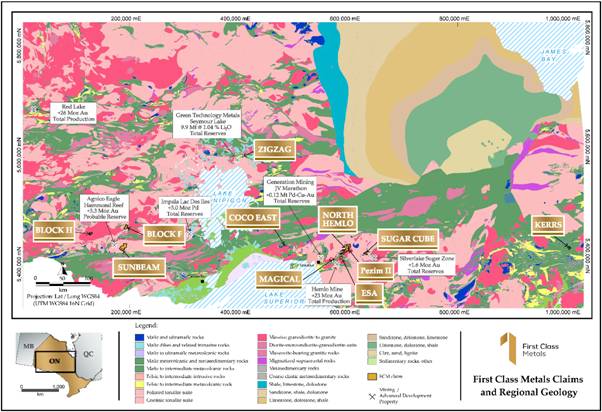
Figure 01 shows the ten property blocks currently under the control of FCMC, including the optioned properties and the JV.
During the reporting period:
• Exploration focused on the flagship properties: Sunbeam and North Hemlo;
• Geophysics and soil sampling grids were conducted at North Hemlo specifically over the Dead Otter trend;
• Ten-hole drill programme was conducted on the Dead Otter trend;
• Drill preparation for Roy on the Sunbeam property, soil and geophysics survey was completed;
• The Company entered into a Letter of Intent with a third party to monetise one of the Company's assets;
• The Company optioned two properties with a focus on Rare Earth Elements (REE); and
• FCM relinquished its option over the Quinlan property after concluding the asset lacks the prospectivity required to advance as a mineral exploration project.
FCM, whilst regularly assessing new land packages and properties offered, considers the two 'flagship' properties of North Hemlo and Sunbeam supported by other assets such as Kerrs and Zigzag to contain the potential to significantly advance the Company.
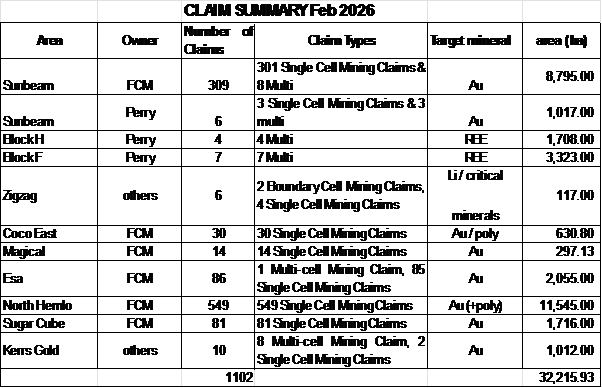
The Company's business model is to add value to the properties and then monetise the asset by structured sale or JV, as was the case with Enable and McKellar in 2024. The steady increase in the lithium price during late '25 and continuing into 2026 bodes well for interest in the Zigzag property. Additionally, the Company announced a potential transaction on one of its assets in June 2025; which, if completed, would be a landmark event for the Company and would reinforce the Company's business model. The following table details the portfolio of ten properties.
Overview of Operations
The 2025 field season was a busy period for First Class Metals, the focus being on the flagship properties with significant field work being conducted on the North Hemlo property culminating in FCM's maiden drill programme on the property focussed on the Dead Otter trend.
Additionally, there were major geological advances on the Sunbeam property with a better understanding of the structural controls to mineralisation being achieved culminating in the confidence to plan a drill programme in early 2026.
FCM, through its 100% owned subsidiary FCMC, continued to explore these two properties whilst other key and non-core properties were left in abeyance as: (a) there were sufficient assessment credits, so work was not required on the non-core properties and (b) so as to maximise expenditure and value addition on the two principal properties.
The business / exploration strategy of FCM is similar in rationale and execution to that of many listed junior exploration companies: to add value leading up to an exit event such as a JV or structured sale. This approach can equally apply to the Company itself or individual projects in the Company's portfolio. To this end two option arrangements were entered into for rare earth element ("REE") properties in northwest Ontario, refer to Figure 1 and Claim Summary table.
FCM intends to continue this business model in 2026: to add value to the existing portfolio as well as to review other opportunities in Ontario that will add potential to the company. However, the focus of any exploration company is the timely undertaking of drilling.
Whilst the Company is monitoring its land position as well as expansion opportunities, the possibility of developing parts of our portfolio by JV is always a consideration. The West Pickle Lake project area under JV with GT Resources Inc. (previously to 'Palladium One Inc.') in the north-east of the North Hemlo property is a clear example of the success of this aspect of the Company's strategy.
Property wide review
Only the Sunbeam and North Hemlo properties (which now includes the OnGold property) were worked in 2025. All the FCM controlled claim blocks shown in Figure 1 and detailed in the Claim summary table remain in good standing to the end of 2025, with only Esa and Coco East necessitating minimum amount spends in 2026 in order to maintain the properties.
As work focused on the two flagship properties in order to maximize exploration advances. Only the flagship properties will be described in detail.
Sunbeam
The Sunbeam Property includes the historic Sunbeam Mine a high-grade underground gold mine which operated from 1898 to 1905. There were also historic developments at Roy, Pettigrew and Reserve Island being the other key zones on the Sunbeam property.
The property now comprises 309 claims in the name of FCMC as well as 6 further claims under option agreements, totalling about 98km², see Figure 02
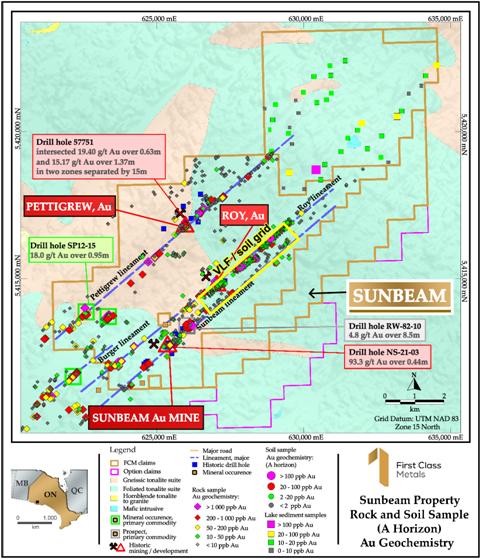
Figure 02 shows the Sunbeam property boundary and the contiguous claims under option. Also shown are three district, sub parallel structure transecting the Property. Note the area of the VLF and soil sampling grid at Roy.
The property is in a prime geological location occupying the geologically favourable area between two Agnico Eagle properties, one being Agnico Eagle's 3.3Moz Hammond Reef deposit, see Figure 03.
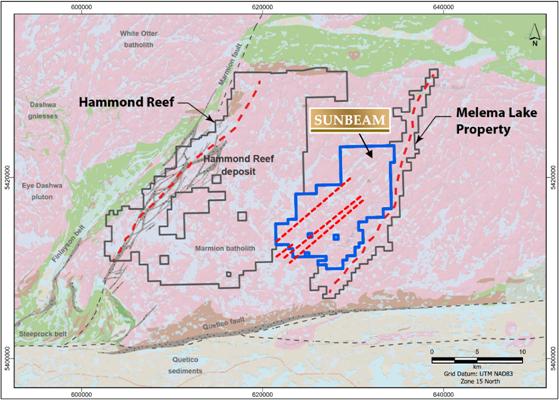
Figure 03 showing the location of the Sunbeam property between two Agnico Eagle properties, the red dotted lines are inferred mineralised structures.
An Exploration Permit, granted to FCMC in June 2023 covers the core area of the property, importantly all three historic developments are included. Furthermore, the same area is under two distinct (though similar) MoU's with the two prominent First Nations who have traditional land claims over an area which includes the Sunbeam property.
The principal exploration activities during the reporting period were an extensive soil sampling and geophysics programme on a >4km long virtual grid with the Roy development at the southwest end, see Figure 04.
Over 500 A-horizon samples were collected along the interpreted northeast extension of the Roy structure. Sample points were 12.5m apart with line spacing of 100m. The results support a robust gold in soil anomaly with one sample exceeding 800ppm Au.
A coincident very low frequency ("VLF") geophysics survey was also completed on the same spacing. The data has not yet been received from the independent consultancy company undertaking the processing and interpretation. The VLF-magnetic survey comprised 905 stations along a cumulative 17.1km.
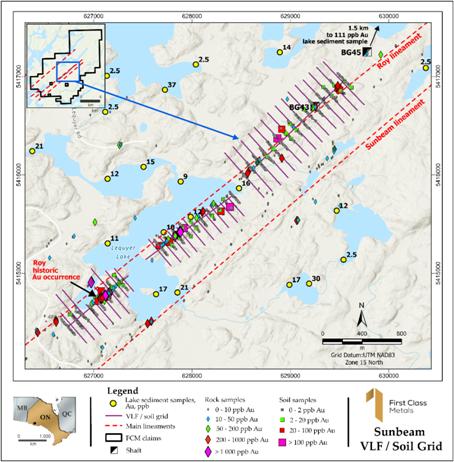
Figure 04 showing the soil / geophysics grid, the Roy development is in the southwest, where drilling was centred.
During the course of the survey a historic shaft was identified. A second shaft has not yet been located on the ground, though historical records confirm its existence. Note that 1.5km to the northeast, along strike is a very anomalous lake sediment sample from a previous winter programme.
A site visit was undertaken with Prof. M.L. Hill who identified key structural controls on the mineralisation at Roy trend, furthermore a review of historic core and petrological studies added further insight to mineralisation controls.
The soil and VLF data once processed will be used in conjunction with other geochemical data to refine targets ahead of possible further drill planning.
Post period
Based on previous work by FCM including prospecting, stripping / channel sampling, a detailed review of the Nuinsco and available TerraX core, soil and preliminary VLF and LiDAR data augmented by further structural measurements at Roy and input from Prof. Mary Louise a drill programme was designed to test new structural concepts at Roy.
A drill programme of a proposed 1,000m of NQ diamond drilling was initiated in Q1 2026.
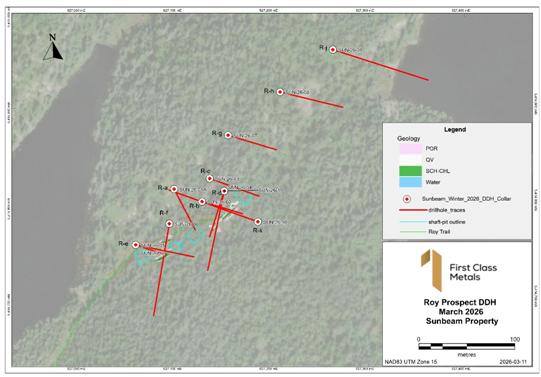
Figure 05 showing the (post period) drill at Roy on the Sunbeam property
By the end of February, five drill holes had been completed for a total of 352m. No assays have been received up to the time of writing. The programme of 12 holes was concluded in March 2026 for a total of 983m, see Figure 05. Two of the initial six drill holes reported visible gold, see Figure 06.

Figure 06 showing visible gold in a drill hole from the Roy trend.
In September the 2025 Ontario Junior Explorers Programmes ("OJEP") grant application was submitted but notification of acceptance was received only post end of period for the purposes of this Annual Report.
The publicly available LiDAR dataset was acquired, and an expert review was initiated in 2025, but the final report had not yet been received.
North Hemlo and Esa
The Hemlo Schreiber greenstone belt has two broad divisions; the south and the north limbs.
The Hemlo producing gold mine is located on the south limb and is associated in a macro sense with shearing and increased molybdenum values. The Hemlo north limb in which the Esa and the North Hemlo (OnGold) properties are located has three distinct structures identified by previous explorers. The structures, interpreted to potentially be shears, in part transect both properties, see Figure 07.
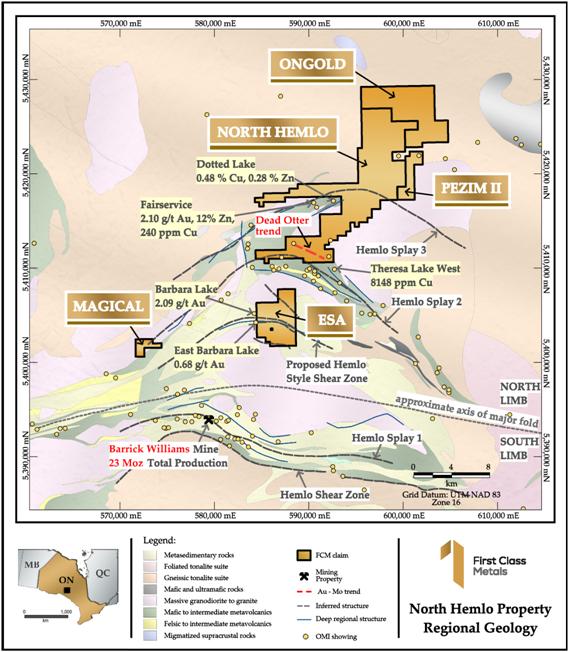
Figure 07 showing the regional geological and structural setting of the North Hemlo (OnGold) and Esa block (Hemlo 'north limb'), relative to the Hemlo gold mine. Note: The Magical claim block is also mentioned.
North Hemlo
The most significant exploration activities on the North Hemlo property during the reporting period were the VLF survey at 6 locations including the Dead Otter trend and one area on the now assimilated OnGold property, see Figure 08 and the drilling on the Dead Otter trend.
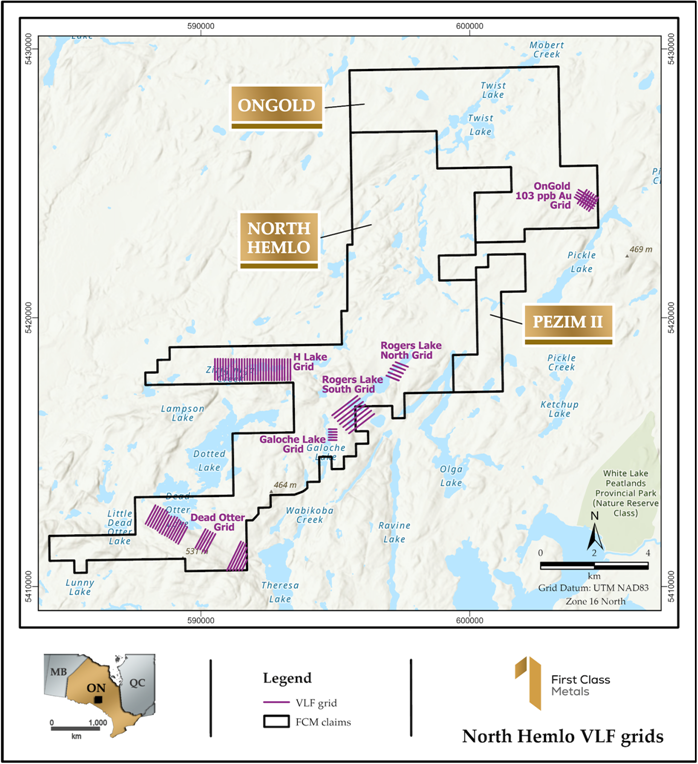
Figure 08 showing the whole North Hemlo property (includes OnGold) with the 6 areas of VLF survey (note the Dead Otter trend had three grids).
Preliminary interpretation of the VLF data showed encouraging structure some of which were 'ground truthed'. However detailed processing of the data is ongoing and once reported will form the basis of a renewed exploration programme throughout the North Hemlo property. It is worth noting that the Rodgers lake area returned a number of highly anomalous lake sediment samples.
An Exploration permit, required for 'invasive' exploration such as trenching, stripping, and drilling, granted for both the North Hemlo and Esa blocks is valid until October 2026. This grant by the Provincial authorities was closely followed by the execution of an Exploration Agreement with Netmizaaggamig Nishnaabeg First Nation (NNFN) in November 2023 (the agreement also covers the Esa and Sugar Cube claim blocks). During the reporting period FCM undertook a drill programme to test the Dead Otter trend, see Figure 09 for drill hole locations.
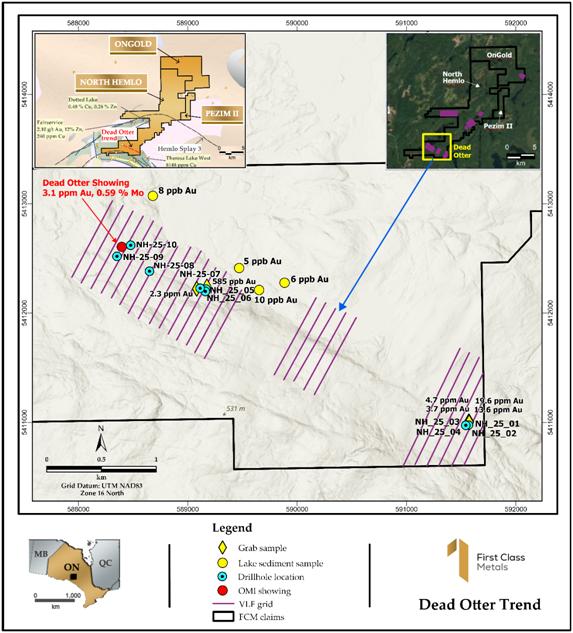
Figure 09 showing the VLF grids on the Dead Otter trend with the locations of the 10 drill holes.
The 10 hole, roughly 750m drill programme was focussed primarily around the 19.6g sample at the southeastern end of the Dead Otter trend. Four holes (~370m) targeted the anomalous zone identified by grab samples. Two holes (25m apart) close to the outcrop were 'stepped-back' on with a steeper, deeper hole.
Other holes in the northwestern zone were to investigate other grab and soil sample anomalies with favourable geology.
Over 400 samples (with QA/QC samples) were submitted to Actlabs in Thunder Bay. The gold assays received did not contain any >1g/t gold (Au) values with the highest assay being 117ppb. However, over 100 samples returned gold values greater than detection. Furthermore, there are also anomalous molybdenum values coincident with albeit only slightly anomalous Au values. This is potentially significant and given their association with Hemlo style mineralisation there remains some encouragement.
Next steps will involve a thorough review of all geological geochemical and geophysical information in order to plan follow up exploration. The drill results will be integrated with the anomalous soil samples as well as the VLF interpretation once completed. Given the encouraging provisional results from the LiDAR over the Sunbeam property area this is also a consideration going forward, given the structural relationship with the mineralisation previously identified is proving critical.
It should be noted that the Dead Otter trend forms only a small area of a highly prospective property.
Summary, strategy, and conclusions
In line with FCM's future corporate plans and divestment strategies across the wider portfolio, it is crucial for the Company to maintain a continuous flow of high-quality prospects that can grow in value over time. The acquisition of additional assets like the two REE properties ensures that FCM is well-positioned for future growth and development. The announced Letter of Intent ("LOI") in respect to asset sale and the decision not to continue the Quinlan option highlights that the Company's strategy is being implemented and is successful.
First Class Metals, through its Canadian subsidiary, controls ten claim blocks totalling ~272km² in northern Ontario, Canada. Two claim blocks (North Hemlo and Sunbeam) account for well over half of the total area.
All the core properties have sufficient assessment credits generated by field work in 2025, to keep them in good standing through to proposed field work in 2026, At the time of writing FCM holds funds or has conducted the exploration required to keep all the claims in good standing for the year 2026 into 2027.
FCM continued its systematic diligent exploration programme covering the core properties in 2025. The results across the North Hemlo property as a block were sufficiently encouraging to warrant further follow-up exploration in the upcoming field season. Field work laid the groundwork for drilling of the Roy prospect at Sunbeam and initial visual indications from the core are encouraging with VG seen in two holes.
While the annual commitment to maintain the claims is approximately CAD$520,000, this expenditure is not necessary in 2026, as assessment credits carried forward from 2025 into the current year are available for many of the properties.
FCM intends to build on the positive exploration results and progress the exploration of the properties to drilling where permitted, pursue the asset sale and initiate exploration on the two new REE properties.
FCM's business model is to assess, add value and develop the properties towards either a sale, joint venture, or relinquishment event. It is currently not the Company's stated aim to become a producer. Priorities will be geared toward the completion of first-pass exploration (realistically drilling) of the principal properties or follow up drilling, in order to fully evaluate the portfolio, both on the merits of the properties and a ranking process.
The Company's strategy remains on track: to identify potential, add value, then monetise by JV or by structured sale.
STRATEGIC REPORT
Key Performance Indicators
Financial
· Market Capitalization: £5.12m on 31st December 2025
· Share Price: 2.13p
Non-Financial
· Due to the nature of the business of the Group typical non-financial KPI's (such as customer retention rate, conversion rate, production efficiency measures etc.) are not applicable to us. Further, while the Group has an effective ESG policy in place, due to unavailability of data such KPI's could not be measured and assessed for the relevant time period. For further details regarding the Group's ESG policy, please see the ESG section of this report.
The principal risks and uncertainties
The principal risks and uncertainties of the Group[1] are outlined below.
A majority of the Group's operating costs will be incurred in US and Canadian dollars, whilst the Group has raised capital in £ Sterling
The Group will incur exploration costs in US and Canadian Dollars, but it has raised capital in £ Sterling. Fluctuations in exchange rates of the US Dollar and Canadian Dollar against £ Sterling may materially affect the Group's translated results of operations. In addition, given the relatively small size of the Group, it may not be able to effectively hedge against risks associated with currency exchange rates at commercially realistic rates. Accordingly, any significant adverse fluctuations in currency rates could have a material adverse effect on the Group's business, financial condition and prospects to a much greater extent than might be expected for a larger enterprise.
Exploration, Development and Operating Risk
Resource exploration and development is a speculative business, characterised by a number of significant risks including, among other things, unprofitable efforts resulting not only from the failure to discover mineral deposits but also from finding mineral deposits that, though present, are insufficient in quantity and quality to return a profit from production. Exploration and development work is the Group's sole business activity.
This risk is accentuated where exploration activity is not carried on as an ancillary activity to a developed business producing operating cash flows from commercial quantities of saleable material from operational activity which can be used to mitigate this risk. The marketability of minerals acquired or discovered by the Group may be affected by numerous factors that are beyond the control of the Group and that cannot be accurately predicted, such as market fluctuations, the proximity and capacity of milling facilities, mineral markets and processing equipment, and such other factors as government regulations, including regulations relating to royalties, allowable production, importing and exporting minerals and environmental protection, the combination of which factors may result in the Group not receiving an adequate return of investment capital.
The business of exploration for minerals and mining involves a high degree of risk. Few properties that are explored, even those demonstrating initial potential, are ultimately developed into producing mines. There is no assurance that the Group's mineral exploration and development activities will result in any discoveries of commercial mineral bodies.
The long-term profitability of the Group's operations will in part be directly related to the costs and success of its exploration and development programs, which may be affected by a number of factors. In recent years, both metal prices and publicly traded securities prices have fluctuated widely.
The Group is not currently generating revenue and will not do so in the near term
The Group is an exploration company and will remain involved in the process of exploring and assessing its asset base for some time. The Group is unlikely to generate revenues until such time as it has made a commercially viable discovery. Given the early stage of the Group's exploration business and even if a potentially commercially recoverable reserve were to be discovered, there is a risk that the grade of mineralisation ultimately mined may differ from that indicated by drilling results and such differences could be material. Accordingly given the very preliminary stages of the Group's exploration activity it is not possible to give any assurance that the Group will ever be capable of generating revenue at the current time unless a material transaction such as the one announced on 09 June 2025 completes.
The Group will need additional financial resources if it moves into commercial exploitation of any mineral resource that it discovers
Whilst the Group has sufficient financial resources to conduct its planned exploration activities, meet its committed licence obligations and cover its general operating costs and overheads for at least 12 months, the Group will need additional financial resources if it wishes to commercially advance any mineral resource discovered because of its exploration activity.
The Group has budgets for all near and short-term activities and plans, however in the longer term the potential for further exploration, development and production plans and additional initiatives may arise, which have not currently been identified, and which may require additional financing which may not be available to the Group when needed, on acceptable terms, or at all. If the Group is unable to raise additional capital when needed or on suitable terms, the Group could be forced to delay, reduce, or eliminate its exploration, development, and production efforts. Additionally, adverse market sentiment could materially impair the Company's ability to access additional capital.
The Group is unaware of any further risks that the business of the Group may be subject to under prevailing market conditions.
Going Concern
As a junior exploration company, the Directors are aware that the Group must seek funds from the market in the next 12 months to meet its investment and exploration plans.
The Group's reliance on a successful fundraising presents a material uncertainty that may cast doubt on the Group's ability to continue to operate as planned and to pay its liabilities as they fall due for a period not less than twelve months from the date of this report.
The Group successfully raised £1,558,000 in the year ended 31 December 2025 through a combination of issuing new shares and convertible loan notes. As at the year-end date the Group had total cash reserves of £77,398 (2024: £221,071).
The Directors are aware of the Group's reliance on fundraising within the next 12 months and the material uncertainty this presents but having reviewed the Group's working capital forecasts they believe the Group is well placed to manage its business risks successfully providing the fundraising is successful.
Section 172 (1) Statement
The First Class Metals Plc Board is cognisant of its legal duty to act in good faith and to promote the success of the Group for the benefit of its shareholders and with regard to the interests of stakeholders and other factors. These include the likely consequence of any decisions we make in the long term, the need to foster relationships we have with all of our stakeholders; the impact our operations have on the environment and local First Nation communities, and the desire to maintain a reputation for high standards of business conduct.
The Board takes a long-term approach to creating and realising value for the shareholders and is aware of the capital and time required in order to develop a resource projects. All of the Group's key assets are early-stage exploration.
The Directors, both individually and collectively, believe, in good faith, that throughout the year and at every meeting of the Board and management when making every key decision, they have acted to promote the success of the Group for the benefit of its members as a whole, as required by Section 172 of the Companies Act 2006, having regard to the stakeholders and matters set out in section 172(1) of the Companies Act 2006. The Directors' Section 172 Statement follows.
Section 172 of the Companies Act is contained in the part of the Act which defines the duties of a director and concerns the "duty to promote the success of the Company".
Section 172 adopts an 'enlightened shareholder value' approach to the statutory duties of a company director, so that a director, in fulfilling his duty to promote the success of the company must act in the way he considers, in good faith, would be most likely to promote the success of the Company for the benefit of its members as a whole, and in doing so have regard to other specified factors insofar as they promote the Company's interests.
The Board of FCM recognises its legal duty to act in good faith and to promote the success of the Group and the Company for the benefit of its shareholders and with regard to the interests of stakeholders as a whole and having regard to other matters set out in Section 172. These include the likely consequences in the long term of any decisions made; the interest of any employees; the need to foster relationships with all stakeholders; the impact future operations may have on the environment and local communities; the desire to maintain a reputation for high standards of business conduct and the need to act fairly between members of the Company.
The Board recognises the importance of open and transparent communication with shareholders and with all stakeholders, including landowners, First Nation communities, and regional and national authorities. We seek to maximise the industry's benefits to local communities, while minimising negative impacts to effectively manage issues of concern to society. Shareholders have the opportunity to discuss issues and provide feedback at any time.
The application of the Section 172 requirements can be demonstrated in relation to the Group operations and activities during the past year as follows.
Having regard to the likely consequences of any decision in the long term
The Group's purpose and vision are set out in the Chairman's Statement and in this Strategic Report. The Board oversees the Company's strategy and is committed to the long-term goal of the development of the Ontario exploration projects. The activities towards that goal are described and discussed in the Strategic Report. The Board remains mindful that its strategic decisions have long-term implications for the progression of all these properties, and these implications are carefully assessed.
Having regard to the need to foster the Group's business relationships with others
The Group operates as a mineral exploration business, without any regular income and is entirely dependent upon new investment from the financial markets for its continued operation. The Board values the benefits of maintaining strong relationships with key partners, contractors, and consultants. This is discussed in more detail elsewhere in this Strategic Report.
Having regard to the interests of the Group employees
The Group currently has no full-time employees and is managed by its directors and a small number of associates and subcontract staff. The Board takes steps to ensure that the suggestions, views, and interests of the Group's personnel are considered in decision-making.
Having regard to the desirability of the Company maintaining a reputation for high standards of business conduct
The Board is committed to high standards of corporate governance, integrity, and social responsibility and to managing the Company in an honest and ethical manner, as further discussed in the Corporate Governance Report. The Directors strive to apply ethical business practices and conduct themselves in a responsible and transparent manner with the goal of ensuring that FCM maintains a reputation for high standards of business conduct and good governance.
Having regard to the impact of the Company's operations on the community and the environment
The Board takes a broad range of stakeholder considerations into account when making decisions and gives careful consideration to any potential impacts on the local community and the environment. The Board strives to maintain good relations with the local community, especially with the First Nations peoples of Ontario.
We recognise the safety and well-being of our employees, local communities, and other stakeholders as a non-negotiable priority. Our commitment to high environmental, social and governance (ESG) standards is central to maintaining our license to operate, to create value for all stakeholders and to ensure commercial success. Our operations are guided by an acute awareness of the role we play as a company in meeting the UN's Sustainable Development Goals (SDGs), including the critical role of strategic minerals in supporting global climate action and complementing resource development in Canada.
As a result, ESG is at the centre of everything the Group undertakes. The Group is dedicated to exploring for precious and battery/base metals in a socially and environmentally responsible way in an industry that will play an essential role in the transition to a lower-carbon economy through underpinning the supply chain for sustainable battery and electric vehicle manufacturing as well as other industrial growth in Canada.
In this way, the Group aims to play an important role in helping Canada meet its emissions reduction targets. FCM aims to comply with all relevant UK and Canadian standards, as well as accepted international guidelines, including strict adherence to the health, safety and environmental standards and regulations, as well as the applicable elements of the Equator Principles. The Group will also endeavour to provide stakeholders with clear insights into our operations to increase assurance regarding the ESG and health and safety aspects of our business.
Our policy consists of five pillars:
1) responsible stewardship,
2) strong partner for local communities (First Nations),
3) an enabler of energy transition,
4) ensuring safe workplaces and operations, and
5) strong governance and an inclusive culture.
Our broad commitments are outlined below. Throughout all operations and our activities, we aim to:
· Play a positive and critical role in the green energy transition.
· Operate in an environmentally responsible manner.
· Promote diversity, inclusion and equality.
Our full ESG report is available on our website.
Greenhouse Gas (GHG) Emissions
The Company is aware that it needs to measure its operational carbon footprint in order to limit and control its environmental impact. The extent to which these activities together with the Group's administrative and management functions result in greenhouse gas emissions is impracticable to estimate and, in any event, less than the amount reportable under the Energy and Carbon Regulations 2018. Additionally, the Company will only measure the impact of its direct activities, as the full impact of the entire supply chain of its suppliers cannot be measured practically.
Board, Shares and Related Parties
Having regard to the need to act fairly as between members of the Group, the Group has only one class of share in issue and all shareholders benefit from the same rights, as set out in the Articles of Association, and as required by the Companies Act 2006. The Board recognises its legal and regulatory duties and does not take any decisions or actions, such as selectively disclosing confidential or inside information, that would provide any shareholder with any unfair advantage or position compared to the shareholders as a whole.
TCFD Compliance Statement - Climate related financial disclosures
Introduction
The Board recognises that transparency regarding climate-related risks and opportunities is critical to maintaining the trust of our stakeholders and allows our investors to understand the implications of the Group's activities on climate change. The Board's consideration of key environmental risks is included under the principal risks and uncertainties section of the Directors' Report. The Board also presents the following synthesis of its adoption of the recommendations of the Task Force on Climate-related Financial Disclosures (TCFD), structured into four sections: Governance, Risk Management, Strategy and Metrics and Targets.
Governance
The Board recognises that operating responsibly, which includes minimizing the environmental impact of our operations, is fundamental to the long-term success of the Group. We believe building a better future involves embedding climate awareness throughout our organisation, starting at the top.
The Board oversees the management of specific risks and opportunities, including climate-related risks and opportunities. The senior management team provides regular updates to our Board on their activities, and, in addition, the Board reviews the risks associated with the Group's operations throughout the year.
Risk Management
The Board recognises that climate change risk is a global issue that may impact how we run our business, both today and in the future. As such, we continue to look for ways to improve our understanding of climate-related risks. However, although the impact of climate change is extremely low at this stage in the Group's development, we are conscious that "doing nothing" isn't an acceptable response to the impact climate change may have on the business in the future. We are therefore working to integrate climate risk variables into our overall risk management process and establish formal multi-disciplinary processes.
Strategy
The Group operates from a corporate head office in the UK but holds metal exploration assets in Ontario, Canada. The nature of these assets includes early-stage exploration with limited invasive impact. The Board is conscious of the inherent environmental risks associated with metals exploration. However, the Board actively encourages its contractors to operate within international environmental guidelines and to perform their activities using the most up-to-date equipment.
Metrics & Targets
The Board is committed to reducing its impact on the environment in all aspects of its business activities in which it operates. The Board engages with all its key stakeholders and partners and encourages the reduction of CO2 emissions throughout the value chain to promote an environment that actively strives towards achieving 'net zero' by 2035. However, at this stage in the Group's development there are no formal metrics or targets to measure the Group's emissions against, but the Board continues to review the need to implement metrics & targets.
 |
 |
CEO
CORPORATE GOVERNANCE REPORT
Introduction
The Company is considered as a 'small cap' company listed on the main market of the London Stock Exchange. It has a board of directors consisting of 4 directors. Of these directors, 2 are considered as Executive directors and 2 are considered Independent Non-Executive Directors. James Knowles, the Executive Chairman, is the only full-time employee of the Company. In order to meet its work-related requirements, the company hires contractors on a periodic basis as and when the need arises.
Considering the size of the Company, the Board believes that it can perform a majority of the functions required by it or through its direct supervision. The Company has two committees: the Audit Committee and the Remuneration Committee which are constituted mainly by two Independent Non-Executive Directors.
Further information on the Board's administrative and management functions along with information about each of the two Board committees and their composition and function as well as their respective activities for the year 2025 can be found below in this Corporate Governance Report.
Chairman's Statement
First Class Metals seeks to operate with a high degree of good corporate governance practice at its core. Corporate governance refers to the set of processes, policies, and procedures that are in place to ensure that a company operates in a responsible and ethical manner. This includes everything from financial oversight to the way that we interact with our employees, and other stakeholders.
Effective corporate governance is crucial to the long-term success of our Company. By maintaining high standards of transparency, accountability and ethical behaviour, we can build trust with our stakeholders and create a strong foundation for sustainable growth.
To that end, we have established a comprehensive framework for corporate governance that covers all aspects of our operations. This includes a clear code of conduct for all employees, regular audits and assessments of our financial and operational performance, and robust systems for risk management and compliance.
We believe that our commitment to corporate governance is a key differentiator for our Company, and we will continue to invest in this area to ensure that we maintain the highest standards of integrity and ethical behaviour in all that we do.
The Chairman takes the lead in ensuring that the various facets of the Company are functioning in an ethical way compliant with best practices in the industry. Under the leadership of the Chairman the Company has policies in place in order to ensure effective corporate governance. These policies are reviewed annually.
The Board aims to lead by example and do what is in the best interest of the Company. We operate in remote and developing areas and ensure our employees and contractors understand their obligations towards the environment and in respect of anti-bribery and corruption. Regular calls with senior employees serve to refresh and re-iterate the Company's ethical standards as they apply to the operational issues that are discussed on that call. All employees are informed of responsibilities with regard to anti-bribery and anti-corruption when they join the Company. Contracts with suppliers also reflect these requirements. Employees are required to treat each other with respect and to not tolerate any form of discrimination.
Anti-Bribery Policy
The anti-bribery policy of the Company aims to ensure that the Company and its employees, agents and business partners comply with all relevant anti-bribery laws and regulations. The policy prohibits any form of bribery, including giving, offering, promising, or receiving bribes, and outlines the procedures for reporting and investigating any suspected violations of the policy. The policy also emphasizes the importance of due diligence in the selection and monitoring of business partners, and provides guidance on gifts, hospitality and donations. The Company's commitment to anti-bribery measures is often reinforced by training, regular risk assessments and reviews of the policy's effectiveness.
Whistle Blower Policy
The whistle-blower policy of the Company is designed to encourage employees and others to report any suspected wrongdoing, including illegal or unethical activities, without fear of retaliation. The policy outlines the procedures for reporting such concerns, including options for confidential reporting, and ensures that all reports will be investigated in a fair and objective manner. The policy also emphasizes the Company's commitment to protecting the confidentiality of whistle-blowers and to taking appropriate action against any retaliation. The Company typically provides training and guidance to its employees and other stakeholders to promote awareness of the policy and its importance.
Environmental, Social, and Governance (ESG) Policy
The ESG policy of the Company outlines its commitment to environmental, social, and governance principles and its approach to managing ESG risks and opportunities. The policy covers a range of issues, including climate change, energy use, human rights, labour standards and board diversity. The Company sets targets and measures its performance against relevant ESG standards and integrates ESG considerations into its decision-making processes. The Company also engages with stakeholders, including investors, suppliers, and communities, to promote transparency and accountability, and to identify and address emerging ESG issues. The Company's ESG policy demonstrates its commitment to responsible and sustainable business practices, which can contribute to long-term value creation and resilience.
Equality and Diversity Policy
The Board is committed to our equality, diversity and inclusion policies. The Company actively promotes equality, diversity and inclusion, and proactively removes and addresses any activities or behaviours that may jeopardise this policy.
The Company aims to create an environment where all stakeholders can work harmoniously, feel valued, appreciated, and included, irrespective of race ethnicity, culture, gender, skin colour, sexual orientation, marital status, religion, disability, ability, educational background, family background, political background, health or representative of any community.
The Company is an equal opportunity employer, which allows equal opportunity for employment and progression in the organisation on the basis of ability, qualifications and aptitude for the work. Every employee shall be treated equally and have the right to a harmonious work environment where an individual is treated fairly and with dignity and respect.
The Board is committed to equality, diversity, and inclusion. While there is no formal diversity policy in place due to the current size of the Group, the Directors remain committed to diversity among our staff and leadership team, and this is revisited each year. The Company actively promotes equality, diversity and inclusion, and proactively removes and addresses any activities or behaviours that may jeopardise this commitment. The Company aims to create an environment where all stakeholders can work harmoniously, feel valued, appreciated, and included, irrespective of race, ethnicity, culture, gender, skin colour, sexual orientation, marital status, religion, disability, ability, education background, family background, political background, health or representative of any community.
Compliance with the Quoted Company Alliance Code
In addition to the above, although the Company is not required to comply with the UK Code of Corporate Governance because the Company is listed on the Equity Shares (transition) category of with the London Stock Exchange. Compliance with the Quoted Company Alliance Code is being undertaken on a voluntary basis to the extent it is considered appropriate considering the size of the Group. Specifically, the Group has adopted and complies with the following principles:
Principle One: Establish a strategy and business model which promote long-term value for shareholders.
The Board implements a well-defined strategy that aims at securing long-term growth for the shareholders. The details of the same can be found in the Strategic Report.
Principle Two: Seek to understand and meet shareholder needs and expectations.
The Board is committed to maintaining good communications with its shareholders and with investors with a view to understanding their needs and expectations. The Board and, in particular, the Chairman, maintains close contact with many of the shareholders.
All shareholders are encouraged to attend the Company's Annual General Meetings where they can meet and directly communicate with the Board.
The Company publishes an Annual Report, Financial Statements and Interim Results. All of which are available at the Company's website. The Company also provides regular regulatory announcements and business updates through the Regulatory News Service (RNS) and copies of such announcements are posted to the Company's website.
Shareholders and investors also have access to information on the Group through the Company's website, http://www.firstclassmetalsplc.com/ which is updated on a regular basis, and which also includes the latest corporate presentation of the Company.
Principle Three: Take into account wider stakeholder and social responsibilities and their implications for long-term success.
The Company will engage positively and seek to develop close relationships with local communities, regulatory authorities and stakeholders which are in close proximity to or connected with its overseas operations and where appropriate the Board will take steps to safeguard the interests of such stakeholders.
The Board has adopted detailed ESG, Equality and Diversity, Anti-Bribery and Whistle-blower policies. The Board plans, in due course, to adopt further appropriate policies to ensure that the Group's activities are compliant with best industry practices.
Principle Four: Embed effective risk management, considering both opportunities and threats, throughout the organisation.
The Board regularly reviews its business strategy and, in particular, identifies and evaluates the risks and uncertainties which the Group is or may be exposed to. As a result of such reviews, the Board will take steps to manage risks or seek to remove or reduce the Group's exposure to them as much as possible.
The risks and uncertainties to which the Group is exposed at present and in the foreseeable future are detailed in Principal Risks and Uncertainties in the Strategic Report.
The Company has a system of financial controls and reporting procedures in place which are considered to be appropriate given the size and structure of the Group.
Principle Five: Maintain the Board as a well-functioning, balanced team led by the Chairman.
James Knowles, the Executive Chairman, leads the Board and is responsible for the effective performance of the Board through control of the Board's agendas and the running of its meetings. James Knowles, in his capacity as Executive Chairman, also has overall responsibility for the corporate governance of the Company. James Knowles takes an active part in the day-to-day corporate aspects of the Company. The day-to-day operational running of the Group is delegated to Marc Sale, the Chief Executive Officer.
The Board holds Board meetings periodically, and at least four times a year, as issues arise which require the attention of the Board. Prior to such meetings, the Board's members receive an appropriate agenda and relevant information and reports for consideration on all significant strategic, operational and financial matters and other business and investment matters which may be discussed and considered.
The Board is supported by the Remuneration and Audit Committees, details of which are set out on below.
Principle Six: Ensure that between them the directors have the necessary up to date experience, skills and capabilities.
The Directors' qualifications and experience are set out on in the Directors' Report. The Board believes that the current balance of sector, technical, financial, operational and public markets skills and experience which its members have is appropriate for the current size and stage of development of the Company. The Company Secretary provides advice and guidance, as required, to the Board on regulatory matters, assisted by the Company's lawyers. The Directors seek to keep their skills up to date through continuing professional development and attending relevant courses. Directors from a technical discipline are encouraged to maintain professional accreditation.
Principle Seven: Evaluate board performance based on clear and relevant objectives, seeking continuous improvement.
The Board's performance is reviewed and considered in the light of the progress and achievements against the Group's long-term strategy and its strategic objectives. However, given the size and nature of the Group, the Board does not consider it appropriate to have a formal performance evaluation procedure in place. The Board will closely monitor the situation as required.
Principle Eight: Promote a corporate culture that is based on ethical values and behaviours.
The Company has established corporate governance arrangements which the Board believes are appropriate for the current size and stage of development of the Company.
The Company has adopted a number of policies applicable to directors, officers and employees and, in some cases, to suppliers and contractors as well, which, in addition to the Company's corporate governance arrangements set out above, are designed to provide the Company with a positive corporate culture. Details of the Board's Policies can be found within this Corporate Governance Report.
Principle Nine: Maintain governance structures and processes that are fit for purpose and support good decision-making by the Board.
Whilst the Board has overall responsibility for all aspects of the business, James Knowles, the Executive Chairman, is responsible for overseeing the running of the Board and ensuring that Board focuses on and agrees with the Group's long-term direction and its business strategy and reviews and monitors the general performance of the Group in implementing its strategic objectives.
The Board has established the Remuneration Committee and the Audit Committee with formally delegated duties and responsibilities. Further, the Board will have a Nomination Committee in place in the coming months.
This Corporate Governance Statement will be reviewed at least annually to ensure that the Company's corporate governance framework evolves in line with the Company's strategy and business plan.
Principle Ten: Communicate how the Company is governed and is performing by maintaining a dialogue with shareholders and other relevant stakeholders.
The Company's approach to communication with shareholders and others is set out under Principles 2 and 3 above.
Leadership of the Board
The Board comprised of 2 Executive Directors and 2 Non-Executive Directors.
The Board is charged with the leadership of the Company and to ensure its long terms success. The key responsibilities of the Board include:
Strategy and Planning
The Board is responsible for setting the Company's long-term strategy and goals.
Risk Management
The Board identifies and assesses the risks associated with the Company's operations, including financial, legal, and reputational risks.
Financial Oversight
The Board oversees the Company's financial operations, including budgeting, financial reporting and auditing.
Corporate Governance
The Board ensures that the Company follows good corporate governance practices, including transparency, accountability and ethical behaviour.
Stakeholder Management
The Board considers the interests of all stakeholders, including shareholders, employees, suppliers and the community and ensures that the Company's operations are sustainable and socially responsible.
Monitoring Performance
The Board monitors the Company's performance against its goals and strategy. It regularly reviews the Company's financial and non-financial performance and makes necessary adjustments to ensure the Company is meeting its objectives.
Division of Responsibilities
The Board has defined the responsibilities of the Chairman, and the CEO as follows:
James Knowles, Chairman: The Chairman is primarily responsible for leading the Board and providing direction for the organisation. The Chairman is responsible for leading meetings, facilitating effective communication between members of the Company, setting goals and strategies for the organisation, and ensuring accountability. He is also directly involved in assisting the CEO on day-to-day matters
Marc Sale, CEO: The CEO is responsible for the overall day to day running of the Company and reports to the Board in which role he is supported by the Chairman.
Independent Non-Executive Directors
Independent non-executive directors ("INEDs") play a crucial role in corporate governance by bringing an objective and independent perspective to the boardroom. Their primary responsibility is to act in the best interest of the Company and its stakeholders by providing oversight, guidance and strategic input to the Board.
The role of the independent Non-Executive Directors is as follows:
• Provide independent oversight: INEDs are responsible for providing an objective and independent perspective on the Company's activities and performance. They scrutinize the Board's decisions and ensure that the Company is complying with legal and regulatory requirements.
• Monitor and advise on risk management: INEDs monitor the Company's risk management policies and procedures and advise the Board on potential risks and their mitigation strategies.
• Review and challenge management decisions: INEDs review and challenge management decisions to ensure that they are aligned with the Company's strategic goals and do not pose any risks to the Company's reputation or financial stability.
• Provide strategic guidance: INEDs bring their expertise and experience to the Board and provide strategic guidance on matters such as mergers and acquisitions, capital allocation and corporate social responsibility.
• Represent the interests of stakeholders: INEDs represent the interests of all stakeholders, including shareholders, employees, customers and suppliers, and ensure that their views are taken into account when making decisions.
Andrew Williamson and Marc Bamber are considered to be INEDs of the Company.
Board Support, Meeting, and Attendance
The Board and its Committees meet regularly on scheduled dates. In leading and controlling the Company, the Directors are expected to attend all meetings and their attendance for the financial year 2025 is shown in the Directors' Report.
The Company Secretary plays a vital role in ensuring good governance, assisting the Chairman. Procedures are in place for distributing meeting agendas and reports so that they are received in good time, with the appropriate information. Ahead of each Board meeting, the Directors each receive reports which include updates on strategy, finance, including management accounts, operations, commercial activities, business development, risk management, legal and regulatory, people and infrastructure and on investor relations. The Directors may have access to independent professional advice, where needed, at the Company's expense.
Board Induction, Training and Development
New Directors are provided with a full and tailored induction in order to introduce them to the business and management of the Company. Throughout their tenure, Directors are given access to the Company's operations and personnel, and receive updates on relevant issues as appropriate, taking into account their individual qualifications and experience. This allows the Directors to function effectively with appropriate knowledge of the Company.
The Board is satisfied that each Director has sufficient time to devote to discharging his responsibilities as a Director of the Company.
Re-Election of Directors
Directors are required to retire and, if eligible, stand for re-election: i) during the third Annual General Meeting from the Annual General Meeting at which they were first elected and at every third Annual General Meeting thereafter; or ii) on the following Annual General Meeting in case they were appointed by the Board of Directors, as is required by the Company's Articles of Association. The composition of the Board is provided above.
Board Committees
The Board has delegated and empowered two Committees: An Audit Committee and a Remuneration Committee.
The Company has thus far not formed a Nomination Committee due to the size of its Board.
Each Committee has written terms of reference set by the Board, which are reviewed annually. The Chair of each committee reports to the Board on the activities of and determinations of such committee. A summary of each Committee's responsibilities and the work done during the year follows.
Audit Committee Report
Composition of the Audit Committee
The Audit Committee comprises of Marc Bamber (Chair of the committee) and Andrew Williamson. The Board considers all members of this committee to have the appropriate skills and expertise. See Director biographies in the Directors' report.
The appointments to the Audit Committee are made by the Board. Only members of the committee have the right to attend these meetings, however the Executive Directors or senior financial members of the Company may be invited by the Committee in order to provide their opinion as required. The external auditor may also attend the meetings and discuss as required the planning and conclusions of their work. The committee also calls upon information from management and consults with the external auditor if required.
The committee meets at least twice a year directly linked to the Company's half year and full year results. It further meets as required.
Operation of the Committee
The Audit Committee periodically reviews and updates the Terms of Reference in order to conform to best practices. These are subject to Board approval.
The Committee works to a planned programme of activities, which are focused on key events in the annual financial reporting cycle and other matters that are considered in accordance with its Terms of Reference.
The Committee operates within terms of reference approved by the Board, including:
• Considering the appointment of external auditors.
• Reviewing relationship with external auditors.
• Reviewing financial reporting and internal control procedures.
• Reviewing the consistency of accounting policies.
An important part of the role of the Audit Committee is its responsibility for reviewing the effectiveness of the Company's financial reporting, internal control policies, and procedures for the identification, assessment and reporting of risk.
The Directors are responsible for internal control in the Company and for reviewing effectiveness. Due to the size of the Company, all key decisions are made by the Board. The Directors have reviewed the effectiveness of the Company's systems during the period under review and consider that there have been no material losses, contingencies, or uncertainties due to weaknesses in the controls. A key governance requirement of the Company's financial statements is for the report and accounts to be fair, balanced and understandable. The coordination and review of the Company wide input into the Annual Report is a sizeable exercise performed within an exacting time frame. It runs alongside the formal audit process undertaken by external auditors and is designed to arrive at a position where initially the Committee, and then the Board, is satisfied with the overall fairness, balance, and clarity of the document.
An essential part of the integrity of the financial statements are the key assumptions and estimates or judgements that have to be made. The Committee reviews key judgements prior to publication of the financial statements at the full and half year, as well as considering significant issues throughout the year. In particular, this includes reviewing any materially subjective assumptions within the Group's activities. The Committee reviewed and was satisfied that the judgements exercised by management on material items contained within the Annual Report were reasonable and that there were no significant issues that needed to be addressed in relation to the financial statements. The key assumptions and estimates or judgements that have been used in preparing these financial statements are set out in note 3 to the accounts.
Internal financial control
Financial controls have been established to maintain proper accounting records and to provide reliable financial information for internal use. Key financial controls include:
• The maintenance of proper records;
• A schedule of matters reserved for the approval of the Board;
• Evaluation, approval procedures and risk assessment for acquisitions; and
• Close involvement of the Executive Directors in the day-to-day operational matters of the Group.
The Directors are responsible for the Group's methods of internal control. The Group's risk management protocols and internal control methods are designed to reduce risk associated with the business of the Group and achieve its strategic objectives. The Group has established procedures of internal control that are considered adequate for a business of the size of the Group.
Audit, Risk and Internal Control
The Audit Committee did not face any significant issues in relation to the preparation of the financial statements. The financial accounts were prepared by the Company with the assistance of DSG Accountancy and Professional Services Limited and were audited by Royce Peeling Green Limited.
 |
Marc Bamber
Audit Committee Chairman
30 April 2026
Remuneration Report
Composition of the Remuneration Committee
The Remuneration Committee for the reporting period comprised of Andrew Williamson (Chair of the Committee) and Marc Bamber.
Role of the Remuneration Committee
The Remuneration Committee's function includes ascertaining the policy and amount of the remuneration of the Executive Directors and other executives including bonuses, incentive payments and share options.
Remuneration Policy
The Remuneration Committee is committed to ensuring that the Company's key executive team is incentivised to drive sustainable earnings growth and returns to shareholders, thereby creating a genuinely strong alignment of interests between management and investors. The Company's remuneration policy aims to provide its members with a competitive market aligned remuneration package to reward their performance and deliver value for shareholders. Remuneration packages are aligned against to that of similar organisations in the sector.
Remuneration policy is designed to ensure that it attracts, retains and motivates the executive members of the Company for the long term. The basic structure of a remuneration package consists of a basic salary, an annual bonus plan and a pension plan.
The remuneration policy is based on the following principles:
1. Fairness and equity: The remuneration should be fair and equitable, ensuring that employees receive compensation that is commensurate with their skills, experience, and performance.
2. Transparency: The remuneration policy should be transparent, ensuring that employees understand how their compensation is determined, including the criteria used for performance evaluation and promotion. As a listed Public Company, an effective measure used to evaluate performance is the prevailing market price of the Company's stock and its performance over various time periods.
3. Competitive compensation: The policy aims to offer compensation that is competitive with industry standards, allowing the Company to attract and retain top talent.
4. Incentives for performance: The policy includes incentives for high performance, such as bonuses or other forms of variable pay, to motivate employees to achieve their goals and objectives.
5. Flexibility: The policy is flexible, allowing for adjustments to compensation based on changes in market conditions, industry trends, and individual employee performance.
6. Regular review: The policy is regularly reviewed and updated to ensure it remains effective and relevant to changing organisational needs and market conditions.
Remuneration of Directors
The remuneration policy and packages of the Directors were duly covered in detail in the Annual Report 2024 and approved at the Annual General meeting of the Company held on 9 June 2025. Further, details of the same will be submitted to the general body of the shareholders at the forthcoming Annual General Meeting of the Company.
a. Remuneration of Executive Directors
During the year, the Executive Directors received a basic salary and benefits as set out in the table below.
b. Remuneration of Non-Executive Directors
The remuneration of the Non-Executive Directors is set by the Board. They attend meeting of the Board of the Company as well as perform their functions in the various Board committees.
Directors Remuneration Report
|
Notes:
1. Marc Sale's company Specialist Exploration Services Scotland Limited ("SES") was paid a total of £126,694 during the year. These payments include travel/accommodation & out of pocket expenses incurred through the period by SES on behalf of First Class Metals PLC amounting to £4571.30.
2. Bonus Payments totalling £75,000 as follows: £30,000 to James Knowles, £30,000 to Marc Sale, £10,000 to Marc Bamber and £5,000 to Andrew Williamson were awarded in 2024. A portion of this sum has been paid and the outstanding payable sums as of 31 December 2025 are: £20,000 to James Knowles, £20,000 to Marc Sale, £5,000 to Marc Bamber and £2,500 to Andrew Williamson. No other bonuses were awarded to this date.
Company Pension Scheme
As of 31 December 2025, the Company has a pension plan in place which the Directors may opt in to whereupon the Company will pay contributions in relation to their remuneration. Thus far, only Marc Sale has opted in. The Company has not paid out any further excess retirement benefits to any other Directors.
Service Contracts
The Company has entered into service contracts with each of its directors. These contracts are on an ongoing basis with the Executive Directors and includes a six month notice period in case of termination.
The contracts with the INEDs are on a three-year basis with an option to renew upon mutual agreement.
The Company entered into a consultancy agreement with Specialist Exploration Services (Scotland) Limited (SES) on 1 March 2022 (SES Consultancy Agreement), pursuant to which SES agreed to provide certain consultancy services to the Company.
SES is a company that Marc Sale owns 51% of. The engagement commenced with effect from 1 March 2022 and shall continue unless terminated as provided for in the SES Consultancy Agreement or on the giving of not less than four weeks' prior written notice by either party. The engagement is for a minimum commitment of at least 12 days per month with such additional time, if any, as may be necessary for the proper performance of the services.
The Company has entered into an agreement for services with Vrynwy Limited on October 12, 2023. Vrynwy Limited has appointed Andrew Williamson as an INED of the Company. The agreement has a term of three years. The agreement may be terminated by either party by giving one month's notice to the other. The agreement is subject to the Company's Articles of Association as may be amended from time to time.
The Company has entered into an agreement for services with Marc Bamber on 25 July 2022. The agreement has a term of three years. The agreement may be terminated by either party by giving six months' notice to the other. The agreement is subject to the Company's Articles of Association as may be amended from time to time. Upon request by Marc Bamber, the payments for such services are being made to his company Buffalo Associates Limited. Copies of the letters of appointments and service contracts awarded to Directors are kept at the registered office of the Company for inspection.
Directors' interest in shares
Holder |
Number of Shares | % of total capital issued |
James Knowles | 9,949,258 | 3.9% |
Marc Sale | 696,419 | 0.27% |
Marc Bamber | 1,377,965 | 0.54% |
Andrew Williamson | - | - |
During the reporting period, two meetings of the Committee were held on 5 August 2025 and 17 September 2025 in order to evaluate and recommend suitable bonuses and pay increases to reward the efforts made by various members of the Company, however, it was determined that as the Company was waiting on the completion of certain events, no changes would be made as of the date of the meeting. =
The Committee considered and recommended a Share Option Plan in December 2023, and the Board of Directors adopted the same. Currently no share options have been awarded under this scheme. However, it is the intention of the Company to award share options as described in the table below at such time the recipients are no longer in possession of inside information as per UK Market Abuse Regulations with specific reference to the press release of 9 June 2025 announced by the Company.
Grantee |
Number of Options | Exercise Price[2] |
James Knowles | 4,000,000 | To be determined |
Marc Sale | 795,000 | £0.02[3] |
Marc Sale | 4,000,000 | To be determined |
Marc Bamber | 2,000,000 | To be determined |
Andrew Williamson | 2,000,000 | To be determined |
Siddharth Muricken | 2,000,000 | To be determined |
Consideration of shareholder views
The Remuneration Committee considers shareholder feedback received and guidance from shareholder bodies. This feedback, plus any additional feedback received from time to time, is considered as part of the Company's periodic reviews of its policy on remuneration.
UK 10-year performance graph
The directors have considered the requirement for a UK 10-year performance graph comparing the Group's Total Shareholder Return with that of a comparable indicator. The directors do not currently consider that including the graph will be meaningful because the Company has only been listed since July 2022, is not paying dividends and is currently incurring losses as it gains scale. The Directors therefore do not consider the inclusion of this graph to be useful to shareholders at the current time. The Directors will review the inclusion of this table for future reports.
UK 10-year CEO table and UK percentage change table
The Directors have considered the requirement for a UK 10-year CEO table and UK percentage change table. The Directors do not currently consider that including these tables would be meaningful because, as described under the Directors' Service Contracts section above, Directors have been engaged in the Company only since July 2022. The Directors will review the inclusion of this table for future reports.
Relative importance of spend on pay
The Directors have considered the requirement to present information on the relative importance of spend on pay compared to shareholder dividends paid. Given that the Company does not currently pay dividends the Directors have not considered it necessary to include such information.
Policy for new appointments
Base salary levels will take into account market data for the relevant role, internal relativities, the individual's experience, and their current base salary. Where an individual is recruited at below market norms, they may be re-aligned over time (e.g. two to three years), subject to performance in the role. Benefits will generally be in accordance with the approved policy.
For external and internal appointments, the Committee may agree that the Company will meet certain relocation and/or incidental expenses as appropriate.
Policy on payment for loss of office
Payment for loss of office would be determined by the Remuneration Committee, taking into account contractual obligations.

|
Andrew Williamson
Remuneration Committee Chairman
DIRECTORS' REPORT
The Directors present their report together with the audited financial statements for the year ended 31 December 2025.
A review of the business and principal risks and uncertainties has been included in the Strategic Report.
Principal Activity
The principal activities of the Company during the period were the acquisition and the exploration and development of its property assets. Successful acquisitions have been completed in 2025
Dividends
No dividend has been paid during the year, nor do the Directors recommend the payment of a final dividend (2024: £nil).
Directors
The Directors who served during the year and up to the date hereof were as follows:
Date of appointment | Date of resignation | |
Marc Sale | 16 June 2022 | 03 March 2025 |
Marc Sale | 2 September 2025 | - |
James Knowles | 26 January 2021 | - |
Andrew Williamson | 15 October 2023 | - |
Marc Bamber | 22 July 2022 | - |
David Webster | 03 March 2025 | 31March 2025 |
Directors' Indemnity Provisions
The Company has implemented Directors and Officers Liability Indemnity insurance.
Donations
The Company made no political donations during the year (2024: £nil).
Share Capital
First Class Metals Plc is incorporated as a public limited company and is registered in England and Wales with the registered number 13158545. The Company has one class of Ordinary Share, and all shares have equal voting rights and rank pari passu for the distribution of dividends and repayment of capital.
Substantial Shareholdings
Details of changes in share capital during the year are detailed in note 17 to the financial statements. On 31 December 2025 shareholders may be analysed as follows:
Major Shareholders
Shareholder | As of 31st December 2024Number of Ordinary Shares | % of issued ordinary share capital | As at the date of this documentNumber of Ordinary Shares | % of issued ordinary share capital |
James Goozee | 25,456,928 | 10.58% | 41,620,184 | 11.58% |
79th Group Limited | 78,552,084 | 32.65% | 0 | 0% |
Power Metal Resources Plc and Power Metals Canada | 19,033,802 | 7.91% | 19,033,802 | 5.17% |
Anthony Harris | 0 | 16,882,738 | 4.46% | |
Darren Andrew Rowlands | 0 | 16,223,709 | 4.44% | |
James Knowles | 9,949,258 | 4.13% | 9,949,258 | 2.70% |
Ayub Bodi | 10,149,256 | 4.21% | 10,149,256 | 2.75% |
Others sub 3% | 97,444,871 | 40.5% | 254,090,525 | 69.05% |
- | ||||
Total Issued | 240,586,199 |
| 367,949,472 |
|
Board of Directors
The Board currently consists of two executive Directors & two independent non-executive Directors. It met regularly throughout 2025 to discuss key issues and to monitor the Company's overall performance. All matters and committees, such as Remuneration and Audit are considered by this Board.
James Knowles
Executive Chairman
A corporate professional who has enjoyed a twenty-five-year career in the financial sector, James is primarily focused on debt funding for Real Estate projects, most recently for Barclays Bank PLC. James is a seasoned resource company investor and has consulted to several London and Canadian listed junior resource companies on investor relations, public relations and social media marketing activities.
Marc Sale
Executive Director & Chief Executive Officer
A corporate professional who has specialised in natural resources, specifically precious and base metals, with a focus on gold, for over 25 years. Marc has worked on project assessment, exploration, and development in Africa, the Americas, Europe, and Australasia. He has held Technical Directorships for several listed and private companies, including Brancote PLC, Landore Resources PLC, Gold Mines of Sardinia, and Patagonia Gold. As a 'Competent Person' he is accomplished in the preparation of Company reports and overseeing JORC/NI43-101 reporting as well as delivery of presentations to investors, institutions and shareholders.
Andrew Williamson
Non-Executive Director
Andrew qualified as a lawyer in 1990 and has worked in the corporate field throughout his career. As a corporate partner, he advised on corporate and capital market transactions, both debt and equity. He has substantial experience of listings on the major stock markets around the world. He also has extensive experience of public and private corporate transactions and the creation of domestic and international investment funds. A former institutional corporate stockbroker, nomad, and sponsor to the Full List, he is known to use his extensive commercial experience to assist his clients with their legal issues. He has been recognized as a recommended lawyer by legal 500 in the private acquisition and merger (sub £100m) category and in the debt capital market category.
Marc Bamber
Non-Executive Director
A Global Corporate Financier, with over 20 years of experience in the hedge fund sector, capital markets, private and institutional investments, investor comms, and marketing. Marc was a core member of the multiple award-winning RAB Special Situations Fund that delivered net returns of 50x to investors with circa. US$2.8Bn in Assets Under Management (AUM) in just under five years. Marc is very active in the international markets and works with a number of Toronto and London-listed companies in senior management roles.
Directors' powers
As set out in the Company's Articles of Association, the business of the Company is managed by the Board which may exercise all powers of the Company.
Directors' Remuneration
A total of £360,964 was paid as remuneration to Directors for the year ended 31 December 2025. The remuneration of the Directors will further be put to the approval of the shareholders at the forthcoming Annual General Meeting of the Company
Board Activities
The Board has determined that the Company will have a minimum of four Board Meetings, one Audit Committee Meeting and two Remuneration Committee Meetings each year. Due to necessary circumstances, the Board held a total of 10 meetings during the year 2025. The meeting of the Audit Committee was held on 30 April 2025, and the meetings of the Remuneration Committee were held on 5 August and 17 September 2025.
The table below provides an overview of the attendance of the various directors.
Board Meeting Attendance | ||
Name of Director | Meetings Attended | |
James Knowles | 10 |
|
Marc Sale | 5[4] |
|
Marc Bamber | 8 |
|
Andrew Williamson | 10 |
|
David Webster | 0 |
|
Explanation of Board Performance and Effectiveness
During the financial year ended 31 December 2025 a Board evaluation was carried out, and it has been determined that the Board has been effective during the period. Additionally, the Board believes that it has developed a suitable composition in order to continue to perform as a cohesive Board for the foreseeable future.
Auditor
First Class Metals Plc had appointed Royce Peeling Green Limited (RPG) on 9 February 2023. RPG has expressed its willingness to continue in office.
At the Annual General Meeting for the year 2025, the Board assessed the performance of RPG for the previous year and recommended to the shareholders that RPG be re-appointed as auditors to the Company for an additional term of one year. This was duly passed by the shareholders as an ordinary resolution.
RPG is a long-established firm of Chartered Accountants and a Public Interest Entity (PIE) registered auditor based in Manchester, England. RPG is a UK member of DFK International, a leading global association of independent accounting firms with a significant international presence across numerous countries. In the UK, RPG operates from two offices with a team of approximately 100 staff, including 10 directors.
RPG does not provide any non-audit services to the Company and therefore its objectivity and independence are safe-guarded.
It is also to be noted that there are no contractual obligations restricting the Board's choice of external auditor.
A resolution to reappoint RPG will be proposed at the forthcoming Annual General Meeting.
Shareholder Communications
The Company uses its corporate website https://www.firstclassmetalsplc.com/ to ensure that the latest announcements, press releases and published financial information are available to all shareholders and other interested parties. The AGM will be used to communicate with both institutional shareholders and private investors and all shareholders are encouraged to participate. The Company counts all proxy votes and will indicate the level of proxies lodged on each resolution after it has been dealt with by a show of hands.
Disclosure of Information to the Auditor
Each of the persons who is a Director at the date of approval of this Annual Report confirms that:
• so far as the Director is aware, there is no relevant audit information of which the Company's auditors are unaware; and
• the Director has taken all the steps that he ought to have taken as a director in order to make himself aware of any relevant audit information and to establish that the Company's auditors are aware of that information.
Statement of Directors' Responsibilities in respect of the Annual Report and the financial statements
The Directors are responsible for preparing this report and the financial statements in accordance with applicable United Kingdom law and regulations and UK adopted International Financial Reporting Standards ("IFRS").
Company law requires the Directors to prepare financial statements for each financial period which present fairly the financial position of the Company and the financial performance and cash flows of the Company for that period.
In preparing those financial statements, the Directors are required to:
• select suitable accounting policies and then apply them consistently;
• make judgements and estimates that are reasonable and prudent;
• present information, including accounting policies, in a manner that provides relevant, reliable, comparable, and understandable information;
• state whether applicable IFRSs have been followed, subject to any material departures disclosed and explained in the financial statements;
• prepare the financial statements on the going concern basis unless it is inappropriate to presume that the Company will continue in business; and
• provide additional disclosures when compliance with the specific requirements in IFRS is insufficient to enable users to understand the impact of particular transactions, other events and conditions on the entity's financial position and financial performance.
The Directors are responsible for keeping adequate accounting records that are sufficient to show and explain the Company's transactions and disclose with reasonable accuracy at any time the financial position of the Company and enable them to ensure that its financial statements comply with the Companies Act 2006. They are also responsible for safeguarding the assets of the Company and hence for taking reasonable steps for the prevention and detection of fraud and other irregularities.
Under applicable law and regulations, the Directors are also responsible for preparing a Strategic Report, Directors' Report, Directors' Remuneration Report and Corporate Governance Statement that comply with that law and those regulations, and for ensuring that the Annual Report includes information required by the Listing Rules of the Financial Conduct Authority.
The financial statements are published on the Company's website https://www.firstclassmetalsplc.com/. The work carried out by the Auditor does not involve consideration of the maintenance and integrity of this website and accordingly, the Auditor accepts no responsibility for any changes that have occurred to the financial statements since they were initially presented on the website. Visitors to the website need to be aware that legislation in the United Kingdom covering the preparation and dissemination of the financial statements may differ from legislation in their jurisdiction.
The directors reduce the risk by outsourcing the preparation of consolidated financial statements to DSG https://www.dsg.uk.com/, a firm of chartered accountants who have adequate skills and experience necessary to do so.
The Directors confirm that to the best of their knowledge:
• the Company financial statements give a true and fair view of the assets, liabilities, financial position and profit or loss of the Group;
• this Annual Report includes the fair review of the development and performance of the business and the position of the Group together with a description of the principal risks and uncertainties that it faces; and
• the Annual Report and Financial Statements, taken as a whole, are fair, balanced, and understandable and provide information necessary for shareholders to assess the Group and Company's performance, business and strategy.
Forward Looking Statements
This document contains certain forward-looking statements. The forward-looking statements reflect the knowledge and information available to the Directors of the Company and Group during preparation and up to the publication of this document. By their very nature, these statements depend upon circumstances and relate to events that may occur in the future and thereby involving a degree of uncertainty. The statements, estimates and projections herein are based upon various assumptions by the Company that may not prove to be correct. Such assumptions are inherently subject to significant economic and competitive uncertainties and contingencies, many of which are beyond the control of the Company, and upon assumptions with respect to the future performance of the Company that may be subject to change because of circumstances beyond the control of the directors and/or the Company. The Company believes that such estimates and other assumptions are reasonable under the circumstances, but no representation, warranty or other assurance is given that such statements, estimates and projections will be realized. There may be variances between such projections and actual events and results.
Post period events
The Company was awarded an OJEP Grant from the Canadian Ministry of Mines for the Sunbeam property for work completed up to March 2026. No cash sums have been received yet.
For further information see: https://firstclassmetalsplc.com/announcements/7456816
An NQ diamond drilling programme was completed in Q1 2026 at the Roy Prospect within the Sunbeam Property. The programme comprised over 1,000 metres of drilling. All assay samples have been submitted to the laboratory for analysis, and results are currently pending. Positive initial results have been received and published. The initial hole which attempted to twin the historic drill hole (SP-11-12 4g/t Au over 1.85m) contained ~2m @1.3g/t Au; the second hole contained 1.1m @ 2.3g/t. Holes three and four both contained a metre at roughly 0.5g/t Au. The photon assay results have also been received for the three sections of core with reported visible gold. Hole 06 (second reported dual occurrence of visible gold) contained two consecutive samples giving 0.6m @ 2.2g/t Au. Significantly hole 05 which contained the initial report of visible gold, returned 0.3m @ 45g/t gold which would equate to almost 5 ounces of gold over one metre, 150g/m (gram metres). Further assay results are pending as of the time of writing.
For further information see: https://firstclassmetalsplc.com/announcements/7504435
No other adjusting or significant non-adjusting events have occurred between the 31 December reporting date and the date of authorisation.
This report is approved by the Board on 30 April 2026 and signed on its behalf by:

James Knowles
Chairman
First Class Metals Plc
(Registration number: 13158545)
Consolidated Income Statement for the Year Ended 31 December 2025
Note | 31 December2025£ | 31 December2024£ | |
Revenue | - | - | |
Administrative expenses | (1,220,055) | (1,365,274) | |
Profit on disposal of intangible assets | - | 31,906 | |
Operating loss | 5 | (1,220,055) | (1,333,368) |
Finance income | 1,145 |
177 | |
Finance costs | (54,672) |
(26,766) | |
Net finance cost | 6 | (53,527) | (26,589) |
Loss before tax | (1,273,582) | (1,359,957) | |
Taxation | 10 | - | - |
Loss for the year | (1,273,582) | (1,359,957) |
Items that may be reclassified subsequently to profit or loss | |||
Foreign currency translation (losses)/gains | 39,598 | (13,904) | |
Total comprehensive loss for the year | (1,233,984) | (1,373,861) | |
Total comprehensive loss attributable to: | |||
Owners of the company | (1,233,984) | (1,373,861) |
The above results were derived from continuing operations.
Loss per share
Basic and diluted loss per share (pence) | 11 | (0.61)p | (1.53)p |
First Class Metals Plc
(Registration number: 13158545)
Consolidated Statement of Financial Position as of 31 December 2025
Note | 31 December2025£ | 31 December2024£ | |
Assets | |||
Non-current assets | |||
Property, plant, and equipment | 13 | 10,716 | 16,731 |
Mineral property exploration and evaluation | 12 | 4,033,288 | 3,643,342 |
4,044,004 | 3,660,073 | ||
Current assets | |||
Trade and other receivables | 15 | 61,050 | 90,389 |
Cash and cash equivalents | 16 | 77,398 | 221,071 |
138,448 | 311,460 | ||
Total assets | 4,182,452 | 3,971,533 | |
Equity and liabilities | |||
Equity | |||
Share capital | 17 | 240,586 | 100,819 |
Share premium | 18 | 8,129,187 | 5,474,035 |
Equity reserve | 18 | - | 713,761 |
Foreign currency translation reserve | 18 | 25,806 | (13,792) |
Retained earnings | 18 | (5,058,183) | (3,784,601) |
Equity attributable to owners of the company | 3,337,396 | 2,489,822 | |
Current liabilities | |||
Trade and other payables | 20 | 442,549 | 558,603 |
Loans and borrowings | 19 | 402,507 | 700,000 |
845,056 | 1,258,603 | ||
Non-current liabilities | |||
Trade and other payables | 20 | - | 223,108 |
Total liabilities | 845,056 | 1,481,711 | |
Total equity and liabilities | 4,182,452 | 3,971,533 | |
The financial statements were approved and authorised for issue by the Board on 30 April 2026 and signed on its behalf by:
James Peter Knowles - Executive Chairman
Director
First Class Metals Plc
(Registration number: 13158545)
Company Statement of Financial Position as of 31 December 2025
Note | 31 December2025£ | 31 December2024£ | |
Assets | |||
Non-current assets | |||
Property, plant, and equipment | 13 | 10,424 | 16,731 |
Investments in subsidiary | 14 | 581 | 581 |
11,005 | 17,312 | ||
Current assets | |||
Trade and other receivables | 15 | 4,623,078 | 3,893,229 |
Cash and cash equivalents | 16 | 77,398 | 187,842 |
4,700,476 | 4,081,071 | ||
Total assets | 4,711,481 | 4,098,383 | |
Equity and liabilities | |||
Equity | |||
Share capital | 17 | 240,586 | 100,819 |
Share premium | 18 | 8,129,187 | 5,474,035 |
Equity reserve | 18 | - | 713,361 |
Retained earnings | 18 | (4,272,106) | (3,213,191) |
Total equity | 4,097,667 | 3,075,024 | |
Current liabilities | |||
Trade and other payables | 20 | 211,307 | 323,359 |
Loans and borrowings | 19 | 402,507 | 700,000 |
613,814 | 1,023,359 | ||
Total equity and liabilities | 4,711,481 | 4,098,383 | |
The Company's loss for the year was £1,058,916 (2024: loss of £1,103,260).
The financial statements were approved and authorised for issued by the Board on 30 April 2026 and signed on its behalf by:
James Peter Knowles - Executive Chairman
Director
First Class Metals Plc
Consolidated Statement of Changes in Equity for the Year Ended 31 December 2025
Share capital£ | Share premium£ | Equity reserve£ | Foreign currency translation£ | Retained earnings£ | Total equity£ | |
On 1 January 2025 | 100,819 | 5,474,035 | 713,361 | (13,792) | (3,784,601) | 2,489,822 |
Loss for the year | - | - | - | - | (1,273,582) | (1,273,582) |
Other comprehensive income | - | - | - | 39,598 | - | 39,598 |
Total comprehensive income | - | - | - | 39,598 | (1,273,582) | (1,233,984) |
New share capital subscribed | 139,767 | 2,655,152 | - | - | - | 2,794,919 |
Shares to be issued | - | - | - | - | - | - |
Other equity reserve movements | - | - | (713,361) | - | - | (713,361) |
On 31 December 2025 | 240,586 | 8,129,187 | - | 25,806 | (5,058,183) | 3,337,396 |
Share capital£ | Share premium£ | Equity reserve£ | Foreign currency translation£ | Retained earnings£ | Total equity£ | |
On 1 January 2024 | 82,046 | 4,719,622 | 719,440 | 112 | (2,424,644) | 3,096,576 |
Loss for the year | - | - | - | - | (1,359,957) | (1,359,957) |
Other comprehensive income | - | - | - | (13,904) | - | (13,904) |
Total comprehensive income | - | - | - | (13,904) | (1,359,957) | (1,373,861) |
New share capital subscribed | 18,773 | 754,413 | - | - | - | 773,186 |
Shares to be issued | - | - | 353,641 | - | - | 353,641 |
Other equity reserve movements | - | - | (359,720) | - | - | (359,720) |
On 31 December 2024 | 100,819 | 5,474,035 | 713,361 | (13,792) | (3,784,601) | 2,489,822 |
First Class Metals Plc
Company Statement of Changes in Equity for the Year Ended 31 December 2025
Share capital£ | Share premium£ | Equity reserve£ | Retained earnings£ | Total£ | |
On 1 January 2025 | 100,819 | 5,474,035 | 713,361 | (3,213,191) | 3,075,024 |
Loss for the year | - | - | - | (1,058,915) | (1,058,915) |
Total comprehensive income | - | - | - | (1,058,915) | (1,058,915) |
New share capital subscribed | 139,767 | 2,655,152 | - | - | 2,794,919 |
Shares to be issued | - | - | - | - | - |
Other equity reserve movements | - | - | (713,361) | - | (713,361) |
On 31 December 2025 | 240,586 | 8,129,187 | - | (4,272,106) | 4,097,667 |
Share capital£ | Share premium£ | Equity reserve£ | Retained earnings£ | Total£ | |
On 1 January 2024 | 82,046 | 4,719,622 | 719,440 | (2,109,031) | 3,411,177 |
Loss for the year | - | - | - | (1,103,260) | (1,103,260) |
Total comprehensive income | - | - | - | (1,103,260) | (1,103,260) |
New share capital subscribed | 18,773 | 754,413 | - | - | 773,186 |
Shares to be issued | - | - | 353,641 | - | 353,641 |
Other equity reserve movements | - | - | (359,220) | - | (359,220) |
On 31 December 2024 | 100,819 | 5,474,035 | 713,361 | (3,213,191) | 3,075,024 |
First Class Metals Plc
Consolidated Statement of Cash Flows for the Year Ended 31 December 2025
Note | 31 December2025£ | 31 December2024£ | |
Cash flows from operating activities | |||
Loss for the year | (1,273,582) | (1,359,957) | |
Adjustments to cash flows from non-cash items | |||
Depreciation and amortisation | 5 | 6,405 | 1,495 |
Impairment losses | 5 | 92,185 | 3,153 |
(Profit)/loss on disposal of mineral properties exploration and evaluation assets | 5 | - | (31,906) |
Foreign exchange loss/(gain) | 5 | 60,330 | 202,357 |
Finance income | 6 | (1,145) | (177) |
Finance costs | 6 | 54,672 | 26,766 |
(1,061,135) | (1,158,269) | ||
Working capital adjustments | |||
Decrease/(increase) in trade and other receivables | 15 | 29,339 | 199,623 |
Increase in trade and other payables | 21 | (113,097) | 255,181 |
Net cash flow from operating activities | (1,144,893) | (703,465) | |
Cash flows from investing activities | |||
Interest received | 6 | 1,145 | 177 |
Acquisitions of property plant and equipment | (390) | (17,323) | |
Proceeds of disposal of mineral property exploration and evaluation assets | 12 | - | 262,480 |
Acquisition of mineral property exploration and evaluation assets | 12 | (568,802) | (653,081) |
Net cash flows from investing activities | (568,047) | (407,747) | |
Cash flows from financing activities | |||
Interest paid | 6 | - | - |
Proceeds from issue of ordinary shares, net of issue costs | 520,000 | 773,186 | |
Proceeds from other borrowing draw downs | 1,038,000 | 700,000 | |
Repayment of other borrowing | - | (160,000) | |
Financing of shares loaned by directors | - | (103,220) | |
Finance cost of financial instruments | (54,672) | (26,766) | |
Foreign exchange gains or losses | 65,939 | 8,281 | |
Net cash flows from financing activities | 1,569,267 | 1,191,481 | |
Net (decrease)/increase in cash and cash equivalents | (143,673) | 80,269 | |
Cash and cash equivalents on 1 January | 221,071 | 140,802 | |
Cash and cash equivalents on 31 December | 77,398 | 221,071 | |
First Class Metals Plc
Notes to the Financial Statements for the Year Ended 31 December 2025
1 | General information |
The Company is a public company limited by share capital, incorporated and domiciled in England and Wales. The principal activity of the Company was that of a holding company.
The principal activity of the Group was that of the exploration of gold and other semi-precious metals as well as battery metals critical to energy storage and power generation solutions.
The Company's ordinary shares are traded on the London Stock Exchange (LSE) under the ticker symbol FCM.
The address of its registered office is:
Manor Court Offices
Suite 24 Manor Court,
Salesbury Hall Road, Ribchester,
Preston, Lancashire,
PR3 3XR,
United Kingdom
These consolidated financial statements comprise the Company and its subsidiary, First Class Metals Canada Inc. (together referred to as 'the Group').
These financial statements were authorised for issue by the board on 30 April 2026.
2 | Accounting policies |
Statement of compliance
The statutory financial statements have been prepared in accordance with International Financial Reporting Standards (IFRS) as adopted by the UK and in accordance with UK companies' legislation, as applicable to companies reporting under IFRS.
Basis of preparation
The financial information has been prepared on the historical cost basis.The financial statements are of the Group and Company are presented in sterling (£), which is the Company's functional currency. Each group entity determines its own functional currency, that of the subsidiary entity being Canadian $. All items included in the financial statements of each entity are measured using that functional currency.
First Class Metals Plc
Notes to the Financial Statements for the Year Ended 31 December 2025 (continued)
2 | Accounting policies (continued) |
Basis of consolidation
The consolidated financial statements comprise the financial information of the Company and its subsidiary made up to the end of the reporting period. Control is achieved when the Group is exposed, or has rights, to variable returns from its involvement with the investee and has the ability to affect those returns through its power over the investee.The consolidated financial statements present the results of the Company and its subsidiary as if they formed a single entity. Inter-company transactions and balances between group companies are therefore eliminated in full. The financial information of subsidiaries is included in the Group's financial statements from the date that control commences until the date that control ceases.The Company has taken advantage of the exemption available under section 408 of the Companies Act 2006 and elected not to present its own Income Statement in these financial statements.
Profit or loss and each component of other comprehensive income (OCI) are attributed to the equity holders of the parent of the Group. When necessary, adjustments are made to the financial information of subsidiaries to bring their accounting policies into line with the Group's accounting policies.
Adoption of New and Revised Standards
The following standards and amendments became effective in the year:
• IFRS 16 Amendments to clarify how a seller-lessee subsequently measures sale and leaseback transactions.
• Amendment to IAS 7 and IFRS 7 - Supplier finance
• Amendment to IAS 1 - Non-current liabilities with covenants
There has been no material impact from the adoption of new standards, amendments to standards or interpretations which are relevant to the Group.
New standards and interpretations not yet adopted
Certain new standards, amendments and interpretations to existing standards have been published that are mandatory for accounting periods beginning on or after 1 January 2026 and which the Group has chosen not to adopt early. These include the following standards which are relevant to the Group:
• Amendments to IAS 21 - Lack of Exchangeability
• IFRS S1, 'General requirements for disclosure of sustainability-related financial information
• IFRS S2, 'Climate-related disclosures'
• Amendments to IFRS 9 and IFRS 7 - Classification and Measurement of Financial Instruments
• IFRS 18 - Presentation and Disclosure in Financial Statements
The Group does not expect that the standards and amendments issued but not yet effective will have a material impact on results or net assets.
First Class Metals Plc
Notes to the Financial Statements for the Year Ended 31 December 2025 (continued)
2 | Accounting policies (continued) |
Going concern
As a junior exploration company, the Directors are aware that the Company must seek funds from the market in the next 12 months to meet its investment and exploration plans and to maintain its listing status.The Group's reliance on a successful fund raising presents a material uncertainty that may cast doubt on the Group's ability to continue to operate as planned and to pay its liabilities as they fall due for a period not less than twelve months from the date of this report.The Company successfully raised £1,558,000 in the year ended 31 December 2025 through a combination of issuing new shares and warrant conversions. As at the year-end date the Group had total cash reserves of £77,398 (2024: £221,802).
Additionally, the Company is advancing multiple transactions, which if successful, would have a substantial positive effect on the Company's business.The Directors are aware of the reliance on fund raising within the next 12 months and the material uncertainty this presents but having reviewed the Group's working capital forecasts they believe the Group is well placed to manage its business risks successfully providing the fund raising is successful.
Government grants
Government grants received of a capital nature are generally deducted in arriving at the carrying amount of the asset purchased. Grants that are receivable as compensation for expenses or losses already incurred or for the purpose of giving immediate financial support to the Group with no future related costs are recognised in profit or loss in the period in which they become receivable. Where retention of a government grant is dependent on the Group satisfying certain criteria, it is initially recognised as deferred income. When the criteria for retention have been satisfied, the deferred income balance is released to the consolidated income statement or netted against the asset purchased.
Foreign currency transactions and balances
Transactions in currencies other than the Group's functional currency are recognised at the rates of exchange prevailing at the dates of the transaction. At the end of each reporting period, monetary items denominated in foreign currencies are translated at the rates prevailing at that date. Non-monetary items that are measured in terms of historical costs are not re-translated.Exchange gains or losses arising from translations of foreign currency monetary assets, liabilities and transactions are recorded in foreign exchange gain (loss) in the statement of net income (loss).
Segmental reporting
Operating segments are presented using the 'management approach', where the information presented is on the same basis as the internal reports provided to the Executive Chairman. The Executive Chairman is responsible for the allocation of resources to operating segments and assessing their performance.
First Class Metals Plc
Notes to the Financial Statements for the Year Ended 31 December 2025 (continued)
2 | Accounting policies (continued) |
Tax
Income tax expense represents the sum of the tax currently payable and deferred tax.
The tax currently payable is based on taxable profit for the year. Taxable profit differs from profit reported in the Income statement because it excludes items of income or expense that are taxable or deductible in other years and it further excludes items that are not taxable or tax deductible. The Group's liability for current tax is calculated using tax rates (and tax laws) that have been enacted or substantively enacted in countries where the Group and its subsidiaries operate by the end of the financial period.Deferred tax is recognised in respect of all timing differences that have originated but not reversed at the balance sheet date where transactions or events have occurred at that date that will result in an obligation to pay more, or a right to pay less or to receive more tax, with the following exceptions:
Deferred tax assets are recognised only to the extent that the Directors consider that it is more likely than not that there will be suitable taxable profits from which the future reversal of the underlying timing differences can be deducted. Deferred tax is measured on an undiscounted basis at the tax rates that are expected to apply in the periods in which timing differences reverse, based on tax rates and laws enacted or substantively enacted at the balance sheet date.
Property, plant, and equipment
Property, plant, and equipment is stated in the statement of financial position at cost, less any subsequent accumulated depreciation and subsequent accumulated impairment losses.The cost of property, plant and equipment includes directly attributable incremental costs incurred in their acquisition and installation.
Depreciation
Depreciation is charged so as to write off the cost of assets over their estimated useful lives, as follows:
Asset class | Depreciation method and rate |
Property | Over the term of the lease |
Computer equipment | 3 years - straight line basis |
First Class Metals Plc
Notes to the Financial Statements for the Year Ended 31 December 2025 (continued)
2 | Accounting policies (continued) |
Mineral property exploration and evaluation
Exploration and evaluation assets under IFRS 6 include acquired mineral use rights for mineral properties held by the Group. Mineral exploration and evaluation expenditures are capitalised. The amount of consideration paid (in cash or share value) for mineral use rights is capitalised on a project-by-project basis pending determination of the technical feasibility and the commercial viability of the project. Capitalised costs include costs directly related to exploration and evaluation activities in the area of interest. General and administrative costs are only allocated to the asset to the extent that those costs can be directly related to operational activities.
Mineral property exploration and evaluation assets will be amortised or impaired to profit and loss once commercial production has been achieved or written off if the exploration assets are abandoned or sold. Depletion of costs capitalised on projects when put into commercial production will be recorded using the unit-of-production method based upon estimated proven and probable reserves. The ultimate recoverability of the amounts capitalised for the exploration and evaluation assets and expenditures is dependent upon the delineation of economically recoverable ore reserves, obtaining and retaining the necessary permits to operate a mine, and realising profitable production or proceeds from the disposition thereof.
The commercial viability of extracting a mineral resource is considered to be determinable when resources are determined to exist. The property rights are current, and it is considered probable that the costs will be recouped through successful development and exploitation of the project, or alternatively by the sale of the property. Upon determination of resources, exploration, and evaluation assets attributable to those resources are first tested for impairment and then reclassified from exploration and evaluation assets to mineral property interests. Expenditures deemed unsuccessful are recognised in operations in the income statement.
Impairment of mineral property exploration and evaluation
The carrying values of capitalised exploration and evaluation assets are assessed for impairment if fact and circumstances indicate that the carrying amount exceeds the recoverable amount and sufficient data exists to evaluate technical feasibility and commercial viability. If any indication of impairment exists, an estimate of the asset's recoverable amount is calculated. The recoverable amount is determined as the higher of the fair value less costs of disposition and the asset's value in use. If the carrying amount of the asset exceeds its estimated recoverable amount, the asset is impaired, and an impairment loss is charged to the income statement so as to reduce the carrying amount to its estimated recoverable amount.
If individual claims/ cells are abandoned for one reason or another, then the property as a whole will be considered for impairment. An impairment presumption also exists if no work has been done on a claim/ cell in three years. Cash resources are taken into consideration to justify claim preservation/ renewal in the forthcoming twelve months.
Investments in subsidiaries
Investments in subsidiary companies are classified as non-current assets and included in the Statement of financial position of the Company at cost, less provision for impairment at the date of acquisition.
Cash and cash equivalents
Cash and cash equivalents comprise cash on hand and call deposits, and other short-term highly liquid investments that are readily convertible to a known amount of cash and are subject to an insignificant risk of changes in value.
First Class Metals Plc
Notes to the Financial Statements for the Year Ended 31 December 2025 (continued)
2 | Accounting policies (continued) |
Trade payables
Trade payables are obligations to pay for goods or services that have been acquired in the ordinary course of business from suppliers. Accounts payable are classified as current liabilities if payment is due within one year or less (or in the normal operating cycle of the business if longer). If not, they are presented as non-current liabilities.Trade payables are recognised initially at the transaction price and subsequently measured at amortised cost using the effective interest method.
Borrowings
All borrowings are initially recorded at the amount of proceeds received, net of transaction costs. Borrowings are subsequently carried at amortised cost, with the difference between the proceeds, net of transaction costs, and the amount due on redemption being recognised as a charge to the Income statement over the period of the relevant borrowing.Interest expense is recognised on the basis of the effective interest method and is included in finance costs.Borrowings are classified as current liabilities unless the Group has an unconditional right to defer settlement of the liability for at least 12 months after the reporting date.
Contingent liabilities and contingent assets
A contingent liability is a possible obligation that arises from past events and whose existence will only be confirmed by the occurrence or non-occurrence of one or more uncertain future events not wholly within the control of the Group. It can also be a present obligation arising from past events that is not recognised because it is not probable that outflow of economic resources will be required, or the amount of obligation cannot be measured reliably.
A contingent liability is not recognised but is disclosed in the notes to the accounts. When a change in the probability of an outflow occurs so that the outflow is probable, it will then be recognised as a provision. A contingent asset is a possible asset that arises from past events and whose existence will be confirmed only by the occurrence or non-occurrence of one or more uncertain events not wholly within the control of the Group. Contingent assets are not recognised but are disclosed in the notes to the accounts when an inflow of economic benefits is probable. When inflow is virtually certain, an asset is recognised.
Share capital
Ordinary shares are classified as equity. Equity instruments are measured at the fair value of the cash or other resources received or receivable, net of the direct costs of issuing the equity instruments.
Defined contribution pension obligation
A defined contribution plan is a pension plan under which fixed contributions are paid into a separate entity and which has no legal or constructive obligations to pay further contributions if the fund does not hold sufficient assets to pay all employees the benefits relating to employee service in the current and prior periods.For defined contribution plans contributions are paid to publicly or privately administered pension insurance plans on a mandatory or contractual basis. The contributions are recognised as employee benefit expense when they are due. If contribution payments exceed the contribution due for service, the excess is recognised as an asset.
First Class Metals Plc
Notes to the Financial Statements for the Year Ended 31 December 2025 (continued)
2 | Accounting policies (continued) |
Financial instruments
A financial instrument is any contract that gives rise to a financial asset of one entity and a financial liability or equity instrument of another entity.
Financial assets and liabilities are recognised in the Group's Statement of Financial Position when the Group becomes party to the contractual provision of the instrument. The following policies for financial instruments have been applied in the preparation of consolidated financial statements:
The Group and Company's financial assets which comprise loans and receivables and other debtors are measured at amortised cost.
The classification depends on the business model for managing the financial assets and the contractual terms of the cash flows. Financial assets are classified as at amortised cost only if both of the following criteria are met:
• the asset is held within a business model whose objective is to collect contractual cash flows; and
• the contractual terms give rise to cash flows that are solely payments of principal and interest.
Financial liabilities (other than convertible debt) are classified as other financial liabilities measured at amortised cost. Financial liabilities are initially recognised at fair value, net of directly attributable transaction costs, and are subsequently measured at amortised cost. A financial liability is de‑recognised when the obligation under the liability is discharged, cancelled or expires.
Compound financial instruments
Compound financial instruments issued by the Company comprise convertible loan notes that can be converted to share capital at the option of the holder, and the number of shares to be issued does not vary with changes in their fair value.
The liability component of a compound financial instrument is initially recognised at the fair value of a similar liability that does not have an equity conversion option. The equity component is initially recognised at the difference between the fair value of the compound financial instrument as a whole and the fair value of the liability and equity components in proportion to the initial carrying amounts.
Subsequent to initial recognition, the liability component of a compound financial instrument is measured at amortised cost using the effective interest method. The equity component of a compound financial instrument is not re-measured subsequent to initial recognition except on conversion or expiry.
3 | Critical accounting judgements and key sources of estimation uncertainty |
Certain amounts included in the financial statements involve the use of judgement and/or estimation. These judgements and estimates are based on the management's best knowledge of the relevant facts and circumstances, having regard to prior experience, but actual results may differ from the amounts included in the financial statements. Information about such judgements and estimates is contained in the accounting policies and/or the notes to the financial statements.Significant areas of estimation uncertainty and critical judgements made by management in preparing the consolidated financial statements include:
First Class Metals Plc
Notes to the Financial Statements for the Year Ended 31 December 2025 (continued)
3 | Critical accounting judgements and key sources of estimation uncertainty (continued) |
Recognition of evaluation and exploration assets
Judgement is required in determining when the future economic benefit of a project can be reasonably be regarded as assured, at which point evaluation and exploration expenses are capitalised. This includes the assessment of whether there is sufficient evidence of the probability of the existence of economically recoverable minerals to justify the commencement of capitalisation of costs.
The carrying value at the year-end was £4,033,288 (2024: £3,643,342).In connection with possible impairment of exploration and evaluation assets the Directors assess each potentially cash generating unit annually to determine whether any indication of impairment exists. The judgements made when making these assessments are similar to those set out above and are subject to the same uncertainties.
4 | Segmental information |
Identification of reportable operating segments
The Group is organised into one corporate function in the UK and the operating segment, being mining and exploration operations. This operating segment is the subsidiary in Canada, for which the Executive Chairman assesses its performance and determines the allocation of resources.
The information reported to the Executive Chairman is on a monthly basis.
Geographical information
Income statement analysis |
| ||||||||||||||||||
| 2025 | 2024 | |||||||||||||||||
|
| UK | Canada | Total | UK | Canada | Total | ||||||||||||
| £ | £ | £ | £ | £ | £ | |||||||||||||
Administrative expenses | 1,060,061 | 159,994 | 1,220,055 | 1,099,581 | 265,693 | 1,365,274 | |||||||||||||
Non-current assets |
| ||||||||||||||||||
| 2025 | 2024 | |||||||||||||||||
|
| UK | Canada | Total | UK | Canada | Total | ||||||||||||
| £ | £ | £ | £ | £ | £ | |||||||||||||
Mineral property exploration and evaluation asset | - | 4,033,288 | 4,033,288 | - | 3,643,342 | 3,643,342 | |||||||||||||
5 |
| Operating loss | |||||||||||||||||
Arrived at after charging
31 December2025£ | 31 December2024£ | |
Depreciation expense | (6,405) | (1,495) |
Impairment losses | (92,185) | (3,153) |
Profit on disposal of mineral properties exploration and evaluation assets | - | 31,906 |
Foreign exchange losses | (20,732) | (202,357) |
First Class Metals Plc
Notes to the Financial Statements for the Year Ended 31 December 2025 (continued)
6 | Finance income and costs | ||
31 December2025£ | 31 December2024£ | ||
Finance income | |||
Interest income on bank deposits | 1,145 | 177 | |
Finance costs | |||
Interest on bank overdrafts and borrowings | - | - | |
Interest expense on other financing liabilities | (54,672) | (26,766) | |
Total finance costs | (54,672) | (26,766) | |
Net finance costs | (53,527) | (26,589) | |
7 | Staff costs | ||
The aggregate payroll costs (including directors' remuneration) were as follows:
31 December2025£ | 31 December2024£ | |
Wages and salaries | 119,596 | 200,414 |
Social security costs | 6,863 | 9,782 |
Other short-term employee benefits | - | - |
Pension costs, defined contribution scheme | 28,000 | 18,000 |
154,459 | 228,196 |
The average monthly number of persons employed by the group (including directors) during the year, analysed by category was as follows:
31 December2025No. | 31 December2024No. | ||
Administration and support | 4 | 4 | |
8 | Directors' remuneration | ||
The directors' remuneration for the year was as follows:
31 December2025£ | 31 December2024£ | |
Remuneration | 332,904 | 373,502 |
Contributions paid to money purchase schemes | 28,000 | 18,000 |
360,904 | 391,502 |
First Class Metals Plc
Notes to the Financial Statements for the Year Ended 31 December 2025 (continued)
8 | Directors' remuneration
| ||||||||||||||||||||||||||||||||||||||||||||||||||||
| |||||||||||||||||||||||||||||||||||||||||||||||||||||
9 | Auditors' remuneration | ||||||||||||||||||||||||||||||||||||||||||||||||||||
31 December2025£ | 31 December2024£ | ||||||||||||||||||||||||||||||||||||||||||||||||||||
Audit of these financial statements | 37,200 | 31,000 | |||||||||||||||||||||||||||||||||||||||||||||||||||
10 | Income tax | ||||||||||||||||||||||||||||||||||||||||||||||||||||
The tax on profit before tax for the year is the same as the standard rate of corporation tax in the UK of 25% (2024: 25%).
The actual tax charge for the year can be reconciled to the expected charge for the year based on the profit or loss and the standard rate of tax as follows:
31 December2025£ | 31 December2024£ | |
Loss before tax | (1,273,582) | (1,359,957) |
Corporation tax at standard rate of 25% (2024: 25%) | (318,396) | (339,989) |
Unrelieved tax losses carried forward | 318,396 | 339,989 |
Total tax charge/(credit) | - | - |
First Class Metals Plc
Notes to the Financial Statements for the Year Ended 31 December 2025 (continued)
There is an unrecognised deferred tax asset on 31 December 2025 of £922,882 (2024: £662,257) which, in view of the trading results, is not considered by the Directors to be recoverable in the short term. The applicable tax rate is 25% which was enacted under UK legislation and would be the rate applicable when the asset reverses.
11 | Loss per share |
The basic loss per share for the period of 0.61p (2024: loss of 1.53p) is calculated by dividing the loss for the period by the weighted average number of Ordinary Shares in issue of 202,180,220 (2024: 89,797,75 Ordinary Shares). Note 17 provides details of the share issues during the year ended 31 December 2025.
There are potentially issuable shares all of which relate to share warrants issued as part of placings in 2024. The weighted average number of additional potential Ordinary Shares in issue is 15,000,452 (2024: 15,000,452). However, due to the losses for the year the impact of the potential additional shares is anti-dilutive and has therefore not been recognised in the calculation of the fully diluted loss per share of 0.61p per share (2024: loss of 1.53p). There have been no further shares issued post year-end.
12 | Mineral property exploration and evaluation |
Group
Mineral property exploration and evaluation£ | |
Cost or valuation | |
On 1 January 2025 | 3,729,129 |
Additions | 568,802 |
Disposals | (48,189) |
Exchange movements | (88,712) |
On 31 December 2025 | 4,161,030 |
Amortisation | |
On 1 January 2025 | 85,787 |
Foreign exchange movements | (2,041) |
Impairment charge | 43,996 |
On 31 December 2025 | 127,742 |
Carrying amount | |
On 31 December 2025 | 4,033,288 |
On 31 December 2024 | 3,643,342 |
First Class Metals Plc
Notes to the Financial Statements for the Year Ended 31 December 2025 (continued)
13 | Property, plant and equipment Group
|
Company
| Property | Furniture, fittings and equipment | Total |
£ | £ | £ | |
Cost or valuation | |||
On 1 January 2025 | 17,323 | 1,598 | 18,921 |
Additions | - | - | - |
On 31 December 2025 | 17,323 | 1,598 | 18,921 |
Depreciation | |||
On 1 January 2025 | 962 | 1,228 | 2,190 |
Charge in year | 5,775 | 532 | 6,307 |
On 31 December 2025 | 6,737 | 1,760 | 8,497 |
Carrying amount | |||
On 31 December 2025 | 10,586 | (162) | 10,424 |
On 31 December 2024 | 16,361 | 370 | 16,731 |
First Class Metals Plc
Notes to the Financial Statements for the Year Ended 31 December 2025 (continued)
14 | Investments |
Company
Details of the Company's subsidiary as of 31 December 2025 are as follows:
Name of subsidiary | Principal activity | Registered office | Proportion of ownership interest and voting rights held2025 | 2024 |
First Class Metals Canada Inc. | Mining of other non-ferrous metal ores | 55 York StreetSuite 401TorontoON M5J 1R7 Canada | 100% ordinary shares | 100% ordinary shares |
Summary of the company investments
31 December2025£ | 31 December2024£ | ||||
Investment in subsidiary | 581 | 581 | |||
15 | Trade and other receivables | ||||
Group | Company | ||||
31 December2025£ | 31 December2024£ | 31 December2025£ | 31 December2024£ | ||
Receivables from Group company | - | - | 4,571,379 | 3,866,914 | |
Accrued income (see note 12) | - | 32,501 | - | - | |
Prepayments | 41,188 | 11,981 | 41,188 | 10,215 | |
Other receivables | 19,862 | 45,907 | 10,511 | 16,100 | |
61,050 | 90,389 | 4,623,078 | 3,893,229 | ||
The receivables from Group company represents amount owed by the Company's subsidiary. This balance was interest free throughout the period and has no fixed repayment date. No provision has been made against this amount.
First Class Metals Plc
Notes to the Financial Statements for the Year Ended 31 December 2025 (continued)
16 | Cash and cash equivalents | ||||
Group | Company | ||||
31 December2025£ | 31 December2024£ | 31 December2025£ | 31 December2024£ | ||
Cash at bank | 77,398 | 221,071 | 77,398 | 187,842 | |
On 31 December 2025 all cash at bank and in hand was denominated in sterling.
17 | Share capital |
Allotted, called up and fully paid shares
31 December2025 | 31 December2024 | |||
No. | £ | No. | £ | |
Ordinary shares of £0.001 each | 240,586,198 | 240,586.20 | 100,819,240 | 100,819.25 |
New shares allotted
During the year 139,766,958 Ordinary shares having an aggregate nominal value of £139,767 were allotted for an aggregate consideration of £2,812,773. |
The table below presents the number of new Ordinary Shares after each equity transactions that occurred in the year ended 31 December 2025 and the comparative period to 31 December 2025.
|
| Number of new Ordinary shares | Share Capital |
|
| No | £ |
| Allotted, issued and fully paid: | ||
| |||
| As of 31 December 2023 | 82,046,029 | 82,046 |
|
|
|
|
| Cash issues | 4,128,572 | 4,129 |
| Share loan repayments | 5,995,332 | 5,995 |
| Kerrs Gold & Zigzag Option Payment | 1,514,201 | 1,514 |
| Issue of shares for services | 7,135,106 | 7,135 |
| As of 31 December 2024 | 100,819,240 | 100,819 |
| |||
| New shares issued in 2025 | 139,766,958 | 139,767
|
| Property Option Payments | 12,613,675 | 12,614 |
| 79th GRP Equity & Loan Repayment | 78,552,084 | 78,552 |
| Issue of shares for services Share Loan Repayments Indigo CLN Conversions June 2026 Fund Raise | 452,488 15,495,332 6,653,379 26,000,000 | 453 15,495 6,653 26,000 |
| As of 31 December 2025 | 240,586,198 | 240,586 |
The Board has provisionally agreed to issue share options to Directors and Key Management Personnel, but no options had been granted at the year end. No share-based payment expense has been recorded in the year.
First Class Metals Plc
Notes to the Financial Statements for the Year Ended 31 December 2025 (continued)
17 | Share capital (continued) |
The Group had in issue the following warrants during the year which are considered equity :
Warrant, Issue & Expiry date | Amount Issued | Exercise Price | Amount Exercised | Number Outstanding at the year end |
Indigo Warrants (1) 12 Nov 2026-12 Nov 2029 | 7,861,635 | 3.18 | 0.00 | 7,861,635 |
18 | Reserves |
Group and Company
Share capital - This represents the nominal value of equity shares in issue.
Share premium - This represents the premium paid above the nominal value of shares in issue less issue costs.
Equity reserve - This represents the value of shares loaned by directors and related equity adjustments arising from share-based financing arrangements.
Retained earnings/(losses)
This represents the accumulated net gains and losses since inception recognised in the Statement of comprehensive income.
Foreign currency translation reserve:
This represents the accumulated exchange differences arising from translating the foreign subsidiary's financial statements from its local currency to the parent's reporting currency. It records fluctuations in net assets due to changing rates, typically using the closing rate for assets/liabilities and average rates for income statement items.
First Class Metals Plc
Notes to the Financial Statements for the Year Ended 31 December 2025 (continued)
19 | Loans and borrowings |
Group | Company | |||
31 December2025£ | 31 December2024£ | 31 December2025£ | 31 December2024£ | |
Current loans and borrowings | ||||
Other borrowings | - | - | - | - |
Other loans | 402,507 | 700,000 | 402,507 | 700,000 |
402,507 | 700,000 | 402,507 | 700,000 | |
The Group's exposure to market and liquidity risks, including maturity analysis, relating to loans and borrowings is disclosed in note 22 "Financial risk review", see also note 26.
First Class Metals Plc
Notes to the Financial Statements for the Year Ended 31 December 2025 (continued)
20 | Trade and other payables | ||||
Group | Company | ||||
Current | 31 December2025£ | 31 December2024£ | 31 December2025£ | 31 December2024£ | |
Trade payables | 70,534 | 152,829 | 38,113 | 111,324 | |
Accrued expenses and deferred consideration | 289,329 | 343,287 | 90,507 | 149,548 | |
Social security and other taxes | 70,332 | 26,703 | 70,333 | 26,703 | |
Other payables | 12,354 | 35,784 | 12,354 | 35,784 | |
442,549 | 558,603 | 211,307 | 323,359 | ||
Non-Current | |||||
Deferred consideration | - | 223,108 | - | - | |
The fair values of the trade and other payables classified as financial instruments are disclosed below.
The Group's exposure to market and liquidity risks, including maturity analysis, relating to trade and other payables is disclosed in note 23 "Financial risk review".
Group | Company | ||||
31 December2025£ | 31 December2024£ | 31 December2025£ | 31 December2024£ | ||
Trade and other payables at amortised cost - Suppliers | 70,534 | 152,829 |
38,113 |
111,324 | |
Deferred consideration at amortised cost | 129,601 | 390,611 | - | - | |
Deferred consideration payable in cash and shares for the purchase of certain mineral exploration rights of £Nil (2024: £223,104) is payable after more than one year.
| |||||
21 | Pension and other schemes | ||||
Defined contribution pension scheme
The Group operates a defined contribution pension scheme. The pension cost charge for the year represents contributions payable by the Group to the scheme and amounted to £28,000 (2024: £18,000).
Contributions totalling £Nil (2024: £Nil) were payable to the scheme at the end of the year.
First Class Metals Plc
Notes to the Financial Statements for the Year Ended 31 December 2025 (continued)
22 | Financial risk review |
Group
This note presents information about the Group's exposure to financial risks and sits management of capital.
The Group's objectives when managing capital are:(a) To maintain a flexible capital structure which optimizes the cost of capital at acceptable risk;(b) To meet external capital requirements on debt and credit facilities;(c) To ensure adequate capital to support long-term growth strategy; and(d) To provide an adequate return to shareholders.The Group continuously monitors and reviews the capital structure to ensure the objectives are met.Management defines capital as the combination of its indebtedness and equity balances, as disclosed in note 17, and manages the capital structure within the context of the business strategy, general economic conditions, market conditions in the power industry and the risk characteristics of assets.The Group's objectives in managing capital and the definition of capital remained unchanged throughout the period. External factors, such as the economic environment, have not altered the Group's objectives in managing capital.
Credit risk
The Group's definition of credit risk is the risk of financial loss to the Group if a customer or counterparty to a financial instrument fails to meet its contractual obligations. At present the Group does not have any customers and its risk on cash and bank is mitigated by holding of the funds in an "A" rated bank.
Liquidity risk
The Group's definition of liquidity risk is the risk that the Group will not be able to meet its financial obligations as they become due. The Group's policy is to ensure that it will always have sufficient cash to allow it to meet its liabilities when they become due. The Group manages liquidity risk by maintaining adequate cash balances (or agreed facilities) to meet expected requirements. The liquidity risk of each group entity is managed centrally by the Executive Chairman. The contractual cashflows are mentioned in note 12,19,20 and 21.
Market risk
The Group's definition of market risk is the risk that changes in market prices, such as commodity prices, will affect the Group's earnings. The objective of market risk management is to identify both the market risk and the Group's options to mitigate this risk.
First Class Metals Plc
Notes to the Financial Statements for the Year Ended 31 December 2025 (continued)
22 | Financial risk review (continued) |
Foreign exchange risk
Foreign exchange risk arises when individual Group entities enter into transactions denominated in a currency other than their functional currency.A majority of the Group's operating costs will be incurred in US and Canadian Dollars, whilst the Group has raised capital in £ Sterling. Fluctuations in exchange rates of the US Dollar and Canadian Dollar against £ Sterling may materially affect the Group's translated results of operations. In addition, given the relatively small size of the Group, it may not be able to effectively hedge against risks associated with currency exchange rates at commercially realistic rates. Accordingly, any significant adverse fluctuations in currency rates could have a material adverse effect on the Group's business, financial condition and prospects to a much greater extent than might be expected for a larger enterprise.
Interest rate risk |
Interest rate risk
Interest rate risk is the risk that the fair value of the future cash flows of a financial instrument will fluctuate because of changes in market rates of interest. As the Group has no significant interest bearing assets or liabilities, the Group's operating cash flows are substantially independent of changes in market interest rates. Therefore, the Group is not exposed to significant interest rate risk.
23 | Financial instruments Financial assets at amortised cost
| |||||||||||||||||||||||||||||||||||||||||||||||||||||||||||||||||||||||||||||||||||||||||||||||||||||||||||||||||||||||||||||||||||||||||||||||||||||||||||
First Class Metals Plc
Notes to the Financial Statements for the Year Ended 31 December 2025 (continued)
24 | Related party transactions |
Parties are considered to be related if one party has the ability (directly or indirectly) to control the other party or exercise significant influence over the other party in making financial and operating decisions. Parties are also considered related if they are subject to common control or common significant influence. Related parties may be individuals or corporate entities.
Group
The Group has taken advantage of the exemption available under IAS 24 "Related Party Disclosures" not to disclose details of transactions between Group undertakings which are eliminated on consolidation.
Company
Funds are transferred within the Group dependent on the operational needs of individual companies, and the Directors do not consider it meaningful to set out the gross amounts of transfers between companies.
Key management personnel
All key management personnel are directors and appropriate disclosure with respect to them is by issue of the same number of Ordinary Shares in the directors' remuneration report.
Marc Sale resigned as a Director which was a pre-condition to the transaction with the 79th GRP Limited. Once it was evident that this transaction failed, he was duly appointed back onto the Board. As such, Marc Sale resigned on 03 March 2025 and was re-appointed back on the Board of Directors on 02 September 2025.
The directors were entitled to an 8.25% facility fee on shares loaned by them to the Company, however, they elected not to receive any fees on the shares loaned.
25 | Results attributable to First Class Metals Plc |
The loss after taxation in the Company amounted to £1,058,916 (2024: £1,103,260). The Directors have taken advantage of the exemptions available under section 408 of the Companies Act 2006 and not presented an income statement for the company alone.
26 | Events after the reporting date |
The Company was awarded the OJEP Grant from the Canadian Ministry of Mines for the Sunbeam property for work completed up to March 2026. No cash sums have been received yet.
For further information see: https://firstclassmetalsplc.com/announcements/7456816
An NQ diamond drilling programme was completed in Q1 2026 at the Roy Prospect within the Sunbeam Property. The programme comprised over 1,000 metres of drilling. All assay samples have been submitted to the laboratory for analysis, and results are currently pending. Positive initial results have been received and published. The initial hole which attempted to twin the historic drill hole (SP-11-12 4g/t Au over 1.85m) contained ~2m @1.3g/t Au; the second hole contained 1.1m @ 2.3g/t. Holes three and four both contained a metre at roughly 0.5g/t Au. The photon assay results have also been received for the three sections of core with reported visible gold. Hole 06 (second reported dual occurrence of visible gold) contained two consecutive samples giving 0.6m @ 2.2g/t Au. Significantly Hole 05 which contained the initial report of visible gold, returned 0.3m @ 45g/t gold which would equate to almost 5 ounces of gold over one metre, 150g/m (gram metres). Further assay results are pending as of the time of writing.
For further information see: https://firstclassmetalsplc.com/announcements/7504435
No other adjusting or significant non-adjusting events have occurred between the 31 December reporting date and the date of authorisation of the financial statements.
[1] (FCM and FCMC are collectively referred to as the "Group")
[2] The exercise price of the options will be decided nearer to the date of issue. The Company would issue them at a reasonable premium to the prevailing market price.
[3] The Company represented in its original prospectus dated 29 July 2022, and the Secondary Prospectus dated 25 February 2025, that it would grant Marc Sale 2,385,000 share options, including 795,000 options at an exercise price of £0.02 per share, subject to HMRC approval of the Company's EMI Scheme and the Secondary Admission respectively. As these events did not occur and no share options have been issued to date, the Company seeks to honour its commitment to Marc Sale to the extent permitted by law.
[4] Marc Sale was eligible to attend 5 meetings as a Director during the financial year 2025. This is because he resigned as a Director which was a pre-condition to the transaction with the 79th GRP Limited. Once it was evident that this transaction failed, he was duly appointed back onto the Board. As such, Marc Sale resigned on 03 March 2025 and was re-appointed back on the Board of Directors on 02 September 2025
Related Shares:
First Class Metals PLC