
29th Jan 2026 07:00
PRESS RELEASE
29th January 2026
KAVANGO RESOURCES PLC
("Kavango" or "the Company")
Results from Resource Drilling at Bill's Luck Gold Mine
RC drilling completes the programme and paves the way to establish a maiden Mineral Resource Estimate
Kavango Resources plc (LSE:KAV, VFEX:KAV.VX), the Southern Africa focused metals exploration and gold production company, is pleased to announce the full results from its reverse circulation ("RC") resource drilling programme at Bill's Luck Gold Mine ("Bill's Luck" or the "Mine") at the Hillside Project ("Hillside"), Zimbabwe. This follows the publication of diamond drilling results from the same programme (26th January 2026).
This programme was designed to establish a maiden Mineral Resource Estimate ("MRE") that will support and inform future mine planning and scheduling while also unlocking the full value of what is increasingly believed to be a significant mineralised system at Bill's Luck.
The programme comprised an initial wide-spaced diamond drill programme followed by infill diamond drilling and a separate RC drill programme along strike to the northwest and southeast. A total of 7,714 metres ("m") were drilled, comprising 3,556m of RC drilling and 4,158m diamond drilling.
As previously announced, the drill programme has intersected the currently mined "Main Reef", as expected, but has also confirmed the presence of an additional "reef" structure adjacent to and parallel with the "Main Reef" that is also mineralised. The drilling also tested and intersected further "reefs" in both the hanging wall and footwall. Results of the diamond and RC drilling programmes will now be used to inform a maiden Mineral Resource Estimate at Bill's Luck.
Gold assay results from the surface RC programme include the following highlights:
· Hole BLRC023:
· 28.80 grammes per tonne ("g/t") over 1.00m from 65.00m
· 28.53g/t over 3.00m from 82.00m (including 25.41g/t over 1.00m and 55.16g/t over 1.00m)
· Hole BLRC033:
· 7.94g/t over 1.00m from 43.00m
· 4.00g/t over 11.00m from 75.00m (including 31.34g/t over 1.00m and 2.98g/t over 1.00m)
· 1.22g/t over 9.00m from 90.00m (including 5.88g/t over 1.00m)
· Hole BLRC016:
· 3.89g/t over 4.00m from 79.00m (including 13.94g/t over 1.00m)
· 37.82g/t over 1.00m from 93.00m
· Hole BLRC028:
· 2.11g/t over 5.00m from 79.00m (including 4.72g/t over 1.00m and 3.27g/t over 1.00m)
· Hole BLRC032:
· 1.64g/t over 5.00m from 97.00m (including 6.47g/t over 1.00m)
· Hole BLRC043:
· 3.30g/t over 12.00m from 114.00m
· Hole BLRC037
· 3.77g/t over 3.00m from 72.00m
· Hole BLRC038:
· 7.13g/t over 3.00m from 64.00m
· Hole BLRC031:
· 0.92g/t over 6.00m from 127.00m (including 2.59g/t over 1.00m and 1.21g/t over 1.00m)
· The gold fire assay grades, including the gravimetric repeat assays and the distribution between intersections of the same reefs in adjacent holes, have been interpreted as reflecting a nugget effect.
· Full assay results can be found in JORC Section 2 at the bottom of this announcement.
* All intersection lengths are measured downhole. Geological modelling of the Bill's Luck Mine is currently underway, and once complete, true width intersections will be announced
Peter Wynter Bee, Interim Chief Executive Officer of Kavango, commented:
"The full resource drilling programme at Bill's Luck is now complete. As previously reported, it has exceeded our expectations, showing the mineralised system continues at depth and along strike, beyond the extent of current development and confirming the presence of multiple mineralised reefs. We look forward to defining a maiden Mineral Resource Estimate at Bill's Luck in the near future, which will provide a robust technical foundation for ongoing mine planning and will inform the planned ramp-up of ore output to feed our 50 tonnes per day pilot Carbon-In-Pulp (CIP) processing plant, which is nearing commissioning. This represents an important step in advancing Bill's Luck towards consistent and scalable gold production."
Bill's Luck Mine
Introduction
Bill's Luck Mine is situated within the Hillside Gold Project. Originally mined between 1916 and 1950, the Bill's Luck Mine produced around 17,000 ounces ("oz") of gold ("Au") at an average grade of 7.7 g/t. Since then, only limited community informal mining activity and small-scale retreatment have taken place. At present, Kavango is focusing on development at Bills Luck ahead of the commissioning of its 50 tonne-per-day ("tpd") pilot carbon-in-pulp ("CIP") plant.
Gold mineralisation at Bill's Luck is structurally and hydrothermally controlled, predominantly occurring within and along the margins of these shear zones. Alteration is characterised by quartz-sericite-chlorite assemblages with disseminated sulphides, often vein-controlled and associated with syntectonic quartz-sulphide veins.
Zones of higher vein density and alteration coincide with areas of stronger deformation, with quartz boudinage, pressure shadows, and mylonitic veins serving as key mineral traps. Late stage mineralised veins also crosscut the earlier mylonitic fabric, indicating prolonged and possibly multi-phase mineralisation.
The structural complexity, combined with the presence of high-strain domains, linking shear structures, and favourable vein-hosting environments, makes the Bill's Luck area a high-potential target for structurally-controlled gold exploration within a dextral transpressional regime.
A collar table and a list of intersections are inserted in the accompanying JORC table. A few RC holes, for reasons of access and logistics remain to be drilled and although shown on the plan for completeness will not have assays.
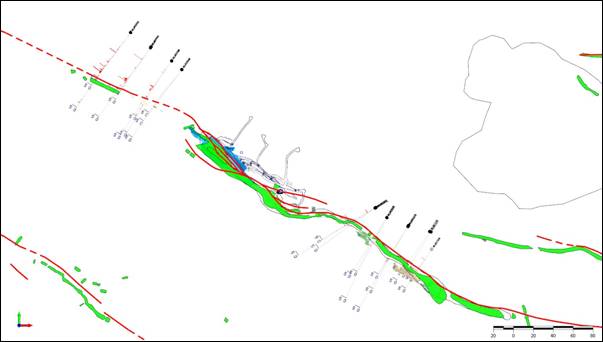
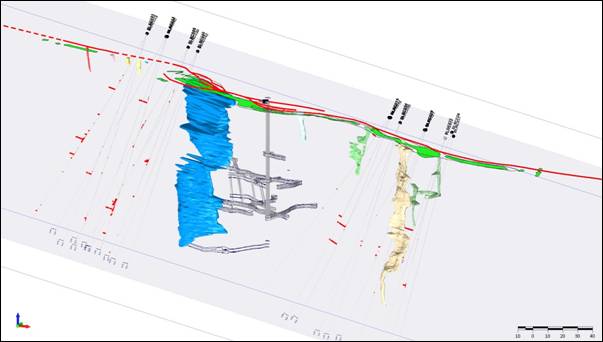
Figure 1: A plan and oblique view of the historic surface workings and interpreted trace of veins with underground workings, borehole traces and gold grades is shown above. Scale bar for assay grades is 5g/t Au.
Kavango's Operations in Zimbabwe
Kavango is exploring for gold deposits in Zimbabwe that have the potential to be developed into commercial scale production quickly through modern mechanised mining and processing. The Company is targeting both open-pit and underground opportunities.
Kavango has two further priority targets at Hillside: Nightshift and Steenbok. At Nightshift, Kavango declared a Maiden Resource Estimate of 19,000oz Au in October 2025, which has the potential for a selective open-pit mining operation, followed by underground mechanised mining. Meanwhile, at Steenbok, Kavango is considering a high-grade mechanised underground mining opportunity.
Further information in respect of the Company and its business interests is provided on the Company's website at www.kavangoresources.com and on X at @KavangoRes.
Correction to RNS dated 26 January 2026: Performance Laboratories Accreditation
The Company notes that its RNS dated 26th January erroneously stated that Performance Laboratories, based in Harare, was not internationally accredited.
Performance Laboratories is an ISO/IEC 17025:2017 accredited commercial testing laboratories, maintained through Southern Africa Development Community Accreditation Services (SADCAS).
This clarification does not affect the assay results or conclusions previously reported.
For further information, please contact:
Kavango Resources plc
Peter Wynter Bee
+44 (0) 797 381 8125
Shard Capital (Broker)
Damon Heath
+44 204 530 6926
BlytheRay (Financial PR)
Tim Blythe/Megan Ray/Said Izagaren
Tel: +44 207 138 3204
Kavango Competent Person Statement
The technical information contained in this announcement pertaining to geology and exploration have been compiled by Mr David Catterall, a Competent Person and a member of a Recognised Professional Organisations (ROPO). David Catterall has sufficient experience that is relevant to the style of mineralisation and type of deposit under consideration and to the activity being undertaken to qualify as a Competent Person as defined in the 2012 Edition of the Australasian Code for Reporting of Exploration Results, Mineral Resources and Ore Reserves (JORC 2012). David is the principal geologist at Tulia Blueclay Limited and a consultant to Kavango Resources. David Catterall is a member of the South African Council for Natural Scientific Professions, a recognised professional organisation.
Kavango Resources plc Sampling Techniques and Data for Hillside Project Diamond Drilling. Zimbabwe
Last updated: 28 January 2026
(Criteria in this section apply to all succeeding sections)
JORC Code. 2012 Edition - Table 1 report Section 1 Sampling Techniques and Data (Criteria in this section apply to all succeeding sections.) | ||
Criteria | JORC Code explanation | Commentary |
Sampling techniques | Nature and quality of sampling (e.g. cut channels. random chips. or specific specialised industry standard measurement tools appropriate to the minerals under investigation. such as down hole gamma sondes. or handheld XRF instruments. etc). These examples should not be taken as limiting the broad meaning of sampling. | · The information in this release relates to the technical details from the Company's RC programme, part of the resource drilling at Hillside Project which lies within the Filabusi Greenstone Belt, Matabeleland, Zimbabwe. · Reverse Circulation drilling was carried out, with representative samples split on site after individual 1m samples were collected from the cyclone. · Two samples were taken using a riffle splitter from the original 1m sample. · Chip samples were submitted for a 25g fire assay with AAS finish. to Performance Laboratories (Pvt) Ltd., at Harare, Zimbabwe. · All samples >5g/t are repeated using a gravimetric finish. · Selected samples will be sent to a check lab, ALS laboratories, Johannesburg, for referee fire assay comparison. · Kavango routinely takes pXRF readings along the core using an Olympus Vanta on Geochem 3 beam mode for 60 seconds. |
Include reference to measures taken to ensure sample representivity and the appropriate calibration of any measurement tools or systems used | · All Kavango's drill samples were geologically logged by suitably qualified geologists on site. · Sample representativity was ensured where possible by drilling perpendicular to structures of interest, and by the sample preparation technique in the laboratory. · The entire borehole was sampled based on geological logging, with the ideal sampling interval being representative of lithology for diamond core. · Individual samples are weighed at the field camp. · Upon arrival at Performance lab, the samples are dried at +/- 105 degrees Celsius for 8 to 12 hours. · The entire sample is crushed to 100% passing 4.75mm. The crushers have inline rotary splitters that split off 500g of sample that is pulverised. · The 500g split is pulverised in a Rocklabs pot and puck pulveriser with 85% passing minus 75μm. · A standard 25g aliquot is used for Fire Assay. · Following industry best practice. a series of certified reference materials (CRM's), duplicates and blanks were included for QAQC as outlined further below. | |
Aspects of the determination of mineralisation that are Material to the Public Report. | ||
In cases where 'industry standard' work has been done this would be relatively simple (e.g. 'reverse circulation drilling was used to obtain 1 m samples from which 3 kg was pulverised to produce a 30 g charge for fire assay'). In other cases. more explanation may be required, such as where there is coarse gold that has inherent sampling problems. Unusual commodities or mineralisation types (e.g. submarine nodules) may warrant disclosure of detailed information. | ||
Drilling techniques | Drill type (e.g. core. reverse circulation. open-hole hammer. rotary air blast. auger. Bangka. sonic. etc) and details (e.g. core diameter. triple or standard tube. depth of diamond tails. face-sampling bit or other type. whether core is oriented and if so. by what method. etc). | · The surface RC drill holes were drilled using an RC drill rig operated by Spartan Drilling Limited. · Spartan routinely uses 8.5", 6" and 4.5" down the hole hammers for RC drilling.
|
Drill sample recovery | Method of recording and assessing core and chip sample recoveries and results assessed. | · Sample recovery was monitored closely throughout from all the RC drilling programmes. · Recovery in rock was estimated at >95%. · Any voids were noted. |
Measures taken to maximise sample recovery and ensure representative nature of the samples. | · Samples prepared for assay are taken consistently from the same side of the core cutting line to avoid bias. · Geologists frequently check the core cutting procedures to ensure the core cutter splits the core correctly in half. · Chip samples were weighed to assess recovery against a theoretical average recovery for a 1m sample in these lithologies with given SG. · RC chip samples were collected every 1m. | |
Whether a relationship exists between sample recovery and grade and whether sample bias may have occurred due to preferential loss/gain of fine/coarse material. | · RC drilling sample recoveries were generally very good and as such it is not expected that any such bias exists. | |
Logging | Whether core and chip samples have been geologically and geotechnically logged to a level of detail to support appropriate Mineral Resource estimation. mining studies and metallurgical studies. | · Kavango's RC drill chips are logged by a team of qualified geologists using predefined lithological, mineralogical, physical characteristic (colour, weathering etc) and logging codes. · RC drill chip sample bags were marked up on site and logging was completed at the rig to ensure recoveries were adequately recorded. · Lithological, alteration and mineralisation are logged at camp. · The drill chips are securely stored at the base camp. · The geologists on site follow industry best practice and standard operating procedure for logging · The chip trays are photographed to preserve a record. · pXRF and magnetic susceptibility data are routinely captured from RC drill chips, every 0.5m to 1m. · Density measurements for drill chips were also calculated. · The QA/QC compilation of all logging results are stored and backed up on a data cloud. |
Whether logging is qualitative or quantitative in nature. Core (or costean. channel. etc) photography. | · All logging is conducted in accordance with Kavango's SOP and standard published logging charts and classification for grain size, abundance, colour and lithologies to maintain a qualitative and semi-quantitative standard based on visual estimation. · Magnetic susceptibility readings are also taken every metre using a ZH Instruments SM-20/SM-30 reader. · All RC drill chips have a portion retained in chip trays for follow-up work and to maintain a representative sample. | |
The total length and percentage of the relevant intersections logged. | · 100% of all recovered intervals are geologically logged. | |
Sub-sampling techniques and sample preparation | If core. whether cut or sawn and whether quarter. half or all cores taken. | · RC chip are weighed at site as they come off the cyclone and every effort is made to ensure each metre sample is representative of the length drilled, with proportional volume and weight recorded. · Samples are split on site using a commercial riffle splitter. · One sample is split down to 1kg for analysis the other is retained for future reference.
|
For all sample types. the nature. quality and appropriateness of the sample preparation techniques | · Field sample handling and preparation is suitable for all drilling methods utilised. · RC samples are weighed at site as they come off the cyclone and every effort is made to ensure each metre sample is representative of the length drilled, with proportional volume and weight recorded. · The laboratory sample preparation technique is considered appropriate and suitable for the core samples and as well as for the expected grades. | |
Quality control procedures adopted for all sub-sampling stages to maximise representivity of samples. | · Kavango's standard field QAQC procedures for drilling samples include the field insertion of blanks, an appropriate selection of standards, field duplicates, replicates, and selection of requested laboratory pulp and coarse crush duplicates. · These are being inserted at a rate of 2.5- 5% each to ensure an appropriate rate of QAQC. | |
Measures taken to ensure that the sampling is representative of the in-situ material collected. including for instance results for field duplicate/second-half sampling. | · Sampling is deemed appropriate for the type of survey and equipment used. · Laboratory duplicates are produced from the crushed and milled chips. · RC samples are split to provide representative duplicate samples using a commercial riffle splitter. | |
Whether sample sizes are appropriate to the grain size of the material being sampled. | · On occasions gold from this project may be coarse, therefore, some nugget effect is expected. This is minimised by using the largest diameter of core possible with the available equipment, and by utilising halved rather than quartered core for assay. | |
Quality of assay data and laboratory tests | The nature. quality and appropriateness of the assaying and laboratory procedures used and whether the technique is considered partial or total. | · A company audit was made of the assay laboratory in this case Performance Laboratories before it was engaged. · The digest and fire assay technique provide a total analysis method. · Between 5% and 20% of submitted samples consisted of additional blank, duplicate (lab duplicate from splitting the pulp), and standard samples. · Round robin and accreditation results for the laboratory were reviewed and considered acceptable. · The company's QAQC samples, including standards, are considered to confirm acceptable bias and precision with no contamination issues identified. |
For geophysical tools. spectrometers. handheld XRF instruments. etc. the parameters used in determining the analysis including instrument make and model. reading times. calibrations factors applied and their derivation. etc.
Nature of quality control procedures adopted (e.g. standards. blanks. duplicates. external laboratory checks) and whether acceptable levels of accuracy (i.e. lack of bias) and precision have been established. | · Kavango use ZH Instruments SM20 and SM30 magnetic susceptibility meters for measuring magnetic susceptibilities and readings are randomly repeated to ensure reproducibility and consistency of the data. · An Olympus Vanta C-series pXRF instrument is used in 3-beam geochemical mode with reading times of 60 seconds in total. Measurements are taken on clean dry core. · For the pXRF results no user factor was applied as per Kavango's SOP. The units are calibrated daily with their respective calibration disks. · In the case of multiple pXRFs the data will be collated and user factors calculated to ascertain their effectiveness. · All QAQC samples were reviewed for precision and accuracy. Results were deemed repeatable and representative: · For pXRF appropriate certified reference materials are inserted on a ratio of 1:25 samples. · Repeat readings are taken every 25 samples. and blank samples are inserted every 25 samples. · QAQC samples are reviewed for consistency. · pXRF CRM values show a slight positive bias. including for Cu. · At low levels (<10ppm) silver values in particular are scattered. · When laboratory assay results are received blank, standard, and duplicate values are reviewed to monitor lab performance. · Select low, moderate and high-grade assay samples are selected, re-labelled and re-submitted to Performance to assess repeatability. · Select low, moderate and high-grade assay samples will also be sent for check analysis at an internationally accredited laboratory. | |
| · Performance Lab insert their own CRM's, duplicates and blanks and follow their own SOP for quality control. · Performance Laboratories are internationally accredited to ISO 7025:2017. · A series of samples, including one entire hole from twinned pair have been sent to Performance in Zimbabwe and ALS Laboratories in South Africa, with acceptable results | |
Verification of sampling and assaying | The verification of significant intersections by either independent or alternative company personnel. | · All RC drill chips are logged and verified by peer review. · The Company's internal CP reviewed sampling and has visited site and the laboratory to verify protocols. · Assay data was received as assay certificates and cross checked by an independent CP against sample submission data to ensure a correct match. |
The use of twinned holes. | · N/A | |
Documentation of primary data. data entry procedures. data verification. data storage (physical and electronic) protocols. | · All data is electronically stored with peer review of data processing and modelling. · Data entry procedures standardised in SOP data checking and verification routine. · Data storage is on a cloud storage facility with access controls and automatic backups. | |
Discuss any adjustment to assay data. | · No adjustments were made to assay data. | |
Location of data points | Accuracy and quality of surveys used to locate drill holes (collar and down-hole surveys). trenches. mine workings and other locations used in Mineral Resource estimation. | · Kavango's surface drill collar coordinates are captured by using handheld Garmin GPS and verified by a second handheld Garmin GPS. · Drill holes are routinely re-surveyed with differential DGPS at regular intervals to ensure sub-metre accuracy as and when sufficient holes warrant. · Downhole surveys of drill holes were done using an AXIS Champ Mag tool or the Champ Gyro (for DTH). |
Specification of the grid system used. | · The grid system used is UTM 35S Arc 1950. All reported coordinates are referenced to this grid. | |
Quality and adequacy of topographic control. | · Topographic control is based on satellite survey data collected at 30m resolution. Quality is considered acceptable. | |
Data spacing and distribution | Data spacing for reporting of Exploration Results. Whether the data spacing. and distribution is sufficient to establish the degree of geological and grade continuity appropriate for the Mineral Resource and Ore Reserve estimation procedure(s) and classifications applied. | · Data spacing and distribution of all survey types is deemed appropriate for the type of survey and equipment used. · The drilling programs are designed to target the multiple interpreted parallel auriferous veins at the Bills Luck Mine on the Prospect Claims.
|
Whether sample compositing has been applied. | · No composite samples have been done | |
Orientation of data in relation to geological structure | Whether the orientation of sampling achieves unbiased sampling of possible structures and the extent to which this is known. considering the deposit type. | · Drill spacing is currently variable but is considered appropriate for this stage of exploration. · Hole orientation is designed to intersect the target structures as perpendicular as is practical. · This is considered appropriate for the geological setting and for the known mineralisation styles. |
If the relationship between the drilling orientation and the orientation of key mineralised structures is considered to have introduced a sampling bias. this should be assessed and reported if material. | · Existence, and orientation of preferentially mineralised structures is not yet fully understood but current available data indicates mineralisation occurs within steep. sub-vertical structures, with the possibility of plunging "ore-shoots". · The drillholes are inclined towards the target, which is understood to dip towards the drillhole at a steep angle (actual geometry to be confirmed by a second hole on section in the future). · The relatively short sample length (typically 1 m) allows for relatively accurate localisation of mineralisation. · No significant sampling bias is therefore expected. | |
Sample security | The measures taken to ensure sample security. | · RC chips are stored in a secure facility at the field office. · Sample bags are logged, tagged, double bagged and sealed in plastic bags stored at the field office. · Samples are stored in a locked company compound at site and in a locked container in Bulawayo. They are shipped onwards to the analytical facility by a reliable commercial courier. · Sample security includes a chain-of-custody procedure that consists of filling out sample submittal forms that are sent to the laboratory with sample shipments to make certain that all samples are received by the laboratory. · Prepared samples are transported to the analytical laboratory in sealed bags that are accompanied by appropriate paperwork. including the original sample preparation request numbers and chain-of-custody forms. |
Audits or reviews | The results of any audits or reviews of sampling techniques and data. | · The CP has visited both site and the laboratory utilised and considered practices and SOPs at both as acceptable. · The CP reviewed all data and spot-checked significant values versus certificates. |
JORC Section 2 Reporting of Exploration Results
(Criteria listed in the preceding section also apply to this section.)
Criteria | JORC Code explanation | Commentary | ||||||||||||||||||||||||||||||||||||||||||||||||||||||||||||||||||||||||||||||||||||||||||||||||||||||||||||||||||||||||||||||||||||||||||||||||||||||||||||||||||||||||||||||||||||||||||||||||||||||||||||||||||||||||||||||||||||||||||||||||||||||||||||||||||||||||||||||||||||||||||||||||||||||||||||||||||||||||||||||||||||||||||||||||||||||||||||||||||||||||||||||||||||||||||||||||||||||||||||||||||||||||||||||||||||||||||||||||||||||||||||||||||||||||||||||||||||||||||||||||||||||||||||||||||||||||||||||||||||||||||||||||||||||||||||||||||||||||||||||||||||||||||||||||||||||||||||||||||||||||||||||||||||||||||||||||||||||||||||||||||||||||||||||||||||||||||||||||||||||||||||||||||||||||||||||||||||||||||||||||||||||||||||||||||||||||||
Mineral tenement and land tenure status | Type. reference name/number. location and ownership including agreements or material issues with third parties such as joint ventures. partnerships. overriding royalties. native title interests. historical sites. wilderness or national park and environmental settings. The security of the tenure held at the time of reporting along with any known impediments to obtaining a licence to operate in the area. | · The Hillside Project consists of 44 gold claims. · Kavango entered into an option agreement with the vendors, dated 25 July 2023. · This was exercised on 23 April 2024 with respect to Hillside and Leopard South. · Transfer of the Claims is presently underway. · More details are provided here https://polaris.brighterir.com/public/kavango_resources_plc/news/rns/story/w9nq44r | ||||||||||||||||||||||||||||||||||||||||||||||||||||||||||||||||||||||||||||||||||||||||||||||||||||||||||||||||||||||||||||||||||||||||||||||||||||||||||||||||||||||||||||||||||||||||||||||||||||||||||||||||||||||||||||||||||||||||||||||||||||||||||||||||||||||||||||||||||||||||||||||||||||||||||||||||||||||||||||||||||||||||||||||||||||||||||||||||||||||||||||||||||||||||||||||||||||||||||||||||||||||||||||||||||||||||||||||||||||||||||||||||||||||||||||||||||||||||||||||||||||||||||||||||||||||||||||||||||||||||||||||||||||||||||||||||||||||||||||||||||||||||||||||||||||||||||||||||||||||||||||||||||||||||||||||||||||||||||||||||||||||||||||||||||||||||||||||||||||||||||||||||||||||||||||||||||||||||||||||||||||||||||||||||||||||||||
Exploration done by other parties | Acknowledgment and appraisal of exploration by other parties. | · The project contains a historic high-grade mine Bills Luck, which has a history of intermittent gold production from 1916 to 1950, yielding 17,000 oz at an average grade of 7.7g/t. After 1950, the mine saw only small-scale sand retreatment and surface workings. · It is currently being mined by informal miners, milling the ore at Bill's Luck stamp mill. | ||||||||||||||||||||||||||||||||||||||||||||||||||||||||||||||||||||||||||||||||||||||||||||||||||||||||||||||||||||||||||||||||||||||||||||||||||||||||||||||||||||||||||||||||||||||||||||||||||||||||||||||||||||||||||||||||||||||||||||||||||||||||||||||||||||||||||||||||||||||||||||||||||||||||||||||||||||||||||||||||||||||||||||||||||||||||||||||||||||||||||||||||||||||||||||||||||||||||||||||||||||||||||||||||||||||||||||||||||||||||||||||||||||||||||||||||||||||||||||||||||||||||||||||||||||||||||||||||||||||||||||||||||||||||||||||||||||||||||||||||||||||||||||||||||||||||||||||||||||||||||||||||||||||||||||||||||||||||||||||||||||||||||||||||||||||||||||||||||||||||||||||||||||||||||||||||||||||||||||||||||||||||||||||||||||||||||
Geology | Deposit type. geological setting and style of mineralisation. | · Bills Luck lies near the southern contact of the Filabusi gold belt and the Bulawayan Basement Schists. Younger intrusive granites bound it to the north. · Gold mineralisation appears to be associated with multiple sub parallel quartz veins that occur in fine grained massive, sheared granite. · The general azimuth of the auriferous veins is 110o TN (dipping steeply to the NNE) · Bills Luck, which has a history of intermittent gold production from 1916 to 1950, yielding 17,000 oz at an average grade of 7.7g/t. After 1950, the mine saw only small-scale sand retreatment and surface workings.
| ||||||||||||||||||||||||||||||||||||||||||||||||||||||||||||||||||||||||||||||||||||||||||||||||||||||||||||||||||||||||||||||||||||||||||||||||||||||||||||||||||||||||||||||||||||||||||||||||||||||||||||||||||||||||||||||||||||||||||||||||||||||||||||||||||||||||||||||||||||||||||||||||||||||||||||||||||||||||||||||||||||||||||||||||||||||||||||||||||||||||||||||||||||||||||||||||||||||||||||||||||||||||||||||||||||||||||||||||||||||||||||||||||||||||||||||||||||||||||||||||||||||||||||||||||||||||||||||||||||||||||||||||||||||||||||||||||||||||||||||||||||||||||||||||||||||||||||||||||||||||||||||||||||||||||||||||||||||||||||||||||||||||||||||||||||||||||||||||||||||||||||||||||||||||||||||||||||||||||||||||||||||||||||||||||||||||||
Drill hole Information | A summary of all information material to the understanding of the exploration results including a tabulation of the following information for all Material drill holes: easting and northing of the drill hole collar elevation or RL (Reduced Level - elevation above sea level in metres) of the drill hole collar dip and azimuth of the hole down hole length and interception depth hole length. If the exclusion of this information is justified on the basis that the information is not Material, and this exclusion does not detract from the understanding of the report. the Competent Person should clearly explain why this is the case.
| · Summary table of all completed Kavango drill holes that form the focus of the current programme is presented below. · The holes were surveyed and sited using a handheld GPS · Upon completion of drilling a DGPS survey was completed by professional surveyors. · Position format: UTM UPS; Map datum Arc 1950 Zone 35S.
| ||||||||||||||||||||||||||||||||||||||||||||||||||||||||||||||||||||||||||||||||||||||||||||||||||||||||||||||||||||||||||||||||||||||||||||||||||||||||||||||||||||||||||||||||||||||||||||||||||||||||||||||||||||||||||||||||||||||||||||||||||||||||||||||||||||||||||||||||||||||||||||||||||||||||||||||||||||||||||||||||||||||||||||||||||||||||||||||||||||||||||||||||||||||||||||||||||||||||||||||||||||||||||||||||||||||||||||||||||||||||||||||||||||||||||||||||||||||||||||||||||||||||||||||||||||||||||||||||||||||||||||||||||||||||||||||||||||||||||||||||||||||||||||||||||||||||||||||||||||||||||||||||||||||||||||||||||||||||||||||||||||||||||||||||||||||||||||||||||||||||||||||||||||||||||||||||||||||||||||||||||||||||||||||||||||||||||
Bills Luck RC Drilling Hole Collars
Bills Luck Assay results using 0.4g/t cut-off and 2m dilution
| ||||||||||||||||||||||||||||||||||||||||||||||||||||||||||||||||||||||||||||||||||||||||||||||||||||||||||||||||||||||||||||||||||||||||||||||||||||||||||||||||||||||||||||||||||||||||||||||||||||||||||||||||||||||||||||||||||||||||||||||||||||||||||||||||||||||||||||||||||||||||||||||||||||||||||||||||||||||||||||||||||||||||||||||||||||||||||||||||||||||||||||||||||||||||||||||||||||||||||||||||||||||||||||||||||||||||||||||||||||||||||||||||||||||||||||||||||||||||||||||||||||||||||||||||||||||||||||||||||||||||||||||||||||||||||||||||||||||||||||||||||||||||||||||||||||||||||||||||||||||||||||||||||||||||||||||||||||||||||||||||||||||||||||||||||||||||||||||||||||||||||||||||||||||||||||||||||||||||||||||||||||||||||||||||||||||||||||
Data aggregation methods | In reporting Exploration Results. weighting averaging techniques. maximum and/or minimum grade truncations (e.g. cutting of high grades) and cut-off grades are usually Material and should be stated. Where aggregate intercepts incorporate short lengths of high-grade results and longer lengths of low-grade results. the procedure used for such aggregation should be stated and some typical examples of such aggregations should be shown in detail. The assumptions used for any reporting of metal equivalent values should be clearly stated. | · All RC drilling results for Bills Luck are included above. · Some of the designed holes have not yet been drilled for reasons of access and logistics. These may be drilled and reported in future RNS
| ||||||||||||||||||||||||||||||||||||||||||||||||||||||||||||||||||||||||||||||||||||||||||||||||||||||||||||||||||||||||||||||||||||||||||||||||||||||||||||||||||||||||||||||||||||||||||||||||||||||||||||||||||||||||||||||||||||||||||||||||||||||||||||||||||||||||||||||||||||||||||||||||||||||||||||||||||||||||||||||||||||||||||||||||||||||||||||||||||||||||||||||||||||||||||||||||||||||||||||||||||||||||||||||||||||||||||||||||||||||||||||||||||||||||||||||||||||||||||||||||||||||||||||||||||||||||||||||||||||||||||||||||||||||||||||||||||||||||||||||||||||||||||||||||||||||||||||||||||||||||||||||||||||||||||||||||||||||||||||||||||||||||||||||||||||||||||||||||||||||||||||||||||||||||||||||||||||||||||||||||||||||||||||||||||||||||||
Relationship between mineralisation widths and intercept lengths | These relationships are particularly important in the reporting of Exploration Results. If the geometry of the mineralisation with respect to the drill hole angle is known. its nature should be reported. If it is not known and only the down hole lengths are reported. there should be a clear statement to this effect (eg 'down hole length. true width not known'). | · Down hole intersection widths are used throughout. · Most of the drill intersections are into steep to vertically dipping units. True thickness is presently unknown and will be determined based on modelling for the MRE. · All measurements state that downhole lengths have been used as the true width cannot yet be established by the current drilling. · Due to the structural control on the mineralisation and the anastomosing nature of the shears, together with an inferred plunge more drilling is required to provide accurate measurements for true thickness | ||||||||||||||||||||||||||||||||||||||||||||||||||||||||||||||||||||||||||||||||||||||||||||||||||||||||||||||||||||||||||||||||||||||||||||||||||||||||||||||||||||||||||||||||||||||||||||||||||||||||||||||||||||||||||||||||||||||||||||||||||||||||||||||||||||||||||||||||||||||||||||||||||||||||||||||||||||||||||||||||||||||||||||||||||||||||||||||||||||||||||||||||||||||||||||||||||||||||||||||||||||||||||||||||||||||||||||||||||||||||||||||||||||||||||||||||||||||||||||||||||||||||||||||||||||||||||||||||||||||||||||||||||||||||||||||||||||||||||||||||||||||||||||||||||||||||||||||||||||||||||||||||||||||||||||||||||||||||||||||||||||||||||||||||||||||||||||||||||||||||||||||||||||||||||||||||||||||||||||||||||||||||||||||||||||||||||
Diagrams | Appropriate maps and sections (with scales) and tabulations of intercepts should be included for any significant discovery being reported These should include. but not be limited to a plan view of drill hole collar locations and appropriate sectional views. | · Appropriate maps (plan and oblique section) included within the text of the RNS, tabulated collar and assay results are presented above in this table. | ||||||||||||||||||||||||||||||||||||||||||||||||||||||||||||||||||||||||||||||||||||||||||||||||||||||||||||||||||||||||||||||||||||||||||||||||||||||||||||||||||||||||||||||||||||||||||||||||||||||||||||||||||||||||||||||||||||||||||||||||||||||||||||||||||||||||||||||||||||||||||||||||||||||||||||||||||||||||||||||||||||||||||||||||||||||||||||||||||||||||||||||||||||||||||||||||||||||||||||||||||||||||||||||||||||||||||||||||||||||||||||||||||||||||||||||||||||||||||||||||||||||||||||||||||||||||||||||||||||||||||||||||||||||||||||||||||||||||||||||||||||||||||||||||||||||||||||||||||||||||||||||||||||||||||||||||||||||||||||||||||||||||||||||||||||||||||||||||||||||||||||||||||||||||||||||||||||||||||||||||||||||||||||||||||||||||||
Balanced reporting | Where comprehensive reporting of all Exploration Results is not practicable. representative reporting of both low and high grades and/or widths should be practiced to avoid misleading reporting of Exploration Results. | · All completed holes are logged, sampled and dispatch as soon as possible.
| ||||||||||||||||||||||||||||||||||||||||||||||||||||||||||||||||||||||||||||||||||||||||||||||||||||||||||||||||||||||||||||||||||||||||||||||||||||||||||||||||||||||||||||||||||||||||||||||||||||||||||||||||||||||||||||||||||||||||||||||||||||||||||||||||||||||||||||||||||||||||||||||||||||||||||||||||||||||||||||||||||||||||||||||||||||||||||||||||||||||||||||||||||||||||||||||||||||||||||||||||||||||||||||||||||||||||||||||||||||||||||||||||||||||||||||||||||||||||||||||||||||||||||||||||||||||||||||||||||||||||||||||||||||||||||||||||||||||||||||||||||||||||||||||||||||||||||||||||||||||||||||||||||||||||||||||||||||||||||||||||||||||||||||||||||||||||||||||||||||||||||||||||||||||||||||||||||||||||||||||||||||||||||||||||||||||||||
Other substantive exploration data | Other exploration data. if meaningful and material. should be reported including (but not limited to): geological observations; geophysical survey results; geochemical survey results; bulk samples - size and method of treatment; metallurgical test results; bulk density. groundwater. geotechnical and rock characteristics; potential deleterious or contaminating substances. | · Geophysical work has been done previously, comprising Gradient Array IP and Stacked Schlumberger Sections · A regional structural mapping programme has been completed and included detailed structural analysis of portions of specific holes. · Further structural work is scheduled | ||||||||||||||||||||||||||||||||||||||||||||||||||||||||||||||||||||||||||||||||||||||||||||||||||||||||||||||||||||||||||||||||||||||||||||||||||||||||||||||||||||||||||||||||||||||||||||||||||||||||||||||||||||||||||||||||||||||||||||||||||||||||||||||||||||||||||||||||||||||||||||||||||||||||||||||||||||||||||||||||||||||||||||||||||||||||||||||||||||||||||||||||||||||||||||||||||||||||||||||||||||||||||||||||||||||||||||||||||||||||||||||||||||||||||||||||||||||||||||||||||||||||||||||||||||||||||||||||||||||||||||||||||||||||||||||||||||||||||||||||||||||||||||||||||||||||||||||||||||||||||||||||||||||||||||||||||||||||||||||||||||||||||||||||||||||||||||||||||||||||||||||||||||||||||||||||||||||||||||||||||||||||||||||||||||||||||
Related Shares:
Kavango Resources