
19th Feb 2026 07:00

THIS ANNOUNCEMENT CONTAINS INSIDE INFORMATION FOR THE PURPOSES OF ARTICLE 7 OF REGULATION 2014/596/EU WHICH IS PART OF DOMESTIC UK LAW PURSUANT TO THE MARKET ABUSE (AMENDMENT) (EU EXIT) REGULATIONS (SI 2019/310) ("UK MAR"). UPON THE PUBLICATION OF THIS ANNOUNCEMENT, THIS INSIDE INFORMATION (AS DEFINED IN UK MAR) IS NOW CONSIDERED TO BE IN THE PUBLIC DOMAIN.
NOT FOR RELEASE, PUBLICATION OR DISTRIBUTION, IN WHOLE OR IN PART, DIRECTLY OR INDIRECTLY IN OR INTO THE UNITED STATES, AUSTRALIA, CANADA, JAPAN, THE REPUBLIC OF SOUTH AFRICA OR ANY OTHER JURISDICTION WHERE TO DO SO WOULD CONSTITUTE A VIOLATION OF THE RELEVANT LAWS OF SUCH JURISDICTION.
19 February 2026
Cobra Resources plc
("Cobra" or the "Company")
Manna Hill Drilling Complete
Broad zones of primary copper mineralisation and molybdenite intersections support thesis for large-scale porphyry system
Cobra (LSE: COBR), a South Australian mineral exploration and development company, is pleased to announce that the initial drilling programme at the Manna Hill Copper Project, comprising 18 drillholes totalling 3,200m, has been completed.
Highlights:
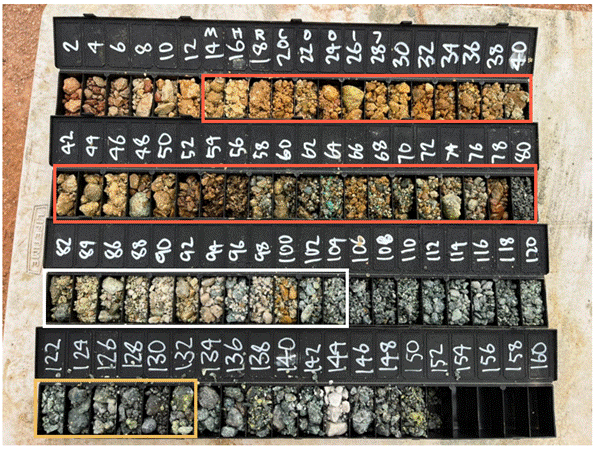
· Broad zones of visible oxide and primary copper mineralisation have been intersected within 10 of 18 holes (Figure 1)
· Molybdenite has been intersected in association with porphyry-like quartz monzonite and diorite-like intrusives that support the Company's thesis for a large-scale porphyry system
· Results anticipated through March
Cobra has a 12-month option to acquire the Manna Hill Project ("Manna Hill Option") and is focusing initially on the Blue Rose priority prospect ("Blue Rose") where existing drilling has intersected copper-gold mineralisation across 1.6km of strike immediately adjacent to a geophysical anomaly interpretated as a porphyry intrusion1.
To watch a video of Rupert Verco, Managing Director, discussing drilling, follow the link: https://investors.cobraplc.com/link/P3Dp0y.
Figure 1: Chip trays from MHRC0017 where copper oxides are visually present from 14m to 100m (orange = oxide, white = transitional and yellow = primary) and copper sulphides from 122m to 132m. Porphyry type, quartz monzonite dykes were intersected at 90-98m and 142-144m.
Rupert Verco, Managing Director of Cobra, commented:
"We are eagerly awaiting results of this drilling programme. All indications are positive to deliver further scale to shallow, high-grade mineralisation. Initial observations indicate that we are vectoring towards a porphyry core.
These results will be the catalyst for the board to exercise the Manna Hill Option, which we believe hosts a tier 1 copper discovery.
The team is busily planning our next drilling programme. With resource definition drilling at the Boland and Head rare earth projects anticipated to commence in March, 2026 stands to be an action-packed year!"
Further details concerning drilling progress
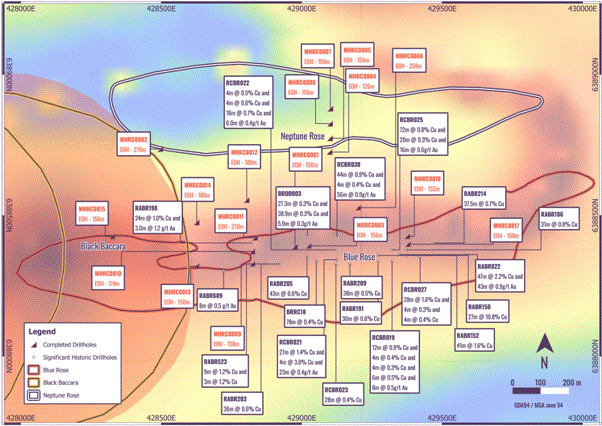
The Blue Rose prospect is a skarn-replacement type where previous exploration has defined copper-gold-molybdenum along 1.6km of continuous strike where drilling has defined the previous intersections:
o [RABR822] 47m at 2.2% Cu and 0.76 g.t Au from 11m
o [RCBR025] 132m at 0.52% Cu from 8m including 48m at 1.04% Cu
o [RABR152] 41m at 1.6% Cu from 9m including 18m at 2.03% Cu
o [RABR205] 43m at 0.6% Cu from 12m
o [RCBR030] 52m at 0.77% Cu and 0.94 g/t Au from 80m
o [RABR198] 24m at 1.0% Cu from 18m incl. 3m @ 1.23g/t Au
o [RCBR021] 23m at 1.4% Cu from 73m incl. 12m @ 0.71g/t Au
Geophysics, including gravity, induced polarisation and magnetics, have been used in collaboration with geochemistry to refine the interpretation of both the stratigraphic unit hosting shallow skarn mineralisation, and porphyry mineralisation that is interpreted to envelop a remnant magnetised intrusion. Past exploration has intersected quartz monzonite intrusions proximal to skarn mineralisation, but their relationship and influence on mineralisation is not clearly understood. This RC drilling programme has generated the first pXRF multi-element dataset that has enabled Cobra and its consultants to assess the geochemistry of the system and evaluate the data in the context of a porphyry setting.
Observations from completed drilling support depth continuities of shallow mineralisation whilst also defining key indicators for mineralisation control and system continuity. As a result, five additional holes were drilled to further test for scale and for potassic porphyry mineralisation.
Figure 2: Plan of completed drilling and historical drill intersections.
About the Manna Hill Project
The Manna Hill Project presents South Australia's premier porphyry prospect in the state that holds around 70% of Australia's copper reserves. The project is comprised of multiple early-stage porphyry and skarn prospects.
The project also includes the Luron Carlin style gold prospect and multiple historic goldfields where over 30koz Au were reported to have been produced. This style of mineralisation remains underexplored and highly prospective.
The project sits along the national railway and Barrier Highway between the mining hub of Broken Hill, a port and base metals smelter, and the City of Adelaide.
Enquiries:
Cobra Resources plc Rupert Verco (Australia) Dan Maling (UK)
| via Vigo Consulting +44 (0)20 7390 0234
|
SI Capital Limited (Joint Broker) Nick Emerson Sam Lomanto
| +44 (0)1483 413 500
|
Global Investment Strategy (Joint Broker) James Sheehan | +44 (0)20 7048 9437 |
Vigo Consulting (Financial Public Relations) Ben Simons Fiona Hetherington | +44 (0)20 7390 0234 |
The person who arranged for the release of this announcement was Rupert Verco, Managing Director of the Company.
Information in this announcement relates to exploration results that have been reported in the following announcements:
· Cobra RNS: Option to Acquire Significant Copper Project, 26 August 2025
References
1. Cobra RNS: Option to Acquire Significant Copper Project, 26 August 2025
2. Meinert, L.D., Hefton, K.K., Mayes, D., Tasiran, I., 1997. Geology, zonation, and fluid evolution of the Big Gossan Cu-Au skarn deposit, Ertsberg district, Irian Jaya. Economic Geology 92, 509-534.
Competent Persons Statement
Information in this announcement has been compiled based on reports from Mitre Geophysics consultants and assessed by Mr Rupert Verco, a Fellow of the Australasian Institute of Mining and Metallurgy. Mr Verco is an employee of Cobra and has more than 18 years' industry experience which is relevant to the style of mineralisation, deposit type, and activity which he is undertaking to qualify as a Competent Person as defined in the 2012 Edition of the Australasian Code for Reporting Exploration Results, Mineral Resources and Ore Reserves of JORC. This includes 13 years of Mining, Resource Estimation and Exploration.
About Cobra
Cobra Resources is a South Australian critical minerals developer, advancing assets at all stages of the pre-production pathway.
In 2023, Cobra identified the Boland ionic rare earth discovery at its Wudinna Project in the Gawler Craton - Australia's only rare earth project suitable for in situ recovery (ISR) mining. ISR is a low-cost, low-disturbance extraction method that eliminates the need for excavation, positioning Boland to achieve bottom-quartile recovery costs.
In 2025, Cobra further expanded its portfolio by optioning the Manna Hill Copper Project in the Nackara Arc, South Australia. The project contains multiple underexplored prospects with strong potential to deliver large-scale copper discoveries.
In 2025, Cobra sold its Wudinna Gold Assets to Barton Gold (ASX: BDG) for up to A$15 million in cash and shares.
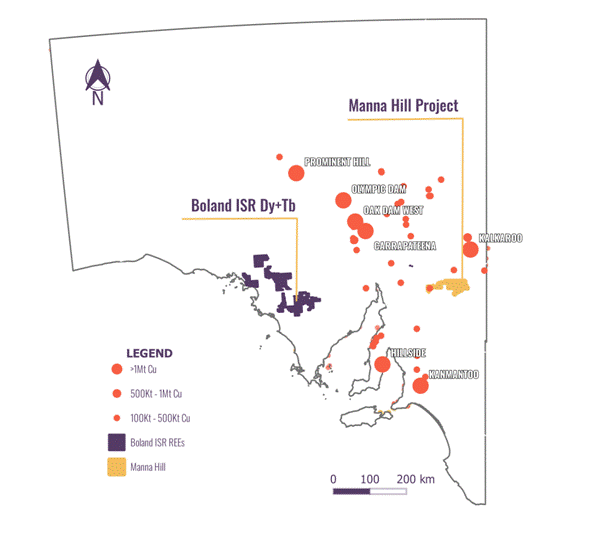
Regional map showing Cobra's tenements in South Australia
Follow us on social media:
LinkedIn: https://www.linkedin.com/company/cobraresourcesplc
X: https://twitter.com/Cobra_Resources
Engage with us by asking questions, watching video summaries and seeing what other shareholders have to say. Navigate to our Interactive Investor hub here: https://investors.cobraplc.com/
Subscribe to our news alert service: https://investors.cobraplc.com/auth/signup
Appendix 1: JORC Code, 2012 Edition - Table 3
Criteria | JORC Code explanation | Commentary |
Sampling techniques | · Nature and quality of sampling (eg cut channels, random chips, or specific specialised industry standard measurement tools appropriate to the minerals under investigation, such as down hole gamma sondes, or handheld XRF instruments, etc). These examples should not be taken as limiting the broad meaning of sampling. · Include reference to measures taken to ensure sample representivity and the appropriate calibration of any measurement tools or systems used. · Aspects of the determination of mineralisation that are Material to the Public Report. · In cases where 'industry standard' work has been done this would be relatively simple (eg 'reverse circulation drilling was used to obtain 1 m samples from which 3 kg was pulverised to produce a 30 g charge for fire assay'). In other cases more explanation may be required, such as where there is coarse gold that has inherent sampling problems. Unusual commodities or mineralisation types (eg submarine nodules) may warrant disclosure of detailed information. | Historic · Historic drill programs have been conducted by multiple companies and methods the historically reported results are being reviewed prior to any broader reporting of results. In general lab assay results across differing programs show comparable tenors of grade and distribution.
Present · RC drill cuttings were collected from the drill rig cyclone in 2 m intervals in industry standard green bags with a 2m representative split from the cyclone collected into a calico bag. The green and calico bags were arranged in rows on site for sampling and assaying. · 2 m samples were split using a cone splitter mounted on the drill rig. · Samples were submitted to BV Laboratories, Perth for analysis. |
Drilling techniques | · Drill type (eg core, reverse circulation, open-hole hammer, rotary air blast, auger, Bangka, sonic, etc) and details (eg core diameter, triple or standard tube, depth of diamond tails, face-sampling bit or other type, whether core is oriented and if so, by what method, etc). | Historic Drilling · Historic drill methods were predominantly aircore and RC drilling with some diamond drilling reported
Current Drilling · Schramm T685 RC rig operated by Bullion Drilling Pty Ltd. The RC drilling was conducted using a 5 ¾-inch hammer. A booster air compressor was used throughout the program.
|
Drill sample recovery | · Method of recording and assessing core and chip sample recoveries and results assessed. · Measures taken to maximise sample recovery and ensure representative nature of the samples. · Whether a relationship exists between sample recovery and grade and whether sample bias may have occurred due to preferential loss/gain of fine/coarse material. | · Historic recoveries have not been assessed. · Drill methods and geological conditions are not expected to promote significant reduced recovery or sample biasing · Bulk RC samples were visually assessed and considered to be representative with good recovery. Recoveries were recorded onsite into Cobras MX Deposit database. · Water was intersected in several drillholes. Where outside return was lost and sample recovery reduced. Recovery estimates recorded into the companies database. Shroud tolerance was managed to optimise recovery.
|
Logging | · Whether core and chip samples have been geologically and geotechnically logged to a level of detail to support appropriate Mineral Resource estimation, mining studies and metallurgical studies. · Whether logging is qualitative or quantitative in nature. Core (or costean, channel, etc) photography. · The total length and percentage of the relevant intersections logged. |
· Historic logging has been completed with a number of different geological logging codes. These are being translated into a standardized logging format prior to entry into the Cobra Drillhole Database
· All holes were qualitatively geologically logged for their entire length by suitably qualified Discover Co geologists and recorded onsite into Discover Co's MX Deposit database. · Mineral Resources have not been estimated; however, the quality of the logging is expected to be suitable for low-confidence resource estimation purposes. · The detail of geological logging is considered sufficient for exploration and resource definition drilling. · Logging included visual estimates for copper oxides and sulphides aswell as pyrite content · All intersections were logged.
|
Sub-sampling techniques and sample preparation | · If core, whether cut or sawn and whether quarter, half or all core taken. · If non-core, whether riffled, tube sampled, rotary split, etc and whether sampled wet or dry. · For all sample types, the nature, quality and appropriateness of the sample preparation technique. · Quality control procedures adopted for all sub-sampling stages to maximise representivity of samples. · Measures taken to ensure that the sampling is representative of the in situ material collected, including for instance results for field duplicate/second-half sampling. · Whether sample sizes are appropriate to the grain size of the material being sampled. | Historic · Historic sampling has not been assessed. Current · For each metre a Metzke cone split sample was collected in a calico bag. A portable XRF unit was used to screen a selected interval of 1m RC bulk samples for anomalous copper values. Where copper value readings exceeded ~200 ppm Cu, sampling was conducted at 1m intervals using the Metzke cone split samples. · Weights of samples submitted for assay averaged 2.5 kg and ranged between 1.8 to 4.1 kg. Sample size is considered appropriate for the material sampled. · Commercially certified reference material of known copper grades and of suitable matrix were included in the laboratory assay sequence at a rate of 1 per 50 samples. · First-split duplicate samples were collected at a rate of 1 per 50 samples. · A coarse blank sample was inserted 1 in every 50 samples. · The Competent Person considers that the sample size is appropriate to the grain size of the material being sampled. |
Quality of assay data and laboratory tests | · The nature, quality and appropriateness of the assaying and laboratory procedures used and whether the technique is considered partial or total. · For geophysical tools, spectrometers, handheld XRF instruments, etc, the parameters used in determining the analysis including instrument make and model, reading times, calibrations factors applied and their derivation, etc. · Nature of quality control procedures adopted (eg standards, blanks, duplicates, external laboratory checks) and whether acceptable levels of accuracy (ie lack of bias) and precision have been established. | Historic · Lab certificates for a large number of drill samples have been retained from historic drilling. These certificates will be used for the import of data into Cobra's drillhole database.
Current · All samples managed for the presence of asbestiform mineral fibers owing to the presence of serpentine and chrysotile |
Verification of sampling and assaying | · The verification of significant intersections by either independent or alternative company personnel. · The use of twinned holes. · Documentation of primary data, data entry procedures, data verification, data storage (physical and electronic) protocols. · Discuss any adjustment to assay data. | Historic · Reported significant intercepts have been reported to the Australian Stock Exchange in the past · Primary assay data and drill logs for reported holes have been reviewed by Cobra staff · Further migration of historic data into the Cobra drillhole database is underway with validation during this process to be undertaken. Current · pXRF readings were calibrated using certified reference material OREAS 460. · Further QAQC procedures will be reported with results
|
Location of data points | · Accuracy and quality of surveys used to locate drill holes (collar and down-hole surveys), trenches, mine workings and other locations used in Mineral Resource estimation. · Specification of the grid system used. · Quality and adequacy of topographic control. |
Historic · Historic Drillholes were recorded with a number of different datums. · Validation of the datums used for each program have been conducted and are continuing. · The key historic drilling used for planning of the January 2026 drill program have high confidence in the datum used and have been assessed in the field Current
· Drill hole locations were determined by handheld GPS with a nominal accuracy of +/- 5 metres. · All coordinates and maps presented here are in the MGA Zone 53 GDA94 coordinate system. · Topographic control is provided by Aerometrex Reigel VQ-780ii Airborne Laser Scanner producing LiDAR digital elevation data at 0.1m accuracy with collar heights extracted from a DTM produced from the LiDAR data.
|
Data spacing and distribution | · Data spacing for reporting of Exploration Results. · Whether the data spacing and distribution is sufficient to establish the degree of geological and grade continuity appropriate for the Mineral Resource and Ore Reserve estimation procedure(s) and classifications applied. · Whether sample compositing has been applied. | Historic · Historic drilling was variably spaced. The drill spacing was sufficient to define mineralization trends at the Blue Rose Skarn but not to the extent of defining a resource. · Drilling at Desert Rose and Double Delight has not been sufficient to assess the prospects and has been sparse Current
· RC holes were drilled angled south along heritage cleared 'drill access tracks' or adjacent to heritage cleared pastoral tracks.
|
Orientation of data in relation to geological structure | · Whether the orientation of sampling achieves unbiased sampling of possible structures and the extent to which this is known, considering the deposit type. · If the relationship between the drilling orientation and the orientation of key mineralised structures is considered to have introduced a sampling bias, this should be assessed and reported if material. |
· Drillholes have been vertical or south dipping · Deeper historic drilling has been south dipping · Mineralization is interpreted to be steeply dipping with limited success to date in identifying a slight north or south dip. · Deeper planned drilling is designed to improve the definition of mineralisation control · Further diamond drilling is expected to validate geological interpretations |
Sample security | · The measures taken to ensure sample security. | Historic · No issues with sample security were reported or are expected to have occurred |
Audits or reviews | · The results of any audits or reviews of sampling techniques and data. | · |
Appendix 3: Section 2 reporting of exploration results
Criteria | JORC Code explanation | Commentary |
Mineral tenement and land tenure status | · Type, reference name/number, location and ownership including agreements or material issues with third parties such as joint ventures, partnerships, overriding royalties, native title interests, historical sites, wilderness or national park and environmental settings. · The security of the tenure held at the time of reporting along with any known impediments to obtaining a licence to operate in the area. | · Blue Rose is located on EL6009 that is heldby Hamelin Gully Pty Ltd. Manna HillMining Pty Ltd, a subsidiary of CobraResources Plc has a 12-month option toacquire Hamelin Gully. · This drilling forms part of the company'sstrategy to seek shareholder approval toexercise the option. · A 1% Over Riding Royalty Agreement isregistered between Hamelin Gully andSprington Trust
A Native Title Agreement is in placebetween the Wilyakali People and HamelinGully Pty Ltd Cultural heritage surveys have beencompleted over EL6009, clearing proposeddrill sites |
Exploration done by other parties | · Acknowledgment and appraisal of exploration by other parties. |
· Historic Exploration has been conducted by multiple companies with key work completed by PacMag, Lynas and Giralia Resources. · Historic exploration demonstrated the geological environment at Blue Rose and the potential for economic mineralization · Commercially driven decisions and land access challenges (now resolved) were common trends in the history of the project transactions |
Geology | · Deposit type, geological setting and style of mineralisation. | Blue Rose · Blue Rose is skarn hosted mineralization on the margins of the Anabama Granite · Oxide mineralisation is stratabound to the Saddleworth limestone formation · A number of porphyry related intrusions have a spatial relationship to mineralisation at Blue Rose and further analysis is planned to determine the control on exo-skarn mineralisation. Neptune Rose · Is interpreted to be hosted within skarn mineralization. · Assessment of the structural vs stratigraphic controls on mineralization will be assessed during drilling Black Baccara · Is interpret to be a sulphide rich halo around a magnetic low core. Assessment of Geological survey spectral from nearby "near miss" diamond holes indicate the metamorphic gradient and spectral responses anticipated from a porphyry system |
Drillhole Information | · A summary of all information material to the understanding of the exploration results including a tabulation of the following information for all Material drill holes: o easting and northing of the drill hole collar o elevation or RL (Reduced Level - elevation above sea level in metres) of the drill hole collar o dip and azimuth of the hole o down hole length and interception depth o hole length. · If the exclusion of this information is justified on the basis that the information is not Material and this exclusion does not detract from the understanding of the report, the Competent Person should clearly explain why this is the case. | · Drilling results are being assessed on the migration of data to the Cobra drillhole database · Historic drill results reflective of the grades and widths expected of the Blue Rose prospect. · Reporting of these results will be included at the completion of the data migration and review. |
Data aggregation methods | · In reporting Exploration Results, weighting averaging techniques, maximum and/or minimum grade truncations (eg cutting of high grades) and cut-off grades are usually Material and should be stated. · Where aggregate intercepts incorporate short lengths of high grade results and longer lengths of low grade results, the procedure used for such aggregation should be stated and some typical examples of such aggregations should be shown in detail. · The assumptions used for any reporting of metal equivalent values should be clearly stated. |
· Historic grade intercepts as length weighted averages with downhole lengths reported, appropriate for this stage of drilling. · No top cutting of grades has been included |
Relationship between mineralisation widths and intercept lengths | · These relationships are particularly important in the reporting of Exploration Results. · If the geometry of the mineralisation with respect to the drill hole angle is known, its nature should be reported. · If it is not known and only the down hole lengths are reported, there should be a clear statement to this effect (eg 'down hole length, true width not known'). | · Downhole intercept lengths are expected to be greater than true length · angled drilling has typically been diping 60 degrees to the south with the mineralization interpreted to be sub vertical at Blue Rose |
Diagrams | · Appropriate maps and sections (with scales) and tabulations of intercepts should be included for any significant discovery being reported These should include, but not be limited to a plan view of drill hole collar locations and appropriate sectional views. | · Relevant diagrams have been included in the announcement. · Exploration results are not being reported for existing mineral resources. · Drilling is aimed at defining new mineral resources. |
Balanced reporting | · Where comprehensive reporting of all Exploration Results is not practicable, representative reporting of both low and high grades and/or widths should be practiced to avoid misleading reporting of Exploration Results. | · Historic results are being assessed during the data migration to the Cobra drillhole database. · This announcement is indicative of the results of the geophysical methods (Induced Polarization) the method does not directly indicate size or grades of mineralisation |
Other substantive exploration data | · Other exploration data, if meaningful and material, should be reported including (but not limited to): geological observations; geophysical survey results; geochemical survey results; bulk samples - size and method of treatment; metallurgical test results; bulk density, groundwater, geotechnical and rock characteristics; potential deleterious or contaminating substances. | · Geophysical results are the focus of the announcement |
Further work | · The nature and scale of planned further work (eg tests for lateral extensions or depth extensions or large-scale step-out drilling). · Diagrams clearly highlighting the areas of possible extensions, including the main geological interpretations and future drilling areas, provided this information is not commercially sensitive. | · RC drill program at Blue Rose, Desert Rose and Double Delight in early January 2026 · Follow up diamond drilling at Desert Rose · Greenfields soil sampling program |
Related Shares:
Cobra Resources