
31st Mar 2026 07:00
Zinnwald Lithium plc / EPIC: ZNWD.L / Market: AIM / Sector: Mining
31 March 2026
Zinnwald Lithium plc
('Zinnwald Lithium' or the 'Company')
Final Results
Zinnwald Lithium plc, the European focused lithium company developing the integrated Zinnwald Lithium Project (the 'Project') in Germany, is pleased to announce its final audited results for the year ended 31 December 2025.
The Company's Annual Report and Financial Statements for the year ended 31 December 2025 will be posted to shareholders today and will be available on the Company's website www.zinnwaldlithium.com.
HIGHLIGHTS
12 Months to 31 December 2025
· Pre-Feasibility Study published confirming the technical and financial viability of a fully integrated mining and processing operation.
· Robust project economics demonstrated, including:
o €3.3 billion pre-tax NPV (8% discount).
o 23.6% pre-tax IRR.
o Post-tax NPV of €2.2 billion and IRR of 19.8%.
· Maiden Ore Reserve declared of 128 Mt grading 4,428ppm (0.44%) Li2O, establishing the Project as one of the largest lithium reserves in Europe.
· Long-life, scalable project:
o Mine life in excess of 40 years.
o Phase 1 production of 18,000 tpa battery grade lithium hydroxide.
o Phase 2 expansion to 35,100 tpa within existing footprint.
· Permitting and ESG milestones achieved, including publication of Environmental and Social Impact Assessment ("ESIA") Scoping Study and stakeholder engagement frameworks.
· Strong government backing:
o Saxon State Government recognition as a project of "outstanding importance".
o Federal Government support aligned with strategic raw materials priorities and advocacy for recognition at European level.
· £3.4 million fundraise completed to support ongoing development and strengthen the balance sheet.
· addition of the Liebenau licence extends licence footprint to c. 13,000 hectares of continuous coverage from main ore body to planned processing area
· Awarded 3-year extension of exploration licence at Falkenhain.
· Strategic partnerships being established, including:
o LOI with Solar-Bau to explore long-term clean power offtake.
o MOU for by-product utilisation in green cement.
· Continued proactive engagement with local communities through regular dialogue and organised events.
· Continued technical optimisation, including process testwork and development of geometallurgical model.
· Continued strengthening of German team with appointment of new permitting manager
Post period end to 27 March 2026
· Completion of spatial planning process / impact assessment for the proposed mining and processing project, supporting progression into the next stages of permitting.
· Strengthened board with the appointment of Dominik Simler as a Non-Executive Director.
· Confirmation of German research allowance tax credit of up to £1.9 million
Jeremy Martin, Non-Executive Chairman, commented: "2025 has been a key year for Zinnwald Lithium, marked by the publication of our Pre-Feasibility Study, which confirmed the scale, longevity and robust economics of the Project. With a strong technical foundation, increasing government support and improving market dynamics, we are well positioned to advance one of Europe's most strategically important lithium developments and play a meaningful role in securing domestic supply of critical raw materials."
*ENDS*
For further information, visit the Zinnwald Lithium website at www.zinnwaldlithium.com or sign up to our investor community at https://investors.zinnwaldlithium.com/auth/signup. Existing investors can view announcements and submit questions via https://investors.zinnwaldlithium.com/announcements.
Anton du Plessis Cherif Rifaat | Zinnwald Lithium plc | |
David Hart
| Allenby Capital Limited Nominated Adviser | +44 (0) 20 3328 5656 |
Michael Seabrook Adam Pollock Jessica Cave | Oberon Capital Broker | +44 (0) 20 3179 5300
|
Isabel de Salis Paul Dulieu | St Brides Partners Ltd Financial PR |
CHAIR'S STATEMENT
As Germany and the European Union intensify efforts to secure domestic supplies of critical raw materials, your Company has made solid progress over the past year advancing one of Europe's most strategically important lithium projects, the Zinnwald Lithium Project, which is positioned to deliver locally sourced, battery grade lithium hydroxide ('LHM').
We began the year with the publication of a Pre-Feasibility Study ('PFS') for the Zinnwald Lithium Project (the 'Project'). This confirmed the technical and financial viability of a fully integrated mining and processing operation, supporting a mine life of more than 40 years and establishing Zinnwald Lithium as a potential major European producer of LiOH. The study also validated a phased development approach, with initial production of approximately 18,000 tonnes per annum ('tpa') of battery-grade LHM, expanding to over 35,000 tpa within the existing project footprint. The PFS included a maiden ore reserve that placed Zinnwald as the largest amongst all European lithium projects based on all published studies to date.
The Project's strong sustainability credentials were also reinforced by the PFS's findings. Underground mining, the use of a circa 9 km long underground ore transport tunnel, zero liquid discharge processing, and the planned reuse or backfilling of material streams reflect our commitment to responsible development in a region with a long mining heritage and high environmental standards. This approach was further reinforced by the execution of a Letter of Intent with solar developer Solar-Bau to explore long-term clean power offtake, and a Memorandum of Understanding with a local green cement producer to assess opportunities for third-party utilisation of selected by-products.
Permitting activities continued to advance during the year and, as part of this pathway, in December 2025 we published the Environmental and Social Impact Assessment ('ESIA') Scoping Study and associated stakeholder engagement frameworks. These represent an important step in defining the scope of the full ESIA and demonstrate our intention to meet both German regulatory requirements and international financing standards. The subsequent completion of the spatial planning process post period end further supports the development concept outlined in the PFS and provides a clear basis to progress into the next stages of permitting.
Community engagement is a core part of our approach, and ongoing dialogue with local stakeholders plays an important role in the development of the Project. Through the ESIA process, we have established a structured and transparent mechanism for engagement, ensuring that stakeholder feedback is considered in the Project's design and in the identification and management of environmental and social impacts. This supports responsible project development and helps build constructive, long-term relationships with the communities in which we operate.
As the Project has advanced, we have progressively strengthened our team in Germany. Furthermore, post period end, this focus on capability was extended at Board level with the appointment of Dominik Simler as a Non-Executive Director, adding strategic depth and German market experience.
Political and institutional support for the Project has continued to strengthen at both regional and federal levels. The Saxony State Government has consistently recognised the Project as being of outstanding importance, reflecting its contribution to regional development, industrial resilience and supply chain security. This has been reinforced by the German Federal Government, which has acknowledged the Project's alignment with national strategic raw material priorities and has committed to advocating for its recognition at European level. Site visits by senior representatives from the Federal Ministry for Economic Affairs and Energy underline the Project's relevance within Germany's broader industrial and energy transition strategy. We were also pleased to be awarded a Research Allowance for work done on our geological and processing development of up to €1.9m.
At European level, initiatives on critical raw materials, supply chain resilience and strategic stockpiling signal a clear shift towards greater self-sufficiency in materials such as lithium, reducing exposure to external suppliers and geopolitical risk. Zinnwald Lithium has been planned with this objective in mind and is well positioned to support Europe's ambitions.
After a period of oversupply and weak pricing, 2026 has seen the lithium market beginning to stabilise as demand strengthens. Electric vehicles remain the dominant driver, supported by rising use of batteries in energy storage, renewable power systems, and the electricity needs of data centres and artificial‑intelligence infrastructure, as well as specialised applications in defence. Declining battery pack costs are also enabling broader adoption. Meanwhile, new high‑quality supply is failing to keep up with demand, particularly in regions with tighter environmental and regulatory requirements such as Europe, once again highlighting the need to progress responsibly planned projects such as ours.
While there have been early signs of improvement in market sentiment, conditions during the period remained challenging. We were therefore delighted to complete a £3.4 million fundraise in June 2025 supported by existing shareholders and strategic investors. This strengthened the balance sheet and enabled us to continue to progress technical studies, permitting, and stakeholder engagement. The Board remains focused on disciplined capital allocation and prudent cash management as the Project advances.
Zinnwald Lithium enters the next phase of development with a strong technical foundation, increasing policy alignment, and an improving lithium market backdrop. Europe's need for secure, domestic lithium supply has become a strategic imperative that will shape industrial and energy policy for decades; your Company is well positioned to contribute to this objective.
On behalf of the Board, I would like to thank our shareholders for their continued support, as well as our employees, partners and stakeholders whose commitment and professionalism underpin the progress we have made.
Jeremy Martin
Non-Executive Chairman
30 March 2026
THE ZINNWALD LITHIUM PROJECT
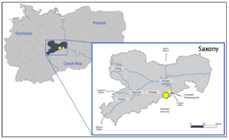
The Zinnwald Lithium project is located in east Germany, some 35 km from Dresden and adjacent to the border with the Czech Republic. Zinnwald Lithium's strategy is to focus on advancing a large scale fully integrated operation that produces battery-grade Lithium Hydroxide product ('LHM'); to optimise the Project from a cost perspective; and to minimise the potential impact on the environment and local communities. All aspects of the Project from mining through to production of the LHM are located near to the deposit itself in an area with developed infrastructure, energy sources, services, facilities, and access roads and rail. Power and water are provided by existing regional supply networks. It is also located close to the heart of the German automotive and chemical industries.
Project location and license areas
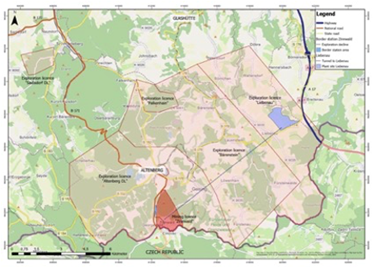
The Project falls entirely within the municipality of Altenberg, which covers an area of 145.8 km2. The municipality had a population of less than 8,000 in 2023. The orebody covered by Zinnwald Lithium's primary licence is located beneath the village of Zinnwald which is some 4 km south of the small ex-mining town of Altenberg. Altenberg is the largest town in the municipality with a population of less than 2,000. The proposed process plant site is located to the north of the village of Liebenau. The terrain rises gradually to the south and creates a natural barrier between the village and the plant site. Liebenau is a small village, also in the municipality of Altenberg, and located approximately 7 km northeast of the town of Altenberg.
The Project is in a granite hosted Sn/W/Li belt that has been mined historically for tin, tungsten and lithium at different times over the past 400 years. Lithium is contained in lithium-bearing mica, which is called "zinnwaldite" taking its name from the nearby village. The Project comprises five license areas that total ~13,000 hectares, but the core license area where the Project's resource has been defined is the Zinnwald license. This is a mining license which covers 256.5 ha and is valid to 31 December 2047.
Regional Map | Map of Zinnwald License areas |
|
|
Geology: Resource and Reserves
Zinnwald conducted an 84 hole, 27,000m drill programme in 2022-2023 that culminated in an updated Mineral Resource Estimate (MRE) in 2024 prepared by Snowden Optiro. The Mineral Resource totals 193.5 Mt at 2,220 ppm Li (429 kt contained lithium metal) in the Measured and Indicated category at a cut-off grade of 1,100 ppm Li. The updated MRE established the Project as one of the largest lithium projects in the EU both in terms of resource size and contained lithium content.
Classification | Tonnes(Mt) | Mean grade | Contained metal | ||
Li (ppm) | Li2O (ppm) | Li (kt) | LCE (kt) | ||
Measured | 36.3 | 2,500 | 5,380 | 91 | 483 |
Indicated | 157.2 | 2,150 | 4,630 | 338 | 1,802 |
MEASURED + INDICATED TOTAL | 193.5 | 2,220 | 4,780 | 429 | 2,285 |
INFERRED TOTAL | 33.3 | 2,140 | 4,610 | 71 | 379 |
As part of the PFS, Snowden prepared a maiden Mineral Ore Reserve that totals 128 Mt (grading 2,056ppm Li) supporting a phased development strategy of 18,000 tpa of LHM in Phase 1 and increasing to a forecast peak production of 35,100 tpa LHM, effectively doubling the capacity within Phase 1 project footprint.
Classification | Tonnes(Mt) | Grade | Contained metal | ||
Li (ppm) | Li2O (ppm) | Li (kt) | LCE (kt) | ||
Proven | 27.2 | 2,188 | 4,711 | 60 | 317 |
Probable | 100.9 | 2,021 | 4,351 | 204 | 1,085 |
Total | 128.1 | 2,056 | 4,428 | 263 | 1,402 |
Technical concept
The Project encompasses the following main phases:
· Bulk underground mining and primary crushing.
· Ore transport from the mine to the mineral processing plant via a 9.1km tunnel
· Beneficiation stage comprising grinding, wet magnetic separation and dewatering resulting in the production of a Zinnwaldite concentrate (grade of circa 1.14% Lithium metal) as well as a quartz sand tailings partially backfilled underground and partially stored on TSF (if unable to be sold).
· Pyrometallurgical stage with calcination of concentrate
· Hydrometallurgical stage where the calcined material is leached with subsequent purification and crystallisation into battery grade Lithium Hydroxide. It includes output of saleable chemicals, such as calcium silicate, calcium fluoride, calcium carbonate and potassium chloride
· The processing plant has been designed to achieve Zero Liquid Discharge.
· Analcime residue, the main processing by-product, either used for backfilling the mined areas underground or potentially sold to the construction industry
Pre-Feasibility Study and production plans
In March 2025, the Company published its PFS that demonstrates the financial viability of the Project with a Pre-tax Net Present Value (NPV) of €3.3 billion and a pre-tax Internal Rate of Return (IRR) of 23.6%. The after tax NPV is €2.2 billion and post-tax IRR is 19.8%. The Project has a mine life of over 40 years and the payback period is less than five years post commencement of production. This PFS included a development concept conceived as a multi-stage approach where Phase 1 will establish the necessary infrastructure, develop the mine and deliver approximately 18,000 tonnes of LHM per annum. Phase 2 will double production capacity and sees production peak at approximately 35,100 tonnes LHM per annum utilising the initial mining and tunnel infrastructure and benefiting from economies of scale.
Permitting / ESIA
The Project will be permitted under German Mining Law and will follow an integrated permitting procedure under one unitary body, the Saxony Mining Authority ('SOBA'). A Spatial Planning Procedure was completed in December 2025 as a pre-cursor to the overarching permit, the General Operating Plan ('GOP'). As part of the GOP process, the Project will complete an Environmental Impact Assessment ('EIA'). The GOP requires various supporting documents including the EIA and other related documentation (e.g. Natura 2000 Impact Assessments, Landscape Management Plan and various environmental technical reports).
The Project has also commenced its work to produce an Environmental and Social Impact Assessment that will meet both the requirements for permitting under German Federal law as well as being completed to a level suitable for the purposes of seeking finance from International Financing Institutions, which are signatories to the Equator Principles 4 (and related standards).
Site selection and impact on local communities
The Project has been designed to minimise the impact on local communities, the environment and protected areas in the vicinity (Natura 2000 and UNESCO World Heritage). This has been done despite a generally higher cost. This includes underground mining and continuous backfilling with mined waste, rather than open-pit mining; ore haulage via a tunnel to be constructed, rather than via truck transport on local roads or overland conveyor; and the selection of an area of ground adjacent to the A17 Highway as the main industrial site. This site is not in a protected area (such as Natura 2000) and is also not directly visible from the nearest village, Liebenau. The site is also well located with access to the A17 Highway and is near a planned solar park with the potential to supply a significant portion of the Project's electrical power needs from a renewable source.
STRATEGIC REPORT
Extracts from the Company's Strategic Report are set out below.
Operational Review
2025 saw Zinnwald Lithium continue to accelerate its development strategy for the Project, including achieving two key milestones. Firstly, the publication of the PFS that demonstrated both the scale of the Project, its long mine life and the robust economics. Secondly, the publication for formal stakeholder engagement of the Scoping Study for its E SIA, including associated stakeholder engagement plans and associated policies.
PRE-FEASIBILITY STUDY
In March 2025, the Group published a PFS for the Project on a phased project basis with a mine life in excess of 40 years. The Project includes an underground mine with associated processing of mined ore to produce battery-grade LHM. Processing including beneficiation, pyrometallurgy and hydrometallurgy will be carried out at an industrial facility to be established near the village of Liebenau. Ore haulage from the mine to the processing facility is via electric conveyor in a 9.1 km tunnel that will be constructed utilising a tunnel boring machine ('TBM') to reduce the Project's impact on local communities.
The Project development concept has been conceived as a multi-stage approach where Phase 1 will establish the necessary infrastructure, develop the mine and deliver approximately 18,000 tonnes of LHM per annum. Phase 2 will double production capacity and sees production peak at approximately 35,100 tonnes LHM per annum utilising the initial mining and tunnel infrastructure and benefiting from economies of scale.
The planned underground mine has been designed as a conventional longhole open stoping operation with paste backfill, utilising regional pillars to mitigate surface subsidence risks. Primary crushing will occur underground before ore is transported through the 9.1 km tunnel via conveyor to the industrial facility.
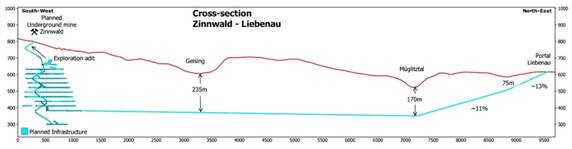
At the industrial facility, ore will be initially processed using conventional high intensity wet magnetic separation to recover a zinnwaldite concentrate. Benign quartz sand waste from this stage will either be returned to the mine for use as backfill material underground, stored on the adjacent tailings storage facility or sold to third parties for use in the construction industry.
Subsequent processing stages will include calcination of the zinnwaldite concentrate in a rotary kiln, pressure leaching and bicarbonation utilising a proprietary process developed by Metso and subsequent evaporation and crystallisation. The primary end product will be battery grade lithium hydroxide which will be shipped via the nearby autobahn to end-users in the German or EU battery chain. A number of by-products including analcime, calcium silicate, calcium fluoride, calcium carbonate and potassium chloride will also be produced. The process plant is designed to achieve zero liquid discharge.
In Phase 1, the Project is expected to deliver approximately 1.6 million tonnes per annum ('tpa') run of mine (ROM), providing approximately 300,000 tpa zinnwaldite concentrate which will be further processed into approximately 18,000 tpa LHM. Given the scale of the resource and the capacity of the planned processing site, the Project considers expansion through development of Phase 2, doubling capacity and allowing output to peak at approximately 35,100 t/a LHM after allowing for the forecast reduction in feed grade over the LOM. The Project implementation plan envisages the permitting and build-out of Phase 1 to demonstrate the viability of the Project before proceeding with Phase 2, assumed to begin operation in Year 7.
Economic Analysis in the PFS
The economic analysis included in the PFS (summarised below) demonstrates the financial viability of the Project with a pre-tax Net Present Value ("NPV") of €3.3 billion and a pre-tax Internal Rate of Return ("IRR") of 23.6%. The post-tax NPV is €2.2 billion and post-tax IRR is 19.8% The Project has a mine life of over 40 years and the payback period is less than five years post commencement of production.
PFS Key Financial Model Metrics | Unit | Value |
Pre-tax NPV (at 8 % discount) | EUR €m | 3,328 |
Pre-tax IRR | % | 23.6% |
Post-tax NPV (at 8 % discount) | EUR €m | 2,187 |
Post-tax IRR | % | 19.8% |
Simple Payback (years post start of production) | Years | 4.6 |
Initial Construction Capital Cost | EUR €m | 1,048 |
Average LOM Unit Operating Costs (pre by-product credits) | EUR/t LHM | 9,505 |
Average LOM Unit Operating Costs (post by-product credits) | EUR/t LHM | 8,403 |
Average LOM Revenue | EUR €m p.a. | 741 |
Average Annual EBITDA with by-products | EUR €m p.a | 484 |
Annual Average LHM Production | KTonnes per annum | 27 |
LiOH Price assumed in model | EUR/t LHM | 26,288 |
MRE and Reserve
Zinnwald conducted an 84 hole, 27,000m drill programme in 2022-2023 that culminated in an updated Mineral Resource Estimate ('MRE') in 2024 (see table below) prepared by Snowden Optiro. The Mineral Resource totals 193.5 Mt at 2,220 ppm Li (429 kt contained lithium metal) in the Measured and Indicated category at a cut-off grade of 1,100 ppm Li. The updated MRE established the Project as the second largest hard rock lithium project in the EU both in terms of resource size and contained lithium content.
As part of the PFS, Snowden Optiro prepared a Mineral Reserve (see table below) estimated using accepted industry practices for underground mines. The identified economic mineralisation was subjected to detailed mine design, scheduling and the development of a cashflow model incorporating technical and economic projections for the mine for the duration of the Reserves case, which is the mining base case. This Maiden Ore Reserve totals 128 Mt grading 2,056ppm Li supporting a phased development strategy of 18,000 tpa of LHM in Phase 1 and increasing to a forecast peak production of 35,100 tpa LHM, effectively doubling the capacity within Phase 1 project footprint.
Classification | Tonnes | Mean Grade | Contained Metal | ||
| (MT) | Li (ppm) | Li2O (ppm) | Li (Kt) | LCE (Kt) |
Resource (Jun 2024 MRE) | |||||
Measured | 36.3 | 2,500 | 5,380 | 91 | 483 |
Indicated | 157.2 | 2,150 | 4,630 | 338 | 1,802 |
MEASURED + INDICATED TOTAL | 193.5 | 2,220 | 4,780 | 429 | 2,285 |
INFERRED TOTAL | 33.3 | 2,140 | 4,610 | 71 | 379 |
Reserve (Mar 2025 PFS) | |||||
Proven | 27.2 | 2,188 | 4,711 | 60 | 317 |
Probable | 100.9 | 2,021 | 4,351 | 204 | 1,085 |
Total | 128.1 | 2,056 | 4,428 | 263 | 1,402 |
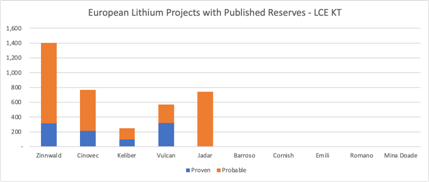
Under Ni 43-101, a Mineral Reserve is defined as the economically mineable part of a measured and/or Indicated Mineral Resource. It includes diluting materials and allowances for losses, which may occur when the material is mined or extracted and is defined by studies at pre-feasibility or feasibility level as appropriate that include application of Modifying Factors. In terms of the lithium projects in Europe, only a few have published proven and probable reserve numbers. These are shown in the chart below and show that the Zinnwald Project has the largest published reserves in Europe on a contained LCE basis.
PERMITTING AND STAKEHOLDER ENGAGEMENT
During the period, the Project completed two material milestones regarding permitting and engagement with the local community. These matters are covered in more detail in the report of the Sustainability Committee below.
In November 2025, the Project published the Environmental and Social Impact Assessment ('ESIA') Scoping Study, Stakeholder Engagement Plan, Land Access, Acquisition and Compensation Framework, and Grievance Mechanism. The Project has committed to undertaking an ESIA that goes beyond the national permitting requirements in order to meet the standards of International Financing Institutions. These documents were published on the Company's UK and local German language websites, they were also placed on display at the various Town Halls in the Altenberg Municipality. The Project and its consultants hosted a well-attended public information and dialogue event on 13 November 2025 to enable direct community participation. This formally started a consultation period, which completed in early 2026, enabling local communities, regional authorities, and other stakeholders to review the ESIA scoping findings, provide feedback, and engage directly with the Company on the proposed development.
In December 2025, the Project and the Saxon Mining Authority received the spatial planning assessment from the Saxony State Directorate Landesdirektion ('LDS') following its review of the public consultation phase of the assessment. This was subsequently published by LDS in January 2026 and concluded that the development concept set out in the PFS, including processing at Liebenau and ore transport via a conveyor tunnel, represents the most favourable option for large-scale development, and confirms the spatial compatibility of the Project. Whilst the assessment does not constitute a development approval it precedes the formal approval process under Federal mining law and provides the framework for further planning. The next stage of the Project will be progressed through the mining permitting process led by the Saxon Mining Authority.
EXPLORATION LICENSES
Whilst the Company's primary focus is on the development of its core Zinnwald Licence, it continues to advance targets on its surrounding 100% owned prospective exploration licence areas. Work on these licences has mainly involved relogging and sampling historical data and core. In November 2025, the Company received its second three year extension of its Falkenhain license that now expires at the end of 2028.
In addition, the team is evaluating an extensive historic geological database derived from historical drilling campaigns such as those undertaken by the former Wismut SAG, which has recently been made available to the public. Notably, there is data for over 900 drill holes of various depths within the areas of interest to the Company that has the potential to provide valuable geological and geotechnical information relevant to its licenses and site location options.
Liebenau Exploration license
On 7 April 2025, the Company announced that it had been granted an additional exploration licence (the 'Liebenau Licence') covering approximately 2,997 hectares in the Erzgebirge region of Saxony, Germany. The Liebenau Licence completes the licence coverage area for the Project's planned operations identified in the PFS and includes the site identified for the processing plant and tailings storage facility. It facilitates the ability for the required geo-technical and hydrogeological drilling to support the Project's next phase of work to complete a Definitive Feasibility Study ('DFS').
The Liebenau Licence adds a substantial land area to the mineral exploration titles of the Company in the region that now stands at combined 12,933 ha (see Map and Table below). Exploration activities on these licenses have the potential to further expand the Company's lithium resources which could ultimately contribute to production. The location of the Liebenau Licence is based on the boundaries of previously granted exploration licences and takes into account the findings of extensive exploration work by the state geological institutions of the former GDR and the data obtained therein. These indicate that granite- and greisen-associated Li-Sn-W mineralisation extend into the proposed exploration area.
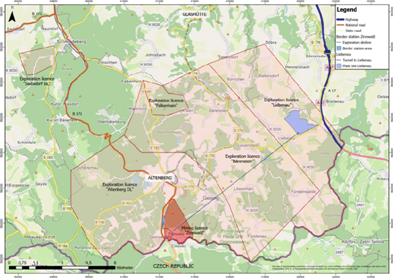
License | No | Interest | Category | Licence expiry date | License area (m²) |
Zinnwald | 2960 | 100% | Mining | 31 December 2047 | 2,564,800 |
Falkenhain | 1686 | 100% | Exploration | 31 December 2028 | 2,957,000 |
Altenberg | 1698 | 100% | Exploration | 20 February 2027 | 42,252,700 |
Sadisdorf | 1706 | 100% | Exploration | 30 June 2026 | 2,249,000 |
Bärenstein | 1713 | 100% | Exploration | 30 June 2028 | 49,339,000 |
Liebenau | 1733 | 100% | Exploration | 01 April 2030 | 29,970,000 |
Total |
|
|
|
| 129,332,500 |
PROCESS DEVELOPMENT / TESTWORK / ENGINEERING
The Project has continued to advance the Project on a number of fronts including work on various of the optimisation recommendations included in the PFS to be completed ahead of starting the work on the DFS.
Geology
The Project is further developing its geometallurgical model and has completed the further work on mineral characterisation, which will serve as the basis for selection of the variability testwork programme. Furthermore, the Project has also started the automated mineralogy works on zinnwaldite/Li-mica in tailings and feed samples, which will provide further insights into potentially non-recoverable lithium bearing minerals in the run-of-mine material. Additionally, the Project has completed the installation works for its hydrogeological monitoring, including measuring points in and around the proposed Zinnwald mine site. The Project has also completed a LIDAR drone survey at the Liebenau site, which will be used to integrate the plant and TSF into a 3D model for visualization purposes.
Processing Testwork
With regard to processing, the Project is progressing further testwork to optimise and de-risk elements of the flow sheet that will underpin the definitive operating criteria in the DFS. This includes assessing the potential to further improve the lithium recovery level in the concentrator, as well as testing the potential to use a tunnel kiln rather than a rotary kiln in the calcination stage. This has the potential to reduce both capital and operating costs in this area as well as simplifying materials handling. Initial results have been encouraging.
LOI with local Cement Company
The Project has signed a non-binding, non-exclusive Memorandum of Understanding ('MoU') with ECOMENT GmbH to develop options for commercialisation of the beneficiation tailings and further development of the backfilling concept. The MoU also includes work around the use of the Project's residues, such as analcime, as a clinker substitute in the cement industry, for which the initial test results have been encouraging.
Solar power opportunity
In 2025, the Company signed a letter of intent ('LOI') with P+S Projektentwicklung Solar-Bau GmbH ('Solar-Bau') to explore the purchase of solar-generated power. Solar-Bau, a solar development company, plans to establish several solar power generation facilities near the Project. This partnership could therefore minimise environmental impact by using solar energy close to its source, thereby reducing energy transfer losses and infrastructure costs, while providing Zinnwald Lithium with a clean energy source to lower the CO2 content of its LHM.
Staffing in Germany
The Group has further strengthened the team in Germany in 2025 with the appointment of a new permitting manager. The local Project team now comprises 11 full time staff of which four are female. The Company also employed six full time consultants during the PFS stage. In total the Group has eighteen full-time professionals (including employees and directors) working across disciplines in both the Dresden and London office locations. In addition, more than 30 professionals work for the Project in partner organisations.
GERMAN STATE AND FEDERAL SUPPORT
German research allowance tax credit under Forschungszulage scheme
Zinnwald Lithium has been informed that it had been awarded a tax credit in the form of cash reimbursement of historic R&D expenses under the German Forschungszulage (Research Allowance) scheme. In March 2026, as part of this recognition, Zinnwald also received its official seal from the Bescheinigungsstelle Forschungszulage ("BSFZ") as proof of its 'entrepreneurial innovation competence'. This scheme was introduced in Germany in 2020 to promote and accelerate corporate research and development. It is a government-funded tax incentive scheme that reimburses eligible R&D expenses. Eligible projects must be in fundamental research, industrial research, or experimental development. Zinnwald submitted two applications, one for its geological R&D studies into the extraction of lithium from micas, and the other for its innovative processing development work, both of which were reflected in its PFS in 2025. Both applications were approved by the BSFZ resulting in an overall reimbursement of up to €1.9 million to be received later in 2026.
Critical Raw Materials Act ("CRMA")
On 25 March 2025, the Company announced that its application under the Critical Raw Materials Act ('CRMA') had been unsuccessful in the first annual list of "strategic" projects. In its review of the Project, the CRMA committee noted that the Project has the potential to make a significant contribution to future supply of lithium for the EU. Despite this outcome, the Company remains optimistic about the Project's long-term prospects as one of the few near-term, sustainable lithium production projects in Europe with the size of resource that can be a significant contributor to European supply. This was demonstrated in the PFS that was published shortly after the EU's announcement and had not been available for review by the EU at the time of the Project's application in August 2024.
Saxony government support
In an immediate response to the CRMA's decision, on 2 April 2025, the Saxon State Government reaffirmed its strong support for the Project, emphasising its strategic significance in securing a sustainable and independent lithium supply for the Free State of Saxony, the Federal Republic of Germany, and Europe as a whole. Saxony's Economics Minister, Dirk Panter, reiterated the government's commitment to the Project, stating:
"Especially in light of increasing international tensions, reducing raw material dependence is crucial for Saxony, Germany, and the EU. The Zinnwald Lithium project plays an outstanding role in this effort. Ensuring an independent and sustainable supply of critical raw materials like lithium is vital for Saxony's competitiveness as an industrial hub and for the transformation of the mobility and energy sectors.
Minister Panter also emphasised the importance of international investment in large-scale projects such as Zinnwald Lithium and welcomed the Company's successful demonstration of the Project's economic feasibility, which highlights the attractiveness and economic significance of raw material extraction in Saxony and Germany. The Minister further confirmed that the Saxon Government will actively support the Project and has designated it a high priority. This commitment is formally acknowledged in the coalition agreement between the CDU and SPD in the Free State of Saxony.
Federal government support
In December 2025, Parliamentary State Secretary Stefan Rouenhoff from the Federal Ministry for Economic Affairs and Energy visited the Project site as part of a political raw materials tour to review progress and discuss ways to accelerate feasibility and approval processes. Discussions also covered opportunities linked to the new European RESourceEU action plan, which aims to speed up financing and permitting for critical raw material projects. He stated:
"The German economy depends on a reliable supply of raw materials and secure supply chains. They are the basic prerequisite for industrial value creation in our country. Increasing geopolitical tensions are putting pressure on business and politics to make further joint efforts at national and European level to secure the supply of raw materials. The National Raw Materials Fund, the Critical Raw Materials Act and the RESourceEU approach, which includes plans for a European centre for critical raw materials, will improve the framework conditions for strategic raw materials projects. The project in Zinnwald could also benefit from this. In any case, the project impressively demonstrates that modern extraction of strategic raw materials is possible in Germany."
Both Mr Rouenhoff and the State Secretary of Saxony Dr Andreas Handschuh promised that the federal and state governments would advocate for the recognition of Zinnwald Lithium as a CRMA Strategic project in the 2026 round of applications. In light of these strong expressions of support, the Company has made an application in January 2026 and final decisions by the EU are expected later in 2026.
Temporary Crisis and Transition Framework ('TCTF')
In 2024, the Company applied for public grant funding under the Federal Government's TCTF programme to support the "Resilience and Sustainability of the Battery Cell Manufacturing Ecosystem" in Germany. The Project underwent detailed technical review and was invited to formally apply for the envisaged funding. While the invitation did not guarantee funding, it acknowledged the Project's strong potential. In June 2024, the Saxony Government announced its commitment to provide its portion of any funding. One of the specific terms of this TCTF programme was that construction of any successful project needed to commence by the end of 2025. Accordingly, the Company elected to withdraw its application under this specific programme and is exploring other grant funding opportunities.
CORPORATE MATTERS
Fundraise
On 18 June 2025, Zinnwald completed a £3.4m fundraise at a placing price of 5p per share. The Board continues to recognise the importance of giving retail shareholders and investors an opportunity to participate in the Company's ongoing funding and utilised the RetailBook Platform for new and existing shareholders located in the United Kingdom, which raised £0.25m in total. AMG Lithium B.V. ('AMG'), a wholly owned subsidiary of Euronext Amsterdam-listed AMG Critical Materials N.V, supported the fund raise and increased its shareholding in the Company from 25.1% to 29.6%. Two other significant and longstanding shareholders in the Company, Henry Maxey and Mark Tindall, also subscribed to increase their respective shareholdings to 14.7% and 5.2%.
Brokers
The Company has elected to go forward with a single broker for the time being and Oberon Capital Ltd has been performing that role with effect from 30 September 2025.
New Director
In February 2026, the Company welcomed Dominik Simler as a new independent non-executive Director in replacement of Graham Brown who has stepped down from the Board. Mr Brown has taken up a new role as Senior Operating Partner of the private equity group, Appian Capital, based full time in Dubai. Mr Simler, a German national, brings over 20 years of pan-European investment and advisory experience, with a particular focus on the central European German speaking region. He has extensive experience in structuring and sourcing capital and working with stakeholders across various industries, having held senior roles at leading private equity and investment firms.
Lithium Market - 2025/26
Lithium Demand Trends - 2025-2026 - Electric Vehicles ('EVs')
EVs saw strong growth again in 2025 with global sales increasing 20% year on year to 20.7m sales in the passenger car and light-duty vehicle segment. Benchmark noted that the European EV market grew by 33% in 2025 compared with 2024, with 31% growth coming from Battery Electric Vehicles and 38% from Plug-in Hybrid Electric Vehicles over the same period. The European electric vehicle market was marked by a year of legislative change, as EU tailpipe emissions targets were softened throughout the year. There was also increased support for consumer EV purchases, with several major European countries expanding or increasing subsidies. Over 2025, EV sales accelerated in several major markets, including in Germany where they grew by 48%. The softening of the 2025 EU emissions targets in May 2025, shifting compliance to an average of 2025-27 emissions rather than just 2025, provided car manufacturers with some relief. However, many manufacturers had already put plans in place to increase EV sales in order to meet these targets.
Looking ahead to 2026, the key development in Europe is the proposed watering down of the 2035 emissions targets, reducing the requirement from a 100% tailpipe emissions reduction (relative to 2021 levels) to 90%, provided certain conditions are met, including the use of low-carbon steel credits and renewable fuel credits. Under the proposed Automotive Package, manufacturers would also benefit from additional compliance flexibilities, including banking and borrowing of emissions performance for the 2030-32 period. Additional measures include new targets for corporate fleets, super-credits for small vehicles, and increased support through the EU's Battery Booster initiative. Benchmark expects car manufacturers to maintain strong EV sales momentum, as they must still comply with the 2025-27 emissions standards. The revival of consumer subsidies will also play a key role, with several countries, including France, Germany, and Sweden, announcing support targeted at low- and middle-income households. As a result, the European EV market is expected to grow by 14% in 2026.
Lithium Demand Trends - 2025-2026 - Battery Energy Storage Systems ('BESS')
In 2025, BESS was the fastest growing battery demand market at around 45% growth year on year, with 315 GWh installed across the grid and behind the meter markets. The grid market was the largest driver with over 240 GWh installed, China and the US continued to be the leading markets here. Notably, China commissioned more BESS capacity in December alone than the US, the world's second-largest market, added over the entire year. Gigascale projects entered the mainstream in 2025, with 46 projects over 1 GWh entering operation according to the Benchmark BESS database, compared to 17 in 2024 and just four in 2023. These projects are capable of transforming a minor market to a major player, such as seen in Saudi Arabia, now a top five largest BESS market by operational grid capacity on the back of a handful of gigascale projects.
Benchmark believes that in 2026, BESS is set for another record year, with over 450 GWh set to enter operation globally. The Benchmark BESS Forecast foresees China and the US continuing to dominate installations, though reducing their combined market share slightly to less than 70% of global installations. Twelve countries have a 2026 pipeline of over 5 GWh, compared to just four countries that exceeded this in 2025, China, US, Saudi Arabia and Australia. Several European countries are also set to enter the mix, with the UK, Germany, Greece, Spain and Italy all exceeding this threshold.
Lithium Supply Trends - 2025-26
Benchmark noted that global lithium supply in 2025 increased by approximately 16%, reaching approximately 1.6 million tonnes of lithium carbonate equivalent, up from an estimated 1.4 million tonnes in 2024, driven by rapid project development in Africa, South America and China. This growth in supply is aimed at meeting robust demand, which grew by 29% for battery applications in 2025. Africa has been the largest source of new supply, with significant contributions from Zimbabwe and Mali, exceeding the growth of the rest of the world combined. There was also continued expansion in South American brine projects (Argentina, Chile) and Chinese projects. Several direct lithium extraction projects have moved towards production, but as yet not contributed materially to overall supply.
The majority of global 2026 supply growth is expected from China. The restart of CATL's Jianxiawo lepidolite mine, at the time of writing expected for Q2 2026, plus Zijin's Hunan and Tibet forays into lithium, as well as Qinghai brine sources will be the major contributors. Africa's 20% year-on-year growth is expected to come from a diverse set of projects in Western and Southern Africa. Mali's Goulamina mine is set to add the most in the region. Following net-flat 2024 and 2025 production figures, Australia is set to add at least 20,000 tonnes LCE this year. Should prices remain elevated, Australian producers could add further to production. Compared to 2025, South American supply is projected to grow by a similar volume. Argentina will account for most of this increase, followed by Chile and Brazil. Most additional output will come from the ramping and expansion of existing operations.
One key driver of long-term supply is around strategic investments to reshape supply security: The US, Europe and major energy companies are making significant long-term moves to secure lithium supply and reduce their reliance on China. The International Energy Agency ranks lithium's geopolitical risk at 3 out of 58, with 85% of global lithium production concentrated in three countries: Australia, Chile and China. With control over refining 60% of the world's lithium, China's threats to disrupt global supply chains for its own political interests clearly pose a threat to lithium accessibility. By securing future production, governments and corporations are mitigating geopolitical risk, enhancing cost visibility and laying the groundwork for sustained demand growth. For lithium miners, this translates into stronger pricing support, improved margins, and a more favourable investment climate.
Lithium Pricing Trends - 2025-26
Lithium sentiment became sharply more bullish at the end of 2025 as strengthening demand expectations outside the US could prompt a market surplus to turn into a deficit some years sooner than previously anticipated. Lithium pricing has remained volatile in recent years, with lithium prices increasing sharply until they peaked in November 2022, followed by a prolonged and steep decline that lasted until the market found its footing again in June 2025. This rebound has been driven by robust demand growth and ongoing inventory reduction, alongside regulatory tightening, including the shutdown of a major Chinese lithium mine by CATL and new government measures aimed at preventing producers from selling lithium at unsustainably low prices.
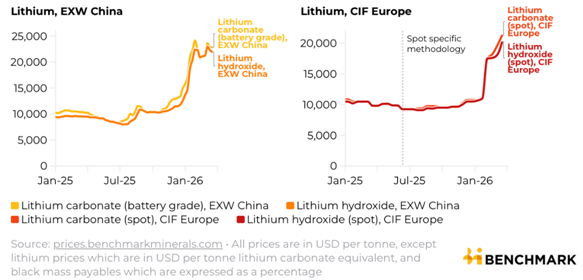
Sprott noted at the end of 2025 that while the extreme peaks of late 2022 are unlikely to return, the price history of the past five years illustrates how periods of imbalance can create significant volatility in either direction. With prices recovering, fundamentals strengthening, and inventories normalising, the market appears to have entered a better position. Sprott believes that lithium's positive momentum marks the beginning of a new chapter, shaped by strategic investment and innovation, ensuring its central role in powering progress across various sectors, including electric vehicles, defence and data centres, for decades to come.
Shareholder Evolution in 2025
During 2025, the Company's underlying shareholder base shows an ever-increasing ownership by German and EU investors. Whilst the Company has no formal listing in Europe as yet, independent brokers trade the Company's shares on eight separate OTC markets in Germany and Europe. Analysis of trading data shows that since the publication of the Project's updated MRE in 2024, the combined trading volumes in Europe are averaging around half of those on AIM. The Company intends to use this interest to increase its exposure to European investors in 2026. Based on the latest share register, it shows that German and other EU holders own over half of the Company.
Outlook
The PFS has demonstrated the size, long mine life and robust economics of the Project and its relevance to the long-term development of the German and EU battery chain. The Company will continue to advance the technical development work required ahead of commencing the DFS. The Company will also continue its work on the permitting and ESIA process and ensuring its social license to operate with the local community, supported by its strong relationship with the local government in Saxony. Alongside this, the Company will continue to advance its long-term financing strategy including discussions with potential financing partners.
Financial Review
Notwithstanding that the Company is a UK Plc admitted to trading on AIM, the Company presents its accounts in its functional currency of Euros, since the majority of its expenditure, including that of its subsidiary Zinnwald Lithium, is denominated in this currency.
The Group is still at an exploration and development stage and not yet producing minerals, which would generate commercial income. The Group is not expected to report overall profits until it is able to profitably commercialise its Zinnwald Lithium project in Germany.
During the year, the Group made an operating loss of €3.5m compared with a loss of €3.1m in 2024. Administrative expenses increased from €2.5m to €2.9m and these include the costs related to being a public listed company, including the costs of non-executive directors, brokers, nominated adviser and other advisers. There was also a share-based payment expense of €0.6m in 2025, compared with €0.7m in 2024, arising from the issuance of various new incentives.
During the year, the Group made an overall loss before taxation of €3.4m compared with a loss of €2.7m for the year ended 31 December 2024. This included interest income of €0.1m on the Group's cash balances compared with €0.4m in 2024. The overall operating loss for the Group for the year improved to €1.5m for 2025 compared with a €2.7m loss for 2024. This improvement is due to the accrued tax credit of €1.85m related to the Forschungszulage research allowance approved in 2025..
The Total Net Assets of the Group increased to €40.7m as at 31 December 2025 from €37.7m at 31 December 2024 due increased capitalised spend on the Project. The Group spent €3.4m on direct development work on the Project focussed on completion of the PFS and ongoing permitting and ESIA work. This increased the Group's Intangible asset balance to €37.6m at year end from €34.2m at the end of 2024 and cash balances decreased to €2.7m from €5.2m at the end of 2024.
The closing cash balance for the Group at the period end was €2.7m. As at today's date, the Group's cash balance is €1.8m with the up to €1.9m cash proceeds from the research allowance tax credit expected later in 2026.
The technical information relating to geology, the Mineral Resource and Reserve Statements and disclosure on other Project matters, particularly the Flowsheet, has been extracted and summarised from the Company's Pre-Feasibility Study Ni 43-101 report. The executive summary of this report was published on 31 March 2025. The independent Qualified Persons are Laurie Hassall (MSci FIMMM QMR FGS) and Rodrigo Pasqua (FAusIMM,BEng (Mining)) of Snowden Optiro and are both Qualified Persons as defined by National Instrument 43-101 - Standards of Disclosure for Mineral Projects.
gROUP STATEMENT OF COMPREHENSIVE INCOME
FOR THE YEAR ENDED 31 DECEMBER 2025
| 31 December 2025 | 31 December 2024 | |
Notes | € | € | |
Continuing operations |
| ||
Administrative expenses |
| (2,913,283) | (2,526,650) |
Other operating income | 7 | 53,246 | 110,605 |
Share based payments charge | 23 | (600,196) | (688,877) |
|
| ||
Operating loss | (3,460,233) | (3,104,922) | |
Finance income | 9 | 86,882 | 380,607 |
| |||
Loss before taxation |
| (3,373,351) | (2,724,315) |
Tax | 10 | 1,858,925 | (11,274) |
| |||
Loss for the financial year | 27 | (1,514,426) | (2,735,589) |
Other comprehensive (loss) / income |
| (41) | 65 |
| |||
Total comprehensive loss for the year |
| (1,514,467) | (2,735,524) |
| |||
| |||
Earnings per share from continuing operations attributable to the owners of the parent company |
| ||
Basic (cents per share) | 11 | (0.30) | (0.57) |
Total loss and comprehensive loss for the year is attributable to the owners of the parent company.
GROUP STATEMENT OF FINANCIAL POSITION
AS AT 31 DECEMBER 2025
| 31 December 2025 | 31 December 2024 | |
Notes | € | € | |
Non-current assets |
| ||
Intangible assets | 12 | 37,554,532 | 34,202,236 |
Property, plant and equipment | 13 | 474,510 | 430,752 |
Right of use assets | 14 | 39,468 | 279,566 |
| |||
| 38,068,510 | 34,912,554 | |
| |||
Current assets |
| ||
Trade and other receivables | 18 | 2,076,205 | 371,142 |
Right of use assets < 1 year | 14 | 120,049 | - |
Cash and cash equivalents |
| 2,667,574 | 5,216,085 |
|
| ||
| 4,863,828 | 5,587,227 | |
| |||
Total Assets |
| 42,932,338 | 40,499,781 |
| |||
Current liabilities |
| ||
Trade and other payables | 19 | (645,071) | (1,106,584) |
Lease liabilities | 14 | (122,804) | (118,652) |
| |||
| (767,875) | (1,225,236) | |
| |||
Net current assets |
| 4,095,953 | 4,361,991 |
| |||
Non-current liabilities |
| ||
Deferred tax liability | 20 | (1,382,868) | (1,382,868) |
Lease liabilities > 1 Year | 14 | (41,882) | (164,687) |
| |||
| (1,424,750) | (1,547,555) | |
| |||
Total Liabilities |
| (2,192,625) | (2,772,791) |
| |||
Net Assets |
| 40,739,713 | 37,726,990 |
| |||
| |||
Equity |
| ||
Share capital | 24 | 6,167,588 | 5,377,253 |
Share premium | 25 | 42,613,014 | 39,476,355 |
Other reserves | 26 | 2,855,735 | 2,303,850 |
Retained losses | 27 | (10,896,624) | (9,430,468) |
| |||
Total equity |
| 40,739,713 | 37,726,990 |
|
GROUP STATEMENT OF CHANGES IN EQUITY
FOR THE YEAR ENDED 31 DECEMBER 2025
Notes | Share capital | Share premium | Other reserves | Retained earnings | Total | |
| € | € | € | € | € | |
Balance at 1 January 2024 |
| 5,365,379 | 39,403,810 | 1,896,531 | (6,817,222) | 39,848,498 |
|
| |||||
Year ended 31 December 2024 |
| |||||
Loss for the year | - | - | - | (2,735,589) | (2,735,589) | |
Other comprehensive income: |
|
|
|
|
|
|
Currency translation differences | - | - | 65 | - | 65 | |
Total comprehensive loss for the year | - | - | 65 | (2,735,589) | (2,735,524) | |
Issue of share capital |
| 11,874 | 72,545 | - | - | 84,419 |
Share issue costs | - | - | - | - | - | |
Credit to equity for equity settled share-based payments | 23 | - | - | 407,254 | 122,343 | 529,597 |
Total transactions with owners recognised directly in equity | 11,874 | 72,545 | 407,254 | 122,343 | 614,016 | |
Balance at 31 December 2024 and 1 January 2025 |
| 5,377,253 | 39,476,355 | 2,303,850 | (9,430,468) | 37,726,990 |
|
| |||||
Year ended 31 December 2025 |
| |||||
Loss for the year | - | - | - | (1,514,426) | (1,514,426) | |
Other comprehensive income |
|
|
|
|
|
|
Currency translation differences | - | - | (41) | - | (41) | |
Total comprehensive income for the year | - | - | (41) | (1,514,426) | (1,514,467) | |
Issue of share capital | 24 | 790,335 | 3,161,343 | - | - | 3,951,678 |
Share issue costs |
| - | (24,684) | - | - | (24,684) |
Credit to equity for equity settled share-based payments | 23 | - | - | 551,926 | 48,270 | 600,196 |
Total transactions with owners recognised directly in equity | 790,335 | 3,136,659 | 551,926 | 48,270 | 4,527,190 | |
Balance at 31 December 2025 |
| 6,167,588 | 42,613,014 | 2,855,735 | (10,896,624) | 40,739,713 |
GROUP STATEMENT OF CASH FLOWS
FOR THE YEAR ENDED 31 DECEMBER 2025
| Year ended 31 December 2025 | Year ended 31 December 2024 |
| |||
Notes | € | € |
| |||
Cash flows from operating activities |
|
|
|
|
|
|
Cash used in operations | 32 | (2,978,817) | (2,583,318) |
| ||
|
| |||||
Net cash outflow from operating activities |
| (2,978,817) | (2,583,318) |
| ||
|
| |||||
Cash flows from investing activities |
| (3,412,159) | (6,552,094) | |||
Exploration expenditure in Germany | 12 | (45,231) | (128,320) | |||
Purchase of property, plant and equipment | 13 | 86,882 | 380,607 | |||
Interest received |
| |||||
|
| |||||
Net cash used in investing activities |
| (3,370,508) | (6,299,807) |
| ||
|
| |||||
Cash flows from financing activities |
|
| ||||
Proceeds from the issue of shares |
| 3,951,678 | - | |||
Share issue costs |
| (24,684) | - | |||
Costs related to vested RSUs |
| - | (74,861) | |||
Lease payments |
| (126,180) | (132,120) | |||
| ||||||
Net cash generated from / (used in) financing activities |
| 3,800,814 | (206,981) |
| ||
|
| |||||
Net decrease in cash and cash equivalents |
| (2,548,511) | (9,090,106) |
| ||
|
| |||||
Cash and cash equivalents at beginning of year |
| 5,216,085 | 14,306,191 |
| ||
|
| |||||
Cash and cash equivalents at end of year |
| 2,667,574 | 5,216,085 |
| ||
|
| |||||
NOTES TO THE FINANCIAL STATEMENTS
FOR THE YEAR ENDED 31 DECEMBER 2025
1. Accounting Policies
1.1 Company Information
Zinnwald Lithium Plc (the "Company") is a public limited company which is listed on the AIM Market of the London Stock Exchange domiciled and incorporated in England and Wales. The registered office address is The Threshing Barn, Manor Barns, Coates Lane, High Wycombe, Bucks, HP13 5UX.
The group consists of Zinnwald Lithium Plc and its wholly owned subsidiaries as follows as at 31 December 2025:
Name of undertaking | Registered office | Nature of business | Class of shares held | Direct holding | Indirect holding |
Zinnwald Lithium Holdings Ltd | United Kingdom | Exploration | Ordinary | 100.0% | - |
Zinnwald Lithium GmbH | Germany | Exploration | Ordinary | - | 100.0% |
Zinnwald Lithium Services GmbH | Germany | Leasing | Ordinary | - | 100.0% |
On 1 December 2017, Zinnwald Lithium Plc acquired the entire issued share capital of Zinnwald Lithium Holdings Ltd ("ZLH", formerly known as Erris Resources (Exploration) Ltd) by way of a share for share exchange, ahead of the Company's listing on the AIM Market of the London Stock Exchange. ZLH's registered office address is The Threshing Barn, Manor Barns, Coates Lane, High Wycombe, Bucks, HP13 5UX.
On 29 October 2020, Zinnwald Lithium Plc acquired 50% of the issued share capital of Zinnwald Lithium GmbH ("ZLG", formerly known as Deutsche Lithium GmbH). On 24 June 2021, the Company acquired the remaining 50% of the issued share capital of ZLG. ZLG is a company registered in Dresden Germany (HRB 45396) with its statutory seat in Altenberg. Its business office is at Antonstrasse 3a, 01097, Dresden, Germany.
On 22 February 2023, ZLH incorporated a new company, Zinnwald Lithium Services GmbH ("ZLS") for the purpose of holding all rental and similar operational leases for the Group's operations in Germany. ZLS is a company registered in Dresden, Germany (HRB 45386) with its statutory seat from Freiberg to Altenberg. Its business office is at Antonstrasse 3a, 01097, Dresden, Germany
1.2 Basis of preparation
These financial statements have been prepared in accordance with UK-adopted International Accounting Standards and IFRIC interpretations and with those parts of the Companies Act 2006 applicable to companies reporting under IFRS (except as otherwise stated).
The financial statements are prepared in euros, which is the functional currency of the company and the group's presentation currency, since the majority of its expenditure, including funding provided to ZLG and ZLS, is denominated in this currency. Monetary amounts in these financial statements are rounded to the nearest €.
The € to GBP exchange rate used for translation as at 31 December 2025 was €1.146224 (2024: €1.209256).
The consolidated financial statements have been prepared under the historical cost convention, unless stated otherwise within the accounting policies. The principal accounting policies adopted are set out below.
1.3 Basis of consolidation
The consolidated financial statements incorporate those of Zinnwald Lithium Plc and all of its subsidiaries (i.e., entities that the group controls when the group is exposed to, or has rights to, variable returns from its involvement with the entity and has the ability to affect those returns through its power over the entity).
All financial statements are made up to 31 December 2025. Where necessary, adjustments are made to the financial statements of subsidiaries to bring the accounting policies used into line with those used by other members of the group.
All intra-group transactions, balances and unrealised gains on transactions between group companies are eliminated on consolidation. Unrealised losses are also eliminated unless the transaction provides evidence of an impairment of the asset transferred.
Subsidiaries are fully consolidated from the date on which control is transferred to the group. They are deconsolidated from the date on which control ceases.
1.4 Going concern
At the time of approving the financial statements, the directors have a reasonable expectation that the group and company have adequate resources to continue in operational existence for the foreseeable future. The Group had a cash balance of €2.7m at the year-end (€1.8m at date of this report along with the up to €1.9m of additional funds in the form of a research allowance tax credit to be received later in 2026) and keeps a tight control over all expenditure. Direct Project development spend is inherently discretionary and the Board maintains an ongoing strategy to enable the curtailing of a number of areas of expenditure to enable it to meet its minimum fixed costs for the next 12 months, even without raising further funds, whilst still maintaining all licenses in good standing. Thus, the Directors, having considered all reasonable possible scenarios, believe that the Group continues to be a going concern and have used this as the basis of accounting in preparing these Financial Statements.
1.5 Intangible assets
Capitalised Exploration and Evaluation costs
Exploration and evaluation assets are capitalised as Intangible Assets and represent the costs incurred on the exploration and evaluation of potential mineral resources, They include direct costs (such as permitting costs, drilling, assays and flowsheet testwork done by consulting engineers), licence payments and fixed salary/consultant costs, capitalised in accordance with IFRS 6 "Exploration for and Evaluation of Mineral Resources". Exploration and Evaluation assets are initially measured at historic cost. Exploration and Evaluation Costs are assessed for indicators of impairment in accordance with IFRS 6 when facts and circumstances suggest that the carrying amount of an asset may exceed its recoverable amount. Any impairment is recognised directly in profit or loss.
1.6 Property, plant and equipment
Property, plant and equipment are initially measured at cost and subsequently measured at cost, net of depreciation and any impairment losses. Depreciation is recognised so as to write off the cost or valuation of assets less their residual values over their useful lives on the following bases:
Leasehold land and buildings No deprecation is charged on these balances
Plant and equipment 25% on cost
Fixtures and fittings 25% on cost
Computers 25% on cost
Motor vehicles 16.7% on cost for new vehicles, 33.3% on cost for second-hand vehicles
Low-value assets (Germany) 100% on cost on acquisition for items valued at less than €800
The gain or loss arising on the disposal of an asset is determined as the difference between the sale proceeds and the carrying value of the asset and is recognised in the income statement.
1.7 Non-current investments
In the parent company financial statements, investments in subsidiaries are initially measured at cost and subsequently measured at cost less any accumulated impairment losses.
1.8 Impairment of non-current assets
At each reporting period end date, the group reviews the carrying amounts of its tangible and intangible assets to determine whether there is any indication that those assets have suffered an impairment loss. If any such indication exists, the recoverable amount of the asset is estimated in order to determine the extent of the impairment loss (if any). Where it is not possible to estimate the recoverable amount of an individual asset, the group estimates the recoverable amount of the cash-generating unit to which the asset belongs.
Intangible assets not yet ready to use and not yet subject to amortisation are reviewed for impairment whenever events or circumstances indicate that the carrying value may not be recoverable.
Recoverable amount is the higher of fair value less costs to sell and value in use. In assessing value in use, the estimated future cash flows are discounted to their present value using a pre-tax discount rate that reflects current market assessments of the time value of money and the risks specific to the asset for which the estimates of future cash flows have not been adjusted.
If the recoverable amount of an asset (or cash-generating unit) is estimated to be less than its carrying amount, the carrying amount of the asset (or cash-generating unit) is reduced to its recoverable amount. An impairment loss is recognised immediately in profit or loss, unless the relevant asset is carried at a revalued amount, in which case the impairment loss is treated as a revaluation decrease.
1.9 Cash and cash equivalents
Cash and cash equivalents include cash in hand and deposits held at call with banks with a maturity date of less than 30 days.
1.10 Right of Use Assets and Lease Liabilities
All leases are accounted for by recognising a right-of-use assets due to a lease liability except for:
· Lease of low value assets; and
· Leases with duration of 12 months or less
The group reviews its contracts and agreements on an annual basis for the impact of IFRS 16. The group has such short duration leases and lease payments are charged to the income statement with the exception of the Group's lease for the Freiberg office and core shed, which expired in April 2024 and have been replaced by new office leases in Dresden and Core Shed in Altenberg that both started on 1 May 2024.
Lease liabilities are measured at the present value of the contractual payments due to the lessor over the lease term, with the discount rate determined by reference to the rate inherent in the lease unless (as is typically the case) this is not readily determinable, in which case the group's incremental borrowing rate on commencement of the lease is used. Variable lease payments are only included in the measurement of the lease liability if they depend on an index or rate. In such cases, the initial measurement of the lease liability assumes the variable element will remain unchanged throughout the lease term. Other variable lease payments are expensed in the period to which they relate.
On initial recognition, the carrying value of the lease liability also includes:
· amounts expected to be payable under any residual value guarantee;
· the exercise price of any purchase option granted in favour of the group if it is reasonably certain to assess that option;
· any penalties payable for terminating the lease, if the term of the lease has been estimated on the basis of termination option being exercised.
Right of use assets are initially measured at the amount of the lease liability, reduced for any lease incentives received, and increased for:
· lease payments made at or before commencement of the lease;
· initial direct costs incurred; and
· the amount of any provision recognised where the group is contractually required to dismantle, remove or restore the leased asset
Subsequent to initial measurement lease liabilities increase as a result of interest charged at a constant rate on the balance outstanding and are reduced for lease payments made. Right-of-use assets are amortised on a straight-line basis over the remaining term of the lease or over the remaining economic life of the asset if, rarely, this is judged to be shorter than the lease term.
1.11 Financial assets
Financial assets are recognised in the group's and company's statement of financial position when the group and company become party to the contractual provisions of the instrument.
Financial assets are classified into specified categories at initial recognition and subsequently measured at amortised cost, fair value through other comprehensive income, or fair value through profit or loss. The classification of financial assets at initial recognition that are debt instruments depends on the financial assets cash flow characteristics and the business model for managing them.
Financial assets are initially measured at fair value plus transaction costs. In order for a financial asset to be classified and measured at amortised cost, it needs to give rise to cash flows that are "solely payments of principal and interest SPPI" on the principal amount outstanding.
Financial assets at amortised cost (debt instruments)
Financial assets at amortised cost are subsequently measured using the effective interest rate method and are subject to impairment. The group's and company's financial assets at amortised cost comprise trade and other receivables and cash and cash equivalents.
Interest is recognised by applying the effective interest rate, except for short-term receivables when the recognition of interest would be immaterial. The effective interest method is a method of calculating the amortised cost of a debt instrument and of allocating the interest income over the relevant period. The effective interest rate is the rate that exactly discounts estimated future cash receipts through the expected life of the debt instrument to the net carrying amount on initial recognition.
Impairment of financial assets
Financial assets are assessed for indicators of impairment at each reporting end date.
Financial assets are impaired where there is objective evidence that, as a result of one or more events that occurred after the initial recognition of the financial asset, the estimated future cash flows of the investment have been affected.
Derecognition of financial assets
Financial assets are derecognised only when the contractual rights to the cash flows from the asset expire, or when it transfers the financial asset and substantially all the risks and rewards of ownership to another entity.
Financial liabilities
Other financial liabilities
Other financial liabilities, including borrowings, are initially measured at fair value, net of transaction costs. They are subsequently measured at amortised cost using the effective interest method, with interest expense recognised on an effective yield basis.
The effective interest method is a method of calculating the amortised cost of a financial liability and of allocating interest expense over the relevant period. The effective interest rate is the rate that exactly discounts estimated future cash payments through the expected life of the financial liability to the net carrying amount on initial recognition.
Derecognition of financial liabilities
Financial liabilities are derecognised when the group's contractual obligations expire or are discharged or cancelled.
1.12 Equity instruments
Equity instruments issued by the group are recorded at the proceeds received, net of direct issue costs.
1.13 Employee benefits
The costs of short-term employee benefits are recognised as a liability and an expense, unless those costs are required to be recognised as part of the cost of non-current assets.
The cost of any unused holiday entitlement is recognised in the period in which the employee's services are received.
Termination benefits are recognised immediately as an expense when the group and company is demonstrably committed to terminate the employment of an employee or to provide termination benefits.
1.14 Retirement benefits
Payments to defined contribution retirement benefit schemes are charged as an expense as they fall due.
1.15 Equity
Share capital
Ordinary shares are classified as equity.
Share premium
Share premium represents the excess of the issue price over the par value on shares issued. Incremental costs directly attributable to the issue of new ordinary shares or options are shown in equity as a deduction, net of tax, from the proceeds.
Merger reserve
A merger reserve was created in 2017 on purchase of the entire share capital of Zinnwald Lithium Holdings Ltd (formerly Erris Resources (Exploration) Ltd) which was completed by way of a share for share exchange and which has been treated as a group reconstruction and accounted for using the reverse merger accounting method.
Share-based payment reserve
The share-based payment reserve is used to recognise the fair value of equity-settled share-based payment transactions.
1.16 Share-based payments
Equity-settled share-based payments with employees and others providing services are measured at the fair value of the equity instruments at the grant date. Fair value is measured by use of an appropriate pricing model. Equity-settled share-based payment transactions with other parties are measured at the fair value of the goods and services, except where the fair value cannot be estimated reliably, in which case they are valued at the fair value of the equity instrument granted.
The fair value determined at the grant date is expensed on a straight-line basis over the vesting period, based on the estimate of shares that will eventually vest. A corresponding adjustment is made to equity.
When the terms and conditions of equity-settled share-based payments at the time they were granted are subsequently modified, the fair value of the share-based payment under the original terms and conditions and under the modified terms and conditions are both determined at the date of the modification. Any excess of the modified fair value over the original fair value is recognised over the remaining vesting period in addition to the grant date fair value of the original share-based payment. The share-based payment expense is not adjusted if the modified fair value is less than the original fair value.
Cancellations or settlements (including those resulting from employee redundancies) are treated as an acceleration of vesting and the amount that would have been recognised over the remaining vesting period is recognised immediately.
1.17 Foreign exchange
Foreign currency transactions are translated into the functional currency using the rates of exchange prevailing at the dates of the transactions. At each reporting end date, monetary assets and liabilities that are denominated in foreign currencies are retranslated at the rates prevailing on the reporting end date. Gains and losses arising on translation are included in administrative expenses in the income statement for the period.
The financial statements are presented in the functional currency of Euros since the majority of exploration expenditure is denominated in this currency.
1.18 Exceptional items
Items are disclosed separately in the financial statements where it is necessary to do so to provide further understanding of the financial performance of the group. They are items that are material, either because of their size or nature, or that are non-recurring.
1.19 Segmental reporting
Operating segments are reported in a manner consistent with the internal reporting provided to the Chief Executive Officer, who is considered to be the group's chief operating decision-maker ('CODM').
1.20 New standards, amendments and interpretations not yet adopted
There were no new standards or amendments to standards adopted by the group and company during the year which had a material impact on the financial statements.
At the date of approval of these financial statements, the following standards and amendments were in issue but not yet effective, and have not been early adopted:
· Amendments to IFRS 9 Financial Instruments and IFRS 7 Financial Instruments: Disclosures (Effective date 1 January 2026)
· Annual Improvements to IFRS standard - Volume 11 (Effective date 1 January 2026)
· IFRS 18 Presentation and Disclosure in Financial Statements (Effective date 1 January 2027)
· IFRS 19 Subsidiaries without Public Accountability (Effective date 1 January 2027)*
*subject to UK endorsement
There are no other IFRSs or IFRIC interpretations that are not yet effective that would be expected to have a material impact on the group or company.
2. Judgements and key sources of estimation uncertainty
In the application of the accounting policies, the directors are required to make judgements, estimates and assumptions about the carrying amount of assets and liabilities that are not readily apparent from other sources. The estimates and associated assumptions are based on historical experience and other factors that are considered to be relevant. Actual results may differ from these estimates.
The estimates and underlying assumptions are reviewed on an ongoing basis. Revisions to accounting estimates are recognised in the period in which the estimate is revised where the revision affects only that period, or in the period of the revision and future periods where the revision affects both current and future periods.
Critical judgements
The following judgements and estimates have had the most significant effect on amounts recognised in the financial statements.
Share-based payments
Estimating fair value for share based payment transactions requires determination of the most appropriate valuation model, which depends on the terms and conditions of the grant. This estimate also requires determination of the most appropriate inputs to the valuation model including the expected life of the share option or appreciation right, volatility and dividend yield and making assumptions about them. For the measurement of the fair value of equity settled transactions with employees at the grant date, the group and company use the Black Scholes model.
Impairment of Capitalised Exploration Costs
Group capitalised exploration costs had a carrying value as at 31 December 2025 of €37,554,533 (2024: €34,202,236), which solely relate to the Zinnwald Lithium Project, Management tests annually whether capitalised exploration costs have a carrying value in accordance with the guidance provided in IFRS 6 and any relevant indicators of impairment. Management has identified four areas that it believes to be most relevant to assessment of indicators of impairment and has concluded that no indicators of impairment exist at this stage:
· Exploration licenses have expired in the period or will expire in the near future and are not expected to be renewed. ZLGs core mining license at Zinnwald is valid to 31 December 2047. ZLG has additional exploration licenses at Falkenhain valid to 31 December 2028 at Altenberg to 15 February 2027, at Sadisdorf to 30 June 2026, at Bärenstein to 30 June 2028 and at Liebenau, newly granted in 2025, valid to 1 April 2030. The Group intends to maintain all licenses and has met all minimum spend requirements. The Group has received two new licenses in the last two years and has received regular three-year extensions on other licenses.
· Substantive expenditure on further exploration for and evaluation of mineral resources in the specific area is neither budgeted nor planned. The Project in Germany is the sole focus of the Zinnwald Group and in 2025 the Group spent a further €3.4m on exploration and evaluation expenditure (2024: €6.4m, 2023: €8.7m) primarily on completion of the PFS. The Group expects to spend substantive additional expenditure on the Project as it moves through the next stages of testwork, a definitive feasibility study, permitting and ESIA work.
· Exploration for and evaluation of mineral resources in the specific area have not led to the discovery of commercially viable quantities of mineral resources and the entity has decided to discontinue such activities in the specific area. Zinnwald conducted an 84 hole, 27,000m drill programme in 2022-2023 that culminated in an updated Mineral Resource Estimate (MRE) in 2024 prepared by Snowden Optiro. The Mineral Resource totals 193.5 Mt at 2,220 ppm Li (429 kt contained lithium metal) in the Measured and Indicated category at a cut-off grade of 1,100 ppm Li. As part of the PFS, Snowden prepared a maiden Mineral Ore Reserve that totals 128 Mt grading 4,428ppm (0.44%) Li₂O. This reserve placed Zinnwald as the largest amongst all European lithium projects based on all published studies that included reserves to date.
· Sufficient data exist to indicate that, although a development in the specific area is likely to proceed, the carrying amount of the exploration and evaluation asset is unlikely to be recovered in full from successful development or by sale. In March 2025, the Project published its PFS that demonstrates the financial viability of the Project with a Pre-tax Net Present Value of €3.3 billion (at an 8% discount rate) and a pre-tax Internal Rate of Return of 23.6%. The after tax NPV is €2.2 billion and post-tax IRR is 19.8%. The Project has a mine life of over 40 years and the payback period is less than five years post commencement of production.
Recoverability of investments in and loans to subsidiaries
The Directors review the carrying value of investments in and loans made to subsidiaries for any indications of impairment of potential non-recoverability. Since all investments and loans ultimately relate solely to funding for the Project in Germany and, as noted above, the Directors do not believe that any impairments is required for that asset, accordingly the Directors do not believe there is any impairment to investment or loan value.
3. Financial Risk and Capital Risk Management
The Group's and Company's activities expose it to a variety of financial risks: market risk (primarily currency risks), credit risk and liquidity risk. The overall risk management programme focusses on currency and working capital management.
Foreign Exchange Risk
The Company operates internationally and is exposed to foreign exchange risk arising from one main currency exposure, namely GBP for its Head Office costs and the value of its shares for fund-raising and Euros for a material part of its operating expenditure. The Group's Treasury risk management policy is currently to hold most of its cash reserves in Euros, as the majority of its current and planned expenditure will be on the Project in Germany.
Credit and Interest Rate Risk
The group and company have no borrowings and a low level of trade creditors and have minimal credit or interest rate risk exposure. The Group's cash and cash equivalents is held at major financial institutions.
Working Capital and Liquidity Risk
Cashflow and working capital forecasting is performed in the operating entities of the group and consolidated at a group level basis for monthly reporting to the Board. The Directors monitor these reports and rolling forecasts to ensure the group has sufficient cash to meet its operational needs. The Board has a policy of maintaining at least a GBP 0.5m cash reserve headroom. The group has no material fixed cost overheads other than its costs of being listed on the AIM market and its leases in Dresden and Altenberg. None of its employee contracts have notice periods of longer than six months and its development expenditure is inherently discretionary.
4. Segmental reporting
The Group operates in the UK and Germany. Activities in the UK include the Head Office corporate and administrative costs whilst the activities in Germany relate to ongoing development work at the group's wholly owned Zinnwald Lithium Project. The reports used by the Board and Management are based on these geographical segments.
Germany | UK | Total | |
2025 | 2025 | 2025 | |
€ | € | € | |
Income | 5,844 | 10,782 | 16,626 |
Administrative expenses | (1,087,091) | (1,734,667) | (2,821,758) |
Share based payment charge | (81,825) | (518,371) | (600,196) |
Loss on foreign exchange | (1,643) | (85,352) | (86,995) |
Other operating income | 53,246 | - | 53,246 |
Finance income | 12,348 | 74,534 | 86,882 |
Interest paid | (4,530) | - | (4,530) |
Tax | 1,858,925 | - | 1,858,825 |
Income / (loss) from operations per reportable segment | 738,648 | (2,253,074) | (1,514,426) |
Reportable segment assets | 40,414,911 | 2,517,427 | 42,932,338 |
Reportable segment liabilities | 693,333 | 1,499,292 | 2,192,625 |
Germany | UK | Total | |
2024 | 2024 | 2024 | |
€ | € | € | |
Administrative expenses | (1,013,403) | (1,675,736) | (2,689,139) |
Share based payment charge | - | (688,877) | (688,877) |
Gain/loss on foreign exchange | - | 170,006 | 170,006 |
Other operating income | 110,605 | - | 110,605 |
Finance income | 1,950 | 378,657 | 380,607 |
Interest paid | (7,517) | - | (7,517) |
Tax | (11,274) | - | (11,274) |
Loss from operations per reportable segment | (919,639) | (1,815,950) | (2,735,589) |
Reportable segment assets | 34,476,535 | 6,082,411 | 40,558,946 |
Reportable segment liabilities | 2,429,932 | 402,024 | 2,831,956 |
5. Operating loss
2025 | 2024 | |
€ | € | |
Operating loss for the year is stated after charging / (crediting) | ||
Exchange losses / (gains) | 86,995 | (170,008) |
Amortisation of intangible assets | 2,106 | 2,010 |
Depreciation of property, plant and equipment | 59,187 | 84,421 |
Depreciation of Right of Use Assets | 120,049 | 126,711 |
Share-based payment expense | 600,196 | 688,877 |
Operating lease charges | 48,022 | 36,641 |
Exploration costs expensed | 907,318 | 824,709 |
6. Auditor's remuneration
Fees payables to the company's auditor | 2025 | 2024 |
€ | € | |
For audit services | ||
Annual Audit of group, parent company and subsidiary undertakings | 45,896 | 45,914 |
Review of interim group financial statements | 3,630 | 3,557 |
49,526 | 49,471 | |
For other services | ||
Taxation compliance services | 6,476 | 7,759 |
7. Other operating income
2025 | 2024 | |
€ | € | |
Other operating income | 53,246 | 110,605 |
Other operating income primarily comprises rental and utilities income from sub-lessors.
8. Employees
The average number of persons (including directors) employed by the group and company during the year was:
Group | Company | |||
2025 | 2024 | 2025 | 2024 | |
Number | Number | Number | Number | |
Directors | 6 | 6 | 6 | 6 |
Employees | 13 | 14 | - | - |
19 | 20 | 6 | 6 | |
Their aggregate remuneration comprised | Group | Company | ||
2025 | 2024 | 2025 | 2024 | |
€ | € | € | € | |
Wages and salaries | 1,832,263 | 1,823,149 | 937,395 | 875,722 |
Social security costs | 221,528 | 235,368 | 123,160 | 137,050 |
Pension costs | 140,569 | 133,329 | 65,367 | 63,370 |
2,194,359 | 2,191,846 | 1,125,922 | 1,076,142 | |
Aggregate remuneration expenses of the group include €892,659 (2024: €913,998) of costs capitalised and included within non-current assets of the group. Aggregate remuneration expenses of the company include €Nil (2023: €Nil) of costs capitalised and included within non-current assets of the group. Directors' remuneration is disclosed in report of Remuneration Committee.
9. Finance income
Group | ||
2025 | 2024 | |
€ | € | |
Interest on bank deposits | 86,882 | 380,607 |
10. Taxation
Group | ||
Income tax expense | 2025 | 2024 |
€ | € | |
UK corporation tax expense - current year | - | - |
Overseas corporation tax expense - current year | - | 2,383 |
Overseas corporation tax expense - prior year reclaim | (1,477) | - |
Overseas research allowance tax credit | (1,857,488) | - |
Overseas real estate tax expense - current year | - | 8,891 |
Total current tax (credit) / expense | (1,858,925) | 11,274 |
|
| |
|
| |
€ | € | |
Loss before taxation | (3,373,531) | (2,735,588) |
Expected tax credit based on the standard rate of corporation tax in the UK of 19.00% (2024: 19.00%) | (640,936) | (519,762) |
Disallowable expenses | 116,694 | 132,436 |
Non-taxable gains | - | - |
Unutilised tax losses carried forward | 524,242 | 388,786 |
Difference in overseas tax rate | (1,477) | 922 |
Overseas research allowance tax credit | (1,857,488) | |
Overseas real estate tax expense | - | 8,891 |
Taxation (credit) / expense for the year | (1,858,925) | 11,274 |
Losses available to carry forward amount to €12,337,000 (2024: €9,578,000). No deferred tax asset has been recognised on these losses, as the probability and timing of available future taxable profits is not something that can currently be estimated. Foreign tax liabilities are calculated at the prevailing tax rates applicable in Germany.
11. Earnings per share
2025 | 2024 | |
€ | € | |
Weighted average number of ordinary shares for basic earnings per share | 510,024,962 | 474,497,857 |
Effect of dilutive potential ordinary shares | ||
- Weighted average number of outstanding share options | 28,959,975 | 22,695,897 |
Weighted average number of ordinary shares for diluted earnings per share | 538,984,937 | 497,193,754 |
Earnings | ||
Continuing operations | (1,514,426) | (2,724,315) |
Loss for the period for continuing operations | ||
Earnings for basic and diluted earnings per share distributable to equity shareholders of the company | (1,514,426) | (2,724,315) |
Earnings per share for continuing operations | ||
Basic and diluted earnings per share | ||
Basic earnings per share - cents | (0.30) | (0.57) |
There is no difference between the basic and diluted earnings per share for the period ended 31 December 2025 or 2024 as the effect of the exercise of options would be anti-dilutive.
12. Intangible Assets
Group | Total |
Cost | € |
At 1 January 2024 | 27,655,638 |
Additions - group funded | 6,552,094 |
At 31 December 2024 | 34,207,732 |
Additions - group funded | 3,412,159 |
Reclassification to Tangible Assets | (57,757) |
At 31 December 2025 | 37,562,134 |
Amortisation and impairment | |
At 1 January 2024 | 3,486 |
Amortisation charged for the year | 2,010 |
At 31 December 2024 | 5,496 |
Amortisation charged for the year | 2,106 |
At 31 December 2025 | 7,602 |
Carrying amount at 31 December 2025 | 37,554,532 |
Carrying amount at 31 December 2024 | 34,202,236 |
Intangible assets comprise capitalised exploration and evaluation costs (direct costs, licence fees and fixed salary / consultant costs) of the Zinnwald Lithium project in Germany. The Company has had no directly owned intangible assets since 2020.
13. Property plant and equipment
Group | Leasehold, land and buildings | Fixtures, fittings and equipment | Motor vehicles | Total |
Cost | € | € | € | € |
At 1 January 2024 | 70,990 | 360,263 | 66,593 | 497,846 |
Additions - group funded | 30,000 | 98,320 | - | 128,320 |
Exchange adjustments | - | 331 | - | 331 |
At 31 December 2024 | 100,990 | 458,914 | 66,593 | 626,497 |
Additions - group funded | 42,545 | 2,686 | - | 45,231 |
Reclassification from Intangibles | - | 57,757 | - | 57,757 |
Exchange adjustments | - | (373) | - | (373) |
At 31 December 2025 | 143,535 | 518,984 | 66,593 | 729,112 |
|
|
|
| |
Depreciation and impairment | ||||
At 1 January 2024 | - | 80,158 | 30,900 | 111,058 |
Depreciation charged for the year | - | 71,135 | 13,286 | 84,421 |
Exchange adjustments | - | 266 | - | 266 |
At 31 December 2024 | - | 151,559 | 44,186 | 195,745 |
Depreciation charged for the year | - | 49,147 | 10,040 | 59,187 |
Exchange adjustments | - | (330) | - | (330) |
At 31 December 2025 | - | 200,376 | 54,226 | 254,602 |
Carrying amount at 31 December 2025 | 143,535 | 318,608 | 12,367 | 474,510 |
Carrying amount at 31 December 2024 | 100,990 | 307,355 | 22,407 | 430,752 |
Company | Computers | |||
Cost | € | |||
At 1 January 2024 | 6,839 | |||
Additions - group funded | - | |||
Exchange adjustments | 331 | |||
At 31 December 2024 | 7,170 | |||
Additions - group funded | - | |||
Exchange adjustments | (373) | |||
At 31 December 2025 | 6,797 | |||
Depreciation and impairment | ||||
At 1 January 2024 | 4,146 | |||
Depreciation charged for the year | 1,463 | |||
Exchange adjustments | 266 | |||
At 31 December 2024 | 5,875 | |||
Depreciation charged for the year | 660 | |||
Exchange adjustments | (330) | |||
At 31 December 2025 | 6,205 | |||
Carrying amount at 31 December 2025 | 592 | |||
Carrying amount at 31 December 2024 | 1,295 | |||
14. Right of Use Assets and Lease Liabilities
In May 2024, Zinnwald Lithium Services GmbH entered into two new commercial lease agreements for an office in Dresden and a Core Shed in Altenberg. The duration of both leases are for 3 years with no break clauses and expire in April 2027. The Dresden lease can be renewed for two further 3-year periods in 2027 and 2030. The Altenberg lease can be renewed for a further 3-year period in 2027 and a further 4-year period in 2030. The monthly combined leases instalments are €10,515 per month, fixed for the duration of the leases. The right of use asset and lease liability for each new leases were recognised on 1 May 2024 on inception of the leases. Movements in the year are shown as follows:
Group | Total |
| € |
Right of Use Asset |
|
At 1 January 2025 | 279,566 |
Depreciation | (120,049) |
At 31 December 2025 | 159,517 |
- Recognised in non-current assets | 39,468 |
- Recognised in current assets | 120,049 |
| |
Lease Liability | |
At 1 January 2025 | 283,339 |
Interest charged in the year | 7,527 |
Lease payments in the year | (126,180) |
At 31 December 2025 | 164,686 |
- Recognised in short-term payables | 122,804 |
- Recognised in payables > 1 year | 41,882 |
15. Investments
Company | 2025 | 2024 |
€ | € | |
Investments in subsidiaries | 14,523,374 | 14,523,374 |
Investments in subsidiaries are recorded at cost, which is the fair value of the consideration paid.
There has been no movement in non-current investments in 2024 or 2025.
16. Trade and other receivables - credit risk
Fair value of trade and other receivables
The directors consider that the carrying amount of trade and other receivables is equal to their fair value.
17. Financial Instruments
| Group |
| Company |
|
| 2025 | 2024 | 2025 | 2024 |
| € | € | € | € |
Financial instruments at amortised cost | ||||
Trade and other receivables | 140,425 | 235,783 | 32,276,734 | 26,781,242 |
Cash and bank balances | 2,667,574 | 5,216,085 | 2,434,952 | 2,964,450 |
2,807,999 | 5,451,868 | 34,711,686 | 29,745,692 | |
Financial liabilities at amortised cost | ||||
Trade and other payables | 645,071 | 1,106,584 | 112,129 | 129,058 |
645,071 | 1,106,584 | 112,129 | 129,058 | |
18. Trade and other receivables
Group | Company | |||
2025 | 2024 | 2025 | 2024 | |
Amounts falling due greater than one year: | € | € | € | € |
Amounts owed by group undertakings | - | - | 32,242,117 | 26,642,540 |
Amounts falling due within one year: | ||||
Trade receivables | 7,157 | 439 | - | - |
Other receivables | 133,268 | 235,344 | 34,617 | 23,576 |
Prepayments and accrued income | 1,935,780 | 135,359 | 28,020 | 55,961 |
2,076,205 | 371,142 | 62,637 | 79,537 | |
Other receivables include VAT amounts recoverable, which were received following the year end. Prepayments and accrued income include the Forschungszulage grant awarded to Zinnwald Lithium GmbH during the year, which the Group expects to receive later in 2026. The Company has reclassified its intercompany loan receivable to greater than one year from 2024 onwards.
The carrying amounts of the Group and Company's trade and other receivables are denominated in the following currencies:
Group | Company | |||
2025 | 2024 | 2025 | 2024 | |
Euros | 1,997,698 | 203,495 | - | 7,371 |
British Pounds | 78,507 | 167,647 | 32,304,754 | 26,714,706 |
2,076,205 | 371,142 | 32,304,754 | 26,722,077 | |
19. Trade and other payables
Group | Company | |||
2025 | 2024 | 2025 | 2024 | |
Amounts falling due within one year: | € | € | € | € |
Trade payables | 171,572 | 343,391 | 28,185 | 18,430 |
Other taxation and social security | 42,482 | 61,465 | 42,482 | 40,231 |
Other payables | 28,633 | 61,234 | - | - |
Accruals and deferred income | 402,384 | 640,494 | 41,462 | 70,397 |
645,071 | 1,106,584 | 112,129 | 129,058 | |
All Trade payables have been settled since the year end.
The carrying amounts of the Group and Company's current liabilities are denominated in the following currencies:
Group | Company | |||
2025 | 2024 | 2025 | 2024 | |
Euros | 528,730 | 808,725 | - | - |
British Pounds | 116,341 | 297,859 | 112,129 | 129,058 |
645,071 | 1,106,584 | 112,129 | 129,058 | |
20. Deferred taxation
The following are the major deferred tax liabilities and assets recognised by the group and company, and movements thereon:
Group | Liabilities | Liabilities |
| 2025 | 2024 |
€ | € | |
Zinnwald Lithium intangible assets - fair value adjustment | 1,382,868 | 1,382,868 |
The deferred tax liability set out above relates to a 25% provision made on the fair value uplift of the company's acquisition of control of Zinnwald Lithium GmbH.
21. Retirement benefit schemes
Defined contribution scheme | 2025 | 2024 |
€ | € | |
|
| |
Charge to profit or loss in respect of defined contribution schemes | 65,367 | 63,370 |
A defined contribution pension scheme is operated for all qualifying employees. The assets of the scheme are held separately from those of the group in an independently administered fund.
22. Share based Incentives
The Directors believe that the success of the Group will depend to a significant degree on the performance of the Group's senior management team. The Directors also recognise the importance of ensuring that the management team are well motivated and identify closely with the success of the Group. The Company adopted an initial Share Option Plan in December 2017 and will continue to issue options to key employees, consultants and Non-Executive Directors. In October 2020, the Company's shareholders approved additional short-term and long-term incentive schemes for Executive Management, the key terms of which are detailed in the Remuneration Committee report.
Share Option Plan (2017)
Movements in the number of share options, under the Share Option Plan (2017), outstanding and their related weighted average exercise prices are as follows:
Year ended 31 December 2025 | Year ended 31 December 2024 | ||||
Average exercise price (£/share) | Number of Options | Average exercise price (£/share) | Number of Options | ||
At beginning of year | £0.1172 | 10,866,668 | £0.1487 | 6,650,000 | |
Granted during the year | £0.0750 | 3,600,000 | £0.0675 | 4,350,000 | |
Lapsed during the year | £0.0753 | (1,800,001) | £0.0675 | (133,332) | |
Exercised during the year | - | - | - | - | |
At end of year | £0.1112 | 12,666,667 | £0.1172 | 10,866,668 | |
Exercisable at the year end | 9,750,000 | 7,283,335 | |||
Weighted average remaining exercise period, years | 2.50 | 3.06 | |||
Option classification | |||||
Issue Date | No of Options | Exercise Price | Expiry Date | ||
15 January 2022 | 3,900,000 | £0.1810 | 15 January 2027 | ||
23 March 2023 | 2,450,000 | £0.1041 | 23 March 2028 | ||
15 January 2024 | 3,550,000 | £0.0675 | 15 January 2029 | ||
31 January 2025 | 2,766,667 | £0.0750 | 31 January 2030 | ||
12,666,667 | £0.1112 | ||||
RSU Scheme (2020)
Movements in the number of RSUs, under the RSU Plan (2020), outstanding and their related weighted average exercise prices are as follows
Year ended 31 December 2025 | Year ended 31 December 2024 | ||||||||
Average exercise price (£/share) | RSUs | Average exercise price (£/share) | RSUs | ||||||
Beginning of Period | n/a | 7,635,254 | n/a | 5,316,310 | |||||
Granted | n/a | 2,624,814 | n/a | 4,228,475 | |||||
Lapsed | n/a | - | n/a | - | |||||
Exercised | n/a | - | £0.0711 | (1,909,531) | |||||
At end of period | n/a | 10,260,068 | n/a | 7,635,254 | |||||
Weighted average remaining exercise period, years | 2.04 | 0.68 | |||||||
RSU Classification |
| ||||||||
Issue Date | No of RSUs | Vesting date | Exercise date |
| |||||
23 March 2023 | 3,406,779 | 23 March 2025 | 23 March 2027 |
| |||||
15 January 2024 | 4,228,475 | 15 January 2026 | 15 January 2028 |
| |||||
31 January 2025 | 2,624,814 | 31 January 2027 | 31 January 2029 |
| |||||
| |||||||||
10,260,068 |
| ||||||||
| |||||||||
PSU Scheme (2020)
Movements in the number of PSUs, under the PSU Plan (2020), outstanding and their related weighted average exercise prices are as follows
Year ended 31 December 2025 | Year ended 31 December 2024 | ||||||||
Average exercise price (£/share) | PSUs | Average exercise price (£/share) | PSUs | ||||||
Beginning of Period | n/a | 4,500,000 | n/a | - | |||||
Granted | n/a | 694,061 | n/a | 4,500,000 | |||||
Lapsed | - | - | n/a | - | |||||
At end of period | 5,194,061 | n/a | 4,500,000 | ||||||
Weighted average remaining exercise period, years | - | - | |||||||
PSU Classification |
| ||||||||
Issue Date | No of PSUs | Vesting date |
| ||||||
15 January 2024 | 4,500,000 | 15 January 2026 |
| ||||||
31 January 2025 | 694,061 | 31 January 2027 |
| ||||||
| |||||||||
5,194,061 |
| ||||||||
| |||||||||
23. Share based payment transactions
Group | Company | |||
2025 | 2024 | 2025 | 2024 | |
| € | € | € | € |
Expenses recognised in the year |
|
|
|
|
Options issued under the Share Option Plan (2017) | 150,473 | 201,811 | 68,648 | 201,811 |
RSUs issued under the RSU Scheme (2020) | 330,374 | 381,834 | 330,374 | 381,834 |
PSUs issued under the PSU Scheme (2020) | 119,349 | 105,232 | 119,349 | 105,232 |
600,196 | 688,877 | 518,371 | 688,877 | |
Awards made under the various share incentive schemes will be expensed over the relevant vesting periods for each scheme. Options and PSUs have been expensed based on a Black Scholes calculation using an option life of 5 years and a risk-free interest rate of 3.9%. The Company has used a volatility rate of 65.6% looking back 3 years from the date of grant to account for the material distorting event of the Company's readmission to AIM in October 2020 following its reverse takeover acquisition of the Zinnwald Project. The Company will use a 4 year look-back for the grants made in January 2025 and thereafter a 5 year look back for all future grants going forward.
24. Share Capital
Group and Company | ||
2025 | 2024 | |
Ordinary share capital | € | € |
Issued and fully paid | ||
542,354,605 ordinary shares of 1p each (2024: 474,536,675) | 6,167,588 | 5,377,253 |
6,167,588 | 5,377,253 | |
The Group's share capital is issued in GBP £ but is converted into the functional currency of the Group (Euros) at the date of issue of the shares.
Reconciliation of movements during the year: | Ordinary Number | Ordinary Value |
| € | € |
Ordinary shares of 1p each | ||
At 1 January 2025 | 474,536,675 | 5,377,253 |
Issue of fully paid shares | 67,817,930 | 790,335 |
At 31 December 2025 | 542,354,605 | 6,167,588 |
25. Share Premium account
Group | Company | |||
2025 | 2024 | 2025 | 2024 | |
| € | € | € | € |
At beginning of year | 39,476,355 | 39,403,810 | 39,476,355 | 39,403,810 |
Issue of new shares | 3,161,343 | - | 3,161,343 | - |
Exercise of share options / RSUs | - | 72,545 | - | 72,545 |
Share issue expenses | (24,684) | - | (24,684) | - |
42,613,014 | 39,476,355 | 42,613,014 | 39,476,355 | |
26. Other reserves
Merger reserve | Share based payment reserve | Translation reserve | Total | |
Group | € | € | € | € |
At 1 January 2024 | 688,731 | 1,207,700 | 100 | 1,896,531 |
Share Option charge for the year | - | 688,877 | - | 688,877 |
Release of RSU provisions | - | (159,280) | - | (159,280) |
Lapsed share incentives | - | (122,343) | - | (122,343) |
Other additions | - | - | 65 | 65 |
At 31 December 2024 | 688,731 | 1,614,954 | 165 | 2,303,850 |
Share Option charge for the year | - | 600,196 | - | 600,196 |
Lapsed share incentives | - | (48,270) | - | (48,270) |
Other additions | - | - | (41) | (41) |
At 31 December 2025 | 688,731 | 2,166,880 | 124 | 2,855,735 |
Share based payment reserve | Translation reserve | Total | ||
Company | € | € | € | |
At 1 January 2024 | 1,207,700 | 100 | 1,207,800 | |
Share Option charge for the year | 688,877 | - | 688,877 | |
Release of provisions | (159,280) | - | (159,280) | |
Lapsed share incentives | (122,343) | - | (122,343) | |
Other additions | - | 65 | 65 | |
At 31 December 2024 | 1,614,954 | 165 | 1,615,119 | |
Share Option charge for the year | 600,196 | 600,196 | ||
Lapsed share incentives | (48,270) | (48,270) | ||
Other additions | - | (41) | (41) | |
At 31 December 2025 | 2,166,880 | 124 | 2,167,004 | |
27. Retained earnings
Group | Company | |||
2025 | 2024 | 2025 | 2024 | |
| € | € | € | € |
At the beginning of the year | (9,430,468) | (6,817,222) | (2,386,589) | (2,787,077) |
Loss for the year | (1,514,426) | (2,735,589) | 542,255 | 278,145 |
Lapsed share incentives | 48,270 | 122,343 | 48,270 | 122,343 |
At the end of the year | (10,896,624) | (9,430,468) | (1,796,064) | (2,386,589) |
28. Financial commitments, guarantees and contingent liabilities
Bacanora Royalty Agreement
The company and Bacanora entered into on completion of the Acquisition a royalty agreement which provides that the Company agrees to pay Bacanora a royalty of 2 per cent. of the net profit received by the company pursuant to its 50 per cent. shareholding in Zinnwald Lithium GmbH ("ZLG") and earned in relation to the sale of lithium products or minerals by ZLG's projects on the Zinnwald and Falkenhain licence areas. The royalty fee shall be paid in Euros and paid by ZLG half yearly. The agreement is for an initial term of 40 years and shall automatically extend for additional 20 year terms until mining and processing operations cease at ZLG's projects at the Zinnwald and Falkenhain licence areas. The company has undertaken to Bacanora to abide by certain obligations in relation to ZLG's projects at the Zinnwald and Falkenhain licence areas such as complying with applicable laws and ensure that these projects are operated in accordance with the underlying licences and concessions granted to Zinnwald Lithium. The company shall have the right, but not the obligation, to extinguish at any time its right to pay a royalty fee to Bacanora prior to the expiry of the term by paying a one-off payment of €2,000,000.
Whilst the Directors acknowledge this contingent liability, at this stage, it is not considered that the outcome can be considered probable or reasonably estimable and hence no provision has been made in the financial statements. The Directors note that the Royalty is only applicable to 50% of ZLG's production and does not apply to the additional 50% of ZLG acquired by the Company in June 2021. The Directors also note that the Royalty obligation remains due to Bacanora, which is now a wholly owned subsidiary of Ganfeng Lithium Limited.
29. Agreements with Ocean Capital Partners
Under the terms of the sale of Erris Zinc Limited to Ocean Capital Partners on 13 June 2023, the Company was granted a 1% Net Smelter Royalty and a €200,000 cash payment due six months after the start of commercial production. As agreed in the Sale and Purchase Agreement, the company also has the right to buy Erris Zinc Ltd back for €1 if the additional exploration spend of €100,000 over 2024 to 2025 was not made by March 2025. This deadline was extended by mutual agreement to August 2025. In October 2025, Ocean Partners confirmed that all required additional exploration spend had been met and that the license area had been renewed by the Irish Authorities to August 2031. Accordingly, all stipulated buyer undertakings have been discharged and the buy-back option has now fallen away with only the future payments due on production remaining in force. Whilst the Directors acknowledge these contingent assets, at this stage, it is not considered that the outcome can be considered certain to be recognised and receivable and hence no asset has been recognised in the financial statements.
30. Events after the reporting date
On 12 February 2026, the Company made a grant of a total of 2,918,81 RSUs and 3,455,000 Options under the Company's Long-Term Incentive Plans relating to performance in 2025, and a total of 880,932 PSUs relating to performance from 1 January 2023 to 31 December 2025. The RSUs and PSUs were issued to Executive Management under the relevant schemes approved by shareholders in October 2020. The Options were primarily issued to Employees and Consultants under the terms of the Option Scheme approved by shareholders in 2017.
On 24 February 2026, the Company appointed Dominik Simler as a Non-Executive Director in replacement of Graham Brown, who stepped down from the Board. Mr Simler brings over 20 years of pan-European investment and advisory experience, with a particular focus on the central European German speaking region ("DACH"). He has extensive experience in structuring and sourcing capital and working with stakeholders across various industries, having held senior roles at leading private equity and investment firms including AEA Investors, Investcorp International and L-GAM Advisors.
In December 2025, the Company was informed that its German subsidiary had been awarded a grant under the German Forschungszulage (Research Allowance) scheme. In March 2026, as part of this recognition, Zinnwald received its official seal from the Bescheinigungsstelle Forschungszulage ("BSFZ") as proof of its 'entrepreneurial innovation competence'. This scheme was introduced in Germany in 2020 to promote and accelerate corporate research and development. It is a government-funded tax incentive scheme that reimburses eligible R&D expenses. Eligible projects must be in fundamental research, industrial research, or experimental development. Zinnwald submitted two applications, one for its geological R&D studies into the extraction of lithium from micas, and the other for its innovative processing development work, both of which were reflected in its PFS in 2025. Both applications were approved by the BSFZ resulting in an overall grant of up to €1.9 million to be received later in 2026.
31. Related party transactions
In 2024, the Company engaged Jeremy Martin in a consultancy agreement to provide specific technical support to the operational team with the development of the resource and processing parts of the Project's flowsheet, in light of his professional qualifications and experience (further detail is included in the report of the Remuneration Committee). This agreement finished in September 2025.
32. Cash used in group operations
2025 | 2024 | |
€ | € | |
Loss for the year after tax | (1,514,426) | (2,735,589) |
Adjustments for: |
|
|
Investment income | (86,882) | (380,607) |
Lease interest | 7,527 | 7,518 |
Depreciation of property, plant and equipment | 59,187 | 84,421 |
Depreciation of Right of Use Assets | 120,049 | 126,711 |
Amortisation of intangible assets | 2,106 | 2,010 |
Gain on disposal | (908) | - |
Equity-settled share-based payment expense | 600,196 | 688,877 |
Movements in working capital: | ||
Increase in trade and other receivables | (1,704,154) | (72,843) |
Decrease in trade and other payables | (461,512) | (303,816) |
Cash used in operations | (2,978,817) | (2,583,318) |
33. Cash used in company operations
2025 | 2024 | |
€ | € | |
Profit for the year after tax | 542,255 | 278,145 |
Adjustments for: |
|
|
Investment income | (74,535) | (378,657) |
Group loan interest | (2,462,482) | (1,742,846) |
Depreciation and impairment of property, plant and equipment | 660 | 1,463 |
Equity-settled share-based payment expense | 518,371 | 688,877 |
Movements in working capital: | ||
Decrease in trade and other receivables | 16,902 | 4,484 |
Decrease in trade and other payables | (16,928) | (47,895) |
Cash used in operations | (1,475,757) | (1,196,429) |
Related Shares:
Zinnwald Lithium