
24th Mar 2026 07:00
24 March 2026

Gamma Communications plc
Results for the year ended 31 December 2025
Significant growth in line with expectations, driven by strong German performance. Continuing healthy cash generation.
Gamma Communications plc ("Gamma" or "the Group"), a leading European provider of business-critical communication technology, is pleased to announce its results for the year ended 31 December 2025.
Andrew Belshaw, Chief Executive Officer, commented: "2025 was another successful year for Gamma. We delivered significant growth driven by our German business, with a resilient performance in the UK, where we are pleased to have won a number of blue-chip customers, despite the challenging macroeconomic backdrop. These results reflect the disciplined execution of our strategy and the strength of our highly cash-generative business model. We continued to expand our portfolio of business-critical solutions, including the launch of "Webex for Gamma" which has been our most successful UK product launch ever.
"The nature of our cash generative business model means that in 2025 we were able to both invest in our business and return £64m to shareholders. We intend to continue to return substantial amounts of cash to shareholders through FY 2026 and FY 2027, balancing investment in organic growth with enhanced cash returns.
"Although the UK SME market headwinds remain, it now forms less than half the Group and we are well positioned when conditions improve. Our strategy, supported by our increased scale in a growing German market, an improving Enterprise sales pipeline and the future growth potential of our Service Provider business, positions Gamma well for years to come."
Year ended 31 December
2025 | 2024 | Change (%) | |
Revenue | £645.8m | £579.4m | +11% |
Gross Profit | £348.2m | £300.3m | +16% |
Gross Margin | 54% | 52% |
|
Adjusted EBITDA1 | £141.7m | £125.5m | +13% |
Profit before tax ("PBT") | £87.7m | £95.6m | (8%) |
Adjusted PBT1 | £119.4m | £111.9m | +7% |
Earnings Per Share ("EPS") (fully diluted) | 69.3p | 72.0p | (4%) |
Adjusted EPS (fully diluted)1 | 94.5p | 85.1p | +11% |
Total cash returned to shareholders | £64.0m | £44.6m | +43% |
Adjusted cash generated by operations1 | £131.8m | £120.4m | 9% |
Adjusted cash conversion1 | 93% | 96% | |
Net (debt)/cash1 | (£9.3m) | £153.7m | NM |
Key highlights
Significant growth across key financial performance metrics | |||
· | Group results underpinned by a strong performance from our recent German acquisitions, and delivered despite the challenging UK macroeconomic backdrop. | ||
· | Recurring revenue2 remains high at 89% (2024: 89%). | ||
· | Return on capital employed ("ROCE")1 was healthy at 27.8% (2024 pro forma: 27.4%). | ||
· | Adjusted EBITDA increased by 13%; Adjusted EPS (fully diluted) increased by 11%. | ||
• | Gamma Germany increased gross profit by 197% to £78.4m (2024: £26.4m), led by our acquisitions of Placetel in September 2024 and Starface in February 2025. Under our first year of ownership, they delivered double digit revenue growth3 in FY 2025 and improved Group gross margin by 2% to 54% (2024: 52%). | ||
• | Gamma Business gross profit declined by 2% to £190.8m (2024: £194.7m). | ||
• | UK SME delivered a resilient performance. Cloud volumes increased despite the challenging UK business environment. Expected headwinds due to the impact of the PSTN switch off in early 2027 reduced FY 2025 gross profit by a net c.£4m. | ||
• | Service Provider⁴ continues to expand globally, recently launching services across APAC; calling services are now available in c.27 countries, making Gamma one of the top global providers. | ||
• | Gamma Enterprise gross profit was £60.3m (2024: £60.2m) with competitive ethernet pricing pressure offsetting the positive impact of our BrightCloud acquisition in July 2024. We entered the current year with momentum following several notable wins for implementation during 2026, including the RAC, Bosch, Zigup plc and Safestore plc, and a substantial extension with WM Morrisons. These wins reflect our competitive proposition, effective go-to-market strategy and high levels of service. | ||
Continued balance sheet strength | |||
· | Adjusted cash generated by operations increased 9% to £131.8m (2024: £120.4m). Adjusted cash conversion remained strong at 93% (2024: 96%) and with closing Net debt at 31 December 2025 of £9.3m (2024: Net cash £153.7m). This was after total outflows of £216.2m for the acquisition of Starface in February 2025 for £152.2m, returns to shareholders through the share buyback of £45.1m in H1 2025 and the payment of £18.9m of dividends in the year. | ||
· | In January 2026, we announced an intention to launch further share buybacks during FY 2026 and FY 2027. When combined with the Board's intention to pay a dividend per share fixed for FY 2026 and FY 2027 at FY 2025 levels, this would represent an aggregate return of up to c.£125m of cash to shareholders in total over the two-year period. | ||
Substantial progress delivering strategic priorities | |||
· | Integration of Starface acquisition progressing well. | ||
· | 2025 restructuring completed, saving £7m p.a. of ongoing UK operating costs from FY 2026 with an associated restructuring cost of £3.3m treated as an exceptional item in FY 2025. | ||
· | Successful launch of Cisco's "Webex for Gamma" in the UK SME market in Q4 2025 - supported by our Cisco top-tier Preferred Partner status. "Webex for Gamma" seats have grown to c.20k from a standing start in the UK. | ||
· | Move to the Main Market of the London Stock Exchange completed in May 2025, with inclusion in the FTSE 250 index from June 2025. | ||
Outlook
The Board expects FY 2026 financial performance to be in line with market expectations, with Adjusted EBITDA and Adjusted EPS (fully diluted) within the consensus range.⁵
Notes | ||
1. | See section "Alternative Performance Measures". |
|
2. | Recurring revenue being revenue which is recognised "over time" as per note 3. |
|
3. | On a proforma unaudited historical GAAP basis against 2024. |
|
4. | Gamma's Service Provider business provides numbering, Voice and SMS capabilities in c.27 countries for large, global communications platform providers who do not have their own telephone networks. |
|
5. | Company compiled range is based on known sell side analyst estimates. The current consensus range for full year 2026 Adjusted EBITDA £138.0m - £144.6m and Adjusted EPS (fully diluted) 90.0p - 96.6p, as at 23 March 2026 |
|
Enquiries
Gamma Communications plc Andrew Belshaw, Chief Executive Officer Bill Castell, Chief Financial Officer Jennifer Shaw, Group Communications Director
| Tel: +44 (0)333 006 5972
|
Investec (Joint Broker) Patrick Robb / Virginia Bull
| Tel: +44 (0)207 579 5970
|
Peel Hunt (Joint Broker) Neil Patel / Benjamin Cryer / Kate Bannatyne | Tel: +44 (0)207 418 8900
|
Teneo (Financial PR Adviser) James Macey White / Matt Low / Ollie Simmonds | Tel: +44 (0)207 353 4200 |
About Gamma
Gamma is a leading European provider of business-critical communications technology. Our extensive channel partner network connects major technology vendors with hundreds of thousands of SMEs, and we deal directly with large corporates and the public sector. Gamma combines its proprietary solutions with leading third-party cloud platforms, its own telecoms network and a high quality of service, to help customers communicate and collaborate more effectively.
Our broad and expanding portfolio - including cloud communications software (telephony, messaging, video, AI-driven customer experience), calling and network connectivity (including security) - enables customers of any size to deploy end-to-end communications and IT solutions via a single provider.
In mainland Europe, Gamma has its largest presence in Germany, delivering services to SMEs through both partners and its own self-service digital platform, and is recognised as one of the country's leading cloud communications providers.
Gamma Business serves UK SMEs via an extensive network of over 1,500 channel partners and its Service Provider business provides international calling capabilities for global communications platform and service providers.
For larger corporate and public sector organisations, Gamma Enterprise engages directly to design and support complex, integrated communications solutions.
With over 2,000 employees, Gamma is a FTSE 250 company listed on the London Stock Exchange (ticker: GAMA). More information can be found at: gammagroup.co
Cautionary Statement
Certain statements in this Full Year results announcement are forward-looking. Although Gamma believes that the expectations reflected in these forward-looking statements are reasonable, we can give no assurance that these expectations will prove to have been correct. Because these statements contain risks and uncertainties, actual results may differ materially from those expressed or implied by these forward-looking statements. We undertake no obligation to update any forward-looking statements whether as a result of new information, future events or otherwise.
Management and Financial Overview
2025 was another successful year for Gamma. We delivered significant growth, driven by our German business and continued resilience in the UK, despite a challenging macroeconomic backdrop.
Our increased scale across Europe, expanded product portfolio and the disciplined execution of our strategy have significantly strengthened the Group, supported by a continued focus on service quality and go‑to‑market execution. The completion of the Starface acquisition marked an important step in our shift to a genuinely pan‑European business, alongside actions to streamline the organisation and strengthen the long‑term resilience of the business model.
During the year, Gamma moved to the Main Market of the London Stock Exchange and, from June 2025, entered the FTSE 250 Index. We returned significant cash to shareholders and expect this to continue through 2026 and 2027, balancing investment in future growth with our commitment to deliver enhanced shareholder returns.
Thank you to our employees for their hard work and commitment throughout the year, including the integration of our largest acquisition to date, navigating the challenging UK trading conditions, and delivering key customer and partner projects across the Group.
Revenue increased by 11% to £645.8m (2024: £579.4m) and gross profit by 16% to £348.2m (2024: £300.3m). This significant growth was driven by our German business, in particular our acquisitions of Placetel and Starface. Under our first year of ownership, they delivered double-digit revenue growth*. Our UK performance was resilient despite the challenging UK business environment. As expected, the UK SME component of Gamma Business was impacted by headwinds ahead of the PSTN switch-off in January 2027 which reduced gross profit by a net c.£4m, while Gamma Enterprise experienced near-term competitive ethernet pricing pressure which reduced gross profit by c.£2m. Together these reduced UK gross profit by approximately £6m in the year. Following a review of the efficiency of our UK operations, we completed a restructuring programme in H2 2025 that will deliver annual operating expense savings of £7m from FY 2026.
Adjusted EBITDAgrew by 13% from £125.5m to £141.7m. It grew at a lower rate than gross profit, as while Starface and Placetel have higher gross profit margins than the existing Group, they structurally have higher operating expenses.
Adjusted PBT increased by 7% from £111.9m to £119.4m. This reflects the £4.2m reduction in interest income and £3.5m increase in interest expense after we used a significant portion of our cash holdings and a drawdown on the RCF to fund the acquisition of Starface in February 2025.
Profit before tax decreased by 8% from £95.6m to £87.7m primarily because of £10.6m (2024: £Nil) of exceptional costs incurred in the year and an increase in amortisation of intangibles arising due to business combinations following the Starface acquisition. These exceptional costs were previously highlighted and comprised our costs to acquire Starface of £5.1m, the one-off costs incurred in our move to the Main Market of the London Stock Exchange of £2.2m and costs of £3.3m incurred in completing the UK restructuring in H2 2025.
Adjusted EPS (fully diluted) increased by 11% from 85.1p to 94.5p. This increase was driven by Adjusted PBT growth as above, supplemented by a 4% benefit from the reduced share count following the share buybacks in 2025 and 2024. EPS (fully diluted) decreased by 4% from 72.0p to 69.3p, reflecting the fall in profit before tax of 8% partially offset by the 4% benefit from share buybacks.
* on a pro forma unaudited historical GAAP basis against 2024.
Market and strategy update
Gamma provides essential business communications technology across Western Europe, enabling organisations of all sizes to connect and collaborate effectively. Our portfolio supports businesses as they modernise their communications infrastructure - from cloud communications for SMEs to secure, complex networking solutions for larger enterprises - providing reliable, flexible platforms for today's digital environment.
Our solutions cover three core categories:
· | Calling: Our telecoms network enables businesses to make and receive external voice phone calls, including the ability to voice-enable third-party platforms such as Zoom, Microsoft Teams and Amazon. For businesses with operations overseas, Gamma operates as a global service provider, supplying phone numbers in c.27 countries to support reliable, compliant global calling. |
· | Cloud Communications: Cloud communication solutions bring voice calling, video, messaging and customer contact tools together in one easy-to-use platform, accessible from anywhere. We provide our own technology (such as PhoneLine+ and Starface) for the SME market as well as leading enterprise platforms from partners like Cisco, Ericsson-LG and Amazon. |
· | Connectivity: Modern voice and cloud services depend on strong, secure data connections. Through partnerships with major network operators, we deliver the broadband, ethernet and mobile access that businesses rely on. |
Market trends
Demand for modern, resilient communications solutions remains strong as organisations adopt cloud-based platforms, upgrade connectivity and invest in technologies such as AI, automation and cybersecurity. Gamma sees AI as an enabler. We are using AI to improve operational efficiency internally and for partners, to enhance customer service and security, and to accelerate product development. We are also embedding AI‑enabled solutions across our portfolio, leveraging leading hyperscaler technologies that deliver real ROI for partners and end users. The telecoms industry relies on physical infrastructure and regulatory frameworks that AI cannot replace, and our extensive channel‑partner relationships further strengthen this foundation.
In previous reports, we highlighted a number of structural market trends that we believe will drive Gamma's growth over the medium term. These themes remain firmly intact and, over the past year, have continued to develop in ways that reinforce our confidence in the long-term opportunity across our core markets.
Ongoing migration to cloud communications - a primary driver of Gamma's growth
Gamma provides cloud communications solutions for businesses of all sizes, combining its own platforms with leading third-party services, and extending popular collaboration tools such as Microsoft Teams, Google, Amazon and Zoom, with secure voice calling. Cloud platforms help companies to reduce complexity, improve reliability and enable flexible working, while avoiding the costs and maintenance of on-site communications hardware.
In Germany, where cloud adoption remains at an earlier stage than the UK, our product portfolios from our recent Placetel and Starface acquisitions have expanded our reach, and support the shift from legacy hardware to higher-value, long-term cloud subscriptions with higher recurring revenue. We are well positioned for significant long-term growth in a large, underpenetrated market.
In the UK, cloud adoption is more advanced. We continue to migrate customers from legacy telephony to higher‑value cloud services across both our own platforms and third‑party solutions such as Cisco Webex. As the market matures, growth is increasingly displacement-led and pricing remains competitive. As a result, growth in cloud user numbers is likely to be broadly offset by lower average margin per user ("AMPU"). To support future margin improvement, we continue to expand our portfolio of value-added services and to deliver more end-to-end managed services for larger organisations and partners.
The Coolwave acquisition in 2024 extended Gamma's international footprint, supporting voice and messaging services for service providers and hyperscalers, and creating further partner-led growth opportunities, particularly in APAC from 2026.
Customer experience ("CX") is an increasing focus for organisations
Part of the transition to cloud communications is driven by increasing consumer expectations of the services they receive from businesses. In response, businesses are increasingly prioritising CX, recognising its impact on customer loyalty, revenue and operational efficiency. This is driving demand for cloud-based contact centre platforms ("CCaaS"), which bring together voice, email, webchat and other channels into a single, flexible solution. These platforms enable organisations to respond faster to customer needs, scale more effectively and harness AI‑driven automation and personalisation to deliver higher‑quality service. While CX currently represents a small proportion of our portfolio, Gamma's products - including enhanced AI capabilities - support both small businesses and larger enterprises.
Full-fibre connectivity is a structural trend
High‑capacity, reliable internet access is now essential for modern business. As more applications and services move to the cloud, and hybrid working and AI-adoption increases data usage, demand for full‑fibre connectivity ("FTTP") continues to rise. Full‑fibre replaces traditional copper lines with fibre‑optic infrastructure, delivering faster speeds, lower latency and improved reliability - all critical for cloud services, video collaboration and the growing use of AI.
The UK's transition from the old analogue phone network to digital, IP‑based voice services by January 2027 - known as PSTN switch-off (Public Switched Telephone Network) - is accelerating the shift from copper to fibre. While full‑fibre offers faster, more reliable service, it carries a higher unit cost for Gamma than legacy copper. As a result, the migration of customers ahead of the switch‑off is creating a one-off gross profit headwind that is dependent on the pace of customer migration, with the full-year financial impact of 2026 migrations expected to be felt until the end of 2027. The headwind will cease once all customers have transitioned.
Gamma is seeking to mitigate this reduction in gross profit by actively capturing market share through structured migration programmes that move customers from legacy copper to fibre efficiently, and through our FibreXchange platform, which simplifies customer access and migration to the fragmented UK fibre market. As the fibre market continues to grow, these combined activities are expected to lead to medium-term connectivity gross profit improvement, once copper withdrawal is completed.
In Germany, while the move from the analogue to the digital phone network happened some time ago, connectivity remains largely on copper lines. Full‑fibre coverage remains relatively limited and fragmented, but is expected to expand, supported by government initiatives and operator investment. While connectivity is currently a small part of our German business, we are exploring ways to maximise this opportunity through partnerships with major local providers or via selective acquisitions.
International expansion of hyperscaler platform communications
As large technology platforms, such as Microsoft Teams, Amazon and Zoom, continue to grow internationally, they require communications partners capable of delivering consistent, compliant voice and messaging services across multiple countries. Only a small number of providers have the scale, regulatory expertise and operational capability to support this effectively. Through its Service Provider business, Gamma is well positioned to meet this demand, providing voice‑enabled, compliant services and multi‑country solutions for its international platform partners.
In addition to supporting global platform providers, Gamma's capabilities also address the needs of multinational enterprises seeking to simplify their communications estate, consolidate suppliers and ensure consistent service quality across geographic regions. Gamma's ability to deliver compliant, scalable solutions across multiple countries positions it as an attractive partner for enterprises looking to streamline their global communications footprint.
Cybersecurity is a critical requirement for businesses
The increasing use of cloud-based services and the growth of data stored in the cloud, have elevated the risk of cyber threat disruption for all businesses. Cybersecurity resilience investment continues to grow across businesses of all sizes as threat levels increase. Gamma's security capabilities provide enterprise‑grade protection in a simple, scalable way. Gamma currently provides cybersecurity products to a number of its enterprise customers and this will increasingly be extended to SMEs.
Adoption of the Internet of Things ("IoT") continues to expand
IoT lets devices like sensors, vehicles and equipment connect to the internet to share data in real time. This helps organisations work more efficiently, reduce risks and costs, and make better decisions. Adoption is accelerating as faster mobile networks and smarter data tools make it easier to use. A recent entrant to the IoT market, Gamma's Fusion IoT platform and embedded SIM ("eSIM") technology offer simple, reliable solutions that help businesses get the most from connected devices.
Taken together, these trends continue to shape demand across our core markets and support our confidence that the current UK SME headwinds are cyclical rather than structural. Gamma's differentiated portfolio, strong partner relationships and continued investment in technology innovation leave us well positioned as market conditions improve.
Strategic Priorities
Gamma's strategy remains focused on strengthening our position as a leading provider of business communications solutions across Western Europe. Five strategic priorities guide our approach:
1. | Migrate customers to modern platforms |
2. | Grow the core business |
3. | Expand into adjacent markets |
4. | Enhance operational efficiency |
5. | Deliver exceptional customer service |
Together, these priorities position us to capture market growth opportunities, supported by a robust business model and disciplined capital allocation, as well as skilled, committed people. Our commercial model is based largely on subscription contracts which have high rates of renewals. This means the Group has high recurring revenues of 89% (2024: 89%) and high levels of cash generation (93% cash conversion in 2025 (2024: 96%)).
1. Migrate customers to modern platforms
The PSTN switch-off in the UK is scheduled for January 2027. Our operational focus is to ensure that existing customers migrate to Gamma's core modern platforms, ensuring they remain with us as their technology needs evolve. In addition, there is the continuing migration of hardware on-premise users in the UK, with customers who have been using Gamma SIP - the internet‑based method that connects on‑premise phone systems to the public telephone network - able to move to our Cloud Communications or our voice-enabled Calling products (such as Microsoft Teams).
2. Grow the core business
Business communications are becoming more complex, combining voice, video, messaging, collaboration tools, AI and customer relationship management systems. Gamma's core strength is enabling organisations to adopt and manage these technologies in a simple, secure and scalable way.
We continue to invest in new product development and delivery, broadening our core customer proposition to offer a comprehensive suite of cloud-based communications solutions for organisations of all sizes across Europe - from micro‑businesses to large enterprises. These are delivered through our own platforms and in partnership with leading global technology providers, including Cisco, Microsoft, Amazon and Ericsson‑LG, whose products we adapt to meet the specific needs of our customers. By integrating these solutions with our telecoms network and service portal, we simplify deployment and management, increase cross-sell and up-sell opportunities, improve margins and deepen long-term customer relationships.
Our pan‑European portal architecture streamlines partner ordering and provisioning and allows new devices to be added within hours (previously days). Gamma Plus, our new approach to launching new value-added services, enables faster delivery of margin-accretive, add-on products. During the year, we launched standalone AI voice agent products in the UK and Germany, and are further developing AI in our products. These upgrades simplify and reduce the cost of product adoption, strengthen loyalty and increase share of customer spend.
In Germany, we expect continued double-digit revenue growth as businesses transition from on-premise systems to the cloud. We are well positioned to capture this shift by scaling Starface through our channel partners and Placetel through our direct online model.
The successful launch of Cisco's Webex cloud communications platform in the UK further strengthened our position across all customer segments. As the UK market consolidates, we see opportunities to acquire substantial customer bases from exiting providers, strengthening our scale and reinforcing our market position.
Across Europe, we see further opportunities to roll out Cisco's Webex as well as in full-fibre connectivity and the growing demand for IoT solutions.
3. Expand into adjacent markets
We are extending our capabilities into new geographies and services, focusing on organic growth with selective accretive M&A as appropriate.
Within Gamma Business UK SME, we are expanding our Managed Service offer to provide customer service, first‑line support and operational services on behalf of certain Channel Partners. This creates a new revenue stream while strengthening partner relationships and expanding the value we provide. We will also grow our higher-margin value-added solution set, including AI Agents, IoT and cybersecurity, to increase share of wallet and customer loyalty.
Our Service Provider business provides numbering, voice and SMS capabilities for large, global communications platform providers who do not have their own telephone networks. Supported by structural demand and largely insulated from UK SME market headwinds, the continued international rollout of our Service Provider capability remains an important growth driver. We now offer fully compliant phone numbers in around 27 countries and are working to expand this further. This global capability enables us to support customers with international operations and generate additional revenue streams beyond the UK market, including our recent expansion into APAC.
We are expanding Placetel, our German digital-direct business, into the Netherlands and Austria, and in Gamma Enterprise our multi‑country capability will allow us to scale across Europe.
Globally, we see further opportunities developing our Microsoft proposition and launching new mobile services through digital and Mobile Virtual Network Operators ("MVNO") models.
4. Enhance operational efficiency
Operational efficiency remains an important focus for Gamma and our customers. We will continue to review our UK and German operating models and cost base while protecting the investment required to capture growth opportunities. Increased use of automation and AI will reduce our costs and improve customer experience, by simplifying their purchase and provisioning journeys.
For customers, our cloud platforms reduce the need to maintain complex on-premise systems, lowering operational overheads. For partners, our portal's self-service and automation features streamline how they can interact with our solutions. Data-driven insights from Gamma Edge, our partner experience programme, are already informing improvements to order journeys, reducing friction in key support workflows and strengthening onboarding. All of this helps partners operate more effectively and deliver better outcomes.
5. Deliver exceptional customer service
Across all routes to market, we remain focused on delivering consistently high‑quality service that supports retention, strengthens partner relationships and underpins our recurring revenue model. Our regulated calling infrastructure, secure connectivity and operational support all ensure reliability at scale. We continue to simplify deployment and management through enhancements to our portal, improving the experience for partners and end users. Targeted investment in our people and customer‑experience programmes will further reinforce service quality and operational resilience.
These five strategic priorities provide a clear and disciplined framework for the Group as we continue to expand our portfolio, grow our presence across Europe and strengthen operational efficiency.
Business Unit performance
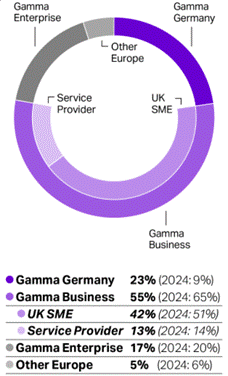
Business unit share of Group gross profit
Gamma Germany
Gamma Germany serves over 75,000 SME customers with a comprehensive product portfolio of cloud communications platforms, on-premise calling, connectivity and IoT products. Delivered through multiple routes to market, including a partner network of c.4,500 partners and our digital channel in Placetel, Gamma Germany now accounts for nearly a quarter of the Group, at 23% of Group gross profit (2024: 9%) following our recent acquisitions of Placetel and Starface.
2025 £m | 2024 £m | Increase | |
Revenue | 110.2 | 54.3 | +103% |
Gross Profit | 78.4 | 26.4 | +197% |
Gross Margin | 71.1% | 48.6% |
Overall growth in Germany was significant, led by our acquisitions of Placetel and Starface, acquired in September 2024 and February 2025 respectively. Both performed strongly, increasing cloud seats (to c.600k) and under the first year of our ownership they delivered double-digit revenue growth*: this was despite an ongoing weak macroeconomic backdrop. Organic gross profit growth was 11% on a constant currency basis, of which 8% was driven by Placetel's Q4 2025 trading which was organic given its acquisition in September 2024. The remainder reflected continued growth in higher margin cloud services partially offset by lower renewals in certain low margin Calling products. Gross margin increased significantly as Starface and Placetel generated meaningfully higher gross margins than our existing German business, as neither incurred significant third‑party licensing cost for their products and currently do not sell mobile through their channels which is at lower margin.
The acquisitions of Placetel and Starface have given us the necessary scale - and around a 15% cloud seat market share - to establish Gamma as the leading challenger in Germany, Europe's largest business communications market, and one where cloud adoption remains at an early stage. Integration is progressing well, with a single German management structure and a country-wide sales team, bringing together our existing German business with Starface with a unified approach to Channel Partner sales.
* on a pro forma unaudited historical GAAP basis against 2024.
Gamma Business
Gamma Business comprises our UK SME and Service Provider businesses, and accounts for 55% of Group gross profit (2024: 65%).
UK SME - accounting for 42% (2024: 51%) of Group gross profit - sells a broad range of Calling, Cloud Communications and Connectivity products that support small UK businesses typically with fewer than 250 employees.
Service Provider - accounting for 13% (2024: 14%) of Group gross profit - provides Calling products (voice services, numbering and SMS capabilities) in c.27 countries for large, global communications platform providers, network operators and Mobile Virtual Network Operators who do not have their own telephone networks.
| 2025 £m | 2024 £m | Increase |
Revenue | 374.6 | 368.9 | +2% |
- UK SME | 282.4 | 278.5 | +1% |
- Service Provider | 92.2 | 90.4 | +2% |
Gross Profit | 190.8 | 194.7 | (2%) |
- UK SME | 146.5 | 151.6 | (3%) |
- Service Provider | 44.3 | 43.1 | +3% |
Gross Margin | 50.9% | 52.8% |
UK SME - delivered a resilient performance despite challenging UK market conditions. Cloud volumes increased, supported by continued growth in our cloud communications portfolio, although gross profit declined by 3%. This was primarily due to expected one-off headwinds ahead of the PSTN switch-off in early 2027 (which includes the impact of customers migrating from higher margin legacy copper products to lower margin fibre replacements), which reduced gross profit by a net c.£4m. We estimate that gross profit will be further reduced by a similar amount in FY 2026, with the full-year financial impact of FY 2026 migrations expected to be felt until the end of FY 2027, depending on the speed of customer migration. Gross profit was also impacted by a slight decline in other traditional voice traffic, which was partially offset by higher cloud volumes and inflationary price rises.
Despite these headwinds, product volumes and customer engagement remained strong. Our broader portfolio - including the lower‑cost PhoneLine+ solution - helped us maintain market share. The successful UK launch of "Webex for Gamma" in Q4 2025 further strengthened our position and, since the October launch, we already have nearly 20,000 seats from a standing start in the UK.
We continue to attract Channel Partners wanting long‑term, strategic alignment and, to maximise opportunities created by migrations, we are offering a fully managed end-to-end migration service:
· | Flotek transitioned its cloud and connectivity portfolio to Gamma through our Gamma Edge programme, adopting Webex as its core application to enhance customer value. |
· | Clear Business signed a landmark agreement for Gamma to provide a fully managed connectivity and voice service to their end users on an outsourced basis. |
· | Our long-term partnership with O2 Daisy enables Gamma to sell our products and services into their c.500,000 customer base. The partnership also sees Gamma take over the voice enablement of O2 Daisy's cloud communication platform, giving both organisations a clearer strategic focus. |
These partnerships demonstrate our ability to deliver complex, high‑value deals and long‑term, scalable growth.
Service Provider - now contributes 25% (2024: 21%) of revenue and 23% (2024: 19%) of gross profit in Gamma Business. It saw healthy growth in Calling products leading to a 3% increase in gross profit, benefitting from structural demand and remaining insulated from UK SME market headwinds. While to date most of its revenue has been generated in the UK and Ireland, we are also well positioned internationally to meet the demand of global platform providers and multinational enterprises who seek to streamline their global communications footprint, as we now offer Calling products in c.27 countries, and in Q1 2026 we launched services in the higher‑growth Asia-Pacific region (starting in Australia, Singapore and the Philippines). This enables global communications platforms and service providers to access compliant calling capabilities locally without becoming licensed telecommunications operators or building their own infrastructure.
Gamma Enterprise
Gamma Enterprise sells cloud communications platforms (including contact centre solutions), connectivity, mobile, security and complex managed networks to mainly large corporate and public sector organisations. It accounts for 17% (2024: 20%) of Group gross profit.
2025 £m | 2024 £m | Increase | |
Revenue | 130.5 | 126.5 | +3% |
Gross Profit | 60.3 | 60.2 | +0% |
Gross Margin | 46.2% | 47.6% |
Gamma Enterprise delivered growth, with the acquisition of BrightCloud, completed in July 2024, contributing £4.4m (2024: £3.3m) of inorganic revenue and £2.4m (2024: £1.9m) of inorganic gross profit. On an organic basis, gross profit reduced by approximately £2m (4%) in 2025 compared to 2024. This was due to near-term competitive ethernet pricing pressure, as long-term customer contracts came up for renewal and we had to apply discounts to the pricing of fibre connectivity in order to retain the business, given the number of alternative networks now competing to provide fibre. We expect this ethernet pricing competition on renewals to continue, reducing gross profit by a further c.£3m in FY 2026, after which we believe pricing will stabilise as the market reaches an equilibrium. This impact is expected to be offset by notable contracts won late in 2025 for roll-out during 2026, as the pipeline continues to improve. These wins include:
· | In the retail space: | |
• | Morrisons - an extension of the current agreement to 2030, together with upgrades to in‑store WiFi and cyber protection. | |
• | Safestore plc - a five‑year contract to modernise and secure the network across 150 locations. | |
· | Other notable customer wins included: | |
• | RAC - managing inbound customer calls. | |
• | Bosch - providing business voice services in both the UK and mainland Europe - a truly pan-European win. | |
• | Zigup plc (formerly Redde Northgate plc) - unified communications service for 3,000 users and 160 locations. | |
Our shift to a new go-to-market operating model focused on Secure Networking, Cyber, Collaboration and Customer Experience better reflects customer needs. We remain confident in the medium‑term growth potential for Gamma Enterprise across our core markets.
Financial review
Operating expenses
Operating expenses grew from £210.0m in 2024 to £257.3m. We break these down as follows:
2025 £m | 2024£m | Increase/ (Decrease) | ||||
£m | % | |||||
Operating expenses excluding research and development costs, depreciation, amortisation and exceptional items: | 187.3 | 156.5 | 30.8 | +20% |
| |
-- Gamma Germany | 55.5 | 19.4 | 36.1 | +186% |
| |
-- UK (Gamma Business and Enterprise) | 110.7 | 110.4 | 0.3 | 0% |
| |
-- Other Europe | 13.6 | 14.0 | (0.4) | (3%) |
| |
-- Central | 7.5 | 12.7 | (5.2) | (41%) |
| |
Research and development costs | 19.4 | 19.7 | (0.3) | (2%) |
| |
Depreciation and amortisation (excluding business combinations) | 21.4 | 20.4 | 1.0 | +5% |
| |
Amortisation arising due to business combinations | 18.6 | 13.4 | 5.2 | +39% |
| |
Exceptional items | 10.6 | - | 10.6 | n/a |
| |
Total operating expenses | 257.3 | 210.0 | 47.3 | +23% |
| |
Operating expenses excluding research and development costs, depreciation, amortisation and exceptional items increased by £30.8m (20%), comprising the following:
· | German costs increased by £36.1m (186%) to £55.5m (2024: £19.4m) following the acquisitions of Placetel in September 2024 and Starface in February 2025, compared to gross profit growth of £52.0m (197%). Excluding these acquisitions, the costs of our German business otherwise increased 7% compared to gross profit growth of 3% as we completed a small amount of restructuring to integrate our German sales force and we undertook limited recruitment to support our enlarged German business. |
· | The UK businesses' costs remained flat at £110.7m (2024: £110.4m) despite the impact of the acquisitions of BrightCloud and Allnet. On an organic basis, operating expenses decreased by £3.3m (a 3% decrease in line with a 3% organic gross profit reduction). Continued cost control across the UK operations more than offset the impact of the increase in employer's NI and inflation. |
· | Central costs, excluding the exceptional items discussed below, decreased by £5.2m to £7.5m (2024: £12.7m) for three primary reasons. Firstly, acquisition‑related professional fees not deemed as exceptional reduced by £2.5m to £0.3m. Secondly, a net gain of £1.6m (2024: £0.8m loss) on mark to market movements on USD forward exchange contracts and the foreign exchange movement on Placetel deferred consideration, reduced central costs by £2.4m. Finally, a net contingent consideration release of £1.9m (2024: £1.3m) related to the Satisnet, Pragma and BrightCloud acquisitions, reduced central costs by £0.6m. |
Research and development costs decreased £0.3m (2%) to £19.4m (2024: £19.7m). The acquisition of Starface increased research and development costs by £0.5m, without which costs reduced by 4%.
Depreciation and amortisation on tangible and intangible assets (excluding business combinations) increased to £21.4m (2024: £20.4m), driven by an increased level of leased right-of-use assets from Starface and Placetel.
Amortisation of intangibles arising due to business combinations increased to £18.6m (2024: £13.4m). This reflected a higher level of acquired intangible assets, principally from the Starface acquisition, as well as the full‑year impact of amortisation on the Placetel intangible assets.
Exceptional items
There were three items classified as exceptional in the year (2024: £Nil) given their size and nature, totaling £10.6m (2024: £Nil). These were the costs associated with the acquisition of Starface of £5.1m, the one-off costs incurred in the Group's move to the Main Market of the London Stock Exchange of £2.2m and costs of £3.3m incurred in completing a UK restructuring in H2 2025. These were previously highlighted at the 2024 Full-Year results presentation on 25 March 2025 and the Half-Year 2025 results presentation on 9 September 2025. The cash cost of these items in the year was £9.4m (2024: £2.7m), with the remainder payable in 2026.
Starface acquisition costs
The acquisition of Starface was of significant scale and so the Group incurred material one-off costs. These principally related to adviser fees, including significant deal contingent success fees, and costs incurred to cap the amount of GBP potentially payable given the acquisition consideration was Euro denominated and subject to German regulatory approval.
Costs associated with the move to the Main Market of the London Stock Exchange
The Group's move of its listing from the AIM to the Main Market of the London Stock Exchange resulted in significant one-off costs, comprising adviser and admission fees.
Restructuring costs
Following a review of the efficiency of our operations, we completed a UK restructuring programme in H2 2025 which resulted in one-off severance costs of £3.3m. This will deliver annual operating expense savings of £7m across both Gamma Business and Gamma Enterprise from FY 2026.
Adjusted EBITDA
Adjusted EBITDA grew from £125.5m to £141.7m (13%) driven by our recent German acquisitions, which performed strongly. It grew at a lower rate than gross profit, as while Starface and Placetel have higher gross profit margins than the existing Group, they have relatively higher operating expenses. Excluding acquisitions, Adjusted EBITDA was flat on an organic constant currency basis, as defined in the APM section. Adjusted EBITDA also benefitted from a net contingent consideration release of £1.9m (2024: £1.3m) related to the Satisnet, Pragma and BrightCloud acquisitions, following an assessment of current trading compared to earn out related thresholds and the expected timing of such payments.
There was also a net gain of £1.6m on mark to market movements on USD forward exchange contracts and the foreign exchange movement on Placetel deferred consideration. We have excluded this net gain from Adjusted EBITDA, treating it as an other adjusting item, as it reflects external market factors and not the Group's trading performance.
We continue to exclude the costs of the implementation of the new UK Finance ERP system from Adjusted EBITDA. We have recorded them as an other adjusting item as the total cost of c.£3m for the implementation across 2024 and 2025 was considered significant. These incremental costs in the year were £1.8m (2024: £1.4m). The implementation is now completed in the UK, with the new Finance ERP in use in 2026. In the medium-term, we also plan to implement the new Finance ERP system in our German operations which will facilitate synergies in the long-term.
Profit before tax and Adjusted PBT
Profit before tax decreased from £95.6m to £87.7m (-8%) while Adjusted PBT grew from £111.9m to £119.4m (7%).
Adjusted PBT was similarly impacted by the items which impacted Adjusted EBITDA above. It grew less than Adjusted EBITDA as net finance costs increased following the use of a significant portion of our cash holdings and a drawdown on the Revolving Credit Facility ("RCF") to fund the acquisition of Starface in February 2025. This led to a corresponding £4.2m reduction in interest income and £3.5m increase in interest expense. Interest on borrowings resulting from the RCF was £2.6m (2024: £Nil).
Profit before tax was also impacted by £10.6m of exceptional costs incurred in the year and an increase of £5.2m in amortisation of intangibles arising due to business combinations following the Starface acquisition, as previously described.
Taxation
The effective tax rate for 2025 was 26% (2024: 27%). This was higher than the 25% statutory UK average rate due primarily to professional fees incurred on the Starface acquisition and the move to the Main Market that were not deductible in determining taxable profit, as well as increased profits generated in Germany that were taxed at a higher rate. These were partly offset by the recognition of a successful £1.9m historical multi-year patent box claim and assumption true ups following the submission of the 2024 UK tax computations.
Net debt, financing and cash flows
As at 31 December 2025, the Group had Net debt of £9.3m (2024: Net cash £153.7m). Net debt comprises borrowings of £33.0m (2024: £Nil) less cash and cash equivalents of £23.7m (2024: £153.7m).
In January 2025, the Group agreed a three-year £130m multicurrency RCF, with an option to extend for a further year. Net of repayments, £33m was drawn down during the year, of which £30m was initially drawn down in February 2025 to part fund the Starface acquisition.
Cash generated by operations was £115.1m (2024: £116.8m). This reduction was after the £9.4m (2024: £2.7m) one-off cash impact of exceptional items previously described and after an overall increase in working capital cash outflows of £6.0m. These outflows were offset by the additional cash generated from our Placetel and Starface acquisitions.
The increase in working capital cash outflow was largely due to a one-off £4.0m of Starface maintenance revenues where the billing and cash collection took place prior to acquisition and so formed part of net cash used in investing activities rather than cash generated by operations. Working capital was also impacted by the one-off payment of an acquired £1.7m non-trading-related Placetel liability.
Adjusted cash generated by operations, which excludes the one-off cash impacts of the exceptional and other adjusting items and the Starface and Placetel working capital matters described above, increased by £11.4m to £131.8m (2024: £120.4m). Adjusted cash conversion remained strong at 93% (2024: 96%).
Adjusted free cash flow which is Adjusted cash generated by operations after capital spend and taxes paid (both as described below), increased by £3.5m to £80.8m (2024: £77.3m), funding amongst other things, £64.0m of returns to shareholders.
Taxes paid increased to £26.7m (2024: £23.9m). This includes a £1.9m partial payment of the tax liabilities acquired with Starface as well as amounts related to Starface's 2025 post acquisition trading.
The primary cash items which are not directly related to trading were:
· | £159.3m was the total cash outflow for acquisitions net of cash acquired (2024: £15.4m). This comprises £152.2m for the acquisition of Starface (net of cash acquired of £14.8m and including the repayment of borrowings acquired of £14.6m presented within financing activities in the cash flow), £1.5m for the acquisition of Allnet (net of cash acquired of £1.4m) and £1.5m for the acquisition of Desatel. This also includes £4.0m of deferred consideration paid for Placetel and BrightCloud and £0.1m of other contingent consideration payments. |
· | £45.1m of own shares were repurchased as part of the share buyback programme announced in March 2025 (2024: £27.3m) and £18.9m was paid as dividends (2024: £17.3m). This totals £64.0m (2024: £44.6m) of cash returned to shareholders. |
· | £33.0m of the RCF was drawn down net of repayments (2024: £1.5m repayment of German borrowings) to part the fund the acquisition of Starface and the share buyback. |
· | Capital spend was £24.3m, which is an increase from £19.2m in 2024. This is discussed below. |
· | £5.1m of lease liability repayments, which increased from £3.3m in 2024 primarily due to the new leases acquired with acquisitions. |
· | £3.0m of interest and costs paid on borrowings which was partly offset by £2.3m of interest received on cash and cash equivalents. This net interest payment of £0.7m compares to a net interest receipt of £7.1m in 2024, reflecting the move from a Net cash to a Net debt position following the acquisition of Starface. |
Capital spend
Capital spend in 2025 was £24.3m (2024: £19.2m), which is 3.8% (2024: 3.3%) as a percentage of revenue. This is broken down as follows:
· | £19.2m on the capitalisation of development costs incurred during the year (2024: £12.5m). The increase was due to additional development costs from Starface following its acquisition and the full‑year impact of development projects which commenced in 2024. This includes the development of the Channel Partner Portal and enhancements to our voice applications. |
· | £4.8m on the core network, including increasing capacity as well as computer equipment and fixtures and fittings (2024: £4.9m). |
· | £0.3m with third-party software vendors for the software which underpins our Cloud products (2024: £1.8m). |
Adjusted EPS (fully diluted) and EPS (fully diluted)
Adjusted EPS (fully diluted) increased from 85.1p to 94.5p (11%). This increase was primarily driven by Adjusted PBT growth of 7% as previously described, supplemented by a 4% benefit from the share buybacks in 2025 and 2024. As explained in the later APM section, we have amended Adjusted EPS (fully diluted) to exclude the benefit of a successful historical multi-year patent box claim of £1.9m recognised in the year, given its multi-year nature which does not reflect current period trading performance. EPS (fully diluted) decreased from 72.0p to 69.3p (4% decrease) primarily reflecting the fall in profit before tax of 8%, which was partially offset by the 4% benefit from share buybacks.
Return on capital employed ("ROCE")
ROCE measures the efficiency of the Group's profit generation from the capital we deploy. It is an important measure of efficiency, newly introduced as a KPI in 2025. ROCE for 2025 was healthy at 27.8% (2024 pro forma: 27.4%). Pro forma explanation included in the APM section.
Acquisitions
The acquisition of Starface in February 2025 was the main driver of a £207.5m increase in intangible assets from £189.3m to £396.6m. This included acquisition-related intangible asset additions of £198.0m comprising customer relationships intangibles of £87.7m, development cost intangibles of £14.9m, brand intangibles of £6.6m and goodwill of £88.8m. The smaller acquisitions of Desatel and Allnet contributed a further £4.3m of intangible assets. In addition, £34.0m of deferred tax liability was recognised on acquired Starface intangible assets.
As at 31 December 2025 the acquisition of Starface had also increased Group contract liabilities by £5.8m (which include the deferred maintenance revenue amounts referred to previously), leased right-of-use assets by £5.9m, lease liabilities by £6.1m (included within other financial liabilities), trade and other receivables by £4.6m and trade and other payables by £3.7m.
Share buyback
In total 3,736,038 ordinary shares were acquired by the Company for an aggregate £45.1m over the course of the H1 2025 share buyback. This represented approximately 4% of the Company's ordinary share capital at commencement of the buyback. The shares purchased were cancelled resulting in a £45.1m reduction in retained earnings.
Dividends
The Board is proposing a final dividend of 14.8p (2024: 13.0p). This is an increase of 14% and is in line with the progressive dividend policy we have applied in respect of FY 2025. Subject to shareholder approval, the final dividend is payable on Thursday 18 June 2026 to shareholders on the register as at 5.00pm on Friday 29 May 2026.
Capital allocation policy
Gamma has a strong balance sheet and a high level of recurring revenues. It continues to generate significant operating cash flow with liquidity supported by its £130m multicurrency RCF, of which £97m remained undrawn at 31 December 2025. The Company is committed to maintaining balance sheet efficiency and providing the appropriate returns to shareholders, while also balancing investment in the development of the business and selective M&A, as appropriate.
In January 2026, following a review of the Company's capital structure, liquidity and cash generation, the Board announced the launch of a share buyback programme within existing shareholder authorities of up to £42.5m in FY 2026 and an intention to launch a further £42.5m share buyback in FY 2027, returning up to £85m in aggregate.
In parallel, the Board also announced that it intends to pay a dividend per share for the next two years fixed at FY 2025 levels. The intended dividends would continue to be structured as 1/3rd : 2/3rds across interim and final payments. The first such dividend would be the interim dividend declared alongside the 2026 interim results in September 2026.
The Board will continue to keep its capital allocation policy under review.
Going concern
In making its assessment on going concern the Directors have considered:
· | The principal risks faced by the Group. |
· | The strong liquidity position of the Group - at 31 December 2025 the Group had cash and cash equivalents of £23.5m and £97.0m of the revolving credit facility undrawn, providing total liquidity of £120.5m (31 December 2024: £153.7m). The Group has drawn £33.0m of the RCF at 31 December 2025. |
· | Budgets, financial plans and associated future cash flows, which assume that in addition to the dividend, £85m is returned to shareholders by way of share buybacks during FY 2026 and FY 2027, including the availability of liquidity and borrowings, as well as covenant compliance. |
· | Sensitivity analysis assessing the impact of severe but plausible scenarios on the going concern assessment period. This analysis confirms that projected cash flows and current borrowing arrangements should provide the Group with significant liquidity over the going concern period. |
The Directors are satisfied that the Group and Company have adequate financial resources to continue in operational existence for the foreseeable future, being a period of at least 12 months from the date of this report. Accordingly, the going concern basis of accounting continues to be used in the preparation of the Annual Report for the year ended 31 December 2025.
Other matters
Sustainability
Gamma remains committed to proactively minimising its environmental impact, delivering further progress against our sustainability strategy in 2025, including our 20th consecutive year of CarbonNeutral® certification. Scope 1 and 2 emissions reduced again during the year, supported by the removal of gas heating, improved datacentre efficiency and continued sourcing of renewable electricity. With purchased goods and services accounting for 92% of Scope 3 emissions, we expanded supply‑chain assessments to 81% of suppliers by spend to enhance data quality and inform reduction plans. Governance remains strong, with Board‑level oversight through the ESG Committee and carbon‑reduction metrics embedded into long‑term incentives.
Board changes
Gamma is pleased to announce the appointment of Damien Maltarp as Chief Financial Officer and Executive Director, following a comprehensive search and selection process. Damien will succeed Bill Castell, who, as previously announced, will be leaving the Group on 31 March 2026 to take up an executive role at a private equity backed business.
Damien will join the Group and the Board at the latest in September 2026, with the exact date to be confirmed.
Andrew Belshaw Chief Executive Officer
| Bill Castell Chief Financial Officer
|
Supplementary information on product volumes
The following reporting of data is consistent with the past. Gamma will host a capital markets day later this year where we will explain how we will report progress going forward.
The table below shows the number of Cloud seats in UK and Europe
Cloud seats - UK & Europe | December | December | Change |
(000's) | 2025 | 2024 | (%) |
UK* | 1,087 | 1,040 | 5% |
Europe | 711 | 434 | 64% |
-- Germany+ | 594 | 311 | 91% |
-- Other Europe | 117 | 123 | (5%) |
*UK Cloud seats excludes seats resulting from the migration of the O2 Daisy base and are at a lower margin.
+On a proforma basis, including Starface seats at 31 December 2024, Cloud seats in Germany were 536,000 and therefore 2025 growth was 11%
The table below shows the number of CCaaS seats:
CCaaS seats - UK & Europe (000's) | December 2025 | December 2024 | Change (%) |
UK* | 48 | 45 | 7% |
Europe - Other Europe | 3 | 5 | (40%) |
*CCaaS seats for Horizon Contact users also take a "Base Horizon" seat (therefore 32,000 seats are separately disclosed within Cloud PBX seats).
The table below shows the increase in the number of SIP Trunks which provide voice enablement to various hardware PBXs and voice applications:
Calling - UK & Europe (000's) | December 2025 | December 2024 | Change (%) |
SIP Trunks enabling traditional hardware PBX | |||
UK | 892 | 932 | (4%) |
Europe | 203 | 206 | (1%) |
-- Germany | 197 | 199 | (1%) |
-- Other Europe | 6 | 7 | (14%) |
SIP Trunks enabling a non-Gamma Cloud PBX | |||
UK | 522 | 481 | 9% |
Europe | - | - | - |
Voice enabled Microsoft Teams users (either Operator Connect or Microsoft Teams Direct Routing) | |||
UK | 555 | 467 | 19% |
Europe | 20 | 14 | 43% |
Condensed consolidated statement of profit or loss | |||
For the year ended 31 December 2025 | |||
Note | 2025 £m | 2024 £m | |
Revenue | 3 | 645.8 | 579.4 |
Cost of sales | (297.6) | (279.1) | |
Gross profit | 348.2 | 300.3 | |
Operating expenses | (257.3) | (210.0) | |
Of which exceptional items | 4 | (10.6) | - |
Profit from operations | 90.9 | 90.3 | |
Finance income | 2.9 | 7.1 | |
Finance expense | (6.1) | (1.8) | |
Profit before tax | 87.7 | 95.6 | |
Tax expense | 5 | (22.7) | (25.8) |
Profit after tax | 65.0 | 69.8 | |
Profit attributable to: |
| ||
Equity holders of Gamma Communications plc | 64.9 | 69.8 | |
Non-controlling interests | 0.1 | - | |
65.0 | 69.8 | ||
Earnings per share attributable to the ordinary equity holders of the Company: |
| ||
Basic per Ordinary Share (pence) | 6 | 69.5 | 72.3 |
Diluted per Ordinary Share (pence) | 6 | 69.3 | 72.0 |
All results recognised during the period were generated from continuing operations.
Condensed consolidated statement of comprehensive income
For the year ended 31 December 2025
2025 £m | 2024 £m | |
Profit after tax for the period | 65.0 | 69.8 |
Other comprehensive income/(expense) | ||
Items that may be reclassified subsequently to the statement of profit or loss: | ||
Exchange differences on translation of foreign operations before tax | 10.0 | (1.9) |
Tax effect of exchange differences on translation of foreign operations | (1.0) | 0.6 |
Total other comprehensive income/(expense) | 9.0 | (1.3) |
|
| |
Total comprehensive income | 74.0 | 68.5 |
Total comprehensive income for the period attributable to: |
| |
Equity holders of Gamma Communications plc | 73.9 | 68.5 |
Non-controlling interests | 0.1 | - |
74.0 | 68.5 |
Condensed consolidated statement of financial position | |||
As at 31 December 2025 | |||
Note | 2025 £m | 2024 £m | |
Assets | |||
Non-current assets | |||
Property, plant and equipment | 8 | 40.0 | 33.6 |
Intangible assets | 9 | 396.8 | 189.3 |
Deferred tax asset | 6.9 | 8.6 | |
Trade and other receivables | 10.8 | 8.7 | |
Contract assets | 12.7 | 6.7 | |
467.2 | 246.9 | ||
Current assets | |||
Inventories | 7.5 | 10.0 | |
Trade and other receivables | 78.4 | 80.4 | |
Contract assets | 41.8 | 35.0 | |
Cash and cash equivalents | 23.7 | 153.7 | |
Current tax asset | 2.7 | 2.0 | |
154.1 | 281.1 | ||
Total assets | 621.3 | 528.0 | |
Liabilities | |||
Non-current liabilities | |||
Other payables | - | 0.1 | |
Other financial liabilities | 45.6 | 5.9 | |
Provisions | 1.4 | 1.4 | |
Contract liabilities | 15.0 | 13.3 | |
Acquisition-related liabilities | 10 | 15.8 | 22.0 |
Deferred tax liability | 48.8 | 17.6 | |
126.6 | 60.3 | ||
Current liabilities | |||
Trade and other payables | 70.3 | 68.4 | |
Other financial liabilities | 5.2 | 2.0 | |
Provisions | 2.1 | 0.9 | |
Contract liabilities | 20.2 | 18.5 | |
Acquisition-related liabilities | 10 | 7.2 | 4.5 |
Current tax liability | 4.7 | 0.7 | |
109.7 | 95.0 | ||
Total liabilities | 236.3 | 155.3 | |
Net assets | 385.0 | 372.7 | |
Equity | |||
Share capital | 11 | 0.2 | 0.2 |
Share premium reserve | 23.3 | 23.3 | |
Other reserves | 12 | (6.3) | (18.2) |
Retained earnings | 368.6 | 368.3 | |
Equity attributable to owners of Gamma Communications plc | 385.8 | 373.6 | |
Non-controlling interests | 0.3 | 0.2 | |
Written put options over non-controlling interests | (1.1) | (1.1) | |
Total equity | 385.0 | 372.7 | |
Condensed consolidated statement of cash flows | |||
For the year ended 31 December 2025 | |||
2025 | 2024 | ||
Note | £m | £m | |
Cash flows from operating activities | |||
Profit for the year before tax | 87.7 | 95.6 | |
Adjustments for: | |||
Depreciation of property, plant and equipment | 8 | 8.2 | 9.3 |
Depreciation of right-of-use assets | 3.8 | 2.4 | |
Amortisation of intangible assets | 9 | 28.0 | 22.1 |
Other change in fair value of contingent consideration | (1.9) | (1.3) | |
Share-based payment expense | 2.2 | 2.7 | |
Finance income | (2.9) | (7.1) | |
Finance expense | 6.1 | 1.8 | |
Other non-cash movements* | (1.4) | - | |
129.8 | 125.5 | ||
(Increase) in trade and other receivables and contract assets | (6.8) | (1.7) | |
Decrease/(increase) in inventories | 3.4 | (1.7) | |
(Decrease) in trade and other payables | (6.0) | (4.8) | |
(Decrease)/increase in contract liabilities | (6.1) | 2.0 | |
Increase/(decrease) in provisions | 0.8 | (2.5) | |
Cash generated by operations | 115.1 | 116.8 | |
Taxes paid | (26.7) | (23.9) | |
Net cash flows from operating activities | 88.4 | 92.9 | |
Investing activities | |||
Purchase of property, plant and equipment | 8 | (4.8) | (4.9) |
Purchase of intangible assets | 9 | (19.5) | (14.3) |
Interest received | 2.3 | 7.1 | |
Acquisition of subsidiaries net of cash acquired | 13 | (144.7) | (15.4) |
Net cash used in investing activities | (166.7) | (27.5) | |
Financing activities | |||
Lease liability repayments | (5.1) | (3.3) | |
Proceeds from borrowings | 108.5 | - | |
Repayment of borrowings | (75.5) | (1.5) | |
Repayment of borrowings acquired with acquisitions | (14.6) | - | |
Interest paid | (3.0) | - | |
Share issues/ reissued | 0.9 | 1.8 | |
Dividends | (18.9) | (17.3) | |
Repurchase of own shares | (45.1) | (27.3) | |
Net cash used in financing activities | (52.8) | (47.6) | |
Net (decrease)/increase in cash and cash equivalents |
(131.1) |
17.8 | |
Cash and cash equivalents at beginning of year | 153.7 | 136.5 | |
Effects of exchange rate changes on cash and cash equivalents | 1.1 | (0.6) | |
Cash and cash equivalents at end of year | 23.7 | 153.7 | |
*Primarily relating to deferred consideration included in investing activities
Condensed consolidated statement of changes in equity
For the year ended 31 December 2025
Share capital £m | Share premium reserve £m | Other reserves £m | Retained earnings £m |
Total £m | Non- controlling interests £m | Written put options over non- controlling interests £m | Total equity £m | |
1 January 2024 |
0.2 |
22.9 |
6.9 |
315.1 |
345.1 |
0.2 |
(1.1) |
344.2 |
Issue or reissue of shares | - | 0.4 | (2.0) | 2.0 | 0.4 | - | - | 0.4 |
Share-based payment expense | - | - | 2.2 | - | 2.2 | - | - | 2.2 |
Deferred tax on share-based payment expense | - | - | - | 0.9 | 0.9 | - | - | 0.9 |
Share buyback1 | - | - | (27.3) | - | (27.3) | - | - | (27.3) |
Treasury share allocations2 | - | - | 3.3 | (2.2) | 1.1 | - | - | 1.1 |
Dividend paid | - | - | - | (17.3) | (17.3) | - | - | (17.3) |
Transactions with owners | - | 0.4 | (23.8) | (16.6) | (40.0) | - | - | (40.0) |
Profit for the year | - | - | - | 69.8 | 69.8 | - | - | 69.8 |
Other comprehensive (expense) | - | - | (1.3) | - | (1.3) | - | - | (1.3) |
Total comprehensive (expense)/income | - | - | (1.3) | 69.8 | 68.5 | - | - | 68.5 |
1 January 2025 | 0.2 | 23.3 | (18.2) | 368.3 | 373.6 | 0.2 | (1.1) | 372.7 |
Issue or reissue of shares | - | - | (1.2) | 1.2 | - | - | - | - |
Share-based payment expense | - | - | 2.2 | - | 2.2 | - | - | 2.2 |
Deferred tax on share-based payment expense | - | - | - | (0.8) | (0.8) | - | - | (0.8) |
Share buyback1 | - | - | - | (45.1) | (45.1) | - | - | (45.1) |
Treasury share allocations2 | - | - | 1.9 | (1.0) | 0.9 | - | - | 0.9 |
Dividend paid | - | - | - | (18.9) | (18.9) | - | - | (18.9) |
Transactions with owners | - | - | 2.9 | (64.6) | (61.7) | - | - | (61.7) |
Profit for the year | - | - | - | 64.9 | 64.9 | 0.1 | - | 65.0 |
Other comprehensive income | - | - | 9.0 | - | 9.0 | - | - | 9.0 |
Total comprehensive income | - | - | 9.0 | 64.9 | 73.9 | 0.1 | - | 74.0 |
31 December 2025 | 0.2 | 23.3 | (6.3) | 368.6 | 385.8 | 0.3 | (1.1) | 385.0 |
1 Represents shares purchased under share buyback programmes. Shares purchased under the 2025 buyback programme were immediately cancelled rather than held in Treasury, within Other Reserves. | ||||||||
2 Treasury share allocations relate to treasury shares which have been used to satisfy share options and other employee share plans.
| ||||||||
1. Basis of preparation
The preliminary results for the year ended 31 December 2025 are an abridged statement of the full Annual Report which was approved by the Board of Directors on 23 March 2026. The consolidated financial statements in the full Annual Report are prepared in accordance with UK-adopted International Financial Reporting Standards ("IFRS"), with IFRS as issued by the International Accounting Standards Board ("IASB") and with the requirements of the Companies Act 2006. The financial statements are prepared on a going concern basis and have been prepared on a historical cost basis, except for certain financial instruments which have been measured at fair value.
The financial information contained in this statement does not constitute statutory financial statements within the meaning of the Companies Act 2006. They are an extract from the full accounts for the year ended 31 December 2025 on which the auditor has expressed an unqualified opinion and do not include any statement under section 498 of the Companies Act 2006. The Group's statutory consolidated financial statements for the year ended 31 December 2025 will be available on the Gamma Communications plc website in due course, will be posted to shareholders prior to the AGM, and subsequently filed at Companies House.
The financial information included in this preliminary announcement does not itself contain sufficient information to comply with IFRS. The annual report and audited financial statements for the year ended 31 December 2025 will be made available on the Group's website in April 2026.
The financial statements are presented in Pounds Sterling and, unless otherwise stated, have been rounded to the nearest 0.1 million (£m). The consolidated financial statements have been prepared on a going concern basis under the historical cost convention, except for certain financial instruments which have been measured at fair value.
The accounting policies adopted are consistent with those followed in the preparation of the audited statutory consolidated financial statements for the year ended 31 December 2025.
A full set of the audited statutory accounts will be available in due course at: www.gammagroup.co/company/investors/results-presentations/
The new standards, amendments and interpretations applied for the first time are shown below. There were no new standards, amendments or interpretations applied for the first time which had a material impact on the condensed consolidated financial statements.
· | Amendments to IAS 21 - Lack of Exchangeability |
2. Accounting policies, judgements and estimates
Accounting policies
The accounting policies adopted are consistent with those followed in the preparation of the audited statutory financial statements for the year ended 31 December 2024 other than for the new amendments applied for the first time as outlined in note 1 and which did not have a material impact on the condensed consolidated financial statements. As a result of the increased balance of acquired intangibles from acquisitions, the group has revised the presentation of the development costs and technology intangible asset categories, which previously included internally generated assets, purchased licences and rights, and acquired technology arising from business combinations. Acquired technology arising from business combinations is now presented separately from internally generated development costs and purchased technology categories, new accounting policy below.
Intangible assets Acquired technology
Acquired technology comprises development projects (both completed and in progress), licences and rights over network interface identifications acquired through business combinations, which are recognised at fair value at the acquisition date. Amortisation is charged to the Consolidated statement of profit or loss through operating expenses on a straight-line basis over the estimated useful life from the date the asset is available for use.
The fair value of a acquired technology at the date of acquisition is based on the Income Method or the Relief from Royalty Method, which is a valuation model based on discounted cash flows or based on fair value, by reference to observable market transactions for similar assets. The useful lives of acquired technology are up to seven years, corresponding to a yearly amortisation of between 14% and 25%. The useful lives are reviewed annually and amended, as required, on a prospective basis.
Critical accounting estimates and judgements
Preparation of the consolidated financial statements requires the Group to make certain estimations, assumptions and judgements regarding the future. Estimates and judgements are continually evaluated based on historical experience and other factors, including best estimates of future events. In the future, actual experience may differ from these estimates and assumptions. The following are considered to be the critical accounting judgements and key sources of estimation uncertainty.
Critical accounting judgements
Critical judgements, apart from those involving estimations, applied in the preparation of the consolidated financial statements are discussed below:
Revenue recognition
Revenue recognition on contracts may involve providing services over multiple years and involving a number of products bundled together. In such instances, judgement is required to identify the date of transaction of separable elements of the contract and the fair values which are assigned to each element.
Key accounting estimates
There are no key accounting estimates that could have a significant risk of causing a material adjustment within the next financial year.
3. Segment information
The Group's main operating segments are outlined below:
· | Gamma Business - Gamma Business comprises our UK SME and Service Provider businesses. It contributed 55% (2024: 65%) of the Group's external gross profit. UK SME sells a broad range of Calling, Cloud Communications and Connectivity products that support small UK businesses typically with fewer than 250 employees. Service Provider provides Calling products (voice services, numbering and SMS capabilities) in c.27 countries for large, global communications platform providers, network operators and mobile virtual network operators who do not have their own telephone networks. |
· | Gamma Enterprise - Gamma Enterprise sells cloud communications platforms (including contact centre solutions), connectivity, mobile, security and complex managed networks to mainly large corporate and public sector organisations. It contributed 17% (2024: 20%) of the Group's external gross profit. |
· | Gamma Germany - Gamma Germany serves over 75,000 SME customers with a comprehensive product portfolio of cloud communications platforms, on-premise calling, connectivity and IoT products. Delivered through multiple routes to market, including a partner network of c.4,500 partners and our digital channel in Placetel. It contributed 23% (2024: 9%) of the Group's gross profit. |
· | Other Europe - This segment consists of sales made through Gamma's Spanish and Dutch businesses. It contributed 5% (2024: 6%) of the Group's external gross profit. |
· | Central functions - This comprises the central management team and wider Group costs. |
Change in segmental reporting
Over the last year the Group has expanded its presence in Germany following the acquisitions of Starface and Placetel. As a result, and to align with internal management reporting, we have split our European segment into two segments: Gamma Germany and Other Europe. This change in reporting structure has taken effect for reporting in 2025 with prior year comparatives also given.
Measurement of operating segment profit or loss, assets and liabilities
The accounting policies of the reportable segments are the same as those described in the accounting policies. The Board and Executive Committee principally evaluate performance on the basis of Adjusted EBITDA (see APM section). The Gross profit of each operating segment is also evaluated. Inter-segment sales are priced in line with sales to external customers, with an appropriate discount being applied to encourage use of Group resources. This policy was applied consistently throughout the current and prior year.
Revenue from external customers has been derived principally in the geographical area of the operating segment and no single customer contributes more than 10% of revenue.
2025 | Gamma Business £m | Gamma Enterprise £m | Gamma Germany £m | Other Europe £m | Central functions £m | Total £m |
Segment revenue | 395.2 | 137.2 | 110.4 | 30.8 | - | 673.6 |
Inter-segment revenue | (20.6) | (6.7) | (0.2) | (0.3) | - | (27.8) |
Revenue from external customers | 374.6 | 130.5 | 110.2 | 30.5 | - | 645.8 |
Timing of revenue recognition | ||||||
At a point in time | 26.5 | 10.8 | 34.4 | 2.1 | - | 73.8 |
Over time (recurring) | 348.1 | 119.7 | 75.8 | 28.4 | - | 572.0 |
374.6 | 130.5 | 110.2 | 30.5 | - | 645.8 | |
Gross profit | 190.8 | 60.3 | 78.4 | 18.7 | - | 348.2 |
|
|
|
|
|
|
|
Adjusted EBITDA | 93.7 | 29.9 | 22.5 | 4.7 | (9.1) | 141.7 |
Exceptional items | (2.2) | (1.1) | - | - | (7.3) | (10.6) |
Other adjusting items | (1.8) | - | - | - | 1.6 | (0.2) |
EBITDA | 89.7 | 28.8 | 22.5 | 4.7 | (14.8) | 130.9 |
2024 | Gamma Business £m | Gamma Enterprise £m | Gamma Germany £m | Other Europe £m | Central functions £m | Total £m |
Segment revenue | 394.2 | 127.6 | 54.3 | 30.0 | - | 606.1 |
Inter-segment revenue | (25.3) | (1.1) | - | (0.3) | - | (26.7) |
Revenue from external customers | 368.9 | 126.5 | 54.3 | 29.7 | - | 579.4 |
Timing of revenue recognition | ||||||
At a point in time | 22.9 | 12.5 | 26.4 | 1.0 | - | 62.8 |
Over time (recurring) | 346.0 | 114.0 | 27.9 | 28.7 | - | 516.6 |
368.9 | 126.5 | 54.3 | 29.7 | - | 579.4 | |
Gross profit | 194.7 | 60.2 | 26.4 | 19.0 | - | 300.3 |
| ||||||
Adjusted EBITDA | 95.0 | 31.4 | 7.0 | 4.8 | (12.7) | 125.5 |
Exceptional items | - | - | - | - | - | - |
Other adjusting items | (1.4) | - | - | - | - | (1.4) |
EBITDA | 93.6 | 31.4 | 7.0 | 4.8 | (12.7) | 124.1 |
A reconciliation of Adjusted EBITDA, the Group's measure of segment profit, to the Group's profit before tax for the year is included below:
| 2025 £m | 2024 £m |
Profit before tax | 87.7 | 95.6 |
Finance income | (2.9) | (7.1) |
Finance expense | 6.1 | 1.8 |
Profit from operations | 90.9 | 90.3 |
Depreciation of property, plant and equipment and right-of-use assets | 12.0 | 11.7 |
Amortisation from intangible assets excluding business combinations | 9.4 | 8.7 |
Amortisation from intangible assets arising due to business combinations | 18.6 | 13.4 |
EBITDA | 130.9 | 124.1 |
Exceptional items | 10.6 | - |
Other adjusting items | 0.2 | 1.4 |
Adjusted EBITDA | 141.7 | 125.5 |
Further details on the definition and calculation of Adjusted EBITDA are included in the APM section.
Geographic segmentation
The UK is the Group's country of domicile and is where most revenue is generated, which is from external UK customers. The geographic analysis of revenue presented below is based on the country in which the customer is invoiced.
The Group's revenue from external customers by geographical location is detailed below:
| 2025 | 2024 |
£m | £m | |
UK | 467.6 | 458.9 |
Germany | 122.9 | 67.5 |
Rest of Europe | 47.1 | 46.5 |
Rest of World | 8.2 | 6.5 |
Total | 645.8 | 579.4 |
The Group's non-current assets, which excludes deferred tax assets and financial instruments, by geographical location of the assets, are detailed below:
2025 | 2024 | ||||
£m | £m | ||||
UK | 174.9 | 141.3 | |||
Germany | 245.2 | 57.1 | |||
Rest of Europe | 26.1 | 35.7 | |||
Total | 446.2 | 234.1 | |||
Product segmentation |
| ||||
2025 | 2024 |
| |||
£m | £m |
| |||
Revenue recognised over time (recurring) |
| ||||
Voice and data traffic | 107.7 | 109.2 |
| ||
Subscriptions and rentals | 450.3 | 403.2 |
| ||
Installation fees and other (over time) | 14.0 | 4.2 |
| ||
Total recognised over time (recurring) | 572.0 | 516.6 |
| ||
Revenue recognised at a point in time |
|
| |||
Equipment sales | 29.4 | 31.1 |
| ||
Commissions | 24.2 | 25.7 |
| ||
Installation fees and other (at a point in time) | 20.2 | 6.0 |
| ||
Total recognised at a point in time | 73.8 | 62.8 |
| ||
Total revenue | 645.8 | 579.4 |
| ||
Recurring revenue includes revenues we have a reasonable expectation to recur. This includes committed revenues, including those under rolling terms and subscriptions.
4. Exceptional items | ||
2025 £m | 2024 £m | |
Acquisition costs | 5.1 | - |
Listing costs | 2.2 | - |
Restructuring costs | 3.3 | - |
Total exceptional items | 10.6 | - |
Tax effect of exceptional items | (0.8) | - |
The acquisition of Starface, see note 13, was of significant scale and so the Group incurred material one-off costs. These principally related to adviser fees, including significant deal contingent success fees, and costs incurred to cap the amount of GBP potentially payable given the acquisition consideration was Euro denominated and subject to German regulatory approval. This is considered exceptional by virtue of the size of the acquisition and the level of costs incurred.
The Group's move of its listing from the AIM to the Main Market of the London Stock Exchange resulted in significant one-off costs, comprising adviser and admission fees. This is considered exceptional due to the one-off nature of the transaction.
Restructuring costs relate to severance of £3.3m in the year (2024: £Nil), following a review of the efficiency of our UK operations. This is considered exceptional due to the one-off nature of the transaction and the level of cost incurred.
The total cash cost of these exceptional items in the year was £9.4m (2024: £2.7m) and the remaining £1.2m is expected to be paid out within the next 12 months.
5. Tax expense | ||
2025 £m | 2024 £m | |
Current tax expense | ||
Current tax on UK profits for the year | 24.5 | 26.4 |
Overseas current tax charge | 5.8 | 1.5 |
Adjustment in respect of prior years | (3.6) | 1.0 |
Total current tax | 26.7 | 28.9 |
Deferred tax expense |
| |
Origination and reversal of temporary differences | (3.0) | (2.1) |
Adjustment in respect of prior years | (1.0) | (1.0) |
Total deferred tax | (4.0) | (3.1) |
Total tax expense | 22.7 | 25.8 |
The tax charge of 26% for 2025 is higher (2024: 27%, higher) than the standard rate of corporation tax in the United Kingdom of 25% (2024: 25%). The differences are explained below:
2025 £m | 2024 £m | |
Profit before tax | 87.7 | 95.6 |
Expected tax charge based on the standard blended rate of United Kingdom corporation tax at the domestic rate of 25% (2024: 25%) |
21.9 |
23.9 |
Effects of: | ||
Tax effect of expenses that are not deductible in determining taxable profit | 5.3 | 2.2 |
Effect of different tax rates of subsidiaries operating in other jurisdictions | 1.4 | - |
Other tax items | (1.3) | (0.3) |
Adjustment in respect of prior years | (4.6) | - |
Total tax expense | 22.7 | 25.8 |
The total tax expense for the year includes a £1.9m credit related to the recognition of a successful historical multi-year patent box claim.
Deferred tax is calculated based on the tax laws and rates that were enacted or substantively enacted at the balance sheet date.
6. Earnings per share | ||
| 2025 | 2024 |
Earnings per Ordinary Share - basic (pence) | 69.5 | 72.3 |
Earnings per Ordinary Share - diluted (pence) | 69.3 | 72.0 |
The calculation of the basic and diluted earnings per share is based on the following data:
2025 | 2024 | |
£m | £m | |
Profit after tax attributable to Ordinary equity holders of the Company | 64.9 | 69.8 |
Shares | No. | No. |
Basic weighted average number of Ordinary Shares | 93,417,299 | 96,573,811 |
Effect of dilution resulting from share options | 277,021 | 408,717 |
Diluted weighted average number of Ordinary Shares | 93,694,320 | 96,982,528 |
7. Dividends
The following dividends were paid by the Group to its shareholders:
£m | £m | |
Final dividend for the year ended 31 December 2023 of 11.4p per Ordinary Share | - | 11.1 |
Interim dividend for the year ended 31 December 2024 of 6.5p per Ordinary Share | - | 6.2 |
Final dividend for the year ended 31 December 2024 of 13.0p per Ordinary Share | 12.1 | - |
Interim dividend for the year ended 31 December 2025 of 7.4p per Ordinary Share | 6.8 | - |
18.9 | 17.3 |
A final dividend of 14.8p will be proposed at the 2025 Annual General Meeting but has not been recognised as it requires shareholder approval. The total amount of dividends proposed for the year ended 31 December 2025 is 22.2p. The payments of these dividends do not have any tax consequences for the Group.
8. Property, plant and equipment | ||||
2025 | 2024 |
| ||
£m | £m |
| ||
Owned property, plant and equipment | 24.8 | 27.0 |
| |
Leased right-of-use assets | 15.2 | 6.6 |
| |
Total property, plant and equipment | 40.0 | 33.6 |
| |
|
| |||
9. Intangible assets
Intangible assets acquired through business combinations | Internally generated development costs1 £m | |||||||
Cost | Goodwill £m | Customer relationships £m | Brand £m | Acquired technology1 £m | Purchased technology1 £m | Total £m | ||
At 1 January 2025 | 135.0 | 78.6 | 5.9 | 14.9 | 58.8 | 29.6 | 322.8 | |
Additions | - | - | - | - | 19.2 | 0.9 | 20.1 | |
Acquisition of subsidiaries | 92.3 | 88.3 | 6.8 | 14.9 | - | - | 202.3 | |
Disposals2 | - | (0.2) | - | - | (14.2) | - | (14.4) | |
Exchange difference | 7.3 | 7.0 | 0.4 | 1.4 | 0.4 | - | 16.5 | |
At 31 December 2025 | 234.6 | 173.7 | 13.1 | 31.2 | 64.2 | 30.5 | 547.3 | |
Amortisation and impairment | ||||||||
At 1 January 2025 | 19.8 | 46.3 | 1.8 | 4.9 | 37.3 | 23.4 | 133.5 | |
Charge for the year | - | 12.1 | 1.6 | 4.9 | 7.9 | 1.5 | 28.0 | |
Disposals2 | - | (0.2) | - | - | (14.2) | - | (14.4) | |
Exchange difference | 0.8 | 2.1 | - | 0.2 | 0.3 | - | 3.4 | |
At 31 December 2025 | 20.6 | 60.3 | 3.4 | 10.0 | 31.3 | 24.9 | 150.5 | |
Carrying value | ||||||||
At 1 January 2025 | 115.2 | 32.3 | 4.1 | 10.0 | 21.5 | 6.2 | 189.3 | |
At 31 December 2025 | 214.0 | 113.4 | 9.7 | 21.2 | 32.9 | 5.6 | 396.8 | |
1 During the year, the Group revised the presentation of the development costs and technology intangible asset categories to exclude "acquired technology arising from business combinations" and present it separately, with development costs renamed as "internally generated development costs" and technology renamed "purchased technology", all as defined in Note 1, Accounting policies.
2 During the year, the Group disposed of certain assets with a net book value of £Nil. These disposals had no impact on the Consolidated statement of profit or loss or the Consolidated statement of financial position.
Included in development costs are assets not yet in service of £5.7m (2024: £4.3m).
Customer relationships includes the following material balances at 31 December 2025:
· | Starface: £88.4m (2024: £Nil) carrying value with nineteen years' amortisation remaining. |
· | Pragma: £11.4m (2024: £12.6m) carrying value with eleven years' amortisation remaining. |
Technology includes the following material balances at 31 December 2025:
· | Starface: £12.5m (2024: £Nil) carrying value with seven years' amortisation remaining. |
Brand includes the following material balances at 31 December 2025:
· | Starface: £6.1m (2024: £Nil) carrying value with seven years' amortisation remaining. |
Intangible assets acquired through business combinations | Internally generated development costs1 £m | |||||||
Cost | Goodwill £m | Customer relationships £m | Brand £m | Acquired technology1 £m | Purchased technology1 £m | Total £m | ||
At 1 January 2024 | 133.2 | 56.7 | 2.2 | 5.6 | 46.7 | 24.4 | 268.8 | |
Additions | - | - | - | - | 12.5 | 1.8 | 14.3 | |
Acquisition of subsidiaries | 15.1 | 10.0 | 2.0 | 9.5 | 0.2 | - | 36.8 | |
Reclassifications2 | (11.4) | 13.7 | 1.8 | - | - | 3.5 | 7.6 | |
Disposals | - | - | - | - | (0.2) | - | (0.2) | |
Exchange difference | (1.9) | (1.8) | (0.1) | (0.2) | (0.4) | (0.1) | (4.5) | |
At 31 December 2024 | 135.0 | 78.6 | 5.9 | 14.9 | 58.8 | 29.6 | 322.8 | |
Amortisation and impairment | ||||||||
At 1 January 2024 | 20.5 | 37.4 | 1.1 | 2.7 | 30.5 | 21.9 | 114.1 | |
Charge for the year | - | 10.2 | 0.7 | 2.5 | 7.2 | 1.5 | 22.1 | |
Disposals | - | - | - | - | (0.2) | - | (0.2) | |
Exchange difference | (0.7) | (1.3) | - | (0.3) | (0.1) | (0.1) | (2.5) | |
At 31 December 2024 | 19.8 | 46.3 | 1.8 | 4.9 | 37.4 | 23.3 | 133.5 | |
Carrying value | ||||||||
At 1 January 2024 | 112.7 | 19.3 | 1.1 | 2.9 | 16.2 | 2.5 | 154.7 | |
At 31 December 2024 | 115.2 | 32.3 | 4.1 | 10.0 | 21.4 | 6.3 | 189.3 | |
1 Prior year comparatives have been represented to reflect the revised presentation of intangible asset categories introduced in the current year. See narrative above for further details.
2 In 2024 we reclassified the balances between goodwill, customer relationships and brand as a result of the finalisation of the fair value accounting for the Pragma acquisition. The other reclassification amount of £3.5m in 2024 related to purchased technology intangible assets previously reported in inventory to better align with other similar transactions.
When considering the recoverable amount, the break-even point for the assumptions is calculated to understand the sensitivity of the assumptions. Given the challenging market conditions in the Netherlands, the headroom between the recoverable amount (determined based on a VIU model) and the carrying value of the Dutch business is modest at £2.4m (2024: £2.5m) at the measurement date.
Key assumptions for the Netherlands value-in-use ("VIU") on which the impairment test is based is the revenue growth over the five-year period, which totals double-digit growth. The long-term growth rate used was 1.4% (2024: 2%). This is based on long-term GDP growth forecasts for the Netherlands. This growth rate does not exceed the relevant long-term average growth rate based on OECD long-term baseline projections No.117.
We have considered reasonably possible changes in key assumptions that could cause an impairment and have identified two key assumptions relating to the cash flows in years 1 to 5. Being:
1) | The Netherlands CGU VIU cash flow assumes low double-digit revenue growth over the five-year period. A decrease in the forecast revenue growth, factoring in directly consequential cost savings to commission and bonuses, by 46% over this period, would see the headroom reduce to £Nil. |
2) | An increase in the pre-tax discount rate of 1.7% from 11.3% to 13.0% would reduce this headroom to £Nil. |
The reduction required to the long-term growth rate to reduce the headroom to £Nil is not considered reasonably possible.
10. Financial Instruments
The tables below set out the measurement categories and carrying values of financial assets and liabilities with fair value inputs where relevant.
|
Measurement category | Carrying value 2025 £m |
Fair value 2025 | Fair value hierarchy 2025/2024 | Carrying value 2024 £m | ||
| Financial assets | ||||||
| Non-current | ||||||
| Contract assets | Amortised cost | 12.7 | 6.7 | |||
| Other receivables | Amortised cost | 1.4 | 0.7 | |||
| Current | ||||||
| Cash and cash equivalents | Amortised cost | 23.7 | 153.7 | |||
| Trade receivables - net | Amortised cost | 52.0 | 55.7 | |||
| Contract assets | Amortised cost | 41.8 | 35.0 | |||
| Other receivables | Amortised cost | 3.4 | 3.5 | |||
| 135.0 | 255.3 | |||||
| Financial liabilities | ||||||
| Non-current | ||||||
| Other payables | Amortised cost | - | 0.1 | |||
| Other financial liabilities: |
| |||||
| Borrowings | Amortised cost | 32.7 | - | |||
| Lease liabilities | Amortised cost | 12.8 | 5.9 | |||
| Derivative liabilities | Fair value through P&L | 0.1 | Fair value based on market inputs | Level 2 | - | |
| Acquisition-related liabilities: | ||||||
| Deferred consideration | Amortised cost | 9.6 | 13.0 | |||
| Contingent consideration
| Fair value through P&L | 4.7 | Fair value weighted expected returns methodology | Level 3 | 7.7 | |
Put option liability | Fair value through P&L | 1.5 | Fair value weighted expected returns methodology | Level 3 | 1.3 | ||
Current |
| ||||||
Trade and other payables | Amortised cost | 66.0 | 64.8 | ||||
Other financial liabilities: |
| ||||||
Borrowings | Amortised cost | 0.3 | - | ||||
Lease liabilities | Amortised cost | 4.8 | 2.0 | ||||
Derivative liabilities | Fair value through P&L | 0.1 | Fair value based on market inputs | Level 2 | - | ||
Acquisition-related liabilities: |
| ||||||
Deferred consideration | Amortised cost | 4.0 | 4.4 | ||||
Contingent consideration | Fair value through P&L | 3.2 | Fair value weighted expected returns methodology | Level 3 | 0.1 | ||
139.8 | 99.3 | ||||||
The carrying value of trade and other receivables, contract assets, cash and cash equivalents, and trade and other payables is considered to be approximately equal to their fair value, due to their short-term nature. The fair value of borrowings is not materially different from its carrying amount, due to the floating interest rate, linked to SONIA, aligning it with the current market level.
Derivative liabilities relate to foreign currency forwards, with a nominal value of $18.3m (£13.6m), measured at fair value which are classed as level 2 in the fair value measurement hierarchy.
Borrowings
Borrowings consist of Revolving Credit Facility ("RCF") of which £33.0m is current and £Nil in non-current. Of which, £Nil (2024: £Nil) are secured on the Group's land and buildings.
The total transaction costs incurred on signing the RCF were £0.7m. The RCF is stated net of unamortised transaction costs of £0.3m (2024: £Nil) and interest payable of £0.3m. The deferred transaction costs have been capitalised and are being amortised over the expected life of the facility. The accrued interest is current, which is payable within 3 months.
The RCF incurs interest on drawn balances at a margin between 1.5% and 2.25% above SONIA, dependant on leverage, and between 0.5% and 0.8% on undrawn balances.
Loan covenants
The following covenants relate to the RCF, and are tested on a 12-month rolling basis:
· | Leverage, defined as total Net debt to EBITDA, not to exceed 3.0x; and |
· | Interest cover, defined as EBITDA to net finance charges, not to be less than 4.0x. |
The Group has significant headroom against both of these covenants throughout the period.
Acquisition-related liabilities
Deferred consideration (amortised cost)
2025 | 2024 | |
£m | £m | |
Current | 4.0 | 4.4 |
Non-current | 9.6 | 13.0 |
13.6 | 17.4 |
Deferred consideration relates to fixed amounts payable with regard to acquisitions. The reconciliation of the carrying amounts is as follows:
| Satisnet | BrightCloud | Placetel | Total |
£m | £m | £m | £m | |
At 1 January 2025 | 0.5 | 0.2 | 16.7 | 17.4 |
Deferred consideration settled | - | (0.2) | (3.8) | (4.0) |
Unwinding of discount | - | - | 1.1 | 1.1 |
Foreign exchange movements | - | - | (0.9) | (0.9) |
At 31 December 2025 | 0.5 | - | 13.1 | 13.6 |
Contingent consideration (level 3)
2025 | 2024 | |||||||
£m | £m | |||||||
Current | 3.2 | 0.1 | ||||||
Non-current | 4.7 | 7.7 | ||||||
7.9 | 7.8 | |||||||
The reconciliation of the carrying amounts of contingent consideration is as follows: | ||||||||
Satisnet £m | Pragma £m | BrightCloud £m | Allnet £m | Other £m | Total £m | |||
At 1 January 2025 | 2.8 | 4.7 | 0.3 | - | - | 7.8 | ||
Acquisition of subsidiary | - | - | - | 0.6 | 0.5 | 1.1 | ||
Contingent consideration settled | - | - | - | - | (0.1) | (0.1) | ||
Change in fair value of contingent consideration: | ||||||||
Unwinding of discount (recognised in finance expense) | 0.1 | 0.8 | 0.1 | - | - | 1.0 | ||
Other change in fair value (recognised in operating expenses) | (2.4) | 0.9 | (0.4) | - | - | (1.9) | ||
At 31 December 2025 | 0.5 | 6.4 | - | 0.6 | 0.4 | 7.9 | ||
Contingent consideration for Satisnet is based on the managed service revenues for the financial year ending 31 December 2025, and gross profit between 1 July 2023 and 31 December 2025. The fair value of £0.5m at 31 December 2025 is current (31 December 2024: expected payout £3.2m). After the impact of the unwinding of the discount, a decrease of £2.4m was required, which was recognised in operating expenses.
Contingent consideration for Pragma is based on the EBITDA performance for the financial year ending 31 December 2026. Consideration of up to £9.8m may be payable. The fair value of £6.4m at 31 December 2025, which takes into account the weighted probability of payout, is based on a payout of £6.4m (31 December 2024: £6.4m), of which £2.0m is current and £4.4m is non-current. After the impact of the unwinding of the discount, an increase of £0.9m was required following a change in the expected payment date which has been recorded within operating expenses.
Contingent consideration for BrightCloud is based on the revenue performance for any consecutive twelve-calendar-month period from acquisition to 31 December 2025. As the performance target was not met, the contingent consideration liability has been released in full, which has been recorded within operating expenses.
Contingent consideration for Allnet is based on future operating expenses targets for the financial years ending 31 December 2025 and 31 December 2026. Consideration of up to £0.6m may be payable. The fair value of £0.6m at 31 December 2025, is split between £0.3m current and £0.3m non-current and is based on a payout of £0.6m.
Other contingent consideration relates to amounts owed by Starface prior to the Group's acquisition. The remaining £0.4m is expected to be settled within 12 months.
The changes in fair value of contingent consideration have resulted in a £1.9m net gain within operating expenses in 2025 (2024: £1.3m net gain). In 2025 acquisition related professional adviser costs not deemed as exceptional total £0.3m (2024: £2.8m), have been expensed within operating expenses.
Put option liability (level 3)
2025 | 2024 | |
£m | £m | |
Non-current | 1.5 | 1.3 |
As a result of the acquisition of Pragma in 2023 there is an option for the previous owners to sell or for the Group to acquire the remaining 5% of the shares in Pragma (which are held by management) in 2027 (where the consideration will be based on the results of the preceding financial year). The movement during the year relates to the unwinding of discounting.
Financial instruments measured at fair value
Liabilities measured at fair value are remeasured at each reporting date and their values are illustrated in the table below: | ||
Financial liabilities | 2025 £m | 2024 £m |
Level 2 Forward exchange contracts (nominal value $18.3m) | 0.2 | - |
Level 3 | 7.9 | 7.8 |
Contingent consideration Put option liability | 1.5 | 1.3 |
Total | 9.6 | 9.1 |
The Group held mark to market forward exchange contracts with a nominal value of $18.3m (£13.6m) at 31 December 2025, to limit potential foreign exchange exposure that could arise on the Group's USD commitments, including up to the next two year's Placetel deferred consideration payments which are denominated in USD.
As at 31 December 2025, the potential undiscounted amount of future payments that could be required under the contingent consideration and the put option liability range from £1.2m to £11.3m and £Nil to £2.9m respectively (31 December 2024: £0.1m to £18.1m and £Nil to £2.9m).
The total gain recognised in the Consolidated statement of profit or loss on Level 3 instruments was £0.7m (2024: £Nil).
The Group's finance team performs valuations of financial items for financial reporting purposes and in consultation with third-party valuation specialists for complex valuations. Valuation techniques are selected based on the characteristics of each instrument, with the overall objective of maximising the use of market-based information. Movements in the fair value are charged through the Consolidated statement of profit or loss.
11. |
Share capital | |||||
At 1 January 2025 | Number | £m | ||||
Ordinary shares of £0.0025 each | 97,500,389 | 0.2 | ||||
Movement: | ||||||
March* | (925,000) | |||||
April* | (1,579,000) | |||||
May* | (125,000) | |||||
June* | (1,107,038) | |||||
At 31 December 2025 | ||||||
Ordinary shares of £0.0025 each | 93,764,351 | 0.2 | ||||
* Ordinary shares purchased and cancelled under the share buyback programme.
In the year 3,736,038 ordinary shares of £0.0025 each were acquired by the Company and cancelled (2024: 1,910,596 ordinary shares of £0.0025 each were acquired by the Company and held in Treasury). 131,073(2024: 186,946) were transferred from treasury to settle exercised share options.
At 31 December 2025, 1,592,577 shares were held in treasury (2024: 1,723,650), representing 1.7% (2024: 1.8%) of issued share capital. The shares held in treasury do not have voting rights. The number of ordinary shares with voting rights was 92,171,774 (2024: 95,776,739), therefore the total issued share capital at 31 December 2025 was 93,764,351 ordinary shares (2024: 97,500,389 ordinary shares).
12. Other reserves | |||||
Merger | Share option | Foreign exchange | Share | Total other | |
reserve | reserve | reserve | reserve | reserves | |
£m | £m | £m | £m | £m | |
At 1 January 2024 | 2.3 | 7.2 | (1.9) | (0.7) | 6.9 |
Issue or reissue of shares | - | (2.0) | - | - | (2.0) |
Share-based payment expense | - | 2.2 | - | - | 2.2 |
Share buyback1 | - | - | - | (27.3) | (27.3) |
Treasury share allocations2 | - | - | - | 3.3 | 3.3 |
Other comprehensive expense | - | - | (1.3) | - | (1.3) |
At 31 December 2024 | 2.3 | 7.4 | (3.2) | (24.7) | (18.2) |
At 1 January 2025 |
2.3 |
7.4 |
(3.2) |
(24.7) |
(18.2) |
Issue or reissue of shares | - | (1.2) | - | - | (1.2) |
Share-based payment expense | - | 2.2 | - | - | 2.2 |
Treasury share allocations2 | - | - | - | 1.9 | 1.9 |
Other comprehensive income | - | - | 9.0 | - | 9.0 |
At 31 December 2025 | 2.3 | 8.4 | 5.8 | (22.8) | (6.3) |
1 Represents shares purchased under the 2024 buyback programme which were held in Treasury. Shares purchased under the 2025 buyback programme were immediately cancelled. 2 Treasury shares allocations are treasury shares which have been used to satisfy share options and other employee share plans. | |||||
13. Business combinationsSummary of acquisitions 2025
On 19 February 2025 the Group completed the acquisition of 100% of SF Technologies Holdings GmbH ("Starface"). Germany holds strategic importance for Gamma, as it represents the largest, and growing, cloud PBX market in Europe, with significantly lower cloud penetration in a larger SME market than the UK. The acquisition of Starface delivers on our strategy to establish a new anchor in the European business, alongside our well-established UK business. Starface is a market leader in the provision of proprietary business communication and collaboration software solutions, tailored to fit the needs of the German market. The company predominantly serves SME businesses in Germany, as well as enterprises and the public sector via its nationwide Channel Partner network, which also covers Austria and Switzerland.
The fair value of identifiable assets acquired and liabilities assumed, which are final, is as follows:
£m | |
Tangible fixed assets1 | 7.3 |
Intangible assets - customer relationships | 87.7 |
Intangible assets - development costs | 14.9 |
Intangible assets - brand | 6.6 |
Cash and cash equivalents | 14.8 |
Inventories | 0.9 |
Trade and other receivables | 3.8 |
Trade and other payables | (3.7) |
Lease liabilities | (6.5) |
Current tax liability | (4.5) |
Bank loans2 | (14.6) |
Contract liabilities | (9.1) |
Deferred tax liability3 | (34.0) |
Total identifiable assets | 63.6 |
Add: Goodwill | 88.8 |
Net assets acquired | 152.4 |
1 Included within tangible fixed assets is £6.5m of right-of-use assets and £0.8m of property, plant and equipment. 2 Bank loans of £14.6m were repaid at the time of acquisition. 3 Deferred tax liability arising on customer relationships, development costs and brand intangible assets. |
The value of the goodwill represents the prospective future economic benefits that are expected to accrue from enhancing the portfolio of products available to the Group's existing customers and access to new customers. The goodwill is not deductible for tax purposes. The useful economic lives applied to the Starface intangible assets are: customer relationships 20 years, development costs 7 years and brand 7 years.
Total £m | ||||
Satisfied by: Cash paid |
152.4 | |||
Total |
|
|
| 152.4 |
£167.0m was the total payment for the acquisition of Starface, gross of £14.8m of cash acquired and including £14.6m to repay, at the time of acquisition, all Starface bank loans. The acquisition consideration reported in the Consolidated statement of cash flows is £137.6m being the £152.4m cash payment of the equity less the £14.8m cash acquired.
Starface acquisition related costs of £5.1m were recognised as an expense within operating expenses in the Consolidated statement of profit or loss. Given their non-recurring nature and materiality, these costs have been classified as exceptional, see note 4. To fund the acquisition of Starface the Group agreed a RCF, for details on issue costs refer to note 10.
Starface contributed £35.7m of revenue, £9.4m to the Group's profit before tax and £6.7m to the Group's profit after tax for the period between the acquisition date and 31 December 2025. If Starface had been acquired on 1 January 2025 the contribution to the Group's revenue for the period would have been £40.6m and the contribution to the Group's profit before tax and profit after tax would have been £10.4m and £7.4m, respectively.
During the period the Group also acquired 100% of the share capital of Allnet Solutions Limited (known as "Allnet") for total consideration of £2.9m (gross of £1.4m of cash acquired) and the trade and assets of Desatel B.V. (known as "Desatel") for total consideration of £1.5m. Fair value accounting for these acquisitions is completed and customer relationship intangibles assets of £Nil and £0.6m, brand of £Nil and £0.2m and goodwill of £2.4m and £1.1m respectively have been recognised. In addition, Allnet's opening balance sheet included a right‑of‑use asset of £1.3m, including £0.3m dilapidation provision.
Net cash outflow on acquisitions:
Starface £m | Desatel £m | Allnet £m | Other £m | Total £m | |
Cash consideration | 152.4 | 1.5 | 2.9 | - | 156.8 |
Less: cash acquired | (14.8) | - | (1.4) | - | (16.2) |
137.6 | 1.5 | 1.5 | - | 140.6 | |
Deferred consideration payments during the year1 | - | - | - | 4.0 | 4.0 |
Contingent consideration payments during the year2 | - | - | - | 0.1 | 0.1 |
Net outflow of cash - investing activities (Acquisition of subsidiaries net of cash acquired) | 137.6 | 1.5 | 1.5 | 4.1 | 144.7 |
Repayment of bank loans3 | 14.6 | - | - | - | 14.6 |
Net outflow of cash - financing activities (Repayment of borrowings acquired with acquisitions) | 14.6 | - | - | - | 14.6 |
Net cash outflow relating to acquisitions in the year | 152.2 | 1.5 | 1.5 | 4.1 | 159.3 |
1 Deferred consideration relates to fixed amounts payable with regard to acquisitions. Other relates to £3.8m Placetel and £0.2m Bright Cloud. 2 See note 10 Financial Instruments. 3 Banks loans of £14.6m were repaid at the time of acquisition.
| |||||
Summary of acquisitions 2024
During 2024 the Group acquired Coolwave Communications Limited ("Coolwave"), BrightCloud Group Limited ("BrightCloud") and BroadSoft Germany GmbH (known as "Placetel"). The fair value accounting for Coolwave and BrightCloud was completed and disclosed in 2024. The fair value accounting for Placetel was provisionally disclosed in 2024. This has now been completed and no changes in the reported fair values have been made.
14. Events after the reporting date
Share buyback
In January 2026, the Group appointed Investec Bank plc to manage a share buyback programme to purchase ordinary shares of £0.0025 each in Gamma Communications plc for an aggregate purchase price of up to £42.5m within certain pre-set parameters (the "Programme"). The company has authorised the Programme to continue while it retains the authority from shareholders to repurchase such ordinary shares until the earlier of (i) the maximum aggregate consideration payable by the Company has been reached or (ii) 31 December 2026, subject to the maximum aggregate number of shares not exceeding the authority conferred by shareholders at the 2025 AGM or any renewal of such authority at the 2026 AGM. The Programme will be conducted by the Company in accordance with and under the terms of the general authority granted to the Board by the Company's shareholders. Share purchases will be made by Investec on the Company's behalf and, in the case of any purchases made during closed periods, shall be made independently of and uninfluenced by the Company. The purpose of the Buyback Programme is to reduce the Company's share capital (any shares repurchased for this purpose will be cancelled) and to enable the Company to meet obligations arising from share option programmes (any shares repurchased for this purpose will be held in treasury).
At 20 March 2026, 1,002,213 ordinary shares have been purchased and cancelled under the Programme for an aggregate value of £9.0m.
In January 2026, the Group also announced the intention to launch a further £42.5m share buyback in FY 2027, returning up to £85m in aggregate.
Alternative Performance Measures
The Group uses certain non-GAAP measures, called APMs, to assess the financial performance of its business as outlined below. These are used by management for internal performance analyses. The presentation of these APMs facilitates comparability with other companies, although the Group's measures may not be calculated in the same way as similarly titled measures reported by other companies. These measures are also useful in connection with discussions with the investment community. They should not be considered in isolation or as a substitute for analysis of the Group's results reported under IFRS.
An explanation of the relevance of each of the APMs and a reconciliation of the APM to the most directly comparable measure calculated and presented in accordance with IFRS are set out below.
Some APMs have the prefix 'Adjusted'. These APMs are all adjusted to exclude the impact of exceptional items (by virtue of their size, nature or incidence) as per Note 4 and other adjusting items, to show the Group's core performance. Certain APMs are also adjusted for specific other items which are described in the relevant APM definition below. Other adjusting items total £0.2m expense (2024: £1.4m gain) and comprise i) consistent with the prior year, the incremental costs of the implementation of new cloud-based Finance and HR systems of £1.8m (2024: £1.4m), partially offset by ii) new in the year, the mark to market movement on USD forward exchange contracts and the foreign exchange movement on the Placetel deferred consideration totalling a £1.6m gain (2024: £Nil). These are adjusted as i) the total incremental cost of the new systems over the implementation period is considered significant and ii) the mark to market movements of the forward exchange contracts and foreign exchange movements on the deferred consideration are driven by macro-economic factors and are not linked to the Group's trading performance. The adjustment for foreign exchange movements is limited to the Placetel deferred consideration as the deferred considerations payments are, in part, fixed by the forward exchange contracts and therefore the two transactions are considered linked.
The Group has also defined Adjusted free cash flow and return on capital employed ("ROCE"), as below, as new APMs in the year. Adjusted free cash flow has been included as it aids understanding of the Group's ability to fund its development, selective M&A or returns to shareholders, from its trading cashflows. ROCE has been included to measure the efficiency of the Group's profit generation from capital employed.
EBITDA and Adjusted EBITDA
EBITDA is presented because it is widely used by securities analysts, investors and our peer group internationally to evaluate the profitability of companies. EBITDA is defined as profit before tax excluding finance expense, finance income, depreciation of property, plant and equipment, right-of-use asset depreciation and amortisation of intangible assets. EBITDA eliminates potential differences in core financial performance that can be caused by variations in capital structures (affecting net finance costs), tax positions (such as the availability of brought forward losses against which taxable profits can be relieved), the cost and age of property, plant and equipment and right-of-use assets (affecting relative depreciation expense), and the extent to which intangible assets are identifiable (affecting relative amortisation expense).
Adjusted EBITDA is a primary profit measure used internally by the Board to assess financial performance of the Group and its segments. It is defined as EBITDA adding back exceptional items and other adjusting items. The following table is a reconciliation from statutory profit before tax for the year, to EBITDA and Adjusted EBITDA:
2025 | 2024 | |
£m | £m | |
Profit before tax | 87.7 | 95.6 |
Finance income | (2.9) | (7.1) |
Finance expense | 6.1 | 1.8 |
Profit from operations | 90.9 | 90.3 |
Depreciation of property, plant and equipment and right-of-use assets | 12.0 | 11.7 |
Amortisation from intangible assets excluding business combinations | 9.4 | 8.7 |
Amortisation from intangible assets arising due to business combinations | 18.6 | 13.4 |
EBITDA | 130.9 | 124.1 |
Exceptional items | 10.6 | - |
Other adjusting items | 0.2 | 1.4 |
Adjusted EBITDA | 141.7 | 125.5 |
Adjusted profit before tax
Adjusted PBT is defined as profit before tax excluding exceptional items and other adjusting items, the amortisation of intangibles arising due to business combinations and the unwinding of discounting on acquisition-related liabilities. These items are individually material items and/or are not considered to be representative of the trading performance of the Group. Amortisation of intangibles arising due to business combinations is excluded because this charge is a non-cash accounting item based on judgements about the assets' value and economic life. Its exclusion is consistent with industry peers and how certain external stakeholders monitor the performance of the business. Unwinding of discounting on acquisition-related liabilities is excluded because the amounts are non-cash accounting items and bear no relation to the Group's trading performance in the year. This adjustment improves comparability between acquired and organically grown operations. Adjusted PBT is the primary profit measure used internally to reward employees.
2025 | 2024 | |
£m | £m | |
Profit before tax | 87.7 | 95.6 |
Exceptional items | 10.6 | - |
Other adjusting items | 0.2 | 1.4 |
Amortisation of intangibles arising due to business combinations | 18.6 | 13.4 |
Unwinding of discounting on acquisition-related liabilities | 2.3 | 1.5 |
Adjusting items | 31.7 | 16.3 |
Adjusted profit before tax | 119.4 | 111.9 |
Adjusted earnings per share (fully diluted)
Adjusted earnings per share ("EPS") (fully diluted) is presented as management believes it is important for understanding the changes in the Group's fully diluted EPS, including improving comparability between acquired and organically grown operations. Adjusted EPS (fully diluted) is defined as Diluted EPS where the earnings attributable to ordinary shareholders are adjusted by excluding exceptional items, other adjusting items, amortisation of intangibles arising due to business combinations and unwinding of discounting on acquisition-related liabilities (for the same reasons outlined previously in relation to Adjusted PBT) and the tax on all of these items. To not exclude the tax impact of these items would give an incomplete picture. These items are individually material and/or are not considered to be representative of the trading performance of the Group. They also have a collectively material impact on EPS. In addition, Adjusted EPS has been amended in the year to remove the benefit of a successful historical patent box claim, given its multi-year nature which does not reflect current period trading performance.
2025 | 2024 | |
Earnings per ordinary share - fully diluted (pence) | 69.3 | 72.0 |
Adjusted earnings per ordinary share - fully diluted (pence) | 94.5 | 85.1 |
2025 £m | 2024 £m | |||
Profit after tax attributable to the ordinary equity holders of the Company | 64.9 | 69.8 | ||
Adjusting items: | ||||
Exceptional items | 10.6 | - | ||
Other adjusting items | 0.2 | 1.4 | ||
Amortisation of intangibles arising due to business combinations | 18.6 | 13.4 | ||
Unwinding of discounting on acquisition-related liabilities | 2.3 | 1.5 | ||
Patent box | (1.9) | - | ||
29.8 | 16.3 | |||
Tax relating to adjusting items | (6.2) | (3.6) | ||
Adjusted profit after tax attributable to the ordinary equity holders of the Company | 88.5 | 82.5 | ||
|
| |||
Shares: | 2025 No. | 2024 No. |
| |
Diluted weighted average number of ordinary shares | 93,694,320 | 96,982,528 |
| |
Net debt/ cash
Net debt/ cash is presented as it is an important liquidity measure used by management and the Board. Net debt/ cash is defined as borrowings less cash and cash equivalents. IFRS 16 lease liabilities and contingent consideration are not considered as debt for the purpose of quoting Net debt/ cash.
| 2025 | 2024 |
£m | £m | |
Cash and cash equivalents | 23.7 | 153.7 |
Borrowings | (33.0) | - |
Net (debt)/ cash | (9.3) | 153.7 |
The following table is a reconciliation of the movements in Net debt/ cash from previously reported years:
Cash and cash equivalents £m |
Borrowings £m | Net (debt)/ cash £m | |
At 1 January 2024 | 136.5 | (1.7) | 134.8 |
Repayments | - | 1.5 | 1.5 |
Net increase in cash and cash equivalents | 17.8 | - | 17.8 |
Effects of foreign exchange rate changes | (0.6) | 0.2 | (0.4) |
At 31 December 2024 | 153.7 | - | 153.7 |
Drawdown of borrowings | 108.5 | (108.5) | - |
Repayment of borrowings | (75.5) | 75.5 | - |
Borrowings acquired with acquisitions | - | (14.6) | (14.6) |
Repayment of borrowings acquired with acquisitions | (14.6) | 14.6 | - |
Interest paid | (3.0) | 3.0 | - |
Interest costs | - | (2.6) | (2.6) |
Amortisation of deferred finance fees | - | (0.4) | (0.4) |
Other non-borrowing related movements in cash and cash equivalents | (146.5) | - | (146.5) |
Net movement before the effect of exchange rate changes | (131.1)1 | (33.0) | (164.1) |
Effects of exchange rate changes | 1.1 | - | 1.1 |
At 31 December 2025 | 23.7 | (33.0) | (9.3) |
1 Net decrease in cash and cash equivalents per the Consolidated statement of cash flows.
| |||
Return on capital employed ("ROCE")
ROCE is presented as it measures the efficiency of the Group's profit generation from capital deployed. It is an important measure of efficiency. It is defined as profit from operations before exceptional items, other adjusting items and amortisation arising from business combinations (for the same reasons outlined previously in relation to Adjusted PBT), divided by Capital employed. Capital employed is defined as Net debt/ cash plus lease liabilities (excluding leases in a finance sub-lease), acquisition-related liabilities and equity.
It is a new measure introduced this year and we have also presented the 2024 comparative to aid understanding. The acquisition of Starface in 2025 was material to the Group and rebased the underlying future Group ROCE. We have therefore chosen to present the 2024 comparative on a pro forma basis in order to, in our view, aid comparability of the periods. To calculate the 2024 pro forma, we have therefore added the 2025 Starface Capital employed to the 2024 Group Capital employed and we have added the 2025 Starface Adjusted profit from operations to the 2024 Group Adjusted profit from operations. By doing this, we establish a proxy which better enables comparability between the periods.
| 2025 £m | 2024 Pro Forma £m |
Net debt/ (cash) | 9.3 | (153.7) |
Lease liabilities | 15.7 | 7.9 |
Acquisition-related liabilities | 23.0 | 26.5 |
Equity | 385.0 | 372.7 |
Starface 2025 capital employed | - | 169.6 |
Capital employed | 433.0 | 423.0 |
Profit before tax | 87.7 | 95.6 |
Finance income | (2.9) | (7.1) |
Finance expense | 6.1 | 1.8 |
Profit from operations | 90.9 | 90.3 |
Exceptional items | 10.6 | - |
Other adjusting items | 0.2 | 1.4 |
Amortisation of intangibles arising due to business combinations | 18.6 | 13.4 |
Starface 2025 Adjusted profit from operations | - | 11.0 |
Adjusted profit from operations | 120.3 | 116.1 |
| ||
ROCE | 27.8% | 27.4% |
Adjusted cash conversion
Adjusted cash conversion is presented as management believe it is important to understand the Group's conversion of Adjusted EBITDA to cash. The Group's Adjusted cash conversion is defined as cash generated by operations excluding the cash impact of exceptional items, other adjusting items and non-recurring acquisition related timing differences, divided by Adjusted EBITDA, so as to exclude the impact of significant or one-off transactions outside the normal course of trading. Adjustments in respect of non-recurring acquisition-related timing differences are:
i) | to exclude the one-off payment in 2025 of an acquired £1.7m non-trading related Placetel liability (for which no expense was recognised as this was accrued in the acquired balance sheet); and |
ii) | To reclassify £4.0m of cash inflows from "Net cash used in investing activities" to "Cash generated by operations". This is in relation to £4.0m of Starface maintenance revenues that were recognised following the acquisition by Gamma, but for which the corresponding cash was collected by Starface prior to the acquisition. This adjustment is in our view necessary, as without it, the cash in question forms part of the acquired balance sheet and is included within "Net cash used in investing activities", which is a disconnect from the related revenue which is part of operating activities. This will not repeat, as in future years, both revenue recognition and cash collection will be part of operating activities, with Starface part of the Gamma group for the whole of the year. |
Adjusted cash conversion is used to track and measure timing differences between profitability and cash generation through working capital management, including seasonality or one-offs.
2025 £m | 2024 £m | |
Cash generated by operations | 115.1 | 116.8 |
Cash impact of exceptional items | 9.4 | 2.7 |
Cash impact of other adjusting items | 1.6 | 0.9 |
Cash impact of non-recurring acquisition-related timing differences | 5.7 | - |
Adjusted cash generated by operations | 131.8 | 120.4 |
Adjusted EBITDA | 141.7 | 125.5 |
Adjusted cash conversion | 93% | 96% |
Adjusted free cash flow
Adjusted free cash flow is presented as management believe it aids understanding of the Group's ability to fund its development, selective M&A or returns to shareholders from its trading cashflows. Adjusted free cash flow is defined as Adjusted cash generated by operations, less taxes paid and the purchases of property, plant and equipment and intangible assets.
| 2025 £m | 2024 £m |
Adjusted cash generated by operations | 131.8 | 120.4 |
Taxes paid | (26.7) | (23.9) |
Purchases of property, plant and equipment | (4.8) | (4.9) |
Purchases of intangible assets | (19.5) | (14.3) |
Adjusted free cash flow | 80.8 | 77.3 |
Organic growth
Organic growth is presented as management believe it is important to understand performance on a comparable basis. It is defined as total reported growth excluding the contribution of material acquisitions for the first 12 months of ownership ("Inorganic growth") and excludes the contribution of material disposals for the last 12 months of ownership, and excluding the impact of foreign exchange movements on the consolidation of our international operations (calculated by taking the current year local currency results translated into Pounds Sterling at the preceding year's foreign exchange rate (1.182:1 Euros to Pound Sterling) and defined as "Constant currency"). It is used for internal performance analysis as it aids comparison of the current year to prior years without being affected by factors which were not present in both periods. It is calculated at an operating segment level and Group level for revenue and gross profit. It is also calculated for Adjusted EBITDA at a Group level.
Current year
Yearended 31 December 2024 | Components of growth | Total reported growth | Year Ended 31 December 2025 | |||||||
Organic growth | Inorganic growth | Constant currency | ||||||||
Revenue | £m | £m | % | £m | % | £m | % | £m | % | £m |
Gamma Business | 368.9 | 5.3 | 1% | 0.4 | 0% | - | - | 5.7 | 2% | 374.6 |
Gamma Enterprise | 126.5 | (0.4) | 0% | 4.4 | 3% | - | - | 4.0 | 3% | 130.5 |
Gamma Germany | 54.3 | 0.8 | 1% | 54.0 | 99% | 1.1 | 2% | 55.9 | 103% | 110.2 |
Other Europe | 29.7 | 0.5 | 2% | - | - | 0.3 | 1% | 0.8 | 3% | 30.5 |
Group revenue | 579.4 | 6.2 | 1% | 58.8 | 10% | 1.4 | 0% | 66.4 | 11% | 645.8 |
Prior year
Yearended 31 December 2023 | Components of growth | Total reported growth | Year ended 31 December 2024 | |||||||
Organic growth | Inorganic growth | Constant currency | ||||||||
Revenue | £m | £m | % | £m | % | £m | % | £m | % | £m |
Gamma Business | 332.2 | 17.6 | 5% | 19.1 | 6% | - | - | 36.7 | 11% | 368.9 |
Gamma Enterprise | 110.1 | 6.7 | 6% | 9.7 | 9% | - | - | 16.4 | 15% | 126.5 |
Gamma Germany | 47.4 | 1.0 | 2% | 7.6 | 16% | (1.7) | (4%) | 6.9 | 15% | 54.3 |
Other Europe | 32.0 | (1.7) | (5%) | - | - | (0.6) | (2%) | (2.3) | (7%) | 29.7 |
Group revenue | 521.7 | 23.6 | 5% | 36.4 | 7% | (2.3) | 0% | 57.7 | 11% | 579.4 |
Current year
Yearended 31 December 2024 | Components of growth | Total reported growth | Year ended 31 December 2025 | |||||||
Organic growth | Inorganic growth | Constant currency | ||||||||
Gross profit | £m | £m | % | £m | % | £m | % | £m | % | £m |
Gamma Business | 194.7 | (4.1) | (2%) | 0.2 | 0% | - | - | (3.9) | (2%) | 190.8 |
Gamma Enterprise | 60.2 | (2.3) | (4%) | 2.4 | 4% | - | - | 0.1 | 0% | 60.3 |
Gamma Germany | 26.4 | 2.9 | 11% | 48.4 | 183% | 0.7 | 3% | 52.0 | 197% | 78.4 |
Other Europe | 19.0 | (0.5) | (3%) | - | - | 0.2 | 1% | (0.3) | (2%) | 18.7 |
Group gross profit | 300.3 | (4.0) | (1%) | 51.0 | 17% | 0.9 | 0% | 47.9 | 16% | 348.2 |
Prior year
Yearended 31 December 2023 | Components of growth | Total reported growth | Year ended 31 December 2024 | |||||||
Organic growth | Inorganic growth | Constant currency | ||||||||
Gross profit | £m | £m | % | £m | % | £m | % | £m | % | £m |
Gamma Business | 176.1 | 10.7 | 6% | 7.9 | 4% | - | - | 18.6 | 11% | 194.7 |
Gamma Enterprise | 52.6 | 3.2 | 6% | 4.4 | 8% | - | - | 7.6 | 14% | 60.2 |
Gamma Germany | 19.2 | 1.7 | 9% | 6.1 | 32% | (0.6) | (3%) | 7.2 | 38% | 26.4 |
Other Europe | 19.3 | 0.3 | 2% | - | - | (0.6) | (3%) | (0.3) | (2%) | 19.0 |
Group gross profit | 267.2 | 15.9 | 6% | 18.4 | 7% | (1.2) | 0% | 33.1 | 12% | 300.3 |
Current year
Year ended 31 December 2024 | Components of growth | Total reported growth | Year ended 31 December 2025 | |||||||
Organic growth | Inorganic growth | Constant currency | ||||||||
| £m | £m | % | £m | % | £m | % | £m | % | £m |
Group Adjusted EBITDA | 125.5 | 0.5 | 0% | 15.5 | 12% | 0.2 | 0% | 16.2 | 13% | 141.7 |
Prior year
Year ended 31 December 2023 | Components of growth | Total reported growth | Year ended 31 December 2024 | |||||||
Organic growth | Inorganic growth | Constant currency | ||||||||
| £m | £m | % | £m | % | £m | % | £m | % | £m |
Group Adjusted EBITDA | 114.3 | 7.3 | 6% | 4.3 | 4% | (0.4) | 0% | 11.2 | 10% | 125.5 |
Related Shares:
Gamma Communications