
13th Feb 2026 17:25
|
UNITED STATES
SECURITIES AND EXCHANGE COMMISSION
Washington, D.C. 20549
FORM 10-K
(Mark One) |
|
ý | ANNUAL REPORT PURSUANT TO SECTION 13 OR 15(d) OF THE SECURITIES EXCHANGE ACT OF 1934 |
For the fiscal year ended December 31, 2025 | |
☐ | TRANSITION REPORT PURSUANT TO SECTION 13 OR 15(d) OF THE SECURITIES EXCHANGE ACT OF 1934 |
For the transition period from to | |
Commission File Number 001-35121
AIR LEASE CORPORATION
(Exact name of registrant as specified in its charter)
Delaware | 27-1840403 |
(State or other jurisdiction of incorporation or organization) | (I.R.S. Employer Identification No.) |
2000 Avenue of the Stars, | Suite 1000N |
|
|
Los Angeles, | California |
| 90067 |
(Address of principal executive offices) |
| (Zip Code) | |
(Registrant's telephone number, including area code): (310) 553-0555
Securities registered pursuant to Section 12(b) of the Act:
Title of each class | Trading Symbol(s) | Name of each exchange on which registered |
Class A Common Stock | AL | New York Stock Exchange |
3.700% Medium-Term Notes, Series A, due April 15, 2030 | AL30 | New York Stock Exchange |
Securities registered pursuant to Section 12(g) of the Act: None
Indicate by check mark if the registrant is a well-known seasoned issuer, as defined in Rule 405 of the Securities Act. Yes ☒ No ☐
Indicate by check mark if the registrant is not required to file reports pursuant to Section 13 or Section 15(d) of the Exchange Act. Yes ☐ No ☒
Indicate by check mark whether the registrant (1) has filed all reports required to be filed by Section 13 or 15(d) of the Securities Exchange Act of 1934 during the preceding 12 months (or for such shorter period that the registrant was required to file such reports), and (2) has been subject to such filing requirements for the past 90 days. Yes ☒ No ☐
Indicate by check mark whether the registrant has submitted electronically every Interactive Data File required to be submitted pursuant to Rule 405 of Regulation S-T (§ 232.405 of this chapter) during the preceding 12 months (or for such shorter period that the registrant was required to submit such files). Yes ☒ No ☐
Indicate by check mark whether the Registrant is a large accelerated filer, an accelerated filer, a non-accelerated filer, a smaller reporting company, or an emerging growth company. See the definitions of "large accelerated filer," "accelerated filer," "smaller reporting company," and "emerging growth company" in Rule 12b-2 of the Exchange Act.
Large accelerated filer | ☒ | Accelerated filer | ☐ | Non-accelerated filer | ☐ | Smaller reporting company | ☐ |
|
|
|
|
|
| Emerging growth company | ☐ |
If an emerging growth company, indicate by check mark if the Registrant has elected not to use the extended transition period for complying with any new or revised financial accounting standards provided pursuant to Section 13(a) of the Exchange Act. ☐
Indicate by check mark whether the registrant has filed a report on and attestation to its management's assessment of the effectiveness of its internal control over financial reporting under Section 404(b) of the Sarbanes-Oxley Act (15 U.S.C. 7262(b)) by the registered public accounting firm that prepared or issued its audit report. ☒
If securities are registered pursuant to Section 12(b) of the Act, indicate by check mark whether the financial statements of the registrant included in the filing reflect the correction of an error to previously issued financial statements. ☐
Indicate by check mark whether any of those error corrections are restatements that required a recovery analysis of incentive-based compensation received by any of the registrant's executive officers during the relevant recovery period pursuant to § 240.10D-1(b). ☐
Indicate by check mark whether the registrant is a shell company (as defined in Rule 12b-2 of the Exchange Act). Yes ☐ No ☒
The aggregate market value of registrant's Class A common stock held by non-affiliates was approximately $6.1 billion on June 30, 2025, based upon the last reported sales price on the New York Stock Exchange. As of February 10, 2026, there were 112,035,408 shares of Class A common stock outstanding.
DOCUMENTS INCORPORATED BY REFERENCE
Designated portions of the Proxy Statement relating to registrant's 2026 Annual Meeting of Shareholders (or if not Proxy Statement is filed, an amendment to this Report), which will be filed with the Securities and Exchange Commission within 120 days after the end of the 2025 fiscal year, are incorporated by reference into Part III of this Report.
|
Form 10-K
For the Year Ended December 31, 2025
INDEX
TABLE OF CONTENTS
|
| Page |
PART I. |
|
|
Item 1. | Business | 5 |
Item 1A. | Risk Factors | 16 |
Item 1B. | Unresolved Staff Comments | 34 |
Item 1C. | Cybersecurity | 35 |
Item 2. | Properties | 35 |
Item 3. | Legal Proceedings | 37 |
Item 4. | Mine Safety Disclosures | 38 |
PART II |
|
|
Item 5. | Market for Registrant's Common Equity, Related Stockholder Matters and Issuer Purchases of Equity Securities | 39 |
Item 6. | [RESERVED] | 40 |
Item 7. | Management's Discussion and Analysis of Financial Condition and Results of Operations | 41 |
Item 7A. | Quantitative and Qualitative Disclosures About Market Risk | 65 |
Item 8. | Financial Statements and Supplementary Data | 67 |
Item 9. | Changes in and Disagreements with Accountants on Accounting and Financial Disclosure | 101 |
Item 9A. | Controls and Procedures | 101 |
Item 9B. | Other Information | 101 |
Item 9C. | Disclosure Regarding Foreign Jurisdictions that Prevent Inspections | 101 |
PART III |
|
|
Item 10. | Directors, Executive Officers and Corporate Governance | 102 |
Item 11. | Executive Compensation | 102 |
Item 12. | Security Ownership of Certain Beneficial Owners and Management Related Stockholder Matters | 102 |
Item 13. | Certain Relationships and Related Transactions, and Director Independence | 103 |
Item 14. | Principal Accounting Fees and Services | 103 |
PART IV |
|
|
Item 15. | Exhibits, Financial Statement Schedules | 103 |
Item 16. | Form 10-K Summary | 121 |
FORWARD LOOKING STATEMENTS
This Annual Report on Form 10-K and other publicly available documents may contain or incorporate statements that constitute forward-looking statements within the meaning of the Private Securities Litigation Reform Act of 1995. Those statements appear in a number of places in this Form 10-K and include statements regarding, among other matters, the proposed acquisition (the "Merger") of Air Lease Corporation pursuant to the Agreement and Plan of Merger, dated September 1, 2025, including any statements regarding the expected closing of the Merger, the ability to complete the Merger, and the expected benefits of the proposed Merger, the state of the airline industry, our ability to access the capital and debt markets (including any restrictions imposed by the proposed Merger), aircraft and engine delivery delays and manufacturing flaws, our aircraft sales pipeline and expectations, changes in inflation and interest rates and other macroeconomic conditions and other factors affecting our financial condition or results of operations. Words such as "can," "could," "may," "predicts," "potential," "will," "projects," "continuing," "ongoing," "expects," "anticipates," "intends," "plans," "believes," "seeks," "estimates" and "should," and variations of these words and similar expressions, are used in many cases to identify these forward-looking statements. Any such forward-looking statements are not guarantees of future performance and involve risks, uncertainties, and other factors that may cause our actual results, performance or achievements, or industry results to vary materially from our future results, performance or achievements, or those of our industry, expressed or implied in such forward-looking statements. Such factors include, among others:
• the inability to complete the Merger because of the failure to receive, on a timely basis or subject to conditions that are not anticipated, the required approvals by governmental or regulatory agencies in connection with the transactions contemplated by the merger agreement;
• the occurrence of any event, change or other circumstance that could give rise to the termination of the merger agreement;
• the risk that the pendency and uncertainty of the Merger disrupts our business and current plans and operations, and potential difficulties in employee retention as a result;
• the effect of the announcement of the Merger on our business relationships, operating results and business generally;
• the restrictions or prohibitions under certain covenants in the merger agreement during the pendency of the Merger that may impact our ability to pursue certain business opportunities;
• the risk that our Class A common stock price may decline if the Merger is not consummated;
• the risk that the Merger may involve unexpected costs, liabilities or delays, or the amount of costs, fees, expenses and charges relating to the Merger may be significant;
• our inability to obtain additional capital on favorable terms, or at all, to acquire aircraft from our orderbook, service our debt obligations and refinance maturing debt obligations, including as a result of the restrictions under the merger agreement on our ability to incur additional debt, which may negatively impact our liquidity and ability to maintain our investment grade credit ratings;
• increases in our cost of borrowing, decreases in our credit ratings or changes in interest rates;
• our inability to generate sufficient returns on our aircraft investments through strategic aircraft acquisitions and profitable leasing;
• the failure of an aircraft or engine manufacturer to meet its contractual obligations to us, including or as a result of labor strikes, aviation supply chain constraints, manufacturing flaws, or technical or other difficulties with aircraft or engines before or after delivery;
• obsolescence of, or changes in overall demand for, our aircraft;
• changes in the value of, and lease rates for, our aircraft, including as a result of aircraft oversupply, manufacturer production levels, our lessees' failure to maintain our aircraft, inflation, and other factors outside of our control;
• impaired financial condition and liquidity of our lessees, including due to lessee defaults and reorganizations, bankruptcies or similar proceedings;
• increased competition from other aircraft lessors;
• the failure by our lessees to adequately insure our aircraft or fulfill their contractual indemnity obligations to us, or the failure of such insurers to fulfill their contractual obligations;
• increased tariffs and other restrictions on trade;
• changes in the regulatory environment, including changes in tax laws and environmental regulations;
• other events affecting our business or the business of our lessees and aircraft manufacturers or their suppliers that are beyond our or their control, such as the threat or realization of epidemic diseases, natural disasters, terrorist attacks, war or armed hostilities between countries or non-state actors; and
• any additional factors discussed under "Part I - Item 1A. Risk Factors" in this Annual Report on Form 10-K for the year ended December 31, 2025, and other Securities and Exchange Commission ("SEC") filings, including future SEC filings.
All forward-looking statements are necessarily only estimates of future results, and there can be no assurance that actual results will not differ materially from expectations. You are therefore cautioned not to place undue reliance on such statements. Any forward-looking statement speaks only as of the date on which it is made, and we do not intend and undertake no obligation to update any forward-looking information to reflect actual results or events or circumstances after the date on which the statement is made or to reflect the occurrence of unanticipated events.
PART I
ITEM 1. BUSINESS
Overview
Air Lease Corporation (the "Company", "AL", "we", "our" or "us") is a leading aircraft leasing company that was founded by aircraft leasing industry pioneer, Steven F. Udvar-Házy. We are principally engaged in purchasing the most modern, fuel-efficient new technology commercial jet aircraft directly from aircraft manufacturers, such as Airbus S.A.S. ("Airbus") and The Boeing Company ("Boeing"), and leasing those aircraft to airlines throughout the world with the intention to generate attractive returns on equity. In addition to our leasing activities, we sell aircraft from our fleet to third parties, including other leasing companies, financial services companies, airlines and other investors. We also provide fleet management services to investors and owners of aircraft portfolios for a management fee. Our operating performance is driven by the growth of our fleet, the terms of our leases, the interest rates on our debt, and the aggregate amount of our indebtedness, supplemented by gains from aircraft sales and our management fees.
We currently have relationships with over 200 airlines across 70 countries. We operate our business on a global basis, providing aircraft to airline customers in every major geographical region, including markets such as Asia Pacific, Europe, the Middle East and Africa, Central America, South America and Mexico, and the U.S. and Canada. In markets such as the United States and Western Europe, our strategy is to focus on the replacement market as many airlines look to replace aging aircraft with new, modern technology, fuel efficient jet aircraft. In less saturated markets, including parts of Asia, in addition to the replacement market, we serve customers expanding their fleets. Many of these less saturated markets are experiencing increased demand for passenger airline travel. We expect that these less saturated markets will also present significant replacement opportunities in upcoming years as many airlines look to replace aging aircraft with new, modern technology, fuel efficient jet aircraft. An important focus of our strategy is meeting the needs of this replacement market. Airlines in some of these less saturated markets have fewer financing alternatives, enabling us to command higher lease rates compared to those in more mature markets.
We mitigate the risks of owning and leasing aircraft through careful management and diversification of our leases and lessees by geography, lease term, and aircraft age and type. We believe that diversification of our fleet reduces the risks associated with individual lessee defaults and adverse geopolitical and regional economic events. We mitigate the risks associated with cyclical variations in the airline industry by managing customer concentrations and lease maturities in our fleet to minimize periods of concentrated lease expirations. In order to maximize residual values and minimize the risk of obsolescence, our strategy is to own an aircraft during the first third of its expected 25-year useful life.
During the year ended December 31, 2025, we purchased 49 new aircraft from Airbus and Boeing, and sold 48 aircraft. We ended the year with a total of 490 aircraft in our owned fleet. The net book value of our fleet[1] grew by 3.1% to $29.1 billion as of December 31, 2025 compared to $28.2 billion as of December 31, 2024. The weighted average age of our fleet was 4.9 years and the weighted average lease term remaining was 7.2 years as of December 31, 2025. Our managed fleet was comprised of 45 aircraft as of December 31, 2025 compared to 60 aircraft as of December 31, 2024. We have a globally diversified customer base comprised of 102 airlines in 53 countries as of December 31, 2025. We continued to maintain a strong lease utilization rate of 100% for the year ended December 31, 2025.
As of December 31, 2025, we had commitments to purchase 218 aircraft from Airbus and Boeing for delivery through 2031, with an estimated aggregate commitment of $12.6 billion. We have placed 99% and 82% of our orderbook on long-term leases for aircraft delivering through the end of 2027 and 2028, respectively, and have placed approximately 64% of our entire orderbook through 2031. We ended 2025 with $28.9 billion in committed minimum future rental payments, consisting of $19.6 billion in contracted minimum rental payments on the aircraft in our existing fleet and $9.3 billion in minimum future rental payments related to aircraft which will deliver from 2026 through 2031. See the section entitled "Proposed Merger" below for more information on the Orderbook Transfer (as defined in the Merger Agreement) and its impact on future rental payments for aircraft that deliver after the effective time of the Merger (as defined below).
Our total revenues for the year ended December 31, 2025 increased by 10.3% to $3.0 billion as compared to 2024. The increase is primarily due to the continued growth in our fleet by net book value, an increase in our portfolio lease yield as well as an increase in our aircraft sales activity. During the year ended December 31, 2025, we recognized $244.4 million in gains from the sale of 48 aircraft, compared to $169.7 million in gains from the sale of 39 aircraft for the year ended December 31, 2024.
We finance the purchase of aircraft and our business with our available cash balances and internally generated funds, which includes cash flows from our leases, as well as aircraft sales and debt financing activities. Our long-term debt financing strategy is focused on raising primarily unsecured debt in the global bank and investment grade capital markets, with limited utilization of government guaranteed export credit or other forms of secured financing, however, pursuant to the Merger Agreement (as defined below), from September 1, 2025 to May 1, 2026, we are restricted from incurring additional indebtedness, other than borrowings under our existing revolving credit facilities and our commercial paper program without Parent's (as defined below) prior written consent (which shall not be unreasonably withheld, conditioned or delayed). We ended 2025 with available liquidity of $7.5 billion, which was comprised of unrestricted cash of $466.4 million and approximately $7.0 billion in undrawn balances under our committed unsecured revolving credit facility, net of $1.4 billion in commercial paper borrowings. As of December 31, 2025, we had total debt outstanding of $19.9 billion, of which 76.8% was at a fixed rate and 97.5% was unsecured, and in the aggregate, our composite cost of funds was 4.15%.
During the year ended December 31, 2025, our net income attributable to common stockholders was $1.0 billion, or $9.29 per diluted share, as compared to $372.1 million, or $3.33 per diluted share, for the year ended December 31, 2024. The increase from the prior year period is primarily due to a net benefit of $736.4 million from the settlement of insurance claims with certain insurers related to aircraft detained in Russia and higher revenues, as discussed above, partially offset by an increase in depreciation expense due to the growth of our fleet, an increase in interest expense due to higher average cost of funds throughout the year, $18.8 million in compensation expense related to the retirement of our Chairman from his executive role, $18.5 million in costs associated with the merger, and $9.5 million in legal costs associated with litigation involving our Russian fleet. See "Item 7. Management's Discussion and Analysis of Financial Condition and Results of Operations" for more information on our financial results for the year ended December 31, 2025.
Adjusted net income before income taxes[2] during the year ended December 31, 2025 was $718.4 million or $6.40 per adjusted diluted share, as compared to $574.2 million, or $5.13 per adjusted diluted share, for the year ended December 31, 2024. Adjusted net income before income taxes increased primarily due to higher total revenues, partially offset by increases in depreciation expense and interest expense, as discussed above.
Proposed Merger
On September 1, 2025, the Company entered into an Agreement and Plan of Merger (the "Merger Agreement"), with Sumisho Air Lease Corporation Designated Activity Company (formerly known as Gladiatora Designated Activity Company), an Irish private limited company ("Parent") and Takeoff Merger Sub Inc., a Delaware corporation and an indirect wholly owned subsidiary of Parent ("Merger Sub"), pursuant to which, among other things and subject to the conditions contained in the Merger Agreement, Merger Sub will merge with and into the Company, with the Company surviving as an indirect wholly owned subsidiary of Parent (the "Merger"). Parent is a new holding company owned by Sumitomo Corporation, a Japanese corporation, SMBC Aviation Capital Limited, a company incorporated with limited liability in Ireland ("SMBC AC"), affiliates of Apollo Capital Management, L.P. and affiliates of Brookfield Asset Management Ltd.
Pursuant to the Merger Agreement, subject to the conditions set forth therein, at the effective time of the Merger (the "Effective Time"), each issued and outstanding share of Class A common stock of the Company (the "Common Stock") (other than (i) any Dissenting Shares (as defined in the Merger Agreement) and (ii) shares to be canceled or converted into shares of the surviving company pursuant to the Merger Agreement), will be converted into the right to receive $65.00 in cash, without interest. Pursuant to the Merger Agreement, at the Effective Time, each share of 4.65% Fixed-Rate Reset Non-Cumulative Perpetual Preferred Stock, Series B ("Series B Preferred Stock"), 4.125% Fixed-Rate Reset Non-Cumulative Perpetual Preferred Stock, Series C ("Series C Preferred Stock") and 6.00% Fixed-Rate Reset Non-Cumulative Perpetual Preferred Stock, Series D ("Series D Preferred Stock") of the Company issued and outstanding immediately prior to the Effective Time will remain outstanding and will be deemed to be a share of preferred stock of the surviving corporation with the same rights, powers, privileges and voting powers, and restrictions and limitations thereof applicable to such series of preferred stock. On December 18, 2025, the Company's Class A common stockholders approved and adopted the Merger Agreement at a special meeting of stockholders. The Merger Agreement also requires the Company to enter into required documentation in order to novate or otherwise transfer, effective immediately after the Effective Time, the OEM Contracts (as defined in the Merger Agreement) comprising the Company's orderbook to SMBC AC. As a result, leases related to aircraft that deliver from the Company's orderbook after the Effective Time, including any contracted future minimum rental payments, are also expected to be transferred to SMBC AC.
The Company currently anticipates that the Merger will close in the first half of calendar year 2026, subject to the satisfaction or waiver of the customary closing conditions. The Company currently operates, and until completion of the Merger will continue to operate, independently of Parent. See Note 18 of Notes to Consolidated Financial Statements included in Part II, Item 8 of this Annual Report on Form 10-K and Item 1.01 of the Company's Current Report on Form 8-K filed with the SEC on September 2, 2025 for additional information regarding the proposed Merger.
Aircraft Industry
While recent tariff announcements have resulted in some volatility for the global aviation business, we believe the overall airline operating environment remains favorable for us and the broader commercial aircraft leasing industry. Factors such as increases in population growth and the size of the global middle class as well as air travel demand, and improved global economic health and development positively affect the long-term performance of the commercial aircraft leasing industry. In addition, factors and trends including increased airline financing needs, Original Equipment Manufacturer ("OEM") supply chain challenges and backlogs and environmental sustainability objectives impact the commercial aircraft leasing industry in the short-term and may increase the demand for our aircraft.
Passenger traffic volume has historically expanded at a faster rate than global gross domestic product ("GDP") growth, in part due to the expansion of the global middle class and the ease and affordability of air travel, which we expect to continue. The International Air Transport Association ("IATA") reported that 2025 passenger traffic was up 5.3% relative to the prior year, primarily due to continued strength in international traffic, offsetting more modest expansion of domestic traffic globally. International traffic rose 7.1% in 2025 as compared to the prior year, benefiting from robust continued international travel expansion in the Asia Pacific region, as well as strong expansion in most other major international markets reported by IATA. Global domestic traffic rose 2.4% during 2025 as compared to the prior year, with strength in most markets outside of the U.S. domestic market. Meanwhile, passenger load factors are persisting at historically high levels with IATA reporting total global passenger load factors of 84% for 2025, continuing to support airline demand for additional aircraft.
As global air traffic continues to expand and aircraft production volumes remain constrained, we are experiencing strong demand for our aircraft through new lease requests and lease extension requests, which we expect to continue throughout 2026. The number of scheduled flights globally has continued to expand in recent months relative to 2024, suggesting continued consistent passenger volume support. While further impact from tariffs or global macroeconomic conditions could have incremental negative impact on traffic expectations, we continue to expect the need for airlines to replace aging aircraft will support demand for newer, more fuel efficient aircraft. As a result, we believe many airlines will look to lessors to fulfill these needs. In addition, both Airbus and Boeing have experienced delivery delays which have been further compounded by engine manufacturer delays, shorter on-wing engine time of most new technology engines and ongoing supply chain challenges. We expect deliveries of our 737 MAX aircraft will continue to be impacted by the FAA's involvement in Boeing's production rates. We also expect that relatively low levels of widebody retirements in recent years could lead to an accelerated replacement cycle of older widebody aircraft in the future.
The strong demand for our aircraft, combined with elevated interest rates and inflation, helped to increase lease rates on new lease agreements and lease extensions during the year ended December 31, 2025. We expect that lease rates will remain strong as the supply and demand environment for commercial aircraft remains tight and our funding advantage relative to our airline customers widens. Lease rates are influenced by several factors above and beyond interest rates, including aircraft demand, supply technicals, supply chain disruptions, environmental initiatives and other factors that may result in a change in lease rates regardless of the interest rate environment and therefore, are difficult to project or forecast. Based on our views of the market and assumptions around our sales activity and interest rate environment, we expect to see a moderately-sized upward trajectory in lease yield through 2029, subject, however, to the uncertain impact that the trade policies and related tariff rates may have on demand for aircraft. We also believe the increase in lease rates and the sustained tightness in the credit markets may result in a shortfall of available capital to finance aircraft purchases, which could increase the demand for leasing.
Airline reorganizations, liquidations, or other forms of bankruptcies occurring in the industry have in the past and may in the future include some of our aircraft customers. Such events have resulted and may in the future result in the early return of aircraft or changes in our lease terms. Our airline customers are facing higher operating costs as a result of persistently elevated interest rates, inflation, tariffs, foreign currency risk, volatility in fuel costs, ongoing labor shortages and disputes, as well as delays and cancellations caused by the global air traffic control system and airports, although strong air traffic demand has provided a counterbalance to these increased costs.
We believe the aircraft leasing industry has remained resilient over time across a variety of global economic conditions and remain optimistic about the long-term fundamentals of our business. We believe leasing will continue to be an attractive form of aircraft financing for airlines because less cash and financing is required for the airlines, lessors maintain key delivery positions, and it provides fleet flexibility while eliminating residual value risk for lessees.
Operations to Date
Current Fleet
The net book value of our fleet increased by 3.1% to $29.1 billion as of December 31, 2025 compared to $28.2 billion as of December 31, 2024. As of December 31, 2025, we owned 490 aircraft in our aircraft portfolio, comprised of 352 narrowbody aircraft and 138 widebody aircraft. As of December 31, 2025, the weighted average fleet age and weighted average remaining lease term of our fleet was 4.9 years and 7.2 years, respectively. We had a managed fleet of 45 aircraft as of December 31, 2025 compared to 60 as of December 31, 2024.
Geographic Diversification
Over 95% of our aircraft are operated internationally. The following table sets forth the dollar amount and percentage of our Rental of flight equipment revenues attributable to the respective geographical regions based on each airline's principal place of business:
|
| Year EndedDecember 31, 2025 |
| Year EndedDecember 31, 2024 |
| Year EndedDecember 31, 2023 | ||||||
Region |
| Amount of Rental Revenue |
| % of Total |
| Amount of Rental Revenue |
| % of Total |
| Amount of Rental Revenue |
| % of Total |
|
| (in thousands, except percentages) | ||||||||||
Europe |
| $ 1,038,463 |
| 38.7 % |
| $ 944,637 |
| 38.0 % |
| $ 769,407 |
| 31.1 % |
Asia Pacific |
| 1,029,664 |
| 38.3 % |
| 1,004,202 |
| 40.4 % |
| 1,156,837 |
| 46.7 % |
The Middle East and Africa |
| 240,329 |
| 9.0 % |
| 206,846 |
| 8.3 % |
| 262,554 |
| 10.6 % |
Central America, South America and Mexico |
| 223,273 |
| 8.3 % |
| 189,919 |
| 7.6 % |
| 156,275 |
| 6.3 % |
U.S. and Canada |
| 152,790 |
| 5.7 % |
| 142,351 |
| 5.7 % |
| 132,534 |
| 5.3 % |
Total |
| $ 2,684,519 |
| 100.0 % |
| $ 2,487,955 |
| 100.0 % |
| $ 2,477,607 |
| 100.0 % |
For the years ended December 31, 2025 and 2024, no individual country represented at least 10% of our rental revenue based on each airline's principal place of business; however, for the year ended December 31, 2023, China was the only individual country that represented at least 10% of our rental revenue based on each airline's principal place of business with rental revenues of $330.8 million.
For the years ended December 31, 2025, 2024, and 2023, no individual airline contributed more than 10% to our rental revenue.
The following table sets forth the regional concentration based on each airline's principal place of business of our flight equipment subject to operating lease based on net book value as of December 31, 2025 and 2024:
|
| December 31, 2025 |
| December 31, 2024 | ||||
Region |
| Net Book Value |
| % of Total |
| Net Book Value |
| % of Total |
|
| (in thousands, except percentages) | ||||||
Europe |
| $ 11,356,104 |
| 39.1 % |
| $ 11,653,668 |
| 41.4 % |
Asia Pacific |
| 10,602,176 |
| 36.5 % |
| 10,077,621 |
| 35.8 % |
Central America, South America, and Mexico |
| 3,114,662 |
| 10.7 % |
| 2,685,098 |
| 9.5 % |
The Middle East and Africa |
| 2,254,646 |
| 7.8 % |
| 1,971,448 |
| 7.0 % |
U.S. and Canada |
| 1,726,042 |
| 5.9 % |
| 1,782,631 |
| 6.3 % |
Total |
| $ 29,053,630 |
| 100.0 % |
| $ 28,170,466 |
| 100.0 % |
The following table sets forth our top five lessees by net book value as of December 31, 2025 and 2024:
| December 31, 2025 |
|
| December 31, 2024 |
Lessee | % of Total |
| Lessee | % of Total |
Virgin Atlantic | 6.1 % |
| Virgin Atlantic | 6.5 % |
Korean Air | 6.0 % |
| Air France-KLM Group | 6.2 % |
Air France-KLM Group | 5.9 % |
| ITA | 5.6 % |
Aeromexico | 5.5 % |
| Vietnam | 4.6 % |
ITA | 5.2 % |
| Aeromexico | 4.4 % |
|
|
|
|
|
At December 31, 2025 and 2024, we owned and managed leased aircraft to customers in the following regions based on each airline's principal place of business:
|
| December 31, 2025 |
| December 31, 2024 | ||||
Region |
| Number of Customers(1) |
| % of Total |
| Number of Customers(1) |
| % of Total |
Europe |
| 45 |
| 44.1 % |
| 51 |
| 44.0 % |
Asia Pacific |
| 26 |
| 25.5 % |
| 32 |
| 27.6 % |
The Middle East and Africa |
| 13 |
| 12.7 % |
| 14 |
| 12.1 % |
U.S. and Canada |
| 10 |
| 9.8 % |
| 11 |
| 9.5 % |
Central America, South America and Mexico |
| 8 |
| 7.9 % |
| 8 |
| 6.8 % |
Total |
| 102 |
| 100.0 % |
| 116 |
| 100.0 % |
|
|
|
|
|
|
|
|
|
(1) A customer is an airline with its own operating certificate. | ||||||||
Our customer base is highly diversified, with an average customer concentration of approximately 1.1% of our fleet net book value as of December 31, 2025. We also have a globally diversified customer base with an average country concentration of approximately 2.0% of our fleet net book value as of December 31, 2025.
Aircraft Acquisition Strategy
We seek to acquire the most highly in demand and widely distributed, modern technology, fuel efficient and lowest emissions narrowbody and widebody commercial jet aircraft, with a primary focus on passenger aircraft. Our strategy is to order new aircraft directly from the manufacturers. When placing new aircraft orders with the manufacturers, we strategically target the replacement of aging aircraft with modern technology aircraft. Additionally, we look to supplement our order pipeline with opportunistic purchases of aircraft in the secondary market and participate in sale-leaseback transactions with airlines.
Prior to ordering aircraft, we evaluate the market for specific types of aircraft. We consider the overall demand for the aircraft type in the marketplace based on our deep knowledge of the aviation industry and our customer relationships. It is important to assess the airplane's economic viability, the operating performance characteristics, engine variant options, intended utilization by our customers, and which aircraft types it will replace or compete with in the global market. Additionally, we study the effects of global airline passenger traffic growth in order to determine the likely demand for our new aircraft upon delivery.
For new aircraft deliveries, we source many components separately, which include seats, safety equipment, avionics, galleys, cabin finishes, engines, and other equipment. Oftentimes, we are able to achieve lower pricing through direct bulk purchase contracts with the component manufacturers than would be achievable if we relied on the airframe manufacturers to source the components for the aircraft themselves. Airframe manufacturers such as Airbus and Boeing install these buyer furnished equipment in our aircraft during the final assembly process at their facilities. With this purchasing strategy, we are able to both meet specific customer configuration requirements and lower our total acquisition cost of the aircraft.
We are subject to certain restrictions on our business activities pursuant to the Merger Agreement, including our ability to place new orders for aircraft. See "Part I-Item 1A. Risk Factors-Risks Relating to the Merger" for more information.
Aircraft Leasing Strategy
The airline industry is complex and constantly evolving due to changes in the competitive landscape and passenger traffic patterns. Fleet flexibility is key to the airlines' ability to effectively operate and compete in their respective markets. Operating leases offer airlines significant fleet flexibility by allowing them to adapt and manage their fleets through varying market conditions without bearing the full financial risk associated with these capital-intensive assets that have an expected useful life of 25 years. We work closely with our airline customers throughout the world to help optimize their long-term aircraft fleet strategies. We may also, from time to time, work with our airline customers to assist them in obtaining financing for aircraft.
We work to mitigate the risks associated with owning and leasing aircraft and cyclical variations in the airline industry through careful management of our fleet, including managing customer concentrations by geography and region, entering into long-term leases, staggering lease maturities, balancing aircraft type exposures, and maintaining a young fleet age. We believe that diversification of our fleet reduces the risks associated with individual customer defaults and the impact of adverse geopolitical and regional economic events. In order to maximize residual values and minimize the risk of obsolescence, our strategy is generally to own an aircraft for approximately the first third of its expected 25-year useful life.
Our management team identifies prospective airline customers based upon industry knowledge and long-standing relationships. Prior to leasing an aircraft, we evaluate the competitive positioning of the airline, the strength and quality of the management team, and the financial performance of the airline. Our management team obtains and reviews relevant business materials from all prospective customers before entering into a lease agreement. Under certain circumstances, the customer may be required to obtain guarantees or other financial support from a sovereign entity or a financial institution. We work closely with our existing customers and potential lessees to develop customized lease structures that address their specific needs. We typically enter into a lease agreement 18 to 36 months in advance of the delivery of a new aircraft from our orderbook. Once the aircraft has been delivered and operated by the airline, we look to remarket the aircraft and sign a follow-on lease six to 12 months ahead of the scheduled expiry of the initial lease term.
Our leases are typically structured as operating leases with fixed rates and terms and typically require cash security deposits and maintenance reserve payments. In addition, our leases are all structured as triple net leases, whereby the lessee is responsible for all operating costs, including taxes, insurance and maintenance and also contain provisions that require payment whether or not the aircraft is operated, irrespective of the circumstances. Substantially all of our leases require payments to be made in U.S. dollars.
In addition, our leases require the lessee to be responsible for compliance with applicable laws and regulations with respect to the aircraft. We require our lessees to comply with the standards of either the U.S. Federal Aviation Administration ("FAA") or its equivalent in foreign jurisdictions. As a function of these laws and the provisions in our lease contracts, the lessees are responsible for performing all maintenance of the aircraft and returning the aircraft and its components in a specified return condition. Generally, we receive a cash deposit and maintenance reserves as security for the lessee's performance of its obligations under the lease and the condition of the aircraft upon return. In addition, most leases contain extensive provisions regarding our remedies and rights in the event of a default by a lessee. The lessee generally is required to continue to make lease payments under all circumstances, including periods during which the aircraft is not in operation due to maintenance or grounding.
Some foreign countries have currency and exchange laws regulating the international transfer of currencies. When necessary, we may require, as a condition to any foreign transaction, that the lessee or purchaser in a foreign country obtain the necessary approvals of the appropriate government agency, finance ministry, or central bank for the remittance of all funds contractually owed in U.S. dollars. We attempt to minimize our currency and exchange risks by negotiating the designated payment currency in our leases to be U.S. dollars. To meet the needs of certain of our airline customers, we have agreed to accept certain lease payments in a foreign currency. After we agree to the rental payment currency with an airline, the negotiated currency typically remains for the term of the lease. We may enter into contracts to mitigate our foreign currency risk, but we expect that the economic risk arising from foreign currency denominated leases will be immaterial to us.
We may, in connection with the lease of used aircraft, agree to contribute specific additional amounts to the cost of certain first major maintenance events or modifications, which usually reflect the usage of the aircraft prior to the commencement of the lease. We may be obligated under the leases to make reimbursements of maintenance reserves previously received to lessees for expenses incurred for certain planned major maintenance. We also, on occasion, may contribute towards aircraft modifications and recover any such costs over the life of the lease.
Monitoring
During the lease term, we closely follow the operating and financial performance of our lessees. We maintain a high level of communication with the lessee and frequently evaluate the state of the market in which the lessee operates, including the impact of changes in passenger air travel and preferences, the impact of delivery delays, changes in general economic conditions, emerging competition, new government regulations, regional catastrophes, and other unforeseen shocks that are relevant to the airline's market. This enables us to identify lessees that may be experiencing operating and financial difficulties. This identification assists us in assessing the lessee's ability to fulfill its obligations under the lease. This monitoring also identifies candidates, where appropriate, to restructure the lease prior to the lessee's insolvency or the initiation of bankruptcy or similar proceedings. Once an insolvency or bankruptcy occurs, we typically have less control over, and would most likely incur greater costs in connection with, the restructuring of the lease or the repossession of the aircraft.
During the life of the lease, situations may emerge that place our customers under significant financial pressure, which may lead us to repossess our aircraft or restructure our leases with our airline customers. When we repossess an aircraft leased in a foreign country, we generally expect to export the aircraft from the lessee's jurisdiction. In some situations, the lessees may not fully cooperate in returning the aircraft. In those cases, we will take appropriate legal action, a process that could ultimately delay the return and export of the aircraft. In addition, in connection with the repossession of an aircraft, we may be required to pay outstanding mechanics' liens, airport charges, navigation fees and other amounts secured by liens on the repossessed aircraft. These charges could relate to other aircraft that we do not own but were operated by the lessee.
Remarketing
Our lease agreements are generally structured to require lessees to notify us six to 12 months in advance of the lease's expiration if a lessee desires to renew or extend the lease. Requiring lessees to provide us with such advance notice provides our management team with an extended period of time to consider a broad set of alternatives with respect to the aircraft, including assessing general market and competitive conditions and preparing to remarket or sell the aircraft. If a lessee fails to provide us with notice, the lease will automatically expire at the end of the term, and the lessee will be required to return the aircraft pursuant to the conditions in the lease. As discussed above, our leases contain detailed provisions regarding the required condition of the aircraft and its components upon return at the end of the lease term.
Aircraft Sales & Trading Strategy
Our strategy is to maintain a portfolio of young modern aircraft with a widely diversified customer base. In order to achieve this profile, we primarily order new planes directly from the manufacturers, place them on long-term leases, and sell the aircraft when they near the end of the first third of their expected 25-year economic useful life. We typically sell aircraft that are currently operated by an airline with multiple years of lease term remaining on the contract, in order to achieve the maximum disposition value of the aircraft. Buyers of the aircraft may include other leasing companies, financial institutions, airlines and other investors. We also, from time to time, buy and sell aircraft on an opportunistic basis for trading profits. Additionally, as discussed below, we may provide management services to buyers of our aircraft assets for a fee.
We are subject to certain restrictions on our business activities pursuant to the Merger Agreement including restriction on our ability to sell more than $1.5 billion in aircraft in 2026. See "Part I-Item 1A. Risk Factors-Risks Relating to the Merger" for more information.
Aircraft Management Strategy
We supplement our core business model by providing fleet management services to third-party investors and owners of aircraft portfolios for a management fee. This allows us to better serve our airline customers and expand our existing airline customer base by providing additional leasing opportunities beyond our own aircraft portfolio, new order pipeline, and customer or regional concentration limits. As of December 31, 2025, we had a managed fleet of 45 aircraft.
Financing Strategy
We finance the purchase of aircraft and our business with available cash balances and internally generated funds, including through cash flows from our operating leases, aircraft sales and trading activity, and debt financings. We aim to maintain investment-grade credit metrics and focus our debt financing strategy on funding our business primarily on an unsecured basis with mostly fixed-rate debt issued in the public bond market. Unsecured financing provides us with operational flexibility when selling or transitioning aircraft from one airline to another. We also have the ability to seek debt financing secured by our assets, as well as financings supported through government-guaranteed export credit agencies for most of our future aircraft deliveries. See "Item 7. Management's Discussion and Analysis of Financial Condition and Results of Operations-Liquidity and Capital Resources-Financing Restrictions Under the Merger Agreement" for a discussion on certain restrictions on our financing strategy in place during the pendency of the Merger Agreement.
Insurance
We generally require our lessees to obtain insurance coverage that is customary in the air transportation industry, including comprehensive liability insurance, aircraft all-risk hull insurance, and war-risk insurance covering risks such as hijacking, terrorism, confiscation, expropriation, seizure, and nationalization. We generally require a certificate of insurance from the lessee's insurance broker prior to delivery of an aircraft. Generally, all certificates of insurance contain a breach of warranty endorsement so that our interests are not prejudiced by any act or omission of the lessee. Lease agreements generally require hull and liability limits to be in U.S. dollars, which are shown on the certificate of insurance.
In accordance with our lease agreements, insurance premiums are paid by the lessee, with coverage acknowledged by the broker or carrier. The territorial coverage, in each case, should be suitable for the lessee's area of operations and based on available insurance coverages. We generally require that the certificates of insurance contain, among other provisions, a provision prohibiting cancellation or material change without at least 30 days' advance written notice to the insurance broker, who would be obligated to give us prompt notice, except in the case of hull war and liability war insurance policies, which customarily only provide seven days' advance written notice for cancellation and may be subject to shorter notice under certain market conditions. Furthermore, the insurance is primary and not contributory, and we require that all insurance carriers be required to waive rights of subrogation against us.
The stipulated loss value schedule under aircraft hull insurance policies is on an agreed-value basis acceptable to us and typically exceeds the book value of the aircraft. In cases where we believe that the agreed value stated in the lease is not sufficient, we make arrangements to cover such deficiency, which would include the purchase of additional "Total Loss Only" coverage for the deficiency.
Aircraft hull policies generally contain standard clauses covering aircraft and engines. The lessee is required to pay all deductibles. Furthermore, the hull war policies generally contain war risk endorsements, including, but not limited to, confiscation (where available), seizure, hijacking and similar forms of retention or terrorist acts.
The comprehensive liability insurance listed on certificates of insurance generally includes provisions for bodily injury, property damage, passenger liability, cargo liability, and such other provisions reasonably necessary in commercial passenger and cargo airline operations. We expect that such certificates of insurance list combined comprehensive single liability limits of not less than $500 million for Airbus and Boeing aircraft. As a standard in the industry, airline operator's policies contain a sublimit for third-party war risk liability generally in the amount of at least $150 million. We require each lessee to purchase higher limits of third-party war risk liability.
The international aviation insurance market has exclusions for physical damage to aircraft hulls caused by weapons of mass destruction, including nuclear events, dirty bombs, bio-hazardous materials, and electromagnetic pulsing. Exclusions for the same type of perils could be introduced into liability policies in the future as well.
We cannot assure you that our lessees will be adequately insured against all risks in all territories in which they operate, that lessees will at all times comply with their obligations to maintain insurance, that any particular claim will be paid, or that lessees will be able to obtain adequate insurance coverage at commercially reasonable rates in the future.
In addition to the insurance coverage obtained by our lessees, we separately purchase contingent liability insurance and contingent hull insurance on all aircraft in our owned fleet and maintain other insurance covering the specific needs of our business operations. While we believe our insurance is adequate both as to coverages and amounts based on industry standards in the current market, we cannot assure you that we are adequately insured against all risks and in all territories in which our aircraft operate. For example, Russia, Ukraine, Belarus and Crimea are now generally excluded from coverage in our contingent liability, contingent hull and contingent hull war insurance.
Competition
The leasing, remarketing, and sale of aircraft is highly competitive. While we are one of the largest aircraft lessors operating on a global scale, the aircraft leasing industry is diversified with a large number of competitors. We face competition from aircraft manufacturers, banks, financial institutions, other leasing companies, and airlines. Some of our competitors may have greater operating and financial resources and access to lower capital costs than we have. Competition for leasing transactions is based on a number of factors, including delivery dates, lease rates, lease terms, other lease provisions, aircraft condition, and the availability in the marketplace of the types of aircraft required to meet the needs of airline customers. Competition in the purchase and sale of used aircraft is based principally on the availability of used aircraft, price, the terms of the lease to which an aircraft is subject, and the creditworthiness of the lessee, if any.
Government Regulation
The air transportation industry is highly regulated. We do not operate commercial jet aircraft, and thus may not be directly subject to many industry laws and regulations, such as regulations of the U.S. Department of State (the "DOS"), the U.S. Department of Transportation, or their counterpart organizations in foreign countries regarding the operation of aircraft for public transportation of passengers and property. As discussed below, however, we are subject to government regulation in a number of respects. In addition, our lessees are subject to extensive regulation under the laws of the jurisdictions in which they are registered or operate. These laws govern, among other things, the registration, operation, maintenance, and condition of the aircraft.
We are required to register our aircraft with an aviation authority mutually agreed upon with our lessee. Each aircraft registered to fly must have a Certificate of Airworthiness, which is a certificate demonstrating the aircraft's compliance with applicable government rules and regulations and that the aircraft is considered airworthy. Each airline we lease to must have a valid operation certificate to operate our aircraft. Our lessees are obligated to maintain the Certificates of Airworthiness for the aircraft they lease.
Our involvement with the civil aviation authorities of foreign jurisdictions consists largely of requests to register and deregister our aircraft on those countries' registries.
We are also subject to the regulatory authority of the DOS and the U.S. Department of Commerce (the "DOC") to the extent such authority relates to the export of aircraft for lease and sale to foreign entities and the export of parts to be installed on our aircraft. We may be required to obtain export licenses for parts installed in aircraft exported to foreign countries. The DOC and the U.S. Department of the Treasury (through its Office of Foreign Assets Control, or "OFAC") impose restrictions on the operation of U.S.-made goods, such as aircraft and engines, in sanctioned countries, as well as on the ability of U.S. companies to conduct business with entities in those countries and with other entities or individuals subject to blocking orders. The U.S. Patriot Act of 2001 (the "Patriot Act") prohibits financial transactions by U.S. persons, including U.S. individuals, entities, and charitable organizations, with individuals and organizations designated as terrorists and terrorist supporters by the U.S. Secretary of State or the U.S. Secretary of the Treasury. The U.S. Customs and Border Protection, a law enforcement agency of the U.S. Department of Homeland Security, enforces regulations related to the import of aircraft into the United States for maintenance or lease and the importation of parts into the U.S. for installation.
Jurisdictions in which aircraft are registered as well as jurisdictions in which they operate may impose regulations relating to noise and emission standards. In addition, most countries' aviation laws require aircraft to be maintained under an approved maintenance program with defined procedures and intervals for inspection, maintenance and repair. To the extent that aircraft are not subject to a lease or a lessee is not in compliance, we are required to comply with such requirements, possibly at our own expense.
Corporate Responsibility and Sustainability
Climate Change
Since the inception of our company in 2010, we have focused on purchasing the most modern, fuel-efficient aircraft available and leasing them to our customers worldwide. In many cases, we serve as a launch customer for Boeing or Airbus, whereby we play a crucial role in introducing a new aircraft type into the global fleet. Our core strategy is helping our airline customers modernize their fleets through our fleet planning services and our portfolio of aircraft that are generally 20 to 25% more fuel-efficient and have a significantly smaller noise footprint than the aircraft they will replace. Aligned with the needs of our customers, reduced fuel consumption, emissions, and noise are a priority when selecting an aircraft to join our fleet. Many of the improvements related to fuel efficiency within the aviation industry have been the result of airlines operating new, more fuel-efficient aircraft.
Human Capital Resources
Culture and Values
We strive to conduct our business with integrity and in an honest and responsible manner and to build and maintain long-term, mutually beneficial relationships with our customers, suppliers, shareholders, employees and other stakeholders. We are also committed to fostering and cultivating a culture of inclusion. As of December 31, 2025, 39% of our employees are multicultural and 51% are female. Our values and priorities are further specified in our code of conduct and our ethics-related compliance policies, procedures, trainings, and programs. Ethical and inclusive behavior is strongly promoted by the management team and these values are reflected in our long-term strategy and our way of doing business.
Employees, Compensation and Benefits
Pay equity is central to our mission to attract and retain the best talent. Our compensation philosophy and reward structure are designed to compensate employees equitably and free of any bias. We demonstrate our commitment to pay equity by regularly reviewing our compensation practices for all our employees. Further, the health and wellness of our employees is a priority, and we offer employee benefits including a competitive compensation philosophy with comprehensive benchmarking analysis. Other benefits for which our employees in the United States, and to the extent practicable outside of the United States, are eligible for include but are not limited to: cash bonus programs, our long-term incentive plan, employee-funded 401(k) programs with company matching, education reimbursement, company-paid medical, dental and vision insurance, company-paid life insurance, reimbursement accounts and remote healthcare services among other health and wellness offerings. As of December 31, 2025, we had 160 full-time employees. None of our employees are represented by a union or collective bargaining agreements.
Access to Our Information
We file annual, quarterly, current reports, proxy statements and other information with the Securities and Exchange Commission (the "SEC"). We make our public SEC filings available, at no cost, through our website at http://www.airleasecorp.com as soon as reasonably practicable after the report is electronically filed with, or furnished to, the SEC. The information contained on or connected to our website is not incorporated by reference into this Annual Report on Form 10-K and should not be considered part of this or any other report filed with the SEC. We will also provide these reports in electronic or paper format free of charge upon written request made to Investor Relations at 2000 Avenue of the Stars, Suite 1000N, Los Angeles, California 90067. Our SEC filings are also available free of charge on the SEC's website at http://www.sec.gov.
Corporate Information
Our website is http://www.airleasecorp.com. We may post information that is important to investors on our website. Information included or referred to on, or otherwise accessible through, our website is not intended to form a part of or be incorporated by reference into this report.
Information about our Executive Officers
Set forth below is certain information concerning each of our executive officers as of February 12, 2026, including his/her age and current position with us. All of our executive officers have been employed by us during the past five years.
Name |
|
| Age |
| Company Position |
John L. Plueger |
| 71 |
| Chief Executive Officer, President and Director | |
Carol H. Forsyte |
| 63 |
| Executive Vice President, General Counsel, Corporate Secretary and Chief Compliance Officer | |
Gregory B. Willis |
| 47 |
| Executive Vice President and Chief Financial Officer | |
Alex A. Khatibi |
| 65 |
| Executive Vice President, Marketing | |
Kishore Korde |
| 52 |
| Executive Vice President, Marketing | |
Grant A. Levy |
| 63 |
| Executive Vice President, Marketing and Commercial Affairs | |
John D. Poerschke |
| 64 |
| Executive Vice President of Aircraft Procurement and Specifications | |
David Beker |
| 48 |
| Executive Vice President, Marketing | |
ITEM 1A. RISK FACTORS
The following important risk factors, and those risk factors described elsewhere in this report or in our other filings with the SEC, could cause our actual results to differ materially from those stated in forward-looking statements contained in this document and elsewhere. These risks are not presented in order of importance or probability of occurrence. Further, the risks described below are not the only risks that we face. Additional risks and uncertainties not currently known to us or that we currently deem immaterial may also impair our business operations. Any of these risks may have a material adverse effect on our business, reputation, financial condition, results of operations, profitability, cash flows or liquidity.
Risk Factors Summary
Risks relating to the Merger
• the inability to complete the Merger because of the failure to receive, on a timely basis or subject to conditions that are not anticipated, the required approvals by governmental or regulatory agencies in connection with the transactions contemplated by the merger agreement;
• the occurrence of any event, change or other circumstance that could give rise to the termination of the merger agreement;
• the risk that the pendency and uncertainty of the Merger disrupts our business and current plans and operations and potential difficulties in employee retention as a result;
• the effect of the announcement of the Merger on our business relationships, operating results and business generally;
• certain restrictions on our business activities resulting from the pendency of the Merger;
• the restrictions or prohibitions under certain covenants in the merger agreement during the pendency of the Merger that may impact our ability to pursue certain business opportunities, including alternatives to the Merger;
• the risk that our Class A common stock price may decline if the Merger is not consummated; and
• the risk that the Merger may involve unexpected costs, litigation, liabilities or delays, or the amount of costs, fees, expenses and charges relating to the Merger.
Risks relating to our capital requirements and debt financings
• our inability to obtain additional capital on favorable terms, or at all, to acquire aircraft from our orderbook, service our debt obligations and refinance maturing debt obligations, including as a result of the restrictions under the merger agreement on our ability to incur additional debt;
• any negative changes in our credit ratings may limit our ability to obtain financing or increase our borrowing costs; and
• the restrictions or prohibitions under certain covenants from our debt agreements.
Operational risks relating to our business
• our inability to generate sufficient returns on our aircraft investments through strategic aircraft acquisitions and profitable leasing;
• the failure of an aircraft or engine manufacturer to meet its contractual obligations to us, including or as a result of labor strikes, aviation supply chain constraints, manufacturing flaws, or technical or other difficulties with aircraft or engines before or after delivery;
• obsolescence of, or changes in overall demand for, our aircraft;
• changes in the value of, and lease rates for, our aircraft, including as a result of aircraft oversupply, manufacturer production levels, our lessees' failure to maintain our aircraft, inflation, and other factors outside of our control;
• impaired financial condition and liquidity of our lessees, including due to lessee defaults and reorganizations, bankruptcies or similar proceedings;
• increased competition from other aircraft lessors;
• the failure by our lessees to adequately insure our aircraft or fulfill their contractual indemnity obligations to us, or the failure of such insurers to fulfill their contractual obligations;
• our inability to satisfy our aircraft acquisition commitments and/or complete our planned aircraft sales;
• our exposure to economic, legal and political risks with our lessees, including adverse events involving the regions in which these lessees operate;
• death, incapacity or departure of one of our key officers;
• the risk of cyber attack or interruption of our IT systems and the loss of information; and
• conflicts of interest between us and clients utilizing our fleet management services and our managed fleet investment partners.
Macroeconomic and global risks relating to our business
• increased tariffs and export and import restrictions on trade;
• other events affecting our business or the business of our lessees and aircraft manufacturers or their suppliers that are beyond our or their control, such as the threat or realization of epidemic diseases, natural disasters, terrorist attacks, war or armed hostilities between countries or non-state actors;
• the risk of decreased demand or oversupply of aircraft in the industry;
• volatility in fuel costs resulting in fluctuating demand for our aircraft; and
• changes in exchange rates of foreign currency in relation to the U.S. dollar could negatively impact our lessees' ability to honor the terms of their leases.
Regulatory, tax and legal risks relating to our business
• changes in the domestic and international regulatory environment, including changes in tax laws and environmental regulations.
Risk factors relating to investment in our Class A common stock
• takeover risk;
• requirement from our bylaws to resolve most disputes between the company and stockholders exclusively through the Delaware Court of Chancery; and
• future offerings of debt or equity securities by us, future sales of our Class A common stock by our directors, executive officers or significant stockholders or the ability to pay dividends.
Risks relating to the Merger
Completion of the Merger is contingent upon satisfying various closing conditions, including approvals from government authorities and regulatory bodies, as well as other factors that may result in uncertainty. There can be no assurances regarding the timing or likelihood of completion. Failure to complete the Merger could have an adverse effect on our Class A common stock price, operating results, and financial condition.
The proposed Merger is subject to several customary conditions including without limitation, (i) the expiration or termination of the waiting period applicable to the Merger and the other transactions contemplated thereby (including the Orderbook Transfer (as defined in the Merger Agreement)) under certain non-U.S. antitrust and competition laws, and the receipt of approval of the Committee on Foreign Investment in the United States under the Defense Production Act and under certain non-U.S. investment laws, (ii) the absence of any applicable law, judgment, or other legal restraint or prohibition or binding order or determination by any governmental entity that prevents, makes illegal or prohibits the consummation of the Merger and the other transactions contemplated by the Merger Agreement, (iii) the accuracy of each party's representations and warranties (subject to certain qualifications), (iv) each party's performance in all material respects of its obligations under the Merger Agreement and (v) the absence of a Company Material Adverse Effect (as defined in the Merger Agreement) after the date of the Merger Agreement.
While we believe we will receive the requisite approvals, there can be no assurance that these and other conditions to closing will be satisfied at all or satisfied on the proposed terms and schedules as contemplated by the parties. Satisfaction of the closing conditions may delay the consummation of the Merger, and if certain closing conditions are not satisfied prior to the end date specified in the Merger Agreement (and subject to certain extensions of the end date specified in the Merger Agreement), we will not be obligated to complete the Merger.
The Merger Agreement contains specified termination rights for each of the parties. Upon termination of the agreement under certain conditions, we must pay Parent a $225.0 million termination fee. The failure to complete the Merger may result in negative publicity and negatively affect our relationship with our stockholders, employees, customers and suppliers. We may also be required to devote significant time and resources to litigation related to any failure to complete the Merger or related to any enforcement proceeding commenced against us to perform our obligations under the Merger Agreement. For these and other reasons, a failed Merger may have an adverse impact on our business, operating results, or financial condition. Additionally, the price of our Class A common stock may decline since the current valuation anticipates successful completion of the Merger.
Uncertainties associated with the Merger could adversely affect our business, results of operations and financial condition.
The announcement and pendency of the Merger, as well as any delays in the expected timeframe, could cause disruption in our business and create uncertainties, which could have an adverse effect on our business, results of operations and financial condition, regardless of whether the Merger is completed. These risks and uncertainties include, but are not limited to:
• the possibility that our relationship with airline customers, our suppliers, and employees could be adversely affected, including if our suppliers, customers or others attempt to negotiate changes in existing business relationships, consider entering into business relationships with parties other than us, delay or defer decisions concerning their business with us, or terminate their existing business relationships with us during the pendency of the Merger;
• uncertainties caused by any negative sentiment in the marketplace with respect to the Merger, which could adversely impact investor confidence in us;
• a diversion of a significant amount of management time and resources toward the completion of the Merger;
• a distraction of our current employees as a result of the Merger, which could result in a decline in their productivity;
• being subject to certain restrictions on the conduct of our business;
• possibly foregoing certain business opportunities that we might otherwise pursue absent the pending Merger;
• difficulties in attracting and retaining key employees due to uncertainties related to the Merger;
• impact of costs related to completion of the Merger, including any costs related to obtaining regulatory approvals; and
• other developments beyond our control, including, but not limited to, changes in domestic or global economic conditions that may affect the timing or success of the Merger.
The adverse effects of the pendency of the Merger could be exacerbated by any delays in completion of the Merger or termination of the Merger Agreement.
While the Merger Agreement is in effect, we are subject to restrictions on our business activities.
While the Merger Agreement is in effect, we are subject to restrictions on our business activities, including, among other things, restrictions on our ability to acquire other businesses and assets (including our ability to place new orders for aircraft), dispose of our assets (including restriction on our ability to sell more than $1.5 billion in aircraft in 2026), enter into or materially modify certain contracts, repurchase, adjust the terms of or issue securities (including preferred stock and any shares of our Class A common stock), pay dividends (subject to limited exceptions, including payment of regular quarterly cash dividends in accordance with past practice and payment of preferred stock dividends as required by the applicable certificate of designation), make certain capital expenditures, settle certain legal actions, take certain actions relating to intellectual property, take certain action related to employee benefit plans, amend our organizational documents and incur additional indebtedness (subject to certain exceptions as discussed in "Item 7. Management's Discussion and Analysis of Financial Condition and Results of Operations-Liquidity and Capital Resources-Financing Restrictions Under the Merger Agreement"), in each case without Parent's prior written consent which shall not be unreasonably withheld, conditioned or delayed. These restrictions could prevent us from pursuing strategic business opportunities, taking actions with respect to our business that we may consider advantageous and responding effectively and/or timely to competitive pressures and industry developments, and may as a result materially adversely affect our business, results of operations and financial condition.
The Merger Agreement contains provisions that limit our ability to pursue alternatives to the Merger.
Under the Merger Agreement, we are restricted from soliciting, initiating, knowingly encouraging or knowingly facilitating any inquiry, discussion, offer or request that constitutes or would reasonably be expected to lead to an Alternative Proposal (as defined in the Merger Agreement). These provisions could discourage a third party that may have an interest in acquiring all or a significant part of our business from considering or proposing an acquisition, even if such third party were prepared to pay consideration with a higher value than the value of the consideration provided for in the Merger Agreement.
We have incurred, and will continue to incur, direct and indirect costs as a result of the Merger.
We have incurred, and will continue to incur, significant costs and expenses, including fees for professional services and other transaction costs, in connection with the Merger. We must pay all of these costs and expenses whether or not the Merger is completed. There are a number of factors beyond our control that could affect the total amount or the timing of these costs and expenses.
Lawsuits have been filed and additional lawsuits may be filed, in connection with the Merger, which could delay or prevent completion of the Merger and/or result in substantial costs.
As described in "Part I-Item 3. Legal Proceedings" below, a number of lawsuits related to the Merger were filed by purported Class A common stockholders, and additional lawsuits may be filed against us and our directors and officers in the future. Although litigation is common in connection with acquisitions of public companies, regardless of any merits related to the underlying acquisition, the outcome of any litigation cannot be assured. Additionally, the amount of fees and costs of defense, including costs associated with the indemnification of directors and officers, and other liabilities that may be incurred in connection with lawsuits and other negative effects, such as diversion of resources from the Merger and ongoing business activities, negative publicity or damage to our relationships with business partners, suppliers and customers, could have an adverse effect on our business, financial condition and operating results.
Risks relating to our capital requirements and debt financings
We will require significant capital to refinance our outstanding indebtedness and to acquire aircraft; our inability to make our debt payments and obtain incremental capital may have a material adverse effect on our business.
We and our subsidiaries have a significant amount of indebtedness. As of December 31, 2025, our total consolidated indebtedness, net of discounts and issuance costs, was approximately $19.7 billion and our interest payments were approximately $915.8 million for the year ended December 31, 2025. We expect these amounts to grow as we acquire more aircraft. Our level of debt could have important consequences, including making it more difficult for us to satisfy our debt payment obligations and requiring a substantial portion of our cash flows to be dedicated to debt service payments; limiting our ability to obtain additional financing; increasing our vulnerability to negative economic and industry conditions; increasing our interest rate risk; and limiting our flexibility in planning for and reacting to changes in our industry.
Growing our fleet will require us to obtain substantial capital through additional financing, which may not be available to us on favorable terms or at all. As of December 31, 2025, we had 218 new aircraft on order with an estimated aggregate commitment of approximately $12.6 billion. In addition to utilizing cash flow from operations to meet these commitments and to maintain an adequate level of unrestricted cash, we will need to raise additional funds by accessing committed debt facilities, securing additional financing from banks or through capital markets offerings. We also need to maintain access to the capital and credit markets and other sources of financing in order to repay or refinance our outstanding debt obligations.
Our access to financing sources depends upon a number of factors over which we have limited control, including general market conditions and interest rate fluctuations; periods of unexpected market disruption and volatility; the market's view of the quality of our business and assets, perception of our growth potential and assessment of our credit risk; the relative attractiveness of alternative investments; and the trading prices of our debt and equity securities. Depending on market conditions at the time and our access to capital, we may also have to rely more heavily on less efficient forms of debt financing or additional equity issuances that may require a larger portion of our cash flow from operations to service, thereby reducing funds available for our operations, future business opportunities and other purposes. Further, the issuance of additional shares of preferred stock may result in such preferred stockholders having rights, preferences or privileges senior to existing Class A common stockholders, who would not have the ability to approve such issuance. These alternative measures may not be successful and may not permit us to make required repayments on our debt or meet our cash requirements, including aircraft purchase commitments. The issuance of additional equity may be dilutive to existing shareholders or otherwise may be on terms not favorable to us or existing shareholders.
Our long-term debt financing strategy is focused on raising primarily unsecured debt in the global bank and investment grade capital markets, however, pursuant to the Merger Agreement, from September 1, 2025 to May 1, 2026, we are restricted from incurring additional indebtedness, other than borrowings under our existing revolving credit facilities or our commercial paper program without Parent's prior written consent (which shall not be unreasonably withheld, conditioned or delayed). Pursuant to the terms of the Merger Agreement (i) if the Merger has not closed by May 1, 2026 then, during the three-month period commencing on such date, we are permitted to incur additional indebtedness in an aggregate principal amount of up to $2.0 billion in the form of secured or unsecured, investment grade bank term loans and (ii) if the Merger has not closed by July 1, 2026, we may also issue or incur up to $2.0 billion in additional indebtedness in the form of secured or unsecured investment grade bank term loans or unsecured investment grade debt securities, with capacity to incur an aggregate principal amount of up to $2.0 billion in additional indebtedness after the end of each three month period thereafter, subject to additional conditions and restrictions contained in the Merger Agreement. The Merger Agreement also restricts our ability to issue additional shares of preferred stock without the Parent's prior written consent (which shall not be unreasonably withheld, conditioned or delayed).
If we are unable to generate sufficient cash flows from operations and cannot obtain capital on terms acceptable to us, we may be forced to seek alternatives, such as to reduce or delay investments and aircraft purchases, or to sell aircraft. We also may not be able to satisfy funding requirements for any aircraft acquisition commitments then in place, which could force us to forfeit our deposits and/or expose us to potential breach of contract claims by our lessees and manufacturers.
As a result of these risks and repercussions, our inability to make our debt payments and/or obtain incremental capital to fund future aircraft purchases may have a material adverse effect on our business.
Cost of borrowing or interest rate increases may adversely affect our net income and our ability to compete in the marketplace.
We finance our business through a combination of short-term and long-term debt financings predominantly at fixed rate. As of December 31, 2025, we had $15.3 billion of fixed rate debt and $4.6 billion of floating rate debt outstanding. Further, we have outstanding preferred stock with an aggregate stated amount of $900.0 million that currently pays dividends at a fixed rate, but the dividend rate is subject to reset every five years based on the then current 5-year U.S. treasury rate. Any increase in our cost of borrowing directly impacts our net income. A shift in monetary policy in the United States and other countries beginning in 2022 resulted in rapid interest rate increases over a relatively short period of time and many are predicting that rates may remain elevated despite rate cuts in late 2024 and 2025 by the Federal Reserve Open Market Committee ("FOMC"). Interest rates that we obtain on our debt financings can fluctuate based on, among other things, changes in views of our credit risk, fluctuations in U.S. Treasury rates and SOFR, as applicable, changes in credit spreads, and the duration of the debt being issued. Increased interest rates prevailing in the market at the time of our incurrence of new debt will also increase our interest expense.
Moreover, if interest rates remain elevated, we will be unable to immediately offset the negative impact on our net income by increasing lease rates, even if the market were able to bear the increased lease rates. Lease rates are influenced by several factors other than interest rates, including supply technicals driven by aircraft demand, supply chain disruptions, environmental initiatives and other factors that may result in a change in lease rates regardless of the interest rate environment. Our leases are generally entered into 18-36 months in advance of aircraft delivery and are for multiple years with fixed lease rates over the life of the lease. Therefore, lags will exist because our lease rates with respect to a particular aircraft cannot generally be increased until the expiration of the lease. Higher interest expense and the need to offset higher borrowing costs by increasing lease rates may ultimately impact our ability to compete with other aircraft leasing companies in the marketplace, especially if those companies have lower cost of funding.
Decreases in interest rates may also adversely affect our business. Since our fixed rate leases are based, in part, on prevailing interest rates at the time we enter into the lease, if interest rates decrease, new fixed rate leases we enter into may be at lower lease rates and our lease revenue will be adversely affected.
If any of these circumstances occur, our net income and/or our ability to compete in the marketplace may be adversely affected.
Negative changes in our credit ratings may limit our ability to obtain financing or increase our borrowing costs, which may adversely impact our net income and/or our ability to compete in the marketplace.
We are currently subject to periodic review by independent credit rating agencies S&P, Fitch and Kroll, each of which currently maintains an investment grade rating with respect to us, and we may become subject to periodic review by other independent credit rating agencies in the future. Our ability to obtain debt financing and our cost of debt financing is dependent, in part, on our credit ratings and we cannot assure you that these credit ratings will remain in effect or that a rating will not be lowered, suspended or withdrawn. Maintaining our credit ratings depends in part on strong financial results and other factors, including the outlook of the rating agencies on our sector and on the market generally. Ratings are not a recommendation to buy, sell or hold any security, and each agency's rating should be evaluated independently of any other agency's rating. Actual or anticipated changes or downgrades in our credit ratings, including any announcement that our ratings are under review for a downgrade, could increase our borrowing costs and limit our access to the capital markets, including our commercial paper program which may adversely impact our net income and/or our ability to compete in the marketplace.
Certain of our debt agreements contain covenants that impose restrictions on us and our subsidiaries that may limit our flexibility to operate our business.
Some of the agreements governing our indebtedness contain financial and non-financial covenants. Most of our credit facilities require us to comply with certain financial maintenance covenants (measured at the end of each quarter) including minimum consolidated stockholders' equity, minimum consolidated unencumbered assets, and an interest coverage test. Complying with such covenants may at times necessitate that we forego other opportunities, including incurring additional indebtedness, declaring or paying certain dividends and distributions or entering into certain transactions, investments, acquisitions, loans, guarantees or advances. Moreover, our failure to comply with any of these covenants could constitute a default and could accelerate some, if not all, of the indebtedness outstanding under such agreements and could create cross-defaults under other debt agreements, which would have a negative effect on our business and our ability to continue as a going concern. In addition, for our secured debt, if we are unable to repay such indebtedness when due and payable, the lenders under our secured debt could proceed against, among other things, the aircraft or other assets securing such indebtedness. As the result of the existence of these financial and non-financial covenants and our need to comply with them, the flexibility we have to operate our business may be limited.
Operational risks relating to our business
We may be unable to generate sufficient returns on our aircraft investments which may have an adverse impact on our net income.
Our financial performance is driven by our ability to acquire strategically attractive commercial aircraft, profitably lease and re-lease them, and finally sell such aircraft in order to generate sufficient revenues to finance our growth and operations, pay our debt service obligations, and meet our other corporate and contractual obligations. We rely on our ability to negotiate and enter into leases with favorable lease terms and to evaluate the ability of lessees to perform their obligations to us prior to receiving the delivery of our orderbook aircraft from the manufacturers. When our leases expire or our aircraft are returned prior to the date contemplated in the lease, we bear the risk of re-leasing or selling the aircraft. Because our leases are predominantly operating leases, only a portion of an aircraft's value is recovered by the revenues generated from the lease and we may not be able to realize the aircraft's residual value after lease expiration. Our ability to profitably purchase, lease, re-lease, sell or otherwise dispose of our aircraft will depend on conditions in the airline industry and general market and competitive conditions at the time of purchase, lease and disposition. In addition to factors linked to the aviation industry in general, other factors that may affect our ability to generate adequate returns from our aircraft include the maintenance and operating history of the airframe and engines, the number of operators using the particular type of aircraft, and aircraft age. If we are unable to generate sufficient returns on our aircraft due to any of the above factors within or outside of our control, it may have an adverse impact on our net income.
Failure to satisfy our aircraft acquisition commitments would negatively affect our ability to further grow our fleet and net income.
As of December 31, 2025, we had entered into binding purchase commitments to acquire a total of 218 new aircraft for delivery through 2031. If we are unable to complete the purchase of such aircraft, we would face several risks, including forfeiting deposits and progress payments and having to pay and expense certain significant costs relating to these commitments; not realizing any of the benefits of completing the acquisitions; damage to our reputation and relationship with aircraft manufacturers; and defaulting on our lease commitments, which could result in monetary damages and damage to our reputation and relationships with lessees. If we determine that the capital required to satisfy these commitments is not available on terms we deem attractive, we may eliminate or reduce any then-existing dividend program to preserve capital to apply to such commitments. These risks, whether financial or reputational, would negatively affect our ability to further grow our fleet and net income.
Failure to complete our planned aircraft sales could affect our net income and may lead us to use alternative sources of liquidity.
Proceeds from aircraft sales in our owned portfolio help supplement our liquidity position, contribute to our net income and improve our debt-to-equity ratio. Our inability to complete the sales of such aircraft on the timeline anticipated, or at all, could impact our net income and may lead us to use alternative sources of liquidity to fund our operations such as additional capital markets issuances or borrowings under our credit facilities.
The failure of an aircraft or engine manufacturer to meet its delivery obligations to us may negatively impact our ability to grow our fleet and our earnings.
The supply of commercial aircraft is dominated by a limited number of airframe and engine manufacturers. As a result, we depend on these manufacturers' ability to remain financially stable, produce products and related components which meet airlines' demands and regulatory requirements, and fulfill any contractual obligations they have to us, which is in turn dependent on a number of factors over which we have little or no control. Those factors include the availability of raw materials and manufactured components, changes in highly exacting performance requirements and product specifications, economic conditions, changes in the regulatory environment and labor relations and negotiations between manufacturers and their respective workforces. If manufacturers fail to meet their contractual obligations to us, we may experience:
• missed or late aircraft deliveries and potential inability to meet our contractual delivery obligations owed to our lessees, resulting in potential lost or delayed revenues, and strained customer relationships;
• an inability to acquire aircraft and engines resulting in lower growth or contraction of our aircraft fleet;
• reduced demand for a particular manufacturer's product, which may lead to reduced market lease rates and lower aircraft residual values and may affect our ability to remarket or sell at a profit, or at all, some of the aircraft in our fleet; and
• technical or other difficulties with aircraft or engines after delivery that subject aircraft to operating restrictions, groundings or increased maintenance requirements, resulting in a decline in residual value and lease rates of such aircraft and impair our ability to lease or dispose of such aircraft or engines on favorable terms or at all.
There have been well-publicized delivery delays by airframe and engine manufacturers. For example, for the last several years, manufacturing delays have significantly impacted the planned purchases of our aircraft on order with both Airbus and Boeing. Recent events, including the Boeing labor strike and the FAA's increased oversight of Boeing's quality control procedures and constraints placed on 737 MAX program production have resulted in delivery delays. Our Airbus deliveries may also be impacted by the residual effects of the Boeing labor strike on the broader aviation supply chain. In addition, the ongoing impact from Pratt & Whitney GTF engine manufacturing flaws is resulting in accelerated engine removal and incremental shop visits, which have resulted and may continue to result in delivery delays of these engines for new aircraft. Because of these delays, we have agreed to revised contractual delivery dates for our Airbus and Boeing aircraft. As of the date of this filing, Airbus and Boeing have generally met the revised delivery dates, and when delayed, the delays have been generally one or two months. However, going forward, delivery delays beyond the revised delivery dates could increase as to the number of aircraft delayed and/or the length of delays. Our leases and purchase agreements with Airbus and Boeing typically provide for cancellation rights starting at one year after the contractual delivery date, regardless of cause. If there are delivery delays greater than one year for aircraft that we have made future lease commitments, some or all of our affected lessees could elect to cancel their lease with respect to such delayed aircraft. Any such cancellation could strain our relationship with such lessee going forward and would negatively affect our business.
Should the severity of the delivery delays from the manufacturers continue or worsen, or should new delays arise, such delays may negatively impact our ability to grow our fleet and our earnings.
If our aircraft become obsolete or experience a decline in customer demand, our ability to lease and sell those aircraft and our results of operations may be negatively impacted and may result in impairment charges.
Aircraft are long-lived assets, requiring long lead times to develop and manufacture, with models becoming obsolete or less in demand over time, in particular when newer, more advanced aircraft are manufactured.
Our fleet, as well as the aircraft that we have on order, have exposure to a decline in customer demand or obsolescence, particularly if unanticipated events occur which shorten the life cycle of such aircraft types, including: the introduction of superior aircraft or technology, such as new airframes or engines with higher fuel efficiency or maintenance reliability; the entrance of new manufacturers which could offer aircraft that are more attractive to our target lessees, including manufacturers of alternative technology aircraft; the advent of alternative transportation technologies which could make travel by air less desirable; government regulations, including those limiting noise and emissions and the age of aircraft operating in a jurisdiction; the costs of operating an aircraft, including maintenance which increases with aircraft age; and compliance with airworthiness directives. Obsolescence of certain aircraft may also trigger impairment charges, increase depreciation expense or result in losses related to aircraft asset value guarantees, if we provide such guarantees.
The demand for our aircraft is also affected by other factors outside of our control, including: air passenger demand; air cargo demand; air travel restrictions; airline financial health; changes in fuel costs, interest rates, foreign currency, potential tariffs, inflation and general economic conditions; technical or maintenance problems or costs associated with a particular aircraft or engine model; airport and air traffic control infrastructure constraints; and the availability and cost of financing.
As demand for particular aircraft declines, lease rates for that type of aircraft are likely to correspondingly decline, the residual values of that type of aircraft could be negatively impacted, and we may be unable to lease or sell such aircraft on favorable terms, if at all. In addition, the risks associated with a decline in demand for a particular aircraft model or type increase if we acquire a high concentration of such aircraft.
If demand declines for a model or type of aircraft of which we own or of which we have a relatively high concentration, or should the aircraft model or type become obsolete, our ability to lease or sell those aircraft and our results of operations may be negatively impacted and may result in impairment charges.
The value and lease rates for aircraft that we own or acquire could decline resulting in an impact to our earnings and cash flows.
From time to time, aircraft values and lease rates have experienced declines due to a variety of factors outside of our control. These factors may impact the aviation industry as a whole or may be more specific to certain types of aircraft in our fleet. For example, the effects of pandemic related travel restrictions, as well as, groundings and aircraft production delays, have each impacted and may continue to impact lease rates or our ability to lease certain aircraft in our fleet or orderbook. Other factors include, but are not limited to: manufacturer production levels and technological innovation; the number of airlines operating the aircraft; our lessees' failure to maintain our aircraft, including as a result of increases in maintenance costs for aircraft and engines seen during 2025 which we expect will continue in 2026; the impact of decisions by the regulatory authority under which the aircraft is operated and any applicable airworthiness directives, service bulletins or other regulatory action that could prevent or limit utilization of the aircraft. As a result of these factors, our earnings and cash flows may be impacted by any decrease in the value of aircraft that we own or acquire or decrease in market rates for leases for these aircraft.
Inflationary pressure may have a negative impact on our financial results, including by diminishing the value of our leases.
High rates of inflation may have a number of adverse effects on our business. Inflation may increase the costs of goods, services and labor used in our operations, thereby increasing our expenses. In addition, inflation has also contributed to the increase in market values for aircraft including older generation aircraft. Because the majority of our income is derived from leases with fixed rates of payment, high rates of inflation will cause a greater decrease in the value of those payments than had the rates of inflation remained lower. In addition, because our leases are generally for multi-year periods, there has been a lag in our ability to adjust the lease rates for a particular aircraft for corresponding increases in interest rates. High rates of inflation may also lead policymakers to attempt to decrease demand or to adopt higher interest rates to combat inflationary pressures, which could increase our exposure to the risks detailed in "Risks relating to our capital requirements and debt financings-Cost of borrowing or interest rate increases may adversely affect our net income and our ability to compete in the marketplace." Our suppliers and lessees may also be subject to material adverse effects as a result of high rates of inflation, including as a result of the impact on their financial conditions, changes in demand patterns, price volatility, and supply chain disruption.
Aircraft have limited economic useful lives and depreciate over time and we may be required to record an impairment charge or sell aircraft for a price less than its depreciated book value which may impact our financial results.
We depreciate our aircraft for accounting purposes on a straight-line basis to the aircraft's residual value over its estimated useful life. Our management team evaluates on a quarterly basis the need to perform an impairment test whenever facts or circumstances indicate a potential impairment has occurred. An assessment is performed whenever events or changes in circumstances indicate that the carrying amount of an aircraft may not be recoverable from its expected future undiscounted net cash flow. We develop the assumptions used in the recoverability assessment based on management's knowledge of, and historical experience in, the aircraft leasing market and aviation industry, as well as from information received from third-party industry sources. Factors considered in developing estimates for this assessment include changes in contracted lease rates, economic conditions, technology, and airline demand for a particular aircraft type. Any of our assumptions and estimates may prove to be inaccurate, which could adversely impact forecasted cash flow. In the event that an aircraft does not meet the recoverability test, the aircraft will be recorded at fair value, resulting in an impairment charge. Deterioration of future lease rates and the residual values of our aircraft could result in impairment charges which may have a significant impact on our financial results. The occurrence of unexpected events or changing conditions may also result in impairment charges. For a description of our impairment policy, see the section titled "Management's Discussion and Analysis of Financial Condition and Results of Operations-Critical Accounting Estimates-Flight equipment."
If we were to record an impairment charge on aircraft, or if we were to dispose of aircraft for a price that is less than its depreciated book value on our balance sheet, it would reduce our total assets and stockholders' equity and increase our debt-to-equity ratio. For example, during the year ended December 31, 2022, we recognized a net loss from asset write-offs of our interest in owned and managed aircraft detained in Russia as a result of the Russia-Ukraine conflict totaling approximately $771.5 million. Depending on the size of the impairment, a reduction in our stockholders' equity may negatively impact our assigned credit rating from ratings agencies or our ability to comply with financial maintenance covenants in certain of our agreements governing our indebtedness. If we are unable to comply with financial maintenance covenants, it could result in an event of default under such agreements. For these reasons, our financial results may be impacted.
We have concentrated customer exposure and economic, legal and political risks associated with these lessees, including adverse events involving the regions in which these lessees operate may have an adverse effect on our financial condition.
Through our lessees and the countries in which they operate, we are exposed to the specific economic, legal and political conditions and associated risks of those jurisdictions. As of December 31, 2025, we had concentrated customer exposure with our top five lessees by net book value, listed below under "Item 7. Management's Discussion and Analysis of Financial Condition and Results of Operations-Our Fleet" and we also had approximately 7.7% and 0.8% of our aircraft by net book value on lease to lessees located in Taiwan and China, respectively. The concentration of our aircraft in the regions in which these lessees operate exposes us to economic, legal and political conditions in these regions, as well as changes in government relations between any of these regions and the U.S., including trade disputes and trade barriers. Our customer base is highly diversified, with an average customer concentration and average country concentration of approximately 1.1% and 2.0% of our fleet net book value as of December 31, 2025, respectively. Risks related to concentrated exposure include economic recessions, financial, public health and political emergencies, burdensome local regulations, trade disputes, and increased risks of requisition of our aircraft and risks of wide-ranging sanctions prohibiting us from leasing flight equipment in certain jurisdictions. An adverse economic, legal or political event in or related to these regions, or deterioration of government relations between the U.S. and these regions, could affect the ability of these lessees to meet their obligations to us, or expose us to various legal or political risks, which could have an adverse effect on our financial condition.
We are dependent on the ability of our lessees to perform their payment and other obligations to us under our leases and their failure to do so may materially and adversely affect our financial results and cash flows.
We generate substantially all of our revenue from leases of aircraft to commercial airlines and our financial performance is driven by the ability of our lessees to perform their payment and other obligations to us under our leases. The airline industry is cyclical, economically sensitive and highly competitive, and our lessees are affected by several factors over which we and they have limited control, including: air passenger demand; changes in fuel costs, interest rates, foreign currency, inflation, labor difficulties, including pilot shortages, wage negotiations or other labor actions; increases in other operating costs, such as increased insurance costs, general economic conditions and governmental regulation and associated fees affecting the air transportation business. In recent years, geopolitical events such as changes in national policy or the imposition of sanctions, including new sanctions, trade barriers or tariffs, as well as events leading to political or economic instability such as war, prolonged armed conflict and acts of terrorism; epidemics, pandemics and natural disasters; availability of financing, including availability of governmental support; airline financial health may also have an impact. Finally, our lessees may also be affected by aircraft accidents, in particular a loss if the aircraft is damaged or destroyed by an event for which insurance coverage is excluded or limited.
These factors could cause our lessees to incur higher costs and to generate lower revenues, which could adversely affect their ability to make lease payments. In addition, lease default levels will likely increase over time if economic conditions deteriorate.
We may agree to deferrals, restructurings and terminations in the ordinary course of our business. For example, during the COVID-19 pandemic, a majority of our lessees received lease deferrals or other accommodations. If a lessee delays, reduces, or fails to make lease payments when due and if we are unable to agree on a lease payment deferral or lease restructuring and we elect to terminate the lease, we may not receive all or any payments still outstanding, and we may be unable to re-lease the aircraft promptly and at favorable rates, if at all. While deferrals generally shift the timing of payments to a later period, restructurings and terminations generally permanently reduce our lease revenue. If we perform a significant number of restructurings and terminations, the associated reduction in lease revenue could materially and adversely affect our financial results and cash flows.
Lessee defaults and reorganizations, bankruptcies or similar proceedings, may result in lost revenues and additional costs.
From time to time, an airline may seek reorganization or protection from creditors under its local laws or may go into liquidation. Some of our lessees have defaulted on their lease obligations or filed for bankruptcy or otherwise sought protection from creditors (collectively referred to as "bankruptcy"). One of our lessees is subject to bankruptcy proceedings as of February 12, 2026 and lessee bankruptcies may increase in the future. Based on historical rates of airline defaults and bankruptcies, we expect that we will experience additional lessee defaults and bankruptcies in the ordinary course of our business.
When a lessee defaults on its lease or files for bankruptcy, we typically incur significant additional costs, including legal and other expenses associated with court or other governmental proceedings. We could also incur substantial maintenance, refurbishment or repair costs if a defaulting lessee fails to pay such costs when necessary to put the aircraft in suitable condition for remarketing or sale. We may also incur storage costs associated with aircraft that we repossess and are unable to place immediately with another lessee, and we may not ultimately be able to re-lease the aircraft at a similar or favorable lease rate. It may also be necessary to pay off liens including fleet liens, taxes and other governmental charges on the aircraft to obtain clear possession and to remarket the aircraft effectively, including, in some cases, liens that the lessee might have incurred in connection with the operation of its other aircraft. We could also incur other costs in connection with the physical possession of the aircraft.
When a lessee fails to fulfill their obligations under the lease or enters into bankruptcy proceedings, the lessee may not make lease payments or may return aircraft to us before the lease expires. When a lessee files for bankruptcy with the intent of reorganizing its business, we may agree to adjust our lease terms, including reducing lease payments by a significant amount. Certain jurisdictions give rights to the trustee in a bankruptcy to assume or reject the lease or to assign it to a third party, or entitle the lessee or another third party to retain possession of the aircraft without paying lease rentals or performing all or some of the obligations under the relevant lease. If one or more airline bankruptcies result in a larger number of aircraft being available for purchase or lease over a short period of time, aircraft values and aircraft lease rates may be depressed, and additional grounded aircraft and lower market values could adversely affect our ability to sell our aircraft or lease or remarket our aircraft at favorable rates or at all.
Our rights upon a lessee default will vary significantly depending upon the jurisdiction and the applicable law, including the need to obtain a court order for repossession of the aircraft and/or consents for deregistration or export of the aircraft. When a defaulting lessee is in bankruptcy additional limitations may apply. There can be no assurance that jurisdictions that have adopted the Cape Town Convention, which provides for uniformity and certainty for repossession of aircraft, will enforce it as written. In addition, certain of our lessees are owned, in whole or in part, by government-related entities, which could complicate our efforts to repossess our aircraft in that government's jurisdiction. Accordingly, we may be delayed in, or prevented from, enforcing certain of our rights under a lease and in remarketing the affected aircraft.
If we repossess an aircraft, we may not be able to export or deregister and profitably redeploy the aircraft in a timely manner or at all. Before an aviation authority will register an aircraft that has previously been registered in another country, it must receive confirmation that the aircraft has been deregistered by that country's aviation authority. In order to deregister an aircraft, the lessee must comply with applicable laws and regulations, and the relevant governmental authority must enforce these laws and regulations. For instance, where a lessee or other operator flies only domestic routes in the jurisdiction in which the aircraft is registered, repossession may be more difficult, especially if the jurisdiction permits the lessee or the other operator to resist deregistration. We may also incur significant costs in retrieving or recreating aircraft records required for registration of the aircraft, and in obtaining a certificate of airworthiness for an aircraft. Upon a lessee default, we may incur significant costs in connection with repossessing our aircraft and we may be delayed in repossessing our aircraft or may be unable to obtain possession of our aircraft.
As a result of the time and process involved with lessee defaults, reorganizations, bankruptcies or similar proceedings as described above, which can vary by airline and jurisdiction among other factors, we may experience lost revenues and additional costs.
We may experience increased competition from other aircraft lessors which may impact our ability to execute our long-term strategy.
The aircraft leasing industry is highly competitive. Some of our competitors have greater resources, lower capital costs, the ability to provide financial or maintenance services, or other inducements to potential lessees or buyers that we do not have, which could help them compete more effectively in certain markets we operate in. In addition, some competitors may have higher risk tolerances, lower investment return expectations or different risk or residual value assessments, which could allow them to consider a wider variety of investments, establish more relationships, bid more aggressively on aviation assets available for sale and offer lower lease rates or sale prices than we can. The barriers to entry in the aircraft sale and leaseback market are comparatively low, and new entrants with private equity, hedge fund, or other funding sources appear from time to time.
Lease competition is driven by lease rates, aircraft availability dates, lease terms, relationships, aircraft condition, specifications and configuration of the aircraft necessary to meet the customer's needs. Competition in the used aircraft market is driven by price, the terms of the lease to which an aircraft is subject and the creditworthiness of the lessee, if any. Our inability to compete successfully with our competitors may impact our ability to execute our long-term strategy.
Our lessees may fail to adequately insure our aircraft or fulfill their indemnity obligations, or we may not be able to adequately insure our aircraft, which may result in increased costs and liabilities.
When an aircraft is on lease, we do not directly control its operation. Nevertheless, because we hold title to the aircraft, we could be sued or held strictly liable for losses resulting from the operation of such aircraft, or may be held liable for losses on other legal theories or claims may be made against us as the owner of an aircraft requiring us to expend resources in our defense. As a result, we separately purchase contingent liability insurance and contingent hull insurance on all aircraft in our owned fleet. While we believe our insurance is adequate both as to coverages and amounts based on industry standards in the current market, we cannot assure you that we are adequately insured against all risks and in all territories in which our aircraft operate. For example, Russia, Ukraine, Belarus and Crimea are now generally excluded from coverage in our contingent liability, contingent hull and contingent hull war insurance.
We also separately require our lessees to obtain specified levels of insurance customary in the aviation industry and indemnify us for, and insure against, liabilities arising out of the lessee's use and operation of the aircraft. Lessees are also required to maintain public liability, property damage and all risk hull and war risk insurance on the aircraft at agreed upon levels. Some lessees may fail to maintain adequate insurance coverage during a lease term, which, although in contravention of the lease terms, could necessitate our taking some corrective action such as terminating the lease or securing insurance for the aircraft. Moreover, even if our lessees retain specified levels of insurance, and indemnify us for, and insure against, liabilities arising out of their use and operation of the aircraft, we cannot assure you that we will not have any liability.
In addition, there are certain risks or liabilities that we or our lessees may face, for which insurers may be unwilling to provide coverage or the cost to obtain such coverage may be prohibitively expensive. For example, insurance coverage is unavailable for claims resulting from dirty bombs, bio-hazardous materials and electromagnetic pulsing. Following the Russia-Ukraine conflict, insurance coverage for claims resulting from acts of terrorism or war are subject to increased coverage limitations and increased premiums.
Even where we, or our lessees, have insurance, we or they may face difficulties in recovering losses under such policies. Disputes with insurers over the extent of coverage are common and insurance claims may take years to fully resolve and we, or our lessees, may not ultimately be successful in recovering losses under insurance policies. Pursuing insurance claims may also require us to incur legal, regulatory and other enforcement costs for which we may not be entitled to reimbursement. For example, we and certain of our subsidiaries submitted insurance claims to recover losses relating to aircraft detained in Russia, and certain of such claims remain outstanding and subject to litigation.
Accordingly, our or our lessees' insurance coverage could be insufficient to cover all claims that could be asserted against us arising from the operation of our aircraft. Inadequate insurance coverage or default by lessees in fulfilling their indemnification or insurance obligations will reduce the proceeds that would be received by us if we are sued and are required to make payments to claimants. Moreover, our and our lessees' insurance coverage is dependent on the financial condition of insurance companies, which might be unable or unwilling to pay claims.
Our or our lessees' failure to adequately insure our aircraft, or our lessees' failure to fulfill their indemnity obligations to us, could reduce insurance proceeds otherwise payable to us in certain cases, may result in increased costs and liabilities for our business.
We may experience the death, incapacity or departure of one of our key officers which may negatively impact our business.
We believe our senior management's reputation and relationships with lessees, manufacturers, buyers and financiers of aircraft are a critical element to our business. We depend on the diligence, skill and network of business contacts of our management team. Our future success will depend, to a significant extent, upon the continued service of our senior management team, particularly: Mr. Plueger, our Chief Executive Officer and President; and our other senior officers, each of whose services are critical to the success of our business strategies. We do not have employment agreements with Mr. Plueger and our other senior officers for their services at Air Lease Corporation, although one of our Irish subsidiaries has limited duration employment agreements under which Mr. Plueger and certain of our other senior officers may terminate their employment at any time. If we were to lose the services of any of the members of our senior management team, it may negatively impact our business.
A cyberattack or other interruption could lead to a material disruption of our information technology ("IT") systems or the IT systems of our third-party providers and the loss of information, which may hinder our ability to conduct our business effectively and may result in lost revenues and additional costs.
We depend on our and our third-party provider's IT systems to conduct our operations. Such systems are subject to damage or interruption from power outages, computer and telecommunications failures, computer viruses, security breaches, ransomware attacks, social-engineering attacks (including through phishing attacks), malicious code (such as viruses and worms), malware (including as a result of advanced persistent threat intrusions), fire and natural disasters, and other similar threats. In particular, severe ransomware attacks are becoming increasingly prevalent and can lead to significant interruptions in our operations, loss of sensitive information and income, reputational harm, and diversion of funds. Extortion payments may alleviate the negative impact of a ransomware attack, but we may be unwilling or unable to make such payments due to applicable laws or regulations prohibiting such payments. Damage or interruption to such IT systems or our data may require significant investment to fix or replace, and we may suffer operational interruptions. Potential interruptions associated with the implementation of new or upgraded systems and technology or with maintenance of existing systems could also disrupt or reduce operational efficiency. Remote work by our employees also increases risks to our IT systems and data, as our employees utilize network connections, computers and devices outside our premises or network, including working at home and while traveling.
Parts of our business depend on the secure operation of our and our third-party providers' IT systems to manage, process, store, and transmit sensitive information, including our proprietary information and that of our customers, suppliers and employees and aircraft leasing information. We have experienced threats to our data and systems, including malware and computer virus attacks. A cyberattack could adversely impact our operations and lead to the loss of sensitive information, including our proprietary information and that of our customers, suppliers and employees. Such losses could result in material adverse consequences, such as competitive disadvantages, litigation, regulatory enforcement actions, lost revenues, reputational harm, interruptions in our operations, additional costs and liabilities. Applicable data privacy and security obligations require us to notify relevant stakeholders of certain cyberattacks or make disclosures to applicable regulatory bodies. Such disclosures are costly, and the disclosure or the failure to comply with such requirements could lead to adverse consequences. While we devote resources to maintaining and developing cyber-security measures, our resources and technical sophistication may be unable to prevent all types of cyberattacks. We take steps designed to detect and remediate vulnerabilities in our IT systems, but we may not be able to detect and remediate all vulnerabilities including on a timely basis. These vulnerabilities could be exploited and result in a cyberattack. Further, we may experience delays in developing and deploying remedial measures designed to address identified vulnerabilities. A cyberattack leading to a disruption of our IT systems or of those of our third-party providers may negatively affect our ability to conduct our business effectively and may result in lost revenues and additional costs.
Conflicts of interest between us and clients utilizing our fleet management services could arise which may result in legal challenges or reputational harm.
Conflicts of interest may arise between us and customers from our managed business who hire us to perform fleet management services such as leasing, acquisition and sales services. These conflicts may arise because services we provide for these clients are also services which we provide for our own fleet, including placement of aircraft with lessees. Our current fleet management services agreements provide that we will use our reasonable commercial efforts in providing services. Nevertheless, despite these contractual waivers, competing with our fleet management clients in practice may result in strained relationships with them. Any conflicts of interest that arise between us and the clients which utilize our fleet management services may result in legal challenges or reputational harm to our business.
We may encounter disputes, deadlock or other conflicts of interest with investment partners of entities in which we have minority interests and for which we serve as manager of the aircraft owned by the entities which may result in legal challenges, reputational harm or loss of fee income.
We own non-controlling interests in entities that invest in aircraft and lease them to airlines or facilitate the sale and continued management of aircraft assets. Additionally, we may also acquire interests in similar entities controlled by third parties in order to take advantage of favorable financing opportunities or tax benefits, to share capital and/or operating risk, and/or to earn fleet management fees. Such interests involve significant risks that may not be present with other methods of ownership, including that:
• we may not realize a satisfactory return on our investment;
• the investment may divert management's attention from our core business;
• our investment partners could have investment goals that are not consistent with our investment objectives, including the timing, terms and strategies for any investments;
• our investment partners may fail to fund their share of required capital contributions or fulfill their other obligations; and
• our investment partners may have competing interests in our markets that could create conflict of interest issues, particularly if aircraft owned by the applicable investment entity are being marketed for lease or sale at a time when we also have comparable aircraft available for lease or sale.
The agreements governing these entities typically provide the non-managing investment partner certain veto rights over various significant actions and the right to remove us as the manager under certain circumstances. If we were to be removed as the manager from a managed fleet portfolio, our reputation may be harmed and we would lose the benefit of future management fees. In addition, we might reach an impasse that could require us to dissolve the investment entity at a time and in a manner that could result in our losing some or all of our original investment in such entity, which may result in losses on our investment and potential legal challenges or reputational harm.
Macroeconomic and global risks relating to our business
Events outside of our control, including the threat or realization of epidemic diseases, natural disasters, terrorist attacks, war or armed hostilities between countries or non-state actors, may adversely affect the demand for air travel, the financial condition of our lessees and of the aviation industry more broadly, or our operations and may ultimately impact our business.
Air travel has historically been disrupted, sometimes severely, by the occurrence of events outside of our and our lessees control and these disruptions have adversely affected, and may in the future adversely affect, our business and financial condition. For example, the COVID-19 pandemic and related travel restrictions significantly impacted air travel and our results of operations through weaker demand for used aircraft, increased defaults, bankruptcies or reorganizations of our lessees, increased requests for lease deferrals, and delays in delivery of aircraft. Future epidemic diseases and other diseases, or the fear of such events could provoke responses that negatively affect passenger air travel.
Air travel has also been disrupted by the occurrence of natural disasters and other natural phenomena, such as extreme weather conditions, floods, fires, hurricanes, earthquakes, and volcanic eruptions. Disruptions due to natural disasters may become more frequent or severe.
Terrorist attacks, war or hostilities between countries or non-state actors, including the fear of such events may adversely affect our business and financial condition. For example, as a result of the Russia-Ukraine conflict, we recorded a net write-off of our interests in our owned and managed aircraft detained in Russia totaling approximately $771.5 million for the year ended December 31, 2022.
The occurrence of any of the events described above, or multiple such events, could cause our lessees to experience decreased passenger demand, to incur higher costs, or to generate lower revenues, which could adversely affect their ability to make lease payments to us or to obtain the types and amounts of insurance we require. This in turn could lead to lease restructurings and repossessions, impair our ability to remarket or otherwise dispose of aircraft on favorable terms or at all, or reduce the proceeds we receive for our aircraft in a disposition which may ultimately impact our business.
Aircraft oversupply in the industry could decrease the value and lease rates of the aircraft in our fleet resulting in an impact to our earnings and cash flows.
The aircraft leasing business has experienced periods of aircraft oversupply at various times in the past, including during the COVID-19 pandemic, as a result of the 2008 financial crisis and during the period following the September 11, 2001 terrorist attacks. The oversupply of a specific type of aircraft is likely to depress the lease rates for, and the value of, that type of aircraft, including upon sale. Further, over recent years, the airline industry has committed to a significant number of aircraft deliveries through order placements with manufacturers, and in response, aircraft manufacturers have generally raised their production output. Increases in production levels could result in an oversupply of relatively new aircraft if growth in airline traffic does not meet airline industry expectations. Additionally, if overall lending capacity to purchasers of aircraft does not increase in line with the increased aircraft production levels, the cost of lending or ability to obtain debt to finance aircraft purchases could be negatively affected. Oversupply may produce sharp and prolonged decreases in market lease rates and residual values and may affect our ability to remarket or sell at a profit, or at all, some of the aircraft in our fleet which would impact our earnings and cash flows.
Export and import restrictions and tariffs may impact where we can place and deliver our aircraft and negatively impact our ability to execute on our long-term strategy.
Existing export restrictions impact where we can place and deliver our aircraft. New export restrictions, including those implemented quickly or as a result of geopolitical events, may impact where we can place and deliver our aircraft or the ability of our lessees to operate our aircraft in certain jurisdictions, which may negatively impact our earnings and cash flows. For example, in early 2022, in connection with the ongoing conflict between Russia and Ukraine, the United States, European Union, United Kingdom and others imposed economic sanctions and export controls against certain industry sectors and parties in Russia. These sanctions include closures of airspace for aircraft operated by Russian airlines, bans on the leasing or sale of aircraft to Russian controlled entities, bans on the export and re-export of aircraft and aircraft components to Russian controlled entities or for use in Russia, and corresponding prohibitions on providing technical assistance, brokering services, insurance and reinsurance, as well as financing or financial assistance. While we terminated all of our leasing activities in Russia in March 2022, these sanctions and export controls continue to place restrictions on where and how certain of our lessees can operate aircraft they lease from us. In addition, import restrictions could impact the costs of aircraft manufactured in the United States and the ability to lease certain aircraft in the United States. On May 1, 2025, the U.S. Department of Commerce initiated an investigation into the effects on national security of imports of commercial aircraft and jet engines. It is unclear what the outcome of this investigation will be and what impact, if any, it will have on the aviation sector.
Tariffs can also impact our ability to place and deliver aircraft. Without the continuation of industry wide exemptions, tariffs could result in higher costs for certain imported aircraft that an airline may not be willing to assume. Our leases are primarily structured as triple net leases, whereby the lessee is responsible for all operating costs including the costs associated with the importation of aircraft. Our lessees are generally obligated to pay such tariffs to customs authorities. If lessees are unwilling or unable to assume such costs, it could have an adverse impact on demand for commercial aircraft or result in lease cancellations for those of our customers whose aircraft delivery has been delayed by over one year and who hold lease cancellation rights. Additionally, tariffs are likely to also increase aircraft acquisition costs and the costs of components and materials that we purchase, both for existing aircraft in our orderbook and future aircraft orders. More broadly, the impact of such tariffs or uncertainty as a result of such tariffs, is likely to have near term negative impact on the global economy and may serve to reduce demand for air travel which could negatively impact our business.
Changes to tariff policy in the U.S. and the reaction from the U.S.'s trading partners has resulted in trade policy uncertainty and an escalation in trade tensions, resulting in significant market volatility. In April 2025, the U.S. imposed baseline tariffs on all countries and individualized higher tariffs on nations with which the U.S. assesses that it has the largest trade deficits, while retaliatory tariffs by other countries, such as China and Canada, have been imposed on U.S. products and goods; however, aircraft and aircraft parts were generally exempted. On January 29, 2026, the U.S. administration threatened to impose a 50% tariff on Canadian manufactured aircraft imported into the U.S. As of the date of this filing, such threats have not resulted in the imposition of additional tariffs. We currently have four aircraft placed for delivery from our orderbook that would subject to such additional tariff if implemented.
In August and September, 2025, the U.S. government implemented trade frameworks with the European Union (the "E.U."), the United Kingdom (the "U.K.") and Japan that allow for the importation of aircraft and aircraft parts into the US duty free. Generally, Boeing aircraft manufactured in the U.S. and delivered to customers in other countries may be subject to tariffs; however, the trade framework with the E.U. the U.K. and Japan preserves the zero tariff regime on Boeing and Airbus aircraft and parts imported into the U.S. and the E.U., the U.K. and Japan, respectively. As of the date of this filing, we had no aircraft placed for delivery from our orderbook that are expected to be subject to existing tariffs. As of December 31, 2025, approximately 0.8% of our aircraft by net book value are on lease to lessees located in China, and we do not have any scheduled future aircraft deliveries to Chinese airline customers.
We cannot predict what further actions may ultimately be taken with respect to export controls, tariffs or trade relations between the U.S. and other countries. Accordingly, it is difficult to predict exactly how, and to what extent, such actions may impact our business, or the business of our lessees or aircraft manufacturers. Any unfavorable government policies on international trade, such as export controls, capital controls or tariffs, may affect the demand for aircraft from our orderbook, increase the cost of aircraft components, delay production, impact the competitive position of certain aircraft manufacturers or prevent aircraft manufacturers from being able to sell aircraft in certain countries. While some trade negotiations are underway, resolution of these trade disputes and associated tariff rates remain uncertain, with unpredictable long-term implications for the global supply chain and economic stability. In turn, this may impact where we can place and deliver our aircraft which may negatively impact our ability to execute on our long-term strategy.
We are subject to the economic and political risks associated with doing business around the world, including in emerging markets, which may expose our business to heightened risks and negatively impact our earnings and cash flows.
The emerging market countries in which we operate could face economic and geopolitical challenges and may experience significant fluctuations in gross domestic product, interest rates and currency exchange rates, as well as civil disturbances, government instability, nationalization and expropriation of private assets and the imposition of unexpected taxes or other charges by government authorities. This can result in economic and political instability which could negatively affect the ability of our lessees to meet their lease obligations leading to higher default rates, which could cause us to record asset write-offs. For example, during the year ended December 31, 2022, we recognized a net loss from asset-write-offs of our interests in owned and managed aircraft detained in Russia as a result of the Russia-Ukraine conflict totaling approximately $771.5 million. We also may experience challenges in leasing or re-leasing aircraft in markets experiencing economic instability. In addition, legal systems in markets in which we operate may have different liability standards, which could make it more difficult for us to enforce our legal rights in such countries, while legal systems in emerging market countries may be less developed and less predictable. Doing business in countries around the world, including in emerging markets, has and may continue to expose us to heightened risks and negatively impact our earnings and cash flows.
Changes in fuel costs could negatively affect our lessees' ability to honor the terms of their leases and by extension the demand for our aircraft.
Historically, fuel prices have fluctuated widely depending primarily on international market conditions, geopolitical and environmental events, and currency exchange rates. The cost of fuel represents a major expense to airlines that is not within their control. Significant increases in fuel costs or ineffective hedges can adversely affect their operating results. Due to the competitive nature of the aviation industry, operators may be unable to pass on increases in fuel prices to their customers by increasing fares in a manner that fully offsets increased fuel costs. In addition, they may not be able to manage this risk by appropriately hedging their exposure to fuel price fluctuations. Airlines that do hedge their fuel costs can also be adversely affected by swift movements in fuel prices if such airlines are required as a result to post cash collateral under hedge agreements. Therefore, if fuel prices materially increase or show significant volatility, our lessees are likely to incur higher costs or generate lower revenues, which may affect their ability to meet their obligations to us. A sustained period of lower fuel costs may also adversely affect regional economies in which certain of our lessees operate or demand for fuel-efficient aircraft. Should changes in fuel costs negatively affect our lessees or demand for our aircraft, we may experience lost revenues and reduced net income.
The appreciation of the U.S. dollar could negatively impact our lessees' ability to honor the terms of their leases, which are generally denominated in U.S. dollars, and may result in lost revenues and reduced net income.
Many of our lessees are exposed to currency risk due to the fact that they earn revenues in their local currencies while a significant portion of their liabilities and expenses are denominated in U.S. dollars, including their lease payments to us, as well as fuel expenses. For the year ended December 31, 2025, more than 95% of our revenues were derived from customers who have their principal place of business outside the U.S. and most leases designated payment currency is U.S. dollars. The ability of our lessees to make lease payments to us in U.S. dollars may be adversely impacted in the event of an appreciating U.S. dollar. This is particularly true for non-U.S. airlines whose operations are primarily domestic. Shifts in foreign exchange rates can be significant, are difficult to predict, and can occur quickly. Should our lessees be unable to honor the terms of their leases due to the appreciation of the U.S. dollar, we may experience lost revenues and reduced net income.
Regulatory, tax and legal risks relating to our business
Income and other taxes could negatively affect our business and operating results due to our multi-jurisdictional operations.
We operate in multiple jurisdictions, the income and other tax regimes of which may be unsettled and subject to change. If we are unable to execute our business in jurisdictions with favorable tax treatment, our operations may be subject to significant income and other taxes. Moreover, because our aircraft are operated by our lessees in multiple states and foreign jurisdictions, we may have nexus or taxable presence as a result of our aircraft landings in such states or foreign jurisdictions, which may result in our being subject to various foreign, state and local taxes in such jurisdictions. Further, any changes in tax laws in any of the jurisdictions in which we are subject to income or other taxes, such as increases in tax rates or limitations on our ability to deduct certain expenses from taxable income, such as depreciation expense and interest expense, could materially affect our tax obligations and effective tax rate. To the extent any such changes occur within the United States, whether under U.S. federal, state or local tax law, we may be disproportionately impacted as compared to our competitor aircraft lessors. For example, certain provisions of the Tax Cuts and Jobs Act that phased into effect in 2022 and were subsequently modified by recent legislation commonly referred to as the One Big Beautiful Bill Act of 2025 (the "Act") limit our ability to deduct interest expense from taxable income in future financial statements. Also, the Inflation Reduction Act of 2022 added, among other things, a 15% minimum tax on the adjusted financial statement income of certain large corporations, as well as a 1% excise tax on the net amount of certain stock repurchases by domestic public corporations. Further, the Act enacted additional changes to the U.S. tax law, including modifications to limitations on deductions for interest expense and accelerated fixed asset depreciation that impacted us starting in 2025. Our tax obligations and effective tax rate could also increase as a result of international tax developments, including the implementation of the base erosion and profit shifting ("BEPS") project that was led by the Organization for Economic Cooperation and Development ("OECD"), a coalition of member countries. The OECD recommended changes to numerous long-standing tax principles, including the implementation of a minimum global effective tax rate of 15%. A number of countries in which we conduct business have enacted, or are in the process of enacting, core elements of these rules. We continue to monitor developments and evaluate the impacts of these new rules, including on our effective tax rates and our eligibility to qualify for transition and safe harbor rules. It is possible that these changes, or other tax law changes or interpretations, could increase our compliance costs or future tax liabilities, or otherwise adversely affect our financial results.
Environmental regulations, fees, taxes and reporting, and other concerns may negatively affect demand for our aircraft, reduce travel and ultimately impact the operating results of our customers.
The airline industry is subject to increasingly stringent and evolving environmental laws, regulations, fees, taxes and reporting of air emissions, water surface and subsurface discharges, safe drinking water, aircraft noise, the management of hazardous substances, oils and waste materials and other regulations affecting aircraft operations. Governmental regulations and reporting regarding aircraft and engine noise and emissions levels apply based on where the relevant aircraft is registered and operated. These regulations, as well as the potential for new and more stringent regulations, could limit the economic life of aircraft and engines, reduce their value, limit our ability to lease or sell the non-compliant aircraft and engines or, if engine modifications are permitted, require us to make significant additional investments in the aircraft and engines to make them compliant. Further, compliance with current or future regulations, fees, taxes and reporting imposed to address environmental concerns could cause our lessees to incur higher costs and to generate lower revenues, which could adversely affect their ability to make lease payments to us.
The airline industry has come under scrutiny by the press, public and investors regarding environmental impacts of air travel. If such scrutiny results in reduced air travel, it may negatively affect demand for our aircraft, lessees' ability to make lease payments and reduce the value we receive for our aircraft upon sale. In addition, increased focus on the environmental impact of air travel has led to the emergence of numerous sustainability initiatives, including the development of sustainable aviation fuel, and electric and hydrogen powered aircraft. While these sustainability initiatives are in the early stages of development, if alternative aircraft technology develops to the point of commercial viability and become widely accepted, we may not be able to adjust our orderbook in a timely manner and could be required to incur increased costs and significant capital investments to transition to such technology.
Climate change may have a long-term impact on our business.
There are inherent climate-related risks wherever our business is conducted. Changes in market dynamics, stakeholder expectations, local, national and international climate change policies, could disrupt our business and operations. Various jurisdictions have announced sustainability initiatives to reduce carbon emissions, explore sustainable aviation fuels, require tracking and disclosure of emissions metrics, or the establishment of sustainability measures and targets. Climate and environmental regulations may impact the types of aircraft we target for investment and the demand for certain aircraft and engine types, and could result in a significant increase in our aircraft costs and may adversely affect future revenue, cash flows and financial performance. Failure to address climate regulations and policies could result in greater exposure to economic and other risks.
Risks and requirements related to transacting business in foreign countries may result in increased liabilities including penalties and fines as well as reputational harm.
Our international operations expose us to trade and economic sanctions and other restrictions imposed by the United States or other governments or organizations. The U.S. Departments of Justice, Commerce, State and Treasury, and other foreign authorities have a broad range of civil and criminal penalties they may seek to impose against corporations and individuals for violations of economic sanctions laws, export control laws, the Foreign Corrupt Practices Act ("FCPA") and other federal statutes and regulations, including the International Traffic in Arms Regulations and those established by the Office of Foreign Assets Control ("OFAC"), laws and regulations applicable to our operations in Ireland and Hong Kong and, increasingly, similar or more restrictive foreign laws, rules and regulations, including the U.K. Bribery Act ("UKBA"), which may also apply to us. Under these laws and regulations, the government may require export licenses, or impose restrictions that would require modifications to business practices, including cessation of business activities in sanctioned countries or with sanctioned persons or entities, and modifications to compliance programs, which may increase compliance costs. Failure to implement changes may subject us to fines, penalties and other sanctions.
We have training programs in place for our employees with respect to FCPA, OFAC, UKBA, export controls and similar laws and regulations, but we cannot assure that our employees, consultants, sales agents, or associates will not engage in unlawful conduct for which we may be held responsible or that our business partners, including our lessees will not engage in conduct that could affect their ability to perform their contractual obligations and result in our being held liable for such conduct. Violation of laws or regulations may result in increased liabilities including penalties and fines as well as reputational harm.
A lessee's failure to obtain required licenses, consents and approvals could negatively affect our ability to remarket or sell aircraft.
Airlines are subject to extensive regulation in the jurisdictions in which they are registered and operate. As a result, we expect some of our leases will require licenses, consents or approvals, including consents from governmental or regulatory authorities for certain payments under our leases and for the import, export or deregistration of aircraft. Subsequent changes in applicable law or administrative practice may require additional licenses and consents or result in revocation of prior licenses and consents. Furthermore, consents needed in connection with our repossession or sale of an aircraft may be withheld. Any of these events could negatively affect our ability to remarket or sell aircraft.
Data privacy risks, including evolving laws, regulations, and other obligations and compliance efforts, may result in business interruption and increased costs and liabilities.
Laws, regulations and other obligations (including applicable guidance, industry standards, external and internal privacy and security policies and contractual requirements) relating to personal data constantly evolve, as federal, state and foreign governments continue to adopt new measures addressing data privacy and processing (including collection, storage, transfer, disposal, disclosure, security and use) of personal data. The interpretation and application of many existing privacy and data protection laws and regulations in the U.S. (including the California Consumer Privacy Act, as amended ("CCPA")), Europe (including the E.U.'s General Data Protection Regulation) and elsewhere impose stringent obligations on processing personal data and impose significant fines. For example, the CCPA, which applies to business representative and other types of personal data of California residents, provides for civil penalties and allows private litigants affected by certain data breaches to recover significant statutory damages. Additionally, the U.S. Department of Justice issued a rule entitled Preventing Access to U.S. Sensitive Personal Data and Government-Related Data by Countries of Concern or Covered Persons, which places additional restriction on certain data transactions involving countries of concern (e.g., China, Russia) and covered persons that may impact certain business activities such as vendor engagements, sale or sharing of data, employment of certain individuals, and investor agreements. Violations of the rule could lead to significant civil and criminal fines and penalties. Such laws and regulations may be interpreted or applied in a manner that is inconsistent with each other and may complicate our existing data management practices. Evolving compliance and operational requirements under the privacy laws of the jurisdictions in which we operate, regulations, and other obligations have become increasingly burdensome and complex. We are also bound by contractual obligations related to data privacy and security, and our efforts to comply with such obligations may not be successful. Privacy-related claims or lawsuits initiated by governmental bodies, customers or other third parties (including class action claims), costly enforcement actions (including regulatory proceedings, investigations, fines, penalties, audits, and inspections), or mass arbitration demands, penalties and fines, require us to change our business practices or cause business interruptions and may lead to administrative, civil, or criminal liability.
Risk factors relating to investment in our Class A common stock
Provisions in Delaware law and our restated certificate of incorporation and amended and restated bylaws may inhibit a takeover of us, which could entrench management or cause the price of our Class A common stock to decline.
Our restated certificate of incorporation and amended and restated bylaws contain provisions that may discourage unsolicited takeover proposals that stockholders consider to be in their best interests, including the ability of our board of directors to issue new series of preferred stock, prohibitions on stockholders calling special meetings, and advance notice requirements for stockholder proposals and director nominations. Further, we have not opted out of Section 203 of the Delaware General Corporation Law, which prohibits a public Delaware corporation from engaging in certain business combinations with an "interested stockholder" (as defined in such section) for three years following the time that such stockholder became an interested stockholder without the prior consent of our board of directors. Section 203 of the Delaware General Corporation Law, and these charter and bylaws provisions, may make the removal of our management more difficult, impede a merger or other business combination or discourage a potential acquirer from making a tender offer for our Class A common stock, which could reduce the market price of our Class A common stock.
Our amended and restated bylaws provide that the Court of Chancery of the State of Delaware will be the sole and exclusive forum for substantially all disputes between us and our stockholders, which could limit our stockholders' ability to obtain a favorable judicial forum for disputes with us or our directors, officers or other employees or stockholders.
Our amended and restated bylaws provide that, unless we consent in writing to the selection of an alternative forum, the Court of Chancery of the State of Delaware is the sole and exclusive forum for (i) any derivative action or proceeding brought on behalf of us, (ii) any action or proceeding asserting a claim of breach of a fiduciary duty owed by any of our current or former directors, officers or other employees or stockholders, (iii) any action asserting a claim arising pursuant to any provision of the Delaware General Corporation Law, or our restated certificate of incorporation or amended and restated bylaws, or as to which the Delaware General Corporation Law confers jurisdiction on the Court of Chancery of the State of Delaware, or (iv) any action asserting a claim governed by the internal affairs doctrine. This exclusive forum provision is intended to apply to claims arising under Delaware state law and would not apply to claims brought pursuant to the Securities Exchange Act of 1934 (the "Exchange Act") or Securities Act of 1933 (the "Securities Act"), each as amended, or any other claim for which the federal courts have exclusive jurisdiction. The exclusive forum provision in our amended and restated bylaws will not relieve us of our duties to comply with the federal securities laws and the rules and regulations thereunder, and our stockholders will not be deemed to have waived our compliance with these laws, rules and regulations. The exclusive forum provision in our amended and restated bylaws may limit a stockholder's ability to bring a claim in a judicial forum of its choosing for disputes with us or our directors, officers or other employees or stockholders, which may discourage lawsuits against us and our directors, officers and other employees and stockholders. In addition, stockholders who do bring a claim in the Court of Chancery of the State of Delaware could face additional litigation costs in pursuing any such claim, particularly if they do not reside in or near Delaware. The Court of Chancery of the State of Delaware may also reach different judgments or results than other courts, including courts where a stockholder would otherwise choose to bring the action, and such judgments or results may be more favorable to us than to our stockholders. However, the enforceability of similar exclusive forum provisions in other companies' certificates of incorporation has been challenged in legal proceedings, and it is possible that a court could find this type of provision to be inapplicable to, or unenforceable in respect of, one or more of the specified types of actions or proceedings. If a court were to find the exclusive forum provision contained in our amended and restated bylaws to be inapplicable or unenforceable in an action, we might incur additional costs associated with resolving such action in other jurisdictions.
Future offerings of debt or equity securities by us may adversely affect the market price of our Class A common stock.
We may obtain financing or further increase our capital resources by issuing additional shares of Class A common stock, or additional series of preferred stock, or offering debt or additional equity securities, including commercial paper, medium-term notes, senior or subordinated notes, or new convertible or preferred securities. Issuing additional shares of Class A common stock or other equity may dilute the economic and voting rights of our existing stockholders or reduce the market price of our Class A common stock. Upon liquidation, holders of our debt securities, our outstanding preferred stock, and any new series of preferred stock, if issued, and lenders with respect to other borrowings, would receive a distribution of our available assets prior to the holders of our Class A common stock. Our outstanding preferred stock have preferences with respect to liquidating distributions and dividend payments which limit our ability to pay dividends to our Class A common stockholders, subject to certain conditions. Any new series of preferred stock could have similar or different preferences. Our decision to issue securities in the future will depend on market conditions and we cannot predict the amount, timing or nature of such issuances, which could be dilutive to Class A stockholders and reduce the market price of our Class A common stock. We are subject to certain restrictions on our business activities pursuant to the Merger Agreement, including restrictions on our ability to issue additional debt and equity. See "Part I-Item 1A. Risk Factors-Risks Relating to the Merger" and "Item 7. Management's Discussion and Analysis of Financial Condition and Results of Operations-Liquidity and Capital Resources-Financing Restrictions Under the Merger Agreement for more information.
We may not be able to continue, or may elect to discontinue, paying dividends which may adversely affect our stock price.
Current dividends may not be indicative of future dividends, and our ability to continue to pay or increase dividends to our shareholders is subject to our board of director's discretion and depends on: our ability to comply with covenants imposed by our financing agreements and our outstanding preferred stock that limit our ability to pay dividends and make certain restricted payments; difficulties in raising additional capital and our ability to finance our aircraft acquisition commitments; our ability to re-finance our long-term debt before it matures; our ability to negotiate favorable lease rates and other contractual terms; demand for our aircraft; the economic condition of the commercial aviation industry generally; the financial condition and liquidity of our lessees; unexpected or increased expenses; the level and timing of aircraft investments, principal repayments and other capital needs; the value of our fleet; our results of operations and general business conditions; legal restrictions on the payment of dividends and other factors that our board of directors deems relevant. In the future we may elect not to pay dividends, be unable to pay dividends or maintain or increase our current level of dividends, which may negatively affect our stock price. We are subject to certain restrictions on our business activities pursuant to the Merger Agreement, including restrictions on our ability to pay dividends (subject to limited exceptions, including payment of regular quarterly cash dividends in accordance with past practice and payment of preferred stock dividends as required by the applicable certificate of designation). See "Part I-Item 1A. Risk Factors-Risks Relating to the Merger" and "Item 7. Management's Discussion and Analysis of Financial Condition and Results of Operations-Liquidity and Capital Resources-Financing Restrictions Under the Merger Agreement for more information.
Future sales of our Class A common stock by our directors, executive officers or significant stockholders, or the perception these sales may occur, may cause our stock price to decline.
If our directors, executive officers or other affiliates, sell substantial amounts of our Class A common stock in the public market, or are perceived as intending to sell, the price of our Class A common stock could decline. Shares of our Class A common stock underlying any outstanding restricted stock unit awards are reserved for issuance under the Air Lease Corporation 2014 Equity Incentive Plan or Air Lease Corporation 2023 Equity Incentive Plan, as applicable, and have been registered on Form S-8 under the Securities Act, and will become eligible for sale in the public markets upon vesting, subject to Rule 144 limitations applicable to affiliates or the registration of the resale with the SEC. The sale of these shares could impair our ability to raise capital through the sale of equity or equity related securities. In addition, a significant number of shares of our Class A common stock may be sold in the public market by any selling stockholders listed in a prospectus we may file with the SEC and such sales, or the perception they may occur, could adversely affect prices for our Class A common stock.
ITEM 1B. UNRESOLVED STAFF COMMENTS
None.
ITEM 1C. CYBERSECURITY
Our cybersecurity program includes the assessment, identification and management of material risks from cybersecurity threats (as such term is defined in Item 106(a) of Regulation S-K). To identify and assess material risks from cybersecurity threats, our annual enterprise risk management assessment considers cybersecurity threat risks alongside other risks as part of our overall risk assessment process. In addition, we engage with consultants, internal and external auditors and other third parties to gather certain insights designed to identify and assess material cybersecurity threat risks, their severity and potential mitigations. We also employ a range of tools and services, depending on the environment, including network and endpoint monitoring, vulnerability assessments, penetration testing and tabletop exercises, to inform our cybersecurity risk identification and assessment. We use third-party service providers to perform a variety of functions throughout our business, such as professional services firms and cybersecurity software providers. Depending on the nature of the services provided and the identity of the provider, our vendor management process may involve different levels of assessment designed to help identify cybersecurity risks. As part of our cybersecurity program, we maintain an incident response plan that includes processes to assess the severity of, escalate, contain, investigate and remediate certain cybersecurity incidents, as well as to comply with applicable reporting obligations.
Our board of directors has delegated oversight of our cybersecurity program, which includes oversight of cybersecurity threats, to the audit committee. Throughout the year at each quarterly meeting, the audit committee receives updates on our cybersecurity program from senior management, including in connection with program enhancements, audits of the program and employee cybersecurity training. Our Head of Information Technology is a Certified Information Systems Security Professional who has provided program management and enterprise cybersecurity services across different organizations for over twenty years, has a Master of Information Technology Management and is responsible for day-to-day assessment and management of our information systems and cybersecurity program. Our Head of Information Technology reports directly to our Chief Financial Officer.
For a description of the risks from cybersecurity threats that may materially affect us, including our business strategy, results of operations or financial condition, and how they may do so, see our risk factors under Part 1. Item 1A. Risk Factors in this Annual Report on Form 10-K, including "A cyberattack could lead to a material disruption of our information technology ("IT") systems or the IT systems of our third-party providers and the loss of business information, which may hinder our ability to conduct our business effectively and may result in lost revenues and additional costs."
ITEM 2. PROPERTIES
Flight Equipment
As of December 31, 2025, we owned 490 aircraft, comprised of 352 narrowbody aircraft and 138 widebody aircraft. Our fleet has a weighted average age of 4.9 years.
The following table shows the scheduled lease terminations (for the minimum non-cancellable period which does not include contracted unexercised lease extension options) of our owned aircraft as of December 31, 2025, updated through February 12, 2026:
Aircraft Type |
| 2026 |
| 2027 |
| 2028 |
| 2029 |
| 2030 |
| Thereafter |
| Total |
Airbus A220-100 |
| - |
| - |
| - |
| - |
| - |
| 8 |
| 8 |
Airbus A220-300 |
| - |
| 2 |
| - |
| - |
| - |
| 31 |
| 33 |
Airbus A320-200 |
| 2 |
| 1 |
| - |
| 1 |
| - |
| 13 |
| 17 |
Airbus A320-200neo |
| - |
| 3 |
| 4 |
| 3 |
| 3 |
| 10 |
| 23 |
Airbus A321-200 |
| 1 |
| 3 |
| 6 |
| 5 |
| 2 |
| - |
| 17 |
Airbus A321-200neo |
| 1 |
| 6 |
| 6 |
| 10 |
| 8 |
| 78 |
| 109 |
Airbus A330-200(1) |
| - |
| - |
| 3 |
| 6 |
| - |
| 4 |
| 13 |
Airbus A330-300 |
| - |
| 1 |
| 1 |
| 1 |
| 1 |
| 1 |
| 5 |
Airbus A330-900neo |
| - |
| - |
| - |
| 1 |
| - |
| 27 |
| 28 |
Airbus A350-900 |
| - |
| - |
| - |
| - |
| - |
| 17 |
| 17 |
Airbus A350-1000 |
| - |
| - |
| - |
| - |
| - |
| 8 |
| 8 |
Boeing 737-800 |
| 5 |
| 8 |
| 10 |
| 6 |
| 2 |
| 7 |
| 38 |
Boeing 737-8 MAX |
| - |
| 4 |
| 4 |
| 1 |
| 9 |
| 53 |
| 71 |
Boeing 737-9 MAX |
| - |
| - |
| - |
| 1 |
| 2 |
| 32 |
| 35 |
Boeing 777-200ER |
| - |
| 1 |
| - |
| - |
| - |
| - |
| 1 |
Boeing 777-300ER |
| - |
| 1 |
| 5 |
| 2 |
| 6 |
| 9 |
| 23 |
Boeing 787-9 |
| 1 |
| - |
| 3 |
| 4 |
| 3 |
| 15 |
| 26 |
Boeing 787-10 |
| - |
| - |
| - |
| - |
| - |
| 17 |
| 17 |
Embraer E190 |
| - |
| - |
| - |
| - |
| 1 |
| - |
| 1 |
Total(2) |
| 10 |
| 30 |
| 42 |
| 41 |
| 37 |
| 330 |
| 490 |
|
|
|
|
|
|
|
|
|
|
|
|
|
|
|
(1) As of December 31, 2025 and 2024, aircraft count includes three and two Airbus A330-200 aircraft classified as freighters, respectively. | ||||||||||||||
(2) As of December 31, 2025 and 2024, our owned fleet count included 12 and 30 aircraft classified as flight equipment held for sale, respectively, and 16 and 15 aircraft classified as net investments in sales-type leases, respectively. | ||||||||||||||
Commitments
As of December 31, 2025, we had contractual commitments to acquire a total of 218 new aircraft from Airbus and Boeing for delivery through 2031, with an estimated aggregate commitment (including adjustments for anticipated inflation) of $12.6 billion as shown in the following tables. The tables are subject to change based on Airbus and Boeing delivery delays. See "Item 7. Management's Discussion and Analysis of Financial Condition and Results of Operations-Our Fleet-Aircraft Delivery Delays" for more information. For more information on the risks and uncertainties impacting our aircraft deliveries, see "Part I-Item 1A. Risk Factors" in this Annual Report on Form 10-K.
Contractual commitment schedule
|
| Estimated Delivery Years |
|
| ||||||||||
Aircraft Type |
| 2026 |
| 2027 |
| 2028 |
| 2029 |
| 2030 |
| Thereafter |
| Total |
Airbus A220-100/300 |
| 3 |
| 8 |
| 14 |
| 8 |
| - |
| - |
| 33 |
Airbus A320/321neo(1) |
| 20 |
| 38 |
| 34 |
| 34 |
| - |
| - |
| 126 |
Airbus A330-900neo |
| 1 |
| - |
| - |
| - |
| - |
| - |
| 1 |
Boeing 737-8/9 MAX |
| 23 |
| 21 |
| 2 |
| - |
| - |
| 5 |
| 51 |
Boeing 787-9/10 |
| 6 |
| 1 |
| - |
| - |
| - |
| - |
| 7 |
Total(2)(3) |
| 53 |
| 68 |
| 50 |
| 42 |
| - |
| 5 |
| 218 |
|
|
|
|
|
|
|
|
|
|
|
|
|
|
|
|
|
|
|
|
|
|
|
|
|
|
|
|
|
|
(1) Our Airbus A320/321neo aircraft orders include 13 long-range variants and 48 extra long-range variants. | ||||||||||||||
(2) The table above reflects Airbus and Boeing aircraft delivery delays based on contractual documentation. | ||||||||||||||
(3) See section entitled "Proposed Merger" under "Part I-Item 1. Business" above for more information on the Orderbook Transfer and its impact on aircraft that deliver after the effective time of the Merger. | ||||||||||||||
New Aircraft Placements
The following table, which is subject to change based on Airbus and Boeing delivery delays, shows the number of new aircraft to be delivered as of December 31, 2025, along with the lease placements of such aircraft as of February 12, 2026. Airbus and Boeing have expressed their desire to increase production rates on several aircraft types but have not meaningfully increased production because of several factors, including ongoing supply chain constraints and other production issues. See "Item 7. Management's Discussion and Analysis of Financial Condition and Results of Operations-Our Fleet-Aircraft Delivery Delays" for more information.
Delivery Year |
| Total number of lease placements |
| Number of aircraft in our orderbook |
| % Leased |
2026 |
| 53 |
| 53 |
| 100.0 % |
2027 |
| 67 |
| 68 |
| 98.5 % |
2028 |
| 20 |
| 50 |
| 40.0 % |
2029 |
| - |
| 42 |
| - % |
2030 |
| - |
| - |
| - % |
Thereafter |
| - |
| 5 |
| - % |
Total(1) |
| 140 |
| 218 |
| 64.2 % |
|
|
|
|
|
|
|
(1) See section entitled "Proposed Merger" under "Part I-Item 1. Business" above for more information on the Orderbook Transfer and its impact on future committed fleet rentals for aircraft that deliver after the effective time of the Merger. | ||||||
Our lease commitments for all aircraft to be delivered in 2026 are binding leases. Our lease commitments for aircraft to be delivered in 2027 are comprised of 63 binding leases and four non-binding letters of intent. Our lease commitments for all aircraft to be delivered in 2028 are binding leases. While our management's historical experience is that non-binding letters of intent for aircraft leases generally lead to binding contracts, we cannot be certain that we will ultimately execute binding agreements for all or any of the letters of intent. While we actively seek lease placements for all aircraft in our orderbook, in making our lease placement decisions, we also take into consideration the anticipated growth in the aircraft leasing market and anticipated improvements in lease rates, which could lead us to determine that entering into particular lease arrangements at a later date would be more beneficial to us.
Facilities
We lease our principal executive office at 2000 Avenue of the Stars, Suite 1000N, Los Angeles, California 90067, USA. We also lease an office in Hong Kong and own our office in Dublin, Ireland. We believe our current facilities are adequate for our current needs and for the foreseeable future.
ITEM 3. LEGAL PROCEEDINGS
On September 1, 2025, the Company entered into an Agreement and Plan of Merger (the "Merger Agreement"), with Sumisho Air Lease Corporation Designated Activity Company (formerly known as Gladiatora Designated Activity Company), an Irish private limited company ("Parent"), and Takeoff Merger Sub Inc., a Delaware corporation and an indirect wholly owned subsidiary of Parent ("Merger Sub"), pursuant to which, among other things and subject to the conditions contained in the Merger Agreement, Merger Sub will merge with and into the Company, with the Company surviving as an indirect wholly owned subsidiary of Parent (the "Merger"). Parent is a new holding company established by Sumitomo Corporation, a Japanese corporation, SMBC Aviation Capital Limited, a company incorporated with limited liability in Ireland, affiliates of Apollo Capital Management, L.P. and affiliates of Brookfield Asset Management Ltd. (collectively, the "Equity Investors").
On October 15, 2025, the Company filed with the U.S. Securities and Exchange Commission (the "SEC") a preliminary proxy statement on Schedule 14A (the "Preliminary Proxy Statement") in connection with the special meeting of the Company's Class A common stockholders held on December 18, 2025 (the "Special Meeting") to, among other things, adopt and approve the Merger Agreement. On November 4, 2025, the Company filed with the SEC a definitive proxy statement on Schedule 14A (the "Definitive Proxy Statement").
On November 12, 2025, a purported Class A common stockholder of the Company (the "Delaware Plaintiff") filed a lawsuit against the Company and each member of the Company's Board of Directors in the Court of Chancery in the State of Delaware (the "Delaware Complaint"). The Delaware Complaint, captioned Bingham v. Air Lease Corp., C.A. No. 2025-1308-BWD (Del. Ch. 2025), asserted claims under Delaware law for breach of fiduciary duties against each member of the Company's Board of Directors related to alleged materially misleading and/or incomplete disclosures in the Definitive Proxy Statement concerning the Company's financial projections, the analyses conducted by J.P. Morgan, discussions about post-transaction employment and prior representations by the Company's legal advisor of Brookfield. The Delaware Plaintiff also sought a preliminary injunction to prevent the Company from proceeding with holding the Class A common stockholder vote on the Merger Agreement at the Special Meeting.
On November 24, 2025, two purported Class A common stockholders of the Company filed separate lawsuits against the Company and each member of the Company's Board of Directors in the Supreme Court of the State of New York in New York County (the "New York Complaints" and together with the Delaware Complaint, the "Complaints"). The New York Complaints, captioned Williams v. Air Lease Corp., No. 659969/2025 (N.Y. Sup. Ct. 2025) and Thomas v. Air Lease Corp., No. 659966/2025 (N.Y. Sup. Ct. 2025), respectively, each asserted claims under New York common law for negligent misrepresentation and concealment and general negligence, concerning the Definitive Proxy Statement, including allegedly misleading and/or incomplete disclosures concerning the Company's financial projections, the analyses conducted by J.P. Morgan, discussions about post-transaction employment and concurrent representations by the Company's financial advisor and its affiliates of Apollo and its affiliates. The New York Complaints also sought to enjoin the Merger until supplemental disclosures to the Definitive Proxy Statement were made.
In addition, subsequent to the Preliminary Proxy Statement filing, the Company also received eleven demand letters from counsel representing purported Class A common stockholders of the Company. These demand letters alleged that the Preliminary Proxy Statement or the Definitive Proxy Statement violated applicable federal or state law and contained materially misleading and/or incomplete disclosures concerning, among other things, the Company's financial projections, the analyses conducted by the Company's financial advisors, the personal or business relationships between the directors and executives of the Company and those of the Equity Investors and the prior representations by the Company's legal advisor of Brookfield. These demand letters requested that the Company issue supplemental disclosures to the Definitive Proxy Statement.
In order to reduce the risk of the Complaints delaying the Special Meeting or the closing of the Merger, and to minimize the nuisance and expense of defending against any litigation, and without admitting any liability or wrongdoing, on November 28, 2025, the Company filed a Current Report on Form 8-K to update and supplement the Definitive Proxy Statement with additional disclosures relating to the Merger (the "Supplemental Disclosures"). Thereafter, the attorneys representing the Class A common stockholders who filed the Complaints acknowledged that the Supplemental Disclosures mooted the claims raised in the Complaints in their entirety and confirmed that they will seek a mootness fee in connection with the Supplemental Disclosures. The Delaware Complaint was voluntarily dismissed pending such mootness fee demand, while the New York Complaints will remain pending as the mootness fee demand is resolved. The Company continues to believe that the disclosures in the Definitive Proxy Statement comply fully with all applicable laws, and denies the allegations in the Complaints described above and believes they are without merit. Nevertheless, resolution of these matters may involve payments by the Company to the Class A common stockholders' attorneys that filed the Complaints and/or submitted the demand letters.
Additionally, from time to time, we may be involved in litigation and claims incidental to the conduct of our business in the ordinary course. Our industry is also subject to scrutiny by government regulators, which could result in enforcement proceedings or litigation related to regulatory compliance matters. We are not presently a party to any enforcement proceedings or litigation related to regulatory compliance matters. We maintain insurance policies in amounts and with the coverage and deductibles we believe are adequate, based on the nature and risks of our business, historical experience and industry standards.
ITEM 4. MINE SAFETY DISCLOSURES
Not applicable.
PART II
ITEM 5. MARKET FOR REGISTRANT'S COMMON EQUITY, RELATED STOCKHOLDER MATTERS AND ISSUER PURCHASES OF EQUITY SECURITIES
Market Information
The Company's Class A common stock has been quoted on the New York Stock Exchange (the "NYSE") under the symbol "AL" since April 19, 2011. Prior to that time, there was no public market for the Company's stock. As of December 31, 2025, there were 112,035,408 shares of Class A common stock outstanding. As of February 3, 2026, shares of the Company's Class A common stock outstanding were held by approximately 44 holders of record.
Dividends
The following table sets forth the dividends declared on the Company's outstanding Class A common stock for the years ended December 31, 2025, 2024, and 2023:
|
| Year EndedDecember 31, 2025 |
| Year EndedDecember 31, 2024 |
| Year EndedDecember 31, 2023 |
Dividends declared per share......................................... |
| $ 0.88 |
| $ 0.85 |
| $ 0.81 |
The board of directors approved quarterly cash dividends on the Company's outstanding Class A common stock in 2025. Under the terms of the Merger Agreement, the Company is subject to certain customary operating covenants prior to the Effective Time, including restrictions on paying dividends. However, the Company is permitted to continue paying regular quarterly cash dividends of up to $0.22 per share of Class A common stock. On February 10, 2026, the Company's board of directors approved a quarterly cash dividend of $0.22 per share on the Company's outstanding Class A common stock. The dividend will be paid on April 7, 2026 to holders of record of Class A common stock as of March 2, 2026.
Performance Graph
The graph below compares the 5-year cumulative return of the Company's Class A common stock, the S&P SmallCap 600 Index and the Company's 2025 custom benchmark group, which remained unchanged from its 2024 custom benchmark group. Due to the lack of other publicly traded, stand-alone aircraft leasing companies, the Company is utilizing the custom benchmarking group included in the Company's annual proxy statements for its current and future performance graphs. This custom benchmarking group reflects companies with similar characteristics to the Company's business, including exposure to real assets, dependence on a highly skilled management team, credit exposure/underwriting expertise, and significant capital investments. The custom benchmarking group investments are weighted by market capitalization as of December 31, 2020, and adjusted monthly.
An investment of $100, with reinvestment of all dividends, is assumed to have been made in our Class A common stock, the 2025 custom benchmarking group and S&P SmallCap 600 Index on December 31, 2020, and the relative performance of each is tracked through December 31, 2025. The stock price performance shown in the graph is not necessarily indicative of future stock price performance.
Comparison of 5 Year Cumulative Total Return
Assumes Initial Investment of $100
December 31, 2025
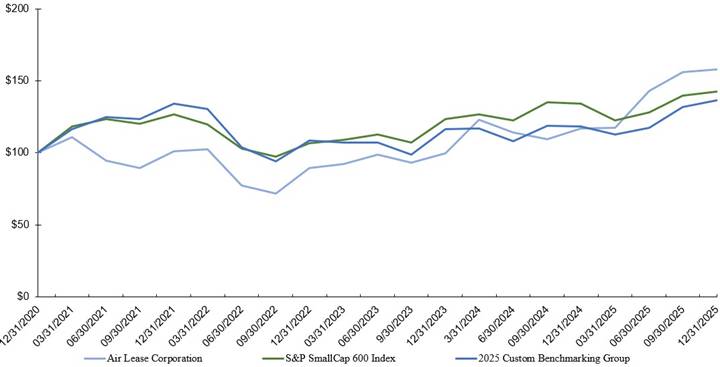
The foregoing Performance Graph does not constitute soliciting material and shall not be deemed filed, incorporated by reference into or a part of any other filing by the Company (including any future filings) under the Securities Act, or the Exchange Act, except to the extent the Company specifically incorporates such report by reference therein.
Company Purchases of Stock
None.
Unregistered Sales of Equity Securities and Use of Proceeds
None.
ITEM 6. [RESERVED]
ITEM 7. MANAGEMENT'S DISCUSSION AND ANALYSIS OF FINANCIAL CONDITION AND RESULTS OF OPERATIONS
The following discussion and analysis of our financial condition and results of operations should be read together with our consolidated financial statements and the related notes appearing in "Item 8. Financial Statements and Supplementary Data" of this Annual Report on Form 10-K.
Overview
Air Lease Corporation (the "Company", "AL", "we", "our" or "us") is a leading aircraft leasing company that was founded by aircraft leasing industry pioneer, Steven F. Udvar-Házy. We are principally engaged in purchasing the most modern, fuel-efficient new technology commercial jet aircraft directly from aircraft manufacturers, such as Airbus S.A.S. ("Airbus") and The Boeing Company ("Boeing"), and leasing those aircraft to airlines throughout the world with the intention of generating attractive returns on equity. In addition to our leasing activities, we sell aircraft from our fleet to third parties, including other leasing companies, financial services companies, airlines and other investors. We also provide fleet management services to investors and owners of aircraft portfolios for a management fee. Our operating performance is driven by the growth of our fleet, the terms of our leases, the interest rates on our debt, and the aggregate amount of our indebtedness, supplemented by gains from aircraft sales and our management fees.
Proposed Merger
On September 1, 2025, the Company entered into an Agreement and Plan of Merger (the "Merger Agreement"), with Sumisho Air Lease Corporation Designated Activity Company (formerly known as Gladiatora Designated Activity Company), an Irish private limited company ("Parent") and Takeoff Merger Sub Inc., a Delaware corporation and an indirect wholly owned subsidiary of Parent ("Merger Sub"), pursuant to which, among other things and subject to the conditions contained in the Merger Agreement, Merger Sub will merge with and into the Company, with the Company surviving as an indirect wholly owned subsidiary of Parent (the "Merger"). Parent is a new holding company owned by Sumitomo Corporation, a Japanese corporation, SMBC Aviation Capital Limited, a company incorporated with limited liability in Ireland, affiliates of Apollo Capital Management, L.P. and affiliates of Brookfield Asset Management Ltd.
Pursuant to the Merger Agreement, subject to the conditions set forth therein, at the effective time of the Merger (the "Effective Time"), each issued and outstanding share of Class A common stock of the Company (the "Common Stock") (other than (i) any Dissenting Shares (as defined in the Merger Agreement) and (ii) shares to be canceled or converted into shares of the surviving company pursuant to the Merger Agreement), will be converted into the right to receive $65.00 in cash, without interest. Pursuant to the Merger Agreement, at the Effective Time, each share of 4.65% Fixed-Rate Reset Non-Cumulative Perpetual Preferred Stock, Series B ("Series B Preferred Stock"), 4.125% Fixed-Rate Reset Non-Cumulative Perpetual Preferred Stock, Series C ("Series C Preferred Stock") and 6.00% Fixed-Rate Reset Non-Cumulative Perpetual Preferred Stock, Series D ("Series D Preferred Stock") of the Company issued and outstanding immediately prior to the Effective Time will remain outstanding and will be deemed to be a share of preferred stock of the surviving corporation with the same rights, powers, privileges and voting powers, and restrictions and limitations thereof applicable to such series of preferred stock. On December 18, 2025, the Company's Class A common stockholders approved and adopted the Merger Agreement at a special meeting of stockholders. The Merger Agreement also requires the Company to enter into required documentation in order to novate or otherwise transfer, effective immediately after the Effective Time, the OEM Contracts (as defined in the Merger Agreement) comprising the Company's orderbook to SMBC AC. As a result, leases related to aircraft that deliver from the Company's orderbook after the Effective Time, including any contracted future minimum rental payments, are also expected to be transferred to SMBC AC.
The Company currently anticipates that the Merger will close in the first half of calendar year 2026, subject to the satisfaction or waiver of the customary closing conditions. We currently operate, and until completion of the Merger will continue to operate, independently of Parent. See Note 18 of Notes to Consolidated Financial Statements included in Part II, Item 8 of this Annual Report on Form 10-K and Item 1.01 of our Current Report on Form 8-K filed with the SEC on September 2, 2025 for additional information regarding the proposed Merger.
2025 Summary
During the year ended December 31, 2025, we purchased 49 new aircraft from Airbus and Boeing and sold 48 aircraft. We ended the year with a total of 490 aircraft in our owned fleet. The net book value of our fleet[3] grew by 3.1% to $29.1 billion as of December 31, 2025 compared to $28.2 billion as of December 31, 2024. The weighted average age of our fleet was 4.9 years and the weighted average lease term remaining was 7.2 years as of December 31, 2025. Our managed fleet was comprised of 45 aircraft as of December 31, 2025 compared to 60 aircraft as of December 31, 2024. We have a globally diversified customer base comprised of 102 airlines in 53 countries as of December 31, 2025. We continued to maintain a strong lease utilization rate of 100% for the year ended December 31, 2025.
As of December 31, 2025, we had commitments to purchase 218 aircraft from Airbus and Boeing for delivery through 2031, with an estimated aggregate commitment of $12.6 billion. We have placed 99% and 82% of our orderbook on long-term leases for aircraft delivering through the end of 2027 and 2028, respectively, and have placed approximately 64% of our entire orderbook through 2031. We ended 2025 with $28.9 billion in committed minimum future rental payments, consisting of $19.6 billion in contracted minimum rental payments on the aircraft in our existing fleet and $9.3 billion in minimum future rental payments related to aircraft which will deliver from 2026 through 2031.
Our total revenues for the year ended December 31, 2025 increased by 10.3% to $3.0 billion as compared to 2024. The increase is primarily due to the continued growth in our fleet by net book value, an increase in our portfolio lease yield as well as an increase in our aircraft sales activity. During the year ended December 31, 2025, we recognized $244.4 million in gains from the sale of 48 aircraft, compared to $169.7 million in gains from the sale of 39 aircraft for the year ended December 31, 2024.
We finance the purchase of aircraft and our business with our available cash balances and internally generated funds, which includes cash flows from our leases, as well as aircraft sales and debt financing activities. Our long-term debt financing strategy is focused on raising primarily unsecured debt in the global bank and investment grade capital markets, with limited utilization of government guaranteed export credit or other forms of secured financing, however, pursuant to the Merger Agreement, from September 1, 2025 to May 1, 2026, we are restricted from incurring additional indebtedness, other than borrowings under our existing revolving credit facilities and our commercial paper program without Parent's prior written consent (which shall not be unreasonably withheld, conditioned or delayed). We ended 2025 with available liquidity of $7.5 billion, which was comprised of unrestricted cash of $466.4 million and approximately $7.0 billion in undrawn balances under our unsecured revolving credit facility, net of $1.4 billion in commercial paper borrowings. As of December 31, 2025, we had total debt outstanding of $19.9 billion, of which 76.8% was at a fixed rate and 97.5% was unsecured, and in the aggregate, our composite cost of funds was 4.15%.
Our net income attributable to common stockholders for the year ended December 31, 2025, was $1.0 billion, or $9.29 per diluted share, as compared to $372.1 million, or $3.33 per diluted share, for the year ended December 31, 2024. The increase from the prior year period is primarily due to a net benefit of $736.4 million from the settlement of insurance claims with certain insurers related to aircraft detained in Russia and higher revenues, as discussed above, partially offset by an increase in depreciation expense due to the growth of our fleet, an increase in interest expense due to higher average cost of funds, partially offset by an increase in depreciation expense due to the growth of our fleet, an increase in interest expense due to higher average cost of funds throughout the year, $18.8 million in compensation expense related to the retirement of our Chairman from his executive role, $18.5 million in costs associated with the merger, and $9.5 million in legal costs associated with litigation involving our Russian fleet. See "Results of Operations" below for more information on our financial results for the year ended December 31, 2025.
Adjusted net income before income taxes[4] during the year ended December 31, 2025 was $718.4 million or $6.40 per adjusted diluted share, as compared to $574.2 million, or $5.13 per adjusted diluted share, for the year ended December 31, 2024. Adjusted net income before income taxes increased primarily due to higher total revenues, partially offset by increases in depreciation expense and interest expense, as discussed above.
Our Fleet
We continue to own one of the youngest fleets among aircraft lessors, including some of the most fuel-efficient commercial jet aircraft available. Our fleet, based on net book value, increased by 3.1%, to $29.1 billion as of December 31, 2025, compared to $28.2 billion as of December 31, 2024. During the year ended December 31, 2025, we purchased 49 new aircraft from Airbus and Boeing and sold 48 aircraft. We ended the period with a total of 490 aircraft in our owned fleet. As of December 31, 2025, the weighted average fleet age and weighted average remaining lease term of our fleet were 4.9 years and 7.2 years, respectively. We also managed 45 aircraft as of December 31, 2025.
Our portfolio metrics as of December 31, 2025 and 2024 are as follows:
| December 31, 2025 |
| December 31, 2024 |
Net book value of flight equipment subject to operating lease | $ 29.1 billion |
| $ 28.2 billion |
Weighted-average fleet age(1) | 4.9 years |
| 4.6 years |
Weighted-average remaining lease term(1) | 7.2 years |
| 7.2 years |
|
|
|
|
Owned fleet(2) | 490 |
| 489 |
Managed fleet | 45 |
| 60 |
Aircraft on order(3) | 218 |
| 269 |
Total | 753 |
| 818 |
|
|
|
|
Current fleet contracted rentals | $ 19.6 billion |
| $ 18.3 billion |
Committed fleet rentals(3) | $ 9.3 billion |
| $ 11.2 billion |
Total committed rentals | $ 28.9 billion |
| $ 29.5 billion |
|
|
|
|
|
|
|
|
(1) Weighted-average fleet age and remaining lease term calculated based on net book value of our flight equipment subject to operating lease. | |||
(2) As of December 31, 2025 and 2024, our owned fleet count included 12 and 30 aircraft classified as flight equipment held for sale, respectively, and 16 and 15 aircraft classified as net investments in sales-type leases, respectively. | |||
(3) See section entitled "Proposed Merger" under "Part I-Item 1. Business" above for more information on the Orderbook Transfer and its impact on future committed fleet rentals for aircraft that deliver after the effective time of the Merger. | |||
The following table sets forth the net book value and percentage of the net book value of our flight equipment subject to operating leases in the indicated regions based on each airline's principal place of business as of December 31, 2025 and 2024:
| December 31, 2025 |
| December 31, 2024 | ||||
Region | Net Book Value |
| % of Total |
| Net Book Value |
| % of Total |
| (in thousands, except percentages) | ||||||
Europe | $ 11,356,104 |
| 39.1 % |
| $ 11,653,668 |
| 41.4 % |
Asia Pacific | 10,602,176 |
| 36.5 % |
| 10,077,621 |
| 35.8 % |
Central America, South America, and Mexico | 3,114,662 |
| 10.7 % |
| 2,685,098 |
| 9.5 % |
The Middle East and Africa | 2,254,646 |
| 7.8 % |
| 1,971,448 |
| 7.0 % |
U.S. and Canada | 1,726,042 |
| 5.9 % |
| 1,782,631 |
| 6.3 % |
Total | $ 29,053,630 |
| 100.0 % |
| $ 28,170,466 |
| 100.0 % |
The following table sets forth our top five lessees by net book value as of December 31, 2025 and 2024:
| December 31, 2025 |
|
| December 31, 2024 |
Lessee | % of Total |
| Lessee | % of Total |
Virgin Atlantic | 6.1 % |
| Virgin Atlantic | 6.5 % |
Korean Air | 6.0 % |
| Air France-KLM Group | 6.2 % |
Air France-KLM Group | 5.9 % |
| ITA | 5.6 % |
Aeromexico | 5.5 % |
| Vietnam | 4.6 % |
ITA | 5.2 % |
| Aeromexico | 4.4 % |
|
|
|
|
|
The following table sets forth the number of aircraft in our owned fleet by aircraft type as of December 31, 2025 and 2024:
|
| December 31, 2025 |
| December 31, 2024 | ||||
Aircraft type |
| Number of Aircraft |
| % of Total |
| Number of Aircraft |
| % of Total |
Airbus A220-100 |
| 8 |
| 1.6 % |
| 7 |
| 1.4 % |
Airbus A220-300 |
| 33 |
| 6.7 % |
| 22 |
| 4.5 % |
Airbus A320-200 |
| 17 |
| 3.5 % |
| 23 |
| 4.7 % |
Airbus A320-200neo |
| 23 |
| 4.7 % |
| 23 |
| 4.7 % |
Airbus A321-200 |
| 17 |
| 3.5 % |
| 19 |
| 3.9 % |
Airbus A321-200neo |
| 109 |
| 22.2 % |
| 108 |
| 22.1 % |
Airbus A330-200(1) |
| 13 |
| 2.7 % |
| 13 |
| 2.7 % |
Airbus A330-300 |
| 5 |
| 1.0 % |
| 5 |
| 1.0 % |
Airbus A330-900neo |
| 28 |
| 5.7 % |
| 28 |
| 5.7 % |
Airbus A350-900 |
| 17 |
| 3.5 % |
| 17 |
| 3.5 % |
Airbus A350-1000 |
| 8 |
| 1.6 % |
| 8 |
| 1.6 % |
Boeing 737-700 |
| - |
| - % |
| 2 |
| 0.4 % |
Boeing 737-800 |
| 38 |
| 7.8 % |
| 61 |
| 12.5 % |
Boeing 737-8 MAX |
| 71 |
| 14.5 % |
| 59 |
| 12.1 % |
Boeing 737-9 MAX |
| 35 |
| 7.1 % |
| 30 |
| 6.1 % |
Boeing 777-200ER |
| 1 |
| 0.2 % |
| 1 |
| 0.2 % |
Boeing 777-300ER |
| 23 |
| 4.7 % |
| 24 |
| 4.9 % |
Boeing 787-9 |
| 26 |
| 5.3 % |
| 26 |
| 5.3 % |
Boeing 787-10 |
| 17 |
| 3.5 % |
| 12 |
| 2.5 % |
Embraer E190 |
| 1 |
| 0.2 % |
| 1 |
| 0.2 % |
Total(2) |
| 490 |
| 100.0 % |
| 489 |
| 100.0 % |
|
|
|
|
|
|
|
|
|
|
|
|
|
|
|
|
|
|
(1) As of December 31, 2025 and 2024, aircraft count includes three and two Airbus A330-200 aircraft classified as freighters, respectively. | ||||||||
(2) As of December 31, 2025 and 2024, our owned fleet count included 12 and 30 aircraft classified as flight equipment held for sale, respectively, and 16 and 15 aircraft classified as net investments in sales-type leases, respectively. | ||||||||
As of December 31, 2025, we had contractual commitments to purchase 218 new aircraft for delivery through 2031, with an estimated aggregate commitment (including adjustments for anticipated inflation) of $12.6 billion, as shown in the following tables. The tables are subject to change based on Airbus and Boeing delivery delays. For more information on the risks and uncertainties impacting our aircraft deliveries, see "Part I-Item 1A. Risk Factors" in this Annual Report on Form 10-K.
Contractual commitment schedule
|
| Estimated Delivery Years |
|
| ||||||||||
Aircraft Type |
| 2026 |
| 2027 |
| 2028 |
| 2029 |
| 2030 |
| Thereafter |
| Total |
Airbus A220-100/300 |
| 3 |
| 8 |
| 14 |
| 8 |
| - |
| - |
| 33 |
Airbus A320/321neo(1) |
| 20 |
| 38 |
| 34 |
| 34 |
| - |
| - |
| 126 |
Airbus A330-900neo |
| 1 |
| - |
| - |
| - |
| - |
| - |
| 1 |
Boeing 737-8/9 MAX |
| 23 |
| 21 |
| 2 |
| - |
| - |
| 5 |
| 51 |
Boeing 787-9/10 |
| 6 |
| 1 |
| - |
| - |
| - |
| - |
| 7 |
Total(2)(3) |
| 53 |
| 68 |
| 50 |
| 42 |
| - |
| 5 |
| 218 |
|
|
|
|
|
|
|
|
|
|
|
|
|
|
|
|
|
|
|
|
|
|
|
|
|
|
|
|
|
|
(1) Our Airbus A320/321neo aircraft orders include 13 long-range variants and 48 extra long-range variants. | ||||||||||||||
(2) The table above reflects Airbus and Boeing aircraft delivery delays based on contractual documentation. | ||||||||||||||
(3) See section entitled "Proposed Merger" under "Part I-Item 1. Business" above for more information on the Orderbook Transfer and its impact on aircraft that deliver after the effective time of the Merger. | ||||||||||||||
Commitments for the acquisition of these aircraft, calculated at an estimated aggregate commitment (including adjustments for anticipated inflation) of approximately $12.6 billion as of December 31, 2025 are as follows:
|
| (in thousands) |
Years ending December 31, |
|
|
2026 |
| $ 3,514,889 |
2027 |
| 3,897,290 |
2028 |
| 2,664,213 |
2029 |
| 2,129,545 |
2030 |
| 47,000 |
Thereafter |
| 298,126 |
Total |
| $ 12,551,063 |
Aircraft Delivery Delays
Pursuant to our purchase agreements with Airbus and Boeing, we agree to contractual delivery dates for each aircraft ordered. These dates can change for a variety of reasons, however for the last several years, manufacturing delays have significantly impacted the planned purchases of our aircraft on order with both Airbus and Boeing. We have agreed to revised contractual delivery dates for our Airbus and Boeing aircraft. As of the date of this filing, Airbus and Boeing have generally met the revised delivery dates, and when delayed, the delays have been generally one or two months in duration. However, going forward, delivery delays beyond the revised delivery dates could increase as to the number of aircraft delayed and/or the length of delays.
The FAA continues to enforce a cap on Boeing's 737 MAX production until quality control issues are resolved, although the production cap was increased modestly in October 2025. The broader aviation supply chain remains constrained impacting production capacity for both Airbus and Boeing. Maintenance, repair, and overhaul ("MRO") facility capacity also remains constrained and has worsened in 2025, and we expect these capacity constraints to continue into 2026. This has resulted in a significant number of engines remaining off-wing for an extended period of time while waiting for inspection or overhaul, meaningfully impacting operations of certain of our airline customers and the broader industry.
The aircraft purchase commitments discussed above could also be impacted by cancellations. Our purchase agreements with Airbus and Boeing generally provide each of us and the manufacturers with cancellation rights for delivery delays starting at one year after the original contractual delivery date, regardless of cause. In addition, our lease agreements generally provide each of us and the lessee with cancellation rights related to certain aircraft delivery delays that typically parallel the cancellation rights in our purchase agreements.
The following table, which is subject to change based on Airbus and Boeing delivery delays, shows the number of new aircraft to be delivered as of December 31, 2025, along with the lease placements of such aircraft as of February 12, 2026. Airbus and Boeing have expressed their desire to increase production rates on several aircraft types but have not meaningfully increased production because of several factors, including ongoing supply chain constraints and other production issues.
Delivery Year |
| Total number of lease placements |
| Number of aircraft in our orderbook |
| % Leased |
2026 |
| 53 |
| 53 |
| 100.0 % |
2027 |
| 67 |
| 68 |
| 98.5 % |
2028 |
| 20 |
| 50 |
| 40.0 % |
2029 |
| - |
| 42 |
| - % |
2030 |
| - |
| - |
| - % |
Thereafter |
| - |
| 5 |
| - % |
Total(1) |
| 140 |
| 218 |
| 64.2 % |
|
|
|
|
|
|
|
|
|
|
|
|
|
|
(1) See section entitled "Proposed Merger" under "Part I-Item 1. Business" above for more information on the Orderbook Transfer and its impact on future committed fleet rentals for aircraft that deliver after the effective time of the Merger. | ||||||
Aircraft Industry and Sources of Revenues
Our revenues are principally derived from operating leases with airlines throughout the world. As of December 31, 2025, we had a globally diversified customer base of 102 airlines in 53 different countries, with over 95% of our business revenues from airlines domiciled outside of the U.S., and we anticipate that most of our revenues in the future will be generated from foreign customers.
While recent tariff announcements have resulted in some volatility for the global aviation business, we believe the overall airline operating environment remains favorable for us and the broader commercial aircraft leasing industry. Factors such as increases in population growth and the size of the global middle class as well as air travel demand, and improved global economic health and development positively affect the long-term performance of the commercial aircraft leasing industry. In addition, factors and trends including increased airline financing needs, OEM supply chain challenges and backlogs, and environmental sustainability objectives impact the commercial aircraft leasing industry in the short-term and may increase the demand for our aircraft. We are monitoring the impact of tariffs on our business. The effects from evolving tariff regimes have not impacted our profitability during the year. As discussed below, it is our expectation that tariff costs resulting from the importation of aircraft will continue to be the responsibility of our leasing customers in accordance with the terms of our triple net leases. While we currently do not expect tariffs to have a material impact on our business, as discussed below, tariffs could impact our business in a number of ways and the level of impact is unknown due to the uncertainty surrounding tariffs currently.
Changes to tariff policy in the U.S. and the reaction from the U.S.'s trading partners has resulted in trade policy uncertainty and an escalation in trade tensions, resulting in significant market volatility. In April 2025, the U.S. imposed baseline tariffs on all countries and individualized higher tariffs on nations with which the U.S. assesses that it has the largest trade deficits, while retaliatory tariffs by other countries, such as China and Canada, have been imposed on U.S. products and goods; however, aircraft and aircraft parts were generally exempted. On January 29, 2026, the U.S. administration threatened to impose a 50% tariff on Canadian manufactured aircraft imported into the U.S. As of the date of this filing, such threats have not resulted in the imposition of additional tariffs. We currently have four aircraft placed for delivery from our orderbook that would subject to such additional tariff if implemented.
In August and September, 2025, the U.S. government implemented trade frameworks with the European Union (the "E.U."), the United Kingdom (the "U.K.") and Japan that allow for the importation of aircraft and aircraft parts into the US duty free. Generally, Boeing aircraft manufactured in the U.S. and delivered to customers in other countries may be subject to tariffs; however, the trade framework with the E.U. the U.K. and Japan preserves the zero tariff regime on Boeing and Airbus aircraft and parts imported into the U.S., the E.U., the U.K. and Japan, respectively. As of the date of this filing, we have no aircraft placed for delivery from our orderbook that are expected to be subject to existing tariffs. As of December 31, 2025, approximately 0.8% of our aircraft by net book value are on lease to lessees located in China, and we do not have any scheduled future aircraft deliveries to Chinese airline customers.
Without the continuation of industry wide exemptions, tariffs could result in higher costs for certain imported aircraft which an airline may not be willing to assume. Our leases are primarily structured as triple net leases, whereby the lessee is responsible for all operating costs including the costs associated with the importation of aircraft. Our lessees are generally obligated to pay such tariffs to customs authorities. If lessees are unwilling or unable to assume such costs, it could have an adverse impact on demand for commercial aircraft or result in lease cancellations for those of our customers whose aircraft delivery has been delayed by over one year and who hold lease cancellation rights. Additionally, tariffs are likely to also increase aircraft acquisition costs and the costs of components and materials that we purchase, both for existing aircraft in our orderbook and future aircraft orders. More broadly, the impact of such tariffs or uncertainty as a result of such tariffs, is likely to have near term negative impact on the global economy and may serve to reduce demand for air travel which could negatively impact our business. While some trade negotiations are underway, resolution of these trade disputes and associated tariff rates remain uncertain, with unpredictable long-term implications for the global supply chain and economic stability.
Passenger traffic volume has historically expanded at a faster rate than global gross domestic product ("GDP") growth, in part due to the expansion of the global middle class and the ease and affordability of air travel, which we expect to continue. The International Air Transport Association ("IATA") reported that 2025 passenger traffic was up 5.3% relative to the prior year, primarily due to continued strength in international traffic, offsetting more modest expansion of domestic traffic globally. International traffic rose 7.1% in 2025 as compared to the prior year, benefiting from robust continued international travel expansion in the Asia Pacific region, as well as strong expansion in most other major international markets reported by IATA. Global domestic traffic rose 2.4% during 2025 as compared to the prior year, with strength in most markets outside of the U.S. domestic market. Meanwhile, passenger load factors are persisting at historically high levels with IATA reporting total global passenger load factors of 84% for 2025, continuing to support airline demand for additional aircraft.
As global air traffic continues to expand and aircraft production volumes remain constrained, we are experiencing strong demand for our aircraft through new lease requests and lease extension requests, which we expect to continue throughout 2026. The number of scheduled flights globally has continued to expand in recent months relative to 2024, suggesting continued consistent passenger volume support. While further impact from tariffs or global macroeconomic conditions could have incremental negative impact on traffic expectations, we continue to expect the need for airlines to replace aging aircraft will support demand for newer, more fuel efficient aircraft. As a result, we believe many airlines will look to lessors to fulfill these needs. In addition, both Airbus and Boeing have delivery delays which have been further compounded by engine manufacturer delays, shorter on-wing engine time of most new technology engines and ongoing supply chain challenges. We expect deliveries of our 737 MAX aircraft will continue to be impacted by the FAA's involvement in Boeing's production rates. We also expect that relatively low levels of widebody retirements in recent years could lead to an accelerated replacement cycle of older widebody aircraft in the future.
The strong demand for our aircraft, combined with still elevated interest rates and inflation, helped to increase lease rates on new lease agreements and lease extensions during the year ended December 31, 2025. We expect that lease rates will remain strong as the supply and demand environment for commercial aircraft remains tight and our funding advantage relative to our airline customers widens. Lease rates are influenced by several factors above and beyond interest rates, including aircraft demand, supply technicals, supply chain disruptions, environmental initiatives and other factors that may result in a change in lease rates regardless of the interest rate environment and therefore, are difficult to project or forecast. Based on our views of the market and assumptions around our sales activity and interest rate environment, we expect to see a moderately-sized upward trajectory in lease yield through 2029, subject, however, to the uncertain impact that the trade policies and related tariff rates may have on demand for aircraft. We also believe the increase in lease rates and the sustained tightness in the credit markets may result in a shortfall of available capital to finance aircraft purchases, which could increase the demand for leasing.
Airline reorganizations, liquidations, or other forms of bankruptcies occurring in the industry have in the past and may in the future include some of our aircraft customers. Such events have resulted and may in the future result in the early return of aircraft or changes in our lease terms. Our airline customers are facing higher operating costs as a result of persistently elevated interest rates, inflation, tariffs, foreign currency risk, volatility in fuel costs, ongoing labor shortages and disputes, as well as delays and cancellations caused by the global air traffic control system and airports, although strong air traffic demand has provided a counterbalance to these increased costs.
We believe the aircraft leasing industry has remained resilient over time across a variety of global economic conditions and remain optimistic about the long-term fundamentals of our business. We believe leasing will continue to be an attractive form of aircraft financing for airlines because less cash and financing is required for the airlines, lessors maintain key delivery positions, and it provides fleet flexibility while eliminating residual value risk for lessees.
Update on Russian Fleet
In June 2022, we and certain of our subsidiaries (collectively, the "Plaintiffs") submitted insurance claims to the insurers (collectively, the "C&P Insurers") on the Plaintiffs' contingent and possessed insurance policy (the "C&P Policy") to recover losses relating to aircraft detained in Russia for which we recorded a net write-off of our interests in our owned and managed aircraft totaling approximately $771.5 million for the year ended December 31, 2022. On December 20, 2022, the Plaintiffs filed suit in the Los Angeles County Superior Court of the State of California against the C&P Insurers in connection with our previously submitted insurance claims (the "California Litigation").
On January 19, 2024, certain of the Plaintiffs filed suit in the High Court of Justice, Business & Property Courts of England & Wales, Commercial Court against the Russian airlines' aviation insurers and reinsurance insurers (collectively, the "Airlines' Insurers") seeking recovery under the Russian airlines' insurance policies for certain aircraft that remain in Russia (the "London Litigation"). The London Litigation remains in the early stages and a trial has been set to begin in October 2026.
During the year ended December 31, 2025, the Plaintiffs entered into settlement agreements with all C&P Insurers. As a result, we recognized a net benefit of $736.4 million from the settlement of insurance claims under our C&P Policy comprised of $727.6 million in cash insurance settlement proceeds and an $8.8 million benefit from our equity interest in our managed fleet.
Pursuant to the terms of the settlement agreements with the C&P Insurers and following receipt of proceeds, the Plaintiffs (i) released their insurance claims against the C&P Insurers under the C&P Policy in the California Litigation, (ii) released their insurance claims against the C&P Insurers under the reinsurance policies at issue in the London Litigation, and (iii) dismissed the C&P Insurers from the California Litigation and London Litigation. On September 5, 2025, all remaining claims in the California Litigation were dismissed.
As of February 12, 2026, we have recovered an aggregate of $834.3 million against our initial $802.4 million write-off of our interests in owned and managed aircraft detained in Russia taken during the first quarter of 2022.
The Plaintiffs continue to have claims against certain Airlines' Insurers in the London Litigation and will continue to vigorously pursue all available insurance claims and related insurance litigation, and all rights and remedies therein. Collection, timing and amounts of any additional insurance and related recoveries in the London Litigation remain uncertain at this time.
Liquidity and Capital Resources
Overview
We ended 2025 with available liquidity of approximately $7.5 billion, which was comprised of unrestricted cash of $466.4 million and approximately $7.0 billion in undrawn balances under our unsecured revolving credit facility, net of $1.4 billion in commercial paper borrowings. We finance the purchase of aircraft and our business operations using our available cash balances and internally generated funds, which includes cash flows from our leases, as well as aircraft sales and debt financing activities. We aim to maintain investment-grade credit metrics and focus our debt financing strategy on funding our business primarily on an unsecured basis with mostly fixed-rate debt issued in the public bond market. Unsecured financing provides us with operational flexibility when selling or transitioning aircraft from one airline to another. We also have the ability to seek debt financing secured by our assets, as well as financings supported through government-guaranteed export credit agencies for future aircraft deliveries. We have also issued preferred stock in recent years and have outstanding preferred stock with an aggregate stated amount of $900.0 million as of February 12, 2026. Our access to a variety of financing alternatives and the global capital markets, including capital raises through unsecured public notes denominated in U.S. dollars or various foreign currencies, our commercial paper program, private capital, bank debt, secured debt and preferred stock issuances serves as a key advantage in managing our liquidity; however, pursuant to the Merger Agreement, we are restricted from incurring additional indebtedness, other than borrowings under our existing revolving credit facilities or our commercial paper program without Parent's written consent (which shall not be unreasonably withheld, conditioned or delayed). See 'Financing Restrictions Under the Merger Agreement' below for further details on the restriction.
We currently believe that we will be able to largely self-fund our orderbook with expected operating cash flows and aircraft sales.
We ended 2025 with total debt outstanding of $19.9 billion, of which 76.8% was at a fixed rate and 97.5% was unsecured, and in the aggregate, our composite cost of funds was 4.15%. As of December 31, 2024, we had total debt outstanding of $20.4 billion, of which 79.0% was at a fixed rate and 97.3% was unsecured, and in the aggregate, our composite cost of funds was 4.14%
Financing Restrictions Under the Merger Agreement
Our long-term debt financing strategy is focused on raising primarily unsecured debt in the global bank and investment grade capital markets, however, pursuant to the Merger Agreement, from September 1, 2025 to May 1, 2026, we are restricted from incurring additional indebtedness, other than borrowings under our existing revolving credit facilities or our commercial paper program without Parent's prior written consent (which shall not be unreasonably withheld, conditioned or delayed). Pursuant to the terms of the Merger Agreement (i) if the Merger has not closed by May 1, 2026 then, during the three-month period commencing on such date, we are permitted to incur additional indebtedness in an aggregate principal amount of up to $2.0 billion in the form of secured or unsecured, investment grade bank term loans and (ii) if the Merger has not closed by July 1, 2026, we may also issue or incur up to $2.0 billion in additional indebtedness in the form of secured or unsecured investment grade bank term loans or unsecured investment grade debt securities, with capacity to incur an aggregate principal amount of up to $2.0 billion in additional indebtedness after the end of each three month period thereafter, subject to additional conditions and restrictions contained in the Merger Agreement. The Merger Agreement also restricts our ability to issue additional shares of preferred stock without the Parent's prior written consent (which shall not be unreasonably withheld, conditioned or delayed).
Capital Allocation Strategy
We have a balanced approach to capital allocation based on the following priorities, ranked in order of priority: first, investing in modern, in-demand aircraft to profitably grow our core aircraft leasing business while maintaining strong fleet metrics and creating sustainable long-term shareholder value; second, maintaining our investment grade balance sheet utilizing unsecured debt as our primary form of financing; and finally, in line with the aforementioned priorities, returning excess cash to stockholders through our dividend as well as regular evaluation of share repurchases, as appropriate. However, pursuant to the Merger Agreement, we are restricted from initiating share repurchases without Parent's prior written consent.
Material Cash Sources and Requirements
We believe that we have sufficient liquidity from available cash balances, cash generated from ongoing operations, available commitments under our unsecured revolving credit facility and commercial paper program to satisfy the operating requirements of our business through at least the next 12 months. Our material cash sources include:
• Unrestricted cash: We ended 2025 with $466.4 million in unrestricted cash.
• Lease cash flows: We ended 2025 with $28.9 billion in committed minimum future rental payments comprised of $19.6 billion in contracted minimum rental payments on the aircraft in our existing fleet and $9.3 billion in minimum future rental payments related to aircraft which will deliver from 2026 through 2031. These rental payments are a primary driver of our short and long-term operating cash flow. As of December 31, 2025, our minimum future rentals on non-cancellable operating leases for the next 12 months was $2.7 billion. For further detail on our minimum future rentals for 2026 and thereafter, see Note 7. "Rental Income" in the "Notes to Consolidated Financial Statements" under "Item 8. Financial Statements and Supplementary Data" in this Annual Report on Form 10-K.
• Unsecured revolving credit facility: As of February 12, 2026, our $8.4 billion revolving credit facility is syndicated across 53 financial institutions, with a stated maturity date of May 5, 2029. The facility contains standard investment grade covenants and does not condition our ability to borrow on the lack of a material adverse effect on us or the general economy. As of February 12, 2026, we had $750.0 million in outstanding borrowings under our unsecured revolving credit facility.
• Commercial paper program: On January 21, 2025, we established a commercial paper program under which we may issue unsecured commercial paper up to a total of $2.0 billion outstanding at any time, with maturities of up to 397 days from the date of issue. The net proceeds from the issuance of commercial paper are expected to be used for general corporate purposes, which may include, among other things, the purchase of commercial aircraft and the repayment of existing indebtedness. As of February 12, 2026, we had $1.6 billion in outstanding borrowings under our commercial paper program at a weighted average interest rate of 4.15%.
• Aircraft sales: Proceeds from the sale of aircraft help supplement our liquidity position. We have $1.2 billion of aircraft in our sales pipeline[5], which includes $529.0 million of aircraft classified as flight equipment held for sale as of December 31, 2025 and $692.0 million of aircraft subject to letters of intent[6]. We expect the sale of the majority of our aircraft classified as flight equipment held for sale to be completed during 2026. We expect to sell approximately $1.5 billion in aircraft for the full year 2026 and continue to see robust demand in the secondary market to support our aircraft sales program.
• Senior unsecured securities: We have historically been a frequent issuer in the investment grade capital markets, opportunistically issuing unsecured notes, primarily through our Medium-Term Note Program at attractive cost of funds and other senior unsecured securities. As described above under "Financing Restrictions Under the Merger Agreement", our future investment grade capital markets issuances, including under our Medium-Term Note Program, are subject to certain restrictions under the Merger Agreement through July 1, 2026.
• Unsecured bank facilities: We have active dialogue with a variety of global financial institutions and have historically entered into new unsecured credit facilities from time to time as a means to supplement our liquidity and sources of funding. These loans are typically pre-payable without penalty at any time offering us significant flexibility in different rate environments. However, as mentioned above under "Financing Restrictions Under the Merger Agreement", our ability to enter into new unsecured bank facilities is subject to certain restrictions under the Merger agreement through May 1, 2026.
• Other sources: In addition to the above, we generate liquidity through cash received from security deposits and maintenance reserves from our lease agreements, other sources of debt financings (including secured bank term loans, export credit and private placements, and other unsecured revolving credit facilities), as well as issuances of preferred stock. However, as mentioned above, we are restricted from incurring additional secured debt or issuing additional preferred stock pursuant to the terms of the Merger Agreement. We have also received $727.6 million in cash insurance proceeds from the settlement of claims against certain insurers related to our Russian fleet during the year ended December 31, 2025 although we don't expect insurance proceeds for this matter to have a meaningful contribution to liquidity in the future. As of February 12, 2026, we had $750.0 million in outstanding borrowings under our other unsecured revolving credit facilities.
In general, increases and reductions in the Federal Funds Rate should affect the interest rate on our Revolving Credit Facility, our new and existing borrowings that bear interest at a floating rate, and borrowings under our commercial paper program.
A shift in monetary policy in the United States and other countries beginning in 2022 resulted in rapid interest rate increases over a relatively short period of time. Despite recent rate cuts made in 2025 by the FOMC, this persistently elevated interest rate environment has resulted in increased borrowing costs for us and will continue to result in elevated borrowing costs until interest rates decline. We cannot predict if or when the FOMC will further reduce the target range for the Federal Funds Rate or the impact of any such reductions on our interest expense or future debt borrowings.
Historically, there has also been a lag between a rise in interest rates and subsequent increases in lease rates. We have experienced increasing lease rates on new lease agreements and lease extensions since 2023, which are serving to partially offset increased borrowing costs. We believe the increased lease rates we have experienced will continue as airlines adjust to a persistently elevated interest rate environment, which will continue to support our funding advantage relative to our airline customers. In addition, lease rates are influenced by several factors above and beyond interest rates, including supply technicals driven by aircraft demand, supply chain disruptions, environmental initiatives and other factors that may result in a change in lease rates regardless of the interest rate environment.
As of December 31, 2025, we were in compliance in all material respects with the covenants contained in our debt agreements. While a ratings downgrade would not result in a default under any of our debt agreements, it could adversely affect our ability to issue debt and obtain new financings, or renew existing financings, and it would increase the interest rate applicable to certain of our financings. Our liquidity plans are subject to a number of risks and uncertainties, including those described in "Item 1A. Risk Factors" of this Annual Report on Form 10-K.
Our material cash requirements are primarily comprised of aircraft purchases, debt service payments and general operating expenses. The amount of our cash requirements depends on a variety of factors, including, the ability of aircraft manufacturers to meet their contractual delivery obligations to us, the ability of our lessees to meet their contractual obligations with us, the timing of aircraft sales from our fleet, the timing and amount of our debt service obligations, potential aircraft acquisitions, and the general economic environment in which we operate.
Our material cash requirements as of December 31, 2025 are as follows (in thousands):
|
| 2026 |
| 2027 |
| 2028 |
| 2029 |
| 2030 |
| Thereafter |
| Total |
Purchase commitments(1)(3) |
| $ 3,514,889 |
| $ 3,897,290 |
| $ 2,664,213 |
| $ 2,129,545 |
| $ 47,000 |
| $ 298,126 |
| $ 12,551,063 |
Debt obligations |
| 8,002,441 |
| 4,026,176 |
| 3,130,140 |
| 1,071,769 |
| 2,167,349 |
| 1,464,469 |
| 19,862,344 |
Interest payments on debt outstanding(2) |
| 712,774 |
| 514,956 |
| 301,460 |
| 175,827 |
| 128,283 |
| 72,951 |
| 1,906,251 |
Total |
| $ 12,230,104 |
| $ 8,438,422 |
| $ 6,095,813 |
| $ 3,377,141 |
| $ 2,342,632 |
| $ 1,835,546 |
| $ 34,319,658 |
|
|
|
|
|
|
|
|
|
|
|
|
|
|
|
|
|
|
|
|
|
|
|
|
|
|
|
|
|
|
(1) Contractual purchase commitments reflect future Airbus and Boeing aircraft deliveries based on contractual documentation and production adjustments as communicated by Airbus and Boeing through February 12, 2026. | ||||||||||||||
(2) Future interest payments on floating rate debt are estimated using floating rates in effect at December 31, 2025, which is inclusive of any cross-currency hedging arrangements. | ||||||||||||||
(3) See section entitled "Proposed Merger" under "Part I-Item 1. Business" above for more information on the Orderbook Transfer and its impact on aircraft that deliver after the effective time of the Merger. | ||||||||||||||
The actual delivery dates of the aircraft in our commitments table and the expected time for payment of such aircraft could be further impacted by the pace at which Airbus and Boeing can deliver aircraft, among other factors. As a result, the timing of our contractual purchase commitments shown in the table above may not reflect when the aircraft investments are actually made. We anticipate our total aircraft investments for the full year 2026 to be between $3.0 billion and $4.0 billion, which may be subject to change due to the pendency of the Merger.
The above table does not include any tax payments we may pay nor any dividends we may pay on our preferred stock or common stock. We are permitted to pay regular quarterly cash dividends up to $0.22 per share of Class A common stock, $11.625 per share of Series B Preferred Stock, $10.3125 per share of Series C Preferred Stock, and $15.00 per share of Series D Preferred Stock, which amounts in respect of the Series B Preferred Stock, Series C Preferred Stock and Series D Preferred Stock may be adjusted in accordance with the dividend reset provisions contained in the relevant certificates of designation.
Cash Flows
Our cash flows provided by operating activities increased by $57.6 million to $1.7 billion for the year ended December 31, 2025. Our cash flows provided by operating activities during the year ended December 31, 2025 increased primarily due to an increase in customer collections related to the growth of our fleet, partially offset by higher cash paid for interest due to higher average cost of funds. Our net cash flows used in investing activities decreased by $1.7 billion to $1.3 billion for the year ended December 31, 2025 primarily due to a decrease in aircraft purchases in the current year, the receipt of $727.6 million in cash insurance settlement proceeds during the year ended December 31, 2025 and an increase in sales proceeds as a result of the increase in our aircraft sales. Our cash flows used in financing activities were $0.4 billion for the year ended December 31, 2025 as compared to $1.4 billion in cash flows provided by financing activities for the year ended December 31, 2024. During the year ended 2025, cash flows from financing activities decreased due to the receipt of $727.6 million in Russian insurance recoveries and due to the increase in our aircraft sales activity. Our financing activities are mainly driven by changes in our investing activities.
Debt
Our debt financing as of December 31, 2025 and 2024 is summarized below:
| December 31, 2025 |
| December 31, 2024 |
| (U.S. dollars in thousands, except percentages) | ||
Unsecured |
|
|
|
Senior unsecured securities | $ 13,860,558 |
| $ 16,046,662 |
Term financings | 3,846,800 |
| 3,628,600 |
Commercial paper | 1,361,400 |
| - |
Revolving Credit Facility | - |
| 170,000 |
Other revolving credit facilities | 300,000 |
| - |
Total unsecured debt financing | 19,368,758 |
| 19,845,262 |
Secured |
|
|
|
Term financings | 318,348 |
| 354,208 |
Export credit financing | 175,238 |
| 190,437 |
Total secured debt financing | 493,586 |
| 544,645 |
|
|
|
|
Total debt financing | 19,862,344 |
| 20,389,907 |
Less: Debt discounts and issuance costs | (132,215) |
| (179,922) |
Debt financing, net of discounts and issuance costs | $ 19,730,129 |
| $ 20,209,985 |
Selected interest rates and ratios: |
|
|
|
Composite interest rate(1) | 4.15 % |
| 4.14 % |
Composite interest rate on fixed-rate debt(1) | 3.91 % |
| 3.74 % |
Percentage of total debt at a fixed-rate | 76.85 % |
| 79.00 % |
|
|
|
|
|
|
|
|
(1) This rate does not include the effect of upfront fees, facility fees, undrawn fees or amortization of debt discounts and issuance costs. | |||
Senior unsecured securities (including Medium-Term Note Program)
As of December 31, 2025 and 2024, we had $13.9 billion and $16.0 billion in senior unsecured securities outstanding, respectively.
Public unsecured notes. As of December 31, 2025, we had $13.3 billion in aggregate principal amount of senior unsecured notes outstanding, all of which have been issued in SEC-registered offerings and with remaining terms ranging from less than one month to six years and bearing interest at fixed rates ranging from 1.875% to 5.95%. As of December 31, 2024, we had $15.4 billion in aggregate principal amount of senior unsecured notes outstanding bearing interest at fixed rates ranging from 1.875% to 5.95%.
All of our fixed rate senior unsecured notes may be redeemed at our option in part or in full at any time and from time to time prior to maturity at the redemption prices (including any "make-whole" premium) specified in such senior unsecured notes. Our senior unsecured notes also require us to offer to purchase all of the notes at a purchase price equal to 101% of the principal amount of the notes, plus accrued and unpaid interest if a "change of control repurchase event" (as defined in the applicable indenture or supplemental indenture) occurs.
The indentures that govern our senior unsecured notes requires us to comply with certain covenants, including restrictions on our ability to (i) incur liens on assets and (ii) merge, consolidate or transfer all or substantially all of our assets.
The covenants contained in these indentures are subject to certain exceptions and qualifications set forth therein. In addition, the indentures also provide for customary events of default. If any event of default occurs, any amount then outstanding under the relevant indentures may immediately become due and payable. These events of default are subject to certain exceptions and qualifications set forth in the indentures.
On May 6, 2024, we renewed and refreshed our Medium-Term Note Program, under which we may issue, from time to time, up to $20.0 billion (or their U.S. dollar equivalent) of debt securities designated as our Medium-Term Notes, Series A. All of our senior unsecured notes issued since 2019 have consisted of Medium-Term Notes, Series A, issued under our Medium-Term Note Program. As of February 12, 2026, we had approximately $18.8 billion remaining capacity under our Medium-Term Note Program.
Unsecured syndicated revolving credit facility
As of December 31, 2025 we did not have any amounts outstanding, and as of February 12, 2026, we had $750.0 million outstanding under our unsecured syndicated revolving credit facility (the "Revolving Credit Facility"), respectively As of December 31, 2024, we had $0.2 billion outstanding under our Revolving Credit Facility. Borrowings under the Revolving Credit Facility are used to finance our working capital needs in the ordinary course of business and for other general corporate purposes.
In April 2025, we amended and extended our Revolving Credit Facility through an amendment that, among other things, (i) added ALC Aircraft Financing Designated Activity Company, an indirect, wholly-owned subsidiary of the Company, as a borrower to the Revolving Credit Facility under a new tranche B revolving commitment totaling $250.0 million (ii) extended the final maturity date from May 5, 2028 to May 5, 2029 and (iii) amended the total revolving commitments thereunder to approximately $8.2 billion as of May 5, 2025. Borrowings under the Revolving Credit Facility continue to accrue interest at Adjusted Term SOFR (as defined in the Revolving Credit Facility) plus a margin of 1.05% per year. We are required to pay a facility fee of 0.20% per year in respect of total commitments under the Revolving Credit Facility. Interest rate and facility fees are subject to changes in our credit ratings.
In May 2025, we entered into a new lender supplement which increased the aggregate capacity of our Revolving Credit Facility by $250.0 million. The additional capacity has a stated maturity date of May 5, 2029.
As of February 12, 2026, lenders held revolving commitments totaling approximately $8.4 billion. Lenders held revolving commitments totaling approximately $8.0 billion that mature on May 5, 2029, commitments totaling $125.0 million that mature on May 5, 2028, commitments totaling $25.0 million that mature on May 5, 2027 and commitments totaling $210.0 million that mature on May 5, 2026.
The Revolving Credit Facility provides for certain covenants, including covenants that limit our subsidiaries' ability to incur, create, or assume certain unsecured indebtedness, and our subsidiaries' abilities to engage in certain mergers, consolidations, and asset sales. The Revolving Credit Facility also requires us to comply with certain financial maintenance covenants including minimum consolidated stockholders' equity, minimum consolidated unencumbered assets, and an interest coverage test. In addition, the Revolving Credit Facility contains customary events of default. In the case of an event of default, the lenders may terminate the commitments under the Revolving Credit Facility and require immediate repayment of all outstanding borrowings.
Other unsecured revolving credit facilities
As of December 31, 2025, and February 12, 2026, we had outstanding balances of $300.0 million and $750 million, respectively. Borrowings under this facility bear interest at one-month Term SOFR plus 1.05%, and matures in 2026. As of December 31, 2024, we did not have outstanding balances under our other unsecured revolving credit facilities. These facilities are not guaranteed and are available at the sole discretion of the lender, who has the right to modify or terminate the facilities at any time.
Unsecured term financings
As of December 31, 2025 and 2024, the outstanding balance on our unsecured term financings was $3.8 billion and $3.6 billion, respectively.
In December 2024, we entered into a $966.5 million unsecured term loan with a three-year maturity bearing interest at one-month Term SOFR plus a margin of 1.125%, subject to adjustment based on our credit rating. In April 2025, pursuant to the terms of the loan agreement, we exercised our option for additional commitments totaling $33.5 million. The term loan contains customary covenants and events of default consistent with our Revolving Credit Facility.
In addition, during the year ended December 31, 2025, we also entered into three other unsecured term facilities, with aggregate commitments totaling $550.0 million with terms ranging between one to two years, bearing interest at a floating rate between one-month SOFR plus 1.00% and one-month SOFR plus 1.15% plus a credit spread adjustment of 0.10%.
Secured debt financings
As of December 31, 2025, we had an outstanding balance of $493.6 million in secured debt financings and had pledged ten aircraft as collateral with a net book value of $728.6 million. As of December 31, 2024, we had an outstanding balance of $544.6 million in secured debt financings and pledged ten aircraft as collateral with a net book value of $772.7 million. All of our secured obligations as of December 31, 2025 and 2024 were recourse in nature.
Commercial paper program
On January 21, 2025, we established a commercial paper program under which we may issue unsecured commercial paper up to a total of $2.0 billion outstanding at any time, with maturities of up to 397 days from the date of issue. The net proceeds from the issuance of commercial paper are used for general corporate purposes, which may include, among other things, the purchase of commercial aircraft and the repayment of existing indebtedness. As of December 31, 2025, and February 12, 2026, we had an outstanding balance of $1.4 billion and $1.6 billion under our commercial paper program, bearing weighted average interest rates of 4.26% and 4.15% and a weighted average maturity of less than one month, respectively.
Preferred equity
The following table summarizes our preferred stock issued and outstanding as of December 31, 2025 (in thousands, except for share amounts and percentages):
| Shares Issued and Outstanding as of December 31, 2025 |
| Liquidation Preference as of December 31, 2025(1) |
| Issue Date |
| Dividend Rate in Effect at December 31, 2025(2) |
| Next dividend rate reset date |
| Dividend rate after reset date |
Series B | 300,000 |
| $ 300,000 |
| March 2, 2021 |
| 4.650 % |
| June 15, 2026 |
| 5 Yr U.S. Treasury plus 4.076% |
Series C | 300,000 |
| 300,000 |
| October 13, 2021 |
| 4.125 % |
| December 15, 2026 |
| 5 Yr U.S. Treasury plus 3.149% |
Series D | 300,000 |
| 300,000 |
| September 24, 2024 |
| 6.000 % |
| December 15, 2029 |
| 5 Yr U.S. Treasury plus 2.560%(3) |
Total | 900,000 |
| $ 900,000 |
|
|
|
|
|
|
|
|
|
|
|
|
|
|
|
|
|
|
|
|
|
|
|
|
|
|
|
|
|
|
|
|
(1) The Series B Preferred Stock, Series C Preferred Stock and Series D Preferred Stock each have a redemption price of $1,000.00 per share, plus any declared and unpaid dividends to, but excluding, the redemption date without accumulation of any undeclared dividends. | |||||||||||
(2) Dividends on preferred stock are discretionary and non-cumulative. When declared, dividends on the Series B Preferred Stock, Series C Preferred Stock and Series D Preferred Stock are reset every five years and payable quarterly in arrears. | |||||||||||
(3) With respect to the Series D Preferred Stock, the dividend rate during any reset period is subject to a 6.00% floor. | |||||||||||
As of December 31, 2025 and 2024, we had 300,000 shares of 4.65% Fixed Rate Reset Non-Cumulative Perpetual Preferred Stock, Series B (the "Series B Preferred Stock"), $0.01 par value, outstanding, with an aggregate liquidation preference of $300.0 million ($1,000 per share). We will pay dividends on the Series B Preferred Stock only when, as and if declared by our board of directors. Dividends will accrue, on a non-cumulative basis, on the stated amount of $1,000 per share at a rate per annum equal to: (i) 4.65% through June 15, 2026, and payable quarterly in arrears beginning on June 15, 2021, and (ii) the Five-year U.S. Treasury Rate as of the applicable reset dividend determination date plus a spread of 4.076% per reset period from June 15, 2026 and reset every five years and payable quarterly in arrears.
We may redeem shares of the Series B Preferred Stock at our option, in whole or in part, from time to time, on any dividend payment date on or after June 15, 2026, for cash at a redemption price equal to $1,000 per share, plus any declared and unpaid dividends, without accumulation of any undeclared dividends. We may also redeem shares of the Series B Preferred Stock at our option under certain other limited conditions. The Series B Preferred Stock ranks on a parity with the Series C Preferred Stock and the Series D Preferred Stock.
As of December 31, 2025 and 2024, we had 300,000 shares of 4.125% Fixed-Rate Reset Non-Cumulative Perpetual Preferred Stock, Series C (the "Series C Preferred Stock"), $0.01 par value, outstanding with an aggregate liquidation preference of $300.0 million ($1,000 per share). We will pay dividends on the Series C Preferred Stock only when, as and if declared by our board of directors. Dividends will accrue, on a non-cumulative basis, on the stated amount of $1,000 per share at a rate per annum equal to: (i) 4.125% through December 15, 2026, and payable quarterly in arrears beginning on December 15, 2021, and (ii) the Five-year U.S. Treasury Rate as of the applicable reset dividend determination date plus a spread of 3.149% per reset period from December 15, 2026 and reset every five years and payable quarterly in arrears.
We may redeem shares of the Series C Preferred Stock at our option, in whole or in part, from time to time, on any dividend payment date on or after December 15, 2026, for cash at a redemption price equal to $1,000 per share, plus any declared and unpaid dividends, without accumulation of any undeclared dividends. We may also redeem shares of the Series C Preferred Stock at our option under certain other limited conditions. The Series C Preferred Stock ranks on a parity with the Series B and Series D Preferred Stock.
As of December 31, 2025 and 2024, we had 300,000 shares of 6.00% Fixed-Rate Reset Non-Cumulative Perpetual Preferred Stock, Series D (the "Series D Preferred Stock"), $0.01 par value, outstanding with an aggregate liquidation preference of $300.0 million ($1,000 per share). We will pay dividends on the Series D Preferred Stock only when, as and if declared by our board of directors. Dividends will accrue, on a non-cumulative basis, on the stated amount of $1,000 per share at a rate per annum equal to: (i) 6.00% through December 15, 2029, and payable quarterly in arrears beginning on December 15, 2024, and (ii) the Five-year U.S. Treasury Rate as of the applicable reset dividend determination date plus a spread of 2.560% per reset period from December 15, 2029 and reset every five years and payable quarterly in arrears.
We may redeem shares of the Series D Preferred Stock at our option, in whole or in part, from time to time, on any dividend payment date on or after December 15, 2029, for cash at a redemption price equal to $1,000 per share, plus any declared and unpaid dividends, without accumulation of any undeclared dividends. We may redeem shares of the Series D Preferred Stock at our option under certain other limited conditions. The Series D Preferred Stock ranks on a parity with the Series B and Series C Preferred Stock.
The following table summarizes the cash dividends that we paid during the year ended December 31, 2025 on our Series B, Series C and Series D Preferred Stock (in thousands):
|
| Payment Dates | ||||||
Title of each class |
| March 15, 2025 |
| June 15, 2025 |
| September 15, 2025 |
| December 15, 2025 |
Series B Preferred Stock |
| $3,487 |
| $3,488 |
| $3,487 |
| $3,487 |
Series C Preferred Stock |
| $3,094 |
| $3,094 |
| $3,094 |
| $3,094 |
Series D Preferred Stock |
| $4,500 |
| $4,500 |
| $4,500 |
| $4,500 |
Off‑balance Sheet Arrangements
We have not established any unconsolidated entities for the purpose of facilitating off-balance sheet arrangements or for other contractually narrow or limited purposes. We have, however, from time to time established subsidiaries or trusts for the purpose of leasing aircraft or facilitating borrowing arrangements which are included in our balance sheet.
We have non-controlling interests in two investment funds in which we own 9.5% of the equity of each fund. We account for our interest in these funds under the equity method of accounting due to our level of influence and involvement in the funds. Also, we manage certain aircraft that we have sold through our Thunderbolt platform. In connection with the sale of certain aircraft portfolios through our Thunderbolt platform, we hold non-controlling interests of approximately 5.0% in two entities. These investments are accounted for under the cost method of accounting.
Credit Ratings
Our investment-grade corporate and long-term debt credit ratings help us to lower our cost of funds and broaden our access to attractively priced capital. The following table summarizes our current credit ratings, including our short-term ratings for our commercial paper program:
Rating Agency |
| Long-term Debt |
| Short-Term Rating |
| Corporate Rating |
| Outlook |
| Date of Last Long-term Debt and Corporate Ratings Action |
Kroll Bond Ratings |
| A- |
| K-1 |
| A- |
| Stable |
| September 2, 2025 |
Standard and Poor's |
| BBB |
| A-2 |
| BBB |
| Stable |
| September 2, 2025 |
Fitch Ratings |
| BBB |
| F-3 |
| BBB |
| Negative |
| September 2, 2025 |
While a ratings downgrade would not result in a default under any of our debt agreements, it could adversely affect our ability to issue debt and obtain new financings, or renew existing financings, and it would increase the interest rate applicable to certain of our financings.
Results of Operations
| Year EndedDecember 31, 2025 |
| Year EndedDecember 31, 2024 |
| Year EndedDecember 31, 2023 |
| (in thousands, except share and per share amounts and percentages) | ||||
Revenues and other income |
|
|
|
|
|
Rental of flight equipment revenue |
|
|
|
|
|
Lease rentals | $ 2,615,364 |
| $ 2,407,506 |
| $ 2,310,347 |
Maintenance rentals and other receipts | 69,155 |
| 80,449 |
| 167,260 |
Total rental of flight equipment revenue | 2,684,519 |
| 2,487,955 |
| 2,477,607 |
Gain on aircraft sales and trading and other income | 331,230 |
| 245,702 |
| 207,370 |
Total revenues and other income | 3,015,749 |
| 2,733,657 |
| 2,684,977 |
Expenses |
|
|
|
|
|
Interest | 837,761 |
| 781,996 |
| 654,910 |
Amortization of debt discounts and issuance costs | 52,799 |
| 54,823 |
| 54,053 |
Interest expense | 890,560 |
| 836,819 |
| 708,963 |
Depreciation of flight equipment | 1,223,532 |
| 1,143,761 |
| 1,068,772 |
Recoveries of Russian fleet write-off | (736,409) |
| - |
| (67,022) |
Selling, general, and administrative | 219,443 |
| 185,933 |
| 186,015 |
Stock-based compensation expense | 48,930 |
| 33,887 |
| 34,615 |
Total expenses | 1,646,056 |
| 2,200,400 |
| 1,931,343 |
Income before taxes | 1,369,693 |
| 533,257 |
| 753,634 |
Income tax (expense)/benefit | (281,306) |
| (105,553) |
| (139,012) |
Net income | $ 1,088,387 |
| $ 427,704 |
| $ 614,622 |
Preferred stock dividends | (44,325) |
| (55,631) |
| (41,700) |
Net income attributable to common stockholders | $ 1,044,062 |
| $ 372,073 |
| $ 572,922 |
|
|
|
|
|
|
Earnings per share of common stock |
|
|
|
|
|
Basic | $ 9.35 |
| $ 3.34 |
| $ 5.16 |
Diluted | $ 9.29 |
| $ 3.33 |
| $ 5.14 |
Weighted-average shares of common stock outstanding |
|
|
|
|
|
Basic | 111,712,160 |
| 111,325,481 |
| 111,005,088 |
Diluted | 112,330,337 |
| 111,869,386 |
| 111,438,589 |
|
|
|
|
|
|
Other financial data |
|
|
|
|
|
Pre-tax margin | 45.4 % |
| 19.5 % |
| 28.1 % |
Adjusted net income before income taxes(1) | $ 718,449 |
| $ 574,205 |
| $ 733,580 |
Adjusted pre-tax margin(1) | 23.8 % |
| 21.0 % |
| 27.3 % |
Adjusted diluted earnings per share before income taxes(1) | $ 6.40 |
| $ 5.13 |
| $ 6.58 |
Pre-tax return on common equity | 18.7 % |
| 7.4 % |
| 11.8 % |
Adjusted pre-tax return on common equity(1) | 10.1 % |
| 8.9 % |
| 12.1 % |
|
|
|
|
| 11.0 % |
(1) Adjusted net income before income taxes (defined as net income attributable to common stockholders excluding the effects of certain non-cash items, such as non-cash deemed dividends upon redemption of our Series A preferred stock, non-recurring items that are not expected to continue in the future, such as retirement compensation, merger related costs and recoveries related to our former Russian fleet, and certain other items), adjusted pre-tax margin (defined as adjusted net income before income taxes divided by total revenues), adjusted diluted earnings per share before income taxes (defined as adjusted net income before income taxes divided by the weighted average diluted common shares outstanding) and adjusted pre-tax return on common equity (defined as adjusted net income before income taxes divided by average common stockholders' equity) are measures of operating performance that are not defined by GAAP and should not be considered as an alternative to net income attributable to common stockholders, pre-tax margin, earnings per share, diluted earnings per share and pre-tax return on common equity, or any other performance measures derived in accordance with GAAP. Adjusted net income before income taxes, adjusted pre-tax margin, adjusted diluted earnings per share before income taxes and adjusted pre-tax return on common equity are presented as supplemental disclosure because management believes they provide useful information on our earnings from ongoing operations.
Management and our board of directors use adjusted net income before income taxes, adjusted pre-tax margin, adjusted diluted earnings per share before income taxes and adjusted pre-tax return on common equity to assess our consolidated financial and operating performance. Management believes these measures are helpful in evaluating the operating performance of our ongoing operations and identifying trends in our performance, because they remove the effects of certain non-cash items, one-time or non-recurring items that are not expected to continue in the future and certain other items. Adjusted net income before income taxes, adjusted pre-tax margin, adjusted diluted earnings per share before income taxes and adjusted pre-tax return on common equity, however, should not be considered in isolation or as a substitute for analysis of our operating results or cash flows as reported under GAAP. Adjusted net income before income taxes, adjusted pre-tax margin, adjusted diluted earnings per share before income taxes and adjusted pre-tax return on common equity do not reflect our cash expenditures or changes in our cash requirements for our working capital needs. In addition, our calculation of adjusted net income before income taxes, adjusted pre-tax margin, adjusted diluted earnings per share before income taxes and adjusted pre-tax return on common equity may differ from the adjusted net income before income taxes, adjusted pre-tax margin, adjusted diluted earnings per share before income taxes and adjusted pre-tax return on common equity, or analogous calculations of other companies in our industry, limiting their usefulness as a comparative measure.
The following table shows the reconciliation of the numerator for adjusted pre-tax margin (in thousands, except percentages):
| Year Ended December 31, | ||||
| 2025 |
| 2024 |
| 2023 |
|
|
| (unaudited) |
|
|
Reconciliation of the numerator for adjusted pre-tax margin (net income attributable to common stockholders to adjusted net income before income taxes): |
|
|
|
|
|
Net income attributable to common stockholders | $ 1,044,062 |
| $ 372,073 |
| $ 572,922 |
Amortization of debt discounts and issuance costs | 52,799 |
| 54,823 |
| 54,053 |
Recoveries of Russian fleet write-off | (736,409) |
| - |
| (67,022) |
Stock-based compensation expense | 48,930 |
| 33,887 |
| 34,615 |
Retirement compensation expense | 9,230 |
| - |
| - |
Merger related costs | 18,531 |
| - |
| - |
Income tax expense | 281,306 |
| 105,553 |
| 139,012 |
Deemed dividend adjustment(a) | - |
| 7,869 |
| - |
Adjusted net income before income taxes | $ 718,449 |
| $ 574,205 |
| $ 733,580 |
|
|
|
|
|
|
Denominator for adjusted pre-tax margin: |
|
|
|
|
|
Total revenues | 3,015,749 |
| 2,733,657 |
| 2,684,977 |
Adjusted pre-tax margin(b) | 23.8 % |
| 21.0 % |
| 27.3 % |
|
|
|
|
|
|
|
|
|
|
|
|
(a) This adjustment consists of a deemed dividend related to the redemption of our Series A preferred stock. The deemed dividend relates to initial costs related to the issuance of our Series A Preferred Stock. | |||||
(b) Adjusted pre-tax margin is adjusted net income before income taxes divided by total revenues. | |||||
The following table shows the reconciliation of the numerator for adjusted diluted earnings per share before income taxes (in thousands, except share and per share amounts):
| Year Ended December 31, | ||||
| 2025 |
| 2024 |
| 2023 |
|
|
| (unaudited) |
|
|
Reconciliation of the numerator for adjusted diluted earnings per share (net income attributable to common stockholders to adjusted net income before income taxes): |
|
|
|
|
|
Net income attributable to common stockholders | $ 1,044,062 |
| $ 372,073 |
| $ 572,922 |
Amortization of debt discounts and issuance costs | 52,799 |
| 54,823 |
| 54,053 |
Recoveries of Russian fleet write-off | (736,409) |
| - |
| (67,022) |
Stock-based compensation expense | 48,930 |
| 33,887 |
| 34,615 |
Retirement compensation expense | 9,230 |
| - |
| - |
Merger related costs | 18,531 |
| - |
| - |
Income tax expense | 281,306 |
| 105,553 |
| 139,012 |
Deemed dividend adjustment | - |
| 7,869 |
| - |
Adjusted net income before income taxes | $ 718,449 |
| $ 574,205 |
| $ 733,580 |
|
|
|
|
|
|
Denominator for adjusted diluted earnings per share: |
|
|
|
|
|
Weighted-average diluted common shares outstanding | 112,330,337 |
| 111,869,386 |
| 111,438,589 |
Adjusted diluted earnings per share before income taxes(c) | $ 6.40 |
| $ 5.13 |
| $ 6.58 |
|
|
|
|
|
|
|
|
|
|
|
|
(c) Adjusted diluted earnings per share before income taxes is adjusted net income before income taxes divided by adjusted weighted-average diluted common shares outstanding. | |||||
The following table shows the reconciliation of pre-tax return on common equity to adjusted pre-tax return on common equity (in thousands, except percentages):
| Year EndedDecember 31, | ||||
| 2025 |
| 2024 |
| 2023 |
|
|
| (unaudited) |
|
|
Reconciliation of the numerator for adjusted pre-tax return on common equity (net income attributable to common stockholders to adjusted net income before income taxes): |
|
|
| ||
Net income attributable to common stockholders | $ 1,044,062 |
| $ 372,073 |
| $ 572,922 |
Amortization of debt discounts and issuance costs | 52,799 |
| 54,823 |
| 54,053 |
Recoveries of Russian fleet write-off | (736,409) |
| - |
| (67,022) |
Stock-based compensation expense | 48,930 |
| 33,887 |
| 34,615 |
Retirement compensation expense | 9,230 |
| - |
| - |
Merger related costs | 18,531 |
| - |
| - |
Income tax expense | 281,306 |
| 105,553 |
| 139,012 |
Deemed dividend adjustment | - |
| 7,869 |
| - |
Adjusted net income before income taxes | $ 718,449 |
| $ 574,205 |
| $ 733,580 |
|
|
|
|
|
|
Reconciliation of the denominator for pre-tax return on common equity to adjusted pre-tax return on common equity: |
|
|
|
|
|
Common stockholders' equity as of beginning of the period | $ 6,632,626 |
| $ 6,310,038 |
| $ 5,796,363 |
Common stockholders' equity as of end of the period | $ 7,572,756 |
| $ 6,632,626 |
| $ 6,310,038 |
Average common stockholders' equity | $ 7,102,691 |
| $ 6,471,332 |
| $ 6,053,201 |
|
|
|
|
|
|
Adjusted pre-tax return on common equity(d) | 10.1 % |
| 8.9 % |
| 12.1 % |
|
|
|
|
|
|
|
|
|
|
|
|
(d) Adjusted pre-tax return on common equity is adjusted net income before income taxes divided by average common stockholders' equity. | |||||
2025 Compared to 2024
Lease rentals
During the year ended December 31, 2025, we recorded $2.6 billion in lease rental revenue, which included amortization expense related to initial direct costs of $93.5 million as compared to $2.4 billion in lease rental revenue, which included amortization expense related to initial direct costs of $101.8 million for the year ended December 31, 2024. Our lease rental revenues increased primarily due to the continued growth of our fleet by net book value and an increase in our portfolio yield. The net book value of our flight equipment subject to operating lease increased to $29.1 billion as of December 31, 2025 from a net book value of $28.2 billion as of December 31, 2024.
Maintenance rentals and other receipts
During the year ended December 31, 2025, we recorded $69.2 million in maintenance rentals and other receipts as compared to $80.4 million for the year ended December 31, 2024. The decrease was primarily due to lower overhaul revenue recognized, partially offset by higher end of lease revenue during the year ended December 31, 2025 as compared to the year ended December 31, 2024. For the year ended December 31, 2025, we recognized end of lease revenue of $29.2 million as compared to $24.3 million for the year ended December 31, 2024.
Gain on aircraft sales and trading and other income
Gain on aircraft sales and trading and other income increased to $331.2 million for the year ended December 31, 2025 compared to $245.7 million for the year ended December 31, 2024. The increase was mainly driven by an increase in our aircraft sales activity. For the year ended December 31, 2025, we recorded $244.4 million in gains from the sale of 48 aircraft and $7.6 million from one sales-type lease, compared to $169.7 million in gains from the sale of 39 aircraft and $17.5 million from four sales-type leases for the year ended December 31, 2024.
Interest expense
Interest expense totaled $890.6 million for the year ended December 31, 2025 compared to $836.8 million for the year ended December 31, 2024. Despite a decrease in our debt balance, our interest expense rose due to an increase in our average cost of funds throughout the year.
Depreciation expense
We recorded $1.22 billion in depreciation expense of flight equipment for the year ended December 31, 2025 compared to $1.14 billion for the year ended December 31, 2024. The increase in depreciation expense for 2025 compared to 2024 is primarily attributable to the growth of our fleet by net book value. We expect our depreciation expense to increase as we continue to add aircraft to our fleet.
Recoveries of Russian fleet write-off
During the year ended December 31, 2025, we recognized a net benefit of $736.4 million from the settlement of insurance claims with certain insurers under our C&P Policy comprised of $727.6 million in cash insurance settlement proceeds and an $8.8 million benefit from our equity interest in our managed fleet. As of February 12, 2026, 16 aircraft previously included in our owned fleet for which we retain title, remain detained in Russia. We did not have any corresponding insurance settlements in the year ended December 31, 2024.
Stock-based compensation expense
We recorded stock-based compensation expense of $48.9 million and $33.9 million for the year ended December 31, 2025 and December 31, 2024, respectively. Of the $48.9 million of stock-based compensation expense recorded for the year ended December 31, 2025, we recorded a $9.6 million expense related to the acceleration of certain RSUs resulting from the retirement of our Chairman from his executive role. In addition, we also revised the underlying vesting estimates of certain book value RSUs due to increased probability of certain performance criteria being achieved, which also contributed to the increase in stock-based compensation expense during the period.
Selling, general, and administrative expenses
We recorded selling, general, and administrative expenses of $219.4 million for the year ended December 31, 2025 compared to $185.9 million for the year ended December 31, 2024. The increase for the year ended December 31, 2025 is primarily due to an increase in non-recurring expenses, including merger-related costs totaling $18.5 million, $9.5 million in legal fees related to the litigation against our insurers regarding our Russian fleet, and a $9.2 million expense related to the retirement of our Chairman from his executive role.
Taxes
For the year ended December 31, 2025, we recorded an income tax expense of $281.3 million and effective tax rate of 20.5%, as compared to $105.6 million in income tax expense and effective tax rate of 19.8% for the year ended December 31, 2024. The increase is primarily due to proceeds received from the settlement of insurance claims in a higher tax jurisdiction, specifically the U.S., and changes in permanent items.
Net income attributable to common stockholders
For the year ended December 31, 2025, we reported net income attributable to common stockholders of $1.0 billion, or $9.29 per diluted share, compared to $372.1 million, or $3.33 per diluted share, for the year ended December 31, 2024. The increase from the prior year is primarily due to a net benefit of $736.4 million from the settlement of insurance claims with certain insurers related to aircraft detained in Russia and higher revenues, as discussed above, partially offset by increases in depreciation expense due to the growth of our fleet, an increase in interest expense due to higher average cost of funds throughout the year, compensation expense related to the retirement of our Chairman from his executive role, costs associated with the merger, and legal costs associated with litigation involving our Russian fleet.
Adjusted net income before income taxes
For the year ended December 31, 2025, our adjusted net income before income taxes was $718.4 million, or $6.40 per adjusted diluted share, compared to $574.2 million, or $5.13 per adjusted diluted share, for the year ended December 31, 2024. Adjusted net income before income taxes increased primarily due to higher revenues, partially offset by increases in depreciation expense and interest expense, as discussed above.
2024 Compared to 2023
Lease rentals
During the year ended December 31, 2024, we recorded $2.4 billion in lease rental revenue, which included amortization expense related to initial direct costs of $101.8 million as compared to $2.3 billion in lease rental revenue, which included amortization expense related to initial direct costs of $75.4 million for the year ended December 31, 2023. Our rental of flight equipment revenues increased due to the continued growth of our fleet. The net book value of our flight equipment subject to operating lease increased to $28.2 billion as of December 31, 2024 from a net book value of $26.2 billion as of December 31, 2023.
Maintenance rentals and other receipts
During the year ended December 31, 2024, we recorded $80.4 million in maintenance rentals and other receipts as compared to $167.3 million for the year ended December 31, 2023. Our maintenance rentals and other receipts decreased primarily due to a decrease in end of lease revenue of approximately $100.1 million as compared to the prior period, due to fewer aircraft returns.
Gain on aircraft sales and trading and other income
Gain on aircraft sales and trading and other income increased to $245.7 million for the year ended December 31, 2024 compared to $207.4 million for the year ended December 31, 2023. The increase was mainly driven by higher gains from sales as compared to the prior year period. For the year ended December 31, 2024, we recorded $169.7 million in gains from the sale of 39 aircraft and $17.5 million from four sales-type leases compared to $146.4 million in gains from the sale of 25 aircraft and $10.4 million from two sales-type leases.
Interest expense
Interest expense totaled $836.8 million for the year ended December 31, 2024 compared to $709.0 million for the year ended December 31, 2023. Our interest expense increased due to an increase in our composite cost of funds to 4.14% as compared to 3.77% in the prior year. We expect our interest expense will continue to increase as our average debt balance outstanding increases with the growth of our fleet based on prevailing interest rates.
Depreciation expense
We recorded $1.14 billion in depreciation expense of flight equipment for the year ended December 31, 2024 compared to $1.07 billion for the year ended December 31, 2023. The increase in depreciation expense for 2024 compared to 2023 is primarily attributable to the growth of our fleet, partially offset by aircraft sales activity during the year. We expect our depreciation expense to increase as we continue to add aircraft to our fleet.
Recoveries of Russian fleet write-off
In December 2023, we recognized a net benefit of approximately $67.0 million from the settlement of insurance claims under S7's insurance policies related to four aircraft previously included in our owned fleet and our equity interest in our managed fleet that were previously on lease to S7. No settlements were executed in 2024.
Selling, general, and administrative expenses
We recorded selling, general, and administrative expenses of $185.9 million for the year ended December 31, 2024 compared to $186.0 million for the year ended December 31, 2023. Selling, general, and administrative expenses represented 6.8% and 6.9% as a percentage of total revenue for the years ended December 31, 2024 and 2023, respectively.
Taxes
For the year ended December 31, 2024, we recorded an income tax expense of $105.6 million and effective tax rate of 19.8%, as compared to $139.0 million in income tax expense and effective tax rate of 18.4% for the year ended December 31, 2023. Changes in the tax rate were primarily driven by variances in permanent items and legislative changes, including the effects of Pillar II.
Net income attributable to common stockholders
For the year ended December 31, 2024, we reported net income attributable to common stockholders of $372.1 million, or $3.33 per diluted share, compared to $572.9 million, or $5.14 per diluted share, for the year ended December 31, 2023. Our net income attributable to common stockholders decreased from the prior year period primarily due to higher interest expense, driven by the increase in our composite cost of funds and overall outstanding debt balance, partially offset by the increase in revenues as discussed above. In addition, for the year ended December 31, 2023, we recognized a net benefit of approximately $67.0 million for the settlement of insurance claims under S7's insurance policies related to four aircraft previously included in our owned fleet and our equity interest in certain aircraft in our managed fleet that were previously on lease to S7.
Adjusted net income before income taxes
For the year ended December 31, 2024, our adjusted net income before income taxes was $574.2 million, or $5.13 per adjusted diluted share, compared to $733.6 million, or $6.58 per adjusted diluted share, for the year ended December 31, 2023. Adjusted net income before income taxes decreased primarily due to higher interest expense, driven by the increase in our composite cost of funds and overall outstanding debt balance, partially offset by the increase in revenue as discussed above.
Critical Accounting Estimates
We believe the following critical accounting estimates can have a significant impact on our results of operations, financial position, and financial statement disclosures, and may require subjective and complex estimates and judgments.
Flight equipment
Flight equipment under operating lease is stated at cost less accumulated depreciation. Purchases, major additions and modifications, and interest on deposits during the construction phase are capitalized. We generally depreciate passenger aircraft on a straight-line basis over a 25-year life from the date of manufacture to a 15% residual value. We generally depreciate freighter aircraft on a straight-line basis over a 35-year life from the date of manufacture to a 15% residual value. Changes in the assumption of useful lives or residual values for aircraft could have a significant impact on our results of operations and financial condition.
Major aircraft improvements and modifications incurred during an off-lease period are capitalized and depreciated over the remaining life of the flight equipment. In addition, costs paid by us for scheduled maintenance and overhauls are capitalized and depreciated over a period to the next scheduled maintenance or overhaul event. Miscellaneous repairs are expensed when incurred.
Our management team evaluates on a quarterly basis the need to perform an impairment test whenever facts or circumstances indicate a potential impairment has occurred. An assessment is performed whenever events or changes in circumstances indicate that the carrying amount of an aircraft may not be recoverable. Recoverability of an aircraft's carrying amount is measured by comparing the carrying amount of the aircraft to future undiscounted net cash flows expected to be generated by the aircraft. The undiscounted cash flows consist of cash flows from currently contracted leases, future projected lease rates, and estimated residual or scrap values for each aircraft. We develop assumptions used in the recoverability analysis based on our knowledge of active lease contracts, current and future expectations of the global demand for a particular aircraft type, potential for alternative use of aircraft and historical experience in the aircraft leasing market and aviation industry, as well as information received from third-party industry sources. The factors considered in estimating the undiscounted cash flows are affected by changes in future periods due to changes in contracted lease rates, economic conditions, technology, and airline demand for a particular aircraft type. In the event that an aircraft does not meet the recoverability test and the aircraft's carrying amount falls below estimated values from third-party industry sources, the aircraft will be recorded at fair value in accordance with our Fair Value Policy, resulting in an impairment charge. Deterioration of future lease rates and the residual values of our aircraft could result in impairment charges which could have a significant impact on our results of operations and financial condition.
We record flight equipment at fair value if we determine the carrying value may not be recoverable. We principally use the income approach to measure the fair value of aircraft. The income approach is based on the present value of cash flows from contractual lease agreements and projected future lease payments, including contingent rentals, net of expenses, which extend to the end of the aircraft's economic life in its highest and best use configuration, as well as a disposition value based on expectations of market participants. These valuations are considered Level 3 valuations, as the valuations contain significant non-observable inputs.
ITEM 7A. QUANTITATIVE AND QUALITATIVE DISCLOSURES ABOUT MARKET RISK
Market risk represents the risk of changes in the value of a financial instrument, caused by fluctuations in interest rates and foreign exchange rates. Changes in these factors could cause fluctuations in our results of operations and cash flows. We are exposed to the market risks described below.
Interest Rate Risk
The nature of our business exposes us to market risk arising from changes in interest rates. Changes, both increases and decreases, in our cost of borrowing, as reflected in our composite interest rate, directly impact our net income. Lease rates, and therefore our revenue from a lease, are generally fixed over the life of our leases. We have some exposure to changing interest rates as a result of our floating-rate debt, primarily from our Revolving Credit Facility, other revolving credit facilities and unsecured term loans. As of December 31, 2025 and 2024, we had $4.6 billion and $4.3 billion, in floating-rate debt outstanding, respectively. Additionally, we have outstanding preferred stock with an aggregate stated amount of $900.0 million as of December 31, 2025, which will reset the dividends to a new fixed rate based on the then-applicable treasury rate after five years from initial issuance and every five years thereafter. If interest rates remain elevated, we would be obligated to make higher interest payments to the lenders of our floating-rate debt, and higher dividend payments to the holders of our preferred stock. If we incur significant fixed-rate debt in the future, increased interest rates prevailing in the market at the time of the incurrence of such debt would also increase our interest expense. If the composite interest rate on our outstanding floating rate debt was to increase by 1.0%, we would expect to incur additional annual interest expense on our existing indebtedness of approximately $46.0 million and $42.8 million as of December 31, 2025 and 2024, respectively, each on an annualized basis, which would put downward pressure on our operating margins.
We also have interest rate risk on our forward lease placements. This is caused by us setting a fixed lease rate in advance of the delivery date of an aircraft. The delivery date is when a majority of the financing for an aircraft is arranged. To partially mitigate the risk of an increasing interest rate environment between the lease signing date and the delivery date of the aircraft, a majority of our forward lease contracts have manufacturer escalation protection and/or interest rate adjusters which would adjust the final lease rate upward or downward based on changes in the consumer price index or certain benchmark interest rates, respectively, at the time of delivery of the aircraft as compared to the lease signing date, subject to an outside limit on such adjustments.
Foreign Exchange Rate Risk
We attempt to minimize currency and exchange risks by entering into aircraft purchase agreements and a majority of lease agreements and debt agreements with U.S. dollars as the designated payment currency. Thus, most of our revenue and expenses are denominated in U.S. dollars. Approximately 0.3% and 0.4% of our lease revenues were denominated in foreign currency as of December 31, 2025 and 2024, respectively. Additionally, some of our net investments in sales-type leases, which represent 0.7% and 0.6% of our total assets as of December 31, 2025 and 2024, respectively, were denominated in foreign currency. These investments are not currently hedged and require remeasurement as of the end of each period, exposing us to fluctuations in exchange rates that could impact our financial results and cash flows. During the year ended December 31, 2025, we recorded a $19.4 million gain resulting from currency fluctuation based on these investments. We periodically assess our unhedged foreign currency risk and may employ hedging strategies in the future to mitigate any potential adverse effects.
Approximately 6.8% and 6.1% of our debt obligations were denominated in foreign currency as of December 31, 2025 and 2024, respectively; however, the exposure of such debt has been effectively hedged. See Note 15. "Fair Value Measurements" in the "Notes to Consolidated Financial Statements" under "Item 8. Financial Statements and Supplementary Data" in this Annual Report on Form 10-K for additional details on the fair value of these swaps. As our principal currency is the U.S. dollar, fluctuations in the U.S. dollar as compared to other major currencies should not have a significant impact on our future operating results. However, many of our lessees are exposed to currency risk due to the fact that they earn revenues in their local currencies while a significant portion of their liabilities and expenses are denominated in U.S. dollars, including their lease payments to us, as well as fuel, debt service, and other expenses. For the year ended December 31, 2025, more than 95% of our revenues were derived from customers who have their principal place of business outside the U.S. and most of our leases' designated payment currency is U.S. dollars. The ability of our lessees to make lease payments to us in U.S. dollars may be adversely impacted in the event of an appreciating U.S. dollar.
ITEM 8. FINANCIAL STATEMENTS AND SUPPLEMENTARY DATA
Air Lease Corporation
INDEX TO CONSOLIDATED FINANCIAL STATEMENTS
Contents
| Page |
Reports of Independent Registered Public Accounting Firm (KPMG LLP, Irvine, CA, Auditor Firm ID: 185) | 68 |
Financial Statements |
|
Consolidated Balance Sheets | 72 |
Consolidated Statements of Income and Other Comprehensive Income/(Loss) | 73 |
Consolidated Statements of Stockholders' Equity | 74 |
Consolidated Statements of Cash Flows | 75 |
Notes to Consolidated Financial Statements | 77 |
REPORT OF INDEPENDENT REGISTERED PUBLIC ACCOUNTING FIRM
To the Shareholders and Board of Directors
Air Lease Corporation:
Opinion on the Consolidated Financial Statements
We have audited the accompanying consolidated balance sheets of Air Lease Corporation and subsidiaries (the Company) as of December 31, 2025 and 2024, the related consolidated statements of income and other comprehensive income/(loss), stockholders' equity, and cash flows for each of the years in the three-year period ended December 31, 2025, and the related notes (collectively, the consolidated financial statements). In our opinion, the consolidated financial statements present fairly, in all material respects, the financial position of the Company as of December 31, 2025 and 2024, and the results of its operations and its cash flows for each of the years in the three-year period ended December 31, 2025, in conformity with U.S. generally accepted accounting principles.
We also have audited, in accordance with the standards of the Public Company Accounting Oversight Board (United States) (PCAOB), the Company's internal control over financial reporting as of December 31, 2025, based on criteria established in Internal Control - Integrated Framework (2013) issued by the Committee of Sponsoring Organizations of the Treadway Commission, and our report dated February 12, 2026 expressed an unqualified opinion on the effectiveness of the Company's internal control over financial reporting.
Basis for Opinion
These consolidated financial statements are the responsibility of the Company's management. Our responsibility is to express an opinion on these consolidated financial statements based on our audits. We are a public accounting firm registered with the PCAOB and are required to be independent with respect to the Company in accordance with the U.S. federal securities laws and the applicable rules and regulations of the Securities and Exchange Commission and the PCAOB.
We conducted our audits in accordance with the standards of the PCAOB. Those standards require that we plan and perform the audit to obtain reasonable assurance about whether the consolidated financial statements are free of material misstatement, whether due to error or fraud. Our audits included performing procedures to assess the risks of material misstatement of the consolidated financial statements, whether due to error or fraud, and performing procedures that respond to those risks. Such procedures included examining, on a test basis, evidence regarding the amounts and disclosures in the consolidated financial statements. Our audits also included evaluating the accounting principles used and significant estimates made by management, as well as evaluating the overall presentation of the consolidated financial statements. We believe that our audits provide a reasonable basis for our opinion.
Critical Audit Matter
The critical audit matter communicated below is a matter arising from the current period audit of the consolidated financial statements that was communicated or required to be communicated to the audit committee and that: (1) relates to accounts or disclosures that are material to the consolidated financial statements and (2) involved our especially challenging, subjective, or complex judgments. The communication of a critical audit matter does not alter in any way our opinion on the consolidated financial statements, taken as a whole, and we are not, by communicating the critical audit matter below, providing a separate opinion on the critical audit matter or on the accounts or disclosures to which it relates.
Assessment of the carrying value of flight equipment subject to operating leases
As discussed in Note 1 to the consolidated financial statements, the Company's assessment of the carrying value of flight equipment is performed on an aircraft by aircraft basis and is measured by comparing the carrying amount of the individual aircraft to the future undiscounted cash flows expected to be generated by that aircraft. The future undiscounted cash flows consist of cash flows from currently contracted leases, future projected lease rates, and estimated residual value for each aircraft. The Company develops assumptions used in the recoverability analysis based on the knowledge of active lease contracts, current and future expectations of the global demand for a particular aircraft type, potential for alternative use of aircraft and historical experience in the aircraft leasing market and aviation industry, as well as information received from third-party industry sources.
The net book value of flight equipment subject to operating leases as of December 31, 2025 was $29.1 billion, which included 462 aircraft.
We identified the assessment of the carrying value of certain flight equipment subject to operating leases as a critical audit matter. Challenging and subjective auditor judgment was required in assessing the future undiscounted cash flows on a certain aircraft. Specifically, key assumptions included future projected leases and residual value. Changes to these key assumptions could have an effect on the Company's impairment analysis.
The following are the primary procedures we performed to address this critical audit matter. We evaluated the design and tested the operating effectiveness of the internal controls related to the Company's impairment assessment of flight equipment, including controls related to the development of cash flows for aircraft. We recalculated the future undiscounted cash flows for certain aircraft using a combination of executed third-party lease contracts, internal data, and other third-party data. We evaluated the Company's cash flows from future projected leases by comparing the cash flows from future projected leases for a specified aircraft type to actual leases currently obtained for that aircraft type. In addition, we involved valuation professionals with specialized skills and knowledge, who assisted in (1) evaluating the residual value of these aircraft used by the Company by comparing to an independently determined value and (2) evaluating certain future lease rates used by the Company by comparing to available market data and industry knowledge.
/s/ KPMG LLP
We have served as the Company's auditor since 2010.
Irvine, California
February 12, 2026
REPORT OF INDEPENDENT REGISTERED PUBLIC ACCOUNTING FIRM
To the Stockholders and Board of Directors
Air Lease Corporation:
Opinion on Internal Control Over Financial Reporting
We have audited Air Lease Corporation and subsidiaries' (the Company) internal control over financial reporting as of December 31, 2025, based on criteria established in Internal Control - Integrated Framework (2013) issued by the Committee of Sponsoring Organizations of the Treadway Commission. In our opinion, the Company maintained, in all material respects, effective internal control over financial reporting as of December 31, 2025, based on criteria established in Internal Control - Integrated Framework (2013) issued by the Committee of Sponsoring Organizations of the Treadway Commission.
We also have audited, in accordance with the standards of the Public Company Accounting Oversight Board (United States) (PCAOB), the consolidated balance sheets of the Company as of December 31, 2025 and 2024, the related consolidated statements of income and other comprehensive income/(loss), stockholders' equity, and cash flows for each of the years in the three-year period ended December 31, 2025, and the related notes (collectively, the consolidated financial statements), and our report dated February 12, 2026 expressed an unqualified opinion on those consolidated financial statements.
Basis for Opinion
The Company's management is responsible for maintaining effective internal control over financial reporting and for its assessment of the effectiveness of internal control over financial reporting, included in the accompanying Management's Report on Internal Control Over Financial Reporting. Our responsibility is to express an opinion on the Company's internal control over financial reporting based on our audit. We are a public accounting firm registered with the PCAOB and are required to be independent with respect to the Company in accordance with the U.S. federal securities laws and the applicable rules and regulations of the Securities and Exchange Commission and the PCAOB.
We conducted our audit in accordance with the standards of the PCAOB. Those standards require that we plan and perform the audit to obtain reasonable assurance about whether effective internal control over financial reporting was maintained in all material respects. Our audit of internal control over financial reporting included obtaining an understanding of internal control over financial reporting, assessing the risk that a material weakness exists, and testing and evaluating the design and operating effectiveness of internal control based on the assessed risk. Our audit also included performing such other procedures as we considered necessary in the circumstances. We believe that our audit provides a reasonable basis for our opinion.
Definition and Limitations of Internal Control Over Financial Reporting
A company's internal control over financial reporting is a process designed to provide reasonable assurance regarding the reliability of financial reporting and the preparation of financial statements for external purposes in accordance with generally accepted accounting principles. A company's internal control over financial reporting includes those policies and procedures that (1) pertain to the maintenance of records that, in reasonable detail, accurately and fairly reflect the transactions and dispositions of the assets of the company; (2) provide reasonable assurance that transactions are recorded as necessary to permit preparation of financial statements in accordance with generally accepted accounting principles, and that receipts and expenditures of the company are being made only in accordance with authorizations of management and directors of the company; and (3) provide reasonable assurance regarding prevention or timely detection of unauthorized acquisition, use, or disposition of the company's assets that could have a material effect on the financial statements.
Because of its inherent limitations, internal control over financial reporting may not prevent or detect misstatements. Also, projections of any evaluation of effectiveness to future periods are subject to the risk that controls may become inadequate because of changes in conditions, or that the degree of compliance with the policies or procedures may deteriorate.
/s/ KPMG LLP
Irvine, California
February 12, 2026
Air Lease Corporation and Subsidiaries
CONSOLIDATED BALANCE SHEETS
| December 31, 2025 |
| December 31, 2024 |
| (in thousands, except share and par value amounts) | ||
Assets |
| ||
Cash and cash equivalents | $ 466,410 |
| $ 472,554 |
Restricted cash | 3,540 |
| 3,550 |
Flight equipment subject to operating leases | 35,880,458 |
| 34,168,919 |
Less accumulated depreciation | (6,826,828) |
| (5,998,453) |
| 29,053,630 |
| 28,170,466 |
Net investment in sales-type leases | 460,806 |
| 433,048 |
Deposits on flight equipment purchases | 1,052,141 |
| 761,438 |
Flight equipment held for sale | 529,016 |
| 951,181 |
Other assets | 1,318,150 |
| 1,485,659 |
Total assets | $ 32,883,693 |
| $ 32,277,896 |
Liabilities and Stockholders' Equity |
|
|
|
Accrued interest and other payables | $ 1,012,345 |
| $ 1,272,984 |
Debt financing, net of discounts and issuance costs | 19,730,129 |
| 20,209,985 |
Security deposits on flight equipment leases | 622,556 |
| 624,597 |
Maintenance reserves on flight equipment leases | 1,477,046 |
| 1,180,741 |
Rentals received in advance | 143,631 |
| 136,566 |
Deferred tax liability | 1,425,230 |
| 1,320,397 |
Total liabilities | $ 24,410,937 |
| $ 24,745,270 |
Stockholders' Equity |
|
|
|
Preferred Stock, $0.01 par value; 50,000,000 shares authorized; 900,000 (aggregate liquidation preference of $900,000) shares issued and outstanding at December 31, 2025 and December 31, 2024, respectively | 9 |
| 9 |
Class A common stock, $0.01 par value; 500,000,000 shares authorized; 112,035,408 and 111,376,884 shares issued and outstanding at December 31, 2025 and December 31, 2024, respectively | 1,120 |
| 1,114 |
Class B Non-Voting common stock, $0.01 par value; authorized 10,000,000 shares; no shares issued or outstanding | - |
| - |
Paid-in capital | 3,383,414 |
| 3,364,712 |
Retained earnings | 5,092,929 |
| 4,147,218 |
Accumulated other comprehensive (loss)/income | (4,716) |
| 19,573 |
Total stockholders' equity | $ 8,472,756 |
| $ 7,532,626 |
Total liabilities and stockholders' equity | $ 32,883,693 |
| $ 32,277,896 |
(See Notes to Consolidated Financial Statements)
Air Lease Corporation and Subsidiaries
CONSOLIDATED STATEMENTS OF INCOME AND OTHER COMPREHENSIVE INCOME/(LOSS)
| Year EndedDecember 31, 2025 |
| Year EndedDecember 31, 2024 |
| Year EndedDecember 31, 2023 |
| (in thousands, except share and per share amounts) | ||||
Revenues and other income |
|
|
|
|
|
Rental of flight equipment revenue |
|
|
|
|
|
Lease rentals | $ 2,615,364 |
| $ 2,407,506 |
| $ 2,310,347 |
Maintenance rentals and other receipts | 69,155 |
| 80,449 |
| 167,260 |
Total rental of flight equipment revenue | 2,684,519 |
| 2,487,955 |
| 2,477,607 |
Gain on aircraft sales and trading and other income | 331,230 |
| 245,702 |
| 207,370 |
Total revenues and other income | 3,015,749 |
| 2,733,657 |
| 2,684,977 |
Expenses |
|
|
|
|
|
Interest | 837,761 |
| 781,996 |
| 654,910 |
Amortization of debt discounts and issuance costs | 52,799 |
| 54,823 |
| 54,053 |
Interest expense | 890,560 |
| 836,819 |
| 708,963 |
Depreciation of flight equipment | 1,223,532 |
| 1,143,761 |
| 1,068,772 |
Recoveries of Russian fleet write-off | (736,409) |
| - |
| (67,022) |
Selling, general, and administrative | 219,443 |
| 185,933 |
| 186,015 |
Stock-based compensation expense | 48,930 |
| 33,887 |
| 34,615 |
Total expenses | 1,646,056 |
| 2,200,400 |
| 1,931,343 |
Income before taxes | 1,369,693 |
| 533,257 |
| 753,634 |
Income tax expense | (281,306) |
| (105,553) |
| (139,012) |
Net income | $ 1,088,387 |
| $ 427,704 |
| $ 614,622 |
Preferred stock dividends | (44,325) |
| (55,631) |
| (41,700) |
Net income attributable to common stockholders | $ 1,044,062 |
| $ 372,073 |
| $ 572,922 |
|
|
|
|
|
|
Other comprehensive income/(loss): |
|
|
|
|
|
Foreign currency translation adjustment | (113,896) |
| 82,952 |
| (20,197) |
Change in fair value of hedged transactions | 82,996 |
| (59,850) |
| 19,460 |
Total tax benefit/(expense) on other comprehensive income/loss | 6,611 |
| (5,304) |
| 157 |
Other comprehensive income/(loss), net of tax | (24,289) |
| 17,798 |
| (580) |
Total comprehensive income attributable for common stockholders | $ 1,019,773 |
| $ 389,871 |
| $ 572,342 |
|
|
|
|
|
|
Earnings per share of common stock: |
|
|
|
|
|
Basic | $ 9.35 |
| $ 3.34 |
| $ 5.16 |
Diluted | $ 9.29 |
| $ 3.33 |
| $ 5.14 |
Weighted-average shares of common stock outstanding |
|
|
|
|
|
Basic | 111,712,160 |
| 111,325,481 |
| 111,005,088 |
Diluted | 112,330,337 |
| 111,869,386 |
| 111,438,589 |
(See Notes to Consolidated Financial Statements)
Air Lease Corporation and Subsidiaries
CONSOLIDATED STATEMENTS OF STOCKHOLDERS' EQUITY
| Preferred Stock |
| Class A Common Stock |
| Class B Non‑Voting Common Stock |
| Paid-in Capital |
| Retained Earnings |
| Accumulated Other Comprehensive Income/(Loss) |
|
| ||||||
| Shares |
| Amount |
| Shares |
| Amount |
| Shares |
| Amount |
|
|
|
| Total | |||
| (in thousands, except share and per share amounts) | ||||||||||||||||||
Balance at December 31, 2022 | 10,600,000 |
| $ 106 |
| 110,892,097 |
| $ 1,109 |
| - |
| $ - |
| $ 3,255,973 |
| $ 3,386,820 |
| $ 2,355 |
| $ 6,646,363 |
Issuance of common stock upon vesting of restricted stock units | - |
| - |
| 213,399 |
| 2 |
| - |
| - |
| - |
| - |
| - |
| 2 |
Stock-based compensation expense | - |
| - |
| - |
| - |
| - |
| - |
| 34,615 |
| - |
| - |
| 34,615 |
Cash dividends (declared $0.81 per share of Class A common stock) | - |
| - |
| - |
| - |
| - |
| - |
| - |
| (89,929) |
| - |
| (89,929) |
Cash dividends (declared on preferred stock) | - |
| - |
| - |
| - |
| - |
| - |
| - |
| (41,700) |
| - |
| (41,700) |
Change in foreign currency translation adjustment and in fair value of hedged transactions, net of tax | - |
| - |
| - |
| - |
| - |
| - |
| - |
| - |
| (580) |
| (580) |
Tax withholdings on stock based-compensation | - |
| - |
| (78,244) |
| (1) |
| - |
| - |
| (3,354) |
| - |
| - |
| (3,355) |
Net income | - |
| - |
| - |
| - |
| - |
| - |
| - |
| 614,622 |
| - |
| 614,622 |
Balance at December 31, 2023 | 10,600,000 |
| $ 106 |
| 111,027,252 |
| $ 1,110 |
| - |
| $ - |
| $ 3,287,234 |
| $ 3,869,813 |
| $ 1,775 |
| $ 7,160,038 |
Issuance of common stock upon vesting of restricted stock units | - |
| - |
| 577,537 |
| 6 |
| - |
| - |
| - |
| - |
| - |
| 6 |
Issuance of preferred stock | 300,000 |
| 3 |
| - |
| - |
| - |
| - |
| 295,009 |
| - |
| - |
| 295,012 |
Redemption of preferred stock | (10,000,000) |
| (100) |
| - |
| - |
| - |
| - |
| (242,031) |
| (7,869) |
| - |
| (250,000) |
Stock-based compensation expense | - |
| - |
| - |
| - |
| - |
| - |
| 33,887 |
| - |
| - |
| 33,887 |
Cash dividends (declared $0.85 per share of Class A common stock) | - |
| - |
| - |
| - |
| - |
| - |
| - |
| (94,668) |
| - |
| (94,668) |
Cash dividends (declared on preferred stock) | - |
| - |
| - |
| - |
| - |
| - |
| - |
| (47,762) |
| - |
| (47,762) |
Change in foreign currency translation adjustment and in fair value of hedged transactions, net of tax | - |
| - |
| - |
| - |
| - |
| - |
| - |
| - |
| 17,798 |
| 17,798 |
Tax withholdings on stock based-compensation | - |
| - |
| (227,905) |
| (2) |
| - |
| - |
| (9,387) |
| - |
| - |
| (9,389) |
Net income | - |
| - |
| - |
| - |
| - |
| - |
| - |
| 427,704 |
| - |
| 427,704 |
Balance at December 31, 2024 | 900,000 |
| $ 9 |
| 111,376,884 |
| $ 1,114 |
| - |
| $ - |
| $ 3,364,712 |
| $ 4,147,218 |
| $ 19,573 |
| $ 7,532,626 |
Issuance of common stock upon vesting of restricted stock units | - |
| - |
| 1,212,787 |
| 12 |
| - |
| - |
| - |
| - |
| - |
| 12 |
Stock-based compensation expense | - |
| - |
| - |
| - |
| - |
| - |
| 48,930 |
| - |
| - |
| 48,930 |
Cash dividends (declared $0.88 per share of Class A common stock) | - |
| - |
| - |
| - |
| - |
| - |
| - |
| (98,351) |
| - |
| (98,351) |
Cash dividends (declared on preferred stock) | - |
| - |
| - |
| - |
| - |
| - |
| - |
| (44,325) |
| - |
| (44,325) |
Change in foreign currency translation adjustment and in fair value of hedged transactions, net of tax | - |
| - |
| - |
| - |
| - |
| - |
| - |
| - |
| (24,289) |
| (24,289) |
Tax withholdings on stock based-compensation | - |
| - |
| (554,263) |
| (6) |
| - |
| - |
| (30,228) |
| - |
| - |
| (30,234) |
Net income | - |
| - |
| - |
| - |
| - |
| - |
| - |
| 1,088,387 |
| - |
| 1,088,387 |
Balance at December 31, 2025 | 900,000 |
| $ 9 |
| 112,035,408 |
| $ 1,120 |
| - |
| $ - |
| $ 3,383,414 |
| $ 5,092,929 |
| $ (4,716) |
| $ 8,472,756 |
(See Notes to Consolidated Financial Statements)
Air Lease Corporation and Subsidiaries
CONSOLIDATED STATEMENTS OF CASH FLOWS
| Year EndedDecember 31, 2025 |
| Year EndedDecember 31, 2024 |
| Year EndedDecember 31, 2023 |
| (in thousands) | ||||
Operating Activities |
|
|
|
|
|
Net income | $ 1,088,387 |
| $ 427,704 |
| $ 614,622 |
Adjustments to reconcile net income to net cash provided by operating activities: |
|
|
|
|
|
Depreciation of flight equipment | 1,223,532 |
| 1,143,761 |
| 1,068,772 |
Recoveries of Russian fleet write-off | (736,409) |
| - |
| (67,022) |
Stock-based compensation expense | 48,930 |
| 33,887 |
| 34,615 |
Deferred taxes | 150,998 |
| 63,021 |
| 133,358 |
Amortization of prepaid lease costs | 93,546 |
| 101,800 |
| 75,389 |
Amortization of discounts and debt issuance costs | 52,799 |
| 54,823 |
| 54,053 |
Gain on aircraft sales, trading and other activity | (261,085) |
| (228,466) |
| (226,945) |
Changes in operating assets and liabilities: |
|
|
|
|
|
Other assets | 100,331 |
| 12,521 |
| 48,310 |
Accrued interest and other payables | (33,618) |
| 75,172 |
| 13,333 |
Rentals received in advance | 7,218 |
| (7,204) |
| (1,605) |
Net cash provided by operating activities | 1,734,629 |
| 1,677,019 |
| 1,746,880 |
Investing Activities |
|
|
|
|
|
Acquisition of flight equipment | (2,348,253) |
| (3,727,416) |
| (3,789,113) |
Payments for deposits on flight equipment purchases | (1,045,667) |
| (446,343) |
| (433,452) |
Proceeds from aircraft sales, trading and other activity | 1,582,970 |
| 1,524,711 |
| 1,684,814 |
Proceeds from settlement of insurance claims | 727,572 |
| - |
| 64,714 |
Acquisition of aircraft furnishings, equipment and other assets | (237,683) |
| (387,255) |
| (305,346) |
Net cash used in investing activities | (1,321,061) |
| (3,036,303) |
| (2,778,383) |
Financing Activities |
|
|
|
|
|
Net proceeds from preferred stock issuance | - |
| 295,012 |
| - |
Redemption of preferred stock | - |
| (250,000) |
| - |
Cash dividends paid on Class A common stock | (98,267) |
| (93,481) |
| (88,792) |
Cash dividends paid on preferred stock | (44,325) |
| (47,762) |
| (41,700) |
Tax withholdings on stock-based compensation | (30,221) |
| (9,387) |
| (3,354) |
Net change in unsecured revolving facilities | 130,000 |
| (930,000) |
| 80,000 |
Net change in commercial paper balance | 1,361,400 |
| - |
| - |
Proceeds from debt financings | 683,074 |
| 5,201,695 |
| 2,993,732 |
Payments in reduction of debt financings | (2,816,359) |
| (3,210,028) |
| (2,593,338) |
Debt issuance costs | (4,665) |
| (10,277) |
| (13,052) |
Security deposits and maintenance reserve receipts | 489,668 |
| 452,022 |
| 398,345 |
Security deposits and maintenance reserve disbursements | (90,027) |
| (26,898) |
| (15,863) |
Net cash (used in)/provided by financing activities | (419,722) |
| 1,370,896 |
| 715,978 |
Net (decrease)/increase in cash | (6,154) |
| 11,612 |
| (315,525) |
Cash, cash equivalents and restricted cash at beginning of period | 476,104 |
| 464,492 |
| 780,017 |
Cash, cash equivalents and restricted cash at end of period | $ 469,950 |
| $ 476,104 |
| $ 464,492 |
Air Lease Corporation and Subsidiaries
CONSOLIDATED STATEMENTS OF CASH FLOWS (CONTINUED)
| Year EndedDecember 31, 2025 |
| Year EndedDecember 31, 2024 |
| Year EndedDecember 31, 2023 |
| (in thousands) | ||||
Supplemental Disclosure of Cash Flow Information |
|
|
|
|
|
Cash paid during the period for interest, including capitalized interest of $43,411, $42,390 and $43,093 at December 31, 2025, 2024 and 2023, respectively | $ 915,815 |
| $ 794,330 |
| $ 693,826 |
Cash paid for income taxes | $ 59,330 |
| $ 57,433 |
| $ 7,801 |
Supplemental Disclosure of Noncash Activities |
|
|
|
|
|
Buyer furnished equipment, capitalized interest and deposits on flight equipment purchases applied to acquisition of flight equipment and other assets | $ 969,210 |
| $ 1,192,974 |
| $ 827,377 |
Flight equipment subject to operating leases reclassified to flight equipment held for sale | $ 1,230,864 |
| $ 1,821,084 |
| $ 1,730,212 |
Transfer of flight equipment to investment in sales-type lease | $ 33,778 |
| $ 106,043 |
| $ 66,907 |
Cash dividends declared on Class A common stock, not yet paid | $ 24,588 |
| $ 24,503 |
| $ 23,316 |
(See Notes to Consolidated Financial Statements)
Air Lease Corporation and Subsidiaries
NOTES TO CONSOLIDATED FINANCIAL STATEMENTS
Note 1. Basis of Preparation and Summary of Significant Accounting Policies
Organization
Air Lease Corporation (the "Company", "AL", "we", "our" or "us") is a leading aircraft leasing company that was founded by aircraft leasing industry pioneer, Steven F. Udvar-Házy. The Company is principally engaged in purchasing the most modern, fuel-efficient, new technology commercial jet aircraft directly from aircraft manufacturers, such as The Boeing Company ("Boeing") and Airbus S.A.S. ("Airbus"). The Company leases these aircraft to airlines throughout the world with the intention of generating attractive returns on equity. As of December 31, 2025, the Company owned 490 aircraft, managed 45 aircraft and had 218 aircraft on order with aircraft manufacturers. In addition to its leasing activities, the Company sells aircraft from its fleet to third parties, including other leasing companies, financial services companies, airlines and other investors. The Company also provides fleet management services to investors and owners of aircraft portfolios for a management fee.
Principles of consolidation
The Company consolidates financial statements of all entities in which the Company has a controlling financial interest, including the accounts of any Variable Interest Entity in which the Company has a controlling financial interest and for which it is the primary beneficiary. All material intercompany balances are eliminated in consolidation.
Segment reporting
The Company's Chief Operating Decision Maker ("CODM"), the Chief Executive Officer ("CEO"), manages the Company's business activities as a single operating and reportable segment at the consolidated level. The CODM evaluates the Company's performance and allocates resources based on its consolidated financial results, as its aircraft leasing, sales, and management operations require centralized oversight of key operational functions. As a single reportable segment entity, the CODM uses consolidated net income attributable to common stockholders to measure segment profit or loss, allocate resources, and assess performance. Significant segment expenses are presented in the Company's consolidated statements of income and other comprehensive income/(loss).
Rental of flight equipment revenue
The Company leases flight equipment principally under operating leases and reports rental income ratably over the life of each lease. Rentals received, but unearned, under the lease agreements are recorded in Rentals received in advance on the Company's Consolidated Balance Sheets until earned. The difference between the rental income recorded and the cash received under the provisions of the lease is included in Lease receivables, as a component of Other assets on the Company's Consolidated Balance Sheets. An allowance for doubtful accounts will be recognized for past-due rentals based on management's assessment of collectability. Management monitors all lessees with past due lease payments and discuss relevant operational and financial issues facing those lessees in order to determine an appropriate allowance for doubtful accounts. In addition, if collection is not reasonably assured, the Company will not recognize rental income for amounts due under the Company's lease contracts and will recognize revenue for such lessees on a cash basis.
All of the Company's lease agreements are triple net leases whereby the lessee is responsible for all taxes, insurance, and aircraft maintenance. In the future, we may incur repair and maintenance expenses for off-lease aircraft. We recognize repair and maintenance expense in our Consolidated Statements of Income for all such expenditures. In many operating lease contracts, the lessee is obligated to make periodic payments, which are calculated with reference to the utilization of the airframe, engines, and other major life-limited components during the lease. In these leases, we will make a payment to the lessee to compensate the lessee for the cost of the Qualifying Event incurred, up to the maximum of the amount of Maintenance Reserves payment made by the lessee during the lease term, net of previous reimbursements. These payments are made upon the lessee's presentation of invoices evidencing the completion of such Qualifying Event. The Company records the portion of Maintenance Reserves that is virtually certain will not be reimbursed to the lessee as Maintenance rentals and other receipts. Maintenance Reserves payments which we may be required to reimburse to the lessee are reflected in Maintenance reserves on flight equipment leases in our Consolidated Balance Sheets.
Any Maintenance Reserves or end of lease payments collected that were not reimbursed to the lessee during the term of the lease for a Qualifying Event are recognized as rental revenues at the end of the lease. Leases that contain provisions which require us to pay a portion of a lessee's major maintenance based on the usage of the aircraft and major life-limited components that were incurred prior to the current lease are recorded as lease incentives based on estimated payments we expect to pay the lessee. These lease incentives are amortized as a reduction of rental revenues over the term of the lease.
Lessee-specific modifications are capitalized as initial direct costs and amortized over the term of the lease as a reduction to rental revenue in our Consolidated Statements of Income.
Our performance obligation associated with the sale of flight equipment is satisfied upon delivery of the flight equipment to a customer, which is the point in time where control of the underlying flight equipment has transferred to the buyer. Revenue is recognized when the performance obligation is satisfied and control of the aircraft related to the performance obligation is transferred to the purchaser.
Net investment in finance or sales-type lease
A net investment in sales-type lease is recognized if a lease meets specific criteria under Accounting Standards Codification ("ASC") 842 at its inception. Upon commencement of the lease, the book value of the leased asset is de-recognized and a net investment in sales-type lease is recognized in our Consolidated Balance Sheets based on the present value of fixed payments under the contract and the residual value of the underlying asset, discounted at the rate implicit in the lease. We recognize the difference between the book value of the aircraft and the net investment in the lease in Gain on aircraft sales and trading and other income in our Consolidated Statement of Income. Interest income on our net investment in sales-type leases is recognized over the lease term in a manner that produces a constant rate of return on the net investment in the lease.
Initial direct costs/Lease incentives
The Company records as period costs those internal and other costs incurred in connection with identifying, negotiating, and delivering aircraft to the Company's lessees. Amounts paid by the Company to lessees and/or other parties in connection with originating lease transactions, including any lessor contributions for maintenance events, are capitalized as lease incentives and are amortized over the lease term. Additionally, regarding the extension of leases that contain maintenance reserve provisions, the Company considers maintenance reserves that were previously recorded as revenue and no longer meet the virtual certainty criteria as a function of the extended lease term as lease incentives and capitalizes such costs. The amortization of lease incentives is recorded as a reduction of lease rentals in the Consolidated Statements of Income and the lessor contribution associated is included within Accrued interest and other payables in the Consolidated Balance Sheets.
Cash, cash equivalents and restricted cash
The Company considers cash and cash equivalents to be cash on hand and highly liquid investments with original maturity dates of 90 days or less. Restricted cash consists of pledged security deposits, maintenance reserves, and rental payments related to secured aircraft financing arrangements.
The following table reconciles cash, cash equivalents and restricted cash reported in the Company's Consolidated Balance Sheets to the total amount presented in our consolidated statement of cash flows (in thousands):
| December 31, 2025 |
| December 31, 2024 |
Cash and cash equivalents | $ 466,410 |
| $ 472,554 |
Restricted cash | 3,540 |
| 3,550 |
Total cash, cash equivalents and restricted cash in the consolidated statements of cash flows | $ 469,950 |
| $ 476,104 |
Flight equipment
Flight equipment under operating lease is stated at cost less accumulated depreciation. Purchases, major additions and modifications, and interest on deposits during the construction phase are capitalized. The Company generally depreciates passenger aircraft on a straight-line basis over a 25-year life from the date of manufacture to a 15% residual value. The Company generally depreciates freighter aircraft on a straight-line basis over a 35-year life from the date of manufacture to a 15% residual value. Changes in the assumption of useful lives or residual values for aircraft could have a significant impact on the Company's results of operations and financial condition.
Major aircraft improvements and modifications incurred during an off-lease period are capitalized and depreciated over the lesser of the remaining life of the flight equipment or the aircraft improvement. In addition, costs paid by us for scheduled maintenance and overhauls are capitalized and depreciated over a period to the next scheduled maintenance or overhaul event. Miscellaneous repairs are expensed when incurred.
The Company's management evaluates on a quarterly basis the need to perform an impairment test whenever facts or circumstances indicate a potential impairment has occurred. An assessment is performed whenever events or changes in circumstances indicate that the carrying amount of an aircraft may not be recoverable. Recoverability of an aircraft's carrying amount is measured by comparing the carrying amount of the aircraft to future undiscounted net cash flows expected to be generated by the aircraft. The undiscounted cash flows consist of cash flows from currently contracted leases, future projected lease rates, and estimated residual or scrap values for each aircraft. We develop assumptions used in the recoverability analysis based on our knowledge of active lease contracts, current and future expectations of the global demand for a particular aircraft type, potential for alternative use of aircraft and historical experience in the aircraft leasing market and aviation industry, as well as information received from third-party industry sources. The factors considered in estimating the undiscounted cash flows are affected by changes in future periods due to changes in contracted lease rates, economic conditions, technology, and airline demand for a particular aircraft type. In the event that an aircraft does not meet the recoverability test and the aircraft's carrying amount falls below estimated values from third-party industry sources, the aircraft will be recorded at fair value in accordance with the Company's Fair Value Policy, resulting in an impairment charge. The Company's Fair Value Policy is described below under "Fair Value Measurements".
Maintenance Rights
The Company identifies, measures, and accounts for maintenance right assets and liabilities associated with its acquisitions of aircraft with in-place leases. A maintenance right asset represents the fair value of the Company's contractual right under a lease to receive an aircraft in an improved maintenance condition as compared to the maintenance condition on the acquisition date. A maintenance right liability represents the Company's obligation to pay the lessee for the difference between the lease end contractual maintenance condition of the aircraft and the actual maintenance condition of the aircraft on the acquisition date.
The Company's aircraft are typically subject to triple-net leases pursuant to which the lessee is responsible for maintenance, which is accomplished through one of two types of provisions in its leases: (i) end of lease return conditions ("EOL Leases") or (ii) periodic maintenance payments ("MR Leases").
(i) EOL Leases
Under EOL Leases, the lessee is obligated to comply with certain return conditions which require the lessee to perform maintenance on the aircraft or make cash compensation payments at the end of the lease to bring the aircraft into a specified maintenance condition.
Maintenance right assets in EOL Leases represent the difference in value between the contractual right to receive an aircraft in an improved maintenance condition as compared to the maintenance condition on the acquisition date. Maintenance right liabilities exist in EOL Leases if, on the acquisition date, the maintenance condition of the aircraft is greater than the contractual return condition in the lease and the Company is required to pay the lessee in cash for the improved maintenance condition. Maintenance right assets are recorded as a component of Flight equipment subject to operating leases on the Consolidated Balance Sheets.
When the Company has recorded maintenance right assets with respect to EOL Leases, the following accounting scenarios exist: (i) the aircraft is returned at lease expiry in the contractually specified maintenance condition without any cash payment to the Company by the lessee, the maintenance right asset is relieved, and an aircraft improvement is recorded to the extent the improvement is substantiated and deemed to meet the Company's capitalization policy; (ii) the lessee pays the Company cash compensation at lease expiry in excess of the value of the maintenance right asset, the maintenance right asset is relieved, and any excess is recognized as end of lease income; or (iii) the lessee pays the Company cash compensation at lease expiry that is less than the value of the maintenance right asset, the cash is applied to the maintenance right asset, and the balance of such asset is relieved and recorded as an aircraft improvement to the extent the improvement is substantiated and meets the Company's capitalization policy. Any aircraft improvement will be depreciated over a period to the next scheduled maintenance event in accordance with the Company's policy with respect to major maintenance and included in Depreciation of flight equipment on the Company's Consolidated Statements of Income.
When the Company has recorded maintenance right liabilities with respect to EOL Leases, the following accounting scenarios exist: (i) the aircraft is returned at lease expiry in the contractually specified maintenance condition without any cash payment by the Company to the lessee, the maintenance right liability is relieved, and end of lease income is recognized; (ii) the Company pays the lessee cash compensation at lease expiry of less than the value of the maintenance right liability, the maintenance right liability is relieved, and any difference is recognized as end of lease income; or (iii) the Company pays the lessee cash compensation at lease expiry in excess of the value of the maintenance right liability, the maintenance right liability is relieved, and the excess amount is recorded as an aircraft improvement to the extent that it meets our capitalization policy.
(ii) MR Leases
Under MR Leases, the lessee is required to make periodic payments to us for maintenance based upon planned usage of the aircraft. When a Qualifying Event occurs during the lease term, the Company is required to reimburse the lessee for the costs associated with such an event. At the end of lease, the Company is entitled to retain any cash receipts in excess of the required reimbursements to the lessee.
Maintenance right assets in MR Leases represent the right to receive an aircraft in an improved condition relative to the actual condition on the acquisition date. The aircraft is improved by the performance of a Qualifying Event paid for by the lessee who is reimbursed by the Company from the periodic maintenance payments that it receives. Maintenance right assets are recorded as a component of Flight equipment subject to operating leases on the Consolidated Balance Sheets.
When the Company has recorded maintenance right assets with respect to MR Leases, the following accounting scenarios exist: (i) the aircraft is returned at lease expiry and no Qualifying Event has been performed by the lessee since the acquisition date, the maintenance right asset is offset by the amount of the associated maintenance payment liability, and any excess is recorded as end of lease income; or (ii) the Company has reimbursed the lessee for the performance of a Qualifying Event, the maintenance right asset is relieved, and an aircraft improvement is recorded to the extent that it meets our capitalization policy.
As of December 31, 2025 and 2024, there were no maintenance right liabilities for MR Leases.
When flight equipment is sold, maintenance rights are included in the calculation of the disposition gain or loss.
For the years ended December 31, 2025 and 2024, the Company did not purchase any aircraft in the secondary market. As of December 31, 2025 and 2024, the Company had maintenance right assets of $14.7 million. Maintenance right assets are included under Flight equipment subject to operating leases in our Consolidated Balance Sheets.
Flight equipment held for sale
Management evaluates all contemplated aircraft sale transactions to determine whether all the required criteria have been met under Generally Accepted Accounting Principles ("GAAP") to classify aircraft as flight equipment held for sale. Management uses judgment in evaluating these criteria. Due to the significant uncertainties of potential sale transactions, the held for sale criteria generally will not be met unless the aircraft is subject to a signed sale agreement, or management has made a specific determination and obtained appropriate approvals to sell a particular aircraft or group of aircraft. Aircraft classified as flight equipment held for sale are recognized at the lower of their carrying amount or estimated fair value less estimated costs to sell. At the time aircraft are classified as flight equipment held for sale, depreciation expense is no longer recognized. As of December 31, 2025, the Company had 12 aircraft with a carrying value of $529.0 million, which were held for sale and included in the Consolidated Balance Sheets. As of December 31, 2024, the Company had 30 aircraft with a carrying value of $951.2 million, which were held for sale and included in the Consolidated Balance Sheets.
Capitalized interest
The Company may borrow funds to finance deposits on new flight equipment purchases. The Company capitalizes interest expense on such borrowings. The capitalized amount is calculated using our composite borrowing rate and is recorded as an increase to the cost of the flight equipment on our Consolidated Balance Sheets at the time of purchase.
Fair value measurements
Fair value is the amount that would be received to sell an asset or paid to transfer a liability in an orderly transaction between market participants at the measurement date. The Company measures the fair value of certain assets on a non-recurring basis, principally our flight equipment, when GAAP requires the application of fair value, including events or changes in circumstances that indicate that the carrying amounts of assets may not be recoverable.
The Company records flight equipment at fair value when we determine the carrying value may not be recoverable. The Company principally uses the income approach to measure the fair value of flight equipment. The income approach is based on the present value of cash flows from contractual lease agreements and projected future lease payments, including contingent rentals, net of expenses, which extend to the end of the aircraft's economic life in its highest and best use configuration, as well as a disposition value based on expectations of market participants. These valuations are considered Level 3 valuations, as the valuations contain significant non-observable inputs.
Income taxes
The Company uses the asset and liability method of accounting for income taxes. Under the asset and liability method, deferred income taxes are recognized for the tax consequences of "temporary differences" by applying enacted statutory tax rates applicable to future years to differences between the financial statement carrying amounts and the tax basis of existing assets and liabilities. The effect on deferred taxes of a change in the tax rates is recognized in income in the period that includes the enactment date. The Company records a valuation allowance for deferred tax assets when the probability of realization of the full value of the asset is less than 50%. The Company recognizes the impact of a tax position, if that position is more than 50% likely to be sustained on audit, based on the technical merits of the position. Recognized income tax positions are measured at the largest amount that is greater than 50% likely to be realized. Changes in recognition or measurement are reflected in the period in which the change in judgment occurs.
Deferred costs
The Company incurs debt issuance costs in connection with debt financings. Those costs are deferred and amortized over the life of the specific loan using the effective interest method and charged to interest expense. The Company also incurs costs in connection with equity offerings. Such costs are deferred until the equity offering is completed and either netted against the equity raised, or expensed if the equity offering is abandoned.
Aircraft under management
As of December 31, 2025, the Company manages aircraft across three management platforms: (i) the Blackbird investment funds (ii) the Thunderbolt platform and (iii) on behalf of a financial institution.
The Company manages aircraft on behalf of two investment funds, Blackbird Capital I, LLC ("Blackbird I") and Blackbird Capital II, LLC ("Blackbird II"). The Company owns non-controlling interests in each fund representing 9.5% of the equity of each fund. These investments are accounted for using the equity method of accounting due to the Company's level of influence and involvement. The investments are recorded at the amount invested net of the Company's 9.5% share of net income or loss, less any distributions or return of capital received from the entities.
Also, the Company manages aircraft that it has sold through its Thunderbolt platform. The Company's Thunderbolt platform facilitates the sale of mid-life aircraft to investors while allowing the Company to continue the management of these aircraft for a fee. In connection with the sale of aircraft portfolios through the Company's Thunderbolt platform, the Company has non-controlling interests of approximately 5.0% in two entities. These investments are accounted for using the cost method of accounting and are recorded at the amount invested less any return of capital received from the respective entity.
Finally, the Company also manages two aircraft for a financial institution for a fee. The Company does not have any equity interest in these financial institutions nor ownership of the aircrafts.
Stock-based compensation
Stock-based compensation cost is measured at the grant date based on the fair value of the award. Stock-based compensation expense is recognized over the requisite service periods of the awards on a straight-line basis.
Use of estimates
The preparation of financial statements in conformity with GAAP requires management to make estimates and assumptions that affect the amounts reported in the financial statements and accompanying notes. Actual results could differ from those estimates.
Reclassification
Certain amounts have been reclassified in the 2023 and 2024 financial statements to conform to the 2025 presentation.
Recently issued accounting pronouncements
In November 2024, FASB issued ASU 2024-03, Income Statement-Reporting Comprehensive Income-Expense Disaggregation Disclosures (Subtopic 220-40) ("ASU 2024-03"). In January 2025, the FASB issued Clarifying the Effective Date ("ASU 2025-01") to add some clarity around the effective date of the guidance. ASU 2024-03 requires disaggregated information for specified categories of expenses, including inventory purchases, employee compensation, depreciation, amortization, and depletion, to be presented in certain expense captions on the face of the income statement. The new standard is effective for annual periods beginning after December 15, 2026, and for interim periods within fiscal years beginning after December 15, 2027. Early adoption is permitted. The amendments may be applied either prospectively, to financial statements issued after the effective date, or retrospectively, to all prior periods presented. The Company is currently evaluating the impact of ASU 2024-03 on its financial statement disclosures.
In December 2025, the FASB issued ASU No. 2025-11, Interim Reporting (Topic 270): Narrow-Scope Improvements ("ASU 2025-11"). The amendments clarify and reorganize existing interim reporting guidance, including the scope of Topic 270 and interim disclosure requirements, and introduce a disclosure principle requiring entities to disclose material events or changes occurring since the most recent annual reporting period. ASU 2025-11 is effective for interim reporting periods within annual reporting periods beginning after December 15, 2027. Early adoption is permitted. The Company is currently evaluating the impact of ASU 2025-11 on its consolidated financial statements and related disclosures.
Recently adopted accounting pronouncements
In December 2023, the FASB issued ASU 2023-09, Income Taxes (Topic 740): Improvements to Income Tax Disclosures ("ASU 2023-09"), which enhances income tax disclosures primarily through additional disaggregation and standardization of the effective tax rate reconciliation and disclosure of income taxes paid by jurisdiction. The Company adopted ASU 2023-09 for the year ended December 31, 2025, and applied the amended disclosure requirements prospectively. See Note 9, Income Taxes, in the accompanying notes to the consolidated financial statements for additional information.
Note 2. Debt Financing
The Company's consolidated debt as of December 31, 2025 and 2024 is summarized below:
| December 31, 2025 |
| December 31, 2024 |
| (in thousands) | ||
Unsecured |
|
|
|
Senior unsecured securities | $ 13,860,558 |
| $ 16,046,662 |
Term financings | 3,846,800 |
| 3,628,600 |
Commercial paper | 1,361,400 |
| - |
Revolving Credit Facility | - |
| 170,000 |
Other revolving credit facilities | 300,000 |
| - |
Total unsecured debt financing | 19,368,758 |
| 19,845,262 |
Secured |
|
|
|
Term financings | 318,348 |
| 354,208 |
Export credit financing | 175,238 |
| 190,437 |
Total secured debt financing | 493,586 |
| 544,645 |
|
|
|
|
Total debt financing | 19,862,344 |
| 20,389,907 |
Less: Debt discounts and issuance costs | (132,215) |
| (179,922) |
Debt financing, net of discounts and issuance costs | $ 19,730,129 |
| $ 20,209,985 |
At December 31, 2025, management of the Company believes it is in compliance in all material respects with the covenants in its debt agreements, including minimum consolidated stockholders' equity, minimum consolidated unencumbered assets, and an interest coverage ratio test. At December 31, 2025 and December 31, 2024, the composite interest rate (excluding amortization of debt discounts and issuance costs) was 4.15% and 4.14%, respectively.
Senior unsecured securities (including Medium-Term Note Program)
As of December 31, 2025, the Company had $13.9 billion in aggregate principal amount of senior unsecured notes outstanding with remaining terms ranging from less than one month to six years and bearing interest at fixed rates ranging from 1.875% to 5.95%. As of December 31, 2024, we had $16.0 billion in aggregate principal amount of senior unsecured notes outstanding bearing interest at fixed rates ranging from 1.875% to 5.95%.
Unsecured syndicated revolving credit facility
As of December 31, 2025 the Company did not have any amounts outstanding, and as of February 12, 2026, the Company had $750.0 million outstanding under its unsecured syndicated revolving credit facility (the "Revolving Credit Facility"), respectively. As of December 31, 2024, the Company had $0.2 billion outstanding under the Revolving Credit Facility. Borrowings under the Revolving Credit Facility are used to finance the Company's working capital needs in the ordinary course of business and for other general corporate purposes.
In April 2025, the Company amended and extended its Revolving Credit Facility through an amendment that, among other things, (i) added ALC Aircraft Financing Designated Activity Company, an indirect, wholly-owned subsidiary of the Company, as a borrower to the Revolving Credit Facility under a new tranche B revolving commitment totaling $250.0 million (ii) extended the final maturity date from May 5, 2028 to May 5, 2029 and (iii) amended the total revolving commitments thereunder to approximately $8.2 billion as of May 5, 2025. Borrowings under the Revolving Credit Facility continue to accrue interest at Adjusted Term SOFR (as defined in the Revolving Credit Facility) plus a margin of 1.05% per year. The Company is required to pay a facility fee of 0.20% per year in respect of total commitments under the Revolving Credit Facility. Interest rate and facility fees are subject to changes in the Company's credit ratings.
In May 2025, the Company entered into a new lender supplement which increased the aggregate capacity of the Revolving Credit Facility by $250.0 million. The additional capacity has a stated maturity date of May 5, 2029.
As of February 12, 2026, lenders held revolving commitments totaling approximately $8.4 billion. Lenders held revolving commitments totaling approximately $8.0 billion that mature on May 5, 2029, commitments totaling $125.0 million that mature on May 5, 2028, commitments totaling $25.0 million that mature on May 5, 2027 and commitments totaling $210.0 million that mature on May 5, 2026.
Other unsecured revolving credit facilities
As of December 31, 2025, and February 12, 2026, the Company had outstanding balances of $300.0 million and $750 million, respectively. Borrowings under these facilities bear interest at rates ranging from Adjusted Term SOFR plus 1.00% to Term SOFR plus 1.05%, or at the applicable rate, and mature in 2026. As of December 31, 2024, the Company did not have outstanding balances under its other unsecured revolving credit facilities. These facilities are not guaranteed and are available at the sole discretion of the lender, who has the right to modify or terminate the facilities at any time.
Unsecured term financings
As of December 31, 2025 and 2024, the outstanding balance on the Company's unsecured term financings was $3.8 billion and $3.6 billion, respectively.
In December 2024, the Company entered into a $966.5 million unsecured term loan with a three-year maturity bearing interest at one-month Term SOFR plus a margin of 1.125%, subject to adjustment based on our credit rating. In April 2025, pursuant to the terms of the loan agreement, the Company exercised its option for additional commitments totaling $33.5 million. The term loan contains customary covenants and events of default consistent with the Company's Revolving Credit Facility.
In addition, during the year ended December 31, 2025, the Company also entered into three other unsecured term facilities, with aggregate commitments totaling $550.0 million with terms ranging between one to two years, bearing interest at a floating rate between one-month SOFR plus 1.00% and one-month SOFR plus 1.15% plus a credit spread adjustment of 0.10%.
Secured debt financings
As of December 31, 2025, the Company had an outstanding balance of $493.6 million in secured debt financings and had pledged ten aircraft as collateral with a net book value of $728.6 million. As of December 31, 2024, the Company had an outstanding balance of $544.6 million in secured debt financings and pledged ten aircraft as collateral with a net book value of $772.7 million. All of the Company's secured obligations as of December 31, 2025 and 2024 were recourse in nature to the Company.
Commercial paper program
On January 21, 2025, the Company established a commercial paper program under which it may issue unsecured commercial paper up to a total of $2.0 billion outstanding at any time, with maturities of up to 397 days from the date of issue. The net proceeds from the issuance of commercial paper are used for general corporate purposes, which may include, among other things, the purchase of commercial aircraft and the repayment of existing indebtedness. As of December 31, 2025, and February 12, 2026, the Company had an outstanding balance of $1.4 billion and $1.6 billion under its commercial paper program, bearing weighted average interest rates of 4.26% and 4.15% and a weighted average maturity of less than one month, respectively.
Maturities of debt outstanding as of December 31, 2025 are as follows:
| (in thousands) |
Years ending December 31, |
|
2026 | $ 8,002,441 |
2027 | 4,026,176 |
2028 | 3,130,140 |
2029 | 1,071,769 |
2030 | 2,167,349 |
Thereafter | 1,464,469 |
Total | $ 19,862,344 |
Note 3. Interest Expense
The following table shows the components of interest for the years ended December 31, 2025, 2024, and 2023:
| Year EndedDecember 31, 2025 |
| Year EndedDecember 31, 2024 |
| Year EndedDecember 31, 2023 |
| (in thousands) | ||||
Interest on borrowings | $ 881,172 |
| $ 824,386 |
| $ 698,003 |
Less capitalized interest | (43,411) |
| (42,390) |
| (43,093) |
Interest | 837,761 |
| 781,996 |
| 654,910 |
Amortization of discounts and deferred debt issue costs | 52,799 |
| 54,823 |
| 54,053 |
Interest expense | $ 890,560 |
| $ 836,819 |
| $ 708,963 |
Note 4. Flight equipment subject to operating lease
The following table summarizes the activities for the Company's flight equipment subject to operating lease for the year ended December 31, 2025:
| (in thousands) |
Net book value as of December 31, 2024 | $ 28,170,466 |
Purchase of flight equipment | 3,371,338 |
Depreciation of flight equipment | (1,223,532) |
Flight equipment subject to operating leases reclassified to flight equipment held for sale | (1,230,864) |
Transfer of flight equipment to investment in sales-type lease | (33,778) |
Net book value as of December 31, 2025 | $ 29,053,630 |
|
|
Accumulated depreciation as of December 31, 2025 | (6,826,828) |
Update on Russian fleet
In June 2022, the Company and certain of its subsidiaries (collectively, the "Plaintiffs") submitted insurance claims to the insurers (collectively, the "C&P Insurers") on the Plaintiffs' contingent and possessed insurance policy ("C&P Policy") to recover losses relating to aircraft detained in Russia for which the Company recorded a net write-off of its interests in its owned aircraft totaling approximately $760.1 million for the year ended December 31, 2022. On December 20, 2022, the Plaintiffs filed suit in the Los Angeles County Superior Court of the State of California against the C&P Insurers in connection with their previously submitted insurance claims (the "California Litigation").
On January 19, 2024, certain of the Plaintiffs filed suit in the High Court of Justice, Business & Property Courts of England & Wales, Commercial Court against the Russian airlines' aviation insurers and reinsurance insurers (collectively, the "Airlines' Insurers") seeking recovery under the Russian airlines' insurance policies for certain aircraft that remain in Russia (the "London Litigation"). The London Litigation remains in the early stages and a trial has been set to begin in October 2026.
During the year ended December 31, 2025, the Plaintiffs entered into settlement agreements with all C&P Insurers. As a result, the Company recognized an aggregate of $727.6 million in cash insurance settlement proceeds. All proceeds are recognized under Recoveries of Russian fleet write-off in the Company's consolidated statement of income and comprehensive income.
Pursuant to the terms of the settlement agreements with the C&P Insurers and following receipt of proceeds, the Plaintiffs (i) released their insurance claims against the C&P Insurers under the C&P Policy in the California Litigation, (ii) released their insurance claims against the C&P Insurers under the reinsurance policies at issue in the London Litigation, and (iii) dismissed the C&P Insurers from the California Litigation and London Litigation. On September 5, 2025, all remaining claims in the California Litigation were dismissed.
As of February 12, 2026, the Company has recovered an aggregate of $823.2 million against its initial $791.0 million write-off of its interests in owned aircraft detained in Russia taken during the first quarter of 2022, comprised of $727.6 million in cash insurance settlement proceeds received from C&P Insurers, $64.7 million in cash insurance settlement proceeds, net of fees, received in December 2023 under Russian airline S7's insurance policies in respect of four aircraft in the Company's owned fleet on lease to S7 at the time of Russia's invasion of Ukraine, and a $30.9 million benefit recorded from the October 2022 return of one Boeing 737-8 MAX aircraft that was not operating and had been in storage in Russia since the 737 MAX grounding.
The Plaintiffs continue to have claims against certain Airlines' Insurers in the London Litigation and will continue to vigorously pursue all available insurance claims and related insurance litigation, and all rights and remedies therein. Collection, timing and amounts of any additional insurance and related recoveries in the London Litigation remain uncertain at this time.
Note 5. Flight Equipment Held for Sale
As of December 31, 2025, the Company had 12 aircraft, with a carrying value of $529.0 million, which were classified as held for sale. The Company expects the sale of all 12 aircraft to be completed during 2026. As of December 31, 2025, the Company received an aggregate of $194.9 million in purchase deposits pursuant to sale agreements related to two of the 12 aircraft, which amount is included in Accrued interest and other payables on the Consolidated Balance Sheets.
As of December 31, 2024, the Company had 30 aircraft, with a carrying value of $951.2 million, which were classified as held for sale.
During the year ended December 31, 2025, the Company transferred 30 aircraft from flight equipment subject to operating lease to flight equipment held for sale and completed the sale of 48 aircraft from its held for sale portfolio. The Company ceases recognition of depreciation expense once an aircraft is classified as held for sale.
The following table summarizes the activities of the Company's flight equipment held for sale for the year ended December 31, 2025 based on carrying value:
| (in thousands) |
Flight equipment held for sale as of December 31, 2024 | $ 951,181 |
Flight equipment subject to operating leases reclassified to flight equipment held for sale | 1,230,864 |
Aircraft sales | (1,653,029) |
Flight equipment held for sale as of December 31, 2025 | $ 529,016 |
Note 6. Stockholders' Equity
The Company was authorized to issue up to 500,000,000 shares of Class A common stock, $0.01 par value, at December 31, 2025 and 2024. As of December 31, 2025 and 2024, the Company had 112,035,408 and 111,376,884 shares of Class A common stock issued and outstanding, respectively. The Company was authorized to issue up to 10,000,000 shares of Class B non-voting common stock, $0.01 par value at December 31, 2025 and December 31, 2024. The Company did not have any shares of Class B non-voting common stock, $0.01 par value, issued or outstanding as of December 31, 2025 or December 31, 2024.
The Company was authorized to issue up to 50,000,000 shares of preferred stock, $0.01 par value, at December 31, 2025 and 2024. As of December 31, 2025 and 2024, the Company had 300,000 shares of 4.65% Fixed-Rate Reset Non-Cumulative Perpetual Preferred Stock, Series B (the "Series B Preferred Stock"), $0.01 par value, issued and outstanding with an aggregate liquidation preference of $300.0 million ($1,000 per share), 300,000 shares of 4.125% Fixed-Rate Reset Non-Cumulative Perpetual Preferred Stock, Series C (the "Series C Preferred Stock"), $0.01 par value, issued and outstanding with an aggregate liquidation preference of $300.0 million ($1,000 per share), and 300,000 shares of 6.00% Fixed-Rate Reset Non-Cumulative Perpetual Preferred Stock, Series D (the "Series D Preferred Stock"), $0.01 par value, issued and outstanding with an aggregate liquidation preference of $300.0 million ($1,000 per share).
The following table summarizes the Company's preferred stock issued and outstanding as of December 31, 2025 (in thousands, except for share amounts and percentages):
| Shares Issued and Outstanding as of December 31, 2025 |
| Liquidation Preference as of December 31, 2025(1) |
| Issue Date |
| Dividend Rate in Effect at December 31, 2025(2) |
| Next dividend rate reset date |
| Dividend rate after reset date |
Series B | 300,000 |
| $ 300,000 |
| March 2, 2021 |
| 4.650 % |
| June 15, 2026 |
| 5 Yr U.S. Treasury plus 4.076% |
Series C | 300,000 |
| 300,000 |
| October 13, 2021 |
| 4.125 % |
| December 15, 2026 |
| 5 Yr U.S. Treasury plus 3.149% |
Series D | 300,000 |
| 300,000 |
| September 24, 2024 |
| 6.000 % |
| December 15, 2029 |
| 5 Yr U.S. Treasury plus 2.560%(3) |
Total | 900,000 |
| $ 900,000 |
|
|
|
|
|
|
|
|
|
|
|
|
|
|
|
|
|
|
|
|
|
|
|
|
|
|
|
|
|
|
|
|
(1) The Series B Preferred Stock, Series C Preferred Stock and Series D Preferred Stock each have a redemption price of $1,000.00 per share, plus any declared and unpaid dividends to, but excluding, the redemption date without accumulation of any undeclared dividends. | |||||||||||
(2) Dividends on preferred stock are discretionary and non-cumulative. When declared dividends on the Series B Preferred Stock, Series C Preferred Stock and Series D Preferred Stock are reset every five years and payable quarterly in arrears. | |||||||||||
(3) With respect to the Series D Preferred Stock, the dividend rate during any reset period is subject to a 6.00% floor. | |||||||||||
Note 7. Rental Income
At December 31, 2025, minimum future rentals on non-cancellable operating leases of flight equipment in the Company's owned fleet, which have been delivered as of December 31, 2025, are as follows:
|
| (in thousands) |
Years ending December 31, |
|
|
2026 |
| $ 2,683,447 |
2027 |
| 2,612,519 |
2028 |
| 2,475,033 |
2029 |
| 2,271,228 |
2030 |
| 2,082,461 |
Thereafter |
| 7,441,921 |
Total |
| $ 19,566,609 |
The Company recorded $69.2 million, and $80.4 million in maintenance rentals and other receipts based on its lessees' usage of the aircraft for the years ended December 31, 2025 and 2024, respectively.
The following table shows the scheduled lease terminations (for the minimum non-cancellable period which does not include contracted unexercised lease extension options) of the Company's owned aircraft as of December 31, 2025, updated through February 12, 2026:
Aircraft Type |
| 2026 |
| 2027 |
| 2028 |
| 2029 |
| 2030 |
| Thereafter |
| Total |
Airbus A220-100 |
| - |
| - |
| - |
| - |
| - |
| 8 |
| 8 |
Airbus A220-300 |
| - |
| 2 |
| - |
| - |
| - |
| 31 |
| 33 |
Airbus A320-200 |
| 2 |
| 1 |
| - |
| 1 |
| - |
| 13 |
| 17 |
Airbus A320-200neo |
| - |
| 3 |
| 4 |
| 3 |
| 3 |
| 10 |
| 23 |
Airbus A321-200 |
| 1 |
| 3 |
| 6 |
| 5 |
| 2 |
| - |
| 17 |
Airbus A321-200neo |
| 1 |
| 6 |
| 6 |
| 10 |
| 8 |
| 78 |
| 109 |
Airbus A330-200(1) |
| - |
| - |
| 3 |
| 6 |
| - |
| 4 |
| 13 |
Airbus A330-300 |
| - |
| 1 |
| 1 |
| 1 |
| 1 |
| 1 |
| 5 |
Airbus A330-900neo |
| - |
| - |
| - |
| 1 |
| - |
| 27 |
| 28 |
Airbus A350-900 |
| - |
| - |
| - |
| - |
| - |
| 17 |
| 17 |
Airbus A350-1000 |
| - |
| - |
| - |
| - |
| - |
| 8 |
| 8 |
Boeing 737-800 |
| 5 |
| 8 |
| 10 |
| 6 |
| 2 |
| 7 |
| 38 |
Boeing 737-8 MAX |
| - |
| 4 |
| 4 |
| 1 |
| 9 |
| 53 |
| 71 |
Boeing 737-9 MAX |
| - |
| - |
| - |
| 1 |
| 2 |
| 32 |
| 35 |
Boeing 777-200ER |
| - |
| 1 |
| - |
| - |
| - |
| - |
| 1 |
Boeing 777-300ER |
| - |
| 1 |
| 5 |
| 2 |
| 6 |
| 9 |
| 23 |
Boeing 787-9 |
| 1 |
| - |
| 3 |
| 4 |
| 3 |
| 15 |
| 26 |
Boeing 787-10 |
| - |
| - |
| - |
| - |
| - |
| 17 |
| 17 |
Embraer E190 |
| - |
| - |
| - |
| - |
| 1 |
| - |
| 1 |
Total(2) |
| 10 |
| 30 |
| 42 |
| 41 |
| 37 |
| 330 |
| 490 |
|
|
|
|
|
|
|
|
|
|
|
|
|
|
|
(1) As of December 31, 2025 and 2024, aircraft count includes three and two Airbus A330-200 aircraft classified as freighters, respectively. | ||||||||||||||
(2) As of December 31, 2025 and 2024, the Company's owned fleet count included 12 and 30 aircraft classified as flight equipment held for sale, respectively, and 16 and 15 aircraft classified as net investments in sales-type leases, respectively. | ||||||||||||||
Note 8. Concentration of Risk
Geographical and credit risks
As of December 31, 2025, all of the Company's Rental of flight equipment revenues were generated by leasing flight equipment to foreign and domestic airlines, and the Company leased and managed aircraft to 102 customers whose principal places of business are located in 53 countries as of December 31, 2025 compared to 116 lessees in 58 countries as of December 31, 2024.
Over 95% of the Company's aircraft are operated internationally. The following table sets forth the regional concentration based on each airline's principal place of business of the Company's flight equipment subject to operating leases based on net book value as of December 31, 2025 and 2024:
|
| December 31, 2025 |
| December 31, 2024 | ||||
Region |
| Net Book Value |
| % of Total |
| Net Book Value |
| % of Total |
|
| (in thousands, except percentages) | ||||||
Europe |
| $ 11,356,104 |
| 39.1 % |
| $ 11,653,668 |
| 41.4 % |
Asia Pacific |
| 10,602,176 |
| 36.5 % |
| 10,077,621 |
| 35.8 % |
Central America, South America, and Mexico |
| 3,114,662 |
| 10.7 % |
| 2,685,098 |
| 9.5 % |
The Middle East and Africa |
| 2,254,646 |
| 7.8 % |
| 1,971,448 |
| 7.0 % |
U.S. and Canada |
| 1,726,042 |
| 5.9 % |
| 1,782,631 |
| 6.3 % |
Total |
| $ 29,053,630 |
| 100.0 % |
| $ 28,170,466 |
| 100.0 % |
|
|
|
|
|
|
|
|
|
At December 31, 2025 and 2024, the Company owned and managed leased aircraft to customers in the following regions based on each airline's principal place of business:
|
| December 31, 2025 |
| December 31, 2024 | ||||
Region |
| Number of Customers(1) |
| % of Total |
| Number of Customers(1) |
| % of Total |
Europe |
| 45 |
| 44.1 % |
| 51 |
| 44.0 % |
Asia Pacific |
| 26 |
| 25.5 % |
| 32 |
| 27.6 % |
The Middle East and Africa |
| 13 |
| 12.7 % |
| 14 |
| 12.1 % |
U.S. and Canada |
| 10 |
| 9.8 % |
| 11 |
| 9.5 % |
Central America, South America and Mexico |
| 8 |
| 7.9 % |
| 8 |
| 6.8 % |
Total |
| 102 |
| 100.0 % |
| 116 |
| 100.0 % |
|
|
|
|
|
|
|
|
|
|
|
|
|
|
|
|
|
|
(1) A customer is an airline with its own operating certificate. | ||||||||
The following table sets forth the dollar amount and percentage of the Company's Rental of flight equipment revenues from its flight equipment subject to operating leases attributable to the indicated regions based on each airline's principal place of business:
|
| Year EndedDecember 31, 2025 |
| Year EndedDecember 31, 2024 |
| Year EndedDecember 31, 2023 | ||||||
Region |
| Amount of Rental Revenue |
| % of Total |
| Amount of Rental Revenue |
| % of Total |
| Amount of Rental Revenue |
| % of Total |
|
| (in thousands, except percentages) | ||||||||||
Europe |
| $ 1,038,463 |
| 38.7 % |
| $ 944,637 |
| 38.0 % |
| $ 769,407 |
| 31.1 % |
Asia Pacific |
| 1,029,664 |
| 38.3 % |
| 1,004,202 |
| 40.4 % |
| 1,156,837 |
| 46.7 % |
The Middle East and Africa |
| 240,329 |
| 9.0 % |
| 206,846 |
| 8.3 % |
| 262,554 |
| 10.6 % |
Central America, South America and Mexico |
| 223,273 |
| 8.3 % |
| 189,919 |
| 7.6 % |
| 156,275 |
| 6.3 % |
U.S. and Canada |
| 152,790 |
| 5.7 % |
| 142,351 |
| 5.7 % |
| 132,534 |
| 5.3 % |
Total |
| $ 2,684,519 |
| 100.0 % |
| $ 2,487,955 |
| 100.0 % |
| $ 2,477,607 |
| 100.0 % |
For the years ended December 31, 2025 and 2024, no individual country represented at least 10% of the Company's rental revenue based on each airline's principal place of business; however, for the year ended December 31, 2023, China was the only individual country that represented at least 10% of the Company's rental revenue based on each airline's principal place of business, with rental revenues of $330.8 million.
For the years ended December 31, 2025, 2024, and 2023, no individual airline contributed more than 10% to the Company's rental revenue.
Currency risk
The Company attempts to minimize currency and exchange risks by entering into aircraft purchase agreements and a majority of lease agreements and debt agreements with U.S. dollars as the designated payment currency.
Note 9. Income Tax
The provision for income taxes consists of the following:
| Year EndedDecember 31, 2025 |
| Year EndedDecember 31, 2024 |
| Year EndedDecember 31, 2023 |
| (in thousands) | ||||
Current: |
|
|
|
|
|
Federal | $ 113,626 |
| $ 37,405 |
| $ - |
State | 4,145 |
| 3,209 |
| 2,195 |
Foreign | 12,537 |
| 1,918 |
| 3,463 |
Deferred: |
|
|
|
|
|
Federal | 91,400 |
| 16,548 |
| 309,614 |
State | 3,155 |
| 36 |
| 343 |
Foreign | 56,443 |
| 46,437 |
| (176,603) |
Income tax expense | $ 281,306 |
| $ 105,553 |
| $ 139,012 |
Income before taxes consisted of the following:
| Year EndedDecember 31, 2025 |
| Year EndedDecember 31, 2024 |
| Year EndedDecember 31, 2023 |
| (in thousands) | ||||
Domestic | $ 1,151,087 |
| $ 415,001 |
| $ 658,023 |
Foreign | 218,606 |
| 118,256 |
| 95,611 |
Income before taxes | $ 1,369,693 |
| $ 533,257 |
| $ 753,634 |
Upon adoption of ASU 2023-09, Improvements to Income Tax Disclosures, as described in Note 1, Basis of Preparation and Summary of Significant Accounting Policies, the reconciliation of taxes at the federal statutory rate to our provision for income taxes for the year ended December 31, 2025 was as follows:
| Year EndedDecember 31, 2025 | |||
| Amount of Income Tax Expense |
| % of Total |
|
| (in thousands, except percentages) | |||
Income taxes at statutory federal rate | $ 287,625 |
| 21.0 % |
|
State and local income taxes, net of federal income tax effect(a) | 5,767 |
| 0.4 |
|
Foreign tax effects |
|
|
|
|
Ireland |
|
|
|
|
Statutory rate differences between Ireland and United States | (16,159) |
| (1.2) |
|
Other | 233 |
| 0.1 |
|
Hong Kong |
|
|
|
|
Statutory rate differences between Hong Kong and United States | (3,554) |
| (0.3) |
|
Other | 1,882 |
| 0.1 |
|
Other foreign jurisdictions | 1,117 |
| 0.1 |
|
Tax Credits |
|
|
|
|
Foreign tax credit | (3,617) |
| (0.3) |
|
Non-taxable or non-deductible items |
|
|
|
|
Section 162(m) limitation | 10,737 |
| 0.8 |
|
Other | (2,725) |
| (0.2) |
|
Income tax expense | $ 281,306 |
| 20.5 % |
|
|
|
|
|
|
(a) State taxes in California, New York State, and New York City, made up the majority (greater than 50 percent) of the tax-effect in this category. |
| |||
The reconciliation of taxes at the federal statutory rate to our provision for income taxes for the years ended December 31, 2024 and 2023 in accordance with the guidance prior to the adoption of ASU 2023-09 was as follows:
| Year EndedDecember 31, 2024 |
| Year EndedDecember 31, 2023 | ||||
| Amount of Income Tax Expense |
| % of Total |
| Amount of Income Tax Expense |
| % of Total |
| (in thousands, except percentages) | ||||||
Income taxes at statutory federal rate | $ 111,984 |
| 21.0 % |
| $ 158,264 |
| 21.0 % |
Effect of rates different than statutory | (12,287) |
| (2.3) |
| (18,917) |
| (2.5) |
Foreign tax credit | (9,668) |
| (1.8) |
| (10,252) |
| (1.4) |
Section 162(m) limitation | 5,083 |
| 0.9 |
| 4,349 |
| 0.6 |
Foreign income taxes | 1,912 |
| 0.4 |
| 3,371 |
| 0.5 |
State income taxes, net of federal income tax effect and other | 2,564 |
| 0.5 |
| 2,005 |
| 0.2 |
Other | 5,965 |
| 1.1 |
| 192 |
| 0.1 |
Income tax expense | $ 105,553 |
| 19.8 % |
| $ 139,012 |
| 18.5 % |
Upon adoption of ASU 2023-09, Improvements to Income Tax Disclosures, as described in Note 1, Basis of Preparation and Summary of Significant Accounting Policies, cash paid for income taxes, net of refunds, during the year ended December 31, 2025 was as follows:
| December 31, 2025 |
| (in thousands) |
Domestic |
|
Federal | $ 48,315 |
State | 5,131 |
Foreign |
|
Hong Kong | $ 4,680 |
Other countries | 1,204 |
Total cash paid for income taxes, net of refunds | $ 59,330 |
As of December 31, 2025 and 2024, the Company's net deferred tax assets (liabilities) are as follows:
| December 31, 2025 |
| December 31, 2024 |
| (in thousands) | ||
Deferred tax assets |
|
|
|
Net operating losses | $ 621,393 |
| $ 561,287 |
Interest expense limitation | 291,865 |
| 319,546 |
Rents received in advance | 21,104 |
| 22,492 |
Other | 31,254 |
| 23,979 |
Total deferred tax assets | 965,616 |
| 927,304 |
|
|
|
|
Deferred tax liabilities |
|
|
|
Aircraft depreciation | $ (2,152,757) |
| $ (1,919,687) |
Effects of foreign jurisdiction deferred taxes | (108,560) |
| (148,114) |
Straight-line rents | (20,969) |
| (31,785) |
Total deferred tax liabilities | $ (2,282,286) |
| $ (2,099,586) |
|
|
|
|
Net deferred tax assets/(liabilities) | $ (1,316,670) |
| $ (1,172,282) |
The Company had deferred tax assets related to interest expense that was limited for federal income tax purposes of $291.9 million as of December 31, 2025, which are available indefinitely to offset taxable income in future periods. The Company also has utilized all deferred tax assets related to foreign tax credits for federal income tax purposes as of December 31, 2025.
As of December 31, 2025, the Company has a net operating loss ("NOL") for foreign income tax and for state income tax purposes of $620.2 million (tax-effected) and $1.4 million (tax-effected, excluding the federal benefit), respectively, which are available to offset taxable income in future periods. The Company's NOL carryforward expire in the following periods:
| NOL Carryforwards (tax effected) |
| (in thousands) |
2026-2030 | $ - |
Thereafter | 621,393 |
Total carryforwards | $ 621,393 |
As of December 31, 2025, the Company has deferred tax assets of $108.6 million included in Other assets in the Company's consolidated balance sheet. The Company has not recorded a valuation allowance against its deferred tax assets as of December 31, 2025 and 2024 as realization of the deferred tax asset is considered more likely than not. In assessing the realizability of the deferred tax assets, management considered whether forecasted income, together with reversals of existing deferred tax liabilities, and tax planning strategies will be sufficient to recover the deferred tax assets and tax credits in making this assessment. Management anticipates the timing differences on aircraft depreciation will reverse and be available for offsetting the reversal of deferred tax assets. As of December 31, 2025 and 2024, the Company has not recorded any liability for unrecognized tax benefits.
The Company files income tax returns in the U.S. and various state and foreign jurisdictions. The Company is subject to examinations by major tax jurisdictions for the 2021 tax year and forward. The Internal Revenue Service has informed the Company of its intent to audit tax year 2023.
Note 10. Commitments and Contingencies
Aircraft Acquisition
As of December 31, 2025, the Company had commitments to acquire a total of 218 new aircraft for delivery through 2031, with an estimated aggregate commitment (including adjustments for anticipated inflation) of $12.6 billion. The following table shows the Company's contractual delivery commitment schedule as of December 31, 2025:
Contractual commitment schedule
|
| Estimated Delivery Years |
|
| ||||||||||
Aircraft Type |
| 2026 |
| 2027 |
| 2028 |
| 2029 |
| 2030 |
| Thereafter |
| Total |
Airbus A220-100/300 |
| 3 |
| 8 |
| 14 |
| 8 |
| - |
| - |
| 33 |
Airbus A320/321neo(1) |
| 20 |
| 38 |
| 34 |
| 34 |
| - |
| - |
| 126 |
Airbus A330-900neo |
| 1 |
| - |
| - |
| - |
| - |
| - |
| 1 |
Boeing 737-7/8/9 MAX |
| 23 |
| 21 |
| 2 |
| - |
| - |
| 5 |
| 51 |
Boeing 787-9/10 |
| 6 |
| 1 |
| - |
| - |
| - |
| - |
| 7 |
Total(2) |
| 53 |
| 68 |
| 50 |
| 42 |
| - |
| 5 |
| 218 |
|
|
|
|
|
|
|
|
|
|
|
|
|
|
|
|
|
|
|
|
|
|
|
|
|
|
|
|
|
|
(1) The Company's Airbus A320/321neo aircraft orders include 13 long-range variants and 48 extra long-range variants. | ||||||||||||||
(2) The table above is subject to change based on Airbus and Boeing delivery delays and reflects aircraft deliveries based on contractual documentation and production adjustments as communicated by Airbus and Boeing through February 12, 2026. The Company's contractual delivery commitment schedule is subject to a number of factors outside its control and the Company cannot guarantee delivery of any particular aircraft at any specific time notwithstanding its contractual delivery commitment schedule. | ||||||||||||||
Pursuant to its purchase agreements with Airbus and Boeing, the Company agrees to contractual delivery dates for each aircraft ordered. These dates can change for a variety of reasons, however, for the last several years, manufacturing delays have significantly impacted the planned purchases of the Company's aircraft on order with both Airbus and Boeing. The Company has agreed to revised contractual delivery dates for its Airbus and Boeing aircraft. As of the date of this filing, Airbus and Boeing have generally met the revised delivery dates, and when delayed, the delays have been generally one or two months in duration. However, going forward, delivery delays beyond the revised delivery dates could increase as to the number of aircraft delayed and/or the length of delays.
The FAA continues to enforce a cap on Boeing's 737 MAX production until quality control issues are resolved, although the production cap was increased modestly in October 2025. The broader aviation supply chain remains constrained impacting production capacity for both Airbus and Boeing.
The aircraft purchase commitments discussed above could also be impacted by cancellations. The Company's purchase agreements with Airbus and Boeing generally provide each of the Company and the manufacturers with cancellation rights for delivery delays starting at one year after the original contractual delivery date, regardless of cause. In addition, the Company's lease agreements generally provide each of the Company and the lessee with cancellation rights related to certain aircraft delivery delays that typically parallel the cancellation rights in the Company's purchase agreements.
Changes to tariff policy in the U.S. and the reaction from the U.S.'s trading partners has resulted in trade policy uncertainty and an escalation in trade tensions, resulting in significant market volatility. In April 2025, the U.S. imposed baseline tariffs on all countries and individualized higher tariffs on nations with which the U.S. assesses that it has the largest trade deficits, while retaliatory tariffs by other countries, such as China and Canada, have been imposed on U.S. products and goods; however, aircraft and aircraft parts were generally exempted. On January 29, 2026, the U.S. administration threatened to impose a 50% tariff on Canadian manufactured aircraft imported into the U.S. As of the date of this filing, such threats have not resulted in the imposition of additional tariffs. The Company currently has four aircraft placed for delivery from its orderbook that would subject to such additional tariff if implemented.
In August and September 2025, the U.S. government implemented trade frameworks with the European Union (the "E.U."), the United Kingdom (the "U.K.") and Japan that allow for the importation of aircraft and aircraft parts into the U.S. duty free. Generally, Boeing aircraft manufactured in the U.S. and delivered to customers in other countries may be subject to tariffs; however, the trade framework with the E.U. the U.K. and Japan preserves the zero tariff regime on Boeing and Airbus aircraft and parts imported into the U.S., the E.U., the U.K. and Japan, respectively. As of the date of this filing, the Company has no aircraft placed for delivery from its orderbook that are expected to be subject to existing tariffs. As of December 31, 2025, approximately 0.8% of the Company's aircraft by net book value are on lease to lessees located in China, and the Company does not have any scheduled future aircraft deliveries to Chinese airline customers.
The Company's leases are primarily structured as triple net leases, whereby the lessee is responsible for all operating costs including the costs associated with the importation of aircraft. The Company's lessees are generally obligated to pay such tariffs to customs authorities. If lessees are unwilling or unable to assume such costs, it could have an adverse impact on demand for commercial aircraft or result in lease cancellations for those of our customers whose aircraft delivery has been delayed by over one year and who hold lease cancellation rights.
Commitments for the acquisition of these aircraft, calculated at an estimated aggregate commitment (including adjustments for anticipated inflation) of approximately $12.6 billion as of December 31, 2025 are as follows:
|
| (in thousands) |
Years ending December 31, |
|
|
2026 |
| $ 3,514,889 |
2027 |
| 3,897,290 |
2028 |
| 2,664,213 |
2029 |
| 2,129,545 |
2030 |
| 47,000 |
Thereafter |
| 298,126 |
Total |
| $ 12,551,063 |
The Company has made non-refundable deposits on flight equipment purchases of $1.1 billion and $0.8 billion as of December 31, 2025 and 2024, respectively, which are subject to manufacturer performance commitments. If the Company is unable to satisfy its purchase commitments, the Company may be forced to forfeit its deposits and may also be exposed to breach of contract claims by its lessees as well as the manufacturers.
Note 11. Earnings Per Share
Basic earnings per share is computed by dividing net income by the weighted-average number of common shares outstanding for the period. Diluted earnings per share reflects the potential dilution that would occur if securities or other contracts to issue common stock were exercised or converted into common stock; however, potential common equivalent shares are excluded if the effect of including these shares would be anti-dilutive. The Company's two classes of common stock, Class A and Class B non-voting, have equal rights to dividends and income, and therefore, basic and diluted earnings per share are the same for each class of common stock. As of December 31, 2025, the Company did not have any Class B non-voting common stock outstanding.
Diluted earnings per share takes into account the vesting of restricted stock units using the treasury stock method. For the years ended December 31, 2025, 2024, and 2023, the Company did not exclude any potentially dilutive securities, whose effect would have been anti-dilutive, from the computation of diluted earnings per share. The Company excluded 727,040, 1,047,068, and 965,788 shares related to restricted stock units for which the performance metric had yet to be achieved as of December 31, 2025, 2024, and 2023, respectively.
The following table sets forth the reconciliation of basic and diluted earnings per share:
| Year Ended December 31, 2025 |
| Year Ended December 31, 2024 |
| Year Ended December 31, 2023 |
| (in thousands, except share and per share amounts) | ||||
Basic earnings per share: |
|
|
|
|
|
Numerator |
|
|
|
|
|
Net income | $ 1,088,387 |
| $ 427,704 |
| $ 614,622 |
Preferred stock dividends | (44,325) |
| (55,631) |
| (41,700) |
Net income attributable to common stockholders | $ 1,044,062 |
| $ 372,073 |
| $ 572,922 |
Denominator |
|
|
|
|
|
Weighted-average common shares outstanding | 111,712,160 |
| 111,325,481 |
| 111,005,088 |
Basic earnings per share | $ 9.35 |
| $ 3.34 |
| $ 5.16 |
Diluted earnings per share: |
|
|
|
|
|
Numerator |
|
|
|
|
|
Net income | $ 1,088,387 |
| $ 427,704 |
| $ 614,622 |
Preferred stock dividends | (44,325) |
| (55,631) |
| (41,700) |
Net income attributable to common stockholders | $ 1,044,062 |
| $ 372,073 |
| $ 572,922 |
Denominator |
|
|
|
|
|
Number of shares used in basic computation | 111,712,160 |
| 111,325,481 |
| 111,005,088 |
Weighted-average effect of dilutive securities | 618,177 |
| 543,905 |
| 433,501 |
Number of shares used in per share computation | 112,330,337 |
| 111,869,386 |
| 111,438,589 |
Diluted earnings per share | $ 9.29 |
| $ 3.33 |
| $ 5.14 |
Note 12. Other Assets
Other assets consisted of the following as of December 31, 2025 and 2024:
|
| December 31, 2025 |
| December 31, 2024 |
|
| (in thousands) | ||
Lease incentives, net |
| $ 384,213 |
| $ 420,154 |
Straight-line rent receivables and prepaid expenses |
| 220,509 |
| 263,966 |
Lease receivables |
| 143,025 |
| 126,750 |
Buyer furnished equipment |
| 101,514 |
| 120,510 |
Investments in managed vehicles |
| 88,111 |
| 80,381 |
Capitalized interest |
| 74,706 |
| 81,224 |
Other assets |
| 306,072 |
| 392,674 |
|
| $ 1,318,150 |
| $ 1,485,659 |
Note 13. Accrued Interest and Other Payables
Accrued interest and other payables consisted of the following as of December 31, 2025 and 2024:
|
| December 31, 2025 |
| December 31, 2024 |
|
| (in thousands) | ||
Purchase deposits on aircraft sales |
| $ 210,256 |
| $ 366,823 |
Lessor contributions |
| 277,154 |
| 280,783 |
Accounts payable and accrued expenses |
| 204,336 |
| 249,167 |
Accrued interest |
| 169,477 |
| 202,968 |
Other liabilities |
| 151,122 |
| 173,243 |
|
| $ 1,012,345 |
| $ 1,272,984 |
Note 14. Stock-based Compensation and Other Compensation
Stock-based Compensation
On May 3, 2023, the stockholders of the Company approved the Air Lease Corporation 2023 Equity Incentive Plan (the "2023 Plan"). As of December 31, 2025, the number of shares of Class A Common Stock available for new award grants under the 2023 Plan is approximately 3,424,660. The Company has issued restricted stock units ("RSUs") with four different vesting criteria: those RSUs that vest based on the attainment of book-value goals, those RSUs that vest based on the attainment of total shareholder return ("TSR") goals, time based RSUs that vest ratably over a time period of three years and RSUs that cliff vest at the end of a one or two year period.
The Company recorded $48.9 million, $33.9 million, and $34.6 million of stock-based compensation expense related to RSUs for the years ended December 31, 2025, 2024, and 2023, respectively. Of the $48.9 million of stock-based compensation expense recorded for the year ended December 31, 2025, the Company recorded a $9.6 million expense related to the acceleration of certain RSUs resulting from the retirement of the Company's Chairman from his executive role. In addition, the Company also revised the underlying vesting estimates of certain book value RSUs due to increased probability of certain performance criteria being achieved, which also contributed to the increase in stock-based compensation expense during the period.
Stock-based compensation cost for RSUs is measured at the grant date based on fair value and recognized over the vesting period. The fair value of time-based and book value RSUs is determined based on the closing market price of the Company's Class A common stock on the date of grant, while the fair value of RSUs that vest based on the attainment of TSR goals is determined at the grant date using a Monte Carlo simulation model. Included in the Monte Carlo simulation model were certain assumptions regarding a number of highly complex and subjective variables, such as expected volatility, risk-free interest rate and expected dividends. To appropriately value the award, the risk-free interest rate is estimated for the time period from the valuation date until the vesting date and the historical volatilities were estimated based on a historical timeframe equal to the time from the valuation date until the end date of the performance period.
During the year ended December 31, 2025, the Company granted 902,812 RSUs of which 164,001 were TSR RSUs and 417,844 were book value RSUs. The following table summarizes the activities for the Company's unvested RSUs for the year ended December 31, 2025:
| Unvested Restricted Stock Units | ||
| Number of Shares |
| Weighted‑ Average Grant‑Date Fair Value |
Unvested at December 31, 2024 | 1,720,950 |
| $ 44.30 |
Granted | 902,812 |
| $ 47.86 |
Vested(1) | (1,212,787) |
| $ 45.88 |
Forfeited/canceled | (37,313) |
| $ 42.99 |
Unvested at December 31, 2025 | 1,373,662 |
| $ 45.62 |
Expected to vest after December 31, 2025(2) | 1,661,286 |
| $ 44.28 |
|
|
|
|
|
|
|
|
(1) During the year ended December 31, 2025, 886,655 performance based RSUs and 326,132 time-based RSUs vested. | |||
(2) Expected to vest amounts for book value based RSUs reflect probability weighted vesting estimates, net of forfeitures, while expected to vest amounts for TSR based RSUs reflect target awards outstanding, adjusted only for forfeitures, as the market condition is incorporated into grant date fair value and not subsequently reassessed. | |||
At December 31, 2025, the outstanding RSUs are expected to vest as follows: 2026-664,287; 2027-622,970; and 2028-374,029.
As of December 31, 2025, there was $23.4 million of unrecognized compensation expense related to unvested stock-based payments granted to employees. Total unrecognized compensation expense will be recognized over a weighted-average remaining period of 1.72 years.
Other Compensation
For the year ended December 31, 2025, the Company recorded a $9.2 million payroll expense accrual resulting from the retirement of its Chairman from his executive role, which will be payable in substantially equal installments in accordance with the Company's normal payroll practices through May 2027. The additional payroll expense is included in selling, general and administrative expenses in the Company's Consolidated Statements of Income, while the liability is included in Accrued interest and other payables on the Company's Consolidated Balance Sheets.
Note 15. Fair Value Measurements
Assets and Liabilities Measured at Fair Value on a Recurring and Non-recurring Basis
The Company has three cross-currency swaps related to its Canadian dollar and Euro Medium-Term Notes. The fair value of these swaps as a foreign currency derivative are categorized as a Level 2 measurement in the fair value hierarchy and are measured on a recurring basis. As of December 31, 2025, the estimated fair value of the Company's foreign currency swaps were, in the aggregate, derivative assets of $46.4 million and derivative liabilities of $2.3 million, respectively. As of December 31, 2024, the estimated fair value of the Company's foreign currency swaps were, in the aggregate, derivative liabilities of $38.8 million. Derivative assets are included in Other assets and derivative liabilities are included in Accrued interest and other payables on the Company's Consolidated Balance Sheets.
Financial Instruments Not Measured at Fair Values
The fair value of debt financing is estimated based on the quoted market prices for the same or similar issues, or on the current rates offered to the Company for debt of the same remaining maturities, which would be categorized as a Level 2 measurement in the fair value hierarchy. The estimated fair value of debt financing as of December 31, 2025 was $19.7 billion compared to a book value of $19.9 billion. The estimated fair value of debt financing as of December 31, 2024 was $20.1 billion compared to a book value of $20.4 billion.
The following financial instruments are not measured at fair value on the Company's Consolidated Balance Sheets at December 31, 2025, but require disclosure of their fair values: cash and cash equivalents and restricted cash. The estimated fair value of such instruments at December 31, 2025 and 2024 approximates their carrying value as reported on the Consolidated Balance Sheets. The fair value of all these instruments would be categorized as Level 1 in the fair value hierarchy.
Note 16. Aircraft Under Management
As of December 31, 2025, the Company managed 45 aircraft across three aircraft management platforms. The Company managed 26 aircraft through the Blackbird investment funds, 17 aircraft through its Thunderbolt platform and two aircraft on behalf of a financial institution.
As of December 31, 2025, the Company managed 26 aircraft on behalf of third-party investors, through two investment funds, Blackbird I and Blackbird II. These funds invest in commercial jet aircraft and lease them to airlines throughout the world. The Company provides management services to these funds for a fee. As of December 31, 2025, the Company's non-controlling interests in each fund was 9.5% and are accounted for under the equity method of accounting. The Company's investment in these funds aggregated $79.5 million and $71.6 million as of December 31, 2025 and 2024, respectively, and are included in Other assets on the Consolidated Balance Sheets.
Additionally, the Company continues to manage aircraft that it sells through its Thunderbolt platform. The Thunderbolt platform facilitates the sale of mid-life aircraft to investors while allowing the Company to continue the management of these aircraft for a fee. As of December 31, 2025, the Company managed 17 aircraft across two separate transactions. The Company has non-controlling interests in two of these entities of approximately 5.0%, which are accounted for under the cost method of accounting. The Company's total investment in aircraft sold through its Thunderbolt platform was $8.6 million and $8.8 million as of December 31, 2025 and 2024, respectively, and are included in Other assets on the Consolidated Balance Sheets.
During the year ended December 31, 2025, the Company's managed platforms received cash insurance settlement proceeds related to certain of their insurance claims related to aircraft detained in Russia. As a result, during the year ended December 31, 2025, the Company recognized a benefit of $8.8 million related to recoveries of its equity interest in its managed fleet that were written off in 2022, which is included under Recoveries of Russian fleet write-off in its consolidated statement of income and comprehensive income. As of February 12, 2026, two aircraft for which the Company's managed fleet retain title remain in Russia.
Finally, the Company also manages two aircraft for a financial institution for a fee. The Company does not have any equity interest in these financial institutions nor ownership of the aircrafts.
Note 17. Net Investment in Sales-type Lease
As of December 31, 2025, the Company had sales-type leases for 16 aircraft and one engine. As of December 31, 2024, the Company had sales-type leases for 15 aircraft and one engine.
Net investment in sales-type leases is included in the Company's Consolidated Balance Sheets based on the present value of fixed payments under the contract and the residual value of the underlying asset, discounted at the rate implicit in the lease. The Company's investment in sales-type leases consisted of the following as of December 31, 2025:
| December 31, 2025 |
| (in thousands) |
Future minimum lease payments to be received | $ 360,235 |
Estimated residual values of leased flight equipment | $ 161,600 |
Less: Unearned income | $ (61,029) |
Net Investment in Sales-type Lease | $ 460,806 |
As of December 31, 2025, future minimum lease payments to be received on sales-type leases were as follows:
| (in thousands) |
Years ending December 31, |
|
2026 | $ 43,887 |
2027 | 43,887 |
2028 | 43,887 |
2029 | 43,887 |
2030 | 43,887 |
Thereafter | 140,800 |
Total | $ 360,235 |
Note 18. Merger Agreement
On September 1, 2025, the Company entered into an Agreement and Plan of Merger (the "Merger Agreement"), with Sumisho Air Lease Corporation Designated Activity Company (formerly known as Gladiatora Designated Activity Company), an Irish private limited company ("Parent") and Takeoff Merger Sub Inc., a Delaware corporation and an indirect wholly owned subsidiary of Parent ("Merger Sub"), pursuant to which, among other things and subject to the conditions contained in the Merger Agreement, Merger Sub will merge with and into the Company, with the Company surviving as an indirect wholly owned subsidiary of Parent (the "Merger"). Parent is a new holding company owned by Sumitomo Corporation, a Japanese corporation, SMBC Aviation Capital Limited, a company incorporated with limited liability in Ireland, affiliates of Apollo Capital Management, L.P. and affiliates of Brookfield Asset Management Ltd.
Pursuant to the Merger Agreement, subject to the conditions set forth therein, at the effective time of the Merger (the "Effective Time"), each issued and outstanding share of Class A common stock of the Company (the "Common Stock") (other than (i) any Dissenting Shares (as defined in the Merger Agreement) and (ii) shares to be canceled or converted into shares of the surviving company pursuant to the Merger Agreement), will be converted into the right to receive $65.00 in cash, without interest. Pursuant to the Merger Agreement, at the Effective Time, each share of 4.65% Fixed-Rate Reset Non-Cumulative Perpetual Preferred Stock, Series B ("Series B Preferred Stock"), 4.125% Fixed-Rate Reset Non-Cumulative Perpetual Preferred Stock, Series C ("Series C Preferred Stock") and 6.00% Fixed-Rate Reset Non-Cumulative Perpetual Preferred Stock, Series D ("Series D Preferred Stock") of the Company issued and outstanding immediately prior to the Effective Time will remain outstanding and will be deemed to be a share of preferred stock of the surviving corporation with the same rights, powers, privileges and voting powers, and restrictions and limitations thereof applicable to such series of preferred stock.
The proposed Merger is subject to customary conditions, including without limitation, (i) the expiration or termination of the waiting period applicable to the Merger and the other transactions contemplated thereby (including the Orderbook Transfer (as defined in the Merger Agreement)) under certain non-U.S. antitrust and competition laws, and the receipt of approval of the Committee on Foreign Investment in the United States under the Defense Production Act and under certain non-U.S. investment laws, (ii) the absence of any applicable law, judgment, or other legal restraint or prohibition or binding order or determination by any governmental entity ("Legal Restraint") that prevents, makes illegal or prohibits the consummation of the Merger and the other transactions contemplated by the Merger Agreement, (iii) the accuracy of each party's representations and warranties (subject to certain qualifications), (iv) each party's performance in all material respects of its obligations under the Merger Agreement and (v) the absence of a Company Material Adverse Effect (as defined in the Merger Agreement) after the date of the Merger Agreement. As described in more detail in "Part I - Item 3. Legal Proceedings", several lawsuits related to the Merger were filed subsequent to the execution of the agreement by purported Class A common stockholders.
The Merger Agreement includes customary representations, warranties and covenants of the Company, Parent, and Merger Sub. Among other things, the Company has agreed to customary covenants regarding the operation of the business of the Company and its subsidiaries prior to the Effective Time. The Company is permitted to pay regular quarterly cash dividends up to $0.22 per share of Common Stock, $11.625 per share of Series B Preferred Stock, $10.3125 per share of Series C Preferred Stock, and $15.00 per share of Series D Preferred Stock (which amounts in respect of the Series B Preferred Stock, Series C Preferred Stock and Series D Preferred Stock may be adjusted in accordance with the dividend reset provisions contained in the relevant certificates of designation) pursuant to the Merger Agreement.
On December 18, 2025, the Company's Class A common stockholders approved and adopted the Merger Agreement at a special meeting of stockholders.
Note 19. Subsequent Events
On February 10, 2026, the Company's board of directors approved quarterly cash dividends for the Company's Class A common stock and Series B, Series C and Series D preferred stock. The following table summarizes the details of the dividends that were declared:
Title of each class |
| Cash dividend per share |
| Record Date |
| Payment Date |
Class A Common Stock |
| $ 0.22 |
| March 2, 2026 |
| April 7, 2026 |
Series B Preferred Stock |
| $ 11.625 |
| February 27, 2026 |
| March 15, 2026 |
Series C Preferred Stock |
| $ 10.3125 |
| February 27, 2026 |
| March 15, 2026 |
Series D Preferred Stock |
| $ 15.00 |
| February 27, 2026 |
| March 15, 2026 |
ITEM 9. CHANGES IN AND DISAGREEMENTS WITH ACCOUNTANTS ON ACCOUNTING AND FINANCIAL DISCLOSURE
None.
ITEM 9A. CONTROLS AND PROCEDURES
Evaluation of Disclosure Controls and Procedures
We maintain disclosure controls and procedures that are designed to ensure that information required to be disclosed in our filings under the Securities Exchange Act of 1934, as amended, is recorded, processed, summarized and reported within the periods specified in the rules and forms of the Securities and Exchange Commission ("SEC"), and such information is accumulated and communicated to our management, including our Chief Executive Officer and principal executive officer and our Chief Financial Officer and principal financial officer (collectively, the "Certifying Officers"), as appropriate, to allow timely decisions regarding required disclosure. In designing and evaluating the disclosure controls and procedures, management recognized that any controls and procedures, no matter how well designed and operated, can provide only reasonable assurance of achieving the desired control objectives, as the Company's controls are designed to do, and management necessarily was required to apply its judgment in evaluating the risk related to controls and procedures.
We have evaluated, under the supervision and with the participation of management, including the Certifying Officers, the effectiveness of our disclosure controls and procedures, as defined in Rules 13a-15(e) and 15d-15(e) of the Securities Exchange Act of 1934, as amended, as of December 31, 2025. Based on that evaluation, our Certifying Officers have concluded that our disclosure controls and procedures were effective as of December 31, 2025.
Management's Report on Internal Control Over Financial Reporting
Our management is responsible for establishing and maintaining adequate internal control over financial reporting. The Company's internal control system was designed to provide reasonable assurance to the Company's management and Board of Directors regarding the preparation and fair presentation of published financial statements.
Our management assessed the effectiveness of the Company's internal control over financial reporting as of December 31, 2025. In making this assessment, it used the criteria set forth by the Committee of Sponsoring Organizations of the Treadway Commission (COSO) in Internal Control-Integrated Framework (2013). Based upon its assessment, our management believes that, as of December 31, 2025, the Company's internal control over financial reporting is effective based on these criteria.
KPMG LLP, the independent registered public accounting firm that audited the consolidated financial statements included in this Annual Report on Form 10-K, has issued an audit report on the effectiveness of the Company's internal control over financial reporting as of December 31, 2025, which is included herein.
Changes in Internal Control Over Financial Reporting
There were no changes in our internal control over financial reporting during the quarter ended December 31, 2025 that materially affected, or are reasonably likely to materially affect, our internal control over financial reporting.
ITEM 9B. OTHER INFORMATION
Rule 10b5-1 Trading Arrangements and Non-Rule 10b5-1 Trading Arrangements
None.
ITEM 9C. DISCLOSURE REGARDING FOREIGN JURISDICTIONS THAT PREVENT INSPECTIONS
Not applicable.
PART III
ITEM 10. DIRECTORS, EXECUTIVE OFFICERS AND CORPORATE GOVERNANCE
Executive Officers of the Company
Except as set forth below or as contained in Part I above, under "Information about our Executive Officers", the other information required by this item will be included in our Proxy Statement for the 2026 Annual Meeting of Stockholders (the "2026 Proxy Statement"), or if no Proxy Statement is filed, an amendment to this Annual Report on Form 10-K, which will be filed with the Securities and Exchange Commission no later than April 30, 2026, and is incorporated herein by reference.
Code of Business Conduct and Ethics
We have adopted a Code of Business Conduct and Ethics for our directors, officers (including our principal executive officer, principal financial officer and principal accounting officer) and employees. Our Code of Business Conduct and Ethics is available on our website at http://www.airleasecorp.com under the "Investors" tab.
Within the time period required by the Securities and Exchange Commission and the New York Stock Exchange, we will post on our website at http://www.airleasecorp.com under the "Investors" tab any amendment to our Code of Business Conduct and Ethics or any waivers of such provisions granted to our principal executive officer, principal financial officer, principal accounting officer or controller or persons performing similar functions.
Corporate Governance Guidelines
We have adopted Corporate Governance Guidelines that are available on our website at http://www.airleasecorp.com under the "Investors" tab.
Insider Trading Policy
We have adopted an Insider Trading Policy governing the purchase, sale and/or other dispositions of Air Lease Corporation's securities that applies to all of our directors, officers, employees, any other persons, such as contractors or consultants whom our General Counsel designates as subject to the Insider Trading Policy, as well as Related Persons (as defined in the Insider Trading Policy). We believe the Insider Trading Policy is reasonably designed to promote compliance with insider trading laws, rules and regulations, as well as applicable listing standards. A copy of the Insider Trading Policy is filed as Exhibit 19.1 to this Annual Report on Form 10-K.
ITEM 11. EXECUTIVE COMPENSATION
The information required by this item will be included in our 2026 Proxy Statement, or if no Proxy Statement is filed, an amendment to this Annual Report on Form 10-K and is incorporated herein by reference.
ITEM 12. SECURITY OWNERSHIP OF CERTAIN BENEFICIAL OWNERS AND MANAGEMENT AND RELATED STOCKHOLDER MATTERS
The information required by this item, except for the information required by Item 201(d) of Regulation S-K below, will be included in our 2026 Proxy Statement, or if no Proxy Statement is filed, an amendment to this Annual Report on Form 10-K and is incorporated herein by reference.
Stock Authorized for Issuance Under Equity Compensation Plans
Set forth below is certain information about the Class A common stock authorized for issuance under the Air Lease Corporation 2014 Equity Incentive Plan and Air Lease Corporation 2023 Equity Incentive Plan as of December 31, 2025.
Plan Category |
| Number of securities to be issued upon exercise of outstanding options, warrants and rights |
| Weighted-average exercise price of outstanding options, warrants and rights |
| Number of securities remaining available for future issuance under equity compensation plans (excluding securities reflected in column (a)) |
| (a) |
| (b) |
| (c) | |
Equity compensation plans approved by security holders | - |
| $ - |
| 3,424,660 | |
Equity compensation plans not approved by security holders | - |
| - |
| - | |
Total | - |
| $ - |
| 3,424,660 | |
ITEM 13. CERTAIN RELATIONSHIPS AND RELATED TRANSACTIONS, AND DIRECTOR INDEPENDENCE
The information required by this item will be included in our 2026 Proxy Statement, or if no Proxy Statement is filed, an amendment to this Annual Report on Form 10-K and is incorporated herein by reference.
ITEM 14. PRINCIPAL ACCOUNTING FEES AND SERVICES
The information required by this item will be included in our 2026 Proxy Statement, or if no Proxy Statement is filed, an amendment to this Annual Report on Form 10-K and is incorporated herein by reference.
PART IV
ITEM 15. EXHIBITS, FINANCIAL STATEMENT SCHEDULES
(a)
1. Consolidated Financial Statements
The following documents are filed as part of this Annual Report on Form 10-K:
| Page |
Reports of Independent Registered Public Accounting Firm | 68 |
Financial Statements |
|
Consolidated Balance Sheets | 72 |
Consolidated Statements of Income and Other Comprehensive Income/(Loss) | 73 |
Consolidated Statements of Stockholders' Equity | 74 |
Consolidated Statements of Cash Flows | 75 |
Notes to Consolidated Financial Statements | 77 |
2. Financial Statement Schedules
Financial statement schedules have been omitted as they are not required, not applicable, or the required information is otherwise included in the consolidated financial statements or the notes thereto.
3. Exhibits
Exhibit |
|
| Incorporated by Reference | ||
Number | Exhibit Description | Form | File No. | Exhibit | Filing Date |
2.1 | Agreement and Plan of Merger, dated as of September 1, 2025, by and among Air Lease Corporation, Gladiatora Designated Activity Company and Takeoff Merger Sub Inc. | 8-K | 001-35121 | 2.1 | September 2, 2025 |
3.1 | Restated Certificate of Incorporation of Air Lease Corporation | S-1 | 333-171734 | 3.1 | January 14, 2011 |
3.2 | Fourth Amended and Restated Bylaws of Air Lease Corporation | 8-K | 001-35121 | 3.1 | March 27, 2018 |
3.3 | Certificate of Designations with respect to the 6.150% Fixed-to-Floating Rate Non-Cumulative Perpetual Preferred Stock, Series A, of Air Lease Corporation, dated March 4, 2019, filed with the Secretary of State of Delaware and effective on March 4, 2019 | 8-A | 001-35121 | 3.2 | March 4, 2019 |
3.4 | Certificate of Designations with respect to the 4.650% Fixed-Rate Reset Non-Cumulative Perpetual Preferred Stock, Series B, dated February 26, 2021, filed with the Secretary of State of Delaware and effective on February 26, 2021. | 8-K | 001-35121 | 3.1 | March 2, 2021 |
3.5 | Certificate of Designations with respect to the 4.125% Fixed-Rate Reset Non-Cumulative Perpetual Preferred Stock, Series C, dated October 11, 2021, filed with the Secretary of State of Delaware and effective on October 11, 2021. | 8-K | 001-35121 | 3.1 | October 13, 2021 |
3.6 | Certificate of Designations with respect to the 6.000% Fixed-Rate Reset Non-Cumulative Perpetual Preferred Stock, Series D, dated September 23, 2024, filed with the Secretary of State of Delaware and effective on September 23, 2024. | 8-K | 001-35121 | 3.1 | September 24, 2024 |
3.7 | Certificate of Elimination relating to the Series A Preferred Stock, dated October 17, 2024. | 8-K | 001-35121 | 3.1 | October 17, 2024 |
4.1 | Description of Capital Stock | 10-K | 001-35121 | 4.1 | February 13, 2025 |
4.2 | Form of Specimen Class A Common Stock Certificate | S-1 | 333-171734 | 4.1 | March 25, 2011 |
4.3 | Registration Rights Agreement, dated as of June 4, 2010, between Air Lease Corporation and FBR Capital Markets & Co., as the initial purchaser/placement agent | S-1 | 333-171734 | 4.2 | January 14, 2011 |
4.4 | Form of Stock Certificate representing the 4.650% Fixed-Rate Reset Non-Cumulative Perpetual Preferred Stock, Series B | 8-K | 001-35121 | 4.1 | March 2, 2021 |
4.5 | Form of Stock Certificate representing the 4.125% Fixed-Rate Reset Non-Cumulative Perpetual Preferred Stock, Series C | 8-K | 001-35121 | 4.1 | October 13, 2021 |
4.6 | Form of Certificate representing the 6.000% Fixed-Rate Reset Non-Cumulative Perpetual Preferred Stock, Series D. | 8-K | 001-35121 | 4.1 | September 24, 2024 |
4.7 | Indenture, dated as of October 11, 2012, between Air Lease Corporation and Deutsche Bank Trust Company Americas, as trustee ("October 2012 Indenture") | S-3 | 333-184382 | 4.4 | October 12, 2012 |
4.8 | Twelfth Supplemental Indenture, dated as of March 8, 2017, to the October 11, 2012 Indenture by and between Air Lease Corporation and Deutsche Bank Trust Company Americas, as Trustee, relating to 3.625% Senior Notes due 2027 | 8-K | 001-35121 | 4.2 | March 8, 2017 |
4.9 | Fifteenth Supplemental Indenture, dated as of November 20, 2017, by and between Air Lease Corporation and Deutsche Bank Trust Company Americas, as trustee, relating to 3.625% Senior Notes due 2027 | 8-K | 001-35121 | 4.3 | November 20, 2017 |
5.0 | Twentieth Supplemental Indenture, dated as of September 17, 2018, by and between Air Lease Corporation and Deutsche Bank Trust Company Americas, as trustee, relating to 4.625% Senior Notes due 2028 | 8-K | 001-35121 | 4.3 | September 17, 2018 |
5.1 | Indenture, dated as of November 20, 2018, by and between Air Lease Corporation and Deutsche Bank Trust Company Americas, as trustee, ("MTN Indenture") | S-3/A | 333-224828 | 4.4 | November 20, 2018 |
5.2 | Paying Agency Agreement, dated as of November 20, 2018, by and between Air Lease Corporation and Deutsche Bank Trust Company Americas, as paying agent and security registrar. | 8-K | 001-35121 | 4.2 | November 20, 2018 |
5.21 | Form of 2018 Fixed Rate Global Medium-Term Note, Series A | 8-K | 001-35121 | 4.3 | November 20, 2018 |
5.22 | Form of 2018 Floating Rate Global Medium-Term Note, Series A | 8-K | 001-35121 | 4.4 | November 20, 2018 |
5.23 | Form of 2021 Fixed Rate Global Medium-Term Note, Series A | 8-K | 001-35121 | 4.3 | May 7, 2021 |
5.24 | Form of 2021 Floating Rate Global Medium-Term Note, Series A | 8-K | 001-35121 | 4.4 | May 7, 2021 |
5.25 | Form of 2024 Fixed Rate Global Medium-Term Note, Series A | 8-K | 001-35121 | 4.3 | May 6, 2024 |
5.26 | Form of 2024 Floating Rate Global Medium-Term Note, Series A | 8-K | 001-35121 | 4.4 | May 6, 2024 |
5.27 | Form of Note representing Air Lease Corporation's €600,000,000 aggregate principal amount of 3.700% Medium-Term Notes, Series A, due April 15, 2030. | 8-A12B | 001-35121 | 4.1 | March 27, 2024 |
Certain instruments defining the rights of holders of long-term debt of Air Lease Corporation and all of its subsidiaries for which consolidated or unconsolidated financial statements are required to be filed are being omitted pursuant to paragraph (b)(4)(iii)(A) of Item 601 of Regulation S-K. Air Lease Corporation agrees to furnish a copy of any such instrument to the Securities and Exchange Commission upon request. |
|
|
|
| |
10.1 | Second Amended and Restated Credit Agreement, dated as of May 5, 2014, by and among Air Lease Corporation, as borrower, the several lenders from time to time parties thereto, and JP Morgan Chase Bank, N.A. as Administrative Agent | 10-Q | 001-35121 | 10.5 | May 8, 2014 |
10.2 | First Amendment, dated as of June 1, 2015, to the Second Amended and Restated Credit Agreement, dated as of May 5, 2014, among Air Lease Corporation, as Borrower, the several lenders from time to time parties thereto, and JP Morgan Chase Bank, N.A. as Administrative Agent | 8-K | 001-35121 | 10.1 | June 2, 2015 |
10.3 | Extension Agreement, dated June 1, 2015, under the Second Amended and Restated Credit Agreement, dated as of May 5, 2014, among Air Lease Corporation, as Borrower, the several banks and other financial institutions or entities from time to time parties thereto, and JP Morgan Chase Bank, N.A. as Administrative Agent | 8-K | 001-35121 | 10.2 | June 2, 2015 |
10.4 | New Lender Supplement, dated September 18, 2015, to the Second Amended and Restated Credit Agreement, among Air Lease Corporation, as Borrower, the several lenders from time to time parties thereto, and JP Morgan Chase Bank, N.A. as Administrative Agent | 10-K | 001-35121 | 10.7 | February 25, 2016 |
10.5 | New Lender Supplement, dated November 25, 2015, to the Second Amended and Restated Credit Agreement, among Air Lease Corporation, as Borrower, the several lenders from time to time parties thereto, and JP Morgan Chase Bank, N.A. as Administrative Agent | 10-K | 001-35121 | 10.8 | February 25, 2016 |
10.6 | Second Amendment, dated as of May 27, 2016, to the Second Amended and Restated Credit Agreement, dated as of May 5, 2014, among Air Lease Corporation, as Borrower, the several lenders from time to time party thereto, and JP Morgan Chase Bank, N.A., as Administrative Agent, the several lenders from time to time party thereto, and JP Morgan Chase Bank, N.A., as Administrative Agent. | 8-K | 001-35121 | 10.1 | June 1, 2016 |
10.7 | Extension Agreement, dated May 27, 2016, among the Company, the several lenders party thereto, and JP Morgan Chase Bank, N.A., as Administrative Agent | 8-K | 001-35121 | 10.2 | June 1, 2016 |
10.8 | New Lender Supplement, dated May 27, 2016, to the Second Amended and Restated Credit Agreement, among Air Lease Corporation, as Borrower, the several lenders from time to time parties thereto, and JP Morgan Chase Bank, N.A., as Administrative Agent | 10-K | 001-35121 | 10.10 | February 23, 2017 |
10.9 | Commitment Increase Supplement, dated May 27, 2016, to the Second Amended and Restated Credit Agreement, among Air Lease Corporation, as Borrower, the several lenders from time to time parties thereto, and JP Morgan Chase Bank, N.A., as Administrative Agent | 10-K | 001-35121 | 10.11 | February 23, 2017 |
10.10 | New Lender Supplement, dated January 27, 2017, to the Second Amended and Restated Credit Agreement, dated as of May 5, 2014, among Air Lease Corporation, as Borrower, the several lenders from time to time parties thereto, and JP Morgan Chase Bank, N.A., as Administrative Agent | 10-K | 001-35121 | 10.12 | February 23, 2017 |
10.11 | New Lender Supplement, dated March 22, 2017, to the Second Amended and Restated Credit Agreement, dated as of May 5, 2014 among Air Lease Corporation, as Borrower, the several lenders from time to time party thereto, and JP Morgan Chase Bank, N.A., as Administrative Agent | 10-Q | 001-35121 | 10.3 | May 4, 2017 |
10.12 | New Lender Supplement, dated March 29, 2017, to the Second Amended and Restated Credit Agreement, dated as of May 5, 2014 among Air Lease Corporation, as Borrower, the several lenders from time to time party thereto, and JP Morgan Chase Bank, N.A., as Administrative Agent | 10-Q | 001-35121 | 10.4 | May 4, 2017 |
10.13 | Third Amendment, dated as of May 2, 2017, to the Second Amended and Restated Credit Agreement, dated as of May 5, 2014 among Air Lease Corporation, as Borrower, the several lenders from time to time party thereto, and JP Morgan Chase Bank, N.A., as Administrative Agent | 10-Q | 001-35121 | 10.5 | May 4, 2017 |
10.14 | New Lender Supplement, dated November 6, 2017, to the Second Amended and Restated Credit Agreement, among Air Lease Corporation, as Borrower, the several lenders from time to time parties thereto, and JP Morgan Chase Bank, N.A., as Administrative Agent | 10-Q | 001-35121 | 10.8 | November 9, 2017 |
10.15 | Fourth Amendment, dated as of May 2, 2018, to the Second Amended and Restated Credit Agreement, dated as of May 5, 2014 among Air Lease Corporation, as Borrower, the several lenders from time to time party thereto, and JP Morgan Chase Bank, N.A., as Administrative Agent | 8-K | 001-35121 | 10.1 | May 3, 2018 |
10.16 | Commitment Increase Supplement, dated February 7, 2018, to the Second Amended and Restated Credit Agreement, among Air Lease Corporation, as Borrower, the several lenders from time to time parties thereto, and JP Morgan Chase Bank, N.A., as Administrative Agent | 10-K | 001-35121 | 10.11 | February 22, 2018 |
10.17 | New Lender Supplement, dated February 1, 2018, to the Second Amended and Restated Credit Agreement, dated as of May 5, 2014, among Air Lease Corporation, as Borrower, the several lenders from time to time parties thereto, and JP Morgan Chase Bank, N.A., as Administrative Agent | 10-K | 001-35121 | 10.12 | February 22, 2018 |
10.18 | New Lender Supplement, dated March 27, 2018, to the Second Amended and Restated Credit Agreement, dated as of May 5, 2014, among Air Lease Corporation, as Borrower, the several lenders from time to time parties thereto, and JP Morgan Chase Bank, N.A., as Administrative Agent | 10-Q | 001-35121 | 10.10 | May 10, 2018 |
10.19 | Commitment Increase Supplement, dated October 23, 2018, to the Second Amended and Restated Credit Agreement, among Air Lease Corporation, as Borrower, the several lenders from time to time parties thereto, and JP Morgan Chase Bank, N.A., as Administrative Agent | 10-Q | 001-35121 | 10.5 | November 8, 2018 |
10.20 | New Lender Supplement, dated February 4, 2019, to the Second Amended and Restated Credit Agreement, dated as of May 5, 2014, among Air Lease Corporation, as Borrower, the several lenders from time to time parties thereto, and JP Morgan Chase Bank, N.A., as Administrative Agent | 10-K | 001-35121 | 10.22 | February 21, 2019 |
10.21 | Commitment Increase Supplement, dated February 4, 2019, to the Second Amended and Restated Credit Agreement, among Air Lease Corporation, as Borrower, the several lenders from time to time parties thereto, and JP Morgan Chase Bank, N.A., as Administrative Agent | 10-K | 001-35121 | 10.23 | February 21, 2019 |
10.22 | Commitment Increase Supplement, dated February 4, 2019, to the Second Amended and Restated Credit Agreement, among Air Lease Corporation, as Borrower, the several lenders from time to time parties thereto, and JP Morgan Chase Bank, N.A., as Administrative Agent | 10-K | 001-35121 | 10.24 | February 21, 2019 |
10.23 | Fifth Amendment and Extension Agreement, dated May 3, 2019, to the Second Amended and Restated Credit Agreement, dated as of May 5, 2014 among Air Lease Corporation, as Borrower, the several lenders from time to time party thereto, and JPMorgan Chase Bank, N.A., as Administrative Agent | 8-K | 001-35121 | 10.1 | May 9, 2019 |
10.24 | New Lender Supplement, dated April 5, 2019, to the Second Amended and Restated Credit Agreement, dated as of May 5, 2014, among Air Lease Corporation, as Borrower, the several lenders from time to time parties thereto, and JP Morgan Chase Bank, N.A., as Administrative Agent | 10-Q | 001-35121 | 10.5 | May 9, 2019 |
10.25 | Commitment Increase Supplement, dated July 31, 2019, to the Second Amended and Restated Credit Agreement, among Air Lease Corporation, as Borrower, the several lenders from time to time parties thereto, and JP Morgan Chase Bank, N.A., as Administrative Agent | 10-Q | 001-35121 | 10.3 | August 8, 2019 |
10.26 | New Lender Supplement, dated January 23, 2020, to the Second Amended and Restated Credit Agreement, dated as of May 5, 2014, among Air Lease Corporation, as Borrower, the several lenders from time to time parties thereto, and JP Morgan Chase Bank, N.A., as Administrative Agent | 10-K | 001-35121 | 10.28 | February 14, 2020 |
10.27 | New Lender Supplement, dated March 5, 2020, to the Second Amended and Restated Credit Agreement, dated as of May 5, 2014, among Air Lease Corporation, as Borrower, the several lenders from time to time parties thereto, and JP Morgan Chase Bank, N.A., as Administrative Agent | 10-Q | 001-35121 | 10.1 | May 7, 2020 |
10.28 | New Lender Supplement, dated February 2, 2021, to the Second Amended and Restated Credit Agreement, dated as of May 5, 2014, among Air Lease Corporation, as Borrower, the several lenders from time to time parties thereto, and JP Morgan Chase Bank, N.A., as Administrative Agent | 10-K | 001-35121 | 10.31 | February 22, 2021 |
10.29 | Sixth Amendment and Extension Agreement, dated April 29, 2021, to the Second Amended and Restated Credit Agreement, dated as of May 5, 2014 among Air Lease Corporation, as Borrower, the several lenders from time to time parties thereto, and JP Morgan Chase Bank, N.A., as Administrative Agent. | 8-K | 001-35121 | 10.1 | April 30, 2021 |
10.30 | New Lender Supplement, dated September 10, 2021, to the Second Amended and Restated Credit Agreement, dated as of May 5, 2014, among Air Lease Corporation, as Borrower, the several lenders from time to time parties thereto, and JP Morgan Chase Bank, N.A., as Administrative Agent. | 10-Q | 001-35121 | 10.1 | November 4, 2021 |
10.31 | New Lender Supplement, dated November 22, 2021, to the Second Amended and Restated Credit Agreement, dated as of May 5, 2014, among Air Lease Corporation, as Borrower, the several lenders from time to time parties thereto, and JP Morgan Chase Bank, N.A., as Administrative Agent. | 10-K | 001-35121 | 10.31 | February 17, 2022 |
10.32 | New Lender Supplement, dated December 22, 2021, to the Second Amended and Restated Credit Agreement, dated as of May 5, 2014, among Air Lease Corporation, as Borrower, the several lenders from time to time parties thereto, and JP Morgan Chase Bank, N.A., as Administrative Agent. | 10-K | 001-35121 | 10.32 | February 17, 2022 |
10.33 | New Lender Supplement, dated December 22, 2021, to the Second Amended and Restated Credit Agreement, dated as of May 5, 2014, among Air Lease Corporation, as Borrower, the several lenders from time to time parties thereto, and JP Morgan Chase Bank, N.A., as Administrative Agent. | 10-K | 001-35121 | 10.33 | February 17, 2022 |
10.34 | Seventh Amendment and Extension Agreement, dated April 26, 2022, to the Second Amended and Restated Credit Agreement, dated as of May 5, 2014 among Air Lease Corporation, as Borrower, the several lenders from time to time party thereto, and JPMorgan Chase Bank, N.A., as Administrative Agent. | 10-Q | 001-35121 | 10.1 | May 5, 2022 |
10.35 | Lender Extension Supplement, dated June 3, 2022, to the Second Amended and Restated Credit Agreement, dated as of May 5, 2014, among Air Lease Corporation, as Borrower, the several lenders from time to time parties thereto, and JP Morgan Chase Bank, N.A., as Administrative Agent. | 10-Q | 001-35121 | 10.2 | August 4, 2022 |
10.36 | New Lender Supplement, dated June 27, 2022, to the Second Amended and Restated Credit Agreement, dated as of May 5, 2014, among Air Lease Corporation, as Borrower, the several lenders from time to time parties thereto, and JP Morgan Chase Bank, N.A., as Administrative Agent. | 10-Q | 001-35121 | 10.3 | August 4, 2022 |
10.37 | New Lender Supplement, dated January 3, 2023, to the Second Amended and Restated Credit Agreement, dated as of May 5, 2014, among Air Lease Corporation, as Borrower, the several lenders from time to time parties thereto, and JP Morgan Chase Bank, N.A., as Administrative Agent. | 10-K | 001-35121 | 10.37 | February 16, 2023 |
10.38 | Commitment Increase Supplement, dated March 30, 2023, to the Second Amended and Restated Credit Agreement, among Air Lease Corporation, as Borrower, the several lenders from time to time parties thereto, and JP Morgan Chase Bank, N.A., as Administrative Agent. | 10-Q | 001-35121 | 10.2 | May 5, 2023 |
10.39 | Eighth Amendment and Extension Agreement, dated April 25, 2023, to the Second Amended and Restated Credit Agreement, dated as of May 5, 2014 among Air Lease Corporation, as Borrower, the several lenders from time to time party thereto, and JPMorgan Chase Bank, N.A., as Administrative Agent. | 8-K | 001-35121 | 10.1 | April 26, 2023 |
10.40 | New Lender Supplement, dated October 13, 2023, to the Second Amended and Restated Credit Agreement, dated as of May 5, 2014, among Air Lease Corporation, as Borrower, the several lenders from time to time parties thereto, and JP Morgan Chase Bank, N.A., as Administrative Agent, as amended. | 10-Q | 001-35121 | 10.2 | November 6, 2023 |
10.41 | New Lender Supplement, dated December 15, 2023, to the Second Amended and Restated Credit Agreement, dated as of May 5, 2014, among Air Lease Corporation, as Borrower, the several lenders from time to time parties thereto, and JP Morgan Chase Bank, N.A., as Administrative Agent, as amended. | 10-K | 001-35121 | 10.41 | February 15, 2024 |
10.42 | Ninth Amendment and Extension Agreement, dated April 29, 2024, to the Second Amended and Restated Credit Agreement, dated as of May 5, 2014 among Air Lease Corporation, as Borrower, the several lenders from time to time party thereto, and JPMorgan Chase Bank, N.A., as Administrative Agent. | 8-K | 001-35121 | 10.1 | April 30, 2024 |
10.43 | Tenth Amendment and Extension Agreement, dated April 30, 2025, to the Second Amended and Restated Credit Agreement, dated as of May 5, 2014 among Air Lease Corporation and ALC Aircraft Financing Designated Activity Company, as Borrower, the several lenders from time to time party thereto, and JPMorgan Chase Bank, N.A., as Administrative Agent. | 10-Q | 001-35121 | 10.2 | May 5, 2025 |
10.44 | New Lender Supplement, dated May 29, 2025, to the Second Amended and Restated Credit Agreement, among Air Lease Corporation, as Borrower, the several lenders from time to time parties thereto, and JP Morgan Chase Bank, N.A., as Administrative Agent. | 10-Q | 001-35121 | 10.2 | August 4, 2025 |
10.45 | Credit Agreement, dated as of December 13, 2024 among Air Lease Corporation and ALC Aircraft Financing Designated Activity Company, as Borrowers, the several lenders from time to time party thereto, and Sumitomo Mitsui Trust Bank, Limited. New York Branch, as Administrative Agent. | 8-K | 001-35121 | 10.1 | December 18, 2024 |
10.46 | Joinder Agreement, dated April 24, 2025, to the Credit Agreement, dated as of December 13, 2024 among Air Lease Corporation and ALC Aircraft Financing Designated Activity Company, as Borrowers, the several lenders from time to time party thereto, and Sumitomo Mitsui Trust Bank, Limited. New York Branch, as Administrative Agent. | 10-Q | 001-35121 | 10.3 | August 4, 2025 |
10.47 | Form of Commercial Paper Dealer Agreement between the Company, as issuer, and the applicable Dealer party thereto. | 8-K | 001-35121 | 10.1 | January 21, 2025 |
10.48 | Voting Agreement, dated as of September 1, 2025, by and among Gladiatora Designated Activity Company and Steven Udvar-Házy, John Plueger, Robert Milton, Matthew Hart, Yvette Hollingsworth Clark, Cheryl Gordon Krongard, Marshall Larsen, Susan McCaw, Ian Saines, Gregory Willis and Carol Forsyte. | 8-K | 001-35121 | 10.1 | September 2, 2025 |
10.49† | Supplemental Agreement No. 2 to Purchase Agreement No. PA-03659, dated September 13, 2013, by and between Air Lease Corporation and The Boeing Company | 10-Q | 001-35121 | 10.3 | November 7, 2013 |
10.50† | Supplemental Agreement No. 3 to Purchase Agreement No. PA-03659, dated July 11, 2014, by and between Air Lease Corporation and The Boeing Company | 10-Q | 001-35121 | 10.2 | November 6, 2014 |
10.51† | Supplemental Agreement No. 4 to Purchase Agreement No. PA-03659, dated January 30, 2015, by and between Air Lease Corporation and The Boeing Company | 10-Q | 001-35121 | 10.19 | August 4, 2016 |
10.52† | Supplemental Agreement No. 5 to Purchase Agreement No. PA-03659, dated August 17, 2015, by and between Air Lease Corporation and The Boeing Company | 10-Q | 001-35121 | 10.20 | August 4, 2016 |
10.53† | Supplemental Agreement No. 6 to Purchase Agreement No. PA-03659, dated January 15, 2016, by and between Air Lease Corporation and The Boeing Company | 10-Q | 001-35121 | 10.21 | August 4, 2016 |
10.54† | Letter Agreement to Purchase Agreement No. PA-03659, dated May 16, 2016 by and between Air Lease Corporation and The Boeing Company | 10-Q | 001-35121 | 10.22 | August 4, 2016 |
10.55† | Supplemental Agreement No. 7 to Purchase Agreement No. PA-03659, dated December 5, 2016, by and between Air Lease Corporation and The Boeing Company | 10-K | 001-35121 | 10.21 | February 23, 2017 |
10.56† | Supplemental Agreement No. 8 to Purchase Agreement No. PA-03659, dated April 14, 2017, by and between Air Lease Corporation and The Boeing Company | 10-Q | 001-35121 | 10.6 | November 9, 2017 |
10.57† | Supplemental Agreement No. 9 to Purchase Agreement No. PA-03659, dated July 31, 2017, by and between Air Lease Corporation and The Boeing Company | 10-Q | 001-35121 | 10.7 | November 9, 2017 |
10.58† | Supplemental Agreement No. 10 to Purchase Agreement No. PA-03659, dated August 6, 2018, by and between Air Lease Corporation and The Boeing Company | 10-Q | 001-35121 | 10.1 | November 8, 2018 |
10.59† | Supplemental Agreement No. 11 to Purchase Agreement No. PA-03659, dated August 24, 2018, by and between Air Lease Corporation and The Boeing Company | 10-Q | 001-35121 | 10.2 | November 8, 2018 |
10.60† | Supplemental Agreement No. 12 to Purchase Agreement No. PA-03659, dated April 26, 2019, by and between Air Lease Corporation and The Boeing Company | 10-Q | 001-35121 | 10.7 | August 9, 2019 |
10.61† | Supplemental Agreement No. 13 to Purchase Agreement No. PA-03659, dated June 26, 2019, by and between Air Lease Corporation and The Boeing Company | 10-Q | 001-35121 | 10.8 | August 9, 2019 |
10.62† | Supplemental Agreement No. 14 to Purchase Agreement No. PA-03659, dated October 2, 2019, by and between Air Lease Corporation and The Boeing Company | 10-K | 001-35121 | 10.43 | February 14, 2020 |
10.63† | Supplemental Agreement No. 15 to Purchase Agreement No. PA-03659, dated February 28, 2020, by and between Air Lease Corporation and The Boeing Company | 10-Q | 001-35121 | 10.3 | May 7, 2020 |
10.64† | Supplemental Agreement No. 16 to Purchase Agreement No. PA-03659, dated February 16, 2022, by and between Air Lease Corporation and The Boeing Company | 10-Q | 001-35121 | 10.8 | May 5, 2022 |
10.65† | Supplemental Agreement No. 17 to Purchase Agreement No. PA-03659, dated June 18, 2023, by and between Air Lease Corporation and The Boeing Company. | 10-Q | 001-35121 | 10.12 | August 3, 2023 |
10.66† | Supplemental Agreement No. 18 to Purchase Agreement No. PA-03659, dated September 5, 2024 by and between Air Lease Corporation and The Boeing Company. | 10-Q | 001-35121 | 10.2 | November 7, 2024 |
10.67† | Amendment and Restatement Agreement of Letter Agreement No. 2 to Amendment No. 10 to the A330-900neo PA, dated July 7, 2021, for Model A330-900 Aircraft. | 10-Q | 001-35121 | 10.2 | November 4, 2021 |
10.68† | Purchase Agreement No. PA-03791, dated July 3, 2012, by and between Air Lease Corporation and The Boeing Company | 10-Q | 001-35121 | 10.1 | November 7, 2013 |
10.69† | Supplemental Agreement No. 1 to Purchase Agreement No. PA-03791, dated February 4, 2013, by and between Air Lease Corporation and The Boeing Company | 10-Q | 001-35121 | 10.12 | May 4, 2017 |
10.70† | Supplemental Agreement No. 2 to Purchase Agreement No. 03791, dated September 13, 2013, by and between Air Lease Corporation and The Boeing Company | 10-Q | 001-35121 | 10.2 | November 7, 2013 |
10.71† | Supplemental Agreement No. 3 to Purchase Agreement No. PA-03791, dated July 11, 2014, by and between Air Lease Corporation and The Boeing Company | 10-Q | 001-35121 | 10.1 | November 6, 2014 |
10.72† | Supplemental Agreement No. 4 to Purchase Agreement No. PA-03791, dated December 11, 2015, by and between Air Lease Corporation and The Boeing Company | 10-Q | 001-35121 | 10.13 | May 4, 2017 |
10.73† | Supplemental Agreement No. 5 to Purchase Agreement No. PA-03791, dated May 17, 2016, by and between Air Lease Corporation and The Boeing Company | 10-Q | 001-35121 | 10.18 | August 4, 2016 |
10.74† | Supplemental Agreement No. 6 to Purchase Agreement No. PA-03791, dated July 8, 2016, by and between Air Lease Corporation and The Boeing Company | 10-K | 001-35121 | 10.35 | February 23, 2017 |
10.75† | Supplemental Agreement No. 7 to Purchase Agreement No. PA-03791, dated October 8, 2016, by and between Air Lease Corporation and The Boeing Company | 10-K | 001-35121 | 10.36 | February 23, 2017 |
10.76† | Supplemental Agreement No. 8 to Purchase Agreement No. PA-03791, dated January 30, 2017, by and between Air Lease Corporation and The Boeing Company | 10-Q | 001-35121 | 10.14 | May 4, 2017 |
10.77† | Supplemental Agreement No. 9 to Purchase Agreement No. PA-03791, dated February 28, 2017, by and between Air Lease Corporation and The Boeing Company | 10-Q | 001-35121 | 10.15 | May 4, 2017 |
10.78† | Supplemental Agreement No. 10 to Purchase Agreement No. PA-03791, dated April 7, 2017, by and between Air Lease Corporation and The Boeing Company | 10-Q | 001-35121 | 10.7 | August 3, 2017 |
10.79† | Supplemental Agreement No. 11 to Purchase Agreement No. PA-03791, dated May 10, 2017, by and between Air Lease Corporation and The Boeing Company | 10-Q | 001-35121 | 10.8 | August 3, 2017 |
10.80† | Supplemental Agreement No. 12 to Purchase Agreement No. PA-03791, dated May 30, 2017, by and between Air Lease Corporation and The Boeing Company | 10-Q | 001-35121 | 10.9 | August 3, 2017 |
10.81† | Supplemental Agreement No. 13 to Purchase Agreement No. PA-03791, dated July 20, 2017, by and between Air Lease Corporation and The Boeing Company | 10-Q | 001-35121 | 10.10 | August 3, 2017 |
10.82† | Supplemental Agreement No. 14 to Purchase Agreement No. PA-03791, dated July 31, 2017, by and between Air Lease Corporation and The Boeing Company | 10-Q | 001-35121 | 10.4 | November 9, 2017 |
10.83† | Supplemental Agreement No. 15 to Purchase Agreement No. PA-03791, dated August 18, 2017, by and between Air Lease Corporation and The Boeing Company | 10-Q | 001-35121 | 10.5 | November 9, 2017 |
10.84† | Supplemental Agreement No. 16 to Purchase Agreement No. PA-03791, dated August 6, 2018, by and between Air Lease Corporation and The Boeing Company | 10-Q | 001-35121 | 10.3 | November 8, 2018 |
10.85† | Supplemental Agreement No. 17 to Purchase Agreement No. PA-03791, dated March 29, 2018, by and between Air Lease Corporation and The Boeing Company | 10-Q | 001-35121 | 10.7 | May 10, 2018 |
10.86† | Supplemental Agreement No. 18 to Purchase Agreement No. PA-03791, dated August 6, 2018, by and between Air Lease Corporation and The Boeing Company | 10-Q | 001-35121 | 10.4 | November 8, 2018 |
10.87† | Supplemental Agreement No. 19 to Purchase Agreement No. PA-03791, dated October 26, 2018, by and between Air Lease Corporation and The Boeing Company | 10-K | 001-35121 | 10.67 | February 21, 2019 |
10.88† | Supplemental Agreement No. 20 to Purchase Agreement No. PA-03791, dated December 10, 2018, by and between Air Lease Corporation and The Boeing Company | 10-K | 001-35121 | 10.68 | February 21, 2019 |
10.89† | Supplemental Agreement No. 21 to Purchase Agreement No. PA-03791, dated February 8, 2019, by and between Air Lease Corporation and The Boeing Company | 10-Q | 001-35121 | 10.7 | May 9, 2019 |
10.90† | Supplemental Agreement No. 22 to Purchase Agreement No. PA-03791, dated March 4, 2019, by and between Air Lease Corporation and The Boeing Company | 10-Q | 001-35121 | 10.8 | May 9, 2019 |
10.91† | Supplemental Agreement No. 23 to Purchase Agreement No. PA-03791, dated June 26, 2019, by and between Air Lease Corporation and The Boeing Company. | 10-Q | 001-35121 | 10.6 | August 9, 2019 |
10.92† | Supplemental Agreement No. 24 to Purchase Agreement No. PA-03791, dated October 2, 2019, by and between Air Lease Corporation and The Boeing Company. | 10-K | 001-35121 | 10.82 | February 14, 2020 |
10.93† | Supplemental Agreement No. 25 to Purchase Agreement No. PA-03791, dated February 28, 2020, by and between Air Lease Corporation and The Boeing Company | 10-Q | 001-35121 | 10.2 | May 7, 2020 |
10.94† | Supplemental Agreement No. 26 to Purchase Agreement No. PA-03791, dated December 30, 2020, by and between Air Lease Corporation and The Boeing Company | 10-K | 001-35121 | 10.91 | February 22, 2021 |
10.95† | Supplemental Agreement No. 27 to Purchase Agreement No. PA-03791, dated April 6, 2021, by and between Air Lease Corporation and The Boeing Company | 10-Q | 001-35121 | 10.7 | August 5, 2021 |
10.96† | Supplemental Agreement No. 28 to Purchase Agreement No. PA-03791, dated July 22, 2021, by and between Air Lease Corporation and The Boeing Company | 10-Q | 001-35121 | 10.6 | November 4, 2021 |
10.97† | Supplemental Agreement No. 29 to Purchase Agreement No. PA-03791, dated November 19, 2021, by and between Air Lease Corporation and The Boeing Company | 10-K | 001-35121 | 10.98 | February 17, 2022 |
10.98† | Supplemental Agreement No. 30 to Purchase Agreement No. PA-03791, dated February 16, 2022, by and between Air Lease Corporation and The Boeing Company | 10-Q | 001-35121 | 10.9 | May 5, 2022 |
10.99† | Supplemental Agreement No. 31 to Purchase Agreement No. PA-03791, dated March 31, 2022, by and between Air Lease Corporation and The Boeing Company | 10-Q | 001-35121 | 10.10 | May 5, 2022 |
10.100† | Supplemental Agreement No. 32 to Purchase Agreement No. PA-03791, dated October 18, 2022, by and between Air Lease Corporation and The Boeing Company | 10-K | 001-35121 | 10.106 | February 16, 2023 |
10.101† | Supplemental Agreement No. 33 to Purchase Agreement No. PA-03791, dated December 5, 2022, by and between Air Lease Corporation and The Boeing Company | 10-K | 001-35121 | 10.107 | February 16, 2023 |
10.102† | Supplemental Agreement No. 34 to Purchase Agreement No. PA-03791, dated November 29, 2023, by and between Air Lease Corporation and The Boeing Company | 10-K | 001-35121 | 10.115 | February 15, 2024 |
10.103† | Supplemental Agreement No. 35 to Purchase Agreement No. PA-03791, dated December 20, 2024, by and between Air Lease Corporation and The Boeing Company | 10-K | 001-35121 | 10.120 | February 13, 2025 |
10.104† | Supplemental Agreement No. 36 to Purchase Agreement No. PA-03791, dated April 9, 2025, by and between Air Lease Corporation and The Boeing Company | 10-Q | 001-35121 | 10.4 | August 4, 2025 |
10.105† | Supplemental Agreement No. 37 to Purchase Agreement No. PA-03791, dated September 19, 2025, by and between Air Lease Corporation and The Boeing Company | 10-Q | 001-35121 | 10.3 | November 3, 2025 |
10.106† | Letter Agreement dated December 30, 2020, by and between Air Lease Corporation and The Boeing Company | 10-K | 001-35121 | 10.92 | February 22, 2021 |
10.107† | Letter Agreement dated December 30, 2020, by and between Air Lease Corporation and The Boeing Company | 10-K | 001-35121 | 10.93 | February 22, 2021 |
10.108† | A320 NEO Family Purchase Agreement, dated May 10, 2012, by and between Air Lease Corporation and Airbus S.A.S. ("A320 NEO Family Purchase Agreement") | 10-Q | 001-35121 | 10.2 | August 9, 2012 |
10.109† | Amendment No. 1 to A320 NEO Family Purchase Agreement, dated December 28, 2012, by and between Air Lease Corporation and Airbus S.A.S. | 10-Q | 001-35121 | 10.7 | August 4, 2016 |
10.110† | Amendment No. 2 to A320 NEO Family Purchase Agreement, dated July 14, 2014, by and between Air Lease Corporation and Airbus S.A.S. | 10-Q | 001-35121 | 10.4 | November 6, 2014 |
10.111† | Amendment No. 3 to A320 NEO Family Purchase Agreement, dated July 14, 2014, by and between Air Lease Corporation and Airbus S.A.S. | 10-Q | 001-35121 | 10.5 | November 6, 2014 |
10.112† | Amendment No. 4 to A320 NEO Family Purchase Agreement, dated October 10, 2014, by and between Air Lease Corporation and Airbus S.A.S. | 10-Q | 001-35121 | 10.8 | August 4, 2016 |
10.113† | Amendment No. 5 to the A320 NEO Family Purchase Agreement, dated March 3, 2015, by and between Air Lease Corporation and Airbus S.A.S. | 10-Q/A | 001-35121 | 10.4 | September 2, 2016 |
10.114† | Amendment No. 6 to the A320 NEO Family Purchase Agreement, dated March 18, 2015, by and between Air Lease Corporation and Airbus S.A.S. | 10-Q | 001-35121 | 10.9 | August 4, 2016 |
10.115† | Amendment No. 7 to the A320 NEO Family Purchase Agreement, dated November 9, 2015, by and between Air Lease Corporation and Airbus S.A.S. | 10-Q | 001-35121 | 10.10 | August 4, 2016 |
10.116† | Amendment No. 8 to the A320 NEO Family Purchase Agreement, dated January 8, 2016, by and between Air Lease Corporation and Airbus S.A.S. | 10-Q | 001-35121 | 10.11 | August 4, 2016 |
10.117† | Amendment No. 9 to the A320 NEO Family Purchase Agreement, dated April 4, 2016, by and between Air Lease Corporation and Airbus S.A.S. | 10-Q | 001-35121 | 10.12 | August 4, 2016 |
10.118† | Amendment No. 10 to the A320 NEO Family Purchase Agreement, dated April 12, 2016, by and between Air Lease Corporation and Airbus S.A.S. | 10-Q | 001-35121 | 10.13 | August 4, 2016 |
10.119† | Amendment No. 11 to the A320 NEO Family Purchase Agreement, dated June 2, 2016, by and between Air Lease Corporation and Airbus S.A.S. | 10-Q | 001-35121 | 10.14 | August 4, 2016 |
10.120† | Amendment No. 12 to A320 NEO Family Purchase Agreement, dated August 17, 2016, by and between Air Lease Corporation and Airbus S.A.S. | 10-Q | 001-35121 | 10.9 | May 4, 2017 |
10.121† | Amendment No. 13 to A320 NEO Family Purchase Agreement, dated December 20, 2016, by and between Air Lease Corporation and Airbus S.A.S. | 10-Q | 001-35121 | 10.10 | May 4, 2017 |
10.122† | Amendment No. 14 to A320 NEO Family Purchase Agreement, dated March 3, 2017, by and between Air Lease Corporation and Airbus S.A.S. | 10-Q | 001-35121 | 10.11 | May 4, 2017 |
10.123† | Amendment No. 15 to A320 NEO Family Purchase Agreement, dated April 10, 2017, by and between Air Lease Corporation and Airbus S.A.S. | 10-Q | 001-35121 | 10.3 | August 3, 2017 |
10.124† | Amendment No. 16 to A320 NEO Family Purchase Agreement, dated June 19, 2017, by and between Air Lease Corporation and Airbus S.A.S. | 10-Q | 001-35121 | 10.4 | August 3, 2017 |
10.125† | Amendment No. 17 to A320 NEO Family Purchase Agreement, dated June 19, 2017, by and between Air Lease Corporation and Airbus S.A.S. | 10-Q | 001-35121 | 10.5 | August 3, 2017 |
10.126† | Amendment No. 18 to A320 NEO Family Purchase Agreement, dated July 12, 2017, by and between Air Lease Corporation and Airbus S.A.S. | 10-Q | 001-35121 | 10.6 | August 3, 2017 |
10.127† | Amendment No. 19 to A320 NEO Family Purchase Agreement, dated July 31, 2017, by and between Air Lease Corporation and Airbus S.A.S. | 10-Q | 001-35121 | 10.2 | November 9, 2017 |
10.128† | Amendment No. 20 to A320 NEO Family Purchase Agreement, dated September 29, 2017, by and between Air Lease Corporation and Airbus S.A.S. | 10-Q | 001-35121 | 10.3 | November 9, 2017 |
10.129† | Amendment No. 21 to A320 NEO Family Purchase Agreement, dated December 27, 2017, by and between Air Lease Corporation and Airbus S.A.S. | 10-K | 001-35121 | 10.75 | February 22, 2018 |
10.130† | Amendment No. 22 to A320 NEO Family Purchase Agreement, dated February 16, 2018, by and between Air Lease Corporation and Airbus S.A.S. | 10-Q | 001-35121 | 10.6 | May 10, 2018 |
10.131† | Amendment No. 23 to A320 NEO Family Purchase Agreement, dated December 31, 2018, by and between Air Lease Corporation and Airbus S.A.S. | 10-K | 001-35121 | 10.92 | February 21, 2019 |
10.132† | Amendment No. 24 to A320 NEO Family Purchase Agreement, dated October 18, 2019, by and between Air Lease Corporation and Airbus S.A.S. | 10-K | 001-35121 | 10.107 | February 14, 2020 |
10.133† | Amendment No. 25 to A320 NEO Family Purchase Agreement, dated December 20, 2019, by and between Air Lease Corporation and Airbus S.A.S. | 10-K | 001-35121 | 10.108 | February 14, 2020 |
10.134† | Amendment No. 26 to A320 NEO Family Purchase Agreement, dated April 7, 2020, by and between Air Lease Corporation and Airbus S.A.S. | 10-Q | 001-35121 | 10.5 | August 6, 2020 |
10.135† | Amendment No. 27 to A320 NEO Family Purchase Agreement, dated August 31, 2020, by and between Air Lease Corporation and Airbus S.A.S. | 10-Q | 001-35121 | 10.4 | November 9, 2020 |
10.136† | Amendment No. 28 to A320 NEO Family Purchase Agreement, dated December 22, 2020, by and between Air Lease Corporation and Airbus S.A.S. | 10-K | 001-35121 | 10.122 | February 22, 2021 |
10.137† | Amendment No. 29 to A320 NEO Family Purchase Agreement, dated December 24, 2020, by and between Air Lease Corporation and Airbus S.A.S. | 10-K | 001-35121 | 10.123 | February 22, 2021 |
10.138† | Amendment No. 30 to A320 NEO Family Purchase Agreement, dated April 28, 2021, by and between Air Lease Corporation and Airbus S.A.S. | 10-Q | 001-35121 | 10.4 | August 5, 2021 |
10.139† | Amendment No. 31 to A320 NEO Family Purchase Agreement, dated June 3, 2021, by and between Air Lease Corporation and Airbus S.A.S. | 10-Q | 001-35121 | 10.5 | August 5, 2021 |
10.140† | Amendment No. 32 to A320 NEO Family Purchase Agreement, dated July 31, 2021, by and between Air Lease Corporation and Airbus S.A.S. | 10-Q | 001-35121 | 10.5 | November 4, 2021 |
10.141† | Amendment No. 33 to A320 NEO Family Purchase Agreement, dated December 20, 2021, by and between Air Lease Corporation and Airbus S.A.S. | 10-K | 001-35121 | 10.134 | February 17, 2022 |
10.142† | Amendment No. 34 to A320 NEO Family Purchase Agreement, dated December 20, 2021, by and between Air Lease Corporation and Airbus S.A.S. | 10-K | 001-35121 | 10.135 | February 17, 2022 |
10.143† | Amendment No. 35 to A320 NEO Family Purchase Agreement, dated February 3, 2022, by and between Air Lease Corporation and Airbus S.A.S. | 10-Q | 001-35121 | 10.6 | May 5, 2022 |
10.144† | Amendment No. 36 to A320 NEO Family Purchase Agreement, dated March 25, 2022, by and between Air Lease Corporation and Airbus S.A.S. | 10-Q | 001-35121 | 10.7 | May 5, 2022 |
10.145† | Amendment No. 37 to A320 NEO Family Purchase Agreement, dated June 16, 2022, by and between Air Lease Corporation and Airbus S.A.S. | 10-Q | 001-35121 | 10.4 | August 4, 2022 |
10.146† | Amendment No. 38 to A320 NEO Family Purchase Agreement, dated October 3, 2022, by and between Air Lease Corporation and Airbus S.A.S. | 10-K | 001-35121 | 10.148 | February 16, 2023 |
10.147† | Amendment No. 39 to A320 NEO Family Purchase Agreement, dated February 29, 2024, by and between Air Lease Corporation and Airbus S.A.S. | 10-Q | 001-35121 | 10.2 | May 6, 2024 |
10.148† | Amendment No. 40 to A320NEO Family Purchase Agreement, dated April 15, 2024, by and between Air Lease Corporation and Airbus S.A.S. | 10-Q | 001-35121 | 10.2 | August 1, 2024 |
10.149† | Amendment No. 41 to the A320 NEO Family Purchase Agreement, dated July 24, 2024, by and between Air Lease Corporation and Airbus S.A.S. | 10-Q | 001-35121 | 10.1 | November 7, 2024 |
10.150† | Amendment No. 42 to the A320 NEO Family Purchase Agreement dated September 6, 2024, by and between Air Lease Corporation and Airbus S.A.S. | 10-Q | 001-35121 | 10.6 | November 7, 2024 |
10.151† | Amendment No. 43 to the A320 NEO Family Purchase Agreement dated May 20, 2025, by and between Air Lease Corporation and Airbus S.A.S. | 10-Q | 001-35121 | 10.5 | August 4, 2025 |
10.152† | Amendment No. 44 to the A320 NEO Family Purchase Agreement dated June 6, 2025, by and between Air Lease Corporation and Airbus S.A.S. | 10-Q | 001-35121 | 10.6 | August 4, 2025 |
10.151† | Agreement dated June 20, 2023, by and between Airbus S.A.S. and Air Lease Corporation. | 10-Q | 001-35121 | 10.13 | August 3, 2023 |
10.152† | Amendment No. 1 to the Agreement dated February 29, 2024, by and between Airbus S.A.S. and Air Lease Corporation. | 10-Q | 001-35121 | 10.3 | May 6, 2024 |
10.153† | Amendment No. 2 to the Agreement dated April 15, 2024, among Airbus S.A.S., Airbus Canada Limited Partnership and Air Lease Corporation. | 10-Q | 001-35121 | 10.3 | August 1, 2024 |
10.154† | Amendment No. 3 to Agreement dated July 24, 2024, among Airbus S.A.S., Airbus Canada Limited Partnership and Air Lease Corporation. | 10-Q | 001-35121 | 10.3 | November 7, 2024 |
10.155† | Amendment No. 4 to Agreement dated July 24, 2024, among Airbus S.A.S., Airbus Canada Limited Partnership and Air Lease Corporation. | 10-Q | 001-35121 | 10.9 | August 4, 2025 |
10.156† | A330-900 NEO Purchase Agreement, dated March 3, 2015, between Air Lease Corporation and Airbus S.A.S. | 10-Q/A | 001-35121 | 10.1 | September 2, 2016 |
10.157† | Amendment No. 1 to the A330-900 NEO Purchase Agreement, dated May 31, 2016, between Air Lease Corporation and Airbus S.A.S. | 10-Q | 001-35121 | 10.17 | August 4, 2016 |
10.158† | Amendment No. 2 to A330-900 NEO Purchase Agreement, dated June 19, 2017, by and between Air Lease Corporation and Airbus S.A.S. | 10-Q | 001-35121 | 10.2 | August 3, 2017 |
10.159† | Amendment No. 3 to A330-900 NEO Purchase Agreement, dated October 2, 2017, by and between Air Lease Corporation and Airbus S.A.S. | 10-K | 001-35121 | 10.79 | February 22, 2018 |
10.160† | Amendment No. 4 to A330-900 NEO Purchase Agreement, dated December 27, 2017, by and between Air Lease Corporation and Airbus S.A.S. | 10-K | 001-35121 | 10.80 | February 22, 2018 |
10.161† | Amendment No. 5 to A330-900 NEO Purchase Agreement, dated December 31, 2018, by and between Air Lease Corporation and Airbus S.A.S. | 10-K | 001-35121 | 10.98 | February 21, 2019 |
10.162† | Amendment No. 6 to A330-900 NEO Purchase Agreement, dated February 27, 2019, by and between Air Lease Corporation and Airbus S.A.S. | 10-Q | 001-35121 | 10.6 | May 9, 2019 |
10.163† | Amendment No. 7 to A330-900 NEO Purchase Agreement, dated August 8, 2019, by and between Air Lease Corporation and Airbus S.A.S. | 10-Q | 001-35121 | 10.2 | November 7, 2019 |
10.164† | Amendment No. 8 to A330-900 NEO Purchase Agreement, dated October 18, 2019, by and between Air Lease Corporation and Airbus S.A.S. | 10-K | 001-35121 | 10.117 | February 14, 2020 |
10.165† | Amendment No. 9 to A330-900 NEO Purchase Agreement, dated December 20, 2019, by and between Air Lease Corporation and Airbus S.A.S. | 10-K | 001-35121 | 10.118 | February 14, 2020 |
10.166† | Amendment No. 10 to the A330-900 NEO Purchase Agreement, dated June 14, 2020, between Air Lease Corporation and Airbus S.A.S. | 10-Q | 001-35121 | 10.4 | August 6, 2020 |
10.167† | Amendment No. 11 to the A330-900 NEO Purchase Agreement, dated August 31, 2020, between Air Lease Corporation and Airbus S.A.S. | 10-Q | 001-35121 | 10.3 | November 9, 2020 |
10.168† | Amendment No. 12 to the A330-900 NEO Purchase Agreement, dated October 2, 2020, between Air Lease Corporation and Airbus S.A.S. | 10-K | 001-35121 | 10.136 | February 22, 2021 |
10.169† | Amendment No. 13 to the A330-900 NEO Purchase Agreement, dated December 24, 2020, between Air Lease Corporation and Airbus S.A.S. | 10-K | 001-35121 | 10.137 | February 22, 2021 |
10.170† | Amendment No. 14 to the A330-900 NEO Purchase Agreement, dated December 13, 2021, between Air Lease Corporation and Airbus S.A.S. | 10-K | 001-35121 | 10.150 | February 17, 2022 |
10.171† | Amendment No. 15 to the A330-900 NEO Purchase Agreement, dated December 20, 2021, between Air Lease Corporation and Airbus S.A.S. | 10-K | 001-35121 | 10.151 | February 17, 2022 |
10.172† | Amendment No. 16 to the A330-900 NEO Purchase Agreement, dated November 6, 2023, between Air Lease Corporation and Airbus S.A.S. | 10-K | 001-35121 | 10.173 | February 15, 2024 |
10.173† | Amendment No. 17 to the A330-900 NEO Purchase Agreement, dated June 6, 2025, between Air Lease Corporation and Airbus S.A.S. | 10-Q | 001-35121 | 10.8 | August 4, 2025 |
10.173† | Agreement, dated December 31, 2018, by and between Air Lease Corporation and Airbus S.A.S. | 10-K | 001-35121 | 10.99 | February 21, 2019 |
10.174† | Amendment No. 1 to Agreement, dated October 30, 2019, between Airbus S.A.S. and Air Lease Corporation | 10-K | 001-35121 | 10.120 | February 14, 2020 |
10.175† | Amendment No. 2 to Agreement, dated December 20, 2019, between Airbus S.A.S. and Air Lease Corporation | 10-K | 001-35121 | 10.121 | February 14, 2020 |
10.176† | Amendment No. 3 to Agreement, dated August 31, 2020, between Airbus S.A.S. and Air Lease Corporation | 10-Q | 001-35121 | 10.2 | November 9, 2020 |
10.177† | Amendment No. 4 to Agreement, dated December 22, 2020, between Airbus S.A.S. and Air Lease Corporation | 10-K | 001-35121 | 10.142 | February 22, 2021 |
10.178† | Amendment No. 5 to Agreement, dated December 20, 2021, between Airbus S.A.S. and Air Lease Corporation | 10-K | 001-35121 | 10.157 | February 17, 2022 |
10.179† | Amendment No. 6 to Agreement, dated January 31, 2022, between Airbus S.A.S. and Air Lease Corporation | 10-Q | 001-35121 | 10.3 | May 5, 2022 |
10.181† | Agreement, dated December 20, 2019, between Airbus S.A.S. and Air Lease Corporation | 10-K | 001-35121 | 10.122 | February 14, 2020 |
10.182† | Amendment No. 1 to Agreement, dated June 14, 2020, between Airbus S.A.S. and Air Lease Corporation | 10-Q | 001-35121 | 10.3 | August 6, 2020 |
10.183† | Amendment No. 2 to Agreement, dated October 2, 2020, between Airbus S.A.S. and Air Lease Corporation | 10-K | 001-35121 | 10.145 | February 22, 2021 |
10.184† | Amendment No. 3 to Agreement, dated April 6, 2021, between Airbus S.A.S. and Air Lease Corporation | 10-Q | 001-35121 | 10.6 | August 5, 2021 |
10.185† | Amendment No. 4 to Agreement, dated July 7, 2021, between Air Lease Corporation and Airbus S.A.S. | 10-Q | 001-35121 | 10.3 | November 4, 2021 |
10.186† | Amendment No. 5 to the Agreement, dated July 31, 2021, between Air Lease Corporation and Airbus S.A.S. | 10-Q | 001-35121 | 10.4 | November 4, 2021 |
10.187† | Amendment No. 6 to the Agreement, dated March 25, 2022, between Air Lease Corporation and Airbus S.A.S. | 10-Q | 001-35121 | 10.4 | May 5, 2022 |
10.180† | Amendment No. 7 to Agreement, dated November 6, 2023, between Airbus S.A.S. and Air Lease Corporation | 10-K | 001-35121 | 10.181 | February 15, 2024 |
10.182† | Amendment No. 8 to Agreement, dated June 26, 2025, between Air Lease Corporation and Airbus S.A.S. | 10-Q | 001-35121 | 10.10 | August 4, 2025 |
10.183† | Agreement, dated December 20, 2019, among Airbus S.A.S. and Airbus Canada Limited Partnership and Air Lease Corporation | 10-K | 001-35121 | 10.123 | February 14, 2020 |
10.184† | Amendment No. 1 to Agreement, dated December 20, 2021, between Airbus S.A.S. and Air Lease Corporation | 10-K | 001-35121 | 10.165 | February 17, 2022 |
10.185† | Amendment No. 2 to Agreement, dated January 11, 2022, between Airbus S.A.S. and Air Lease Corporation | 10-Q | 001-35121 | 10.1 | May 5, 2022 |
10.186† | Amendment No. 3 to Agreement, dated November 6, 2023, between Airbus S.A.S. and Air Lease Corporation | 10-K | 001-35121 | 10.192 | February 15, 2024 |
10.187† | A220 Purchase Agreement, dated December 20, 2019, by and between Airbus Canada Limited Partnership and Air Lease Corporation | 10-K | 001-35121 | 10.124 | February 14, 2020 |
10.188† | Amendment No. 1 to the A220 Purchase Agreement, dated August 31, 2020, by and between Air Lease Corporation and Airbus Canada Limited Partnership | 10-Q | 001-35121 | 10.5 | November 9, 2020 |
10.189† | Amendment No. 2 to the A220 Purchase Agreement, dated April 6, 2021, by and between Air Lease Corporation and Airbus Canada Limited Partnership. | 10-Q | 001-35121 | 10.2 | August 5, 2021 |
10.190† | Amendment No. 3 to the A220 Purchase Agreement, dated June 3, 2021, by and between Air Lease Corporation and Airbus Canada Limited Partnership. | 10-Q | 001-35121 | 10.3 | August 5, 2021 |
10.191† | Amendment No. 4 to the A220 Purchase Agreement, dated December 20, 2021, by and between Air Lease Corporation and Airbus Canada Limited Partnership. | 10-K | 001-35121 | 10.170 | February 17, 2022 |
10.192† | Amendment No. 5 to the A220 Purchase Agreement, dated March 25, 2022, by and between Air Lease Corporation and Airbus Canada Limited Partnership. | 10-Q | 001-35121 | 10.2 | May 5, 2022 |
10.193† | Amendment No. 6 to the A220 Purchase Agreement, dated July 15, 2022, by and between Air Lease Corporation and Airbus Canada Limited Partnership. | 10-Q | 001-35121 | 10.1 | November 3, 2022 |
10.194† | Amendment No. 7 to the A220 Purchase Agreement, dated August 31, 2022, by and between Air Lease Corporation and Airbus Canada Limited Partnership. | 10-Q | 001-35121 | 10.2 | November 3, 2022 |
10.195† | Amendment No. 8 to the A220 Purchase Agreement, dated October 3, 2022, by and between Air Lease Corporation and Airbus Canada Limited Partnership. | 10-K | 001-35121 | 10.190 | February 16, 2023 |
10.196† | Amendment No. 9 to the A220 Purchase Agreement, dated July 6, 2023, by and between Air Lease Corporation and Airbus Canada Limited Partnership. | 10-Q | 001-35121 | 10.1 | November 6, 2023 |
10.197† | Amendment No. 10 to the A220 Purchase Agreement, dated February 29, 2024, by and between Air Lease Corporation and Airbus Canada Limited Partnership. | 10-Q | 001-35121 | 10.4 | May 6, 2024 |
10.198† | Amendment No. 11 to the A220 Purchase Agreement, dated May 22, 2024, by and between Air Lease Corporation and Airbus Canada Limited Partnership. | 10-Q | 001-35121 | 10.4 | August 1, 2024 |
10.199† | Amendment No. 12 to the A220 Purchase Agreement, dated July 24, 2024, by and between Air Lease Corporation and Airbus Canada Limited Partnership. | 10-Q | 001-35121 | 10.5 | November 7, 2024 |
10.200† | Amendment No. 13 to the A220 Purchase Agreement, dated June 6, 2025, by and between Air Lease Corporation and Airbus Canada Limited Partnership. | 10-Q | 001-35121 | 10.7 | August 4, 2025 |
10.201† | Amendment and Restatement Agreement of Letter Agreement No. 1 to the A220 Purchase Agreement | 10-K | 001-35121 | 10.219 | February 13, 2025 |
10.202† | Agreement, dated July 24, 2024, by and between Air Lease Corporation and Airbus S.A.S. | 10-Q | 001-35121 | 10.4 | November 7, 2024 |
10.203† | 2021 Agreement, dated December 20, 2021, between Airbus S.A.S. and Air Lease Corporation | 10-K | 001-35121 | 10.171 | February 17, 2022 |
10.204† | 2024 Agreement, dated December 10, 2024, between Airbus Canada Limited Partnership and Air Lease Corporation | 10-K | 001-35121 | 10.222 | February 13, 2025 |
10.205† | 2024 Agreement, dated December 10, 2024, between Airbus Canada Limited Partnership and Air Lease Corporation | 10-K | 001-35121 | 10.223 | February 13, 2025 |
10.206† | 2024 Agreement, dated December 20, 2024, between Airbus S.A.S and Air Lease Corporation | 10-K | 001-35121 | 10.224 | February 13, 2025 |
10.207† | Amendment No. 1 dated June 26, 2025, between Airbus S.A.S and Air Lease Corporation | 10-Q | 001-35121 | 10.11 | August 4, 2025 |
10.208§ | Tax Equalization Understanding between Air Lease Corporation and Jie Chen, dated June 5, 2019 | 8-K | 001-35121 | 10.3 | June 7, 2019 |
10.209§ | Air Lease Corporation Annual 2025 Cash Bonus Plan | 10-K | 001-35121 | 10.227 | February 13, 2025 |
10.210§ | Air Lease Corporation 2014 Equity Incentive Plan | 10-Q | 001-35121 | 10.2 | May 8, 2014 |
10.211§ | Air Lease Corporation 2023 Equity Incentive Plan | 8-K | 001-35121 | 10.1 | May 5, 2023 |
10.212§ | Form of Grant Notice (Deferral) and Form of Restricted Stock Units Award Agreement (Deferral) for Non-Employee Directors under the Air Lease Corporation 2014 Equity Incentive Plan | 10-K | 001-35121 | 10.41 | February 26, 2015 |
10.213§ | Form of Grant Notice (Deferral) and Form of Restricted Stock Units Award Agreement for non-employee directors under the Air Lease Corporation 2014 Equity Incentive Plan, for awards granted beginning May 9, 2018 | 10-Q | 001-35121 | 10.3 | August 9, 2018 |
10.214§ | Form of Grant Notice and Form of Book Value and Total Stockholder Return Restricted Stock Units Award Agreement for Messrs. John L. Plueger and Steven F. Udvar-Házy under the Air Lease Corporation 2014 Equity Incentive Plan, for awards granted beginning February 20, 2018 | 10-Q | 001-35121 | 10.3 | May 10, 2018 |
10.215§ | Form of Grant Notice (Time-Based Vesting) and Form of Restricted Stock Units Award (Time-Based Vesting) Agreement for Messrs. John L. Plueger and Steven F. Udvar-Házy under the Air Lease Corporation 2014 Equity Incentive Plan, for awards granted beginning February 20, 2018 | 10-Q | 001-35121 | 10.1 | May 10, 2018 |
10.216§ | Form of Grant Notice and Form of Book Value and Total Stockholder Return Restricted Stock Units Award Agreement for officers (Executive Vice President and below) and other employees under the Air Lease Corporation 2014 Equity Incentive Plan, for awards granted beginning February 20, 2018 | 10-Q | 001-35121 | 10.2 | May 10, 2018 |
10.217§ | Form of Grant Notice (Time-Based Vesting) and Form of Restricted Stock Units Award (Time-Based Vesting) Agreement for officers (Executive Vice President and below) and other employees under the Air Lease Corporation 2014 Equity Incentive Plan, for awards granted beginning February 20, 2018 | 10-Q | 001-35121 | 10.4 | May 4, 2017 |
10.218§ | Form of Grant Notice and Standard Terms and Conditions for 2023 Equity Incentive Plan - Non-employee Director Restricted Stock Units | 10-Q | 001-35121 | 10.3 | August 3, 2023 |
10.219§ | Form of Grant Notice and Standard Terms and Conditions for 2023 Equity Incentive Plan - Non-employee Director Restricted Stock Units (Deferral) | 10-Q | 001-35121 | 10.4 | August 3, 2023 |
10.220§ | Form of Grant Notice and Standard Terms and Conditions for 2023 Equity Incentive Plan - Messrs. John L. Plueger and Steven F. Udvar-Házy Book Value Restricted Stock Units | 10-Q | 001-35121 | 10.5 | August 3, 2023 |
10.221§ | Form of Grant Notice and Standard Terms and Conditions for 2023 Equity Incentive Plan - Messrs. John L. Plueger and Steven F. Udvar-Házy TSR Restricted Stock Units | 10-Q | 001-35121 | 10.6 | August 3, 2023 |
10.222§ | Form of Grant Notice and Standard Terms and Conditions for 2023 Equity Incentive Plan - Messrs. John L. Plueger and Steven F. Udvar-Házy Time-Based Restricted Stock Units | 10-Q | 001-35121 | 10.7 | August 3, 2023 |
10.223§ | Form of Grant Notice and Standard Terms and Conditions for 2023 Equity Incentive Plan - Mr. Steven F. Udvar-Házy Time-Based Restricted Stock Units (Bonus) | 10-Q | 001-35121 | 10.8 | August 3, 2023 |
10.224§ | Form of Grant Notice and Standard Terms and Conditions for 2023 Equity Incentive Plan - Executive Vice Presidents and Below Book Value Restricted Stock Units | 10-Q | 001-35121 | 10.9 | August 3, 2023 |
10.225§ | Form of Grant Notice and Standard Terms and Conditions for 2023 Equity Incentive Plan - Executive Vice Presidents and Below TSR Restricted Stock Units | 10-Q | 001-35121 | 10.10 | August 3, 2023 |
10.226§ | Form of Grant Notice and Standard Terms and Conditions for 2023 Equity Incentive Plan - Executive Vice Presidents and Below Time-Based Restricted Stock Units | 10-Q | 001-35121 | 10.11 | August 3, 2023 |
10.227§ | Form of Grant Notice and Standard Terms and Conditions for 2023 Equity Incentive Plan - Messrs. John L. Plueger and Steven F. Udvar-Házy Book Value Restricted Stock Units | 10-K | 001-35121 | 10.245 | February 13, 2025 |
10.228§ | Form of Grant Notice and Standard Terms and Conditions for 2023 Equity Incentive Plan - Messrs. John L. Plueger and Steven F. Udvar-Házy TSR Restricted Stock Units | 10-K | 001-35121 | 10.246 | February 13, 2025 |
10.229§ | Form of Grant Notice and Standard Terms and Conditions for 2023 Equity Incentive Plan - Messrs. John L. Plueger and Steven F. Udvar-Házy Time-Based Restricted Stock Units | 10-K | 001-35121 | 10.247 | February 13, 2025 |
10.230§ | Form of Grant Notice and Standard Terms and Conditions for 2023 Equity Incentive Plan - Mr. Steven F. Udvar-Házy Time-Based Restricted Stock Units (Bonus) | 10-K | 001-35121 | 10.248 | February 13, 2025 |
10.231§ | Form of Grant Notice and Standard Terms and Conditions for 2023 Equity Incentive Plan - Executive Vice Presidents and Below Book Value Restricted Stock Units | 10-K | 001-35121 | 10.249 | February 13, 2025 |
10.232§ | Form of Grant Notice and Standard Terms and Conditions for 2023 Equity Incentive Plan - Executive Vice Presidents and Below TSR Restricted Stock Units | 10-K | 001-35121 | 10.250 | February 13, 2025 |
10.233§ | Form of Grant Notice and Standard Terms and Conditions for 2023 Equity Incentive Plan - Executive Vice Presidents and Below Time-Based Restricted Stock Units | 10-K | 001-35121 | 10.251 | February 13, 2025 |
10.234§ | Severance Agreement, dated as of July 1, 2016, by and between Air Lease Corporation and John L. Plueger | 10-Q | 001-35121 | 10.3 | August 4, 2016 |
10.235§ | Air Lease Corporation Executive Severance Plan, adopted February 22, 2017, as amended on May 3, 2017 | 10-Q | 001-35121 | 10.1 | May 4, 2017 |
10.236§ | Form of Indemnification Agreement with directors and officers | S-1 | 333-171734 | 10.12 | February 22, 2011 |
10.237§ | Form of Indemnification Agreement with Company directors and Section 16 officers (as defined in Rule 16a-1(f) under the Securities Exchange Act of 1934, as amended), adopted February 13, 2020 | 10-Q | 001-35121 | 10.5 | May 7, 2020 |
10.238§ | Air Lease Corporation Non-Employee Director Compensation (as amended May 2, 2025) | 10-Q | 001-35121 | 10.14 | August 4, 2025 |
10.239§ | Employment Agreement between ALC Aircraft Limited and John L. Plueger, dated February 14, 2023. | 10-K | 001-35121 | 10.213 | February 16, 2023 |
10.240§ | Letter Agreement between Air Lease Corporation and John L. Plueger, dated February 14, 2023. | 10-K | 001-35121 | 10.215 | February 16, 2023 |
10.241§ | Amendment, dated April 16, 2025, to the Employment Agreement between ALC Aircraft Limited and John L. Plueger. | 10-Q | 001-35121 | 10.3 | May 5, 2025 |
10.242§ | Letter Agreement, by and among Air Lease Corporation, ALC Aircraft Limited and Steven Udvar-Házy, dated March 13, 2025. | 8-K | 001-35121 | 10.1 | March 13, 2025 |
10.243§ | Employment Agreement between ALC Aircraft Limited and Kishore Korde, dated October 2, 2025. | 10-Q | 001-35121 | 10.4 | November 3, 2025 |
10.244§ | Letter Agreement between Air Lease Corporation and Kishore Korde, dated October 2, 2025. | 10-Q | 001-35121 | 10.5 | November 3, 2025 |
10.245§ | Employment Agreement between ALC Aircraft Limited and David Beker, dated October 2, 2025. | 10-Q | 001-35121 | 10.6 | November 3, 2025 |
10.246§ | Letter Agreement between Air Lease Corporation and David Beker, dated October 2, 2025. | 10-Q | 001-35121 | 10.7 | November 3, 2025 |
10.247§ | Form of Acceleration and Clawback Agreement | 8-K | 001-35121 | 10.1 | January 6, 2026 |
19.1 | Air Lease Corporation Insider Trading Policy | 10-K | 001-35121 | 19.1 | February 13, 2025 |
21.1 | List of Significant Subsidiaries of Air Lease Corporation |
|
|
| Filed herewith |
23.1 | Consent of Independent Registered Accounting Firm |
|
|
| Filed herewith |
31.1 | Certification of the Principal Executive Officer Pursuant to Section 302 of the Sarbanes-Oxley Act of 2002. |
|
|
| Filed herewith |
31.2 | Certification of the Principal Financial Officer Pursuant to Section 302 of the Sarbanes-Oxley Act of 2002. |
|
|
| Filed herewith |
32.1 | Certification of the Chief Executive Officer Pursuant to 18 U.S.C. Section 1350, as Adopted Pursuant to Section 906 of the Sarbanes-Oxley Act of 2002. |
|
|
| Furnished herewith |
32.2 | Certification of the Chief Financial Officer pursuant to 18 U.S.C. Section 1350, as Adopted Pursuant to Section 906 of the Sarbanes-Oxley Act of 2002. |
|
|
| Furnished herewith |
97.1§ | Incentive Compensation Recoupment Policy | 10-K | 001-35121 | 97.1 | February 15, 2024 |
101.INS | Inline XBRL Instance Document (the instance document does not appear in the Interactive Data File because its XBRL tags are embedded within the Inline XBRL document) |
|
|
| Filed herewith |
101.SCH | XBRL Taxonomy Extension Schema |
|
|
|
|
101.CAL | XBRL Taxonomy Extension Calculation Linkbase |
|
|
|
|
101.DEF | XBRL Taxonomy Extension Definition Linkbase |
|
|
|
|
101.LAB | XBRL Taxonomy Extension Label Linkbase |
|
|
|
|
101.PRE | XBRL Taxonomy Extension Presentation Linkbase |
|
|
|
|
104 | Cover Page Interactive Data File (formatted in Inline XBRL and contained in Exhibit 101) |
|
|
|
|
† The Company has either (i) omitted confidential portions of the referenced exhibit and filed such confidential portions separately with the Securities and Exchange Commission pursuant to a request for confidential treatment under Rule 406 promulgated under the Securities Act of 1933 or (ii) omitted portions of the referenced exhibit pursuant to Item 601(b) of Regulation S-K because it (a) is not material and (b) is the type that the Company treats as private or confidential.
§ Management contract or compensatory plan or arrangement.
ITEM 16. FORM 10-K SUMMARY
None.
SIGNATURES
Pursuant to the requirements of Section 13 or 15(d) of the Securities Exchange Act of 1934, the registrant has duly caused this report to be signed on its behalf by the undersigned, thereunto duly authorized, on February 12, 2026.
| AIR LEASE CORPORATION | |
|
| |
|
| |
| By: | /s/ Gregory B. Willis |
|
| Gregory B. Willis Executive Vice President and Chief Financial Officer (Principal Financial Officer and Principal Accounting Officer) |
Pursuant to the requirements of the Securities Exchange Act of 1934, this report has been signed below by the following persons on behalf of the registrant and in the capacities and on the dates indicated:
| Signature |
|
| Title |
|
| Date |
|
|
|
| ||||||
/s/ Steven F. Udvar-Házy | Chairman of the Board of Directors | February 12, 2026 | ||||||
Steven F. Udvar-Házy | ||||||||
|
|
| ||||||
/s/ John L. Plueger | Chief Executive Officer and President (Principal Executive Officer) | February 12, 2026 | ||||||
John L. Plueger | ||||||||
|
|
| ||||||
/s/ Matthew J. Hart | Director | February 12, 2026 | ||||||
Matthew J. Hart | ||||||||
|
|
| ||||||
/s/ Yvette Hollingsworth Clark | Director | February 12, 2026 | ||||||
Yvette Hollingsworth Clark | ||||||||
|
|
|
|
|
|
|
|
|
/s/ Cheryl Gordon Krongard | Director | February 12, 2026 | ||||||
Cheryl Gordon Krongard | ||||||||
|
|
| ||||||
| Director |
| ||||||
Marshall O. Larsen | ||||||||
|
|
| ||||||
| Director |
| ||||||
Susan R. McCaw | ||||||||
|
|
| ||||||
/s/ Robert A. Milton | Director | February 12, 2026 | ||||||
Robert A. Milton | ||||||||
|
|
| ||||||
/s/ Ian M. Saines | Director | February 12, 2026 | ||||||
Ian M. Saines | ||||||||
[1] References throughout this Annual Report on Form 10-K to "our fleet" refer to the aircraft included in flight equipment subject to operating leases and do not include aircraft in our managed fleet, our flight equipment held for sale or aircraft classified as net investments in sales-type leases unless the context indicates otherwise.
[2]Adjusted net income before income taxes excludes the effects of certain non-cash items such as non-cash deemed dividends upon redemption of our Series A preferred stock, non-recurring items that are not expected to continue in the future, such as retirement compensation, merger related costs and recoveries related to our former Russian fleet, and certain other items. Adjusted net income before income taxes and adjusted diluted earnings per share before income taxes are measures of financial and operational performance that are not defined by U.S. Generally Accepted Accounting Principles ("GAAP"). See "Results of Operations" in "Item 7. Management's Discussion and Analysis of Financial Condition and Results of Operations" of this Annual Report on Form 10-K for a discussion of adjusted net income before income taxes and adjusted diluted earnings per share before income taxes as non-GAAP measures and a reconciliation of these measures to net income attributable to common stockholders.
[3]References throughout this Annual Report on Form 10-K to "our fleet" refer to the aircraft included in flight equipment subject to operating leases and do not include aircraft in our managed fleet, flight equipment held for sale or aircraft classified as net investments in sales-type leases unless the context indicates otherwise.
[4] Adjusted net income before income taxes excludes the effects of certain non-cash items such as non-cash deemed dividends upon redemption of our Series A preferred stock, one-time or non-recurring items that are not expected to continue in the future, such as retirement compensation, merger related costs and recoveries to our former Russian fleet, and certain other items. Adjusted net income before income taxes and adjusted diluted earnings per share before income taxes are measures of financial and operational performance that are not defined by U.S. Generally Accepted Accounting Principles ("GAAP"). See "Results of Operations" below for a discussion of adjusted net income before income taxes and adjusted diluted earnings per share before income taxes as non-GAAP measures and a reconciliation of these measures to net income attributable to common stockholders.
[5] Aircraft in our sales pipeline is as of December 31, 2025, adjusted for letters of intent signed through February 12, 2026.
[6] While our management's historical experience is that non-binding letters of intent for aircraft sales generally lead to binding contracts, we cannot be certain that we will ultimately execute binding sales agreements for all or any of the aircraft subject to letters of intent or predict the timing of closing for any such aircraft sales.
Related Shares:
Alc Sukuk 28 S