
30th Mar 2026 13:33
For immediate release 30 March 2026
European Metals Holdings Limited
("European Metals" or the "Company")
ANNUAL RESULTS
European Metals Holdings Limited (ASX & AIM: EMH, OTCQX and OTCQB: EMHXY and EMHLF) ("European Metals" or the "Company") are pleased to announce the Company's Annual results for the year ended 31 December 2025.
The annual report has been released on the Australian Securities Exchange ("ASX") as required under the listing rules of the ASX.
Whilst the financial information included in this announcement has been prepared in accordance with the accounting policies and basis of preparation set out below, this announcement does not constitute the Company's statutory financial statements.
A copy of the annual report will be posted to shareholders and is also available on the Company's website www.europeanmet.com.
ENQUIRIES:
European Metals Holdings Limited Keith Coughlan, Executive Chairman
Kiran Morzaria, Non-Executive Director
Carly Terzanidis, Company Secretary |
Tel: +61 (0) 419 996 333 Email: [email protected]
Tel: +44 (0) 20 7440 0647
Tel: +61 8 6245 2050 Email: cosec@europeanmet.com
|
Zeus Capital Limited (Nomad & Broker) James Joyce / Darshan Patel / Chris Wardley (Corporate Finance) Harry Ansell (Broking)
|
Tel: +44 (0) 203 829 5000
|
BlytheRay (Financial PR) Tim Blythe Megan Ray
Chapter 1 Advisors (Financial PR - Aus) David Tasker
|
Tel: +44 (0) 20 7138 3222
Tel: +61 (0) 433 112 936 |
CHAIRMAN'S LETTER
Dear ShareholdersWelcome to the 2025 Annual Report of European Metals Holdings Limited.
On behalf of the Board of Directors, I am pleased to present this report after a very significant year in the development of the Cinovec Lithium Project ("Project"). The Project has received the full support of both the European Union and the Czech Government, with its strategic importance being formally recognised and culminating in the award of two grants totalling approximately EUR 400 million. This very significant level of funding is a major contributor to the certainty of the Cinovec Project.
The Definitive Feasibility Study ("DFS") for the Project was also completed during the year, establishing a robust base case for the development of the Cinovec Project and confirming its potential role in enabling the local sourcing of a significant portion of the lithium required for the region's energy transition. Since completion of the DFS, the Company and Geomet s.r.o. have continued to review optimisation opportunities and early engineering initiatives, including further testwork and studies intended to support value engineering and the next phase of project development. This is particularly important for the Project, given its profile in the region and the likelihood that the Project will be one of the largest local suppliers of lithium chemicals to the European Union.
While the Project continues to benefit from strong support at both Czech Republic and European Union level, the Board remains focused on disciplined execution. Key priorities for 2026 include progressing the environmental approval process, advancing project optimisation and engineering work, continuing stakeholder engagement, and evaluating funding pathways to support the Project through the pre-Final Investment Decision ("FID") period.
We are seeing a renewed focus on energy security as well as raw material security as the world experiences a period of geopolitical uncertainty. This is particularly evident in Europe, with the European Council restating its concerns and plans for the security of the raw materials required to enable the green energy transition.
The macro conditions in the global lithium market improved over the year, and we are confident in a positive outlook for the foreseeable future. Production of electric vehicles has increased sharply, particularly in Europe, as has the demand for Energy Storage Systems. These are clearly the two key drivers for lithium demand. The ESG credentials of the Project continue to be a focus and we have made significant progress in the field of stakeholder engagement, as evidenced by the strong government support.
Finally, I would like to take this opportunity to thank all staff, advisors, contractors, our project partners, CEZ, and shareholders who continue to support us through the ebbs and flows of developing this very large Project. I look forward to continuing to update you throughout the new year as we progress permitting, project optimisation, financing discussions and the workstreams required to move the Project towards FID.
___________________________
Keith Coughlan
EXECUTIVE CHAIRMAN
PROJECT REVIEW
In March 2025 the Company announced an update for the Cinovec Project ("Cinovec" or "the Project"), confirming that the Cinovec mineral deposit had been designated a Strategic Deposit for the purposes of the Czech Construction Code, which is a major step forward for the Project resulting in a simplified and shortened permitting timeframe.
Cinovec's Strategic Deposit designation will enable Geomet to obtain certain permits and take actions to secure the development of the Project without undue delay. This designation helps accelerate permitting processes via:
• Expedited approval processes - Strategically significant deposits will have priority in obtaining permits and official approvals, reducing the time required for project preparation and mining initiation.
• Reduced administrative burden - The designation streamlines coordination between various authorities, eliminating bureaucratic obstacles and minimising assessment duplication, fulfilling "One Stop Shop" permitting assessment as required under the European Union's Critical Raw Materials Act ("CRMA").
• Priority environmental impact assessment ("EIA") review - The EIA process may have accelerated deadlines or be coordinated to minimise delays caused by complex administrative procedures.
• Use of exceptional procedures - Strategically significant deposits may be eligible for special legislative procedures similar to those for key infrastructure projects, potentially limiting blocking possibilities by certain institutions or civil organisations.
Overall, the Strategic Deposit status enhances the predictability and speed of permitting processes, facilitating the timely extraction of raw materials critical for energy security and industrial needs.
Also in March 2025, the Company announced that the European Commission declared Cinovec to be a Strategic Project under the CRMA, confirming the importance of Cinovec in supplying battery grade lithium chemicals to the European battery supply chain.
Strategic Project status will bring with it explicit support from European institutions, including financial institutions, and permitting will be brought within accelerated and simplified process and time limits set out within the CRMA.
The CRMA aims to strengthen security of critical raw material supplies, reduce dependence on imports from third countries, and support innovation in the sustainable sourcing of mineral resources.
In April 2025, the Company announced an update in relation to grant funding by the European Union, whereby the Czech selection panel of the managing authority for the EU Just Transition Fund ("JTF") approved a CZK800 million (US$36 million) grant to the Cinovec Project. The approval of financial support for the Project under the JTF represents a further important confirmation of support from European and Czech institutions.
The JTF grant was provided conditional on the Project EIA being submitted by 31 December 2025 (which was confirmed by the Company subsequent to the end of the period) and approval of the EIA by the Czech Ministry of Environment by 30 June 2026.
In August 2025 the Company announced that Geomet s.r.o., its associate, was granted an updated Preliminary Mining Permit ("Permit") by the Czech Ministry of the Environment for the southern part of the Cinovec deposit (Cinovec-III South).
The Permit, valid for a period of 8 years until 2033, covers an area of 1.4807km². This Permit serves as a critical legal prerequisite for obtaining a Final Mining Permit and secures the Company's priority right to apply for and obtain a Final Mining Area and Final Mining Permit. Together with the existing Preliminary Mining Permits for Cinovec- Northwest and Cinovec-East (valid until 2028), this Permit encompasses the entirety of the Cinovec ore reserve.
The Company also noted its plans to consolidate all three Preliminary Mining Permits (Cinovec Northwest, Cinovec-East and Cinovec-South) into a single Preliminary Mining Permit. This consolidation is a strategic step to facilitate the development of the mine by streamlining the process of obtaining a single Final Mining Area and Final Mining Permit.
Also in August 2025, the Company announced an EUR11.0m Geomet cash call to fund completion of the Cinovec Definitive Feasibility Study, with the Company's share, pursuant to the Project's ownership structure, being EUR5.39m (~AU$9.67m).
To support the cash call obligation, the Company confirmed completion of a AU$3.0m placement via the issue of 18.75 million shares at $0.16 per share, with proceeds applied to the obligation and working capital.
Consistent with the strategy to minimise shareholder dilution, in September 2025 the Company announced the refinancing of the CZK121m (~AU$8.86m) Dukla loan that was advanced to Geomet s.r.o. in December 2023 for the acquisition of land at Dukla. The land purchase was originally contemplated as the site of the Lithium Chemical Plant, however given the plant's proposed relocation to Prunéřov, most of the land is no longer required. The refinance resulted in the Company retaining a buy-back right over the loan, exercisable at any time prior to 31 December 2025.
In November 2025 the Company announced that, subject to completion of administrative processes, Geomet s.r.o. had been informed of the award of a grant of up to EUR360 million (AU$645 million) under the "Strategic Investments for a Climate-Neutral Economy" programme (the "Programme"), administered by the Ministry of Industry and Trade of the Czech Republic for the development of the Company's Cinovec Project.
The Programme is designed to support significant investments in the production and expansion of equipment, key components, and critical raw materials essential for the transition to a climate neutral economy. The Programme is aligned with the European Commission's Temporary Crisis and Transition Framework and aims to accelerate economic development and investment in strategic sectors.
In December 2025 the Company released the Cinovec Definitive Feasibility Study ("DFS"), confirming the Project as a long-life producer of battery grade lithium carbonate strategically located within the European EV and battery manufacturing corridor.
Highlights of the DFS include:
• Steady-state (excluding ramp up/ramp down) production of 37,500 tonnes per annum (tpa) of battery-grade lithium carbonate (Li₂CO₃), representing approximately 5.2% of EU demand in 2030 and sufficient for up to 1,300,000 60kWh EV batteries annually.
• 26+ year operating life, underpinned by a Mineral Resource Estimate of 747.54 Mt @ 0.19% Li (0.40% Li₂O) (7.45 Mt lithium carbonate equivalent ("LCE")) and an Ore Reserve of 54.40 Mt @ 0.27% Li (0.58% Li₂O) (145,000t contained Li), with expansion optionality.
• Robust economics based upon the first 23 years of the full life of mine ("LOM") 27-year production schedule: (ungeared, using flat US$26,000 lithium carbonate price)
o Pre-tax NPV8%: US$1.455bn (Inclusive of grants and exclusive of inferred resources)
o Pre-tax IRR: 14.8% (Inclusive of grants and exclusive of inferred resources)
o LOM C1 costs: US$12,621/t
o LOM AISC: US$13,879/t
• Initial CAPEX of US$1.72bn (including contingency and net of approved grants) and sustaining CAPEX (life of mine) of US$0.498B.
• Vertically integrated project comprising underground mine, Prunéřov beneficiation and lithium chemical plant and all necessary integration of utilities and transport requirements.
• Strong ESG profile aligned with EU CRMA, Equator Principles and International Finance Corporation standards.
Completion of the DFS enables advancement of key workstreams:
• EU stakeholder engagement for additional grant and debt support
• Formal project financing discussions
• Finalisation of advanced off-take negotiations
• Optimisation, permitting and pre-FID planning focused upon improving the base case DFS
EVENTS AFTER REPORTING PERIOD
On 30 January 2026, the Company successfully completed a $3,459,680 capital raise, having issued 10,811,500 fully paid ordinary shares at an issue price of $0.32 per share.
The Company also announced that Geomet s.r.o. was informed that it had received Regional Rezoning approval for the Cinovec Project, with the Ústí nad Labem Regional Assembly voting to support the rezoning application submitted by the Czech Ministry of Industry and Trade.
The rezoning defines the Project's areas and corridors for lithium mining and processing, including corridors for necessary utility supply developments including water, electricity and gas at all of the Project's sites. It also defines the area for the storage and processing of materials from mining activities and the treatment of lithium concentrate at the Prunéřov Processing Plant site, and the planned tailings management facilities in the Doly Nastup Tušimice ("DNT") mining area.
On 10 February 2026, the $750,000 loan payable to a third party was repaid in full via a cash payment.
Other than the matters referred to above, no other matter or circumstance has arisen since 31 December 2025 that has significantly affected, or may significantly affect, the Group's operations, the results of those operations, or the Group's state of affairs in future financial years.
RISKS AND UNCERTAINTIES
The Group's activities have inherent risk, and the Board is unable to provide certainty of the expected results of activities, or that any or all of the likely activities will be achieved. The material business risks faced by the Group that could influence the Group's future prospects, and how the Group manages these risks, are provided below.
Operational risk The Company may be affected by various operational factors. In the event that any of these potential risks eventuate, the Company's operational and financial performance may be adversely affected. No assurances can be given that the Company will achieve commercial viability through successful exploration outcomes on its tenement holdings. Until the Company is able to realise value from its projects, it is likely to incur ongoing operating losses.The operations of the Company may be affected by various factors, including failure to achieve predicted grades during mining, operational and technical difficulties encountered during mining, lack of infrastructure in the Company's areas of operation, unanticipated metallurgical problems which may affect value of defined resources, increases in the costs of consumables, spare parts, plant and equipment.
Mineral Resource estimates are made in accordance with the 2012 edition of the JORC Code. Mineral resources are estimates only. An estimate is an expression of judgement based on knowledge, experience and industry practice. Estimates may alter significantly when new information or techniques become available. Resource estimates can be imprecise and depend on interpretations, which may prove to be inaccurate.The Company's interests in mining tenements are at various stages of exploration and potential production and potential investors should understand that mineral exploration and production is a speculative and high-risk undertaking that may be impeded by circumstances and factors beyond the control of the Company. The Company has interests in mining tenements in the Czech Republic which operate under different regulatory conditions which may impact on time taken to evaluate projects and may affect the viability of resources.There can be no assurance that the tenements, or any other exploration properties that may be acquired in the future, will result in the exploitation of an economic mineral resource. Even though an apparently viable deposit has been identified, there is no guarantee that it can be economically exploited.The Company will need to apply for a mining lease to undertake development and mining on the relevant tenement. There is no guarantee that the Company will be granted a mining lease and if it is granted, it will be subject to conditions which may impact on the financial viability of the project.
Project development, permitting and pre-FID execution risk
The Cinovec Project has now progressed to a stage where several interrelated development risks have increased in importance. These include the timing and outcome of the EIA process, the timing of subsequent permitting and approvals, the incorporation of optimisation outcomes and further engineering into the project development pathway, and the availability of funding to support the Project through the pre-FID period. Delays in any of these areas may affect the timing of development milestones, including FID, and may increase project costs or require changes to scope, sequencing or implementation strategy. The Group seeks to manage these risks through active engagement with regulators, continued stakeholder consultation, staged engineering and optimisation work, disciplined budget management and ongoing evaluation of funding alternatives.
RenewalsMining and exploration tenements are subject to periodic renewal. The renewal of the term of granted tenements is subject to compliance with the applicable mining legislation and regulations and the discretion of the relevant mining authority. Renewal conditions may include increased expenditure and work commitments or compulsory relinquishment of areas of the tenements. The imposition of new conditions or the inability to meet those conditions may adversely affect the operations, financial position and/or performance of the Company. The Company considers the likelihood of tenure forfeiture to be low given the laws and regulations governing exploration in the Czech Republic and the ongoing expenditure budgeted for by the Company. However, the consequence of forfeiture or involuntary surrender of a granted tenement for reasons beyond the control of the Company could be significant.Title to tenementsNotwithstanding that the exploration licenses, the subject of the Cinovec Project have been granted, if the application for the licenses did not strictly comply with the application requirements (i.e. the required reports were not lodged or were lodged late), there is a risk that the tenements could be deemed invalid.
Global conditions General economic conditions, movements in interest and inflation rates and currency exchange rates may have an adverse effect on the Company's potential development activities, as well as on its ability to fund those activities.
General economic conditions, laws relating to taxation, new legislation, trade barriers including tariffs, interest and inflation rates, currency exchange controls, national and international political circumstances (including outbreaks in international hostilities, wars, terrorist acts, sabotage, subversive activities, security operations, labour unrest, civil disorder, and states of emergency), natural disasters (including fires, earthquakes and floods), and quarantine restrictions, epidemics and pandemics, may have an adverse effect on the Company's operations and financial performance, including the Company's exploration and development activities, as well as on its ability to fund those activities.
Regulatory complianceRegulatory risks of the Company's operating activities are subject to extensive laws and regulations relating to numerous matters including resource licence consent, environmental compliance and rehabilitation, taxation, employee relations, health and worker safety, waste disposal, protection of the environment, protection of endangered and protected species and other matters. The Company requires permits from regulatory authorities to authorise the Company's operations. These permits relate to exploration, development, production and rehabilitation activities. While the Company believes that it will operate in substantial compliance with all material current laws and regulations, agreements or changes in their enforcement or regulatory interpretation could result in changes in legal requirements or in the terms of existing permits and agreements applicable to the Company or its properties, which could have a material adverse impact on the Company's current operations or planned activities.
Obtaining necessary permits can be a time-consuming process and there is a risk that Company will not obtain these permits on acceptable terms, in a timely manner or at all. The costs and delays associated with obtaining necessary permits and complying with these permits and applicable laws and regulations could materially delay or restrict the Company from proceeding with the development of a project or the operation or development of a mine. Any failure to comply with applicable laws and regulations or permits, even if inadvertent, could result in material fines, penalties or other liabilities. In extreme cases, failure could result in suspension of the Company's activities or forfeiture of one or more of the tenements, the subject of the Projects.
For the Cinovec Project specifically, permitting involves multiple stages and authorities, including environmental, mining, land access, infrastructure and other related approvals. The timing of these processes may be affected by administrative review periods, requests for additional information, stakeholder or community consultation, cross-border consultation requirements and potential appeals. There is also a risk that permits, where granted, may be subject to conditions that affect the timing, design, scope or economics of the Project.ClimateThere are a number of climate-related factors that may affect the operations and proposed activities of the Company. The climate change risks particularly attributable to the Company include: (a) the emergence of new or expanded regulations associated with the transitioning to a lower-carbon economy and market changes related to climate change mitigation. The Company may be impacted by changes to local or international compliance regulations related to climate change mitigation efforts, or by specific taxation or penalties for carbon emissions or environmental damage. These examples sit amongst an array of possible restraints on industry that may further impact the Company and its business viability. While the Company will endeavour to manage these risks and limit any consequential impacts, there can be no guarantee that the Company will not be impacted by these occurrences; and (b) climate change may cause certain physical and environmental risks that cannot be predicted by the Company, including events such as increased severity of weather patterns and incidence of extreme weather events and longer-term physical risks such as shifting climate patterns. All these risks associated with climate change may significantly change the industry in which the Company operates.
General risks Future funding requirements and the ability to access debt and equity markets. The Group's funding requirements are expected to continue as the Cinovec Project advances through permitting, optimisation, engineering and pre-FID activities. The Group continues to assess funding alternatives at both Company and project level, including equity, debt, strategic investment and other arrangements. There can be no assurance that funding will be available on acceptable terms, in the timeframe required, or at all.. Additional funding will be required in the event development costs exceed the Company's estimates and to effectively implement its business and operations plans in the future, to take advantage of opportunities for acquisitions, joint ventures or other business opportunities, and to meet any unanticipated liabilities or expenses which the Company may incur, additional financing will be required. In addition, should the Company consider that its development results justify commencement of production on any of its projects, additional funding will be required to implement the Company's development plans, the quantum of which, remain unknown at the date of the Annual report. The Company may seek to raise further funds through equity or debt financing, joint ventures, production sharing arrangements or other means. Failure to obtain sufficient financing for the Company's activities and future projects may result in delay and indefinite postponement of development or production on the Company's properties or even loss of a property interest or interest in a joint venture. There can be no assurance that additional finance will be available when needed or, if available, the terms of the financing might not be favourable to the Company and might involve substantial dilution to shareholders.
Reliance on key personnelThe responsibility of overseeing the day-to-day operations and the strategic management of the Company depends substantially on its senior management and its key personnel. There can be no assurance given that there will be no detrimental impact on the Company if one or more of these employees cease their employment. The Company may not be able to replace its senior management or key personnel with persons of equivalent expertise and experience within a reasonable period of time or at all and the Company may incur additional expenses to recruit, train and retain personnel. Loss of such personnel may also have an adverse effect on the performance of the Company.CompetitionThe industry in which the Company will be involved is subject to domestic and global competition. Although the Company will undertake all reasonable due diligence in its business decisions and operations, the Company will have no influence or control over the activities or actions of its competitors, which activities or actions may, positively or negatively, affect the operating and financial performance of the Company's projects and business.
Market conditions Share market conditions may affect the value of the Company's shares regardless of the Company's operating performance. Share market conditions are affected by many factors such as:
(a) | general economic outlook; |
(b) | introduction of tax reform or other new legislation; |
(c) | interest rates and inflation rates; |
(d) | global health epidemics or pandemics; |
(e) | currency fluctuations; |
(f) | changes in investor sentiment toward particular market sectors; |
(g) | the demand for, and supply of, capital; |
(h) | political tensions; and |
(i) | terrorism or other hostilities. |
The market price of shares can fall as well as rise and may be subject to varied and unpredictable influences on the market for equities in general and resource exploration stocks in particular. Neither the Company nor the Directors warrant the future performance of the Company, or any return on an investment in the Company. Potential investors should be aware that there are risks associated with any securities investment. Securities listed on the stock market, and in particular securities of exploration companies experience extreme price and volume fluctuations that have often been unrelated to the operating performance of such companies. These factors may materially affect the market price of the shares regardless of the Company's performance. In addition, after the end of the relevant escrow periods affecting shares in the Company, a significant sale of then tradeable shares (or the market perception that such a sale might occur) could have an adverse effect on the Company's share price.
Commodity price volatility and exchange rate If the Company achieves success leading to mineral production, the revenue it will derive through the sale of product exposes the potential income of the Company to commodity price and exchange rate risks. Commodity prices fluctuate and are affected by many factors beyond the control of the Company. Such factors include supply and demand fluctuations for precious and base metals, technological advancements, forward selling activities and other macro-economic factors. Furthermore, international prices of various commodities are denominated in United States dollars, whereas the income and expenditure of the Company will be taken into account in Australian currency, exposing the Company to the fluctuations and volatility of the rate of exchange between the United States dollar and the Australian dollar as determined in international markets. Government policy changes Adverse changes in government policies or legislation may affect ownership of mineral interests, taxation, royalties, land access, labour relations, and mining and exploration activities of the Company. It is possible that the current system of exploration and mine permitting in the Czech Republic may change, resulting in impairment of rights and possibly expropriation of the Company's properties without adequate compensation.
Dilution In the future, the Company may elect to issue shares or engage in capital raisings to fund development or construction of the Project and growth, for investments or acquisitions that the Company may decide to undertake, to repay debt or for any other reason the Board may determine at the relevant time. While the Company will be subject to the constraints of the ASX Listing Rules regarding the percentage of its capital that it is able to issue within a 12-month period (other than where exceptions apply), shareholder interests may be diluted as a result of such issues of shares or other securities. Taxation The acquisition and disposal of shares will have tax consequences, which will differ depending on the individual financial affairs of each investor. All potential investors in the Company are urged to obtain independent financial advice about the consequences of acquiring shares from a taxation viewpoint and generally. To the maximum extent permitted by law, the Company, its officers and each of their respective advisers accept no liability and responsibility with respect to the taxation consequences of subscribing for shares under any prospectus.
Litigation The Company is exposed to possible litigation risks including, tenure disputes, environmental claims, occupational health and safety claims and employee claims. Further, the Company may be involved in disputes with other parties in the future which may result in litigation. Any such claim or dispute if proven, may impact adversely on the Company's operations, reputation, financial performance and financial position. The Company is not currently engaged in any litigation.
Environmental regulation The operations and proposed activities of the Company are subject to Czech laws and regulations concerning the environment. As with most exploration projects and mining and mineral processing operations, the Company's activities are expected to have an impact on the environment, particularly if advanced exploration or mine and processing plant development proceeds. Whilst the processing plant for the Cinovec Project is to be a rehabilitated industrial site (Prunéřov EPR1), outstanding rehabilitation requirements may arise as a result of finalisation of this. It is the Company's intention to conduct its activities to the highest standard of environmental obligation, including compliance with all environmental laws.Mining operations have inherent risks and liabilities associated with safety and damage to the environment and the disposal of waste products occurring as a result of mineral exploration and production. The occurrence of any such safety or environmental incident could delay production or increase production costs. Events, such as unpredictable rainfall or bushfires may impact on the Company's ongoing compliance with environmental legislation, regulations, and licences. Significant liabilities could be imposed on the Company for damages, clean-up costs or penalties in the event of certain discharges into the environment, environmental damage caused by previous operations or non-compliance with environmental laws or regulations.The disposal of mining and process waste and mine water discharge are under constant legislative scrutiny and regulation. There is a risk that environmental laws and regulations become more onerous making the Company's operations more expensive.Approvals are required for land clearing and for ground disturbing activities. Delays in obtaining such approvals can result in the delay to anticipated exploration programs or mining activities and any other rehabilitation requirements arising.
In addition, the Cinovec Project is subject to an extensive EIA process and related stakeholder engagement, including in relation to cross-border impacts and land access matters. The scale and complexity of these processes may result in longer approval timeframes than originally anticipated, and there can be no assurance that all environmental and related approvals will be obtained on acceptable terms or within the desired timeframe.
The Directors present their report, together with the financial statements, on the consolidated entity (referred to hereafter as the 'Group') consisting of European Metals Holdings Limited (referred to hereafter as the 'Company' or 'parent entity') and the entities it controlled at the end of, or during, the financial year ended 31 December 2025.
Directors
The following persons were Directors of European Metals Holdings Limited during the whole of the financial period and up to the date of this report, unless otherwise stated:
Mr Keith Coughlan | Executive Chairman |
Mr Richard Pavlik | Executive Director |
Mr Kiran Morzaria | Non-Executive Director |
Ambassador Lincoln Bloomfield Jr | Non-Executive Director |
Ms Merrill Gray | Non-Executive Director |
Company secretary
Mr Henko Vos - appointed: 1 February 2024, resigned: 14 July 2025
Ms Sujana Karthik - appointed: 14 July 2025, resigned: 5 November 2025
Ms Carly Terzanidis - appointed: 5 November 2025
Ms Terzanidis is an experienced corporate professional with 20 years' prior experience in the financial services industry, with a focus on capital markets and governance, and is a Chartered Secretary. Ms Terzanidis is an Associate of the Governance Institute of Australia and holds a Bachelor of Commerce with majors in Accounting and Corporate & Resources Administration. Ms Terzanidis is currently company secretary of a number of ASX listed companies.
Principal activities
The Group is primarily involved in the exploration activities of the Cinovec lithium project in the Czech Republic.
Review of operations
The 12 months ended 31 December 2025 have been one of significant growth and development for the Group. For further information refer to the Project Review section of this report.
Results of operations
The loss for the Group after providing for income tax amounted to $8,210,596 (six-months ended 31 December 2024: $1,250,604).
Financial position
The net assets of the Group have decreased by $2,121,087 to $32,211,480 at 31 December 2025 (31 December 2024: $34,332,567).
Significant changes in the state of affairs
There were no significant changes in the state of affairs of the Group during the financial period other than as disclosed in the Project Review section of this report.
Dividends
There were no dividends paid, recommended or declared during the current or previous financial period.
Information on Directors
Name: | Keith Coughlan |
Title: | Executive Chairman - Appointed 30 June 2020 Previously Managing Director (Chief Executive Officer) - Appointed 6 September 2013 to 30 June 2020 |
Qualifications: | Bachelor of Arts |
Experience and expertise: | Mr Coughlan has had almost 30 years' experience in stockbroking and funds management. He has been largely involved in the funding and promoting of resource companies listed on ASX, AIM and TSX. He has advised various companies on the identification and acquisition of resource projects and was previously employed by one of Australia's then largest funds management organisations. |
Other current directorships: | Mr Coughlan is a Non-Executive Director of Codrus Minerals Limited (appointed 22 July 2024) Mr Coughlan is a Non-Executive Director of Geomet s.r.o. (appointed April 2014) |
Former directorships (last 3 years): | Mr Coughlan was previously the Non-Executive Chairman of Doriemus plc (appointed 19 June 2019, resigned 18 June 2024) |
Special responsibilities: | Member of Nomination CommitteeMember of Environment, Social and Governance Committee |
Interests in shares: | Mr Coughlan held, at the date of this report, 850,000 shares via a direct interest and 4,900,000 shares via an indirect interest by Inswinger Holdings Pty Ltd, an entity of which Mr Coughlan is a director and a shareholder |
Interests in options: | Nil |
Interests in performance rights: | Nil |
Name: | Richard Pavlik |
Title: | Executive Director - Appointed 27 June 2017 |
Qualifications: | Masters Degree in Mining Engineering |
Experience and expertise: | Mr Pavlik is the Chief Advisor to the Chief Executive Officer of Geomet s.r.o. and is a highly experienced Czech mining executive. Mr Pavlik holds a Masters Degree in Mining Engineering from the Technical University of Ostrava in the Czech Republic. He is the former Chief Project Manager and Advisor to the Chief Executive Officer at OKD. OKD has been a major coal producer in the Czech Republic. He has almost 30 years of relevant industry experience in the Czech Republic. Mr Pavlik also has experience as a Project Analyst at Normandy Capital in Sydney as part of a postgraduate program from Swinburne University. Mr Pavlik has held previous senior positions within OKD and New World Resources as Chief Engineer, and as Head of Surveying and Geology. He has also served as the Head of the Supervisory Board of NWR Karbonia, a Polish subsidiary of New World Resources (UK) Limited. He has an intimate knowledge of mining in the Czech Republic. |
Other current directorships: | Mr Pavlik is Executive Director of Geomet s.r.o. (appointed September 2023) |
Former directorships (last 3 years): | Nil |
Special responsibilities: | Member of Environment, Social and Governance CommitteeMember of Nomination Committee |
Interests in shares: | Mr Pavlik held, at the date of this report, 300,000 shares via a direct interest |
Interests in options: | Nil |
Interests in performance rights: | Nil |
Name: | Kiran Morzaria |
Title: | Non-Executive Director - Appointed 10 December 2015 |
Qualifications: | Bachelor of Engineering (Industrial Geology) from the Camborne School of Mines and an MBA (Finance) from CASS Business School |
Experience and expertise: | Mr Morzaria has extensive experience in the mineral resource industry working in both operational and management roles. He spent the first four years of his career in exploration, mining and civil engineering before obtaining his MBA. Mr Morzaria has served as a director of a number of public companies in both an executive and non-executive capacity. |
Other current directorships: | Mr Morzaria is a Non-Executive Director of Geomet s.r.o. (appointed April 2014). Mr Morzaria is Chief Executive Officer and Director of Cadence Minerals plc (appointed 31 July 2015) and Director of UK Oil & Gas plc (appointed 23 October 2015). |
Former directorships (last 3 years): | Nil |
Special responsibilities: | Chair of Remuneration CommitteeChair of Nomination CommitteeMember of Audit and Risk CommitteeMember of Environment, Social and Governance Committee |
Interests in shares: | Mr Morzaria held, at the date of this report, 200,000 shares via a direct interest. |
Interests in options: | Nil |
Interests in performance rights: | Nil |
Name: | Lincoln Bloomfield Jr. |
Title: | Non-Executive Director - Appointed 3 January 2021 |
Qualifications: | Harvard College (cum laude, Government, 1974), Fletcher School of Law and Diplomacy (M.A.L.D., 1980) |
Experience and expertise: | Ambassador Bloomfield is based in Washington, DC, and brings governance and regulatory experience, years of international diplomacy and security expertise to the EMH Board, along with a North Americanpresence, while his private sector experience is centred on sustainability, resilience and renewable energy. |
Other current directorships: | Nil |
Former directorships (last 3 years): | Nil |
Special responsibilities: | Chair of Environment, Social and Governance CommitteeChair of Audit and Risk CommitteeMember of Remuneration CommitteeMember of Nomination Committee |
Interests in shares: | Ambassador Bloomfield held, at the date of this report, 644,630 shares via a direct interest |
Interests in options: | Nil |
Interests in performance rights: | Nil |
Name: | Merrill Gray |
Title: | Non-Executive Director - Appointed 18 April 2024 |
Qualifications: | Bachelor of Engineering, Bachelor of Science, MBA, fellow of The Australasian Institute of Mining and Metallurgy and the Australian Institute of Engineering. |
Experience and expertise: | Ms Gray is a highly experienced executive and non-executive director of ASX and private companies. Her appointment brings over 30 years of metallurgical and mining engineering as well as geology experience., including large scale new technology project development and production management skills. Ms Gray currently works as a global critical minerals and renewable energy (including hydrogen derivatives) corporate advisor, having previously been Managing Director and Chief Executive Officer of Syngas Ltd (Founder), NH3 Clean Energy Limited (previously: Hexagon Energy Materials Limited) (ASX:NH3) and Co-Managing Director of lithium-ion battery recycling company, Primobius GmbH. She has significant international experience, including within the European Union and specifically with German automotive OEMs. Ms Gray brings experience and networks across the lithium-ion battery supply chain. |
Other current directorships: | Ms Gray is Managing Director of AnteoTech Ltd (appointed 18 August 2025), previously interim Managing Director (appointed 18 April 2025) and Non-Executive Director (appointed 31 January 2025) |
Former directorships (last 3 years): |
|
Special responsibilities: | Member of Environment, Social and Governance CommitteeMember of Audit and Risk Committee Member of Nomination Committee |
Interests in shares: | Nil |
Interests in options: | Nil |
Interests in performance rights: | Nil |
'Other current directorships' quoted above are current directorships for listed entities only and excludes directorships of all other types of entities, unless otherwise stated.
'Former directorships (last 3 years)' quoted above are directorships held in the last 3 years for listed entities only and excludes directorships of all other types of entities, unless otherwise stated.
Meetings of Directors
The number of meetings of the Company's Board of Directors ('the Board') held during the period ended 31 December 2025, and the number of meetings attended by each Director were:
| Directors' Meetings | Audit and Risk Committee | Nomination Committee | Remuneration Committee | ESG Committee | |||||
Name | Number attended | Number eligible to attend | Number attended | Number eligible to attend | Number attended | Number eligible to attend | Number attended | Number eligible to attend | Number attended | Number eligible to attend |
|
|
|
|
|
|
|
|
|
|
|
Keith Coughlan | 5 | 5 | - | - | - | - | - | - | 1 | 1 |
Richard Pavlik | 5 | 5 | - | - | - | - | - | - | 1 | 1 |
Kiran Morzaria | 3 | 5 | 2 | 2 | - | - | 2 | 2 | - | 1 |
Lincoln Bloomfield, Jr | 5 | 5 | 2 | 2 | - | - | 2 | 2 | 1 | 1 |
Merrill Gray | 5 | 5 | 2 | 2 | - | - | 2 | 2 | 1 | 1 |
The Board considers remuneration, nomination, and Environmental, Social, and Governance ("ESG") matters as integral to its strategic oversight. As such, these matters were discussed as part of Board meeting agendas rather than solely through separate committee meetings. This approach ensures that all Directors remain actively engaged in these critical areas, fostering a holistic and informed decision-making process aligned with the Company's objectives and governance principles.
Indemnifying officers or auditor
During the financial year ended 31 December 2025 the Company has given an indemnity or entered into an agreement to indemnify, or paid or agreed to pay insurance premiums as follows:
(i) | The Company has entered into agreements to indemnify all Directors and provide access to documents, against any liability arising from a claim brought by a third party against the Company. The agreement provides for the Company to pay all damages and costs which may be awarded against the Directors. |
(ii) | The Company has paid premiums to insure each of the Directors against liabilities for costs and expenses incurred by them in defending any legal proceedings arising out of their conduct while acting in the capacity of Director of the Company, other than conduct involving a wilful breach of duty in relation to the Company. Under the terms and conditions of the insurance contract, the nature of the liabilities insured against, and the premium paid cannot be disclosed. |
(iii) | No indemnity or insurance of auditors has been paid.
|
Shares under option
Unissued ordinary shares of European Metals Holdings Limited under option at the date of this report are as follows:
Grant | Expiry | Exercise | Number |
date | date | price | under option |
|
|
|
|
07/10/2024 | 30/06/2026 | $0.25 | 5,000,000 |
31/10/2025 | 31/10/2028 | $0.20 | 2,500,000 |
|
|
|
|
|
|
| 7,500,000 |
No person entitled to exercise the options had or has any right by virtue of the option to participate in any share issue of the Company or of any other body corporate.
Shares issued on the exercise of options
There were no ordinary shares of European Metals Holdings Limited issued on the exercise of options during the year ended 31 December 2025 and up to the date of this report.
Performance Rights
Performance rights on issue at the date of this report is as follows:
| Grant | Issue | Expiry | Number |
Issued to | date | date | date | on issue |
|
|
|
|
|
Employee in terms of employee incentive plan ("Plan") | 07/10/2024 | 31/10/2024 | 02/03/2026 | 100,000 |
Environmental, Social and Governance
The Company has adopted a set of ESG metrics and disclosures following the recommendations released by the World Economic Forum ("WEF") in Geneva, Switzerland which are acknowledged as the gold standard for ESG reporting.
The establishment of an ESG Committee at Board level is chaired by Ambassador Lincoln Bloomfield who has considerable private sector experience centred on sustainability, resilience and renewable energy. Ambassador Bloomfield has stated, "European Metals is making every effort to ensure that any finished product containing our lithium will satisfy the public's need for assurance that high ESG standards have been upheld at every stage of our production process. We are committed to the well-being of our workforce, minimising environmental impact throughout our process, and engaging with the local community".
The Company's ESG transparency commitment is a precursor to an independent lithium production Life Cycle Assessment2 ("LCA") which includes a full Carbon Footprint assessment.
Proceedings on behalf of the Company
No person has applied to the Court under section 237 of the Corporations Act 2001 for leave to bring proceedings on behalf of the Company, or to intervene in any proceedings to which the Company is a party for the purpose of taking responsibility on behalf of the Company for all or part of those proceedings.
Non-audit services
There were no non-audit services provided during the financial period by the auditor.
Auditor's independence declaration
A copy of the auditor's independence declaration as required under section 307C of the Corporations Act 2001 is set out immediately after this Directors' report.
Corporate Governance Statement
The Company's 2025 Corporate Governance Statement has been released as a separate document and is located on the Company's website at https://www.europeanmet.com/corporate-governance/ .
Rounding of amounts
The Company is of a kind referred to in Corporations Instrument 2016/191, issued by the Australian Securities and Investments Commission, relating to 'rounding-off'. Amounts in this report have been rounded off in accordance with that Corporations Instrument to the nearest dollar.
Remuneration report (audited)
This report details the nature and amount of remuneration for each Director of the Company, and key management personnel ("KMP"). The Directors are pleased to present the remuneration report which sets out the remuneration information for European Metals Holdings Limited's Non-Executive Directors, Executive Directors and other key management personnel.
A. Principles used to determine the nature and amount of remuneration
The remuneration policy of the Group has been designed to align Director and management objectives with shareholder and business objectives by providing a fixed remuneration component, and offering specific long-term incentives based on key performance areas affecting the Group financial results. The Board of the Company believes the remuneration policy to be appropriate and effective in its ability to attract and retain the best management and Directors to run and manage the Group, as well as create goal congruence between Directors, executives and shareholders
The Board's policy for determining the nature and amount of remuneration for Board members and senior executives of the Group is as follows:
· The remuneration policy, setting the terms and conditions for the executive Directors and other senior executives, was developed by the Board. All executives receive a base salary (which is based on factors such as length of service and experience), superannuation and options and performance incentives (as determined by the Board and approved by shareholders as required). The Board reviews executive packages annually by reference to the Group's performance, executive performance, and comparable information from industry sectors and other listed companies in similar industries.
· Executives are also entitled to participate in the employee share and option arrangements via the employee incentive plan.
· All remuneration paid to Directors and Executives is valued at the cost to the Group and expensed.
· The Board policy is to remunerate Non-executive Directors at an amount of $70,000 per annum (or equivalent in other currencies), including an allowance for membership of committees, and to remunerate Executive Chairman at an amount of $490,000 per annum, including superannuation but excluding bonuses and long-term incentives. The Board determines payments to the Non-executive Directors and reviews their remuneration annually based on market practice, duties, and accountability. Independent external advice is sought when required. The maximum aggregate amount of fees that can be paid to Non-executive Directors is subject to approval by shareholders at the Annual General Meeting. Fees for Non-executive Directors are not linked to the performance of the Group. However, to align Directors' interests with shareholder interests, the Directors are encouraged to hold shares in the Company.
· The remuneration policy has been tailored to increase the direct positive relationship between shareholders' investment objectives and Directors' and Executives' performance. The policy allows for the issue of options to the Directors and Executives to encourage the alignment of personal and shareholder interests. The Company believes this policy will be effective in increasing shareholder wealth. For details of Directors' and Executives' interests in shares, options and performance shares at year end, refer to sections d, e and f of the remuneration report.
At the 2025 AGM of shareholders, 82.9% of the votes received supported the adoption of the remuneration report for the six-month period ended 31 December 2024. The Company did not receive any specific feedback at the AGM regarding its remuneration practices.
B. Details of remuneration
Details of the nature and amount of each element of the emoluments of each of the KMP of the Company (the Directors) for the year ended 31 December 2025 are set out in the following tables:
The maximum amount of remuneration for Non-Executive Directors is $300,000 as approved by shareholders.
During the financial period, the Company did not engage any remuneration consultants.
| Short-term benefits | Post-employment benefits | Long-term benefits | Equity-settled share-based payments |
| % related to performance | ||
| Salary fees and leave | Profit share and bonuses | Non-monetary | Super-annuation | Annual leave and long service leave | Performance rights/ options | Total |
|
31 December 2025 | $ | $ | $ | $ | $ | $ | $ | % |
|
|
|
|
|
|
|
|
|
Executive director |
|
|
|
|
|
|
|
|
Keith Coughlan(i) | 445,049 | - | - | 32,500 | (24,771) | - | 452,778 | - |
Non-executive directors | ||||||||
Richard Pavlik | 80,357 | - | - | - | - | - | 80,357 | - |
Kiran Morzaria | 54,576 | - | - | - | - | - | 54,576 | - |
Lincoln Bloomfield Jr | 69,996 | - | - | - | - | - | 69,996 | - |
Merrill Gray | 72,916 | - | - | - | - | - | 72,916 | - |
|
|
|
|
|
|
|
|
|
| 722,894 | - | - | 32,500 | (24,771) | - | 730,623 |
|
(i) | During the financial year, a total of $137,280 of Mr Coughlan's remuneration was reimbursed by Geomet s.r.o. | ||||||||
| Short-term benefits | Post-employment benefits | Long-term benefits | Equity-settled share-based payments |
| % related to performance | |||
| Salary fees and leave | Profit share and bonuses | Non-monetary | Super-annuation | Annual leave and long service leave | Performance rights/ options(ii) | Total |
| |
Six-month period ended 31 December 2024 | $ | $ | $ | $ | $ | $ | $ | % | |
|
|
|
|
|
|
|
|
| |
Executive director |
|
|
|
|
|
|
|
| |
Keith Coughlan(i) | 236,661 | - | - | 15,000 | 22,793 | (584,984) | (310,530) | - | |
Non-executive directors | |||||||||
Richard Pavlik | 38,448 | - | - | - | - | (292,492) | (254,044) | - | |
Kiran Morzaria | 29,446 | - | - | - | - | - | 29,446 | - | |
Lincoln Bloomfield Jr | 35,023 | - | - | - | - | - | 35,023 | - | |
Merrill Gray | 35,000 | - | - | - | - | - | 35,000 | - | |
|
|
|
|
|
|
|
|
| |
| 374,578 | - | - | 15,000 | 22,793 | (877,476) | (465,105) |
| |
(i) | During the financial year, a total of $68,640 of Mr Coughlan's remuneration was reimbursed by Geomet s.r.o. |
(ii) | As noted in section F "Performance rights granted for the transitional financial year ended 31 December 2024" of the Remuneration Report, performance rights were granted to Keith Coughlan and Richard Pavlik on 17 December 2020. The Group's estimate of the probability of when these performance rights will vest has been updated, as disclosed in section F. As a result, there has been a reversal of the expense. |
C. Service agreements
It was formally agreed at a meeting of the Directors that the following remuneration be established; there are no formal notice periods or termination benefits payable on termination.
Mr Keith Coughlan, Executive Chairman, receives a salary of $460,000 plus statutory superannuation contribution per annum.
D. Loan shares
During the financial year ended 31 December 2025 no shares were issued to KMP under the Plan (transitional financial year ended 31 December 2024: nil).
Loan shares on issue to KMP under the Plan are as follows:
31 December 2025 | Loan shares grant details | Exercised | Lapsed/ cancelled | Balance at end of the period | |||||
| Grant date | No. | Value | No. | Value | No. | Value | No. vested | Value |
|
|
| $ |
| $ |
| $ |
| $ |
|
|
|
|
|
|
|
|
|
|
Group KMP |
|
|
|
|
|
|
|
|
|
Keith Coughlan | 30/11/2017 | 850,000 | 592,245 | - | - | - | - | 850,000 | 592,245 |
Richard Pavlik | 30/11/2017 | 300,000 | 209,028 | - | - | - | - | 300,000 | 209,028 |
Kiran Morzaria | 30/11/2017 | 200,000 | 139,352 | - | - | - | - | 200,000 | 139,352 |
|
|
|
|
|
|
|
|
|
|
|
| 1,350,000 | 940,625 | - | - | - | - | 1,350,000 | 940,625 |
The terms of the loan shares are disclosed in note 16(c).
E. Options issued for the financial year ended 31 December 2025
No options were issued as part of the remuneration for the financial year ended 31 December 2025 (six-month period ended 31 December 2024: nil).
No options were held by KMP at 31 December 2025 (31 December 2024: nil).
F. Performance rights granted for the financial year ended 31 December 2025
No performance rights were granted as part of the remuneration for the financial year ended 31 December 2025 (31 December 2024: nil).
Granted in previous periods | Performance rights details | Exercised | Lapsed/ Cancelled | Balance at end of the period | Vested | Unve-sted | |||||
| Grant date | No. | Value | No. | Value | No. 1 | Value2 | No. | Value | No. | No. |
|
|
| $ |
| $ |
| $ |
| $ |
|
|
|
|
|
|
|
|
|
|
|
|
|
|
Group KMP |
|
|
|
|
|
|
|
|
|
| - |
Keith Coughlan | 17/12/2020 | 2,400,000 | 2,088,000 | - | - | (2,400,000) | (2,088,000) | - | - | - | - |
Richard Pavlik | 17/12/2020 | 1,200,000 | 1,044,000 | - | - | (1,200,000) | (1,044,000) | - | - | - | - |
(1) | On 2 March 2025, the above performance rights expired/lapsed as the relevant performance hurdles were not achieved by the applicable testing date. As a result, these rights ceased to be exercisable. |
(2) | The probability assigned to performance rights was considered to be 0% and as a result, the accumulated vesting expense had been reversed in the prior year. |
G. Equity instruments issued on exercise of remuneration options
No equity instruments were issued during the financial year ended 31 December 2025 to Directors or other KMP (31 December 2024: Nil).
H. Loans to Directors and key management personnel
No loans were issued to Directors or KMP during the financial year ended 31 December 2025 (31 December 2024: Nil). See section D for share loans currently recognised from previous issue.
I. Company performance, shareholder wealth and Directors' and executives' remuneration
The remuneration policy has been tailored to increase the direct positive relationship between shareholders' investment objectives and Directors' and executives' performance. This may be facilitated through the issue of options to the majority of Directors and executives to encourage the alignment of personal and shareholder interests. The Company believes this policy will be effective in increasing shareholder wealth. At commencement of mine production, performance-based bonuses based on key performance indicators are expected to be introduced.
J. Other information - Shareholdings
| Balance at start of period | Granted as remuneration during the period | Issued on exercise of options | Other changes during the period | Balance at end of the period |
Name | No. | No. | No. | No. | No. |
|
|
|
|
|
|
Keith Coughlan | 850,000 | - | - | - | 850,000 |
Keith Coughlan - Indirect1 | 4,900,000 | - | - | - | 4,900,000 |
Richard Pavlik | 300,000 | - | - | - | 300,000 |
Kiran Morzaria | 200,000 | - | - | - | 200,000 |
Lincoln Bloomfield, Jr | 525,000 | - | - | 119,6303 | 644,630 |
|
|
|
|
|
|
| 6,775,0002 | - | - | 119,630 | 6,894,630 |
(1) | Mr Coughlan held, at 31 December 2025, 850,000 shares via a direct interest and 4,900,000 shares via an indirect interest held by Inswinger Holdings Pty Ltd, an entity of which Mr Coughlan is a director and a shareholder. |
(2) | The prior year balance has been updated to reflect the sale of shares in the 2024 year by Cadence Minerals. Mr Morzaria is a director of Cadence Minerals plc, who does not exert control of the acquisition or disposal of the shares held by Cadence Minerals and he is not a beneficiary. |
(3) | During the period ended 31 December 2025, Ambassador Bloomfield acquired 119,630 shares directly through on-market trades (six-month ended 31 December 2024: nil). |
K. Other transactions with key management personnel
Purchases from related parties are made on terms equivalent to those that prevail in arm's length transactions.
During the year the Company received company secretarial, accounting and bookkeeping services from Nexia Perth (Nexia) and Occam Corporate Pty Ltd.
Nexia, a company at which the spouse of Executive Chairman, Keith Coughlan, acted as KMP from January 2025 to April 2025 received $55,071 (2024: $110,015) plus GST from the Company. The amount payable to Nexia as at 31 December 2025 was nil (31 December 2024: $15,543).
Occam Corporate Pty Ltd, a company at which the spouse of Executive Chairman, Keith Coughlan, acts as Director from April 2025 to December 2025 received $61,311 (2024: nil) plus GST from the Company. The amount payable to Occam Corporate Pty Ltd as at 31 December 2025 was $32,000 (31 December 2024: nil). In addition, the Company charges Occam Corporate Pty Ltd's $2,000 per month for use of the Company's office.
There were no other transactions with KMP during the financial year ended 31 December 2025.
L. Additional information
The earnings of the Group for the five years to 31 December 2025 are summarised below:
| 31 December 2025 | six-month period ended 31 December 2024 | 30 June 2024 | 30 June 2023 | 30 June 2022 |
| $ | $ | $ | $ | $ |
|
|
|
|
|
|
Sales revenue | - | - | - | - | - |
Loss after income tax | (8,210,596) | (1,250,604) | (3,355,576) | (5,928,441) | (6,802,895) |
EBITDA | (8,148,510) | (1,218,042) | (3,289,784) | (5,876,476) | (6,758,452) |
EBIT | (8,199,859) | (1,243,778) | (3,344,508) | (5,925,349) | (6,798,864) |
Reconciliation from EBITDA to the loss after income tax
| Consolidated | |
| 31 December 2025 | six-month period ended 31 December 2024 |
| $ | $ |
|
|
|
EBITDA | (8,158,510) | (1,218,042) |
Interest | (10,737) | (6,826) |
Depreciation | (51,349) | (25,736) |
|
|
|
Loss after income tax | (8,210,596) | (1,250,604) |
The factors that are considered to affect total shareholders return ('TSR') are summarised below:
| 31 December 2025 | six-month period ended 31 December 2024 | 30 June 2024 | 30 June 2023 | 30 June 2022 |
|
|
|
|
|
|
Share price at financial period end ($) | 0.36 | 0.17 | 0.28 | 0.83 | 0.65 |
Total dividends declared (cents per share) | - | - | - | - | - |
Basic earnings per share (cents per share) | (3.81) | (0.60) | (1.64) | (3.14) | (3.78) |
Diluted earnings per share (cents per share) | (3.81) | (0.60) | (1.64) | (3.14) | (3.78) |
This concludes the remuneration report, which has been audited.
This report is made in accordance with a resolution of Directors, pursuant to section 298(2)(a) of the Corporations Act 2001.
On behalf of the Directors
|
___________________________ |
Keith Coughlan |
EXECUTIVE CHAIRMAN |
|
30 March 2026 |
|
|
| |||
| Consolidated | ||||
| 31 December 2025 | Six-month period ended 31 December 2024 | |||
Note | $ | $ | |||
| |||||
Finance income |
| 546,886 | 377,490 | ||
Other income |
| 394,100 | - | ||
|
|
|
| ||
Expenses |
|
|
| ||
Share based payments | 17 | (417,130) | 1,366,048 | ||
Share of loss of equity accounted investee | 11 | (2,707,417) | (1,486,398) | ||
Loss on disposal of loan | 12 | (2,116,793) | - | ||
Professional fees |
| (1,959,529) | (561,617) | ||
Employee benefits expense |
| (637,905) | (309,418) | ||
Advertising and promotion |
| (282,561) | (168,260) | ||
Travel and accommodation |
| (81,100) | (95,263) | ||
Directors' fees |
| (277,845) | (148,404) | ||
Share registry and listing expenses |
| (157,611) | (70,067) | ||
Insurance expense |
| (65,613) | (35,293) | ||
Depreciation and amortisation expense |
| (51,349) | (25,736) | ||
Facility, advance fee and finance costs |
| (10,737) | (6,826) | ||
Foreign exchange gain/(loss) |
| 73,529 | 98,769 | ||
Other expenses |
| (459,521) | (185,629) | ||
|
|
|
| ||
Loss before income tax expense |
| (8,210,596) | (1,250,604) | ||
|
|
|
| ||
Income tax expense | 4 | - | - | ||
|
|
|
| ||
Loss after income tax expense for the period |
| (8,210,596) | (1,250,604) | ||
|
|
|
| ||
Other comprehensive income/(loss) |
|
|
| ||
|
|
|
| ||
Items that may be reclassified subsequently to profit or loss |
|
|
| ||
Exchange differences on translating foreign operations |
| 649,974 | (370,368) | ||
Exchange difference on translating investment in Geomet s.r.o. | 11 | 2,112,501 | 836,346 | ||
|
|
|
| ||
Other comprehensive income/(loss) for the period, net of tax |
| 2,762,475 | 465,978 | ||
|
|
|
| ||
Total comprehensive loss for the period |
| (5,448,121) | (784,626) | ||
The above consolidated statement of profit or loss and other comprehensive income should be read in conjunction with the accompanying notes
|
| Cents | Cents |
|
|
|
|
Basic loss per share | 8 | (3.81) | (0.60) |
Diluted loss per share | 8 | (3.81) | (0.60) |
|
|
|
| ||
| Consolidated | ||||
| 31 December 2025 | 31 December 2024 | |||
Note | $ | $ | |||
Assets |
|
|
| ||
|
|
|
| ||
Current assets |
|
|
| ||
Cash and cash equivalents | 9 | 397,473 | 3,524,484 | ||
Trade and other receivables |
| 66,798 | 349,385 | ||
Other assets |
| 91,658 | 144,429 | ||
Total current assets |
| 555,929 | 4,018,298 | ||
|
|
|
| ||
Non-current assets |
|
|
| ||
Other assets |
| 30,785 | 30,075 | ||
Right-of-use assets |
| 91,415 | 141,281 | ||
Investments accounted for using the equity method | 11 | 34,463,594 | 22,881,546 | ||
Loan receivable | 12 | - | 8,052,790 | ||
Property, plant and equipment |
| 5,524 | 4,407 | ||
Total non-current assets |
| 34,591,318 | 31,110,099 | ||
|
|
|
| ||
Total assets |
| 35,147,247 | 35,128,397 | ||
|
|
|
| ||
Liabilities |
|
|
| ||
|
|
|
| ||
Current liabilities |
|
|
| ||
Trade and other payables | 13 | 2,074,232 | 325,624 | ||
Employee benefits |
| 12,877 | 326,350 | ||
Lease liabilities |
| 55,598 | 49,086 | ||
Loan payable | 14 | 750,000 | - | ||
Total current liabilities |
| 2,892,707 | 701,060 | ||
|
|
|
| ||
Non-current liabilities |
|
|
| ||
Lease liabilities |
| 43,060 | 94,770 | ||
Total non-current liabilities |
| 43,060 | 94,770 | ||
|
|
|
| ||
Total liabilities |
| 2,935,767 | 795,830 | ||
|
|
|
| ||
Net assets |
| 32,211,480 | 34,332,567 | ||
|
|
|
| ||
Equity |
|
|
| ||
Issued capital | 15 | 61,796,611 | 58,886,707 | ||
Reserves | 16 | 5,990,646 | 2,811,041 | ||
Accumulated losses |
| (35,575,777) | (27,365,181) | ||
|
|
|
| ||
Total equity |
| 32,211,480 | 34,332,567 | ||
The above consolidated statement of financial position should be read in conjunction with the accompanying notes
| |||||||
| Issued | Share based payment | Foreign currency translation | Accumulated | Total equity | ||
| capital | reserve | reserve | losses | |||
Consolidated | $ | $ | $ | $ | $ | ||
|
|
|
|
|
| ||
Balance at 1 July 2024 | 58,886,707 | 6,996,449 | 688,148 | (30,088,063) | 36,483,241 | ||
|
|
|
|
|
| ||
Loss after income tax expense for the period | - | - | - | (1,250,604) | (1,250,604) | ||
Other comprehensive income for the period, net of tax | - | - | 465,978 | - | 465,978 | ||
|
|
|
|
|
| ||
Total comprehensive income/(loss) for the period | - | - | 465,978 | (1,250,604) | (784,626) | ||
|
|
|
|
|
| ||
Transactions with owners, recognised directly in equity: |
|
|
|
|
| ||
Share-based payments | - | (1,366,048) | - | - | (1,366,048) | ||
Transfer from performance rights/options reserve | - | (3,973,486) | - | 3,973,486 | - | ||
Transactions with owners, recognised directly in equity: |
|
|
|
|
| ||
|
|
|
|
|
| ||
Balance at 31 December 2024 | 58,886,707 | 1,656,915 | 1,154,126 | (27,365,181) | 34,332,567 | ||
| Issued | Share based payment | Foreign currency translation | Accumulated | Total equity |
| capital | reserve | reserve | losses | |
Consolidated | $ | $ | $ | $ | $ |
|
|
|
|
|
|
Balance at 1 January 2025 | 58,886,707 | 1,656,915 | 1,154,126 | (27,365,181) | 34,332,567 |
|
|
|
|
|
|
Loss after income tax expense for the period | - | - | - | (8,210,596) | (8,210,596) |
Other comprehensive income for the period, net of tax | - | - | 2,762,475 | - | 2,762,475 |
|
|
|
|
|
|
Total comprehensive income/(loss) for the period | - | - | 2,762,475 | (8,210,596) | (5,448,121) |
|
|
|
|
|
|
Transactions with owners, recognised directly in equity: |
|
|
|
|
|
Share-based payments (note 17) | - | 417,130 | - | - | 417,130 |
Shares issued during the year (15) | 2,909,904 | - | - | - | 2,909,904 |
|
|
|
|
|
|
Balance at 31 December 2025 | 61,796,611 | 2,074,045 | 3,916,601 | (35,575,777) | 32,211,480 |
The above consolidated statement of changes in equity should be read in conjunction with the accompanying notes.
Consolidated statement of cash flows |
For the financial year ended 31 December 2025 |
|
| Consolidated | |
| Note | 31 December 2025 | six-month period ended 31 December 2024 |
|
| $ | $ |
Cash flows from operating activities |
|
|
|
Payments to suppliers and employees |
| (1,687,690) | (1,652,575) |
Interest received |
| 552,748 | 378,390 |
Interest paid |
| (10,737) | - |
|
|
|
|
Net cash used in operating activities | 18 | (1,145,679) | (1,274,185) |
|
|
|
|
Cash flows from investing activities |
|
|
|
Proceeds from disposal of loan |
| 6,763,794 | - |
Payments for investments in associate |
| (12,176,964) | - |
Payments for property, plant and equipment |
| (2,600) | - |
|
|
|
|
Net cash used in investing activities |
| (5,415,770) | - |
|
|
|
|
Cash flows from financing activities |
|
|
|
Proceeds from issue of shares |
| 3,112,500 | - |
Share issue transaction costs |
| (202,596) | - |
Proceeds from borrowings |
| 750,000 | - |
Repayment of lease liabilities |
| (144,930) | (43,514) |
|
|
|
|
Net cash (used in)/from financing activities |
| 3,514,974 | (43,514) |
|
|
|
|
Net decrease in cash and cash equivalents |
| (3,046,475) | (1,317,699) |
Cash and cash equivalents at the beginning of the financial period |
| 3,524,484 | 4,727,375 |
Effects of exchange rate changes on cash and cash equivalents |
| (80,536) | 114,808 |
|
|
|
|
Cash and cash equivalents at the end of the financial period | 9 | 397,473 | 3,524,484 |
The above consolidated statement of cash flows should be read in conjunction with the accompanying notes.
Note 1. General information
The financial statements cover European Metals Holdings Limited as a Group consisting of European Metals Holdings Limited and the entities it controlled at the end of, or during, the year. The financial statements are presented in Australian dollars, which is European Metals Holdings Limited's functional and presentation currency.
European Metals Holdings Limited is a listed public company limited by shares, incorporated and domiciled in Australia. Its registered office and principal place of business is:
Ground Floor, 41 Colin Street |
|
West Perth WA 6005 |
|
Telephone 08 6245 2050 |
|
Email www.europeanmet.com |
|
A description of the nature of the Group's operations and its principal activities are included in the Directors' report, which is not part of the financial statements.
The financial statements were authorised for issue, in accordance with a resolution of Directors, on 30 March 2026.
Note 2. Material accounting policy information
(a) Basis of preparation
These consolidated financial statements and notes represent those of European Metals Holdings Limited ("EMH" or "the Company") and its Controlled Entities (the "Consolidated Group" or "Group"). The consolidated financial statements are general purpose financial statements, which have been prepared in accordance with Australian Accounting Standards, Australian Accounting Interpretations, other authoritative pronouncements of the Australian Accounting Standards Boards (AASB) and the Corporations Act 2001. The Group is a for-profit entity for financial reporting purposes under Australian Accounting Standards. The accounting policies detailed below have been adopted in the preparation of the financial report. Except for cash flow information, the consolidated financial statements have been prepared on an accrual basis and are based on historical cost, modified, where applicable, by the measurement at fair values of selected non-current assets, financial assets and financial liabilities. The Company is a listed public company, incorporated in Australia.
(i) New and Revised Accounting Standards Adopted by the Group
The Group has adopted all the new or amended Accounting Standards and Interpretations issued by the Australian Accounting Standards Board ("AASB") that are mandatory for the current reporting period.New and revised Accounting Standards for Application in Future PeriodsAustralian Accounting Standards and Interpretations that have recently been issued or amended but are not yet mandatory, have not been early adopted by the consolidated entity for the annual reporting period ended 31 December 2025. The consolidated entity's assessment of the impact of these new or amended Accounting Standards and Interpretations, most relevant to the consolidated entity, are set out below. AASB 18 Presentation and Disclosure in Financial StatementsThis standard is applicable to annual reporting periods beginning on or after 1 January 2027 and early adoption is permitted. The standard replaces IAS 1 'Presentation of Financial Statements', with many of the original disclosure requirements retained and there will be no impact on the recognition and measurement of items in the financial statements. But the standard will affect presentation and disclosure in the financial statements, including introducing five categories in the statement of profit or loss and other comprehensive income: operating, investing, financing, income taxes and discontinued operations. The standard introduces two mandatory sub-totals in the statement: 'Operating profit' and 'Profit before financing and income taxes'. There are also new disclosure requirements for 'management-defined performance measures', such as earnings before interest, taxes, depreciation and amortisation ('EBITDA') or 'adjusted profit'. The standard provides enhanced guidance on grouping of information (aggregation and disaggregation), including whether to present this information in the primary financial statements or in the notes. The consolidated entity will adopt this standard from 1 January 2027, and it is expected that there will be a significant change to the layout of the statement of profit or loss and other comprehensive income.
(ii) Statement of Compliance
Australian Accounting Standards set out accounting policies that the AASB has concluded would result in the financial statements containing relevant and reliable information about transactions, events and conditions. Compliance with Australian Accounting Standards ensures that the financial statements and notes also comply with International Financial Reporting Standards as issued by the International Accounting Standards Board ("IASB").
(iii) Reporting period and comparative information
The Company changed its financial year end from 30 June to 31 December in the prior reporting period. As such, the comparative information relates to the six-month period ended 31 December 2024 and therefore the comparative amounts presented are not entirely comparable.
(iv) Going concern
The Group's financial statements have been prepared on the going concern basis, which contemplates continuity of normal business activities and the realisation of assets and the settlement of liabilities in the ordinary course of business.At 31 December 2025, the Group had a cash position of $397,473 (31 December 2024: $3,524,484) and a working capital deficit of $2,369,868 (31 December 2024: surplus of $3,317,238). For the financial year ended 31 December 2025, the Group recorded a loss of $8,243,686 (six-month ended 31 December 2024: $1,250,604) and had net cash outflows from operating and investing activities of $5,415,770 (six-month ended 31 December 2024: cash outflow of $1,274,185). The Group's cash flow forecast to 31 March 2027 indicates that the Group will be required to raise additional funds to meet its current level of operating costs and investment activities in order to maintain its current level of ownership in Geomet s.r.o.
Should the Group not be able to meet its proportional share of any cash calls, its interest in Geomet s.r.o. may be diluted under the terms of the Shareholders' Agreement. The Group intends to maintain its current investment strategy to maintain its current investment in Geomet s.r.o., and as a result, there is a material uncertainty that may cast significant doubt over the entity's ability to continue as a going concern in respect to the current investment strategy.
The Directors believe it is appropriate to prepare the financial report on a going concern basis for the following reasons:
- the Group has a net asset position of $32,178,390 and a cash balance of $397,473 as at reporting date.
- the Group has the ability to raise further funds through a capital raising as it has successfully demonstrated in the past, in particular the successful $3,500,000 capital raise completed subsequent to period end.
- the Group continues its focus on maintaining an appropriate level of corporate overheads in line with the available cash resources.
- if the Group cannot meet any future cash calls from Geomet s.r.o., it has the option of either raising additional funds through a capital raising or diluting its interest in the event that it decides not to meet such cash calls.
Based on these factors, the directors believe that it is appropriate to prepare the 31 December 2025 financial statements on a going concern basis. In the event that the Company is not able to continue as a going concern, it may be unable to realise its assets and discharge its liabilities in the normal course of business. The financial statements do not include adjustments relating to the recoverability and classification of recorded asset amounts, nor to the amounts and classification of liabilities that might be necessary should the Company and the Group not continue as a going concern.
(v) Critical accounting estimates and judgements
The application of accounting policies requires the use of judgements, estimates and assumptions about carrying values of assets and liabilities that are not readily apparent from other sources. The estimates and associated assumptions are based on historical experience and other factors that are considered to be relevant. Actual results may differ from these estimates. The estimates and underlying assumptions are reviewed on an ongoing basis. Revisions are recognised in the period in which the estimate is revised if it affects only that period or in the period of the revision and future periods if the revision affects both current and future periods.
Share-based payment transactionsThe Group measures the cost of equity-settled transactions with employees and consultants by reference to the estimated fair value of the equity instruments at the date at which they are granted. These are expensed over the estimated vesting periods. Judgement has been exercised on the probability and timing of achieving milestones related to performance rights granted to Directors.
Recognition of deferred tax assets Deferred tax assets relating to temporary differences and unused tax losses have not been recognised as the Directors are of the opinion that it is not probable that future taxable profit will be available against which the benefits of the deferred tax assets can be utilised. Investment in associateControl exists where the parent entity is exposed or has the rights to variable returns from its involvement with the investee and has the ability to affect those returns through its power over the investee. Power over the investee exists when it has existing rights to direct the relevant activities of the investee which are those which significantly affect the investee's returns. Joint control is the contractually agreed sharing of control of an arrangement, which exists only when decisions about the relevant activities require the unanimous consent of the parties sharing control. Significant influence exists if the Group holds 20% or more of the voting power of an investee and has the power to participate in the financial and operating policy decisions of the entity. Judgements are required by the Group to consider the existence of control, joint control or significant influence over an investee. The Group has considered its investment in Geomet s.r.o. concluding the Group has significant influence but not control or joint control. Control and joint control do not exist as the Group does not direct and does not have the power to direct the relevant activities of Geomet s.r.o. This lies with the Geomet s.r.o. board, of which there are only 3 out of 7 in common with the Group, and Geomet s.r.o. Chief Executive Officer and Chief Financial Officer who are employed and work directly for Geomet s.r.o.
(b) Income Tax
Current income tax expense charged to the profit or loss is the tax payable on taxable income calculated using applicable income tax rates enacted, or substantially enacted, as at reporting date. Current tax liabilities (assets) are therefore measured at the amounts expected to be paid to (recovered from) the relevant taxation authority. Deferred income tax expense reflects movements in deferred tax asset and deferred tax liability balances during the year as well unused tax losses. Current and deferred income tax expense (income) is charged or credited directly to equity instead of the profit or loss when the tax relates to items that are credited or charged directly to equity. Deferred tax assets and liabilities are ascertained based on temporary differences arising between the tax bases of assets and liabilities and their carrying amounts in the consolidated financial statements. Deferred tax assets also result where amounts have been fully expensed but future tax deductions are available. No deferred income tax will be recognised from the initial recognition of an asset or liability, excluding a business combination, where there is no effect on accounting or taxable profit or loss.Deferred tax assets and liabilities are calculated at the tax rates that are expected to apply to the period when the asset is realised or the liability is settled, based on tax rates enacted or substantively enacted at reporting date. Their measurement also reflects the manner in which management expects to recover or settle the carrying amount of the related asset or liability.
Deferred tax assets relating to temporary differences and unused tax losses are recognised only to the extent that it is probable that future taxable profit will be available against which the benefits of the deferred tax asset can be utilised. Where temporary differences exist in relation to investments in subsidiaries, branches, associates, and joint ventures, deferred tax assets and liabilities are not recognised where the timing of the reversal of the temporary difference can be controlled, and it is not probable that the reversal will occur in the foreseeable future.
Current tax assets and liabilities are offset where a legally enforceable right of set-off exists and it is intended that net settlement or simultaneous realisation, and settlement of the respective asset and liability will occur. Deferred tax assets and liabilities are offset where a legally enforceable right of set-off exists, the deferred tax assets and liabilities relate to income taxes levied by the same taxation authority on either the same taxable entity or different taxable entities where it is intended that net settlement or simultaneous realisation and settlement of the respective asset and liability will occur in future periods in which significant amounts of deferred tax assets or liabilities are expected to be recovered or settled.
(c) Impairment of Assets
At the end of each reporting period the Group assesses whether there is an indication that an asset may be impaired. If any such indication exists, or when annual impairment testing for an asset is required, the Group makes an estimate of the asset's recoverable amount. An asset's recoverable amount is the higher of its fair value less costs to sell and its value in use and is determined for an individual asset, unless the asset does not generate cash inflows that are largely independent of those from other assets or groups of assets and the asset's value in use cannot be estimated to be close to its fair value. In such cases the asset is tested for impairment as part of the cash-generating unit to which it belongs. When the carrying amount of an asset or cash-generating unit exceeds its recoverable amount, the asset or cash-generating unit is considered impaired and is written down to its recoverable amount. In assessing value in use, the estimated future cash flows are discounted to their present value using a pre-tax discount rate that reflects current market assessments of the time value of money and the risks specific to the asset. Impairment losses relating to continuing operations are recognised in those expense categories consistent with the function of the impaired asset unless the asset is carried at revalued amount in which case the impairment loss is treated as a revaluation decrease. An assessment is also made at each reporting period as to whether there is any indication that previously recognised impairment losses may no longer exist or may have decreased. If such indication exists, the recoverable amount is estimated. A previously recognised impairment loss is reversed only if there has been a change in the estimates used to determine the asset's recoverable amount since the last impairment loss was recognised. If that is the case the carrying amount of the asset is increased to its recoverable amount. That increased amount cannot exceed the carrying amount that would have been determined, net of depreciation, had no impairment loss been recognised for the asset in prior years. Such reversal is recognised in profit or loss unless the asset is carried at revalued amount, in which case the reversal is treated as a revaluation increase. After such a reversal the depreciation charge is adjusted in future periods to allocate the asset's revised carrying amount, less any residual value, on a systematic basis over its remaining useful life.
(d) Segment reporting
An operating segment is a component of the Group that engages in business activities from which it may earn revenues and incur expenses, including revenues and expenses that relate to transactions with any of the Group's other components. Operating segments' results are reviewed by the Group's Executive Chairman to make decisions about resources to be allocated to the segment and assess its performance, and for which discrete financial information is available.
(e) Principles of Consolidation
The consolidated financial statements incorporate all of the assets, liabilities and results of the parent European Metals Holdings Limited and all of the subsidiaries. Subsidiaries are entities the parent controls. The parent controls an entity when it is exposed to, or has rights to, variable returns from its involvement with the entity and has the ability to affect those returns through its power over the entity. A list of the subsidiaries is provided in note 20. The assets, liabilities and results of all subsidiaries are fully consolidated into the financial statements of the Group from the date on which control is obtained by the Group. The consolidation of a subsidiary is discontinued from the date that control ceases. Intercompany transactions, balances and unrealised gains or losses on transactions between Group entities are fully eliminated on consolidation. Accounting policies of subsidiaries have been changed and adjustments made where necessary to ensure uniformity of the accounting policies adopted by the Group.
(f) Share based payments
The grant date fair value of share-based payment awards granted to employees is recognised as an employee expense, with a corresponding increase in equity, over the period that the employees unconditionally become entitled to the awards. The amount recognised as an expense is adjusted to reflect the number of awards for which the related service and non-market vesting conditions are expected to be met, such that the amount ultimately recognised as an expense is based on the number of awards that do not meet the related service and non-market performance conditions at the vesting date. For share-based payment awards with non-vesting conditions, the grant date fair value of the share-based payment is measured to reflect such conditions and there is no true-up for differences between expected and actual outcomes.
Loan shares are treated similar to options and value is an estimate calculated using an appropriate mathematical formula based on Black-Scholes option pricing model. The choice of models and the resultant Loan share value require assumptions to be made in relation to the likelihood and timing of the vesting of the Loan shares and the value and volatility of the price of the underlying shares.
(g) Foreign Currency Transactions and Balances
Functional and presentation currencyThe functional currency of each of the Group's entities is measured using the currency of the primary economic environment in which that entity operates. The consolidated financial statements are presented in Australian dollars which is the parent entity's functional and presentation currency. Transaction and balancesForeign currency transactions are translated into functional currency using the exchange rates prevailing at the date of the transaction. Foreign currency monetary items are translated at the year-end exchange rate. Non-monetary items measured at historical cost continue to be carried at the exchange rate at the date of the transaction. Non-monetary items measured at fair value are reported at the exchange rate at the date when fair values were determined. Exchange differences arising on the translation of monetary items are recognised in Profit or Loss, except where deferred in equity as a qualifying cash flow or net investment hedge. Exchange differences arising on the translation of non-monetary items are recognised directly in equity to the extent that the gain or loss is directly recognised in other comprehensive income; otherwise the exchange difference is recognised in Profit or Loss. Group companiesThe financial results and position of foreign operations whose functional currency is different from the Group's presentation currency are translated as follows:· Assets and liabilities are translated at year end exchange rates prevailing at the end of the reporting period;· Income and expenses are translated at average exchange rates for the period; and· Retained earnings are translated at the exchange rates prevailing at the date of the transaction. Exchange differences arising on translation of foreign operations recognised in the other comprehensive income and included in the foreign currency translation reserve in the Statement of Financial Position. These differences are reclassified into Profit or Loss in the period in which the operation is disposed.
(h) Investments in associates
Associates are entities over which the consolidated entity has significant influence but not control or joint control. Investments in associates are accounted for using the equity method. Under the equity method, the share of the profits or losses of the associate is recognised in profit or loss and the share of the movements in equity is recognised in other comprehensive income. Investments in associates are carried in the statement of financial position at cost plus post-acquisition changes in the consolidated entity's share of net assets of the associate. Goodwill relating to the associate is included in the carrying amount of the investment and is neither amortised nor individually tested for impairment. Dividends received or receivable from associates reduce the carrying amount of the investment.
When the consolidated entity's share of losses in an associate equal or exceeds its interest in the associate, including any unsecured long-term receivables, the consolidated entity does not recognise further losses, unless it has incurred obligations or made payments on behalf of the associate. The consolidated entity discontinues the use of the equity method upon the loss of significant influence over the associate and recognises any retained investment at its fair value. Any difference between the associate's carrying amount, fair value of the retained investment and proceeds from disposal is recognised in profit or loss.
Note 3. Determination of fair values
A number of the Group's accounting policies and disclosures require the determination of fair value, for both financial and non-financial assets and liabilities. Fair values have been determined for measurement and / or disclosure purposes based on the following methods. When applicable, further information about the assumptions made in determining fair values is disclosed in the notes specific to that asset or liability. When an asset or liability, financial or non-financial, is measured at fair value for recognition or disclosure purposes, the fair value is based on the price that would be received to sell an asset or paid to transfer a liability in an orderly transaction between market participants at the measurement date; and assumes that the transaction will take place either: in the principal market; or in the absence of a principal market, in the most advantageous market. Fair value is measured using the assumptions that market participants would use when pricing the asset or liability, assuming they act in their economic best interests. For non-financial assets, the fair value measurement is based on its highest and best use. Valuation techniques that are appropriate in the circumstances and for which sufficient data are available to measure fair value, are used, maximising the use of relevant observable inputs and minimising the use of unobservable inputs. Assets and liabilities measured at fair value are classified into three levels, using a fair value hierarchy that reflects the significance of the inputs used in making the measurements. Classifications are reviewed at each reporting date and transfers between levels are determined based on a reassessment of the lowest level of input that is significant to the fair value measurement. For recurring and non-recurring fair value measurements, external valuers may be used when internal expertise is either not available or when the valuation is deemed to be significant. External valuers are selected based on market knowledge and reputation. Where there is a significant change in fair value of an asset or liability from one period to another, an analysis is undertaken, which includes a verification of the major inputs applied in the latest valuation and a comparison, where applicable, with external sources of data.Share-based payment transactionsThe fair value of the employee share options is measured using the Black-Scholes formula. Measurement inputs include share price on measurement date, exercise price of the instrument, expected volatility (based on weighted average historic volatility adjusted for changes expected due to publicly available information), weighted average expected life of the instruments (based on historical experience and general option holder behaviour), expected dividends, and the risk-free interest rate (based on government bonds). Service and non-market performance conditions attached to the transactions are not taken into account in determining the fair value. The fair value of consultant share options is measured at the fee for the services received, except for when the fair value of the services cannot be estimated reliably, in which case the fair value is measured using the Black-Scholes formula. The fair value of performance rights granted to Directors is measured using the share price at grant date. Service and non-market performance conditions attached to the transactions are not taken into account in determining the fair value. Note 4. Income tax expense
| Consolidated | |
| 31 December 2025 | six-month period ended 31 December 2024 |
| $ | $ |
|
|
|
(a) Income tax benefit |
|
|
Current tax | - | - |
Deferred tax - origination and reversal of temporary differences | - | - |
|
|
|
Aggregate income tax expense | - | - |
|
|
|
Deferred tax included in income tax expense comprises: |
|
|
Decrease in deferred tax assets | - | - |
Increase in deferred tax liabilities * | - | - |
|
|
|
Deferred tax - origination and reversal of temporary differences | - | - |
|
|
|
(b) Numerical reconciliation of income tax benefit and tax at the statutory rate |
|
|
Loss before income tax expense | (8,210,596) | (1,250,604) |
|
|
|
Tax at the statutory tax rate of 25% | (2,052,649) | (312,651) |
|
|
|
Tax effect amounts which are not deductible/(taxable) in calculating taxable income: |
|
|
Non-deductible expenses | 1,332,007 | 490,387 |
Non-assessable income | - | (341,512) |
Adjustments recognised in the current year in relation to the current tax of previous years | - | - |
Effect of temporary differences that would be recognised directly in equity | - | - |
Temporary differences not recognised | 720,642 | 163,776 |
|
|
|
Income tax expense | - | - |
| Consolidated | |
| 31 December 2025 | 31 December 2024 |
| $ | $ |
|
|
|
Deferred tax assets/(liabilities) not recognised |
|
|
Deferred tax assets/(liabilities) not recognised comprises temporary differences attributable to: |
|
|
Tax losses | 2,989,024 | 2,213,330 |
Other future deductions | 480 | 672 |
Cash and cash equivalents | - | (43,101) |
Trade and other receivables | - | (1,466) |
Prepayment | (24,949) | (36,107) |
Property, plant and equipment | (593) | |
Trade and other payables | 10,453 | 9,203 |
Right-of-use assets | (22,854) | (35,320) |
Lease liabilities | 24,665 | 35,964 |
Unrealised foreign exchange gains | (22,018) | |
Employee benefits | 3,219 | 85,337 |
|
|
|
Unrecognised net deferred tax asset | 2,957,427 | 2,228,512 |
Any capital gain on disposal of shares in Geomet s.r.o. held by European Metals (UK) Limited ("EMH UK") is tax-exempt under the current UK legislation (Schedule 7AC of the Taxation of Chargeable Gains Act 1992). For this reason, no deferred tax liability has been recognised as at 31 December 2025.
The Company is a tax resident of Australia. The unused tax losses are representative of losses incurred in Australia. These tax losses can only be utilised in the future if the continuity of ownership test is passed, or failing that, the business continuity test. The Company is subject to UK taxation regulations in respect of European Metals (UK) Limited.
Note 5. Related party transactions
Transactions between related parties are at arms' length and on normal commercial terms and conditions no more favourable than those available to other parties unless otherwise stated. During the financial year ended 31 December 2025, the Company received a total of $2,502,472 (six-months ended 31 December 2024: $488,438) from its associate, Geomet s.r.o. These amounts related mainly to recharges for management services provided for the Cinovec project. The balance owing from Geomet s.r.o at 31 December 2025 is nil (31 December 2024: $94,802). The Company's Executive Chairman also received remuneration of $15,777 from Geomet s.r.o, during the financial year (six-months ended 31 December 2024: $68,640), for his services as a non-executive director. From January 2025 to April 2025, the Company received company secretarial, accounting and bookkeeping services of $47,571 plus GST from Nexia (six-months period ended 31 December 2024: $100,015), a company at which the spouse of Executive Chairman, Keith Coughlan, acted as KMP. The amount payable to Nexia as at 31 December 2025 was nil (31 December 2024: $15,543).
From April 2025 to December 2025, the Company received company secretarial, accounting and bookkeeping services of $61,311 plus GST from Occam Corporate Services Pty Ltd, a company at which the spouse of Executive Chairman, Keith Coughlan, acts as Director. The amount payable to Occam Corporate Services Pty Ltd as at 31 December 2025 was $32,000 (31 December 2024: nil). In addition, the Company charges Occam Corporate Pty Ltd's $2,000 per month for use of the Company's office.
On 31 May 2023, a loan of $8,418,872 (initial value of CZK 121,000,000) was advanced to Geomet s.r.o by the Company. The loan was due for repayment on 31 December 2028 and carried a fixed interest rate at 8.8% per annum. On 12 September 2025, the company settled a cash call from Geomet s.r.o., in part, via the refinancing of the full value of the loan to Geomet s.r.o. There have been no further loan advancements or repayments made during the year. Interest charged and paid for the year was $333,953 (CZK 4,584,556). Closing balance of the loan is nil (31 December 2204: $8,052,790) (See note 12).There were no other transactions with related parties during the financial year.
Subsidiaries
Interests in subsidiaries are set out in note 20.
Key management personnel
Disclosures relating to KMP are set out in note 6 and the remuneration report included in the Directors' report.
Note 6. Key management personnel disclosures
Refer to the Remuneration report contained in the Directors' report for details of the remuneration paid or payable to each member of the Group's KMP for financial year ended 31 December 2025 and six-month period ended 31 December 2024.
The totals of remuneration paid to KMP during the year are as follows:
| Consolidated | |
| 31 December 2025 | six-month period ended 31 December 2024 |
| $ | $ |
|
|
|
Short-term benefits | 722,894 | 374,578 |
Post-employment benefits | 32,500 | 15,000 |
Annual leave and long service leave | (24,771) | 22,793 |
| 730,623 | 412,371 |
|
|
|
Equity settled | - | (877,477) |
|
|
|
| 730,623 | (465,106) |
There were no new loans to KMP during the financial year ended 31 December 2025 (six-month period ended 31 December 2024: nil). The total value of loan shares at 31 December 2025 amounted to $940,625 (31 December 2024: $940,625). The fair value of the remaining 1,350,000 loan shares is $940,625 at 31 December 2025 (31 December 2024: $940,625) (Specified in note 16).
Note 7. Remuneration of auditors
| Consolidated | |
| 31 December 2025 | six-month period ended 31 December 2024 |
Auditor's services | $ | $ |
|
|
|
Audit and review of financial report | 116,200 | 43,554 |
Under provision in prior year | - | 14,606 |
|
|
|
| 116,200 | 58,160 |
Note 8. Earnings per share
| Consolidated | |
| 31 December 2025 | six-month period ended 31 December 2024 |
| $ | $ |
|
|
|
Loss after income tax | (8,210,596) | (1,250,604) |
| Number | Number |
|
|
|
Weighted average number of ordinary shares used in calculating basic earnings per share | 214,147,371 | 207,444,705 |
| Cents | Cents |
|
|
|
Basic loss per share | (3.81) | (0.60) |
Diluted loss per share | (3.81) | (0.60) |
Potential ordinary shares of the Company consist of 7,500,000 options and 100,000 performance rights which were considered as being potentially dilutive at balance date.In accordance with AASB 133 'Earnings per Share' these options have been excluded from the calculation of diluted loss per share due to their antidilutive effect and as such, diluted loss per share is equal to basic loss per share.
Note 9. Cash and cash equivalents
| Consolidated | |
| 31 December 2025 | 31 December 2024 |
| $ | $ |
|
|
|
Current assets |
|
|
Cash at bank | 397,473 | 1,767,689 |
Cash on deposit | - | 1,756,795 |
|
|
|
| 397,473 | 3,524,484 |
Note 10. Trade and other receivables
| Consolidated | |
| 31 December 2025 | 31 December 2024 |
| $ | $ |
|
|
|
Current assets |
|
|
Trade receivables | - | 94,802 |
Other receivables | - | 211,432 |
Interest receivable | - | 5,862 |
BAS receivable | 66,798 | 37,289 |
|
|
|
| 66,798 | 349,385 |
Note 11. Investments accounted for using the equity method
| Consolidated | |
| 31 December 2025 | 31 December 2024 |
| $ | $ |
|
|
|
Non-current assets |
|
|
Investments accounted for using equity method | 34,463,594 | 22,881,546 |
|
|
|
Reconciliation |
|
|
Reconciliation of the carrying amounts at the beginning and end of the current and previous financial period are set out below: |
|
|
|
|
|
Opening carrying amount | 22,881,546 | 23,531,598 |
Increase in investment1 | 12,176,964 | - |
Share of loss - associates | (2,707,417) | (1,486,398) |
Share of the movement in foreign currency translation reserve - associates | 2,112,501 | 836,346 |
|
|
|
Closing carrying amount | 34,463,594 | 22,881,546 |
(1) During the financial year ended 31 December 2025, the Company increased its investment in Geomet s.r.o. via the contribution of cash calls, largely to support the successful completion of the Definitive Feasibility Study (DFS) for the Cinovec Project.
Effective 28 April 2020 and up to 31 December 2025, Geomet s.r.o. was equity accounted (i.e. 49% of share of the profit or loss of the investee after the date of acquisition) for as Investment in Associate by EMH. The Company was appointed to provide services for managing the Cinovec project development, see note 5 for details.
Contingent liabilities, commitments and bank guarantees Geomet had no contingent liabilities, commitments or bank guarantees at 31 December 2025 (31 December 2024: nil).
|
| |
| 31 December 2025 | 31 December 2024 |
| $ | $ |
|
|
|
Summarised statement of financial position |
|
|
Current assets | 8,796,654 | 7,368,336 |
Non-current assets | 104,326,197 | 80,218,467 |
Total assets | 113,122,851 | 87,586,803 |
|
|
|
Current liabilities | 3.499.926 | 4,665,823 |
Non-current liabilities | 18,139,387 | 16,644,730 |
Total liabilities | 21,639,313 | 21,310,553 |
|
|
|
Net assets | 91,483,538 | 66,276,250 |
| 31 December 2025 | Six-month period ended 31 December 2024 |
Summarised statement of profit or loss and other comprehensive income | $ | $ |
|
|
|
Other income | 212,106 | 340,242 |
Expenses | (5,648,194) | (3,373,707) |
Loss for the year | (5,436,088) | (3,033,465) |
Note 12. Loan receivable
| Consolidated | |
| 31 December 2025 | 31 December 2024 |
| $ | $ |
|
|
|
Non-current assets |
|
|
Advances to associate | - | 8,052,790 |
During the year, the Company entered into a transaction to sell its loan receivable owing from Geomet s.r.o., which had a principal amount of $8,052,790 (CZK 121,000,000). The loan carried a fixed interest rate of 8.8% per annum and was due to mature on 31 December 2028.
On 12 September 2025, the loan was refinanced to a third party, with the Company retaining a buy‑back right exercisable up to 31 December 2025. The loan sale was undertaken as part of the settlement of a cash call from Geomet s.r.o.
The buy‑back right expired unexercised on 31 December 2025, at which time control and substantially all risks and rewards of ownership transferred to the third party. Accordingly, the loan receivable was derecognised in accordance with AASB 9 Financial Instruments.
The carrying amount of the loan derecognised was $8,689,469 (CZK 121,000,000). Cash consideration of $6,572,676 (CZK 92,000,000) was received, resulting in a loss of $2,116,793 recognised in the Statement of Profit & Loss. The Company has no continuing involvement in respect of the loan following derecognition.
Significant accounting judgement - Derecognition of loan receivable
Management exercised judgement in determining the timing of derecognition of the loan receivable to Geomet s.r.o. While the loan was refinanced to a third party on 12 September 2025, the Company retained a contractual buy‑back right until 31 December 2025. Management concluded that control and substantially all risks and rewards of ownership were transferred only upon the expiry of the buy‑back right. Accordingly, the loan was derecognised on 31 December 2025.
Note 13. Trade and other payables
| Consolidated | ||
| 31 December 2025 | 31 December 2024 | |
| $ | $ | |
|
|
| |
Current liabilities |
|
| |
Accruals1 | 1,694,881 | 80,989 | |
Trade payables | 322,152 | 165,745 | |
Other payables | 57,199 | 78,890 | |
|
|
| |
| 2,074,232 | 325,624 | |
| |||
(1) | On 21 January 2026, the Company entered into an Amended Consulting Agreement with a consultant which had been providing consultancy services to the Company and to Geomet s.r.o. in respect to financing the Cinovec Project under a consulting agreement dated 10 June 2019 that ceased as of 30 June 2023. This Amended Consulting Agreement was executed to recognise the continued financial and corporate consulting provided after 30 June 2023 up to 31 December 2025. As at 31 December 2025 an amount of $1,544,300 remained uninvoiced pursuant to the Amended Consulting Agreement and has been accrued as at 31 December 2025. | ||
Note 14. Loan payable
| Consolidated | ||
| 31 December 2025 | 31 December 2024 | |
| $ | $ | |
|
|
| |
Current liabilities |
|
| |
Short-term borrowing | 750,000 | - | |
|
|
| |
| 750,000 | - | |
| |||
| |||
During the financial year ended 31 December 2025, the Company entered into a loan agreement, under which the lender agreed to provide loan funding of up to $500,000, with amounts repayable by 1 February 2026. As consideration for the facility, the Company agreed to issue equity instruments comprising a fixed return of $50,000 in shares and a further return of $25,000 in shares upon drawdown, based on a share price of $0.20 per share (375,000 shares issued on 31 October 2025).
On 19 December 2025, the parties executed an extension and variation letter under which the repayment date was extended from 1 February 2026 to 28 February 2026. In consideration for the extension, the Company agreed to issue the lender 187,500 fully paid ordinary shares, and the available loan amount was increased from $500,000 to $750,000.
The loan was fully repaid on 10 February 2026.
Note 15. Issued capital
(a) Issued and paid up capital
| Consolidated | |||
| 31 December 2025 | 31 December 2024 | 31 December 2025 | 31 December 2024 |
| Shares | Shares | $ | $ |
|
|
|
|
|
Issued capital | 226,757,205 | 207,444,705 | 61,796,611 | 58,886,707 |
(b) Movements in shares
| Consolidated | |||
|
| No. of shares | Issue price | $ |
|
| |||
Opening balance 1 January 2025 | 207,444,705 | 58,886,707 | ||
Share issue | 22-Aug-2025 | 8,917,000 | $0.16 | 1,426,720 |
Share issue | 25-Aug-2025 | 8,657,000 | $0.16 | 1,385,120 |
Share issue | 28-Aug-2025 | 1,176,000 | $0.16 | 188,160 |
Share issue | 31-Oct-2025 | 375,000 | $0.20 | 75,000 |
Share issue | 29-Dec-2025 | 187,500 | $0.20 | 37,500 |
Less: share issue costs | (202,596) | |||
226,757,205 | 61,796,611 | |||
There were no movements in shares during the six-month period ended 31 December 2024.
(c) Capital risk management
The Group's objectives when managing capital are to safeguard its ability to continue as a going concern, so that it may continue to provide returns for shareholders and benefits for other stakeholders.
The capital structure of the Group consists of equity comprising issued capital, reserves and accumulated losses.
The Group does not have ready access to credit facilities, with the primary source of funding being equity raisings. Therefore, the focus of the Group's capital risk management is to maintain sufficient current working capital to meet the requirements of the Group to meet exploration programs and corporate overheads. The Group's strategy is to ensure appropriate liquidity is maintained to meet anticipated operating requirements, with a view to initiating appropriate capital raisings as required. The working capital position of the Group at 31 December 2025 is as follows:
| Consolidated | |
| 31 December 2025 | 31 December 2024 |
| $ | $ |
|
|
|
Cash and cash equivalents | 397,473 | 3,524,484 |
Trade and other receivables | 66,798 | 349,385 |
Other assets | 91,658 | 144,429 |
Trade and other payables | (2,074,232) | (325,624) |
Employee benefits | (12,877) | (326,350) |
Lease liability | (55,598) | (49,086) |
Loan payable | (750,000) | - |
Working capital surplus | (2,336,778) | 3,317,238 |
The Group is not subject to any externally imposed capital requirements.
Note 16. Reserves
| Consolidated | |
| 31 December 2025 | 31 December 2024 |
| $ | $ |
|
|
|
Options reserve 14(a) | 1,133,420 | 716,290 |
Loan shares reserve 14(d) | 940,625 | 940,625 |
Foreign currency reserve 14(e) | 3,916,601 | 1,154,126 |
|
|
|
| 5,990,646 | 2,811,041 |
(a) Option reserve
| Consolidated | |
| 31 December 2025 | 31 December 2024 |
| $ | $ |
|
|
|
Balance at the beginning of the period | 716,290 | 418,000 |
Share based payment expense | 417,130 | 298,290 |
Balance at the end of the period | 1,133,420 | 716,290 |
The following options existed as at 31 December 2024 and 31 December 2025:
|
| Balance at | Issued during | Exercised during | Expired during | Balance at |
| Expiry date | 31 December 2024 | the period | the period | the period | 31 December 2025 |
|
|
|
|
|
|
|
Options @ 80 cents1 | 31/12/2025 | 1,000,000 | - | - | (1,000,000) | - |
Options @ 25 cents2 | 30/06/2026 | 5,000,000 | - | - | - | 5,000,000 |
Options @ 20 cents3 | 31/10/2028 | - | 2,500,000 | - | - | 2,500,000 |
|
| 6,000,000 | 2,500,000 | - | (1,000,000) | 7,500,000 |
(1) | 2,000,000 options exercisable at $0.80 on or before 31 December 2025 were granted to consultants on 15 June 2023, subject to vesting conditions. The share-based payment expense of $418,000 was recognised in the consolidated statement of profit or loss and other comprehensive income at 30 June 2023 as 1,000,000 had met vesting conditions. The remaining 1,000,000 did not meet vesting conditions and therefore lapsed on 28 March 2024. On 31 December 2025, 1,000,000 options expired without being exercised. |
(2) | 5,000,000 options exercisable at $0.25 on or before 30 June 2026 were granted to consultants on 7 October 2024, they were not subject to vesting conditions therefore the share-based payment expense of $298,290 was recognised in the consolidated statement of profit or loss and other comprehensive income for the six-month period ended 31 December 2024. |
(3) | 2,500,000 options exercisable at $0.20 on or before 31 October 2028 were granted to consultants on 31 October 2025, they were not subject to vesting conditions therefore the share-based payment expense of $417,130 was recognised in the consolidated statement of profit or loss and other comprehensive income for the financial year ended 31 December 2025. |
(b) Performance rights reserve
| 31 December 2025 | 31 December 2025 | 31 December 2024 | 31 December 2024 |
| Number | $ | Number | $ |
|
|
|
|
|
Balance at the beginning of the period | 7,600,000 | - | 7,300,000 | 1,664,338 |
Granted | - | - | 300,000 | - |
Converted | - | - | - | - |
Expired | (7,500,000) | - | - | - |
Movement1 | - | - | - | (1,664,338) |
Transfer to retained earnings | - | - | - | - |
Balance at the end of the period | 100,000 | - | 7,600,000 | - |
(1) | Movement relates to reassessment of probability of performance rights by management during the six-month period ended 31 December 2024. |
(c) Loan shares reserve
In prior years, remuneration in the form of an employee securities incentive plan was issued to the Directors and employees to attract, motivate and retain such persons and to provide them with an incentive to deliver growth and value to shareholders.The loan shares reserve records the fair value of the loan shares issued. The loan shares represent an option arrangement. Loan shares vested immediately. The key terms of the Plan and of each limited recourse loan provided under the Plan are as follows:
(i) | The total loan equal to issue price multiplied by the number of Plan shares/shares applied for ("the Advance"), which shall be deemed to have been drawn down at settlement upon issued of the loan shares. |
(ii) | The loan shall be interest free. However, if the advance is not repaid on or before the repayment date, the Advance will accrue interest at the rate disclosed in the Plan from the business day after the repayment date until the date the Advance is repaid in full. |
(iii) | All or part of the loan may be repaid prior to the Advance repayment date. |
Repayment date
(i) | Notwithstanding paragraph iii. above, the "borrower" may repay all or part of the Advance at any time before the repayment date i.e. the repayment date for 1,650,000 Director shares - 15 years after the date of loan advance and the repayment date for 1,500,000 Employee shares - 7 years after the date of loan advance. |
(ii) | The Loan is repayable on the earlier of:(a) The repayment date;(b) The Plan shares being sold;(c) The borrower becoming insolvent;(d) The borrower ceasing to be employed by the Company; and(e) The Plan shares being acquired by a third party by way of an amalgamation, arrangement, or formal takeover bid for not less than all the outstanding shares. |
Loan forgiveness
(i) | The Board may, in its sole discretion, waive the right to repayment of all or any part of the outstanding balance of an Advance where:(a) The borrower dies or becomes permanently disabled; or(b) The Board otherwise determines that such waiver is appropriate. |
(ii) | Where the Board waives repayment of the Advance in accordance with clause 6(a), the Advance is deemed to have been repaid in full for the purposes of the Plan in this agreement. |
Sale of loan shares
(i) | In accordance with the terms of the Plan and the invitation, the loan shares cannot be sold, transferred, assigned, charged or otherwise encumbered with the Plan shares except in accordance with the Plan. | ||||
| 31 December 2025 | 31 December 2025 | 31 December 2024 | 31 December 2024 | |
| Number | $ | Number | $ | |
|
|
|
|
| |
Balance at the beginning of the period | 1,350,000 | 1,442,667 | 1,350,000 | 1,442,667 | |
Transfer to retained earnings | - | - | - | (502,042) | |
Balance at the end of the period | 1,350,000 | 1,442,667 | 1,350,000 | 940,625 | |
Loan shares entitle the holder to participate in dividends and the proceeds on winding up of the Company in proportion to the number of shares held. On a show of hands every holder of a share present at a meeting in person or by proxy, is entitled to one vote, and in a poll each share is entitled to one vote.
The Loan shares were issued to the executive members under the Plan on 6 June 2018.
Holders of shares have the same entitlement benefits of holding the underlying shares. Each share in the Company confers upon the Shareholder:
(1) | the right to one vote at a meeting of the shareholders of the Company or on any resolution of shareholders; |
(2) | the right to an equal share in any dividend paid by the Company; and |
(3) | the right to an equal share in the distribution of the surplus assets of the Company on its liquidation. |
Loan shares granted in prior years and existed during the financial year ended 31 December 2025:
| 31 December 2024 | Repaid during | 31 December 2025 |
| Number | the period | Number |
|
|
|
|
Director Loan shares | 1,350,000 | - | 1,350,000 |
| 1,350,000 | - | 1,350,000 |
No loan shares were granted/repaid during the financial year.
The total fair value of the loan shares was fully expensed in the consolidated statement of profit or loss and other comprehensive income in the 30 June 2019 financial year.
A summary of the outstanding Director loan shares at 31 December 2025 and the inputs used in the valuation of the loan shares issued to Directors are as follows:
Loan shares | Keith Coughlan | Richard Pavlik | Kiran Morzaria |
|
|
|
|
Issue price | $0.725 | $0.725 | $0.725 |
Share price at date of issue | $0.70 | $0.70 | $0.70 |
Grant date | 30/11/2017 | 30/11/2017 | 30/11/2017 |
Expected volatility | 143.41% | 143.41% | 143.41% |
Expiry date | 30/11/2032 | 30/11/2032 | 30/11/2032 |
Expected dividends | Nil | Nil | Nil |
Risk free interest rate | 2.47% | 2.47% | 2.47% |
Value per loan | $0.69676 | $0.69676 | $0.69676 |
Number of loan shares | 850,000 | 300,000 | 200,000 |
Total value | $592,245 | $209,028 | $139,352 |
(e) Foreign currency translation reserve
The foreign currency translation reserve records exchange differences arising on translation of foreign controlled subsidiary and the Group's share of foreign exchange movement in Geomet s.r.o.
| Consolidated | |
| 31 December 2025 | 31 December 2024 |
| $ | $ |
|
|
|
Balance at the beginning of the period | 1,154,126 | 688,148 |
Movement during the period | 2,762,475 | 465,978 |
Balance at the end of the period | 3,916,601 | 1,154,126 |
Note 17. Share-based payments
| Number of options | Weighted average exercise price | Number of options | Weighted average exercise price |
| 31 December 2025 | 31 December 2025 | 31 December 2024 | 31 December 2024 |
|
|
|
|
|
Outstanding at the beginning of the financial year | 6,000,000 | $0.34 | 1,000,000 | $0.80 |
Granted | 2,500,000 | $0.20 | 5,000,000 | $0.25 |
Expired | (1,000,000) | $0.80 | - | $0.00 |
|
|
|
|
|
Outstanding at the end of the financial year | 7,500,000 | $0.34 | 6,000,000 | $0.34 |
|
|
|
|
|
Exercisable at the end of the financial year | 7,500,000 | $0.34 | 6,000,000 | $0.34 |
The weighted average remaining contractual life of options outstanding at the end of the financial year ended 31 December 2025 was 1.28 years (31 December 2024: 1.41 years).
During the financial year ended 31 December 2025, the Group incurred a share-based payment expense of $417,130 (31 December 2025: $298,290) and nil reversal (31 December 2024: $1,664,339). Total expense through the consolidated statement of profit or loss and other comprehensive income for the financial year ended 31 December 2025 was $417,130 (31 December 2024: reversal $1,366,048) resulting from the transactions detailed below.
(i) Performance rights granted in previous years and existing during the financial year ended 31 December 2025:
● | On 17 December 2020, 3,600,000 performance rights were granted to Directors. The performance rights were valued at $3,132,000 at grant date and were being expensed over the vesting period as noted below. For the year ended 31 December 2025, management reassessed the probability of achieving the financial hurdles attached to the Class A, Class B and Class C performance rights and concluded that the probability remained at 0%. Accordingly, no share-based payment expense was recognised in the consolidated statement of profit or loss and other comprehensive income for the year ended 31 December 2025.
As the performance rights expired during the year unvested, no further amount remains to be recognised in relation to these instruments. |
| Number | Grant | Expiry | Share price on grant | Value | Total fair | % vested |
| granted | date | date | date | per right | value | % |
|
|
|
|
|
|
|
|
Class A(i) | 1,200,000 | 17/12/2020 | 02/03/2025 | $0.87 | $0.87 | 1,044,000 | - |
Class B(ii) | 1,200,000 | 17/12/2020 | 02/03/2025 | $0.87 | $0.87 | 1,044,000 | - |
Class C(iii) | 1,200,000 | 17/12/2020 | 02/03/2025 | $0.87 | $0.87 | 1,044,000 | - |
| On 22 February 2022, 900,000 performance rights were granted to a consultant. The performance rights were valued at $1,044,000 at grant date and were being expensed over the vesting period as noted below. For the year ended 31 December 2025, management reassessed the probability of achieving the financial hurdles attached to the Class A, Class B and Class C performance rights and concluded that the probability remained at 0%. Accordingly, no share-based payment expense was recognised in the consolidated statement of profit or loss and other comprehensive income for the year ended 31 December 2025.
As the performance rights expired during the year unvested, no further amount remains to be recognised in relation to these instruments. |
| Number | Grant | Expiry | Share price on grant | Value | Total fair | % vested |
| granted | date | date | date | per right | value | % |
|
|
|
|
|
|
|
|
Class A(i) | 300,000 | 22/02/2022 | 02/03/2025 | $1.16 | $1.16 | 348,000 | - |
Class B(iii) | 300,000 | 22/02/2022 | 02/03/2025 | $1.16 | $1.16 | 348,000 | - |
Class C(ii) | 300,000 | 22/02/2022 | 02/03/2025 | $1.16 | $1.16 | 348,000 | - |
● | On 27 February 2022, 1,200,000 performance rights were granted to a consultant. The performance rights were valued at $1,368,000 at grant date and were expensed over the vesting period as noted below. For the year ended 31 December 2025, management reassessed the probability of achieving the financial hurdles attached to the Class A, Class B and Class C performance rights and concluded that the probability remained at 0%. Accordingly, no share-based payment expense was recognised in the consolidated statement of profit or loss and other comprehensive income for the year ended 31 December 2025.
As the performance rights expired during the year unvested, no further amount remains to be recognised in relation to these instruments. |
| Number | Grant | Expiry | Share price on grant | Value | Total fair | % vested |
| granted | date | date | date | per right | value | % |
|
|
|
|
|
|
|
|
Class A(i) | 400,000 | 27/02/2022 | 02/03/2025 | $1.14 | $1.14 | 456,000 | - |
Class B(iii) | 400,000 | 27/02/2022 | 02/03/2025 | $1.14 | $1.14 | 456,000 | - |
Class C(ii) | 400,000 | 27/02/2022 | 02/03/2025 | $1.14 | $1.14 | 456,000 | - |
● | On 29 August 2022, 750,000 performance rights were granted to an employee. The performance rights were valued at $547,500 at grant date and were expensed over the vesting period as noted below. For the year ended 31 December 2025, management reassessed the probability of achieving the financial hurdles for its Tranche 1, Tranche 2 and Tranche 3 performance rights and concluded that the probability remained at 0%. Accordingly, no share-based payment expense was recognised in the consolidated statement of profit or loss and other comprehensive income for the year ended 31 December 2025.
As the performance rights expired during the year unvested, no further amount remains to be recognised in relation to these instruments. |
| Number | Grant | Expiry | Share price on grant | Value | Total fair | % vested |
| granted | date | date | date | per right | value | % |
|
|
|
|
|
|
|
|
Tranche 1(i) | 250,000 | 29/08/2022 | 02/03/2025 | $0.73 | $0.73 | 182,500 | - |
Tranche 2(ii) | 250,000 | 29/08/2022 | 02/03/2025 | $0.73 | $0.73 | 182,500 | - |
Tranche 3(iii) | 250,000 | 29/08/2022 | 02/03/2025 | $0.73 | $0.73 | 182,500 | - |
● | On 14 December 2022, 100,000 performance rights were granted to an employee. The performance rights were valued at $69,000 at grant date and were expensed over the vesting period as noted below. For the year ended 31 December 2025, management reassessed the probability of achieving the financial hurdles for its Tranche 2 performance rights and concluded that the probability remained at 0%. Accordingly, no share-based payment expense was recognised in the consolidated statement of profit or loss and other comprehensive income for the year ended 31 December 2025.
As the performance rights expired during the year unvested, no further amount remains to be recognised in relation to these instruments. |
| Number | Grant | Expiry | Share price on grant | Value | Total fair | % vested |
| granted | date | date | date | per right | value | % |
|
|
|
|
|
|
|
|
Tranche 2(iv) | 100,000 | 14/12/2022 | 20/12/2025 | $0.69 | $0.69 | 69,000 | - |
● | On 7 October 2024, 300,000 performance rights were granted to a consultant. The performance rights were valued at $49,500 at grant date and were expensed over the vesting period as noted below. For the year ended 31 December 2025, management reassessed the probability of achieving the financial hurdles for its Tranche 2 performance rights and concluded that the probability remained at 0%. Accordingly, no share-based payment expense was recognised in the consolidated statement of profit or loss and other comprehensive income for the year ended 31 December 2025.The above performance rights did not have market vesting conditions and therefore have been valued at the share price on the grant date of 7 October 2024.
The below Tranche 1 and Tranche 2 performance rights expired during the year ended 31 December 2025 |
| Number | Grant | Expiry | Share price on grant | Value | Total fair | % vested |
| granted | date | date | date | per right | value | % |
|
|
|
|
|
|
|
|
Tranche 1(ii) | 100,000 | 07/10/2024 | 02/03/2025 | $0.165 | $0.165 | 16,500 | - |
Tranche 2(iii) | 100,000 | 07/10/2024 | 02/03/2025 | $0.165 | $0.165 | 16,500 | - |
Tranche 3(v) | 100,000 | 07/10/2024 | 02/03/2026 | $0.165 | $0.165 | 16,500 | - |
(i) | shall vest upon an announcement by the Company to the ASX stating that the Company has executed an offtake agreement for at least 25% of the product planned to be produced from the Cinovec Project. |
(ii) | shall vest upon the attainment of Project Finance for the Cinovec Project. |
(iii) | shall vest upon an announcement by the Company to the ASX stating that the Company has made a Decision to Mine in respect of the Cinovec Project. |
(iv) | shall vest upon an announcement by the Company to the ASX stating that the Company has the detailed designs of the plant in connection with the Cinovec Project. |
(v) | shall vest upon successful commissioning of the Prunéřov Lithium Chemical Plant, as specified in the Definitive Feasibility Study. |
(ii) Options granted during the year ended 31 December 2025:
● | On 31 October 2025, 2,500,000 options were granted to consultants. The options were valued at $417,130 at grant date and were fully expensed ($417,130) during the year period ended 31 December 2025 as there were no vesting conditions attached.The options granted were valued using Black-Scholes model. The number of securities granted, and valuation inputs are outlined below. |
| Options |
|
| Share price |
| Expected | Risk-free | Fair value |
| issued | Grant | Expiry | at grant | Exercise | volatility | rate | at grant |
| No. | date | date | date | price | % | % | date |
|
|
|
|
|
|
|
|
|
Consultant options | 2,500,000 | 31/10/2025 | 31/10/2028 | $0.25 | $0.20 | 98.07% | 3.55% | 417,130 |
(iii) Options granted in previous years and existing during the financial year ended 31 December 2025:
● | On 7 October 2024, 5,000,000 options were granted to consultants. The options were valued at $298,290 at grant date and were fully expensed during the six-month period ended 31 December 2024 as there were no vesting conditions attached.The options granted were valued using Black-Scholes model. The number of securities granted, and valuation inputs are outlined below. |
| Options |
|
| Share price |
| Expected | Risk-free | Fair value |
| issued | Grant | Expiry | at grant | Exercise | volatility | rate | at grant |
| No. | date | date | date | price | % | % | date |
|
|
|
|
|
|
|
|
|
Consultant options | 5,000,000 | 07/10/2024 | 30/06/2026 | $0.165 | $0.25 | 85.26% | 3.78% | 298,290 |
(iv) Shares issued as payment for borrowing costs during the financial year ended 31 December 2025
● | During the financial year ended 31 December 2025, the Company entered into a loan agreement, under which the lender agreed to provide loan funding of up to $500,000, with amounts repayable by 1 February 2026. As consideration for the facility, the Company agreed to issue equity instruments comprising a fixed return of $50,000 in shares and a further return of $25,000 in shares upon drawdown, based on a share price of $0.20 per share (375,000 shares issued on 31 October 2025).
On 19 December 2025, the parties executed an extension and variation letter under which the repayment date was extended from 1 February 2026 to 28 February 2026. In consideration for the extension, the Company agreed to issue the lender 187,500 fully paid ordinary shares, and the available loan amount was increased from $500,000 to $750,000.
|
Note 18. Cash flow information
(a) Reconciliation of loss after income tax to net cash used in operating activities
| Consolidated | |
| 31 December 2025 | six-month period ended 31 December 2024 |
| $ | $ |
|
|
|
Loss after income tax expense for the period | (8,210,596) | (1,250,604) |
|
|
|
Adjustments for: |
|
|
Loss on disposal of loan | 2,116,793 | - |
Share-based payments | 417,130 | (1,366,048) |
Finance costs | 10,737 | 6,826 |
Foreign exchange differences | (73,529) | (114,808) |
Depreciation and amortisation | 51,349 | 25,736 |
Share of loss - associates | 2,707,417 | 1,486,398 |
|
|
|
Change in operating assets and liabilities: |
|
|
Increase/(Decrease) in trade and other receivables | 335,358 | (48,129) |
Decrease/(Increase) in trade and other payables | 1,813,135 | (28,745) |
(Decrease)/Increase in other provisions | (313,473) | 15,189 |
|
|
|
Net cash used in operating activities | (1,145,679) | (1,274,185) |
(b) Credit standby facilities
The Company had no credit standby facilities as at 31 December 2025 and 31 December 2024.
(c) Investing and financing activities - non-cash
There were no non-cash investing or financing activities during the period.
Note 19. Operating segments
The accounting policies used by the Group in reporting segments are in accordance with the measurement principles of Australian Accounting Standards. The Group has identified its operating segments based on the internal reports that are provided to the Board of Directors. According to AASB 8 Operating Segments, two or more operating segments may be aggregated into a single operating segment if the segments have similar economic characteristics, and the segments are similar in each of the following respects: • The nature of the products and services;• The nature of the production processes;• The type or class of customer for their products and services;• The methods used to distribute their products or provide their services; and• If applicable, the nature of the regulatory environment, for example; banking, insurance and public utilities. Effective 28 April 2020, the Group has a 49% interest in Geomet s.r.o. which is accounted for in accordance with AASB 128 Investment in Associates and Joint Venture. Therefore, the Group has only one operating segment based on geographical location. The Australian segment incorporates the services provided to Geomet s.r.o. in relation to the Cinovec project development along with head office and treasury function. Consequently, the financial information for the sole operating segment is identical to the information presented in these financial reports.
Note 20. Financial risk management
The Group's financial instruments consist mainly of deposits with banks, loans to associated company, leases and accounts receivable and payable. The main purpose of non-derivative financial instruments is to raise finance for Group's operations. The Group does not speculate in the trading of derivative instruments.
The Group holds the following financial instruments:
| Consolidated | |
| 31 December 2025 | 31 December 2024 |
| $ | $ |
|
|
|
Financial assets |
|
|
Cash and cash equivalents | 397,473 | 3,524,484 |
Trade and other receivables | 66,798 | 349,385 |
Other assets | 91,658 | 174,504 |
Advances to associate | - | 8,052,790 |
| 555,929 | 12,101,163 |
|
|
|
Financial liabilities |
|
|
Trade and other payables | 2,074,232 | 325,624 |
Lease liabilities | 98,658 | 143,856 |
| 2,172,890 | 469,480 |
The fair value of the Group's financial assets and liabilities approximate their carrying value.
Specific Financial Risk Exposures and Management
The Group's activities expose it to a variety of financial risks: market risk (including currency risk, interest rate risk and price risk) credit risk and liquidity risk.
(i) Market risk
The Board meets on a regular basis to analyse currency and interest rate exposure and to evaluate treasury management strategies in the context of the most recent economic conditions and forecasts.
Interest rate risk
Exposure to interest rate risk arises on financial assets and financial liabilities recognised at the end of the reporting period whereby a future change in interest rates will affect future cash flows or the fair value of fixed rate financial instruments. The Group is also exposed to earnings volatility on floating rate instruments. Interest rate risk is not material to the Group as no interest-bearing debt arrangements have been entered into.
Price risk
Price risk relates to the risk that the fair value or future cash flows of a financial instrument will fluctuate because of changes in market prices. The Group is not exposed to significant price risk.
Foreign exchange risk
Exposure to foreign exchange risk may result in the fair value or future cash flows of a financial instrument fluctuating due to movement in foreign exchange rates of currencies in which the Group holds financial instruments which are other than the AUD functional currency of the Group.
With instruments being held by overseas operations, fluctuations in foreign currencies may impact on the Group's financial results. The Group's exposure to foreign exchange risk is monitored by the Board. The majority of the Group's funds are held in Australian dollars, British Sterling and the Euro.
At 31 December 2025, the Group has financial assets and liabilities denominated in the foreign currencies detailed below:
| 31 December 2025 | 31 December 2024 | ||||||
| Amount in EUR | Amount in GBP | Amount in CZK | Amount in USD | Amount in EUR | Amount in GBP | Amount in CZK | Amount in USD |
|
|
|
|
|
|
|
|
|
|
|
|
|
|
|
|
|
|
Cash and cash equivalents in EMH | 99 | 15 | - | - | 1,207,125 | 51,328 | - | - |
Trade and other payables in EMH | 26,356 | 44,890 | - | 44,083 | 8,380 | 1,960 | - | 86,942 |
Advances to associates in EMH UK | - | - | - | - | - | - | 8,052,790 | - |
| 26,455 | 44,905 | - | 44,083 | 1,215,505 | 53,288 | 8,052,790 | 86,942 |
|
|
|
|
|
|
|
|
|
5% effect in foreign exchange rates | 1,323 | 2,245 | - | 2,204 | 60,775 | 2,664 | 402,640 | 4,347 |
Other than intercompany balances and the advance to associate there were no financial assets and liabilities denominated in foreign currencies for EMH UK.
(ii) Credit risk
Credit exposure represents the extent of credit related losses that the Group may be subject to on amounts to be received from financial assets. Credit risk arises principally from trade and other receivables. The objective of the Group is to minimise the risk of loss from credit risk. The Group trades only with creditworthy third parties. In addition, receivable balances are monitored on an ongoing basis with the result that the Group's exposure to bad debts is insignificant. The Group's maximum credit risk exposure is limited to the carrying value of its financial assets as indicated on the Consolidated Statement of Financial Position and notes to the consolidated financial statements.
The credit quality of the financial assets was high during the period. The table below details the credit quality of the financial assets at the end of the period.
|
| 31 December 2025 | 31 December 2024 |
Financial assets | Credit Quality | $ | $ |
|
|
|
|
Cash and cash equivalents held at Westpac Bank | High | 397,214 | 1,230,664 |
Cash and cash equivalents held at ANZ bank | High | 259 | 2,293,820 |
Bank guarantee held at ANZ bank | High | 30,785 | 30,075 |
Trade and other receivables |
| 66,798 | 349,385 |
Other assets |
| 91,658 | 144,429 |
Advances to associate |
| - | 8,052,790 |
|
|
|
|
|
| 586,714 | 12,101,163 |
(iii) Liquidity risk
Liquidity risk is the risk that the entity will not be able to meet its financial obligations as they fall due. The objective of the Group is to maintain sufficient liquidity to meet commitments under normal and stressed conditions.
Prudent liquidity risk management implies maintaining sufficient cash and marketable securities, and the availability of funding through an adequate amount of committed credit facilities. The Group aims at maintaining flexibility in funding by maintaining adequate reserves of liquidity.
The following are the contractual maturities of financial assets and financial liabilities, including estimated interest receipts and payments and excluding the impact of netting arrangements.
| Carrying amount | Contractual Cash flows | 3 months | 3-6 months | 6-24 months | >24 months |
As at 31 December 2025 | $ | $ | $ | $ | $ | $ |
|
|
|
|
|
|
|
Financial assets |
|
|
|
|
|
|
Cash and cash equivalents | 397,473 | 397,473 | 397,473 | - | - | - |
Trade and other receivables | 66,798 | 66,798 | 66,798 | - | - | - |
Other assets | 91,658 | 91,658 | 91,658 | - | - | - |
Cash inflows | 555,929 | 555,929 | 555,929 | - | - | - |
|
|
|
|
|
|
|
Financial liabilities |
|
|
|
|
|
|
Trade and other payables | 2,074,232 | 2,074,232 | 2,074,232 | - | - | - |
Lease liabilities | 98,658 | 98,658 | 12,287 | 12,566 | 73,804 | - |
Cash outflows | 2,172,890 | 2,172,890 | 2,086,519 | 12,566 | 73,804 | - |
| Carrying amount | Contractual Cash flows | 3 months | 3-6 months | 6-24 months | >24 months |
As at 31 December 2024 | $ | $ | $ | $ | $ | $ |
|
|
|
|
|
|
|
Financial assets |
|
|
|
|
|
|
Cash and cash equivalents | 3,524,484 | 3,524,484 | 3,524,484 | - | - | - |
Trade and other receivables | 349,385 | 349,385 | 349,385 | - | - | - |
Other assets | 174,504 | 174,504 | 144,429 | - | 30,075 | - |
Advances to associate | 8,052,790 | 8,052,790 | - | - | - | 8,052,790 |
Cash inflows | 12,101,163 | 12,101,163 | 4,018,298 | - | 30,075 | 8,052,790 |
|
|
|
|
|
|
|
Financial liabilities |
|
|
|
|
|
|
Trade and other payables | 325,624 | 325,624 | 325,624 | - | - | - |
Lease liabilities | 143,856 | 143,856 | 7,176 | 14,679 | 102,504 | 19,497 |
Cash outflows | 469,480 | 469,480 | 332,800 | 14,679 | 102,504 | 19,497 |
(iv) Interest rate risk
From time to time the Group has significant interest-bearing assets, but they are as a result of the timing of equity raising and capital expenditure rather than a reliance on interest income. The interest rate risk arises on the rise and fall of interest rates. The Group's exposure to interest rate risk, which is the risk that a financial instrument's value will fluctuate as a result of changes in market interest rates and the effective weighted average interest rate for each class of financial assets and financial liabilities comprises:
| Weighted average | Floating | Fixed | Non |
|
| interest rate | interest rate | interest rate | interest bearing | Total |
As at 31 December 2025 | % | $ | $ | $ | $ |
|
|
|
|
|
|
Financial assets |
|
|
|
|
|
Cash and cash equivalents | 0.75% | 397,473 | - | - | 397,473 |
Trade and other receivables |
| - | - | 66,798 | 66,798 |
Other assets | 4.00% | - | - | 91,658 | 91,658 |
|
| 397,473 | - | 158,456 | 555,929 |
|
|
|
|
|
|
Financial liabilities |
|
|
|
|
|
Trade and other payables |
| - | - | 325,624 | 325,624 |
Lease liabilities | 9.02% | - | 143,856 | - | 143,856 |
|
| - | 143,856 | 325,624 | 469,480 |
| Weighted average | Floating | Fixed | Non |
|
| interest rate | interest rate | interest rate | interest bearing | Total |
As at 31 December 2024 | % | $ | $ | $ | $ |
|
|
|
|
|
|
Financial assets |
|
|
|
|
|
Cash and cash equivalents | 1.00% | 1,767,689 | 1,756,795 | - | 3,524,484 |
Trade and other receivables |
| - | - | 349,385 | 349,385 |
Other assets | 4.00% | - | 30,075 | 144,429 | 174,504 |
Advances to associate | 8.80% | - | 8,052,790 | - | 8,052,790 |
|
| 1,767,689 | 9,839,660 | 493,814 | 12,101,163 |
|
|
|
|
|
|
Financial liabilities |
|
|
|
|
|
Trade and other payables |
| - | - | 325,624 | 325,624 |
Lease liabilities | 9.02% | - | 143,856 | - | 143,856 |
|
| - | 143,856 | 325,624 | 469,480 |
Cash flow sensitivity analysis for variable rate instruments
A change of 100 basis points in the interest rates at the reporting date would have increased or decreased the Group's equity and profit or loss by $2,988 (31 December 2024: $17,677).
(v) Net fair value of financial assets and liabilities
The net fair value of cash and cash equivalents and non-interest-bearing monetary assets and financial liabilities approximates their carrying values.
Note 21. Controlled entities
Subsidiaries of European Metals Holdings Limited are as follows:
|
| Ownership interest | |
| Principal place of business / | 31 December 2025 | 31 December 2024 |
Name | Country of incorporation | % | % |
|
|
|
|
European Metals (UK) Limited (EMH UK) | United Kingdom | 100.00% | 100.00% |
EMH (Australia) Pty Ltd | Australia | 100.00% | 100.00% |
Note 22. Parent entity information
The following information has been extracted from the books and records of the parent, European Metals Holdings Limited, and has been prepared in accordance with Australian Accounting Standards.
Statement of financial position
| Parent | |
| 31 December 2025 | 31 December 2024 |
| $ | $ |
|
|
|
Total current assets | 539,992 | 4,018,298 |
|
|
|
Total non-current assets | 25,600,063 | 19,999,423 |
Total assets | 26,140,055 | 24,017,721 |
|
|
|
Total current liabilities | 2,892,707 | 701,062 |
|
|
|
Total non-current liabilities | 43,060 | 94,770 |
Total liabilities | 2,935,767 | 795,832 |
|
|
|
Net assets | 23,204,288 | 23,221,889 |
Equity |
|
|
Issued capital | 61,796,611 | 58,886,707 |
Options reserve 14(a) | 1,133,420 | 716,290 |
Performance shares reserve 14(b) | - | - |
Performance rights reserve 14(c) | - | - |
Loan shares reserve 14(d) | 940,625 | 940,625 |
Accumulated losses | (40,666,368) | (37,321,733) |
|
|
|
Total Equity | 23,204,288 | 23,221,889 |
Statement of profit or loss and other comprehensive income
| Parent | |
| 31 December 2025 | six-month period ended 31 December 2024 |
| $ | $ |
|
|
|
Profit/(loss) after income tax | (3,344,635) | 236,067 |
|
|
|
Total comprehensive income/(loss) | (3,344,635) | 236,067 |
Guarantees entered into by the parent entity in relation to the debts of its subsidiaries
The parent entity had no guarantees in relation to the debts of its subsidiaries as at 31 December 2025 and 31 December 2024.
Contingent liabilities
The parent entity had no contingent liabilities as at 31 December 2025 and 31 December 2024 .
Commitments
The parent entity had no commitments as at 31 December 2025 and 31 December 2024.
Material accounting policy information
The accounting policies of the parent entity are consistent with those of the Group, as disclosed in note 2, except for the following:
● | Investments in subsidiaries are accounted for at cost, less any impairment, in the parent entity. |
Note 23. Capital commitments
There are no capital commitments for the Group as at 31 December 2025 and 31 December 2024.
Note 24. Contingent liabilities and commitments
Contingent Liability - Dilution Risk
Under the Shareholders' Agreement, should the Group fail to meet its proportional share of any future cash calls from Geomet s.r.o., its ownership interest in Geomet s.r.o. may be diluted in favour of those shareholders that do contribute, based on the fair market value of the shares represented by the unpaid cash call. As at the date of this report, no such dilution has occurred.
Other Commitments and Contingent Liabilities
There have been no other material changes in the Group's contingent liabilities or commitments since the last reporting date, other than those disclosed above.
Note 25. Events after the reporting period
On 30 January 2026, the Company successfully completed a $3,459,680 capital raise, having issued 10,811,500 fully paid ordinary shares at an issue price of $0.32 per share.
The Company also announced that Geomet s.r.o. was informed that it had received Regional Rezoning approval for the Cinovec Project, with the Ústí nad Labem Regional Assembly voting to support the rezoning application submitted by the Czech Ministry of Industry and Trade.
The rezoning defines the Project's areas and corridors for lithium mining and processing, including corridors for necessary utility supply developments including water, electricity and gas at all of the Project's sites. It also defines the area for the storage and processing of materials from mining activities and the treatment of lithium concentrate at the Prunéřov Processing Plant site, and the planned tailings management facilities in the Doly Nastup Tušimice (DNT) mining area.
On 10 February 2026, the $750,000 loan payable to a third party was repaid in full (Note 14) via a cash payment.
Other than the above, no other matter or circumstance has arisen since 31 December 2025 that has significantly affected, or may significantly affect the Group's operations, the results of those operations, or the Group's state of affairs in future financial years.
Basis of preparation
This consolidated entity disclosure statement (CEDS) has been prepared in accordance with the Corporations Act 2001 and includes information for each entity that was part of the consolidated entity as at the end of the financial period in accordance with AASB 10 Consolidated Financial Statements.
Determination of tax residency
Section 295 (3A)(vi) of the Corporation Act 2001 defines tax residency as having the meaning in the Income Tax Assessment Act 1997. The determination of tax residency involves judgement as there are different interpretations that could be adopted, and which could give rise to a different conclusion on residency.In determining tax residency, the consolidated entity has applied the following interpretations:
● | Australian tax residency the consolidated entity has applied current legislation and judicial precedent, including having regard to the Tax Commissioner's public guidance in Tax Ruling TR 2018/5 |
● | Foreign tax residency where necessary, the consolidated entity has used independent tax advisers in foreign jurisdictions to assist in its determination of tax residency to ensure applicable foreign tax legislation has been complied with (see section 295(3A)(vii) of the Corporations Act 2001). |
Entity name | Entity type | Place of incorporation | Ownership interest % | Australian Resident | Foreign Jurisdiction |
|
|
|
|
|
|
European Metals Holding Limited | Body corporate | Australia | 100.00% | Yes | n/a |
European Metals (UK) Limited (EMH UK) | Body corporate | United Kingdom | 100.00% | No | United Kingdom |
EMH (Australia) Pty Ltd | Body corporate | Australia | 100.00% | Yes | n/a |
In the Directors' opinion:
● | the attached financial statements and notes comply with the Corporations Act 2001, the Accounting Standards, the Corporations Regulations 2001 and other mandatory professional reporting requirements; |
● | the attached financial statements and notes comply with International Financial Reporting Standards as issued by the International Accounting Standards Board as described in note 2 to the financial statements; |
● | the attached financial statements and notes give a true and fair view of the Group's financial position as at 31 December 2025 and of its performance for the financial period ended on that date; |
● | there are reasonable grounds to believe that the Company will be able to pay its debts as and when they become due and payable; and |
● | the information disclosed in the attached consolidated entity disclosure statement is true and correct. |
The Directors have been given the declarations required by section 295A of the Corporations Act 2001.
Signed in accordance with a resolution of Directors made pursuant to section 295(5)(a) of the Corporations Act 2001.
On behalf of the Directors
___________________________ |
Keith Coughlan |
EXECUTIVE CHAIRMAN |
|
30 March 2026 |
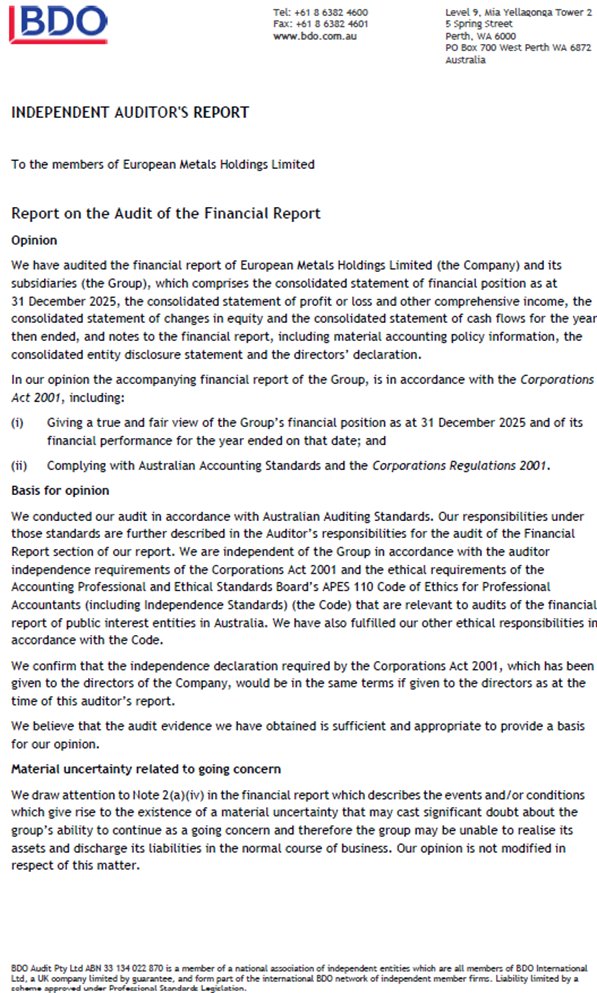
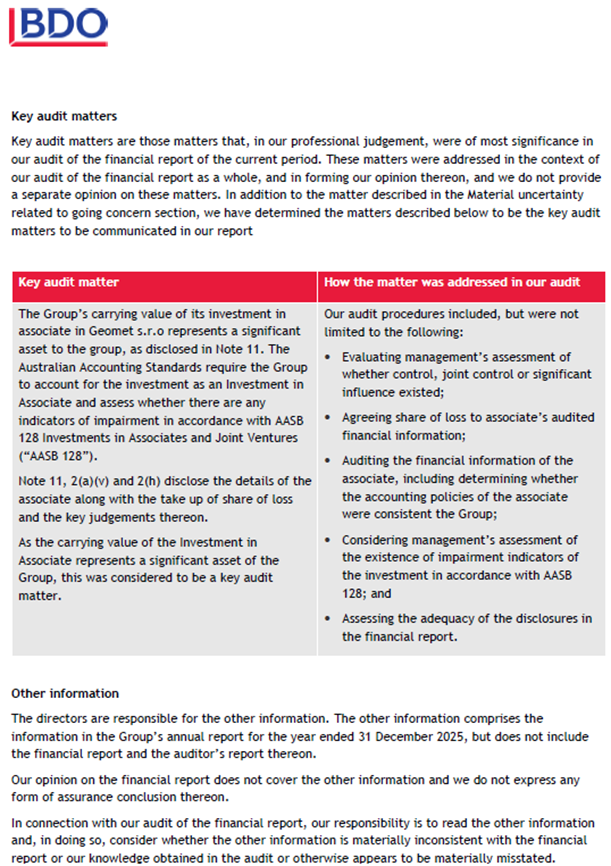
Related Shares:
European Metals Holdings